
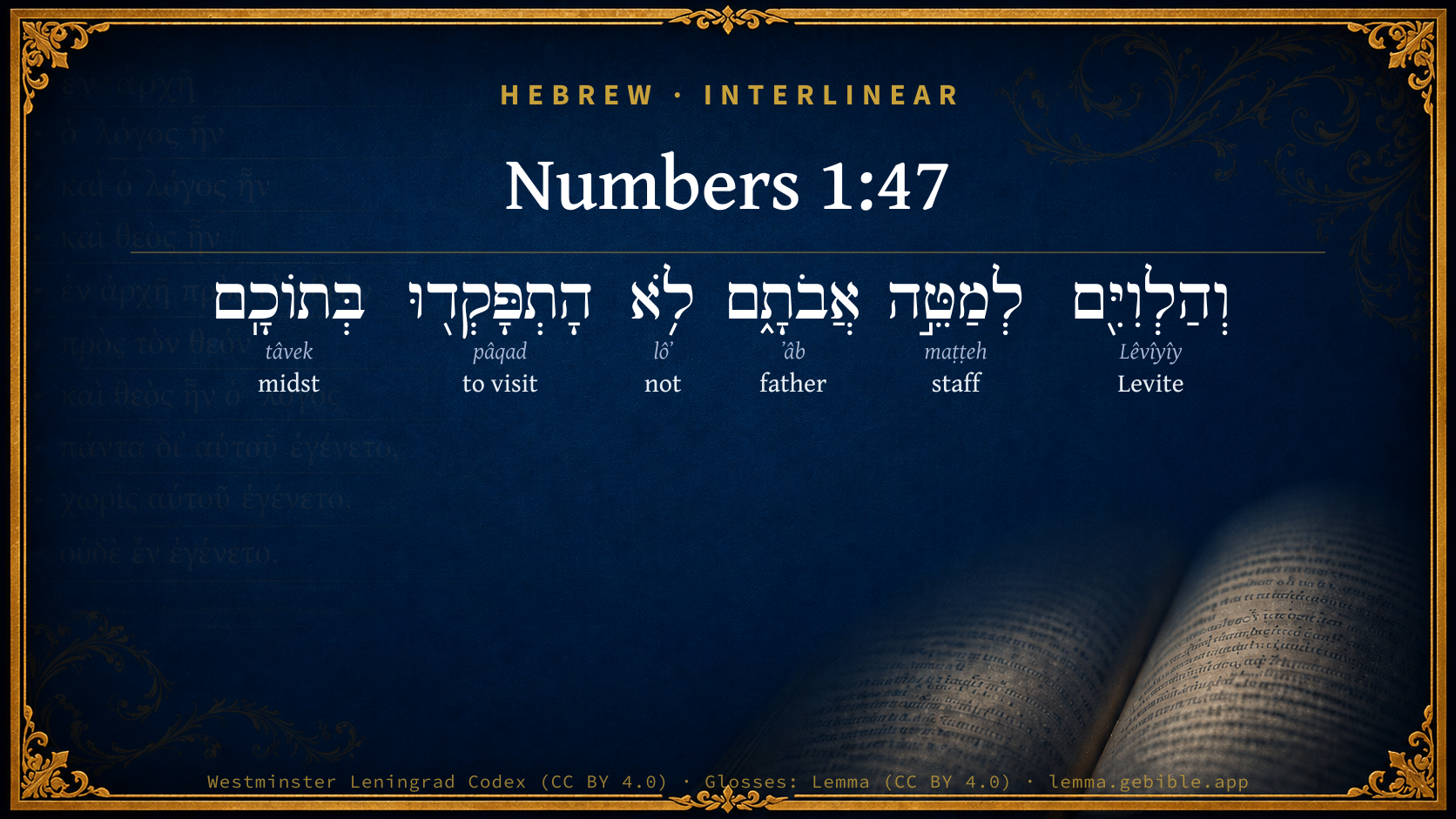
Numbers 1:47

Hebrew (Westminster Leningrad Codex) Numbers 1:47 appears in the Hebrew Old Testament. The text above is from the Westminster Leningrad Codex. Each word links to its Strong’s number, a concise gloss, and parsing drawn from the Open Scriptures Hebrew Bible morphology. Click any word for its full Brown-Driver-Briggs (BDB) entry.
Download image
Cite this verse

Numbers 1:47 (World English Bible). Public Domain. Lemma interlinear Bible study tool, https://lemma.gebible.app/v/numbers/1/47.

Show BibTeX & RIS
BibTeX
RIS
English Translation
But the Levites after the tribe of their fathers were not numbered among them.
World English Bible · Public Domain
Download a study sheet

One document with this verse’s original text, its word-by-word gloss line, the meaning frame, cross-references with their text, attributed commentary, and full source and license credits — printable, and it pastes into notes with its structure intact.

This verse Autodidact and up

Study sheet (.html) Plain text (.txt)

A passage Seminary Student

Up to 50 verses in one chapter. A passage sheet keeps up to 6 commentary sources and 12 cross-references per verse, in the order this page ranks them, and says so on the sheet whenever that leaves anything out. Ask for a single verse and you get the Autodidact verse sheet above.

Everything on this page stays free to read, with no account — the sheet is a download of what is already on screen, not access to it.

Want to remove ads? Support Godless Engineer
Compare translations 3

The same verse in 3 English versions, stacked beneath the original-language interlinear above. Click any original word for its lexicon entry.

Each is an independent rendering of the whole verse — the interlinear is not word-aligned to these translations.

Highlighted words mark where these versions differ — a whole-verse word diff, not a word-by-word alignment.

  • World English Bible Public Domain
    But the Levites after the tribe of their fathers were not numbered among them.
  • King James Version Public Domain
    But the Levites after the tribe of their fathers were not numbered among them.
  • unfoldingWord Literal Text CC BY-SA 4.0
    And the Levites according to the tribe of their fathers were not counted in the midst of them.

unfoldingWord Literal Text — © unfoldingWord, licensed CC BY-SA 4.0. Word-aligned USFM3 via Door43 (git.door43.org/unfoldingWord/en_ult).

Versions to compare (up to 4)

3 of 4 selected

Show all 18 translations

Every available English version of this verse, each an independent rendering of the whole verse.

  • World English Bible Public Domain
    But the Levites after the tribe of their fathers were not numbered among them.
  • Berean Standard Bible Public Domain
    The Levites, however, were not numbered along with them by the tribe of their fathers.
  • Majority Standard Bible Public Domain
    The Levites, however, were not numbered along with them by the tribe of their fathers.
  • King James Version Public Domain
    But the Levites after the tribe of their fathers were not numbered among them.
  • American Standard Version (1901) Public Domain
    But the Levites after the tribe of their fathers were not numbered among them.
  • Revised Version (1885) Public Domain
    But the Levites after the tribe of their fathers were not numbered among them.
  • Geneva Bible (1599) Public Domain
    But the Leuites, after the tribes of their fathers were not nombred among them.
  • Douay-Rheims (1899) Public Domain
    But the Levites in the tribes of their families were not numbered with them.
  • Young's Literal Translation Public Domain
    And the Levites, for the tribe of their fathers, have not numbered themselves in their midst,
  • Literal Standard Version CC BY-SA 4.0
    And the Levites, for the tribe of their fathers, have not numbered themselves in their midst,
  • Unlocked Literal Bible CC BY-SA 4.0
    But the men who were descended from Levi were not counted,
  • unfoldingWord Literal Text CC BY-SA 4.0
    And the Levites according to the tribe of their fathers were not counted in the midst of them.
  • Darby Bible Public Domain
    But the Levites after the tribe of their fathers were not numbered among them.
  • World Messianic Bible Public Domain
    But the Levites after the tribe of their fathers were not counted among them.
  • Webster's Bible Public Domain
    But the Levites, after the tribe of their fathers, were not numbered among them.
  • Free Bible Version CC BY-SA 4.0
    However, the Levites were not registered with the others according to their tribe and families.
  • Bible in Basic English Public Domain
    But the Levites, of the tribe of their fathers, were not numbered among them.
  • JPS Tanakh (1917) Public Domain
    But the Levites after the tribe of their fathers were not numbered among them.

Literal Standard Version (2020), Covenant Press — licensed CC BY-SA 4.0. Text via the HelloAO Bible API (eBible.org). Unlocked Literal Bible (unfoldingWord) — licensed CC BY-SA 4.0. Text via the HelloAO Bible API (eBible.org). unfoldingWord Literal Text — © unfoldingWord, licensed CC BY-SA 4.0. Word-aligned USFM3 via Door43 (git.door43.org/unfoldingWord/en_ult). Free Bible Version, Dr. Jonathan Gallagher — licensed CC BY-SA 4.0. Text via the HelloAO Bible API (eBible.org).

Word by word

More ways to search: Search by grammar → Find every occurrence → Compare this word →

Practice this passage: Drill this verse → Learn its vocabulary →

About this verse

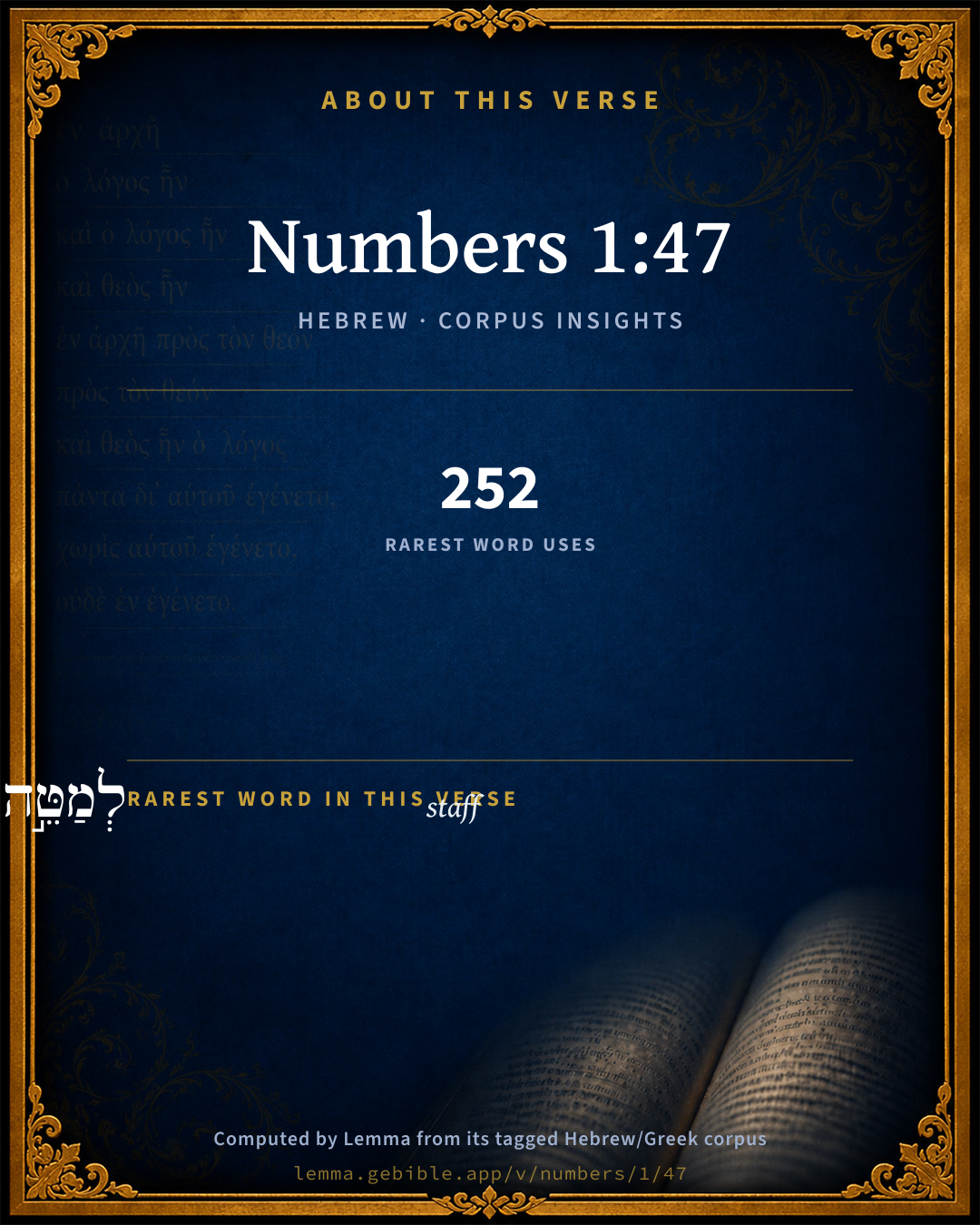
These counts appear in no published source. They are computed here, from the morphology-tagged text and Lemma’s own curated glosses. What Lemma adds →

6
words
6
distinct lemmas
Pentateuch
section

Grammatical profile

  • 1 verb
  • 4 nouns
  • 1 particle

Verb forms

  • הָתְפָּקְד֖וּ Hothpaal · Perfect

Hebrew & Septuagint length

In English translation the verse runs 14 words from the Hebrew and 17 from the Septuagint (LXX English) — closely comparable.

A rough comparison of the two English renderings, which tokenize alike — not a word-level alignment.

Word counts can differ between the Hebrew and the Greek without any difference in meaning — e.g. the Hebrew direct-object marker אֵת has no separate Greek word, and Greek often adds the article ὁ.

Cross-references

8

Topical passages linked to Numbers 1:47 in the Treasury of Scripture Knowledge — connected by theme and wording, ordered by reader-vote popularity; previews shown in the World English Bible.

  • Numbers 2:33 But the Levites were not numbered among the children of Israel; as Yahweh commanded Moses.
  • Numbers 3:1–4:49 Now this is the history of the generations of Aaron and Moses in the day that Yahweh spoke with Moses in Mount Sinai.
  • Numbers 26:57–62 These are those who were numbered of the Levites after their families: of Gershon, the family of the Gershonites; of Kohath, the family of the Kohathites; of Merari, the family of the Merarites.
  • 1 Chronicles 6:1–81 The sons of Levi: Gershon, Kohath, and Merari.
  • 1 Chronicles 21:6 But he didn't count Levi and Benjamin among them; for the king's word was abominable to Joab.
  • Numbers 1:3 from twenty years old and upward, all who are able to go out to war in Israel. You and Aaron shall number them by their divisions.
  • Numbers 1:50 but appoint the Levites over the Tabernacle of the Testimony, and over all its furnishings, and over all that belongs to it. They shall carry the tabernacle, and all its furnishings; and they shall take care of it, and shall encamp around it.
  • Numbers 8:1–26 Yahweh spoke to Moses, saying,

Cross-references courtesy of OpenBible.info (CC BY 4.0).

Hebrew and Greek witnesses Masoretic Hebrew ↔ Greek Septuagint

The same verse in the two great witnesses to the Old Testament, shown verse-for-verse.

These are two independent witnesses, not word-aligned to each other, and the Septuagint is shown in lemma (dictionary) form.

Hebrew Numbers 1:47 Masoretic · Westminster Leningrad Codex

וְהַלְוִיִּ֖ם לְמַטֵּ֣ה אֲבֹתָ֑ם לֹ֥א הָתְפָּקְד֖וּ בְּתוֹכָֽם

But the Levites after the tribe of their fathers were not numbered among them.

World English Bible · Public Domain

Greek LXX Numbers 1:47 Septuagint · lemma form

ὁ δέ λευίτης ἐκ ὁ φυλή πατριά αὐτός οὐ ἐπισκέπτω ἐν ὁ υἱός ἰσραήλ

But the Levites of the tribe of their family were not counted among the children of Israel.

LXX2012 (modern English Septuagint) · Public Domain

Hebrew: Westminster Leningrad Codex (CC BY 4.0). Greek: Septuagint (public domain); English from LXX2012 (modern English Septuagint) (Public Domain). How the Septuagint differs from the Hebrew →

Targum (Aramaic paraphrase)

2

The Targum is the ancient Jewish Aramaic paraphrase of the Hebrew Scriptures — an interpretive translation, not the Hebrew text itself. Onkelos (literal) and Pseudo-Jonathan (expansive) render the Torah, and Jonathan the Prophets. Coverage is partial: where no permissively-licensed English translation exists for a verse, only the Aramaic is shown. This is verse-level text, not a word-by-word alignment to the Hebrew.

  1. Targum Onkelos Torah (Genesis–Deuteronomy)
    וְלֵוָאֵי לְשִׁבְטָא דַאֲבָהַתְהוֹן לָא אִתְמְנִיאוּ בֵּינֵיהוֹן

    (no public-domain English translation for this verse)

    Targum Onkelos — Aramaic: “Onkelos Genesis” (public domain); “Onkelos Exodus” (public domain); “Onkelos Leviticus” (public domain); “Onkelos Numbers” (public domain); “Onkelos Deuteronomy” (public domain). English: “Sefaria Community Translation” (CC0 1.0 (public-domain dedication)); “J.W. Etheridge. The Targums of Onkelos and Jonathan Ben Uzziel on the Pentateuch. London: Longmans, Green, 1862” (public domain). Text via Sefaria.

  2. Targum Pseudo-Jonathan Torah (Genesis–Deuteronomy)
    וְלֵיוָאֵי לְשִׁבְטָא דַאֲבָהַתְהוֹן לָא אִתְמְנִיאוּ בֵּינֵיהוֹן

    But the Levites after their father's tribe were not numbered among them.

    Targum Pseudo-Jonathan — Aramaic: “Targum Jonathan on Genesis” (public domain); “Targum Jonathan on Exodus” (public domain); “Targum Jonathan on Leviticus” (public domain); “Targum Jonathan on Numbers” (public domain); “Targum Jonathan on Deuteronomy” (public domain). English: “The Targum of Jonathan ben Uzziel, trans. J. W. Etheridge, London, 1862” (public domain). Text via Sefaria.

Commentary

Notes on Numbers 1:47 from classic Christian and Jewish commentators (each source and its license shown beneath its notes). The classic Christian expositions comment on the surrounding passage and are grouped to its opening verse, so a note may address several verses; the Jewish commentaries on the Tanakh (Rashi and others) are per-verse, so they appear only where the commentator wrote on this verse.

Lemma curates 59 commentaries, every one of them public domain or Creative Commons licensed, each selected and text-cleaned for this edition rather than reprinted as found. About our sources →

Trapp's Complete Commentary

John Trapp

Num 1:47 But the Levites after the tribe of their fathers were not numbered among them.

Ver. 47. Were not numbered.] Because, by special privilege exempted from secular and military employments, that they may wholly devote themselves to the service of the sanctuary. Peter, in like sort, must put up his sword; and Timothy "not entangle himself with the affairs of this life, that he may please Him who hath chosen him to be a soldier" of another nature. {2Ti 2:4} But Timotheus Herulus, that warlike bishop of Alexandria, A.D. 467, was a gallant fellow in his generation. And some of Peter’s pretended successors were viri biliosi et bellicosi; cast the keys into Tiber, and took up St Paul’s sword, {a} and the imperial clothes. So have various of their dear sons done; as Philip, bishop of Beauvieu, in France, who, being taken in battle by our Richard I, in a skirmish, had his armour he was taken in sent to the Pope, with these words engraven thereon, Vide utrum filii tui tunica sit, vel non, See whether this be thy son’s coat or not.

{a} Theophilus Alexandriae Episcopus, primus inter Christiani nominis episcopos, arma tractavit. - Socrat.

John Trapp, A Commentary or Exposition upon All the Books of the Old and New Testament (1647–1656) — public domain. Text from a community e-Sword module.

The Biblical Illustrator

Joseph S. Exell

Num_1:47-54

The Levites . . . were not numbered.

The Levites and their service an illustration of the Christian ministry

The Levites were exempted from military service, and set apart for the service of the tabernacle. In any wise arrangement of the affairs of human society provision will be made for the requirements of the spiritual nature of man.

I. The true christian minister should manifest some fitness for the work before he is designated thereto. In determining the trade which their sons shall learn, wise parents will consider their respective inclinations and aptitudes. An artist would perhaps make a poor minister; a successful merchant might utterly fail as a barrister. Is there less aptitude required in the work of the gospel ministry than in the other pursuits of life? Adaptation of voice, of mind, of character, &c.

II. The true christian minister is called of God to his work.

III. The work of the christian minister demands his entire devotion thereto.

IV. A faithful discharge of the duties of the christian minister is essential to the well-being of society.

V. Personal holiness of heart and life are essential to the faithful discharge of the duties of the christian ministry. Levites separated from other tribes for sacred work. Their outward separation intended to show separation from worldliness and sin. They who have to do with holy things should themselves be holy. (W. Jones.)

The Levites not numbered:

We shall see them afterward numbered by themselves, but they were not put in the common reckoning, because God had chosen them to be His possession, and separated them from the rest of the people. And lest any man should think that Moses did ambitiously prefer the tribe of Levi, whereof himself descended, he showeth he did it not of his own head, but by the special commandment of God. Their office is declared--to take the charge of the Tabernacle and worship of God, that when they were to take their journey they should carry it, and when they were to stay and pitch their tents they should set it down and look to it with all diligence. And as God would not have them encumbered in affairs unproper to them and impertinent to their calling, so He would not have others that were not of their tribe and family to break into their function, as it were to invade another mans possession; nay, He denounceth death to such as were strangers from that tribe that should presume to meddle with those holy things, or set their hands unto them. An example hereof we have in Uzzah (2Sa_6:1-23.).. We learn from hence that it is the duty of the ministers of Gods Word to exercise themselves only in things of their calling; they must wait upon the office to which they are appointed. They are not to be distracted from their calling by worldly matters that no way belong unto them (Num_3:6-7). And doubtless it is great reason that they should content themselves with their own callings, that so they may please Him that hath called them, and forego all that may disturb them in the course whereunto they ought to tend. We must be like soldiers that are called to bear arms. The reason and comparison is pressed by the apostle to this purpose (2Ti_2:3-4). Secondly, the multitude is great, and the difficulty much of those things which are required of the minister, belonging rightly and duly to his calling, in regard whereof we may say (2Co_2:16). Were that a wise servant, who having both his hands fall, and more than he can well do, should, besides his masters work, undertake a new and another burden of some other mans business, which of right doth not belong unto him? (W. Attersoll.)

.

The Biblical Illustrator, edited by Joseph S. Exell (c. 1880s–1900s) — public domain. Text from a community e-Sword module.

Whedon's Commentary on the Bible

Daniel D. Whedon

LEVITES EXEMPTED FROM THE CENSUS, AND ASSIGNED TO THE TABERNACLE SERVICE, Num_1:47-53.

47. Levites… not numbered — As the Levites were wholly devoted to sacred duties in the place of the firstborn, they were exempted from the payment of the half-shekel atonement poll-tax, as well as from military service. Hence they were not enumerated in either the former or the present census. A special census of Levites will be found in Num_3:15.

Daniel D. Whedon (gen. ed.), Commentary on the Old and New Testaments (1874–1909) — public domain. Text from a community e-Sword module.

Tyndale Open Study Notes

Tyndale Open Resources

1:47-54 The tribe of Levi did not serve in Israel’s army with the other tribes. This section of Numbers describes the organization of Levites for service in the Tabernacle, which was their primary responsibility.

Tyndale Open Study Notes — © Tyndale Open Resources, licensed CC BY-SA 4.0. Text via the HelloAO Bible API.

Geneva Bible (1599)

Geneva Bible translators

Which were warriors, but were appointed to the use of the Tabernacle.

Geneva Bible (1599) marginal notes — public domain. Text via Bolls.life.

Matthew Henry's Commentary

Care is here taken to distinguish from the rest of the tribes the tribe of Levi, which, in the matter of the golden calf, had distinguished itself, Exo 32:26. Note, Singular services shall be recompensed with singular honours. Now,

I. It was the honour of the Levites that they were made guardians of the spiritualities; to them was committed the care of the tabernacle and the treasures thereof, both in their camps and in their marches. 1. When they moved the Levites were to take down the tabernacle, to carry it and all that belonged to it, and then to set it up again in the place appointed, Num 1:50, Num 1:51. It was for the honour of the holy things that none should be permitted to see them, or touch them, but those only who were called of God to the service. Thus we all are unfit and unworthy to have fellowship with God until we are first called by his grace into the fellowship of his Son Jesus Christ our Lord, and so, being the spiritual seed of that great high priest, are made priests to our God; and it is promised that God would take Levites to himself, even from the Gentiles, Isa 66:21. 2. When they rested the Levites were to encamp round about the tabernacle (Num 1:50, Num 1:53), that they might be near their work, and resident upon their charge, always ready to attend, and that they might be a guard upon the tabernacle, to preserve it from being either plundered or profaned. They must pitch round about the tabernacle, that there be no wrath upon the congregation, as there would be if the tabernacle and the charge of it were neglected, or those crowded upon it that were not allowed to come near. Note, Great care must be taken to prevent sin, because the preventing of sin is the preventing of wrath.

II. It was their further honour that as Israel, being a holy people, was not reckoned among the nations, so they, being a holy tribe, were not reckoned among other Israelites, but numbered afterwards by themselves, Num 1:49. The service which the Levites were to do about the sanctuary is called (as we render it in the margin) a warfare, Num 4:23. And, being engaged in that warfare, they were discharged from military services, and therefore not numbered with those that were to go out to war. Note, Those that minister about holy things should neither entangle themselves, nor be entangled, in secular affairs. The ministry is itself work enough for a whole man, and all little enough to be employed in it. It is an admonition to ministers to distinguish themselves by their exemplary conversation from common Israelites, not affecting to seem greater, but aiming to be really better, every way better than others.

Matthew Henry's Commentary on the Whole Bible (1708–1710) — public domain (CC PDM 1.0). Text via the HelloAO Bible API.

Jamieson, Fausset & Brown

Robert Jamieson, A. R. Fausset & David Brown

But the Levites . . . were not numbered among them--They were obliged to keep a register of their own. They were consecrated to the priestly office, which in all countries has been exempted customarily, and in Israel by the express authority of God, from military service. The custody of the things devoted to the divine service was assigned to them so exclusively, that "no stranger"--that is, no person, not even an Israelite of any other tribe, was allowed, under penalty of death, to approach these [Num 16:40]. Hence they encamped round the tabernacle in order that there should be no manifestation of the divine displeasure among the people. Thus the numbering of the people was subservient to the separation of the Levites from those Israelites who were fit for military service, and to the practical introduction of the law respecting the first-born, for whom the tribe of Levi became a substitute [Exo 13:2; Num 3:12].

Next: Numbers Chapter 2

Jamieson, Fausset & Brown — Commentary Critical and Explanatory on the Whole Bible (1871) — public domain (CC PDM 1.0). Text via the HelloAO Bible API.

The Cambridge Bible for Schools and Colleges

gen. ed. J. J. S. Perowne

47–54. The Levites were not to be numbered as fighting men, but were assigned other duties on the march. These duties are stated more fully in chs. 3, 4.

The Cambridge Bible for Schools and Colleges (gen. ed. J. J. S. Perowne; Cambridge University Press, 1878–1918) — public domain. Text from a community e-Sword module.

Albert Barnes' Notes on the Bible

When a census of the tribe of Levi takes place. Num 3:15; Num 26:62, “all” the males are counted from a month old and upward, and not, as in the other tribes, those only who were of age for service in the field.

Num 1:48

had spoken - Render spake. The formal appointment is only now made, in reward for their zeal Exo 32:26-29, though reference to their future office appears previously in Lev 25:32 ff, and they had already acted as assistants to the priests (compare Exo 38:21).

Albert Barnes' Notes on the Bible (1834–1885) — public domain. Text from a community e-Sword/MySword module.

Haydock's Catholic Bible Commentary

Levites. As they attended the tabernacle, like God’s peculiar servants, and were not obliged to go forth to battle, it was not necessary to number them with the rest. (Calmet) --- They might, however, fight if they thought proper, as the Machabees did. See Josephus, Antiquities iii. 11., and iv. 4. (Tirinus)

George Leo Haydock (1774–1849), Haydock's Catholic Family Bible and Commentary, 1859 edition — public domain. Excludes Psalms (Douay-Rheims chapter numbering differs from Protestant) and Deuterocanonical books (Catholic canon only).

The Pulpit Commentary

THE LEVITES (verses Num_3:39) but not among the rest; their census was taken separately, and on a different basis.

Vers. 47-54. The servants of God.

We have here, spiritually, the multitude of those who are specially devoted to the service and ministry of God, whoever they may be, and whatever their labour for the body of Christ: that these have their own duties and charges, and therewith their own immunities and liberties. Or we may take it rather of all the people of God, so far as they rise to the higher religious life, dying unto the world, and living unto Christ. Consider, therefore

I THAT THE LEVITES WERE NOT NUMBERED WITH THE REST, FOR THE ORDINARY PURPOSES OF THE LIFE IN THE WILDERNESS. Those that are devoted to the service of God, or addicted to the ministry of the saints, are to be mixed up as little as possible in the entanglements of business, of politics, of society, and of all the transitory things which make up the life of the world.

II That they were NOT NUMBERED among the other tribes, not in order that they might be idle, or have less to do, but THAT THEY MIGHT THE BETTER DO THEIR OWN WORK which the Lord assigned them. Even so, no one is marked off, or set apart, that he may live on others, or look down on others, or enjoy more ease or more consideration than others; but only that he may be the more free to do the work which the Lord hath appointed him.

III THAT THE SUM OF THEIR LABOUR AND CHARGE WAS TO ATTEND UPON THE TABERNACLE to be in waiting upon the Divine presence in the midst of Israel. So they who would give themselves to the work of Christ must set this before them as the great object of it all: that he be glorified, and his spiritual presence be cherished in the midst of his people. As in one sense, the true way to serve God is to serve his people, so in another the true way to serve the people is to help them to serve God. Nor is their work of least real value, who, having none opportunity of benefiting their fellows directly, do yet assist by their practice and example to keep alive reverence and devotion amidst a careless world.

IV THAT THE ENCAMPING OF THE LEVITES WAS TO BE CLOSE ROUND ABOUT THE TABERNACLE. So those that are especially called to the service of God must have their dwelling very near him: they can only do more for him, on condition of living nearer to him. It is their one real privilege if they know it that, having their duties about holy things, and being free from many distractions common to others, they have opportunity of keeping closer to the holy one.

V THAT NO "STRANGER" MIGHT COME NIGH UNTO THE TABERNACLE ON PAIN OF DEATH. So can no profane person intrude upon Divine things except at deadly spiritual peril. That nearness to God which is life to the humble and meek is death to the presumptuous soul; that familiarity with holy things which is a source of growth in grace to the holy is hardening and destruction to the unholy. No "stranger" to the atoning love can venture upon the presence of the All-holy and live: every one that knows not God, and has not his love abiding in him, is a "stranger" in this sense.

VI THAT VERY MUCH OF THE LEVITES" WORK WAS LABORIOUS, TIRESOME, OR TRIVIAL, YET IT WAS ALL UNDER THE SAME AWFUL SANCTIONS, and invested with the same holy character. So, if any will be really devoted to the work of Christ, he must do that which falls to his lot, however humble outwardly, or apparently unspiritual; for the work is all one, and all of one, if only it be done for that one.

HOMILIES BY W. BINNIE Vers. 47-54. The appointment of the Levites to be the sacred tribe.

This is the first of a series of passages in which the law regarding the Levites is delivered. These all occur in Numbers, excepting a very few which are found in Deuteronomy; and they must be read together if you would get a connected and complete view of the statutes relating to the sacred tribe. Read together, the several texts will be found to dovetail one into another. The first is quite general, merely intimating that the Levites were to be numbered and marshaled as a host by themselves, being wholly dedicated to the service of the sanctuary. The second, entitled "The generations" of the Levites, their Family Book, gives particulars regarding their divisions and several offices (chapters 3, 4). The third describes how they were set apart to office by a solemn purification. (Num_8:5) Subsequent passages contain (fourthly) the tragic story of Korah and his company (chapter 16), and (fifthly) the provision made for the Levites" honourable maintenance (chapters 18, 35). One who reads this series of passages with care will make a discovery of some value regarding the structure of these books of the Pentateuch. Because the several laws relating to one subject are not set down in one place, as they would be in our books, and are not arranged according to our ideas of order, it is confidently affirmed that they are set down without any order, and indeed that the Mosaic law is a somewhat random collection of documents diverse in date and character. This is certainly an error. The beautiful order discoverable in the ordinances regarding the Levites will be found to prevail in the ordinances scattered as they may seem on many other subjects.

I This, being the earliest notice of the Levites as a separate and sacred tribe, invites us to review THE STORY OF THEIR CALLING. The first step was taken when the Lord, ordaining in Israel a hereditary priesthood, nominated "Aaron the Levite" and his sons. Still, though Aaron the Levite was called, nothing was said regarding the rest of the tribe. But it was plain that one man and his two sons (the whole number of the Aaronites after the death of Nadab and Abihu) could not execute the priests" office for a great nation. Helpers they must have. Who more fit than their brethren of their own tribe? They were much the smallest of the tribes, so that their maintenance would not be too burdensome; and they had already distinguished themselves by their zeal for the Lord to such a degree as amounted to a virtual consecration to his service. (see Exo_32:29) Accordingly, when the order was given to number and marshal the congregation, an exception was made in relation to the Levites. They were numbered by themselves, as a separated and sacred tribe. Recall the fact just noticed, that the Levites were fitted for their office before they were called to it. Their fitness was made manifest before a word was spoken regarding the honourable office in which it was to be exercised. The whole history of the Church is full of similar facts. When some great exigency arises calling for the services of men possessing special qualities of character or attainment, it is generally found that the Head of the Church has anticipated the occasion by raising up the men required. See for an illustrious example, Gal_1:15, Gal_1:16.

II THE WORK APPOINTED TO THE LEVITES. It was "to keep the charge of the tabernacle" (verse 53). They carried it; guarded it; did all the work of it except offering sacrifice, burning incense, and blessing the people. In a word, they, under the hand and oversight of the priests, attended to the "outward business of the house of God". (Neh_11:16) One cannot read this account of the Levites" work without being touched with a sense of the superiority of the Christian Church and its services over the tabernacle and the Levitical ministrations. To thoughtful and spiritually-minded men the Levitical ministrations must have been an intolerable burden. Barnabas the Levite would, without doubt, say Amen when he heard Peter"s description of them as "a yoke which neither we nor our fathers were able to bear". (Act_15:10) It is right to remember that, as time passed, the yoke was much mitigated. If the Pentateuch gives no express commandment to the Levites except about the external business of the tabernacle, that simply confirms the antiquity of the Pentateuch. By King David they were invited to higher service as singers and even as psalmists. Jehoshaphat employed them largely as public teachers of the law throughout the cities of Judah. (2Ch_17:8, 2Ch_17:9) Moreover, the Levitical services as prescribed by Moses, although burdensome and unprofitable when compared with those of the New Testament Church, had a great purpose to serve both in prefiguring the truth to be afterwards revealed, and as an educational institute by which the people of God were prepared for the better time. It is a good thing to have a charge to keep in connection with Christ"s Church, in any capacity, however humble. Better be a Levite to keep the door of the house of God than live without God in a palace. B.

The Pulpit Commentary (1880–1919), ed. H.D.M. Spence-Jones & Joseph S. Exell — public domain. Text from a community e-Sword module.

Kretzmann's Popular Commentary

Paul E. Kretzmann

The Levites Set Aside for God’s Service.

v. 47. But the Levites after the tribe of their fathers were not numbered among them, they were not included in this census.

v. 48. For the Lord had spoken unto Moses, saying,

v. 49. Only thou shalt not number the tribe of Levi, they were not to be mustered and organized for war, neither take the sum of them among the children of Israel;

v. 50. but thou shalt appoint the Levites over the Tabernacle of Testimony, and over all the vessels thereof, and over all things that belong to it; they were to have all these things in their charge and be responsible for their safe-keeping; they shall bear the Tabernacle and all the vessels thereof, carry them from one encampment to the next; and they shall minister unto it, and shall encamp round about the Tabernacle, in carrying out the charge entrusted to them.

v. 51. And when the Tabernacle setteth forward, the Levites shall take it down, for it was constructed with this object in mind; and when the Tabernacle is to be pitched, the Levites shall set it up; and the stranger that cometh nigh, he who does not belong to the tribe of Levi, shall be put to death.

v. 52. And the children of Israel shall pitch their tents, every man by his own camp, in that section of the encampment assigned to his tribe, and every man by his own standard, the flag, or banner, which showed the location of his tribe, throughout their hosts.

v. 53. But the Levites shall pitch round about the Tabernacle of Testimony, that there be no wrath upon the congregation of the children of Israel; for the anger of the Lord would surely strike every unauthorized person that dared to transgress the Lord’s commandment in coming near to the Tabernacle; and the Levites shall keep the charge of the Tabernacle of Testimony.

v. 54. And the children of Israel did according to all that the Lord commanded Moses; so did they. Note that it appears throughout: God is a God of order, 1Co 14:40, and it pleases Him if the matters pertaining to His service are carried out according to a well-arranged plan.

Paul E. Kretzmann, Popular Commentary of the Bible (1921–1924) — public domain. Text from a community e-Sword module.

unfoldingWord translationNotes

Door43 World Missions Community

the men who were descended from Levi were not counted

This can be stated in active form. AT: "Moses and Aaron did not count the men who were descended from Levi" (See: Active or Passive)

who were descended from Levi

In some languages this is a passive verb. If needed, this can be written differently. AT: "who were from the tribe of Levi" (See: Active or Passive)

must not count the tribe of Levi

Here the "tribe of Levi" refers to all of the men in the tribe of Levi. AT: "must not count the men of the tribe of Levi" (See: Synecdoche)

translationWords

Levi

Yahweh

tribe

unfoldingWord translationNotes — © Distant Shores Media and the Door43 World Missions Community, licensed CC BY-SA 4.0. Source: git.door43.org/Door43/en_tn.

Ramban (Nachmanides)

Rabbi Moshe ben Nachman (Ramban / Nachmanides)

BUT THE LEVITES AFTER THE TRIBE OF THEIR FATHERS WERE NOT NUMBERED AMONG THEM. Moses had understood at the beginning of his own accord that he should not count the Levites [with the other tribes], because he had been told, And with you there shall be a man of every tribe etc., Verse 4. meaning that each of the tribes that were to be counted should have their prince present, and since G-d had not appointed a prince for the tribe of Levi, hence he [Moses] did not count them. Therefore he was in doubt about the Levites and did not know what to do with them. And when he had finished all those who were counted of the people, and the Levites remained alone [uncounted], the Holy One, blessed be He, explained to him that he was not to count them among the children of Israel but that he should take their sum separately, for he was to appoint them over the Tabernacle of the Testimony. He stated ‘p’kod’ [‘number’ — in the singular] the children of Levi, 3:15. meaning that he [Moses] was to count them by himself without [the assistance of] the princes, and it was he [Moses] who called upon Aaron to be with him, Verse 39: All that were numbered of the Levites, whom Moses and Aaron numbered etc. Thus it is clear that Aaron also participated in the counting of the Levites. Since his name was not mentioned when Moses was commanded to take that census, Ramban suggests that he joined at Moses’ invitation, see further in text of Ramban that Moses’ action was alluded to in the words of G-d. See Note 93. since he [Aaron] was the prince of that tribe, and just as the princes of Israel were [present] at [the counting of] their tribes, so was the prince of the Levites to be present when they were counted. Perhaps that is the reason for the dots [in the Torah] on the word ‘v’Aharon’ [and Aaron, in the phrase: All that were numbered of the Levites, whom Moses ‘and Aaron’ numbered], Verse 39: All that were numbered of the Levites, whom Moses and Aaron numbered etc. Thus it is clear that Aaron also participated in the counting of the Levites. Since his name was not mentioned when Moses was commanded to take that census, Ramban suggests that he joined at Moses’ invitation, see further in text of Ramban that Moses’ action was alluded to in the words of G-d. See Note 93. since his [assistance in the counting] was not by the express commandment of G-d. Afterwards, [however], when the Levites were appointed to their individual services and burdens, Moses called upon the princes of the congregation to be with him, as it is said, All those that were numbered of the Levites, whom Moses and Aaron and the princes of Israel numbered, since it was fitting that they should all give their assent to and supervise the establishment of the mishmaroth. [literally: a guard] is a Division of priests and Levites for duty in the Sanctuary. According to tradition, Moses divided the priests into eight Divisions, four from the families of Eleazar and four from Ithamar, and later on when the Sanctuary was built in Jerusalem, David and Samuel sub-divided them into twenty-four Divisions. Each Division served for a period of one week, and during the three Festivals all the Divisions were in attendance simultaneously (see “The Commandments” Vol. I, pp. 46-47). See also Ramban further, Verse 53, and at Note 96, for additional aspects of this term as used by Ramban. — It should be noted that the concept of mishmaroth applied also to the Levites and Israelites, for just as the priests were divided into twenty-four Divisions, so also were the other two groups. Each week a new mishmar of priests, Levites, and Israelites would arrive in Jerusalem to attend to the Divine Services in the Sanctuary. The Israelites’ function was to “stand by” the daily offerings brought for the whole congregation of Israel, for “how can a man’s offering be offered while he does not stand by it?” (Taanith 26a). Such a group of Israelites is referred to as a ma’amad (literally: “stand by”). In the text of Ramban before us, however, reference is only to the Divisions of the priests and Levites. And Scripture repeats in another place, These are they that were numbered of the families of the Kohathites … whom Moses and Aaron numbered ‘according to the commandment of the Eternal’ by the hand of Moses command, there had been a hint, and Moses therefore, in asking Aaron to be present, was indeed acting according to the command of the Eternal. Because He had already hinted through the dots [on the word v’Aharon, Verse 39: All that were numbered of the Levites, whom Moses and Aaron numbered etc. Thus it is clear that Aaron also participated in the counting of the Levites. Since his name was not mentioned when Moses was commanded to take that census, Ramban suggests that he joined at Moses’ invitation, see further in text of Ramban that Moses’ action was alluded to in the words of G-d. See Note 93.] that Aaron had to be there, from which Moses understood that he was to do so, [hence it says according to the commandment of the Eternal]. command, there had been a hint, and Moses therefore, in asking Aaron to be present, was indeed acting according to the command of the Eternal. But the [presence of the] princes of the congregation [at the numbering of the Levites] was not obligatory, and Moses called them in order to show them respect, [therefore Scripture does not state that their presence was “according to the commandment of the Eternal”]. In Tractate Bechoroth the Rabbis have said that the dots on the word Aharon, Verse 39: All that were numbered of the Levites, whom Moses and Aaron numbered etc. Thus it is clear that Aaron also participated in the counting of the Levites. Since his name was not mentioned when Moses was commanded to take that census, Ramban suggests that he joined at Moses’ invitation, see further in text of Ramban that Moses’ action was alluded to in the words of G-d. See Note 93. are to hint that Aaron himself was not counted at all in the census of the Levites. indicate that “he was not in the census of the Levites,” which can be interpreted as saying that he did not participate in counting the people, and only Moses did it. Mizrachi in fact interprets Rashi in this way, since the verse [whom Moses and Aaron counted] refers to those who did the actual counting of the Levites, thus the dots on the word “Aaron” indicate that he did not participate in the counting — but he himself may well have been counted. Ramban’s language, however, clearly means that “Aaron himself was not counted at all in the census of the Levites.” This explains why Ramban does not quote this explanation of the Gemara in the name of Rashi, as he is wont to do, since his interpretation of the text of Bechoroth 4a is different than Rashi’s.

Ramban (Nachmanides) on the Tanakh — English translation: “Commentary on the Torah by Ramban (Nachmanides). Translated and annotated by Charles B. Chavel. New York, Shilo Pub. House, 1971-1976” (CC BY 4.0). Text via Sefaria.

Sforno

Rabbi Ovadia Sforno

Were not counted. They were not counted by those who did the counting and did not count themselves, as they did not prepare themselves like the rest of the nation by assembling according to lineage. This happened before Hashem told Moshe (v. 48), “However, the tribe of Levi you shall not count,” for indeed, they waited to see what Hashem would command them, since the tribe of Levi was not mentioned with the rest of the tribes, as it says (v. 4), “There shall be one man for each tribe, etc.”

Sforno on the Tanakh — English translation: “Yalkut, Sifsei Chachomim Chumash, Metsudah Publications, 2009” (CC BY 4.0). Text via Sefaria.

Lesson kit

Teaching starters — assembled from the data on this page, not authored interpretation. Every prompt links to the verse data it draws on. Edit before teaching.

Numbers, in the Pentateuch, opens this verse with 6 words (6 distinct Hebrew lemmas). Its most distinctive word is maṭṭeh (“staff”). A historical commentator’s framing appears above. Read the whole chapter for the surrounding context.

Discussion questions

  1. What does “staff” (maṭṭeh) contribute to the verse as a whole?
  2. Numbers 2:33 shares this passage’s theme. How do the two illuminate each other?
  3. These translations render this verse differently; the difference is in the English rendering, not the original. What questions does that raise?
  4. The verb «הָתְפָּקְד֖וּ» is Hothpaal Perfect. How does its form color the action?
  5. Reading how Trapp's Complete Commentary and The Biblical Illustrator read this verse, where do the two commentators agree and where do they part?

Things to notice

Reading settings

Reading text

Shown beneath each verse's original-language words.

Old Testament
Old Testament edition

Read the OT as the Masoretic Hebrew (MT) or the Greek Septuagint (LXX).

English shown for the Greek Septuagint (in the Hebrew ↔ Greek comparison).

Comparing translations? Open the Compare panel on any verse page to stack up to four side by side.