2 Samuel 7:2

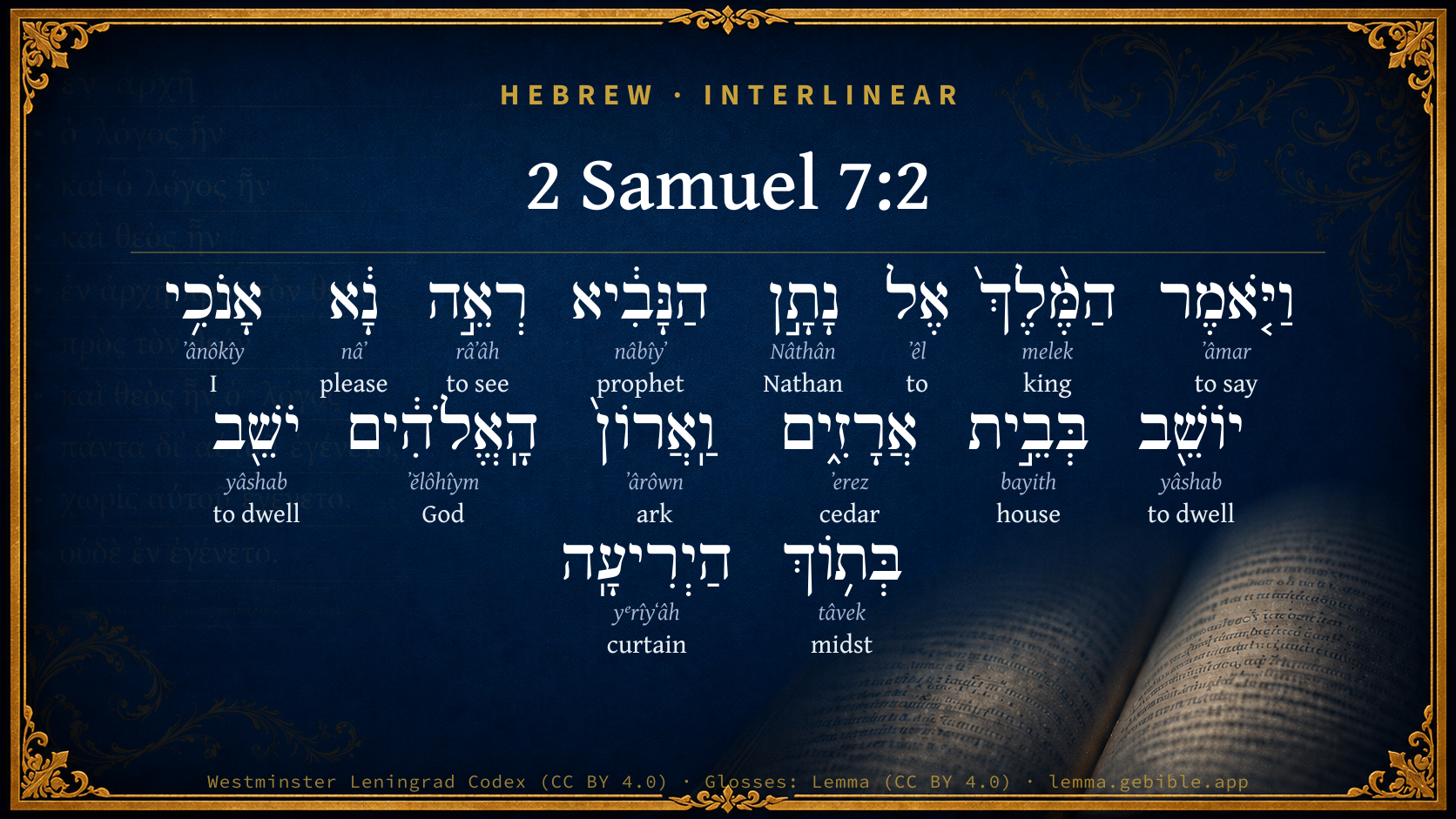
Hebrew (Westminster Leningrad Codex) 2 Samuel 7:2 appears in the Hebrew Old Testament. The text above is from the Westminster Leningrad Codex. Each word links to its Strong’s number, a concise gloss, and parsing drawn from the Open Scriptures Hebrew Bible morphology. Click any word for its full Brown-Driver-Briggs (BDB) entry.
Download image
Cite this verse

2 Samuel 7:2 (World English Bible). Public Domain. Lemma interlinear Bible study tool, https://lemma.gebible.app/v/2-samuel/7/2.

Show BibTeX & RIS
BibTeX
RIS
English Translation
that the king said to Nathan the prophet, See now, I dwell in a house of cedar, but the ark of God dwells within curtains.
World English Bible · Public Domain
Download a study sheet

One document with this verse’s original text, its word-by-word gloss line, the meaning frame, cross-references with their text, attributed commentary, and full source and license credits — printable, and it pastes into notes with its structure intact.

This verse Autodidact and up

Study sheet (.html) Plain text (.txt)

A passage Seminary Student

Up to 50 verses in one chapter. A passage sheet keeps up to 6 commentary sources and 12 cross-references per verse, in the order this page ranks them, and says so on the sheet whenever that leaves anything out. Ask for a single verse and you get the Autodidact verse sheet above.

Everything on this page stays free to read, with no account — the sheet is a download of what is already on screen, not access to it.

Want to remove ads? Support Godless Engineer
Compare translations 3

The same verse in 3 English versions, stacked beneath the original-language interlinear above. Click any original word for its lexicon entry.

Each is an independent rendering of the whole verse — the interlinear is not word-aligned to these translations.

Highlighted words mark where these versions differ — a whole-verse word diff, not a word-by-word alignment.

  • World English Bible Public Domain
    that the king said to Nathan the prophet, See now, I dwell in a house of cedar, but the ark of God dwells within curtains.
  • King James Version Public Domain
    That the king said unto Nathan the prophet, See now, I dwell in an house of cedar, but the ark of God dwelleth within curtains.
  • unfoldingWord Literal Text CC BY-SA 4.0
    that the king said to Nathan the prophet, “See, please, I am dwelling in a house of cedars, but the Box of God is dwelling in the midst of a curtain.”

unfoldingWord Literal Text — © unfoldingWord, licensed CC BY-SA 4.0. Word-aligned USFM3 via Door43 (git.door43.org/unfoldingWord/en_ult).

Versions to compare (up to 4)

3 of 4 selected

Show all 18 translations

Every available English version of this verse, each an independent rendering of the whole verse.

  • World English Bible Public Domain
    that the king said to Nathan the prophet, See now, I dwell in a house of cedar, but the ark of God dwells within curtains.
  • Berean Standard Bible Public Domain
    he said to Nathan the prophet, “Here I am, living in a house of cedar, while the ark of God remains in a tent.”
  • Majority Standard Bible Public Domain
    he said to Nathan the prophet, “Here I am, living in a house of cedar, while the ark of God remains in a tent.”
  • King James Version Public Domain
    That the king said unto Nathan the prophet, See now, I dwell in an house of cedar, but the ark of God dwelleth within curtains.
  • American Standard Version (1901) Public Domain
    that the king said unto Nathan the prophet, See now, I dwell in a house of cedar, but the ark of God dwelleth within curtains.
  • Revised Version (1885) Public Domain
    that the king said unto Nathan the prophet, See now, I dwell in an house of cedar, but the ark of God dwelleth within curtains.
  • Geneva Bible (1599) Public Domain
    The King saide vnto Nathan the Prophet, Beholde, nowe I dwel in an house of cedar trees, and the Arke of God remayneth within the curtaines.
  • Douay-Rheims (1899) Public Domain
    He said to Nathan the prophet: Dost thou see that I dwell in a house of cedar, and the ark of God is lodged within skins?
  • Young's Literal Translation Public Domain
    that the king saith unto Nathan the prophet, `See, I pray thee, I am dwelling in a house of cedars, and the ark of God is dwelling in the midst of the curtain.'
  • Literal Standard Version CC BY-SA 4.0
    that the king says to Nathan the prophet, “Now see, I am dwelling in a house of cedars, but the Ark of God is dwelling in the midst of the curtain.”
  • Unlocked Literal Bible CC BY-SA 4.0
    the king said to Nathan the prophet, “Look, I am living in a house of cedar, but the ark of God is staying in the middle of a tent.”
  • unfoldingWord Literal Text CC BY-SA 4.0
    that the king said to Nathan the prophet, “See, please, I am dwelling in a house of cedars, but the Box of God is dwelling in the midst of a curtain.”
  • Darby Bible Public Domain
    that the king said to Nathan the prophet, See now, I dwell in a house of cedars, and the ark of God dwells under curtains.
  • World Messianic Bible Public Domain
    the king said to Nathan the prophet, “See now, I dwell in a house of cedar, but God’s ark dwells within curtains.”
  • Webster's Bible Public Domain
    That the king said to Nathan the prophet, See now, I dwell in a house of cedar, but the ark of God dwelleth within curtains.
  • Free Bible Version CC BY-SA 4.0
    So he said to Nathan the prophet, “Look at me—I live in a palace made of cedar, but the Ark of God is still in a tent.”
  • Bible in Basic English Public Domain
    The king said to Nathan the prophet, See now, I am living in a house of cedar, but the ark of God is housed inside the curtains of a tent.
  • JPS Tanakh (1917) Public Domain
    that the king said unto Nathan the prophet: 'See now, I dwell in a house of cedar, but the ark of God dwelleth within curtains.'

Literal Standard Version (2020), Covenant Press — licensed CC BY-SA 4.0. Text via the HelloAO Bible API (eBible.org). Unlocked Literal Bible (unfoldingWord) — licensed CC BY-SA 4.0. Text via the HelloAO Bible API (eBible.org). unfoldingWord Literal Text — © unfoldingWord, licensed CC BY-SA 4.0. Word-aligned USFM3 via Door43 (git.door43.org/unfoldingWord/en_ult). Free Bible Version, Dr. Jonathan Gallagher — licensed CC BY-SA 4.0. Text via the HelloAO Bible API (eBible.org).

Word by word

More ways to search: Search by grammar → Find every occurrence → Compare this word →

Practice this passage: Drill this verse → Learn its vocabulary →

נָתָ֣ן
Nâthân
H5416
“Nathan”
Noun, Proper
Part of Speech
Noun
Type
Proper
Full BDB Definition

Origin: from H5414

TWOT: None

Nathan = "giver" - a son of David by Bathsheba - the eminent prophet in the time of David and Solomon - a man of Zobah, father of one of David's mighty warriors - father of Azariah who was over the officers of Solomon - son of Attai and father of Zabad of the tribe of Judah - brother of Joel of the tribe of Judah - one of the head men who returned from Babylon with Ezra - a man with a foreign wife in the time of Ezra - head of a family of Israel who shall mourn when they look on Him whom they pierced
  1. וַיֹּ֤אמֶר ʼâmar H559 “and · to say” Conjunction + Verb, Qal, Sequential Imperfect, 3rd Person, Masculine, Singular
  2. הַמֶּ֨לֶךְ֙ melek H4428 “the · king” Particle, Definite Article + Noun, Common, Masculine, Singular, Absolute
  3. אֶל ʼêl H413 “to” Preposition
  4. הַנָּבִ֔יא nâbîyʼ H5030 “the · prophet” Particle, Definite Article + Noun, Common, Masculine, Singular, Absolute
  5. רְאֵ֣ה râʼâh H7200 “see” Verb, Qal, Imperative, 2nd Person, Masculine, Singular
  6. נָ֔א nâʼ H4994 “please” Particle, Exhortation
  7. אָנֹכִ֥י ʼânôkîy H595 “I” Pronoun, Personal, 1st Person, Common, Singular
  8. יוֹשֵׁ֖ב yâshab H3427 “dwelling” Verb, Qal, Participle Active, Masculine, Singular, Absolute
  9. בְּבֵ֣ית bayith H1004 “in/at · house of” Preposition + Noun, Common, Masculine, Singular, Construct
  10. אֲרָזִ֑ים ʼerez H730 “cedars” Noun, Common, Masculine, Plural, Absolute
  11. וַֽאֲרוֹן֙ ʼârôwn H727 “and · ark of” Conjunction + Noun, Common, Both, Singular, Construct
  12. הָֽאֱלֹהִ֔ים ʼĕlôhîym H430 “the · God(s)” Particle, Definite Article + Noun, Common, Masculine, Plural, Absolute
  13. יֹשֵׁ֖ב yâshab H3427 “dwelling” Verb, Qal, Participle Active, Masculine, Singular, Absolute
  14. בְּת֥וֹךְ tâvek H8432 “in/at · midst of” Preposition + Noun, Common, Masculine, Singular, Construct
  15. הַיְרִיעָֽה yᵉrîyʻâh H3407 “the · curtain” Particle, Definite Article + Noun, Common, Feminine, Singular, Absolute

About this verse

These counts appear in no published source. They are computed here, from the morphology-tagged text and Lemma’s own curated glosses. What Lemma adds →

16
words
15
distinct lemmas
Historical
section

Shared distinctive vocabulary

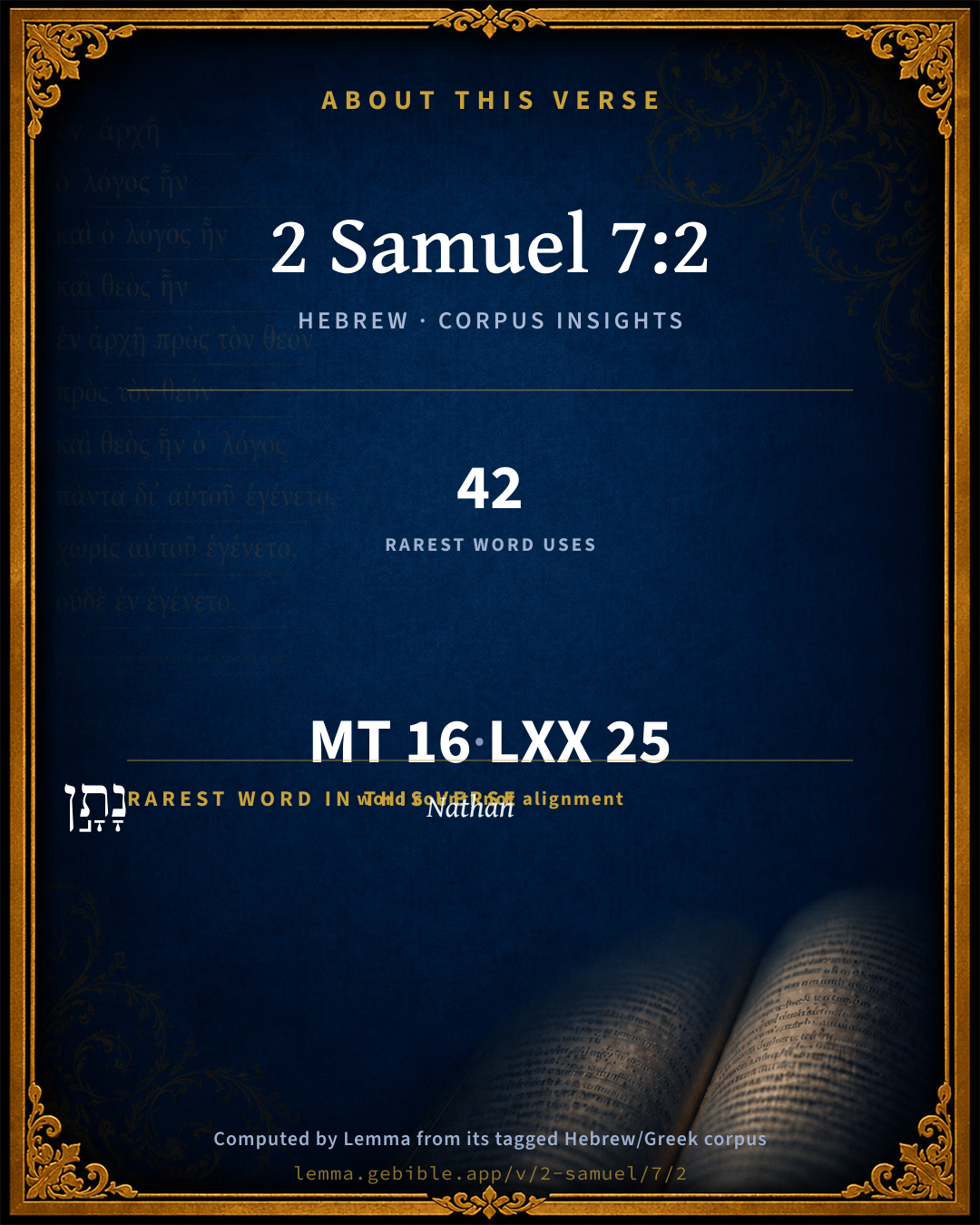
נָתָ֣ן Nathan H5416 occurs in 39 verses of the Hebrew Bible. Also found in:

Grammatical profile

  • 4 verbs
  • 9 nouns
  • 1 pronoun
  • 1 preposition
  • 1 particle

Verb forms

  • וַיֹּ֤אמֶר Qal · Sequential Imperfect
  • רְאֵ֣ה Qal · Imperative
  • יוֹשֵׁ֖ב Qal · Participle Active
  • יֹשֵׁ֖ב Qal · Participle Active

Repetition

A word recurs within this verse — often emphatic in Hebrew:

  • יוֹשֵׁ֖ב to dwell H3427 ×2

Hebrew & Septuagint length

In English translation the verse runs 25 words from the Hebrew and 30 from the Septuagint (LXX English) — closely comparable.

A rough comparison of the two English renderings, which tokenize alike — not a word-level alignment.

Word counts can differ between the Hebrew and the Greek without any difference in meaning — e.g. the Hebrew direct-object marker אֵת has no separate Greek word, and Greek often adds the article ὁ.

In the original languages it is 16 Hebrew tokens and 25 Greek tokens — but the two are counted differently (Hebrew bundles its prefixes and suffixes into one token; the Greek is in lemma form), so that isn’t a like-for-like length.

Cross-references

15

Topical passages linked to 2 Samuel 7:2 in the Treasury of Scripture Knowledge — connected by theme and wording, ordered by reader-vote popularity; previews shown in the World English Bible.

  • 2 Samuel 5:11 Hiram king of Tyre sent messengers to David, and cedar trees, and carpenters, and masons; and they built David a house.
  • 1 Chronicles 16:1 They brought in the ark of God, and set it in the midst of the tent that David had pitched for it: and they offered burnt offerings and peace-offerings before God.
  • 2 Samuel 12:1 Yahweh sent Nathan to David. He came to him, and said to him, "There were two men in one city; the one rich, and the other poor.
  • Haggai 1:4 "Is it a time for you yourselves to dwell in your paneled houses, while this house lies waste?
  • John 2:17 His disciples remembered that it was written, "Zeal for your house will eat me up."
  • Acts 7:46 who found favor in the sight of God, and asked to find a habitation for the God of Jacob.
  • Exodus 26:1–14 "Moreover you shall make the tent with ten curtains; of fine twined linen, and blue, and purple, and scarlet, with cherubim. The work of the skillful workman you shall make them.
  • 1 Chronicles 29:29 Now the acts of David the king, first and last, behold, they are written in the history of Samuel the seer, and in the history of Nathan the prophet, and in the history of Gad the seer,
  • Exodus 40:21 He brought the ark into the tent, and set up the veil of the screen, and screened the ark of the testimony, as Yahweh commanded Moses.
  • 2 Samuel 6:17 They brought in the ark of Yahweh, and set it in its place, in the midst of the tent that David had pitched for it; and David offered burnt offerings and peace-offerings before Yahweh.
  • 2 Samuel 7:17 According to all these words, and according to all this vision, so did Nathan speak to David.
  • 1 Chronicles 14:1 Hiram king of Tyre sent messengers to David, and cedar trees, and masons, and carpenters, to build him a house.
  • 2 Chronicles 1:4 But David had brought the ark of God up from Kiriath Jearim to [the place] that David had prepared for it; for he had pitched a tent for it at Jerusalem.
  • Psalms 132:5 Until I find out a place for Yahweh, A dwelling for the Mighty One of Jacob."
  • Jeremiah 22:13–15 Woe to him who builds his house by unrighteousness, and his chambers by injustice; who uses his neighbor's service without wages, and doesn't give him his hire;

Cross-references courtesy of OpenBible.info (CC BY 4.0).

Hebrew and Greek witnesses Masoretic Hebrew ↔ Greek Septuagint

The same verse in the two great witnesses to the Old Testament, shown verse-for-verse.

These are two independent witnesses, not word-aligned to each other, and the Septuagint is shown in lemma (dictionary) form.

Hebrew 2 Samuel 7:2 Masoretic · Westminster Leningrad Codex

וַיֹּ֤אמֶר הַמֶּ֨לֶךְ֙ אֶל נָתָ֣ן הַנָּבִ֔יא רְאֵ֣ה נָ֔א אָנֹכִ֥י יוֹשֵׁ֖ב בְּבֵ֣ית אֲרָזִ֑ים וַֽאֲרוֹן֙ הָֽאֱלֹהִ֔ים יֹשֵׁ֖ב בְּת֥וֹךְ הַיְרִיעָֽה

that the king said to Nathan the prophet, See now, I dwell in a house of cedar, but the ark of God dwells within curtains.

World English Bible · Public Domain

Greek LXX 2 Samuel 7:2 Septuagint · lemma form

καί εἶπον ὁ βασιλεύς πρός ναθαν ὁ προφήτης ἰδού δή ἐγώ καταοἰκέω ἐν οἶκος κέδρινος καί ὁ κιβωτός ὁ θεός καταἧμαι ἐν μέσος ὁ σκηνή

that the king said to Nathan the prophet, Behold now, I live in a house of cedar, and the ark of the Lord dwells in the midst of a tent.

LXX2012 (modern English Septuagint) · Public Domain

Hebrew: Westminster Leningrad Codex (CC BY 4.0). Greek: Septuagint (public domain); English from LXX2012 (modern English Septuagint) (Public Domain). How the Septuagint differs from the Hebrew →

Targum (Aramaic paraphrase)

1

The Targum is the ancient Jewish Aramaic paraphrase of the Hebrew Scriptures — an interpretive translation, not the Hebrew text itself. Onkelos (literal) and Pseudo-Jonathan (expansive) render the Torah, and Jonathan the Prophets. Coverage is partial: where no permissively-licensed English translation exists for a verse, only the Aramaic is shown. This is verse-level text, not a word-by-word alignment to the Hebrew.

  1. Targum Jonathan Prophets (Joshua–Malachi)
    וַאֲמַר מַלְכָּא לְנָתָן נְבִיָא חֲזֵי כְעַן דִי אֲנָא יָתֵיב בְּבֵיתָא דִי מְטַלֵל בְּכִיוֹרֵי אַרְזַיָא וַאֲרוֹנָא דַייָ שָׁרֵי בְּמַשְׁכְּנָא בְגוֹ יְרִיעֲתָא:

    (no public-domain English translation for this verse)

    Targum Jonathan — Aramaic: “Mikraot Gedolot” (public domain). English: “Sefaria Community Translation” (CC0 1.0 (public-domain dedication)); “London "Chaldee Paraphrase," 1871” (public domain). Text via Sefaria.

Commentary

Notes on 2 Samuel 7:2 from classic Christian and Jewish commentators (each source and its license shown beneath its notes). The classic Christian expositions comment on the surrounding passage and are grouped to its opening verse, so a note may address several verses; the Jewish commentaries on the Tanakh (Rashi and others) are per-verse, so they appear only where the commentator wrote on this verse.

Lemma curates 59 commentaries, every one of them public domain or Creative Commons licensed, each selected and text-cleaned for this edition rather than reprinted as found. About our sources →

Trapp's Complete Commentary

John Trapp

2Sa 7:2 That the king said unto Nathan the prophet, See now, I dwell in an house of cedar, but the ark of God dwelleth within curtains.

Ver. 2. That the king said unto Nathan the prophet.] This he said out of that ardent devotion and zeal kindled and increased in him by his late religious joy at the removal of the ark; by the presence whereof he tasted more and more how good the Lord was: and thereupon consulted with himself and Nathan about a fit retribution: saying in effect as Psa 116:12. The building of a temple non tantum voluit, sed et vovit, he both designed and vowed, {Psa 132:2} but herein he failed, that he would run before the Lord’s commandment. So hard it is to hold the golden mean, and not to mingle some sin with our best actions.

See now, I dwell in an house of cedar.] Ahab dwelt in a palace of ivory, and yet had no thoughts of heart for God and his service. The thoughts of the wicked are little worth. {Pro 10:20}

John Trapp, A Commentary or Exposition upon All the Books of the Old and New Testament (1647–1656) — public domain. Text from a community e-Sword module.

Tyndale Open Study Notes

Tyndale Open Resources

7:2 Nathan is recorded in David’s life on three occasions: (1) here with a promise for David; (2) in 12:1-15 with a parable of judgment against David; (3) in 1 Kgs 1:11-27 with a plan for installing Solomon as David’s successor. • A cedar palace would have been made of stone with cedar paneling inside.

Tyndale Open Study Notes — © Tyndale Open Resources, licensed CC BY-SA 4.0. Text via the HelloAO Bible API.

Geneva Bible (1599)

Geneva Bible translators

Within the Tabernacle covered with skins, Exod. 26:7.

Geneva Bible (1599) marginal notes — public domain. Text via Bolls.life.

Adam Clarke's Commentary

Verse 2. I dwell in a house of cedar] That is, a house whose principal beams, ceiling, and wainscot, were cedar.

Dwelleth within curtains.] Having no other residence but the tabernacle, which was a place covered with the skins of beasts, Ex 26:14.

Adam Clarke's Commentary on the Bible (1810–1826) — public domain. Text from a community e-Sword/MySword module.

Ellicott's Commentary for English Readers

(2) Nathan.—This is the first mention of him, but he was already a confidential counsellor of the king, and became prominent later in this reign and in the opening of that of Solomon (2 Samuel 12; 1Ki_1:10; 1Ki_1:12; 1Ki_1:34; 1Ki_1:38). Nathan “the prophet” and Gad “the seer” wrote parts of the history of this and the succeeding reign (1Ch_29:29; 2Ch_9:29).

Within curtains.—This is the word used in Exodus 26 and 36 for the covering of the tabernacle. The ark was not now within that, but in a similar temporary structure. David’s heart is moved by a comparison of his own royal residence with the inferior provision for the ark. Compare the opposite state of things among the returned exiles in Hag_1:10.

A Bible Commentary for English Readers, edited by Charles John Ellicott (1878–1897) — public domain. Text from a community e-Sword module.

The Cambridge Bible for Schools and Colleges

gen. ed. J. J. S. Perowne

2. Nathan the prophet] The first mention of one of the most eminent men in the reigns of David and Solomon. It was he who rebuked David for his sin with Bathsheba (ch. 2Sa_12:1 ff.); who became Solomon’s tutor (ch. 2Sa_12:25, note), and took a leading part in securing his succession to the throne (1Ki_1:22 ff.); who wrote a history of the reign of David and of part at least of the reign of Solomon (1Ch_29:29; 2Ch_9:29), from which in all probability a large portion of the books of Samuel, Kings, and Chronicles, is derived.

within curtains] The term applied in Exo_26:1 ff; Exo_36:8 ff., to the coverings of the tabernacle.

The Cambridge Bible for Schools and Colleges (gen. ed. J. J. S. Perowne; Cambridge University Press, 1878–1918) — public domain. Text from a community e-Sword module.

John Gill's Exposition

That the king said unto Nathan the prophet,.... This is the first time this prophet is made mention of, but often afterwards, yet who he was, and from whence he came, is not known; he appears to be a man of great piety and prudence, as well as endowed with a prophetic spirit, and was very familiar with David, and perhaps dwelt in his palace; being a man on all accounts fit for conversation with princes, to whom David imparted what he had been meditating upon in his heart. The Jews have a tradition (t) that he was the same with Jonathan the son of Shimea, the brother of David, Sa2 21:21; which is not very likely:

see now, I dwell in an house of cedar; made of the cedars of Lebanon; see what a spacious palace it is:

but the ark of God dwelleth within curtains; in a tabernacle within curtains, as the Targum; not the tabernacle of Moses, for that was at Gibeon, Ch1 21:29; but that which David had made for it, which consisted of curtains that were drawn around it, Sa2 6:17. It gave him a concern that he should dwell in so magnificent a palace, and the ark of God should have so mean an habitation; wherefore it was upon his mind to build a grand edifice for it, and this he suggested hereby to Nathan, and so he understood him, as appears by what follows; and the rather he was led to such a thought, being now at rest and in peace; for then it was an house was to be built for God, in which he would cause his name to dwell, as David might easily learn from Deu 12:9; and who so proper to set forward such a work as a king, and he when at rest from his enemies?

(t) Hieron. Trad. Heb. in 2 Reg. fol. 79. M. & in lib. Paralipom. fol. 89. B. F.

John Gill's Exposition of the Whole Bible (1746–1763) — public domain (CC PDM 1.0). Text via the HelloAO Bible API.

Albert Barnes' Notes on the Bible

Nathan the prophet - Here first mentioned, but playing an important part afterward (e. g. 2Sa 12:1; 1Ki 1:10; 1Ch 29:29; 2Ch 9:29). From the two last passages it appears that he wrote the history of David’s reign, and a part at least of Solomon’s. His distinctive title is the prophet, that of Gad the seer (compare 1Sa 9:9). He was probably nuch younger than David. In 2Sa 7:3, he spoke his own private opinion; in 2Sa 7:4, this was corrected by the word of the Lord.

Albert Barnes' Notes on the Bible (1834–1885) — public domain. Text from a community e-Sword/MySword module.

Haydock's Catholic Bible Commentary

Nathan. An admirable courier, (Grotius) and a great saint, Ecclesiasticus xlvii. He was neither too rough, nor too complaisant. --- Cedar. This was the most esteemed species of wood. The palace of the Persian kings, at Ecbatana, was chiefly built of it, and of cypress wood. (Polybius x.) --- Houses were not there built in such a solid manner, as they are in colder climates. They consisted mostly of wood. --- Skins. The outer veils of the tabernacle were made of skins, as others generally were. (Calmet) --- Hebrew and Chaldean, "of curtains."

George Leo Haydock (1774–1849), Haydock's Catholic Family Bible and Commentary, 1859 edition — public domain. Excludes Psalms (Douay-Rheims chapter numbering differs from Protestant) and Deuterocanonical books (Catholic canon only).

Matthew Poole's English Annotations

i.e. In a tent or tabernacle, 1Sa 7:6 composed of several curtains, Exo 26:1, &c.

Matthew Poole's English Annotations on the Holy Bible (1683–1685) — public domain. Text from a community e-Sword/MySword module.

Whedon's Commentary on the Bible

Daniel D. Whedon

2. I dwell in a house of cedar, but the ark… within curtains — A compunctious thought and feeling. He had housed himself right royally, while the sacred symbol of Jehovah’s presence had been quite neglected.

Within curtains — Literally, in the midst of the curtain, (1Ch_17:1,) under curtains, that is, tent-coverings, woven of goat’s hair. Exo_26:7. On the tent in which the ark then abode, see note on

2Sa_6:17.

Daniel D. Whedon (gen. ed.), Commentary on the Old and New Testaments (1874–1909) — public domain. Text from a community e-Sword module.

The Pulpit Commentary

A house of cedar; Hebrew, cedars. As these trees were sent by Hiram, and as the house was built, and David now settled in it, some considerable time must have elapsed since his accession. Moreover, the league with Hiram would be the result of David"s successes recorded in 2Sa_8:1; for the bond of union between the two was their mutual fear of the Philistines. As we have seen before, the alliance with Tyro had a very civilizing effect upon the Hebrews, who were far inferior to the Tyrians in the mechanical arts; and David"s house of hewn cedar logs was marvellous in the eyes of a people who still dwelt chiefly in tents. David purposed to build even a more sumptuous palace for Jehovah, and advised with Nathan as his chief counsellor, and the person to whom subsequently the education of Solomon was confided. Within curtains; Hebrew, the curtain; that is, the tent. The tabernacle prepared by Moses for the ark was formed of ten curtains, (Exo_26:1) but the significance lay, not in their number, hut in the dwelling of Jehovah still being a mere temporary lodging, though his people had received from him a settled land.

The Pulpit Commentary (1880–1919), ed. H.D.M. Spence-Jones & Joseph S. Exell — public domain. Text from a community e-Sword module.

John Wesley's Explanatory Notes

Curtains - That is, in a tent or tabernacle, ver. 6, composed of several curtains.

John Wesley, Explanatory Notes Upon the Whole Bible (1754–1765) — public domain. Text via the GEBible commentary corpus.

Lesson kit

Teaching starters — assembled from the data on this page, not authored interpretation. Every prompt links to the verse data it draws on. Edit before teaching.

2 Samuel, in the Historical, opens this verse with 16 words (15 distinct Hebrew lemmas). Its most distinctive word is Nâthân (“Nathan”). A historical commentator’s framing appears above. Read the whole chapter for the surrounding context.

Discussion questions

  1. The word Nâthân carries the sense “Nathan.” How does it shape the verse?
  2. 2 Samuel 5:14 shares the word «Nathan» with this verse. How do the two illuminate each other?
  3. “to dwell” occurs 2× in this one verse. What is the effect of the repetition?
  4. These translations render this verse differently; the difference is in the English rendering, not the original. What questions does that raise?
  5. The verb «וַיֹּ֤אמֶר» is Qal Sequential Imperfect. How does its form color the action?
  6. Reading how Trapp's Complete Commentary and Tyndale Open Study Notes read this verse, where do the two commentators agree and where do they part?

Things to notice

Reading settings

Reading text

Shown beneath each verse's original-language words.

Old Testament
Old Testament edition

Read the OT as the Masoretic Hebrew (MT) or the Greek Septuagint (LXX).

English shown for the Greek Septuagint (in the Hebrew ↔ Greek comparison).

Comparing translations? Open the Compare panel on any verse page to stack up to four side by side.