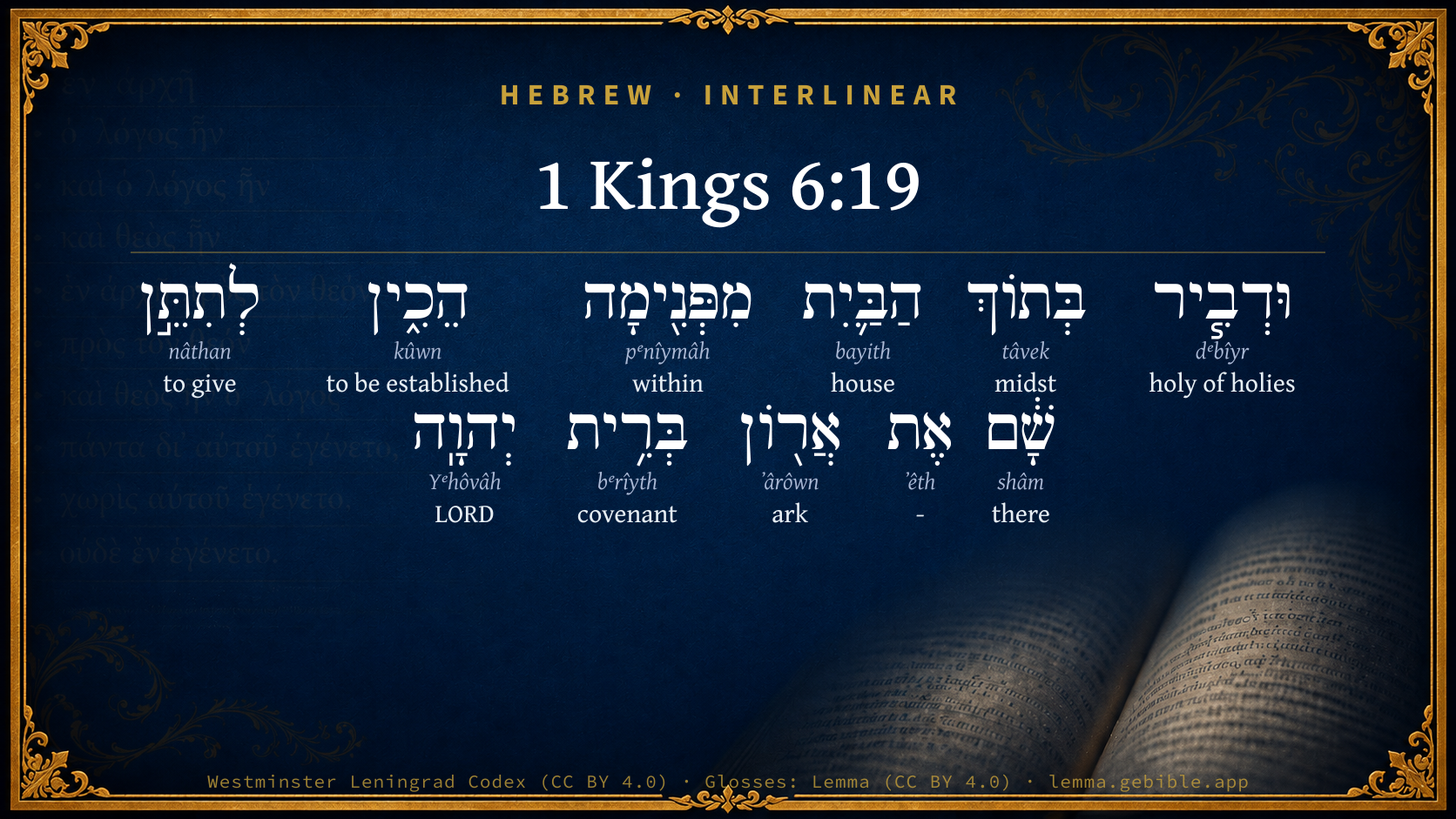
1 Kings 6:19

Hebrew (Westminster Leningrad Codex) 1 Kings 6:19 appears in the Hebrew Old Testament. The text above is from the Westminster Leningrad Codex. Each word links to its Strong’s number, a concise gloss, and parsing drawn from the Open Scriptures Hebrew Bible morphology. Click any word for its full Brown-Driver-Briggs (BDB) entry.
Download image
Cite this verse

1 Kings 6:19 (World English Bible). Public Domain. Lemma interlinear Bible study tool, https://lemma.gebible.app/v/1-kings/6/19.

Show BibTeX & RIS
BibTeX
RIS
English Translation
He prepared an oracle in the midst of the house within, to set there the ark of the covenant of Yahweh.
World English Bible · Public Domain
Download a study sheet

One document with this verse’s original text, its word-by-word gloss line, the meaning frame, cross-references with their text, attributed commentary, and full source and license credits — printable, and it pastes into notes with its structure intact.

This verse Autodidact and up

Study sheet (.html) Plain text (.txt)

A passage Seminary Student

Up to 50 verses in one chapter. A passage sheet keeps up to 6 commentary sources and 12 cross-references per verse, in the order this page ranks them, and says so on the sheet whenever that leaves anything out. Ask for a single verse and you get the Autodidact verse sheet above.

Everything on this page stays free to read, with no account — the sheet is a download of what is already on screen, not access to it.

Want to remove ads? Support Godless Engineer
Compare translations 3

The same verse in 3 English versions, stacked beneath the original-language interlinear above. Click any original word for its lexicon entry.

Each is an independent rendering of the whole verse — the interlinear is not word-aligned to these translations.

Highlighted words mark where these versions differ — a whole-verse word diff, not a word-by-word alignment.

  • World English Bible Public Domain
    He prepared an oracle in the midst of the house within, to set there the ark of the covenant of Yahweh.
  • King James Version Public Domain
    And the oracle he prepared in the house within, to set there the ark of the covenant of the LORD.
  • unfoldingWord Literal Text CC BY-SA 4.0
    And he prepared the inner sanctuary in the midst of the house on the inside to put the Box of the Covenant of Yahweh there.

unfoldingWord Literal Text — © unfoldingWord, licensed CC BY-SA 4.0. Word-aligned USFM3 via Door43 (git.door43.org/unfoldingWord/en_ult).

Versions to compare (up to 4)

3 of 4 selected

Show all 18 translations

Every available English version of this verse, each an independent rendering of the whole verse.

  • World English Bible Public Domain
    He prepared an oracle in the midst of the house within, to set there the ark of the covenant of Yahweh.
  • Berean Standard Bible Public Domain
    Solomon also prepared the inner sanctuary within the temple to set the ark of the covenant of the LORD there.
  • Majority Standard Bible Public Domain
    Solomon also prepared the inner sanctuary within the temple to set the ark of the covenant of the LORD there.
  • King James Version Public Domain
    And the oracle he prepared in the house within, to set there the ark of the covenant of the LORD.
  • American Standard Version (1901) Public Domain
    And he prepared an oracle in the midst of the house within, to set there the ark of the covenant of Jehovah.
  • Revised Version (1885) Public Domain
    And he prepared an oracle in the midst of the house within, to set there the ark of the covenant of the LORD.
  • Geneva Bible (1599) Public Domain
    Also he prepared the place of the oracle in the mids of the house within, to set the Arke of the couenant of the Lord there.
  • Douay-Rheims (1899) Public Domain
    And he made the oracle in the midst of the house, in the inner part, to set there the ark of the covenant of the Lord.
  • Young's Literal Translation Public Domain
    And the oracle in the midst of the house within he hath prepared, to put there the ark of the covenant of Jehovah.
  • Literal Standard Version CC BY-SA 4.0
    And he has prepared the oracle in the midst of the house within, to put the Ark of the Covenant of YHWH there.
  • Unlocked Literal Bible CC BY-SA 4.0
    Solomon prepared the inner room inside the house in order to place the ark of the covenant of Yahweh there.
  • unfoldingWord Literal Text CC BY-SA 4.0
    And he prepared the inner sanctuary in the midst of the house on the inside to put the Box of the Covenant of Yahweh there.
  • Darby Bible Public Domain
    And he prepared the oracle in the midst of the house within, to set there the ark of the covenant of Jehovah.
  • World Messianic Bible Public Domain
    He prepared an inner sanctuary in the middle of the house within, to set the ark of the LORD’s covenant there.
  • Webster's Bible Public Domain
    And the oracle he prepared in the house within, to set there the ark of the covenant of the LORD.
  • Free Bible Version CC BY-SA 4.0
    He also had the inner sanctuary made within the Temple where the Ark of the Lord's Agreement would be placed.
  • Bible in Basic English Public Domain
    And he made ready an inmost room in the middle of the house, in which to put the ark of the agreement of the Lord.
  • JPS Tanakh (1917) Public Domain
    And he prepared the Sanctuary in the midst of the house within, to set there the ark of the covenant of the LORD.

Literal Standard Version (2020), Covenant Press — licensed CC BY-SA 4.0. Text via the HelloAO Bible API (eBible.org). Unlocked Literal Bible (unfoldingWord) — licensed CC BY-SA 4.0. Text via the HelloAO Bible API (eBible.org). unfoldingWord Literal Text — © unfoldingWord, licensed CC BY-SA 4.0. Word-aligned USFM3 via Door43 (git.door43.org/unfoldingWord/en_ult). Free Bible Version, Dr. Jonathan Gallagher — licensed CC BY-SA 4.0. Text via the HelloAO Bible API (eBible.org).

Word by word

More ways to search: Search by grammar → Find every occurrence → Compare this word →

Practice this passage: Drill this verse → Learn its vocabulary →

About this verse

These counts appear in no published source. They are computed here, from the morphology-tagged text and Lemma’s own curated glosses. What Lemma adds →

11
words
11
distinct lemmas
Historical
section

Notable vocabulary

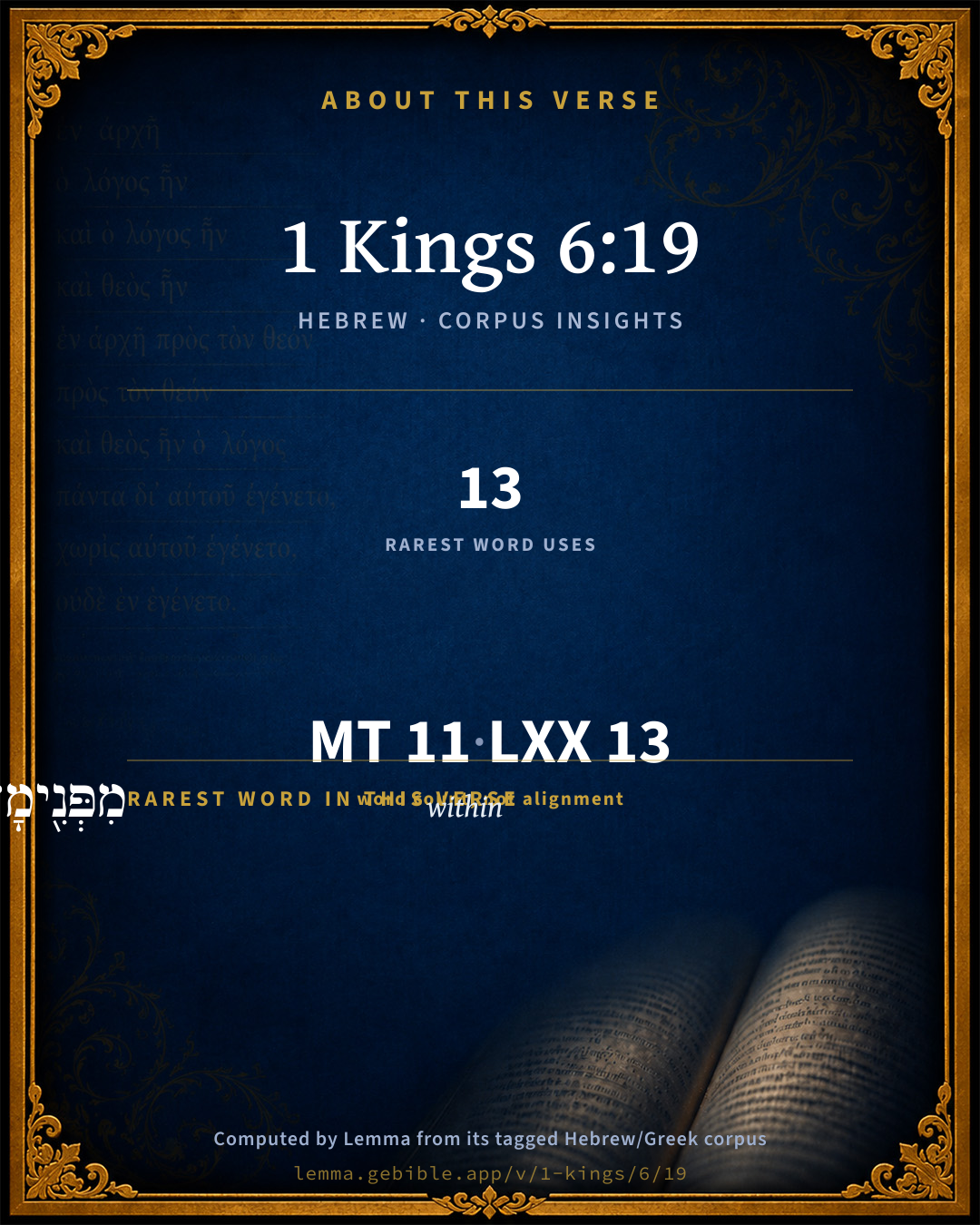
The rarest word here is מִפְּנִ֖ימָה within H6441 — appearing just 13 times in the whole Hebrew Bible.

Shared distinctive vocabulary

מִפְּנִ֖ימָה within H6441 occurs in 12 verses of the Hebrew Bible. Also found in:

Grammatical profile

  • 2 verbs
  • 6 nouns
  • 2 adverbs
  • 1 particle

Verb forms

  • הֵכִ֑ין Hiphil · Perfect
  • לְתִתֵּ֣ן Qal · Infinitive Construct

Hebrew & Septuagint length

In English translation the verse runs 21 words from the Hebrew and 25 from the Septuagint (LXX English) — closely comparable.

A rough comparison of the two English renderings, which tokenize alike — not a word-level alignment.

Word counts can differ between the Hebrew and the Greek without any difference in meaning — e.g. the Hebrew direct-object marker אֵת has no separate Greek word, and Greek often adds the article ὁ.

In the original languages it is 11 Hebrew tokens and 13 Greek tokens — but the two are counted differently (Hebrew bundles its prefixes and suffixes into one token; the Greek is in lemma form), so that isn’t a like-for-like length.

Cross-references

8

Topical passages linked to 1 Kings 6:19 in the Treasury of Scripture Knowledge — connected by theme and wording, ordered by reader-vote popularity; previews shown in the World English Bible.

  • Exodus 40:20–21 He took and put the testimony into the ark, and set the poles on the ark, and put the mercy seat above on the ark.
  • 1 Kings 6:5 Against the wall of the house he built stories round about, against the walls of the house round about, both of the temple and of the oracle; and he made side-chambers round about.
  • 1 Kings 6:16 He built twenty cubits on the hinder part of the house with boards of cedar from the floor to the walls [of the ceiling]: he built [them] for it within, for an oracle, even for the most holy place.
  • 1 Kings 8:6–10 The priests brought in the ark of the covenant of Yahweh to its place, into the oracle of the house, to the most holy place, even under the wings of the cherubim.
  • 2 Chronicles 4:20 and the lampstands with their lamps, to burn according to the ordinance before the oracle, of pure gold;
  • 2 Chronicles 5:7 The priests brought in the ark of the covenant of Yahweh to its place, into the oracle of the house, to the most holy place, even under the wings of the cherubim.
  • Psalms 28:2 Hear the voice of my petitions, when I cry to you, When I lift up my hands toward your Most Holy Place.
  • Hebrews 9:3–4 After the second veil was the tabernacle which is called the Holy of Holies,

Cross-references courtesy of OpenBible.info (CC BY 4.0).

Hebrew and Greek witnesses Masoretic Hebrew ↔ Greek Septuagint

The same verse in the two great witnesses to the Old Testament, shown verse-for-verse.

These are two independent witnesses, not word-aligned to each other, and the Septuagint is shown in lemma (dictionary) form.

Hebrew 1 Kings 6:19 Masoretic · Westminster Leningrad Codex

וּדְבִ֧יר בְּתוֹךְ הַבַּ֛יִת מִפְּנִ֖ימָה הֵכִ֑ין לְתִתֵּ֣ן שָׁ֔ם אֶת אֲר֖וֹן בְּרִ֥ית יְהוָֽה

He prepared an oracle in the midst of the house within, to set there the ark of the covenant of Yahweh.

World English Bible · Public Domain

Greek LXX 1 Kings 6:19 Septuagint · lemma form

ὁ δαβιρ ἐν μέσος ὁ οἶκος ἔσωθεν δίδωμι ἐκεῖ ὁ κιβωτός διαθήκη κύριος

in front of the oracle in the midst of the house within, in order to put there the ark of the covenant of the Lord.

LXX2012 (modern English Septuagint) · Public Domain

Hebrew: Westminster Leningrad Codex (CC BY 4.0). Greek: Septuagint (public domain); English from LXX2012 (modern English Septuagint) (Public Domain). How the Septuagint differs from the Hebrew →

Targum (Aramaic paraphrase)

1

The Targum is the ancient Jewish Aramaic paraphrase of the Hebrew Scriptures — an interpretive translation, not the Hebrew text itself. Onkelos (literal) and Pseudo-Jonathan (expansive) render the Torah, and Jonathan the Prophets. Coverage is partial: where no permissively-licensed English translation exists for a verse, only the Aramaic is shown. This is verse-level text, not a word-by-word alignment to the Hebrew.

  1. Targum Jonathan Prophets (Joshua–Malachi)
    וּבֵית כַּפּוֹרֵי מִגוֹ בֵיתָא מִלְגָיו אַתְקֵין לְמִתַּן תַּמָן יַת אֲרוֹן קְיָמָא דַיָי:

    (no public-domain English translation for this verse)

    Targum Jonathan — Aramaic: “Mikraot Gedolot” (public domain). English: “Sefaria Community Translation” (CC0 1.0 (public-domain dedication)); “London "Chaldee Paraphrase," 1871” (public domain). Text via Sefaria.

Commentary

Notes on 1 Kings 6:19 from classic Christian and Jewish commentators (each source and its license shown beneath its notes). The classic Christian expositions comment on the surrounding passage and are grouped to its opening verse, so a note may address several verses; the Jewish commentaries on the Tanakh (Rashi and others) are per-verse, so they appear only where the commentator wrote on this verse.

Lemma curates 59 commentaries, every one of them public domain or Creative Commons licensed, each selected and text-cleaned for this edition rather than reprinted as found. About our sources →

Trapp's Complete Commentary

John Trapp

1Ki 6:19 And the oracle he prepared in the house within, to set there the ark of the covenant of the LORD.

Ver. 19. To set there the ark of the covenant of the Lord.] This was a most precious piece. The Palladium at Troy, the Pessinuntium at Rome, the Image at Ephesus, made by Canetias, an ancient craftsman, and said by the covetous priests to have fallen down from Jupiter, {Act 19:35} are not worthy to be named in the same day with this ark of the covenant; the principle evidence of God’s gracious presence, and, besides, a very lively type of Christ, and therefore kept in the innermost part of God’s house.

John Trapp, A Commentary or Exposition upon All the Books of the Old and New Testament (1647–1656) — public domain. Text from a community e-Sword module.

Joseph Benson's Commentary

1Ki 6:19-20. And the oracle — Or, rather, the most holy place. He prepared — That is, he adorned and fitted it for the reception of the ark. Solomon made every thing new but the ark: that, with its mercy-seat, was still the same that Moses made. This was the token of God’s presence, which is with his people, whether they meet in tent or temple, and changes not with their condition. And the oracle in the forepart — That is, in the innermost part, before mentioned, which is called the forepart, because it was before him that entered into the house. And he overlaid it with pure gold — Not merely gilded it, but covered it with plates of gold. For the gold amounted to six hundred talents, as is said 2Ch 3:8. And so covered the altar — That is, the altar of incense, with gold, chap. 1Ki 7:48; 1Ch 28:18.

Joseph Benson's Commentary on the Old and New Testaments (1811–1818) — public domain. Text from a community e-Sword module.

The Pulpit Commentary

And the oracle Heb. an oracle. Heb. rybiD probably from rbD speak. Sc Jerome, oraculum; and Aquila and Symm. crhmatisthrion. Gesenius, Bahr, al., however, interpret the word to mean the hinder part, adytum he prepared in the house within lit. in the midst of the house within, i.e., between the Holy Place and the end structure to set there the principal purpose which the oracle served. Teti = tTe with repeated syllable. Cf. 1Ki_17:14, Ken the ark of the covenant of the Lord.

The Ark of the Covenant of the Lord.

This temple of Solomon, so "exceeding magnifical," this "holy and beautiful house," "of fame and glory throughout all lands why was it built? what its primary purpose? It was above everything else a home for the ark, (1Ki_8:1, 1Ki_8:6) a place for the Divine Glory which hovered over it.

In this temple, unlike the shrines of Paganism, there was no statue, no similitude of God. Here was no "image which fell down from Jupiter," no Baal or Asherah, no Apis or Osiris. We may imagine how this would impress the Phoenician workmen. We know how it impressed Pompeius and the Romans. There is deep significance in those words of the Roman historian: Inania arcana, vacua sedes. Nothing but the ark. And this ark, what was it? It was a coffer, a chest. It was nothing in itself; but it was meant to contain something. It was the casket of a rare jewel. "There was nothing in the ark, save the two tables of stone, etc.. (1Ki_8:9) It was the "ark of the testimony. So that the temple was properly and primarily the shrine and depository of the tables of the law graven with the "ten words," "the words of the covenant". (Deu_4:13)

Now we have just seen that the temple was the archetype of the Church: we have seen, too, that everything in Judaism has its analogue in Christianity. What, then, let us ask, was the significance of the ark? To what does it correspond in the new dispensation?

In the Church, to nothing. The "words of the covenant" are no longer kept in the dark. No; we now inscribe them on our chancel walls. In the "sanctuary" of the Gothic church the ten commandments are "writ large*" for men to see.

But if Judaism was really the outline of Christianity, then there must be something in Christianity answering to that ark which was the core and centre of the Mosaic system. Certainly. But it is to be found, not in "temples made with hands," but in those other "temples" of the Christian faith, the bodies of believers, the temples of the Holy Ghost. (1Co_3:16 1Co_6:19) The ark was the soul of Judaism. It may fittingly represent the souls which Christ has redeemed. Temple, ark, tables of the law these severally correspond to the "body, soul, spirit" of the Christian man. Within the temple was the ark; within the ark the tables. Within the swma is the yuch; within the yuch the pneuma. Nor is this so fanciful as it seems. For are not our bodies the "temples of the Holy Ghost"? And are not our heartsi.e. , our inmost being, our spiritual part (1Pe_3:4) the fleshy tables on which He writes His law? Yes, in the "new covenant" God writes His law in the heart, and puts it in the inward parts (see Jer_31:33; cf. Eze_11:19, Eze_11:20; 2Co_3:8) In the face of these scriptures, who can deny that the ark and its tables have their analogues in the New Testament? Such, then, being the symbolism and significance of temple, ark, and tables of law, what are their lessons? Among others these:

1. That God dwells within us. No longer in temples made with hands, but "with him that is of a contrite and humble spirit". (Isa_57:15) Did theShechinch brood over the mercy seat? Not less truly does God"s Spirit (Rom_8:9) and witness (ver. 16) with our spirit. Men say the Shechinah has left the world. On the contrary, It has enshrined Itself in the soul. Christ in you; (Col_1:27) God dwelling in us; (1Jn_4:2) this is the last best gospel of our religion. The Old Testament, Neander says, tells of a God who is for man. In the Gospels we hear of Emmanuel, God with man. But the Epistles speak to us of God in man.

2. That God writes His law upon us. We have seen that in the Church there is neither ark nor tables of stone. It is because there is no need of either. This is the age of that "new covenant" of which the prophet spoke, when the finger of God should write the law upon the spirit, and when the Bath Kol should speak within. The laws of our country are so voluminous that no man can hope to know or to remember them, and their "glorious uncertainty" is proverbial But God"s law is but one (Rom_13:9, Rom_13:10; Heb_8:10 Heb_10:16) and that sweet and blessed statute the Spirit graves within us. Now observe

3. The ark, led by God, conducted Israel to victory, and rest. In the journeyings of Israel the ark went before them. (Num_10:33) At the Jordan it opened a way for them. (Jos_3:14-17) Before Jericho it led them on to victory. (Jos_6:9-11) Even so the soul, guided and taught of God, passes safely through its pilgrimage, conquers its foes, and gains its heavenly rest. Let us yield ourselves to be "led by the Spirit of. (Rom_8:14)

1. The ark, led by man, conducted Israel to disaster and defeat. When the Israelites, instead of following the ark, would lead it, (1Sa_4:3) it landed them in a "very great slaughter." It proved to be no fetish, as they had hoped; it only led them to a shameful death. "It is one thing to want to have truth on our side; another to want to be on the side of truth" (Whately). It is of no avail to have the commandments of God, unless we keep them; to know His will, unless we do it. And if we lean to our own understandings, the soul will make shipwreck. Reason, it is true, is "the candle of the Lord;" but revelation is the lamp to our feet and the light to our path" (Psa_119:105; cf. Pro_3:5, Pro_3:6)

2. The ark, the pride of Israel, on two occasions became its plague. The men of Bethshemesh looked into it, and died. Uzzah put forth his hand to steady it, and was smitten for his error. (2Sa_6:7) So the ark teaches the much needed lesson of reverence reverence for God and the things of God. It also suggests that dishonour done to God, or disregard of His law, has a sure retribution. If we stifle our convictions or quench the Spirit"s light, the law written within may hereafter become the "instrument to scourge us.

3. In the second temple there was no ark. A stone is said to have taken its place. The venerable relic of the wilderness life, the sacred chest, and its still more sacred contents, both perished in the sack of Jerusalem (2Ki_25:9 sqq.) May we not see here a lesson against impenitence? Over how many souls may "Ichabod" be written? The ark of God is taken! The soul is led captive of the devil The heart of flesh, the "fleshy tables" on which the Spirit loves to write, has given place to a heart of stone a heart as cold, as hard, as senseless, as void of all grace and blessing as this stone which stood in the oracle in the room of the ark of the covenant of the Lord.

The Pulpit Commentary (1880–1919), ed. H.D.M. Spence-Jones & Joseph S. Exell — public domain. Text from a community e-Sword module.

Tyndale Open Study Notes

Tyndale Open Resources

6:19-22 Following the pattern of the Tabernacle, the inner sanctuary, which was overlaid . . . inside with solid gold, was separated from the main room of the Temple by a curtain (2 Chr 3:14) and gold chains. Like the Most Holy Place in the Tabernacle, the inner sanctuary was a perfect cube. It housed the Ark of the Lord’s Covenant that symbolized God’s presence. The place of atonement was atop the Ark (Exod 25:17); the high priest annually made propitiation for the Israelites by sprinkling the sacrificial blood of the atonement on it (Lev 16:1-19). • The altar that belonged to the Most Holy Place stood in the main room. The priests burned incense there daily (Exod 30:34-38; 37:25-29). The altar was made of cedar and covered with gold. • Like the inner sanctuary, the main room was also completely overlaid with gold, which reminded the priests that Almighty God was present. The main room also housed ten golden lampstands, ten tables (2 Chr 4:7-8), and other furnishings (1 Kgs 7:48-50).

Tyndale Open Study Notes — © Tyndale Open Resources, licensed CC BY-SA 4.0. Text via the HelloAO Bible API.

Geneva Bible (1599)

Geneva Bible translators

That is, in the most inward place of the house.

Geneva Bible (1599) marginal notes — public domain. Text via Bolls.life.

Adam Clarke's Commentary

Verse 19. The oracle he prepared] See the description of the temple at the end of this chapter. 1Kg 6:38.

Adam Clarke's Commentary on the Bible (1810–1826) — public domain. Text from a community e-Sword/MySword module.

The Cambridge Bible for Schools and Colleges

gen. ed. J. J. S. Perowne

19. And the oracle, &c.] Read, ‘And he prepared an oracle.’

to set there the ark of the covenant of the Lord] Which was at present in the city of David. See 1Ki_3:15 note.

The Cambridge Bible for Schools and Colleges (gen. ed. J. J. S. Perowne; Cambridge University Press, 1878–1918) — public domain. Text from a community e-Sword module.

John Gill's Exposition

And the oracle in the forepart,.... Which stood in the forepart of the temple, before a man's face as he entered into it, and went on; or the forepart of the holy of holies, next to the holy place, was of the dimensions as follows, when the back part of it might be higher at least, and be equal to the holy place, even thirty feet; the forepart being lower, and left open to let in the light of the candlesticks, and the smoke of the incense, out of the holy place: this

was twenty cubits in length, and twenty cubits in breadth, and twenty cubits in the height thereof: and was a perfect square, and as the most holy place may be an emblem of the church triumphant, it may denote the perfection of its heavenly state; so the new Jerusalem is a foursquare, Rev 21:16;

and he overlaid it with pure gold; make it rich, glorious, and magnificent, and may denote the glory of the heavenly state, Rev 21:21; and so Florus (z), the Roman historian, calls it the golden heaven, as it were, into which Pompey went, and saw the great secret of the Jewish nation, the ark:

and so covered the altar which was of cedar; the altar of incense, which is here mentioned, because it was near the most holy place, Kg1 6:22; this altar by Moses was made of shittim wood, but Solomon's was of cedar it seems; unless, as the words will bear to be rendered, "he covered the altar with cedar" (a); though made of shittim wood, it had a covering of cedar over it; or if of stone, such a covering was on it, that it might better receive the gold which was afterwards put upon it.

(z) De Gest. Roman. l. 3. c. 5. (a) "operuit cedro", Montanus.

John Gill's Exposition of the Whole Bible (1746–1763) — public domain (CC PDM 1.0). Text via the HelloAO Bible API.

Matthew Poole's English Annotations

He prepared, i.e. adorned and fitted it for the receipt of the ark.

In the house, Heb. in the middle of the house, or building; not the middle mathematically or exactly, but in general within the house, as that phrase, in the middle, oft signifies; as Deu 4:11; Jos 7:21; Dan 3:26.

Within, or, in the uttermost part of the house; for so this was, the entrance into the house being at the other end.

Matthew Poole's English Annotations on the Holy Bible (1683–1685) — public domain. Text from a community e-Sword/MySword module.

John Wesley's Explanatory Notes

Prepared - That is, adorned and fitted it for the receipt of the ark. Solomon made every thing new, but the ark. That with its mercy seat was still the same that Moses made. This was the token of God's presence, which is with his people, whether they meet in tent or temple, and changes not with their condition.

John Wesley, Explanatory Notes Upon the Whole Bible (1754–1765) — public domain. Text via the GEBible commentary corpus.

unfoldingWord translationNotes

Door43 World Missions Community

Solomon prepared ... Solomon overlaid

Solomon would have commanded his workers to do this work. AT: "They prepared ... They overlaid" (See: Metonymy)

twenty cubits

"9.2 meters"

covered the altar with cedar wood

This altar would be used for burning incense.

translationWords

ark of the covenant

pure

gold

altar

unfoldingWord translationNotes — © Distant Shores Media and the Door43 World Missions Community, licensed CC BY-SA 4.0. Source: git.door43.org/Door43/en_tn.

Rashi

Rabbi Shlomo Yitzchaki (Rashi)

And the Holy of Holies within the Beis Hamikdosh. The “Amoh Traksin” partition.

To place. [It has the same meaning] as לתת.

Rashi on the Tanakh — English translations: “The Judaica Press complete Tanach with Rashi, translated by A. J. Rosenberg” (CC BY 4.0); “Pentateuch with Rashi's commentary by M. Rosenbaum and A.M. Silbermann, 1929-1934” (public domain); “The Metsudah Tanach series, Lakewood, N.J” (CC BY 4.0); and “The Book of Joshua, Metsudah Publications, 1997” (CC BY 4.0). Text via Sefaria.

Lesson kit

Teaching starters — assembled from the data on this page, not authored interpretation. Every prompt links to the verse data it draws on. Edit before teaching.

1 Kings, in the Historical, opens this verse with 11 words (11 distinct Hebrew lemmas). Its most distinctive word is pᵉnîymâh (“within”). A historical commentator’s framing appears above. Read the whole chapter for the surrounding context.

Discussion questions

  1. What does “within” (pᵉnîymâh) contribute to the verse as a whole?
  2. How does Leviticus 10:18, which shares the word «within», read alongside this verse?
  3. The translations on this page render this verse differently — a whole-verse word diff, not a word-by-word alignment. What might account for the different wordings?
  4. «הֵכִ֑ין» is a Hiphil Perfect verb. How does that grammatical form shape the action described?
  5. Compare how Trapp's Complete Commentary and Joseph Benson's Commentary read this verse. Where do they agree or differ?

Things to notice

Reading settings

Reading text

Shown beneath each verse's original-language words.

Old Testament
Old Testament edition

Read the OT as the Masoretic Hebrew (MT) or the Greek Septuagint (LXX).

English shown for the Greek Septuagint (in the Hebrew ↔ Greek comparison).

Comparing translations? Open the Compare panel on any verse page to stack up to four side by side.