
1 Chronicles 21:6

Hebrew (Westminster Leningrad Codex) 1 Chronicles 21:6 appears in the Hebrew Old Testament. The text above is from the Westminster Leningrad Codex. Each word links to its Strong’s number, a concise gloss, and parsing drawn from the Open Scriptures Hebrew Bible morphology. Click any word for its full Brown-Driver-Briggs (BDB) entry.
Download image
Cite this verse

1 Chronicles 21:6 (World English Bible). Public Domain. Lemma interlinear Bible study tool, https://lemma.gebible.app/v/1-chronicles/21/6.

Show BibTeX & RIS
BibTeX
RIS
English Translation
But he didn't count Levi and Benjamin among them; for the king's word was abominable to Joab.
World English Bible · Public Domain
Download a study sheet

One document with this verse’s original text, its word-by-word gloss line, the meaning frame, cross-references with their text, attributed commentary, and full source and license credits — printable, and it pastes into notes with its structure intact.

This verse Autodidact and up

Study sheet (.html) Plain text (.txt)

A passage Seminary Student

Up to 50 verses in one chapter. A passage sheet keeps up to 6 commentary sources and 12 cross-references per verse, in the order this page ranks them, and says so on the sheet whenever that leaves anything out. Ask for a single verse and you get the Autodidact verse sheet above.

Everything on this page stays free to read, with no account — the sheet is a download of what is already on screen, not access to it.

Want to remove ads? Support Godless Engineer
Compare translations 3

The same verse in 3 English versions, stacked beneath the original-language interlinear above. Click any original word for its lexicon entry.

Each is an independent rendering of the whole verse — the interlinear is not word-aligned to these translations.

Highlighted words mark where these versions differ — a whole-verse word diff, not a word-by-word alignment.

  • World English Bible Public Domain
    But he didn't count Levi and Benjamin among them; for the king's word was abominable to Joab.
  • King James Version Public Domain
    But Levi and Benjamin counted he not among them: for the king's word was abominable to Joab.
  • unfoldingWord Literal Text CC BY-SA 4.0
    But Levi and Benjamin he did not muster in their midst, for the word of the king was abhorrent to Joab.

unfoldingWord Literal Text — © unfoldingWord, licensed CC BY-SA 4.0. Word-aligned USFM3 via Door43 (git.door43.org/unfoldingWord/en_ult).

Versions to compare (up to 4)

3 of 4 selected

Show all 18 translations

Every available English version of this verse, each an independent rendering of the whole verse.

  • World English Bible Public Domain
    But he didn't count Levi and Benjamin among them; for the king's word was abominable to Joab.
  • Berean Standard Bible Public Domain
    But Joab did not include Levi and Benjamin in the count, because the king’s command was detestable to him.
  • Majority Standard Bible Public Domain
    But Joab did not include Levi and Benjamin in the count, because the king’s command was detestable to him.
  • King James Version Public Domain
    But Levi and Benjamin counted he not among them: for the king's word was abominable to Joab.
  • American Standard Version (1901) Public Domain
    But Levi and Benjamin counted he not among them; for the king's word was abominable to Joab.
  • Revised Version (1885) Public Domain
    But Levi and Benjamin counted he not among them: for the king’s word was abominable to Joab.
  • Geneva Bible (1599) Public Domain
    But the Leuites and Beniamin counted he not among them: for the Kings worde was abominable to Ioab.
  • Douay-Rheims (1899) Public Domain
    But Levi and Benjamin he did not number: for Joab unwillingly executed the king's orders.
  • Young's Literal Translation Public Domain
    And Levi and Benjamin he hath not numbered in their midst, for the word of the king was abominable with Joab.
  • Literal Standard Version CC BY-SA 4.0
    And he has not numbered Levi and Benjamin in their midst, for the word of the king was abominable with Joab.
  • Unlocked Literal Bible CC BY-SA 4.0
    But Levi and Benjamin were not counted among them, for the king's command had disgusted Joab.
  • unfoldingWord Literal Text CC BY-SA 4.0
    But Levi and Benjamin he did not muster in their midst, for the word of the king was abhorrent to Joab.
  • Darby Bible Public Domain
    But Levi and Benjamin he did not count among them; for the king's word was abominable to Joab.
  • World Messianic Bible Public Domain
    But he didn’t count Levi and Benjamin among them, for the king’s word was abominable to Joab.
  • Webster's Bible Public Domain
    But Levi and Benjamin he counted not among them: for the king's word was abominable to Joab.
  • Free Bible Version CC BY-SA 4.0
    However, Joab did not include Levi and Benjamin in the census total, because he disagreed with what the king had ordered.
  • Bible in Basic English Public Domain
    But Levi and Benjamin were not numbered among them, for Joab was disgusted with the king's order.
  • JPS Tanakh (1917) Public Domain
    But Levi and Benjamin he did not number among them; for the king's word was abominable to Joab.

Literal Standard Version (2020), Covenant Press — licensed CC BY-SA 4.0. Text via the HelloAO Bible API (eBible.org). Unlocked Literal Bible (unfoldingWord) — licensed CC BY-SA 4.0. Text via the HelloAO Bible API (eBible.org). unfoldingWord Literal Text — © unfoldingWord, licensed CC BY-SA 4.0. Word-aligned USFM3 via Door43 (git.door43.org/unfoldingWord/en_ult). Free Bible Version, Dr. Jonathan Gallagher — licensed CC BY-SA 4.0. Text via the HelloAO Bible API (eBible.org).

Word by word

More ways to search: Search by grammar → Find every occurrence → Compare this word →

Practice this passage: Drill this verse → Learn its vocabulary →

נִתְעַ֥ב
taʻâb
H8581
“to abhor”
Verb, Niphal, Perfect, 3rd Person, Masculine, Singular
Part of Speech
Verb
Stem
Niphal
Form
Perfect
Person
3rd Person
Gender
Masculine
Number
Singular
Full BDB Definition

Origin: a primitive root

TWOT: 2530

to abhor, be abominable, do abominably - (Niphal) to be abhorred, be detested - in the ritual sense - in the ethical sense - (Piel) - to loathe, abhor, regard as an abomination - in the ritual sense - in the ethical sense - to cause to be an abomination - (Hiphil) to make abominable, do abominably - in the ritual sense - in the ethical sense
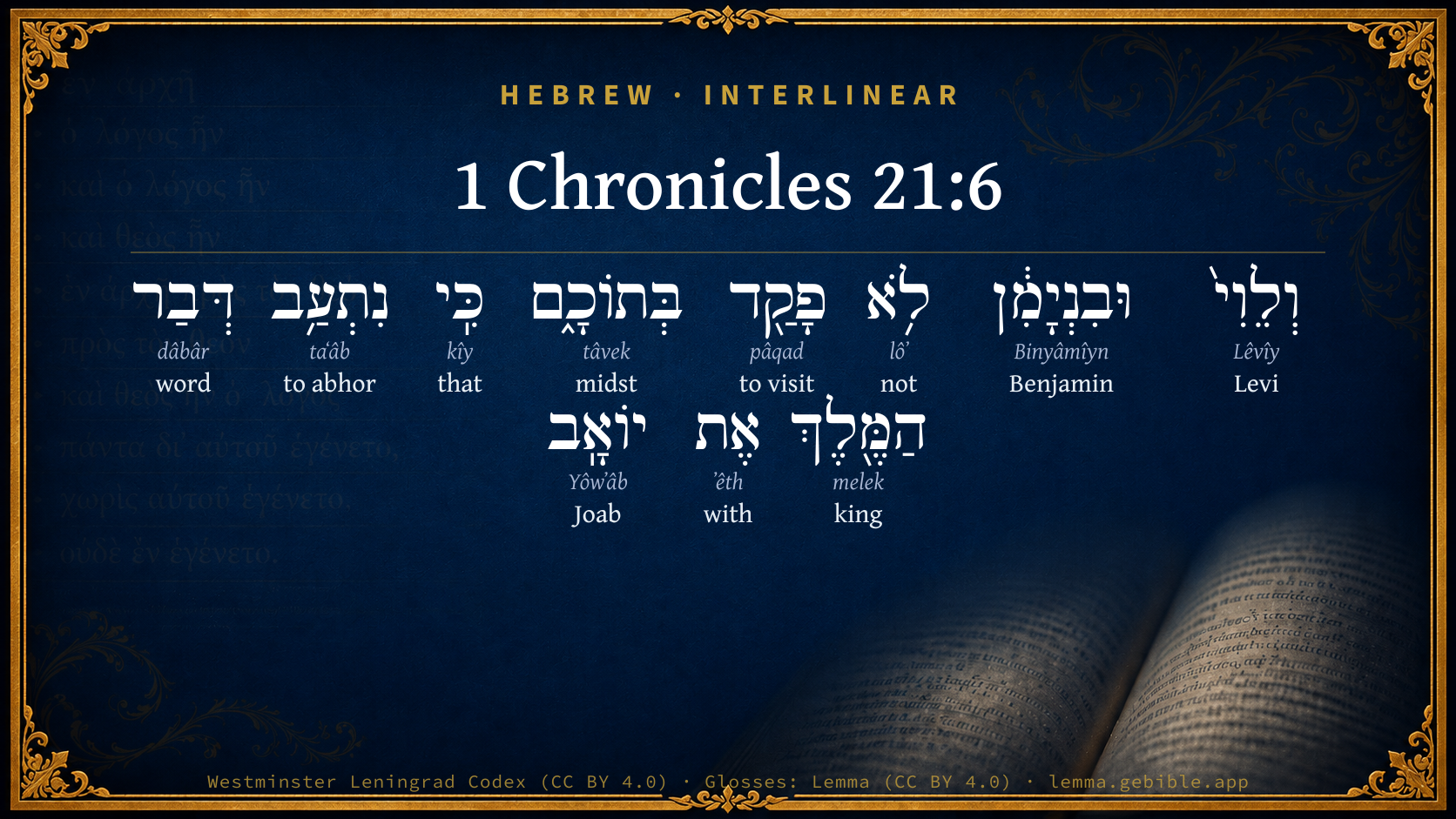
  1. וְלֵוִי֙ Lêvîy H3878 “and · Levi” Conjunction + Noun, Proper
  2. וּבִנְיָמִ֔ן Binyâmîyn H1144 “and · Benjamin” Conjunction + Noun, Proper
  3. לֹ֥א lôʼ H3808 “not” Particle, Negative
  4. פָקַ֖ד pâqad H6485 “to visit” Verb, Qal, Perfect, 3rd Person, Masculine, Singular
  5. בְּתוֹכָ֑ם tâvek H8432 “in/at · midst · their” Preposition + Noun, Common, Masculine, Singular, Construct + Suffix, Personal, 3rd Person, Masculine, Plural
  6. כִּֽי kîy H3588 “that” Conjunction
  7. דְּבַר dâbâr H1697 “word of” Noun, Common, Masculine, Singular, Construct
  8. הַמֶּ֖לֶךְ melek H4428 “the · king” Particle, Definite Article + Noun, Common, Masculine, Singular, Absolute
  9. אֶת ʼêth H854 “with” Preposition
  10. יוֹאָֽב Yôwʼâb H3097 “Joab” Noun, Proper

About this verse

These counts appear in no published source. They are computed here, from the morphology-tagged text and Lemma’s own curated glosses. What Lemma adds →

11
words
11
distinct lemmas
Historical
section

Notable vocabulary

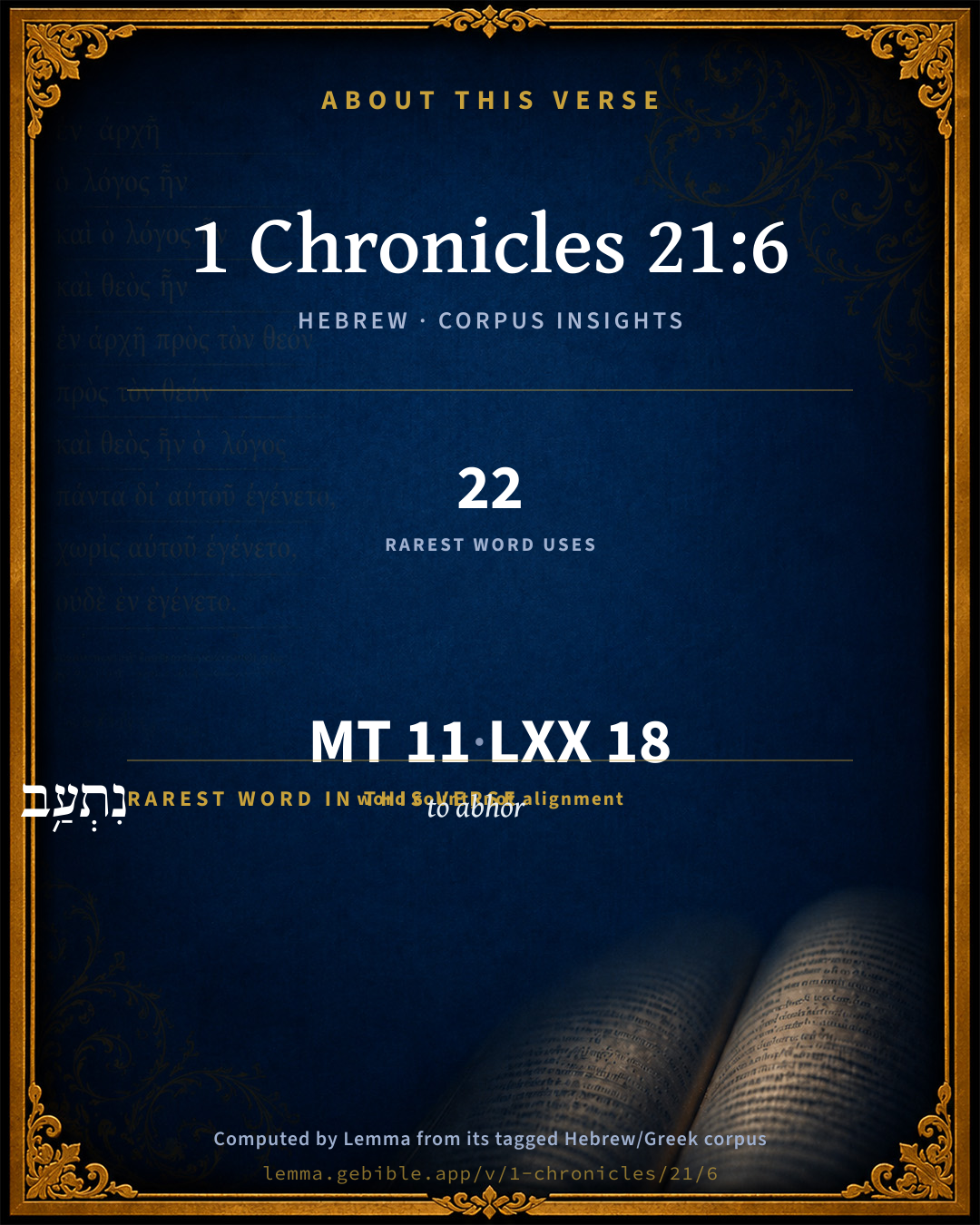
The rarest word here is נִתְעַ֥ב to abhor H8581 — appearing just 22 times in the whole Hebrew Bible.

Shared distinctive vocabulary

נִתְעַ֥ב to abhor H8581 occurs in 20 verses of the Hebrew Bible. Also found in:

Grammatical profile

  • 2 verbs
  • 6 nouns
  • 1 preposition
  • 1 conjunction
  • 1 particle

Verb forms

  • פָקַ֖ד Qal · Perfect
  • נִתְעַ֥ב Niphal · Perfect

Hebrew & Septuagint length

In English translation the verse runs 17 words from the Hebrew and 19 from the Septuagint (LXX English) — closely comparable.

A rough comparison of the two English renderings, which tokenize alike — not a word-level alignment.

Word counts can differ between the Hebrew and the Greek without any difference in meaning — e.g. the Hebrew direct-object marker אֵת has no separate Greek word, and Greek often adds the article ὁ.

In the original languages it is 11 Hebrew tokens and 18 Greek tokens — but the two are counted differently (Hebrew bundles its prefixes and suffixes into one token; the Greek is in lemma form), so that isn’t a like-for-like length.

Cross-references

5

Topical passages linked to 1 Chronicles 21:6 in the Treasury of Scripture Knowledge — connected by theme and wording, ordered by reader-vote popularity; previews shown in the World English Bible.

  • 1 Chronicles 27:24 Joab the son of Zeruiah began to number, but didn't finish; and there came wrath for this on Israel; neither was the number put into the account in the chronicles of king David.
  • Numbers 1:47–49 But the Levites after the tribe of their fathers were not numbered among them.
  • 2 Samuel 3:27 When Abner was returned to Hebron, Joab took him aside into the midst of the gate to speak with him quietly, and struck him there in the body, so that he died, for the blood of Asahel his brother.
  • 2 Samuel 11:15–21 He wrote in the letter, saying, Set Uriah in the forefront of the hottest battle, and retire you from him, that he may be struck, and die.
  • 2 Samuel 20:9–10 Joab said to Amasa, Is it well with you, my brother? Joab took Amasa by the beard with his right hand to kiss him.

Cross-references courtesy of OpenBible.info (CC BY 4.0).

Hebrew and Greek witnesses Masoretic Hebrew ↔ Greek Septuagint

The same verse in the two great witnesses to the Old Testament, shown verse-for-verse.

These are two independent witnesses, not word-aligned to each other, and the Septuagint is shown in lemma (dictionary) form.

Hebrew 1 Chronicles 21:6 Masoretic · Westminster Leningrad Codex

וְלֵוִי֙ וּבִנְיָמִ֔ן לֹ֥א פָקַ֖ד בְּתוֹכָ֑ם כִּֽי נִתְעַ֥ב דְּבַר הַמֶּ֖לֶךְ אֶת יוֹאָֽב

But he didn't count Levi and Benjamin among them; for the king's word was abominable to Joab.

World English Bible · Public Domain

Greek LXX 1 Chronicles 21:6 Septuagint · lemma form

καί ὁ λευί καί ὁ βενιαμίν οὐ ἀριθμέω ἐν μέσος αὐτός ὅτι καταἰσχύω λόγος ὁ βασιλεύς ὁ ιωαβ

But he numbered not Levi and Benjamin among them; for the word of the king was painful to Joab.

LXX2012 (modern English Septuagint) · Public Domain

Hebrew: Westminster Leningrad Codex (CC BY 4.0). Greek: Septuagint (public domain); English from LXX2012 (modern English Septuagint) (Public Domain). How the Septuagint differs from the Hebrew →

Commentary

Notes on 1 Chronicles 21:6 from classic Christian and Jewish commentators (each source and its license shown beneath its notes). The classic Christian expositions comment on the surrounding passage and are grouped to its opening verse, so a note may address several verses; the Jewish commentaries on the Tanakh (Rashi and others) are per-verse, so they appear only where the commentator wrote on this verse.

Lemma curates 59 commentaries, every one of them public domain or Creative Commons licensed, each selected and text-cleaned for this edition rather than reprinted as found. About our sources →

Joseph Benson's Commentary

1Ch 21:6. Levi and Benjamin counted he not — Partly for the following reason, and principally by God’s gracious providence to Levi, because they were devoted to his service; and to Benjamin, because they were the least of all the tribes, having been almost extinct, (Judges 21.,) and because God foresaw that they would be faithful to the house of David in the division of the tribes, and therefore he would not have them diminished. And Joab also presumed to leave these two tribes unnumbered, because he had specious pretences for it; for Levi, because they were no warriors, and the king’s command reached only of those that drew sword; and for Benjamin, because they, being so small a tribe, and bordering upon Jerusalem, might easily be numbered afterward.

Joseph Benson's Commentary on the Old and New Testaments (1811–1818) — public domain. Text from a community e-Sword module.

Jamieson, Fausset & Brown

Robert Jamieson, A. R. Fausset & David Brown

Levi and Benjamin counted he not--If this census was ordered with a view to the imposition of taxes, this alone would account for Levi, who were not warriors (Ch1 21:5), not being numbered (see on Num 1:47-54). The population of Benjamin had been taken (see on Ch1 7:6-11), and the register preserved in the archives of that tribe. This, however, was taken on another occasion, and by other agency than that of Joab. The non-numbering of these two tribes might have originated in the special and gracious providence of God, partly because Levi was devoted to His service, and Benjamin had become the least of all the tribes (Jdg. 21:1-25); and partly because God foresaw that they would remain faithful to the house of David in the division of the tribes, and therefore He would not have them diminished [POOLE]. From the course followed in this survey (see on Sa2 24:4-8), it would appear that Judah and Benjamin were the last tribes that were to be visited; and that, after the census in Judah had been finished, Joab, before entering on that of Benjamin, had to return to Jerusalem, where the king, now sensible of his great error, gave orders to stop all further proceedings in the business. Not only the remonstrance of Joab at the first, but his slow progress in the survey (Sa2 24:8) showed the strong repugnance and even horror of the old general at this unconstitutional measure.

Jamieson, Fausset & Brown — Commentary Critical and Explanatory on the Whole Bible (1871) — public domain (CC PDM 1.0). Text via the HelloAO Bible API.

Adam Clarke's Commentary

Verse 6. Levi and Benjamin counted he not] The rabbins give the following reason for this: Joab, seeing that this would bring down destruction upon the people, purposed to save two tribes. Should David ask, Why have you not numbered the Levites? Joab purposed to say, Because the Levites are not reckoned among the children of Israel. Should he ask, Why have you not numbered Benjamin? he would answer, Benjamin has been already sufficiently punished, on account of the treatment of the woman at Gibeah: if, therefore, this tribe were to be again punished, who would remain?

Adam Clarke's Commentary on the Bible (1810–1826) — public domain. Text from a community e-Sword/MySword module.

Ellicott's Commentary for English Readers

(6) But Levi . . .—This verse is wanting in Samuel, but it probably existed in the original source. There is nothing in the style to suggest a later hand; while the word “counted” (pâqad), which has not been used before in this chapter, occurs twice in the parallel passage (2Sa_24:2; 2Sa_24:4). It is noticeable also that the chronicler writes “the king” (not “David”) here, as in Samuel.

As regards the fact stated, we may observe that the sacerdotal tribe of Levi would naturally be exempted from a census taken for military or political purposes. (Comp. Num_1:47; Num_1:49.) And 1Ch_27:24 expressly asserts that the census was not completed; a result with which Joab’s disapprobation of the scheme may have had much to do. The order in which the tribes were numbered (2Sa_24:4-8; see 1Ch_21:4) makes it likely that Judah and Benjamin were to have been taken last, and that, after numbering Judah, Joab repaired to the capital, where he was ordered by the king to desist from the undertaking. Josephus (Antiq. vii. 13, 1) speaks as if Joab had not had time to include Benjamin in the census. He may have feared to give offence to the tribe of Saul.

A Bible Commentary for English Readers, edited by Charles John Ellicott (1878–1897) — public domain. Text from a community e-Sword module.

The Cambridge Bible for Schools and Colleges

gen. ed. J. J. S. Perowne

6. Levi] In Num_1:49 it is ordained that Levi is not to be numbered among the children of Israel, i.e. treated as liable to military service. The Levites were, however, numbered separately; Num_3:15; Num_26:57. in 2 Sam. there is nothing to correspond with this verse.

The Cambridge Bible for Schools and Colleges (gen. ed. J. J. S. Perowne; Cambridge University Press, 1878–1918) — public domain. Text from a community e-Sword module.

Albert Barnes' Notes on the Bible

To omit the Levites would be to follow the precedent recorded in Num 1:47-49. The omission of Benjamin must he ascribed to a determination on the part of Joab to frustrate the king’s intention, whereby he might hope to avert God’s wrath from the people.

Albert Barnes' Notes on the Bible (1834–1885) — public domain. Text from a community e-Sword/MySword module.

Haydock's Catholic Bible Commentary

Number. These might therefore escape the pestilence. (Du Hamel) --- For. Hebrew, "because the king’s word was abominable to Joab." We read that Benjamin was numbered unto David, chap. vii. 5, 11. But that might be on another occasion; or the register continued in the archives, and was not brought to the king. See chap. xxvii. 24. (Calmet)

George Leo Haydock (1774–1849), Haydock's Catholic Family Bible and Commentary, 1859 edition — public domain. Excludes Psalms (Douay-Rheims chapter numbering differs from Protestant) and Deuterocanonical books (Catholic canon only).

Matthew Poole's English Annotations

Levi and Benjamin counted he not among them; partly for the following reason, and principally by God’s special and gracious providence to these two tribes; to Levi, because they were devoted to his service; and to Benjamin, because they were the least of all the tribes, having been almost extinct, Jdg 21, and because God foresaw that they would be faithful to the house of David in the division of the tribes, and therefore he would not have them diminished. And Joab presumed to leave these two tribes unnumbered, because he had specious pretences for it; for Levi, because they were no warriors, and the king’s command reached only to those that drew sword, as appears from 1Ch 21:5; and for Benjamin, because they, being so small a tribe, and bordering upon Jerusalem their chief city, might easily be numbered afterward.

Matthew Poole's English Annotations on the Holy Bible (1683–1685) — public domain. Text from a community e-Sword/MySword module.

Whedon's Commentary on the Bible

Daniel D. Whedon

6. Levi and Benjamin counted he not — The Levites were not numbered by Moses in obedience to the command which was given at Sinai, “Thou shalt not number the tribe of Levi, neither take the sum of them among the children of Israel.” Num_1:49. Because of this command they were not reckoned by David. The Benjamites were not numbered, probably, as Bertheau explains, because the numbering was stopped before the census of that tribe was taken. The writer gives as a reason that the king’s word was abominable to Joab. Joab discerned at the beginning of the matter that it was fraught with evil omen, (see on 2Sa_24:3,) and his opposition to the measure served, probably, to stop the census sooner than would otherwise have been the case. The coming of the pestilence put an effectual stop to Joab’s work. 1Ch_27:24.

Daniel D. Whedon (gen. ed.), Commentary on the Old and New Testaments (1874–1909) — public domain. Text from a community e-Sword module.

The Pulpit Commentary

Averse to his task as Joab was, he may have been indebted to the memory of the exemption of Levi from census for the idea of enlarging upon it and omitting Benjamin as well. The important contents of this short verse are not found in Samuel, so that we can borrow no light thence. But Benjamin was "the least of the tribes", (Jud 21:1-23) and Peele has suggested that God would not permit the numbers of either of these tribes to be lessened, as he foresaw that they would be faithful to the throne of David on the division of the kingdom. Others think that the omission of these tribes in the census may have been due to Joab"s recall to Jerusalem before the completion of the work, and to the king"s repentance in the interim cutting off the necessity of completing it. This little agrees, however, with the resolute tone and assigned reason contained in this verse. Peele"s explanation, meantime, explains nothing in respect of the statement that the king"s word was abominable to Joab.

The Pulpit Commentary (1880–1919), ed. H.D.M. Spence-Jones & Joseph S. Exell — public domain. Text from a community e-Sword module.

John Wesley's Explanatory Notes

Counted not - Partly for the following reason; and principally by God's gracious providence to Levi, because they were devoted to his service; and to Benjamin, because they were the least of all the tribes, having been almost extinct, Judg. xxi, 6, and because God foresaw that they would be faithful to the house of David in the division of the tribes, and therefore he would not have them diminished. And Joab also presumed to leave these two tribes unnumbered, because he had specious pretenses for it; for Levi, because they were no warriors, and the king's command reached only of those that drew sword. And for Benjamin, because they, being so small a tribe, and bordering upon Jerusalem, might easily be numbered afterward.

John Wesley, Explanatory Notes Upon the Whole Bible (1754–1765) — public domain. Text via the GEBible commentary corpus.

unfoldingWord translationNotes

Door43 World Missions Community

But Levi and Benjamin were not counted among them

The Levites were supposed to lead worship and not to fight. It is unclear why Joab did not count Benjamin. This can be stated in active voice. AT: "But Joab did not count the men from the tribes of Levi and Benjamin" (See: Active or Passive)

the king's command had disgusted Joab

This can be stated in active form. AT: "Joab was offended by what David had commanded" (See: Active or Passive)

by this action

Here "this action" refers to David's plan to count all the men of Israel who are able to fight.

so he attacked Israel

The nature of this attack is not clear. It was apparently enough to cause David to realize that Yahweh was angry with him for counting the people.

take away your servant's guilt

This is an idiom. Forgiveness is here spoken of as having guilt taken away. AT: "forgive me" (See: Idiom)

your servant's guilt

David refers to himself as God's servant. AT: "my guilt" (See: First, Second, or Third Person)

translationWords

Levi

Benjamin

command

God

sin

servant

guilt

fool

unfoldingWord translationNotes — © Distant Shores Media and the Door43 World Missions Community, licensed CC BY-SA 4.0. Source: git.door43.org/Door43/en_tn.

Rashi

Rabbi Shlomo Yitzchaki (Rashi)

But Levi and Benjamin he did not count among them, etc. Joab knew that it would be considered a sin for the people, leading to a plague; Joab therefore said, “I can save these tribes from the census. Concerning Levi, if David says: ‘Why did you not count Levi?’ I shall answer him that they were not counted among the Children of Israel (Num. 2:33). And this is what I shall say about Benjamin: ‘Weren’t they stricken in the episode of the concubine in Gibeah? If they are afflicted now, what will be left of them?’”

Rashi on the Tanakh — English translations: “The Judaica Press complete Tanach with Rashi, translated by A. J. Rosenberg” (CC BY 4.0); “Pentateuch with Rashi's commentary by M. Rosenbaum and A.M. Silbermann, 1929-1934” (public domain); “The Metsudah Tanach series, Lakewood, N.J” (CC BY 4.0); and “The Book of Joshua, Metsudah Publications, 1997” (CC BY 4.0). Text via Sefaria.

Lesson kit

Teaching starters — assembled from the data on this page, not authored interpretation. Every prompt links to the verse data it draws on. Edit before teaching.

1 Chronicles, in the Historical, opens this verse with 11 words (11 distinct Hebrew lemmas). Its most distinctive word is taʻâb (“to abhor”). A historical commentator’s framing appears above. Read the whole chapter for the surrounding context.

Discussion questions

  1. The word taʻâb carries the sense “to abhor.” How does it shape the verse?
  2. Deuteronomy 7:26 shares the word «to abhor» with this verse. How do the two illuminate each other?
  3. The translations on this page render this verse differently — a whole-verse word diff, not a word-by-word alignment. What might account for the different wordings?
  4. The verb «פָקַ֖ד» is Qal Perfect. How does its form color the action?
  5. Reading how Joseph Benson's Commentary and Jamieson, Fausset & Brown read this verse, where do the two commentators agree and where do they part?

Things to notice

Reading settings

Reading text

Shown beneath each verse's original-language words.

Old Testament
Old Testament edition

Read the OT as the Masoretic Hebrew (MT) or the Greek Septuagint (LXX).

English shown for the Greek Septuagint (in the Hebrew ↔ Greek comparison).

Comparing translations? Open the Compare panel on any verse page to stack up to four side by side.