
Joshua 4:10

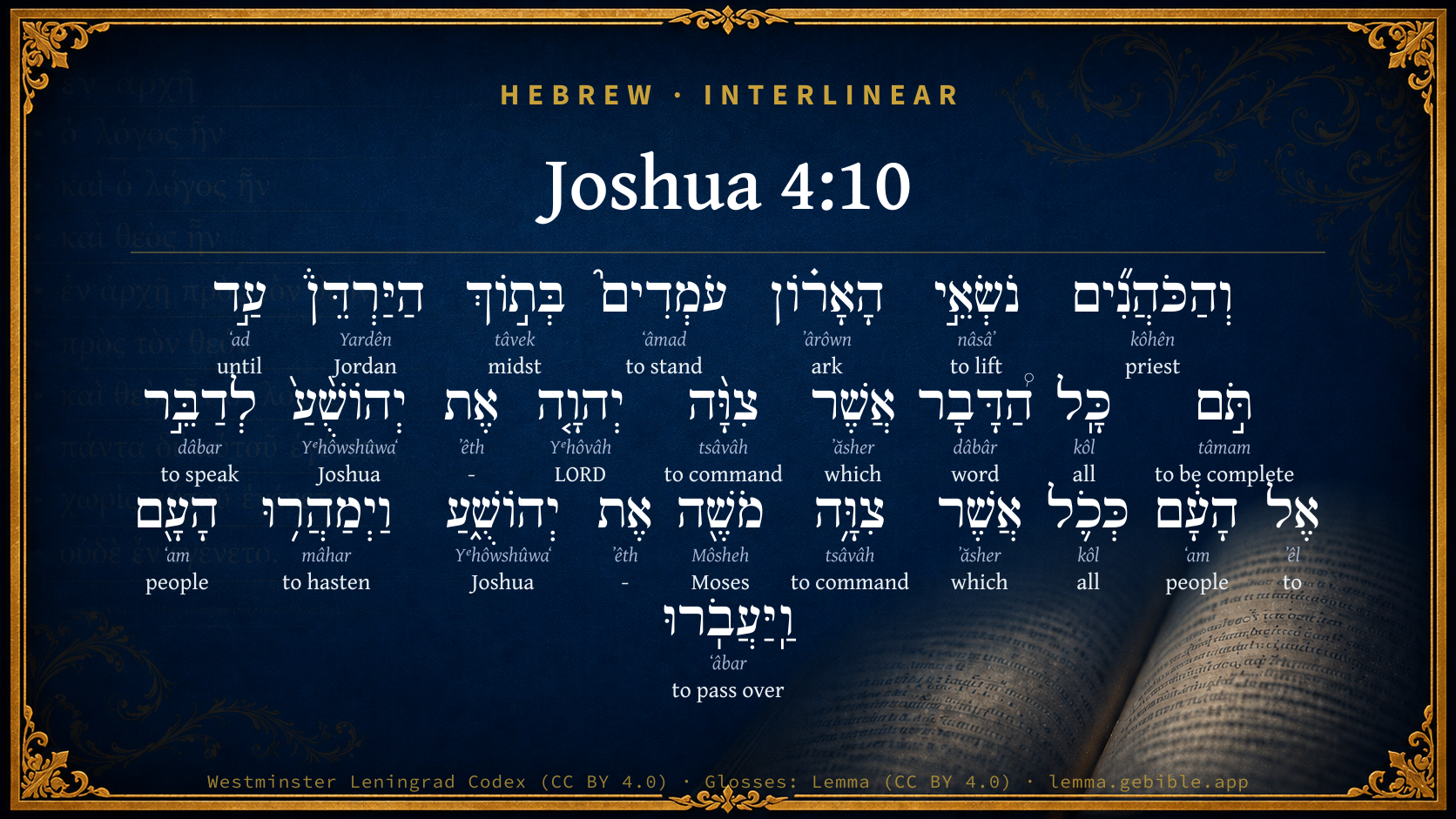
Hebrew (Westminster Leningrad Codex) Joshua 4:10 appears in the Hebrew Old Testament. The text above is from the Westminster Leningrad Codex. Each word links to its Strong’s number, a concise gloss, and parsing drawn from the Open Scriptures Hebrew Bible morphology. Click any word for its full Brown-Driver-Briggs (BDB) entry.
Download image
Cite this verse

Joshua 4:10 (World English Bible). Public Domain. Lemma interlinear Bible study tool, https://lemma.gebible.app/v/joshua/4/10.

Show BibTeX & RIS
BibTeX
RIS
English Translation
For the priests who bore the ark stood in the midst of the Jordan, until everything was finished that Yahweh commanded Joshua to speak to the people, according to all that Moses commanded Joshua: and the people hurried and passed over.
World English Bible · Public Domain
Download a study sheet

One document with this verse’s original text, its word-by-word gloss line, the meaning frame, cross-references with their text, attributed commentary, and full source and license credits — printable, and it pastes into notes with its structure intact.

This verse Autodidact and up

Study sheet (.html) Plain text (.txt)

A passage Seminary Student

Up to 50 verses in one chapter. A passage sheet keeps up to 6 commentary sources and 12 cross-references per verse, in the order this page ranks them, and says so on the sheet whenever that leaves anything out. Ask for a single verse and you get the Autodidact verse sheet above.

Everything on this page stays free to read, with no account — the sheet is a download of what is already on screen, not access to it.

Want to remove ads? Support Godless Engineer
Compare translations 3

The same verse in 3 English versions, stacked beneath the original-language interlinear above. Click any original word for its lexicon entry.

Each is an independent rendering of the whole verse — the interlinear is not word-aligned to these translations.

Highlighted words mark where these versions differ — a whole-verse word diff, not a word-by-word alignment.

  • World English Bible Public Domain
    For the priests who bore the ark stood in the midst of the Jordan, until everything was finished that Yahweh commanded Joshua to speak to the people, according to all that Moses commanded Joshua: and the people hurried and passed over.
  • King James Version Public Domain
    For the priests which bare the ark stood in the midst of Jordan, until everything was finished that the LORD commanded Joshua to speak unto the people, according to all that Moses commanded Joshua: and the people hasted and passed over.
  • unfoldingWord Literal Text CC BY-SA 4.0
    And the priests, the carriers of the Box, stood in the midst of the Jordan until the finishing of all of the thing that Yahweh had commanded Joshua to speak to the people, according to all of what Moses had commanded Joshua. And the people hurried and crossed over.

unfoldingWord Literal Text — © unfoldingWord, licensed CC BY-SA 4.0. Word-aligned USFM3 via Door43 (git.door43.org/unfoldingWord/en_ult).

Versions to compare (up to 4)

3 of 4 selected

Show all 18 translations

Every available English version of this verse, each an independent rendering of the whole verse.

  • World English Bible Public Domain
    For the priests who bore the ark stood in the midst of the Jordan, until everything was finished that Yahweh commanded Joshua to speak to the people, according to all that Moses commanded Joshua: and the people hurried and passed over.
  • Berean Standard Bible Public Domain
    Now the priests who carried the ark remained standing in the middle of the Jordan until the people had completed everything the LORD had commanded Joshua to tell them, just as Moses had directed Joshua. The people hurried across,
  • Majority Standard Bible Public Domain
    Now the priests who carried the ark remained standing in the middle of the Jordan until the people had completed everything the LORD had commanded Joshua to tell them, just as Moses had directed Joshua. The people hurried across,
  • King James Version Public Domain
    For the priests which bare the ark stood in the midst of Jordan, until everything was finished that the LORD commanded Joshua to speak unto the people, according to all that Moses commanded Joshua: and the people hasted and passed over.
  • American Standard Version (1901) Public Domain
    For the priests that bare the ark stood in the midst of the Jordan, until everything was finished that Jehovah commanded Joshua to speak unto the people, according to all that Moses commanded Joshua: and the people hasted and passed over.
  • Revised Version (1885) Public Domain
    For the priests which bare the ark stood in the midst of Jordan, until every thing was finished that the LORD commanded Joshua to speak unto the people, according to all that Moses commanded Joshua: and the people hasted and passed over.
  • Geneva Bible (1599) Public Domain
    So the Priests, which bare ye Arke, stoode in the middes of Iorden, vntill euery thing was finished that ye Lord had comanded Ioshua to say vnto the people, according to all that Moses charged Ioshua: then the people hasted and went ouer.
  • Douay-Rheims (1899) Public Domain
    Now the priests that carried the ark, stood in the midst of the Jordan till all things were accomplished which the Lord had commanded Josue to speak to the people, and Moses had said to him. And the people made haste and passed over.
  • Young's Literal Translation Public Domain
    And the priests bearing the ark are standing in the midst of the Jordan till the completion of the whole thing which Jehovah commanded Joshua to speak unto the people, according to all that Moses commanded Joshua, and the people haste and pass over.
  • Literal Standard Version CC BY-SA 4.0
    And the priests carrying the Ark are standing in the midst of the Jordan until the completion of the whole thing which YHWH commanded Joshua to speak to the people, according to all that Moses commanded Joshua, and the people hurry and pass over.
  • Unlocked Literal Bible CC BY-SA 4.0
    The priests that carried the ark stood in the middle of the Jordan until everything that Yahweh commanded Joshua to tell the people was completed, according to all that Moses had commanded Joshua. The people hurried and they crossed over.
  • unfoldingWord Literal Text CC BY-SA 4.0
    And the priests, the carriers of the Box, stood in the midst of the Jordan until the finishing of all of the thing that Yahweh had commanded Joshua to speak to the people, according to all of what Moses had commanded Joshua. And the people hurried and crossed over.
  • Darby Bible Public Domain
    And the priests who bore the ark stood in the midst of the Jordan, until everything was finished that Jehovah had commanded Joshua to speak unto the people, according to all that Moses had commanded Joshua. And the people hasted and passed over.
  • World Messianic Bible Public Domain
    For the priests who bore the ark stood in the middle of the Jordan until everything was finished that the LORD commanded Joshua to speak to the people, according to all that Moses commanded Joshua; and the people hurried and passed over.
  • Webster's Bible Public Domain
    For the priests who bore the ark stood in the midst of Jordan, until every thing was finished that the LORD commanded Joshua to speak to the people, according to all that Moses commanded Joshua: and the people hasted and passed over.
  • Free Bible Version CC BY-SA 4.0
    The priests carrying the Ark remained standing in the middle of the Jordan until everything was done just as the Lord had told the people to do, all that Moses had told Joshua to do. The people crossed over quickly.
  • Bible in Basic English Public Domain
    For the priests who took up the ark kept there in the middle of Jordan till all the orders given to Joshua by Moses from the Lord had been done: then the people went over quickly.
  • JPS Tanakh (1917) Public Domain
    And the priests that bore the ark stood in the midst of the Jordan, until every thing was finished that the LORD commanded Joshua to speak unto the people, according to all that Moses commanded Joshua; and the people hastened and passed over.

Literal Standard Version (2020), Covenant Press — licensed CC BY-SA 4.0. Text via the HelloAO Bible API (eBible.org). Unlocked Literal Bible (unfoldingWord) — licensed CC BY-SA 4.0. Text via the HelloAO Bible API (eBible.org). unfoldingWord Literal Text — © unfoldingWord, licensed CC BY-SA 4.0. Word-aligned USFM3 via Door43 (git.door43.org/unfoldingWord/en_ult). Free Bible Version, Dr. Jonathan Gallagher — licensed CC BY-SA 4.0. Text via the HelloAO Bible API (eBible.org).

Word by word

More ways to search: Search by grammar → Find every occurrence → Compare this word →

Practice this passage: Drill this verse → Learn its vocabulary →

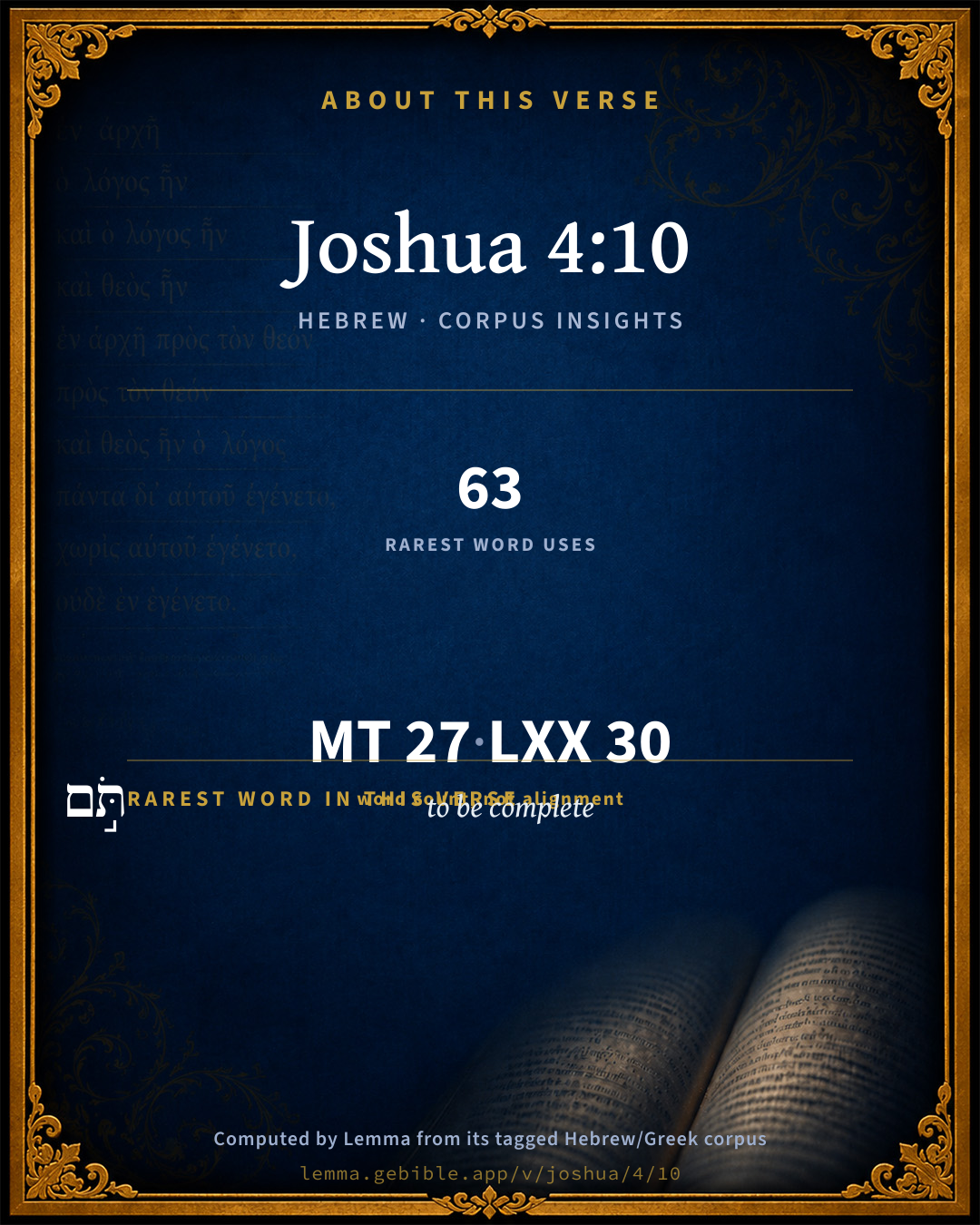
תֹּ֣ם
tâmam
H8552
“to be complete”
Verb, Qal, Infinitive Construct
Part of Speech
Verb
Stem
Qal
Form
Infinitive Construct
Full BDB Definition

Origin: a primitive root

TWOT: 2522

to be complete, be finished, be at an end - (Qal) - to be finished, be completed - completely, wholly, entirely (as auxiliary with verb) - to be finished, come to an end, cease - to be complete (of number) - to be consumed, be exhausted, be spent - to be finished, be consumed, be destroyed - to be complete, be sound, be unimpaired, be upright - to complete, finish - to be completely crossed over - (Niphal) to be consumed - (Hiphil) - to finish, complete, perfect - to finish, cease doing, leave off doing - to complete, sum up, make whole - to destroy (uncleanness) - to make sound - (Hithpael) to deal in integrity, act uprightly
  1. וְהַכֹּהֲנִ֞ים kôhên H3548 “and · the · priests” Conjunction + Particle, Definite Article + Noun, Common, Masculine, Plural, Absolute
  2. נֹשְׂאֵ֣י nâsâʼ H5375 “lifting” Verb, Qal, Participle Active, Masculine, Plural, Construct
  3. הָאָר֗וֹן ʼârôwn H727 “the · ark” Particle, Definite Article + Noun, Common, Both, Singular, Absolute
  4. עֹמְדִים֮ ʻâmad H5975 “standing” Verb, Qal, Participle Active, Masculine, Plural, Absolute
  5. בְּת֣וֹךְ tâvek H8432 “in/at · midst of” Preposition + Noun, Common, Masculine, Singular, Construct
  6. הַיַּרְדֵּן֒ Yardên H3383 “the · Jordan” Particle, Definite Article + Noun, Proper
  7. עַ֣ד ʻad H5704 “until” Preposition
  8. כָּֽל kôl H3605 “all of” Noun, Common, Masculine, Singular, Construct
  9. הַ֠דָּבָר dâbâr H1697 “the · word” Particle, Definite Article + Noun, Common, Masculine, Singular, Absolute
  10. אֲשֶׁר ʼăsher H834 “which” Particle, Relative
  11. צִוָּ֨ה tsâvâh H6680 “to command” Verb, Piel, Perfect, 3rd Person, Masculine, Singular
  12. יְהוָ֤ה Yᵉhôvâh H3068 “LORD” Noun, Proper
  13. אֶת ʼêth H853 “-” Particle, Direct Object
  14. יְהוֹשֻׁ֨עַ֙ Yᵉhôwshûwaʻ H3091 “Joshua” Noun, Proper
  15. לְדַבֵּ֣ר dâbar H1696 “to speak” Preposition + Verb, Piel, Infinitive Construct
  16. אֶל ʼêl H413 “to” Preposition
  17. הָעָ֔ם ʻam H5971 “the · people” Particle, Definite Article + Noun, Common, Masculine, Singular, Absolute
  18. כְּכֹ֛ל kôl H3605 “like/as · all” Preposition + Noun, Common, Masculine, Singular, Absolute
  19. אֲשֶׁר ʼăsher H834 “which” Particle, Relative
  20. צִוָּ֥ה tsâvâh H6680 “to command” Verb, Piel, Perfect, 3rd Person, Masculine, Singular
  21. מֹשֶׁ֖ה Môsheh H4872 “Moses” Noun, Proper
  22. אֶת ʼêth H853 “-” Particle, Direct Object
  23. יְהוֹשֻׁ֑עַ Yᵉhôwshûwaʻ H3091 “Joshua” Noun, Proper
  24. וַיְמַהֲר֥וּ mâhar H4116 “and · to hasten” Conjunction + Verb, Piel, Sequential Imperfect, 3rd Person, Masculine, Plural
  25. הָעָ֖ם ʻam H5971 “the · people” Particle, Definite Article + Noun, Common, Masculine, Singular, Absolute
  26. וַֽיַּעֲבֹֽרוּ ʻâbar H5674 “and · to pass over” Conjunction + Verb, Qal, Sequential Imperfect, 3rd Person, Masculine, Plural

About this verse

These counts appear in no published source. They are computed here, from the morphology-tagged text and Lemma’s own curated glosses. What Lemma adds →

27
words
21
distinct lemmas
Historical
section

Grammatical profile

  • 8 verbs
  • 13 nouns
  • 2 prepositions
  • 4 particles

Verb forms

  • נֹשְׂאֵ֣י Qal · Participle Active
  • עֹמְדִים֮ Qal · Participle Active
  • תֹּ֣ם Qal · Infinitive Construct
  • צִוָּ֨ה Piel · Perfect
  • לְדַבֵּ֣ר Piel · Infinitive Construct
  • צִוָּ֥ה Piel · Perfect
  • וַיְמַהֲר֥וּ Piel · Sequential Imperfect
  • וַֽיַּעֲבֹֽרוּ Qal · Sequential Imperfect

Repetition

Words recur within this verse — often emphatic in Hebrew:

  • כָּֽל all H3605 ×2
  • צִוָּ֨ה to command H6680 ×2
  • יְהוֹשֻׁ֨עַ֙ Joshua H3091 ×2
  • הָעָ֔ם people H5971 ×2
  • אֲשֶׁר which H834 ×2

Hebrew & Septuagint length

In English translation the verse runs 41 words from the Hebrew and 35 from the Septuagint (LXX English) — closely comparable.

A rough comparison of the two English renderings, which tokenize alike — not a word-level alignment.

Word counts can differ between the Hebrew and the Greek without any difference in meaning — e.g. the Hebrew direct-object marker אֵת has no separate Greek word, and Greek often adds the article ὁ.

In the original languages it is 27 Hebrew tokens and 30 Greek tokens — but the two are counted differently (Hebrew bundles its prefixes and suffixes into one token; the Greek is in lemma form), so that isn’t a like-for-like length.

Cross-references

11

Topical passages linked to Joshua 4:10 in the Treasury of Scripture Knowledge — connected by theme and wording, ordered by reader-vote popularity; previews shown in the World English Bible.

  • Joshua 3:13 It shall come to pass, when the soles of the feet of the priests who bear the ark of Yahweh, the Lord of all the earth, shall rest in the waters of the Jordan, that the waters of the Jordan shall be cut off, even the waters that come down from above; and they shall stand in one heap.
  • Exodus 12:39 They baked unleavened cakes of the dough which they brought forth out of Egypt; for it wasn't leavened, because they were thrust out of Egypt, and couldn't wait, neither had they prepared for themselves any food.
  • Numbers 27:21–23 He shall stand before Eleazar the priest, who shall inquire for him by the judgment of the Urim before Yahweh: at his word shall they go out, and at his word they shall come in, both he, and all the children of Israel with him, even all the congregation.
  • Deuteronomy 31:9 Moses wrote this law, and delivered it to the priests the sons of Levi, who bore the ark of the covenant of Yahweh, and to all the elders of Israel.
  • Joshua 3:16–17 that the waters which came down from above stood, and rose up in one heap, a great way off, at Adam, the city that is beside Zarethan; and those that went down toward the sea of the Arabah, even the Salt Sea, were wholly cut off: and the people passed over right against Jericho.
  • Psalms 119:60 I will hurry, and not delay, To obey your commandments.
  • Proverbs 27:1 Don't boast about tomorrow; For you don't know what a day may bring forth.
  • Ecclesiastes 9:10 Whatever your hand finds to do, do it with your might; for there is no work, nor device, nor knowledge, nor wisdom, in Sheol, where you are going.
  • Isaiah 28:16 therefore thus says the Lord Yahweh, Behold, I lay in Zion for a foundation a stone, a tried stone, a precious corner -[stone] of sure foundation: he who believes shall not be in haste.
  • 2 Corinthians 6:2 for he says, "At an acceptable time I listened to you, In a day of salvation I helped you." Behold, now is the acceptable time. Behold, now is the day of salvation.
  • Hebrews 3:7–8 Therefore, even as the Holy Spirit says, "Today if you will hear his voice,

Cross-references courtesy of OpenBible.info (CC BY 4.0).

Hebrew and Greek witnesses Masoretic Hebrew ↔ Greek Septuagint

The same verse in the two great witnesses to the Old Testament, shown verse-for-verse.

These are two independent witnesses, not word-aligned to each other, and the Septuagint is shown in lemma (dictionary) form.

Hebrew Joshua 4:10 Masoretic · Westminster Leningrad Codex

וְהַכֹּהֲנִ֞ים נֹשְׂאֵ֣י הָאָר֗וֹן עֹמְדִים֮ בְּת֣וֹךְ הַיַּרְדֵּן֒ עַ֣ד תֹּ֣ם כָּֽל הַ֠דָּבָר אֲשֶׁר צִוָּ֨ה יְהוָ֤ה אֶת יְהוֹשֻׁ֨עַ֙ לְדַבֵּ֣ר אֶל הָעָ֔ם כְּכֹ֛ל אֲשֶׁר צִוָּ֥ה מֹשֶׁ֖ה אֶת יְהוֹשֻׁ֑עַ וַיְמַהֲר֥וּ הָעָ֖ם וַֽיַּעֲבֹֽרוּ

For the priests who bore the ark stood in the midst of the Jordan, until everything was finished that Yahweh commanded Joshua to speak to the people, according to all that Moses commanded Joshua: and the people hurried and passed over.

World English Bible · Public Domain

Greek LXX Joshua 4:10 Septuagint · lemma form

ἵστημι δέ ὁ ἱερεύς ὁ αἴρω ὁ κιβωτός ὁ διαθήκη ἐν ὁ ἰορδάνης ἕως ὅς συντελέω ἰησοῦς πᾶς ὅς ἐντέλλομαι κύριος ἀναἀγγέλλω ὁ λαός καί σπεύδω ὁ λαός καί διαβαίνω

And the priests that bore the ark of the covenant stood in Jordan, until Joshua had finished all that the Lord commanded him to report to the people; and the people hasted and passed over.

LXX2012 (modern English Septuagint) · Public Domain

On this verse, John Gill's Exposition discusses the Septuagint’s reading. Read the note in Commentary ↓

Hebrew: Westminster Leningrad Codex (CC BY 4.0). Greek: Septuagint (public domain); English from LXX2012 (modern English Septuagint) (Public Domain). How the Septuagint differs from the Hebrew →

Targum (Aramaic paraphrase)

1

The Targum is the ancient Jewish Aramaic paraphrase of the Hebrew Scriptures — an interpretive translation, not the Hebrew text itself. Onkelos (literal) and Pseudo-Jonathan (expansive) render the Torah, and Jonathan the Prophets. Coverage is partial: where no permissively-licensed English translation exists for a verse, only the Aramaic is shown. This is verse-level text, not a word-by-word alignment to the Hebrew.

  1. Targum Jonathan Prophets (Joshua–Malachi)
    וְכַהֲנַיָא נַטְלֵי אֲרוֹנָא קַיְמִין בְּגוֹ יַרְדְנָא עַד דִשְׁלִים כָּל פִּתְגָמָא דְפַקֵיד יְיָ יַת יְהוֹשֻׁעַ לְמַלָלָא עִם עַמָא כְּכֹל דְפַקֵיד מֹשֶׁה יַת יְהוֹשֻׁעַ וְאוֹחִיאוּ עַמָא וַעֲבָרוּ:

    (no public-domain English translation for this verse)

    Targum Jonathan — Aramaic: “Mikraot Gedolot” (public domain). English: “Sefaria Community Translation” (CC0 1.0 (public-domain dedication)); “London "Chaldee Paraphrase," 1871” (public domain). Text via Sefaria.

Commentary

Notes on Joshua 4:10 from classic Christian and Jewish commentators (each source and its license shown beneath its notes). The classic Christian expositions comment on the surrounding passage and are grouped to its opening verse, so a note may address several verses; the Jewish commentaries on the Tanakh (Rashi and others) are per-verse, so they appear only where the commentator wrote on this verse.

Lemma curates 59 commentaries, every one of them public domain or Creative Commons licensed, each selected and text-cleaned for this edition rather than reprinted as found. About our sources →

Jamieson, Fausset & Brown

Robert Jamieson, A. R. Fausset & David Brown

THE PEOPLE PASS OVER. (Jos 4:10-13)

the priests which bare the ark stood in the midst of Jordan--This position was well calculated to animate the people, who probably crossed below the ark, as well as to facilitate Joshua's execution of the minutest instructions respecting the passage (Num 27:21-23). The unfaltering confidence of the priests contrasts strikingly with the conduct of the people, who "hasted and passed over." Their faith, like that of many of God's people, was, through the weakness of nature, blended with fears. But perhaps their "haste" may be viewed in a more favorable light, as indicating the alacrity of their obedience, or it might have been enjoined in order that the the whole multitude might pass in one day.

Jamieson, Fausset & Brown — Commentary Critical and Explanatory on the Whole Bible (1871) — public domain (CC PDM 1.0). Text via the HelloAO Bible API.

Trapp's Complete Commentary

John Trapp

Jos 4:10 For the priests which bare the ark stood in the midst of Jordan, until every thing was finished that the LORD commanded Joshua to speak unto the people, according to all that Moses commanded Joshua: and the people hasted and passed over.

Ver. 10. Until everything was finished.] They would not off the ground till the work was done; but by a heroical faith, there held them, when others feared and therefore hasted away.

And the people hasted and passed over.] Partly through desire of the promised land, but principally through fear of danger, by those hideous mountains of water which hung over their heads: a ghastly sight surely.

John Trapp, A Commentary or Exposition upon All the Books of the Old and New Testament (1647–1656) — public domain. Text from a community e-Sword module.

Joseph Benson's Commentary

Jos 4:10-11. The priests stood in the midst of Jordan till every thing was finished — The constancy of the priests, on this occasion, bears very honourable testimony to their faith and patience; for it must have taken up a considerable time, a whole day, at least, for the passage of six hundred thousand fighting men, besides the numerous people that accompanied them, with their baggage and provisions, and for the performing the other things here mentioned. The people hasted and passed over — Some understand this of the twelve men that carried the stones; but it seems rather to be meant of the body of the people; for though mention was made of their passing over, (Jos 4:1,) it is here repeated for the sake of this circumstance to be added, that they passed in haste. This, it is probable, they did, either because Joshua, by the officers, ordered them to make haste, that they might complete their passage before the night came on, or because the sight of the waters suspended on their right, struck them with terror, through the weakness of their faith. For, in so great a multitude of men, women, and children, it is not credible that all hearts were animated with the same confidence. Perhaps, also, some made haste that they might not either tempt God, by desiring a continuance of the miracle longer than was necessary, or try the patience of the priests too much by any unnecessary delay. It is most likely, however, that fear had the principal influence in causing them to hasten their march. The priests, on the contrary, who bore the ark, continued dauntless at their post, till at last, there remaining no one on the eastern shore, nor in the bed of the river, there was no further reason for their continuing in the midst of it, and therefore they were commanded by Joshua, who himself received an order from God to that purpose, (Jos 4:16-17,) to come up out of Jordan. Then, and not before, they crossed quite over; in the presence of the people — That is, in the sight of all Israel, who, no doubt, beheld with admiration, from the western bank of the river, both them and the ark which they carried over, and which had been the means of their safe passage. The place where the Israelites crossed has since been called Bethabara, which signifies the house of passage. It is mentioned Joh 1:28.

Joseph Benson's Commentary on the Old and New Testaments (1811–1818) — public domain. Text from a community e-Sword module.

The Preacher's Complete Homiletical Commentary

Joseph S. Exell (gen. ed.)

CRITICAL NOTES.

Jos_4:12. Before the children of Israel] The usual order of marching was thus broken, that their promise, given in Num_32:17, might be faithfully observed.

Jos_4:13. About forty thousand] This left about seventy thousand men fit to bear arms, besides women and children, who did not pass over. The total number of the two and a half tribes who remained behind probably amounted to between three and four hundred thousand.

Jos_4:19. Gilgal] According to Josephus (Antiq. v. 1. 4), Gilgal was fifty furlongs from Jordan, and ten from Jericho.

MAIN HOMILETICS OF THE PARAGRAPH.—Jos_4:10-19

THE REWARDS OF SERVICE AND THE PENALTIES OF SIN

I. He who begins with God will need God to the end. Jos_4:10-11. It was not “until everything was finished,” and “all the people were clean passed over,” that the Ark left the river. Having begun to cross under the help of God, His presence was needed till the last man was in Canaan. It is ever thus with God’s people now. There is no single step which they can afford to take without Him. The moment He left them, the pent-up floods would sweep them away. He who is thus needed by His people graciously abides with them. They who follow Christ may presently say, “Having loved His own which were in the world, He loved them unto the end.”

II. He who is faithful before God will be rewarded with God’s approval. Jos_4:12-13. Our promises to each other are not hidden from the Lord. When they are kept, He makes record of our faithfulness. Not less does He behold us if they are broken.

III. He who honours God will be honoured by God. Joshua had honoured God by his obedience to the Divine commands, and not less by the spirit which he had manifested throughout. Joshua, in turn, was magnified

(1) in his exalted communion with God,

(2) in his abiding influence over the people, and

(3) in his inheritance of the dignity and power, as well as the place, of Moses, his great predecessor.

IV. He who waits in obedience to God will not be forgotten of God. Jos_4:15-17. The priests must have stood in this position of seeming danger, bearing the Ark for several hours. When we where wait God bids us or places us:—

1. We wait in perfect safety.

2. We never wait in vain. Such waiting is useful (a) to ourselves, (b) and useful to others.

3. We shall not have to wait a moment after our work is done. None need think, in his trial, that God has forgotten him.

V. He who trusts God will assuredly find cause to bless God. Jos_4:18. The people had been walking by faith; the priests had waited in faith. Reason, and intelligence, and thought on the laws of nature, could make nothing of these upstanding waters. It was only as they remembered God that the priests dared to stand in the river, or that the people dared to cross. Each ventured because of the presence of God, symbolised as it was in the Ark. They feared as they crossed, and they “hasted and passed over.” How their fears must have been rebuked and their faith confirmed by the closing scene of the miracle! No sooner did the Ark leave Jordan, than the waters burst forth, and rushed on their way. The people must have felt more than ever, “This thing was all of God.”

1. Using our faith, we shall soon have reason to bless God for the increase of faith. The end of His ways confirms our ventures into confidence.

2. Using our faith, we shall presently come, almost before we are aware of it, into the full fruition of all our hope. They who ventured and went on in haste, and trusted as best they could, presently found themselves in the promised land. It had been long looked for, long desired; then, through some fear, and some confusion, and the best trust they could command, they suddenly find themselves in Canaan. What a picture it is of many a life and many an ending of life! Still we have to say, “So He bringeth them unto their desired haven.”

VI. He who rebels against God will find that God’s penalties are as severe as His threatenings. Jos_4:19. The forty years were fully accomplished, saving just this margin of five days with which God seems to lay emphasis on the merciful side of His faithfulness. The carcases that were doomed had every one fallen in the wilderness. The spared lives of Joshua and Caleb seem to lay even a severer stress on the faithfulness of Divine threats and the terrible realness of Divine wrath. It is by such incidents as these that we can best contemplate such solemn questions as that of eternal punishment. Those who have almost come to believe that no one will be utterly destroyed, would do well to remember that God has ever been as severe as His word. The history of His judgments is quite as awful as the prophecies which foretold them. Was not the banishment from Eden as awful as the threat? Was the destruction of Sodom less terrible than the terms in which it was revealed to Abraham? Were not the successive struggles which preceded the captivity at Babylon, and was not the captivity itself, fully as dreadful as the warning words of the prophet? True, the Saviour stood and wept over Jerusalem, and said fearful words about wrath coming through the Romans: surely no one can read the heart-rending story of Josephus, and not feel that, stern as was the prophecy, the history is even more awful. God’s threats have never been mere threats. The fulfilment has ever been as terrible as the prediction. None of the Divine threats recorded in the Bible in any measure approximate to the awful words which set forth the final destruction of the wicked. Read these numerous passages how we will, the world has never heard anything like them before. With such a series of threatenings, and with such a history of previous fulfilments of lesser threatenings to expound them, it seems almost idle to speculate as some are speculating on theories of punishment. Of what account are any differences which we can measure and estimate, where all is so incomprehensibly dreadful? As to the merciful character of God, the mercy which would fail so to punish would also have forborne thus to threaten. Some modern views of Divine mercy proceed on the assumption that it is necessary to the perfectness of the Divine character. It seems to be forgotten that where mercy becomes essential it ceases to be mercy, and at that point is a right. Let us look somewhat more steadfastly at the threatenings which have been fulfilled, and remember that “God in history” will better serve for guidance than man in theory.

OUTLINES AND COMMENTS ON THE VERSES

Jos_4:10-11.—THE WAY OF DIFFICULTY

I. Remembrance of God is the only encouragement through which some parts of life’s way become bearable and passable. What the symbol of God’s presence was to Israel, such is our perception of Him by faith to us. We may have to endure “as seeing Him who is invisible,” but there are not a few places in which this is the only way to endure with hopefulness. Stoicism may be matured till a man, in any trial, can keep just calm enough not to cry out; at such times it is only in the thought of God that we can walk on in the calmness of hope. Happy is he who is not driven to say, “I remembered God, and was troubled.”

II. God’s regard to the greater trials of our life does not call off His attention from details. He not only parted the waters, but He waited in the river, both in power and presence, “until everything was finished.”

III. The general commandments of the Bible are meant to regulate and control the specific acts of our life. “According to all that Moses,” etc. But Moses had never given any commands touching the actual passage of the Jordan. Yet Moses had commanded an implicit reliance on Divine guidance and a careful obedience to Divine requirements. Such general words covered all the particulars of the case. There are many things in the family, in business, in the Church, and in the world, which no specific precept may touch; there is absolutely no place which we can occupy in our daily life which in principle and in spirit is not covered by the Scriptures.

IV. While Divine patience never wearies in giving us necessary help, when God goes before, we should promptly follow. “The people hasted and passed over.” Whatever motive actuated their haste, haste was the right thing for the time. God does not work that we may idly look on. His manifest energy is a call for our marked diligence. Cf. 2Sa_5:24.

V. God, who makes way in the van of our difficulties, is no less necessary to secure our rear. Jos_4:11. Cf. Deu_25:17-18. Not only that He may see His people, but that He may save them, He besets them “behind and before.” They may say one to another, “The Lord will go before you, and the God of Israel will be your rereward.”

Jos_4:10, last clause. Several reasons have been given by different writers for this haste, each writer usually contending for his own. Probably the majority of the people were moved by fear, but some feelings may have led some of the host to hasten, and other considerations others. I. The haste of fear. This also leads to Canaan. II. The haste of diligence. With so many to cross, and so much to be done, each had need to remember, “the night cometh.” III. The haste of reverent obedience. God does not work mightily and command urgently that men may move slothfully. IV. The haste of compassion. While the people tarried, the priests must wait. No man ever idles without expense and inconvenience to some one else. V. The haste of unconscious influence. The quick movement of a few would communicate itself to all. Our pace times that of our companion, and his that of others. How glorious are life’s privileges; how solemn its responsibilities!

Jos_4:12-13.—I. They who promise freely should perform faithfully (Num_32:17-20). No promise can be broken without injury to him who has pledged his word, however it may be concerning those to whom the promise is made. It is said that the Earl of Chatham promised his son that he should be present at the pulling down of a garden wall. Through forgetfulness, the wall was destroyed in the son’s absence. Feeling, however, the importance of his word, the father had it rebuilt, in order that, according to his promise, his son might witness its demolition. II. They who have already come into the joy of inheritance should be foremost in seeking the same blessing for others. III. They who are best fitted to go to the front should not shrink from it on account of danger. These were chosen men. They had no families with them to hinder their movements. IV. They who take the place of danger in the cause of their brethren must win honour, whether victory is theirs or not.

Jos_4:14.

I. The Lord’s idea of the qualifications necessary in a leader of His people.

1. Natural capacity.

2. Absolute obedience.

3. Lofty courage.

4. Deep humility.

5. Absence of self-seeking.

6. Generous concern for others.

II. The Lord’s idea of the influence necessary to a leader of His people.

1. The gratitude of the people through remembrances of past help.

2. The fear of the people for one with whom the Lord evidently dwells.

3. The confidence of the people in one through whom the Lord manifestly works.

The best way to the highest honour is through obedience to our exalted Lord.

God does but magnify men that they may better help their fellows, and thus glorify Him in return.

He only will be magnified by God, who longs to bring men into the promised possession.

“Whom God will make great, him He first makes small through wearisome cross, and care, and toil, and danger.” [Cramer.]

Whom God greatly magnifies, men should regard with reverence and fear. Cf. 2Ki_2:23-25.

Jos_4:15-17. WAITING ON THE LORD

The priests stood still till they were commanded to leave the river. The waters were heaped above them, the people had all passed over, but even then they waited for the word of the Lord.

I. The character and spirit of our waiting.

1. Waiting on the Lord does not mean the suspension of our own efforts. The priests were still to bear the Ark. Not for a single moment were they to put it down. Our toil may have to go on to very weariness.

2. Waiting on the Lord does mean that no trust is to be placed in our own efforts, but that all our faith is to be in the love and energy of God. Our efforts have often about as much power to work out the results we seek as the holding of this wooden chest in the middle of the river had to keep back the waters.

II. The necessity for our waiting.

1. There is often a necessity in the nature of the case itself. The time taken for so large a host to cross the river could not be other than long. God was willing to work miraculously to make a way for the people, but not to help them over. Our difficulties always present not only a place for Divine help, but a sphere for human effort, and our part generally takes up much time.

2. There is a necessity in the direction of our own discipline. We cannot learn trust and patience as theories, any more than a soldier can learn drill and battle from books. He must go through his task; we must do the same with ours. Carlyle has said, “Experience is an excellent schoolmaster, but he does charge such dreadful wages.” Beecher has somewhere written, “God sends experience to paint men’s portraits. Does some longing youth look at the settled face of a Washington, whose lineaments have been transmitted to us by the artist’s skill, and strive to wear as noble a mien? That look—the winds of the Alleghanies, the trials of the Jersey winter, the sufferings at Cambridge, the conflicts with Congress, wrought it out; and he who would gain it must pass through as stern a school.” Much more must the children of God, who would be “transformed into the image of His Son,” get one by one those Divine lineaments graven into their spirits by doing and bearing the will of God.

“He cannot be a perfect man,

Not being try’d and tutor’d in the world.”

3. The will of God to His children should ever be necessity enough. If we can see no other reason for having to wait, this may well be sufficient. Christ placed the dreadful agony of Gethsemane just on this ground—“Not as I will, but as Thou wilt.”

III. Encouragements in our waiting.

1. Many of our difficulties are mainly in the heart, and the very act of trusting in God brings the relief we seek. There are times, as was the case here in Jordan, when difficulties are outward and actual; even then, to wait on God is best. There are other times when our trials come from our own fears and weakness; then “They that wait on the Lord shall renew their strength” in the very process of trusting Him.

2. At the point where our earthly comforts fail us, heavenly delights begin most to abound. God would not prepare all His mercies for our flesh. This time of weary waiting and physical discomfort to the priests was a time in which with reverent communion and holy joy their spirits might be strengthened in God. Such hours with God make spiritual stamina for a lifetime.

3. Exceeding great and precious promises assure us that “Blessed are all they that wait for Him.” Our waiting is ever in the light of His word, let there be what other darkness there may.

4. “Did ever any trust in God and was confounded?” Our waiting is illuminated with promises before us, and with history behind. “He that believeth shall not make haste.”

“If often the faithful God before our eyes graciously helps others out of need and peril, while we, in cur own thought, are left far behind, still our hour also shall yet come. Let us only await the right time.” [Cramer.]

Jos_4:18. “So long as Christ, the true mercy-seat, is under us, and His ministers in this unquiet life preach the gospel, we need not fear; the great floods of sin and of the wrath of God must retire, because for them that are in Christ Jesus there is now no condemnation.”

“The enemies of the Church can proceed no farther than has been appointed to them.”

“If Christ and His word depart from us, then must we be eternally overwhelmed and perish.” [Cramer.]

1. In the beginning of a believer’s triumph he sees readily that the power and the work are alone of God.

2. Familiarity with the wonderful works of God sometimes finds His people regarding them as natural, and taking them as matter-of-course occurrences.

3. Therefore the end of God’s ways, even more manifestly than the beginning, declares the power to have been all from on high.

The Preacher's Complete Homiletical Commentary (gen. ed. Joseph S. Exell; Funk & Wagnalls, c. 1892) — public domain (pre-1929). A full-Bible homiletical/sermon-outline anthology covering 65 of 66 books (2 John is absent from the source module). Text from a community e-Sword module.

Matthew Henry's Commentary

The inspired historian seems to be so well pleased with his subject here that he is loth to quit it, and is therefore very particular in his narrative, especially in observing how closely Joshua pursued the orders God gave him, and that he did nothing without divine direction, finishing all that the Lord had commanded him (v. 10), which is also said to be what Moses commanded. We read not of any particular commands that Moses gave to Joshua about this matter: the thing was altogether new to him. It must therefore be understood of the general instructions Moses had given him to follow the divine direction, to deliver that to the people which he received of the Lord, and to take all occasions to remind them of their duty to God, as the best return for his favours to them. This which Moses, who was now dead and gone, had said to him, he had in mind at this time, and did accordingly. It is well for us to have the good instructions that have been given us ready to us when we have occasion for them.

I. The people hasted and passed over, v. 10. Some understand this of the twelve men that carried the stones, but it seems rather to be meant of the body of the people; for, though an account was given of their passing over (v. 1), yet here it is repeated for the sake of this circumstance, which was to be added, that they passed over in haste, either because Joshua by their officers ordered them to make haste, for it was to be but one day's work and they must not leave a hoof behind, or perhaps it was their own inclination that hastened them. 1. Some hasted because they were not able to trust God. They were afraid the waters should return upon them, being conscious of guilt, and diffident of the divine power and goodness. 2. Others because they were not willing to tempt God to continue the miracle longer than needs must, nor would they put the patience of the priests that bor the ark too much to the stretch by unnecessary delay. 3. Others because they were eager to be in Canaan, and would thus show how much they longed after that pleasant land. 4. Those that considered least, yet hasted because others did. He that believeth doth not make haste to anticipate God's counsels, but he makes haste to attend them, Isa 28:16.

II. The two tribes and a half led the van, Jos 4:12, Jos 4:13. So they had promised when they had their lot given them on that side Jordan, Num 32:27. And Joshua had lately reminded them of their promise, Jos 1:12-15. It was fit that those who had the first settlement should be the first in the encounter of difficulties, the rather because they had not the incumbrance of families with them as the other tribes had, and they were all chose men, and fit for service, ready armed. It was a good providence that they had so strong a body to lead them on, and would be an encouragement to the rest. And the two tribes had no reason to complain: the post of danger is the post of honour.

III. When all the people had got clear to the other side, the priests with the ark came up out of Jordan. This, one would think, should have been done of course; their own reason would tell them that now there was no more occasion for them, and yet they did not stir a step till Joshua ordered them to move, and Joshua did not order them out of Jordan till God directed him to do so, Jos 4:15-17. so observant were they of Joshua, and he of God, which was their praise, as it was their happiness to be under such good direction. How low a condition soever God may at any time bring his priests or people to, let them patiently wait, till by his providence he shall call them up out of it, as the priests here were called to come up out of Jordan, and let them not be weary of waiting, while they have the tokens of God's presence with them, even the ark of the covenant, in the depth of their adversity.

IV. As soon as ever the priests and the ark had come up out of Jordan, the waters of the river, which had stood on a heap, gradually flowed down according to their nature and usual course, and soon filled the channel again, v. 18. This makes it yet more evident that the stop which had now been given to the river was not from any secret natural cause, but purely from the power of God's presence, and for the sake of his Israel; for when Israel's turn was served, and the token of God's presence was removed, immediately the water went forward again; so that if it be asked, What ailed thee, O Jordan! that thou wast driven back? It must be answered, It was purely in obedience to the God of Israel, and in kindness to the Israel of God. There is therefore none like unto the God of Jeshurun; happy also art thou, O Israel! who is like unto thee, O people? Some observe here, by way of allusion, that when the ark, and the priests that bor it, are removed from any place, the flood-gates are drawn up, the defence has departed, and an inundation of judgments is to be expected shortly. Those that are unchurched will soon be undone. The glory has departed if the ark is taken.

V. Notice is taken of the honour put upon Joshua by all this (v. 14): On that day the Lord magnified Joshua, both by the fellowship he admitted him to with himself, speaking to him upon all occasions and being ready to be consulted by him, and by the authority he confirmed him in over both priests and people. Those that honour God he will honour, and when he will magnify a man, as he had said he would magnify Joshua (Jos 3:7), he will do it effectually. Yet it was not for Joshua's sake only that he was thus magnified, but to put him in a capacity of doing so much the more service to Israel, for hereupon they feared him as they feared Moses. Se here what is the best and surest way to command the respect of inferiors, and to gain their reverence and observance, not by blustering and threatening, and carrying it with a high hand, but by holiness and love, and all possible indications of a constant regard to their welfare, and to God's will and honour. Those are feared in the best manner, and to the best purpose, who make it to appear that God is with them, and that they set him before them. Those that are sanctified are truly magnified, and are worthy of double honour. Favourites of heaven should be looked on with awe.

VI. An account is kept of the time of this great event (v. 19): it was on the tenth day of the first month, just forty years since they came out of Egypt, wanting five days. God had said in his wrath that they should wander forty years in the wilderness, but, to make up that forty, we must take in the first year, which was then past, and had been a year of triumph in their deliverance out of Egypt, and this last, which had been a year of triumph likewise on the other side Jordan, so that all the forty were not years of sorrow; and at last he brought them into Canaan five days before the forty years were ended, to show how little pleasure God takes in punishing, how swift he is to show mercy, and that for the elects' sake the days of trouble are shortened, Mat 24:22. God ordered it so that they should enter Canaan four days before the annual solemnity of the passover, and on the very day when the preparation for it was to begin (Exo 12:3), because he would have their entrance into Canaan Graced and sanctified with that religious feast, and would have them then to be reminded of their deliverance out of Egypt, that, comparing them together, God might be glorified as the Alpha and Omega of their bliss.

Matthew Henry's Commentary on the Whole Bible (1708–1710) — public domain (CC PDM 1.0). Text via the HelloAO Bible API.

Adam Clarke's Commentary

Verse 10. And the people hasted and passed over.] How very natural is this circumstance! The people seeing the waters divided, and Jordan running back, might be apprehensive that it would soon resume its wonted course; and this would naturally lead them to hasten to get over, with as much speed as possible. The circumstance itself thus marked is a proof that the relater was an eyewitness of this miraculous passage.

Adam Clarke's Commentary on the Bible (1810–1826) — public domain. Text from a community e-Sword/MySword module.

John Calvin's Commentaries

10. For the priests which bare, etc If we are ordered to halt while others are hastening, we know how easily a feeling of irksomeness is produced, because we seem to be occupying an inferior position. The priests, therefore, are justly praised for their patience in calmly remaining alone at their post, while the whole people were swiftly hurrying on to the further bank. For they might have begun to feel doubtful lest the heaps of water which were suspended over their heads might suddenly melt away and engulf them. They therefore evinced their piety no less by remaining there than by venturing to proceed into the opposing current. Thus, in the first place, they displayed their ready obedience, and in the second their constancy, making it manifest that they had not obeyed from mere impulse. For their firmness of purpose, which is praised, must have had its origin in a living principle. It was a proof of modesty that they attempted nothing rashly, but regulated their whole procedure as it were in strict conformity to the word of God.

Although it is probable that Joshua was instructed by a new message from heaven as to what was necessary to be done, he is, however, said to have followed what Moses had commanded. By this I understand that Moses had carefully enjoined him to hang on the lips of God, that he was thoroughly obedient to the injunction, and accordingly was always observant of what was pleasing to God. In short, the command of Moses here mentioned was general, but God gave special injunctions to Joshua as each circumstance arose.

John Calvin's Commentaries (1540-1563) — public domain. Text from the Calvin Translation Society English edition (1840s-50s) via the Christian Classics Ethereal Library (ccel.org). Calvin's coverage is partial (roughly two-thirds of the Bible); uncommented books and verses are honest gaps, never fabricated. The 19th-century editor's footnotes and remarks are omitted so the notes are faithfully Calvin's own voice.

Ellicott's Commentary for English Readers

(10) According to all that Moses commanded Joshua.—It would seem that the passage of Jordan had been made the subject of some directions by Moses, though nothing is written concerning the manner of it in the Pentateuch. It is noticeable that if Israel had gone into the land when Moses brought them to the frontier at Kadesh-barnea, in the second year of the Exodus, they would have had no occasion to pass the Jordan at all. When the route was changed we cannot say, unless the compassing of the land of Edom (Numbers 21), when they left Kadesh the second time, because they were not permitted to cross that territory, marks the decision. If so, the fact suggests some interesting reflections.

A Bible Commentary for English Readers, edited by Charles John Ellicott (1878–1897) — public domain. Text from a community e-Sword module.

The Cambridge Bible for Schools and Colleges

gen. ed. J. J. S. Perowne

10. the priests which bare the ark stood] Their patient attitude, standing still and motionless, was eminently calculated to impart courage to the people.

The Cambridge Bible for Schools and Colleges (gen. ed. J. J. S. Perowne; Cambridge University Press, 1878–1918) — public domain. Text from a community e-Sword module.

John Gill's Exposition

For the priests which bare the ark stood in the midst of Jordan,.... Though on dry ground, the waters being divided:

until everything was finished that the Lord commanded Joshua to speak unto the people, according to all that Moses commanded Joshua; that is, until all the people had passed over Jordan, as the Lord had ordered Joshua, to encourage them unto, and go over with them, Jos 1:2; and which Moses, by divine direction, had given Joshua in charge to do, Deu 31:7; Kimchi interprets this of the setting up of the stones in Jordan, and the removal of the other to Gilgal, of which Moses said nothing to Joshua; and though it may be true of the former, that the priests stood in Jordan till that was done, which is not certain, yet not of the latter; for it is plain, and it is most reasonable to conclude, that the priests were come up from the midst of Jordan before Israel marched to Gilgal, or even began their march, see Jos 4:18; and much less is this to be understood of the stones at Ebal, as others, and so referred to Deu 27:2; which was not done until after Ai was taken, Jos 8:24. And it is not reasonable to imagine that the priests should continue in Jordan to that time; Abarbinel thinks it refers to the words in Jos 1:3; which had been spoken by the Lord to Joshua, and had been expressed by Moses, Deu 11:24; and which he supposes were now repeated by Joshua, and the priests continued in their station until he had made an end of rehearsing them; the last clause relating to Moses is left out in the Septuagint version:

and the people hasted and passed over; not stood in fear of the waters of the river returning upon them; rather through an eager desire of setting their feet on the land of Canaan, and it may be to relieve the priests from their station as soon as might be.

John Gill's Exposition of the Whole Bible (1746–1763) — public domain (CC PDM 1.0). Text via the HelloAO Bible API.

Haydock's Catholic Bible Commentary

To him. Moses had been dead forty days. But it seems this miraculous division of the Jordan had been revealed to him, and he had cautioned Josue to let slip no opportunity of attaching the people to God’s service, by erecting monuments of religion, as he did on this occasion. (Calmet) --- Haste. Though they were assured by the divine promise, they experienced a certain fear. (Salien) --- Even the most constant are liable to such impressions. (Matthew xiv. 30.)

George Leo Haydock (1774–1849), Haydock's Catholic Family Bible and Commentary, 1859 edition — public domain. Excludes Psalms (Douay-Rheims chapter numbering differs from Protestant) and Deuterocanonical books (Catholic canon only).

Matthew Poole's English Annotations

To speak unto the people, i.e. to command the people to do. According to all that Moses commanded Joshua; which he did not particularly, but in the general, because he commanded Joshua to observe and do all that God had commanded him by Moses, and all that he should command him any other way. Hasted and passed over, i.e. passed over with haste; which is noted as an argument of their fear, or weakness of their faith; as, on the contrary, the priests are commended that they stood firm, and fixed, and settled in their minds, as well as in the posture of their bodies.

Matthew Poole's English Annotations on the Holy Bible (1683–1685) — public domain. Text from a community e-Sword/MySword module.

Whedon's Commentary on the Bible

Daniel D. Whedon

10. The priests… stood… until every thing was finished — It is not necessary to suppose that the building of the river monument took place after the people had passed, but it could have been built while they were hastening across the dry channel. This would abbreviate the time of the priests standing still and supporting the ark.

According to all that Moses commanded Joshua — We do not find in the books of Moses any directions respecting the manner of passing over the Jordan, and of perpetuating the remembrance of that event. The meaning of this passage must be that Joshua obeyed Jehovah as Moses had commanded him, without being enjoined any special duty in this case. Num_27:23; Deu_3:28; Deu_31:23. In accordance with the precept of his illustrious predecessor, he had been very attentive to the words of God.

And the people hasted — There were obvious reasons for their haste. The priests were in a painful attitude, bearing the ark with the tables of stone within. The waters, rising up above, with no visible barrier to keep them from dashing suddenly down upon the people in the channel, would produce a trepidation in the beholders, and quicken their pace. Haste was also necessary in order that the entire nation, with all their possessions, might cross in one day. The supernatural never supersedes the fullest exercise of our natural abilities.

Daniel D. Whedon (gen. ed.), Commentary on the Old and New Testaments (1874–1909) — public domain. Text from a community e-Sword module.

The Pulpit Commentary

For. Rather, and. This verse does not give a reason for the last. The priests which bare the ark stood. This must have been a majestic sight. While the people "hasted" to cross, either that they might effect the passage during the day, or, more probably, Because they crossed in fear and trembling, partly in spite of, and partly because of, the miraculous interposition on their behalf, the priests bearing the ark of God, the visible symbol of His presence, stood solemnly still at the brink of the river, nor did they stir until every one of that mighty host had passed over. Then, when all had safely crossed, the ark of God was borne across the bed of the river, and as soon as the soles of the priests touched the highest point that the waters had reached on the other side, they returned to their place, and all was as it had been before. Well might the Israelites erect a double memorial of a scene so wonderful as this! All that Moses commanded Joshua. (Deu_31:23) And the people hasted and passed over. "Unde et ego arbitror, quia nobis quoque venientibus ad baptismum salutarem, et suscipientibus sacramenta Verbi Dei, non otiose, nec segnitur res gerenda est, sed festinandum est, et perurgendum" (Orig., Hom. 5.).

The Pulpit Commentary (1880–1919), ed. H.D.M. Spence-Jones & Joseph S. Exell — public domain. Text from a community e-Sword module.

John Wesley's Explanatory Notes

Commanded Joshua - Not particularly, but in general; because he commanded Joshua to observe and do all that God had commanded him by Moses, and all that he should command him any other way. Hasted - That is, passed over with haste, an argument of their fear, or weakness of their faith; as on the contrary, the priests are commended that they stood firm, and settled in their minds, as well as in the posture of their bodies.

John Wesley, Explanatory Notes Upon the Whole Bible (1754–1765) — public domain. Text via the GEBible commentary corpus.

Kretzmann's Popular Commentary

Paul E. Kretzmann

The Stones Pitched in Gilgal

v. 10. For the priests which bare the ark stood in the midst of Jordan until everything was finished that the Lord commanded Joshua to speak unto the people, according to all that Moses commanded Joshua; and the people hasted and passed over, made as quick a passage as possible. Moses had, according to the command of God, commissioned Joshua to lead the people into the Promised Land, at the same time giving him the assurance that the Lord would be with him. Therefore the execution of the divine command was at the same time an act of obedience to the charge of Moses. During all this time, while the entire host of Israel passed over and while the stones were taken from the bed of the river for the monument, the priests stood in the bed of the stream, their presence with the ark serving as a guarantee for the safe passage of all the people.

v. 11. And it came to pass, when all the people were clean passed over, when every last one of them had reached the high ground beyond the flood-stage, that the ark of the Lord passed over, for it was the emblem of Jehovah, the almighty God, who held back the waves in their mad rush, and the priests, who were only the bearers of the sacred chest, in the presence of the people, all of them being witnesses of the miraculous happening.

v. 12. And the children of Reuben and the children of Gad and half the tribe of Manasseh passed over armed before the children of Israel, as Moses spake unto them, that is, their best soldiers, as the representatives of their armies, Jos 1:14;

v. 13. about forty thousand prepared for war, fully armed and equipped, passed over before the Lord, in whose presence their promise had been given, unto battle, for a war of conquest and extermination was before them, to the plains of Jericho, the plain or valley extending to that city. These forty thousand warriors represented the flower of the two and one half tribes east of Jordan, the remaining sixty to seventy thousand being left for the protection of the cities and their meadows.

v. 14. On that day the Lord magnified Joshua in the sight of all Israel, they were filled with the proper reverence for him as the chosen leader of the host; and they feared him as they feared Moses all the days of his life, Jos 3:7.

v. 15. And the Lord spake unto Joshua, saying,

v. 16. Command the priests that bear the Ark of the Testimony that they come up out of Jordan, from the midst of the stream where they had been stationed during the passage of the people.

v. 17. Joshua, therefore, commanded the priests, saying, Come ye up out of Jordan.

v. 18. And it came to pass, when the priests that bare the Ark of the Covenant of the Lord were come up out of the midst of Jordan, and the soles of the priests’ feet were lifted up unto the dry land, literally, "tore themselves loose toward the dry land," said of leaving the bed of the stream and stepping upon the dry bank, that the waters of Jordan returned unto their place, flowed down stream in their natural course, and flowed over all his banks, as they did before. Thus it must have been plain to all the people that it had been the ark which had served as a dam to hold back the waters of the flooded river.

v. 19. And the people came up out of Jordan on the tenth day of the first month, on the very day on which, forty years before, their fathers had selected a lamb or a kid for the first celebration of the Passover, Exo 12:3, and encamped in Gilgal, in the east border of Jericho, of the territory of Jericho.

v. 20. And those twelve stones which they took out of Jordan did Joshua pitch, set up for a memorial, in Gilgal.

v. 21. And he spake unto the children of Israel, saying, When your children shall ask their fathers in time to come, saying, What mean these stones?

v. 22. then ye shall let your children know, give them the information as the Lord had commanded in vv. 6 and 7, saying, Israel came over this Jordan on dry land.

v. 23. For the Lord, your God, dried up the waters of Jordan from before you until ye were passed over, as the Lord, your God, did to the Bed Sea, which He dried up from before us, until we were gone over, the statement being given in poetical form, with epic brevity and force;

v. 24. that all the people of the earth might know the hand of the Lord, acknowledge His almighty power in affording to His people this miraculous passage, that it is mighty; that ye might fear the Lord, your God, forever, Exo 14:31; Deu 6:2. The remembrance of God’s wonderful deed at this time was intended to keep the right fear of the Lord in the hearts of the children of Israel, lest they, in forgetting His blessings, lose the faith and trust of their hearts. We Christians also should be ever mindful of the great and wonderful deeds of God which He performed for the salvation of our soul, in redeeming us from the terrors of the wilderness of His wrath and in leading us into the glorious light of the Gospel, as a surety of our eternal salvation.

Paul E. Kretzmann, Popular Commentary of the Bible (1921–1924) — public domain. Text from a community e-Sword module.

unfoldingWord translationNotes

Door43 World Missions Community

the Jordan

This refers to the Jordan River.

the people

This refers to the nation of Israel. (See: Metonymy)

crossed over

This means to go to the opposite bank of the river. AT: "traveled from one side to the opposite side" (See: Idiom)

before the people

This refers to being in front of the people or in the sight of all the people. Everyone saw the ark being carried by the priests. (See: Idiom)

translationWords

priest

ark of the covenant

Jordan River

Yahweh

Moses

unfoldingWord translationNotes — © Distant Shores Media and the Door43 World Missions Community, licensed CC BY-SA 4.0. Source: git.door43.org/Door43/en_tn.

Rashi

Rabbi Shlomo Yitzchaki (Rashi)

Until the the completion of everything. This is as we learn in Masches Sotah, 34a: While they were standing in the Jordan, Yehoshua said to them, “You must know the purpose for which you are crossing the Jordan. It is on the condition that you drive away all the inhabitants of the land.”

Rashi on the Tanakh — English translations: “The Judaica Press complete Tanach with Rashi, translated by A. J. Rosenberg” (CC BY 4.0); “Pentateuch with Rashi's commentary by M. Rosenbaum and A.M. Silbermann, 1929-1934” (public domain); “The Metsudah Tanach series, Lakewood, N.J” (CC BY 4.0); and “The Book of Joshua, Metsudah Publications, 1997” (CC BY 4.0). Text via Sefaria.

Lesson kit

Teaching starters — assembled from the data on this page, not authored interpretation. Every prompt links to the verse data it draws on. Edit before teaching.

Joshua, in the Historical, opens this verse with 27 words (21 distinct Hebrew lemmas). Its most distinctive word is tâmam (“to be complete”). A historical commentator’s framing appears above. Read the whole chapter for the surrounding context.

Discussion questions

  1. What does “to be complete” (tâmam) contribute to the verse as a whole?
  2. How does Joshua 3:13, which shares this passage’s theme, read alongside this verse?
  3. What does the repetition of “all” (2× in this one verse) do in this verse?
  4. These translations render this verse differently. What is at stake in choosing one wording over another?
  5. «נֹשְׂאֵ֣י» is a Qal Participle Active verb. How does that grammatical form shape the action described?
  6. Compare how Jamieson, Fausset & Brown and Trapp's Complete Commentary read this verse. Where do they agree or differ?

Things to notice

Reading settings

Reading text

Shown beneath each verse's original-language words.

Old Testament
Old Testament edition

Read the OT as the Masoretic Hebrew (MT) or the Greek Septuagint (LXX).

English shown for the Greek Septuagint (in the Hebrew ↔ Greek comparison).

Comparing translations? Open the Compare panel on any verse page to stack up to four side by side.