Genesis 1:6

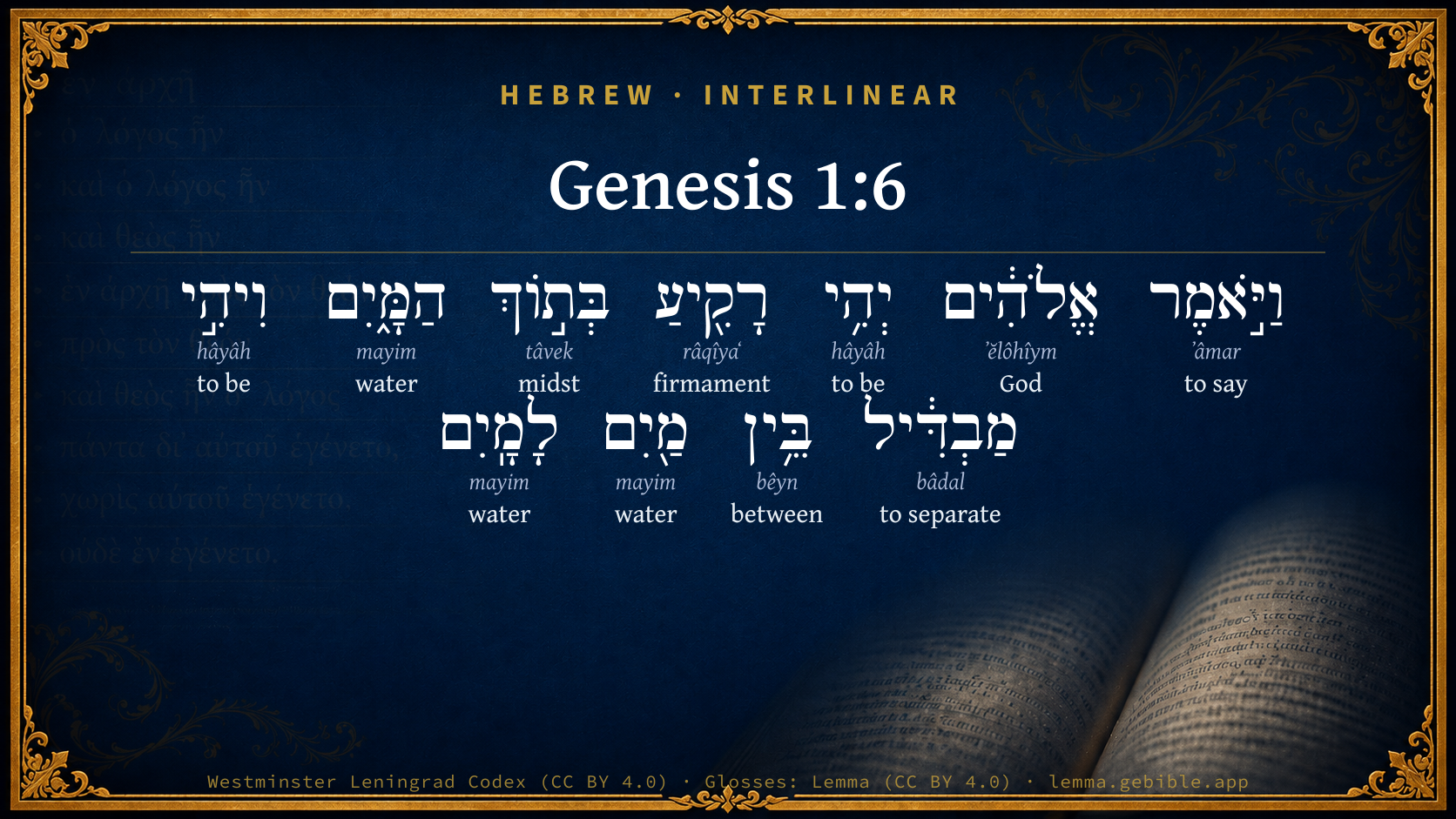
Hebrew (Westminster Leningrad Codex) Genesis 1:6 appears in the Hebrew Old Testament. The text above is from the Westminster Leningrad Codex. Each word links to its Strong’s number, a concise gloss, and parsing drawn from the Open Scriptures Hebrew Bible morphology. Click any word for its full Brown-Driver-Briggs (BDB) entry.
Download image
Cite this verse

Genesis 1:6 (World English Bible). Public Domain. Lemma interlinear Bible study tool, https://lemma.gebible.app/v/genesis/1/6.

Show BibTeX & RIS
BibTeX
RIS
English Translation
God said, "Let there be an expanse in the midst of the waters, and let it divide the waters from the waters."
World English Bible · Public Domain
Highlights
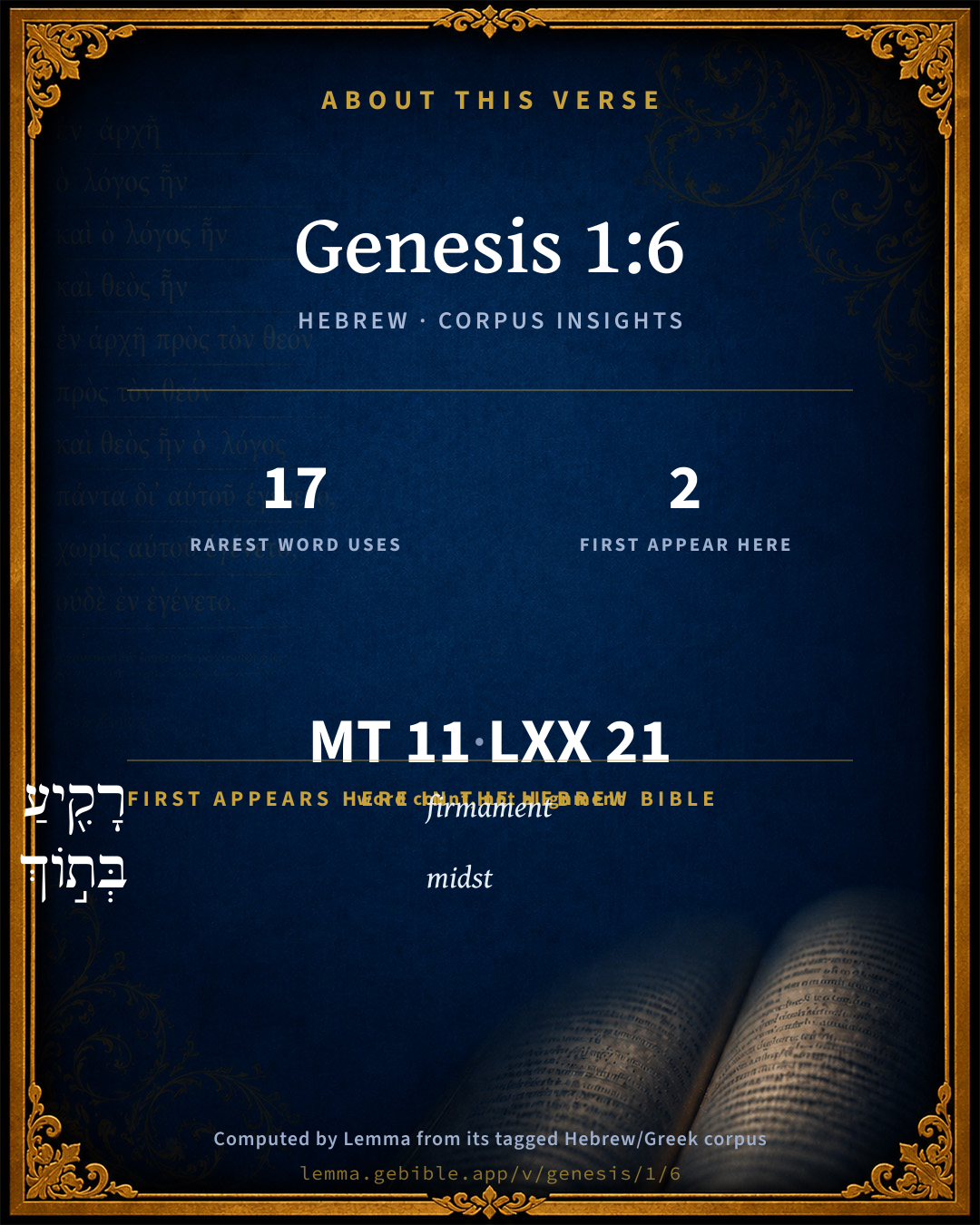
  • 2 first appearances in the Hebrew Bible
Full analysis ↓
Download a study sheet

One document with this verse’s original text, its word-by-word gloss line, the meaning frame, cross-references with their text, attributed commentary, and full source and license credits — printable, and it pastes into notes with its structure intact.

This verse Autodidact and up

Study sheet (.html) Plain text (.txt)

A passage Seminary Student

Up to 50 verses in one chapter. A passage sheet keeps up to 6 commentary sources and 12 cross-references per verse, in the order this page ranks them, and says so on the sheet whenever that leaves anything out. Ask for a single verse and you get the Autodidact verse sheet above.

Everything on this page stays free to read, with no account — the sheet is a download of what is already on screen, not access to it.

Want to remove ads? Support Godless Engineer
Compare translations 3

The same verse in 3 English versions, stacked beneath the original-language interlinear above. Click any original word for its lexicon entry.

Each is an independent rendering of the whole verse — the interlinear is not word-aligned to these translations.

Highlighted words mark where these versions differ — a whole-verse word diff, not a word-by-word alignment.

  • World English Bible Public Domain
    God said, "Let there be an expanse in the midst of the waters, and let it divide the waters from the waters."
  • King James Version Public Domain
    And God said, Let there be a firmament in the midst of the waters, and let it divide the waters from the waters.
  • unfoldingWord Literal Text CC BY-SA 4.0
    Then God said, “Let there be an expanse in the middle of the waters, and let it separate the waters from the waters.”

unfoldingWord Literal Text — © unfoldingWord, licensed CC BY-SA 4.0. Word-aligned USFM3 via Door43 (git.door43.org/unfoldingWord/en_ult).

Versions to compare (up to 4)

3 of 4 selected

Show all 18 translations

Every available English version of this verse, each an independent rendering of the whole verse.

  • World English Bible Public Domain
    God said, "Let there be an expanse in the midst of the waters, and let it divide the waters from the waters."
  • Berean Standard Bible Public Domain
    And God said, “Let there be an expanse between the waters, to separate the waters from the waters.”
  • Majority Standard Bible Public Domain
    And God said, “Let there be an expanse between the waters, to separate the waters from the waters.”
  • King James Version Public Domain
    And God said, Let there be a firmament in the midst of the waters, and let it divide the waters from the waters.
  • American Standard Version (1901) Public Domain
    And God said, Let there be a firmament in the midst of the waters, and let it divide the waters from the waters.
  • Revised Version (1885) Public Domain
    And God said, Let there be a firmament in the midst of the waters, and let it divide the waters from the waters.
  • Geneva Bible (1599) Public Domain
    Againe God said, Let there be a firmament in the mids of the waters: and let it separate the waters from the waters.
  • Douay-Rheims (1899) Public Domain
    And God said: Let there be a firmament made amidst the waters: and let it divide the waters from the waters.
  • Young's Literal Translation Public Domain
    And God saith, `Let an expanse be in the midst of the waters, and let it be separating between waters and waters.'
  • Literal Standard Version CC BY-SA 4.0
    And God says, “Let an expanse be in the midst of the waters, and let it be separating between waters and waters.”
  • Unlocked Literal Bible CC BY-SA 4.0
    God said, “Let there be an expanse between the waters, and let it divide the waters from the waters.”
  • unfoldingWord Literal Text CC BY-SA 4.0
    Then God said, “Let there be an expanse in the middle of the waters, and let it separate the waters from the waters.”
  • Darby Bible Public Domain
    And God said, Let there be an expanse in the midst of the waters, and let it be a division between waters and waters.
  • World Messianic Bible Public Domain
    God said, “Let there be an expanse in the middle of the waters, and let it divide the waters from the waters.”
  • Webster's Bible Public Domain
    And God said, Let there be a firmament in the midst of the waters, and let it divide the waters from the waters.
  • Free Bible Version CC BY-SA 4.0
    God said, “Let there be an expanse in the middle of the waters to divide the waters.”
  • Bible in Basic English Public Domain
    And God said, Let there be a solid arch stretching over the waters, parting the waters from the waters.
  • JPS Tanakh (1917) Public Domain
    And God said: 'Let there be a firmament in the midst of the waters, and let it divide the waters from the waters.'

Literal Standard Version (2020), Covenant Press — licensed CC BY-SA 4.0. Text via the HelloAO Bible API (eBible.org). Unlocked Literal Bible (unfoldingWord) — licensed CC BY-SA 4.0. Text via the HelloAO Bible API (eBible.org). unfoldingWord Literal Text — © unfoldingWord, licensed CC BY-SA 4.0. Word-aligned USFM3 via Door43 (git.door43.org/unfoldingWord/en_ult). Free Bible Version, Dr. Jonathan Gallagher — licensed CC BY-SA 4.0. Text via the HelloAO Bible API (eBible.org).

Word by word

More ways to search: Search by grammar → Find every occurrence → Compare this word →

Practice this passage: Drill this verse → Learn its vocabulary →

רָקִ֖יעַ
râqîyaʻ
H7549
“firmament”
Noun, Common, Masculine, Singular, Absolute
Part of Speech
Noun
Type
Common
Gender
Masculine
Number
Singular
State
Absolute
Full BDB Definition

Origin: from H7554

TWOT: 2217a

extended surface (solid), expanse, firmament - expanse (flat as base, support) - firmament (of vault of heaven supporting waters above) - considered by Hebrews as solid and supporting 'waters' above
  1. וַיֹּ֣אמֶר ʼâmar H559 “and · to say” Conjunction + Verb, Qal, Sequential Imperfect, 3rd Person, Masculine, Singular
  2. אֱלֹהִ֔ים ʼĕlôhîym H430 “God(s)” Noun, Common, Masculine, Plural, Absolute
  3. יְהִ֥י hâyâh H1961 “to be” Verb, Qal, Jussive, 3rd Person, Masculine, Singular
  4. בְּת֣וֹךְ tâvek H8432 “in/at · midst of” Preposition + Noun, Common, Masculine, Singular, Construct
  5. הַמָּ֑יִם mayim H4325 “the · water(s)” Particle, Definite Article + Noun, Common, Masculine, Plural, Absolute
  6. וִיהִ֣י hâyâh H1961 “and · to be” Conjunction + Verb, Qal, Imperfect, 3rd Person, Masculine, Singular
  7. מַבְדִּ֔יל bâdal H914 “separating” Verb, Hiphil, Participle Active, Masculine, Singular, Absolute
  8. בֵּ֥ין bêyn H996 “between” Preposition
  9. מַ֖יִם mayim H4325 “water(s)” Noun, Common, Masculine, Plural, Absolute
  10. לָמָֽיִם mayim H4325 “to/for · water(s)” Preposition + Noun, Common, Masculine, Plural, Absolute

About this verse

These counts appear in no published source. They are computed here, from the morphology-tagged text and Lemma’s own curated glosses. What Lemma adds →

11
words
8
distinct lemmas
Pentateuch
section

Notable vocabulary

The rarest word here is רָקִ֖יעַ firmament H7549 — appearing just 17 times in the whole Hebrew Bible.

First appearance in Scripture

These words make their first canonical appearance in the Hebrew Bible here:

  • רָקִ֖יעַ firmament H7549
  • בְּת֣וֹךְ midst H8432

Shared distinctive vocabulary

רָקִ֖יעַ firmament H7549 occurs in 15 verses of the Hebrew Bible. Also found in:

Grammatical profile

  • 4 verbs
  • 6 nouns
  • 1 preposition

Verb forms

  • וַיֹּ֣אמֶר Qal · Sequential Imperfect
  • יְהִ֥י Qal · Jussive
  • וִיהִ֣י Qal · Imperfect
  • מַבְדִּ֔יל Hiphil · Participle Active

Repetition

Words recur within this verse — often emphatic in Hebrew:

  • הַמָּ֑יִם water H4325 ×3
  • יְהִ֥י to be H1961 ×2

Hebrew & Septuagint length

In English translation the verse runs 22 words from the Hebrew and 28 from the Septuagint (LXX English) — closely comparable.

A rough comparison of the two English renderings, which tokenize alike — not a word-level alignment.

Word counts can differ between the Hebrew and the Greek without any difference in meaning — e.g. the Hebrew direct-object marker אֵת has no separate Greek word, and Greek often adds the article ὁ.

In the original languages it is 11 Hebrew tokens and 21 Greek tokens — but the two are counted differently (Hebrew bundles its prefixes and suffixes into one token; the Greek is in lemma form), so that isn’t a like-for-like length.

Cross-references

19

Topical passages linked to Genesis 1:6 in the Treasury of Scripture Knowledge — connected by theme and wording, ordered by reader-vote popularity; previews shown in the World English Bible.

  • Jeremiah 51:15 He has made the earth by his power, he has established the world by his wisdom, and by his understanding has he stretched out the heavens:
  • Job 37:18 Can you, with him, spread out the sky, Which is strong as a cast metal mirror?
  • Psalms 33:6 By Yahweh's word the heavens were made; All their host by the breath of his mouth.
  • Job 26:7–8 He stretches out the north over empty space, And hangs the earth on nothing.
  • Jeremiah 10:12–13 He has made the earth by his power, he has established the world by his wisdom, and by his understanding has he stretched out the heavens:
  • Psalms 104:2 He covers himself with light as with a garment. He stretches out the heavens like a curtain.
  • Psalms 148:4 Praise him, you heavens of heavens, You waters that are above the heavens.
  • Psalms 33:9 For he spoke, and it was done. He commanded, and it stood firm.
  • Psalms 136:5–6 To him who by understanding made the heavens; For his loving kindness endures forever:
  • Psalms 19:1 The heavens declare the glory of God. The expanse shows his handiwork.
  • Zechariah 12:1 An oracle. The word of Yahweh concerning Israel. Yahweh, who stretches out the heavens, and lays the foundation of the earth, and forms the spirit of man within him says:
  • Genesis 1:20 God said, "Let the waters swarm with swarms of living creatures, and let birds fly above the earth in the open expanse of sky."
  • Psalms 150:1 Praise Yah! Praise God in his sanctuary! Praise him in his heavens for his acts of power!
  • Genesis 7:11–12 In the six hundredth year of Noah's life, in the second month, on the seventeenth day of the month, on the same day all the fountains of the great deep were burst open, and the sky's windows were opened.
  • Job 26:13 By his Spirit the heavens are garnished. His hand has pierced the swift serpent.
  • Job 37:11 Yes, he loads the thick cloud with moisture. He spreads abroad the cloud of his lightning.
  • Genesis 1:14 God said, "Let there be lights in the expanse of sky to divide the day from the night; and let them be for signs, and for seasons, and for days and years;
  • Job 38:22–26 Have you entered the treasuries of the snow, Or have you seen the treasures of the hail,
  • Ecclesiastes 11:3 If the clouds are full of rain, they empty themselves on the earth; And if a tree falls toward the south, or toward the north, In the place where the tree falls, there shall it be.

Cross-references courtesy of OpenBible.info (CC BY 4.0).

Hebrew and Greek witnesses Masoretic Hebrew ↔ Greek Septuagint

The same verse in the two great witnesses to the Old Testament, shown verse-for-verse.

These are two independent witnesses, not word-aligned to each other, and the Septuagint is shown in lemma (dictionary) form.

Hebrew Genesis 1:6 Masoretic · Westminster Leningrad Codex

וַיֹּ֣אמֶר אֱלֹהִ֔ים יְהִ֥י רָקִ֖יעַ בְּת֣וֹךְ הַמָּ֑יִם וִיהִ֣י מַבְדִּ֔יל בֵּ֥ין מַ֖יִם לָמָֽיִם

God said, "Let there be an expanse in the midst of the waters, and let it divide the waters from the waters."

World English Bible · Public Domain

Greek LXX Genesis 1:6 Septuagint · lemma form

καί εἶπον ὁ θεός γίγνομαι στερέωμα ἐν μέσος ὁ ὕδωρ καί εἰμί διαχωρίζω ἀνά μέσος ὕδωρ καί ὕδωρ καί γίγνομαι οὕτως

And God said, Let there be a firmament in the midst of the water, and let it be a division between water and water, and it was so.

LXX2012 (modern English Septuagint) · Public Domain

On this verse, Joseph Benson's Commentary discusses the Septuagint’s reading. Read the note in Commentary ↓

Hebrew: Westminster Leningrad Codex (CC BY 4.0). Greek: Septuagint (public domain); English from LXX2012 (modern English Septuagint) (Public Domain). How the Septuagint differs from the Hebrew →

Targum (Aramaic paraphrase)

2

The Targum is the ancient Jewish Aramaic paraphrase of the Hebrew Scriptures — an interpretive translation, not the Hebrew text itself. Onkelos (literal) and Pseudo-Jonathan (expansive) render the Torah, and Jonathan the Prophets. Coverage is partial: where no permissively-licensed English translation exists for a verse, only the Aramaic is shown. This is verse-level text, not a word-by-word alignment to the Hebrew.

  1. Targum Onkelos Torah (Genesis–Deuteronomy)
    וַאֲמַר יְיָ יְהִי רְקִיעָא בִּמְצִיעוּת מַיָּא וִיהִי מַפְרִישׁ בֵּין מַיָּא לְמַיָּא

    (no public-domain English translation for this verse)

    Targum Onkelos — Aramaic: “Onkelos Genesis” (public domain); “Onkelos Exodus” (public domain); “Onkelos Leviticus” (public domain); “Onkelos Numbers” (public domain); “Onkelos Deuteronomy” (public domain). English: “Sefaria Community Translation” (CC0 1.0 (public-domain dedication)); “J.W. Etheridge. The Targums of Onkelos and Jonathan Ben Uzziel on the Pentateuch. London: Longmans, Green, 1862” (public domain). Text via Sefaria.

  2. Targum Pseudo-Jonathan Torah (Genesis–Deuteronomy)
    וַאֲמַר יְיָ יְהִי רְקִיעָא בִּמְצִיעוּת מַיָא וִיהִי מַפְרִישׁ בֵּינֵי מוֹי עִלָאֵי לְבֵינֵי מוֹי תַּתָּאֵי

    And the Lord said, Let there be an expanse in the midst of the waters, and let it separate between the waters above and the waters beneath.

    Targum Pseudo-Jonathan — Aramaic: “Targum Jonathan on Genesis” (public domain); “Targum Jonathan on Exodus” (public domain); “Targum Jonathan on Leviticus” (public domain); “Targum Jonathan on Numbers” (public domain); “Targum Jonathan on Deuteronomy” (public domain). English: “The Targum of Jonathan ben Uzziel, trans. J. W. Etheridge, London, 1862” (public domain). Text via Sefaria.

Commentary

Notes on Genesis 1:6 from classic Christian and Jewish commentators (each source and its license shown beneath its notes). The classic Christian expositions comment on the surrounding passage and are grouped to its opening verse, so a note may address several verses; the Jewish commentaries on the Tanakh (Rashi and others) are per-verse, so they appear only where the commentator wrote on this verse.

Lemma curates 59 commentaries, every one of them public domain or Creative Commons licensed, each selected and text-cleaned for this edition rather than reprinted as found. About our sources →

Jamieson, Fausset & Brown

Robert Jamieson, A. R. Fausset & David Brown

SECOND DAY. (Gen 1:6-8)

firmament--an expanse--a beating out as a plate of metal: a name given to the atmosphere from its appearing to an observer to be the vault of heaven, supporting the weight of the watery clouds. By the creation of an atmosphere, the lighter parts of the waters which overspread the earth's surface were drawn up and suspended in the visible heavens, while the larger and heavier mass remained below. The air was thus "in the midst of the waters," that is, separated them; and this being the apparent use of it, is the only one mentioned, although the atmosphere serves other uses, as a medium of life and light.

Jamieson, Fausset & Brown — Commentary Critical and Explanatory on the Whole Bible (1871) — public domain (CC PDM 1.0). Text via the HelloAO Bible API.

Trapp's Complete Commentary

John Trapp

Gen 1:6 And God said, Let there be a firmament in the midst of the waters, and let it divide the waters from the waters.

Ver. 6. Let there be a firmament.] Yet not so firm, but it shall be dissolved. {2Pe 3:11} That it is not presently so; that those windows of heaven are not opened, as once in the deluge, having no better a bar than the liquid air, and we suddenly buried in one universal grave of waters; see a miracle of God’s mercy, and thank him for this powerful word of his, "Let there be a firmament." Bartholinus {a} tells us, that in the year of Christ 1551, a very great multitude of men and cattle were drowned by a terrible tempest, the clouds suddenly dissolving, and the waters pouring down amain with such a strange stupendous violence, that the massy walls of many cities, various vineyards, and fair houses were utterly destroyed and ruined. Clouds, those bottles of rain, are vessels as thin as the liquor which is contained in them. There they hang and move, though weighty with their burdens. How they are upheld, saith a reverend divine, {b} and why they fall here and now, we know not, and wonder. {Job 26:8} They water our lands, as we do our gardens, and are therefore called our heavens. {Deu 33:28}

{a} Barthol. l. 2. De Meteoris

{b} D. H. Contemp.

John Trapp, A Commentary or Exposition upon All the Books of the Old and New Testament (1647–1656) — public domain. Text from a community e-Sword module.

Albert Barnes' Notes on the Bible

- IV. The Second Day

6. רקיע rāqı̂ya‛, “expanse;” στερέωμα stereōma, רקע rāqa‛, “spread out by beating, as leaf gold.” This expanse was not understood to be solid, as the fowl is said to fly on the face of it Gen 1:21. It is also described as luminous Dan 12:3, and as a monument of divine power Psa 150:1.

7. עשׂה ‛āśâh “work on,” “make out of already existing materials.”

The second act of creative power bears upon the deep of waters, over which the darkness had prevailed, and by which the solid crust was still overlaid. This mass of turbid and noisy water must be reduced to order, and confined within certain limits, before the land can be reached. According to the laws of material nature, light or heat must be an essential factor in all physical changes, especially in the production of gases and vapors. Hence, its presence and activity are the first thing required in instituting a new process of nature. Air naturally takes the next place, as it is equally essential to the maintenance of vegetable and animal life. Hence, its adjustment is the second step in this latest effort of creation.

Gen 1:6

Let there be an expanse in the midst of the water. - For this purpose God now calls into existence the expanse. This is that interval of space between the earth on the one side and the birds on the wing, the clouds and the heavenly bodies on the other, the lower part of which we know to be occupied by the air. This will appear more clearly from a comparison of other passages in this chapter (Gen 1:14, Gen 1:20).

And let it be dividing between water and water. - It appears that the water in a liquid state was in contact with another mass of water, in the shape of dense fogs and vapors; not merely overhanging, but actually resting on the waters beneath. The object of the expanse is to divide the waters which are under it from those which are above it. Hence, it appears that the thing really done is, not to create the space that extends indefinitely above our heads (which, being in itself no thing, but only room for things, requires no creating), but to establish in it the intended disposition of the waters in two separate masses, the one above, and the other below the intervening expanse. This we know is effected by means of the atmosphere, which receives a large body of water in the state of vapor, and bears up a visible portion of it in the form of clouds. These ever-returning and ever-varying piles of mist strike the eye of the unsophisticated spectator; and when the dew is observed on the grass, or the showers of rain, hail, and snow are seen falling on the ground, the conclusion is obvious - that above the expanse, be the distance small or great, is laid up an unseen and inexhaustible treasury of water, by which the earth may be perpetually bedewed and irrigated.

The aqueous vapor is itself, as well as the element with which it is mingled, invisible and impalpable; but when condensed by cold it becomes apparent to the eye in the form of mists and clouds, and, at a certain point of coolness, begins to deposit itself in the palpable form of dew, rain, hail, or snow. As soon as it becomes obvious to the sense it receives distinguishing names, according to its varying forms. But the air being invisible, is unnoticed by the primitive observer until it is put in motion, when it receives the name of wind. The space it occupies is merely denominated the expanse; that is, the interval between us and the various bodies that float above and hang upon nothing, or nothing perceptible to the eye.

The state of things before this creative movement may be called one of disturbance and disorder, in comparison with the present condition of the atmosphere. This disturbance in the relations of air and water was so great that it could not be reduced to the present order without a supernatural cause. Whether any other gases, noxious or innocuous, entered into the constitution of the previous atmosphere, or whether any other ingredients were once held in solution by the watery deep, we are not informed. Whether any volcanic or plutonic violence had disturbed the scene, and raised a dense mass of gaseous damp and fuliginous matter into the airy region, is not stated. How far the disorder extended we cannot tell. We are merely certain that it reached over all the land known to man during the interval between this creation and the deluge. Whether this disorder was temporary or of long standing, and whether the change was effected by altering the axis of the earth’s rotation, and thereby the climate of the land of primeval man, or by a less extensive movement confined to the region under consideration, are questions on which we receive no instruction, because the solution does not concern our well-being. As soon as human welfare comes to be in any way connected with such knowledge, it will by some means be made attainable.

The introduction of the expanse produced a vast change for the better on the surface of the earth. The heavy mass of murky damp and aqueous steam commingling with the abyss of waters beneath is cleared away. The fogs are lifted up to the higher regions of the sky, or attenuated into an invisible vapor. A leaden mass of clouds still overshadows the heavens. But a breathing space of pure pellucid air now intervenes between the upper and lower waters, enveloping the surface of the earth, and suited for the respiration of the flora and fauna of a new world.

Let it be noted that the word “be” is here again employed to denote the commencement of a new adjustment of the atmosphere. This, accordingly, does not imply the absolute creation on the second day of our present atmosphere: it merely indicates the constitution of it out of the materials already at hand, - the selecting and due apportionment of the proper elements; the relegation of all now foreign elements to their own places; the dissipation of the lazy, deadening damps, and the establishment of a clear and pure air fit for the use of the future man. Any or all of these alterations will satisfy the form of expression here adopted.

Gen 1:7

Then made God the expanse. - Here the distinction between command and execution is made still more prominent than in the third verse. For the word of command stands in one verse, and the effect realized is related in the next. Nay, we have the doing of the thing and the thing done separately expressed. For, after stating that God made the expanse, it is added, “and it was so.” The work accomplished took a permanent form, in which it remained a standing monument of divine wisdom and power.

Gen 1:8

Then called God to the expanse, heaven. - This expanse is, then, the proper and original skies. We have here an interesting and instructive example of the way in which words expand in their significance from the near, the simple, the obvious, to the far and wide, the complex and the inferential: The heaven, in the first instance, meant the open space above the surface in which we breathe and move, in which the birds fly and the clouds float. This is the atmosphere. Then it stretches away into the seemingly boundless regions of space, in which the countless orbs of luminous and of opaque surfaces circumambulate. Then the heavens come to signify the contents of this indefinitely augmented expanse, - the celestial luminaries themselves. Then, by a still further enlargement of its meaning, we rise to the heaven of heavens, the inexpressibly grand and august presence-chamber of the Most High, where the cherubim and seraphim, the innumerable company of angels, the myriads of saints, move in their several grades and spheres, keeping the charge of their Maker, and realizing the joy of their being. This is the third heaven 2Co 12:2 to the conception of which the imaginative capacity of the human mind rises by an easy gradation. Having once attained to this majestic conception, man is so far prepared to conceive and compose that sublime sentence with which the book of God opens, - “In the beginning God created ‘the heavens’ and the earth.”

The expanse, or aerial space, in which this arrangement of things has been effected, having received its appropriate name, is recognized as an accomplished fact, and the second day is closed.

Albert Barnes' Notes on the Bible (1834–1885) — public domain. Text from a community e-Sword/MySword module.

The Biblical Illustrator

Joseph S. Exell

Gen_1:6-8

Let there be a firmament

The atmosphere

I.

THE ATMOSPHERE IS NECESSARY TO THE POSSIBILITY OF HUMAN LIFE.

1. Gathers up the vapours.

2. Throws them down again in rain, snow, or dew, when needed.

3. Modifies and renders more beautiful the light of the sun.

4. Sustains life.

II. IT IS NECESSARY FOR THE PRACTICAL PURPOSES OF LIFE.

1. The atmosphere is necessary for the transmission of sound. If there were no atmosphere, the bell might be tolled, the cannon might be fired, a thousand voices might render the music of the sweetest hymn, but not the faintest sound would be audible. Thus all commercial, educational, and social intercourse would be at an end, as men would not be able to hear each other speak. We seldom think of the worth of the atmosphere around us, never seen, seldom felt, but without which the world would be one vast grave.

2. The atmosphere is necessary for many purposes related to the inferior objects of the world. Without it the plants could not live, our gardens would be divested of useful vegetables, and beautiful flowers. Artificial light would be impossible. The lamp of the mines could not be kindled. The candle of the midnight student could never have been lighted. The bird could not have wended its way to heavens gate to utter its morning song, as there would have been no air to sustain its flight.

III. LET US MAKE A PRACTICAL IMPROVEMENT OF THE SUBJECT.

1. To be thankful for the air we breathe. How often do we recognize the air by which we are surrounded as amongst the chief of our daily blessings, and as the immediate and continued gift of God? How seldom do we utter praise for it.

2. To make the best use of the life it preserves. To cultivate a pure life. To speak golden words. To make a true use of all the subordinate ministries of nature. (J. S. Exell, M. A.)

Uses of the atmosphere

1. The atmosphere is the great fund and storehouse of life to plants and animals; its carbonic acid is the food of the one, and its oxygen the nourishment of the other; without its carbonic acid the whole vegetable kingdom would wither, and without its oxygen the blood of animals, which is the life thereof, would be only serum and water.

2. It is a refractor of light. Without it the suns rays would fall perpendicularly and directly on isolated portions of the world, and with a velocity which would probably render them invisible; but by means of the atmosphere they are diffused in a softened effulgence through the entire globe.

3. It is a reflector of light. Hence its mysterious, beautiful, and poetical blue, contrasting and yet harmonizing with the green mantle of the world.

4. It is the conservator and disperser and modifier of heat. By its hot currents constantly flung from the equatorial regions of the world, even the cold of the frigid zones is deprived of its otherwise unbearable rigour; while the mass of cold air always rushing from about the poles towards the equator quenches half the heat of tropical suns, and condenses the vapour so needful to the luxuriant vegetation.

5. It is the great vibratory of sound, the true sounding board of the world, and without it the million voices and melodies of this earth would all be dumb; it would be a soundless desert, where an earthquake would not make a whisper. By its pressure the elastic fluids of animal bodies are prevented from bursting their slender vessels and causing instantaneous destruction. Its winds propel our ships, its electricity conveys our messages. By the aid of its warm gales and gentle dews the desert can be made to blossom as the rose. (John Cobley.)

The composition of the atmosphere

But the atmosphere with which the Creator has surrounded the earth is wonderful also in its composition. The two elements of which it chiefly consists--oxygen and nitrogen--are mixed in definite proportions, as 20 to 80 in 100 parts. If this proportion were but slightly altered, as nitrogen destroys life and extinguishes flame, the result of any perceptible increase of it would be that fires would lose their strength and lamps their brightness, plants would wither, and man, with the whole animal kingdom, would perform their functions with difficulty and pain. Or if the quantity of nitrogen were much diminished, and the oxygen increased, the opposite effect would be produced. The least spark would set anything combustible in a flame; candles and lamps would burn with the most brilliant blaze for a moment, but would be quickly consumed. If a house caught fire, the whole city would be burnt down. The animal fluids would circulate with the greatest rapidity, brain fever would soon set in, and the lunatic asylums would be filled. A day is coming when the elements shall melt with fervent heat. God has but to subtract the nitrogen from the air, and the whole world would instantly take fire; such is the activity and energy of the oxygen when left uncontrolled. (Brewer.)

Interesting illustrations of design in the atmosphere

Vast quantities of oxygen are daily consumed by animals, and by combustion. Carbonic acid gas is evolved instead. But this gas is so injurious that when the air is charged with only one-tenth part of it, it is wholly unfit for animals to breathe, and is unsuitable to the support of fires. The vegetable kingdom meets the whole difficulty. It gives out oxygen and takes in carbonic acid in amply sufficient measure to balance the disturbance created by the animals. Thus every breath we draw instructs us to admire the wisdom of Him who doeth all things well. (Brewer.)

Again, oxygen is a little heavier and nitrogen a little lighter than common air. Had it been otherwise, had nitrogen been a little heavier, and carbonic acid gas been a little lighter, we must have breathed them again, so that, instead of breathing wholesome air, we should have been constantly inhaling the very gases which the lungs had rejected as offal. The consequences would have been most fatal. Life would have been painful; diseases ten times more prevalent than they now are; and death would have cut us off at the very threshold of our existence. (Brewer.)

Further, if the air had possessed an odour, such as that of phosphuretted hydrogen, it would have interfered not only with the perfume of flowers, but also with our faculty of discriminating wholesome foods by their smell. If it had been coloured like chlorine gas, or a London fog, we should have seen only the thick air, and not the objects around us. Had it been less transparent than it now is, it would have obstructed the rays of the sun, diminished their light and warmth, and abridged our power of distant vision. (Brewer.)

The air is the great means of life, not only to man, but to all living things. It is also essential to combustion. Without it no fire would burn, and all our industries which depend on the use of fire would necessarily be at a standstill. By the heat of the sun an immense quantity of water in the form of vapour is daily carried up from the earth, rivers, and seas--amounting, indeed, to many millions of gallons! In the course of a year it is not less than forty thousand cubic miles! But if there were no atmosphere this circulation could not exist. There would be no rain, rivers, or seas, but one vast desert. Neither could the clouds be buoyed up from the surface of the earth, nor could the winds blow to disperse noxious vapours, and produce a system of ventilation among the abodes of men. (Brewer.)

The influence of sin seen in its deterioration

There is something in the earths atmosphere that blights and injures. It is not the same healthful, genial, joyous firmament that it was when God created it. (H. Bonar.)

Genesis of the sky

I. EXPLANATION OF THE PASSAGE.

1. Ancient conception of the sky. To the ancient Hebrew the sky seemed a vast, outstretched, concave surface or expansion, in which the stars were fastened, and over which the ethereal waters were stored. (See Pro_8:27; Heb_1:12; Isa_34:4; Isa_40:22; Job_22:14; Job_37:18; Psa_148:4.) Ah, all this, you tell me, is scientifically false; the sky is not a material arch, or tent, or barrier, with outlets for rain; it is only the matterless limit of vision. Neither, let me again remind you, is there any such thing as sunrise or sunset. To use such words is to utter what science declares is a falsehood. And yet your astronomer, living in the blaze of science, fresh from the discovery of spectrum analysis and satellites of Mars, and knowing too that his words are false, still persists in talking of sunrise and sunset. Will you, then, deny to the untutored Moses, speaking in the child-like language of that ancient infarct civilization, the privilege which you so freely accord to the nineteenth-century astronomer?

2. Panorama of the emerging sky. Everywhere is still a shapeless, desolate chaos. And now a sudden break is seen. A broad, glorious band or expanse glides through the angry, chaotic waste, separating it into two distinct masses--the lower, the heavy fluids; the upper, the ethereal vapours. The band, still bearing upward the vapour, swells and mounts and arches and vaults, till it becomes a concave hemisphere or dome. That separating, majestic dimension we cannot to this day call by a better name than the expanse. And that expanse God called heavens. And there was evening and there was morning, a second day.

II. MORAL MEANING OF THE STORY.

1. The heavens suggest the souls true direction--it is upward. To express moral excellence by terms of altitude is an instinct. How naturally we use such phrases as these: Exalted worth, high resolve, lofty purpose, elevated views, sublime character, eminent purity! How naturally, too, we use opposite phrases: Low instincts, base passions, degraded character, grovelling habits, stooping to do it! Doubtless here, too, is the secret of the arch, and especially the spire, as the symbol of Christian architecture: the Church is an aspiration. Even the very word heaven itself, like the Greek Ouranos, means height, and, according to the etymologists, is an Anglo-Saxon word, heo-fan; meaning what is heaved up, lifted, heav-en--heaven. Well, then, may the vaulting sky stand as a symbol of human aspiration. The true life is a perpetual soaring and doming; or rather, like the mystic temple of Ezekiels vision, it is an inverted spiral, forever winding upward, and broadening as it winds (Eze_41:7). The souls true life is a perpetual exhalation; her affections evermore evaporating from her own great deep, and mounting heavenward in clouds of incense.

2. As the heavens suggest human aspirations, so do the heavens suggest their complement, Divine perfections. It is true, e.g., in respect to Gods immensity. Nothing seems so remote from us, or gives such an idea of vastness, as the dome of heaven. Climb we ever so high on mountain top, the stars are still above us. Again: It is true in respect to Gods sovereignty. Nothing seems to be so absolutely beyond human control or modification as the sun and stars of heaven. Again: It is true in respect to Gods spirituality. Nothing seems so like that rarity of texture which we instinctively ascribe to pure, incorporeal spirit, as that subtile, tenuous ether which, it is believed, pervades the clear, impalpable sky, and, indeed, all immensity. And in this subtile ether, so invisible to sight, so impalpable to touch, so diffused throughout earth and the spaces of the heavenly expanse, we may behold a symbol of that invisible, intangible, ever-omnipresent One who Himself is Spirit; and who, accordingly, can be worshipped only in spirit and truth (Joh_4:24). Again: it is true in respect to Gods purity. Nothing is so exquisite an emblem of absolute spotlessness and eternal chastity, as the unsullied expanse of heaven, untrodden by mortal foot, unswept by aught but angel wings. Again: It is true in respect to Gods beatitude. We cannot conceive a more perfect emblem of felicity and moral splendour than light. Everywhere and evermore, among rudest nations as well as among most refined, light is instinctively taken as the first and best possible emblem of whatever is most intense and perfect in blessedness and glory. And whence comes light--the light which arms us with health, and fills us with joy, and tints flower and cloud with beauty, and floods mountain and mead with splendour--but from the sky? Well, then, may the shining heaven be taken as the elect emblem of Him who decketh Himself with light as with a robe (Psa_104:2), who dwelleth in light which no man can approach unto (1Ti_6:16), who Himself is the Father of lights (Jam_1:17). (G. D.Boardman.)

The atmosphere

The word atmosphere indicates, in general, its character and its relation to the earth. It is compounded of two Greek words, one signifying vapour and the other sphere, and, taken together, they denote a sphere of vapour enveloping or enwrapping the whole earth. The ancients regarded the air, as children do now, as nothing at all. A vessel filled only with air, had nothing in it. As light as air is a proverbial expression, but a very false one, to denote nothingness. We may not be aware of it, but yet it is true that the breathing of the air yields us three-quarters of our nourishment, while the other quarter only is supplied by the food, solid and liquid, of which we partake. The principal parts of this food are oxygen, hydrogen, nitrogen, and carbonic acid, and these, too, are the constituent elements of the atmosphere. There is a sense, therefore, in which we may truly say of the air, what the apostle and the old Greek poet before him said of God, In it we live and move and have our being. The weight of the atmosphere is so great that its pressure upon a man of ordinary size has been computed to be about fourteen or fifteen tons. A man of large frame would have to carry one or two tons additional. But as the airs pressure is lateral as well as vertical, and equal upon all sides and parts of every body, it not only does not crush or injure the frailest flower, but actually feeds and nourishes it. There are other than atmospheric burdens, and those which consciously press more heavily, which yet a man may find a great blessing ill carrying with a cheerful face and courage. The atmosphere is tenanted by myriad forms of life, vegetable and animal. A French naturalist of great eminence, M. Miquel, writing upon Living Organisms of the Atmosphere, has found numberless organisms dancing in the light of a single sunbeam. The atmosphere, moreover, is the great agent by which nature receives the wonderful colours which are her most beautiful adorning. It is owing to the reflection of the suns rays that the sky and the distant horizon assume that beautiful azure hue which is subject to endless variations. It is owing to the refraction of these rays as they pass obliquely through the aerial strata, that we have the splendours of the morning and evening twilight, and that we seem to see the sun three or four minutes before he actually rises above the eastern horizon, and three or four minutes after he actually disappears below the western horizon. If it were not for the atmosphere, the light would instantaneously disappear as the sun sank below the horizon, and leave the world in utter darkness, while at his rising in the morning the world would pass in an instant from complete darkness into a flood of dazzling and blinding light. Such daily and sudden shocks to vision would be painful, and probably destructive to sight. Without the atmosphere there would have been no place in the universe for the dwelling place of man, because without it the waters would have prevailed. But as by the atmosphere the waters below were, on the second day of the creative week, divided from those above, a place was provided suitable for the abode of man. Without the air, which gathers the moisture in the clouds and sends it down again upon the earth, there could be no precipitation of rain or snow. Without the atmosphere there could be no purifying winds, which are but air in motion, no medium to transmit and diffuse the light and heat of the sun, no agent to modify and make surpassingly beautiful the light of the sun, and no possibility of respiration for plants or animals, without which it would be impossible to maintain any form of organic life. The atmosphere, too, is indispensable for all the practical purposes of life. If by some miraculous intervention it should be made possible for human life to exist without the air, it would be useless and vain. The air is necessary for the transmission of sound. Without it, the bell might be tolled, the cannon might be fired, a great multitude of voices might unite to render the music of the sweetest hymn, but not the faintest sound would be audible either to the performers or to the listeners. In the worship of God we should need no tune books, no organ, no choir, no preacher, for there is no speech nor language where their voice is not heard, and the voices of none of these could be heard. You might breathe or even loudly speak your words of love into the very ear of some dear one, and yet not one of your words would be heard without the presence of air in the ear to empower its wondrous mechanism for hearing. As light is indispensable for seeing, so in exactly the same way is the air necessary for hearing, and without it the ear would be a perfectly useless organ, instead of being, as now, a wonderful organ to minister to our joy and delight. And since without the atmosphere we could not hear each other speak, it follows that all commercial, educational, and social intercourse would be at an end, and the earth would become one vast grave.

1. Let us learn from the air a lesson--and it is a most impressive one--as to the inestimable value of our common mercies, which we enjoy every moment, without a thought and without an emotion of gratitude to the great Giver of them.

2. Let us learn from the atmosphere a lesson as to how to overcome our difficulties. The dove in the fable was irritated because the wind ruffled its feathers and opposed its flight. It foolishly desired to have a firmament free from air, through the empty spaces of which it vainly thought it could fly with the speed of lightning. Silly bird! It did not know that without the air it could not fly at all, nor even live. And just so it is with the difficulties we encounter. Without them and without conquering them, a high Christian manhood or character is unattainable.

3. Let us learn from the atmosphere a lesson of thankfulness. It is amongst the chief of our daily blessings, and is the immediate and continuous gift of God, to whom our praises are continually due.

4. Let us learn from the atmosphere to make the best use possible of the life it nourishes and preserves. As in itself the air is sweet, wholesome, and life-giving, let us be taught by it to live pure and noble lives which shall yield for others wholesome and helpful and not poisonous and corrupt influences. Our example makes a moral atmosphere for others to breathe, which is wholesome or noxious, according as the example is good or bad. (G. C.Noyes, D. D.)

The atmosphere

The atmosphere, like an ocean, overlies the whole surface of the earth; in fact, it is an ocean; and it is literally true, that, like crabs and lobsters, we live and move and spend our days at the bottom of a sea--an aerial sea. This atmospheric ocean rises far above us, and, like that of waters, has its waves, its currents, and its tides. It is found to grow more rarified, as well as colder, as we ascend towards its upper limit, which is supposed to be about forty-five miles above the level of the sea. Barometrical observations, however, show that on ascending to the height of three and a half miles (nearly that of Cotopaxi), we leave behind us, by weight, more than one-half the whole mass of the atmosphere. And from the experience of aeronauts, it is believed that there is no such air as man can breathe at an elevation of eight miles; probably death would be the certain consequence of exceeding seven, though some, of late, at great risk and suffering, have ascended to nearly that height. On the summit of Mont Blanc, which is a trifle under three miles, the sensations of those who make the ascent are very painful, owing to the levity of the air; the flesh puffs out, the head is oppressed, the respiration is difficult, and the face becomes livid; whilst the temperature is cold almost past endurance. This ocean of air, like that of water, has also its weight and pressure. People, in general, are not aware, because they are not conscious, of any weight resting upon them from the atmosphere; yet reliable experiments prove that at the sea level it presses with a force equal to fourteen and three-fifths pounds on every square inch, or 2,100 pounds on every square foot, or 58,611,548,160 pounds on every square mile; or on the whole surface of the earth with a weight equal to that of a solid globe of lead sixty miles in diameter! How few reflect that they live under an ocean of such stupendous weight! But to bring this fact more sensibly before the mind, we may state that the atmospheric pressure on the whole surface of a medium sized man is no less than fourteen tons--a weight that would instantly crash him, as hollow vessels collapse when sunk deep in the ocean, but for the elasticity and equal pressure of the air on every part without, and the counterbalancing pressure and elasticity of the air within. The air encompassing the earth is a compound substance, made up of two gases, mixed in the proportion of twenty-one parts of oxygen to seventy-nine parts of nitrogen, by measure; mixed with these is a small proportion of carbonic acid gas, which does not exceed one two-thousandth part of the whole volume of the atmosphere. Whether the air is taken from the greatest depths, or the most exalted heights which man has ever reached, this proportion of the oxygen and nitrogen gases is maintained invariably. Considering the vast and varied exhalations that constantly ascend from sea and land, together with the incessant agitation of winds and tempests, this stands before us a most astonishing fact, indeed! But it is not more wonderful than it is important. No possible change could be made in the composition of the air, without rendering it injurious both to animal and vegetable life. If the quantity of nitrogen were but a little increased, all the vital functions of man would be performed with difficulty, pain, and slowness, and the pendulum of life would soon come to a stand. If, on the other hand, the proportion of oxygen were increased, all the processes of life would be quickened into those of a fever, and the animal fabric would soon be destroyed, as it were, by its own fires. (H. W. Morris, D. D.)

Reflections

1. On the mass of the atmosphere. Vast an appendage as this is to our globe, its dimensions and density have been adapted with the utmost exactness to the constitution of all organized existences. Any material change in its mass would require a corresponding change in the structure of both plants and animals, and, indeed, in the whole economy of the world. If its mass were considerably reduced, all the difficulties experienced by travellers on the summits of lofty mountains, and by aeronauts at great elevations above the earth, would ensue; on the other hand, if much increased, opposite and equally disastrous results would follow. If the atmosphere had been twice or three times its present mass, currents of air would move with double or triple their present force. With such a change nothing on sea or land could stand against a storm. But how happily do we find all things balanced as now constituted. And how obvious, that, ere ever God had breathed forth the fluid air, in His all-comprehending Mind, its mass was measured and weighed, and the strength and wants of all living creatures duly estimated before one of them had been called into being. All the works of God have been done according to a determinate counsel and infallible foreknowledge.

2. On the pressure of the atmosphere. Contemplating the enormous weight of the air, resting upon all things and all persons, who but must devoutly admire both the wisdom and the goodness of the Creator, in so adjusting all the properties of the firmament, that under it we can breathe and walk and act with ease, unconscious of weight or oppression, while in fact we are every moment under a load, which, when reduced to figures, surpasses both our comprehension and belief.

3. On the composition of the atmosphere. How very wonderful is this! When we reflect upon the proportions and combinations of its constituent elements, we cannot but look up with adoring reverence to its Divine Author. What wisdom, what power, what benevolence, have been exercised in arranging the chemical constitution and agencies of this world, to adapt them unfailingly to the strength and wants of animals and of plants, even the most delicate and minute! How very slightly the atmosphere of life differs from one that would produce instant and universal death How trifling the change the Almighty had need make in the air we hourly breathe, to lay all the wicked and rebellious sons of men lifeless and silent in the dust! (H. W. Morris, D. D.)

A type of prayer and its answer

In the natural world, the sun pours down its light and heat, and diffuses his genial influences over all; yet warming and animating, in a special degree, those fields and hillsides turned more directly towards him, and drawing upward from them a proportionally greater amount of vapour; this vapour, as we have seen, in due time, returns in showers, refreshing and beautifying all nature. So in the world of Christian devotion. Under the benignant beams of the Sun of Righteousness, the exhalations of prayer and praise are drawn upwards to the heavenly throne, more abundantly, as in nature, from those more completely under His gracious influences; and these exhalations of the heart, through a Saviours mediation, are made to return in richer showers, even showers of grace, to refresh and strengthen those souls to bring forth fruit unto everlasting life. Again: As the earth, without showers, would soon become parched and barren and dead; so, without the rain and dew of Divine grace, the moral earth would become as iron, and its heavens as brass; every plant of holiness, every flower of piety, and every blade of virtue, would soon droop and die. Nor does the parallel end here: as in the physical world, the greater the quantity of vapours drawn up from sea and land, the greater will be the amount of rain that sooner or later will come down on plain and mountain; so in the spiritual, the more abundant the exhalations of prayer and supplication from the children of men, the more copious the showers of grace that will be poured out in return. Let prayer, therefore, daily ascend as the vapours from the ends of the earth, and rise as clouds of incense before the throne, and this wilderness shall yet blossom as the rose, flourish as the garden of the Lord, and bloom with all the beauties of an unblighted paradise. (H. W. Morris, D. D.)

Atmospherical adjustments

The atmosphere constitutes a machinery which, in all its complicated and admirable adjustments, offers the most striking displays and convincing proofs of this. This vast and wonderful appendage of our globe has been made expressly to meet the nature and wants of the living creatures and growing vegetation that occupy its surface; and all these plants and animals have been created with distinct reference to the properties of the atmosphere. Throughout design and mutual adaptation are most manifest. The atmosphere has been composed of those elements, and composed of them in just the proportions that are essential to the health and nurture of all living creatures. The atmosphere has been made for lungs; and lungs have been made for the atmosphere, being elaborately constructed for its alternate admission and expulsion. And how beautiful that adjustment by which animals breathe of the oxygen of the air, and set carbonic acid free for the use of plants, while plants absorb carbonic acid, and set oxygen free for the benefit of animals! The atmosphere and the ear have also been formed one for the other. This organ is so constructed that its use depends entirely upon the elastic properties of the air. In like manner the atmosphere and the organs of speech have been formed in mutual adaptation. The whole mouth, the larynx, the tongue, the lips, have been made with inimitable skill to form air into words. Equally evident is the mutual adaptation of the atmosphere and the organs of smell, as the latter can effect their function only in connection with the former. In one word, all the parts of all animal organizations, even to the very pores of the skin, have been contrived with minute nicety in adaptation to the constituent elements and elastic properties of the atmosphere. Add to all the foregoing, its admirable qualities for disseminating h, at evaporating moisture, equalizing climate, producing winds, forming clouds, and diffusing light--and we behold in the Firmament of heaven a concourse of vast contrivances, that constitute a sublime anthem to the Creators praise! The various elements composing the atmosphere, its gases, and vapours, and electricity, are, indeed, as if instinct with life and reason. Animated by the solar beams, they are everywhere in busy and unerring activity,--sometimes acting singly, sometimes in combination, but always playing into each others hands with a certainty and perfection which might almost be called intelligence, and which nothing short of Infinite Wisdom could have devised. Thus, by their manifold and beneficial operations, the heavens declare the glory of God, and the firmament showeth His handiwork. (H. W. Morris, D. D.)

The firmament

The use of it was to divide the waters from the waters: that is, the waters on the earth from the waters in the clouds, which are well known to be supported by the buoyant atmosphere. The division here spoken of is that of distribution. God having made the substance of all things, goes on to distribute them. By means of this the earth is watered by the rain of heaven, without which it would be unfruitful, and all its inhabitants perish. God makes nothing in vain. There is a grandeur in the firmament to the eye; but this is not all: usefulness is combined with beauty. Nor is it useful only with respect to animal subsistence: it is a mirror, conspicuous to all, displaying the glory of its Creator, and showing His handiworks. The clouds also, by emptying themselves upon the earth, set us an example of generosity; and reprove those who, full of this worlds good, yet keep it principally to themselves. (A. Fuller.)

The second day

The second days work is the forming of an expanse or heaven in the creature, by which the hitherto unbounded waters are divided from the waters. God then names the expanse. At this stage the state of the creature, that it is drowned in waters, begins to be perceived. Such is the second state or stage in the new creation. In the midst of the waters a heaven is formed in the once benighted creature. That unstable element, so quickly moved by storms, is the well-known type of the restless desires of the heart of fallen man; for the wicked are like the troubled sea, which cannot rest, whose waters cast up mire and dirt. Before regeneration, unquiet lusts everywhere prevail: the whole man or creature is drowned and buried in them. In the progress of the new creation, these waters are not at once removed: indeed, they are never wholly removed till that other creation comes, when there is no more sea. They are first divided by a heaven; then bounded on the third day, when the dry land rises up out of them. This heaven represents the understanding opened, as the rising earth upon the third day shows us the will liberated. For till now, the understanding has been darkened; nay, it is written of the natural man that he has no understanding. But now the heaven is stretched. Christ opens the understanding of those who before this had been His disciples. And thus another precious gift, once hid with Christ in God, now by Christ is wrought in us also. A heaven is formed within the creature; a heaven into which darkness may return, and through which clouds shall pour as well as bright sunshine; a heaven which for sin may be shut up and become like brass, but which was made to be the home and treasure house of sweet and dewy showers; a heaven like Israels path through the sea of old, sorely threatened by dark and thick waters, but, like that same path, a step to resurrection power, and worthy to be called heaven, even by God Himself; influencing the earth in untold ways, here attracting, there repelling; the great means after light of arranging and disposing all things. (A. Jukes.)

The Biblical Illustrator, edited by Joseph S. Exell (c. 1880s–1900s) — public domain. Text from a community e-Sword module.

Joseph Benson's Commentary

Gen 1:6. Let there be a firmament — This term, which is an exact translation of the word used by the Septuagint, or Greek translation of the Old Testament, by no means expresses the sense of the word used by Moses, רקיע, rakiang, which merely means extension or expansion. And as this extension or expansion was to be in the midst of the waters, and was to divide the waters from the waters, it chiefly, if not solely, means the air or atmosphere which separates the water in the clouds from that which is in and upon the earth. Thus the second great production of the Almighty was the element which is next in simplicity, purity, activity, and power, to the light, and no doubt was also used by him as an agent in producing some subsequent effects, especially in gathering the waters into one place. It is true, we afterward read of the sun, moon, and stars being set in the firmament of heaven: but the meaning seems only to be that they are so placed as only to be visible to us through the atmosphere.

Joseph Benson's Commentary on the Old and New Testaments (1811–1818) — public domain. Text from a community e-Sword module.

Whedon's Commentary on the Bible

Daniel D. Whedon

SECOND DAY — HEAVENS, Gen_1:6-8.

6. Let there be a firmament — Hebrews, רקיע; Sept., στερεωμα; Vulg., firmamentum. The Hebrew word properly means something spread out; margin, expansion. It means the expanse, the open space above the surface of the land through which an observer looks away to what appears a vast concave surface above him. This open sky is metaphorically called the “firmament;” but we are not to suppose that the ancients, any more than the moderns, believed in a solid metallic firmament. The poetical language of Job_37:18; Isa_40:22; Psa_78:23, etc., no more implies such a belief than similar metaphors in the poetry of the present day.

In the midst of the waters — Between the waters below and the waters above, as is immediately explained.

Let it divide — Let it serve as a divider of the waters below, (namely, the deep,) and the waters that float in cloudy masses above the face of the deep. Psa_148:4.

Daniel D. Whedon (gen. ed.), Commentary on the Old and New Testaments (1874–1909) — public domain. Text from a community e-Sword module.

The Pulpit Commentary

CHAPTER 1:6-8

Day two. The work of this day consisted in the formation of that immense gaseous ocean, called the atmosphere, by which the earth is encircled. And God said, Let there be a firmament (rakiya, an expand, from rakah, to beat out; LXX, sterewma; Vulgate, firmamentum) in the midst of the waters. To affirm with Knobel, Gesenius, and others that the Hebrews supposed the atmospheric heavens to be a metallic substance, (Exo_24:10) a vault fixed on the water-flood which surrounds the, (Pro_8:27) firm as a molten looking-glass, borne (Job_37:18) by the highest mountains, which are therefore called the pillars and foundations of heaven, (2Sa_22:8) and having doors and windows (Gen_7:11 Gen_28:17; Psa_78:23) is to confound poetical metaphor with literal prose, optical and phenomenal language with strict scientific statement. The Vulgate and English translations of rakiya may convey the idea of solidity, though it is doubtful if sterewma (LXX) does not signify that which makes firm as well as that which is made firm (McCaul, Wordsworth, W. Lewis), thus referring to the well-known scientific fact that the atmosphere by its weight upon the waters of the sea keeps them down, and by its pressure against our bodies keeps them up; but it is certain that not solidity, but expansiveness, is the idea represented by rakiya (cf. Scottish, tax, to stretch; (Job_37:18; Psa_104:2; Isa_40:22)

The firmament, expanse of liquid, pure, Transparent, elemental air, diffused In circuit to the uttermost convex Of this great round. (Milton, "Par. Lost," Bk. 7. )

And let it divide the waters from the waters. What these waters were, which were designed to be parted by the atmospheric firmament, is explained in the verse which follows.

The Pulpit Commentary (1880–1919), ed. H.D.M. Spence-Jones & Joseph S. Exell — public domain. Text from a community e-Sword module.

The Preacher's Complete Homiletical Commentary

Joseph S. Exell (gen. ed.)

CRITICAL NOTES.—

Gen_1:6. Firmament] Or: “expanse;” prop. “something beaten out.” “expanded.”

MAIN HOMILETICS OF THE PARAGRAPH.—Gen_1:6-8

THE ATMOSPHERE

The word here translated “firmament” more properly means expanse; it comes from a Hebrew verb meaning “to spread out.” It is literally “Let there be something spread out between the waters” Let us review the uses of the atmosphere.

I. It is necessary to the possibility of human life. Had not the waters been divided by the atmosphere, human life could not have existed. There would have been no chamber in the great universe for the occupation of man. The waters would have prevailed. Whereas by the atmosphere the waters below were divided from those above, and space was left for the residence of man. “The Lord stretcheth out the heavens as a curtain, and spreadeth them out as a tent to dwell in,” Isa_40:22. Thus in the work of the second day we have abundant evidence that God was preparing the world for the habitation of man. The atmosphere.—

1. Gathers up the vapours.

2. Throws them down again in rain, snow, or dew, when needed.

3. Modifies and renders more beautiful the light of the sun.

4. Sustains life.

II. It is necessary for the practical purposes of life. Suppose that by some miraculous intervention human life was rendered possible without the existence of the atmosphere, yet it would be useless and vain, totally incapable of occupation.

1. The atmosphere is necessary for the transmission of sound. If there were no atmosphere, the bell might be tolled, the cannon might be fired, a thousand voices might render the music of the sweetest hymn, but not the faintest sound would be audible. Thus all commercial, educational and social intercourse would be at an end, as men would not be able to hear each other speak. We seldom think of the worth of the atmosphere around us, never seen, seldom felt, but without which the world would be one vast grave.

2. The atmosphere is necessary for many purposes related to the inferior objects of the world. Without it the plants could not live, our gardens would be divested of useful vegetables, and beautiful flowers. Artificial light would be impossible. The lamp of the mines could not be kindled. The candle of the midnight student could never have been lighted. The smoke of the winter fire would not have ascended into the sky. The bird could not have wended its way to heaven’s gate to utter its morning song, as there would have been no air to sustain its flight.

III. Let us make a practical improvement of the subject.

1. To be thankful for the air we breathe. How often do we recognise the air by which we are surrounded as amongst the chief of our daily blessings, and as the immediate and continued gift of God? How seldom do we utter praise for it. It is unseen; often unheard; hence, almost forgotten. Were it visible or audible it might the more readily and frequently inspire us with gratitude. The gift is daily. It is universal. It should evoke the devotion of the world.

2. To make the best use of the life it preserves. To cultivate a pure life. To speak golden words. To make a true use of all the subordinate ministries of nature.

SUGGESTIVE COMMENTS ON THE VERSES

Gen_1:6. That the heaven above is understood by the firmament is evident, because God set the sun, moon and stars therein (Gen_1:14). And that it includes the air also, is evident from the fact that birds are to fly in it (Gen_1:20).

God gathered the water below into one channel that the earth might be dry and habitable: however in His wisdom and providence he hath so ordered it, that waters issuing out from the seas by secret passages, and breaking out into fountains, and rivers, may thereby make fruitful the valleys and lower parts of the earth; yet we know that they reach not to the higher grounds, much less to the tops of the hills. It was, therefore, needful that some water should be carried on high above the hills; that from thence they might distil in showers upon the higher places of the earth to moisten them, that no part thereof might remain unfruitful [J. White].

The sky according to optical appearance:—

1. Carpet (Psa_104:2).

2. A Curtain (Isa_40:22).

3. A transparent work of sapphire (Exo_24:10).

4. A molten looking glass (Job_37:18).

The water:—

1. Once boundless.

2. Once useless.

3. Now fruitful.

4. Now traversed.

The gathering together of the waters—

1. Some think that the earth was a plain without hills, that the waters might the more speedily run together; and that the present inequality in the land began after the flood.

2. That the waters were dried up by the fervent heat of the sun.

3. That the earth was dried up by a mighty wind, as after the deluge.

4. That it was done by the direct command of God.

God’s speaking is His making. Word and power go together with Him.

Gen_1:7. We must acknowledge both the rain and the fruitfulness of the earth as from God.

1. By seeking them at His hand (Jas_5:17).

2. By returning thanks to Him for them, as blessings of inestimable value, the want of which would ruin the world in one year.

The firmament is a partition between waters and waters.

The firmament doth its duty at God’s command, admirably to preserve creatures, and abides.

Gen_1:8. God who gives being best gives the name to things. Their natures are well known to Him … The second day is God’s creature as the first … Work and day should lead us more to know God their Maker.

Day and night continue—

1. Because the same power that created continues them.

2. Because God is neither capable of error or inconstancy.

3. Learn to regard the Divine Being as immutable.

I. The speaking.

II. The dividing.

III. The naming.

SUGGESTIVE ILLUSTRATIONS

Heaven! Gen_1:8. Look above you, and in the over-arching firmament read the truth of an all-pervading Providence. “Yon sky,” says Gill, “is God’s outspread hand, and the glittering stars are the jewels on the fingers of the Almighty.” Do you not see that His hand closes round you on all sides? you cannot go where universal love shines not? As Luther remarked: “I was at my window, and saw the stars, and the sky, and that vast and glorious firmament in which the Lord has placed them. I could nowhere discover the columns on which the Master has supported His immense vault, and yet the heavens did not fall. I beheld thick clouds hanging above us like a vast sea, and I could perceive neither ground on which they reposed, nor cords by which they were suspended, and yet they did not fall upon us. Why? Because

“There is a power,

Unseen, that rules the illimitable world,

That guides its motion from the brightest star

To the least dust of this sin-tainted mould.”—Thomson.

Mountains! Gen_1:9. Fancy the mountains brought down to the level of a uniform plane. Conceive no peaks soaring aloft into the regions of perpetual snow—no declivities, leading the wanderer in a few hours from Arctic colds to the genial mildness of an Italian sky. Picture no precipitous streams, whose foaming waters as they bound along first reflect the dark pine in their crystal mirror, then the sturdy oak, then the noble chestnut, or the graceful laurel. How monotonous would be the landscape! how uniform the character of organic life over vast tracts of country, where new vegetation—thanks to the perpetual changes of elevation and aspect of the soil—is seen revelling in endless multiplicity of forms. But what if earth

“Be but the shadow of heaven, and things therein,

Each to other like, more than on earth is thought.”

The Preacher's Complete Homiletical Commentary (gen. ed. Joseph S. Exell; Funk & Wagnalls, c. 1892) — public domain (pre-1929). A full-Bible homiletical/sermon-outline anthology covering 65 of 66 books (2 John is absent from the source module). Text from a community e-Sword module.

Keil & Delitzsch

C. F. Keil & F. Delitzsch

The Second Day. - When the light had been separated from the darkness, and day and night had been created, there followed upon a second fiat of the Creator, the division of the chaotic mass of waters through the formation of the firmament, which was placed as a wall of separation (מבדּיל) in the midst of the waters, and divided them into upper and lower waters. רקיע .s, from רקע to stretch, spread out, then beat or tread out, means expansum, the spreading out of the air, which surrounds the earth as an atmosphere. According to optical appearance, it is described as a carpet spread out above the earth (Psa 54:2), a curtain (Isa 40:22), a transparent work of sapphire (Exo 24:10), or a molten looking-glass (Job 37:18); but there is nothing in these poetical similes to warrant the idea that the heavens were regarded as a solid mass, a σιδήρεον, or χάλκεον or πολύχαλκον, such as Greek poets describe. The רקיע (rendered Veste by Luther, after the στερέωα of the lxx and firmamentum of the Vulgate) is called heaven in Gen 1:8, i.e., the vault of heaven, which stretches out above the earth. The waters under the firmament are the waters upon the globe itself; those above are not ethereal waters

(Note: There is no proof of the existence of such "ethereal waters" to be found in such passages as Rev 4:6; Rev 15:2; Rev 22:1; for what the holy seer there beholds before the throne as "a sea of glass like unto crystal mingled with fire," and "a river of living water, clear as crystal," flowing from the throne of God into the streets of the heavenly Jerusalem, are wide as the poles from any fluid or material substance from which the stars were made upon the fourth day. Of such a fluid the Scriptures know quite as little, as of the nebular theory of La Place, which, notwithstanding the bright spots in Mars and the inferior density of Jupiter, Saturn, and other planets, is still enveloped in a mist which no astronomy will ever disperse. If the waters above the firmament were the elementary matter of which the stars were made, the waters beneath must be the elementary matter of which the earth was formed; for the waters were one and the same before the creation of the firmament.) But the earth was not formed from the waters beneath; on the contrary, these waters were merely spread upon the earth and then gathered together into one place, and this place is called Sea. The earth, which appeared as dry land after the accumulation of the waters in the sea, was created in the beginning along with the heavens; but until the separation of land and water on the third day, it was so completely enveloped in water, that nothing could be seen but "the deep," or "the waters" (Gen 1:2). If, therefore, in the course of the work of creation, the heaven with its stars, and the earth with its vegetation and living creatures, came forth from this deep, or, to speak more correctly, if they appeared as well-ordered, and in a certain sense as finished worlds; it would be a complete misunderstanding of the account of the creation to suppose it to teach, that the water formed the elementary matter, out of which the heaven and the earth were made with all their hosts. Had this been the meaning of the writer, he would have mentioned water as the first creation, and not the heaven and the earth. How irreconcilable the idea of the waters above the firmament being ethereal waters is with the biblical representation of the opening of the windows of heaven when it rains, is evident from the way in which Keerl, the latest supporter of this theory, sets aside this difficulty, viz., by the bold assertion, that the mass of water which came through the windows of heaven at the flood was different from the rain which falls from the clouds; in direct opposition to the text of the Scriptures, which speaks of it not merely as rain (Gen 7:12), but as the water of the clouds. Vid., Gen 9:12., where it is said that when God brings a cloud over the earth, He will set the rainbow in the cloud, as a sign that the water (of the clouds collected above the earth) shall not become a flood to destroy the earth again.)

beyond the limits of the terrestrial atmosphere, but the waters which float in the atmosphere, and are separated by it from those upon the earth, the waters which accumulate in clouds, and then bursting these their bottles, pour down as rain upon the earth. For, according to the Old Testament representation, whenever it rains heavily, the doors or windows of heaven are opened (Gen 7:11-12; Psa 78:23, cf. Kg2 7:2, Kg2 7:19; Isa 24:18). It is in (or with) the upper waters that God layeth the beams of His chambers, from which He watereth the hills (Psa 104:13), and the clouds are His tabernacle (Job 36:29). If, therefore, according to this conception, looking from an earthly point of view, the mass of water which flows upon the earth in showers of rain is shut up in heaven (cf. Gen 8:2), it is evident that it must be regarded as above the vault which spans the earth, or, according to the words of Psa 148:4, "above the heavens."

(Note: In Gen 1:8 the lxx interpolates καὶ εἶδεν ὁ Θεὸς ὅτι καλόν (and God saw that it was good), and transfers the words "and it was so" from the end of Gen 1:7 to the close of Gen 1:6 : two apparent improvements, but in reality two arbitrary changes. The transposition is copied from Gen 1:9, Gen 1:15, Gen 1:24; and in making the interpolation, the author of the gloss has not observed that the division of the waters was not complete till the separation of the dry land from the water had taken place, and therefore the proper place for the expression of approval is at the close of the work of the third day.)

Keil & Delitzsch — Biblical Commentary on the Old Testament (1861–1891) — public domain (CC PDM 1.0). Text via the HelloAO Bible API. (Old Testament only.)

Tyndale Open Study Notes

Tyndale Open Resources

1:6-8 The creation account describes the appearance of things from a human perspective. The sky is viewed as a shiny dome that is a buffer between two collections of water (cp. Job 37:18; Ezek 1:22). In the ancient Near East, the cosmos was understood as a three-tier system, with rain originating from the outermost tier (see Gen 7:11-12 and study note).

Tyndale Open Study Notes — © Tyndale Open Resources, licensed CC BY-SA 4.0. Text via the HelloAO Bible API.

Geneva Bible (1599)

Geneva Bible translators

Or, spreading over, and air.

Geneva Bible (1599) marginal notes — public domain. Text via Bolls.life.

Matthew Henry's Commentary

We have here an account of the second day's work, the creation of the firmament, in which observe, 1. The command of God concerning it: Let there be a firmament, an expansion, so the Hebrew word signifies, like a sheet spread, or a curtain drawn out. This includes all that is visible above the earth, between it and the third heavens: the air, its higher, middle, and lower, regions - the celestial globe, and all the spheres and orbs of light above: it reaches as high as the place where the stars are fixed, for that is called here the firmament of heaven (Gen 1:14, Gen 1:15), and as low as the place where the birds fly, for that also is called the firmament of heaven, Gen 1:20. When God had made the light, he appointed the air to be the receptacle and vehicle of its beams, and to be as a medium of communication between the invisible and the visible world; for, though between heaven and earth there is an inconceivable distance, yet there is not an impassable gulf, as there is between heaven and hell. This firmament is not a wall of partition, but a way of intercourse. See Job 26:7; Job 37:18; Psa 104:3; Amo 9:6. 2. The creation of it. Lest it should seem as if God had only commanded it to be done, and some one else had done it, he adds, And God made the firmament. What God requires of us he himself works in us, or it is not done. He that commands faith, holiness, and love, creates them by the power of his grace going along with his word, that he may have all the praise. Lord, give what thou commandest, and then command what thou pleasest. The firmament is said to be the work of God's fingers, Psa 8:3. Though the vastness of its extent declares it to be the work of his arm stretched out, yet the admirable fineness of its constitution shows that it is a curious piece of art, the work of his fingers. 3. The use and design of it - to divide the waters from the waters, that is, to distinguish between the waters that are wrapped up in the clouds and those that cover the sea, the waters in the air and those in the earth. See the difference between these two carefully observed, Deu 11:10, Deu 11:11, where Canaan is upon this account preferred to Egypt, that Egypt was moistened and made fruitful with the waters that are under the firmament, but Canaan with waters from above, out of the firmament, even the dew of heaven, which tarrieth not for the sons of men, Mic 5:7. God has, in the firmament of his power, chambers, store-chambers, whence he watereth the earth, Psa 104:13; Psa 65:9, Psa 65:10. He has also treasures, or magazines, of snow and hail, which he hath reserved against the day of battle and war, Job 38:22, Job 38:23. O what a great God is he who has thus provided for the comfort of all that serve him and the confusion of all that hate him! It is good having him our friend, and bad having him our enemy. 4. The naming of it: He called the firmament heaven. It is the visible heaven, the pavement of the holy city; above the firmament God is said to have his throne (Eze 1:26), for he has prepared it in the heavens; the heavens therefore are said to rule, Dan 4:26. Is not God in the height of heaven? Job 22:12. Yes, he is, and we should be led by the contemplation of the heavens that are in our eye to consider our Father who is in heaven. The height of the heavens should remind us of God's supremacy and the infinite distance there is between us and him; the brightness of the heavens and their purity should remind us of his glory, and majesty, and perfect holiness; the vastness of the heavens, their encompassing of the earth, and the influence they have upon it, should remind us of his immensity and universal providence.

Matthew Henry's Commentary on the Whole Bible (1708–1710) — public domain (CC PDM 1.0). Text via the HelloAO Bible API.

Adam Clarke's Commentary

Verse 6. And God said, Let there be a firmament] Our translators, by following the firmamentum of the Vulgate, which is a translation of the στερεωμα of the Septuagint, have deprived this passage of all sense and meaning. The Hebrew word רקיע rakia, from רקע raka, to spread out as the curtains of a tent or pavilion, simply signifies an expanse or space, and consequently that circumambient space or expansion separating the clouds, which are in the higher regions of it, from the seas, c., which are below it. This we call the atmosphere, the orb of atoms or inconceivably small particles but the word appears to have been used by Moses in a more extensive sense, and to include the whole of the planetary vortex, or the space which is occupied by the whole solar system.

Adam Clarke's Commentary on the Bible (1810–1826) — public domain. Text from a community e-Sword/MySword module.

John Calvin's Commentaries

6 Let there be a firmament The work of the second day is to provide an empty space around the circumference of the earth, that heaven and earth may not be mixed together. For since the proverb, ‘to mingle heaven and earth,’ denotes the extreme of disorder, this distinction ought to be regarded as of great importance. Moreover, the word רקיע (rakia) comprehends not only the whole region of the air, but whatever is open above us: as the word heaven is sometimes understood by the Latins. Thus the arrangement, as well of the heavens as of the lower atmosphere, is called רקיע(rakia) without discrimination between them, but sometimes the word signifies both together sometimes one part only, as will appear more plainly in our progress. I know not why the Greeks have chosen to render the word ςτερέωμα, which the Latins have imitated in the term, firmamentum; for literally it means expanse. And to this David alludes when he says that ‘the heavens are stretched out by God like a curtain,’ (Psalm 104:2.) If any one should inquire whether this vacuity did not previously exist, I answer, however true it may be that all parts of the earth were not overflowed by the waters; yet now, for the first time, a separation was ordained, whereas a confused admixture had previously existed. Moses describes the special use of this expanse, to divide the waters from the waters from which word arises a great difficulty. For it appears opposed to common sense, and quite incredible, that there should be waters above the heaven. Hence some resort to allegory, and philosophize concerning angels; but quite beside the purpose. For, to my mind, this is a certain principle, that nothing is here treated of but the visible form of the world. He who would learn astronomy, and other recondite arts, let him go elsewhere. Here the Spirit of God would teach all men without exception; and therefore what Gregory declares falsely and in vain respecting statues and pictures is truly applicable to the history of the creation, namely, that it is the book of the unlearned. The things, therefore, which he relates, serve as the garniture of that theater which he places before our eyes. Whence I conclude, that the waters here meant are such as the rude and unlearned may perceive. The assertion of some, that they embrace by faith what they have read concerning the waters above the heavens, notwithstanding their ignorance respecting them, is not in accordance with the design of Moses. And truly a longer inquiry into a matter open and manifest is superfluous. We see that the clouds suspended in the air, which threaten to fall upon our heads, yet leave us space to breathe. They who deny that this is effected by the wonderful providence of God, are vainly inflated with the folly of their own minds. We know, indeed that the rain is naturally produced; but the deluge sufficiently shows how speedily we might be overwhelmed by the bursting of the clouds, unless the cataracts of heaven were closed by the hand of God. Nor does David rashly recount this among His miracles, that God layeth the beams of his chambers in the waters, (Psalm 104:3;) and he elsewhere calls upon the celestial waters to praise God, (Psalm 148:4.) Since, therefore, God has created the clouds, and assigned them a region above us, it ought not to be forgotten that they are restrained by the power of God, lest, gushing forth with sudden violence, they should swallow us up: and especially since no other barrier is opposed to them than the liquid and yielding, air, which would easily give way unless this word prevailed, ‘Let there be an expanse between the waters.’ Yet Moses has not affixed to the work of this day the note that God saw that it was good: perhaps because there was no advantage from it till the terrestrial waters were gathered into their proper place, which was done on the next day, and therefore it is there twice repeated.

John Calvin's Commentaries (1540-1563) — public domain. Text from the Calvin Translation Society English edition (1840s-50s) via the Christian Classics Ethereal Library (ccel.org). Calvin's coverage is partial (roughly two-thirds of the Bible); uncommented books and verses are honest gaps, never fabricated. The 19th-century editor's footnotes and remarks are omitted so the notes are faithfully Calvin's own voice.

Ellicott's Commentary for English Readers

(6) A firmament.—This is the Latin translation of the Greek word used by the translators of the Septuagint Version. Undoubtedly it means something solid; and such was the idea of the Greeks, and probably also of the Hebrews. As such it appears in the poetry of the Bible, where it is described as a mighty vault of molten glass (Job_37:18), upheld by the mountains as pillars (Job_26:11; 2Sa_22:8), and having doors and lattices through which the Deity pours forth abundance (Gen_7:11; Psa_78:23). Even in this “Hymn of Creation” we have poetry, but not expressed in vivid metaphors, but in sober and thoughtful language. Here, therefore, the word rendered “firmament” means an expanse. If, as geologists tell us, the earth at this stage was an incandescent mass, this expanse would be the ring of equilibrium, where the heat supplied from below was exactly equal to that given off by radiation into the cold ether above. And gradually this would sink lower and lower, until finally it reached the surface of the earth; and at this point the work of the second day would be complete.

A Bible Commentary for English Readers, edited by Charles John Ellicott (1878–1897) — public domain. Text from a community e-Sword module.

The Cambridge Bible for Schools and Colleges

gen. ed. J. J. S. Perowne

6–8. The Firmament of the Heaven

6. Let there be … waters] The work of the “second day” is the creation of the so-called “firmament” of heaven. The Hebrews had no conception of an infinite ethereal space. The vault of heaven was to them a solid arched, or vaulted, structure, resting upon the pillars of the earth (Job_26:11). On the top of this dome were the reservoirs of “the waters above the heaven,” which supplied the rain and the dew. Beneath the earth were other reservoirs of waters, which were the sources of the seas, lakes, rivers and springs. After the creation of light the next creative act was, according to the Hebrew cosmogony, the division of the primaeval watery abyss, by means of a solid partition which is here denoted by the word rendered “firmament.” The waters are above it and below it.

a firmament] This word reproduces the Lat. firmamentum; LXX στερέωμα. The Hebrew râqîa denotes (see Heb. Lex.) “extended surface, (solid) expanse” (as if beaten out; cf. Job_37:18). For the verb raq‘a=beat, or spread, out, cf. Exo_39:3, Num_17:4, Jer_10:4, Eze_1:22, “and over the head of the living creatures there was the likeness of a firmament … stretched forth over their heads above.” Compare Job_37:18, “canst thou with him spread out (tarqi‘a) the sky which is strong as a molten mirror?” See Psa_19:1; Psa_150:1, Dan_12:3, where “firmament” = sky.

89504e470d0a1a0a0000000d49484452000001860000018b08020000004c7ca26c000000017352474200aece1ce90000000970485973000012740000127401de661f780000621e49444154785eed9d6d9ac3b8adacef64d3274b98ac3a57092695370590a23e2dcbec1ffdb86510040b4001a464f71ffffce73fffdffc99084c042602cf40e06fcf30635a311198084c04fe85c0a4a41907138189c083109894f420674c5326021381494933062602138107213029e941ce98a64c0426027fcc3b6ebf10047ffcf1c7b2ccfffbbfffd362fffcf34f5bf8dffffef7b892dffa0588e61a1f82c0a4a48738e2423316aef9c73ffe912750350ac2e2cf425e22265115e96cb93899eb429ffdb2ea252ee7cf2f20b0b0ccb2cce5b77eb46a5d512725e14c55bac2e17131ba30f66239b342f3c88f24c7878ca89d320f47e0ff3ddcbe695e0781cc174f804b7416c6900483b0fa466a511d6a5b55f2041ca60dfb109894b40fb7478cca8d49ee6e82111e61ee9811d66a8998f2f5ef5ad7d8eaa7d43fe759d20b77ed7178b464ac8e9096487fe13ae792de88c0a4a4377a75ae6922f0b508cce792bed675d3f089c01b119894f446afce354d04be168149495febba69f844e08d08ccb3a4377af5ae358d3c147e972d739e97203029e9258ebc7f19f9bede62c3726b2faecf7b7cf77be41d33ce8ddb27fd983fc9718335f9032247260df6d1cfa26af9a049ff01ee23d3cdb1af476052d2852e5e4dfe7b5a8985f868c942222752e1c23e8b3653383ffe766154bd5df5a4a4f33dbce47f64693ca9b84a4ce75b9034961fbb35a9c5ce534c35060cb576f18625cf29be1481494997382e762e3a58c97d447fd6921af6f1c532aadc4665e258686b4703b53444b16b6bad28d8301e258f2588a1c286ade05ce2b0a9f43908cc0fd53c0d8148e0cc23bab2d560059bb883cae393b13169304bd65f7e9a4cb46bf25245aaa28c06f2636b9a82b6cd4fb16df5f50be4e7c76e9fe8c4209120a64c4f5b2d0e55e29a50aebe8694d4629972c60e25d981b7310b07661e244f95fcb875f953febb10981bb7e734acffb5246268d913e9c7927c93d1b1691207a90dc98d58886d3af7d9b19dd4c1d6c8f7c0497fecef62a3b769f953f8bb109894f45dfeda6f6d873be2b67d7c79c0568a296faead2a09362c8fffe36218b3bc30fdf16ed0d3e4a6fdd1f0e09193921eec9c86693c1e3e623db35dac147ba5ce5d7c11411c6c67036cf8c22c5b9f0928cfbc7444a52dad4ddd2729b1d82a5d1e81748e3d0181efda67fea6b5719ca4b5d3eb8380d8b9cf938f8db53a3b7292cd3a601249f1382c860fc2b2558cc83f19c3adeb7a94fcec924ea0f5ab55c4edf998258abc9270bce6f3e4a8dfb6f4755ebd5dca275cb18fd3f243208ce442ca811dd78c43674ab8ebbcdaf5bfa8ff5104398db163ecf8d3fa05ee5c06ef918d94f49c78a53baeeb416cba58664cc7ce2863d2b29c37efb2f2830b198174c6f30e04ae6a717798f2e34354e46d836694c4e39b413e9286c17d0737449a8e56b52ec644ca55aec8f69ec77d4d23cd6072561863ec13c694a38e1b36351c446052d241004f1b1e7c612ca32b4c2a5e3cbd56679a0bc38c288d6224c0ebb453ab3b0b2f2e3c263596a1d99992261f9de588d3f54c4a3a1dd29e424b6fcb73e5706e340eee32c6179973b54549d4993756d19bc442d4aa90478e106b3652ac24abc8ad444fcc3559693c2aee949cc7db9171f7fd683b939f485c1ccf9bf18b4d71a35d43eeb31233e5d9e3cac8f1b01e323ad1f205b76c929e29d5447ab2c9ecd4f5cfa27a22206f537527ffcdb9ec2448953c77227963328e9e926d7c483e7f9101d9b610e6f5bc6f529754ae31c6eeb373d35eb5b30f1dd7b3cfceade04ff9bfe26a02713f024a66db5c284bc7b3251bbf7b43c41d4da69b1194cc6cedda62dfc48d12298cbb2aedf2fad3c5f052c6b4998cd1ebe0a244a023f253e62002f32ce9208043c32d8598184c2175e02da565be59c288e67283d067baab7b019b9ddb0dae97ccd5c1a15c0b975cd2d688f2e32c36141353a881c0a4a46b4343ed80f51d412e9935fad65846898c4c8fb2d15274478f702d3a95f655d6b0c5720f489eea7452e38bfa0ac4c697f315929392ae7553ab67518fb0698f6619a2ec558313da24b63ba33659752d82497b0b0412f471930cd2e30aa786410426250d02b55f8c3b94bc4ddba4b76c10c441e21125edbe4e211b6c9d48a8e5cfa6551c14364ae2aaf9faf82c1d5e0e473c99b80f2eff83c327255d0ebe68e8084184953913f6755bbbd7ac248c17fa2d7aead8d37a8bdd4da6b9d5b42fcfa448fdb273ebaa4d0987b7768b5ba798f219814949974785352f39c7ca2b2d22cbc5595b8ccb57726c82d656c89ab2fe9fb93b2bf76b6493fe164cc36d71fd3e485ed8bd353e86e59b474f4abadcbb6519b7929b8d504ae482ffe35b066bcdd43f0ac3804e7f065cc2b36cbbf2c516d7643d36dde5f1f4f60926257ddec3641f2bef33dc77b8871b64310bfb9a559d9dde874d19c9aea5739e3aada26d029392b62276be3c0f59ac039a94949ba04d0e2829895b69f2973556e544920f4fc9771d4a5a3d0edbb4a2d70b4f4afa1f17eba8e286a2c7482513b5aebf3e16f72d7024e1d92219bcea74387bc9538b00bba71fdf3eef73d6c8a8dfa2a47c746a18ad52d2eac1505698dd509656f64a23e57ac4bb53c63705ff3963e2e952269716cdd9111595b78ec9a70bb622f05b94c49b2f3bee9588b0149a799f958bb09d4f2f1e921e0acb360bf4ad1ebd489e362b9f958776c2a225f70f952f32b5a35680ab0f2ab7c6d96579ff68aee73e6ea42cddbff66f99f1b728e9a0578cd12c9a79b2d02fc2cce44812aaea67cbc125745a366b21b91ce51bc9a844c38895244e7afa784f61ab6b3553fdfd3b9bd9d651f7dcdf6d8dd84949eb885969e50eabd3e15b27653dbf31112989fa39aa954565cfd55f95b1a7516426a34e5b94f7c26c3f334d9b2ab657eb9e385b42544bc52a09fdd9c43572a596963774671bfe667d7f2c8b6b45d5bc1eff8d630935feb758c192ff490611b36f1a8b6f0e8bffa841b5ba78046d7e4b19ff6947ebbf89c48ae2b71618f4b1f57faeed30bbfcee37fd0f12f2e36dc668a2c5b6b0643c2f1806315c6303ff71553bc07ce19037f3edb1b5b55a716e583403db9cf26216687558c7acfeef6815edd616ac9ce86aab465a8f728b778f616cf1c61dc18d2dbd7f8fcde3767e85e4dcb835ddc4fa93cf1a8c624a4a627cef8bf51d31c46d2697d0d98f700f12c375658701c787702baa6c57f7745c7f4b43b9f31a994ea46f5b36dbd3f50bd8c844bf203329a9e7e5f2aca1d55c448b9ec94bbc70513cd9790dcd18afd27766fe0e1cd899764ac50ecd4622073568385bec4ca65787c459abf8889e4949ff859db9cdd82ab9c6bca5bd46c94a57b8d6b2b463c0c8ec3cc12977a6234ace9569c1ae1eca7ac073673fa28d0d69d96fee6ec78e58f52d632725fde5293bbfd8da63df99c632953c32c29b9dfe8e3a09c507e358c9dc6a3fcb23a70f1a5c4ead76e9b65af53404b6daf3bb94649b1a3b03deb1fd61566f75c3887cdebc748e874614868c351d07bbadf17957250dcff8338f52c7c1858cef5857cd3828c073baf1fdda73ec3fb8fc1dc37f9492f27924037ac171dff9ee455b0992d145ed98127b3c6d7644dbe010767f419a235659cf187f0ece78ae5867e33658453e68fcb950ecd0f6199fed30f4dc21769acbb88f899e10134cc54b37535aac3a91564b72ae173ada72ef363e75e6a69b9b0ea2c7a9edc06e7c453f25f97e4aea2473aebd17b5399b42cab69037eca458ba6fcede16323a82316eda87646e8aa52777a0ac498c874e95b2e2511a9959bed5aa6f5ae3fb84df4f498c2af35f8e09d5b18f64a655d1cec9e87581f89185b7fc32c808fd6e4b1df12ab973eda2426d695b9da395b1ced6ccf4d330f2e0aa0b5605ae0b8f1b34bf9c92ace3c88076eae70de86b0a5221ebf69d369c3297f50b5ad73ee5ec95f669b06ec87aa2833a770fe7b901992eae67b56ad06c4fdaa1bfddb67d7ce0cb2929f035cf99d74f3f36327e61bd0d63fa4dc157c7593ec769a5d96ae85baeaeca8f08a8513ac8952373756484895544c36af953dd53840d1b2bc5d541639e36fc272889a0abcd26359ccb4ad6f38b13730c953bb52b426475cf72d6a427224955a76f55d47fed66cc23886969adcd60c48c28e9c85c5f37f6e5946419626713a707fab8fbad5c8f0fdc2779842902a5c1dead83f0d6e4bfc13bb4761fb0fb46d1fbad9dda20e0fb0c78f2a8dfa5a40f56a188b67cba795da06ca50359a29d85b2b76f244f49f236a4dcb45eb7ea11cd373b82e4de728aede64656f12699dfa2a4d88d738b7e736fac9ddafd35b0bf52520f89c3767cabdd563fcd8c929ed6b406441fac553a392a29e686b6f109d4f64e4a92f3726db734b8c7076a8b444927cebbdabfac86b25965acdd62ab72097d4ab22114ce033f450d6cf44e74d3a0aafb6bd5a061b789bd93929454b907d6953b239e3cb84a105b7dcfce2b8f1dd90558efc33f6d5fb36a7c8b92caf62a4f44fb472cdf8ad5a07c1fd241253bc4c886d69feed0f6a543de4c490aac9c0ff7d4a21be8af4501118e830725860fc99a40adeeda3abb9e3c5634cd2e8c5944015defaf77771266aabdb48a742a475812b0df13a5bb41bb68e03b2989514e62ba08c4d6cedf8ade15b3f753d4d2be6540a74bca9bb87ea3d4e9926c203bd932f7841e078ed0e20e9c4bb3c3aa8b66ccfde06f125076d6175352abb2c57532d13d81952b3cdb8d1d79323ea49536e44401d229d1b931b13ce9f35194f7d2ec9cf3a4a41623e44e6ad58071d0cc5fea2b4d035bdd7dca57475dd4faadcefb4c81afa42436d5ca34868eea9bdae04e429ee818e3c113355bfee48ea3cc55db7d04441dd6b833373897ecd432c5e6b2593e2d29f52055594796b531902e72eb541b087c2525294c23924446b9a82e5754fdf4fa3adfdf404965c7d7225ceb9e72e65f07c5aae6ccaa74102db77eaa68f5ff1d06bbfdcb10528bdda7f8d5d54d81dd087c252571b5114f0a20d253a7ae6ec52bb39e65bbb1e456fd83f2ad36a7e4a97f159c7fff0c2a7f9458b6dc1c2d6badc1d9b10a36da2d8455d864c6c1be6c879d3f32e42be375c437b6671919d29721f12940ff6a35ff53a5cb86ff78ec2a3f3b1453364a776ec48e23dcd7d059608b911785d96b368bda2b2991bf5a6c2e565aa5fbd5d9af06ed1bf5bf9692221cb5b3bbd4372ad436cb591b2552528be03a6979e9da6f539ee9d53ae292205a5bdad6eecfdaedd6ead8587510605dcce6e9ddd2a73f4b676fa6a41bb2a513f1567e8f1823ca6388b792eac8444f1e6b294a526895047549abedcc22691d2819b0c50eabc4c47eca78a7c356760890b9d87600a68a56719bf92d1c3729697f1aaa056b752e0aa6831b28ee29ecf57eebbf7ca441da3a031aef9288c7a0f22032d59ead888a2fcaea22cd39bad85e85120a9705acdf916db5fc52f949497be0e596a1dcac4518b151ea4fb35ac1ac86bf7e9bb6ea95dc34d91526aabaa441dcd855514f69954861a4175b5dd76e01855cd640dadaadffb68193923643dd296ee2203148ab81ca44b69a2d075badcdebfcaa01b91b2289b3473072efaf52c2e528329dd2feab607ba2b19392367ba5cf1d11a65b9b7936db9d6de067ebf066a46e1c90012789b0ab5d6d48cb1d9cea01778874073d78e3ba5f38d5a4a40d4eed9385c868b5df593d3b281b22cd3ed8796d58d8eb44cd05d6ced87257f1b47ddf32bcd56acd4ef678284d4a1ac2509d7f29ad90152bb548a715b2d23fd22e0d59fcf3429968cad655809b7cc9537474bf63ddb43dfc795ffd0f00939286e221531243d628a9e423ee1d3a02a1b6cf8043164fa1ff45a0d5ba6eaa01727a9f8fe6b9d291e89b94b48e5e44ad95cdd65145ab3f8aebad838c5954d7dd704c22102e9da8deb694b1694d8918ad14eb33d7b105bd76f4a4a415d7724b455ab1586c45b36d16e619c4a732a9445e67d56c7f563b2009a8c0944366abbbcfd793929ab8b5b65a24a95691a452b155a708cf2e695ff8ee1e95cfbf730fb5aa7c75c3ae1ddcea09faea5cbf23f0794ae25d551ea3b4f63837f88664940b602eadab26293473cfb53a760a5c81402e0f2525f5794a052918a78cd8d92b6d75dfe7298959aa6cb74e64f54fe6fc56085aa73f9d0e686b45651324b5f3a0e1b8a7766b60d569b530ab6c620265d3641577b7c1bf33f0f394a4031ab648ab1c94896c30d5ad03cad592cd762b58ed8468245c6c6bb643c3c82c536613022c813670309c346a44fe838dff26583e2bfc144a3a8ec2267f93772298d47beb4f232f23911da703f3c0e8b897afd090cb03a98a81d1993d428831d3e9beaf58c56b74be87924e71899a2f6bec196d3bc8286ccb1dd929364f25c711309faa2c6987be5a4e62d7d6d9eccf001874d3df366d915e2cfcf7bffffd8f3ffe50e43104fffcf3cfe5cf7ffce31fe2a945780714bb77a63be69a433621102e8e9f0883e58afc1eee2eb7fc1a45e7c6eb45cff2c350914c5ca740bceeff7045317cf9cd179b96fc5ce141ea7abd98628e7b3a7537d6934749dcf1b3bbc3da31d71cb20f01562335b6725cff1090fecd81c4702297b18132eecb5b4876dc462babfbca7d80dc3c6a676add6ce5d5d3c9b5aa843c418828b9da86a9ff81088856689b78aa6570542c8550168b88da14545958b3f459d2f82e877ad9006eb2ed5cc7fdf1e3bb096dd6c2c16addd57bf3fa737bdd69d905082c7ba265b75e06c012364bd22eef96e913ef2e035b02cb5b1de5172ce5afe916abb8455d6c883ff34104c5aeb0a7a7f35c86fb2e6de5fd11d61cf6f0dfb5b469ed7104d43e6455d64d9b40195765af341bf00296e39efb5e0d3c3fb2ce5cd5ef7b57372d3f8e40debf1819b58ad6e0c6474745c74d7d8d869fdeb8e55b6cdcb845fbfdc90ef6ee8e79ceb78e40c48c0223fedc7dfad1df00ae5bf346891f7d0820eeb6aac465cff28ce98d7e9f6bda8380f15190d16e3e12972d0437e34dfef8454a2a8fb419a16acee37473fe4c0484c04240e736ced2c6b0dcf7e0db3bdcf4739424c7ebfe6e76a4dd957887a7e72a8e23c073ebe3dae241c7450f9fc20db5e7b2de7153efd4f0739414070111071dc7c77325777a62cef57c04ce620a9d1b2c4118353258c99ef67e3e209758f89a83fa918508c1c11b22233aa7cc44601c81d6d303baf53623f387eeb8a949d6b1e2251c3f954e04da08e8294a3ea3c8d7ad87337f07d45fa1243d2c3bf9e87782fb812be543033cd60c569acf042c20fcc45952f0917ae30746ea34e9771088385c625201b904a7dd62fbe567027ea24b52f1992dd2ef64fe3357aae76ff58853d8199f8663edec7c3eee994b3bcdaaf193b9ef951458dfbb8469f93b105842310eb0f50c0a3f531281aa672f7ff3a8fb57ba2473f6698c3e154d04b620606749f17502a2a1e892d42efd6653ff13674951948e3cf8bf25eaa6eccf21a0af885c7db0480749a21b4526bfbb7239ed0ec9fea1523cdfd4fa693d02ae47341feaa713fbe107f6996a8e4e5ce65435113004623ba6678e56f189b054beb406724fd7d2c9079d4431fd8136fbf8c7f4ee49f033bb243d8abaac3998983ff753b29e01f9e54f0cdd0ffb0fce181410ad8d9af16870d837a93d118f4483d3f92825bbaa12d865527dd220c845ca3bcf9a2f32f953537c5c331853bfe345be337889af57197d50c088d9083b9b2eb583aba219ac0c519df453aa1d5cc2149b08ec438001c9a623e829b721e28e885b1d2ce4d9450afb0c3b3e4a4b635b775c6d47c399dfbdcdbeae4534b947e59af3a8b2a70d47965390928c252fc5712aff71042c5095c0a4243550192be60edf6590ff08c2675292aa418f02cffe6afdf0a551387bb41f71e45ce6471060d9e3eb602212935d19b7b6dc04d8a6615cdbf325dff910c0cddfb53eb8f79c62af44c0be606439a3c99f5ee21392ea95c6d1d07db71d63c7677988e499c7db0f599202a2bf257c88b5d38c172010e7d3fdafbb5904f42192ad4b56ffb575e037cabfad4b221f9df5ed36dfe8d769f3cb10f89dc6ff6d94f4532deecbb26e2ea78fc08f7c4fc03b29e917b6dc33817f0d811f29b7af3a4bca4fdfcf87247f2d6f5fbc5eddc25bfdd8ca5783f02a4a0a4ff054fba6e74dbf3a04a6f15f8540fedf015f65febab1efd9b8f53f63bd8ec49498087c0302af3f517a4997a42d9b3e46f4fa62f20de9336d3c1f019d93bef650e2f94f738e5868fb35fb604ebc3ba267ca4c049e8f80a2fdf9a6eeb0f00d1b373d3ebbac9f27dc0b0da9579acf289d5fafa7c60f21f0f2679476d0d8d3862830744b426524daa5a7193ced99081c44e0c58dffd777497c58a3f5157c0b31cd2ee943157d4e7b1502fa8702fa3770ef08f2971c6f477fa4ca133544e747ef70d555a13df57e2d02713421f3f71d78c7b7f4f2bb7af5cdb91f01e6bb29a9f4812e76beacef2358cf4927022722609f2a5feaee91d21ba7ae4ff8a4face8d1bd3fe839fdeb0de35fcbd5ce48d52f9495f107162584c5513810f22f0ce6794f61db3991b4c49bc5b7e21a47df55476a7beb06a91e4eb6ce7a62f8d1c34691f1a73d444e0230828aa3f32fb4593eebc1b252ac9cffb58efd77920283f3dd42a38a592101ec4859ae7334a83a04db18723a0aafca6901e4de94ff9a685f56a0bd66fdcdee4c24fb966cefb04047400f404634eb1e1e994d45ae4a696357691b113dcd45b9d02f1543211b814814db970a925a728ffca3b6efac2d0f15b0c947cc26d850f9e89cea9df8700437adfa300cfc164e71db7cf2e408f44ea1948de65a36d2f7ff4feb36e98b33f03819705f9577649ea54e3c9a3ceb7acf3098067c4cfb46222703e02d1257d7b7f14b87c1f25a9450abae18748ca0f94c4fe3624dfe1b3f3237a6afc66049644d0bf487941847f1f25297848408b4be2b1310bad784c7eb918c4347ef6f4cd213a6dff3904f434c00b3eb1f0959424eab147e08d71b4c79efdd1cfe5e88f2df855b5f694fb76b72951a4c55e4c3ff9eefef8139bb7193f279a085c87c06b1e9bfcca2e69f1ab3eddb6b0d2e28ce857f3c64d7e7a5519f9b116602ef7a710f8b28700746094cfb6ad6f0a2fbef373893f15a173b1c308bce31fbd7d5397147713ec4b1874434df71af86d2f71a45db2d5b0a3a7e044e03b10d09ee03bcc6d5979dde6f674cdb104aad59ffccc1a1d73ba0d53e144e0c9083047bef4839c5fd32595f7f8d5fef0a828daa2e5f7e292e898bebb684ceb2702c308443dd62de64d8f2945b2e4af971c9efc24c141ca8fa586b09d225343dc950f19bd3681c1194d2cb748a59e41b17d36cc511381e723a05dc20e53492a47f4ec985a4346bf09206c15ddc46b5df9afba4494d63ddafb99b6426779dd766d7d4acab61d81698e9d087c0b026751c9a7326894928c59c41ae5757549239c657d4d6836fa130392fbf25659038decbf2598a69d1381e308e46439aef34e0da39474914de5e62ecfc5ad62bc5b764ca4a4901969ac2e5ada543b11f808024a968fcc7e7cd2ef782e890f462e2ca307239717a29e20207da22d3e4db2b8673e249936d3f3c29b11e091f65706ff7156bb41038fae74aad5ef80668b74835fe614cf444039f24cf3fa567dcd4300fafa051538eee672d5d399d49b0be25cdb44e075087cc1c64d7bb1d8972d5c63dfc0607bb7d7f9682e6822b00d81affe1cd5d3bb24fb86b6857de28488fbb26dee9ad2138189c08311787a97a4b3baf22b6b677ff4e0d09aa67d0c017dd421dffff9984dc3133f9d9274af8d94144cb4b0d557de5018f6cd149c081c41e04bbf18e0e91bb78e4b261f1d89d739f61710889b3c9b3ee9f671589e4e49716c44f6999bb58f07cd34e02b10d08da065fbf645acf4e88ddbcbfe41d557c4f134f23508f0446959d4b7d4f24753d2976e865f13d373215f8d003ff310cfcd7c052b3d77e3a656b3ff48e45707cd347e22701d0222a0f806b1258fecebc3f8ed48fc9aa47297b75c8c9feb0cfe4bf3631f39d7ca1f6be1346c22f070042289c2c8e5455477d91ceff2c3eafacc435e97245ba3ce8262e59b00f247f06d627e943f7f5bc8112b038273751eb1678e9d087c1d02a2a448a57e36899bca65662632923a0b9cf52f27e97cd7817d8eace4e0dcecb0f12346c66ea6edac054f3d13811f4180346494146c72160e276b3b6816b9d32cb33da7b58b1a98db481ec21d346f0e9f08fc2c022ceab6233b9744ce45f8e8f1765813e767f1a27506545ecff27145685e7e9636279808fc1202713e1da9facc7f4c7f9492aef0e682d4377e36e70a28a6ce89c06e04ec0b33f87975ed514c66f75c270e7c1c252d2c3eeffa9fe8e0a9ea9711602ac56b72506c6e9ef65fc51e47490b6499cef745d559cf509ca567df2ae6a889c056046247b670100f46f4f5d0c6418bd8a37670cfa2a448fe235d523cf1b528d18751c6ddd972cc777d44687cbd53f24710c8dff0c385076d3d6707f7ac0f941cff9e17fbda49debcebc71fbfbbd224e7b7a0fc48eabe6399d6d48b6bb4718b17f6451a0ffa3ce9b937f08e68e3534efb1e4a527ba5e1f65055dc6b88df141673c5c31a3afc0b315e8c268e4c77e2f31d47d09b632702814044af3d4913d16e474b8698067e16c9a76cdce22e9bb8205eec3bc421fab91d359d8b30f76565e9582eda07ee9e7622f88ef2feedab88438308954f9dcec411522ec9e4a3d6c14814e0cfc7f6671951dd8a083e372623165a7713552254a92d62e990cfd837b13fa2705c3755ea9e46cc9b32bf808035e90ac291b5b3311f916fc9b0d3619073bba09a5d36f80af523661c19bbfe819223da57c7d26ddcace9fa4833a9b220884528ec98f4da484acc653c2531eedd444fb476759953e0f508b0c18f808968ecc409196124ce573164842b7a2d8c651b492a6bfe20313d85920c20b63942a72475920e3b237147de57e7be492eb162c2ce88a3b4c5588d9229f023082824d82ba9ef0e10d8921b7d94cca58027c77568ae43498a6411a5099b9b4ea1c87daeff0c25650758921b49ab046556ea93fd56505aac573aac14de3ae3947f0702ec92acc7579ce84087f532e8c6ced14861565c454f7963c8240a3115e910b616a9e44196e78fb8e6339494db427a2bd78178b744500327417c2480e6a46a85c82ce214b51ba41ea324a583e29c94641c34920b621f79874719ace2ab1bb4fbd3ea6e4acad42e0232c62158a27cab3fac2d83d80d8acd4c9b088c23a01689d5941ca4d8366a8868e4455118439d14d3aacd6246db70183d59ed8f775b2b0db36f4e99cf539275ade4f5b235b5fed35adcf1307a9f241b4636eaef5be9d356c45d125b1ef28b955831119b203257ee6bd45b49ccaa382b3779c468c5d24a46f651bd8d986ea2a4ceae558964c0c955dcdc9699c680785ab0de690f7b46bd5e8d24b6f1775afba6b998e40a51a63a41b696dfe4c544add629d244ed95a666479339c818ca0ab965508e19ad25ded2ef2c99d376aba3efa3a4566e0862614a275941880533023a64b7158baf96277af9756769116de3308e131f69318fca2631a9ac595e25d6aff6dd6ee3e5bbbc3b339dd619499ec4c7fd47294f2796958cb1246e1aecc2feebf1d56e4dd190a3762450fa06918f0893102951989454e6b3525a456f9568485e390a3bac21c7290a5ba5955671942957889b190a80dd79fbe2816c49e874127abc36ef2830989ed65b95b8f5838434647571dc0b2b5d92d1b02d80659053cab2924a29a9facca572d240d3ae9886164c238c398ed4f32595f0e3a61ae3af226614c6aa98bd909597ee56cee8dd3242c617f53b92e46b5192a552f8d43cab448e513164b5802d3223b4c52646568d3b65dbc62d736d39a555bc18c500b5d7428d2f0c20815812d6f8825f2c690431d25fe4217d7c5893588acbeb1250dc77aa4b9689e1254fbdd889e34b133b04a18889789d7443ea27b308e1d58214b4352236be8a2cb98d9236cdb4dabca8aaabab125b5b7b452eb75e2087ecd5906d02e14e617190f5321d1b582d8debcb5165211d640d3a312b379b59b446aaf79d383f642ea31e85bdf2ce58be45f1ac139b9aa08b70389f920603280341022637515232748051fe08ac17a1f959b5fd56a52847ffc97bf3459fc214e8648d55cc574b71494932ac55de3e0bf8cdb35bad35ea314a22e0acfdab48ae0a44afb4eaf1dde09c4f4983a6083215676316917a09a801270a93f008b283a67e85d88e28c99cb2da96932304f5083ef272ab87252d52a18c1c99e5c532d9bf8c70e64e20acfcd26bee3cd83718b90c724dbfe73de2883329697031c635462284527c1cb0c64f0c2f2b86328a9247d0f9aeb19b56cd00a547fa4eb4501e9f7195595a949aedfc2ea79c656da6809292549b433ed244afed8a52c9ba8156d9b0b5a8cc9cb5c6bfe2f014755af9a0b65c9f054a093d8156fe682e3211511e34e63562627383b75c604901ab8d8fb551e3add9609744ca33a27c8d9b762c44b0b4aa3205ac2db20e80242577d3ad64ba5553b3bf5687ac0a9cd0258d974a4387fd9180c859219222791b70f196d58dd5c5bf4c2053522762ca12b7eacaac3097901255d9d6c2bcd50dadb2e4cb9cd8424f55999942e17c9dcea29b5448886dd9400d62bb1a36837acee992c6eba4cc5274e67e729129433307b4f596596013d96f82ecb1c2f405b1ed7449f9ad55dc7231188948356e1df44a3d23ca1feb91b30c230842d21c9129c9aa0e492712cd0a8c58cf926b7515e7fa68b44b125344f2b3df59b598020282c4449d01566e79fad5d2987107516e5ac514be08813219b666c845b6ddaf9689a61ac3c4c95d52ee8ca824e45bf9ab14eb9725515b06e4144f8d5212cd6db58e233e23c78b38ca4592a74864368b50201c561f460c9b321381a721c03e4089c3ac292989894086ca45ddba9b18d8619c6814727b25a65b6db147101ea524eb3b64596bfde5dc627a23a3bc1242c98ecc68581543d391f2ceed2747d0b42a140eb61e705ccf942c11f89d7ac32ccb1597e090bc8ca7985cfdad0699a5d5ae6a7357b2cfad5d92b24b794e7e09fa6cb594b65489913e2cf8327fdb28f194f13a6d909f3a4e3a92f68c83b2a0193f1e996b8e95a30dea9c998a46c5e429a972a70b72ad5d8d61e56309c826e37343d061abdc9d580e6e9afa5fbedb3480052a13501067ab37b1fc64a39419d73a0bce45fde26cc55ce63b9ba865de380edc454ab9ad8e7f2a5674b19cebebd2661cb1b324cdb9e60851159d62fcf52d202bcf5b7de2a50be9e448b97db1b6c036435bbd3f4449994dac45ca75c9ec28c3257749e2265252a7abcaf2f2252b646e67c2fe4d60e53e887529d78a5cd6c84d7a37cc30cedd64585f98c847e874d89325e7141b4a90e3e2a025e21dc91bb0960056a2399c33aaec13ff53967c8a126355d36905fb9419adb792017d4e64bac9ad991c3659d8a42405ae8c9377154fa4cc32df640a69c5e0162593263225d10c3291185a53e40c673365093908562635d9b04983308ce1196463d2adbc998dc90444fcc9a41652ad758d9b94699acbe7bb16d966612e5d24947281250e3992f3d8416f6e121b47ccf24539657cb169f67dc2b900584a2aa7ac8c318b772cfc5f49b16a31398f73c89da181de55709bdd96815a4ce65aae5358880544851ca8241725310415c419599a916334af6b15b15581cec295b48a09568255cd16bb31912ed27d2c210c230265c36df61656a4ef926be2a27e1bc20c921cd359b9a5c42a44e5ec4423db93d38c11dec72117800ed75b285a715d5ddaaa4076b4916076718e999c41ca47968ae5f52594c4e957175c0a580c85a1ada0b4b7624999777240338195489a45e8e41ccb1163381adc5c6387bfcc917d645aef1a6b905c8c7a0c6419c610a10ce1320e92e596a579b8e25b9286950c8e175b03b484576684d9d2dcf785a5ba914e8e810e5de648cbd1a8e95a6032ad32b05a5780668ea0f12c36e6f4b238194aa1b93330a77f76a2cccbc1160b69c56d8b4f9a5d92ccddc744c6be6487cc478cb31cdf86a3629154d5f12bf321436c9ecb8b5578d95b39635bbcd077f988c356a34d59c120cba1cc2b2214235969b0783584cbd034de11dae6824df464a89ad964bd6c70e911d3100bb1df1ad8a1834c824c4ee143cd568fa581d3195665909b4ee69a5180692e43a215810aaa5318605cc9ca5992ccea388025c5bc228098544c72212ea28919e9bce05a02d4c916ab30fa3374b6f885e675b2dab2972125b335918575063047645668ab26d4f9b5c59fe92714ad98267a16a9fc93449011b66a240a88499972945400a8d8e620cef4216df25a6b765d973d2da2343b452e2349250b6d1603936925af29ce339d29a85a36d0488b349aa4f8d71a5b7cc46451526b513463159fec9a3e92eb6749239ee8986899a38a64a92be08cc514a0ba4e345b8c996da6190231272de3432122f758580b6b825e66b2a525339f3a733ad9f26d46c58a851a17988920a09023f85a1733775802976a393c5eebc7d8c7e298069392f2f51c3f5c48cb2ac68322810bcf394fb2cb799b27b22b0632f513492d90c3351d9322229391634582906af60e8509875246d3597cd2a77c4d542dad94a4834c5253920c32c806957219463d96093997483dc623961579e56136c59809a12d7e34d6dcafe14a0cc50a838c4aa8b39fc9ad78ca7059c6d218ad824b6076e5f433ab72c4db90f8d36064021853e4fca4c1164b96deb652bddb99bd13512d4ab274155d1a511219199093d36891e0ebb5414436b13026f8b49fb629dee897bc28332cc7955d299726ef9ba776e4bec28091bfaa67e52cc918844b2ad35b79cbd8923fe80c39cf2e8a86849768c2629102f19ac1616a2510da38566b0ce0380b97cf55c4da2d3ea8d67252920cfacc3b82d4dc96f396a16fd1bf4a49329e705972eea6248b10a662c95c2d4a32db3221b6d0b6e8cf79c5c8b41c364a923b4ad261d8642e2829c91665fa099df15409a3591b3650b2434911e78a768b19a5129345affbf153324e0ef50e319dbf71cbe9642c600e162eb154859abd60569b4249b628892c2340c91a0cd3782def4aa72989e11296f1963c99bc72f2f38a99c7592c6485558792cad919cacc2b52468792185e5abe1181ad9179621cd1a224133354633af988aecc94d49fa24594a15f3f2501e578633cd077044aa38c41cc4e061e8d1498f4a3a5400699ca392f2519e15c48a45bf913aa5a6f3129cca4439494e70bf7943f2da69712328b928aa374318668cd8a095ed49a15a3969f866cc7eb5a142db4a8d2744c7573a4deb2acce914427e598630e644923c4f2cfbc22ce423c191f9acb628809608cd3ca6a4392096c8ec89352d85846d3116a0580c16e322d31c509d94d11ce776979beaee9245682a35914154679fa53e9c0748b55d023e69dc811ba89de24dab453b9364e1f1d6661f8e5d51da2a4feac9c8c28e4981388a409535e121023523c453a33afd3797479f68a6582d199259ee2806117beb7d835b5e4ac32f96dde9cfcd9f232d0cbbcca416ffacbe43116e09fd9cbadac0b1f658ec811d5a2a492fbc8bf5c8b4d97610f3be53ec265d091b9a4362fb3d4a0594a3b45467a57f46136c87ec5989024aab1228d2d834da9c74943ad85962ec690d68fb28fc357896250e06ffdb947defdf3cf3f434c2fec75b9ce7ffcfbe7effffee12c62a5e5dd3c7bc493ae73c6b8b88c8a8b1a1efa358b4dc729344453843067eccc5e1a1cfa173d319066f4573a823c1566f90c4ec870091c25f9ec1453fec71f7f94b89958cb80ced2645b8c3567d9c5eccabc34c26e8191cd080f4aed22cf294696c3f033f32c0e978916182d9e4b64169948967e482cfa170b17e19888d666584464d2a9100d25e2eeb0903f915c61154d5a342c2b8a1faa5dfeec245db1a81675b502970499cd95b678cbaadc32bdbaaac88ddc25e552a059d4a728af045c2c4cc54d02b2365e18d0b4d6fa82b04d46ca497145964b8026c544542edb54240985b46952aba514300c6936df9206eaccafe50e7a8a809b074d6d56489f323ce8f71c728680f9456b9417e8e816ce74376794773292a69fd16538b4169e959b191ca86ca4174c3e6414bd0c0ccec590cbc2ca0ead88a9141729931d74e44a4ef3beb6a3c7dbf42203cbc29a39599ac89c3772e1587a51d7331dd810928be2db869b93726458805abe91aa32dd1825955991f390c4d7e1828eb6b02a2f9939400f12287353e61a29310d5c8891ac0dc97c978d61125a42860b884c5eacc521ffb43436e2cb11db47b274b10589ad97716b40c9b6d020626a71ab1c6d7a622c81b2e094bcae4bbe0c00026ecc52e635236d90d78e6edca23fe4eff8533f2211bd507bcc1e4f7da61c9007ca31a5ce65a09acfd6d8b2815c0696b38730bbd3452c5ad66892f3bb1d0b65126d88c5963d39bb5f6262bb09ae741f742dacccaa655edbaf6920bd3fd8a28f6c8294b12d885af8e71595670bad85b722961b5bf3884cedb8206fdc3aeba29e70c472a5bf772bcf2b6c2db281f8f37422a6887d22a70b992500968b91b67aa1cd5a9cc3c49fb1f7d796ad1539b50b3ad4458e17d10617f2f708f9d9dcea15c9df6c43e41256f820f250c5eb52c220969112b625a8ba868015c930802bb5d96db894a85670b819cc3ec2e66521cd15c966a15a5bafaa5fac3a1b53da291768084d0d78255386812c8c75318408b2c58cad8bf5560bb116232c2444b2d96031b44d8c916c1e2f5d935d490b732cc9ce3c91f0310bf34a05630e48cb08258eac322fe464c9be1ec9e87119cbf1d581bd8d5bcd616b571579e20ea1c6f430fa50343062ccfd240529cf21a2b7983f8cb6321f98b70c322921b531584d7399ea8c0f266d9e884cc7cc245918fb943cc5b55bcc9506534999d2a400cb6ae299f3d322d216a5f5da8b166765e439b064871625d91425a3e5b069913ba7a69162132e5c4a322bc9b95989450e5d46e5f454e4826c88d78a2526e62a53dc2670f42c69d0509177a0402ed79f2c0e24af921418403998e421058a5da163e4da32b75997e2b565ec2a252927151f967ed4501a2679aa52c832528dad980f42a06467e253e689a6b380cef830a9285c928e3194adc5d824fe643e97cc4507c95fb43373ae8032543314d959f98a825c0163bc2c031812390e8598ccc884c898a4f72df235915889b665b20b798ee2152ab1e03472b4858fd0458f9276a86b4d595292a59fa227278f31548bd172b092ce188894cca32c38f427cd90571825cc5b5d278f98c32cc798361d34989696ff46495a729ed7cc2e2389f96c4b53c46702b2ac2eb3b1e49abc96329c086c47206738fd9807960e359408822d5399693ecd35ccc891214a250c4bc9503979c41c1d6bb1c0b388521251cf08657472dc3c28466374ad4ed13bde8e232e1d5fe9459c5df120b33cba335ae59f7148ac93dad6b9dd22130769cb581dc8c59f111083a7a4d99245b38ea8e3ddd5e73e42a625367e3cdf81456f2db36c5d9a9d2b33e0f87a75f68e9ed65833d534d8bbe1b8beaa9133f2117f2db3e49b099bc226acedc4a742b1b5a208f57857c6e81479798baf432cbb5e322140874a275f8480cc8e5c8bb14b42e9203c56b7293c567d47e3837de24ed76ae0fd576095b44604c4c7e2e6d60ba1400101cd6a40b05893e33adb81b8c26accfa203d1a556a1322ac542a2c02813111b34450965597a3584062884a07edc96550416f664b39d1202c9c5d7399496689d62e9d5c9d946814976031278f08314264f664f30c708b9012700661849989b5166bab16e0cc58439b9a5b10293c18eaf42fe3474acc6c066d049b49dac50800c5bc70d045464b7699aed07d96593185a13dc2128332376ddc029a4c3d749be03638c441845b61448e50420aaf3294199a7a6d7ae478ba907eb580e3d41676fdb7f2bb96ba16d0349e995c86b2b22b071013cf1841011debcdd9c8aca05b3b4c61e699fb06734386b526cd9ecd3cc84571e1b6d816e9708a3e4f199b94894dca507897806b5ea965882a47e87125548e6d45f2204de49824313161e59a92d047a61bddb8d91307dabbd90bc6566ebfc5e821a61d99ae9b8045aa86e4ebad5ed714d2a4184281e5756ed1d5e52e63f5eee0ae41769a7cb94c93d1a31cf13054b9952bfbe1915d0f533a50a51fe38ad0d05bb63995859124ade63cfaf645c60c8b2d798622e655ce68b31c211e286954586e6990c383f1564eda1ab2fb7a5e17fdcb479c9629cadd6519ed3c3ad014016f36955573416f19abce40a9b76381da88c50bfe904c458e6c4786a61be1ad1119abb45622c4a92a8fe469059946b162b0bc7079aa30b1f83c967eca9d8b54e92dea9172d631961d5a68e873b1b42ac4cc54fd692053d8b02a87483e1b13f0d21255b09211e84a139025018539bd13276140d66643a45ff2fdd82b53516e928f8c82f9672c41e819b6061a53ae8c2809081c2da48515a7a6a72c0265a792250f94eb259395688a0e3bd059d911968f7d07ed78f7a687006899c2484e1294ba62816269c6c0256590a4388b5109e3c6323fb3492b321891e4b292d76c3916e88603698b49452539be4d0985b379b12806ee48e858108f0ca14c2682ad1a4af90e2bd1e09213491c82bdc311d9007337bd202f5bb88af5c83225c1c912d959724d78534c6124280b254381fc9a8121cb99411d2e235d4a4f8b8b5bde5f394be2f4165ee5c258645a6c6a64411e21591817d0910ceeec60798862163a9950e475ce4b34053167cc99cf8096259c8e10d9758e5540cb72a324f3b4c6b64c2202e1825318e1b14ae8af66f4ff6fdfaa024079867106cd8a0d792d5392d4b22631f02c1ea48da4467aa2408e554532e9f84e7fb518a06fc3397149f45bbc4bba91ade163fe2ebdc2b4543a598e453ce947744006ec30a6d51943cd78a1155ba4339b2bff694a6cac703070147965f131f0099155cb3b43f3b17395053f03ab2b2dfa30aa22e3cb7d46198a07ab25f9ba2293599623ad53b148496c5e72aa324a3fe5b573286993f516074649862c194a2e6196b2e0e484644058a36491d7ca7ca3c892116873d9e950207bbdc3328115e3af251c6920fecdc916e0e8fa2697bd5558f969d09153ca32665e2829c9a222539285967193956199147e348f907472841825290c181265e448c086980d9677a585e321b44e490727284d61fe08eb5cd2958a650498cb595e2c3fe97b360b1aa235aa0c6666b1b0b33f8d5863c6b0d016c8eb142b81628594b6984bcb1f611905cd7864fca6648bca154246070c4221268f9751615157961c8b433182c22993608e2b3644a77b9338d8eb83c1b6424964c7ecadd52bb25508b21c91a4cd7994b7322549b9870414178ddd73dc98cbe53c926036be2405d10a6b05b9864b26395a94b4b0ea535566c6d383ef97151add936be8cab24bca02e6e2169d59c9d19f9644f24b59cb2db9bec889eb5dd2a6c52869d5775812b255b68645e5221719b1522e294a783623252591cb454994b410a1a74931a43cf291c29713b1ac65d221b6368ae4485266204e3eda149cfb84152a640a7365d9b3f4394bfea57ec6b055b5882ee9647e596033e4d83430ad583e73e0ed03eaac512753d20eb3c22583846294647c2470c91af4251953a6cabb7239f530dac459349851a2b5180eba4e0d59862691345b94d4423bc0d48f11dfa610dccd7accb41d51f1a821c6057447ae91a41249e62a156fc953e42fea67c0d00c0b8f3c9c04b40aa63154f967ce35c618832d5e87019b82edaf55ac9aab0948ccaba3c6052c79984eb92e8557b4ce92928885a565c908e42c73adbda5f8232549a7ea9e884f20c8ec92136dd2d0a3f82b9dda0f388602876f0a5333c3d6d2f76f672272dcd678dd2a3f1e84abcb918f5a11681a4a0e62c951b46440f232196f4a0a0b4206cc6e3a388298cc26a3ed50b8de25196512d6087dfee84ac9a09d8b02913ac586e63f52923cc4b4977ba8814aa88109ccf83042b4654a1b09451469c19743c426620e1b1fc55b06056dce5ecf246b193512289958a31898e5595547866f8da8a2f2d6a246d6d2876b5583dc9a6d0e94b2374327b3947f863c7f5309a3d782564eb148231f29832c55997d9da45e45e36a81754abada02ea67fa2901e4b9c091ceceae9506896596e1150b56fda9e0b3980b1b2c98146dbcce946604f4135b921640e294cc6ea583ca0416af1101c39cb89992f1c42e694b960b433383fe2d7956deb784b7102a59722b039a12191f36cb921c099989480d54db2726631ff33b7d416306c3a36552185ffe88e9c4860a51865019639b38e45994c4652b094b4aea24bf1289f444b75949b1f8d6bb790aab6c3945739099f10ae8326943bfccb60c2447e7b75673984ccad92dd408bba571497365b495e4c2c0cd99c3f8b6bc2ddfa273252fc916a16cca8dac448008ff7861deb477ed4f5a6b6333d1287ee426d60c394b2f0e32ef6e7c44a0e1faf15029e276c408793a1324dfb2d0b13f5beccbeb248b92925482640909c5f259f94fc7d3eb61a1a24ab02af935908c261b5abc60c424ab94a865c6c65cadcc1c715399879600623d46367130017ac412af65522b1c793d678ec2c06634ef30f78cd73a697024430854a624faba2c219d68e1d81cc68cc61ca599cb2c98cbc4944c28ecfcc8ec1d817770c8509754a650b99e121745550726bd453a607a583430cf8da714a92d4ab22c550e30e5e83c425cea643c295614704c360d2fd3bb35e9b88fa9d6d2be5ca60a9a0db47a603cd5b127730dd156d25a44d10cb27fc7660515f5b74853293d8e649654c8315d33ade46861cc3054483aa653314342ccd5823958aebd95a404bc959565d9c8a4a6f5d2a747001fa2a4238e1c1f6b712967e717e13f4246866205506ac99dadacb0b240850c9dfcda088eb6c948b29204648958b81fdfab488a8b85a4d92601063acd906d7c410c576d68c522af67ae240d951456560bb33cd36876cdaafd1d01a56e9e37930ea9876e25931a255189890931c2a8106d11f191c50e8ecd316cc13ca887621b2889a92e462435ee987e3502e40c7a45cb168f44b88877e424ba36de6536eacff20533dc088b0157c63d19d3e249f4447712db231526d6286d96a54289362bd3eca2455b99ffd97d1d4a32fd793a1bab85e4eb1943f32c0bcf89199b0164247052219fe3d662c9d827034846a301d998eb92f1dcd4ee6b1ba524155e45b05e74dea28cc2485e2c9353e68a11c225b9501807c9b5740cddb99592246fbc56024aead440633a93b1b4c978ee8e831c9a395b8c9a8d71fa7ff60b49f92e79c1b28ef1c3b11657258d12e1506b89aa28da0d26071ad79bcecc7d32c96229f3bb05b368cb18cd28497a2c2bcdb9651a32fb2c378d344f816e5cc928258d6bec48b6023da3230e62f88a1a48348a42be2bcf590c590497d05b51cafcd24a3932975121e992d1c6d0091014c4b6ae53f0bf41494eb68b26cdb41b4e37038ca18e1b532acc3123cfcace92b02218c82c166fa4aa788b317c22dacc41658d2e92d46486f1a0c9ec86fa564aca5525fbc9649899e65d63282245d68f298c14c85931232d51648b20183a8a837841260a6bc974a656916a32344f01612e1714bb9dfd6b034b923a08021924d39f1539c6430e750b2419467650707e7bad1a877d1b259dc8cacab7115b999cf45c5937ac8ed166714d8e1516585252a6333291d5b49292ac064a21afb3188a92b452d61f4d3182db2fcb5cc7e00c15226cd5281cdd696acada260eca8eceac94ebf70b3cdefb0f252482f80f25cb3f36587ef31f2ae47f3c397845ca4d3e26b27f9821ea59fc24f93046c91c562dff2f41a11053f0bf412cc3973fe37f8d2c62f1df25e57b663ed71eff0643216e6a558a9717fa2f14314b8c8a8bfa7f1ed6fb28ce6cc6e54fe11c53cb80e5c5a67f439267fc852b11098a9cb396bc097945d7c8a8881349e6ff62a240b5a5295962b8fd44be28adf43a0089ebba58fe1f59cb474ea71939f551a8c76975b045cadcafb6223a52e53033cd129eab8ae11aa5bd4f5c612bd1b730660fc2924e6963cb6d02f94f13ce9d9468d1d6988b6aae8a5a57d0907eb458d933eebb29791602e285ac301cc4985460c8891ca570e5c078cdf854d0463c9cb510e9618c31d818ba25cbc8c82c79c4ce6d1bb7d3e1384ba1d153569b298fb4a23062da2bbc88382f9277c82cf65accd29ac5085741af3890012d3a3e0bc68e9ecc83967b5b6d3812b55be73a51de228d0c25eec8858744432ee0eb92d1146fab117ee21a0faa3ae8d96d9464cd0bf9b5648183c68d439319475d553082a5b70a8ed184adc8c41834ac6325d7b0e0488f45adf091362b98a43352c0cd019aebf3a64ead14bea8e68fc7cc0ec9b2d9316a2effcc5d4fae6d641f364a8a5e95badcb34846d52bf73eacc13bd67edb900d94d44a7b03c82a79d9f229d33270f43a43b9cf6ed913362f3b1dbd1541c070b140d94a49a418f2146b2923c32889ab600b163848a1c5e8d5b152d21f3194a9968d653ba0f0a043cdb9c2e1eaa56dd5af3aa75528605a8b65115a652b2b48ad16493a73fa58016e655f795d4b90122eb3ac2bfdacdc0aef5f9cbb6fd829a3caf568e5f46504bd32532f3a6c585a48793a4049453ecd84d589185968a1492aa4495c8b484ae4a8b533c24abe3bc5111d2534808805146652e64d63cf120d4dc15507f82d8ebb7ad559bf5130054aa2213839d22cd52d00ca0a74ff92f38c9901cda10c80dd066fe89276cff1c08156072caa448bec7422493abf999fa2330d619121ed52a734281b395c59714569ea3078bc4588f4da48847948e83a5c93c5c235ac071f8c9fc0bc555762bd999dad9a0e521247c9ef42c30ac00731b97aeadfa5241661a31ef20e03ae4f494c5af671d2a6982325311049854a4b25a7751c574746cc9b9121db0a1cbd20ab2a633325514c5871c9a7d4dbdd10d1a41608b652763a5c086dc8e4c5d828a38b9ca89ad47a21eaa4fdf19a658caf774374ddc0cd94d4c765c450a12cb00c322a61f68e281f97a11965649883c953c6320ca64c250c56992731a3a410501a589846cd7c66487121b18ad2d4bc04360286cfb8370f4a2a14655e78df6ccbc88b3a19a8fb28297307d9f0e002cb9c52a40d929d892941ceb573332531d42c9dca54e132e4aa1604ca5e213802961522633a268659a8b00bdf189b742a981165ae6f2531b1480aba7c3140286b2683e099c47462e6dca3ca206557c2a868b10c29c98838536d66ed4e9d6b71fa3db0586dc839a5c42cb9fb88917b2869d37cd679ae26d226c62d85ad5e199a7988300d16506075ba15d29c68942492398e04a721d2236252e81bdd2b4023d0f59b91c1e028a9dc06aefa6293a3bf4b38e3663e9537891223441e31a2214919c22c3f2cba069d62c0a6fb2e84775bbb9992cc73fd89c547acfcab43c6177396cf445b31353b26061ce98046924798f66437a324e3a0721632171320278f952ccd6bcc1503e36249c4e3c87fafa46292a5abf42623412e369f964a8cce444c2525d9bbf49d59a528a51f73712aab915d94e65cc66c165be00d656c3325716d8cef6c2b835eaf0d0b1b258583117f162545f0d1bbe226be304aa2f1243541241ea11206770e68032a0b1b1f196de94f039071a64ce37a6f08b5419f5e2a96b93b00cf930620e6a04ebc515e9454d6a44c34319194e764d987096392258dabc8049419ad93c87c6b9f9179d44e4aca115fa8fe4f92db92949f998008071532c9cda3f1d62970980b1928aa6ffd08962591ed623a0b6ee32ff248661c924ebc2be5242c21c052bc8a8cb4b5d6750ab01f5452a693600c07e9b78596b85b2e303cc9e372caaa4ebadb9cdb8af30f023838f589256df49b000c2ca3527d6a3953ecf256bc1b6b8bd7f1b1787d6e3e3391e96160e9adfc3500a179c74f7c1eda26d567b2e32dd95c1a13eb8ab7e20b00e2cb003220cb9510e6100298bf39c0803203f467e7e3e6f1567c863b5e8461f19972f9421f0a1ff9e47ab9b48b2eeeb0277cba4027da15fb2cabb6eb61b68133b896088c322ac6352cf684975566ca80dc81c3a00d07c53a0cb055f3664a1a9fa0e5a4805595cabe844129ad8916f94c5ea184591df2417ce1573523b4b9b42af44758f00b58227055016892bd56acd05a9aadaf9e88af3ac930f262e79b4c38b0e4f4101032546bdf9da224e437ba2c8bb56fc9e87b9c6427ca1b0f9241c9ad116fab8e0a91232d9c6e846273c59f1da88f90110d88308be97284445cb58227608c6f1129434b5f305202fe2ca61b6cccb2187335bf4b826003ccbd8c35cc11199d8b629cace4c4be7115901c821a22128c2bb122016544691369edaaea1220d52a7fc4bc998835bb64684f7e97e869755ca6ea0757244b4c325c5f266ad6b9c371344609a60a6429c712c58507682c36ac6474283530020d7f067c8899702b474a314b9fd598cccb2ca76344e5b011b00a5abd287d4da8072d1c11db7f0a4383323d895fca64c88b89600d3797d4d35268d747d65ccaac06104769bd0c1de69b4284eb122589ad7256946e56e63044720a592658d629699999f935a3d62292216b5c60c6e49816cf76d8cab88641453617e551a7ec911732b6442014e6b4e428be3679fa576f99b64e44c9c89c38395f72b80ade4dd16e69b5a31894d359c26e32a9cec4232a982a9bf49074e55da510c152fc998319d9ac754c9b4d26ed165662e4a9652433b6154f22941825b596391cdee720a3a48eb0e512b3829618ce96bda6df18505ed672b44c633a9b5101100a493de2298613b9a3159f5c080d23f1d5d9f2bf37523897d959720deda77e638732c9190f12a0241324cf1e1031d76cd24efc33e40491797f77fae48187ce92b4ebdebad55fec88f30b6a8860e59e5f28eb1496c579b918004949bccec2cba838e6b02ff494367b3178401ea37842ac43d3984b61549e9bb60e5363948eb7cc365e977e127729df5a69299ccf6b6322f3b24ecdf24944eb5e41792243972d1e5c64141bf12202437733e20a8d59ccb370926bb840d9a9c3327284247330b78e5a1649bd25553ae5d4622318cc7e1a66332e0363c9fae1393daf2bde08b85eeb45b63facd5d913039e9386e504d3cee35aa75783f1568a1da2a423139f32b64385f99052512b626ed9a00acfb2a95a518e0a7e0c2a89a9973f799ccc94ee33b8de2d13265fec9cbc7640a61ed359cedb99259f10670d5b8b9665916582bddbb26df7a96dcb5a5b57e8d7c512b70889089ead20c87dd24c0dcbecd44933e2205c57029f72760b365b4228096dc6a12a24bb17d50cce231d97aab4d2357278fe180211b8da7a88f22416484a20bc65a88600c76a885a89a8aefc9353b4deb52172625c57d65155d846036430176bf1407901122bd26f5b14971c939abc2e4a52cb2c670f6c098529147a1a9e5f18148288c6c4284dc7909067e9e83cafad3d4fca252b78e81a1360f0104cface624c0140fb2f7dbdff785b085afec8dc260bee7a6304054b63399e268de8395d467169244ec314c18a1b090b6a4b364b2dc6a25846212537e584ec7850e96a0a950026201730fa2de7453ac6265c66ae6d4483c4244c987e25af91613b4456e26384621165b6310e89db6a5c89da9422c299d426d22762f4484b98554486f18580cd17cbbcce6e5a5de3aac0514a5a9da02f20d668bda06f56e75ae5ba7049f9d3220b053a092ed7ea41dbc41a39aa8c92983f65ae2a1a947e16882205adb7e4ac92f8320932c92d9a89c60825497e9c92181e4670abe492e94361605eb385d840fdd9a74bd680d5a830015192b8438ee0153ada18d9f2c5f4e84f869f5c46b732a8324aa4cead6b5c95ff3025adda77bf4049fccc22ab81161f8c4865bb5cc808e3448a00658b188a4a948df985e2c9d8c4984e3cc57cb37097726688d50c2dd3f236d0205ce274aa6d65bb2518bd4f4ecc25c1bcc6551be60496b6e9751e5b32572c277bfffe88dd3123e1caab9007ad70ee9868c79049493b405b1f22979704275e30975b2fa0b48febcc49a6aea510ffb47686c427c3d8d7482df336736287b549be6176a6a43e7cc6ad465e9961b3bce6e55b192552a76629c7664a521ab7ac6df97d3d747e5ee2644a6a85eff4501969990e8c7ad8a7b4ca78648572c328293394b2aec3659992348531a39a0572470ccf94d44f602e8401236d1d1b32a788d089bc1171d925199ed46c6d639f3d084240613fd216ad967e0429e5152aba48844fc9af53941c67d4f329a9c49d55c51cb0e94f8b8f72ac85a0d9138e3c0edc891ad8cb64a07241b69c318ee09f810f339934c454172c1a1eb8d9706ba34a968ce4314668616e9966fa3319f18a28cfa623f1c918b347c8643f6ab81050983d2a72648c301967bd4ed211907e6e9e9802ff33e9457a77a825b2aa000a0bc59fd543438d41b39b07198b74b3d5254be91d4b8e21ad1c96fd66c33825895364aac6c65bfa2d7899cf94c99c65e581026621cb00f59380cc00126b2626ae4266904ced621860546596905e73e43c8a8c76479ad6c8174664a69cbc6f3173d08cd6f093bba48bacfc945a63491265264d66388bb3dc5fd61c4e91cb7b0c61ba5a6a29abf5a2241d3505a4f83209957bd6bf901f493146d34673d9712525d91aa53f138191dd2a5370397444ab5c29eb3e157273de49498f8801510f5b0f31116bbe729e5d09db3aa9529e1b1536abd37fe4a8cd188aca5969d5a1eca32412416e5ec83bec9ed8641122957d822910c4e9999d43218767cab39ec29a88558a7c44b43ddb883fc20d67fd74bee84713b5642256e219f6f39f523f6b850fd0139f63d02706f2470702c912437d308deba0bc04e4057d684b43e441c92c5716ffda87c84a3f2e326158bc8881fafc97aef761a61249b63e56b29821882e8a2bd993cd1ef9500b5d294eef7c82c7808d4f539a7cab0d0c0be3d379fafd80a0feaf092753d2456b1bfc4c53397bf65fc748b9d698da58407e550a7582f2224cce553b683fc58cdd32258585829449a20f4fb532a7fcecabb28e54281cce2daee7c2fb346de4a3ec7a360d227456be8b98fd2f949eddc46db0ce5ae8fef6443b05a58d058d0ddf175254c219f5da76013c97d9b0f28f8a6afba3f2ae2b5a8ede128c2d26ead7f67897cb0dcdb4a1e52969a67c07ffe52deefb3e8af1e727a75faeb6669e255d853063fae01ca18a4935a2b0959ce558f61a23caef911165dc33ddea2cf2a93cf2340b5797f07c81f3296953439101ea543915432b6e0c0bf54acf877e938537acabc5a1ab5418ad4a6739d6fbb0fb08775be36357289f273a91fa37796450b88ce77e33c821049f1d7d6efa981451c0f43b9bfa64d04e3e4b8af38565c1dc7966afe8506001cbded5595d28e161c426b25b3d62b0a390f07169b6bea9ebda2d747b79dadb67b8f66172eea8c173a8f1494b85e5c1fcb84ee673e9e88e73f31175ebd641cc3218277630c723675b97ddcad8941765cc746e43e5e41d5cce565fb4e44fa6a4b3cc7a889e7cacde21855372a6d3248aeb49d32571af16e17c5b532bfd38ff3ec4f5fbcc389d9df79971e22846f53d157152d289eeeba96a05abee7d70306f2db594e67bfffd8e52e495fbc7b2662ef22c8ff9db6f55abcbbb633797d69bbc38a7b91e810b29e97d15e37a77bc64063dca54126e5ee4a69dc83e8cd84e8e6b50cf18db31ad2b34cc081f47725cf22a4aba7417c3e5b1f8af6e5822b066308dc7c7941c4140dc944f9d3ac3adcfcd6dac8ded08704b959f2a323d8bb0d25347a86ab195447680755bdb7b15258d3bd20ef9588ef25e86088e4c718a4c6b526e6d782a2fe26b711f23d8bee0fd36c79f82cc54f2710472a7d6a7c5856882bfec3e92f19d557a8dba61bd9fa4a41b9677dd14160ae33dfce05e66c4721e39f1f07b646cc8e4c25b96e2fe213ab75daab1dce674c019c76d7c5153f2ab11989474b2fbf251313be18bee59441f6e07d2272fac52374828ab95dc7ac3b2ce1be7968f8f9cb864b6c636d7eaeecc0e075484660b3ce2a0cb29897797470cfa7619dbc1d9834e9b82323e92ba0a088fedee67a555f33e2b6007ed614c8b5378984d06cc94d4f94cecc1f55a43ca7a165d6dd64fb3e3dd4d6176d0e0f3870f3e84ba5b6c9fc50a02cddbd713ae5a7e2f3f666a5cd4f55266f7eafa03c3a4ddca97e123632516208c0cb94e26dc1420cb6507a71bc1f0e30b3fb8c653862bb615f3f642a466d4a6f40918f5ee4722eaf208ce5cc02be10993118e8c338bf20e43d1bb7d22cb7c977d604ecd7cd709a6987d77b41d19bb7bd2830373253f18d683c3cfc56a84040f02f5c0e1b9721faca9fbd638b435d8d7e97cd1287bde84965b936f37c824199d7cd9e1eb228f54ec3b6e16194e14b3d8dd5c9d50e4b942db32243fdc1851b55c0f997811a6c68ce5cd94fc60a479b3b535d02c92e77721ed0889d8961ab059cfe02677d080c14907b54db16d08ec63b2396a04815691b1ebe55e32b7dce58ce16cb690ad0acffe859db9c696faa98d26b5969f971c164a9e5d0ff70b92313424cfde5921ce3e571d37575a264309112dd7ebec1a03417fb2d91f898d2cf39bad59c661ffb6621fee3f35cab291699953dd90b1b125bb29a56d07da212fe52d0d68d9b9c359e2c748d10edf918f449165a292563a842b766e6115261949113a29efd4836d05bf2bcdc566c33a43335c194c5db1b51887967feef0fb89436ea5a41cafc76bcb89589cae2ad758320283867d04ab7d99307d026a252d8d51eb11aa5adddc0e40942d1d96195fa06c33b22899cb48b634dec0c9b01310099f88cf0e48cf1a420c9577aa1923bc7f96257d3df751d2a63a70bc1631ee3bdd7b6955a77cd95ba4157b2bbc9e098275a9e39b11d62853a5953f967efcf3f42e6990e6980fb65e216318b658de56d71233b52d4aca93b624efc9d29f9ae53e4ada0d6bd979da7981a841ddbbf51799953a9c45535b7d7e641d7f6c5427ac5b8d8c742a576d15b299c5bc73d14c62425e44492cc5fde6429ed2624b58325595ec304849f29702a60ccb416dbb437a0eec20f00594f4bdfe6bd56abb5ea66e96c938949d0549811d19d3acdf828db7a89944b896b2c1512db1b1ad4ecd4c1def9232ad649c5bbd8f49aef65cdf1ba20fb4fc6fe3f1f76b929d6fde3b08059ffded7c3ac11e11ce92f93b30f924f7729f5e3f7d8323edf5c3b6ab24386eb84c3355d932973fe30a1f8cd6a2cc8605fcf811852d92f1a7a9d5f5e52dbe5e14c69f1cd579ac5996749e0889c52e02fc3104563f6e7230785e3f7c3e9774a18b3bc16d0ffee454e1e33c9dc764ecf9a648ec32f1f8e48e1976f0d1212298352f2695dff16676b66cb0ebf9b9a798dd9e4be2236012889ec8accd0f9ac5a35b945c7d6cadfc5aa55660d9977e88a017a0c8b6f6e74898ca6655535baf555993cf671123939e2f737fe7a67aa80a1cabb23ad95aaa1d88e850409b14b5d9acf0f72ff3ce1903bdbc8dea9c255138869f6270a47df651562effb2e72ac52850da6902a1d954e53829c574489757710a3e8f557256001c5fe067ba242b3bf6e072d9faaa9888cbb9493948d5b9bcf4f931aae2777fb8f120648de11996568b61ee6bf577d606b62ab9ea7f3417a558cca8ee63b0a38c16acecf5ae81f0d7b57e8692be02756597bd883f8d4663457ccb6472322cf29bbee428d26ce484cbb2ae44dbbecf483276ddf635c6c29397bf2292bfcbc84949dfe5af3bac15b1b6bef542edc68835ad6ff938d2e41ae7ea3be448acb4ad343893ef64d811875e2d3329e96a84a7fe9d08a80fd5e78d33455235bfdc321f6387a4ce8f771c1e97cbe8e8a10dd6dbf258c06e9be6bba8b23c8f52d31a5bcbccc8812191b11389071e3e7c989278e3e981e8ec4ca639ec3002ea6b6654b4b0644f978f5f0337a3aaf28ede536eb4fd679d9fa42452b8e11ec5279f31dbc5cec1c7e1a4980a3e8980b6754f4b984f8272dedcd6819ea7f8044d9fa4a4c57c63fafe032ce59db80e063c62583d48e62d957c846c375c46ce98c33071eb8801dc5c94742c9d6cd15b0fa19c101d9f50a1c2ce3a3f7ba54fb8e233737e98923eb3e847cebafa785e6ed499b4e59def7c73904bcfcfec0587b69eb48cb1b96d1927681b9ec9349a234e91af3cd27bd3a8f31038fe68d3cf6a38ebe9b2d0a384179e4110fc7379dd9a34b2fdd29fe3eb350df188e326b59dc0178ca133d00b58341167dc34efa5c04ee544e0f2387e25dc8af891b0561a2849b4ffca4f18874226955e7790d42eaf63cf88a9af74d6ee4565feca1892ec8ef409f260de9bb7d4fe4f1a4388354c2147fdbb01b967e0b3366edff260089f73593de6e011188fe7e3b53d8b18db16de886c3dd7c348eddba307a05b47c53b605f3dd7e39dfb23b9fa9b63f363ba0b0eb60d67e470ef2c2ff389f66578fefcc333b17d10251d7976ae534996b794e1f9f444fe2b9fc66ea9a5c2d55b427623368223ca5766a5b0d6de5a65c0fefda9554ada119acc01abf0a6cd287bd018dd8dedc3bbfa518fd0b35a3694f03ba09843ce45e0419474eec22cc8f2ad3d0bd6b2ec8bc2969856f42b5b2215751c5b562a1162a416532827a751673ce220dab2f3ef5820419325b6b44116d88a7f464c546b9653b3d6d8a10919bc0cec5352ff66f6e0536f7db14e3fc89e7784f5b622fca3f2f7ec0fdf340bf7e73a40ed1ff494e738f9902842d0748658d6cfdec454851e9e29e8f0ab13e59d66a75ca659a529346f69795e6079a096b59508770eda78cad33f47d35ca598b95b6a79fd4de1fdf1b5cce3edcd2e50e95601efab88d86d714a7e6b3569b3aafe904ede6e5e3c0698e59d651a499964e8d145596bac648c193a63142d111debadfcae7879d1403e128fab3694de31c66f71e5116c7f79ec432989fd02638b01c43218b165bfaff0abd546d9b0da253173b48a32b8f9ee78b3d0c9931d1cb703bacc0ea592556388703ff905696ec7d8cbb0616cb179d6d04260d5fe18d8721c83b67434a3bd6c698d9a8d52fb8bdde1d6fb873c9a924a97ecbec85acd3248a78ad4284cafe4886c7507d61ae4e2dfa19b1cb8fd59fa7932984507836f30ab857c6b3ab2499f913bbc43ff8e5052d970eda3d483308e0fb7e50f56af71fd9f927ce8f1763ecaddcd44e5401d00f37c349f95e6fb35f9e65de8d73def38e28d108f1f1ed6aac4512c3ffdbc0cd74db41892efe0d2da7c806dc7f9a181569d8ba796b97acacb03fb6c83b9a07fdf2d1f3c6b76bd55ded3d4bcd4af5becfd258c1ccf9f8eed6f29fc1417f6e7ed57b68b6cce070779a29051dfa1dea763128559bd732396b781659f1f03d9fb58eba108ce929d3dc508aaa1b9d53ef02deda3ad7ba2d925bc21106ff5e1255cec118846c760e9a7a9ab8167508f8036653621f0d02e69717c94d34b0bbb151f7616655d5285e7077ad5c2b4aaebeab3338335b0d332f4bb89fc51b2c11937890d2eb3ec32d4a1e8db33e4773dd5a53e34ace297402c7f4accda49b6c3fc6a0e318bb451493cf3c1e59b3df6bc0525edcb2a3a18c612f4bb25b91a969bdcf47ce1e75252844854ad87e0d8caedce66a44f169bd6d599c5f2d6d4f6dfdd644347386f725bb44e16c85521ae883e961626ef8543c676795a26f5f70b5beb99a3cedeadbff1dc0466fff420abe283be7a77c16775b3bcc9aa8f0b3f9a92e4fe0cd347dcd0a2c8d5fe65b1ffb8c19681c4a44f3a276651275e07896ff02ca9f39cbd6cc894b4bc153b38a1dda96ad17de4f6aa9fe4173d77ba8308deda3d3dfa5f4b46602dd1995beec51f4b702cbff9225eeb8735d0dea258bc8e98685d8f8914f1acd2ad4aab5a9d8defc75f5f616b6c67967bf6bfc6051d3bed36b651cc62ede277b5c6ea9256933686180e3a8d2a872f50cb18de795875416b09ab469e2870bcc89d68cc99aa369d3c7d4478e4d4f96ac31482e544ad63693b40e5916d19d3fdb3673bebb52008853c328f3f79406ea7ddcc463b47d769b15dd7124233d1b063ec9647780e6dc383f15b08737544d2e44d434b67ebe05c55a763ffc84a9f10b45727c545fa1ffa5cd245abddadb64f4925f518010d4ead8ccdfc121c54c63adb37b21249c7ae9374acfbd34423a54ff6d0b63cd0b8324631b7fb5c90495f6d541f58636a0977a82a8c6fa9ed7861d0c553ac8fc0a3cf924652e21e99d59b563a9850aa84619d63a696e51ab2a4136fedf5f75f3ae3a0da48c8d6f1f0b9d0f50f923557eb2ca90f54f9ae9d25c59ff9d1a4b8681a7884240e8a17bc75c8fb6e0b983c7bca77e54ae4e582b22f6eb9809b32ee22edfa2bf76e93928612739592c40811b8ccc078bd297a345db0d24273cc93412e231f9955436bde2264ecd019da62aebe86f2dd714c32f89db1466d2a2da184a7f89d2327d5123d94b005ceffb9cb1c88196f8625f9e2a6591e2afc8d6da4a06c1d796837915f7ce37a37d9cc6a7cdb89c6eac6b6bf631a199e4f709630585da092d6ceada299ed1f18754eb556e7dde4b2294c04beb24b52136e34cf9dcebeea94eb06fb0bd6ab90645bbefa8c9c3d1a177bbd8756aadf36ab6c94d42e6ded797f1bcbcdabff4a4adabccaee00c59ff5e1a298d6c67ed12ae2e32e496cb5f5f63fcd14bd46315f7e93884594e33ba673419bda260217213029e922606f526b7cda3ffed4d17290e989260681daef52ff6c0c4f84fd95aa2625bdd2ad8f5e54ec58d9df8d9c131b97d926daceefe3e8971b791d4e0b1ade1b2d1ff2b65b5d9ddd9cf67493708f47dea4a4e3184e0d1f43a0731e57de3b6fdd502f6fc0f109801d2bb4934d5164e7b180e8345bbcf623878fefa1a4d522b623aae69089c03d088c9c092e14694fbddd63dbcdb3bc6491f95e18cf98fb4fa945516a95a01f294d3787dd9c6e22d042e02594149cb2fce673ba83cfcbf2a936125909991d40f0bed88e2093369d7d2c4a3a0f13e4f3947978b103f639e4d108ccc7b49e8f403c98971fcf8ba707e390227eeb4717f92e2f2eaff9f86219a399d36d3a2ab767116589c15bae42c6cc47109f1f8d575bf8da8fddcee0de143a62bda09260c0fc7384e0d481c60b99471a357a0d338c6df373d8a4ece9f74d7e7fa0f07b366e8fee45a7716720a0a707f8d95a3e4f9027b16f622c37da7671f9333f31609aed98d93ef34c85d2161af859c812927bbedcea0c6f5ca6e38134394d9a083c0481dc7fa98ba485ade6310bdbdeb9b55f7ec8f23f62c6ef7649f356da65656e2a9e08ec47e0e59434f8b49b3a6dbe3050b541d874936b12dffed89c237f1281f75352797c70a9afe3a0a1cf86f966164d0afa6b3d0db089132f5de9543e11381d819753d2e9787d56a17d3a2c8cd1e75dfb8ff6dac7bee25083ecd6e250136b3d959a916131c8e7c161807d9542ee4c75257f26aeec5bcb87f867affad9b8dd34fba4a44d704de1fb10307211add86774ed16156f69f1db0e5a7c3db8b51f59b6edfa357bbf23665d595ecf167852d248b04d993723503e5b30b8e0fce8ffe0c07c7c19037fe1536c7d8826250d86d0149b085c88406c87271f2d10ff2825e94bdd1565fa16da0be36eaa9e084c04d610f8454a1a3fa05d436fdbfb71a650de472321da39ee3c5cd886f294fe76043ef280e68f4f5a3e13ac0fd6ea535d1925055b3e311d3943b5581dfc389834e78f9be9e369e5a782c37ece3238e38f87c78f2fff17bba46faf22fbecb72f6f19bfb9d3ff2eaa1dc6b44e4cf277d75a47d9ffda96f91d7e3b7cf1c4213f4ec973f94f43605327a57eb3d35ada87d12209fb4d65a73fede4b08de214f156dc509b3f7d046697f4c43a316d9a08fc2c029392dcf5f6241edfee7f25eecfc6d05cf844e04c04661bd9e9b74ba0b54758edfff3f03eda7dbf96a7cb717eccf3f2e9d089c057233037b785fbec3863d3e9c69168c8f7b676b0dec881859da718c9da7d34515ee7b6da9155cfb113012230376e67b69c6fd5d5f9c86bb9647d98760490f206dcc847cff4a9dd9159e6e35d23283d426632f444e03508d8035f6cf75adbf391e7b9323ead518337fe5e03f8150b991bb72b509d3abf1b8191adbaedb2d95f8c0cff6e80aeb47e6edcb6f5aafa4fcdf6153cf31b79b6e138a527020d0426256d088d4f7d384ea7d19dafe0e13feac8affb2729934f3704c114bd18814949db006e3db554e67cfe0cc7ea64fccc04bf7191df46b6aa64554027ca23a7c82377fde6f728ac623e05061198943408d4146b2230c8bc9b6ec3d964cbe90c493f7f1a4eef9264e3965c3c15610acb7b887985fc2acbf9a0ec3d393029e91e9ce72cfb11c8fb4aeb55f337888b8c6256a3a4fe065cc2596c794b5f613e9f2ad8efd1eec8494917013bd5be0a01fbe6efc947d7797752d299d8964733e5a380f344f94cdca7ae17213029e94c671a25e9f1622baaad43e5bcbf90717613ed4ca3a7ae89c093109894f4246f0cd8d269af32d3950d9a2619bcdd6646b59a3e63cf79183ce0cc29522030296986c53908f0c899fff4b1f3652f9cf8dca71c3a4be2c9779fb2cfc1656ad988c0a4a48d804df18f22d0fa0793dcd896061ae5b5f6d4f38cefa3eefdd7e493923eee8269c0446022f05f0426257d201af89cde07a69f534e041e8cc0df1e6cdb6b4d5b3611b18f580e98979f85a1e2855ef38adeeabc58e4ed67511ec427fa1b3cd3792de873615f82c0ec92bec45107cc8cf391d629cca2b8ffe0dfe08db9d5bb7bf91bd7e223269dd9f5519558fd3ce83910055f337452d2d7b8ea99860e6e425bbcd6a1a4f2631f59beffe910fbaeb58504e75db6670692ac9a94f470074df386106027a8d7f95f514e4a1a42f3a34293923e0aff0f4f1e7dd3ec597e3804eaa54f4a9a21311198083c088179c7ed41ced867cabc95b60fb739ea9908cc2ee9997ed96055feacef3298df48495dfca8c78639a6e844e03604aefc5f0353f71d08d87fc15d2227fe59d078085178e4b5698e45e619e37ad8c321ba1e17895108db1593b903d339c7e710985dd278e64ec91504ec93b7942e1f29b2c78e16f92c364fc17f2dec2625fd9ac7e77a27028f46601e6f3fda3dd3b889c0af213029e9d73c3ed73b1178340293921eed9e69dc44e0d7109894f46b1e9feb9d083c1a8149498f76cf346e22f06b084c4afa358fcff54e041e8dc0a4a447bb671a3711f835042625fd9ac7e77a27028f466052d2a3dd338d9b08fc1a02ff1f86a6e8758d28b04a0000000049454e44ae426082

A diagram representing the Semitic conception of the Universe.

From Dr Hastings’ Dictionary of the Bible, by kind permission of Messrs T. & T. Clark.

For the solidity of the heaven according to this conception, cf. Amo_9:6, “it is he that buildeth his chambers in the heaven, and hath founded his vault upon the earth.” The fall of rain was regarded as the act of God in opening the sluices of heaven, cf. Gen_7:11, 2Ki_7:2; 2Ki_7:19, Psa_78:23; Psa_148:4, “ye waters that be above the heavens.”

The LXX adds at the end of this verse, “and it was so.” This formula, which appears in Gen_1:11; Gen_1:15; Gen_1:24, in each case after the words of Divine fiat, seems more suitable here than at the close of Gen_1:7, as in the Hebrew text.

The Cambridge Bible for Schools and Colleges (gen. ed. J. J. S. Perowne; Cambridge University Press, 1878–1918) — public domain. Text from a community e-Sword module.

John Gill's Exposition

And God said, let there be a firmament in the midst of the waters,.... On which the Spirit of God was sitting and moving, Gen 1:2 part of which were formed into clouds, and drawn up into heaven by the force of the body of fire and light already produced; and the other part left on the earth, not yet gathered into one place, as afterwards: between these God ordered a "firmament to be", or an "expanse" (v); something stretched out and spread like a curtain, tent, or canopy: and to this all those passages of Scripture refer, which speak of the stretching out of the heavens, as this firmament or expanse is afterwards called; seePsa 104:2 and by it is meant the air, as it is rendered by the Targum on Psa 19:1 we call it the "firmament" from the (w) word which the Greek interpreter uses, because it is firm, lasting, and durable: and it has the name of an expanse from its wide extent, it reaching from the earth to the third heaven; the lower and thicker parts of it form the atmosphere in which we breathe; the higher and thinner parts of it, the air in which fowls fly, and the ether or sky in which the sun, moon, and stars are placed; for all these are said to be in the firmament or expanse, Gen 1:17. These are the stories in the heavens the Scriptures speak of, Amo 9:6 and the air is divided by philosophers into higher, middle, and lower regions: and so the Targum of Jonathan places this firmament or expanse between the extremities of the heaven, and the waters of the ocean. The word in the Syriac language has the sense of binding and compressing (x); and so it is used in the Syriac version of Luk 6:38 and may denote the power of the air when formed in compressing the chaos, and dividing and separating the parts of it; and which it now has in compressing the earth, and the several parts that are in it, and by its compression preserves them and retains them in their proper places (y):

and let it divide the waters from the waters; the waters under it from those above it, as it is explained in the next verse; of which more there.

(v) "expansio", Montanus. Tigurine version; "extensio", Munster, Fagius, Vatablus, Aben Ezra; "expansum", Junius, Tremellius, Piscator, Drusius, Schmidt, Sept. "firmamentum", V. L. (w) Id. (x) Vid. Castell. Lex. col. 3647. Fuller. Miscell. Sacr. l. 1. c. 6. (y) Vid. Dickinson. Physica "vetus et vera", c. 7. sect. 13, 14. p. 88, 89.

John Gill's Exposition of the Whole Bible (1746–1763) — public domain (CC PDM 1.0). Text via the HelloAO Bible API.

Haydock's Catholic Bible Commentary

A firmament. By this name is here understood the whole space between the earth and the highest stars. The lower part of which divideth the waters that are upon the earth, from those that are above in the clouds. (Challoner) --- The Hebrew Rokia is translated stereoma, solidity by the Septuagint., and expansion by most of the moderns. The heavens are often represented as a tent spread out, Psalm ciii. 3. (Calmet)

George Leo Haydock (1774–1849), Haydock's Catholic Family Bible and Commentary, 1859 edition — public domain. Excludes Psalms (Douay-Rheims chapter numbering differs from Protestant) and Deuterocanonical books (Catholic canon only).

Matthew Poole's English Annotations

A firmament; or, an extension, or a space or

place extended or stretched out, and spread abroad like a tent or curtain, between the waters, though not exactly in the middle place; as Tyrus is said to sit, or be situated in the midst of the seas, Eze 28:2, though it was but a little space within the sea. But of these things see more in Gen 1:7.

Matthew Poole's English Annotations on the Holy Bible (1683–1685) — public domain. Text from a community e-Sword/MySword module.

John Wesley's Explanatory Notes

We have here an account of the second day's work, the creation of the firmament. In which observe,

1. The command of God: Let there be a firmament - An expansion; so the Hebrew word signifies, like a sheet spread, or a curtain drawn out. This includes all that is visible above the earth, between it and the third heavens, the air, its higher, middle, and lower region, the celestial globe, and all the orbs of light above; it reaches as high as the place where the stars are fixed, for that is called here the firmament of heaven, ver. 14, 15, and as low as the place where the birds fly for that also is called the firmament of heaven, ver. 20.

2. The creation of it: and God made the firmament.

3. The design of it; to divide the waters from the waters-That is, to distinguish between the waters that are wrapt up in the clouds, and those that cover the sea; the waters in the air, and those in the earth.

4. The naming it: He called the firmament Heaven - 'Tis the visible heaven, the pavement of the holy city. The height of the heavens should mind us of God's supremacy, and the infinite distance that is between us and him; the brightness of the heavens, and their purity, should mind us of his majesty, and perfect holiness; the vastness of the heavens, and their encompassing the earth, and influence upon it, should mind us of his immensity and universal providence. See note at "ver. 6"

John Wesley, Explanatory Notes Upon the Whole Bible (1754–1765) — public domain. Text via the GEBible commentary corpus.

Scofield Reference Notes

C. I. Scofield

firmament Lit. expanse (i.e. of waters beneath, of vapour above).

The Scofield Reference Bible (1917 edition), notes by C. I. Scofield — public domain. Text from a community e-Sword module.

Kretzmann's Popular Commentary

Paul E. Kretzmann

The Creation of the Firmament

v. 6. And God said, Let there be a firmament in the midst of the waters, and let it divide the waters from the waters. God’s almighty word continued to create on the second day. He caused a firm extension, or expansion, to be fixed in the midst of the waters, in the chaos where liquid and vapor were intermingled with the more solid substances. The purpose of this firmament was to keep separate the waters from the waters, as the text next explains.

v. 7. And God made the firmament, and divided the waters which were under the firmament from the waters which were above the firmament. And it was so. Although there is no concrete, visible vault of the sky, yet there is an invisible dividing-wall above the earth, which under ordinary conditions holds back the masses of water in gaseous form which are high above the visible clouds. Cf Gen 7:11.

v. 8. and God called the firmament Heaven. And the evening and the morning were the second day. God Himself applied the name heaven, or heavens, to the invisible dividing-wall which separates the waters below from the waters above. Thus the work of the second day was accomplished.

Paul E. Kretzmann, Popular Commentary of the Bible (1921–1924) — public domain. Text from a community e-Sword module.

unfoldingWord translationNotes

Door43 World Missions Community

Let there be an expanse ... let it divide

These are commands. By commanding that the expanse should exist and that it divide the waters, God made it exist and divide the waters. (See: Imperatives - Other Uses)

expanse

large empty space. The Jewish people thought of this space as being shaped like the inside of dome or the inside of a bowl that is turned upside down.

between the waters

"in the water"

God made the expanse and divided the waters

"In this way God made the expanse and divided the waters." When God spoke, it happened. This sentence explains what God did when he spoke.

It was so

"It happened like that" or "That is what happened." What God commanded happened just as he said it should. This phrase appears throughout the chapter and has the same meaning wherever it appears.

evening and morning

This refers to the whole day. The writer speaks of the whole day as if it were these two parts. In the Jewish culture, a day begins when the sun sets. See how you translated this in Genesis 1:5. (See: Merism)

the second day

This refers to the second day that the universe existed. See how you translated "the first day" in Genesis 1:5 and decide if you should translate this the same way.

translationWords

God

unfoldingWord translationNotes — © Distant Shores Media and the Door43 World Missions Community, licensed CC BY-SA 4.0. Source: git.door43.org/Door43/en_tn.

Rashi

Rabbi Shlomo Yitzchaki (Rashi)

יהי רקיע BE THERE AN EXPANSE — Let the expansion become fixed; for although the heavens were created on the first day, they were still in a fluid form, and they became solidified only on the second day at the dread command (literally, rebuke) of the Holy One, blessed be He, when he said “Let the firmament be stable” (Genesis Rabbah 4:2). It is to this that allusion is made in what is written in (Job 26:11): “The pillars of heaven were trembling” (i. e. they were unstable) — this was during the whole of the first day — and on the second (Job 26:11): “they were astonished at His rebuke”, like a man who stands immovable, amazed at the rebuke of one who terrifies him.

בתוך המים IN THE MIDST OF THE WATERS — In the exact centre of the waters; because there is the same distance between the upper waters and the firmament as there is between the firmament and the waters that are upon the earth. Thus you may infer that they (the upper waters) are suspended in space by the command of the King (Genesis Rabbah 4:3).

Rashi on the Tanakh — English translations: “The Judaica Press complete Tanach with Rashi, translated by A. J. Rosenberg” (CC BY 4.0); “Pentateuch with Rashi's commentary by M. Rosenbaum and A.M. Silbermann, 1929-1934” (public domain); “The Metsudah Tanach series, Lakewood, N.J” (CC BY 4.0); and “The Book of Joshua, Metsudah Publications, 1997” (CC BY 4.0). Text via Sefaria.

Ramban (Nachmanides)

Rabbi Moshe ben Nachman (Ramban / Nachmanides)

LET THERE BE A FIRMAMENT. G-d now said that the substance which had come into being first — that which He created from nought — should be a firmament, stretched as a tent in the midst of the waters, separating between waters and waters. It is possible that this is what the Rabbis intended by their saying, “Rav said, ‘The heavens were in a fluid form on the first day, and on the second day they solidified.’ Rav thus said, ‘Let there be a firmament means let the firmament become strong.’ Rabbi Yehudah the son of Rabbi Shimon said, ‘Let the firmament become like a plate, just as you say in the verse, And they did beat — [vayerak’u contains the same root as raki’a, firmament] — the gold into thin plates.’”

IN THE MIDST OF THE WATERS. This means in the center of the waters, between the higher waters and the lower waters. For there is the same distance between the firmament and the waters upon the earth as between the higher waters and the firmament. Thus you may infer that the upper waters are suspended in space by the command of G-d. Thus it is explained in Bereshith Rabbah and in Rashi’s commentary. This is part of the process of creation [which those who know it are obliged to conceal]; so do not expect me to write anything about it, as the subject is one of the mysteries of the Torah, and the verses in their plain meaning do not require such an interpretation since Scripture itself did not go into it at length, and to give the interpretation is forbidden even to those who know it, and so much the more to us.

Ramban (Nachmanides) on the Tanakh — English translation: “Commentary on the Torah by Ramban (Nachmanides). Translated and annotated by Charles B. Chavel. New York, Shilo Pub. House, 1971-1976” (CC BY 4.0). Text via Sefaria.

Radak

Rabbi David Kimhi (Radak)

ויאמר אלוקים יהי רקיע, actually this firmament, horizon, already existed, seeing that it was the atmosphere, the air, just as the Torah speaks in verse 20 of ועוף יעופף על הארץ “and the birds are to fly above the earth,” adding: על פני רקיע השמים “on the face of the firmament spanning the heavens.” What then do the words יהי רקיע mean? They mean that this רקיע should now become something substantial. It should now become capable of sustaining the atmosphere, the air. In other words, this רקיע, which up until this point had been above the waters and had therefore been very wet and weak, impeding the light from above it from properly penetrating to the earth below, should now function constructively. This רקיע did not become “strong” until the earth itself had become dry land, i.e. on the third “day.” Only at that point did the light encounter something solid, i.e. a hard place in the globe so that it condensed into becoming as if frozen due to its proximity to this earth. The רקיע was made on the second “day,” and the words ויאמר אלוקים יקוו המים ותראה היבשה, a directive (verse 9) issued on the third “day,” refers to an existing phenomenon. There are a number of such. This is nothing unusual. This is also the view expressed by Ibn Ezra, who writes in his commentary on verse 9 that “this paragraph is inextricably linked to the one preceding it,” refuting the view that the “horizon” was not created until the second day. But as soon as the wind dried out the earth on the first day the earth became hard enough (dry), and the powerful heat was transformed into what we know as the atmosphere, heat retreating upwards to the region of the “upper” waters. Proof that the atmosphere, רקיע, had already existed before the second day is Genesis 2,1 ביום עשות אלוקים שמים וארץ, “on the day G’d had made heaven and earth.” When something is hidden, not concentrated and its particles have not been defined, it does not yet qualify for the expression בריאה, “something which has been created.” This is what Ibn Ezra wrote, and his comments are perfectly correct.

בתוך המים, as far as this expression is concerned, it was necessary, seeing that the atmosphere itself was a component of the waters, [just as the Jewish people had been part of the Egyptian population prior to the Exodus so that G’d in redeeming them has spoken of taking גוי מקרב גוי, “one nation out of the very midst of the same nation” (Deut. 4,34. Ed.]

ויהי מבדיל בין מים למים, the meaning of these words is similar to the words בין המים אשר מתחת לרקיע ובין המים אשר מעל לרקיע, “between the waters which are below the atmosphere and the waters which are above the atmosphere.” (end of verse 7). These “upper” waters are normally something that exist only as a potential, awaiting the rising of vapours from the lower waters (oceans) i.e. moist air, to transform them into actual water, i.e. rain, as has been explained by the scientists. The “separation” was needed in order for the upper “waters” to retain the ability to be converted into actual waters as they had been prior to the separation. Only in this fashion would it become possible to also irrigate the high mountains on the surface of the earth. Personally, I am perplexed by what Maimonides wrote in his Moreh, page 235 of Rabbi Kapach’s edition, He compared the separation described here to the separation that G’d had made between light and darkness. How could this be, seeing that here the division is between what is “up,” on top, and what is “down,” below. The division was not a natural division, separation, such as that between light and darkness. How could Maimonides describe “this” division as טבעי, i.e. in the very nature of things? Still, the fact remains that Maimonides is correct, and he has enlightened us who had been walking in darkness, just as he has enlightened us concerning many other things. It is worthwhile to examine what our sages of old have written on this and how their understanding agrees with the result of the researches of the scientists in our time. (14th century) We read in Bereshit Rabbah 4,2 (a comment attributed by different scholars to two different authors) “at the time G’d said: “let there be an atmosphere within the waters,” the innermost drop of water froze (congealed) becoming what are known as the “lower” regions of heaven, as opposed to שמי השמים, the name by which the “upper” celestial regions are known. Rav says that whereas on the first day the heavens were in a wet, fluid state, they congealed on the second day. The words: יהי רקיע are a directive for this atmosphere to become strong; [to assume firm contours. Ed.] Rabbi Yuda in the name of Rabbi Seymon says that these words mean: יעשה מטלית לרקיע, “let the heaven be equipped with a cover.” The word is used in the same sense as in Exodus 39,3 וירקעו את פחי הזהב, “they beat the gold plates into thin plates.” Rabbi Chaninah said that a fire issued forth from above and lapped up the wet parts of the Rakia, thereby solidifying the remainder. When Rabbi Yochanan encountered the verse ברוחו שמים שפרה in Job 26,13, “By His spirit the heavens were calmed,” he used to say that Rabbi Chaninah had interpreted our verse correctly. Rabbi Yudan, son of Rabbi Shimon, would say that a fire issued forth from the upper regions and dried out the moisture of the Rakia by means of its heat. Rabbi Tanchuma (Bereshit Rabbah 4,3) said if the Torah had written the words ובין המים אשר על הרקיע, I would have said that the reference was to the substance of the rakia. Seeing that the Torah wrote אשר מעל לרקיע, this refers to the “upper waters” which had been suspended there by a Divine directive. Rabbi Acha added that the “fruit,” i.e. derivatives of the upper waters are the rains which earth receives from these regions. The sages said also that that the upper waters did not separate voluntarily from the lower waters but that they cried. We know this from Job 28,11 מבכי נהרות חבש indicating that the rain descends in droplets, similar to tears. All of this basically conforms to what we have written earlier. The sages (Bereshit Rabbah 4,5) said also that the rakia is comparable to a pool which is covered with a ceiling. Due to the evaporation of the waters in the pool rising, the ceiling appears to break out in perspiration, releasing heavy drops of moisture. These drops of moisture are not salty (as the ocean water below), and they do not mix with the ocean water. This mysterious phenomenon is what is referred to in Pirkey de Rabbi Eliezer chapter 4 where we are told that in answer to the question which rakia was created on the second day? Rabbi Eliezer says that it was the rakia which is above the chayot [a category of certain angels and their habitat Ed.] seeing that we read in Ezekiel 1,22 ודמות על ראשי החיה רקיע, and there was a likeness above the chayoh resembling the rakia.” These “chayot” are not physical, do not possess a body.

Radak on the Tanakh — English translations: “Sefaria Community Translation” (CC0 1.0 (public-domain dedication)); “Eliyahu Munk, HaChut Hameshulash” (CC BY 4.0); “Rabbi Mike Feuer, Jerusalem Anthology” (CC BY 4.0); and “R. David Kimhi on the first book of Psalms, Translated by R.G. Finch, London, 1919” (public domain). Text via Sefaria.

Lesson kit

Teaching starters — assembled from the data on this page, not authored interpretation. Every prompt links to the verse data it draws on. Edit before teaching.

Genesis, in the Pentateuch, opens this verse with 11 words (8 distinct Hebrew lemmas). Its most distinctive word is râqîyaʻ (“firmament”). A historical commentator’s framing appears above. Read the whole chapter for the surrounding context.

Discussion questions

  1. What does “firmament” (râqîyaʻ) contribute to the verse as a whole?
  2. 2 words make their first appearance in Scripture here. What does this debut establish?
  3. How does Genesis 1:7, which shares the word «firmament», read alongside this verse?
  4. What does the repetition of “water” (3× in this one verse) do in this verse?
  5. These translations render this verse differently; the difference is in the English rendering, not the original. What questions does that raise?
  6. «וַיֹּ֣אמֶר» is a Qal Sequential Imperfect verb. How does that grammatical form shape the action described?
  7. Compare how Jamieson, Fausset & Brown and Trapp's Complete Commentary read this verse. Where do they agree or differ?

Things to notice

Reading settings

Reading text

Shown beneath each verse's original-language words.

Old Testament
Old Testament edition

Read the OT as the Masoretic Hebrew (MT) or the Greek Septuagint (LXX).

English shown for the Greek Septuagint (in the Hebrew ↔ Greek comparison).

Comparing translations? Open the Compare panel on any verse page to stack up to four side by side.