Amos 6:4

Hebrew (Westminster Leningrad Codex) Amos 6:4 appears in the Hebrew Old Testament. The text above is from the Westminster Leningrad Codex. Each word links to its Strong’s number, a concise gloss, and parsing drawn from the Open Scriptures Hebrew Bible morphology. Click any word for its full Brown-Driver-Briggs (BDB) entry.
Download image
Cite this verse

Amos 6:4 (World English Bible). Public Domain. Lemma interlinear Bible study tool, https://lemma.gebible.app/v/amos/6/4.

Show BibTeX & RIS
BibTeX
RIS
English Translation
Who lie on beds of ivory, And stretch themselves on their couches, And eat the lambs out of the flock, And the calves out of the midst of the stall;
World English Bible · Public Domain
Download a study sheet

One document with this verse’s original text, its word-by-word gloss line, the meaning frame, cross-references with their text, attributed commentary, and full source and license credits — printable, and it pastes into notes with its structure intact.

This verse Autodidact and up

Study sheet (.html) Plain text (.txt)

A passage Seminary Student

Up to 50 verses in one chapter. A passage sheet keeps up to 6 commentary sources and 12 cross-references per verse, in the order this page ranks them, and says so on the sheet whenever that leaves anything out. Ask for a single verse and you get the Autodidact verse sheet above.

Everything on this page stays free to read, with no account — the sheet is a download of what is already on screen, not access to it.

Want to remove ads? Support Godless Engineer
Compare translations 3

The same verse in 3 English versions, stacked beneath the original-language interlinear above. Click any original word for its lexicon entry.

Each is an independent rendering of the whole verse — the interlinear is not word-aligned to these translations.

Highlighted words mark where these versions differ — a whole-verse word diff, not a word-by-word alignment.

  • World English Bible Public Domain
    Who lie on beds of ivory, And stretch themselves on their couches, And eat the lambs out of the flock, And the calves out of the midst of the stall;
  • King James Version Public Domain
    That lie upon beds of ivory, and stretch themselves upon their couches, and eat the lambs out of the flock, and the calves out of the midst of the stall;
  • unfoldingWord Literal Text CC BY-SA 4.0
    They lie on beds of ivory and lounge on their couches. They eat lambs from the flock and calves from the stall.

unfoldingWord Literal Text — © unfoldingWord, licensed CC BY-SA 4.0. Word-aligned USFM3 via Door43 (git.door43.org/unfoldingWord/en_ult).

Versions to compare (up to 4)

3 of 4 selected

Show all 18 translations

Every available English version of this verse, each an independent rendering of the whole verse.

  • World English Bible Public Domain
    Who lie on beds of ivory, And stretch themselves on their couches, And eat the lambs out of the flock, And the calves out of the midst of the stall;
  • Berean Standard Bible Public Domain
    You lie on beds inlaid with ivory, and lounge upon your couches. You dine on lambs from the flock and calves from the stall.
  • Majority Standard Bible Public Domain
    You lie on beds inlaid with ivory, and lounge upon your couches. You dine on lambs from the flock and calves from the stall.
  • King James Version Public Domain
    That lie upon beds of ivory, and stretch themselves upon their couches, and eat the lambs out of the flock, and the calves out of the midst of the stall;
  • American Standard Version (1901) Public Domain
    that lie upon beds of ivory, and stretch themselves upon their couches, and eat the lambs out of the flock, and the calves out of the midst of the stall;
  • Revised Version (1885) Public Domain
    that lie upon beds of ivory, and stretch themselves upon their couches, and eat the lambs out of the flock, and the calves out of the midst of the stall;
  • Geneva Bible (1599) Public Domain
    They lie vpon beddes of yuorie, and stretch themselues vpon their beddes, and eate the lambes of the flocke, and the calues out of the stall.
  • Douay-Rheims (1899) Public Domain
    You that sleep upon beds of ivory, and are wanton on your couches: that eat the lambs out of the flock, and the calves out of the midst of the herd;
  • Young's Literal Translation Public Domain
    Who are lying down on beds of ivory, And are spread out on their couches, And are eating lambs from the flock, And calves from the midst of the stall,
  • Literal Standard Version CC BY-SA 4.0
    Who are lying down on beds of ivory, || And are spread out on their couches, || And are eating lambs from the flock, || And calves from the midst of the stall,
  • Unlocked Literal Bible CC BY-SA 4.0
    They lie on beds of ivory and lounge on their couches. They eat lambs from the flock and calves from the stall.
  • unfoldingWord Literal Text CC BY-SA 4.0
    They lie on beds of ivory and lounge on their couches. They eat lambs from the flock and calves from the stall.
  • Darby Bible Public Domain
    that lie upon beds of ivory, and stretch themselves upon their couches, and eat the lambs out of the flock, and the calves from the midst of the stall;
  • World Messianic Bible Public Domain
    who lie on beds of ivory, and stretch themselves on their couches, and eat the lambs out of the flock, and the calves out of the middle of the stall,
  • Webster's Bible Public Domain
    That lie upon beds of ivory, and stretch themselves upon their couches, and eat lambs from the flock, and calves from the midst of the stall;
  • Free Bible Version CC BY-SA 4.0
    How disastrous it will be for you people who lie on beds decorated with ivory and lounge on couches, eating lamb from your flocks and fattened calves from the stall.
  • Bible in Basic English Public Domain
    Who are resting on beds of ivory, stretched out on soft seats, feasting on lambs from the flock and young oxen from the cattle-house;
  • JPS Tanakh (1917) Public Domain
    That lie upon beds of ivory, and stretch themselves upon their couches, and eat the lambs out of the flock, and the calves out of the midst of the stall;

Literal Standard Version (2020), Covenant Press — licensed CC BY-SA 4.0. Text via the HelloAO Bible API (eBible.org). Unlocked Literal Bible (unfoldingWord) — licensed CC BY-SA 4.0. Text via the HelloAO Bible API (eBible.org). unfoldingWord Literal Text — © unfoldingWord, licensed CC BY-SA 4.0. Word-aligned USFM3 via Door43 (git.door43.org/unfoldingWord/en_ult). Free Bible Version, Dr. Jonathan Gallagher — licensed CC BY-SA 4.0. Text via the HelloAO Bible API (eBible.org).

Word by word

More ways to search: Search by grammar → Find every occurrence → Compare this word →

Practice this passage: Drill this verse → Learn its vocabulary →

מַרְבֵּֽק
marbêq
H4770
“stall”
Noun, Common, Masculine, Singular, Absolute
Part of Speech
Noun
Type
Common
Gender
Masculine
Number
Singular
State
Absolute
Full BDB Definition

Origin: from an unused root meaning to tie up

TWOT: 2110a

stall (of animals)
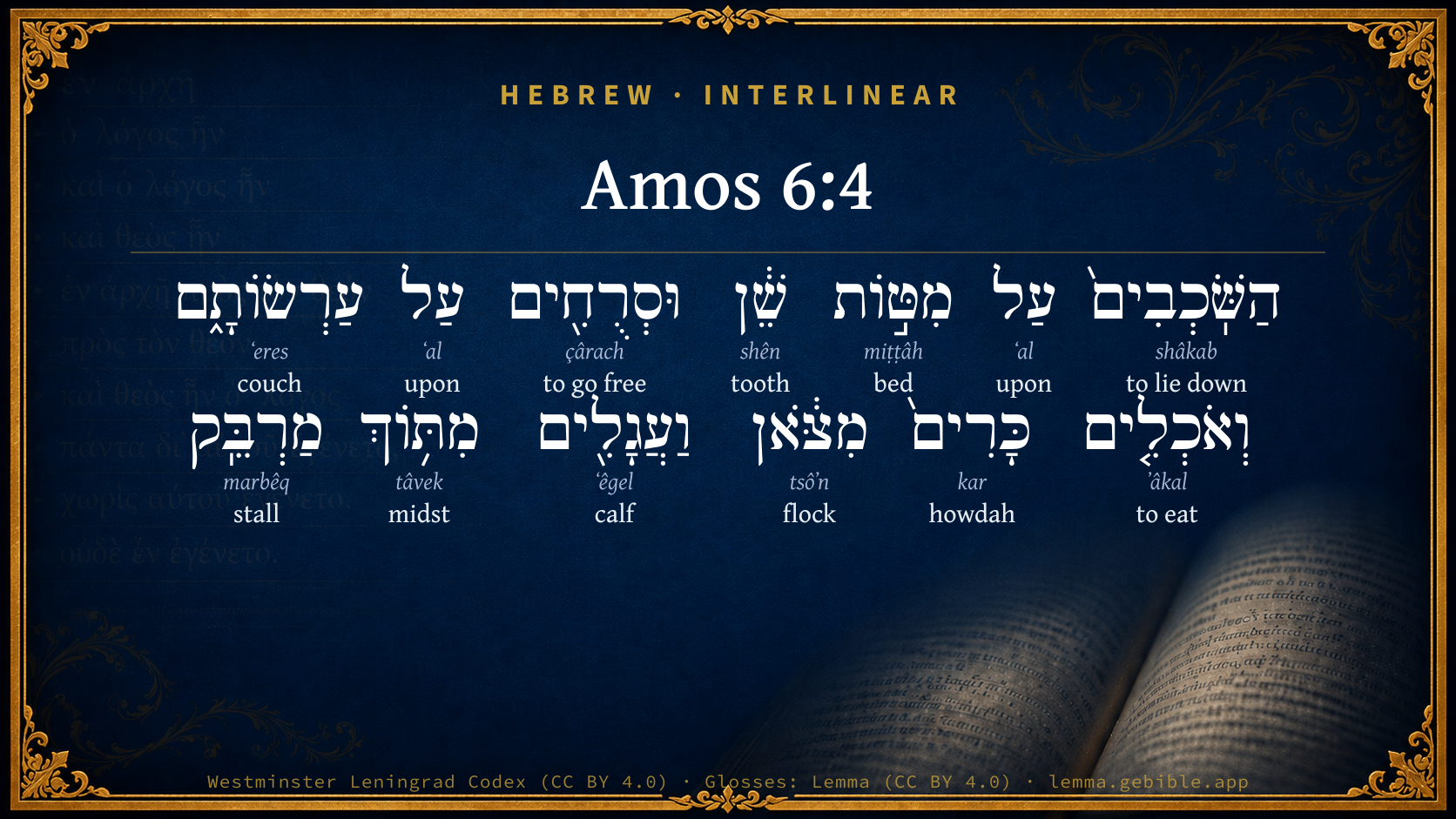
  1. הַשֹּֽׁכְבִים֙ shâkab H7901 “the · lying down” Particle, Definite Article + Verb, Qal, Participle Active, Masculine, Plural, Absolute
  2. עַל ʻal H5921 “upon” Preposition
  3. מִטּ֣וֹת miṭṭâh H4296 “beds of” Noun, Common, Feminine, Plural, Construct
  4. שֵׁ֔ן shên H8127 “tooth” Noun, Common, Both, Singular, Absolute
  5. וּסְרֻחִ֖ים çârach H5628 “and · gone free” Conjunction + Verb, Qal, Participle Passive, Masculine, Plural, Absolute
  6. עַל ʻal H5921 “upon” Preposition
  7. עַרְשׂוֹתָ֑ם ʻeres H6210 “couches · their” Noun, Common, Feminine, Plural, Construct + Suffix, Personal, 3rd Person, Masculine, Plural
  8. וְאֹכְלִ֤ים ʼâkal H398 “and · eating” Conjunction + Verb, Qal, Participle Active, Masculine, Plural, Absolute
  9. כָּרִים֙ kar H3733 “howdahs” Noun, Common, Masculine, Plural, Absolute
  10. מִצֹּ֔אן tsôʼn H6629 “from · flock” Preposition + Noun, Common, Both, Singular, Absolute
  11. וַעֲגָלִ֖ים ʻêgel H5695 “and · calves” Conjunction + Noun, Common, Masculine, Plural, Absolute
  12. מִתּ֥וֹךְ tâvek H8432 “from · midst of” Preposition + Noun, Common, Masculine, Singular, Construct

About this verse

These counts appear in no published source. They are computed here, from the morphology-tagged text and Lemma’s own curated glosses. What Lemma adds →

13
words
12
distinct lemmas
Prophets
section

Notable vocabulary

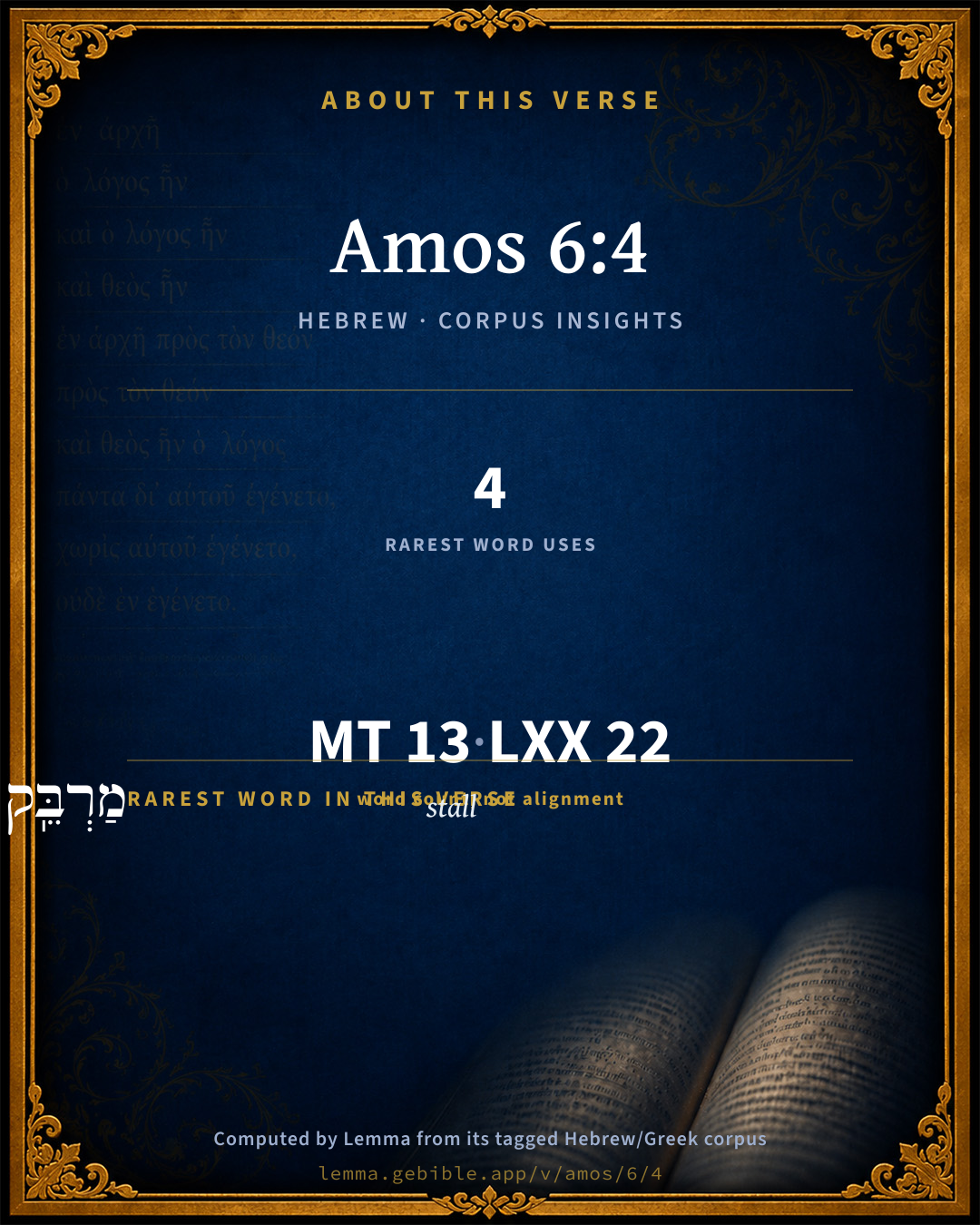
The rarest word here is מַרְבֵּֽק stall H4770 — appearing just 4 times in the whole Hebrew Bible.

Shared distinctive vocabulary

מַרְבֵּֽק stall H4770 occurs in 4 verses of the Hebrew Bible. Also found in:

Grammatical profile

  • 3 verbs
  • 8 nouns
  • 2 prepositions

Verb forms

  • הַשֹּֽׁכְבִים֙ Qal · Participle Active
  • וּסְרֻחִ֖ים Qal · Participle Passive
  • וְאֹכְלִ֤ים Qal · Participle Active

Repetition

A word recurs within this verse — often emphatic in Hebrew:

Hebrew & Septuagint length

In English translation the verse runs 30 words from the Hebrew and 29 from the Septuagint (LXX English) — closely comparable.

A rough comparison of the two English renderings, which tokenize alike — not a word-level alignment.

Word counts can differ between the Hebrew and the Greek without any difference in meaning — e.g. the Hebrew direct-object marker אֵת has no separate Greek word, and Greek often adds the article ὁ.

In the original languages it is 13 Hebrew tokens and 22 Greek tokens — but the two are counted differently (Hebrew bundles its prefixes and suffixes into one token; the Greek is in lemma form), so that isn’t a like-for-like length.

Cross-references

10

Topical passages linked to Amos 6:4 in the Treasury of Scripture Knowledge — connected by theme and wording, ordered by reader-vote popularity; previews shown in the World English Bible.

  • Amos 3:12 Thus says Yahweh: "As the shepherd rescues out of the mouth of the lion two legs, Or a piece of an ear, So shall the children of Israel be rescued who sit in Samaria on the corner of a couch, And on the silken cushions of a bed."
  • 1 Samuel 25:36–38 Abigail came to Nabal; and, behold, he held a feast in his house, like the feast of a king; and Nabal's heart was merry within him, for he was very drunken: therefore she told him nothing, less or more, until the morning light.
  • Psalms 73:7 Their eyes bulge with fat. Their minds pass the limits of conceit.
  • Isaiah 5:11–12 Woe to those who rise up early in the morning, that they may follow strong drink; Who stay late into the night, until wine inflames them!
  • Isaiah 22:13 and behold, joy and gladness, killing oxen and killing sheep, eating flesh and drinking wine: let us eat and drink, for tomorrow we shall die.
  • Ezekiel 34:2–3 Son of man, prophesy against the shepherds of Israel, prophesy, and tell them, even to the shepherds, Thus says the Lord Yahweh: Woe to the shepherds of Israel who feed themselves! Shouldn't the shepherds feed the sheep?
  • Luke 12:19–20 I will tell my soul, "Soul, you have many goods laid up for many years. Take your ease, eat, drink, be merry."'
  • Luke 16:19 "Now there was a certain rich man, and he was clothed in purple and fine linen, living in luxury every day.
  • James 5:5 You have lived delicately on the earth, and taken your pleasure. You have nourished your hearts as in a day of slaughter.
  • Romans 13:13–14 Let us walk properly, as in the day; not in reveling and drunkenness, not in sexual promiscuity and lustful acts, and not in strife and jealousy.

Cross-references courtesy of OpenBible.info (CC BY 4.0).

Hebrew and Greek witnesses Masoretic Hebrew ↔ Greek Septuagint

The same verse in the two great witnesses to the Old Testament, shown verse-for-verse.

These are two independent witnesses, not word-aligned to each other, and the Septuagint is shown in lemma (dictionary) form.

Hebrew Amos 6:4 Masoretic · Westminster Leningrad Codex

הַשֹּֽׁכְבִים֙ עַל מִטּ֣וֹת שֵׁ֔ן וּסְרֻחִ֖ים עַל עַרְשׂוֹתָ֑ם וְאֹכְלִ֤ים כָּרִים֙ מִצֹּ֔אן וַעֲגָלִ֖ים מִתּ֥וֹךְ מַרְבֵּֽק

Who lie on beds of ivory, And stretch themselves on their couches, And eat the lambs out of the flock, And the calves out of the midst of the stall;

World English Bible · Public Domain

Greek LXX Amos 6:4 Septuagint · lemma form

ὁ καταεὕδω ἐπί κλίνη ἐλεφαντίνος καί κατασπαταλάω ἐπί ὁ στρωμνή αὐτός καί ἐσθίω ἔριφος ἐκ ποίμνιον καί μοσχάριον ἐκ μέσος βουλόλιον γαλαθηνός

who sleep upon beds of ivory, and live delicately on their couches, and eat kids out of the flocks, and sucking calves out of the midst of the stalls;

LXX2012 (modern English Septuagint) · Public Domain

On this verse, John Gill's Exposition discusses the Septuagint’s reading. Read the note in Commentary ↓

Hebrew: Westminster Leningrad Codex (CC BY 4.0). Greek: Septuagint (public domain); English from LXX2012 (modern English Septuagint) (Public Domain). How the Septuagint differs from the Hebrew →

Targum (Aramaic paraphrase)

1

The Targum is the ancient Jewish Aramaic paraphrase of the Hebrew Scriptures — an interpretive translation, not the Hebrew text itself. Onkelos (literal) and Pseudo-Jonathan (expansive) render the Torah, and Jonathan the Prophets. Coverage is partial: where no permissively-licensed English translation exists for a verse, only the Aramaic is shown. This is verse-level text, not a word-by-word alignment to the Hebrew.

  1. Targum Jonathan Prophets (Joshua–Malachi)
    דְשָׁכְבִין עַל עַרְסָן דִמְכַבְּשָׁן בְּשֵׁן דְפִיל וְעוּמְקִין עַל עַרְסֵיהוֹן וְאָכְלִין פַּטִימִין מֵעָנָא וְעֶגְלִין מִגוֹ רְבַקָא:

    (no public-domain English translation for this verse)

    Targum Jonathan — Aramaic: “Mikraot Gedolot” (public domain). English: “Sefaria Community Translation” (CC0 1.0 (public-domain dedication)); “London "Chaldee Paraphrase," 1871” (public domain). Text via Sefaria.

Commentary

Notes on Amos 6:4 from classic Christian and Jewish commentators (each source and its license shown beneath its notes). The classic Christian expositions comment on the surrounding passage and are grouped to its opening verse, so a note may address several verses; the Jewish commentaries on the Tanakh (Rashi and others) are per-verse, so they appear only where the commentator wrote on this verse.

Lemma curates 59 commentaries, every one of them public domain or Creative Commons licensed, each selected and text-cleaned for this edition rather than reprinted as found. About our sources →

Trapp's Complete Commentary

John Trapp

Amo 6:4 That lie upon beds of ivory, and stretch themselves upon their couches, and eat the lambs out of the flock, and the calves out of the midst of the stall;

Ver. 4. That lie upon beds of ivory] Which was a commodity far fetched (even out of India), and dearly bought; precious and sumptuous, Eze 27:15. The wealthier sort used to deck their houses with such kind of beds decked with ivory ( lectis eburatis, as Plautus phraseth it), as Est 1:6, with gold and silver; hence their houses are called houses of ivory, Amo 3:15 1Ki 22:39. See Plin. lib. 33. cap. 11; Horat. l. 2. Sat. 6. Here, then, is condemned their luxury, and abuse of God’s good gifts, with neglect of the public welfare, and contempt of judgments threatened.

And stretch themselves upon their couches] Pandiculantur in suis cubilibus, so Rabbi Solomon. Others render it, redundantibus ac diffluentibus. Woe to them that delight in overlong and large coverlets, curtains, &c., superfluously hanging down on all sides upon the very ground: so Kimchi. The Seventy and Vulgate render it, Woe to those that wantonize upon their couches, melting in sensual pleasures. Kατασπαταλωντες. Lascivientes. Deliciantes. Compare 1Ti 5:6 Jas 5:5. God grudgeth not his people an honest affluence, Psa 23:4, but granteth them all things richly to enjoy, 1Ti 6:17. Howbeit he requireth them to be sober and watch; not making provision for the flesh, to live after the lusts thereof, but walking decently as in the day; not in rioting and drunkenness, not in chambering and wantonness, Rom 13:13-14.

And eat the lambs out of the flock] E grege, id est, egregios ac optimos, the very best and fattest morsels, pampering their paunches; swinish belly gods.

And the calves out of the midst of the stall] The French call them high-grass-veals, Veaux de haute graisse. Nothing would down with them but tid bits, λιπαρα και λαμπρα, dainty and goodly, Rev 18:9. Those abbey lubbers of the Romish synagogue are compared to fed horses, pampered in their cloisters (as war horses in their stalls or stables), and prepared unto battle, Rev 9:7. Lawful it is, I grant, at some times to eat of the fat and drink of the sweet, Neh 8:10, and to please the appetite, Deu 4:26, to gratify it with what it liketh and lusteth after. But yet it must still be remembered, that it is a sin to feed without fear; and a shame for a servant of God to be a slave to his palate. "Eat such things as are set before you," παρατιθεμενα, saith Christ to his disciples, be it never so homely or wholesome, Luk 10:8. And Gen 9:3, after, "Every moving thing that liveth shall be meat for you," it is added, "even as the green herb have I given you all things," that is, soberly and without curiosity, to take and make use of such meats as are at hand, as Dr Willet interprets it. And this Nature seems to teach man, in giving him so narrow a mouth, throat, and belly; whereas to swine she hath given a wide mouth, a very thick neck, a large belly, and but a very little brains; that they might the sooner grow fat, and take no other thought but for the belly, saith Bodine.

John Trapp, A Commentary or Exposition upon All the Books of the Old and New Testament (1647–1656) — public domain. Text from a community e-Sword module.

The Preacher's Complete Homiletical Commentary

Joseph S. Exell (gen. ed.)

CRITICAL NOTES.]

Amo_6:4.] Luxury added to oppression. Stretch] Lit. pour themselves out, “dissolved, unnerved, in luxury and sloth.” Beds] inlaid with ivory. Lambs] Choice and delicious in the East.

Amo_6:5.] like David they employ themselves with music, but for a different aim.

Amo_6:6.] Not satisfied with small cups, they took the bowls used for sprinkling of blood, to indulge in excess, and used the most costly oils, not for health and cleanliness, but wanton luxury. Grieved] not for calamities suffered in the past, or threatened in future.

A RECKLESS COMMUNITY.—Amo_6:4-6

Israel not only put away the day of Divine retribution, but multiplied the causes which produced it. Violence within will bring violence from without the land. When we put away God we invite destruction. Luxury, revelry, and debauchery describe a reckless community and reign in the present day. The special sins condemned are depicted in a peculiar manner.

I. Self-indulgence. Men betray their feelings and abuse their gifts, show they live like epicures, and pamper themselves like beasts. This selfish indulgence is seen—

1. In luxurious ease. “That lie upon beds of ivory.” Beds most expensive and scarce, splendid and far-fetched. They unnerved and relaxed themselves upon couches. They humoured themselves in idleness and wealth; indulged in personal gratification, abounded in superfluities, and robbed the poor of necessities.

2. In effeminate diet. The choicest lambs and calves fed out of the stall only satisfied their appetite. Some live to eat, and do not eat to live; feed without gratitude, and indulge in lust without restraint. “Whose God is their belly, and whose glory is in their shame.”

II. Profane revelry. “That chant to the sound of the viol” They tried to lead a merry life and a happy one. They displayed ingenuity by inventing instruments to drive away dull care. As David improved and introduced musical instruments into the service of God, so these men devised and fitted them for luxury and sensuality. But artificial music creates no Divine harmony. It weakens the nature and ministers to the folly of men. When men sing instead of weeping, when mirth is unseasonable, unbridled, and licentious, it is void of everything that dignifies the mind and elevates the soul to God. “Admonishing one another in psalms and hymns and spiritual songs, singing with grace in your heart to the Lord.”

“There’s not a string attuned to mirth

But has its chord in melancholy.”

III. Shameful debauchery. Luxury and selfishness lead to excess; sensuality and mirth, to irreverence. This is seen—

1. In profane conduct. They were not satisfied with ordinary vessels, but robbed the altars to “drink wine in bowls.” In former times princes of Israel manifested zeal in consecrating silver bowls to God, now they drink in honour of idolatry. They profaned the vessels of the sanctuary, and devoted to selfish what should have been for sacred uses.

2. In riotous excess. They drank out of large, not small cups. This they did habitually without measure or stint. They spent their wealth in pleasure and dissipation; employed their ingenuity to discover new methods of self-gratification, and drank wine to silence conscience, banish reflection, and harden the heart.

IV. Sinful apathy. They had no concern whatever for the nation sinking into decay and suffering under the judgment of God.

1. Their joy is unbridled. Their extravagance is seen in “the chief ointments with which they anoint themselves,” not for health and comfort, but wanton luxury. The custom of anointing was suspended in time of mourning (2Sa_14:2), but these neither grieve for themselves nor for the ruin of their country.

2. Their indifference is stolid. Bent on personal gratification of the most debasing kind, they were devoid of all patriotism and concern for the injury to the kingdom. “They are not grieved for the affliction of Joseph.” They indulged in the heartless conduct of the sons of Jacob towards their brother, eating bread when Joseph was in the pit (Gen_37:24). Wrath had broken “out like a fire in the house of Joseph” (ch. Amo_5:6), but they were deaf to the warnings of God and the remonstrance of the poor. They spent their time in beds of indolence and ease; pampered their bodies with delicious viands; and delighted their souls in strains of music, excess of wine, and costly perfumes. Sensuality results in unnatural feeling for kindred and country; shuts out the sufferings of others, and leads to greater indulgence. “We are verily guilty concerning our brother, in that we saw the anguish of his soul when he besought us and we would not hear.”

HOMILETIC HINTS AND OUTLINES

Amo_6:5. The use and abuse of music.

1. Its use, when devoted to the worship of God and the welfare of men. Vocal and instrumental music may be of immense service in the culture of the heart and the training of the young. Our nature is adapted to harmony, and God has bestowed means for improvement.

“There is in souls a sympathy with sounds,

And as the mind is pitched the ear is pleased.”

2. Its abuse when employed in the service of Satan and ministering to licentiousness and lust. How often found in midnight revels and scenes of intemperance! “Debased music is a mark of a nation’s decay and promotes it,” says one. The constitution of nations may be affected by changing national music. “Give me the making of the nation’s ballads,” said Lord Chatham, “and I care not who makes the laws.” David consecrated lyre and harp to the service of God, now men gain reputation by comic songs and immodest dancing. “Bid lute and harp to awake to the glory of God.”

Like David. Men abuse gifts of God by the examples of saints. They stumble in their infirmities, and copy their actions in a wrong spirit. David a great lover of music, and employed it in the praise of God. Imitators use it for carnal pleasure.

Amo_6:6. True patriotism, grieving for Joseph.

1. A country is often deeply afflicted by inward calamities and outward dangers.

2. A lover of his country will grieve for its affliction. David and Jeremiah noble examples.

3. Selfish indulgence deprives men of sympathy with others, renders them ungrateful and unpatriotic. “How many dwell in ceiled houses, and sing to the sound of the harp, and feast on the richest dainties, and care nothing for the sorrows of Christ, and his Church, nay, rather rejoice in them!” (Rev_11:10) [Wordsworth].

“Breathes there a man with soul so dead,

Who never to himself hath said,

This is my own, my native land!” [Scott.]

ILLUSTRATIONS TO CHAPTER 3

Amo_6:4-6. Pleasure. Would you judge of the lawfulness or unlawfulness of pleasures, take this rule:—Whatever weakens your reason, impairs the tenderness of your conscience, obscures your sense of God, or takes off the relish of spiritual things; in short, whatever increases the strength and authority of your body over your mind, that thing is sin to you, however innocent it may be in itself [Southey].

“In this fool’s paradise he drank delight.” [G. Crabbe.]

The Preacher's Complete Homiletical Commentary (gen. ed. Joseph S. Exell; Funk & Wagnalls, c. 1892) — public domain (pre-1929). A full-Bible homiletical/sermon-outline anthology covering 65 of 66 books (2 John is absent from the source module). Text from a community e-Sword module.

Keil & Delitzsch

C. F. Keil & F. Delitzsch

This forgetfulness of God shows itself more especially in the reckless licentiousness and debauchery of these men. Amo 6:4. "They who lie upon beds of ivory, and stretch themselves upon their couches, and eat lambs from the flock, and calves out of the fattening stall. Amo 6:5. Who prattle to the tune of the harp; like David, they invent string instruments. Amo 6:6. Who drink wine out of sacrificial bowls, and anoint themselves with the best oils, and do not afflict themselves for the hurt of Joseph." They lie stretched, as it were poured out (סרחים), upon beds inlaid with ivory, to feast and fill their belly with the flesh of the best lambs and fattened calves, to the playing of harps and singing, in which they take such pleasure, that they invent new kinds of playing and singing. The ἁπ. λεγ. pârat, to strew around (cf. peret in Lev 19:10), in Arabic to throw many useless words about, to gossip, describes the singing at the banquets as frivolous nonsense. כּלי שׁיר, articles or instruments of singing, are not musical instruments generally, but, as we may see from Ch2 34:12, compared with Ch2 29:26-27, and Ch1 23:5, the stringed instruments that were either invented by David (e.g., the nebel), or arranged by him for the sacred song of the temple, together with the peculiar mode of playing them; in other words, "the playing upon stringed instruments introduced by David." Consequently the meaning of Amo 6:5 is the following: As David invented stringed instruments in honour of his God in heaven, so do these princes invent playing and singing for their god, the belly. The meaning to invent or devise, which Baur will not allow to חשׁב, is established beyond all doubt by Exo 31:4. They drink thereby out of sacrificial bowls of wine, i.e., drink wine out of sacrificial bowls. שׁתה with ב, as in Gen 44:5. Mizrâq, in the plural mizrâqı̄m and mizrâqōth, from zâraq, to sprinkle, was the name given both to the vessels used for the sprinkling of the blood, and also to the bowls made use of for pouring the libation of wine upon the table of shew-bread (Ch2 4:8). This word is applied by Amos to the bowls out of which the gluttons drank their wine; with special reference to the offering of silver sacrificial bowls made by the tribe-princes at the consecration of the altar (Numbers 7), to show that whereas the tribe-princes of Israel in the time of Moses manifested their zeal for the service of Jehovah by presenting sacrificial bowls of silver, the princes of his own time showed just as much zeal in their care for their god, the belly. Mizrâqı̄m does not mean "rummers, or pitchers used for mixing wine." Lastly, Amos refers to their anointing themselves with the firstling of the oils, i.e., the best oils, as a sign of unbridled rejoicing, inasmuch as the custom of anointing was suspended in time of mourning (Sa2 14:2), for the purpose of appending the antithesis ולא גחלוּ, they do not afflict or grieve themselves for the ruin of Israel. Shēbher, breach, injury, destruction. Joseph signifies the people and kingdom of the ten tribes.

Keil & Delitzsch — Biblical Commentary on the Old Testament (1861–1891) — public domain (CC PDM 1.0). Text via the HelloAO Bible API. (Old Testament only.)

Tyndale Open Study Notes

Tyndale Open Resources

6:4 Meat was typically used to honor distinguished guests. The common food was bread, fruit, vegetables, and dairy products. The everyday use of meat shows the opulence of the wealthy classes.

Tyndale Open Study Notes — © Tyndale Open Resources, licensed CC BY-SA 4.0. Text via the HelloAO Bible API.

Jamieson, Fausset & Brown

Robert Jamieson, A. R. Fausset & David Brown

(See Amo 2:8).

beds of ivory--that is, adorned, or inlaid, with ivory (Amo 3:15).

stretch themselves--in luxurious self-indulgence.

lambs out of the flock--picked out as the choicest, for their owners selfish gratification.

Jamieson, Fausset & Brown — Commentary Critical and Explanatory on the Whole Bible (1871) — public domain (CC PDM 1.0). Text via the HelloAO Bible API.

Adam Clarke's Commentary

Verse 4. That lie upon beds of ivory] The word הוי hoi, wo, is understood at the beginning of each of the first, third, fourth, fifth, and sixth verses. The beds mentioned here may be either sofas to recline on at table, or beds to sleep on; and these among the ancients were ornamented with ivory inlaid. They were called lectos eburatos by Plautus, lectos eburnos by Horace, "ivory beds." Probably those ornamented with shells, or mother-of-pearl, may be intended. Several works of this kind may be still seen in Palestine and other places. I have before me a cross brought from Jerusalem, incrusted all over with mother-of-pearl, and various figures chased on it.

There must have been a great deal of luxury and effeminacy among the Israelites at this time; and, consequently, abundance of riches. This was in the time of Jeroboam the second, when the kingdom had enjoyed a long peace. The description in the fourth, fifth, and sixth verses, is that of an Asiatic court even in the present day.

Adam Clarke's Commentary on the Bible (1810–1826) — public domain. Text from a community e-Sword/MySword module.

John Calvin's Commentaries

Amos still pursues the reproof we have noticed at the beginning of the chapter, — that the chief men, of whom he speaks, cast away from them all cares and anxieties, and indulged in pleasures, while the whole country was miserably distressed. We must ever bear in mind what I have already said, — that luxury is not simply reprehended by the Prophet, as some incorrectly think, without sufficiently considering what is said, for it is not what the Prophet treats of; but he upbraids the Israelites for setting up an iron neck against God’s judgments, yea, for shamelessly trifling with God, while he was endeavoring to lead them by degrees to repentance. The Prophet complains that nothing availed with them.

He then says, first, that they slept on ivory beds. To use ivory beds was not in itself bad, except that excess is ever to be condemned; for, when we give up ourselves to pomps and pleasures, we certainly are not then free from sin: indeed, every desire for present things, which exceeds moderation, is ever justly reprehensible. And when men greedily seek splendor and display, or become ambitious and proud, or are given to delicacies, they are guilty of vices ever condemned by God. But it might be, that one used an ivory bed, who was yet willing to lie on the ground: for we know that there was then a great abundance of ivory, and that it was commonly used in Asia. Italy formerly knew not what it was to use a bed of ivory, that is, before the victory of Lucius Scipio: but after the king Antiochus was conquered, then Italy freely used ivory beds and fineries; and thus luxury broke down their courage and effeminated them.

I will come now to our Prophet: it might have been that ivory was not then so valuable in Judea: they might then have used ivory beds without blame. But Amos ever regards the miseries of those times. The rich then ought to have given up all their luxuries, and to have betaken themselves to dust and ashes, when they saw that God was incensed with them, when they saw that the fire of his vengeance was kindled. We now then perceive why Amos was so indignant against those who slept on ivory beds.

He adds, And who extend themselves on their beds: for סרח, sarech, is properly to extend; it means also to become fetid; and further, it means to be superfluous; and therefore some render the words, “upon ivory beds and superfluities;” but this is strained, and agrees not with what follows, upon their couches. The Prophet then, I have no doubt, points out here the manners of those who so heedlessly indulged themselves: “Ye extend,” he says, “your legs and your arms on your couches, as idle men, accustomed to indulgences, are wont to do. But the Lord will awaken you in a new way; his scourges ought to have roused you, but ye remain asleep. Hence, since God could not terrify you by his rods, nothing more remains but to draw you forth against your will to be punished.” This was the reason why the Prophet said that they extended themselves on their couches.

Ye eat also the lambs from the flock, and the calves from the midst of the rich pasture, or of the stall. I prefer taking מרבק, merebek, for folds. Since then they loved fat meat, the Prophet reproves this luxury: he had indeed in view, as it has been already said, the then calamitous time; for if the rich had in their usual way feasted, and had even taken fat meat, they would not have deserved so severe a punishment: but when the Lord called them to mourning, and when the signals of his wrath spread horror all around, it was a stupidity not to be endured, for them to continue their indulgences, which they ought, on the contrary, to have renounced. Indeed, this passage agrees with that of Isaiah, to which I have already referred. It now follows —

John Calvin's Commentaries (1540-1563) — public domain. Text from the Calvin Translation Society English edition (1840s-50s) via the Christian Classics Ethereal Library (ccel.org). Calvin's coverage is partial (roughly two-thirds of the Bible); uncommented books and verses are honest gaps, never fabricated. The 19th-century editor's footnotes and remarks are omitted so the notes are faithfully Calvin's own voice.

Ellicott's Commentary for English Readers

(4) Of ivory—i.e., inlaid with that material.

A Bible Commentary for English Readers, edited by Charles John Ellicott (1878–1897) — public domain. Text from a community e-Sword module.

The Cambridge Bible for Schools and Colleges

gen. ed. J. J. S. Perowne

4. That lie upon divans (Amo_3:12) of ivory] i.e. divans, the frames of which were inlaid with ivory: cf. the “ivory couches,” and “great ivory seats,” which Sennacherib boasts that he received from Hezekiah (K.A.T[174][175] p. 293 bottom, referred to by Mitchell).

[174] .A.T. … Eb. Schrader, Die Keilinschriften und das A. T., ed. 2, 1883 (translated under the title The Cuneiform Inscriptions and the O. T. 1885, 1888). The references are to the pagination of the German, which is given on the margin of the English translation.

[175] … Eb. Schrader, Die Keilinschriften und das A. T., ed. 2, 1883 (translated under the title The Cuneiform Inscriptions and the O. T. 1885, 1888). The references are to the pagination of the German, which is given on the margin of the English translation.

and are stretched out upon their couches] The older custom in Israel was to sit while eating (Gen_27:19; Jdg_19:6; 1Sa_20:5; 1Sa_20:24; 1Ki_13:20), whether upon a rug or carpet spread out on the floor, or (2Ki_4:10) on a seat: the custom of reclining at table is first mentioned here; it was not impossibly a foreign fashion introduced from Syria, and is in any case viewed by the shepherd-prophet as a signal mark of effeminacy and luxury. Of course, in later times—probably through Greek or Aramaic influence—it became general (Sir_41:19; Mat_9:10; Mat_26:7, &c.).

lambs] Heb. kârîm, not the usual word for lambs, and denoting apparently such as, from their age or kind, were a special delicacy (cf. Deu_32:14; 1Sa_15:9).

and calves out of the midst of the stall] Brought directly from the place where they were tied up (such, as Arabic shews, is the meaning of the word) to be fatted. Cf. Luk_15:23.

The Cambridge Bible for Schools and Colleges (gen. ed. J. J. S. Perowne; Cambridge University Press, 1878–1918) — public domain. Text from a community e-Sword module.

John Gill's Exposition

That lie upon beds of ivory,.... That were made of it, or inlaid with it, or covered with it, as the Targum; nor was it improbable that these were made wholly of ivory, for such beds we read of: Timaeus says (r), the Agrigentines had beds entirely made of ivory; and Horace (s) also speaks of such beds: and if any credit can be given to the Targums of Jonathan and Jerusalem on Gen 50:1. Joseph made his father Jacob to lie on a bed of ivory. Indeed, the Latin interpreters of these Targums render it a cedar bed; but Buxtorf (t) conjectures that ivory is meant by the word used; and so Bochart (u) translates it; on these they lay either for sleep and rest, or to eat their meals;

and stretch themselves upon their couches; for the same purposes, living in great splendour, and indulging themselves in ease and sloth; as it was the custom of the eastern countries, and is of the Arabs now; that they make little or no use of chairs, but either sitting cross legged, or lying at length, have couches to lie on at their meals; and when they indulge to ease, they cover or spread their floors with carpets, which for the most part are of the richest materials. Along the sides of the wall or floor, a range of narrow beds or mattresses is often placed upon these carpets; and, for their further ease and convenience, several velvet or damask bolsters are placed upon these, or mattresses (w), to lean upon, and take their ease; see Eze 13:18; and thus, and in some such like manner, did the principal men of the people of Israel indulge themselves. Some render it, "abound with superfluities"; the Septuagint and Vulgate Latin versions, "are lascivious"; and the Arabic version, "burn in lust"; and so some of the Jewish writers interpret it of their committing adulteries, and all uncleanness, on their beds and couches;

and eat the lambs out of the flock; pick the best and fattest of them for their use: so the Targum,

"eat the fat of the sheep:''

and the calves out of the midst of the stall; where they are put, and kept to be fattened; from thence they took what they liked best, and perhaps not out of theft own flocks and stalls, but out of others, and with which they pampered themselves to excess.

(r) Apud Aelian. Var. Hist. l. 12. c. 29. (s) "----Rubro ubi cocco Tincta super lectos cauderet vestis eburnos". Horat. Serm. l. 2. Satyr. 6. v. 102. (t) Lexic. Talmud. col. 2475. (u) Hierozoic. par. 1. l. 2. c. 24. col. 252. (w) See Shaw's Travels, p. 209. Ed. 2.

John Gill's Exposition of the Whole Bible (1746–1763) — public domain (CC PDM 1.0). Text via the HelloAO Bible API.

Albert Barnes' Notes on the Bible

That lie upon beds (that is, sofas) of ivory - that is, probably inlaid with ivory. The word might, in itself, express either the bed, in which they slept by night, or the divan, on which the Easterns lay at their meals; “and stretch themselves,” literally, “are poured” out , stretching their listless length, dissolved, unnerved, in luxury and sloth, “upon their couches,” perhaps under an awning: “and eat the lambs,” probably “fatted lambs (as in Deu 32:14; Psa 37:20; 1Sa 15:9; Jer 51:40), out of the flock,” chosen, selected out of it as the best, and “calves out of the midst of the stall;” that is, the place where they were tied up (as the word means) to be fatted. They were stall-fed, as we say, and these people had the best chosen for them.

: “He shews how they ‘draw nigh the seat of violence.’ They lay on beds or couches of ivory, and expended thereon the money wherewith their poor brethren were to be fed. Go now, I say not into the houses of nobles, but into any house of any rich man, see the gilded and worked couches, curtains woven of silk and gold, and walls covered with gold, while the poor of Christ are naked, shivering, shriveled with hunger. Yet stranger is it, that while this is everywhere, scarce anywhere is there who now blames it. Now I say, for there were formerly. ‘Ye array,’ Ambrose says , ‘walls with gold, men ye bare. The naked cries before your door and you neglect him; and are careful with what marbles you clothe your pavement. The poor seeketh money, and hath it not; man asketh for bread, and thy horse champeth gold. Thou delightest in costly ornaments, while others have not meal. What judgment thou heapest on thyself, thou man of wealth! Miserable, who hast power to keep so many souls from death, and hast not the will! The jewel of thy ring could maintain in life a whole population.’ If such things are not to be blamed now, then neither were they formerly.”

Albert Barnes' Notes on the Bible (1834–1885) — public domain. Text from a community e-Sword/MySword module.

Haydock's Catholic Bible Commentary

Ivory, with which the beds for eating were adorned, ver. 7. (Calmet) --- Wanton. Hebrew, "stretch themselves out upon their," &c. (Haydock)

George Leo Haydock (1774–1849), Haydock's Catholic Family Bible and Commentary, 1859 edition — public domain. Excludes Psalms (Douay-Rheims chapter numbering differs from Protestant) and Deuterocanonical books (Catholic canon only).

Matthew Poole's English Annotations

The woe is to be added to them that, either out of laziness or luxury, and to please the flesh, lay themselves to rest

upon beds of ivory; on beautiful, rich beds, bought with the gain of bribes and oppression.

Stretch themselves upon their couches: this somewhat explains the former; they did extremely indulge their pride and luxury, and on beds or couches laid themselves to feast, when God called them to mourn and weep.

Eat, with excess, as Mat 24:37,38; Lu 12:19,20.

The lambs out of the flock; the very best in all their flock, and probably they chose them out first, before they set out lambs for sacrifices; or else these gluttonous judges and rulers eat the best lambs, not of their own, but out of poor oppressed men’s flocks.

The calves, those that were fattest too,

out of the midst of the stall; kept on purpose to make them most delicious and nourishing meat.

Matthew Poole's English Annotations on the Holy Bible (1683–1685) — public domain. Text from a community e-Sword/MySword module.

The Pulpit Commentary

That lie upon beds of ivory; couches inlaid with ivory (see note on Amo_3:15) at meals. The prophet substantiates his denunciation by describing their selfish luxury and debauchery. Stretch themselves literally, are poured out; Septuagint, kataspatalwntev, wantoning. " Out of the midst of the stall. Calves put up to be fattened. They do this presumably net on festivals, when it would have been proper and excusable, but every day.

Vers. 4-7.

The sin of dissolute life.

A herdsman and gatherer of wild figs like Amos, brought into contact with the nobility and the courtiers of a wealthy and luxurious city like Samaria, was likely enough to be shocked and scandalized. The judgments he formed were naturally severe, but they were not unjust or passionate. His language remains a merited and everlasting rebuke to those in high station who live for their own gratification and indulgence.

I A LUXURIOUS AND DISSOLUTE LIFE IS A SHAMEFUL MISUSE OF PRECIOUS OPPORTUNITIES. It is sometimes judged that those who are "born in the purple," those who inherit great estates, great wealth, are to be excused if they form in youth, and retain in manhood, habits of expensive self-indulgence. But as all men are, above all, the children of God, endowed with a spiritual nature and entrusted with sacred opportunities, it is not to be for a moment admitted that the advantages of high station absolve them from the obligations involved in human nature and human life. A man has no right to pamper the body and exalt it to a lordship over the spirit; he has no right to gratify his tastes as though self-gratification were the great end of existence.

II A LUXURIOUS AND DISSOLUTE LIFE IS MORALLY DEBASING AND DEGRADING. No one can live below the appointed level of humanity without paying the inevitable penalty, without incurring the inevitable deterioration. The light burns dim; the fine gold turns to clay. The couch of indolence, the feast of gluttony, the voluptuous music, the brimming bowls of wine, the costly unguents, these are dangerous indulgences. Men may give them fine names, and call them the bounties of Divine providence. And it is quite true that the evil is not in the instruments of self-indulgence, but in the bad uses to which they are put. But none can live merely for bodily, for aesthetic, for social, enjoyment, without injuring his own character, without losing self-respect and the esteem of those whose esteem is worth having.

III A LUXURIOUS AND DISSOLUTE LIFE ON THE PART OF THE GREAT IS A BAD EXAMPLE TO THE COMMUNITY AT LARGE. Bad habits penetrate from the so called upper to the so called lower class. When the nobility and gentry are self-indulgent, the tradespeople who grow wealthy are likely to follow their example, and the poor are likely enough to grow envious and discontented. The Samaritan chiefs were reproached for misleading the people, and justly. The ignorant and the thoughtless are naturally influenced by an example of selfishness, and none can altogether escape receiving some measure of harm.

IV A LUXURIOUS AND DISSOLUTE LIFE RENDERS THE GREAT INSENSIBLE TO THE AFFLICTIONS OF THE POOR AND OPPRESSED. The language of the prophet is very touching: the self indulgent "are not grieved for the affliction of Joseph." Wrapped up in their own enjoyments, comforts, and luxuries, the great fail to sympathize with those whom we call "the masses." A self-denying and benevolent and public-spirited course of conduct would have precisely an opposite effect. There is no reason m the nature of things why nobles should not feel with and for the poor and unfortunate; as a matter of fact, they often do so. But those whose absorbing thought is of self have neither heart nor time to give to their less-favoured neighbours.

V A LUXURIOUS AND DISSOLUTE LIFE OFTEN INVOLVES A SPEEDY AND FEARFUL RETRIBUTION. The table of the epicure is overthrown. The sybarite is dragged from his palace, and sent away into exile. Those who have been worthless members of their own state become banished mourners in a strange land. And the song of pleasure is exchanged for the wail of woe. T.

Vers. 4-7.

Carnal indulgence.

lie upon beds of ivory, and stretch themselves upon their couches, and eat the lambs out of the flock, and the calves out of the midst of the stall," etc. Here is a sketch of the way in which these leading men of the chief nations luxuriated in carnal pleasures and sensual indulgences. Observe two things.

I THE MORAL TORPOR OF CARNAL INDULGENCE. Observe two things.

1. These people wrought entirely for the senses. See how they slept! They provided themselves with "beds of ivory." They did not require rest for their weary limbs, otherwise beds of straw would have done. They wanted to be grand, they loved glitter, hence "beds of ivory." Here is the lust of the eye. See how they ate! "And stretch themselves upon their couches, and eat the lambs out of the flock, and the calves out of the midst of the stall." They abounded in superfluities; they partook of the choicest dainties of nature, and that in a recumbent position. Here is the lust of the palate. See how they sang! "That chant to the sound of the viol, and invent to themselves instruments of music, like David." Musical sounds gratified their auricular sensibilities, and they chanted to the "viol." Here is the lust of the ear. See how they drank! They "drink wine in bowls." Small vessels would not do; they must take long, deep draughts of the pleasing beverage. Here again is the lust of the palate. See how they anointed themselves! With the chief ointments." They regaled their olfactory nerves with the choicest perfumes of nature. Here is the lust of the smell. See how indifferent they were to the suffering of the true Church of God! "They are not grieved for the affliction of Joseph." What a description this of a people that lived and wrought entirely for the senses! They were practical materialists. They had no spiritual vision, sensibilities, or experience. Their imperishable souls were submerged in the deep flowing sea of mere animal pleasures. Are there no such men now? For what do our prosperous tradesmen and the upper ten thousand live? For the most part, we fear, for the senses. Grand furniture of ivory;" choicest viands out of the flock, and calves out of the midst of the stall;" ravishing music to the sound of the viol;" delectable beverages the choicestwines in "bowls;" the most delicious aromas chief ointments." Has carnal indulgence been more rife in any land or age than this? Matter everywhere governs spirit; the body everywhere is the despot, men are "carnal, sold under sin.

2. These people wrought without conscience. In all this there is no effort of conscience recorded, no word uttered. There is, indeed, a reference to intellectual effort, for it is said "they invented to themselves instruments of music." Carnal indulgence has ever been and is now as much, if not more than ever, the great employer of man"s inventive faculties. Luxury in England today is the great employer of human ingenuity. But there is no conscience here. When conscience is touched in such a state of things, and startled by the sense of its guilt, it exclaims, "O wretched man that I am! who shall deliver me from the body of this sin and death?

II THE RETRIBUTIVE RESULT OF CARNAL INDULGENCE. The threat in the text is:

1. The loss of liberty. "Therefore now shall they go captive with the first that go captive." Those who had taken the lead in revelry and all manner of wickedness were to be the first in the procession of captives. In such a position their disgrace would be more conspicuous. Luxury always leads to slavery: it is the eternal law of justice, that those who live to the flesh shall lose their freedom and be exiled into the region of tyranny. "Lust, when it hath conceived, bringeth forth sin; and sin, when it is full-grown, bringeth forth death". (Jam_1:15)

2. The loss of provisions. "And the banquet of them that stretched themselves shall be removed." They shall have scarcity, perhaps starvation, instead of the profusion of dainties with which their tables have been spread. All this carnal indulgence and voluptuousness, this luxury in ease, and diet, and music, and aroma will not go on forever. They are abnormal conditions of human nature; retribution will one day put an end to them.

O luxury, Bane of elated life, of affluent states, What ruin is not thine? Behind thee gapes Th" unfathomable gulf where Ashur lies O"erwhelmed, forgotten; and high boasting Cham: And Elam"s haughty pomp; and beauteous Greece; And the great queen of earth, imperial Rome. (Dyer.)

D.T.

The Pulpit Commentary (1880–1919), ed. H.D.M. Spence-Jones & Joseph S. Exell — public domain. Text from a community e-Sword module.

John Wesley's Explanatory Notes

That lie - That out of laziness or luxury, lay themselves to rest. And eat - The very best in all their flock.

John Wesley, Explanatory Notes Upon the Whole Bible (1754–1765) — public domain. Text via the GEBible commentary corpus.

Rashi

Rabbi Shlomo Yitzchaki (Rashi)

and stretch out on their beds Heb. וּסְרֻחִים. They spread themselves out and stretch themselves out on their beds. Our Sages, however, explained that they would exchange wives with one another and befoul their beds with semen that is not theirs. [from Shabbath 62b]

lambs Heb. כָּרִים Lambs.

out of the stall—The place where the calves are gathered, and in O.F. kopled, a pen.

Rashi on the Tanakh — English translations: “The Judaica Press complete Tanach with Rashi, translated by A. J. Rosenberg” (CC BY 4.0); “Pentateuch with Rashi's commentary by M. Rosenbaum and A.M. Silbermann, 1929-1934” (public domain); “The Metsudah Tanach series, Lakewood, N.J” (CC BY 4.0); and “The Book of Joshua, Metsudah Publications, 1997” (CC BY 4.0). Text via Sefaria.

Lesson kit

Teaching starters — assembled from the data on this page, not authored interpretation. Every prompt links to the verse data it draws on. Edit before teaching.

Amos, in the Prophets, opens this verse with 13 words (12 distinct Hebrew lemmas). Its most distinctive word is marbêq (“stall”). A historical commentator’s framing appears above. Read the whole chapter for the surrounding context.

Discussion questions

  1. What does “stall” (marbêq) contribute to the verse as a whole?
  2. 1 Samuel 28:24 shares the word «stall» with this verse. How do the two illuminate each other?
  3. “upon” occurs 2× in this one verse. What is the effect of the repetition?
  4. These translations render this verse differently; the difference is in the English rendering, not the original. What questions does that raise?
  5. The verb «הַשֹּֽׁכְבִים֙» is Qal Participle Active. How does its form color the action?
  6. Reading how Trapp's Complete Commentary and The Preacher's Complete Homiletical Commentary read this verse, where do the two commentators agree and where do they part?

Things to notice

Reading settings

Reading text

Shown beneath each verse's original-language words.

Old Testament
Old Testament edition

Read the OT as the Masoretic Hebrew (MT) or the Greek Septuagint (LXX).

English shown for the Greek Septuagint (in the Hebrew ↔ Greek comparison).

Comparing translations? Open the Compare panel on any verse page to stack up to four side by side.