
Exodus 24:16

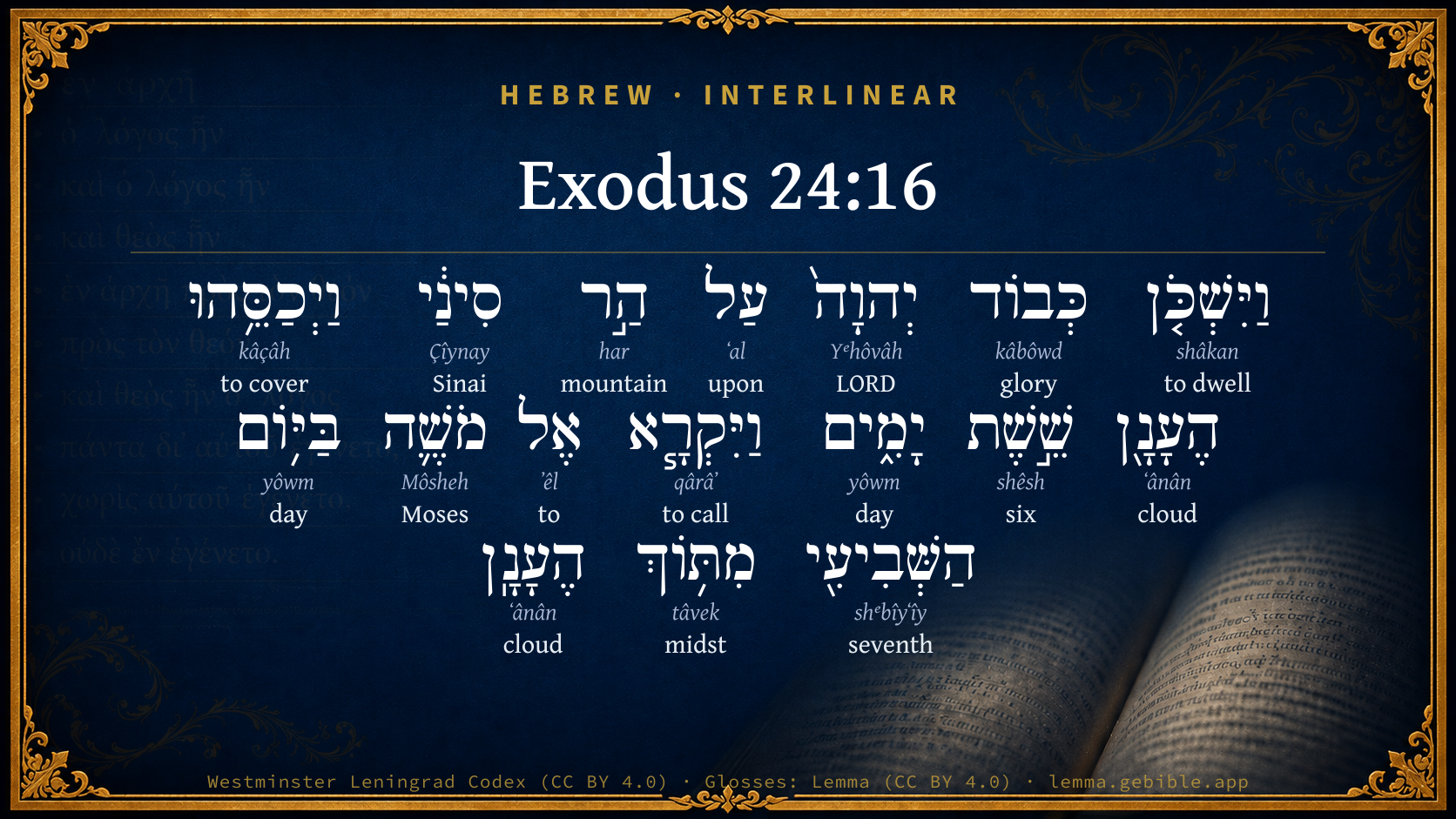
Hebrew (Westminster Leningrad Codex) Exodus 24:16 appears in the Hebrew Old Testament. The text above is from the Westminster Leningrad Codex. Each word links to its Strong’s number, a concise gloss, and parsing drawn from the Open Scriptures Hebrew Bible morphology. Click any word for its full Brown-Driver-Briggs (BDB) entry.
Download image
Cite this verse

Exodus 24:16 (World English Bible). Public Domain. Lemma interlinear Bible study tool, https://lemma.gebible.app/v/exodus/24/16.

Show BibTeX & RIS
BibTeX
RIS
English Translation
The glory of Yahweh settled on Mount Sinai, and the cloud covered it six days. The seventh day he called to Moses out of the midst of the cloud.
World English Bible · Public Domain
Download a study sheet

One document with this verse’s original text, its word-by-word gloss line, the meaning frame, cross-references with their text, attributed commentary, and full source and license credits — printable, and it pastes into notes with its structure intact.

This verse Autodidact and up

Study sheet (.html) Plain text (.txt)

A passage Seminary Student

Up to 50 verses in one chapter. A passage sheet keeps up to 6 commentary sources and 12 cross-references per verse, in the order this page ranks them, and says so on the sheet whenever that leaves anything out. Ask for a single verse and you get the Autodidact verse sheet above.

Everything on this page stays free to read, with no account — the sheet is a download of what is already on screen, not access to it.

Want to remove ads? Support Godless Engineer
Compare translations 3

The same verse in 3 English versions, stacked beneath the original-language interlinear above. Click any original word for its lexicon entry.

Each is an independent rendering of the whole verse — the interlinear is not word-aligned to these translations.

Highlighted words mark where these versions differ — a whole-verse word diff, not a word-by-word alignment.

  • World English Bible Public Domain
    The glory of Yahweh settled on Mount Sinai, and the cloud covered it six days. The seventh day he called to Moses out of the midst of the cloud.
  • King James Version Public Domain
    And the glory of the LORD abode upon mount Sinai, and the cloud covered it six days: and the seventh day he called unto Moses out of the midst of the cloud.
  • unfoldingWord Literal Text CC BY-SA 4.0
    And the glory of Yahweh settled on Mount Sinai, and the cloud covered it six days. And on the seventh day he called to Moses from within the cloud.

unfoldingWord Literal Text — © unfoldingWord, licensed CC BY-SA 4.0. Word-aligned USFM3 via Door43 (git.door43.org/unfoldingWord/en_ult).

Versions to compare (up to 4)

3 of 4 selected

Show all 18 translations

Every available English version of this verse, each an independent rendering of the whole verse.

  • World English Bible Public Domain
    The glory of Yahweh settled on Mount Sinai, and the cloud covered it six days. The seventh day he called to Moses out of the midst of the cloud.
  • Berean Standard Bible Public Domain
    and the glory of the LORD settled on Mount Sinai. For six days the cloud covered it, and on the seventh day the LORD called to Moses from within the cloud.
  • Majority Standard Bible Public Domain
    and the glory of the LORD settled on Mount Sinai. For six days the cloud covered it, and on the seventh day the LORD called to Moses from within the cloud.
  • King James Version Public Domain
    And the glory of the LORD abode upon mount Sinai, and the cloud covered it six days: and the seventh day he called unto Moses out of the midst of the cloud.
  • American Standard Version (1901) Public Domain
    And the glory of Jehovah abode upon mount Sinai, and the cloud covered it six days: and the seventh day he called unto Moses out of the midst of the cloud.
  • Revised Version (1885) Public Domain
    And the glory of the LORD abode upon mount Sinai, and the cloud covered it six days: and the seventh day he called unto Moses out of the midst of the cloud.
  • Geneva Bible (1599) Public Domain
    And the glorie of the Lord abode vpon mount Sinai, and the cloude couered it sixe dayes: and the seuenth day he called vnto Moses out of the middes of the cloude.
  • Douay-Rheims (1899) Public Domain
    And the glory of the Lord dwelt upon Sinai, covering it with a cloud six days: and the seventh day he called him out of the midst of the cloud.
  • Young's Literal Translation Public Domain
    and the honour of Jehovah doth tabernacle on mount Sinai, and the cloud covereth it six days, and He calleth unto Moses on the seventh day from the midst of the cloud.
  • Literal Standard Version CC BY-SA 4.0
    and the glory of YHWH dwells on Mount Sinai, and the cloud covers it [for] six days, and He calls to Moses on the seventh day from the midst of the cloud.
  • Unlocked Literal Bible CC BY-SA 4.0
    Yahweh's glory settled on Mount Sinai, and the cloud covered it for six days. On the seventh day he called to Moses from within the cloud.
  • unfoldingWord Literal Text CC BY-SA 4.0
    And the glory of Yahweh settled on Mount Sinai, and the cloud covered it six days. And on the seventh day he called to Moses from within the cloud.
  • Darby Bible Public Domain
    And the glory of Jehovah abode on mount Sinai, and the cloud covered it six days; and on the seventh day he called to Moses out of the midst of the cloud.
  • World Messianic Bible Public Domain
    The LORD’s glory settled on Mount Sinai, and the cloud covered it six days. The seventh day he called to Moses out of the middle of the cloud.
  • Webster's Bible Public Domain
    And the glory of the LORD abode upon mount Sinai, and the cloud covered it six days: and the seventh day he called to Moses from the midst of the cloud.
  • Free Bible Version CC BY-SA 4.0
    The Lord's glory came down on Mount Sinai, covering it for six days. On the seventh day the Lord called to Moses from inside the cloud.
  • Bible in Basic English Public Domain
    And the glory of the Lord was resting on Mount Sinai, and the cloud was over it for six days; and on the seventh day he said Moses' name out of the cloud.
  • JPS Tanakh (1917) Public Domain
    And the glory of the LORD abode upon mount Sinai, and the cloud covered it six days; and the seventh day He called unto Moses out of the midst of the cloud.

Literal Standard Version (2020), Covenant Press — licensed CC BY-SA 4.0. Text via the HelloAO Bible API (eBible.org). Unlocked Literal Bible (unfoldingWord) — licensed CC BY-SA 4.0. Text via the HelloAO Bible API (eBible.org). unfoldingWord Literal Text — © unfoldingWord, licensed CC BY-SA 4.0. Word-aligned USFM3 via Door43 (git.door43.org/unfoldingWord/en_ult). Free Bible Version, Dr. Jonathan Gallagher — licensed CC BY-SA 4.0. Text via the HelloAO Bible API (eBible.org).

Word by word

More ways to search: Search by grammar → Find every occurrence → Compare this word →

Practice this passage: Drill this verse → Learn its vocabulary →

סִינַ֔י
Çîynay
H5514
“Sinai”
Noun, Proper
Part of Speech
Noun
Type
Proper
Full BDB Definition

Origin: of uncertain derivation

TWOT: 1488

Sinai = "thorny" - the mountain where Moses received the Law from Jehovah; located at the southern end of the Sinai peninsula between the horns of the Red Sea; exact site unknown
  1. וַיִּשְׁכֹּ֤ן shâkan H7931 “and · to dwell” Conjunction + Verb, Qal, Sequential Imperfect, 3rd Person, Masculine, Singular
  2. כְּבוֹד kâbôwd H3519 “glory of” Noun, Common, Both, Singular, Construct
  3. יְהוָה֙ Yᵉhôvâh H3068 “LORD” Noun, Proper
  4. עַל ʻal H5921 “upon” Preposition
  5. הַ֣ר har H2022 “mountain of” Noun, Common, Masculine, Singular, Construct
  6. וַיְכַסֵּ֥הוּ kâçâh H3680 “and · to cover · him” Conjunction + Verb, Piel, Sequential Imperfect, 3rd Person, Masculine, Singular + Suffix, Personal, 3rd Person, Masculine, Singular
  7. הֶעָנָ֖ן ʻânân H6051 “the · cloud” Particle, Definite Article + Noun, Common, Masculine, Singular, Absolute
  8. שֵׁ֣שֶׁת shêsh H8337 “six” Adjective, Cardinal number, Masculine, Singular, Construct
  9. יָמִ֑ים yôwm H3117 “days” Noun, Common, Masculine, Plural, Absolute
  10. וַיִּקְרָ֧א qârâʼ H7121 “and · to call” Conjunction + Verb, Qal, Sequential Imperfect, 3rd Person, Masculine, Singular
  11. אֶל ʼêl H413 “to” Preposition
  12. מֹשֶׁ֛ה Môsheh H4872 “Moses” Noun, Proper
  13. בַּיּ֥וֹם yôwm H3117 “in/at the · day” Preposition, Determined + Noun, Common, Masculine, Singular, Absolute
  14. הַשְּׁבִיעִ֖י shᵉbîyʻîy H7637 “the · seventh” Particle, Definite Article + Adjective, Ordinal number, Masculine, Singular, Absolute
  15. מִתּ֥וֹךְ tâvek H8432 “from · midst of” Preposition + Noun, Common, Masculine, Singular, Construct
  16. הֶעָנָֽן ʻânân H6051 “the · cloud” Particle, Definite Article + Noun, Common, Masculine, Singular, Absolute

About this verse

These counts appear in no published source. They are computed here, from the morphology-tagged text and Lemma’s own curated glosses. What Lemma adds →

17
words
15
distinct lemmas
Pentateuch
section

Shared distinctive vocabulary

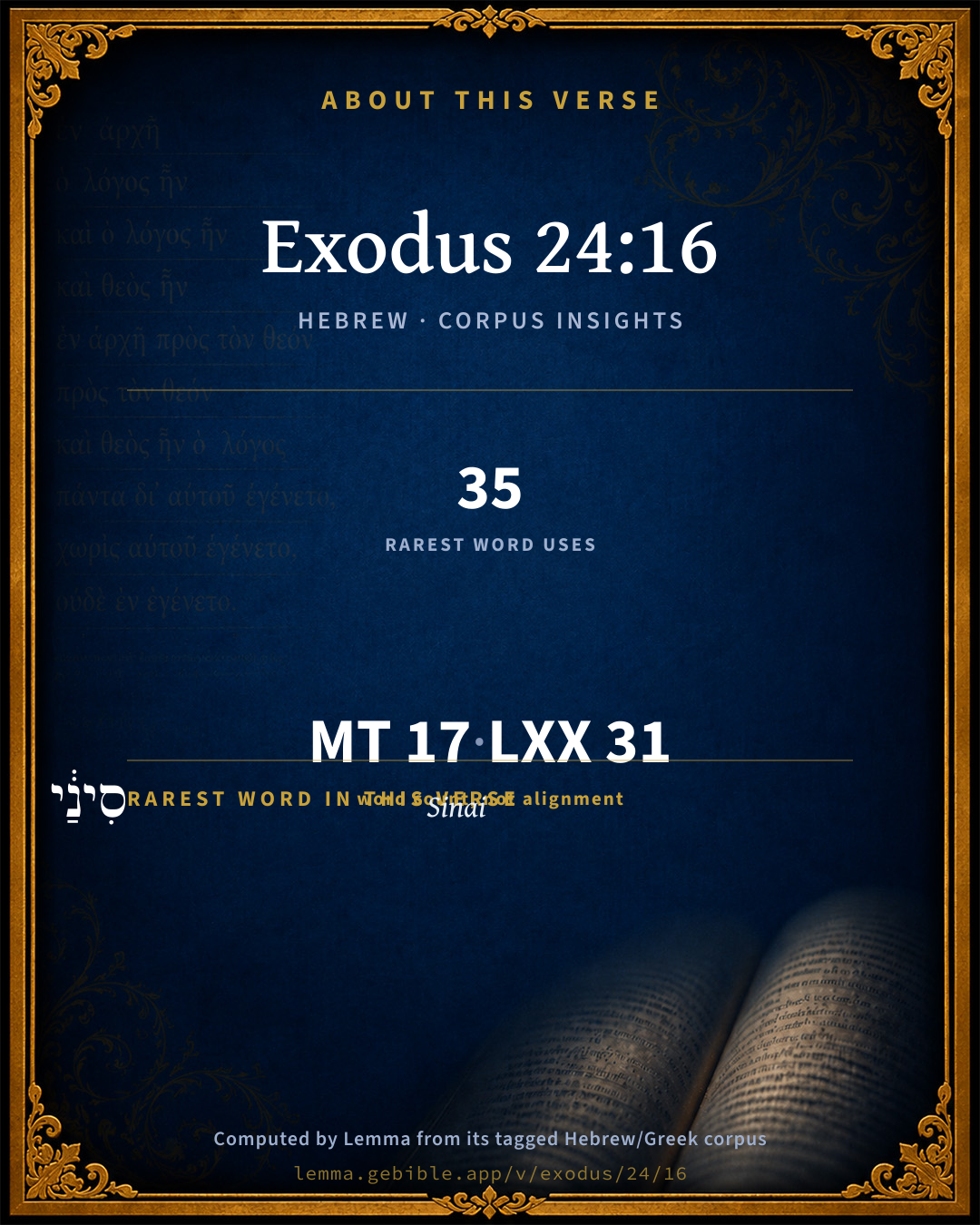
סִינַ֔י Sinai H5514 occurs in 34 verses of the Hebrew Bible. Also found in:

Grammatical profile

  • 3 verbs
  • 10 nouns
  • 2 adjectives
  • 2 prepositions

Verb forms

  • וַיִּשְׁכֹּ֤ן Qal · Sequential Imperfect
  • וַיְכַסֵּ֥הוּ Piel · Sequential Imperfect
  • וַיִּקְרָ֧א Qal · Sequential Imperfect

Repetition

Words recur within this verse — often emphatic in Hebrew:

  • הֶעָנָ֖ן cloud H6051 ×2
  • יָמִ֑ים day H3117 ×2

Hebrew & Septuagint length

In English translation the verse runs 29 words from the Hebrew and 34 from the Septuagint (LXX English) — closely comparable.

A rough comparison of the two English renderings, which tokenize alike — not a word-level alignment.

Word counts can differ between the Hebrew and the Greek without any difference in meaning — e.g. the Hebrew direct-object marker אֵת has no separate Greek word, and Greek often adds the article ὁ.

In the original languages it is 17 Hebrew tokens and 31 Greek tokens — but the two are counted differently (Hebrew bundles its prefixes and suffixes into one token; the Greek is in lemma form), so that isn’t a like-for-like length.

Cross-references

11

Topical passages linked to Exodus 24:16 in the Treasury of Scripture Knowledge — connected by theme and wording, ordered by reader-vote popularity; previews shown in the World English Bible.

  • Exodus 16:10 It happened, as Aaron spoke to the whole congregation of the children of Israel, that they looked toward the wilderness, and, behold, the glory of Yahweh appeared in the cloud.
  • Numbers 16:42 It happened, when the congregation was assembled against Moses and against Aaron, that they looked toward the tent of meeting: and, behold, the cloud covered it, and the glory of Yahweh appeared.
  • Ezekiel 1:28 As the appearance of the bow that is in the cloud in the day of rain, so was the appearance of the brightness round about. This was the appearance of the likeness of the glory of Yahweh. When I saw it, I fell on my face, and I heard a voice of one that spoke.
  • Leviticus 9:23 Moses and Aaron went into the Tent of Meeting, and came out, and blessed the people: and the glory of Yahweh appeared to all the people.
  • Exodus 19:11 and be ready against the third day; for on the third day Yahweh will come down in the sight of all the people on Mount Sinai.
  • Exodus 20:10 but the seventh day is a Sabbath to Yahweh your God. You shall not do any work in it, you, nor your son, nor your daughter, your man-servant, nor your maid-servant, nor your cattle, nor your stranger who is within your gates;
  • Exodus 24:17 The appearance of the glory of Yahweh was like devouring fire on the top of the mountain in the eyes of the children of Israel.
  • Numbers 14:10 But all the congregation bade stone them with stones. The glory of Yahweh appeared in the tent of meeting to all the children of Israel.
  • Psalms 99:7 He spoke to them in the pillar of cloud. They kept his testimonies, The statute that he gave them.
  • 2 Corinthians 4:6 seeing it is God who said, "Light will shine out of darkness," who has shone in our hearts, to give the light of the knowledge of the glory of God in the face of Jesus Christ.
  • Revelation 1:10 I was in the Spirit on the Lord's day, and I heard behind me a loud voice, like a trumpet

Cross-references courtesy of OpenBible.info (CC BY 4.0).

Hebrew and Greek witnesses Masoretic Hebrew ↔ Greek Septuagint

The same verse in the two great witnesses to the Old Testament, shown verse-for-verse.

These are two independent witnesses, not word-aligned to each other, and the Septuagint is shown in lemma (dictionary) form.

Hebrew Exodus 24:16 Masoretic · Westminster Leningrad Codex

וַיִּשְׁכֹּ֤ן כְּבוֹד יְהוָה֙ עַל הַ֣ר סִינַ֔י וַיְכַסֵּ֥הוּ הֶעָנָ֖ן שֵׁ֣שֶׁת יָמִ֑ים וַיִּקְרָ֧א אֶל מֹשֶׁ֛ה בַּיּ֥וֹם הַשְּׁבִיעִ֖י מִתּ֥וֹךְ הֶעָנָֽן

The glory of Yahweh settled on Mount Sinai, and the cloud covered it six days. The seventh day he called to Moses out of the midst of the cloud.

World English Bible · Public Domain

Greek LXX Exodus 24:16 Septuagint · lemma form

καί καταβαίνω ὁ δόξα ὁ θεός ἐπί ὁ ὄρος ὁ σινα καί καλύπτω αὐτός ὁ νεφέλη ἕξ ἡμέρα καί καλέω κύριος ὁ μωυσῆς ὁ ἡμέρα ὁ ἕβδομος ἐκ μέσος ὁ νεφέλη

And the glory of God came down upon the mount Sina, and the cloud covered it six days; and the Lord called Moses on the seventh day out of the midst of the cloud.

LXX2012 (modern English Septuagint) · Public Domain

Hebrew: Westminster Leningrad Codex (CC BY 4.0). Greek: Septuagint (public domain); English from LXX2012 (modern English Septuagint) (Public Domain). How the Septuagint differs from the Hebrew →

Targum (Aramaic paraphrase)

2

The Targum is the ancient Jewish Aramaic paraphrase of the Hebrew Scriptures — an interpretive translation, not the Hebrew text itself. Onkelos (literal) and Pseudo-Jonathan (expansive) render the Torah, and Jonathan the Prophets. Coverage is partial: where no permissively-licensed English translation exists for a verse, only the Aramaic is shown. This is verse-level text, not a word-by-word alignment to the Hebrew.

  1. Targum Onkelos Torah (Genesis–Deuteronomy)
    וּשְׁרָא יְקָרָא דַיְיָ עַל טוּרָא דְסִינַי וַחֲפָהִי עֲנָנָא שִׁתָּא יוֹמִין וּקְרָא לְמשֶׁה בְּיוֹמָא שְׁבִיעָאָה מִגוֹ עֲנָנָא:

    (no public-domain English translation for this verse)

    Targum Onkelos — Aramaic: “Onkelos Genesis” (public domain); “Onkelos Exodus” (public domain); “Onkelos Leviticus” (public domain); “Onkelos Numbers” (public domain); “Onkelos Deuteronomy” (public domain). English: “Sefaria Community Translation” (CC0 1.0 (public-domain dedication)); “J.W. Etheridge. The Targums of Onkelos and Jonathan Ben Uzziel on the Pentateuch. London: Longmans, Green, 1862” (public domain). Text via Sefaria.

  2. Targum Pseudo-Jonathan Torah (Genesis–Deuteronomy)
    וּשְׁרָא אִיקַר שְׁכִינְתָּא דַיְיָ עַל טַוְורָא דְסִינַי וַחֲפָהִי עֲנַן יְקָרָא שִׁיתָּא יוֹמִין וּקְרָא לְמשֶׁה בְּיוֹמָא שְׁבִיעָאָה מִגּוֹ עֲנָנָא

    And the glory of the Lord's Shekinah abode upon the mountain of Sinai, and the Cloud of Glory covered it six days. And on the seventh day He called to Mosheh from the midst of the Cloud.

    Targum Pseudo-Jonathan — Aramaic: “Targum Jonathan on Genesis” (public domain); “Targum Jonathan on Exodus” (public domain); “Targum Jonathan on Leviticus” (public domain); “Targum Jonathan on Numbers” (public domain); “Targum Jonathan on Deuteronomy” (public domain). English: “The Targum of Jonathan ben Uzziel, trans. J. W. Etheridge, London, 1862” (public domain). Text via Sefaria.

Commentary

Notes on Exodus 24:16 from classic Christian and Jewish commentators (each source and its license shown beneath its notes). The classic Christian expositions comment on the surrounding passage and are grouped to its opening verse, so a note may address several verses; the Jewish commentaries on the Tanakh (Rashi and others) are per-verse, so they appear only where the commentator wrote on this verse.

Lemma curates 59 commentaries, every one of them public domain or Creative Commons licensed, each selected and text-cleaned for this edition rather than reprinted as found. About our sources →

Trapp's Complete Commentary

John Trapp

Exo 24:16 And the glory of the LORD abode upon mount Sinai, and the cloud covered it six days: and the seventh day he called unto Moses out of the midst of the cloud.

Ver. 16. Six days.] The people had but three days of preparation to receive the law; Moses hath six. Singular holiness is required of ministers: the measures of the sanctuary were double to the ordinary, as the shekel, cubit, &c. Ministers had need wish, as Elisha did, a doubled and trebled spirit, that they may save themselves and those that hear them. {1Ti 4:16}

John Trapp, A Commentary or Exposition upon All the Books of the Old and New Testament (1647–1656) — public domain. Text from a community e-Sword module.

Joseph Benson's Commentary

Exo 24:16. A cloud covered the mount six days — A visible token of God’s special presence there, for he so shows himself to us, as at the same time to conceal himself from us; he lets us know so much as to assure us of his power and grace, but intimates to us that we cannot find him out to perfection. During these six days Moses stayed waiting upon the mountain, for a call into the presence-chamber. And on the seventh day — Probably the sabbath day; he called unto Moses — Now the thick cloud opened in the sight of all Israel, and the glory of the Lord broke forth like devouring fire.

Joseph Benson's Commentary on the Old and New Testaments (1811–1818) — public domain. Text from a community e-Sword module.

Geneva Bible (1599)

Geneva Bible translators

Or, him.

Geneva Bible (1599) marginal notes — public domain. Text via Bolls.life.

Adam Clarke's Commentary

Verse 16. And the seventh day he called] It is very likely that Moses went up into the mount on the first day of the week; and having with Joshua remained in the region of the cloud during six days, on the seventh, which was the Sabbath, God spake to him, and delivered successively to him, during forty days and forty nights, the different statutes and ordinances which are afterwards mentioned.

Adam Clarke's Commentary on the Bible (1810–1826) — public domain. Text from a community e-Sword/MySword module.

Ellicott's Commentary for English Readers

(16) The seventh day he called unto Moses out of the midst of the cloud.—Moses, it is evident, would not enter the cloud without a positive summons. It pleased God to put off the summons for six days. Moses doubtless employed the time in such prayer and meditation as rendered him fit for near contact with Deity.

A Bible Commentary for English Readers, edited by Charles John Ellicott (1878–1897) — public domain. Text from a community e-Sword module.

John Gill's Exposition

And the glory of the Lord abode upon Mount Sinai,.... The divine Shechinah or Majesty, some visible token of it, an exceeding great brightness and splendour:

and the cloud covered it six days; either the glory of the Lord, so that it could not be seen it had been; or the mount, as Jarchi; but that is observed before, unless repeated for the sake of the time it covered it, six days; or him, Moses, as some in Jarchi, who for six days together was covered with a thick cloud, so that he was not seen by any while on the mountain; and thus he remained, until he was admitted into the immediate presence of God, for which he was now preparing: what he did, or was made known to him during this time, is not said; it is probable his thoughts were employed about the glory and greatness of the divine Being; and as he was abstracted from earthly men and things, he was more at leisure to contemplate on divine and heavenly things, and so was more fitted for an intercourse with God, and had more courage and presence of mind to enter into it:

and on the seventh day he called unto Moses out of the midst of the cloud; in which the glory of God was, and which seems to favour the first sense of the preceding clause, that it was the glory of God the cloud covered.

John Gill's Exposition of the Whole Bible (1746–1763) — public domain (CC PDM 1.0). Text via the HelloAO Bible API.

Haydock's Catholic Bible Commentary

Called him, to come up still higher, while Josue remained there.

George Leo Haydock (1774–1849), Haydock's Catholic Family Bible and Commentary, 1859 edition — public domain. Excludes Psalms (Douay-Rheims chapter numbering differs from Protestant) and Deuterocanonical books (Catholic canon only).

Matthew Poole's English Annotations

The glory of the Lord, i.e. the tokens of his glorious presence in the fire, Exo 24:17; Deu 4:36.

The cloud covered it from the eyes of the people.

The seventh day; so long God made Moses wait, either to exercise his humility, devotion, and dependence upon God; or to prepare him by degrees for so great a work; or because this was the sabbath day, called therefore the seventh with an emphatical article; and God might choose that day for the beginning of that glorious work, to put the greater honour upon it, and oblige the people to a stricter observance of it. So it was upon a Lord’s day that St. John had his revelation delivered to him, Rev 1:10.

Matthew Poole's English Annotations on the Holy Bible (1683–1685) — public domain. Text from a community e-Sword/MySword module.

Whedon's Commentary on the Bible

Daniel D. Whedon

16. Glory of the Lord abode upon mount Sinai — Compare the theophany as described in Exo_19:16-20. Whether the six days here mentioned were subsequent to Moses’s departure from the elders or previous to it, is a question not easily determined by the text. Either supposition is possible. The order of statements in the narrative does not determine the question, for in Exo_24:13-14 we observe that Moses’s direction for the elders is spoken after it is said that he and Joshua went up into the mount. In the note above, on Exo_24:9, we have given preference to the view that the sacrificial feast was prolonged for six days, during which time all that is recorded in Exo_24:3-11 occurred. During this solemn sealing of the covenant it was appropriate that the cloud should cover the mountain, and that on the seventh day Moses should be called to go up and receive the further revelations.

Daniel D. Whedon (gen. ed.), Commentary on the Old and New Testaments (1874–1909) — public domain. Text from a community e-Sword module.

The Pulpit Commentary

Now occurred a remarkable pause. The summons had been given to Moses, and he had obeyed it. He was there on the platform a little below the summit, ready, but waiting for a further call. The call was not made for six days. A holy calm reigned upon Sinai the cloud rested upon the summit, and in the cloud was the glory of the Lord. Moses and Joshua waited near but for six days there was no sign. God thus taught Moses, and through him the world, that near approach to him requires long and careful preparation. Moses, no doubt, was occupied during the six days in continual prayer. At last, on the seventh day, the call, which Moses had expected, came. God called unto Moses out of the midst of the cloud. God summoned him to a closer approach bade him enter the cloud and draw as nigh to him as possible.

The Pulpit Commentary (1880–1919), ed. H.D.M. Spence-Jones & Joseph S. Exell — public domain. Text from a community e-Sword module.

John Wesley's Explanatory Notes

A cloud covered the mount six days - A visible token of God's special presence there, for he so shews himself to us, as at the same time to conceal himself from us, he lets us know so much as to assure us of his power and grace, but intimates to us that we cannot find him out to perfection. During these six days Moses staid waiting upon the mountain, for a call into the presence- chamber. And on the seventh day - Probably the sabbath-day, he called unto Moses. Now the thick cloud opened in the sight of all Israel, and the glory of the Lord broke forth like devouring fire.

John Wesley, Explanatory Notes Upon the Whole Bible (1754–1765) — public domain. Text via the GEBible commentary corpus.

unfoldingWord translationNotes

Door43 World Missions Community

Yahweh's glory

This was the brilliant light of God's presence. AT: "The brilliant light showing God's presence" (See: Metonymy)

like a devouring fire

This means the glory of Yahweh was very large and seemed to burn brightly like a fire. AT: "like a big fire burning" (See: Simile)

in the eyes of the Israelites

Their eyes represent seeing, and seeing represents their thoughts or judgment about they saw. AT: "to the Israelites" (See: Metaphor)

forty days and forty nights

"40 days and 40 nights" (See: Numbers)

translationWords

Yahweh

glory

Sinai

call

devour

fire

unfoldingWord translationNotes — © Distant Shores Media and the Door43 World Missions Community, licensed CC BY-SA 4.0. Source: git.door43.org/Door43/en_tn.

Rashi

Rabbi Shlomo Yitzchaki (Rashi)

ויכסהו הענן AND THE CLOUD COVERED IT (lit., “him”) [SIX DAYS] — Our Rabbis are of different opinions as to what this passage means. Some of them hold that these were the six days from the first of Sivan (until the Feast of Weeks, the day of the Giving of the Law) —

and that the word ויכסהו in the phrase ויכסהו הענן “the cloud covered him” or covered “it” means that it covered the mountain.

ויקרא אל משה ביום השביעי AND HE CALLED UNTO MOSES ON THE SEVENTH DAY of Sivan to utter the Ten Commandments. It is true that Moses and all Israel were standing there but the text states, “He called unto Moses” merely to give special honour to Moses calling him by name. Others, however, say that the passage means: AND THE CLOUD COVERED HIM — Moses, FOR SIX DAYS after the Ten Commandments had been given. These were at the beginning of the forty days which Moses spent on Mount Sinai when he went up to receive the Tablets, and Scripture teaches you that whosoever enters the camp of the Divine Majesty (here the mountain and later on the Holy of Holies) requires separation from others (must live in seclusion) for six days (Yoma 4a).

Rashi on the Tanakh — English translations: “The Judaica Press complete Tanach with Rashi, translated by A. J. Rosenberg” (CC BY 4.0); “Pentateuch with Rashi's commentary by M. Rosenbaum and A.M. Silbermann, 1929-1934” (public domain); “The Metsudah Tanach series, Lakewood, N.J” (CC BY 4.0); and “The Book of Joshua, Metsudah Publications, 1997” (CC BY 4.0). Text via Sefaria.

Lesson kit

Teaching starters — assembled from the data on this page, not authored interpretation. Every prompt links to the verse data it draws on. Edit before teaching.

Exodus, in the Pentateuch, opens this verse with 17 words (15 distinct Hebrew lemmas). Its most distinctive word is Çîynay (“Sinai”). A historical commentator’s framing appears above. Read the whole chapter for the surrounding context.

Discussion questions

  1. The word Çîynay carries the sense “Sinai.” How does it shape the verse?
  2. How does Exodus 16:1, which shares the word «Sinai», read alongside this verse?
  3. What does the repetition of “cloud” (2× in this one verse) do in this verse?
  4. The translations on this page render this verse differently — a whole-verse word diff, not a word-by-word alignment. What might account for the different wordings?
  5. «וַיִּשְׁכֹּ֤ן» is a Qal Sequential Imperfect verb. How does that grammatical form shape the action described?
  6. Compare how Trapp's Complete Commentary and Joseph Benson's Commentary read this verse. Where do they agree or differ?

Things to notice

Reading settings

Reading text

Shown beneath each verse's original-language words.

Old Testament
Old Testament edition

Read the OT as the Masoretic Hebrew (MT) or the Greek Septuagint (LXX).

English shown for the Greek Septuagint (in the Hebrew ↔ Greek comparison).

Comparing translations? Open the Compare panel on any verse page to stack up to four side by side.