
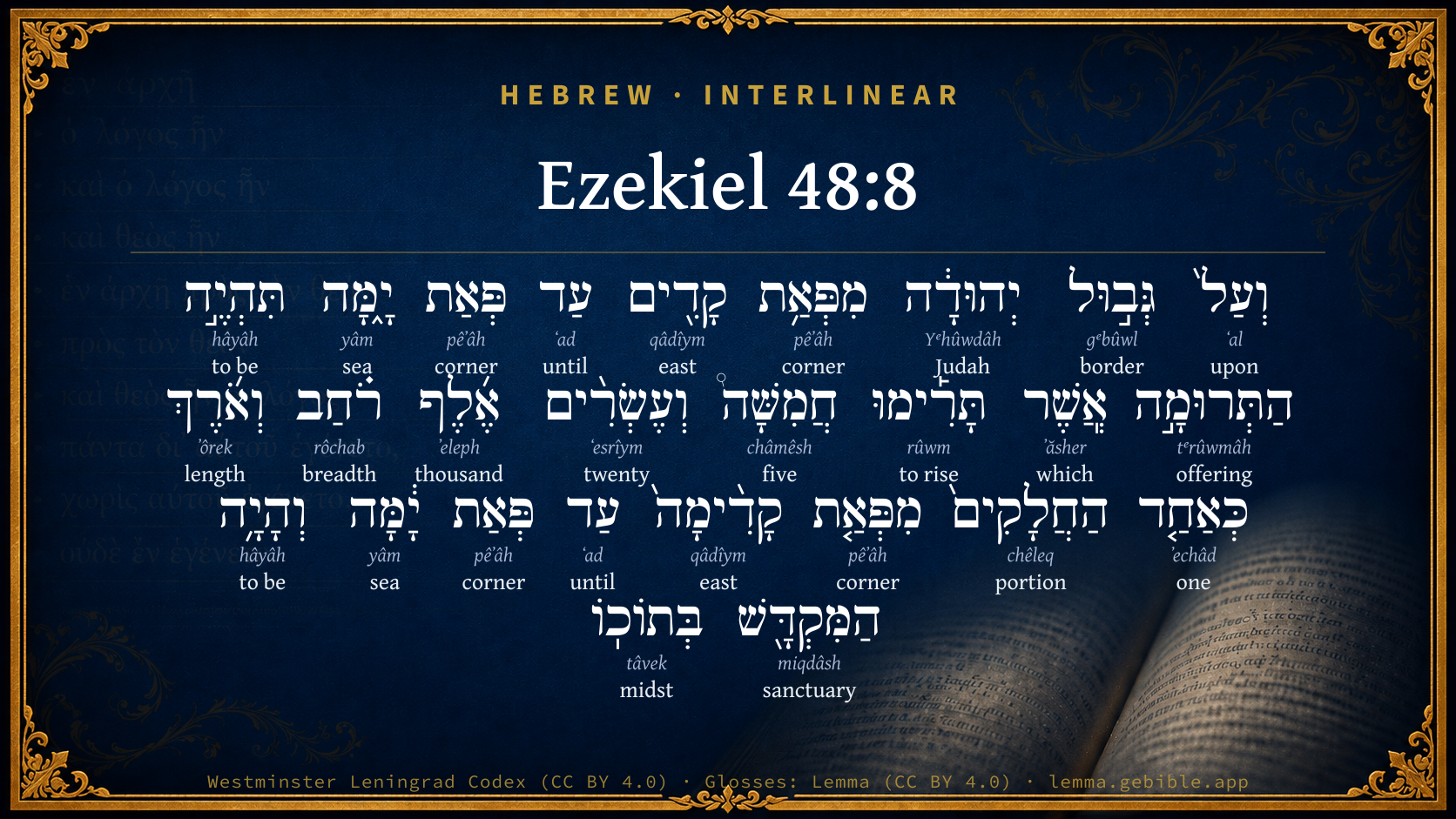
Ezekiel 48:8

Hebrew (Westminster Leningrad Codex) Ezekiel 48:8 appears in the Hebrew Old Testament. The text above is from the Westminster Leningrad Codex. Each word links to its Strong’s number, a concise gloss, and parsing drawn from the Open Scriptures Hebrew Bible morphology. Click any word for its full Brown-Driver-Briggs (BDB) entry.
Download image
Cite this verse

Ezekiel 48:8 (World English Bible). Public Domain. Lemma interlinear Bible study tool, https://lemma.gebible.app/v/ezekiel/48/8.

Show BibTeX & RIS
BibTeX
RIS
English Translation
By the border of Judah, from the east side to the west side, shall be the offering which you shall offer, twenty-five thousand [reeds] in breadth, and in length as one of the portions, from the east side to the west side: and the sanctuary shall be in the midst of it.
World English Bible · Public Domain
Download a study sheet

One document with this verse’s original text, its word-by-word gloss line, the meaning frame, cross-references with their text, attributed commentary, and full source and license credits — printable, and it pastes into notes with its structure intact.

This verse Autodidact and up

Study sheet (.html) Plain text (.txt)

A passage Seminary Student

Up to 50 verses in one chapter. A passage sheet keeps up to 6 commentary sources and 12 cross-references per verse, in the order this page ranks them, and says so on the sheet whenever that leaves anything out. Ask for a single verse and you get the Autodidact verse sheet above.

Everything on this page stays free to read, with no account — the sheet is a download of what is already on screen, not access to it.

Want to remove ads? Support Godless Engineer
Compare translations 3

The same verse in 3 English versions, stacked beneath the original-language interlinear above. Click any original word for its lexicon entry.

Each is an independent rendering of the whole verse — the interlinear is not word-aligned to these translations.

Highlighted words mark where these versions differ — a whole-verse word diff, not a word-by-word alignment.

  • World English Bible Public Domain
    By the border of Judah, from the east side to the west side, shall be the offering which you shall offer, twenty-five thousand [reeds] in breadth, and in length as one of the portions, from the east side to the west side: and the sanctuary shall be in the midst of it.
  • King James Version Public Domain
    And by the border of Judah, from the east side unto the west side, shall be the offering which ye shall offer of five and twenty thousand reeds in breadth, and in length as one of the other parts, from the east side unto the west side: and the sanctuary shall be in the midst of it.
  • unfoldingWord Literal Text CC BY-SA 4.0
    The offering of land that you will make will be along the border with Judah and extend from the east side to the west side; it will be twenty-five thousand cubits in width. Its length will correspond to one tribe’s portion from the east side to the west side, and the temple will be in the middle of it.

unfoldingWord Literal Text — © unfoldingWord, licensed CC BY-SA 4.0. Word-aligned USFM3 via Door43 (git.door43.org/unfoldingWord/en_ult).

Versions to compare (up to 4)

3 of 4 selected

Show all 18 translations

Every available English version of this verse, each an independent rendering of the whole verse.

  • World English Bible Public Domain
    By the border of Judah, from the east side to the west side, shall be the offering which you shall offer, twenty-five thousand [reeds] in breadth, and in length as one of the portions, from the east side to the west side: and the sanctuary shall be in the midst of it.
  • Berean Standard Bible Public Domain
    Bordering the territory of Judah, from east to west, will be the portion you are to set apart. It will be 25,000 cubits wide, and the length of a tribal portion from east to west. In the center will be the sanctuary.
  • Majority Standard Bible Public Domain
    Bordering the territory of Judah, from east to west, will be the portion you are to set apart. It will be 25,000 cubits wide, and the length of a tribal portion from east to west. In the center will be the sanctuary.
  • King James Version Public Domain
    And by the border of Judah, from the east side unto the west side, shall be the offering which ye shall offer of five and twenty thousand reeds in breadth, and in length as one of the other parts, from the east side unto the west side: and the sanctuary shall be in the midst of it.
  • American Standard Version (1901) Public Domain
    And by the border of Judah, from the east side unto the west side, shall be the oblation which ye shall offer, five and twenty thousand `reeds' in breadth, and in length as one of the portions, from the east side unto the west side: and the sanctuary shall be in the midst of it.
  • Revised Version (1885) Public Domain
    And by the border of Judah, from the east side unto the west side, shall be the oblation which ye shall offer, five and twenty thousand reeds in breadth, and in length as one of the portions, from the east side unto the west side: and the sanctuary shall be in the midst of it.
  • Geneva Bible (1599) Public Domain
    And by the border of Iudah from the East part vnto the West part shall be the offering which they shall offer of fiue and twentie thousande reedes broade, and of length as one of the other parts, from the East side vnto the Westside, and the Sanctuarie shalbe in the middes of it.
  • Douay-Rheims (1899) Public Domain
    And by the border of Juda, from the east side even to the side of the sea, shall be the firstfruits which you shall set apart, five and twenty thousand in breadth, and in length, as every one of the portions from the east side to the side of the sea: and the sanctuary shall be in the midst thereof.
  • Young's Literal Translation Public Domain
    and by the border of Judah, from the east side unto the west side is the heave-offering that ye lift up, five and twenty thousand broad and long, as one of the parts, from the east side unto the west side: and the sanctuary hath been in its midst.
  • Literal Standard Version CC BY-SA 4.0
    and by the border of Judah, from the east side to the west side is the raised-offering that you lift up, twenty-five thousand [cubits] broad and long, as one of the parts, from the east side to the west side: and the sanctuary has been in its midst.
  • Unlocked Literal Bible CC BY-SA 4.0
    The offering of land that you will make will be along the border with Judah and extend from the east side to the west side; it will be twenty-five thousand cubits in width. Its length will correspond to one tribe's portion from the east side to the west side, and the temple will be in the middle of it.
  • unfoldingWord Literal Text CC BY-SA 4.0
    The offering of land that you will make will be along the border with Judah and extend from the east side to the west side; it will be twenty-five thousand cubits in width. Its length will correspond to one tribe’s portion from the east side to the west side, and the temple will be in the middle of it.
  • Darby Bible Public Domain
    And by the border of Judah, from the east side unto the west side, shall be the heave-offering that ye shall offer, five and twenty thousand [cubits] in breadth, and in length as one of the parts from the east side unto the west side: and the sanctuary shall be in the midst of it.
  • World Messianic Bible Public Domain
    “By the border of Judah, from the east side to the west side, shall be the offering which you shall offer, twenty-five thousand reeds in width, and in length as one of the portions, from the east side to the west side; and the sanctuary shall be in the middle of it.
  • Webster's Bible Public Domain
    And by the border of Judah, from the east side to the west side, shall be the offering which ye shall offer of five and twenty thousand reeds in breadth, and in length as one of the other parts, from the east side to the west side: and the sanctuary shall be in the midst of it.
  • Free Bible Version CC BY-SA 4.0
    Adjacent to Judah's allocation, from east to west, is the special area you are to make provision for. It is to be 25,000 cubits wide, and extend the same length as a tribal allocation from east to west. The sanctuary will be in the middle of it.
  • Bible in Basic English Public Domain
    And on the limit of Judah, from the east side to the west side, will be the offering which you are to make, twenty-five thousand wide, and as long as one of the parts, from the east side to the west side: and the holy place will be in the middle of it.
  • JPS Tanakh (1917) Public Domain
    And by the border of Judah, from the east side unto the west side, shall be the offering which ye shall set aside, five and twenty thousand reeds in breadth, and in length as one of the portions, from the east side unto the west side; and the sanctuary shall be in the midst of it.

Literal Standard Version (2020), Covenant Press — licensed CC BY-SA 4.0. Text via the HelloAO Bible API (eBible.org). Unlocked Literal Bible (unfoldingWord) — licensed CC BY-SA 4.0. Text via the HelloAO Bible API (eBible.org). unfoldingWord Literal Text — © unfoldingWord, licensed CC BY-SA 4.0. Word-aligned USFM3 via Door43 (git.door43.org/unfoldingWord/en_ult). Free Bible Version, Dr. Jonathan Gallagher — licensed CC BY-SA 4.0. Text via the HelloAO Bible API (eBible.org).

Word by word

More ways to search: Search by grammar → Find every occurrence → Compare this word →

Practice this passage: Drill this verse → Learn its vocabulary →

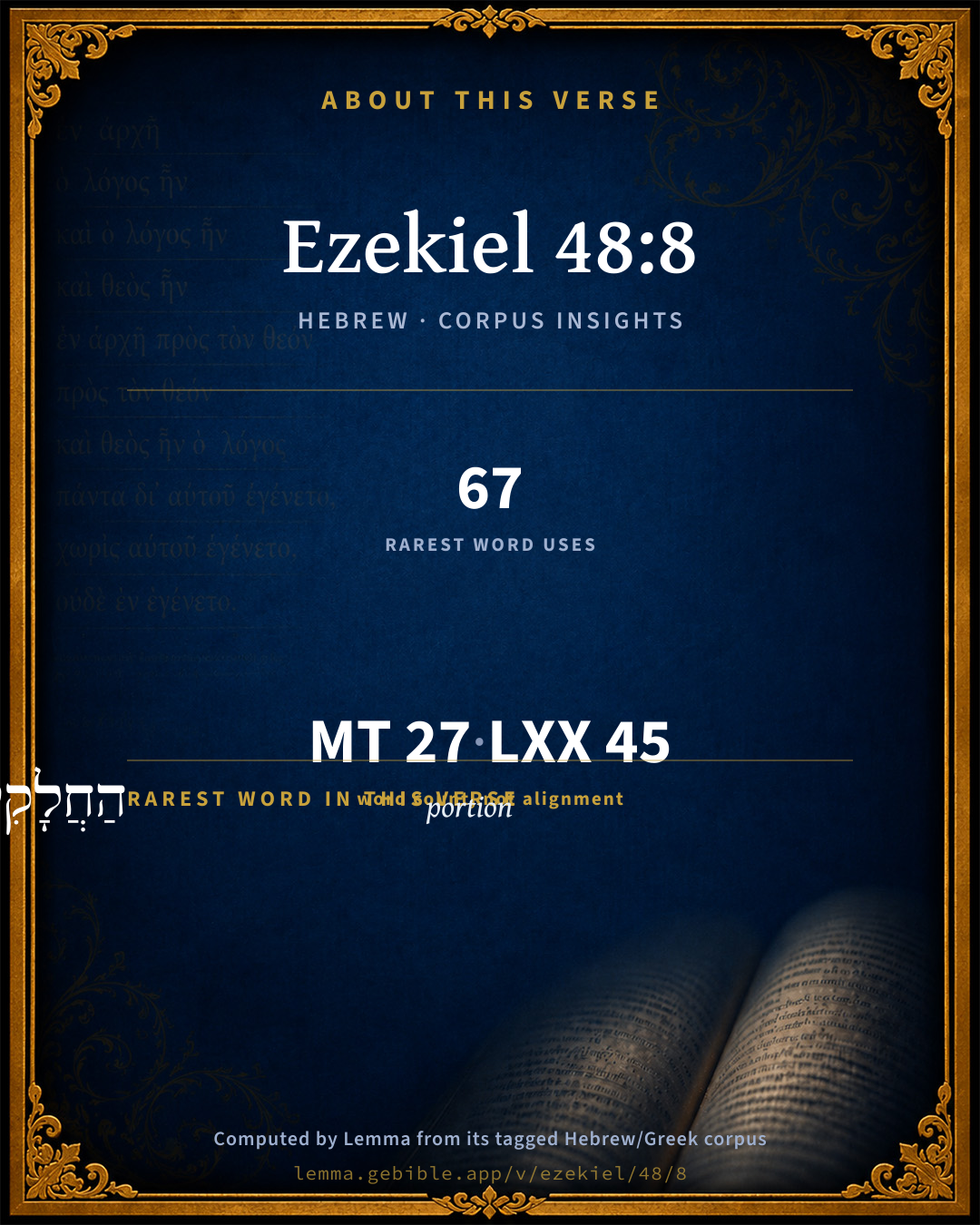
הַחֲלָקִים֙
chêleq
H2506
“the · portions”
Particle, Definite Article + Noun, Common, Masculine, Plural, Absolute
Part of Speech
Particle + Noun
Type
Common
Gender
Masculine
Number
Plural
State
Absolute
Full BDB Definition

Origin: from H2505

TWOT: 669a

portion, share, part, territory - portion, share - portion, tract, parcel (of land) - one's portion, one's possession - (chosen) portion - portion, award (from God) - smoothness, seductiveness, flattery
  1. וְעַל֙ ʻal H5921 “and · upon” Conjunction + Preposition
  2. גְּב֣וּל gᵉbûwl H1366 “border of” Noun, Common, Masculine, Singular, Construct
  3. יְהוּדָ֔ה Yᵉhûwdâh H3063 “Judah” Noun, Proper
  4. מִפְּאַ֥ת pêʼâh H6285 “from · corner of” Preposition + Noun, Common, Feminine, Singular, Construct
  5. קָדִ֖ים qâdîym H6921 “east” Noun, Common, Masculine, Singular, Absolute
  6. עַד ʻad H5704 “until” Preposition
  7. פְּאַת pêʼâh H6285 “corner of” Noun, Common, Feminine, Singular, Construct
  8. יָ֑מָּה yâm H3220 “sea · toward” Noun, Common, Masculine, Singular, Absolute + Suffix, Demonstrative
  9. תִּהְיֶ֣ה hâyâh H1961 “to be” Verb, Qal, Imperfect, 3rd Person, Feminine, Singular
  10. הַתְּרוּמָ֣ה tᵉrûwmâh H8641 “the · offering” Particle, Definite Article + Noun, Common, Feminine, Singular, Absolute
  11. אֲֽשֶׁר ʼăsher H834 “which” Particle, Relative
  12. תָּרִ֡ימוּ rûwm H7311 “to rise” Verb, Hiphil, Imperfect, 2nd Person, Masculine, Plural
  13. חֲמִשָּׁה֩ châmêsh H2568 “five” Adjective, Cardinal number, Masculine, Singular, Absolute
  14. וְעֶשְׂרִ֨ים ʻesrîym H6242 “and · twenty” Conjunction + Adjective, Cardinal number, Both, Plural, Absolute
  15. אֶ֜לֶף ʼeleph H505 “thousand” Adjective, Cardinal number, Both, Singular, Absolute
  16. רֹ֗חַב rôchab H7341 “breadth” Noun, Common, Masculine, Singular, Absolute
  17. וְאֹ֜רֶךְ ʼôrek H753 “and · length” Conjunction + Noun, Common, Masculine, Singular, Absolute
  18. כְּאַחַ֤ד ʼechâd H259 “like/as · one” Preposition + Adjective, Cardinal number, Masculine, Singular, Construct
  19. מִפְּאַ֤ת pêʼâh H6285 “from · corner of” Preposition + Noun, Common, Feminine, Singular, Construct
  20. קָדִ֨ימָה֙ qâdîym H6921 “east · toward” Noun, Common, Masculine, Singular, Absolute + Suffix, Demonstrative
  21. עַד ʻad H5704 “until” Preposition
  22. פְּאַת pêʼâh H6285 “corner of” Noun, Common, Feminine, Singular, Construct
  23. יָ֔מָּה yâm H3220 “sea · toward” Noun, Common, Masculine, Singular, Absolute + Suffix, Demonstrative
  24. וְהָיָ֥ה hâyâh H1961 “and · to be” Conjunction + Verb, Qal, Sequential Perfect, 3rd Person, Masculine, Singular
  25. הַמִּקְדָּ֖שׁ miqdâsh H4720 “the · sanctuary” Particle, Definite Article + Noun, Common, Masculine, Singular, Absolute
  26. בְּתוֹכֽוֹ tâvek H8432 “in/at · midst · his” Preposition + Noun, Common, Masculine, Singular, Construct + Suffix, Personal, 3rd Person, Masculine, Singular

About this verse

These counts appear in no published source. They are computed here, from the morphology-tagged text and Lemma’s own curated glosses. What Lemma adds →

27
words
20
distinct lemmas
Prophets
section

Grammatical profile

  • 3 verbs
  • 16 nouns
  • 4 adjectives
  • 3 prepositions
  • 1 particle

Verb forms

  • תִּהְיֶ֣ה Qal · Imperfect
  • תָּרִ֡ימוּ Hiphil · Imperfect
  • וְהָיָ֥ה Qal · Sequential Perfect

Repetition

Words recur within this verse — often emphatic in Hebrew:

  • מִפְּאַ֥ת corner H6285 ×4
  • קָדִ֖ים east H6921 ×2
  • עַד until H5704 ×2
  • יָ֑מָּה sea H3220 ×2
  • תִּהְיֶ֣ה to be H1961 ×2

Hebrew & Septuagint length

In English translation the verse runs 52 words from the Hebrew and 50 from the Septuagint (LXX English) — closely comparable.

A rough comparison of the two English renderings, which tokenize alike — not a word-level alignment.

Word counts can differ between the Hebrew and the Greek without any difference in meaning — e.g. the Hebrew direct-object marker אֵת has no separate Greek word, and Greek often adds the article ὁ.

In the original languages it is 27 Hebrew tokens and 45 Greek tokens — but the two are counted differently (Hebrew bundles its prefixes and suffixes into one token; the Greek is in lemma form), so that isn’t a like-for-like length.

Cross-references

12

Topical passages linked to Ezekiel 48:8 in the Treasury of Scripture Knowledge — connected by theme and wording, ordered by reader-vote popularity; previews shown in the World English Bible.

  • Isaiah 12:6 Cry aloud and shout, you inhabitant of Zion; for great in the midst of you is the Holy One of Israel!"
  • Isaiah 33:20–22 Look on Zion, the city of our solemnities: your eyes shall see Jerusalem a quiet habitation, a tent that shall not be removed, the stakes of it shall never be plucked up, neither shall any of the cords of it be broken.
  • Ezekiel 45:1–6 Moreover, when you shall divide by lot the land for inheritance, you shall offer an offering to Yahweh, a holy portion of the land; the length shall be the length of twenty-five thousand [reeds], and the breadth shall be ten thousand: it shall be holy in all the border of it round about.
  • Ezekiel 48:21 The residue shall be for the prince, on the one side and on the other of the holy offering and of the possession of the city; in front of the twenty-five thousand of the offering toward the east border, and westward in front of the twenty-five thousand toward the west border, answerable to the portions, it shall be for the prince: and the holy offering and the sanctuary of the house shall be in the midst of it.
  • Ezekiel 48:35 It shall be eighteen thousand [reeds] round about: and the name of the city from that day shall be, Yahweh is there.
  • Zechariah 2:11–12 Many nations shall join themselves to Yahweh in that day, and shall be my people; and I will dwell in the midst of you, and you shall know that Yahweh of Hosts has sent me to you.
  • 2 Corinthians 6:16 What agreement has a temple of God with idols? For you are a temple of the living God. Even as God said, "I will dwell in them, and walk in them; and I will be their God, and they will be my people."
  • Ephesians 2:20–22 being built on the foundation of the apostles and prophets, Christ Jesus himself being the chief cornerstone;
  • Colossians 2:9 For in him all the fullness of the Godhead dwells bodily,
  • Revelation 21:3 I heard a loud voice out of heaven saying, "Behold, God's dwelling is with people, and he will dwell with them, and they will be his people, and God himself will be with them as their God.
  • Revelation 21:22 I saw no temple in it, for the Lord God, the Almighty, and the Lamb, are its temple.
  • Revelation 22:3 There will be no curse any more. The throne of God and of the Lamb will be in it, and his servants serve him.

Cross-references courtesy of OpenBible.info (CC BY 4.0).

Hebrew and Greek witnesses Masoretic Hebrew ↔ Greek Septuagint

The same verse in the two great witnesses to the Old Testament, shown verse-for-verse.

These are two independent witnesses, not word-aligned to each other, and the Septuagint is shown in lemma (dictionary) form.

Hebrew Ezekiel 48:8 Masoretic · Westminster Leningrad Codex

וְעַל֙ גְּב֣וּל יְהוּדָ֔ה מִפְּאַ֥ת קָדִ֖ים עַד פְּאַת יָ֑מָּה תִּהְיֶ֣ה הַתְּרוּמָ֣ה אֲֽשֶׁר תָּרִ֡ימוּ חֲמִשָּׁה֩ וְעֶשְׂרִ֨ים אֶ֜לֶף רֹ֗חַב וְאֹ֜רֶךְ כְּאַחַ֤ד הַחֲלָקִים֙ מִפְּאַ֤ת קָדִ֨ימָה֙ עַד פְּאַת יָ֔מָּה וְהָיָ֥ה הַמִּקְדָּ֖שׁ בְּתוֹכֽוֹ

By the border of Judah, from the east side to the west side, shall be the offering which you shall offer, twenty-five thousand [reeds] in breadth, and in length as one of the portions, from the east side to the west side: and the sanctuary shall be in the midst of it.

World English Bible · Public Domain

Greek LXX Ezekiel 48:8 Septuagint · lemma form

καί ἀπό ὁ ὅριον ιουδα ἀπό ὁ πρός ἀνατολή ἕως ὁ πρός θάλασσα εἰμί ὁ ἀπαρχή ὁ ἀφορισμός πέντε καί εἴκοσι χιλιάς εὖρος καί μῆκος καθώς εἷς ὁ μερίς ἀπό ὁ πρός ἀνατολή καί ἕως ὁ πρός θάλασσα καί εἰμί ὁ ἅγιος ἐν μέσος αὐτός

And from the borders of Juda, from the eastern parts shall be the offering of first fruits, in the breadth twenty-five thousand reeds, and in length as one of the portions measured from the east even to the western parts: and the sanctuary shall be in the midst of them.

LXX2012 (modern English Septuagint) · Public Domain

On this verse, Whedon's Commentary on the Bible discusses the Septuagint’s reading. Read the note in Commentary ↓

Hebrew: Westminster Leningrad Codex (CC BY 4.0). Greek: Septuagint (public domain); English from LXX2012 (modern English Septuagint) (Public Domain). How the Septuagint differs from the Hebrew →

Targum (Aramaic paraphrase)

1

The Targum is the ancient Jewish Aramaic paraphrase of the Hebrew Scriptures — an interpretive translation, not the Hebrew text itself. Onkelos (literal) and Pseudo-Jonathan (expansive) render the Torah, and Jonathan the Prophets. Coverage is partial: where no permissively-licensed English translation exists for a verse, only the Aramaic is shown. This is verse-level text, not a word-by-word alignment to the Hebrew.

  1. Targum Jonathan Prophets (Joshua–Malachi)
    וְעַל תְּחוּם יְהוּדָה מֵרוּחַ מַדִינְחָא עַד רוּחַ מַעֲרָבָא תְּהֵי אַפְרָשׁוּתָא דְתִפְרְשׁוּן עַסְרִין וַחֲמֵשׁ אַלְפִין פּוּתְיָא וְאוּרְכָּא כְּחַד מִן חוּלְקַיָא מֵרוּחַ מַדִינְחָא עַד רוּחַ מַעֲרָבָא וִיהֵי כֵיבַשׁ מַקְדְשָׁא בְגַוֵיהּ:

    (no public-domain English translation for this verse)

    Targum Jonathan — Aramaic: “Mikraot Gedolot” (public domain). English: “Sefaria Community Translation” (CC0 1.0 (public-domain dedication)); “London "Chaldee Paraphrase," 1871” (public domain). Text via Sefaria.

Commentary

Notes on Ezekiel 48:8 from classic Christian and Jewish commentators (each source and its license shown beneath its notes). The classic Christian expositions comment on the surrounding passage and are grouped to its opening verse, so a note may address several verses; the Jewish commentaries on the Tanakh (Rashi and others) are per-verse, so they appear only where the commentator wrote on this verse.

Lemma curates 59 commentaries, every one of them public domain or Creative Commons licensed, each selected and text-cleaned for this edition rather than reprinted as found. About our sources →

Trapp's Complete Commentary

John Trapp

Eze 48:8 And by the border of Judah, from the east side unto the west side, shall be the offering which ye shall offer of five and twenty thousand [reeds in] breadth, and [in] length as one of the [other] parts, from the east side unto the west side: and the sanctuary shall be in the midst of it.

Ver. 8. Shall be the offering.] Whereof see Eze 45:1-7.

Of five and twenty thousand reeds.] Which being exactly cast up, saith one, come to forty-five miles, and therefore cannot be meant of any city to be built by the Jews again after their return from Babylon, but must be understood as the Church under the gospel.

John Trapp, A Commentary or Exposition upon All the Books of the Old and New Testament (1647–1656) — public domain. Text from a community e-Sword module.

Joseph Benson's Commentary

Eze 48:8. By the border of Judah, &c., shall be the offering, &c. — Next to the border of Judah, which runs in length from east to west, shall be the offering ye shall set apart for the service of God, Eze 45:1. The word reeds, it must be observed, is not in the original text, either here or in that place, and, as we have there noticed, many learned men think it more probable, that the measure of cubits is intended in both passages: see the note there. And in the length as in one of the other parts — Given to the adjoining tribes. From the east side unto the west side — Which was likewise twenty-five thousand reeds, or cubits, according to the dimensions of the holy portion, set down Eze 45:1-6, for the oblation was to be four-square, consisting of twenty-five thousand, multiplied by twenty-five thousand.

Joseph Benson's Commentary on the Old and New Testaments (1811–1818) — public domain. Text from a community e-Sword module.

Geneva Bible (1599)

Geneva Bible translators

That is, the portion of the ground which they shall separate and appoint to the Lord, which shall be divided into three parts, for the Priests, for the Prince, and for the city.

Geneva Bible (1599) marginal notes — public domain. Text via Bolls.life.

The Cambridge Bible for Schools and Colleges

gen. ed. J. J. S. Perowne

8. the offering … reeds in breadth] The Oblation (Eze_45:1) … cubits in breadth, i.e. N. to S. This is the breadth of the whole part subtracted from the territory of the country, and devoted to the priests, the Levites, the city and the prince. In length it goes from the Jordan to the sea, just “as one of the other parts,” i.e. the portions of the tribes. The sanctuary shall be situated in the centre of this oblation, viz. in the portion assigned to the priests—that assigned to the Levites being on the north and that assigned to the city on the south.

The Cambridge Bible for Schools and Colleges (gen. ed. J. J. S. Perowne; Cambridge University Press, 1878–1918) — public domain. Text from a community e-Sword module.

John Gill's Exposition

It shall be for the priests that are sanctified,.... That are set apart by the Lord; called by him to this office, and sanctified with the gifts and graces of his Spirit; and so fitted and qualified for the work:

of the sons of Zadok, which have kept my charge, which went not astray when the children of Israel went astray, as the Levites went astray; ministers faithful to the Lord in the worst of times; and who are and wil be taken notice of by him, both now and hereafter, Mat 25:21; see Gill on Eze 44:15, Eze 44:16.

John Gill's Exposition of the Whole Bible (1746–1763) — public domain (CC PDM 1.0). Text via the HelloAO Bible API.

Albert Barnes' Notes on the Bible

“Length” is throughout measured from west to east, as breadth is from north to south.

The offering Eze 48:9-22, or, “oblation,” here includes all the land given to priests, Levites, city, and prince; the different parts being distinguished. All these together are to extend from west to east in the same way as the portions of the other tribes, the imaginary Jordan being the eastern boundary of all.

Albert Barnes' Notes on the Bible (1834–1885) — public domain. Text from a community e-Sword/MySword module.

Haydock's Catholic Bible Commentary

Apart, for the Levitical tribe and the prince. (Calmet) --- As the first-born and things which spring first, so also the land consecrated to the Lord is called first-fruits. (Worthington) --- Thousand cubits (chap. xlv. 1.) or 12,500 paces, (Haydock) allowing two cubits for each. This would not reach to the Jordan River. But thrice that space must be reckoned, the king having two of them (Calmet) on each side of the temple, namely, towards the sea, and on the other side of the Jordan. (Haydock)

George Leo Haydock (1774–1849), Haydock's Catholic Family Bible and Commentary, 1859 edition — public domain. Excludes Psalms (Douay-Rheims chapter numbering differs from Protestant) and Deuterocanonical books (Catholic canon only).

Matthew Poole's English Annotations

The offering; the holy portion, of which Eze 45:1, set out for priests, Levites, and city, Eze 45:4-6.

Reeds is here supplied by the translators, but I rather think cubits; for the greatness of the portion measured by reeds will eat out the tribes, or leave very little for them, as appears thus: The whole length from north to south was about one hundred and sixty miles, the breadth about sixty. Now twenty-five thousand reeds is at the least seventy-seven miles, at one thousand paces to a mile. These seventy-seven taken out of one hundred and sixty, there will remain but eighty-three for the twelve tribes, which will afford not quite seven miles in breadth for each tribe; whereas seventy-seven miles are allotted to the priests, Levites, and city; so that there will remain but eighty-three miles for the twelve tribes, that is, to each one almost seven miles. Now this to me would seem very much disproportioned; but twenty-five thousand cubits reckoned doth give the holy portion and city twelve miles and half square, and gives near as much in breadth to each tribe, and five times almost as much in length to each tribe; which appears thus: twelve times twelve make one hundred and forty-four, and twelve quarters make three wholes; give then each tribe twelve and a quarter, you divide one hundred and forty-seven by twelve and a quarter: now to this add the prince’s, the holy portion, and the city land, which is twelve miles and a half, and you have one hundred and fifty-nine miles and three quarters, which is the length of the whole land. Thus the breadth of each portion for each tribe; but the length of each exceeded the prince’s by twelve and a half, and the holy portion as much as sixty exceeds twelve and a half.

From the east side to the west side; that is, twenty-five thousand in length, which amounts to twelve miles and a half. Now the residue of the land from the sea eastward abutting on the whole breadth of the holy portion by equal proportion, will be twenty-three and a quarter, and as much from the other side, measuring from the eastern bounds of the holy portion to the utmost bounds eastward of the land, which is sixty miles from its utmost western bounds; as appears thus: take an oblong square, whose breadth is twelve and a half, its length sixty; suppose in the very middle twelve and a half square taken up, there will remain at each end the half of forty-seven and a half, which is twenty-three and three quarters. According to this we conceive the prince hath assigned him as much as two tribes very near, and almost four times as much as the holy oblation; so that there is good reason for that Eze 45:9, against oppression, and the command that he be content.

The sanctuary; the whole contents of suburbs, courts, and house.

In the midst of it; of the land laid out for the holy portion, for God and his priests.

Matthew Poole's English Annotations on the Holy Bible (1683–1685) — public domain. Text from a community e-Sword/MySword module.

Whedon's Commentary on the Bible

Daniel D. Whedon

8, 9. Toy reads: “On the border of Judah, from the east end to the west end, shall be the reservation which ye shall set aside: twenty-five thousand cubits wide, and in length equal to one tribal portion from east to west; and the sanctuary shall be therein. The reservation which ye shall set aside for Jehovah shall be twenty-five thousand cubits long and twenty thousand cubits wide.” Plumptre, with many old expositors, believes not cubit but reed is “undoubtedly the word to be supplied” in the above specifications, if so it would mark distinctively the ideal character of the land distribution, since if the attempt were made to lay off this reservation (A.V., “offering;” R.V., “oblation”) of twenty thousand reeds (one hundred and forty thousand cubits) in length, it would extend far beyond the Jordan, which is given as the east border of the land. We think probably “cubit,” not “reed,” should be supplied (see Eze_45:1-5) and read with the Septuagint twenty thousand instead of ten thousand (Eze_48:9), believing that this verse and the close of Eze_48:13 refer to the entire territory occupied by both priests and Levites.

Daniel D. Whedon (gen. ed.), Commentary on the Old and New Testaments (1874–1909) — public domain. Text from a community e-Sword module.

The Pulpit Commentary

Vers. 8-22 The terumah, or priests" portion (vers. 8-12), with the portions for the Levites (vers. 13, 14), for the city (vers. 15-20), and for the prince (vers. 21, 22).

The terumah, already referred to, (Eze_45:1-5) is here more minutely described.

(1) In situation, it should be by the border of Judah, i.e. contiguous to Judah"s territory on the south. Hence it should embrace all the above specified portions.

(2) In breadth, from north to south, it should be twenty-five thousand reeds, this being undoubtedly the word to be supplied.

(3) In length, it should be as one of the other parts, extending from the east to the west side of the land.

(4) In relation to the sanctuary, this should be in the midst of it, not necessarily in the exact geographical center of the whole terumah in the larger sense, but generally in a central position.

HOMILIES BY J.D. DAVIES Vers. 8-14. Religion the nucleus of human life.

The spiritual training of men has been uppermost in God"s mind. As a wise father trains his child, so God has been training us. From God earthly fathers have instinctively learnt their methods. With unparalleled patience God has been encouraging men to take the first step heavenward, then the next, and the next. The progress has been slow, often imperceptible; yet it has been continuous. Earth has been, and still will be, a great school-house, a religious university, and God"s lesson-books are numberless. The outline of God"s plan was sketched in Judaea, and the Hebrews (dull scholars as they were) have become teachers to the world.

I RELIGION FILLS A CENTRAL PLACE IN A RENOVATED WORLD. "The sanctuary of the Lord shall be in the midst thereof." As the light of truth permeates men"s minds, they will discover the supreme excellence of piety. Whatever will aid in the unfolding of their spiritual nature, whatever will promote increasing likeness to God, shall be most appreciated. Temporary good will sink into its proper place; will be appraised at its proper value. The outlook upon human destiny will be taken from a loftier elevation. Present possessions and enjoyments will be deemed, not final, but stepping-stones to higher things. And, from her central throne, Religion will radiate a benign influence over every interest men have in life. What the sun is to the solar system, or what the axle is to the wheel, or what the heart is to the human body, true religion will be among the concernments of our race.

II RELIGION PROVIDES A GRADUATED SCALE OF EXCELLENCE. It produces states of purity, circle within circle. Central amongst the civilized nations lay the Hebrew people a "holy nation a peculiar people." Among the Hebrew tribes was one tribe set apart and hallowed for God. Within this tribe was selected a consecrated family, and within this family a consecrated man. So also within Jerusalem, the holy city, there was a central portion holier still; within this enclosure a court sacred to the priests, and within this holy place the holy of holies. Thus God leads us step by step from a lower to a loftier life, from one stage of holiness unto another. We aspire and make endeavor after a nobler style of life; and lo! when we have attained it (as in ascending the Alpine mountains) we discover heights of excellence still above us, more attractive yet. Kindlier methods than those God uses on our behalf it is impossible to employ, and his benevolent ambition is to raise us to his own level of life and joy.

III RELIGION PROMOTES UNITY AMID DIVERSITY. "The sanctuary shall be in the midst of it." In other words, the several tribes of Israel were allotted their territory (in Ezekiel"s ideal sketch) in relation to the holy place. Their vital connection with the sanctuary determined their connection with each other. The distinction between the tribes was not obliterated; it served some useful purpose; but this common relation to the sanctuary bound them each to each. If they had any separate interests as tribes, they had larger and more precious interests as a nation. The more they valued the sanctuary the stronger was the attachment to each other. The nearer they got to God the less distance there was between each other. Among the citizens in Christ"s kingdom diversities in minor things will continue. Diversity adds to beauty and to usefulness. Diversity of function and office, diversity in opinion and in taste, is lawful; yet amid all lawful diversity there runs a bond a vital tie of true unity. The members of the body are various, yet the body is one. In all God"s works the same principle prevails.

IV RELIGION BRINGS GOD EQUALLY NEAR TO ALL. As a fact in Jewish history, the tribe of Dan, being furthest removed from God"s sanctuary, became more worldly, idolatrous, and godless than the other tribes. In the new settlement of things, in Ezekiel"s vision, Dan shall have equal privilege with the rest. Type and parable wilt always lack some elements, which inhere in the substance. In the new kingdom God shall be within easy reach of all. Spiritual monopolies shall cease. Exclusive privilege has vanished. The devout heart in every tribe of men, or in any class of society, may find God always near. Distance from God is no longer geographical; it is moral. The slave and the pauper may have access to the great presence-chamber; the monarch, Jew or Gentile, may be barred out by their own unbelief. "With that man will I dwell, who is of a humble and a contrite heart.

V RELIGION HAS AMPLE REWARD FOR FAITHFUL SERVICE. The sons of Zadok had remained faithful in a time of general apostasy. Divine approval may not have been openly or profusely expressed at the time. Yet generous reward was in store. Permanent honor and permanent advantage appear as the prolific fruit. They shall dwell nearer to God than others do. The entire nation shall serve them. Their deed shall reflect honor upon their father"s name. The glory of their deed shall be perpetual, shall be world-wide. Their noble deed shall be the seed-corn for other deeds, and these again shall bear fruit in other lands. "The memory of the righteous is blessed.

VI RELIGION IS SUPREMELY VALUABLE. Concerning this consecrated land it was decreed, "They shall not sell of it, neither exchange, nor alienate the firstfruits of the land." Nothing can compensate for the loss of religion. It is solid consolation that true piety is inalienable. No power on earth or in hell can rob us of our faith, or of our purity, or cf our hope. It has the guarantee of almighty protection. You can no more alienate religion from a saint than you can alienate warmth from a sunbeam or saltness from the sea. All that a man hath will he give for his life; but the life of his spirit he accounts a thousandfold more precious yet. God"s friendship is treasure which no arithmetic can express. All comparisons fail. D.

The Pulpit Commentary (1880–1919), ed. H.D.M. Spence-Jones & Joseph S. Exell — public domain. Text from a community e-Sword module.

unfoldingWord translationNotes

Door43 World Missions Community

General Information:

Yahweh continues giving Ezekiel his message to the people of Israel.

twenty-five thousand cubits ... ten thousand cubits

Each long cubit was about 54 centimeters. See how you translated this in Ezekiel 40:5. AT: "25,000 cubits ... 10,000 cubits" or "13.5 kilometers ... 5.4 kilometers" (See: Biblical Distance)

translationWords

sacrifice

temple

Yahweh

unfoldingWord translationNotes — © Distant Shores Media and the Door43 World Missions Community, licensed CC BY-SA 4.0. Source: git.door43.org/Door43/en_tn.

Rashi

Rabbi Shlomo Yitzchaki (Rashi)

shall be the offering etc., Now, if you ask, how is it possible that Jerusalem should be in its place? Was not Jerusalem on the northern border of Judah, which received the south of the land of Canaan? And here it is in the middle of the tribes! [I will answer you that] this division is not like Joshua’s division, for this one is like the rows of a vineyard and all the portions are equal, whereas [in] Joshua’s division, the tribe of Judah had such a large portion that [its territory was] too much for it until Simeon took part of it as is said (Josh. 19:9): “Out of the lot of the children of Judah was the inheritance of the children of Simeon.” Therefore, the width of the portion that Judah received in the days of Joshua suffices now for the five remaining tribes to take a share of it, because its length was very great, from the eastern side to the ocean, and Jerusalem is located there.

and the Sanctuary shall be in its midst as he proceeds to explain.

Rashi on the Tanakh — English translations: “The Judaica Press complete Tanach with Rashi, translated by A. J. Rosenberg” (CC BY 4.0); “Pentateuch with Rashi's commentary by M. Rosenbaum and A.M. Silbermann, 1929-1934” (public domain); “The Metsudah Tanach series, Lakewood, N.J” (CC BY 4.0); and “The Book of Joshua, Metsudah Publications, 1997” (CC BY 4.0). Text via Sefaria.

Lesson kit

Teaching starters — assembled from the data on this page, not authored interpretation. Every prompt links to the verse data it draws on. Edit before teaching.

Ezekiel, in the Prophets, opens this verse with 27 words (20 distinct Hebrew lemmas). Its most distinctive word is chêleq (“portion”). A historical commentator’s framing appears above. Read the whole chapter for the surrounding context.

Discussion questions

  1. How does “portion” (chêleq) shape what this verse is saying?
  2. How does Isaiah 12:6, which shares this passage’s theme, read alongside this verse?
  3. What does the repetition of “corner” (4× in this one verse) do in this verse?
  4. These translations render this verse differently; the difference is in the English rendering, not the original. What questions does that raise?
  5. «תִּהְיֶ֣ה» is a Qal Imperfect verb. How does that grammatical form shape the action described?
  6. Compare how Trapp's Complete Commentary and Joseph Benson's Commentary read this verse. Where do they agree or differ?

Things to notice

Reading settings

Reading text

Shown beneath each verse's original-language words.

Old Testament
Old Testament edition

Read the OT as the Masoretic Hebrew (MT) or the Greek Septuagint (LXX).

English shown for the Greek Septuagint (in the Hebrew ↔ Greek comparison).

Comparing translations? Open the Compare panel on any verse page to stack up to four side by side.