
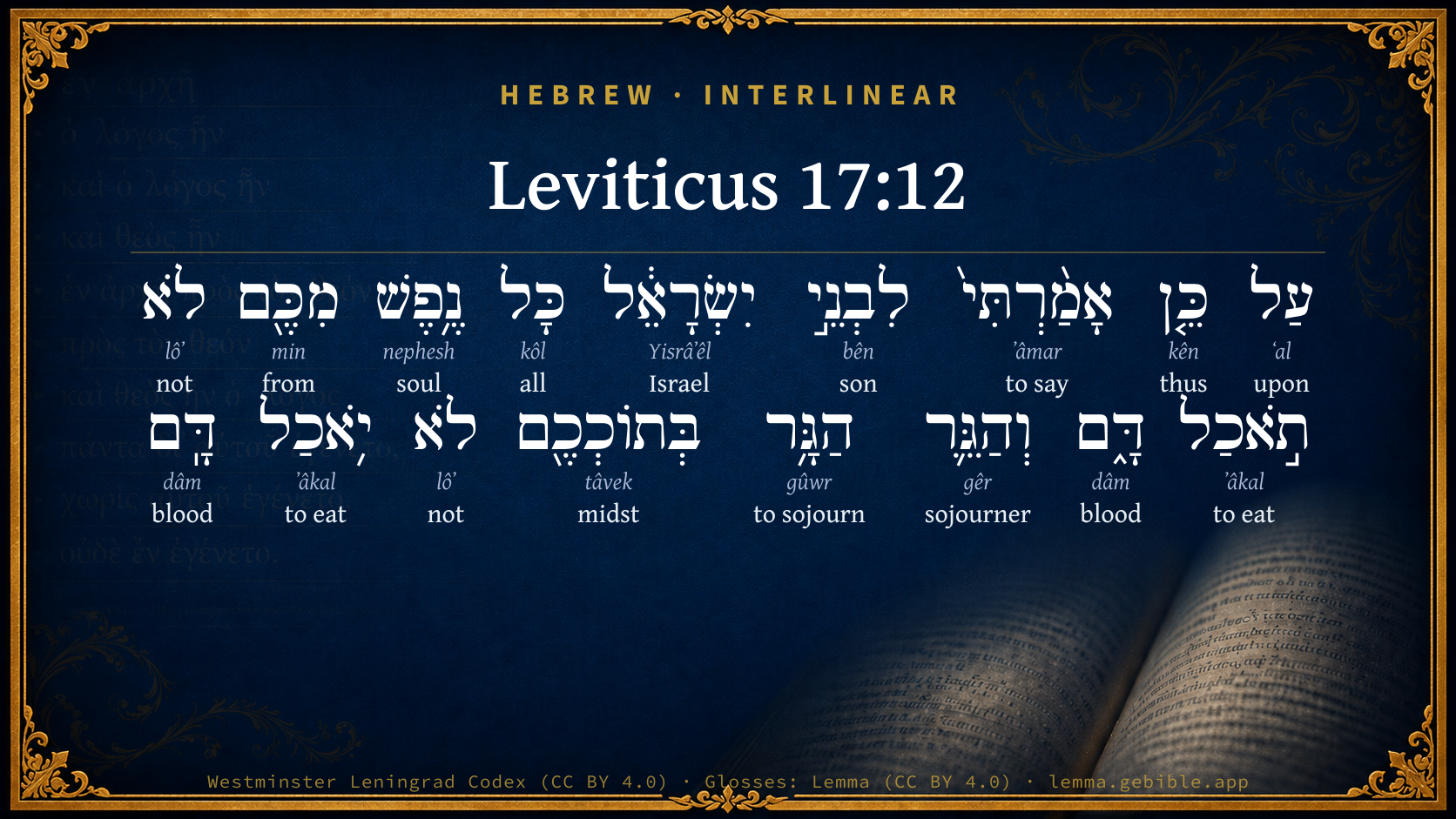
Leviticus 17:12

Hebrew (Westminster Leningrad Codex) Leviticus 17:12 appears in the Hebrew Old Testament. The text above is from the Westminster Leningrad Codex. Each word links to its Strong’s number, a concise gloss, and parsing drawn from the Open Scriptures Hebrew Bible morphology. Click any word for its full Brown-Driver-Briggs (BDB) entry.
Download image
Cite this verse

Leviticus 17:12 (World English Bible). Public Domain. Lemma interlinear Bible study tool, https://lemma.gebible.app/v/leviticus/17/12.

Show BibTeX & RIS
BibTeX
RIS
English Translation
Therefore I have said to the children of Israel, "No person among you shall eat blood, neither shall any stranger who lives as a foreigner among you eat blood."
World English Bible · Public Domain
Download a study sheet

One document with this verse’s original text, its word-by-word gloss line, the meaning frame, cross-references with their text, attributed commentary, and full source and license credits — printable, and it pastes into notes with its structure intact.

This verse Autodidact and up

Study sheet (.html) Plain text (.txt)

A passage Seminary Student

Up to 50 verses in one chapter. A passage sheet keeps up to 6 commentary sources and 12 cross-references per verse, in the order this page ranks them, and says so on the sheet whenever that leaves anything out. Ask for a single verse and you get the Autodidact verse sheet above.

Everything on this page stays free to read, with no account — the sheet is a download of what is already on screen, not access to it.

Want to remove ads? Support Godless Engineer
Compare translations 3

The same verse in 3 English versions, stacked beneath the original-language interlinear above. Click any original word for its lexicon entry.

Each is an independent rendering of the whole verse — the interlinear is not word-aligned to these translations.

Highlighted words mark where these versions differ — a whole-verse word diff, not a word-by-word alignment.

  • World English Bible Public Domain
    Therefore I have said to the children of Israel, "No person among you shall eat blood, neither shall any stranger who lives as a foreigner among you eat blood."
  • King James Version Public Domain
    Therefore I said unto the children of Israel, No soul of you shall eat blood, neither shall any stranger that sojourneth among you eat blood.
  • unfoldingWord Literal Text CC BY-SA 4.0
    Therefore, I said to the sons of Israel, “Every person among you shall not eat blood. And the sojourner, the one sojourning in your midst shall not eat blood.”

unfoldingWord Literal Text — © unfoldingWord, licensed CC BY-SA 4.0. Word-aligned USFM3 via Door43 (git.door43.org/unfoldingWord/en_ult).

Versions to compare (up to 4)

3 of 4 selected

Show all 18 translations

Every available English version of this verse, each an independent rendering of the whole verse.

  • World English Bible Public Domain
    Therefore I have said to the children of Israel, "No person among you shall eat blood, neither shall any stranger who lives as a foreigner among you eat blood."
  • Berean Standard Bible Public Domain
    Therefore I say to the Israelites, ‘None of you may eat blood, nor may any foreigner living among you eat blood.’
  • Majority Standard Bible Public Domain
    Therefore I say to the Israelites, ‘None of you may eat blood, nor may any foreigner living among you eat blood.’
  • King James Version Public Domain
    Therefore I said unto the children of Israel, No soul of you shall eat blood, neither shall any stranger that sojourneth among you eat blood.
  • American Standard Version (1901) Public Domain
    Therefore I said unto the children of Israel, No soul of you shall eat blood, neither shall any stranger that sojourneth among you eat blood.
  • Revised Version (1885) Public Domain
    Therefore I said unto the children of Israel, No soul of you shall eat blood, neither shall any stranger that sojourneth among you eat blood.
  • Geneva Bible (1599) Public Domain
    Therefore I saide vnto ye children of Israel, None of you shall eate blood: neither the stranger that soiourneth among you, shall eate blood.
  • Douay-Rheims (1899) Public Domain
    Therefore I have said to the children of Israel: No soul of you, nor of the strangers that sojourn among you, shall eat blood.
  • Young's Literal Translation Public Domain
    `Therefore I have said to the sons of Israel, No person among you doth eat blood, and the sojourner who is sojourning in your midst doth not eat blood;
  • Literal Standard Version CC BY-SA 4.0
    Therefore I have said to the sons of Israel: No person among you eats blood, and the sojourner who is sojourning in your midst does not eat blood;
  • Unlocked Literal Bible CC BY-SA 4.0
    Therefore I said to the people of Israel that no one among you must eat blood, neither may any foreigner who lives among you eat blood.
  • unfoldingWord Literal Text CC BY-SA 4.0
    Therefore, I said to the sons of Israel, “Every person among you shall not eat blood. And the sojourner, the one sojourning in your midst shall not eat blood.”
  • Darby Bible Public Domain
    Therefore have I said unto the children of Israel, No soul of you shall eat blood, neither shall the stranger who sojourneth among you eat blood.
  • World Messianic Bible Public Domain
    Therefore I have said to the children of Israel, “No person among you may eat blood, nor may any stranger who lives as a foreigner among you eat blood.”
  • Webster's Bible Public Domain
    Therefore I said to the children of Israel, No soul of you shall eat blood, neither shall any stranger that sojourneth among you eat blood.
  • Free Bible Version CC BY-SA 4.0
    That's why I'm warning the Israelites: None of you is allowed to eat blood, and no foreigner living among you is allowed to eat blood.
  • Bible in Basic English Public Domain
    For this reason I have said to the children of Israel, No man among you, or any others living with you, may take blood as food.
  • JPS Tanakh (1917) Public Domain
    Therefore I said unto the children of Israel: No soul of you shall eat blood, neither shall any stranger that sojourneth among you eat blood.

Literal Standard Version (2020), Covenant Press — licensed CC BY-SA 4.0. Text via the HelloAO Bible API (eBible.org). Unlocked Literal Bible (unfoldingWord) — licensed CC BY-SA 4.0. Text via the HelloAO Bible API (eBible.org). unfoldingWord Literal Text — © unfoldingWord, licensed CC BY-SA 4.0. Word-aligned USFM3 via Door43 (git.door43.org/unfoldingWord/en_ult). Free Bible Version, Dr. Jonathan Gallagher — licensed CC BY-SA 4.0. Text via the HelloAO Bible API (eBible.org).

Word by word

More ways to search: Search by grammar → Find every occurrence → Compare this word →

Practice this passage: Drill this verse → Learn its vocabulary →

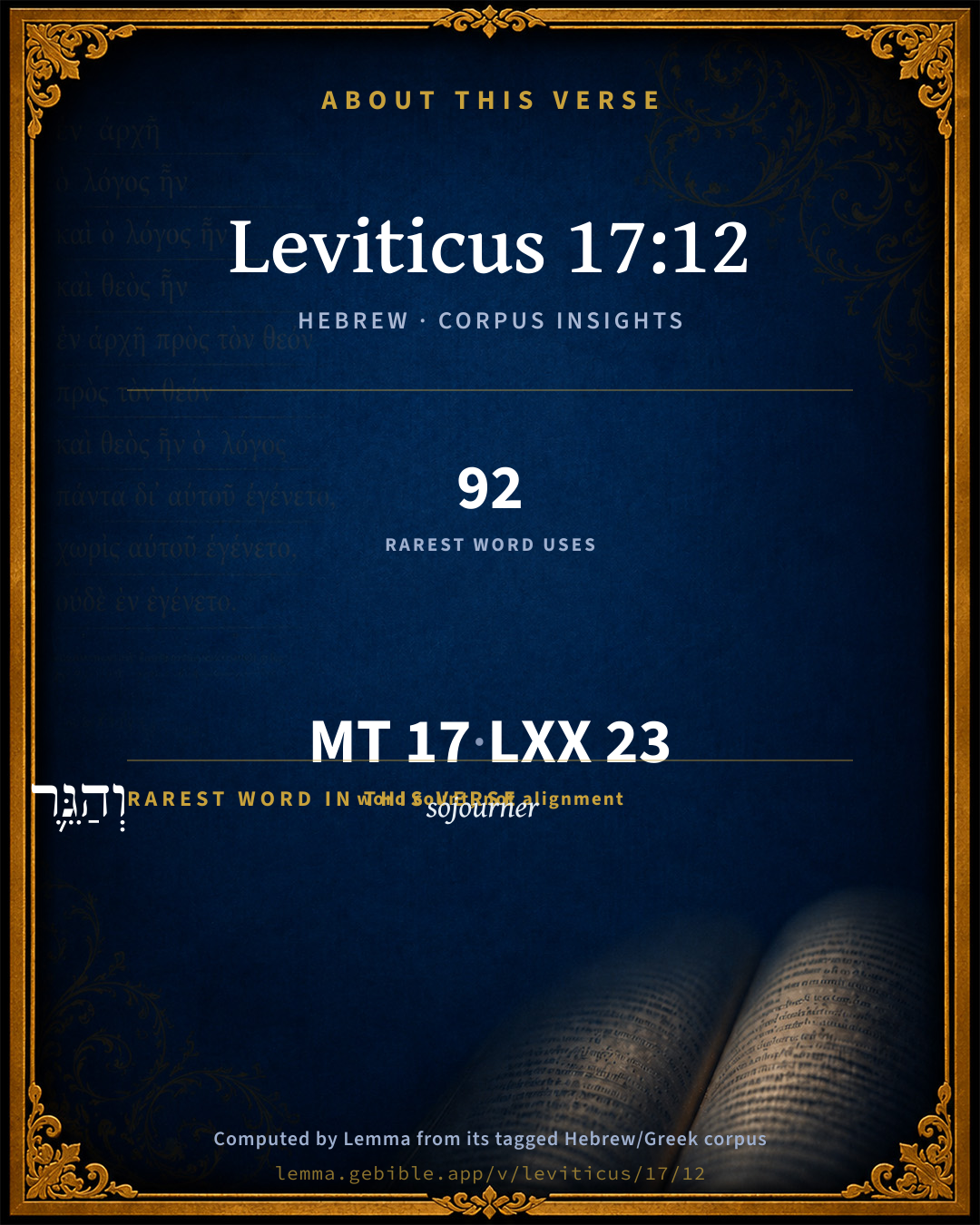
וְהַגֵּ֛ר
gêr
H1616
“and · the · sojourner”
Conjunction + Particle, Definite Article + Noun, Common, Masculine, Singular, Absolute
Part of Speech
Conjunction + Particle + Noun
Type
Common
Gender
Masculine
Number
Singular
State
Absolute
Full BDB Definition

Origin: from H1481

TWOT: 330a

sojourner - a temporary inhabitant, a newcomer lacking inherited rights - of foreigners in Israel, though conceded rights
  1. עַל ʻal H5921 “upon” Preposition
  2. כֵּ֤ן kên H3651 “thus” Particle, Demonstrative
  3. אָמַ֨רְתִּי֙ ʼâmar H559 “to say” Verb, Qal, Perfect, 1st Person, Common, Singular
  4. לִבְנֵ֣י bên H1121 “to/for · sons of” Preposition + Noun, Common, Masculine, Plural, Construct
  5. יִשְׂרָאֵ֔ל Yisrâʼêl H3478 “Israel” Noun, Proper
  6. כָּל kôl H3605 “all of” Noun, Common, Masculine, Singular, Construct
  7. נֶ֥פֶשׁ nephesh H5315 “soul” Noun, Common, Both, Singular, Absolute
  8. מִכֶּ֖ם min H4480 “from · you” Preposition + Suffix, Personal, 2nd Person, Masculine, Plural
  9. לֹא lôʼ H3808 “not” Particle, Negative
  10. תֹ֣אכַל ʼâkal H398 “to eat” Verb, Qal, Imperfect, 3rd Person, Feminine, Singular
  11. דָּ֑ם dâm H1818 “blood” Noun, Common, Masculine, Singular, Absolute
  12. הַגָּ֥ר gûwr H1481 “the · sojourning” Particle, Definite Article + Verb, Qal, Participle Active, Masculine, Singular, Absolute
  13. בְּתוֹכְכֶ֖ם tâvek H8432 “in/at · midst · your” Preposition + Noun, Common, Masculine, Singular, Construct + Suffix, Personal, 2nd Person, Masculine, Plural
  14. לֹא lôʼ H3808 “not” Particle, Negative
  15. יֹ֥אכַל ʼâkal H398 “to eat” Verb, Qal, Imperfect, 3rd Person, Masculine, Singular
  16. דָּֽם dâm H1818 “blood” Noun, Common, Masculine, Singular, Absolute

About this verse

These counts appear in no published source. They are computed here, from the morphology-tagged text and Lemma’s own curated glosses. What Lemma adds →

17
words
14
distinct lemmas
Pentateuch
section

Grammatical profile

  • 4 verbs
  • 8 nouns
  • 2 prepositions
  • 3 particles

Verb forms

  • אָמַ֨רְתִּי֙ Qal · Perfect
  • תֹ֣אכַל Qal · Imperfect
  • הַגָּ֥ר Qal · Participle Active
  • יֹ֥אכַל Qal · Imperfect

Repetition

Words recur within this verse — often emphatic in Hebrew:

  • תֹ֣אכַל to eat H398 ×2
  • דָּ֑ם blood H1818 ×2
  • לֹא not H3808 ×2

Hebrew & Septuagint length

In English translation the verse runs 29 words from the Hebrew and 26 from the Septuagint (LXX English) — closely comparable.

A rough comparison of the two English renderings, which tokenize alike — not a word-level alignment.

Word counts can differ between the Hebrew and the Greek without any difference in meaning — e.g. the Hebrew direct-object marker אֵת has no separate Greek word, and Greek often adds the article ὁ.

In the original languages it is 17 Hebrew tokens and 23 Greek tokens — but the two are counted differently (Hebrew bundles its prefixes and suffixes into one token; the Greek is in lemma form), so that isn’t a like-for-like length.

Hebrew and Greek witnesses Masoretic Hebrew ↔ Greek Septuagint

The same verse in the two great witnesses to the Old Testament, shown verse-for-verse.

These are two independent witnesses, not word-aligned to each other, and the Septuagint is shown in lemma (dictionary) form.

Hebrew Leviticus 17:12 Masoretic · Westminster Leningrad Codex

עַל כֵּ֤ן אָמַ֨רְתִּי֙ לִבְנֵ֣י יִשְׂרָאֵ֔ל כָּל נֶ֥פֶשׁ מִכֶּ֖ם לֹא תֹ֣אכַל דָּ֑ם וְהַגֵּ֛ר הַגָּ֥ר בְּתוֹכְכֶ֖ם לֹא יֹ֥אכַל דָּֽם

Therefore I have said to the children of Israel, "No person among you shall eat blood, neither shall any stranger who lives as a foreigner among you eat blood."

World English Bible · Public Domain

Greek LXX Leviticus 17:12 Septuagint · lemma form

διά οὗτος εἶπον ὁ υἱός ἰσραήλ πᾶς ψυχή ἐκ σύ οὐ ἐσθίω αἷμα καί ὁ προσήλυτος ὁ προςκεῖμαι ἐν σύ οὐ ἐσθίω αἷμα

Therefore I said to the children of Israel, No soul of you shall eat blood, and the stranger that abides among you shall not eat blood.

LXX2012 (modern English Septuagint) · Public Domain

Hebrew: Westminster Leningrad Codex (CC BY 4.0). Greek: Septuagint (public domain); English from LXX2012 (modern English Septuagint) (Public Domain). How the Septuagint differs from the Hebrew →

Targum (Aramaic paraphrase)

2

The Targum is the ancient Jewish Aramaic paraphrase of the Hebrew Scriptures — an interpretive translation, not the Hebrew text itself. Onkelos (literal) and Pseudo-Jonathan (expansive) render the Torah, and Jonathan the Prophets. Coverage is partial: where no permissively-licensed English translation exists for a verse, only the Aramaic is shown. This is verse-level text, not a word-by-word alignment to the Hebrew.

  1. Targum Onkelos Torah (Genesis–Deuteronomy)
    עַל כֵּן אֲמָרִית לִבְנֵי יִשְׂרָאֵל כָּל אֱנַשׁ מִנְכוֹן לָא יֵיכוּל דְמָא וְגִיוֹרָא דְיִתְגַיְרוּן בֵּינֵיכוֹן לָא יֵיכוּל דְמָא

    (no public-domain English translation for this verse)

    Targum Onkelos — Aramaic: “Onkelos Genesis” (public domain); “Onkelos Exodus” (public domain); “Onkelos Leviticus” (public domain); “Onkelos Numbers” (public domain); “Onkelos Deuteronomy” (public domain). English: “Sefaria Community Translation” (CC0 1.0 (public-domain dedication)); “J.W. Etheridge. The Targums of Onkelos and Jonathan Ben Uzziel on the Pentateuch. London: Longmans, Green, 1862” (public domain). Text via Sefaria.

  2. Targum Pseudo-Jonathan Torah (Genesis–Deuteronomy)
    בְּגִין כֵּן אֲמָרִית לִבְנֵי יִשְרָאֵל אִיזְדַהֲרוֹן דְכָל בַּר נַשׁ מִנְכוֹן לָא יֵיכוֹל אַדְמָא וְגִיוֹרַיָא דְמִתְגַיְירוּן לְמֵיתַב בֵּינֵיכוֹן לָא יֵיכְלוּן אַדְמָא

    Therefore have I said to the sons of Israel, Beware lest any man among you eat the blood. Neither shall the strangers who sojourn by dwelling among you eat the blood.

    Targum Pseudo-Jonathan — Aramaic: “Targum Jonathan on Genesis” (public domain); “Targum Jonathan on Exodus” (public domain); “Targum Jonathan on Leviticus” (public domain); “Targum Jonathan on Numbers” (public domain); “Targum Jonathan on Deuteronomy” (public domain). English: “The Targum of Jonathan ben Uzziel, trans. J. W. Etheridge, London, 1862” (public domain). Text via Sefaria.

Commentary

Notes on Leviticus 17:12 from classic Christian and Jewish commentators (each source and its license shown beneath its notes). The classic Christian expositions comment on the surrounding passage and are grouped to its opening verse, so a note may address several verses; the Jewish commentaries on the Tanakh (Rashi and others) are per-verse, so they appear only where the commentator wrote on this verse.

Lemma curates 59 commentaries, every one of them public domain or Creative Commons licensed, each selected and text-cleaned for this edition rather than reprinted as found. About our sources →

Trapp's Complete Commentary

John Trapp

Lev 17:12 Therefore I said unto the children of Israel, No soul of you shall eat blood, neither shall any stranger that sojourneth among you eat blood.

Ver. 12. No soul of you shall eat blood.] Haply because the Magi or wise men of Chaldea did use to eat blood when they conversed with devils; and, by them, foretold things to come. {a}

{a} Maimonides.

John Trapp, A Commentary or Exposition upon All the Books of the Old and New Testament (1647–1656) — public domain. Text from a community e-Sword module.

Ellicott's Commentary for English Readers

(12) Therefore I said . . . —Because it is the vehicle of life, and has been ordained by God to atone for life, the children of Israel are here forbidden to eat it. The strangers are also prohibited eating blood, because they have submitted to the law of the land, and because their eating it would not only infringe the law which they have voluntarily adopted, but would lessen the horror with which such indulgence was regarded by the Jews. Hence the enforcement of this prohibition by the Apostle (Act_15:20; Act_15:29; Act_21:25).

A Bible Commentary for English Readers, edited by Charles John Ellicott (1878–1897) — public domain. Text from a community e-Sword module.

John Gill's Exposition

Therefore I said unto the children of Israel, no soul of you shall eat blood,.... Great or small as Jarchi observes, for the reason above given; which, though not expressed before, was the true reason of this law, which had been given before, and now repeated; see Lev 3:17,

neither shall any stranger that sojourneth among you eat blood; any proselyte of righteousness; this is not observed before.

John Gill's Exposition of the Whole Bible (1746–1763) — public domain (CC PDM 1.0). Text via the HelloAO Bible API.

Whedon's Commentary on the Bible

Daniel D. Whedon

12. Neither shall any stranger… eat blood — So ingrained into the Hebrew conscience did this prohibition become that it was as imperative as any precept of the moral law. It was as impossible for even the first Christian Council to conceive of piety in a Gentile convert who ate blood, as in one guilty of fornication. Act_15:29.

Daniel D. Whedon (gen. ed.), Commentary on the Old and New Testaments (1874–1909) — public domain. Text from a community e-Sword module.

The Pulpit Commentary

This verse emphatically restates that the atoning power of the blood, as being the seat of life, is the reason that the eating of it is forbidden, and the same statement is repeated in a different connexion in verse 14.

The Pulpit Commentary (1880–1919), ed. H.D.M. Spence-Jones & Joseph S. Exell — public domain. Text from a community e-Sword module.

unfoldingWord translationNotes

Door43 World Missions Community

I said

Here "I" refers to Yahweh.

no one among you must eat blood

"no one among you may eat meat with blood in it"

that may be eaten

This can be translated in active form. AT: "that I have said they may eat" (See: Active or Passive)

cover the blood with earth

"cover the blood with dirt"

translationWords

alien

earth

unfoldingWord translationNotes — © Distant Shores Media and the Door43 World Missions Community, licensed CC BY-SA 4.0. Source: git.door43.org/Door43/en_tn.

Rashi

Rabbi Shlomo Yitzchaki (Rashi)

כל נפש מכם NO SOUL OF YOU [SHALL EAT BLOOD] — This is stated in addition to v. 10 to admonish the adults about their young children (that they should not permit them blood to eat — for “no soul” shall eat blood) (Sifra, Acharei Mot, Section 7 6; Yevamot 114a).

Rashi on the Tanakh — English translations: “The Judaica Press complete Tanach with Rashi, translated by A. J. Rosenberg” (CC BY 4.0); “Pentateuch with Rashi's commentary by M. Rosenbaum and A.M. Silbermann, 1929-1934” (public domain); “The Metsudah Tanach series, Lakewood, N.J” (CC BY 4.0); and “The Book of Joshua, Metsudah Publications, 1997” (CC BY 4.0). Text via Sefaria.

Lesson kit

Teaching starters — assembled from the data on this page, not authored interpretation. Every prompt links to the verse data it draws on. Edit before teaching.

Leviticus, in the Pentateuch, opens this verse with 17 words (14 distinct Hebrew lemmas). Its most distinctive word is gêr (“sojourner”). A historical commentator’s framing appears above. Read the whole chapter for the surrounding context.

Discussion questions

  1. How does “sojourner” (gêr) shape what this verse is saying?
  2. What does the repetition of “to eat” (2× in this one verse) do in this verse?
  3. These translations render this verse differently. What is at stake in choosing one wording over another?
  4. «אָמַ֨רְתִּי֙» is a Qal Perfect verb. How does that grammatical form shape the action described?
  5. Compare how Trapp's Complete Commentary and Ellicott's Commentary for English Readers read this verse. Where do they agree or differ?

Things to notice

Reading settings

Reading text

Shown beneath each verse's original-language words.

Old Testament
Old Testament edition

Read the OT as the Masoretic Hebrew (MT) or the Greek Septuagint (LXX).

English shown for the Greek Septuagint (in the Hebrew ↔ Greek comparison).

Comparing translations? Open the Compare panel on any verse page to stack up to four side by side.