Joshua 14:3

Hebrew (Westminster Leningrad Codex) Joshua 14:3 appears in the Hebrew Old Testament. The text above is from the Westminster Leningrad Codex. Each word links to its Strong’s number, a concise gloss, and parsing drawn from the Open Scriptures Hebrew Bible morphology. Click any word for its full Brown-Driver-Briggs (BDB) entry.
Download image
Cite this verse

Joshua 14:3 (World English Bible). Public Domain. Lemma interlinear Bible study tool, https://lemma.gebible.app/v/joshua/14/3.

Show BibTeX & RIS
BibTeX
RIS
English Translation
For Moses had given the inheritance of the two tribes and the half-tribe beyond the Jordan: but to the Levites he gave no inheritance among them.
World English Bible · Public Domain
Download a study sheet

One document with this verse’s original text, its word-by-word gloss line, the meaning frame, cross-references with their text, attributed commentary, and full source and license credits — printable, and it pastes into notes with its structure intact.

This verse Autodidact and up

Study sheet (.html) Plain text (.txt)

A passage Seminary Student

Up to 50 verses in one chapter. A passage sheet keeps up to 6 commentary sources and 12 cross-references per verse, in the order this page ranks them, and says so on the sheet whenever that leaves anything out. Ask for a single verse and you get the Autodidact verse sheet above.

Everything on this page stays free to read, with no account — the sheet is a download of what is already on screen, not access to it.

Want to remove ads? Support Godless Engineer
Compare translations 3

The same verse in 3 English versions, stacked beneath the original-language interlinear above. Click any original word for its lexicon entry.

Each is an independent rendering of the whole verse — the interlinear is not word-aligned to these translations.

Highlighted words mark where these versions differ — a whole-verse word diff, not a word-by-word alignment.

  • World English Bible Public Domain
    For Moses had given the inheritance of the two tribes and the half-tribe beyond the Jordan: but to the Levites he gave no inheritance among them.
  • King James Version Public Domain
    For Moses had given the inheritance of two tribes and an half tribe on the other side Jordan: but unto the Levites he gave none inheritance among them.
  • unfoldingWord Literal Text CC BY-SA 4.0
    For Moses had given the inheritance of two tribes and half of a tribe from the other side of the Jordan. But to the Levites he did not give an inheritance in the midst of them.

unfoldingWord Literal Text — © unfoldingWord, licensed CC BY-SA 4.0. Word-aligned USFM3 via Door43 (git.door43.org/unfoldingWord/en_ult).

Versions to compare (up to 4)

3 of 4 selected

Show all 18 translations

Every available English version of this verse, each an independent rendering of the whole verse.

  • World English Bible Public Domain
    For Moses had given the inheritance of the two tribes and the half-tribe beyond the Jordan: but to the Levites he gave no inheritance among them.
  • Berean Standard Bible Public Domain
    For Moses had given the inheritance east of the Jordan to the other two and a half tribes. But he granted no inheritance among them to the Levites.
  • Majority Standard Bible Public Domain
    For Moses had given the inheritance east of the Jordan to the other two and a half tribes. But he granted no inheritance among them to the Levites.
  • King James Version Public Domain
    For Moses had given the inheritance of two tribes and an half tribe on the other side Jordan: but unto the Levites he gave none inheritance among them.
  • American Standard Version (1901) Public Domain
    For Moses had given the inheritance of the two tribes and the half-tribe beyond the Jordan: but unto the Levites he gave no inheritance among them.
  • Revised Version (1885) Public Domain
    For Moses had given the inheritance of the two tribes and the half tribe beyond Jordan: but unto the Levites he gave none inheritance among them.
  • Geneva Bible (1599) Public Domain
    For Moses had giuen inheritance vnto two tribes and an halfe tribe, beyond Iorde: but vnto the Leuites he gaue none inheritance among them.
  • Douay-Rheims (1899) Public Domain
    For to two tribes and a half Moses had given possession beyond the Jordan: besides the Levites, who received no land among their brethren:
  • Young's Literal Translation Public Domain
    for Moses hath given the inheritance of two of the tribes, and of half of the tribe, beyond the Jordan, and to the Levites he hath not given an inheritance in their midst;
  • Literal Standard Version CC BY-SA 4.0
    for Moses has given the inheritance of two of the tribes, and of half of the tribe, beyond the Jordan, and he has not given an inheritance to the Levites in their midst;
  • Unlocked Literal Bible CC BY-SA 4.0
    For Moses had given the inheritance of the two and one-half tribes beyond the Jordan, but to the Levites he gave no inheritance.
  • unfoldingWord Literal Text CC BY-SA 4.0
    For Moses had given the inheritance of two tribes and half of a tribe from the other side of the Jordan. But to the Levites he did not give an inheritance in the midst of them.
  • Darby Bible Public Domain
    For Moses had given the inheritance of the two tribes and the half tribe beyond the Jordan, but to the Levites he had given no inheritance among them.
  • World Messianic Bible Public Domain
    For Moses had given the inheritance of the two tribes and the half-tribe beyond the Jordan; but to the Levites he gave no inheritance among them.
  • Webster's Bible Public Domain
    For Moses had given the inheritance of two tribes and a half-tribe on the other side of Jordan: but to the Levites he gave no inheritance among them.
  • Free Bible Version CC BY-SA 4.0
    Moses had allotted land to the two and a half tribes east of the Jordan but he had made no allocation to the Levites among them.
  • Bible in Basic English Public Domain
    For Moses had given their heritage to the two tribes and the half-tribe on the other side of Jordan, but to the Levites he gave no heritage among them.
  • JPS Tanakh (1917) Public Domain
    For Moses had given the inheritance of the two tribes and the half-tribe beyond the Jordan; but unto the Levites he gave no inheritance among them.

Literal Standard Version (2020), Covenant Press — licensed CC BY-SA 4.0. Text via the HelloAO Bible API (eBible.org). Unlocked Literal Bible (unfoldingWord) — licensed CC BY-SA 4.0. Text via the HelloAO Bible API (eBible.org). unfoldingWord Literal Text — © unfoldingWord, licensed CC BY-SA 4.0. Word-aligned USFM3 via Door43 (git.door43.org/unfoldingWord/en_ult). Free Bible Version, Dr. Jonathan Gallagher — licensed CC BY-SA 4.0. Text via the HelloAO Bible API (eBible.org).

Word by word

More ways to search: Search by grammar → Find every occurrence → Compare this word →

Practice this passage: Drill this verse → Learn its vocabulary →

מֵעֵ֖בֶר
ʻêber
H5676
“from · side”
Preposition + Noun, Common, Masculine, Singular, Absolute
Part of Speech
Preposition + Noun
Type
Common
Gender
Masculine
Number
Singular
State
Absolute
Full BDB Definition

Origin: from H5674

TWOT: 1556a

region beyond or across, side - region across or beyond - side, opposite side
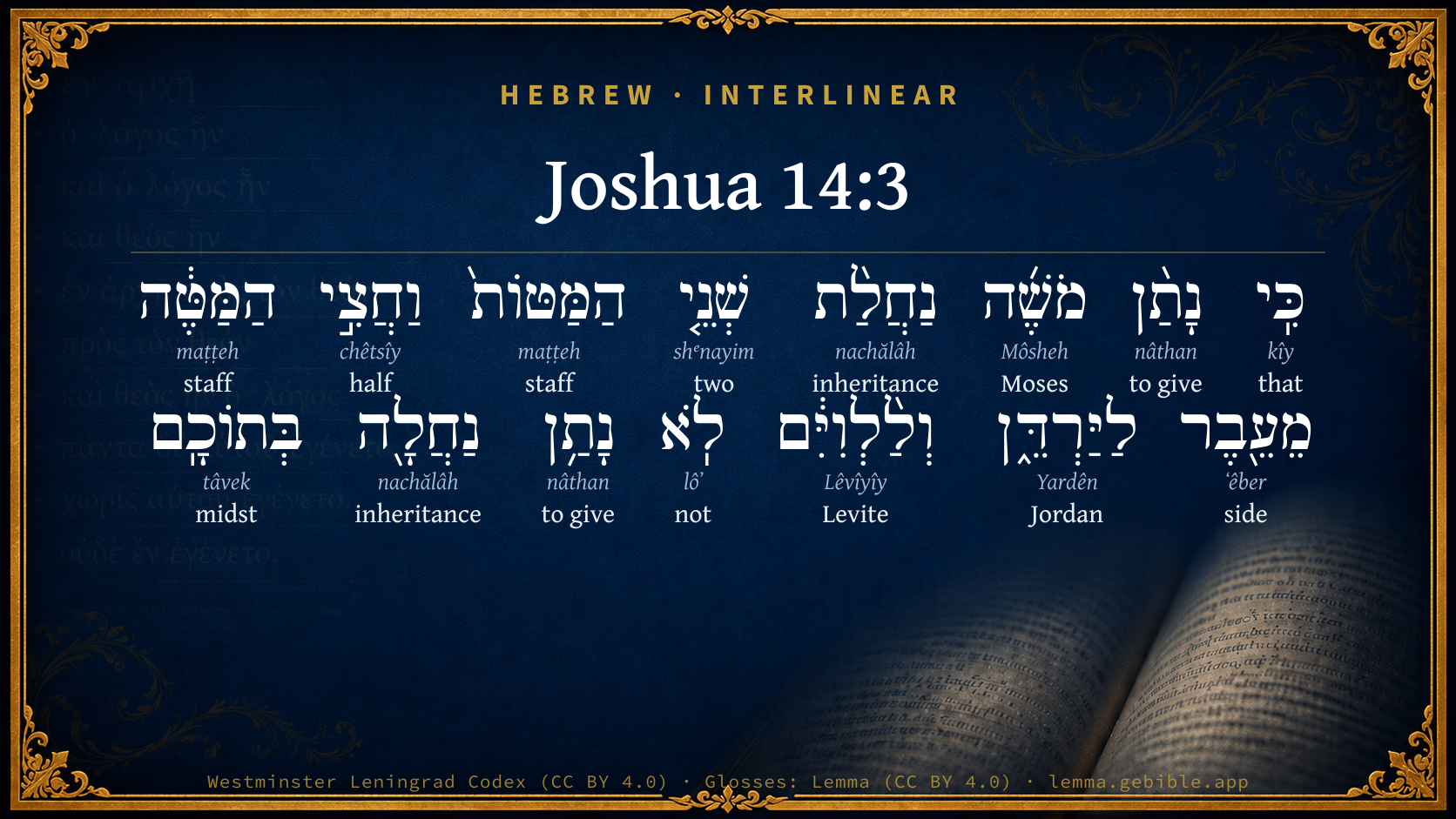
  1. כִּֽי kîy H3588 “that” Conjunction
  2. נָתַ֨ן nâthan H5414 “to give” Verb, Qal, Perfect, 3rd Person, Masculine, Singular
  3. מֹשֶׁ֜ה Môsheh H4872 “Moses” Noun, Proper
  4. נַחֲלַ֨ת nachălâh H5159 “inheritance of” Noun, Common, Feminine, Singular, Construct
  5. שְׁנֵ֤י shᵉnayim H8147 “two” Adjective, Cardinal number, Masculine, Dual, Construct
  6. הַמַּטּוֹת֙ maṭṭeh H4294 “the · staffs” Particle, Definite Article + Noun, Common, Masculine, Plural, Absolute
  7. וַחֲצִ֣י chêtsîy H2677 “and · half of” Conjunction + Noun, Common, Masculine, Singular, Construct
  8. הַמַּטֶּ֔ה maṭṭeh H4294 “the · staff” Particle, Definite Article + Noun, Common, Masculine, Singular, Absolute
  9. לַיַּרְדֵּ֑ן Yardên H3383 “to/for the · Jordan” Preposition, Determined + Noun, Proper
  10. וְלַ֨לְוִיִּ֔ם Lêvîyîy H3881 “and · to/for the · Levites” Conjunction + Preposition, Determined + Noun, Gentilic, Masculine, Plural, Absolute
  11. לֹֽא lôʼ H3808 “not” Particle, Negative
  12. נָתַ֥ן nâthan H5414 “to give” Verb, Qal, Perfect, 3rd Person, Masculine, Singular
  13. נַחֲלָ֖ה nachălâh H5159 “inheritance” Noun, Common, Feminine, Singular, Absolute
  14. בְּתוֹכָֽם tâvek H8432 “in/at · midst · their” Preposition + Noun, Common, Masculine, Singular, Construct + Suffix, Personal, 3rd Person, Masculine, Plural

About this verse

These counts appear in no published source. They are computed here, from the morphology-tagged text and Lemma’s own curated glosses. What Lemma adds →

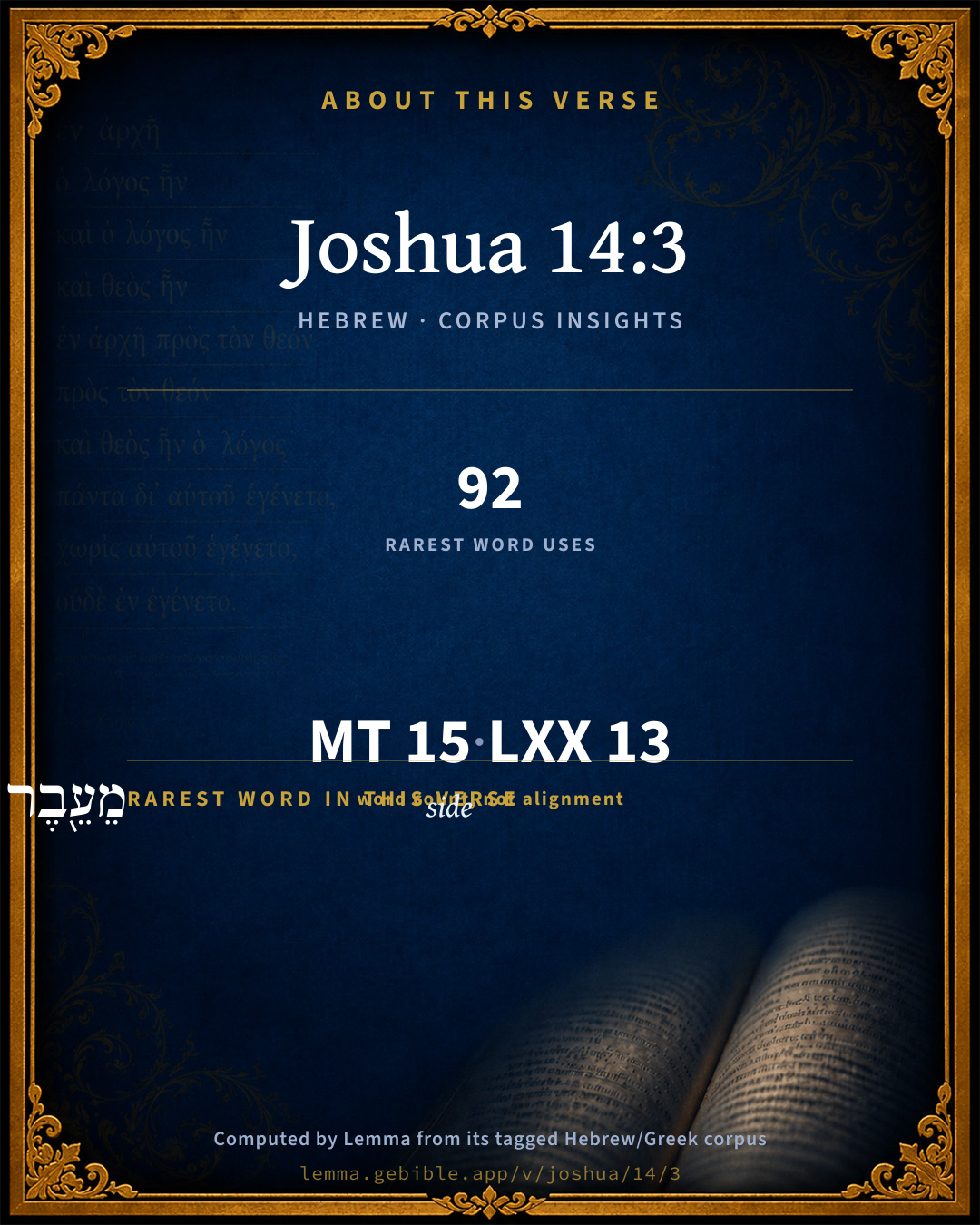
15
words
12
distinct lemmas
Historical
section

Grammatical profile

  • 2 verbs
  • 10 nouns
  • 1 adjective
  • 1 conjunction
  • 1 particle

Verb forms

  • נָתַ֨ן Qal · Perfect
  • נָתַ֥ן Qal · Perfect

Repetition

Words recur within this verse — often emphatic in Hebrew:

  • נָתַ֨ן to give H5414 ×2
  • נַחֲלַ֨ת inheritance H5159 ×2
  • הַמַּטּוֹת֙ staff H4294 ×2

Hebrew & Septuagint length

In English translation the verse runs 26 words from the Hebrew and 10 from the Septuagint (LXX English) — the Septuagint runs noticeably shorter here. See the side-by-side →

A rough comparison of the two English renderings, which tokenize alike — not a word-level alignment.

Word counts can differ between the Hebrew and the Greek without any difference in meaning — e.g. the Hebrew direct-object marker אֵת has no separate Greek word, and Greek often adds the article ὁ.

In the original languages it is 15 Hebrew tokens and 13 Greek tokens — but the two are counted differently (Hebrew bundles its prefixes and suffixes into one token; the Greek is in lemma form), so that isn’t a like-for-like length.

Cross-references

5

Topical passages linked to Joshua 14:3 in the Treasury of Scripture Knowledge — connected by theme and wording, ordered by reader-vote popularity; previews shown in the World English Bible.

  • Joshua 13:14 Only to the tribe of Levi he gave no inheritance; the offerings of Yahweh, the God of Israel, made by fire are his inheritance, as he spoke to him.
  • Joshua 13:8 With him the Reubenites and the Gadites received their inheritance, which Moses gave them, beyond the Jordan eastward, even as Moses the servant of Yahweh gave them:
  • Numbers 32:29–42 Moses said to them, If the children of Gad and the children of Reuben will pass with you over the Jordan, every man who is armed to battle, before Yahweh, and the land shall be subdued before you; then you shall give them the land of Gilead for a possession:
  • Deuteronomy 3:12–17 This land we took in possession at that time: from Aroer, which is by the valley of the Arnon, and half the hill-country of Gilead, and the cities of it, gave I to the Reubenites and to the Gadites:
  • Joshua 13:32–33 These are the inheritances which Moses distributed in the plains of Moab, beyond the Jordan at Jericho, eastward.

Cross-references courtesy of OpenBible.info (CC BY 4.0).

Hebrew and Greek witnesses Masoretic Hebrew ↔ Greek Septuagint

The same verse in the two great witnesses to the Old Testament, shown verse-for-verse.

Here the Septuagint runs noticeably shorter than the Hebrew — LXX2012 (modern English Septuagint) 10 words vs World English Bible 26. A rough length comparison of the two English translations, not a word-level alignment — read both below.

These are two independent witnesses, not word-aligned to each other, and the Septuagint is shown in lemma (dictionary) form.

Hebrew Joshua 14:3 Masoretic · Westminster Leningrad Codex

כִּֽי נָתַ֨ן מֹשֶׁ֜ה נַחֲלַ֨ת שְׁנֵ֤י הַמַּטּוֹת֙ וַחֲצִ֣י הַמַּטֶּ֔ה מֵעֵ֖בֶר לַיַּרְדֵּ֑ן וְלַ֨לְוִיִּ֔ם לֹֽא נָתַ֥ן נַחֲלָ֖ה בְּתוֹכָֽם

For Moses had given the inheritance of the two tribes and the half-tribe beyond the Jordan: but to the Levites he gave no inheritance among them.

World English Bible · Public Domain

Greek LXX Joshua 14:3 Septuagint · lemma form

ἀπό ὁ πέραν ὁ ἰορδάνης καί ὁ λευίτης οὐ δίδωμι κλῆρος ἐν αὐτός

But to the Levites he gave no inheritance among them.

LXX2012 (modern English Septuagint) · Public Domain

Hebrew: Westminster Leningrad Codex (CC BY 4.0). Greek: Septuagint (public domain); English from LXX2012 (modern English Septuagint) (Public Domain). How the Septuagint differs from the Hebrew →

Targum (Aramaic paraphrase)

1

The Targum is the ancient Jewish Aramaic paraphrase of the Hebrew Scriptures — an interpretive translation, not the Hebrew text itself. Onkelos (literal) and Pseudo-Jonathan (expansive) render the Torah, and Jonathan the Prophets. Coverage is partial: where no permissively-licensed English translation exists for a verse, only the Aramaic is shown. This is verse-level text, not a word-by-word alignment to the Hebrew.

  1. Targum Jonathan Prophets (Joshua–Malachi)
    אֲרֵי יְהַב מֹשֶׁה אַחֲסָנַת תְּרֵין שִׁבְטִין וּפַלְגוּת שִׁבְטָא מֵעִיבְרָא לְיַרְדְנָא וּלְלֵוָאֵי לָא יְהַב אַחֲסָנָא בֵּינֵיהוֹן:

    (no public-domain English translation for this verse)

    Targum Jonathan — Aramaic: “Mikraot Gedolot” (public domain). English: “Sefaria Community Translation” (CC0 1.0 (public-domain dedication)); “London "Chaldee Paraphrase," 1871” (public domain). Text via Sefaria.

Commentary

Notes on Joshua 14:3 from classic Christian and Jewish commentators (each source and its license shown beneath its notes). The classic Christian expositions comment on the surrounding passage and are grouped to its opening verse, so a note may address several verses; the Jewish commentaries on the Tanakh (Rashi and others) are per-verse, so they appear only where the commentator wrote on this verse.

Lemma curates 59 commentaries, every one of them public domain or Creative Commons licensed, each selected and text-cleaned for this edition rather than reprinted as found. About our sources →

Trapp's Complete Commentary

John Trapp

Jos 14:3 For Moses had given the inheritance of two tribes and an half tribe on the other side Jordan: but unto the Levites he gave none inheritance among them.

Ver. 3. But unto the Levites.] See Jos 13:14.

John Trapp, A Commentary or Exposition upon All the Books of the Old and New Testament (1647–1656) — public domain. Text from a community e-Sword module.

Geneva Bible (1599)

Geneva Bible translators

As Reuben and Gad and half the tribe of Manasseh, Num. 32:33.

Geneva Bible (1599) marginal notes — public domain. Text via Bolls.life.

The Cambridge Bible for Schools and Colleges

gen. ed. J. J. S. Perowne

3. For Moses] In this verse the reason is stated why there were only nine tribes and a half, to whom the land was distributed by lot; viz. because two tribes and a half had already received their inheritance on the east of the Jordan, and no land was given to the Levites as an inheritance.

The Cambridge Bible for Schools and Colleges (gen. ed. J. J. S. Perowne; Cambridge University Press, 1878–1918) — public domain. Text from a community e-Sword module.

John Gill's Exposition

And Moses had given the inheritance of two tribes, and an half tribe, on the other side Jordan,.... The two tribes of Gad and Reuben, and the half tribe of Manasseh, whose inheritance is described in Jos 13:8,

but unto the Levites he gave none inheritance among them; this is frequently observed, that it might be taken notice of, to show the disinterestedness of Moses in this affair, Levi being his own tribe; and to recommend the care of the Levites to the other tribes, according to the provision God had made for them.

John Gill's Exposition of the Whole Bible (1746–1763) — public domain (CC PDM 1.0). Text via the HelloAO Bible API.

Keil & Delitzsch

C. F. Keil & F. Delitzsch

So many tribes were to receive their inheritance, for the two tribes and a half had already received theirs from Moses on the other side of the Jordan, and the tribe of Levi was not to receive any land for an inheritance. According to this, there seem to be only eight tribes and a half to be provided for (2 1/2 + 1 + 8 1/2 = 12); but there were really nine and a half, for the sons of Joseph formed two tribes in consequence of the adoption of Ephraim and Manasseh by the patriarch Jacob (Gen 48:5). But although the Levites were to have no share in the land, they were to receive towns to dwell in, with pasture adjoining for their cattle; these the other tribes were to give up to them out of their inheritance, according to the instructions in Num 35:1-8 (see the notes upon this passage).

So far as the division of the land itself was concerned, it was to be distributed by lot, according to Num 26:52.; but, at the same time, the distribution was carried out with such special regard to the relative sizes of the different tribes, that the more numerous tribe received a larger share of the land than one that was not so numerous. This could only be accomplished, however, by their restricting the lot to the discrimination of the relative situation of the different tribes, and then deciding the extent and boundaries of their respective possessions according to the number of families of which they were composed.

(Note: "This was the force of the lot: there were ten lots cast in such a manner as to decide that some were to be next to the Egyptians, some to have the sea-coasts, some to occupy the higher ground, and some to settle in the valleys. When this was done, it remained for the heads of the nation to determine the boundaries of their different territories according to some equitable standard. It was their place, therefore, to ascertain how many thousand heads there were in each tribe, and then to adjudicate a larger or smaller space according to the size of the tribe" (Calvin). Or, as Clericus observes (Num 26:52), "the lot seems to have had respect to the situation alone, and not to the extent of territory at all.")

The casting of the lots was probably effected, as the Rabbins assumed, by means of two urns, one filled with slips having the names of the tribes upon them; the other, with an equal number, representing separate divisions of the land: so that when one slip, with a name upon it, was taken out of one urn, another slip, with a division of the land upon it, was taken from the other. The result of the lot was accepted as the direct decree of God; "for the lot was not controlled in any way by the opinion, or decision, or authority of men" (Calvin). See the fuller remarks at Num 26:56.

In the account of the casting of the lots, the first fact which strikes us is, that after the tribes of Judah and Joseph had received their inheritance, an interruption took place, and the camp was moved from Gilgal to Shiloh, and the tabernacle erected there (Jos 18:1-9); after which the other tribes manifested so little desire to receive their inheritance, that Joshua reproved them for their indolence (Jos 18:3), and directed them to nominate a committee of twenty-one from their own number, whom he sent out to survey the land and divide it into seven parts; and it was not till after this had been done that the casting of the lots was proceeded with, and each of these seven tribes received its inheritance. The reason for this interruption is not given; and the commentators have differed in their opinions as to the cause (see Keil's former Comm. on Joshua, pp. 347ff.). The following appears to be the most probable supposition. When Joshua received the command from the Lord to divide the land among the tribes, they made an approximative division of the land into nine or ten parts, according to the general idea of its extent and principal features, which they had obtained in connection with the conquest of the country, and then commenced distributing it without any more minute survey or more accurate measurement, simply fixing the boundaries of those districts which came out first according to the size of the tribes upon whom the lots fell. As soon as that was done, these tribes began to move off into the territory allotted to them, and to take possession of it. The exact delineation of the boundaries, however, could not be effected at once, but required a longer time, and was probably not finally settled till the tribe had taken possession of its land. In this manner the tribes of Judah, Ephraim, and half Manasseh had received their inheritance one after another. And whilst they were engaged in taking possession, Shiloh was chosen, no doubt in accordance with divine instructions, as the place where the tabernacle was to be permanently erected; and there the sanctuary was set up, the whole camp, of course, removing thither at the same time. But when the casting of the lots was about to be continued for the remainder of the tribes, they showed no great desire for fixed abodes, as they had become so accustomed to a nomad life, through having been brought up in the desert, that they were much more disposed to continue it, than to take possession of a circumscribed inheritance, - a task which would require more courage and exertion, on account of the remaining Canaanites, than a life in tents, in which they might wander up and down in the land by the side of the Canaanites, and supply their wants from its productions, as Abraham, Isaac, and Jacob had formerly done, since the Canaanites who were left were so weakened by the war that the Israelites had no occasion for a moment's anxiety about them, provided they did not attempt to expel or to exterminate them. But Joshua could not rest contented with this, if he would remain faithful to the charge which he had received from the Lord. He therefore reproved these tribes for their tardiness, and commanded them to take steps for continuing the casting of lots for the land. But as the tribe of Joseph had expressed its dissatisfaction with the smallness of the inheritance allotted to it, and by so doing had manifested its cowardice, which prevented it from attacking the Canaanites who were still left in the territory that had fallen to their lot, Joshua may possibly have had his eyes opened in consequence to the fact that, if the casting of lots was continued in the manner begun, and with nothing more than an approximative definition of the different portions of the land, there was a possibility of still greater dissatisfaction arising among the other tribes, since some of them at any rate would be sure to receive portions of the land in which the Canaanites were more numerous and still stronger than in the possessions of Ephraim. He therefore gave orders, that before the casting of lots was proceeded with any further, the rest of the land should be carefully surveyed and divided into seven districts, and that a statement of the result should be laid before him, that these seven districts might be divided by lot among the seven tribes. This survey of the land no doubt very clearly showed that what remained, after deducting the possessions of Judah and Joseph, was too small for the remaining seven tribes, in proportion to what had been already divided. Moreover, it had also been discovered that Judah's share was larger than this tribe required (Jos 19:9). Consequently it was necessary that certain partial alterations should be made in the arrangements connected with the first division. The lot itself could not be pronounced invalid when it had once been cast, as its falling was regarded as the decision of God himself, and therefore it was impossible to make a fresh division of the whole land among all the tribes. The only thing that could be done was to leave the two tribes in those districts which had fallen to them by lot (Jos 18:5), but to take certain parts of their territory for the other tribes, which would leave the lot in all its integrity, as the lot itself had not determined either the size of the boundaries. This will serve to explain both the interruption to the casting of the lots, which had been commenced at Gilgal, and also the peculiar manner in which it was continued at Shiloh.

Keil & Delitzsch — Biblical Commentary on the Old Testament (1861–1891) — public domain (CC PDM 1.0). Text via the HelloAO Bible API. (Old Testament only.)

Lesson kit

Teaching starters — assembled from the data on this page, not authored interpretation. Every prompt links to the verse data it draws on. Edit before teaching.

Joshua, in the Historical, opens this verse with 15 words (12 distinct Hebrew lemmas). Its most distinctive word is ʻêber (“side”). The Greek Septuagint runs shorter here. A historical commentator’s framing appears above. Read the whole chapter for the surrounding context.

Discussion questions

  1. What does “side” (ʻêber) contribute to the verse as a whole?
  2. Joshua 13:14 shares this passage’s theme. How do the two illuminate each other?
  3. “to give” occurs 2× in this one verse. What is the effect of the repetition?
  4. Compared with the Hebrew, the Septuagint runs shorter here. What questions does that raise?
  5. These translations render this verse differently. What is at stake in choosing one wording over another?
  6. The verb «נָתַ֨ן» is Qal Perfect. How does its form color the action?
  7. Reading how Trapp's Complete Commentary and Geneva Bible (1599) read this verse, where do the two commentators agree and where do they part?

Things to notice

Reading settings

Reading text

Shown beneath each verse's original-language words.

Old Testament
Old Testament edition

Read the OT as the Masoretic Hebrew (MT) or the Greek Septuagint (LXX).

English shown for the Greek Septuagint (in the Hebrew ↔ Greek comparison).

Comparing translations? Open the Compare panel on any verse page to stack up to four side by side.