Exodus 14:22

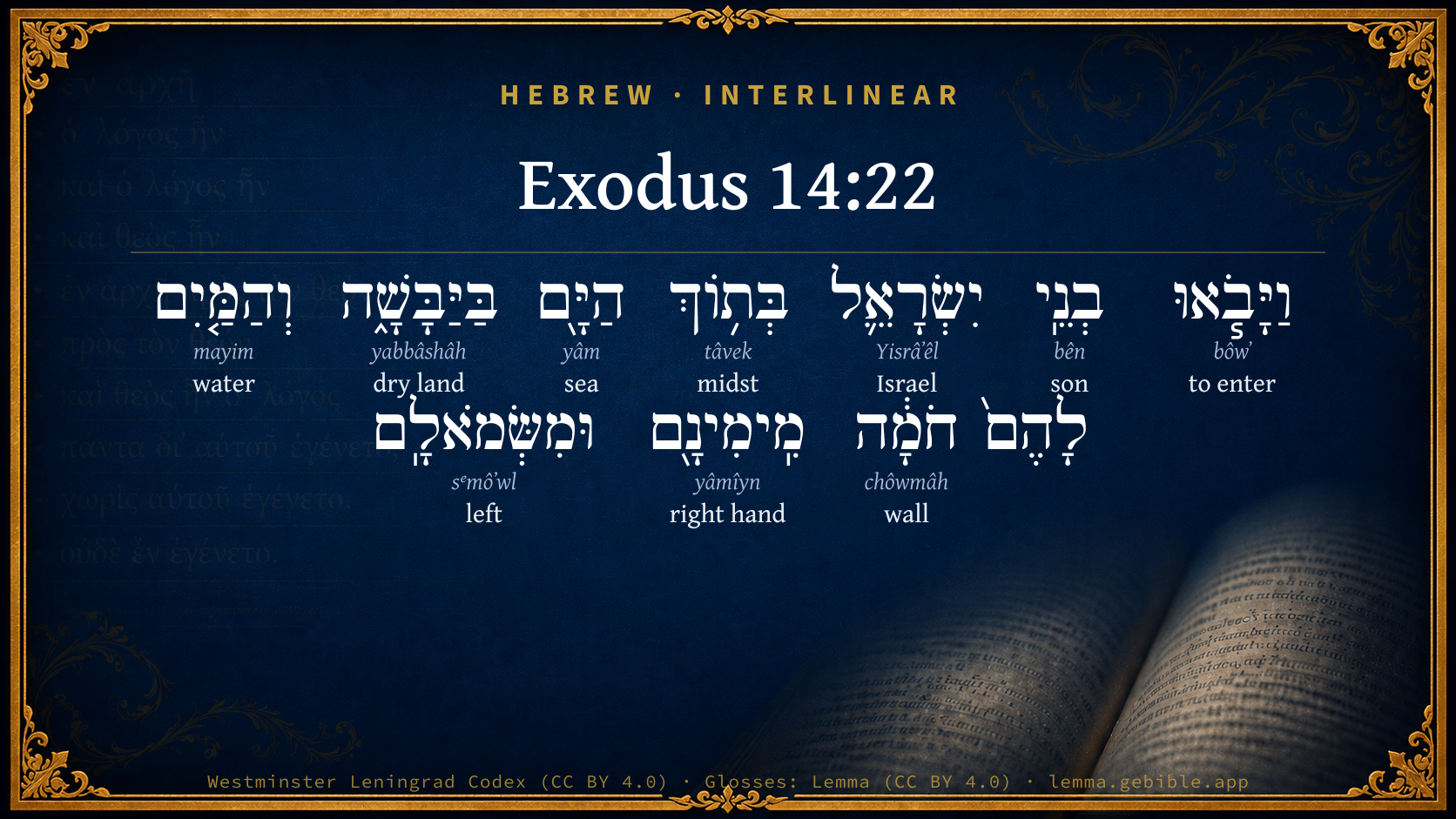
Hebrew (Westminster Leningrad Codex) Exodus 14:22 appears in the Hebrew Old Testament. The text above is from the Westminster Leningrad Codex. Each word links to its Strong’s number, a concise gloss, and parsing drawn from the Open Scriptures Hebrew Bible morphology. Click any word for its full Brown-Driver-Briggs (BDB) entry.
Download image
Cite this verse

Exodus 14:22 (World English Bible). Public Domain. Lemma interlinear Bible study tool, https://lemma.gebible.app/v/exodus/14/22.

Show BibTeX & RIS
BibTeX
RIS
English Translation
The children of Israel went into the midst of the sea on the dry ground, and the waters were a wall to them on their right hand, and on their left.
World English Bible · Public Domain
Highlights
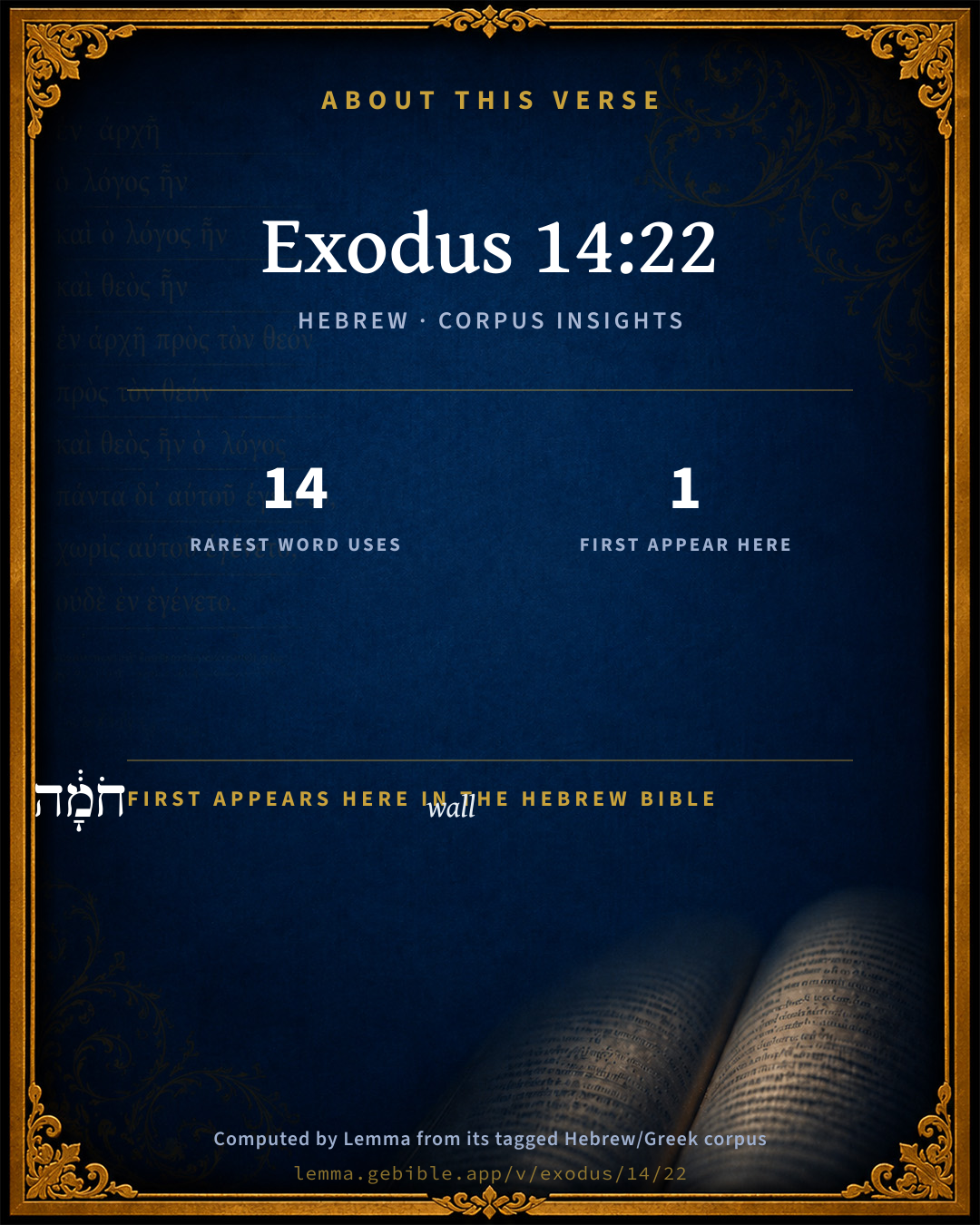
  • 1 first appearance in the Hebrew Bible
Full analysis ↓
Download a study sheet

One document with this verse’s original text, its word-by-word gloss line, the meaning frame, cross-references with their text, attributed commentary, and full source and license credits — printable, and it pastes into notes with its structure intact.

This verse Autodidact and up

Study sheet (.html) Plain text (.txt)

A passage Seminary Student

Up to 50 verses in one chapter. A passage sheet keeps up to 6 commentary sources and 12 cross-references per verse, in the order this page ranks them, and says so on the sheet whenever that leaves anything out. Ask for a single verse and you get the Autodidact verse sheet above.

Everything on this page stays free to read, with no account — the sheet is a download of what is already on screen, not access to it.

Want to remove ads? Support Godless Engineer
Compare translations 3

The same verse in 3 English versions, stacked beneath the original-language interlinear above. Click any original word for its lexicon entry.

Each is an independent rendering of the whole verse — the interlinear is not word-aligned to these translations.

Highlighted words mark where these versions differ — a whole-verse word diff, not a word-by-word alignment.

  • World English Bible Public Domain
    The children of Israel went into the midst of the sea on the dry ground, and the waters were a wall to them on their right hand, and on their left.
  • King James Version Public Domain
    And the children of Israel went into the midst of the sea upon the dry ground: and the waters were a wall unto them on their right hand, and on their left.
  • unfoldingWord Literal Text CC BY-SA 4.0
    And the sons of Israel entered the middle of the sea on dry ground. And the waters were a wall for them on their right and on their left.

unfoldingWord Literal Text — © unfoldingWord, licensed CC BY-SA 4.0. Word-aligned USFM3 via Door43 (git.door43.org/unfoldingWord/en_ult).

Versions to compare (up to 4)

3 of 4 selected

Show all 18 translations

Every available English version of this verse, each an independent rendering of the whole verse.

  • World English Bible Public Domain
    The children of Israel went into the midst of the sea on the dry ground, and the waters were a wall to them on their right hand, and on their left.
  • Berean Standard Bible Public Domain
    and the Israelites went through the sea on dry ground, with walls of water on their right and on their left.
  • Majority Standard Bible Public Domain
    and the Israelites went through the sea on dry ground, with walls of water on their right and on their left.
  • King James Version Public Domain
    And the children of Israel went into the midst of the sea upon the dry ground: and the waters were a wall unto them on their right hand, and on their left.
  • American Standard Version (1901) Public Domain
    And the children of Israel went into the midst of the sea upon the dry ground: and the waters were a wall unto them on their right hand, and on their left.
  • Revised Version (1885) Public Domain
    And the children of Israel went into the midst of the sea upon the dry ground: and the waters were a wall unto them on their right hand, and on their left.
  • Geneva Bible (1599) Public Domain
    Then the children of Israel went through the middes of the Sea vpon the drie ground, and the waters were a wall vnto them on their right hand, and on their left hand.
  • Douay-Rheims (1899) Public Domain
    And the children of Israel went in through the midst of the sea dried up: for the water was as a wall on their right hand and on their left.
  • Young's Literal Translation Public Domain
    and the sons of Israel go into the midst of the sea, on dry land, and the waters `are' to them a wall, on their right and on their left.
  • Literal Standard Version CC BY-SA 4.0
    and the sons of Israel go into the midst of the sea on dry land, and the waters [are] a wall to them, on their right and on their left.
  • Unlocked Literal Bible CC BY-SA 4.0
    The Israelites went into the middle of the sea on dry ground. The waters formed a wall for them on their right hand and on their left.
  • unfoldingWord Literal Text CC BY-SA 4.0
    And the sons of Israel entered the middle of the sea on dry ground. And the waters were a wall for them on their right and on their left.
  • Darby Bible Public Domain
    And the children of Israel went through the midst of the sea on the dry [ground]; and the waters were a wall to them on their right hand and on their left.
  • World Messianic Bible Public Domain
    The children of Israel went into the middle of the sea on the dry ground; and the waters were a wall to them on their right hand and on their left.
  • Webster's Bible Public Domain
    And the children of Israel went into the midst of the sea upon the dry ground: and the waters were a wall to them on their right hand, and on their left.
  • Free Bible Version CC BY-SA 4.0
    and the Israelites walked through the sea on dry ground, with walls of water to their right and left.
  • Bible in Basic English Public Domain
    And the children of Israel went through the sea on dry land: and the waters were a wall on their right side and on their left.
  • JPS Tanakh (1917) Public Domain
    And the children of Israel went into the midst of the sea upon the dry ground; and the waters were a wall unto them on their right hand, and on their left.

Literal Standard Version (2020), Covenant Press — licensed CC BY-SA 4.0. Text via the HelloAO Bible API (eBible.org). Unlocked Literal Bible (unfoldingWord) — licensed CC BY-SA 4.0. Text via the HelloAO Bible API (eBible.org). unfoldingWord Literal Text — © unfoldingWord, licensed CC BY-SA 4.0. Word-aligned USFM3 via Door43 (git.door43.org/unfoldingWord/en_ult). Free Bible Version, Dr. Jonathan Gallagher — licensed CC BY-SA 4.0. Text via the HelloAO Bible API (eBible.org).

Word by word

More ways to search: Search by grammar → Find every occurrence → Compare this word →

Practice this passage: Drill this verse → Learn its vocabulary →

בַּיַּבָּשָׁ֑ה
yabbâshâh
H3004
“in/at the · dry land”
Preposition, Determined + Noun, Common, Feminine, Singular, Absolute
Part of Speech
Preposition + Noun
Type
Common
Gender
Feminine
Number
Singular
State
Absolute
Full BDB Definition

Origin: from H3001

TWOT: 837b

dry land, dry ground
  1. וַיָּבֹ֧אוּ bôwʼ H935 “and · to enter” Conjunction + Verb, Qal, Sequential Imperfect, 3rd Person, Masculine, Plural
  2. בְנֵֽי bên H1121 “sons of” Noun, Common, Masculine, Plural, Construct
  3. יִשְׂרָאֵ֛ל Yisrâʼêl H3478 “Israel” Noun, Proper
  4. בְּת֥וֹךְ tâvek H8432 “in/at · midst of” Preposition + Noun, Common, Masculine, Singular, Construct
  5. הַיָּ֖ם yâm H3220 “the · sea” Particle, Definite Article + Noun, Common, Masculine, Singular, Absolute
  6. וְהַמַּ֤יִם mayim H4325 “and · the · water(s)” Conjunction + Particle, Definite Article + Noun, Common, Masculine, Plural, Absolute
  7. חֹמָ֔ה chôwmâh H2346 “wall” Noun, Common, Feminine, Singular, Absolute
  8. מִֽימִינָ֖ם yâmîyn H3225 “from · right hand · their” Preposition + Noun, Common, Feminine, Singular, Construct + Suffix, Personal, 3rd Person, Masculine, Plural
  9. וּמִשְּׂמֹאלָֽם sᵉmôʼwl H8040 “and · from · left · their” Conjunction + Preposition + Noun, Common, Masculine, Singular, Construct + Suffix, Personal, 3rd Person, Masculine, Plural

About this verse

These counts appear in no published source. They are computed here, from the morphology-tagged text and Lemma’s own curated glosses. What Lemma adds →

11
words
10
distinct lemmas
Pentateuch
section

Notable vocabulary

The rarest word here is בַּיַּבָּשָׁ֑ה dry land H3004 — appearing just 14 times in the whole Hebrew Bible.

First appearance in Scripture

This word makes its first canonical appearance in the Hebrew Bible here:

  • חֹמָ֔ה wall H2346

Shared distinctive vocabulary

בַּיַּבָּשָׁ֑ה dry land H3004 occurs in 14 verses of the Hebrew Bible. Also found in:

Grammatical profile

  • 1 verb
  • 9 nouns
  • 1 preposition

Verb forms

  • וַיָּבֹ֧אוּ Qal · Sequential Imperfect

Hebrew & Septuagint length

In English translation the verse runs 31 words from the Hebrew and 34 from the Septuagint (LXX English) — closely comparable.

A rough comparison of the two English renderings, which tokenize alike — not a word-level alignment.

Word counts can differ between the Hebrew and the Greek without any difference in meaning — e.g. the Hebrew direct-object marker אֵת has no separate Greek word, and Greek often adds the article ὁ.

Cross-references

12

Topical passages linked to Exodus 14:22 in the Treasury of Scripture Knowledge — connected by theme and wording, ordered by reader-vote popularity; previews shown in the World English Bible.

  • Hebrews 11:29 By faith, they passed through the Red sea as on dry land. When the Egyptians tried to do so, they were swallowed up.
  • Exodus 15:19 For the horses of Pharaoh went in with his chariots and with his horsemen into the sea, and Yahweh brought back the waters of the sea on them; but the children of Israel walked on dry land in the midst of the sea.
  • Psalms 66:6 He turned the sea into dry land. They went through the river on foot. There, we rejoiced in him.
  • Exodus 14:29 But the children of Israel walked on dry land in the midst of the sea, and the waters were a wall to them on their right hand, and on their left.
  • Psalms 78:13 He split the sea, and caused them to pass through; He made the waters stand as a heap.
  • Exodus 15:8 With the blast of your nostrils the waters were piled up. The floods stood upright as a heap. The deeps were congealed in the heart of the sea.
  • Nehemiah 9:11 You divided the sea before them, so that they went through the midst of the sea on the dry land; and their pursuers you did cast into the depths, as a stone into the mighty waters.
  • Isaiah 63:13 who led them through the depths, as a horse in the wilderness, so that they didn't stumble?
  • 1 Corinthians 10:1 Now I would not have you ignorant, brothers, that our fathers were all under the cloud, and all passed through the sea;
  • Numbers 33:8 They traveled from before Hahiroth, and passed through the midst of the sea into the wilderness: and they went three days' journey in the wilderness of Etham, and encamped in Marah.
  • Habakkuk 3:8–10 Was Yahweh displeased with the rivers? Was your anger against the rivers, Or your wrath against the sea, That you rode on your horses, On your chariots of salvation?
  • Zechariah 2:5 For I,' says Yahweh, 'will be to her a wall of fire around it, and I will be the glory in the midst of her.

Cross-references courtesy of OpenBible.info (CC BY 4.0).

Hebrew and Greek witnesses Masoretic Hebrew ↔ Greek Septuagint

The same verse in the two great witnesses to the Old Testament, shown verse-for-verse.

These are two independent witnesses, not word-aligned to each other, and the Septuagint is shown in lemma (dictionary) form.

Hebrew Exodus 14:22 Masoretic · Westminster Leningrad Codex

וַיָּבֹ֧אוּ בְנֵֽי יִשְׂרָאֵ֛ל בְּת֥וֹךְ הַיָּ֖ם בַּיַּבָּשָׁ֑ה וְהַמַּ֤יִם לָהֶם֙ חֹמָ֔ה מִֽימִינָ֖ם וּמִשְּׂמֹאלָֽם

The children of Israel went into the midst of the sea on the dry ground, and the waters were a wall to them on their right hand, and on their left.

World English Bible · Public Domain

Greek LXX Exodus 14:22 Septuagint · lemma form

καί εἰςἔρχομαι ὁ υἱός ἰσραήλ εἰς μέσος ὁ θάλασσα κατά ὁ ξηρός καί ὁ ὕδωρ αὐτός τεῖχος ἐκ δεξιός καί τεῖχος ἐκ εὐώνυμος

And the children of Israel went into the midst of the sea on the dry land, and the water of it was a wall on the right hand and a wall on the left.

LXX2012 (modern English Septuagint) · Public Domain

Hebrew: Westminster Leningrad Codex (CC BY 4.0). Greek: Septuagint (public domain); English from LXX2012 (modern English Septuagint) (Public Domain). How the Septuagint differs from the Hebrew →

Targum (Aramaic paraphrase)

2

The Targum is the ancient Jewish Aramaic paraphrase of the Hebrew Scriptures — an interpretive translation, not the Hebrew text itself. Onkelos (literal) and Pseudo-Jonathan (expansive) render the Torah, and Jonathan the Prophets. Coverage is partial: where no permissively-licensed English translation exists for a verse, only the Aramaic is shown. This is verse-level text, not a word-by-word alignment to the Hebrew.

  1. Targum Onkelos Torah (Genesis–Deuteronomy)
    וְעַלוּ בְנֵי יִשְׂרָאֵל בְּגוֹ יַמָא בְּיַבֶּשְׁתָּא וּמַיָּא לְהוֹן שׁוּרִין מִיַּמִינֵהוֹן וּמִסְמָאלֵהוֹן:

    (no public-domain English translation for this verse)

    Targum Onkelos — Aramaic: “Onkelos Genesis” (public domain); “Onkelos Exodus” (public domain); “Onkelos Leviticus” (public domain); “Onkelos Numbers” (public domain); “Onkelos Deuteronomy” (public domain). English: “Sefaria Community Translation” (CC0 1.0 (public-domain dedication)); “J.W. Etheridge. The Targums of Onkelos and Jonathan Ben Uzziel on the Pentateuch. London: Longmans, Green, 1862” (public domain). Text via Sefaria.

  2. Targum Pseudo-Jonathan Torah (Genesis–Deuteronomy)
    וְעָלוּ בְנֵי יִשְרָאֵל בְּגוֹ יַמָא בְּיַבֶּשְׁתָּא וּמַיָא קַרְשְׁווּן הֵי כְשׁוּרִין דְּמִן תְּלַת מְאָה מִילִין מִיַּמִינְהוֹן וּמִשְמָאלְהוֹן

    And the children of Israel went through the midst of the sea upon the ground, and the waters were congealed like a wall, three hundred miles on their right hand and on their left.

    Targum Pseudo-Jonathan — Aramaic: “Targum Jonathan on Genesis” (public domain); “Targum Jonathan on Exodus” (public domain); “Targum Jonathan on Leviticus” (public domain); “Targum Jonathan on Numbers” (public domain); “Targum Jonathan on Deuteronomy” (public domain). English: “The Targum of Jonathan ben Uzziel, trans. J. W. Etheridge, London, 1862” (public domain). Text via Sefaria.

Commentary

Notes on Exodus 14:22 from classic Christian and Jewish commentators (each source and its license shown beneath its notes). The classic Christian expositions comment on the surrounding passage and are grouped to its opening verse, so a note may address several verses; the Jewish commentaries on the Tanakh (Rashi and others) are per-verse, so they appear only where the commentator wrote on this verse.

Lemma curates 59 commentaries, every one of them public domain or Creative Commons licensed, each selected and text-cleaned for this edition rather than reprinted as found. About our sources →

Trapp's Complete Commentary

John Trapp

Exo 14:22 And the children of Israel went into the midst of the sea upon the dry [ground]: and the waters [were] a wall unto them on their right hand, and on their left.

Ver. 22. Were a wall unto them.] Every main affliction is our Red Sea, saith one, which, while it threats to swallow, preserves us.

John Trapp, A Commentary or Exposition upon All the Books of the Old and New Testament (1647–1656) — public domain. Text from a community e-Sword module.

Tyndale Open Study Notes

Tyndale Open Resources

14:22 As with the plagues, naturalistic explanations for this event are beside the point. A strong, steady wind blowing across a relatively shallow, contained body of water can change its depth dramatically, but that does not produce dry ground, with walls of water on each side. The Lord can intervene in nature and do with it as he wishes.

Tyndale Open Study Notes — © Tyndale Open Resources, licensed CC BY-SA 4.0. Text via the HelloAO Bible API.

Jamieson, Fausset & Brown

Robert Jamieson, A. R. Fausset & David Brown

the children of Israel went into the midst of the sea, &c.--It is highly probable that Moses, along with Aaron, first planted his footsteps on the untrodden sand, encouraging the people to follow him without fear of the treacherous walls; and when we take into account the multitudes that followed him, the immense number who through infancy and old age were incapable of hastening their movements, together with all the appurtenances of the camp, the strong and steadfast character of the leaders' faith was strikingly manifested (Jos 2:10; Jos 4:23; Psa 66:6; Psa 74:13; Psa 106:9; Psa 136:13; Isa 63:11-13; Co1 10:1; Heb 11:29).

Jamieson, Fausset & Brown — Commentary Critical and Explanatory on the Whole Bible (1871) — public domain (CC PDM 1.0). Text via the HelloAO Bible API.

Adam Clarke's Commentary

Verse 22. And the waters were a wall unto them on their right and on their left.] This verse demonstrates that the passage was miraculous. Some have supposed that the Israelites had passed through, favoured by an extraordinary ebb, which happened at that time to be produced by a strong wind, which happened just then to blow! Had this been the case, there could not have been waters standing on the right hand and on the left; much less could those waters, contrary to every law of fluids, have stood as a wall on either side while the Israelites passed through, and then happen to become obedient to the laws of gravitation when the Egyptians entered in! An infidel may deny the revelation in toto, and from such we expect nothing better; but to hear those who profess to believe this to be a Divine revelation endeavouring to prove that the passage of the Red Sea had nothing miraculous in it, is really intolerable. Such a mode of interpretation requires a miracle to make itself credible. Poor infidelity! how miserable and despicable are thy shifts!

Adam Clarke's Commentary on the Bible (1810–1826) — public domain. Text from a community e-Sword/MySword module.

Ellicott's Commentary for English Readers

(22) The waters were a wall unto them.—Any protection is in Scripture called “a wall,” or “a rampart” (1Sa_25:16; Pro_18:11; Isa_26:1; Jer_1:18; Nah_3:8). In the present case, the waters protected Israel on either flank—the Red Sea upon the right, the Bitter Lakes upon the left. Poetical writers, as was natural, used language still more highly metaphorical (Psa_78:13; Exo_15:8), and spoke of the waters as “standing on an heap.” Hence, some moderns have gone so far as to maintain that on this occasion the water “gave up its nature, formed with its waves a strong wall, and instead of streaming like a fluid, congealed into a hard substance” (Kalisch). But this is to turn poetry into prose, and enslave oneself to a narrow literalism.

A Bible Commentary for English Readers, edited by Charles John Ellicott (1878–1897) — public domain. Text from a community e-Sword module.

The Cambridge Bible for Schools and Colleges

gen. ed. J. J. S. Perowne

22. and the waters were a wall, &c.] ‘A very summary poetical and hyperbolical (Exo_15:8) description of the occurrence, which can at most be pictured as the drying up of a shallow ford, on both sides of which the basin of the sea was much deeper, and remained filled with water’ (Di.).

The Cambridge Bible for Schools and Colleges (gen. ed. J. J. S. Perowne; Cambridge University Press, 1878–1918) — public domain. Text from a community e-Sword module.

John Gill's Exposition

And the children of Israel went into the midst of the sea upon the dry ground,.... Some Jewish writers say (c), that the tribe of Judah went in first, and then the other tribes followed; but it is most likely, what Josephus says (d), that Moses first entered in, and then the Israelites, encouraged by his example, went in after him; and a very adventurous action it was, and nothing but strong faith in the almighty power and promise of God could have engaged them in it, to which the apostle ascribes it, Heb 11:29. It is the opinion of Aben Ezra, and some other Jewish writers, that the Israelites did not pass through the Red sea to the opposite shore, only went some way into it, and took a compass in a semicircle, and came out on the same shore again, and which has been espoused by some Christian writers; and chiefly because they were in the wilderness of Etham before, and from whence they went into it, and when they came out of it, it was still the wilderness of Etham they came into, and went three days' journey into it seeking water; see Exo 13:20. Though it is possible the wilderness on the opposite shore might bear the same name, because of its likeness to it; and if it was the same wilderness that went round the Arabic gulf, or Red sea, and reached on to the other side of it, and so the wilderness of Etham lay on both sides, the difficulty is removed; for it seems most agreeable to the expressions of Scripture, that the Israelites passed through it from shore to shore. Others, in order to lessen the miracle, would have it that Moses, well knowing the country, and observing the tide, took the advantage of low water, and led the Israelites through it; and this story is told by the Egyptian priests of Memphis, as Artapanus (e) relates; but were the Egyptians less knowing of their country, and of the tide of the Red sea? and could Moses be sure of the exact time when they would come up to him, and the tide would serve him? Besides, the Egyptian priests at Heliopolis own the miracle, and relate it much as Moses has done; which must proceed from a conviction of the truth of it. And the above historian reports that the king (of Egypt) with a great army, and consecrated animals, pursued the Jews because of the substance they had borrowed of the Egyptians, which they took with them; but Moses being bid by a divine voice (or the voice of God, of Jehovah) to smite the sea with a rod, and hearkening to it, he touched the water with the rod, and so it divided, and his forces passed through a dry path, and the Egyptians attempting the same and pursuing, fire or lightning flashed out against them; and the sea shutting up the path again, partly by fire, and partly by the flow of the water, they all perished: and that this affair was miraculous, and could not be owing to any advantage taken from the tide, the following things have been observed; it is owned that the Red sea ebbs and flows like other seas that have a communication with the ocean, that is, the waters rise towards the shore during six hours, and having continued about a quarter of an hour at high water, ebb down again during another six hours; and it is observed by those who have examined it, that the greatest distance it falls from the place of high water is about three hundred yards; and that during the time of low water, one may safely travel it, as some have actually done; so that those three hundred paces, which the sea leaves uncovered during the time of low water, can continue so but for the space of half an hour at most; for during the first six hours, the sea retires only by degrees, and in less than half an hour it begins again to flow towards the shore. The most therefore that can be allowed, both of time and space of passable ground, in a moderate computation, is about two hundred paces, during six hours, or one hundred and fifty paces, during eight hours. Now it is further observed, that it is plain that a multitude consisting of upwards of two millions and a half of men, women, children, and slaves, encumbered besides with great quantities of cattle, household stuff, and the spoils of the Egyptians, could never perform such a march within so short a time; we may say within even double that space, though we should allow them also double the breadth of ground to do it on. This argument, it is added, will hold good against those who suppose they only coasted along some part of the sea, and those who maintain that they crossed the small arm or point of it which is toward the further end, near the isthmus of Suez; seeing that six or eight hours could not have sufficed for the passage of so immense a multitude, allow them what breadth of room you will; much less for Pharaoh to have entered it with his whole host (f): and for the confirmation of the Mosaic account of this affair, and as miraculous, may be observed the testimony of Diodorus Siculus, who reports (g) that it is a tradition among the Ichthyophagi, who inhabit near the Red sea, or Arabic gulf, which they have received from the report of their ancestors, and is still preserved with them, that upon a great recess of the sea, every place of the gulf became dry, the sea falling to the opposite parts, the bottom appeared green, and returning back with a mighty force, was restored to its place again; which can have reference to nothing else but to this transaction in the time of Moses. And Strabo (h) relates a very wonderful thing, and such as rarely happens, that on the shore between Tyre and Ptolemais, when they of Ptolemais had a battle with the Emperor Sarpedon at that place, and there being put to flight, a flow of the sea like an inundation covered those that fled, and some were carried into the sea and perished, and others were left dead in hollow places; after a reflux followed, and discovered and showed the bodies of those that lay among the dead fishes. Now learned men have observed (i), that what is here said of the sea of Tyre is to be understood of the Red sea, and that Sarpedon is not a proper name, but the same with , "Sarphadon", the prince of deliverance, or of the delivered, as Moses was:

and the waters were a wall to them on their right hand and on their left; some of the Jewish Rabbins from Exo 15:8 have supposed that the waters were frozen as they were drove back by the east wind, and so stood up firm while the Israelites passed through, and then another wind thawed them, which brought them upon the Egyptians; but no doubt this was done by the wonderful interposition of divine power, and perhaps the ministry of angels was made use of, to detain and continue them in this position, until the end was answered. Adrichomius says (k), the breadth of the sea was six miles at the passage of the Israelites; but a late traveller (l) tells us, that the channel between Sdur (or Shur, on the opposite side) and Gibbel Gewoubee, and Attackah (which he supposes was the place of their passage), was nine or ten miles over. Thevenot says (m), that during the space of five days he kept along the coast of the Red sea, in going to Mount Sinai, he could not observe it to be anywhere above eight or nine miles over. A later traveller (n) tells us, that from the fountains of Moses may be plainly seen a wonderful aperture (Pihahiroth; see Exo 14:2) in the mountains on the other side of the Red sea, through and from which the children of Israel entered into it, when Pharaoh and his host were drowned; which aperture is situated west-southwest from these fountains of Moses, and the breadth of the sea hereabouts, where the children of Israel passed it, is about four or five hours' journey. The Arabic geographer (o) calls the place Jethren, where Pharaoh and his host were drowned; and represents it as a dangerous place to sail in, and where many ships are lost, and that this rough place is about the space of six miles. A countryman (p) of ours, who had been in these parts, guesses that the breadth of the place (called by the Mahometans, Kilt el Pharown, the well or pit of Pharaoh) where the Israelites are said to pass through is about six or seven leagues; the difference between these writers may be accounted for by the different places where they suppose this passage was.

(c) Pirke Elizer, c. 42. (d) Antiqu. l. 2. c. 16. sect. 2. (e) Apud Euseb. Praepar. Evangel. l. 9. c. 27. p. 436. (f) Universal History, vol. 3. p. 392, 393. marg. (g) Bibliothec. l. 3. p. 174. (h) Geograph. l. 16. p. 521, 522. (i) Vid. Scheuchzer. Physic. Sacr. vol. 1. p. 167. (k) Theatrum Terrae, p. 123, 124. (l) Dr. Shaw's Travels, p. 314. Edit. 2. (m) Travels into the Levant, B. 2. ch. 33. p. 175. (n) A Journal from Grand Cairo, &c. in 1722. p. 13. Edit. 2. (o) Climat. 3. par. 3. (p) Pitts's Account of the Mahometans, p. 77.

John Gill's Exposition of the Whole Bible (1746–1763) — public domain (CC PDM 1.0). Text via the HelloAO Bible API.

Albert Barnes' Notes on the Bible

Were a wall unto them - Compare Nah 3:8. The waters served the purpose of an intrenchment and wall; the people could not be attacked on either flank during the transit; to the north was the water covering the whole district; to the south was the Red Sea.

Albert Barnes' Notes on the Bible (1834–1885) — public domain. Text from a community e-Sword/MySword module.

Haydock's Catholic Bible Commentary

CHAPTER XIV.

George Leo Haydock (1774–1849), Haydock's Catholic Family Bible and Commentary, 1859 edition — public domain. Excludes Psalms (Douay-Rheims chapter numbering differs from Protestant) and Deuterocanonical books (Catholic canon only).

Matthew Poole's English Annotations

This was about midnight, as may be gathered from Exo 14:24.

The waters were a wall, both for height, and for their defence.

Matthew Poole's English Annotations on the Holy Bible (1683–1685) — public domain. Text from a community e-Sword/MySword module.

The Pulpit Commentary

The waters were a walli.e. , a protection, a defence. Pharaoh could not attack them on either flank, on account of the two bodies of water between which their march lay. He could only come at them by following after them. The metaphor has been by some understood literally, especially on account of the expression in Exo 15:8The floods stood upright as a heap; " and again that in Psa_78:13He made the waters to stand as a heap. " But those phrases, occurring in poems, must be taken as poetical; and can scarcely have any weight in determining the meaning of wall" here. We must ask ourselves is there not an economy and a restraint in the exertion by God even ofmiraculous power? is more used than is needed for the occasion? and would not all that was needed at this time have been effected by such a division of the sea as we have supposed, without the fluid being converted into a solid, or having otherwise the laws of its being entirely altered. Kalisch"s statement, that the word wall" here is not intended to convey the idea of protection, but only of hardness and solidity," seems to us the very reverse of the truth. Protection is at any rate the main idea, and any other is secondary and subordinate.

HOMILIES BY G.A. GOODHART Ver. 22. We walk by faith, not by sight.

The great mistake of most people is, that they trust too much to their own eyes. They will not take into consideration anything that lies beyond the field of sensible experiences. Now God and his eternity, though manifested in this field, are practically outside it; the spiritual eyesight is more reliable than the physical, because that which it sees is safer to rely upon. Natural sight shows us obstacles, spiritual sight shows us how they may be surmounted. Try to walk by the one and you must stand still; try to walk by the other and nothing can long keep you standing. Notice here:

I FAITH"S SECRET, The story illustrates this; it shows us:

1. What the Israelites saw. Their position looked bad enough. Behind were the hosts of Pharaoh; before, the sea. They were shut in. Trusting only to their eyes they could hardly do other than despair. (Exo_14:10-13) Better to have been let alone" in Egypt, than thus delivered, to be destroyed in the wilderness. A clear head, if the heart be faint, is not much help to any man.

2. What Moses saw. He was in the same position as the people whom he led, yet he could see more than they did. He looked not merely before and behind, he looked also up to God. Faith enabled him to ignore sight, and inspired him to encourage his sight-fascinated followers. Soon the word came which justified his faith, obstacles were nothing, let them wait the word of command and then go forward. " Often difficulties seem to surround us no way of escape anywhere visible. Even so faith can sight the way, for faith can sight God who sees it. Stand still, wait his word; refuse to allow that for those who trust him any difficulties can be insurmountable. Faith would not be of much good were there no obstacles to test it. Faith is not of much good if it cannot learn to ignore obstacles.

II FAITH"S SUCCESS. The path of faith not merely leads out of danger, it turns dangers into safeguards and transforms them into a protection for those who tread it. When the word came Go forward," the waters no longer shut in" the Israelites; instead:

1. They protected them during their passage. The Egyptians could butfollow, they could not circumvent. The waters were a wall unto them" on either side; no wall could have been more impregnable.

2. They secured them against the fury of their pursuers. Israel once across,the waters returned, overwhelming the armies of the enemy. So too faith, facing the flood, found that waters which drowned the world upheld the ark and floated it in safety. So too faith, facing the waters of death, finds that though they overwhelm the unready they float the faithful into a safe harbour. So too with all difficulties, faced in faith, they are our best helpers. The hand of the diligent" not only maketh rich," it cleaves a way for him through the sea of difficulty, and leaves his pursuers, sloth, ignorance, all the deadly sins, overwhelmed and swallowed up behind him.

III FAITH"S STRENGTH. HOW comes faith to do all this? It is not faith that does it, but the God in whom faith trusts. Nothing is impossible to faith, because nothing is impossible to God. The Egyptians are sure of their prey; the Israelites are sure of destruction; because, whilst reckoning with what sight sees, they fail to reckon with the unseen God. Moses is sure of safety because he is sure of God, and knows that he is more than a match for all the seeming tyranny of circumstances.

Application. How many people are shut in, faithless and discouraged before some sea of difficulty! I cannot do this," I cannot do that," and yet no progress is possible until I not merely can but do. O ye of little faith, wherefore will ye doubt!" I cannot; " no, but God can; and what he bids you do that he will strengthen you to do. Don"t stand facing the difficulties, but face the God who is above them and beyond them. Stand still and wait" until the word comes, but when the word does come, Go forward". G. (cf. 2Co_12:9, 2Co_12:10)

The Pulpit Commentary (1880–1919), ed. H.D.M. Spence-Jones & Joseph S. Exell — public domain. Text from a community e-Sword module.

Lesson kit

Teaching starters — assembled from the data on this page, not authored interpretation. Every prompt links to the verse data it draws on. Edit before teaching.

Exodus, in the Pentateuch, opens this verse with 11 words (10 distinct Hebrew lemmas). Its most distinctive word is yabbâshâh (“dry land”). A historical commentator’s framing appears above. Read the whole chapter for the surrounding context.

Discussion questions

  1. How does “dry land” (yabbâshâh) shape what this verse is saying?
  2. This is the first place “wall” appears in Scripture (first appears here). What does its debut here establish?
  3. How does Genesis 1:9, which shares the word «dry land», read alongside this verse?
  4. These translations render this verse differently; the difference is in the English rendering, not the original. What questions does that raise?
  5. «וַיָּבֹ֧אוּ» is a Qal Sequential Imperfect verb. How does that grammatical form shape the action described?
  6. Compare how Trapp's Complete Commentary and Tyndale Open Study Notes read this verse. Where do they agree or differ?

Things to notice

  • 1 word makes its first canonical appearance in Scripture here.
  • These translations choose different wording for 9 words in this verse.
  • 10 distinct Hebrew lemmas span 11 words in this verse.

Reading settings

Reading text

Shown beneath each verse's original-language words.

Old Testament
Old Testament edition

Read the OT as the Masoretic Hebrew (MT) or the Greek Septuagint (LXX).

English shown for the Greek Septuagint (in the Hebrew ↔ Greek comparison).

Comparing translations? Open the Compare panel on any verse page to stack up to four side by side.