
Exodus 15:19

Hebrew (Westminster Leningrad Codex) Exodus 15:19 appears in the Hebrew Old Testament. The text above is from the Westminster Leningrad Codex. Each word links to its Strong’s number, a concise gloss, and parsing drawn from the Open Scriptures Hebrew Bible morphology. Click any word for its full Brown-Driver-Briggs (BDB) entry.
Download image
Cite this verse

Exodus 15:19 (World English Bible). Public Domain. Lemma interlinear Bible study tool, https://lemma.gebible.app/v/exodus/15/19.

Show BibTeX & RIS
BibTeX
RIS
English Translation
For the horses of Pharaoh went in with his chariots and with his horsemen into the sea, and Yahweh brought back the waters of the sea on them; but the children of Israel walked on dry land in the midst of the sea.
World English Bible · Public Domain
Download a study sheet

One document with this verse’s original text, its word-by-word gloss line, the meaning frame, cross-references with their text, attributed commentary, and full source and license credits — printable, and it pastes into notes with its structure intact.

This verse Autodidact and up

Study sheet (.html) Plain text (.txt)

A passage Seminary Student

Up to 50 verses in one chapter. A passage sheet keeps up to 6 commentary sources and 12 cross-references per verse, in the order this page ranks them, and says so on the sheet whenever that leaves anything out. Ask for a single verse and you get the Autodidact verse sheet above.

Everything on this page stays free to read, with no account — the sheet is a download of what is already on screen, not access to it.

Want to remove ads? Support Godless Engineer
Compare translations 3

The same verse in 3 English versions, stacked beneath the original-language interlinear above. Click any original word for its lexicon entry.

Each is an independent rendering of the whole verse — the interlinear is not word-aligned to these translations.

Highlighted words mark where these versions differ — a whole-verse word diff, not a word-by-word alignment.

  • World English Bible Public Domain
    For the horses of Pharaoh went in with his chariots and with his horsemen into the sea, and Yahweh brought back the waters of the sea on them; but the children of Israel walked on dry land in the midst of the sea.
  • King James Version Public Domain
    For the horse of Pharaoh went in with his chariots and with his horsemen into the sea, and the LORD brought again the waters of the sea upon them; but the children of Israel went on dry land in the midst of the sea.
  • unfoldingWord Literal Text CC BY-SA 4.0
    For the horse of Pharaoh went with his chariots and horsemen into the sea. And Yahweh returned upon them the waters of the sea. And the sons of Israel walked on dry land in the middle of the sea.

unfoldingWord Literal Text — © unfoldingWord, licensed CC BY-SA 4.0. Word-aligned USFM3 via Door43 (git.door43.org/unfoldingWord/en_ult).

Versions to compare (up to 4)

3 of 4 selected

Show all 18 translations

Every available English version of this verse, each an independent rendering of the whole verse.

  • World English Bible Public Domain
    For the horses of Pharaoh went in with his chariots and with his horsemen into the sea, and Yahweh brought back the waters of the sea on them; but the children of Israel walked on dry land in the midst of the sea.
  • Berean Standard Bible Public Domain
    For when Pharaoh’s horses, chariots, and horsemen went into the sea, the LORD brought the waters of the sea back over them. But the Israelites walked through the sea on dry ground.
  • Majority Standard Bible Public Domain
    For when Pharaoh’s horses, chariots, and horsemen went into the sea, the LORD brought the waters of the sea back over them. But the Israelites walked through the sea on dry ground.
  • King James Version Public Domain
    For the horse of Pharaoh went in with his chariots and with his horsemen into the sea, and the LORD brought again the waters of the sea upon them; but the children of Israel went on dry land in the midst of the sea.
  • American Standard Version (1901) Public Domain
    For the horses of Pharaoh went in with his chariots and with his horsemen into the sea, and Jehovah brought back the waters of the sea upon them; but the children of Israel walked on dry land in the midst of the sea.
  • Revised Version (1885) Public Domain
    For the horses of Pharaoh went in with his chariots and with his horsemen into the sea, and the LORD brought again the waters of the sea upon them; but the children of Israel walked on dry land in the midst of the sea.
  • Geneva Bible (1599) Public Domain
    For Pharaohs horses went with his charets and horsemen into the Sea, and the Lord brought the waters of the Sea vpon them: but the children of Israel went on drie land in the middes of the Sea.
  • Douay-Rheims (1899) Public Domain
    For Pharao went in on horseback with his chariots and horsemen into the sea: and the Lord brought back upon them the waters of the sea: but the children of Israel walked on dry ground in the midst thereof.
  • Young's Literal Translation Public Domain
    For the horse of Pharaoh hath gone in with his chariots and with his horsemen into the sea, and Jehovah turneth back on them the waters of the sea, and the sons of Israel have gone on dry land in the midst of the sea.
  • Literal Standard Version CC BY-SA 4.0
    For the horse of Pharaoh has gone in with his chariots and with his horsemen into the sea, and YHWH turns back the waters of the sea on them, and the sons of Israel have gone on dry land in the midst of the sea.
  • Unlocked Literal Bible CC BY-SA 4.0
    For Pharaoh's horses went with his chariots and horsemen into the sea. Yahweh brought back the waters of the sea on them. But the Israelites walked on dry land in the middle of the sea.
  • unfoldingWord Literal Text CC BY-SA 4.0
    For the horse of Pharaoh went with his chariots and horsemen into the sea. And Yahweh returned upon them the waters of the sea. And the sons of Israel walked on dry land in the middle of the sea.
  • Darby Bible Public Domain
    For the horse of Pharaoh, with his chariots and with his horsemen, came into the sea, and Jehovah brought again the waters of the sea upon them; and the children of Israel went on dry [ground] through the midst of the sea.
  • World Messianic Bible Public Domain
    For the horses of Pharaoh went in with his chariots and with his horsemen into the sea, and the LORD brought back the waters of the sea on them; but the children of Israel walked on dry land in the middle of the sea.
  • Webster's Bible Public Domain
    For the horse of Pharaoh went in with his chariots and with his horsemen into the sea, and the LORD brought again the waters of the sea upon them; but the children of Israel went on dry land in the midst of the sea.
  • Free Bible Version CC BY-SA 4.0
    When Pharaoh's horses, chariots, and horsemen went into the sea, the Lord brought the water rushing back over them. But the Israelites walked through the sea on dry ground.
  • Bible in Basic English Public Domain
    For the horses of Pharaoh, with his war-carriages and his horsemen, went into the sea, and the Lord sent the waters of the sea back over them; but the children of Israel went through the sea on dry land.
  • JPS Tanakh (1917) Public Domain
    For the horses of Pharaoh went in with his chariots and with his horsemen into the sea, and the LORD brought back the waters of the sea upon them; but the children of Israel walked on dry land in the midst of the sea.

Literal Standard Version (2020), Covenant Press — licensed CC BY-SA 4.0. Text via the HelloAO Bible API (eBible.org). Unlocked Literal Bible (unfoldingWord) — licensed CC BY-SA 4.0. Text via the HelloAO Bible API (eBible.org). unfoldingWord Literal Text — © unfoldingWord, licensed CC BY-SA 4.0. Word-aligned USFM3 via Door43 (git.door43.org/unfoldingWord/en_ult). Free Bible Version, Dr. Jonathan Gallagher — licensed CC BY-SA 4.0. Text via the HelloAO Bible API (eBible.org).

Word by word

More ways to search: Search by grammar → Find every occurrence → Compare this word →

Practice this passage: Drill this verse → Learn its vocabulary →

בַיַּבָּשָׁ֖ה
yabbâshâh
H3004
“in/at the · dry land”
Preposition, Determined + Noun, Common, Feminine, Singular, Absolute
Part of Speech
Preposition + Noun
Type
Common
Gender
Feminine
Number
Singular
State
Absolute
Full BDB Definition

Origin: from H3001

TWOT: 837b

dry land, dry ground
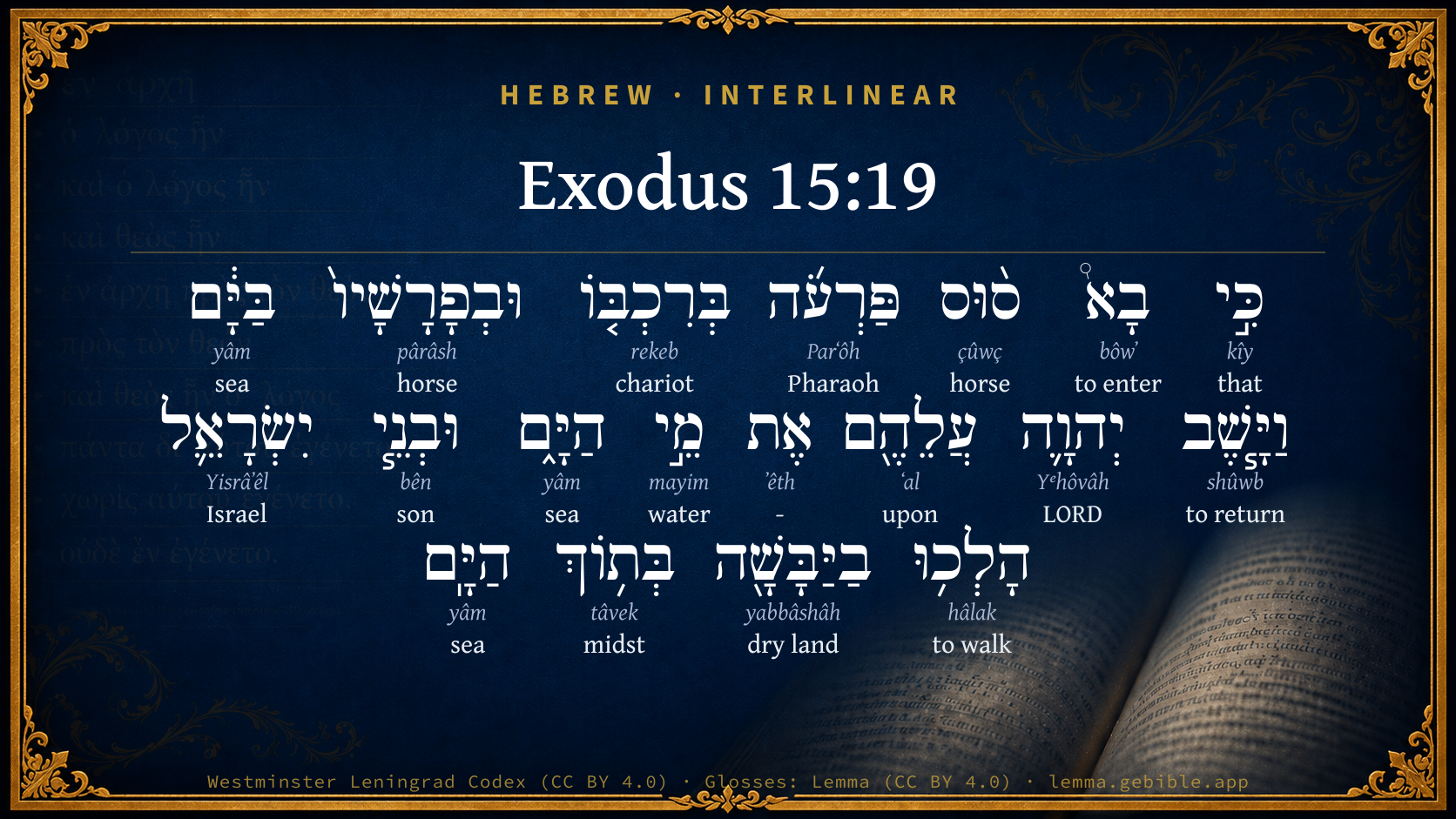
  1. כִּ֣י kîy H3588 “that” Conjunction
  2. בָא֩ bôwʼ H935 “to enter” Verb, Qal, Perfect, 3rd Person, Masculine, Singular
  3. ס֨וּס çûwç H5483 “horse of” Noun, Common, Masculine, Singular, Construct
  4. פַּרְעֹ֜ה Parʻôh H6547 “Pharaoh” Noun, Proper
  5. בְּרִכְבּ֤וֹ rekeb H7393 “in/at · chariot · his” Preposition + Noun, Common, Masculine, Singular, Construct + Suffix, Personal, 3rd Person, Masculine, Singular
  6. וּבְפָרָשָׁיו֙ pârâsh H6571 “and · in/at · horses · his” Conjunction + Preposition + Noun, Common, Masculine, Plural, Construct + Suffix, Personal, 3rd Person, Masculine, Singular
  7. בַּיָּ֔ם yâm H3220 “in/at the · sea” Preposition, Determined + Noun, Common, Masculine, Singular, Absolute
  8. וַיָּ֧שֶׁב shûwb H7725 “and · to return” Conjunction + Verb, Hiphil, Sequential Imperfect, 3rd Person, Masculine, Singular
  9. יְהוָ֛ה Yᵉhôvâh H3068 “LORD” Noun, Proper
  10. עֲלֵהֶ֖ם ʻal H5921 “upon · them” Preposition + Suffix, Personal, 3rd Person, Masculine, Plural
  11. אֶת ʼêth H853 “-” Particle, Direct Object
  12. מֵ֣י mayim H4325 “water(s) of” Noun, Common, Masculine, Plural, Construct
  13. הַיָּ֑ם yâm H3220 “the · sea” Particle, Definite Article + Noun, Common, Masculine, Singular, Absolute
  14. וּבְנֵ֧י bên H1121 “and · sons of” Conjunction + Noun, Common, Masculine, Plural, Construct
  15. יִשְׂרָאֵ֛ל Yisrâʼêl H3478 “Israel” Noun, Proper
  16. הָלְכ֥וּ hâlak H1980 “to walk” Verb, Qal, Perfect, 3rd Person, Common, Plural
  17. בְּת֥וֹךְ tâvek H8432 “in/at · midst of” Preposition + Noun, Common, Masculine, Singular, Construct
  18. הַיָּֽם yâm H3220 “the · sea” Particle, Definite Article + Noun, Common, Masculine, Singular, Absolute

About this verse

These counts appear in no published source. They are computed here, from the morphology-tagged text and Lemma’s own curated glosses. What Lemma adds →

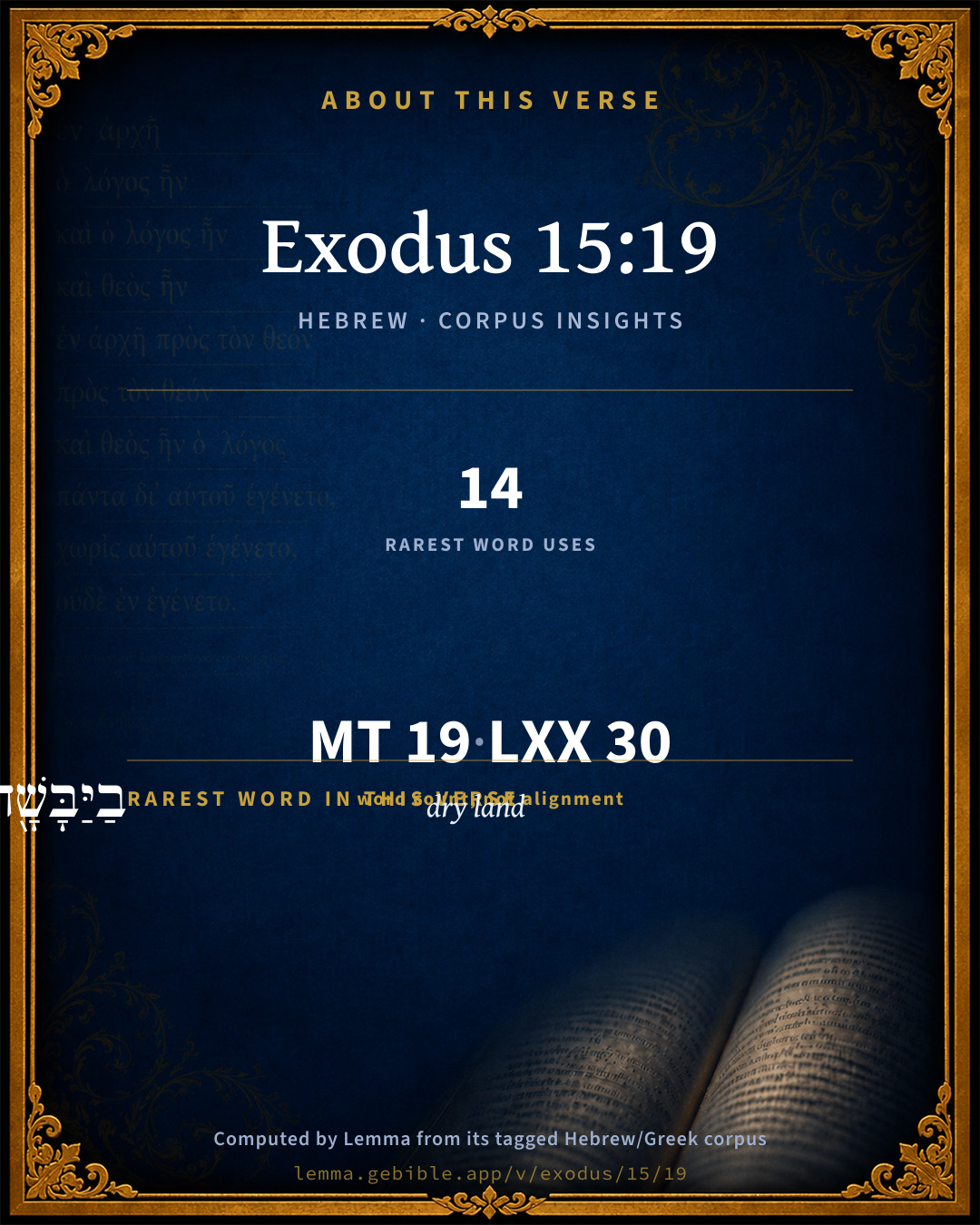
19
words
17
distinct lemmas
Pentateuch
section

Notable vocabulary

The rarest word here is בַיַּבָּשָׁ֖ה dry land H3004 — appearing just 14 times in the whole Hebrew Bible.

Shared distinctive vocabulary

בַיַּבָּשָׁ֖ה dry land H3004 occurs in 14 verses of the Hebrew Bible. Also found in:

Grammatical profile

  • 3 verbs
  • 13 nouns
  • 1 preposition
  • 1 conjunction
  • 1 particle

Verb forms

  • בָא֩ Qal · Perfect
  • וַיָּ֧שֶׁב Hiphil · Sequential Imperfect
  • הָלְכ֥וּ Qal · Perfect

Repetition

A word recurs within this verse — often emphatic in Hebrew:

  • בַּיָּ֔ם sea H3220 ×3

Hebrew & Septuagint length

In English translation the verse runs 43 words from the Hebrew and 41 from the Septuagint (LXX English) — closely comparable.

A rough comparison of the two English renderings, which tokenize alike — not a word-level alignment.

Word counts can differ between the Hebrew and the Greek without any difference in meaning — e.g. the Hebrew direct-object marker אֵת has no separate Greek word, and Greek often adds the article ὁ.

In the original languages it is 19 Hebrew tokens and 30 Greek tokens — but the two are counted differently (Hebrew bundles its prefixes and suffixes into one token; the Greek is in lemma form), so that isn’t a like-for-like length.

Cross-references

4

Topical passages linked to Exodus 15:19 in the Treasury of Scripture Knowledge — connected by theme and wording, ordered by reader-vote popularity; previews shown in the World English Bible.

  • Exodus 14:28–29 The waters returned, and covered the chariots and the horsemen, even all Pharaoh's army that went in after them into the sea. There remained not so much as one of them.
  • Hebrews 11:29 By faith, they passed through the Red sea as on dry land. When the Egyptians tried to do so, they were swallowed up.
  • Exodus 14:22–23 The children of Israel went into the midst of the sea on the dry ground, and the waters were a wall to them on their right hand, and on their left.
  • Proverbs 21:31 The horse is prepared for the day of battle; But victory is with Yahweh.

Cross-references courtesy of OpenBible.info (CC BY 4.0).

Hebrew and Greek witnesses Masoretic Hebrew ↔ Greek Septuagint

The same verse in the two great witnesses to the Old Testament, shown verse-for-verse.

These are two independent witnesses, not word-aligned to each other, and the Septuagint is shown in lemma (dictionary) form.

Hebrew Exodus 15:19 Masoretic · Westminster Leningrad Codex

כִּ֣י בָא֩ ס֨וּס פַּרְעֹ֜ה בְּרִכְבּ֤וֹ וּבְפָרָשָׁיו֙ בַּיָּ֔ם וַיָּ֧שֶׁב יְהוָ֛ה עֲלֵהֶ֖ם אֶת מֵ֣י הַיָּ֑ם וּבְנֵ֧י יִשְׂרָאֵ֛ל הָלְכ֥וּ בַיַּבָּשָׁ֖ה בְּת֥וֹךְ הַיָּֽם

For the horses of Pharaoh went in with his chariots and with his horsemen into the sea, and Yahweh brought back the waters of the sea on them; but the children of Israel walked on dry land in the midst of the sea.

World English Bible · Public Domain

Greek LXX Exodus 15:19 Septuagint · lemma form

ὅτι εἰςἔρχομαι ἵππος φαραώ σύν ἅρμα καί ἀναβάτης εἰς θάλασσα καί ἐπιἄγω ἐπί αὐτός κύριος ὁ ὕδωρ ὁ θάλασσα ὁ δέ υἱός ἰσραήλ πορεύομαι διά ξηρός ἐν μέσος ὁ θάλασσα

For the horse of Pharao went in with the chariots and horsemen into the sea, and the Lord brought upon them the water of the sea, but the children of Israel walked through dry land in the midst of the sea.

LXX2012 (modern English Septuagint) · Public Domain

Hebrew: Westminster Leningrad Codex (CC BY 4.0). Greek: Septuagint (public domain); English from LXX2012 (modern English Septuagint) (Public Domain). How the Septuagint differs from the Hebrew →

Targum (Aramaic paraphrase)

2

The Targum is the ancient Jewish Aramaic paraphrase of the Hebrew Scriptures — an interpretive translation, not the Hebrew text itself. Onkelos (literal) and Pseudo-Jonathan (expansive) render the Torah, and Jonathan the Prophets. Coverage is partial: where no permissively-licensed English translation exists for a verse, only the Aramaic is shown. This is verse-level text, not a word-by-word alignment to the Hebrew.

  1. Targum Onkelos Torah (Genesis–Deuteronomy)
    אֲרֵי עַלוּ סוּסָוַת פַּרְעֹה בִּרְתִכּוֹהִי וּבְפָרָשׁוֹהִי בְּיַמָא וַאֲתֵיב יְיָ עֲלֵיהוֹן יָת מֵי יַמָא וּבְנֵי יִשְׂרָאֵל הַלִיכוּ בְיַבֶּשְׁתָּא בְּגוֹ יַמָא:

    (no public-domain English translation for this verse)

    Targum Onkelos — Aramaic: “Onkelos Genesis” (public domain); “Onkelos Exodus” (public domain); “Onkelos Leviticus” (public domain); “Onkelos Numbers” (public domain); “Onkelos Deuteronomy” (public domain). English: “Sefaria Community Translation” (CC0 1.0 (public-domain dedication)); “J.W. Etheridge. The Targums of Onkelos and Jonathan Ben Uzziel on the Pentateuch. London: Longmans, Green, 1862” (public domain). Text via Sefaria.

  2. Targum Pseudo-Jonathan Torah (Genesis–Deuteronomy)
    אֲרוּם עָלוּ סוּסְוַות פַּרְעה בִּרְתִיכוֹי וּבְפָרָשׁוֹי בְּיַמָא וְחָזַר יְיָ עֲלֵיהוֹן יַת מוֹי דְיַמָּא וּבְנֵי יִשְרָאֵל הֲלִיכוּ בְּיַבֶּשְׁתָּא בְּגוֹ יַמָא וְתַמָּן סַלְקוּן עִינָוַון בְּסִימָן וְאִילָנֵי מֵיכְלָא וְיַרְקֵי וּמִגְדֵי בְּאַרְעִית יַמָא

    For Pharoh's horses with his chariots and horsemen went into the sea, and the Lord made the waters of the sea to return upon them; but the sons of Israel walked upon the land in the midst of the sea, and there did spring up sweet fountains and trees yielding food and verdure and ripe fruits, (even) on the ground of the sea.

    Targum Pseudo-Jonathan — Aramaic: “Targum Jonathan on Genesis” (public domain); “Targum Jonathan on Exodus” (public domain); “Targum Jonathan on Leviticus” (public domain); “Targum Jonathan on Numbers” (public domain); “Targum Jonathan on Deuteronomy” (public domain). English: “The Targum of Jonathan ben Uzziel, trans. J. W. Etheridge, London, 1862” (public domain). Text via Sefaria.

Commentary

Notes on Exodus 15:19 from classic Christian and Jewish commentators (each source and its license shown beneath its notes). The classic Christian expositions comment on the surrounding passage and are grouped to its opening verse, so a note may address several verses; the Jewish commentaries on the Tanakh (Rashi and others) are per-verse, so they appear only where the commentator wrote on this verse.

Lemma curates 59 commentaries, every one of them public domain or Creative Commons licensed, each selected and text-cleaned for this edition rather than reprinted as found. About our sources →

Trapp's Complete Commentary

John Trapp

Exo 15:19 For the horse of Pharaoh went in with his chariots and with his horsemen into the sea, and the LORD brought again the waters of the sea upon them; but the children of Israel went on dry [land] in the midst of the sea.

Ver. 19. For the horse of Pharaoh.] A good soul is altogether unsatisfiable in sanctifying God’s name, and setting forth his goodness. Should I do nothing else all the days of my life, said that martyr, yea, as long as the days of heaven shall last, but kneel on my knees and repeat David’s Psalms; yet should I fall infinitely short of what I owe to God. {a}

{a} Act. and Mon.

John Trapp, A Commentary or Exposition upon All the Books of the Old and New Testament (1647–1656) — public domain. Text from a community e-Sword module.

The Biblical Illustrator

Joseph S. Exell

Exo_15:19-21

With timbrels and with dances.

Song, timbrel, and dance

The monuments reproduce this scene in all its parts. Separate choirs of men and women are represented on them, singing in alternate responses; the timbrel, or tambourine, is represented as the instrument of the women, as the flute is that of the men; and the playing of the tambourine, unaccompanied, as here, by other instruments, is represented in connection with singing and the dance. Further, it appears from the monuments that music had eminently a religious destination in Egypt, that the timbrel was specially devoted to sacred uses, and that religious dances were performed in the worship of Osiris. (E. C. Wines, D. D.)

In the tombs at Thebes timbrels, like Miriams, round and square, are seen in the bands of the women; while pipes, trumpets, sistrums, drums, and guitars are there in great abundance and variety; and harps, not much unlike the modern instrument, with varying numbers of strings up to twenty-two. (S. C. Bartlett, D. D.)

Cheering effect of music

Whilst the Federal army lay before the city of Richmond, the regimental bands were silent. When they began to retreat to Malvern, the troops marched through the acres of ripe grain, cutting off the tops and gathering them into their haversacks, being out of rations, as well as lame and stiff from marching. Orders were here given for the bands to strike up playing, and the effect on the dispirited men was almost magical as the patriotic airs were played. They seemed to catch new hope and enthusiasm, and a cheer went up from each regiment.

Serving God with a cheerful spirit

When the poet Carpani inquired of his friend Haydn how it happened that his church music was always so cheerful, the great composer made a most beautiful reply. I cannot, said he, make it otherwise; I write according to the thoughts I feel. When I think upon God, my heart is so full of joy that the notes dance and leap, as it were, from my pen; and since God has given me a cheerful heart, it will be pardoned me that I serve Him with a cheerful spirit.

The Biblical Illustrator, edited by Joseph S. Exell (c. 1880s–1900s) — public domain. Text from a community e-Sword module.

Tyndale Open Study Notes

Tyndale Open Resources

15:19-21 Miriam led the women in praise. In many ancient societies, men and women performed ceremonies separately. Women had special roles in ritual praise and lamentation.

Tyndale Open Study Notes — © Tyndale Open Resources, licensed CC BY-SA 4.0. Text via the HelloAO Bible API.

Ellicott's Commentary for English Readers

(19) This verse is parenthetic. It forms no part of the “Song of Moses.” Originally, perhaps, when that song was a separate document, it was appended as an historical comment, showing the occasion on which the poem was composed. When the records of Moses were collected—either by himself, towards the close of his life, or by Joshua—the addition was kept, although it had become unnecessary for the original purpose. As it stands, it emphasises the great fact of Israel’s final deliverance—the nucleus around which Exodus gathers itself.

A Bible Commentary for English Readers, edited by Charles John Ellicott (1878–1897) — public domain. Text from a community e-Sword module.

The Cambridge Bible for Schools and Colleges

gen. ed. J. J. S. Perowne

19. Probably an addition by the compiler who united together JE and P, emphasizing once again, in words adapted from Exo_14:23; Exo_14:28-29 (P), the great deliverance which the poem celebrated.

brought again] brought back. Cf. on Exo_14:26.

and the children of Israel, &c.] verbatim as Exo_14:29 a.

dry land] better, dry ground, to agree with Exo_14:22; Exo_14:29 a.

The Cambridge Bible for Schools and Colleges (gen. ed. J. J. S. Perowne; Cambridge University Press, 1878–1918) — public domain. Text from a community e-Sword module.

John Gill's Exposition

And Miriam the prophetess, the sister of Aaron,.... The same, it is highly probable, that is called the sister of Moses, Exo 2:3, her name Miriam is the same as Mary with us, and signifies bitterness; and, as the Hebrews (x) observe, had it from the bitterness of the times, and the afflictions the Israelites endured and groaned under when she was born; which is a much more probable signification and reason of her name than what is given by others, that it is the same with Marjam, which signifies a drop of the sea; from whence, they fancy, came the story of Venus, and her name of Aphrodite, the froth of the sea: Miriam was a prophetess, and so called, not from this action of singing, here recorded of her, for so all the women that sung with her might be called prophetesses, though sometimes in Scripture prophesying intends singing; but rather from her having a gift of teaching and instructing, and even of foretelling things to come; for the Lord spoke by her as well as by Moses and Aaron, and she, with them, were the leaders of the people of Israel, sent to them of the Lord, see Num 12:2, she is particularly called the sister of Aaron, though she was likewise the sister of Moses; the reason is, that being older than Moses, she was Aaron's sister before his, and having lived all her days with Aaron almost, and very little with Moses, was best known by being the sister of Aaron; and it is possible she might be his own sister by father and mother's side, when Moses was by another woman; however, it is said of her, she

took a timbrel in her hand; and all the women went out after her with timbrels and with dances; timbrels were a sort of drums or tabrets, which being beat upon gave a musical sound, somewhat perhaps like our kettledrums; and though dances were sometimes used in religious exercises, yet the word may signify another kind of musical instruments, as "pipes" or "flutes" (y), as it is by some rendered; and by the Syriac and Arabic versions, "sistrums"; which were musical instruments much used by the Egyptians, and from whom the Israelitish women had these; and as they were going to keep a feast in the wilderness, they lent them to them, it is very probable, on that account; otherwise it is not easy to conceive what use the Israelites could have for them, and put them to during their hard bondage and sore affliction in Egypt: now with these they went out of the camp or tents into the open fields, or to the shore of the Red sea, and sung as Moses and the men of Israel did: to this the psalmist seems to refer in Psa 68:25.

(x) Seder Olam Rabba, c. 3. p. 9. Dibre Hayamim, fol. 2. 2. (y) "cum fistulis", Junius & Tremellius, Piscator; "cum tibiis", Drusius; so Ainsworth.

John Gill's Exposition of the Whole Bible (1746–1763) — public domain (CC PDM 1.0). Text via the HelloAO Bible API.

Albert Barnes' Notes on the Bible

For the horse ... - This verse does not belong to the hymn, but marks the transition from it to the narrative.

Albert Barnes' Notes on the Bible (1834–1885) — public domain. Text from a community e-Sword/MySword module.

Haydock's Catholic Bible Commentary

For, &c. He is not tired with repeating this wonderful judgment, which gave him reason to hope that God would complete his work; and at the same time, give a sanction to his mission. If the most potent of the monarchs of the earth could so little withstand his power, what had he to fear from a few jarring clans of barbarians and shepherds? (Haydock)

George Leo Haydock (1774–1849), Haydock's Catholic Family Bible and Commentary, 1859 edition — public domain. Excludes Psalms (Douay-Rheims chapter numbering differs from Protestant) and Deuterocanonical books (Catholic canon only).

Whedon's Commentary on the Bible

Daniel D. Whedon

19. This verse is not a part of the song, but repeats the incident that was its occasion.

Daniel D. Whedon (gen. ed.), Commentary on the Old and New Testaments (1874–1909) — public domain. Text from a community e-Sword module.

The Pulpit Commentary

Vers. 19-21. Sequel to the Song. The "sequel" treats of two quite separate masters.

1. It asserts, in verse 19, the historic groundwork of the song, reiterating ina condensed form the three principal facts of the presage already recorded in ch. 14.

1. Israel"s safe transit across the sea-bed;

2. the pursuit attempted by the Egyptian chariot-force; end

3. the return of the waters upon the pursuers by God"s providential action.

2. It relates, in verses 20 and 21, the part taken by Miriam in the recitationof the ode, which has been noticed in the "introduction" to the chapter.

The horse of Pharaoh, with his chariots, and with his horsemen. Rather, "with his chariots, and with his chariot men." Compare Exo_14:23. The Lord brought again the waters of the sea upon them. See Exo_14:26, Exo_14:27; and Exo_15:10. The waters did not merely return to their natural place when the east wind ceased to blow, but were "brought back" by miraculous power, and with abnormal rapidity.

The Pulpit Commentary (1880–1919), ed. H.D.M. Spence-Jones & Joseph S. Exell — public domain. Text from a community e-Sword module.

Kretzmann's Popular Commentary

Paul E. Kretzmann

The Song of Miriam

v. 19. For the horse of Pharaoh went in with his chariots and with his horsemen into the sea, the historian implying, at this point, that Pharaoh, riding forward at the head of his army, was destroyed with all his host, Psa 136:15, and the Lord brought again the waters of the sea upon them; but the children of Israel went on dry land in the midst of the sea, in the bed which the sea ordinarily filled.

v. 20. And Miriam, the prophetess, the sister of Aaron, who from now on takes her place at the side of Aaron under the leadership of Moses, although she was endowed with prophetic gifts, took a timbrel, a tambourine, in her hand; and all the women went out after her with timbrels and with dances, in a stately, solemn religious dance, with marching and singing in unison.

v. 21. And Miriam answered them, she and her company chanted their refrain at the end of every verse, or stanza, as sung by Moses and the children of Israel, Sing ye to the Lord, for He hath triumphed gloriously, He has exalted His majesty; the horse and his rider hath He thrown into the sea. Cf v. 1. All the people, men and women, were thus engaged in the hymn of praise and thanksgiving, took part in the festival in honor of Jehovah, a fine example to the believers of all times.

Paul E. Kretzmann, Popular Commentary of the Bible (1921–1924) — public domain. Text from a community e-Sword module.

unfoldingWord translationNotes

Door43 World Missions Community

Miriam ... Aaron

Miriam was the older sister of Moses and Aaron. (See: How to Translate Names)

tambourine

This is a musical instrument like a small drum that also has pieces of metal around the side that make a sound when shaken. (See: Translate Unknowns)

he has triumphed gloriously

It can be stated explicitly over whom Yahweh triumphed. See how you translated this in Exodus 15:1. AT: "he has achieved a glorious victory over the army of Egypt" (See: Assumed Knowledge and Implicit Information)

The horse and his rider he has thrown into the sea

Miriam sang about God causing the sea to cover and drown the horse and rider as if God had thrown them into the sea. See how you translated this in Exodus 15:1. AT: "He has made the horse and rider drown in the sea" (See: Metaphor)

translationWords

Pharaoh

horse

chariot

prophet

Aaron

glory

unfoldingWord translationNotes — © Distant Shores Media and the Door43 World Missions Community, licensed CC BY-SA 4.0. Source: git.door43.org/Door43/en_tn.

Rashi

Rabbi Shlomo Yitzchaki (Rashi)

כי בא סוס פרעה means WHEN [THE HORSES] CAME.

Rashi on the Tanakh — English translations: “The Judaica Press complete Tanach with Rashi, translated by A. J. Rosenberg” (CC BY 4.0); “Pentateuch with Rashi's commentary by M. Rosenbaum and A.M. Silbermann, 1929-1934” (public domain); “The Metsudah Tanach series, Lakewood, N.J” (CC BY 4.0); and “The Book of Joshua, Metsudah Publications, 1997” (CC BY 4.0). Text via Sefaria.

Ramban (Nachmanides)

Rabbi Moshe ben Nachman (Ramban / Nachmanides)

FOR THE HORSES OF PHARAOH WENT IN WITH HIS CHARIOTS AND WITH HIS HORSEMEN. Rabbi Abraham ibn Ezra said that this verse is also part of the Song, for Moses and the children of Israel were singing and saying: For the horses of Pharaoh went in with his chariots and with his horsemen into the sea, and the Eternal brought back the waters of the sea upon them while the children of Israel were walking on dry land in the midst of the sea, this being a miracle within a miracle. when the horses of Pharaoh went in, etc., He brought the waters upon them, and at the same time, the children of Israel walked on dry land.But this verse is not written in the style of the Song, nor is it in the style of prophecies! [Therefore, Ibn Ezra’s interpretation is not correct.] Instead, the verse is to be interpreted [as dating the Song]: Then sang Moses — when the horses of Pharaoh went in. Immediately on that day — not the following day or at some later time — [he sang this Song]. It may be that the sense thereof is as follows: Then Moses sang, when the horses of Pharaoh went into the sea and G-d brought back the waters of the sea upon them while the children of Israel were yet walking on dry land in the midst of it. Thus the verse relates that they said the Song while they were walking in the midst of the sea on dry land. Scripture further tells that it was then that Miriam the prophetess took the timbrel in hand and sang them the first verse of the Song that they, [i.e., the women], should sing after Moses and Israel.

Ramban (Nachmanides) on the Tanakh — English translation: “Commentary on the Torah by Ramban (Nachmanides). Translated and annotated by Charles B. Chavel. New York, Shilo Pub. House, 1971-1976” (CC BY 4.0). Text via Sefaria.

Lesson kit

Teaching starters — assembled from the data on this page, not authored interpretation. Every prompt links to the verse data it draws on. Edit before teaching.

Exodus, in the Pentateuch, opens this verse with 19 words (17 distinct Hebrew lemmas). Its most distinctive word is yabbâshâh (“dry land”). A historical commentator’s framing appears above. Read the whole chapter for the surrounding context.

Discussion questions

  1. How does “dry land” (yabbâshâh) shape what this verse is saying?
  2. Genesis 1:9 shares the word «dry land» with this verse. How do the two illuminate each other?
  3. “sea” occurs 3× in this one verse. What is the effect of the repetition?
  4. These translations render this verse differently; the difference is in the English rendering, not the original. What questions does that raise?
  5. The verb «בָא֩» is Qal Perfect. How does its form color the action?
  6. Reading how Trapp's Complete Commentary and The Biblical Illustrator read this verse, where do the two commentators agree and where do they part?

Things to notice

Reading settings

Reading text

Shown beneath each verse's original-language words.

Old Testament
Old Testament edition

Read the OT as the Masoretic Hebrew (MT) or the Greek Septuagint (LXX).

English shown for the Greek Septuagint (in the Hebrew ↔ Greek comparison).

Comparing translations? Open the Compare panel on any verse page to stack up to four side by side.