
Joshua 13:16

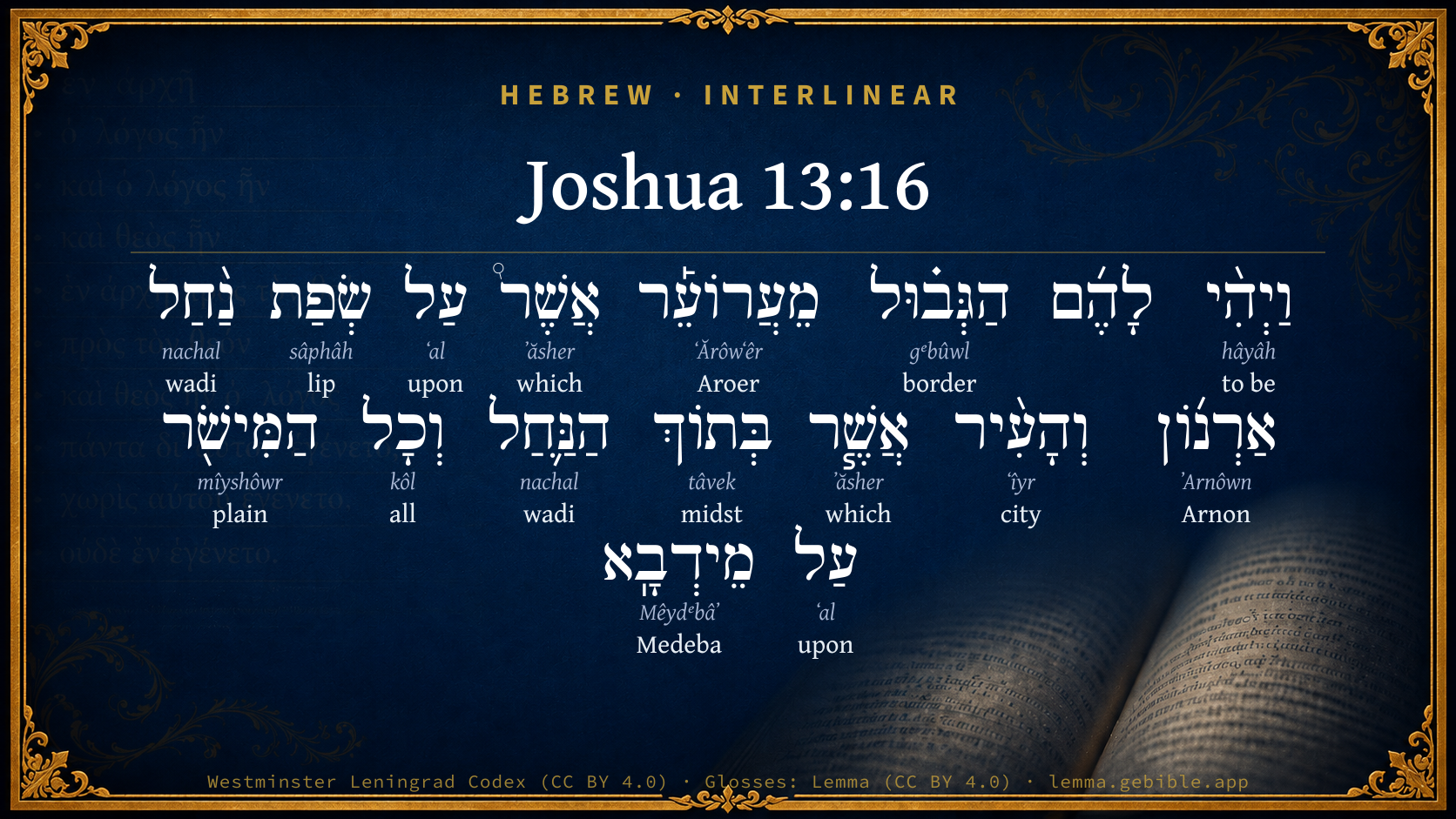
Hebrew (Westminster Leningrad Codex) Joshua 13:16 appears in the Hebrew Old Testament. The text above is from the Westminster Leningrad Codex. Each word links to its Strong’s number, a concise gloss, and parsing drawn from the Open Scriptures Hebrew Bible morphology. Click any word for its full Brown-Driver-Briggs (BDB) entry.
Download image
Cite this verse

Joshua 13:16 (World English Bible). Public Domain. Lemma interlinear Bible study tool, https://lemma.gebible.app/v/joshua/13/16.

Show BibTeX & RIS
BibTeX
RIS
English Translation
Their border was from Aroer, that is on the edge of the valley of the Arnon, and the city that is in the middle of the valley, and all the plain by Medeba;
World English Bible · Public Domain
Download a study sheet

One document with this verse’s original text, its word-by-word gloss line, the meaning frame, cross-references with their text, attributed commentary, and full source and license credits — printable, and it pastes into notes with its structure intact.

This verse Autodidact and up

Study sheet (.html) Plain text (.txt)

A passage Seminary Student

Up to 50 verses in one chapter. A passage sheet keeps up to 6 commentary sources and 12 cross-references per verse, in the order this page ranks them, and says so on the sheet whenever that leaves anything out. Ask for a single verse and you get the Autodidact verse sheet above.

Everything on this page stays free to read, with no account — the sheet is a download of what is already on screen, not access to it.

Want to remove ads? Support Godless Engineer
Compare translations 3

The same verse in 3 English versions, stacked beneath the original-language interlinear above. Click any original word for its lexicon entry.

Each is an independent rendering of the whole verse — the interlinear is not word-aligned to these translations.

Highlighted words mark where these versions differ — a whole-verse word diff, not a word-by-word alignment.

  • World English Bible Public Domain
    Their border was from Aroer, that is on the edge of the valley of the Arnon, and the city that is in the middle of the valley, and all the plain by Medeba;
  • King James Version Public Domain
    And their coast was from Aroer, that is on the bank of the river Arnon, and the city that is in the midst of the river, and all the plain by Medeba;
  • unfoldingWord Literal Text CC BY-SA 4.0
    And the border for them was from Aroer, which on the lip of the wadi of Arnon, and the city that in the middle of the wadi, and all of the plateau beside Medeba,

unfoldingWord Literal Text — © unfoldingWord, licensed CC BY-SA 4.0. Word-aligned USFM3 via Door43 (git.door43.org/unfoldingWord/en_ult).

Versions to compare (up to 4)

3 of 4 selected

Show all 18 translations

Every available English version of this verse, each an independent rendering of the whole verse.

  • World English Bible Public Domain
    Their border was from Aroer, that is on the edge of the valley of the Arnon, and the city that is in the middle of the valley, and all the plain by Medeba;
  • Berean Standard Bible Public Domain
    The territory from Aroer on the rim of the Arnon Valley, along with the city in the middle of the valley, to the whole plateau beyond Medeba,
  • Majority Standard Bible Public Domain
    The territory from Aroer on the rim of the Arnon Valley, along with the city in the middle of the valley, to the whole plateau beyond Medeba,
  • King James Version Public Domain
    And their coast was from Aroer, that is on the bank of the river Arnon, and the city that is in the midst of the river, and all the plain by Medeba;
  • American Standard Version (1901) Public Domain
    And their border was from Aroer, that is on the edge of the valley of the Arnon, and the city that is in the middle of the valley, and all the plain by Medeba;
  • Revised Version (1885) Public Domain
    And their border was from Aroer, that is on the edge of the valley of Arnon, and the city that is in the middle of the valley, and all the plain by Medeba;
  • Geneva Bible (1599) Public Domain
    And their coast was from Aroer, that is on the brinke of the riuer Arnon, and from the citie that is in the middes of the riuer, and all the plaine which is by Medeba:
  • Douay-Rheims (1899) Public Domain
    And their border was from Aroer, which is on the bank of the torrent Arnon, and in the midst of the valley of the same torrent: all the plain, that leadeth to Medaba,
  • Young's Literal Translation Public Domain
    and the border is to them from Aroer, which `is' on the edge of the brook Arnon, and the city which `is' in the midst of the brook, and all the plain by Medeba,
  • Literal Standard Version CC BY-SA 4.0
    and the border is to them from Aroer, which [is] on the edge of the Brook of Arnon, and the city which [is] in the midst of the brook, and all the plain by Medeba,
  • Unlocked Literal Bible CC BY-SA 4.0
    Their territory was from Aroer, on the edge of the Arnon River gorge, and the city that is in the middle of the valley, and all the plateau by Medeba.
  • unfoldingWord Literal Text CC BY-SA 4.0
    And the border for them was from Aroer, which on the lip of the wadi of Arnon, and the city that in the middle of the wadi, and all of the plateau beside Medeba,
  • Darby Bible Public Domain
    And their territory was from Aroer, which is on the bank of the river Arnon, and the city that is in the midst of the ravine, and all the plateau by Medeba;
  • World Messianic Bible Public Domain
    Their border was from Aroer, that is on the edge of the valley of the Arnon, and the city that is in the middle of the valley, and all the plain by Medeba;
  • Webster's Bible Public Domain
    And their border was from Aroer that is on the bank of the river Arnon, and the city that is in the midst of the river, and all the plain by Medeba;
  • Free Bible Version CC BY-SA 4.0
    Their territory stretched from Aroer on the edge of the Arnon valley, from the town in the middle of the valley, and all the plateau of Medeba;
  • Bible in Basic English Public Domain
    Their limit was from Aroer, on the edge of the valley of the Arnon, and the town in the middle of the valley, and all the table-land by Medeba;
  • JPS Tanakh (1917) Public Domain
    And their border was from Aroer, that is on the edge of the valley of Arnon, and the city that is in the middle of the valley, and all the table-land by Medeba;

Literal Standard Version (2020), Covenant Press — licensed CC BY-SA 4.0. Text via the HelloAO Bible API (eBible.org). Unlocked Literal Bible (unfoldingWord) — licensed CC BY-SA 4.0. Text via the HelloAO Bible API (eBible.org). unfoldingWord Literal Text — © unfoldingWord, licensed CC BY-SA 4.0. Word-aligned USFM3 via Door43 (git.door43.org/unfoldingWord/en_ult). Free Bible Version, Dr. Jonathan Gallagher — licensed CC BY-SA 4.0. Text via the HelloAO Bible API (eBible.org).

Word by word

More ways to search: Search by grammar → Find every occurrence → Compare this word →

Practice this passage: Drill this verse → Learn its vocabulary →

מֵידְבָֽא
Mêydᵉbâʼ
H4311
“Medeba”
Noun, Proper
Part of Speech
Noun
Type
Proper
Full BDB Definition

Origin: from H4325 and H1679

TWOT: None

Medeba = "water of rest" - a town in Moab assigned to Reuben and located 4 miles (6 kilometers) southwest of Heshbon; still extant
  1. וַיְהִ֨י hâyâh H1961 “and · to be” Conjunction + Verb, Qal, Sequential Imperfect, 3rd Person, Masculine, Singular
  2. הַגְּב֗וּל gᵉbûwl H1366 “the · border” Particle, Definite Article + Noun, Common, Masculine, Singular, Absolute
  3. מֵעֲרוֹעֵ֡ר ʻĂrôwʻêr H6177 “from · Aroer” Preposition + Noun, Proper
  4. אֲשֶׁר֩ ʼăsher H834 “which” Particle, Relative
  5. עַל ʻal H5921 “upon” Preposition
  6. שְׂפַת sâphâh H8193 “lip of” Noun, Common, Feminine, Singular, Construct
  7. נַ֨חַל nachal H5158 “wadi of” Noun, Common, Masculine, Singular, Construct
  8. אַרְנ֜וֹן ʼArnôwn H769 “Arnon” Noun, Proper
  9. וְהָעִ֨יר ʻîyr H5892 “and · the · city” Conjunction + Particle, Definite Article + Noun, Common, Feminine, Singular, Absolute
  10. אֲשֶׁ֧ר ʼăsher H834 “which” Particle, Relative
  11. בְּתוֹךְ tâvek H8432 “in/at · midst of” Preposition + Noun, Common, Masculine, Singular, Construct
  12. הַנַּ֛חַל nachal H5158 “the · wadi” Particle, Definite Article + Noun, Common, Masculine, Singular, Absolute
  13. וְכָל kôl H3605 “and · all of” Conjunction + Noun, Common, Masculine, Singular, Construct
  14. הַמִּישֹׁ֖ר mîyshôwr H4334 “the · plain” Particle, Definite Article + Noun, Common, Masculine, Singular, Absolute
  15. עַל ʻal H5921 “upon” Preposition

About this verse

These counts appear in no published source. They are computed here, from the morphology-tagged text and Lemma’s own curated glosses. What Lemma adds →

17
words
13
distinct lemmas
Historical
section

Notable vocabulary

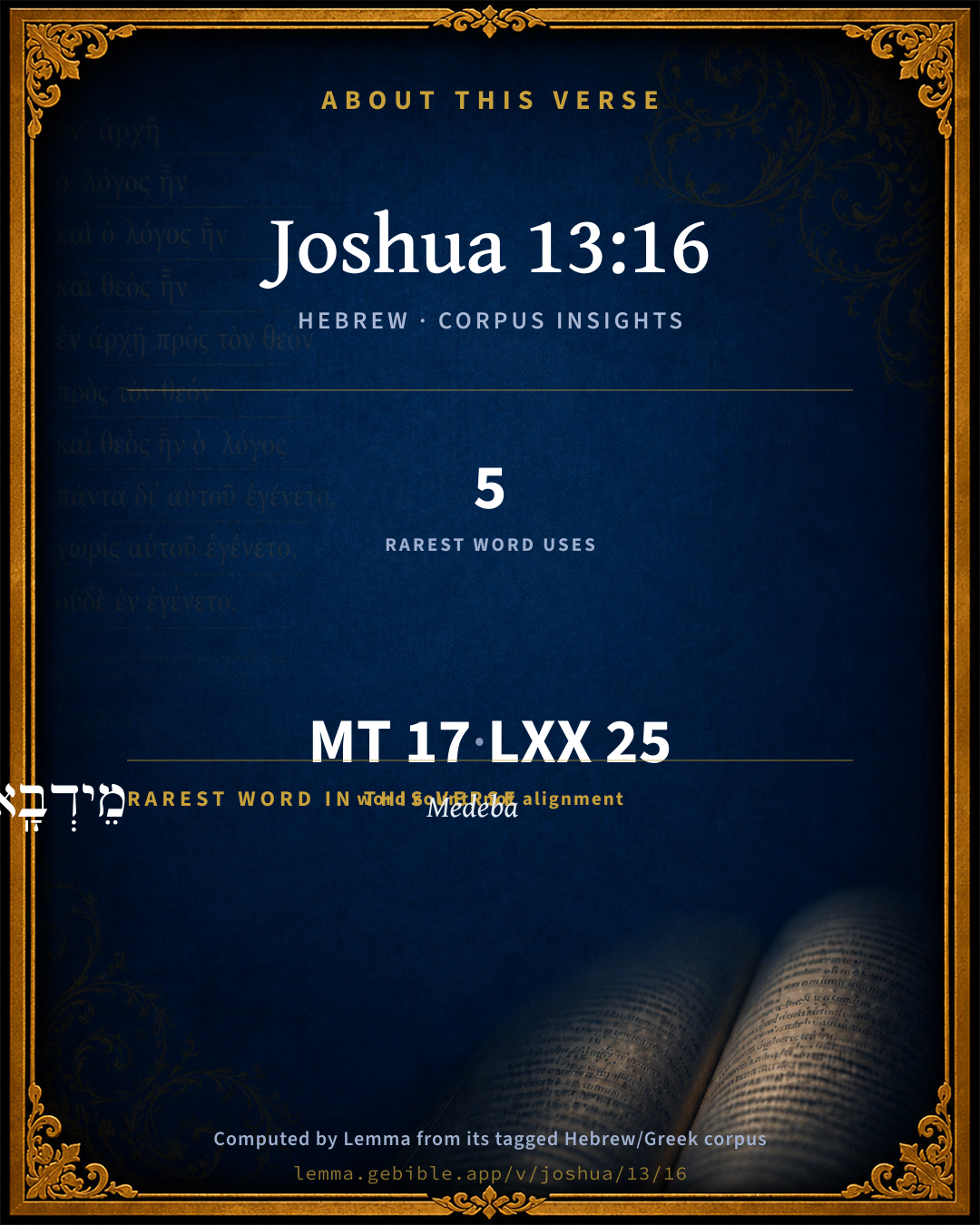
The rarest word here is מֵידְבָֽא Medeba H4311 — appearing just 5 times in the whole Hebrew Bible.

Shared distinctive vocabulary

מֵידְבָֽא Medeba H4311 occurs in 5 verses of the Hebrew Bible. Also found in:

Grammatical profile

  • 1 verb
  • 11 nouns
  • 3 prepositions
  • 2 particles

Verb forms

  • וַיְהִ֨י Qal · Sequential Imperfect

Repetition

Words recur within this verse — often emphatic in Hebrew:

  • עַל upon H5921 ×2
  • נַ֨חַל wadi H5158 ×2
  • אֲשֶׁר֩ which H834 ×2

Hebrew & Septuagint length

In English translation the verse runs 33 words from the Hebrew and 28 from the Septuagint (LXX English) — closely comparable.

A rough comparison of the two English renderings, which tokenize alike — not a word-level alignment.

Word counts can differ between the Hebrew and the Greek without any difference in meaning — e.g. the Hebrew direct-object marker אֵת has no separate Greek word, and Greek often adds the article ὁ.

In the original languages it is 17 Hebrew tokens and 25 Greek tokens — but the two are counted differently (Hebrew bundles its prefixes and suffixes into one token; the Greek is in lemma form), so that isn’t a like-for-like length.

Cross-references

9

Topical passages linked to Joshua 13:16 in the Treasury of Scripture Knowledge — connected by theme and wording, ordered by reader-vote popularity; previews shown in the World English Bible.

  • Joshua 13:9 from Aroer, that is on the edge of the valley of the Arnon, and the city that is in the middle of the valley, and all the plain of Medeba to Dibon;
  • Joshua 12:2 Sihon king of the Amorites, who lived in Heshbon, and ruled from Aroer, which is on the edge of the valley of the Arnon, and [the city that is in] the middle of the valley, and half Gilead, even to the river Jabbok, the border of the children of Ammon;
  • Numbers 21:28–30 For a fire is gone out of Heshbon, A flame from the city of Sihon: It has devoured Ar of Moab, The lords of the high places of the Arnon.
  • Numbers 32:33–38 Moses gave to them, even to the children of Gad, and to the children of Reuben, and to the half-tribe of Manasseh the son of Joseph, the kingdom of Sihon king of the Amorites, and the kingdom of Og king of Bashan, the land, according to the cities of it with [their] borders, even the cities of the land round about.
  • Deuteronomy 3:12 This land we took in possession at that time: from Aroer, which is by the valley of the Arnon, and half the hill-country of Gilead, and the cities of it, gave I to the Reubenites and to the Gadites:
  • Isaiah 15:1–2 The burden of Moab. For in a night Ar of Moab is laid waste, [and] brought to nothing; for in a night Kir of Moab is laid waste, [and] brought to nothing.
  • Isaiah 15:4 Heshbon cries out, and Elealeh; their voice is heard even to Jahaz: therefore the armed men of Moab cry aloud; his soul trembles within him.
  • Isaiah 16:7–9 Therefore shall Moab wail for Moab, everyone shall wail: for the raisin-cakes of Kir Hareseth shall you mourn, utterly stricken.
  • Jeremiah 48:21–24 Judgment is come on the plain country, on Holon, and on Jahzah, and on Mephaath,

Cross-references courtesy of OpenBible.info (CC BY 4.0).

Hebrew and Greek witnesses Masoretic Hebrew ↔ Greek Septuagint

The same verse in the two great witnesses to the Old Testament, shown verse-for-verse.

These are two independent witnesses, not word-aligned to each other, and the Septuagint is shown in lemma (dictionary) form.

Hebrew Joshua 13:16 Masoretic · Westminster Leningrad Codex

וַיְהִ֨י לָהֶ֜ם הַגְּב֗וּל מֵעֲרוֹעֵ֡ר אֲשֶׁר֩ עַל שְׂפַת נַ֨חַל אַרְנ֜וֹן וְהָעִ֨יר אֲשֶׁ֧ר בְּתוֹךְ הַנַּ֛חַל וְכָל הַמִּישֹׁ֖ר עַל מֵידְבָֽא

Their border was from Aroer, that is on the edge of the valley of the Arnon, and the city that is in the middle of the valley, and all the plain by Medeba;

World English Bible · Public Domain

Greek LXX Joshua 13:16 Septuagint · lemma form

καί γίγνομαι αὐτός ὁ ὅριον ἀπό αροηρ ὅς εἰμί κατά πρόσωπον φάραγξ αρνων καί ὁ πόλις ὁ ἐν ὁ φάραγξ αρνων καί πᾶς ὁ μισωρ

And their borders were from Aroer, which is opposite the brook of Arnon, and theirs is the city that is in the valley of Arnon; and all Misor,

LXX2012 (modern English Septuagint) · Public Domain

Hebrew: Westminster Leningrad Codex (CC BY 4.0). Greek: Septuagint (public domain); English from LXX2012 (modern English Septuagint) (Public Domain). How the Septuagint differs from the Hebrew →

Targum (Aramaic paraphrase)

1

The Targum is the ancient Jewish Aramaic paraphrase of the Hebrew Scriptures — an interpretive translation, not the Hebrew text itself. Onkelos (literal) and Pseudo-Jonathan (expansive) render the Torah, and Jonathan the Prophets. Coverage is partial: where no permissively-licensed English translation exists for a verse, only the Aramaic is shown. This is verse-level text, not a word-by-word alignment to the Hebrew.

  1. Targum Jonathan Prophets (Joshua–Malachi)
    וַהֲוָה לְהוֹן תְּחוּמָא מֵעֲרוֹעֵר דִי עַל כֵּיף נַחֲלָא דְאַרְנוֹן וְקַרְתָּא דִי בְגוֹ נַחֲלָא וְכָל מֵישְׁרָא עַד מֵידְבָא:

    (no public-domain English translation for this verse)

    Targum Jonathan — Aramaic: “Mikraot Gedolot” (public domain). English: “Sefaria Community Translation” (CC0 1.0 (public-domain dedication)); “London "Chaldee Paraphrase," 1871” (public domain). Text via Sefaria.

Commentary

Notes on Joshua 13:16 from classic Christian and Jewish commentators (each source and its license shown beneath its notes). The classic Christian expositions comment on the surrounding passage and are grouped to its opening verse, so a note may address several verses; the Jewish commentaries on the Tanakh (Rashi and others) are per-verse, so they appear only where the commentator wrote on this verse.

Lemma curates 59 commentaries, every one of them public domain or Creative Commons licensed, each selected and text-cleaned for this edition rather than reprinted as found. About our sources →

Trapp's Complete Commentary

John Trapp

Jos 13:16 And their coast was from Aroer, that [is] on the bank of the river Arnon, and the city that [is] in the midst of the river, and all the plain by Medeba;

Ver. 16. And the city that is in the midst.] See Jos 13:9.

John Trapp, A Commentary or Exposition upon All the Books of the Old and New Testament (1647–1656) — public domain. Text from a community e-Sword module.

The Cambridge Bible for Schools and Colleges

gen. ed. J. J. S. Perowne

16. their coast] Observe the use of the word “coast” here, without any allusion to the seaboard. The word comes from the Latin costa = “a rib,” “side,” through the Fr. “coste.” Hence it = “a border” generally, though now applied to the sea-coast only. Comp. “Bethlehem and in all the coasts thereof” (Mat_2:16); “the coasts of Judæa” (Mat_19:1); the coasts of Gadara (Mar_5:17); “the coasts” of Antioch in Pisidia (Act_13:50). The portion of country this tribe selected, under its modern name of the Belka, is still esteemed beyond all others by the Arab sheepmasters. It was the southernmost and smallest portion of the district east of the Jordan.

from Aroer] See above, ch. Jos_12:2; all the plain by Medeba = the plateau east of Abarim or mount Pisgah. See above, Jos_12:3.

the city that is in the midst] = Ar of Moab, as above, Jos_13:9.

The Cambridge Bible for Schools and Colleges (gen. ed. J. J. S. Perowne; Cambridge University Press, 1878–1918) — public domain. Text from a community e-Sword module.

John Gill's Exposition

Heshbon, and all her cities that are in the plain,.... Which was by Medeba, and reached to Dibon:

Dibon, and Bamothbaal, and Bethbaalmeon; Dibon was rebuilt by Gad, though it belonged to Reuben, and perhaps was inhabited by both, being on the borders of each; and Bamothbaal signifies the high places of Baal; see Num 22:41; perhaps this is the same with Bamoth in the valley, Num 21:20; and Bethbaalmeon is the same with Baalmeon in Num 32:38; where it is highly probable was a temple of Baal, since both "beth" signifies an house, and "meon" an habitation.

John Gill's Exposition of the Whole Bible (1746–1763) — public domain (CC PDM 1.0). Text via the HelloAO Bible API.

Matthew Poole's English Annotations

The city that is in the midst of the river; of which see Deu 3:16; Jos 12:2.

Matthew Poole's English Annotations on the Holy Bible (1683–1685) — public domain. Text from a community e-Sword/MySword module.

Whedon's Commentary on the Bible

Daniel D. Whedon

16. Aroer — A city on the northern bank of the river Arnon, and on the southern border of the territory conquered from Sihon, king of the Amorites. Compare Num_21:26. Its ruins, called Araayr, were discovered by Burckhardt on the summit of a lofty wall of rock overlooking the ancient Arnon. It is to be distinguished from the Aroer before Rabbah (Jos_13:25) and the Aroer in the south of Judah. 1Sa_30:28. The city that is in the midst of the river is a subject of dispute. Some think it is the city Aroer itself. Others conjecture that Aroer consisted of two parts, or an upper and lower city, one on the high bank of the river, and the other in the valley below, where it may have been surrounded by the waters of the stream. Others think it was a city at the junction of the Arnon and one of its tributaries, where Burckhardt saw a hill with ruins on it. Keil thinks that it was Ar of Moab, and at that junction Ar Moab is located on Menke’s map.

Plain by Medeba — “The whole plain of Medeba was occupied by the Reubenites; but the city itself was, perhaps, strongly fortified, and suffered to remain, like many in western Palestine, in the hands of its old inhabitants. Its ruins still exist, and bear their old name under the Arabic form Madeba. They lie about four miles southeast of Heshbon, with which they are connected by an ancient paved road. The city occupied a low hill, a mile and a half in circumference. The whole site is covered with ruins; not a solitary building remains standing. The plain around it, though now desolate, is fertile, and thickly dotted with ancient cities.” — J.L. Porter.

Daniel D. Whedon (gen. ed.), Commentary on the Old and New Testaments (1874–1909) — public domain. Text from a community e-Sword module.

Lesson kit

Teaching starters — assembled from the data on this page, not authored interpretation. Every prompt links to the verse data it draws on. Edit before teaching.

Joshua, in the Historical, opens this verse with 17 words (13 distinct Hebrew lemmas). Its most distinctive word is Mêydᵉbâʼ (“Medeba”). A historical commentator’s framing appears above. Read the whole chapter for the surrounding context.

Discussion questions

  1. How does “Medeba” (Mêydᵉbâʼ) shape what this verse is saying?
  2. How does Numbers 21:30, which shares the word «Medeba», read alongside this verse?
  3. What does the repetition of “upon” (2× in this one verse) do in this verse?
  4. These translations render this verse differently. What is at stake in choosing one wording over another?
  5. «וַיְהִ֨י» is a Qal Sequential Imperfect verb. How does that grammatical form shape the action described?
  6. Compare how Trapp's Complete Commentary and The Cambridge Bible for Schools and Colleges read this verse. Where do they agree or differ?

Things to notice

Reading settings

Reading text

Shown beneath each verse's original-language words.

Old Testament
Old Testament edition

Read the OT as the Masoretic Hebrew (MT) or the Greek Septuagint (LXX).

English shown for the Greek Septuagint (in the Hebrew ↔ Greek comparison).

Comparing translations? Open the Compare panel on any verse page to stack up to four side by side.