
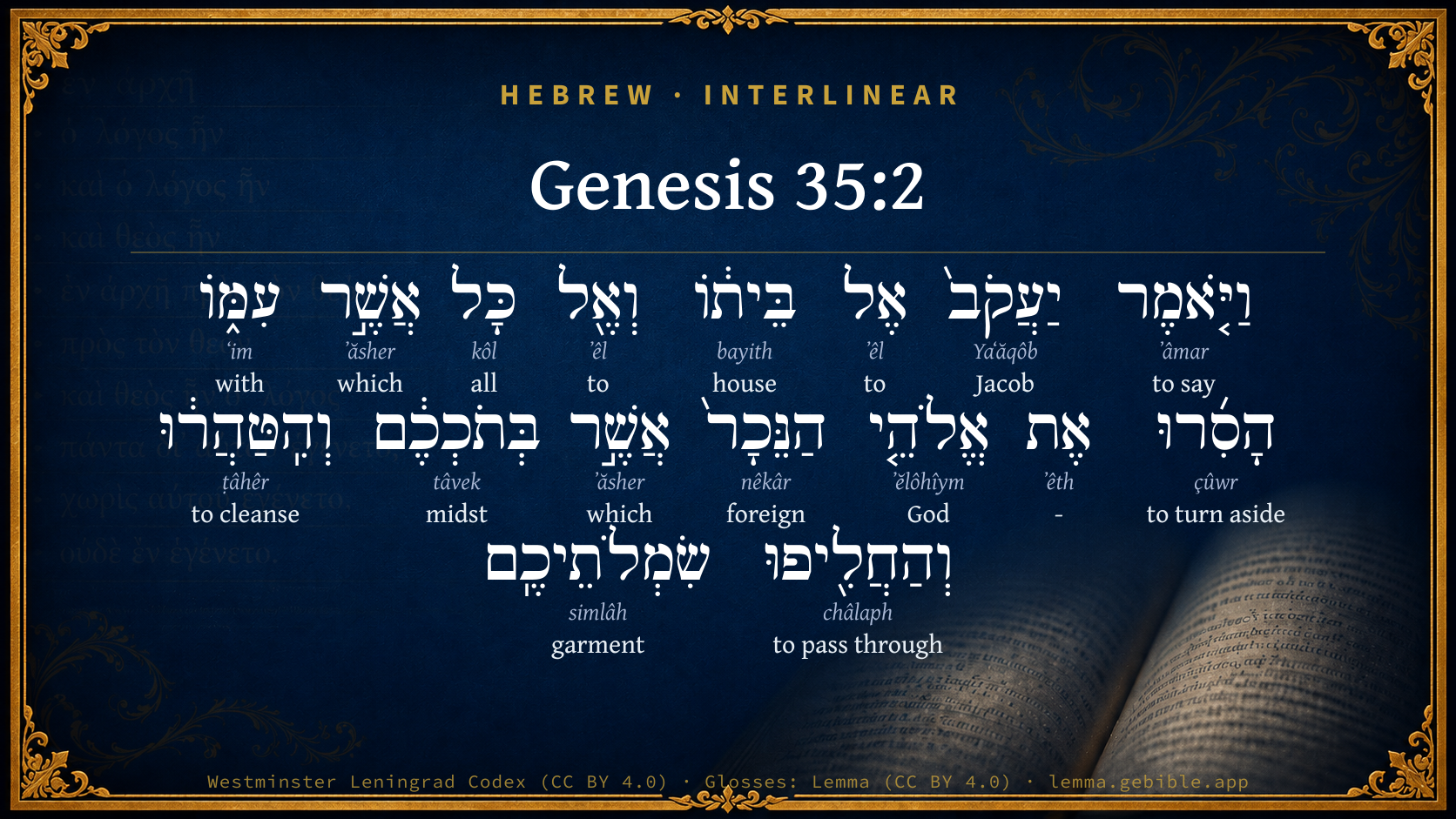
Genesis 35:2

Hebrew (Westminster Leningrad Codex) Genesis 35:2 appears in the Hebrew Old Testament. The text above is from the Westminster Leningrad Codex. Each word links to its Strong’s number, a concise gloss, and parsing drawn from the Open Scriptures Hebrew Bible morphology. Click any word for its full Brown-Driver-Briggs (BDB) entry.
Download image
Cite this verse

Genesis 35:2 (World English Bible). Public Domain. Lemma interlinear Bible study tool, https://lemma.gebible.app/v/genesis/35/2.

Show BibTeX & RIS
BibTeX
RIS
English Translation
Then Jacob said to his household, and to all who were with him, "Put away the foreign gods that are among you, purify yourselves, change your garments.
World English Bible · Public Domain
Highlights
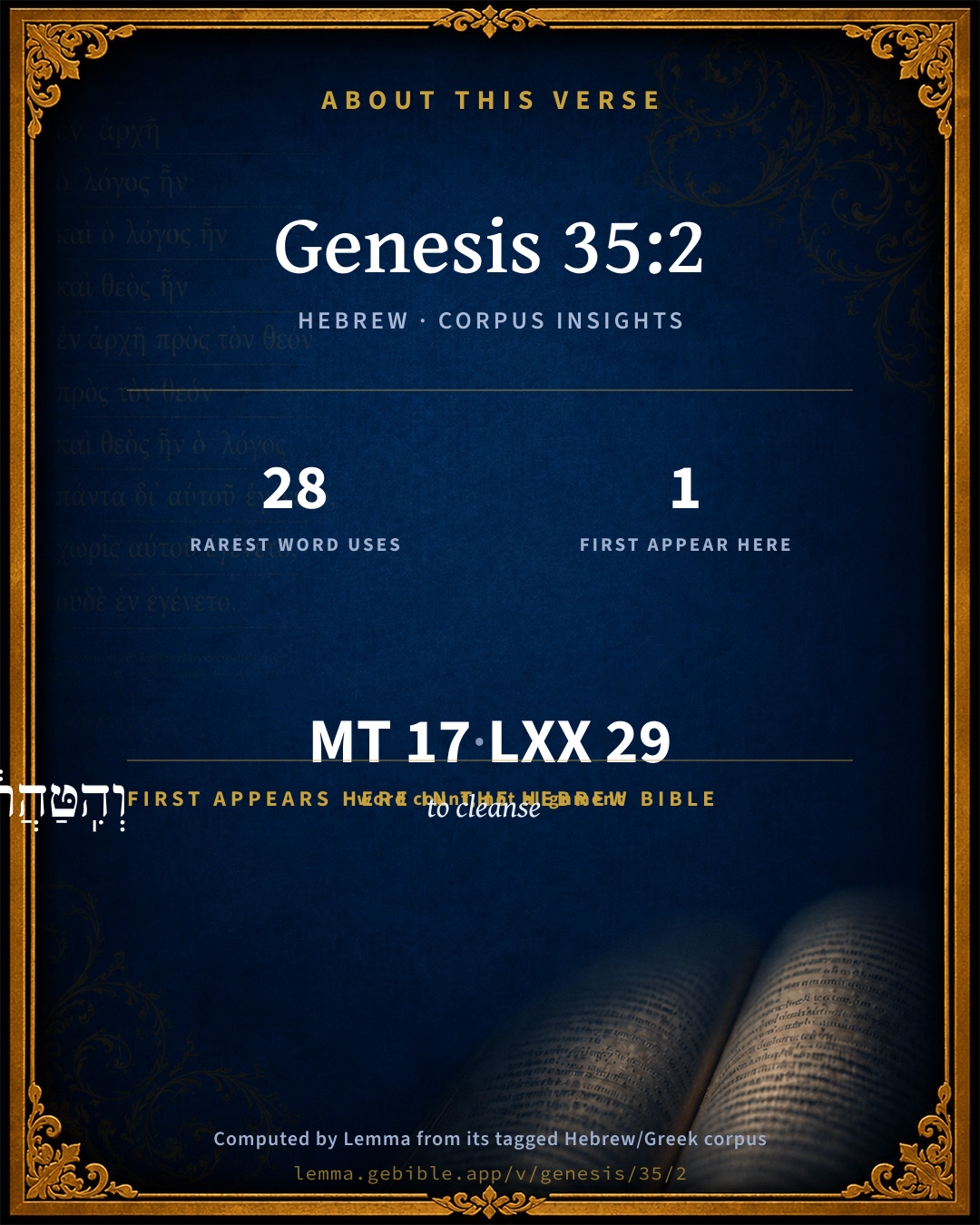
  • 1 first appearance in the Hebrew Bible
Full analysis ↓
Download a study sheet

One document with this verse’s original text, its word-by-word gloss line, the meaning frame, cross-references with their text, attributed commentary, and full source and license credits — printable, and it pastes into notes with its structure intact.

This verse Autodidact and up

Study sheet (.html) Plain text (.txt)

A passage Seminary Student

Up to 50 verses in one chapter. A passage sheet keeps up to 6 commentary sources and 12 cross-references per verse, in the order this page ranks them, and says so on the sheet whenever that leaves anything out. Ask for a single verse and you get the Autodidact verse sheet above.

Everything on this page stays free to read, with no account — the sheet is a download of what is already on screen, not access to it.

Want to remove ads? Support Godless Engineer
Compare translations 3

The same verse in 3 English versions, stacked beneath the original-language interlinear above. Click any original word for its lexicon entry.

Each is an independent rendering of the whole verse — the interlinear is not word-aligned to these translations.

Highlighted words mark where these versions differ — a whole-verse word diff, not a word-by-word alignment.

  • World English Bible Public Domain
    Then Jacob said to his household, and to all who were with him, "Put away the foreign gods that are among you, purify yourselves, change your garments.
  • King James Version Public Domain
    Then Jacob said unto his household, and to all that were with him, Put away the strange gods that are among you, and be clean, and change your garments:
  • unfoldingWord Literal Text CC BY-SA 4.0
    So Jacob said to his household and to all who with him, “Remove the foreign gods that among you, and purify yourselves and change your clothes.

unfoldingWord Literal Text — © unfoldingWord, licensed CC BY-SA 4.0. Word-aligned USFM3 via Door43 (git.door43.org/unfoldingWord/en_ult).

Versions to compare (up to 4)

3 of 4 selected

Show all 18 translations

Every available English version of this verse, each an independent rendering of the whole verse.

  • World English Bible Public Domain
    Then Jacob said to his household, and to all who were with him, "Put away the foreign gods that are among you, purify yourselves, change your garments.
  • Berean Standard Bible Public Domain
    So Jacob told his household and all who were with him, “Get rid of the foreign gods that are among you. Purify yourselves and change your garments.
  • Majority Standard Bible Public Domain
    So Jacob told his household and all who were with him, “Get rid of the foreign gods that are among you. Purify yourselves and change your garments.
  • King James Version Public Domain
    Then Jacob said unto his household, and to all that were with him, Put away the strange gods that are among you, and be clean, and change your garments:
  • American Standard Version (1901) Public Domain
    Then Jacob said unto his household, and to all that were with him, Put away the foreign gods that are among you, and purify yourselves, and change your garments:
  • Revised Version (1885) Public Domain
    Then Jacob said unto his household, and to all that were with him, Put away the strange gods that are among you, and purify yourselves, and change your garments:
  • Geneva Bible (1599) Public Domain
    Then saide Iaakob vnto his houshold and to all that were with him, Put away the strange gods that are among you, and clense your selues, and change your garments:
  • Douay-Rheims (1899) Public Domain
    And Jacob having called together all his household, said: Cast away the strange gods that are among you, and be cleansed and change your garments.
  • Young's Literal Translation Public Domain
    And Jacob saith unto his household, and unto all who `are' with him, `Turn aside the gods of the stranger which `are' in your midst, and cleanse yourselves, and change your garments;
  • Literal Standard Version CC BY-SA 4.0
    And Jacob says to his household, and to all who [are] with him, “Turn aside the gods of the stranger which [are] in your midst, and cleanse yourselves, and change your garments;
  • Unlocked Literal Bible CC BY-SA 4.0
    Then Jacob said to his household and to all who were with him, “Put away the foreign gods that are among you, purify yourselves, and change your clothes.
  • unfoldingWord Literal Text CC BY-SA 4.0
    So Jacob said to his household and to all who with him, “Remove the foreign gods that among you, and purify yourselves and change your clothes.
  • Darby Bible Public Domain
    And Jacob said to his household, and to all that were with him, Put away the strange gods that are among you, and cleanse yourselves, and change your garments;
  • World Messianic Bible Public Domain
    Then Jacob said to his household, and to all who were with him, “Put away the foreign gods that are among you, purify yourselves, and change your garments.
  • Webster's Bible Public Domain
    Then Jacob said to his household, and to all that were with him, Put away the strange gods that are among you, and be clean, and change your garments:
  • Free Bible Version CC BY-SA 4.0
    So Jacob told his family and everyone who was with him, “Get rid of the pagan idols you have with you. Purify yourselves and change your clothes.
  • Bible in Basic English Public Domain
    Then Jacob said to all his people, Put away the strange gods which are among you, and make yourselves clean, and put on a change of clothing:
  • JPS Tanakh (1917) Public Domain
    Then Jacob said unto his household, and to all that were with him: 'Put away the strange gods that are among you, and purify yourselves, and change your garments;

Literal Standard Version (2020), Covenant Press — licensed CC BY-SA 4.0. Text via the HelloAO Bible API (eBible.org). Unlocked Literal Bible (unfoldingWord) — licensed CC BY-SA 4.0. Text via the HelloAO Bible API (eBible.org). unfoldingWord Literal Text — © unfoldingWord, licensed CC BY-SA 4.0. Word-aligned USFM3 via Door43 (git.door43.org/unfoldingWord/en_ult). Free Bible Version, Dr. Jonathan Gallagher — licensed CC BY-SA 4.0. Text via the HelloAO Bible API (eBible.org).

Word by word

More ways to search: Search by grammar → Find every occurrence → Compare this word →

Practice this passage: Drill this verse → Learn its vocabulary →

וְהַחֲלִ֖יפוּ
châlaph
H2498
“and · pass through”
Conjunction + Verb, Hiphil, Imperative, 2nd Person, Masculine, Plural
Part of Speech
Conjunction + Verb
Stem
Hiphil
Form
Imperative
Person
2nd Person
Gender
Masculine
Number
Plural
Full BDB Definition

Origin: a primitive root

TWOT: 666

to pass on or away, pass through, pass by, go through, grow up, change, to go on from - (Qal) - to pass on quickly - to pass away (vanish) - to come on anew, sprout again (of grass) - to pass through - to overstep, transgress - (Piel) to cause to pass, change - (Hiphil) - to change, substitute, alter, change for better, renew - to show newness (of tree)
  1. וַיֹּ֤אמֶר ʼâmar H559 “and · to say” Conjunction + Verb, Qal, Sequential Imperfect, 3rd Person, Masculine, Singular
  2. יַעֲקֹב֙ Yaʻăqôb H3290 “Jacob” Noun, Proper
  3. אֶל ʼêl H413 “to” Preposition
  4. בֵּית֔וֹ bayith H1004 “house · his” Noun, Common, Masculine, Singular, Construct + Suffix, Personal, 3rd Person, Masculine, Singular
  5. וְאֶ֖ל ʼêl H413 “and · to” Conjunction + Preposition
  6. כָּל kôl H3605 “all of” Noun, Common, Masculine, Singular, Construct
  7. אֲשֶׁ֣ר ʼăsher H834 “which” Particle, Relative
  8. עִמּ֑וֹ ʻim H5973 “with · him” Preposition + Suffix, Personal, 3rd Person, Masculine, Singular
  9. הָסִ֜רוּ çûwr H5493 “turn aside” Verb, Hiphil, Imperative, 2nd Person, Masculine, Plural
  10. אֶת ʼêth H853 “-” Particle, Direct Object
  11. אֱלֹהֵ֤י ʼĕlôhîym H430 “God(s) of” Noun, Common, Masculine, Plural, Construct
  12. הַנֵּכָר֙ nêkâr H5236 “the · foreign” Particle, Definite Article + Noun, Common, Masculine, Singular, Absolute
  13. אֲשֶׁ֣ר ʼăsher H834 “which” Particle, Relative
  14. בְּתֹכְכֶ֔ם tâvek H8432 “in/at · midst · your” Preposition + Noun, Common, Masculine, Singular, Construct + Suffix, Personal, 2nd Person, Masculine, Plural
  15. וְהִֽטַּהֲר֔וּ ṭâhêr H2891 “and · cleanse” Conjunction + Verb, Hithpael, Imperative, 2nd Person, Masculine, Plural
  16. שִׂמְלֹתֵיכֶֽם simlâh H8071 “garments · your” Noun, Common, Feminine, Plural, Construct + Suffix, Personal, 2nd Person, Masculine, Plural

About this verse

These counts appear in no published source. They are computed here, from the morphology-tagged text and Lemma’s own curated glosses. What Lemma adds →

17
words
15
distinct lemmas
Pentateuch
section

First appearance in Scripture

This word makes its first canonical appearance in the Hebrew Bible here:

  • וְהִֽטַּהֲר֔וּ to cleanse H2891

Shared distinctive vocabulary

וְהַחֲלִ֖יפוּ to pass through H2498 occurs in 27 verses of the Hebrew Bible. Also found in:

Grammatical profile

  • 4 verbs
  • 7 nouns
  • 3 prepositions
  • 3 particles

Verb forms

  • וַיֹּ֤אמֶר Qal · Sequential Imperfect
  • הָסִ֜רוּ Hiphil · Imperative
  • וְהִֽטַּהֲר֔וּ Hithpael · Imperative
  • וְהַחֲלִ֖יפוּ Hiphil · Imperative

Repetition

Words recur within this verse — often emphatic in Hebrew:

  • אֶל to H413 ×2
  • אֲשֶׁ֣ר which H834 ×2

Hebrew & Septuagint length

In English translation the verse runs 27 words from the Hebrew and 33 from the Septuagint (LXX English) — closely comparable.

A rough comparison of the two English renderings, which tokenize alike — not a word-level alignment.

Word counts can differ between the Hebrew and the Greek without any difference in meaning — e.g. the Hebrew direct-object marker אֵת has no separate Greek word, and Greek often adds the article ὁ.

In the original languages it is 17 Hebrew tokens and 29 Greek tokens — but the two are counted differently (Hebrew bundles its prefixes and suffixes into one token; the Greek is in lemma form), so that isn’t a like-for-like length.

Cross-references

55

Topical passages linked to Genesis 35:2 in the Treasury of Scripture Knowledge — connected by theme and wording, ordered by reader-vote popularity; previews shown in the World English Bible.

  • Exodus 19:10 Yahweh said to Moses, "Go to the people, and sanctify them today and tomorrow, and let them wash their garments,
  • Exodus 19:14 Moses went down from the mountain to the people, and sanctified the people; and they washed their clothes.
  • Ezekiel 18:31 Cast away from you all your transgressions, in which you have transgressed; and make you a new heart and a new spirit: for why will you die, house of Israel?
  • James 4:8 Draw near to God, and he will draw near to you. Cleanse your hands, you sinners; and purify your hearts, you double-minded.
  • Genesis 18:19 For I have known him, to the end that he may command his children and his household after him, that they may keep the way of Yahweh, to do righteousness and justice; to the end that Yahweh may bring on Abraham that which he has spoken of him."
  • Joshua 24:15 If it seem evil to you to serve Yahweh, choose you this day whom you will serve; whether the gods which your fathers served that were beyond the River, or the gods of the Amorites, in whose land you dwell: but as for me and my house, we will serve Yahweh.
  • Joshua 24:23 Now therefore put away, [said he], the foreign gods which are among you, and incline your heart to Yahweh, the God of Israel.
  • Ezekiel 36:25 I will sprinkle clean water on you, and you shall be clean: from all your filthiness, and from all your idols, will I cleanse you.
  • Hebrews 10:22 let's draw near with a true heart in fullness of faith, having our hearts sprinkled from an evil conscience, and having our body washed with pure water,
  • 1 Peter 2:1–2 Putting away therefore all wickedness, all deceit, hypocrisies, envies, and all evil speaking,
  • Genesis 31:19 Now Laban had gone to shear his sheep: and Rachel stole the teraphim that were her father's.
  • Genesis 31:34 Now Rachel had taken the teraphim, put them in the camel's saddle, and sat on them. Laban felt about all the tent, but didn't find them.
  • Deuteronomy 32:16 They moved him to jealousy with strange [gods]; With abominations provoked they him to anger.
  • 1 Samuel 7:3 Samuel spoke to all the house of Israel, saying, If you do return to Yahweh with all your heart, then put away the foreign gods and the Ashtaroth from among you, and direct your hearts to Yahweh, and serve him only; and he will deliver you out of the hand of the Philistines.
  • 2 Corinthians 7:1 Having therefore these promises, beloved, let us cleanse ourselves from all defilement of flesh and spirit, perfecting holiness in the fear of God.
  • Exodus 20:3–4 You shall have no other gods before me.
  • Exodus 23:13 "Be careful to do all things that I have said to you; and don't invoke the name of other gods, neither let them be heard out of your mouth.
  • Leviticus 15:5 Whoever touches his bed shall wash his clothes, and bathe himself in water, and be unclean until the evening.
  • Leviticus 17:16 But if he doesn't wash them, or bathe his flesh, then he shall bear his iniquity.'"
  • Numbers 31:24 You shall wash your clothes on the seventh day, and you shall be clean; and afterward you shall come into the camp.
  • Deuteronomy 5:7 You shall have no other gods before me.
  • Deuteronomy 6:14 You shall not go after other gods, of the gods of the peoples who are round about you;
  • Deuteronomy 7:25 The engraved images of their gods shall you burn with fire: you shall not covet the silver or the gold that is on them, nor take it to you, lest you be snared therein; for it is an abomination to Yahweh your God.
  • Deuteronomy 11:28 and the curse, if you shall not listen to the commandments of Yahweh your God, but turn aside out of the way which I command you this day, to go after other gods, which you have not known.
  • Jeremiah 5:7 How can I pardon you? your children have forsaken me, and sworn by them that are no gods: when I had fed them to the full, they committed adultery, and assembled themselves in troops at the prostitutes' houses.
  • Ezekiel 20:7 I said to them, Cast you away every man the abominations of his eyes, and don't defile yourselves with the idols of Egypt; I am Yahweh your God.
  • Genesis 34:2 Shechem the son of Hamor the Hivite, the prince of the land, saw her. He took her, lay with her, and humbled her.
  • Genesis 34:24–25 All who went out of the gate of his city listened to Hamor, and to Shechem his son; and every male was circumcised, all who went out of the gate of his city.
  • Genesis 35:22 It happened, while Israel lived in that land, that Reuben went and lay with Bilhah, his father's concubine, and Israel heard of it. Now the sons of Jacob were twelve.
  • Joshua 23:7 that you not come among these nations, these that remain among you; neither make mention of the name of their gods, nor cause to swear [by them], neither serve them, nor bow down yourselves to them;
  • Joshua 24:2 Joshua said to all the people, Thus says Yahweh, the God of Israel, Your fathers lived of old time beyond the River, even Terah, the father of Abraham, and the father of Nahor: and they served other gods.
  • Joshua 24:20 If you forsake Yahweh, and serve foreign gods, then he will turn and do you evil, and consume you, after that he has done you good.
  • Judges 10:16 They put away the foreign gods from among them, and served Yahweh; and his soul was grieved for the misery of Israel.
  • Ruth 1:15 She said, Behold, your sister-in-law is gone back to her people, and to her god: return you after your sister-in-law.
  • 2 Samuel 7:23 What one nation in the earth is like your people, even like Israel, whom God went to redeem to himself for a people, and to make him a name, and to do great things for you, and awesome things for your land, before your people, whom you redeem to you out of Egypt, [from] the nations and their gods?
  • 2 Kings 5:10 Elisha sent a messenger to him, saying, Go and wash in the Jordan seven times, and your flesh shall come again to you, and you shall be clean.
  • 2 Kings 5:12–13 Aren't Abanah and Pharpar, the rivers of Damascus, better than all the waters of Israel? may I not wash in them, and be clean? So he turned and went away in a rage.
  • 2 Kings 17:29 However every nation made gods of their own, and put them in the houses of the high places which the Samaritans had made, every nation in their cities in which they lived.
  • 1 Chronicles 16:26 For all the gods of the peoples are idols: But Yahweh made the heavens.
  • Job 1:5 It was so, when the days of their feasting had run their course, that Job sent and sanctified them, and rose up early in the morning, and offered burnt offerings according to the number of them all. For Job said, "It may be that my sons have sinned, and renounced God in their hearts." Thus did Job continually.
  • Psalms 51:2 Wash me thoroughly from my iniquity. Cleanse me from my sin.
  • Psalms 51:7 Purify me with hyssop, and I will be clean. Wash me, and I will be whiter than snow.
  • Psalms 101:2–7 I will be careful to live a blameless life. When will you come to me? I will walk within my house with a blameless heart.
  • Ecclesiastes 5:1 Guard your steps when you go to God's house; for to draw near to listen is better than to give the sacrifice of fools, for they don't know that they do evil.
  • Isaiah 1:16 Wash yourselves, make yourself clean. Put away the evil of your doings from before my eyes; Cease to do evil.
  • Isaiah 52:11 Depart you, depart you, go you out from there, touch no unclean thing; go you out of the midst of her; cleanse yourselves, you who bear the vessels of Yahweh.
  • Jeremiah 13:27 I have seen your abominations, even your adulteries, and your neighing, the lewdness of your prostitution, on the hills in the field. Woe to you, Jerusalem! you will not be made clean; how long shall it yet be?
  • Jeremiah 16:20 Shall a man make to himself gods, which yet are no gods?
  • Daniel 5:4 They drank wine, and praised the gods of gold, and of silver, of brass, of iron, of wood, and of stone.
  • John 13:10–11 Jesus said to him, "Someone who has bathed only needs to have his feet washed, but is completely clean. You are clean, but not all of you."
  • Acts 19:26 You see and hear, that not at Ephesus alone, but almost throughout all Asia, this Paul has persuaded and turned away many people, saying that they are no gods, that are made with hands.
  • 1 Corinthians 10:7 Neither be idolaters, as some of them were. As it is written, "The people sat down to eat and drink, and rose up to play."
  • 2 Corinthians 6:15–17 What agreement has Christ with Belial? Or what portion has a believer with an unbeliever?
  • Galatians 4:8 However at that time, not knowing God, you were in bondage to those who by nature are not gods.
  • Jude 1:23 and some save, snatching them out of the fire with fear, hating even the clothing stained by the flesh.

Cross-references courtesy of OpenBible.info (CC BY 4.0).

Hebrew and Greek witnesses Masoretic Hebrew ↔ Greek Septuagint

The same verse in the two great witnesses to the Old Testament, shown verse-for-verse.

These are two independent witnesses, not word-aligned to each other, and the Septuagint is shown in lemma (dictionary) form.

Hebrew Genesis 35:2 Masoretic · Westminster Leningrad Codex

וַיֹּ֤אמֶר יַעֲקֹב֙ אֶל בֵּית֔וֹ וְאֶ֖ל כָּל אֲשֶׁ֣ר עִמּ֑וֹ הָסִ֜רוּ אֶת אֱלֹהֵ֤י הַנֵּכָר֙ אֲשֶׁ֣ר בְּתֹכְכֶ֔ם וְהִֽטַּהֲר֔וּ וְהַחֲלִ֖יפוּ שִׂמְלֹתֵיכֶֽם

Then Jacob said to his household, and to all who were with him, "Put away the foreign gods that are among you, purify yourselves, change your garments.

World English Bible · Public Domain

Greek LXX Genesis 35:2 Septuagint · lemma form

εἶπον δέ ἰακώβ ὁ οἶκος αὐτός καί πᾶς ὁ μετά αὐτός αἴρω ὁ θεός ὁ ἀλλότριος ὁ μετά σύ ἐκ μέσος σύ καί καθαρίζω καί ἀλλάσσω ὁ στολή σύ

And Jacob said to his house, and to all that were with him, Remove the strange gods that are with you from the midst of you, and purify yourselves, and change your clothes.

LXX2012 (modern English Septuagint) · Public Domain

Hebrew: Westminster Leningrad Codex (CC BY 4.0). Greek: Septuagint (public domain); English from LXX2012 (modern English Septuagint) (Public Domain). How the Septuagint differs from the Hebrew →

Targum (Aramaic paraphrase)

2

The Targum is the ancient Jewish Aramaic paraphrase of the Hebrew Scriptures — an interpretive translation, not the Hebrew text itself. Onkelos (literal) and Pseudo-Jonathan (expansive) render the Torah, and Jonathan the Prophets. Coverage is partial: where no permissively-licensed English translation exists for a verse, only the Aramaic is shown. This is verse-level text, not a word-by-word alignment to the Hebrew.

  1. Targum Onkelos Torah (Genesis–Deuteronomy)
    וַאֲמַר יַעֲקֹב לֶאֱנַשׁ בֵּיתֵהּ וּלְכֹל דִּי עִמֵּהּ אַעְדוּ יָת טַעֲוַת עַמְמַיָּא דִי בֵינֵיכוֹן וְאִדַכּוּ וְשַׁנּוּ כְּסוּתְכוֹן

    (no public-domain English translation for this verse)

    Targum Onkelos — Aramaic: “Onkelos Genesis” (public domain); “Onkelos Exodus” (public domain); “Onkelos Leviticus” (public domain); “Onkelos Numbers” (public domain); “Onkelos Deuteronomy” (public domain). English: “Sefaria Community Translation” (CC0 1.0 (public-domain dedication)); “J.W. Etheridge. The Targums of Onkelos and Jonathan Ben Uzziel on the Pentateuch. London: Longmans, Green, 1862” (public domain). Text via Sefaria.

  2. Targum Pseudo-Jonathan Torah (Genesis–Deuteronomy)
    וַאֲמַר יַעֲקב לְאִנְשֵׁי בַּיְיתֵיהּ וּלְכל דְעִימֵיהּ עִטְרוּן יַת טַעֲוַת עַמְמַיָא דְבֵינֵיכוֹן דִדְבַרְתּוּן מִבֵּית טַעֲוַות שְׁכֶם וְאִידְכּוּ מִסוֹאֲבוֹת קְטוֹלַיָא דִקְרַבְתּוּן בְּהוֹן וְשַׁנוּ כְּסוּתְכוֹן

    And Jakob said to the men of his house, and to all who were with him, Put away the idols of the peoples which are among you which you took from the temple* of Shekem, and purify you from the uncleannesses of the slain whom you have and change your raiment.

    Targum Pseudo-Jonathan — Aramaic: “Targum Jonathan on Genesis” (public domain); “Targum Jonathan on Exodus” (public domain); “Targum Jonathan on Leviticus” (public domain); “Targum Jonathan on Numbers” (public domain); “Targum Jonathan on Deuteronomy” (public domain). English: “The Targum of Jonathan ben Uzziel, trans. J. W. Etheridge, London, 1862” (public domain). Text via Sefaria.

Commentary

Notes on Genesis 35:2 from classic Christian and Jewish commentators (each source and its license shown beneath its notes). The classic Christian expositions comment on the surrounding passage and are grouped to its opening verse, so a note may address several verses; the Jewish commentaries on the Tanakh (Rashi and others) are per-verse, so they appear only where the commentator wrote on this verse.

Lemma curates 59 commentaries, every one of them public domain or Creative Commons licensed, each selected and text-cleaned for this edition rather than reprinted as found. About our sources →

Trapp's Complete Commentary

John Trapp

Gen 35:2 Then Jacob said unto his household, and to all that [were] with him, Put away the strange gods that [are] among you, and be clean, and change your garments:

Ver. 2. Then Jacob said unto his household.] So Gideon began his reformation at his father’s house. David also would walk wisely in the midst of his house; and this he calls "a perfect way," a sign of sincerity. {Psa 101:2} This Psalm Bishop Ridley read over often to his family, hiring them to learn it by heart; and taking care that they might be a spectacle to all others of virtue and honesty.

Put away the strange gods.] Strange it was that such idols should be suffered among them. Calvin thinks that Jacob winked at Rachel’s superstition, of a blind love to her; as Solomon gratified his mistresses of Moab. I should think rather that they were the idols of Shechem, brought into the house either by Jacob’s sons and servants, or by the captive women.

Be clean, and change your garments.] God is to be approached unto with the best preparation we can make. Heathens saw that God is not to be drawn nigh unto, hand over head, but preparation to be made at home. {a} We wash us every day; but, when to dine with great ones, we wash us with balls, and put on our best.

{a} Oυκ εκ παροδου προσκυνειν, αλλ’ οικοθεν παρεσκυασμενοι. - Plut. Heathens had their caena pura before their solemn sacrifices. - Godw., Antiq.

John Trapp, A Commentary or Exposition upon All the Books of the Old and New Testament (1647–1656) — public domain. Text from a community e-Sword module.

The Biblical Illustrator

Joseph S. Exell

Gen_35:2-4

Put away the strange gods that are among you

The putting away of idols

I.

MANY CHRISTIANS ARE SUFFERING FROM SPIRITUAL DECLENSION. They hardly realize it, it has crept on them so quietly; but they have drifted far away from their Bethel and Penuel. Gray hairs are on a man before he knows. Summer fruit is beginning to rot within long before its surface is pitted with specks. The leafs connection with the branch is severed, even when it looks green. The devil is too shrewd to make Judases at a stroke; he wins us from the side of Christ by hair-breadths.

II. IDOLS ARE THE INEVITABLE SYMPTOM OF INCIPIENT DECAY. Go at autumn into the woods and see how the members of the fungus tribes are scattered plentifully throughout the unfrequented glades. All through the long scorching summer days their germs were present in the soil; but they were kept from germinating by the dryness of the air and the heat of the sun. However, there is now nothing to prevent it; nay, the dank damp of decay is the very food of their life. Where the shade is deepest and the soil most impregnated with the products of corruption, they love to pitch their tents. Wherever, therefore, you find these fungus growths, you may be sure that there is corruption and decay. Similarly, whenever there has set in upon the spiritual life the autumn of decay, you will be sure to find a fungus--growth of idols--the sorrowful symptoms that the bright summer time has passed, or is passing away from the soul.

III. THESE IDOLS MUST BE SURRENDERED BEFORE THERE CAN BE VICTORY OR PEACE. The reason for Jacobs flight before those alien tribes was, of course, the censurable and merciless action of his sons; but above and beyond this lay the fact that Jacob had been giving some measure of countenance to the existence of idolatry in the camp. I always find in Christian experience that failure and defeat indicate the presence of some idol somewhere and the need of more complete consecration to God. It may be a hidden idol; and it may be hidden by the Rachel of your heart, lovely and beloved: but if it be there it will be the certain cause of disappointment. You say that you do not find yourself able to overcome besetting sin; that you are tripped up before you look to Christ; that you are sometimes hot as juniper-coals, and then cold as ice; you talk about your experiences as if Christ had failed--no such thing! Get down on your knees, search out the idols, ransack all the camel baggage in spite of all that Rachel may say, bring out the accursed things, and bury them. (F. B.Meyer, B. A.)

Buried idols

Jacob did not break or burn the idols, but hid them. Jacobs besetting sin was double-dealing, and it appears to us the text is another example of the patriarchs special failing. He was not altogether weaned from his idols, he had a lingering regard for them; he did not, even yet, yield himself fully to Jehovah. Let us show--

I. How WE MAY STILL BE GUILTY OF THE EQUIVOCAL CONDUCT RECORDED IN THE TEXT.

1. We are thus guilty when we retain privately those evil practices we have renounced in public. Iniquity is iniquity to God, whether done in the eye of the sun or wrought in thickest darkness; whether coarse or refined; whether called by its true name or wrapped in glozing gilded speech. Burke tells of that sensibility of principle, that chastity of honour which ennobled whatever it touched, and under which vice itself lost half its evil by losing all its grossness. This is rhetoric. When vice is divested of all grossness it has not lost a particle of its evil in the judgment of heaven; the secret idol, the idol skilfully veiled or richly adorned by taste, is equally hateful to God with the open and gross idolatries of inferior civilization.

2. We are thus guilty when we practise partially the evils we have renounced as a whole. In the days of the English Reformation, the reformers finding the coloured windows in the churches to be objects of reverence to the people, ordered them to be broken and replaced by plain glass. But where the authorities had a love for the beautiful they contented themselves by taking out a few panes here and there--a saints head, a martyrs nimbus, an angels wing, and having thus mutilated the figures, trusted they would do no harm. Somewhat after this fashion are men apt to renounce the world and sin. We deal delicately with things, habits, associations, pursuits, pleasures, employments, which ought to be utterly sacrificed, and sacrificed for ever.

3. We are thus guilty when we retain mentally what we have renounced in action. It is possible that the idols of life which have no longer any concrete existence may find asylum in the heart and brain, and be most steadily worshipped there. This is true--

(1) When the evil renounced in the life is not also renounced in the will.

(2) When the evil renounced in our life is cherished in our imagination we are victims of the patriarchs fallacy. It has been said: It is possible to lead a life of imagination quite distinct from the active life. This is quite true. Our life may be as blameless on the practical side as it is stained on the mental side.

(3) When the evil renounced in our life is cherished in affection we similarly err. We profess renunciation of the world--of its pomps and vanities; yet do we sympathize with the merely secular side of life. How intoxicated we are by a little prosperity! How depressed by a little adversity! The world has still a place in our heart; we are not altogether rid of the great idol.

II. We must feel the importance of COMPLETE CONSECRATION TO GOD. This secret clinging to sin is a source of weakness, unhappiness, and peril. The apostle writes to the Romans, ye are dead to sin. How completely this idea cuts us off from the world of evil! how utterly it separates us from all godlessness and wickedness! We once heard a converted Persian relate that when he was converted to Christianity his angry kindred considered him a dead man, and celebrated his funeral obsequies accordingly. They were not far wrong. When one is converted to Christ he has absolutely renounced sin, the world may justly count him dead, and all the vices follow his bier. (W. L. Watkinson.)

A needed reformation

No sooner is Jacob admonished to go to Bethel, than he feels the necessity of a reformation, and gives command for it. This proves that he knew of the corrupt practices of his family, and had too long connived at them. We are glad however to find him resolved at last to put them away. A constant attendance on Gods ordinances is dwelling as it were in Bethel; and it is by this that we detect ourselves of evils which we should otherwise go on in without thought or concern. It is coming to the light, which will manifest our deeds, whether they be wrought in God or not. Wicked men may reconcile the most sacred religious duties with the indulgence of secret sins; but good men cannot do so. They must wash their hands in innocency, and so compass Gods altar. Jacob not only commands his household to put away their idols, but endeavours to impress upon them his own sentiments. Let us arise, saith he, and go up to Bethel; and I will make there an altar unto God, who answered me in the day of my distress, and was with me in the way which I went. He is decided for himself, and uses all means to persuade his family to unite with him. His intimating that God bad heretofore answered him in the day of his distress, might be designed not only to show them the propriety of what he was about to do, but to excite a hope that God might disperse the cloud which now hung over them on account of the late impure and bloody transaction. (A. Fuller.)

Lessons

1. Grace keeps hearts close in obedience unto Gods call.

2. It is the duty of conscience in all governors of families and others to enjoin all with them to obey Gods call. It is no violence.

3. It is rulers duty in order to reconcile God, so much as they may, to bring souls to repentance.

4. The first part of repentance is to depart from evil.

5. Governors are bound to turn all under them from outward evils which they may prevent.

6. Images and relics of idolatry may not be suffered in the families of Jacobs children.

7. Repentance requireth not only negative but positive cleanness.

8. Typical repentance in outward washings was in the Church before the law was written.

9. Real endowment with righteousness unto Gods likeness was intended by it (Gen_35:2).

10. It is Jacobs work to rouse his family to move towards God (so good rulers will do) when he himself is roused by Him.

11. Not only preparation but motion must be in penitents to Gods house.

12. Repentance is then complete when men are brought fully home to God.

13. God is reached unto when His true worship is entertained by men.

14. God may and doth use some eminent minister to set up His worship, that others might know 2:15. God is known to Jacob and his seed to be a God answering prayer.

16. All good providences to Jacob are mercies truly to his family.

17. Mercies of God to our fathers while we enjoy them bind us to own and worship the same God (Gen_2:3). (G. Hughes, B. D.)

Lessons

1. When rulers obey Gods call, He maketh subjects obey theirs.

2. Where God overpowers, souls freely and fully part with their desired jewels of vanity and superstition.

3. Good rulers will execute as well as enjoin sentence against false gods.

4. In bringing false worshippers to God, it is good to bury the monuments of their sin out of sight.

5. Jacob-rulers will not be content but in the destruction of all means of false worship.

6. Monuments of idolatry must die at Shechem, and not live at Bethel (Gen_35:4). (G. Hughes, B. D.)

The Biblical Illustrator, edited by Joseph S. Exell (c. 1880s–1900s) — public domain. Text from a community e-Sword module.

Joseph Benson's Commentary

Gen 35:2. Put away the strange gods that are among you — This is evidently a mistranslation; the Hebrew אלהי הנכר means, not the strange gods that are among you, but the gods of the stranger that is among you, alluding probably to the captive Shechemite women, who now made a part of his household, or to other Gentiles who had joined themselves to his family, and who might secretly worship idols. Thus, like a good man, and a good master of a family, he takes care not only for himself, but for all his family, to keep them from the exercise of a false religion, and to engage them, as far as he could, in the profession and practice of the true. And be clean — Cleanse yourselves by outward and ritual washing, (compare Exo 19:10-14,) which even then was in use, and was considered as an emblem of cleansing the soul, by repentance, from all those impure lusts and vile affections, whereby a man becomes polluted in the sight of God. This, no doubt, Jacob had chiefly in view; namely, that they should cleanse their hands from blood, and from their late detestable cruelty, and purify their hearts from those evil dispositions which had given birth to such abominable wickedness, that they might be fit to approach God in his worship. And change your garments — In token of your changing your minds and manners.

Joseph Benson's Commentary on the Old and New Testaments (1811–1818) — public domain. Text from a community e-Sword module.

Tyndale Open Study Notes

Tyndale Open Resources

35:2-4 Jacob had vowed wholehearted devotion to the Lord (28:20-22); establishing this required that his family remove all pagan idols and cease their devotion to other gods. God permits no rivals; only the Lord was to be their God (cp. Josh 5:1-9).

Tyndale Open Study Notes — © Tyndale Open Resources, licensed CC BY-SA 4.0. Text via the HelloAO Bible API.

Geneva Bible (1599)

Geneva Bible translators

That by this outward act they should show their inward repentance.

Geneva Bible (1599) marginal notes — public domain. Text via Bolls.life.

Jamieson, Fausset & Brown

Robert Jamieson, A. R. Fausset & David Brown

Then Jacob said unto his household . . . Put away the strange gods that are among you--Hebrew, "gods of the stranger," of foreign nations. Jacob had brought, in his service, a number of Mesopotamian retainers, who were addicted to superstitious practices; and there is some reason to fear that the same high testimony as to the religious superintendence of his household could not have been borne of him as was done of Abraham (Gen 18:19). He might have been too negligent hitherto in winking at these evils in his servants; or, perhaps, it was not till his arrival in Canaan, that he had learnt, for the first time, that one nearer and dearer to him was secretly infected with the same corruption (Gen 31:34). Be that as it may, he resolved on an immediate and thorough reformation of his household; and in commanding them to put away the strange gods, he added,

be clean, and change your garments--as if some defilement, from contact with idolatry, should still remain about them. In the law of Moses, many ceremonial purifications were ordained and observed by persons who had contracted certain defilements, and without the observance of which, they were reckoned unclean and unfit to join in the social worship of God. These bodily purifications were purely figurative; and as sacrifices were offered before the law, so also were external purifications, as appears from the words of Jacob; hence it would seem that types and symbols were used from the fall of man, representing and teaching the two great doctrines of revealed truth--namely, the atonement of Christ and the sanctification of our nature.

Jamieson, Fausset & Brown — Commentary Critical and Explanatory on the Whole Bible (1871) — public domain (CC PDM 1.0). Text via the HelloAO Bible API.

Adam Clarke's Commentary

Verse 2. Put away the strange gods] אלהי הנכר elohey hannechar, the gods of the foreigners, which were among them. Jacob's servants were all Syrians, and no doubt were addicted less or more to idolatry and superstition. These gods might belong to them, or, as some have conjectured, they were the teraphim which Rachel stole; but these have already been supposed to be astrological tables, or something of this kind, called by Laban his gods, because by them he supposed he could predict future events, and that they referred to certain astral and planetary intelligences, by whose influences sublunary things were regulated. But it is more natural to suppose that these gods found now in Jacob's family were images of silver, gold, or curious workmanship, which were found among the spoils of the city of Shechem. Lest these should become incitements to idolatry, Jacob orders them to be put away.

Be clean, and change your garments] Personal or outward purification, as emblematical of the sanctification of the soul, has been in use among all the true worshippers of God from the beginning of the world. In many cases the law of Moses more solemnly enjoined rites and ceremonies which had been in use from the earliest ages. "A Hindoo considers those clothes defiled in which he has been employed in business, and always changes them before eating and worship." - WARD.

Adam Clarke's Commentary on the Bible (1810–1826) — public domain. Text from a community e-Sword/MySword module.

John Calvin's Commentaries

2. Then Jacob said unto his household. The prompt obedience of Jacob is here described. For when he heard the voice of God, he neither doubted nor disputed with himself respecting what was necessary to be done: but, as he was commanded, he quickly prepared himself for his journey. But to show that he obeyed God, he not only collected his goods, but also purified his house from idols. For if we desire that God should be propitious to us, all hindrances are to be removed, which in any way separate him from us. Hence also we perceive to what point the theft of Rachel tended. For, (as we have said,) she neither wished to draw her father away from superstition, but rather followed him in his fault; nor did she keep this poison to herself, but spread it through the whole family. Thus was that sacred house infected with the worst contagion. Whence also it appears, how great is the propensity of mankind to impious and vicious worship; since the domestics of Jacob, to whom the pure religion had been handed down, thus eagerly laid hold on the idols offered to them. And Jacob was not entirely ignorant of the evil: but it is probable that he was so far under the influence of his wife, that, by connivance, he silently cherished this plague of his family. And truly, in one word, he convicts and condemns both himself and the rest, by calling idols “strange gods.” For whence arose the distinction here made, unless from his knowing that he ought to be devoted to one God only? For there is a tacit comparison between the God of Abraham and all other gods which the world had wickedly invented for itself: not because it was in the power of Abraham to determine who should be the true God: but because God had manifested himself to Abraham, he also wished to assume His name. Jacob therefore confesses his own negligence, in having admitted to his house idols, against which the door had been closed by God. For wherever the knowledge of the true God shines, it is necessary to drive far away whatever men fabricate to themselves which is contrary to the true knowledge of him. But whereas Jacob had been lulled to sleep either by the blandishments of his wife, or had neglected to do his duty, through the carelessness of the flesh, he is now aroused by the fear of danger, to become more earnest in the pure worship of God. If this happened to the holy patriarch, how much more ought carnal security to be dreaded by us, in the season of prosperity? If, however, at any time such torpor and neglect shall have stolen upon us, may the paternal chastisement of God excite and stimulate us diligently to purge ourselves from whatever faults we, by our negligence, may have contracted. The infinite goodness of God is here conspicuous; seeing that he still deigned to regard the house of Jacob, though polluted with idols, as his sanctuary. For although Jacob mingled with idolaters, and even his wife, — a patroness of idolatry, — slept in his bosom, his sacrifices were always acceptable to God. Yet this great benignity of God in granting pardon, neither lessens the fault of the holy man, nor ought to be used by us as an occasion for negligence. For though Jacob did not approve of these superstitions, yet it was not owing to him that the pure worship of God was not gradually subverted. For the corruption which originated with Rachel was now beginning to spread more widely. And the example of all ages teaches the same thing. For scarcely ever does the truth of God so prevail among men, however strenuously pious teachers may labor in maintaining it, but that some superstitions will remain among the common people. If dissimulation be added to them, the mischief soon creeps onward, until it takes possession of the whole body. By being thus cherished, the mass of superstitions which at this day pervades the Papacy, has gained its influence. Wherefore we must boldly resist those beginnings of evil, lest the true religion should be injured by the sloth and silence of the pastors.

And be clean, and change your garments. This is an exhortation to the external profession of penitence. For Jacob wishes that his domestics, who before had polluted themselves, should testify their renewed purification by a change of garments. With the same design and end, the people, after they had made the golden calves, were commanded by Moses to put off their ornaments. Only in that instance a different method was observed; namely, that the people having laid aside their ornaments, simply confessed their guilt by mournful and mean apparel: but in the house of Jacob the garments were changed, in order that they who had been defiled might come forth as new men: yet the end (as I have said) was the same, that by this external rite, idolaters might learn how great was the atrocity of their wickedness. For although, repentance is an inward virtue, and has its seat in the heart, yet this ceremony was by no means superfluous; for we know how little disposed men are to be displeased with themselves on account of their sins, unless they are pierced with many goads. Again, the glory of God is also concerned in this, that men should not only inwardly reflect upon their guilt, but at the same time openly declare it. This then is the sum; although God had given no express command concerning the purifying of his house, yet because he had commanded an altar to be raised, Jacob, in order that he might yield pure obedience to God, took care that all impediments should be removed; and he did this when necessity compelled him to seek help from God.

John Calvin's Commentaries (1540-1563) — public domain. Text from the Calvin Translation Society English edition (1840s-50s) via the Christian Classics Ethereal Library (ccel.org). Calvin's coverage is partial (roughly two-thirds of the Bible); uncommented books and verses are honest gaps, never fabricated. The 19th-century editor's footnotes and remarks are omitted so the notes are faithfully Calvin's own voice.

Ellicott's Commentary for English Readers

(2) Strange gods.—Besides Rachel’s teraphim, many, probably, of the persons acquired by Jacob at Haran were idolaters, and had brought their gods with them. Besides these, the numerous men and women who formed the”tafs” of the Shechemites were certainly worshippers of false deities. The object, then, of this reformation was not merely to raise Jacob’s own family to a higher spiritual state, but also to initiate the many heathen belonging to their households into the true religion. Outward rites of purification and changes of garment were to accompany the religious teaching given, because of their symbolical value; and we can well believe that much deep and earnest religious feeling would be evoked by the solemnities which accompanied this drawing near of the whole tribe to God. This reformation is also interesting as being the first of a long series of such acts constantly recurring in the history of Israel; and especially it is parallel to the sanctification of the people at Sinai. There, also, there was the initiation not merely of the lineal Israel, but also of the mixed multitude, into the true religion—for Jacob’s family had then grown into a nation; and there, also, symbolical washings were enjoined (Exo_19:10-14). These subsequently were still practised under the Law, and grew into the baptism by which we are now admitted into the Church of Christ.

A Bible Commentary for English Readers, edited by Charles John Ellicott (1878–1897) — public domain. Text from a community e-Sword module.

The Cambridge Bible for Schools and Colleges

gen. ed. J. J. S. Perowne

2. strange gods] The images of the gods of foreigners, i.e. of another family, tribe, or nation. Rachel had carried away, from Haran, the household gods of her father’s family. Cf. Gen_31:19; Gen_31:30; Gen_31:32-35. The presence of the gods of the foreigner was displeasing in the sight of the God of Israel. Cf. Jos_24:23, “Now therefore put away the strange gods which are among you, and incline your heart unto the Lord, the God of Israel”; words which were also spoken at Shechem.

purify yourselves] Cf. Exo_19:10; Lev_15:5. Purification was effected by ceremonial washings.

The Cambridge Bible for Schools and Colleges (gen. ed. J. J. S. Perowne; Cambridge University Press, 1878–1918) — public domain. Text from a community e-Sword module.

John Gill's Exposition

Then Jacob said unto his household,.... His wives and children:

and to all that were with him; his menservants and maidservants, and such as remained with him of the captives of Shechem, who might choose to continue with him:

put away the strange gods that are among you; meaning not the teraphim or images of Laban's, which Rachel had stolen from him; for it can hardly be thought that these should be retained so many years in Jacob's family, and used in an idolatrous manner; but rather such as might be among the Canaanitish servants that had been lately taken into Jacob's service, or that were among the captives of Shechem, or taken along with the spoil of that city; and so the Targum of Jonathan calls them the idols of the people, which they brought from the idols' temple at Shechem; and the words may be rendered, "the gods of the strangers" (s), that is, of the Shechemites, who were Heathens and aliens, strangers to the true God, the knowledge and worship of him:

and be clean; either by abstaining from their wives, as some interpret it, from Exo 19:10; or rather by washing their bodies, as Aben Ezra gives the sense of it; their hands were full of the blood of the Shechemites, and needed to be washed and purified, as the Targum of Jonathan has it, from the pollutions of the slain, before they went to Bethel, the house of God; and these outward ablutions and purifications were significative of inward cleansing by the grace of God, and of outward reformation of life and manners; see Isa 1:15,

and change your garments: which might be stained with blood, and therefore not fit to appear in before God, or were old and worn out, or sordid apparel: changing and washing of garments were also emblems of renewing of the mind, and cleansing of the soul, and of the change of heart and life, as well as of pleasure, delight, and cheerfulness in appearing before God.

(s) "deos alenigenarum", Pagninus; "alienigenae", Montanus, Schmidt; "alieni populi", Junius & Tremellius, Piscator.

John Gill's Exposition of the Whole Bible (1746–1763) — public domain (CC PDM 1.0). Text via the HelloAO Bible API.

Haydock's Catholic Bible Commentary

Strange gods, which his servants had reserved in the plundering of Sichem; perhaps he had also been informed of Rachel’s theft. (Du Hamel) --- Garments; put on your cleanest and best attire, to testify the purity with which you ought to approach to the service of God. (Menochius) --- See Exodus xix. 10; Leviticus xv. 13.

George Leo Haydock (1774–1849), Haydock's Catholic Family Bible and Commentary, 1859 edition — public domain. Excludes Psalms (Douay-Rheims chapter numbering differs from Protestant) and Deuterocanonical books (Catholic canon only).

Matthew Poole's English Annotations

The strange gods, the idols, which are so called here, and Deu 31:16; 32:12; Jos 24:20, because they were the gods of strange and foreign nations, such as all were accounted who were not Israelites.

Quest. How came these to be and to continue so long in Jacob's house.

Answ. Either,

1. By Rachel's means, who brought them from her father's house, which haply was not discovered till this time. Or,

2. By Leah, and by Jacob's two concubines, who might possibly bring such with them. Or,

3. By the means of Jacob's Gentile servants, who might secretly worship such gods; or having taken them from the She-chemites, they might keep them for their precious matter, as gold and silver, though not for religious use. Like a good man, and a good master of a family, he takes care not only for himself, but for all his family, to keep them from the exercise of a false religion, and to engage them as far as he can in the profession and practice of the true. Compare Gen 18:19 Jos 24:15.

Be clean; cleanse yourselves by outward and ritual washing, as Exo 19:10,14, which even then was in use; and especially by purging your hearts as well as hands from these idols, which I perceive, to my sorrow, some of you have still retained; and from your late detestable cruelty; that you may be fit to approach to that God who hath now summoned me and you to make a solemn appearance before him.

Change your garments, either by putting on new garments, as 2Sa 12:20, or by washing the old ones, as Exo 19:10; Lev 15:13. And these, as well as other ceremonial institutions and practices, were professions of their repentance; which consists in putting off the old man, and putting on the new, Eph 4:22.

Matthew Poole's English Annotations on the Holy Bible (1683–1685) — public domain. Text from a community e-Sword/MySword module.

Whedon's Commentary on the Bible

Daniel D. Whedon

2. Jacob said unto his household — And not to his own immediate family of wives, concubines, and children only; but to all that were with him; servants and helpers of every class and grade. The voice of God inspired him to sudden and resolute action in stopping at once the tampering with idolatry, which had gone too far in his house. Three things he now commands:

Put away the strange gods — The teraphim, which Rachel had superstitiously stolen and carried with her from her father’s house, (Gen_31:19,) and similar images and charms in possession of other members of the household. Among the spoils of Shechem may also have been idolatrous images.

Be clean — Rather, cleanse yourselves. This was doubtless to be done by ceremonial ablutions, but of what particular form we have no means of knowing.

Change your garments — This would be another and marked token of their assuming a new and higher mode of religious life and action. Observe, there were priestly rites, and ceremonial purifications previous to the Mosaic legislation.

Daniel D. Whedon (gen. ed.), Commentary on the Old and New Testaments (1874–1909) — public domain. Text from a community e-Sword module.

The Pulpit Commentary

Vers. 2, 3. Then Jacob said unto his household (i.e. those more immediately belonging to his family), and to all that were with him (referring probably to the captured Shechemites), Put away the strange gods literally, the gods of the stranger, including most likely the teraphim of Laban, which Rachel still retained, and other objects of idolatrous worship, either brought by Jacob"s servants from Mesopotamia, or adopted in Canaan, or perhaps possessed by the captivesthat are among you, and be clean, literally, cleanse yourselves. The word is that which afterwards describes the purifications of the law. (Num_19:11, Num_19:12; Lev_14:4 Lev_15:13) Aben Ezra interprets it as meaning that they washed their bodies; and Michaelis views the rite as a kind of baptism, signifying their adoption of the true religion of Jehovah a quasi baptism of repentance, like that afterwards preached by John (vide "Suppl.," p. 1000)and change your garments. The directions here given are very similar to those which were subsequently issued at Sinai, (Exo_19:10) and were meant to symbolize a moral and spiritual purification of the mind and heart. And let us arise, and go to Bethel. "This is obviously not the first time Jacob acquainted his family with the vision at Bethel (Inglis). And I will make there an altar unto God, El is probably employed because of its proximity to and connection with Bethel, or house of El, and the intended contrast between the El of Bethel and the strange Elohim which Jacob"s household were commanded to put away (cf. Quarry, p. 512)who answered me in the day of my distress, this seems to imply that Jacob prayed at Bethel before he slept, if it does not refer to his supplication before meeting, Esau. (Gen_32:9) and was with me in the way which I went. This language clearly looks back to Bethel. (vide Gen_28:20)

HOMILIES BY F. HASTINGS Ver. 2.

Jacob"s preparation for acceptable worship.

away the strange gods that are among you, and be ye clean, and change your garments: and let us arise, and go up to Bethel." When thou vowest a vow, defer not to pay it," says Ecclesiastes; (Gen_5:4) but Jacob had deferred. He made a vow at Bethel, and he seems afterwards to have ignored it. If he thought of it, a number of things had been ever ready to present themselves as excuses for delay. His faithful services given constantly to Laban, his efforts to make good his position in the land, and then to avert the anger of Esau, had apparently absorbed so much of his attention that he had forgotten his vows. These solemn promises had been made at a very critical period of his life, and God had not forgotten them. He reminds Jacob of them in a very emphatic manner. Jacob had failed to see in the circumstances in which he was placed with respect to the people among whom he dwelt that there was a hint of neglected duty. God permitted Jacob to be made uncomfortable that he might be made considerate. The way in which his sons had treated the Shechemites had brought him into great danger. He and all his were likely to be cut off by these enraged inhabitants of the land. He is reminded of the danger in which he was once placed from the vengeance of Esau. The similarity of the circumstances forcibly and very naturally turn his thoughts to the One who alone can be his defense. Thus circumstances and Divine communications impel to the performance of duty. How merciful is God in his treatment of souls! How he leads the wanderer back to duty! Jacob, when about to strike his tents and remove to Bethel, wishes that his sons and servants should go up with him, and that they should go up in the right spirit. He therefore says to them, "Put away the strange gods," &c. ;

I NEGLECTED DUTY IS A HINDRANCE TO APPROPRIATE AND ACCEPTABLE WORSHIP. That Jacob should have been obliged to give such an injunction to his household shows that he had not sufficiently kept before his sons and servants the duty they owed to God. He had allowed himself to strive for worldly success until they might have even imagined that he was no better than the rest of them or their neighbors; but deep down in the heart of this man was a reverence for God and a desire to do his will. His neglect to carefully instruct his sons had borne bitter fruit. Had he instilled into his sons ideas more in accordance with the character of the God he served, they would not have taken such mean methods as are mentioned of revenging themselves on those they had come to dislike. His neglect necessitates the sudden and difficult effort now put forth to induce his sons to seek with him to serve God. He feels that he cannot rightly worship God unless his children and household are with him in spirit. He wishes to foster in them a belief in his own sincerity. To have one in a family looking on indifferently or sneeringly is death to successful worship. Jacob"s neglect had led to carelessness by his sons of the Divine service. He could not himself enter heartily on the service until he had discharged, in a measure, his duty as guide and instructor to his family.

II ANOTHER HINDRANCE IS THE ATTACHMENT TO OBJECTS WRONGLY HELD IN REVERENCE. The sons of Jacob had admitted false gods into their affections. Idolatry was rife among them. Even his wife Rachel had so much faith in her father"s idols that she stole them when she left home. The sons caught the spirit of the mother, and indulged in the worship of strange gods. Perhaps they worshipped secretly the gods which Rachel cherished, or they may have given adoration to the idols they found among the spoils of the Shechemites. They may have had little images which they carried about with them, as many superstitious Christians carry the crucifix. Amulets and charms they seem to have worn on their hands and in their ears, all indicating superstition, false worship, and wrong ideas. God is spoken of in the Bible as "jealous." This is with respect to worship given to representations of gods having no existence. The jealousy is right, because it would be an evil thing for man himself to think there were many gods, or to select his own god. When, in after ages, the descendants of these sons of Jacob yielded to the sin of worshipping other gods, ten of the tribes were swept away, and have never been rediscovered. Indeed the stream was tainted in source, and "grew no purer as it rolled along." When Achan brought the Babylonish garment into the camp of Israel, the chosen of God could not stand before their enemies, but when it was removed they were again victorious. So strange gods must be removed from our homes and from our hearts, or we can never be successful in the conflict against sin, or in the acceptability of the worship we offer. It is for each Christian to search his soul, and to see whether there is any desire, habit, or practice which in the least militates against the worship of God. Many who were incorporated with Jacob"s household were Syrians, who brought their evil practices with them. When any enter God"s Church they must leave behind them the practices of the world; nor possessions nor potation must be the gods then worshipped, "If any man love the world, the love of the Father is not in him.

III THE HARBOURING OF ANY SPECIAL SIN WILL BE A SURE HINDRANCE. The sons of Jacob had not only outward false objects of reverence, but inward evil propensities. They were treacherous, cruel, lustful, envious, murderous. See how they treated the Shechemites, and in after years their own brother Joseph. What scandalizing, jealousy, and even opposition, are found in some homes! How hard it is to alienate sinful habits from the heart and the home I how hard to get the right tone for devout service in the home I Certain habits of temper, ridicule, sarcasm will chill and check all worship. Jacob urged his sons to be clean,pure, change their garments." They had need to do the latter, for they had been spotted with the blood of the men they had murdered. Jacob meant that they were to put on the garments kept for the worship of God. Rebekah had garments by her in which Esau as eldest son worshipped God, and which she put on Jacob. It is probable that it was the practice under the patriarchal dispensation to perform certain ceremonial ablutions prior to entering on the solemn worship. "Cleaniness is next to godliness.

It leads to it. The need of purity in the worship or God is thus indicated by ablutions and change of garments. But how easily we may have the outward without the inward. We need cleansing in the holy fountain opened by Christ, and to be clothed by his righteousness.

IV A great hindrance to successful worship is HAVING LOW IDEAS OF THE DIGNITY OF THE ACT, AND THE MAJESTY AND HOLINESS OF HIM WHOM WE WORSHIP. God must be made to appear great to us. He is "high and lifted up." He made not only these frames of ours, but this vast universe. He is worshipped by worlds of intelligent spirits, and has been worshipped from the depths of eternity. He is holy and full of majesty. Shall we be indifferent as to the duty or the mode of worship? What a marvel that we should be permitted to have fellowship with our Creator I If we have it, it must be in the way and place he appoints. For Jacob it was at Bethel, for the Jews at Jerusalem, for Christians at the cross. To Jacob and the Jews it was by annual sacrifices, to us it is by the offering of Christ "once for all. H.

The Pulpit Commentary (1880–1919), ed. H.D.M. Spence-Jones & Joseph S. Exell — public domain. Text from a community e-Sword module.

Rashi

Rabbi Shlomo Yitzchaki (Rashi)

הנכר [PUT AWAY] THE STRANGE [GODS] —which you have in your possession from the spoil of Shechem.

ותטהרו AND PURIFY YOURSELVES of idol-worship.

והחליפו שמלותיכם AND CHANGE YOUR GARMENTS — lest you have in your possession a vestment that has been employed in idolatrous worship (Genesis Rabbah 81:3).

Rashi on the Tanakh — English translations: “The Judaica Press complete Tanach with Rashi, translated by A. J. Rosenberg” (CC BY 4.0); “Pentateuch with Rashi's commentary by M. Rosenbaum and A.M. Silbermann, 1929-1934” (public domain); “The Metsudah Tanach series, Lakewood, N.J” (CC BY 4.0); and “The Book of Joshua, Metsudah Publications, 1997” (CC BY 4.0). Text via Sefaria.

Radak

Rabbi David Kimhi (Radak)

אל ביתו, to his children.

ואל כל אשר לו, to his men and maidservants.

הסירו את אלוהי הנכר, the silver and gold the sons of Yaakov had looted from Shechem had idolatrous images engraved upon them, as had the various pieces of jewelry they had taken with them from there. Even though Yaakov’s sons had not taken these items in order to worship them but in order to melt them down and to put them to other uses, i.e. to use the melted down gold and silver, [something halachically acceptable as the idolatrous nature of these artifacts had been nullified through the melt down, Ed.] Yaakov did not want his children or household to benefit from anything which had once served idolatrous purposes although it was no longer recognisable as something that had once served such a purpose. Moses is on record as expressing similar sentiments when he said (Deuteronomy 7,25) “do not covet the silver or gold which was upon them.” (after the idols themselves had already been destroyed) He repeated this sentiment even more strongly in Deuteronomy 13,18 when he said “no part of the banned property may adhere to your hand, etc.” [these injunctions were especially called for after the Israelites had not only been allowed to loot the property of the former owners, but other Torah legislation such as even the eating of pig had been temporarily suspended during the years when the conquered the land of Canaan and had not yet settled there and received their tribal heritage. Ed.]

והטהרו; they needed to purify themselves as contact with idolatrous objects confers ritual impurity on the person who had been in touch with it.

והחליפו שמלותיכם, your garments too have become contaminated by the same ritual impurity so that you have to put on others. Alternatively, what is meant are the garments of the people of Shechem which were part of the loot.

Radak on the Tanakh — English translations: “Sefaria Community Translation” (CC0 1.0 (public-domain dedication)); “Eliyahu Munk, HaChut Hameshulash” (CC BY 4.0); “Rabbi Mike Feuer, Jerusalem Anthology” (CC BY 4.0); and “R. David Kimhi on the first book of Psalms, Translated by R.G. Finch, London, 1919” (public domain). Text via Sefaria.

Lesson kit

Teaching starters — assembled from the data on this page, not authored interpretation. Every prompt links to the verse data it draws on. Edit before teaching.

Genesis, in the Pentateuch, opens this verse with 17 words (15 distinct Hebrew lemmas). Its most distinctive word is châlaph (“to pass through”). A historical commentator’s framing appears above. Read the whole chapter for the surrounding context.

Discussion questions

  1. The word châlaph carries the sense “to pass through.” How does it shape the verse?
  2. The word “to cleanse” first appears here in Scripture. What is being introduced at this debut?
  3. Genesis 31:7 shares the word «to pass through» with this verse. How do the two illuminate each other?
  4. “to” occurs 2× in this one verse. What is the effect of the repetition?
  5. These translations render this verse differently. What is at stake in choosing one wording over another?
  6. The verb «וַיֹּ֤אמֶר» is Qal Sequential Imperfect. How does its form color the action?
  7. Reading how Trapp's Complete Commentary and The Biblical Illustrator read this verse, where do the two commentators agree and where do they part?

Things to notice

Reading settings

Reading text

Shown beneath each verse's original-language words.

Old Testament
Old Testament edition

Read the OT as the Masoretic Hebrew (MT) or the Greek Septuagint (LXX).

English shown for the Greek Septuagint (in the Hebrew ↔ Greek comparison).

Comparing translations? Open the Compare panel on any verse page to stack up to four side by side.