
Deuteronomy 10:4

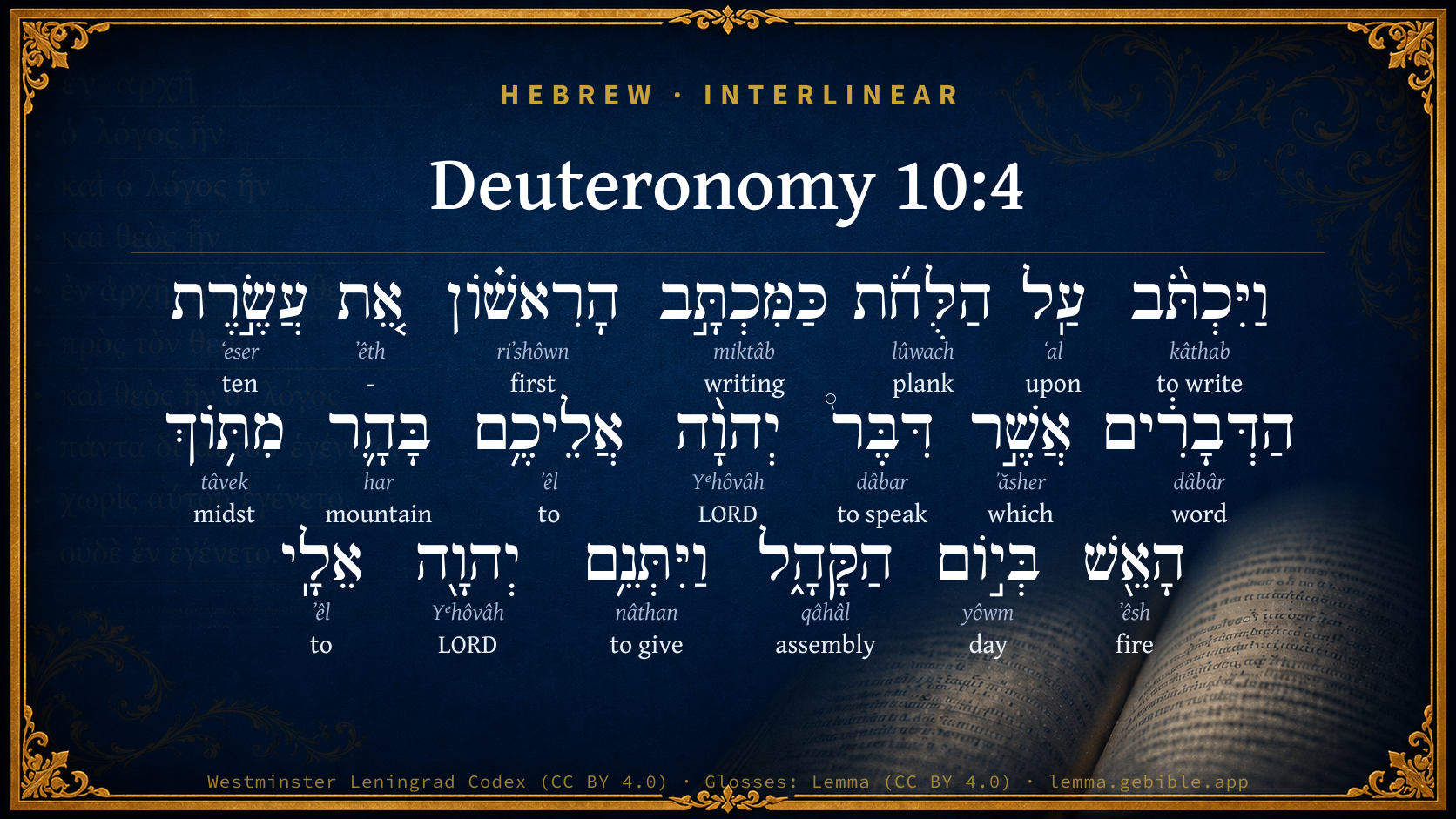
Hebrew (Westminster Leningrad Codex) Deuteronomy 10:4 appears in the Hebrew Old Testament. The text above is from the Westminster Leningrad Codex. Each word links to its Strong’s number, a concise gloss, and parsing drawn from the Open Scriptures Hebrew Bible morphology. Click any word for its full Brown-Driver-Briggs (BDB) entry.
Download image
Cite this verse

Deuteronomy 10:4 (World English Bible). Public Domain. Lemma interlinear Bible study tool, https://lemma.gebible.app/v/deuteronomy/10/4.

Show BibTeX & RIS
BibTeX
RIS
English Translation
He wrote on the tables, according to the first writing, the ten commandments, which Yahweh spoke to you on the mountain out of the midst of the fire in the day of the assembly: and Yahweh gave them to me.
World English Bible · Public Domain
Download a study sheet

One document with this verse’s original text, its word-by-word gloss line, the meaning frame, cross-references with their text, attributed commentary, and full source and license credits — printable, and it pastes into notes with its structure intact.

This verse Autodidact and up

Study sheet (.html) Plain text (.txt)

A passage Seminary Student

Up to 50 verses in one chapter. A passage sheet keeps up to 6 commentary sources and 12 cross-references per verse, in the order this page ranks them, and says so on the sheet whenever that leaves anything out. Ask for a single verse and you get the Autodidact verse sheet above.

Everything on this page stays free to read, with no account — the sheet is a download of what is already on screen, not access to it.

Want to remove ads? Support Godless Engineer
Compare translations 3

The same verse in 3 English versions, stacked beneath the original-language interlinear above. Click any original word for its lexicon entry.

Each is an independent rendering of the whole verse — the interlinear is not word-aligned to these translations.

Highlighted words mark where these versions differ — a whole-verse word diff, not a word-by-word alignment.

  • World English Bible Public Domain
    He wrote on the tables, according to the first writing, the ten commandments, which Yahweh spoke to you on the mountain out of the midst of the fire in the day of the assembly: and Yahweh gave them to me.
  • King James Version Public Domain
    And he wrote on the tables, according to the first writing, the ten commandments, which the LORD spake unto you in the mount out of the midst of the fire in the day of the assembly: and the LORD gave them unto me.
  • unfoldingWord Literal Text CC BY-SA 4.0
    And he wrote on the tablets, like the first writing, the Ten Words which Yahweh had spoken to you on the mountain from the midst of the fire on the day of the assembly. And Yahweh gave them to me.

unfoldingWord Literal Text — © unfoldingWord, licensed CC BY-SA 4.0. Word-aligned USFM3 via Door43 (git.door43.org/unfoldingWord/en_ult).

Versions to compare (up to 4)

3 of 4 selected

Show all 18 translations

Every available English version of this verse, each an independent rendering of the whole verse.

  • World English Bible Public Domain
    He wrote on the tables, according to the first writing, the ten commandments, which Yahweh spoke to you on the mountain out of the midst of the fire in the day of the assembly: and Yahweh gave them to me.
  • Berean Standard Bible Public Domain
    And the LORD wrote on the tablets what had been written previously, the Ten Commandments that He had spoken to you on the mountain out of the fire on the day of the assembly. The LORD gave them to me,
  • Majority Standard Bible Public Domain
    And the LORD wrote on the tablets what had been written previously, the Ten Commandments that He had spoken to you on the mountain out of the fire on the day of the assembly. The LORD gave them to me,
  • King James Version Public Domain
    And he wrote on the tables, according to the first writing, the ten commandments, which the LORD spake unto you in the mount out of the midst of the fire in the day of the assembly: and the LORD gave them unto me.
  • American Standard Version (1901) Public Domain
    And he wrote on the tables, according to the first writing, the ten commandments, which Jehovah spake unto you in the mount out of the midst of the fire in the day of the assembly: and Jehovah gave them unto me.
  • Revised Version (1885) Public Domain
    And he wrote on the tables, according to the first writing, the ten commandments, which the LORD spake unto you in the mount out of the midst of the fire in the day of the assembly: and the LORD gave them unto me.
  • Geneva Bible (1599) Public Domain
    Then he wrote vpon the Tables according to the first writing (the tenne commandements, which the Lord spake vnto you in the Mount out of the middes of the fire, in the day of the assemblie) and the Lord gaue them vnto me.
  • Douay-Rheims (1899) Public Domain
    And he wrote in the tables, according as he had written before, the ten words, which the Lord spoke to you in the mount from the midst of the fire, when the people were assembled: and he gave them to me.
  • Young's Literal Translation Public Domain
    `And He writeth on the tables, according to the first writing, the Ten Matters, which Jehovah hath spoken unto you in the mount, out of the midst of the fire, in the day of the assembly, and Jehovah giveth them unto me,
  • Literal Standard Version CC BY-SA 4.0
    And He writes on the tablets according to the first writing, the Ten Commandments, which YHWH has spoken to you in the mountain, out of the midst of the fire, in the day of the assembly, and YHWH gives them to me,
  • Unlocked Literal Bible CC BY-SA 4.0
    He wrote on the tablets, like the first writing, the Ten Commandments which Yahweh had spoken to you on the mountain out of the middle of the fire on the day of the assembly; then Yahweh gave them to me.
  • unfoldingWord Literal Text CC BY-SA 4.0
    And he wrote on the tablets, like the first writing, the Ten Words which Yahweh had spoken to you on the mountain from the midst of the fire on the day of the assembly. And Yahweh gave them to me.
  • Darby Bible Public Domain
    And he wrote on the tables, as the first writing, the ten words which Jehovah spoke unto you on the mountain, from the midst of the fire, on the day of the assembly, and Jehovah gave them unto me.
  • World Messianic Bible Public Domain
    He wrote on the tablets, according to the first writing, the ten commandments, which the LORD spoke to you on the mountain out of the middle of the fire in the day of the assembly; and the LORD gave them to me.
  • Webster's Bible Public Domain
    And he wrote on the tables according to the first writing, the ten commandments, which the LORD spoke to you in the mount, from the midst of the fire, in the day of the assembly: and the LORD gave them to me.
  • Free Bible Version CC BY-SA 4.0
    The Lord wrote what he had before on the tablets, the Ten Commandments that he'd told you when he spoke from the fire on the mountain when we were all assembled there. The Lord gave them to me,
  • Bible in Basic English Public Domain
    And he put on the stones, as in the first writing, the ten rules which the Lord gave you on the mountain out of the fire on the day of the great meeting: and the Lord gave the stones to me.
  • JPS Tanakh (1917) Public Domain
    And He wrote on the tables according to the first writing, the ten words, which the LORD spoke unto you in the mount out of the midst of the fire in the day of the assembly; and the LORD gave them unto me.

Literal Standard Version (2020), Covenant Press — licensed CC BY-SA 4.0. Text via the HelloAO Bible API (eBible.org). Unlocked Literal Bible (unfoldingWord) — licensed CC BY-SA 4.0. Text via the HelloAO Bible API (eBible.org). unfoldingWord Literal Text — © unfoldingWord, licensed CC BY-SA 4.0. Word-aligned USFM3 via Door43 (git.door43.org/unfoldingWord/en_ult). Free Bible Version, Dr. Jonathan Gallagher — licensed CC BY-SA 4.0. Text via the HelloAO Bible API (eBible.org).

Word by word

More ways to search: Search by grammar → Find every occurrence → Compare this word →

Practice this passage: Drill this verse → Learn its vocabulary →

כַּמִּכְתָּ֣ב
miktâb
H4385
“like/as the · writing”
Preposition, Determined + Noun, Common, Masculine, Singular, Absolute
Part of Speech
Preposition + Noun
Type
Common
Gender
Masculine
Number
Singular
State
Absolute
Full BDB Definition

Origin: from H3789

TWOT: 1053c

writing, thing written - handwriting - thing written - writing
  1. וַיִּכְתֹּ֨ב kâthab H3789 “and · to write” Conjunction + Verb, Qal, Sequential Imperfect, 3rd Person, Masculine, Singular
  2. עַֽל ʻal H5921 “upon” Preposition
  3. הַלֻּחֹ֜ת lûwach H3871 “the · planks” Particle, Definite Article + Noun, Common, Masculine, Plural, Absolute
  4. הָרִאשׁ֗וֹן riʼshôwn H7223 “the · first” Particle, Definite Article + Adjective, Ordinal number, Masculine, Singular, Absolute
  5. אֵ֚ת ʼêth H853 “-” Particle, Direct Object
  6. עֲשֶׂ֣רֶת ʻeser H6235 “ten” Adjective, Cardinal number, Masculine, Singular, Construct
  7. הַדְּבָרִ֔ים dâbâr H1697 “the · words” Particle, Definite Article + Noun, Common, Masculine, Plural, Absolute
  8. אֲשֶׁ֣ר ʼăsher H834 “which” Particle, Relative
  9. דִּבֶּר֩ dâbar H1696 “to speak” Verb, Piel, Perfect, 3rd Person, Masculine, Singular
  10. יְהוָ֨ה Yᵉhôvâh H3068 “LORD” Noun, Proper
  11. אֲלֵיכֶ֥ם ʼêl H413 “to · you” Preposition + Suffix, Personal, 2nd Person, Masculine, Plural
  12. בָּהָ֛ר har H2022 “in/at the · mountain” Preposition, Determined + Noun, Common, Masculine, Singular, Absolute
  13. מִתּ֥וֹךְ tâvek H8432 “from · midst of” Preposition + Noun, Common, Masculine, Singular, Construct
  14. הָאֵ֖שׁ ʼêsh H784 “the · fire” Particle, Definite Article + Noun, Common, Both, Singular, Absolute
  15. בְּי֣וֹם yôwm H3117 “in/at · day of” Preposition + Noun, Common, Masculine, Singular, Construct
  16. הַקָּהָ֑ל qâhâl H6951 “the · assembly” Particle, Definite Article + Noun, Common, Masculine, Singular, Absolute
  17. וַיִּתְּנֵ֥ם nâthan H5414 “and · to give · them” Conjunction + Verb, Qal, Sequential Imperfect, 3rd Person, Masculine, Singular + Suffix, Personal, 3rd Person, Masculine, Plural
  18. יְהוָ֖ה Yᵉhôvâh H3068 “LORD” Noun, Proper
  19. אֵלָֽי ʼêl H413 “to · me” Preposition + Suffix, Personal, 1st Person, Common, Singular

About this verse

These counts appear in no published source. They are computed here, from the morphology-tagged text and Lemma’s own curated glosses. What Lemma adds →

20
words
18
distinct lemmas
Pentateuch
section

Notable vocabulary

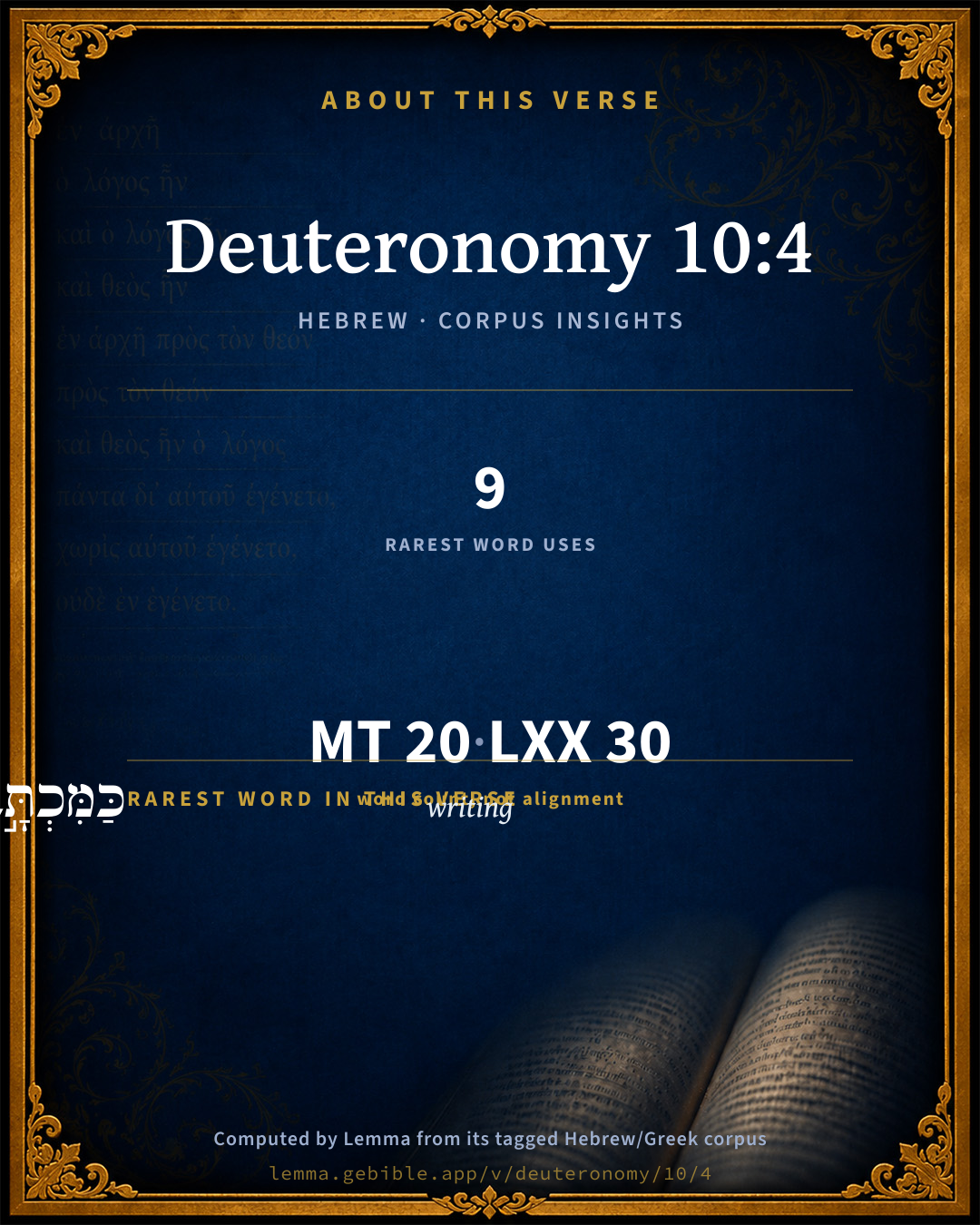
The rarest word here is כַּמִּכְתָּ֣ב writing H4385 — appearing just 9 times in the whole Hebrew Bible.

Shared distinctive vocabulary

כַּמִּכְתָּ֣ב writing H4385 occurs in 8 verses of the Hebrew Bible. Also found in:

Grammatical profile

  • 3 verbs
  • 10 nouns
  • 2 adjectives
  • 3 prepositions
  • 2 particles

Verb forms

  • וַיִּכְתֹּ֨ב Qal · Sequential Imperfect
  • דִּבֶּר֩ Piel · Perfect
  • וַיִּתְּנֵ֥ם Qal · Sequential Imperfect

Repetition

Words recur within this verse — often emphatic in Hebrew:

  • יְהוָ֨ה LORD H3068 ×2
  • אֲלֵיכֶ֥ם to H413 ×2

Hebrew & Septuagint length

In English translation the verse runs 40 words from the Hebrew and 37 from the Septuagint (LXX English) — closely comparable.

A rough comparison of the two English renderings, which tokenize alike — not a word-level alignment.

Word counts can differ between the Hebrew and the Greek without any difference in meaning — e.g. the Hebrew direct-object marker אֵת has no separate Greek word, and Greek often adds the article ὁ.

In the original languages it is 20 Hebrew tokens and 30 Greek tokens — but the two are counted differently (Hebrew bundles its prefixes and suffixes into one token; the Greek is in lemma form), so that isn’t a like-for-like length.

Cross-references

8

Topical passages linked to Deuteronomy 10:4 in the Treasury of Scripture Knowledge — connected by theme and wording, ordered by reader-vote popularity; previews shown in the World English Bible.

  • Deuteronomy 9:10 Yahweh delivered to me the two tables of stone written with the finger of God; and on them [was written] according to all the words, which Yahweh spoke with you on the mountain out of the midst of the fire in the day of the assembly.
  • Exodus 34:28 He was there with Yahweh forty days and forty nights; he neither ate bread, nor drank water. He wrote on the tablets the words of the covenant, the ten commandments.
  • Deuteronomy 4:11–15 You came near and stood under the mountain; and the mountain burned with fire to the heart of the sky, with darkness, cloud, and thick darkness.
  • Deuteronomy 18:16 according to all that you desired of Yahweh your God in Horeb in the day of the assembly, saying, Let me not hear again the voice of Yahweh my God, neither let me see this great fire any more, that I not die.
  • Hebrews 12:18–19 For you have not come to a mountain that might be touched, and that burned with fire, and to blackness, darkness, tempest,
  • Exodus 19:17–18 Moses led the people out of the camp to meet God; and they stood at the lower part of the mountain.
  • Exodus 20:1–17 God spoke all these words, saying,
  • Deuteronomy 5:4–26 Yahweh spoke with you face to face on the mountain out of the midst of the fire,

Cross-references courtesy of OpenBible.info (CC BY 4.0).

Hebrew and Greek witnesses Masoretic Hebrew ↔ Greek Septuagint

The same verse in the two great witnesses to the Old Testament, shown verse-for-verse.

These are two independent witnesses, not word-aligned to each other, and the Septuagint is shown in lemma (dictionary) form.

Hebrew Deuteronomy 10:4 Masoretic · Westminster Leningrad Codex

וַיִּכְתֹּ֨ב עַֽל הַלֻּחֹ֜ת כַּמִּכְתָּ֣ב הָרִאשׁ֗וֹן אֵ֚ת עֲשֶׂ֣רֶת הַדְּבָרִ֔ים אֲשֶׁ֣ר דִּבֶּר֩ יְהוָ֨ה אֲלֵיכֶ֥ם בָּהָ֛ר מִתּ֥וֹךְ הָאֵ֖שׁ בְּי֣וֹם הַקָּהָ֑ל וַיִּתְּנֵ֥ם יְהוָ֖ה אֵלָֽי

He wrote on the tables, according to the first writing, the ten commandments, which Yahweh spoke to you on the mountain out of the midst of the fire in the day of the assembly: and Yahweh gave them to me.

World English Bible · Public Domain

Greek LXX Deuteronomy 10:4 Septuagint · lemma form

καί γράφω ἐπί ὁ πλάξ κατά ὁ γραφή ὁ πρῶτος ὁ δέκα λόγος ὅς λαλέω κύριος πρός σύ ἐν ὁ ὄρος ἐκ μέσος ὁ πῦρ καί δίδωμι αὐτός κύριος ἐγώ

And he wrote upon the tables according to the first writing the ten commandments, which the Lord spoke to you in the mountain out of the midst of the fire, and the Lord gave them to me.

LXX2012 (modern English Septuagint) · Public Domain

Hebrew: Westminster Leningrad Codex (CC BY 4.0). Greek: Septuagint (public domain); English from LXX2012 (modern English Septuagint) (Public Domain). How the Septuagint differs from the Hebrew →

Targum (Aramaic paraphrase)

2

The Targum is the ancient Jewish Aramaic paraphrase of the Hebrew Scriptures — an interpretive translation, not the Hebrew text itself. Onkelos (literal) and Pseudo-Jonathan (expansive) render the Torah, and Jonathan the Prophets. Coverage is partial: where no permissively-licensed English translation exists for a verse, only the Aramaic is shown. This is verse-level text, not a word-by-word alignment to the Hebrew.

  1. Targum Onkelos Torah (Genesis–Deuteronomy)
    וּכְתַב עַל לוּחַיָא כִּכְתָבָא קַדְמָאָה יָת עַשְׂרָא פִתְגָמַיָא דִי מַלִיל יְיָ עִמְכוֹן בְּטוּרָא מִגוֹ אֶשְׁתָא בְּיוֹמָא דִקְהָלָא וִיהָבִנוּן יְיָ לִי

    (no public-domain English translation for this verse)

    Targum Onkelos — Aramaic: “Onkelos Genesis” (public domain); “Onkelos Exodus” (public domain); “Onkelos Leviticus” (public domain); “Onkelos Numbers” (public domain); “Onkelos Deuteronomy” (public domain). English: “Sefaria Community Translation” (CC0 1.0 (public-domain dedication)); “J.W. Etheridge. The Targums of Onkelos and Jonathan Ben Uzziel on the Pentateuch. London: Longmans, Green, 1862” (public domain). Text via Sefaria.

  2. Targum Pseudo-Jonathan Torah (Genesis–Deuteronomy)
    וּכְתַב עַל לוּחַיָא הֵי כִּכְתָבָא קַמָּא יַת עֲשַרְתֵּי דְבִירַיָא דְמַלֵּיל יְיָ עִמְכוֹן בְּטַוְורָא מִגּוֹ אֵישָׁתָא בְּיוֹמָא דְאִתְכְּנָשׁוּ קְהָלָא וִיהָבִינָן יְיָ לִי

    And He wrote upon the tables according to the former writing, the Ten Words which the Lord spake with you from the mount in the midst of the fire on the day that the congregation was gathered together, and the Lord gave them to me.

    Targum Pseudo-Jonathan — Aramaic: “Targum Jonathan on Genesis” (public domain); “Targum Jonathan on Exodus” (public domain); “Targum Jonathan on Leviticus” (public domain); “Targum Jonathan on Numbers” (public domain); “Targum Jonathan on Deuteronomy” (public domain). English: “The Targum of Jonathan ben Uzziel, trans. J. W. Etheridge, London, 1862” (public domain). Text via Sefaria.

Commentary

Notes on Deuteronomy 10:4 from classic Christian and Jewish commentators (each source and its license shown beneath its notes). The classic Christian expositions comment on the surrounding passage and are grouped to its opening verse, so a note may address several verses; the Jewish commentaries on the Tanakh (Rashi and others) are per-verse, so they appear only where the commentator wrote on this verse.

Lemma curates 59 commentaries, every one of them public domain or Creative Commons licensed, each selected and text-cleaned for this edition rather than reprinted as found. About our sources →

Trapp's Complete Commentary

John Trapp

Deu 10:4 And he wrote on the tables, according to the first writing, the ten commandments, which the LORD spake unto you in the mount out of the midst of the fire in the day of the assembly: and the LORD gave them unto me.

Ver. 4. Out of the midst of the fire.] The law was given in fire; it is "a law of fire," {Deu 33:2} given by God, who is "a consuming fire," {Heb 12:29} and hath a tribunal of fire, {Eze 1:27} and shall plead with transgressors in flames of fire; {Isa 66:15-16} the trial of our works shall be by fire. {1Co 3:13} "Let us therefore have grace, whereby we may serve God acceptably, with reverence and godly fear." It is the apostle’s use. {Heb 12:28}

John Trapp, A Commentary or Exposition upon All the Books of the Old and New Testament (1647–1656) — public domain. Text from a community e-Sword module.

Geneva Bible (1599)

Geneva Bible translators

When you were assembled to receive the Law.

Geneva Bible (1599) marginal notes — public domain. Text via Bolls.life.

Jamieson, Fausset & Brown

Robert Jamieson, A. R. Fausset & David Brown

he wrote on the tables, according to the first writing--that is, not Moses, who under the divine direction acted as amanuensis, but God Himself who made this inscription a second time with His own hand, to testify the importance He attached to the ten commandments. Different from other stone monuments of antiquity, which were made to stand upright and in the open air, those on which the divine law was engraven were portable, and designed to be kept as a treasure. JOSEPHUS says that each of the tables contained five precepts. But the tradition generally received, both among Jewish and Christian writers is, that one table contained four precepts, the other six.

Jamieson, Fausset & Brown — Commentary Critical and Explanatory on the Whole Bible (1871) — public domain (CC PDM 1.0). Text via the HelloAO Bible API.

Adam Clarke's Commentary

Verse 4. Ten commandments] See Clarke on Ex 20:1, &c.

Adam Clarke's Commentary on the Bible (1810–1826) — public domain. Text from a community e-Sword/MySword module.

Ellicott's Commentary for English Readers

(4) According to the first writing, the ten commandments.—The words written on the second tables were the same which had been written on the first.

In the day of the assembly.—Or, in New Testament language, “the day of the Church.” The Pentecost of the Old Testament was the day when “the letter” was given; the Pentecost of the New Testament was the day of the “Spirit that giveth life.” Each of these aspects of God’s covenant produced a Church after its kind.

A Bible Commentary for English Readers, edited by Charles John Ellicott (1878–1897) — public domain. Text from a community e-Sword module.

The Cambridge Bible for Schools and Colleges

gen. ed. J. J. S. Perowne

4. And he wrote on the tables … the ten words] Exo_34:28, J. This adds the words of the covenant, for which D has according to the first writing, cp. Deu_9:10.

the ten words] See above p. 81.

in the mount out of the midst of the fire] Above Deu_9:10.

in the day of the assembly] See on Deu_9:10, Deu_5:22.

The Cambridge Bible for Schools and Colleges (gen. ed. J. J. S. Perowne; Cambridge University Press, 1878–1918) — public domain. Text from a community e-Sword module.

John Gill's Exposition

And he wrote on the tables according to the first writing,.... The same laws, in the same letters:

the ten commandments which the Lord spake unto you in the mount; in Mount Sinai, on which he descended, and from whence he delivered the decalogue by word of mouth in an audible manner, that all the people could hear it:

out of the midst of the fire; in which he descended, and where he continued, and from whence he spake, so that it was indeed a fiery law:

in the day of the assembly; when all the people of Israel were assembled together at the bottom of the mount to hear it:

and the Lord gave them unto me; the two tables, when he had wrote upon them the ten commands.

John Gill's Exposition of the Whole Bible (1746–1763) — public domain (CC PDM 1.0). Text via the HelloAO Bible API.

Haydock's Catholic Bible Commentary

To me. God had already promulgated the same laws in the hearing of all, Exodus xix. 17. (Haydock)

George Leo Haydock (1774–1849), Haydock's Catholic Family Bible and Commentary, 1859 edition — public domain. Excludes Psalms (Douay-Rheims chapter numbering differs from Protestant) and Deuterocanonical books (Catholic canon only).

Whedon's Commentary on the Bible

Daniel D. Whedon

4. He wrote on the tables, according to the first writing — In Deu_9:10, it reads, “written with the finger of God.”

It is held by some of the critics that Deu_10:6-7 are out of place, that they interrupt the order of the narrative, and that no satisfactory reason for their being introduced can be given. They would indeed be difficult to account for on the theory of some critics, that the work is of a later origin. Moses recalls the death of Aaron. But though Aaron dies the high priesthood is continued. “His aim throughout is to prove the patient mercy of the Lord to his people in spite of their aggravated sins. The calf worship had brought on them a double token of the divine displeasure. First, the tables of the covenant were broken, and the covenant itself dissolved almost as soon as made; but in answer to the intercession of Moses new tables were provided, written upon by the finger of God, and placed in the ark. Next, the Lord had been angry with Aaron to have destroyed him; and with such a judgment on the high priest the covenant of grace to Israel would have come doubly to an end. But Moses prayed for Aaron at that time, and he was forgiven. Not only so, but when the time of death arrived there was a new token of God’s restored and enduring favour, when ‘Eleazar his son ministered in the priest’s office in his [Aaron’s] stead.’ Thus doubly, at the close of their wanderings, by the presence of the new tables in the ark, and by the high priesthood of Eleazar in the place of Aaron, mercy had rejoiced against judgment. These verses, then, are natural in a retrospect by Moses himself at the close of his life, and on this hypothesis alone.” BIRKS, The Pentateuch and its Anatomists, pp. 261, 262.

Daniel D. Whedon (gen. ed.), Commentary on the Old and New Testaments (1874–1909) — public domain. Text from a community e-Sword module.

Lesson kit

Teaching starters — assembled from the data on this page, not authored interpretation. Every prompt links to the verse data it draws on. Edit before teaching.

Deuteronomy, in the Pentateuch, opens this verse with 20 words (18 distinct Hebrew lemmas). Its most distinctive word is miktâb (“writing”). A historical commentator’s framing appears above. Read the whole chapter for the surrounding context.

Discussion questions

  1. How does “writing” (miktâb) shape what this verse is saying?
  2. Exodus 32:16 shares the word «writing» with this verse. How do the two illuminate each other?
  3. “LORD” occurs 2× in this one verse. What is the effect of the repetition?
  4. These translations render this verse differently. What is at stake in choosing one wording over another?
  5. The verb «וַיִּכְתֹּ֨ב» is Qal Sequential Imperfect. How does its form color the action?
  6. Reading how Trapp's Complete Commentary and Geneva Bible (1599) read this verse, where do the two commentators agree and where do they part?

Things to notice

Reading settings

Reading text

Shown beneath each verse's original-language words.

Old Testament
Old Testament edition

Read the OT as the Masoretic Hebrew (MT) or the Greek Septuagint (LXX).

English shown for the Greek Septuagint (in the Hebrew ↔ Greek comparison).

Comparing translations? Open the Compare panel on any verse page to stack up to four side by side.