Numbers 1:49

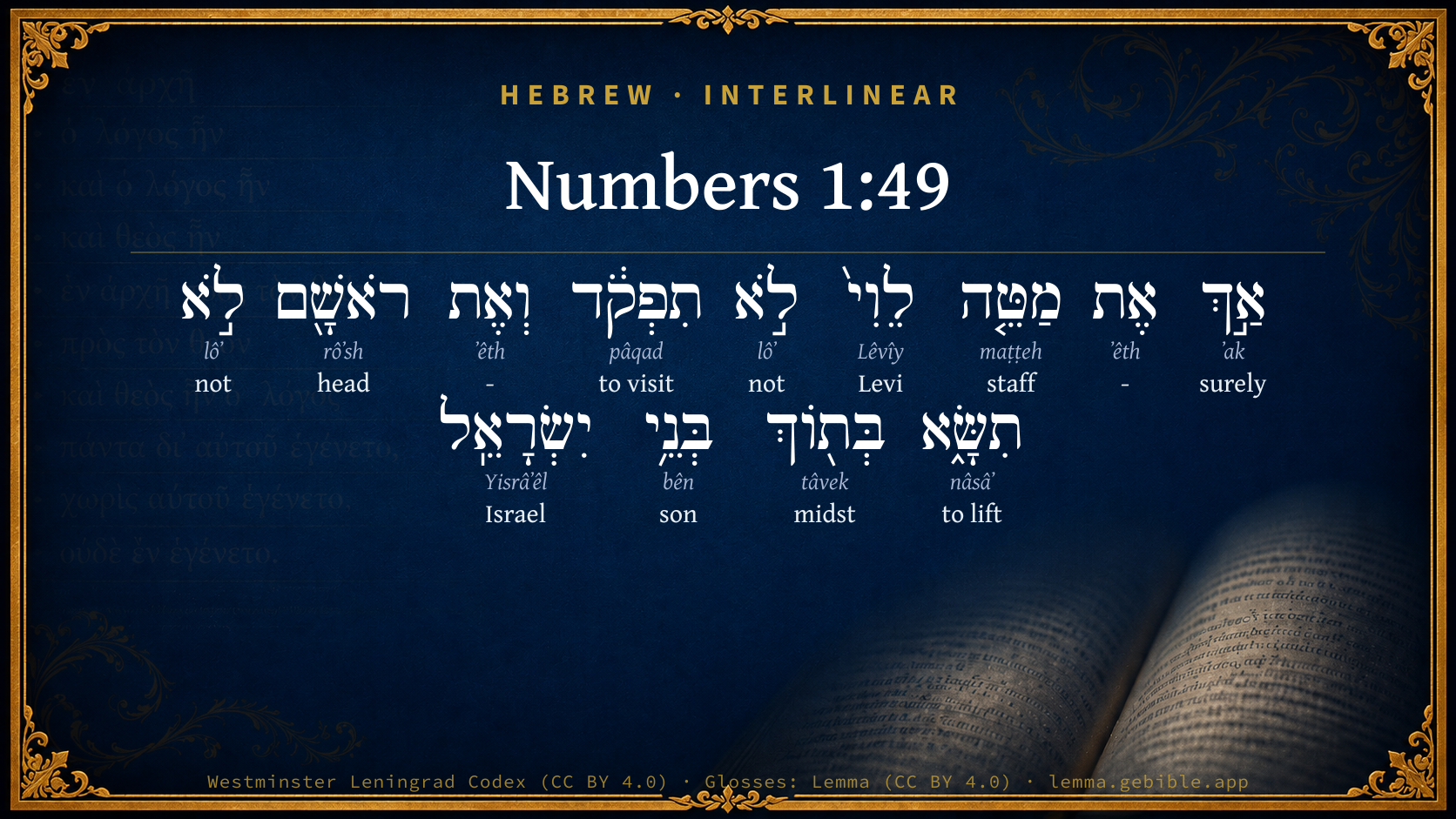
Hebrew (Westminster Leningrad Codex) Numbers 1:49 appears in the Hebrew Old Testament. The text above is from the Westminster Leningrad Codex. Each word links to its Strong’s number, a concise gloss, and parsing drawn from the Open Scriptures Hebrew Bible morphology. Click any word for its full Brown-Driver-Briggs (BDB) entry.
Download image
Cite this verse

Numbers 1:49 (World English Bible). Public Domain. Lemma interlinear Bible study tool, https://lemma.gebible.app/v/numbers/1/49.

Show BibTeX & RIS
BibTeX
RIS
English Translation
"Only the tribe of Levi you shall not number, neither shall you take a census of them among the children of Israel;
World English Bible · Public Domain
Download a study sheet

One document with this verse’s original text, its word-by-word gloss line, the meaning frame, cross-references with their text, attributed commentary, and full source and license credits — printable, and it pastes into notes with its structure intact.

This verse Autodidact and up

Study sheet (.html) Plain text (.txt)

A passage Seminary Student

Up to 50 verses in one chapter. A passage sheet keeps up to 6 commentary sources and 12 cross-references per verse, in the order this page ranks them, and says so on the sheet whenever that leaves anything out. Ask for a single verse and you get the Autodidact verse sheet above.

Everything on this page stays free to read, with no account — the sheet is a download of what is already on screen, not access to it.

Want to remove ads? Support Godless Engineer
Compare translations 3

The same verse in 3 English versions, stacked beneath the original-language interlinear above. Click any original word for its lexicon entry.

Each is an independent rendering of the whole verse — the interlinear is not word-aligned to these translations.

Highlighted words mark where these versions differ — a whole-verse word diff, not a word-by-word alignment.

  • World English Bible Public Domain
    "Only the tribe of Levi you shall not number, neither shall you take a census of them among the children of Israel;
  • King James Version Public Domain
    Only thou shalt not number the tribe of Levi, neither take the sum of them among the children of Israel:
  • unfoldingWord Literal Text CC BY-SA 4.0
    “Only the tribe of Levi you shall not count, and you shall not lift up their heads in the midst of the sons of Israel.

unfoldingWord Literal Text — © unfoldingWord, licensed CC BY-SA 4.0. Word-aligned USFM3 via Door43 (git.door43.org/unfoldingWord/en_ult).

Versions to compare (up to 4)

3 of 4 selected

Show all 18 translations

Every available English version of this verse, each an independent rendering of the whole verse.

  • World English Bible Public Domain
    "Only the tribe of Levi you shall not number, neither shall you take a census of them among the children of Israel;
  • Berean Standard Bible Public Domain
    “Do not number the tribe of Levi in the census with the other Israelites.
  • Majority Standard Bible Public Domain
    “Do not number the tribe of Levi in the census with the other Israelites.
  • King James Version Public Domain
    Only thou shalt not number the tribe of Levi, neither take the sum of them among the children of Israel:
  • American Standard Version (1901) Public Domain
    Only the tribe of Levi thou shalt not number, neither shalt thou take the sum of them among the children of Israel;
  • Revised Version (1885) Public Domain
    Only the tribe of Levi thou shalt not number, neither shalt thou take the sum of them among the children of Israel:
  • Geneva Bible (1599) Public Domain
    Onely thou shalt not number the tribe of Leui, neither take the summe of them among the children of Israel:
  • Douay-Rheims (1899) Public Domain
    Number not the tribe of Levi, neither shalt thou put down the sum of them with the children of Israel:
  • Young's Literal Translation Public Domain
    `Only, the tribe of Levi thou dost not number, and their sum thou dost not take up in the midst of the sons of Israel;
  • Literal Standard Version CC BY-SA 4.0
    “Only the tribe of Levi you do not number, and you do not take up their census in the midst of the sons of Israel;
  • Unlocked Literal Bible CC BY-SA 4.0
    “You must not count the tribe of Levi or include them in the total of the people of Israel.
  • unfoldingWord Literal Text CC BY-SA 4.0
    “Only the tribe of Levi you shall not count, and you shall not lift up their heads in the midst of the sons of Israel.
  • Darby Bible Public Domain
    Only thou shalt not number the tribe of Levi, neither take the sum of them among the children of Israel.
  • World Messianic Bible Public Domain
    “Only the tribe of Levi you shall not count, neither shall you take a census of them among the children of Israel;
  • Webster's Bible Public Domain
    Only thou shalt not number the tribe of Levi, neither take the sum of them among the children of Israel:
  • Free Bible Version CC BY-SA 4.0
    “Don't register the tribe of Levi; don't count them in the census with the other Israelites.
  • Bible in Basic English Public Domain
    Only the tribe of Levi is not to be numbered among the children of Israel,
  • JPS Tanakh (1917) Public Domain
    'Howbeit the tribe of Levi thou shalt not number, neither shalt thou take the sum of them among the children of Israel;

Literal Standard Version (2020), Covenant Press — licensed CC BY-SA 4.0. Text via the HelloAO Bible API (eBible.org). Unlocked Literal Bible (unfoldingWord) — licensed CC BY-SA 4.0. Text via the HelloAO Bible API (eBible.org). unfoldingWord Literal Text — © unfoldingWord, licensed CC BY-SA 4.0. Word-aligned USFM3 via Door43 (git.door43.org/unfoldingWord/en_ult). Free Bible Version, Dr. Jonathan Gallagher — licensed CC BY-SA 4.0. Text via the HelloAO Bible API (eBible.org).

Word by word

More ways to search: Search by grammar → Find every occurrence → Compare this word →

Practice this passage: Drill this verse → Learn its vocabulary →

About this verse

These counts appear in no published source. They are computed here, from the morphology-tagged text and Lemma’s own curated glosses. What Lemma adds →

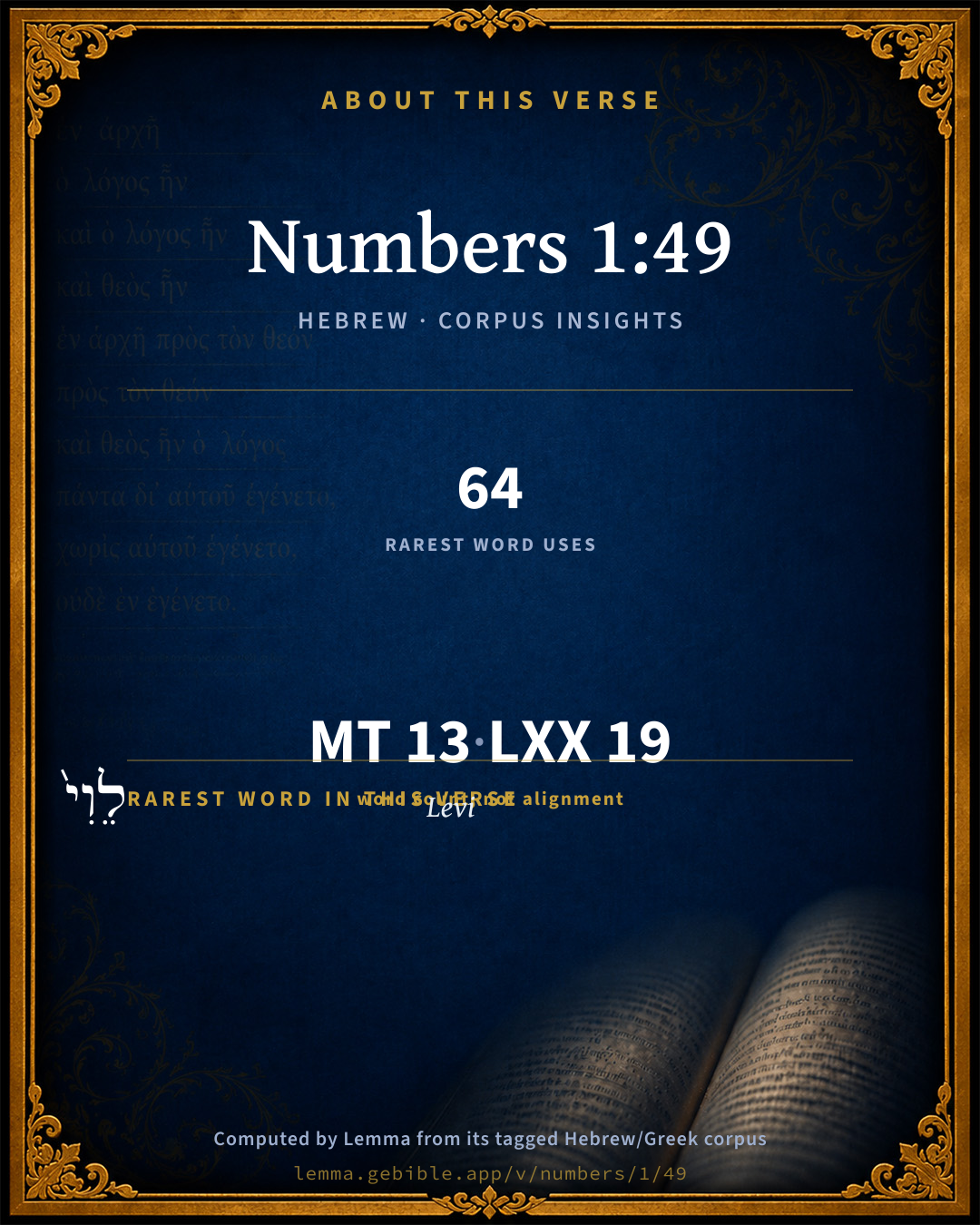
13
words
11
distinct lemmas
Pentateuch
section

Grammatical profile

  • 2 verbs
  • 6 nouns
  • 5 particles

Verb forms

  • תִפְקֹ֔ד Qal · Imperfect
  • תִשָּׂ֑א Qal · Imperfect

Repetition

A word recurs within this verse — often emphatic in Hebrew:

Hebrew & Septuagint length

In English translation the verse runs 22 words from the Hebrew and 24 from the Septuagint (LXX English) — closely comparable.

A rough comparison of the two English renderings, which tokenize alike — not a word-level alignment.

Word counts can differ between the Hebrew and the Greek without any difference in meaning — e.g. the Hebrew direct-object marker אֵת has no separate Greek word, and Greek often adds the article ὁ.

In the original languages it is 13 Hebrew tokens and 19 Greek tokens — but the two are counted differently (Hebrew bundles its prefixes and suffixes into one token; the Greek is in lemma form), so that isn’t a like-for-like length.

Cross-references

2

Topical passages linked to Numbers 1:49 in the Treasury of Scripture Knowledge — connected by theme and wording, ordered by reader-vote popularity; previews shown in the World English Bible.

  • Numbers 26:62 Those who were numbered of them were twenty-three thousand, every male from a month old and upward: for they were not numbered among the children of Israel, because there was no inheritance given them among the children of Israel.
  • Numbers 2:33 But the Levites were not numbered among the children of Israel; as Yahweh commanded Moses.

Cross-references courtesy of OpenBible.info (CC BY 4.0).

Hebrew and Greek witnesses Masoretic Hebrew ↔ Greek Septuagint

The same verse in the two great witnesses to the Old Testament, shown verse-for-verse.

These are two independent witnesses, not word-aligned to each other, and the Septuagint is shown in lemma (dictionary) form.

Hebrew Numbers 1:49 Masoretic · Westminster Leningrad Codex

אַ֣ךְ אֶת מַטֵּ֤ה לֵוִי֙ לֹ֣א תִפְקֹ֔ד וְאֶת רֹאשָׁ֖ם לֹ֣א תִשָּׂ֑א בְּת֖וֹךְ בְּנֵ֥י יִשְׂרָאֵֽל

"Only the tribe of Levi you shall not number, neither shall you take a census of them among the children of Israel;

World English Bible · Public Domain

Greek LXX Numbers 1:49 Septuagint · lemma form

ὁράω ὁ φυλή ὁ λευί οὐ συν ἐπισκέπτομαι καί ὁ ἀριθμός αὐτός οὐ λαμβάνω ἐν μέσος ὁ υἱός ἰσραήλ

See, you shall not muster the tribe of Levi, and you shall not take their numbers, in the midst of the children of Israel.

LXX2012 (modern English Septuagint) · Public Domain

Hebrew: Westminster Leningrad Codex (CC BY 4.0). Greek: Septuagint (public domain); English from LXX2012 (modern English Septuagint) (Public Domain). How the Septuagint differs from the Hebrew →

Targum (Aramaic paraphrase)

2

The Targum is the ancient Jewish Aramaic paraphrase of the Hebrew Scriptures — an interpretive translation, not the Hebrew text itself. Onkelos (literal) and Pseudo-Jonathan (expansive) render the Torah, and Jonathan the Prophets. Coverage is partial: where no permissively-licensed English translation exists for a verse, only the Aramaic is shown. This is verse-level text, not a word-by-word alignment to the Hebrew.

  1. Targum Onkelos Torah (Genesis–Deuteronomy)
    בְּרַם יָת שִׁבְטָא דְלֵוִי לָא תִמְנֵי וְיָת חֻשְׁבַּנְהוֹן לָא תְקַבֵּל בְּגוֹ בְּנֵי יִשְׂרָאֵל

    (no public-domain English translation for this verse)

    Targum Onkelos — Aramaic: “Onkelos Genesis” (public domain); “Onkelos Exodus” (public domain); “Onkelos Leviticus” (public domain); “Onkelos Numbers” (public domain); “Onkelos Deuteronomy” (public domain). English: “Sefaria Community Translation” (CC0 1.0 (public-domain dedication)); “J.W. Etheridge. The Targums of Onkelos and Jonathan Ben Uzziel on the Pentateuch. London: Longmans, Green, 1862” (public domain). Text via Sefaria.

  2. Targum Pseudo-Jonathan Torah (Genesis–Deuteronomy)
    בְּרַם יַת שִׁבְטָא דְלֵוִי לָא תִמְנֵי וְיַת חוּשְׁבַּנְהוֹן לָא תְקַבֵּל בְּגוֹ בְּנֵי יִשְרָאֵל

    Nevertheless, the tribe of Levi thou shalt not number, nor take their sum among the children of Israel:

    Targum Pseudo-Jonathan — Aramaic: “Targum Jonathan on Genesis” (public domain); “Targum Jonathan on Exodus” (public domain); “Targum Jonathan on Leviticus” (public domain); “Targum Jonathan on Numbers” (public domain); “Targum Jonathan on Deuteronomy” (public domain). English: “The Targum of Jonathan ben Uzziel, trans. J. W. Etheridge, London, 1862” (public domain). Text via Sefaria.

Commentary

Notes on Numbers 1:49 from classic Christian and Jewish commentators (each source and its license shown beneath its notes). The classic Christian expositions comment on the surrounding passage and are grouped to its opening verse, so a note may address several verses; the Jewish commentaries on the Tanakh (Rashi and others) are per-verse, so they appear only where the commentator wrote on this verse.

Lemma curates 59 commentaries, every one of them public domain or Creative Commons licensed, each selected and text-cleaned for this edition rather than reprinted as found. About our sources →

Joseph Benson's Commentary

Num 1:49. Levi — Because they were not generally to go out to war, which was the thing principally eyed in this muster, (Num 1:3; Num 1:20; Num 1:45,) but were to attend upon the service of the tabernacle. They that minister upon holy things, should not entangle themselves in secular affairs. The ministry itself is work enough for a whole man, and all little enough to be employed in it.

Joseph Benson's Commentary on the Old and New Testaments (1811–1818) — public domain. Text from a community e-Sword module.

John Gill's Exposition

Only thou shall not number the tribe of Levi,.... That is, along with the other tribes, for it might be numbered by itself, as it afterwards was, Num 3:43,

neither take the sum of them among the children of Israel; which confirms what is before observed: now this being the declared will of God clears Moses from all partiality to his own tribe, he doing nothing but what he had a command of God for it.

John Gill's Exposition of the Whole Bible (1746–1763) — public domain (CC PDM 1.0). Text via the HelloAO Bible API.

Matthew Poole's English Annotations

Because they were not generally to go out to war, which was the thing principally eyed in this muster, Num 1:3,20,45 but were to attend upon the service or the tabernacle, and therefore are reserved to another distinct muster, Num 3:15; 4:2, &c. And lost this should bc thought to, be designed and done through Moses’s ambition to give his own tribe the pre-eminence, he assures them it was done by God’s express command.

Matthew Poole's English Annotations on the Holy Bible (1683–1685) — public domain. Text from a community e-Sword/MySword module.

Whedon's Commentary on the Bible

Daniel D. Whedon

49. Tribe of Levi — This tribe, together with that of Simeon, because their founders had perpetrated the treacherous massacre of the Shechemites, (Gen_34:25-26,) were under the curse of Jacob: “I will divide them in Jacob and scatter them in Israel.” Gen_49:7. Simeon was greatly reduced in number in the wilderness, and received a small portion in Canaan adjoining Judah, but was soon scattered in the cities of this stronger tribe. Levi was forbidden a portion of the Land of Promise except forty-eight cities in the other tribes, and was appointed to the charge of the tabernacle instead of the firstborn, who were sacred to Jehovah because they had been sanctified by the Lord, and spared when the destroyer slew the firstborn of the Egyptians. A branch of this family, the house of Aaron, became the priestly family, and the rest of the tribe, under the technical designation of Levites, were set apart to the menial services of the tabernacle, such as pitching, taking down, and transporting the sacred tent and its furniture. The curse of dispersion pronounced on Levi was thus converted into a blessing, 1,) because of the conspicuous faithfulness of Moses and Aaron, members of this tribe; and 2,) because of the commendable zeal for God of the whole tribe in the case of the golden calf. Exo_32:16. Every ancestral curse may be mitigated or changed into a blessing by the obedience of posterity to the Divine law. “But where sin abounded grace did much more abound.” Rom_5:20.

Daniel D. Whedon (gen. ed.), Commentary on the Old and New Testaments (1874–1909) — public domain. Text from a community e-Sword module.

John Wesley's Explanatory Notes

Levi - Because they were not generally to go out to war, which was the thing principally eyed in this muster, ver. 3, 20, 45, but were to attend upon the service of the tabernacle. They that minister upon holy things, should not entangle themselves in secular affairs. The ministry itself is work enough for a whole man, and all little enough to be employed in it.

John Wesley, Explanatory Notes Upon the Whole Bible (1754–1765) — public domain. Text via the GEBible commentary corpus.

Rashi

Rabbi Shlomo Yitzchaki (Rashi)

אך את מטה לוי לא תפקד ONLY THOU SHALT NOT NUMBER THE TRIBE OF LEVI — The legion of the King is worthy to be numbered by itself (cf. Midrash Tanchuma, Bamidbar 15). — Another explanation is: The Holy One, blessed be He, foresaw that a decree would once be made against all those that had been numbered from twenty years and upwards, viz., that they should die in the wilderness (Numbers 14:29). He therefore said: Let these (the Levites) not be included amongst those now counted, in which case they must die, because they are Mine, since they did not sin by worshipping the golden calf (cf. Numbers Rabbah 3:7; Bava Batra 121b).

Rashi on the Tanakh — English translations: “The Judaica Press complete Tanach with Rashi, translated by A. J. Rosenberg” (CC BY 4.0); “Pentateuch with Rashi's commentary by M. Rosenbaum and A.M. Silbermann, 1929-1934” (public domain); “The Metsudah Tanach series, Lakewood, N.J” (CC BY 4.0); and “The Book of Joshua, Metsudah Publications, 1997” (CC BY 4.0). Text via Sefaria.

Lesson kit

Teaching starters — assembled from the data on this page, not authored interpretation. Every prompt links to the verse data it draws on. Edit before teaching.

Numbers, in the Pentateuch, opens this verse with 13 words (11 distinct Hebrew lemmas). Its most distinctive word is Lêvîy (“Levi”). A historical commentator’s framing appears above. Read the whole chapter for the surrounding context.

Discussion questions

  1. The word Lêvîy carries the sense “Levi.” How does it shape the verse?
  2. Numbers 26:62 shares this passage’s theme. How do the two illuminate each other?
  3. “not” occurs 2× in this one verse. What is the effect of the repetition?
  4. These translations render this verse differently. What is at stake in choosing one wording over another?
  5. The verb «תִפְקֹ֔ד» is Qal Imperfect. How does its form color the action?
  6. Reading how Joseph Benson's Commentary and John Gill's Exposition read this verse, where do the two commentators agree and where do they part?

Things to notice

Reading settings

Reading text

Shown beneath each verse's original-language words.

Old Testament
Old Testament edition

Read the OT as the Masoretic Hebrew (MT) or the Greek Septuagint (LXX).

English shown for the Greek Septuagint (in the Hebrew ↔ Greek comparison).

Comparing translations? Open the Compare panel on any verse page to stack up to four side by side.