Exodus 28:33

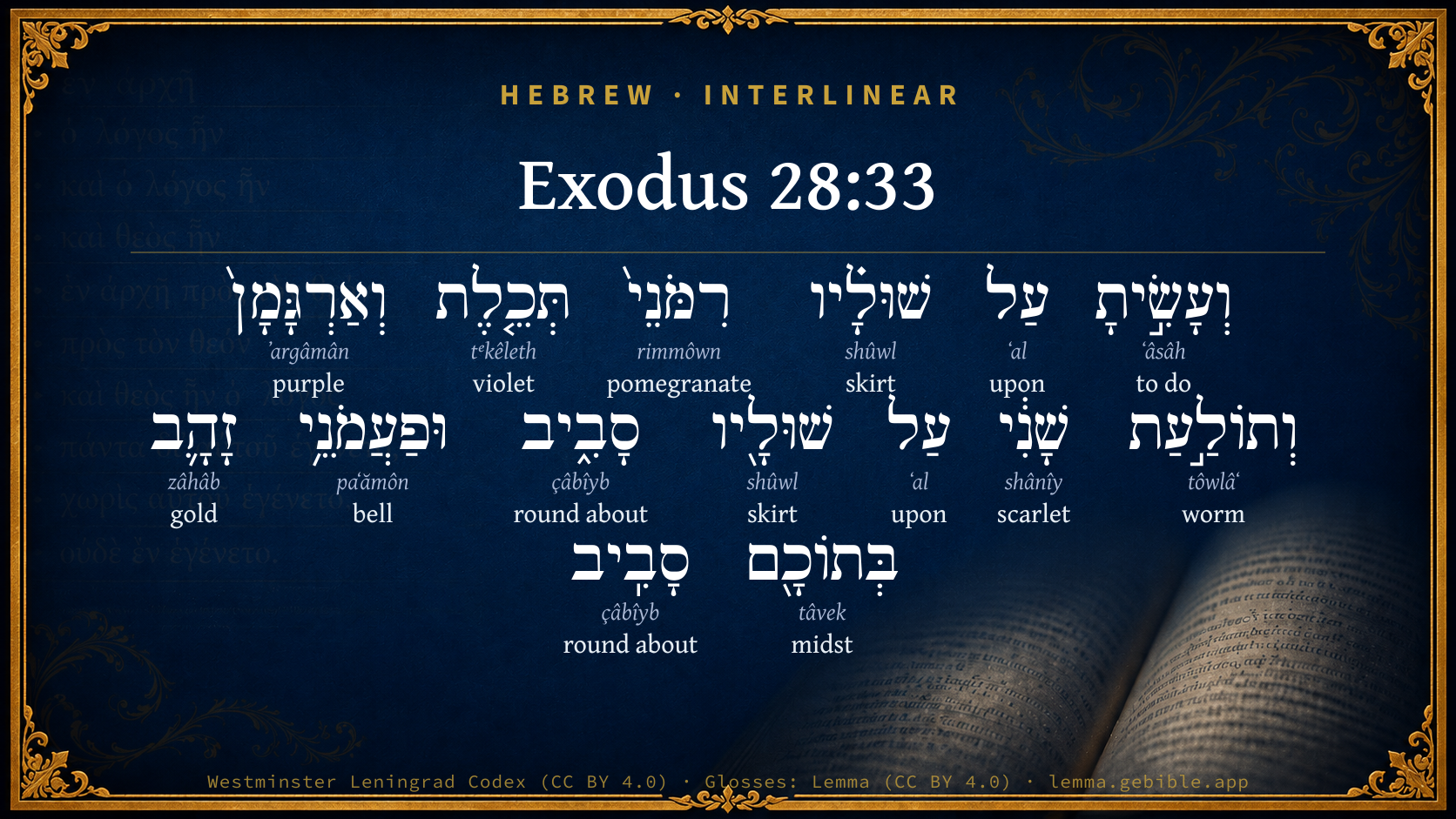
Hebrew (Westminster Leningrad Codex) Exodus 28:33 appears in the Hebrew Old Testament. The text above is from the Westminster Leningrad Codex. Each word links to its Strong’s number, a concise gloss, and parsing drawn from the Open Scriptures Hebrew Bible morphology. Click any word for its full Brown-Driver-Briggs (BDB) entry.
Download image
Cite this verse

Exodus 28:33 (World English Bible). Public Domain. Lemma interlinear Bible study tool, https://lemma.gebible.app/v/exodus/28/33.

Show BibTeX & RIS
BibTeX
RIS
English Translation
On its hem you shall make pomegranates of blue, and of purple, and of scarlet, around its hem; and bells of gold between them round about:
World English Bible · Public Domain
Highlights
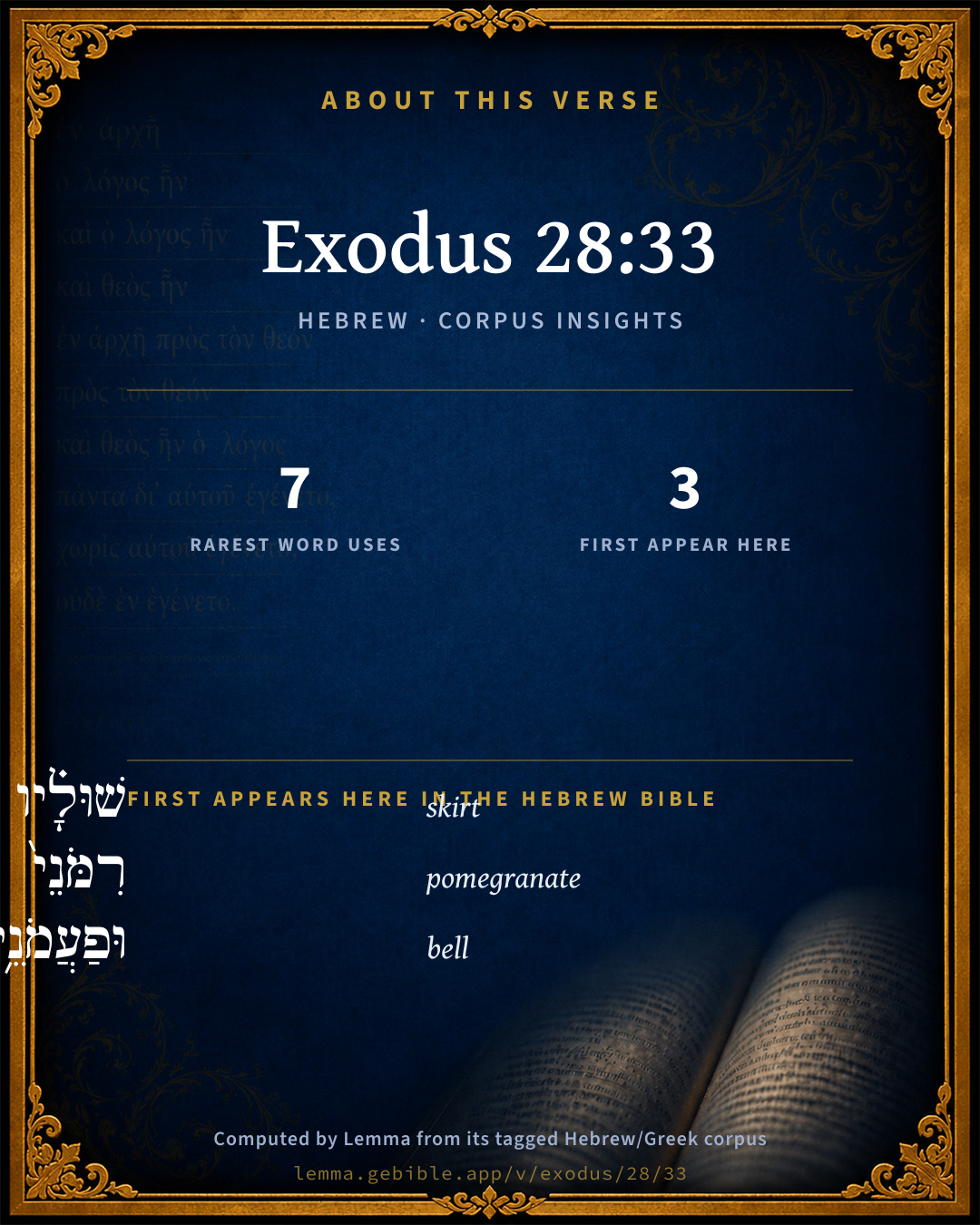
  • 3 first appearances in the Hebrew Bible
Full analysis ↓
Download a study sheet

One document with this verse’s original text, its word-by-word gloss line, the meaning frame, cross-references with their text, attributed commentary, and full source and license credits — printable, and it pastes into notes with its structure intact.

This verse Autodidact and up

Study sheet (.html) Plain text (.txt)

A passage Seminary Student

Up to 50 verses in one chapter. A passage sheet keeps up to 6 commentary sources and 12 cross-references per verse, in the order this page ranks them, and says so on the sheet whenever that leaves anything out. Ask for a single verse and you get the Autodidact verse sheet above.

Everything on this page stays free to read, with no account — the sheet is a download of what is already on screen, not access to it.

Want to remove ads? Support Godless Engineer
Compare translations 3

The same verse in 3 English versions, stacked beneath the original-language interlinear above. Click any original word for its lexicon entry.

Each is an independent rendering of the whole verse — the interlinear is not word-aligned to these translations.

Highlighted words mark where these versions differ — a whole-verse word diff, not a word-by-word alignment.

  • World English Bible Public Domain
    On its hem you shall make pomegranates of blue, and of purple, and of scarlet, around its hem; and bells of gold between them round about:
  • King James Version Public Domain
    And beneath upon the hem of it thou shalt make pomegranates of blue, and of purple, and of scarlet, round about the hem thereof; and bells of gold between them round about:
  • unfoldingWord Literal Text CC BY-SA 4.0
    And on its bottom hem you shall make pomegranates of blue, purple, and worm of scarlet all around on its hem with bells of gold between them all around:

unfoldingWord Literal Text — © unfoldingWord, licensed CC BY-SA 4.0. Word-aligned USFM3 via Door43 (git.door43.org/unfoldingWord/en_ult).

Versions to compare (up to 4)

3 of 4 selected

Show all 18 translations

Every available English version of this verse, each an independent rendering of the whole verse.

  • World English Bible Public Domain
    On its hem you shall make pomegranates of blue, and of purple, and of scarlet, around its hem; and bells of gold between them round about:
  • Berean Standard Bible Public Domain
    Make pomegranates of blue, purple, and scarlet yarn all the way around the lower hem, with gold bells between them,
  • Majority Standard Bible Public Domain
    Make pomegranates of blue, purple, and scarlet yarn all the way around the lower hem, with gold bells between them,
  • King James Version Public Domain
    And beneath upon the hem of it thou shalt make pomegranates of blue, and of purple, and of scarlet, round about the hem thereof; and bells of gold between them round about:
  • American Standard Version (1901) Public Domain
    And upon the skirts of it thou shalt make pomegranates of blue, and of purple, and of scarlet, round about the skirts thereof; and bells of gold between them round about:
  • Revised Version (1885) Public Domain
    And upon the skirts of it thou shalt make pomegranates of blue, and of purple, and of scarlet, round about the skirts thereof; and bells of gold between them round about:
  • Geneva Bible (1599) Public Domain
    And beneath vpon the skirtes thereof thou shalt make pomegranates of blew silke, and purple, and skarlet, round about the skirts thereof, and belles of gold betweene them round about:
  • Douay-Rheims (1899) Public Domain
    And beneath at the feet of the same tunick round about, thou shalt make as it were pomegranates, of violet, and purple, and scarlet twice dyed, with little bells set between:
  • Young's Literal Translation Public Domain
    `And thou hast made on its hem pomegranates of blue, and purple, and scarlet, on its hem round about, and bells of gold in their midst round about;
  • Literal Standard Version CC BY-SA 4.0
    And you have made on its hem pomegranates of blue, and purple, and scarlet, on its hem all around, and bells of gold in their midst all around;
  • Unlocked Literal Bible CC BY-SA 4.0
    On the bottom hem, you must make pomegranates of blue, purple, and scarlet yarn all around. Gold bells must be between them all around.
  • unfoldingWord Literal Text CC BY-SA 4.0
    And on its bottom hem you shall make pomegranates of blue, purple, and worm of scarlet all around on its hem with bells of gold between them all around:
  • Darby Bible Public Domain
    And on the skirts thereof thou shalt make pomegranates of blue, and purple, and scarlet, round about the skirts thereof; and bells of gold between them round about:
  • World Messianic Bible Public Domain
    On its hem you shall make pomegranates of blue, and of purple, and of scarlet, all around its hem; with bells of gold between and around them:
  • Webster's Bible Public Domain
    And beneath, upon the hem of it thou shalt make pomegranates of blue, and of purple, and of scarlet, round about its hem; and bells of gold between them around it.
  • Free Bible Version CC BY-SA 4.0
    Make pomegranates using blue, purple, and crimson thread and attach them all the way around its hem, with gold bells between them,
  • Bible in Basic English Public Domain
    And round the skirts of it put fruits in blue and purple and red, with bells of gold between;
  • JPS Tanakh (1917) Public Domain
    And upon the skirts of it thou shalt make pomegranates of blue, and of purple, and of scarlet, round about the skirts thereof; and bells of gold between them round about:

Literal Standard Version (2020), Covenant Press — licensed CC BY-SA 4.0. Text via the HelloAO Bible API (eBible.org). Unlocked Literal Bible (unfoldingWord) — licensed CC BY-SA 4.0. Text via the HelloAO Bible API (eBible.org). unfoldingWord Literal Text — © unfoldingWord, licensed CC BY-SA 4.0. Word-aligned USFM3 via Door43 (git.door43.org/unfoldingWord/en_ult). Free Bible Version, Dr. Jonathan Gallagher — licensed CC BY-SA 4.0. Text via the HelloAO Bible API (eBible.org).

Word by word

More ways to search: Search by grammar → Find every occurrence → Compare this word →

Practice this passage: Drill this verse → Learn its vocabulary →

וּפַעֲמֹנֵ֥י
paʻămôn
H6472
“and · bells of”
Conjunction + Noun, Common, Masculine, Plural, Construct
Part of Speech
Conjunction + Noun
Type
Common
Gender
Masculine
Number
Plural
State
Construct
Full BDB Definition

Origin: from H6471

TWOT: 1793b

bell - on high priest's robe
  1. וְעָשִׂ֣יתָ ʻâsâh H6213 “and · to do” Conjunction + Verb, Qal, Sequential Perfect, 2nd Person, Masculine, Singular
  2. עַל ʻal H5921 “upon” Preposition
  3. שׁוּלָ֗יו shûwl H7757 “skirts · his” Noun, Common, Masculine, Plural, Construct + Suffix, Personal, 3rd Person, Masculine, Singular
  4. רִמֹּנֵי֙ rimmôwn H7416 “pomegranates of” Noun, Common, Masculine, Plural, Construct
  5. תְּכֵ֤לֶת tᵉkêleth H8504 “violet” Noun, Common, Feminine, Singular, Absolute
  6. וְאַרְגָּמָן֙ ʼargâmân H713 “and · purple” Conjunction + Noun, Common, Masculine, Singular, Absolute
  7. וְתוֹלַ֣עַת tôwlâʻ H8438 “and · worm of” Conjunction + Noun, Common, Feminine, Singular, Construct
  8. שָׁנִ֔י shânîy H8144 “scarlet” Noun, Common, Masculine, Singular, Absolute
  9. עַל ʻal H5921 “upon” Preposition
  10. שׁוּלָ֖יו shûwl H7757 “skirts · his” Noun, Common, Masculine, Plural, Construct + Suffix, Personal, 3rd Person, Masculine, Singular
  11. סָבִ֑יב çâbîyb H5439 “round about” Noun, Common, Both, Singular, Absolute
  12. זָהָ֛ב zâhâb H2091 “gold” Noun, Common, Masculine, Singular, Absolute
  13. בְּתוֹכָ֖ם tâvek H8432 “in/at · midst · their” Preposition + Noun, Common, Masculine, Singular, Construct + Suffix, Personal, 3rd Person, Masculine, Plural
  14. סָבִֽיב çâbîyb H5439 “round about” Noun, Common, Both, Singular, Absolute

About this verse

These counts appear in no published source. They are computed here, from the morphology-tagged text and Lemma’s own curated glosses. What Lemma adds →

15
words
12
distinct lemmas
Pentateuch
section

Notable vocabulary

The rarest word here is וּפַעֲמֹנֵ֥י bell H6472 — appearing just 7 times in the whole Hebrew Bible.

First appearance in Scripture

These words make their first canonical appearance in the Hebrew Bible here:

  • שׁוּלָ֗יו skirt H7757
  • רִמֹּנֵי֙ pomegranate H7416
  • וּפַעֲמֹנֵ֥י bell H6472

Shared distinctive vocabulary

וּפַעֲמֹנֵ֥י bell H6472 occurs in 4 verses of the Hebrew Bible. Also found in:

Grammatical profile

  • 1 verb
  • 12 nouns
  • 2 prepositions

Verb forms

  • וְעָשִׂ֣יתָ Qal · Sequential Perfect

Repetition

Words recur within this verse — often emphatic in Hebrew:

  • עַל upon H5921 ×2
  • שׁוּלָ֗יו skirt H7757 ×2
  • סָבִ֑יב round about H5439 ×2

Hebrew & Septuagint length

In English translation the verse runs 26 words from the Hebrew and 26 from the Septuagint (LXX English) — the same length.

A rough comparison of the two English renderings, which tokenize alike — not a word-level alignment.

Word counts can differ between the Hebrew and the Greek without any difference in meaning — e.g. the Hebrew direct-object marker אֵת has no separate Greek word, and Greek often adds the article ὁ.

Cross-references

4

Topical passages linked to Exodus 28:33 in the Treasury of Scripture Knowledge — connected by theme and wording, ordered by reader-vote popularity; previews shown in the World English Bible.

  • Exodus 39:24–26 They made on the skirts of the robe pomegranates of blue, purple, scarlet, and twined linen.
  • 1 Kings 7:18 So he made the pillars; and there were two rows round about on the one network, to cover the capitals that were on the top of the pillars: and so did he for the other capital.
  • 2 Kings 25:17 The height of the one pillar was eighteen cubits, and a capital of brass was on it; and the height of the capital was three cubits, with network and pomegranates on the capital round about, all of brass: and like to these had the second pillar with network.
  • Zechariah 14:20 In that day there will be on the bells of the horses, "HOLY TO YAHWEH;" and the pots in Yahweh's house will be like the bowls before the altar.

Cross-references courtesy of OpenBible.info (CC BY 4.0).

Hebrew and Greek witnesses Masoretic Hebrew ↔ Greek Septuagint

The same verse in the two great witnesses to the Old Testament, shown verse-for-verse.

These are two independent witnesses, not word-aligned to each other, and the Septuagint is shown in lemma (dictionary) form.

Hebrew Exodus 28:33 Masoretic · Westminster Leningrad Codex

וְעָשִׂ֣יתָ עַל שׁוּלָ֗יו רִמֹּנֵי֙ תְּכֵ֤לֶת וְאַרְגָּמָן֙ וְתוֹלַ֣עַת שָׁנִ֔י עַל שׁוּלָ֖יו סָבִ֑יב וּפַעֲמֹנֵ֥י זָהָ֛ב בְּתוֹכָ֖ם סָבִֽיב

On its hem you shall make pomegranates of blue, and of purple, and of scarlet, around its hem; and bells of gold between them round about:

World English Bible · Public Domain

Greek LXX Exodus 28:33 Septuagint · lemma form

καί ποιέω ἐπί ὁ λῶμα ὁ ὑποδύτης κάτωθεν ὡσεί ἐκἀνθέω ῥοά ῥοίσκος ἐκ ὑάκινθος καί πορφύρα καί κόκκινος διανήθω καί βύσσος κλώθω ἐπί ὁ λῶμα ὁ ὑποδύτης κύκλος ὁ αὐτός δέ εἶδος ῥοίσκος χρυσοῦς καί κώδων ἀνά μέσος οὗτος περικύκλῳ

And you shall put it on the spun blue cloth, and it shall be on the mitre: it shall be in the front of the mitre.

LXX2012 (modern English Septuagint) · Public Domain

On this verse, The Cambridge Bible for Schools and Colleges discusses the Septuagint’s reading. Read the note in Commentary ↓

Hebrew: Westminster Leningrad Codex (CC BY 4.0). Greek: Septuagint (public domain); English from LXX2012 (modern English Septuagint) (Public Domain). How the Septuagint differs from the Hebrew →

Targum (Aramaic paraphrase)

2

The Targum is the ancient Jewish Aramaic paraphrase of the Hebrew Scriptures — an interpretive translation, not the Hebrew text itself. Onkelos (literal) and Pseudo-Jonathan (expansive) render the Torah, and Jonathan the Prophets. Coverage is partial: where no permissively-licensed English translation exists for a verse, only the Aramaic is shown. This is verse-level text, not a word-by-word alignment to the Hebrew.

  1. Targum Onkelos Torah (Genesis–Deuteronomy)
    וְתַעְבֵּד עַל שִׁיפוֹלוֹהִי רִמוֹנֵי תִּכְלָא וְאַרְגְוָנָא וּצְבַע זְהוֹרִי עַל שִׁיפוֹלוֹהִי סְחוֹר סְחוֹר וְזַגִין דְדַהֲבָא בֵּינֵיהוֹן סְחוֹר סְחוֹר:

    (no public-domain English translation for this verse)

    Targum Onkelos — Aramaic: “Onkelos Genesis” (public domain); “Onkelos Exodus” (public domain); “Onkelos Leviticus” (public domain); “Onkelos Numbers” (public domain); “Onkelos Deuteronomy” (public domain). English: “Sefaria Community Translation” (CC0 1.0 (public-domain dedication)); “J.W. Etheridge. The Targums of Onkelos and Jonathan Ben Uzziel on the Pentateuch. London: Longmans, Green, 1862” (public domain). Text via Sefaria.

  2. Targum Pseudo-Jonathan Torah (Genesis–Deuteronomy)
    וְתַעֲבֵיד עַל שִׁיפּוּלוֹי רוּמַנְיַין דְּתִיכְלָא וְאַרְגְּוָונָא וּצְבַע זְהוֹרֵי עַל שִׁיפּוּלוֹי חֲזוֹר חֲזוֹר וְחִיזוּרְיַין דְּדַהֲבָא בְּמִצְעֵיהוֹן חֲזוֹר חֲזוֹר

    And thou shalt make upon the hem of it pomegranates of hyacinth, and purple, and crimson, upon its hem, round about, and bells of gold among them round about.

    Targum Pseudo-Jonathan — Aramaic: “Targum Jonathan on Genesis” (public domain); “Targum Jonathan on Exodus” (public domain); “Targum Jonathan on Leviticus” (public domain); “Targum Jonathan on Numbers” (public domain); “Targum Jonathan on Deuteronomy” (public domain). English: “The Targum of Jonathan ben Uzziel, trans. J. W. Etheridge, London, 1862” (public domain). Text via Sefaria.

Commentary

Notes on Exodus 28:33 from classic Christian and Jewish commentators (each source and its license shown beneath its notes). The classic Christian expositions comment on the surrounding passage and are grouped to its opening verse, so a note may address several verses; the Jewish commentaries on the Tanakh (Rashi and others) are per-verse, so they appear only where the commentator wrote on this verse.

Lemma curates 59 commentaries, every one of them public domain or Creative Commons licensed, each selected and text-cleaned for this edition rather than reprinted as found. About our sources →

Trapp's Complete Commentary

John Trapp

Exo 28:33 And [beneath] upon the hem of it thou shalt make pomegranates [of] blue, and [of] purple, and [of] scarlet, round about the hem thereof; and bells of gold between them round about:

Ver. 33. Pomegranates of blue.] These hanging intermixed with bells, signified the sweet and comfortable effects of Christ’s doctrine; {a} by which we come to be clothed with Christ’s righteousness, and "from his fulness to receive even grace for grace." {Joh 1:16}

{a} Mr Jackson.

John Trapp, A Commentary or Exposition upon All the Books of the Old and New Testament (1647–1656) — public domain. Text from a community e-Sword module.

Ellicott's Commentary for English Readers

(33) Pomegranates.—The pomegranate was a favourite ornament in Assyria, but not in Egypt. It appears from Jos_7:21 that the fabrics of Babylon were carried by the merchants into Syria at a date not much later than this, whence we may conclude that they circulated also in Arabia and Egypt.

Bells of gold.—The bell is also more Assyrian than Egyptian. Its use as an article of priestly costume has no direct parallel, nor are bells known to have been employed in the religious services of any ancient nation. The statement that Persian kings wore bells rests upon no sufficient authority. We seem to have here the introduction of an entirely new religious usage.

A Bible Commentary for English Readers, edited by Charles John Ellicott (1878–1897) — public domain. Text from a community e-Sword module.

The Cambridge Bible for Schools and Colleges

gen. ed. J. J. S. Perowne

33, 34. The skirt was to be adorned with a border of pomegranates (i.e. balls shaped like pomegranates), made of the richly coloured materials mentioned in Exo_25:4; and a small golden bell was to be attached to the hem between each two of the pomegranates. The pomegranate tree was common in Palestine (cf. Num_13:23, Deu_8:8, al.); its fruit, when ripe, is of a bright red colour, about the size of an orange. In v. 33 Sam. LXX. add, and fine twined linen: cf. Exo_38:24.

The Cambridge Bible for Schools and Colleges (gen. ed. J. J. S. Perowne; Cambridge University Press, 1878–1918) — public domain. Text from a community e-Sword module.

John Gill's Exposition

A golden bell and a pomegranate, a golden bell and a pomegranate,.... First a golden bell and then a pomegranate, then a bell and then a pomegranate again, and so on:

upon the hem of the robe round about; all round the hem or skirts of the robe were they placed in this manner: the Targum of Jonathan says, the sum or number of them were seventy one; but Maimonides (c) says there were seventy two, thirty six in each skirt; and so says R. Levi Ben Gersom; but Clemens of Alexandria (d) has increased the number to three hundred and sixty six, according to the days of the year, and thinks they signified the acceptable year of the Lord proclaiming and resounding the great appearance of the Saviour: "golden bells" may denote either the intercession of Christ in heaven, which if not vocal, as on earth, has a speech or sound in it, which is understood: his blood, righteousness, and sacrifice, call aloud for peace and pardon, and it is a sound that is always heard with delight; the matter of them being gold may denote the preciousness and excellency of Christ's intercession, and the duration of it; and being on the hem of the robe shows that Christ's righteousness is that on which his intercession depends, and from whence it has its efficacy: or else these bells may be an emblem of the Gospel, as preached by Christ himself, and by his apostles and ministers, compared to "bells" for sound; the sound of the Gospel being a sound of love, grace, mercy, peace, pardon, righteousness, life, and salvation; a joyful sound, like that of the jubilee, an even and certain one, different from that of the law, and exceeding musical and delightful; and to "golden" bells for the preciousness of it, and its truths, and for its duration; and being on the hem of the robe may signify that in the Gospel the righteousness of Christ is revealed and pointed at, and that faith in this righteousness comes hereby; "the pomegranates" on Aaron might be an emblem of his priesthood, and of the ceremonial law, and of the good things they were shadows and types of; and of Christ himself, and of the virtue, odour, and fragrancy of his sufferings, sacrifice, and intercession; and also of the church, called an orchard of pomegranates, Sol 4:13 consisting of various members, as the pomegranate of various grains; the juice of which the blood of Christ may resemble, in which those members swim and are washed; and who are of a grateful odour to God, and are surrounded by his power and love; and their hanging upon the hem of the robe may signify the acceptableness of them through the righteousness, sacrifice, and mediation of Christ, and the fruits of good works, which both the righteousness of Christ and the Gospel produce; and particularly the bells and pomegranates may signify that sound doctrine and a savoury life and conversation should go together in the priests of the Lord, in the ministers of his word.

(c) Hilchot Cele Hamikdash, c. 9. sect. 4. (d) Stromat. l. 5. p. 564.

John Gill's Exposition of the Whole Bible (1746–1763) — public domain (CC PDM 1.0). Text via the HelloAO Bible API.

Haydock's Catholic Bible Commentary

Bells, to denote the harmony of the universe, (Philo) and that all the actions of a priest ought to give edification. (St. Jerome)

George Leo Haydock (1774–1849), Haydock's Catholic Family Bible and Commentary, 1859 edition — public domain. Excludes Psalms (Douay-Rheims chapter numbering differs from Protestant) and Deuterocanonical books (Catholic canon only).

Matthew Poole's English Annotations

Pomegranates; the figures of pomegranates, but flat and embroidered. By the sound of the

bells the people might be admonished of the work which the priest was employed in, and thereby be provoked to join their affections and devotions with his. These pomegranates and bells might note either,

1. The qualifications of the priest, who was both to declare or give forth the sound of pure and wholesome doctrine, and to adorn his doctrine with the fragrancy and fruitfulness of a good conversation. Or,

2. The glorious achievements of Christ, who caused the sound of his doctrine to be heard by all men, and offered up himself as a sacrifice to God for a sweet-smelling savour, Eph 5:2.

Matthew Poole's English Annotations on the Holy Bible (1683–1685) — public domain. Text from a community e-Sword/MySword module.

The Pulpit Commentary

Upon the hem of it. Literally "at its edge" Pomegranates. Tassels in the shape of pomegranates, of three colours, seem to be intended. An ornament of the kind is common in Assyria, but not in Egypt. Bells of gold between them. The bell is not often found in Egypt, and seems certainly not to have born in common use there. It was, however. often hung round the necks of horses in Assyria (Ancient Monarchies, vol. it. pp. 8, 14, 15, 27), and is so simple an object that its invention was probably very early. The Assyrian bells are shaped almost exactly like our own. as are the classical ones.

The Pulpit Commentary (1880–1919), ed. H.D.M. Spence-Jones & Joseph S. Exell — public domain. Text from a community e-Sword module.

John Wesley's Explanatory Notes

Pomegranates - The figures of Pomegranates, but flat and embroidered.

John Wesley, Explanatory Notes Upon the Whole Bible (1754–1765) — public domain. Text via the GEBible commentary corpus.

unfoldingWord translationNotes

Door43 World Missions Community

General Information:

Yahweh continues to tell Moses what the people do.

pomegranates

A pomegranate is a round fruit with a red outer skin. (See: Translate Unknowns)

a golden bell and a pomegranate

This phrase is repeated to show the pattern of the design on the robe.

The robe is to be on Aaron when he serves

This can be stated in active form. AT: "Aaron must wear the robe when he serves" (See: Active or Passive)

so that its sound can be heard

This can be stated in active form. AT: "so that the bells make a sound" (See: Active or Passive)

This is so that he does not die

It is implied that he would die because he did not obey Yahweh. This can be stated. AT: "As a result, he will not die because of disobeying my instructions" (See: Assumed Knowledge and Implicit Information)

translationWords

Aaron

holy place

Yahweh

unfoldingWord translationNotes — © Distant Shores Media and the Door43 World Missions Community, licensed CC BY-SA 4.0. Source: git.door43.org/Door43/en_tn.

Rashi

Rabbi Shlomo Yitzchaki (Rashi)

רמוני POMEGRANATES — They were round and hollow, similar to that kind of pomegranates which are made like (have the form of) a hen’s egg.

ופעמני זהב AND BELLS OF GOLD — bells, together with the clappers in them.

בתוכם סביב IN THE MIDST OF THEM ROUND ABOUT — i. e. between them (the pomegranates) all the way round the hem: between every two pomegranates there was one bell attached hanging from the hem of the Robe (cf. Zevachim 88b).

Rashi on the Tanakh — English translations: “The Judaica Press complete Tanach with Rashi, translated by A. J. Rosenberg” (CC BY 4.0); “Pentateuch with Rashi's commentary by M. Rosenbaum and A.M. Silbermann, 1929-1934” (public domain); “The Metsudah Tanach series, Lakewood, N.J” (CC BY 4.0); and “The Book of Joshua, Metsudah Publications, 1997” (CC BY 4.0). Text via Sefaria.

Lesson kit

Teaching starters — assembled from the data on this page, not authored interpretation. Every prompt links to the verse data it draws on. Edit before teaching.

Exodus, in the Pentateuch, opens this verse with 15 words (12 distinct Hebrew lemmas). Its most distinctive word is paʻămôn (“bell”). A historical commentator’s framing appears above. Read the whole chapter for the surrounding context.

Discussion questions

  1. How does “bell” (paʻămôn) shape what this verse is saying?
  2. 3 words here appear for the first time in Scripture. What is being introduced at this debut?
  3. Exodus 28:34 shares the word «bell» with this verse. How do the two illuminate each other?
  4. “upon” occurs 2× in this one verse. What is the effect of the repetition?
  5. The translations on this page render this verse differently — a whole-verse word diff, not a word-by-word alignment. What might account for the different wordings?
  6. The verb «וְעָשִׂ֣יתָ» is Qal Sequential Perfect. How does its form color the action?
  7. Reading how Trapp's Complete Commentary and Ellicott's Commentary for English Readers read this verse, where do the two commentators agree and where do they part?

Things to notice

  • 3 words make their first canonical appearance in Scripture here.
  • These translations choose different wording for 11 words in this verse.
  • “upon” occurs 2× in this single verse.
  • 12 distinct Hebrew lemmas span 15 words in this verse.

Reading settings

Reading text

Shown beneath each verse's original-language words.

Old Testament
Old Testament edition

Read the OT as the Masoretic Hebrew (MT) or the Greek Septuagint (LXX).

English shown for the Greek Septuagint (in the Hebrew ↔ Greek comparison).

Comparing translations? Open the Compare panel on any verse page to stack up to four side by side.