
Leviticus 26:12

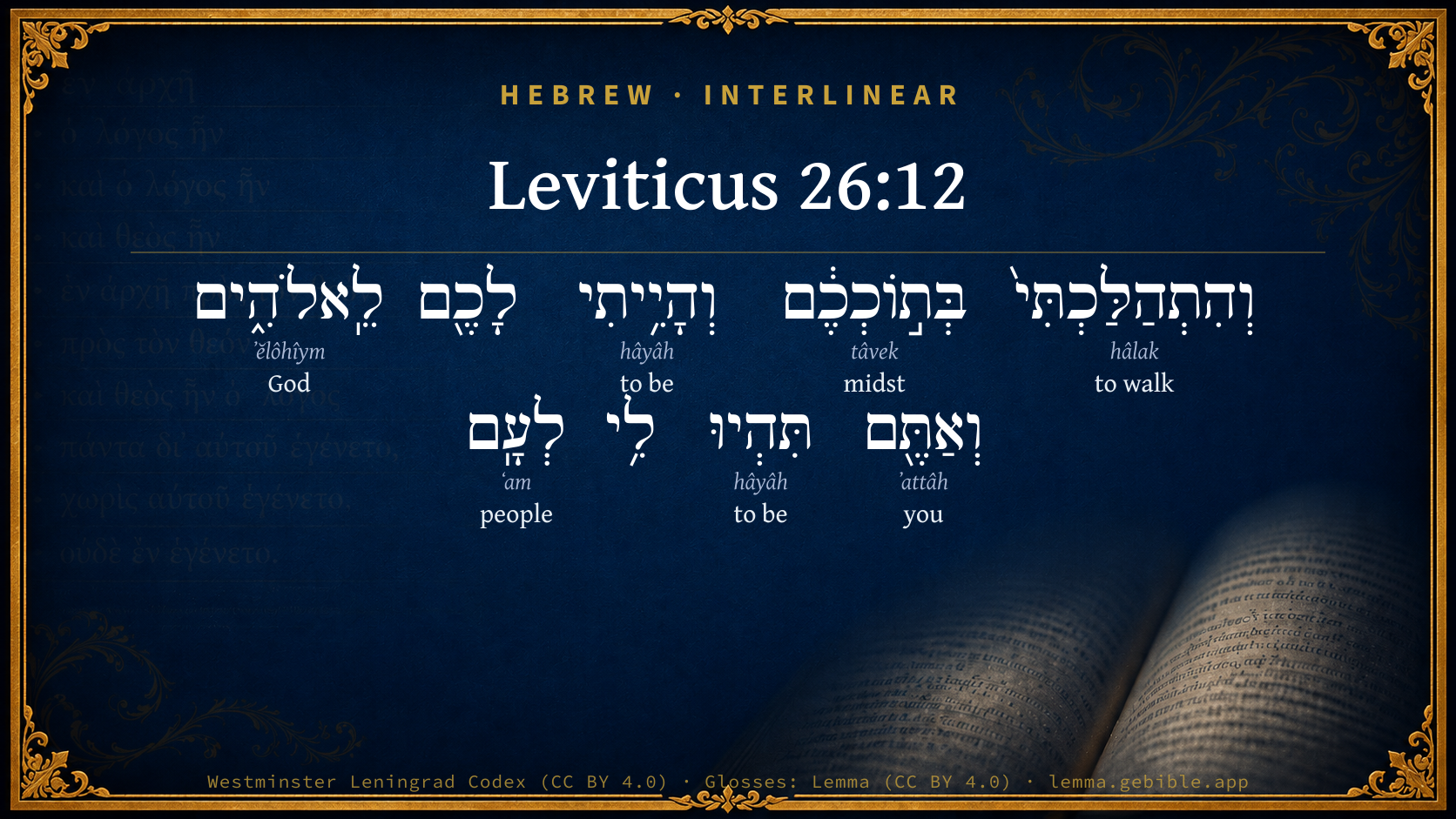
Hebrew (Westminster Leningrad Codex) Leviticus 26:12 appears in the Hebrew Old Testament. The text above is from the Westminster Leningrad Codex. Each word links to its Strong’s number, a concise gloss, and parsing drawn from the Open Scriptures Hebrew Bible morphology. Click any word for its full Brown-Driver-Briggs (BDB) entry.
Download image
Cite this verse

Leviticus 26:12 (World English Bible). Public Domain. Lemma interlinear Bible study tool, https://lemma.gebible.app/v/leviticus/26/12.

Show BibTeX & RIS
BibTeX
RIS
English Translation
I will walk among you, and will be your God, and you will be my people.
World English Bible · Public Domain
Download a study sheet

One document with this verse’s original text, its word-by-word gloss line, the meaning frame, cross-references with their text, attributed commentary, and full source and license credits — printable, and it pastes into notes with its structure intact.

This verse Autodidact and up

Study sheet (.html) Plain text (.txt)

A passage Seminary Student

Up to 50 verses in one chapter. A passage sheet keeps up to 6 commentary sources and 12 cross-references per verse, in the order this page ranks them, and says so on the sheet whenever that leaves anything out. Ask for a single verse and you get the Autodidact verse sheet above.

Everything on this page stays free to read, with no account — the sheet is a download of what is already on screen, not access to it.

Want to remove ads? Support Godless Engineer
Compare translations 3

The same verse in 3 English versions, stacked beneath the original-language interlinear above. Click any original word for its lexicon entry.

Each is an independent rendering of the whole verse — the interlinear is not word-aligned to these translations.

Highlighted words mark where these versions differ — a whole-verse word diff, not a word-by-word alignment.

  • World English Bible Public Domain
    I will walk among you, and will be your God, and you will be my people.
  • King James Version Public Domain
    And I will walk among you, and will be your God, and ye shall be my people.
  • unfoldingWord Literal Text CC BY-SA 4.0
    And I will walk in your midst and be God to you, and you will be a people to me.

unfoldingWord Literal Text — © unfoldingWord, licensed CC BY-SA 4.0. Word-aligned USFM3 via Door43 (git.door43.org/unfoldingWord/en_ult).

Versions to compare (up to 4)

3 of 4 selected

Show all 18 translations

Every available English version of this verse, each an independent rendering of the whole verse.

  • World English Bible Public Domain
    I will walk among you, and will be your God, and you will be my people.
  • Berean Standard Bible Public Domain
    I will walk among you and be your God, and you will be My people.
  • Majority Standard Bible Public Domain
    I will walk among you and be your God, and you will be My people.
  • King James Version Public Domain
    And I will walk among you, and will be your God, and ye shall be my people.
  • American Standard Version (1901) Public Domain
    And I will walk among you, and will be your God, and ye shall be my people.
  • Revised Version (1885) Public Domain
    And I will walk among you, and will be your God, and ye shall be my people.
  • Geneva Bible (1599) Public Domain
    Also I will walke among you, and I wil be your God, and ye shalbe my people.
  • Douay-Rheims (1899) Public Domain
    I will walk among you, and will be your God, and you shall be my people.
  • Young's Literal Translation Public Domain
    and I have walked habitually in your midst, and have become your God, and ye -- ye are become My people;
  • Literal Standard Version CC BY-SA 4.0
    and I have habitually walked in your midst, and have become your God, and you become My people;
  • Unlocked Literal Bible CC BY-SA 4.0
    I will walk among you and be your God, and you will be my people.
  • unfoldingWord Literal Text CC BY-SA 4.0
    And I will walk in your midst and be God to you, and you will be a people to me.
  • Darby Bible Public Domain
    and I will walk among you, and will be your God, and ye shall be to me a people.
  • World Messianic Bible Public Domain
    I will walk among you, and will be your God, and you will be my people.
  • Webster's Bible Public Domain
    And I will walk among you, and will be your God, and ye shall be my people.
  • Free Bible Version CC BY-SA 4.0
    I shall always be right there with you. I will be your God, and you will be my people.
  • Bible in Basic English Public Domain
    And I will be present among you and will be your God and you will be my people.
  • JPS Tanakh (1917) Public Domain
    And I will walk among you, and will be your God, and ye shall be My people.

Literal Standard Version (2020), Covenant Press — licensed CC BY-SA 4.0. Text via the HelloAO Bible API (eBible.org). Unlocked Literal Bible (unfoldingWord) — licensed CC BY-SA 4.0. Text via the HelloAO Bible API (eBible.org). unfoldingWord Literal Text — © unfoldingWord, licensed CC BY-SA 4.0. Word-aligned USFM3 via Door43 (git.door43.org/unfoldingWord/en_ult). Free Bible Version, Dr. Jonathan Gallagher — licensed CC BY-SA 4.0. Text via the HelloAO Bible API (eBible.org).

Word by word

More ways to search: Search by grammar → Find every occurrence → Compare this word →

Practice this passage: Drill this verse → Learn its vocabulary →

בְּת֣וֹכְכֶ֔ם
tâvek
H8432
“in/at · midst · your”
Preposition + Noun, Common, Masculine, Singular, Construct + Suffix, Personal, 2nd Person, Masculine, Plural
Part of Speech
Preposition + Noun
Type
Common
Gender
Masculine
Number
Singular
State
Construct
Full BDB Definition

Origin: from an unused root meaning to sever

TWOT: 2498

midst, middle - midst, middle - into, through (after verbs of motion) - among (of a number of persons) - between (of things arranged by twos) - from among (as to take or separate etc)
  1. וְהִתְהַלַּכְתִּי֙ hâlak H1980 “and · to walk” Conjunction + Verb, Hithpael, Sequential Perfect, 1st Person, Common, Singular
  2. וְהָיִ֥יתִי hâyâh H1961 “and · to be” Conjunction + Verb, Qal, Sequential Perfect, 1st Person, Common, Singular
  3. לֵֽאלֹהִ֑ים ʼĕlôhîym H430 “to/for · God(s)” Preposition + Noun, Common, Masculine, Plural, Absolute
  4. וְאַתֶּ֖ם ʼattâh H859 “and · you” Conjunction + Pronoun, Personal, 2nd Person, Masculine, Plural
  5. תִּהְיוּ hâyâh H1961 “to be” Verb, Qal, Imperfect, 2nd Person, Masculine, Plural
  6. לְעָֽם ʻam H5971 “to/for · people” Preposition + Noun, Common, Masculine, Singular, Absolute

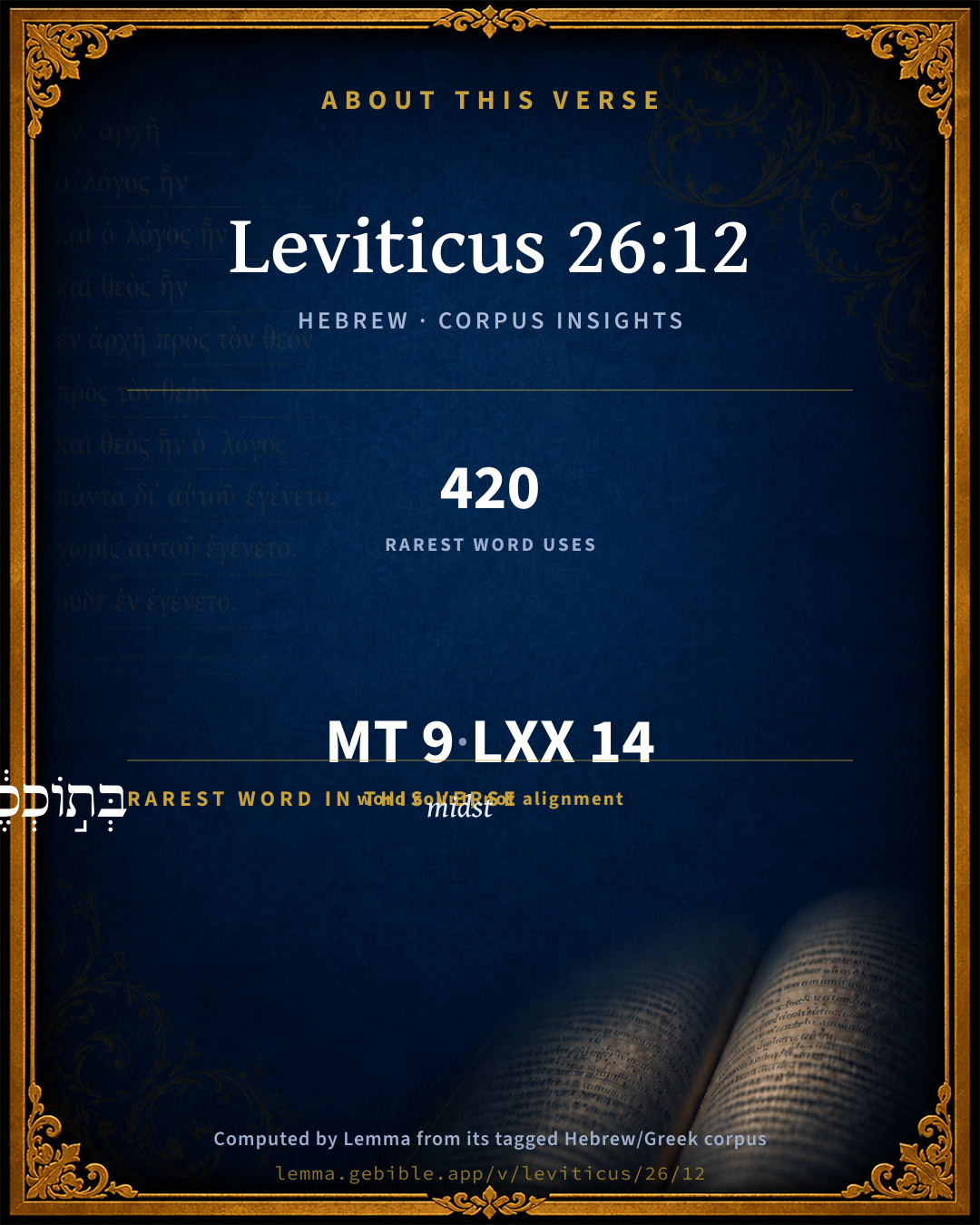
About this verse

These counts appear in no published source. They are computed here, from the morphology-tagged text and Lemma’s own curated glosses. What Lemma adds →

9
words
6
distinct lemmas
Pentateuch
section

Grammatical profile

  • 3 verbs
  • 3 nouns
  • 1 pronoun
  • 2 prepositions

Verb forms

  • וְהִתְהַלַּכְתִּי֙ Hithpael · Sequential Perfect
  • וְהָיִ֥יתִי Qal · Sequential Perfect
  • תִּהְיוּ Qal · Imperfect

Repetition

A word recurs within this verse — often emphatic in Hebrew:

  • וְהָיִ֥יתִי to be H1961 ×2

Hebrew & Septuagint length

In English translation the verse runs 16 words from the Hebrew and 16 from the Septuagint (LXX English) — the same length.

A rough comparison of the two English renderings, which tokenize alike — not a word-level alignment.

Word counts can differ between the Hebrew and the Greek without any difference in meaning — e.g. the Hebrew direct-object marker אֵת has no separate Greek word, and Greek often adds the article ὁ.

In the original languages it is 9 Hebrew tokens and 14 Greek tokens — but the two are counted differently (Hebrew bundles its prefixes and suffixes into one token; the Greek is in lemma form), so that isn’t a like-for-like length.

Cross-references

23

Topical passages linked to Leviticus 26:12 in the Treasury of Scripture Knowledge — connected by theme and wording, ordered by reader-vote popularity; previews shown in the World English Bible.

  • 2 Corinthians 6:16 What agreement has a temple of God with idols? For you are a temple of the living God. Even as God said, "I will dwell in them, and walk in them; and I will be their God, and they will be my people."
  • Jeremiah 30:22 You shall be my people, and I will be your God.
  • Jeremiah 7:23 but this thing I commanded them, saying, Listen to my voice, and I will be your God, and you shall be my people; and walk you in all the way that I command you, that it may be well with you.
  • Exodus 6:7 and I will take you to me for a people, and I will be to you a God; and you shall know that I am Yahweh your God, who brings you out from under the burdens of the Egyptians.
  • Deuteronomy 23:14 for Yahweh your God walks in the midst of your camp, to deliver you, and to give up your enemies before you; therefore shall your camp be holy, that he may not see an unclean thing in you, and turn away from you.
  • Joel 2:27 You will know that I am in the midst of Israel, And that I am Yahweh, your God, and there is no one else; And my people will never again be disappointed.
  • Hebrews 11:16 But now they desire a better country, that is, a heavenly one. Therefore God is not ashamed of them, to be called their God, for he has prepared a city for them.
  • Exodus 19:5–6 Now therefore, if you will indeed obey my voice, and keep my covenant, then you shall be my own possession from among all peoples; for all the earth is mine;
  • Isaiah 41:10 Don't you be afraid, for I am with you; don't be dismayed, for I am your God; I will strengthen you; yes, I will help you; yes, I will uphold you with the right hand of my righteousness.
  • Zechariah 13:9 I will bring the third part into the fire, And will refine them as silver is refined, And will test them like gold is tested. They will call on my name, and I will hear them. I will say, 'It is my people;' And they will say, 'Yahweh is my God.'"
  • Genesis 17:7 I will establish my covenant between me and you and your seed after you throughout their generations for an everlasting covenant, to be a God to you and to your seed after you.
  • Jeremiah 11:4 which I commanded your fathers in the day that I brought them forth out of the land of Egypt, out of the iron furnace, saying, Obey my voice, and do them, according to all which I command you: so shall you be my people, and I will be your God;
  • Ezekiel 11:20 that they may walk in my statutes, and keep my ordinances, and do them: and they shall be my people, and I will be their God.
  • Revelation 21:7 He who overcomes, I will give him these things. I will be his God, and he will be my son.
  • Psalms 50:7 "Hear, my people, and I will speak; Israel, and I will testify against you. I am God, your God.
  • Jeremiah 31:33 But this is the covenant that I will make with the house of Israel after those days, says Yahweh: I will put my law in their inward parts, and in their heart will I write it; and I will be their God, and they shall be my people:
  • Jeremiah 32:38 and they shall be my people, and I will be their God:
  • Isaiah 12:2 Behold, God is my salvation. I will trust, and will not be afraid; for Yah, Yahweh, is my strength and song; and he has become my salvation."
  • Ezekiel 36:38 As the flock for sacrifice, as the flock of Jerusalem in her appointed feasts, so shall the waste cities be filled with flocks of men; and they shall know that I am Yahweh.
  • Genesis 3:8 They heard the voice of Yahweh God walking in the garden in the cool of the day, and the man and his wife hid themselves from the presence of Yahweh God among the trees of the garden.
  • Exodus 3:6 Moreover he said, "I am the God of your father, the God of Abraham, the God of Isaac, and the God of Jacob." Moses hid his face; for he was afraid to look at God.
  • Psalms 68:18–20 You have ascended on high. You have led away captives. You have received gifts among men, Yes, among the rebellious also, that Yah God might dwell there.
  • Matthew 22:32 'I am the God of Abraham, and the God of Isaac, and the God of Jacob?' God is not the God of the dead, but of the living."

Cross-references courtesy of OpenBible.info (CC BY 4.0).

Hebrew and Greek witnesses Masoretic Hebrew ↔ Greek Septuagint

The same verse in the two great witnesses to the Old Testament, shown verse-for-verse.

These are two independent witnesses, not word-aligned to each other, and the Septuagint is shown in lemma (dictionary) form.

Hebrew Leviticus 26:12 Masoretic · Westminster Leningrad Codex

וְהִתְהַלַּכְתִּי֙ בְּת֣וֹכְכֶ֔ם וְהָיִ֥יתִי לָכֶ֖ם לֵֽאלֹהִ֑ים וְאַתֶּ֖ם תִּהְיוּ לִ֥י לְעָֽם

I will walk among you, and will be your God, and you will be my people.

World English Bible · Public Domain

Greek LXX Leviticus 26:12 Septuagint · lemma form

καί ἐν περιπατέω ἐν σύ καί εἰμί σύ θεός καί σύ εἰμί ἐγώ λαός

and I will walk among you, and be your God, and you⌃ shall be my people.

LXX2012 (modern English Septuagint) · Public Domain

Hebrew: Westminster Leningrad Codex (CC BY 4.0). Greek: Septuagint (public domain); English from LXX2012 (modern English Septuagint) (Public Domain). How the Septuagint differs from the Hebrew →

Targum (Aramaic paraphrase)

2

The Targum is the ancient Jewish Aramaic paraphrase of the Hebrew Scriptures — an interpretive translation, not the Hebrew text itself. Onkelos (literal) and Pseudo-Jonathan (expansive) render the Torah, and Jonathan the Prophets. Coverage is partial: where no permissively-licensed English translation exists for a verse, only the Aramaic is shown. This is verse-level text, not a word-by-word alignment to the Hebrew.

  1. Targum Onkelos Torah (Genesis–Deuteronomy)
    וְאַשְׁרֵי שְׁכִינְתִּי בֵּינֵיכוֹן וְאֶהֱוֵי לְכוֹן לֶאֱלָהּ וְאַתּוּן תְּהוֹן קֳדָמַי לְעָם

    (no public-domain English translation for this verse)

    Targum Onkelos — Aramaic: “Onkelos Genesis” (public domain); “Onkelos Exodus” (public domain); “Onkelos Leviticus” (public domain); “Onkelos Numbers” (public domain); “Onkelos Deuteronomy” (public domain). English: “Sefaria Community Translation” (CC0 1.0 (public-domain dedication)); “J.W. Etheridge. The Targums of Onkelos and Jonathan Ben Uzziel on the Pentateuch. London: Longmans, Green, 1862” (public domain). Text via Sefaria.

  2. Targum Pseudo-Jonathan Torah (Genesis–Deuteronomy)
    וְאַשְׁרֵי אִיקַר שְׁכִינְתִּי בֵּינֵיכוֹן וִיהֵי מֵימְרִי לְכוֹן לֶאֱלָהָא פְּרוֹק וְאַתּוּן תְּהוֹן לִשְׁמִי לְאוּמָא קַדִישַׁיָא

    but the Glory of My Shekinah shall dwell among you, and My Word shall be to you for a redeeming God, and you shall be unto My Name for a holy people.

    Targum Pseudo-Jonathan — Aramaic: “Targum Jonathan on Genesis” (public domain); “Targum Jonathan on Exodus” (public domain); “Targum Jonathan on Leviticus” (public domain); “Targum Jonathan on Numbers” (public domain); “Targum Jonathan on Deuteronomy” (public domain). English: “The Targum of Jonathan ben Uzziel, trans. J. W. Etheridge, London, 1862” (public domain). Text via Sefaria.

Commentary

Notes on Leviticus 26:12 from classic Christian and Jewish commentators (each source and its license shown beneath its notes). The classic Christian expositions comment on the surrounding passage and are grouped to its opening verse, so a note may address several verses; the Jewish commentaries on the Tanakh (Rashi and others) are per-verse, so they appear only where the commentator wrote on this verse.

Lemma curates 59 commentaries, every one of them public domain or Creative Commons licensed, each selected and text-cleaned for this edition rather than reprinted as found. About our sources →

Trapp's Complete Commentary

John Trapp

Lev 26:12 And I will walk among you, and will be your God, and ye shall be my people.

Ver. 12. And I will walk.] {See Trapp on "2Co 6:16"}

John Trapp, A Commentary or Exposition upon All the Books of the Old and New Testament (1647–1656) — public domain. Text from a community e-Sword module.

Tyndale Open Study Notes

Tyndale Open Resources

26:12 your God . . . my people: The covenant bound the parties to one another, making each belong to the other.

Tyndale Open Study Notes — © Tyndale Open Resources, licensed CC BY-SA 4.0. Text via the HelloAO Bible API.

Ellicott's Commentary for English Readers

(12) And I will walk among you.—This promise is quoted by St. Paul (2Co_6:16).

A Bible Commentary for English Readers, edited by Charles John Ellicott (1878–1897) — public domain. Text from a community e-Sword module.

The Cambridge Bible for Schools and Colleges

gen. ed. J. J. S. Perowne

12. I will walk among you] Cp. Gen_3:8.

The Cambridge Bible for Schools and Colleges (gen. ed. J. J. S. Perowne; Cambridge University Press, 1878–1918) — public domain. Text from a community e-Sword module.

John Gill's Exposition

I am the Lord your Lord, which brought you forth out of the land of Egypt,.... Who, having done that, was able to fulfil the above promises; and which may be considered as an earnest and pledge of them, as well as be a motive to the Israelites, and an obligation upon them to obey the commandments of God, and walk in his statutes:

that ye should not be their bondmen; this was the end of their being brought out of Egypt, that they might be no longer in a state of bondage to the Egyptians, nor to any other, but to serve the Lord their God, by whom they were delivered; as those who are redeemed by Christ from worse than Egyptian bondage, from sin, Satan, and the law, are redeemed, that they might not be the servants of any, but be a peculiar people, zealous of good works to serve the Lord Christ:

and I have broken the bands of your yoke; which fastened it on their shoulders, that is, set them at full liberty, from the yoke of all their enemies, particularly the Egyptians, who made their lives bitter in hard bondage, making the yoke of it heavy upon them; as Christ has broken the yoke of spiritual enemies from off the shoulders and necks of his people, Isa 10:27,

and made you go upright; who before stooped under the yoke, as well as were of dejected countenances, but now were made to walk in an erect stature, as the Targum of Jonathan, and so Jarchi and Aben Ezra, or in liberty, as Onkelos; see Gal 5:1; and with heads lift up and countenances cheerful.

John Gill's Exposition of the Whole Bible (1746–1763) — public domain (CC PDM 1.0). Text via the HelloAO Bible API.

Matthew Poole's English Annotations

I will walk among you, as I have hitherto done, both by my pillar of cloud and fire, and by my tabernacle, which have walked or gone along with you in all your journeys, and stayed among you in all your stations, to protect, conduct, instruct, and comfort you.

Ye shall be my people; I will own you for that peculiar people which I have singled out of the mass of mankind, to bless you here, and to save you hereafter.

Matthew Poole's English Annotations on the Holy Bible (1683–1685) — public domain. Text from a community e-Sword/MySword module.

Whedon's Commentary on the Bible

Daniel D. Whedon

12. I will walk among you — Here is implied the intimacy of delighted companionship, as Enoch walked with God. Thus Jehovah desired to walk with Israel, and thus he would have walked if the nation had cleaved unto the Lord. “Can two walk together, except they be agreed?”

And be your God — Guidance, protection, sustenance, illumination, sanctification, present and eternal gladness and glory lie in these four short words.

Ye shall be my people — Dignity, honour, sonship, and heirship are wrapped up in this promise. “All things are yours, and ye are Christ’s, and Christ is God’s.”

Daniel D. Whedon (gen. ed.), Commentary on the Old and New Testaments (1874–1909) — public domain. Text from a community e-Sword module.

The Pulpit Commentary

And I will walk among you, and will be your God, and ye shall be my people. These words are quoted by St. Paul as a ground of the holiness required of God"s people. (2Co_6:16)

The Pulpit Commentary (1880–1919), ed. H.D.M. Spence-Jones & Joseph S. Exell — public domain. Text from a community e-Sword module.

John Wesley's Explanatory Notes

I will walk among you - As I have hitherto done, both by my pillar of cloud and fire, and by my tabernacle, which have walked or gone along with you in all your journeys, and staid among you in all your stations, to protect, conduct, instruct, and comfort you. And I will own you for that peculiar people which I have singled out of mankind, to bless you here and to save you hereafter.

John Wesley, Explanatory Notes Upon the Whole Bible (1754–1765) — public domain. Text via the GEBible commentary corpus.

Keil & Delitzsch

C. F. Keil & F. Delitzsch

God's walking in the midst of Israel does not refer to His accompanying and leading the people on their journeyings, but denotes the walking of God in the midst of His people in Canaan itself, whereby He would continually manifest Himself to the nation as its God and make them a people of possession, bringing them into closer and closer fellowship with Himself, and giving them all the saving blessings of His covenant of grace.

Keil & Delitzsch — Biblical Commentary on the Old Testament (1861–1891) — public domain (CC PDM 1.0). Text via the HelloAO Bible API. (Old Testament only.)

Rashi

Rabbi Shlomo Yitzchaki (Rashi)

והתהלכתי בתוככם AND I WILL WALK AMONG YOU — I will, as it were, walk with you in the Garden of Eden as though I were one of yourselves and you will not be frightened of Me. One might think that this implies: you will not fear (reverence) Me! Scripture however states, “but I will be your God” (Sifra, Bechukotai, Chapter 3 3-4).

Rashi on the Tanakh — English translations: “The Judaica Press complete Tanach with Rashi, translated by A. J. Rosenberg” (CC BY 4.0); “Pentateuch with Rashi's commentary by M. Rosenbaum and A.M. Silbermann, 1929-1934” (public domain); “The Metsudah Tanach series, Lakewood, N.J” (CC BY 4.0); and “The Book of Joshua, Metsudah Publications, 1997” (CC BY 4.0). Text via Sefaria.

Ramban (Nachmanides)

Rabbi Moshe ben Nachman (Ramban / Nachmanides)

AND I WILL WALK AMONG YOU. This means that My conduct with you will be well-known, as when a monarch walks in the midst of his army, supplying them with all their needs.This then is the way of the simple sense of the words of the covenant, and it is true, for so indeed will He do with them. Now Scripture did not mention here the reward of the existence of the souls in the World of Souls,. and in the World to Come after the resurrection, for their existence [following the death of the body] is a matter of necessity in the way of creation, as I have explained in [the section on] excisions, this form of punishment being the “cutting off” of the guilty ones [from life eternal], and all the other [souls] will continue to exist on account of their fundamental nature inherent in their creation. But by way of the Truth, [the mystic teachings of the Cabala], these blessings [in this section] are also heavenly blessings in matters above, as I have explained. Thus, And I will give peace in the Land; and My soul shall not abhor you, and similarly, and I will walk among you, allude to the [Divine] attribute which our Rabbis have called Shechinah (the Divine Presence), of [the root found in the expression], And I will set ‘mishkani’ (My dwelling) among you, and as the Rabbis say: “The Shechinah (Divine Presence) dwells with Israel.” And in Bereshith Rabbah they have said: “The Divine Presence was mainly in the lower world.” Thus the Garden of Eden [i.e., the World of Souls] and the World to Come [after the resurrection] are mentioned here (Verse 11); and I will give peace in the Land (Verse 6), as hinted to above (Ma’or V’shamesh). to those who know [the way of Truth].Now these blessings in their perfection will only occur when all Israel do the will of their Father [in heaven], and when [as a result of this] the structure of heaven and earth will be perfect, in accordance with its [original] plan. There are no other blessings in the Torah as perfect as these, which constitute the words of the covenant and the conditions between the Holy One, blessed be He, and us.Know, [however], that Israel never attained these blessings in their perfection, neither many of them [i.e., as a people] nor as individuals, since their merits were never sufficient for them, just as the Rabbis have said with reference to David’s [captains]: “And he [Adino the Eznite] lifted up his spear against eight hundred, whom he slew at one time. But he [David] was troubled about the [remaining] two hundred. (Deuteronomy 32:30) (Moed Katan 16b). Thereupon a Divine Voice came forth and said to him, Save only in the matter of Uriah the Hittite.” Therefore you will find our Rabbis of blessed memory speaking of [the fulfillment of] these verses [containing the blessings] in the future [which is yet] to come. [Thus they have said]. 2:2. “This teaches that a child of Israel will in the future stretch forth [his hand into the pupil of an adder’s eye, and remove his gall through his mouth.” Similarly they have said]:, 3:3. “The Holy One, blessed be He, will in the future walk about with the righteous in the World to Come.” This is because [these blessings] have not yet been fulfilled, but they will be fulfilled for us at the time of [our] perfection.

Ramban (Nachmanides) on the Tanakh — English translation: “Commentary on the Torah by Ramban (Nachmanides). Translated and annotated by Charles B. Chavel. New York, Shilo Pub. House, 1971-1976” (CC BY 4.0). Text via Sefaria.

Sforno

Rabbi Ovadia Sforno

I will walk among you. Walking connotes someone who walks to and fro and not to any place in particular. If so, when it says here “I will walk among you” it means the influence of Hashem’s Honor will not descend to one place alone. This is the way it was concerning the Mishkan and the Beit HaMikdash, as it says (Shemos 25:8), “They shall make a Sanctuary for Me, and I will dwell in their midst.” This means I will dwell with you in this manner and in this place alone, as clearly expressed in the verses (ibid. 30:6), “Where I will meet with you there,” and (ibid. 25:22), “I will set My meetings with you there.” However, here the Torah emphasizes: I will walk among you and My Honor shall be seen in every place you will be, for in fact in every place the generation’s righteous men will be is holy, My lofty Sanctuary.

Sforno on the Tanakh — English translation: “Yalkut, Sifsei Chachomim Chumash, Metsudah Publications, 2009” (CC BY 4.0). Text via Sefaria.

Lesson kit

Teaching starters — assembled from the data on this page, not authored interpretation. Every prompt links to the verse data it draws on. Edit before teaching.

Leviticus, in the Pentateuch, opens this verse with 9 words (6 distinct Hebrew lemmas). Its most distinctive word is tâvek (“midst”). A historical commentator’s framing appears above. Read the whole chapter for the surrounding context.

Discussion questions

  1. How does “midst” (tâvek) shape what this verse is saying?
  2. How does 2 Corinthians 6:16, which shares this passage’s theme, read alongside this verse?
  3. What does the repetition of “to be” (2× in this one verse) do in this verse?
  4. These translations render this verse differently. What is at stake in choosing one wording over another?
  5. «וְהִתְהַלַּכְתִּי֙» is a Hithpael Sequential Perfect verb. How does that grammatical form shape the action described?
  6. Compare how Trapp's Complete Commentary and Tyndale Open Study Notes read this verse. Where do they agree or differ?

Things to notice

Reading settings

Reading text

Shown beneath each verse's original-language words.

Old Testament
Old Testament edition

Read the OT as the Masoretic Hebrew (MT) or the Greek Septuagint (LXX).

English shown for the Greek Septuagint (in the Hebrew ↔ Greek comparison).

Comparing translations? Open the Compare panel on any verse page to stack up to four side by side.