
1 Kings 11:20

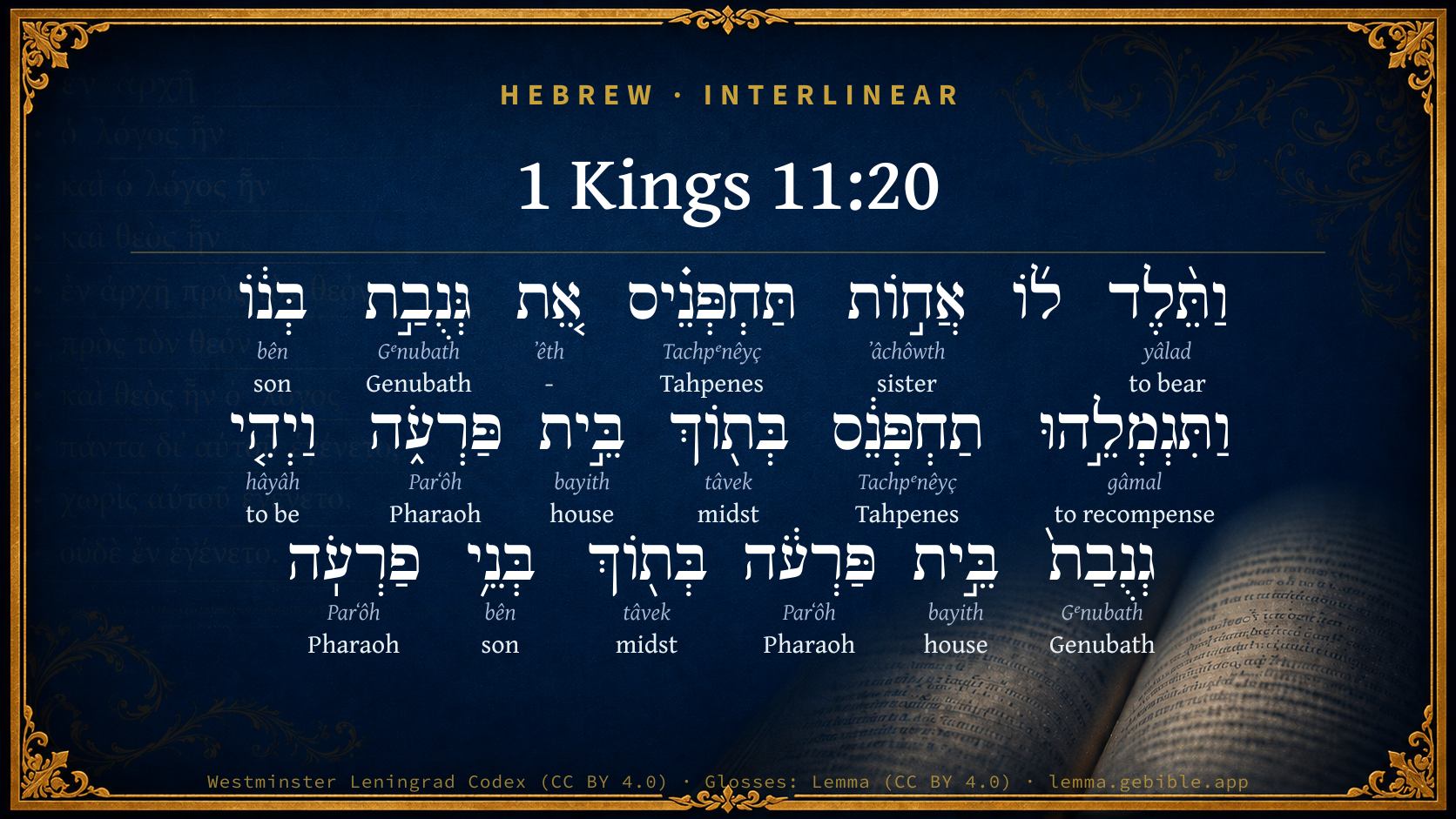
Hebrew (Westminster Leningrad Codex) 1 Kings 11:20 appears in the Hebrew Old Testament. The text above is from the Westminster Leningrad Codex. Each word links to its Strong’s number, a concise gloss, and parsing drawn from the Open Scriptures Hebrew Bible morphology. Click any word for its full Brown-Driver-Briggs (BDB) entry.
Download image
Cite this verse

1 Kings 11:20 (World English Bible). Public Domain. Lemma interlinear Bible study tool, https://lemma.gebible.app/v/1-kings/11/20.

Show BibTeX & RIS
BibTeX
RIS
English Translation
The sister of Tahpenes bore him Genubath his son, whom Tahpenes weaned in Pharaoh's house; and Genubath was in Pharaoh's house among the sons of Pharaoh.
World English Bible · Public Domain
Highlights Full analysis ↓
Download a study sheet

One document with this verse’s original text, its word-by-word gloss line, the meaning frame, cross-references with their text, attributed commentary, and full source and license credits — printable, and it pastes into notes with its structure intact.

This verse Autodidact and up

Study sheet (.html) Plain text (.txt)

A passage Seminary Student

Up to 50 verses in one chapter. A passage sheet keeps up to 6 commentary sources and 12 cross-references per verse, in the order this page ranks them, and says so on the sheet whenever that leaves anything out. Ask for a single verse and you get the Autodidact verse sheet above.

Everything on this page stays free to read, with no account — the sheet is a download of what is already on screen, not access to it.

Want to remove ads? Support Godless Engineer
Compare translations 3

The same verse in 3 English versions, stacked beneath the original-language interlinear above. Click any original word for its lexicon entry.

Each is an independent rendering of the whole verse — the interlinear is not word-aligned to these translations.

Highlighted words mark where these versions differ — a whole-verse word diff, not a word-by-word alignment.

  • World English Bible Public Domain
    The sister of Tahpenes bore him Genubath his son, whom Tahpenes weaned in Pharaoh's house; and Genubath was in Pharaoh's house among the sons of Pharaoh.
  • King James Version Public Domain
    And the sister of Tahpenes bare him Genubath his son, whom Tahpenes weaned in Pharaoh's house: and Genubath was in Pharaoh's household among the sons of Pharaoh.
  • unfoldingWord Literal Text CC BY-SA 4.0
    And the sister of Tahpenes bore to him Genubath, his son, and Tahpenes weaned him in the midst of the house of Pharaoh. And Genubath was in the house of Pharaoh in the midst of the sons of Pharaoh.

unfoldingWord Literal Text — © unfoldingWord, licensed CC BY-SA 4.0. Word-aligned USFM3 via Door43 (git.door43.org/unfoldingWord/en_ult).

Versions to compare (up to 4)

3 of 4 selected

Show all 18 translations

Every available English version of this verse, each an independent rendering of the whole verse.

  • World English Bible Public Domain
    The sister of Tahpenes bore him Genubath his son, whom Tahpenes weaned in Pharaoh's house; and Genubath was in Pharaoh's house among the sons of Pharaoh.
  • Berean Standard Bible Public Domain
    And the sister of Tahpenes bore Hadad a son named Genubath. Tahpenes herself weaned him in Pharaoh’s palace, and Genubath lived there among the sons of Pharaoh.
  • Majority Standard Bible Public Domain
    And the sister of Tahpenes bore Hadad a son named Genubath. Tahpenes herself weaned him in Pharaoh’s palace, and Genubath lived there among the sons of Pharaoh.
  • King James Version Public Domain
    And the sister of Tahpenes bare him Genubath his son, whom Tahpenes weaned in Pharaoh's house: and Genubath was in Pharaoh's household among the sons of Pharaoh.
  • American Standard Version (1901) Public Domain
    And the sister of Tahpenes bare him Genubath his son, whom Tahpenes weaned in Pharaoh's house; and Genubath was in Pharaoh's house among the sons of Pharaoh.
  • Revised Version (1885) Public Domain
    And the sister of Tahpenes bare him Genubath his son, whom Tahpenes weaned in Pharaoh’s house: and Genubath was in Pharaoh’s house among the sons of Pharaoh.
  • Geneva Bible (1599) Public Domain
    And the sister of Tahpenes bare him Genubath his sonne, whome Tahpenes wayned in Pharaohs house: and Genubath was in Pharaohs house among the sonnes of Pharaoh.
  • Douay-Rheims (1899) Public Domain
    And the sister of Taphnes bore him his son Genubath, and Taphnes brought him up in the house of Pharao: and Genubath dwelt with Pharao among his children.
  • Young's Literal Translation Public Domain
    and the sister of Tahpenes beareth to him Genubath his son, and Tahpenes weaneth him within the house of Pharaoh, and Genubath is in the house of Pharaoh in the midst of the sons of Pharaoh.
  • Literal Standard Version CC BY-SA 4.0
    and the sister of Tahpenes bears to him his son Genubath, and Tahpenes weans him within the house of Pharaoh, and Genubath is in the house of Pharaoh in the midst of the sons of Pharaoh.
  • Unlocked Literal Bible CC BY-SA 4.0
    The sister of Tahpenes gave birth to Hadad's son. They named him Genubath. Tahpenes raised him in Pharaoh's palace. So Genubath lived in Pharaoh's palace among the children of Pharaoh.
  • unfoldingWord Literal Text CC BY-SA 4.0
    And the sister of Tahpenes bore to him Genubath, his son, and Tahpenes weaned him in the midst of the house of Pharaoh. And Genubath was in the house of Pharaoh in the midst of the sons of Pharaoh.
  • Darby Bible Public Domain
    And the sister of Tahpenes bore him Genubath his son; and Tahpenes brought him up in Pharaoh's house; and Genubath was in Pharaoh's household, among the sons of Pharaoh.
  • World Messianic Bible Public Domain
    The sister of Tahpenes bore him Genubath his son, whom Tahpenes weaned in Pharaoh’s house; and Genubath was in Pharaoh’s house among the sons of Pharaoh.
  • Webster's Bible Public Domain
    And the sister of Tahpenes bore him Genubath his son, whom Tahpenes weaned in Pharaoh's house: and Genubath was in Pharaoh's household among the sons of Pharaoh.
  • Free Bible Version CC BY-SA 4.0
    She gave birth to his son called Genubath. Tahpenes brought him up in Pharaoh's palace with Pharaoh's own children.
  • Bible in Basic English Public Domain
    And the sister of Tahpenes had a son by him, Genubath, whom Tahpenes took care of in Pharaoh's house; and Genubath was living in Pharaoh's house among Pharaoh's sons.
  • JPS Tanakh (1917) Public Domain
    And the sister of Tahpenes bore him Genubath his son, whom Tahpenes weaned in Pharaoh's house; and Genubath was in Pharaoh's house among the sons of Pharaoh.

Literal Standard Version (2020), Covenant Press — licensed CC BY-SA 4.0. Text via the HelloAO Bible API (eBible.org). Unlocked Literal Bible (unfoldingWord) — licensed CC BY-SA 4.0. Text via the HelloAO Bible API (eBible.org). unfoldingWord Literal Text — © unfoldingWord, licensed CC BY-SA 4.0. Word-aligned USFM3 via Door43 (git.door43.org/unfoldingWord/en_ult). Free Bible Version, Dr. Jonathan Gallagher — licensed CC BY-SA 4.0. Text via the HelloAO Bible API (eBible.org).

Word by word

More ways to search: Search by grammar → Find every occurrence → Compare this word →

Practice this passage: Drill this verse → Learn its vocabulary →

גְּנֻבַ֣ת
Gᵉnubath
H1592
“Genubath”
Noun, Proper
Part of Speech
Noun
Type
Proper
Full BDB Definition

Origin: from H1589

TWOT: None

Genubath = "theft" - son of Hadad, an Edomite of the royal family, by an Egyptian princess, the sister of Tahpenes, the queen of the Pharaoh who governed Egypt in the latter part of the reign of David
  1. וַתֵּ֨לֶד yâlad H3205 “and · to bear” Conjunction + Verb, Qal, Sequential Imperfect, 3rd Person, Feminine, Singular
  2. אֲח֣וֹת ʼâchôwth H269 “sister of” Noun, Common, Feminine, Singular, Construct
  3. תַּחְפְּנֵ֗יס Tachpᵉnêyç H8472 “Tahpenes” Noun, Proper
  4. אֵ֚ת ʼêth H853 “-” Particle, Direct Object
  5. בְּנ֔וֹ bên H1121 “son · his” Noun, Common, Masculine, Singular, Construct + Suffix, Personal, 3rd Person, Masculine, Singular
  6. וַתִּגְמְלֵ֣הוּ gâmal H1580 “and · to recompense · him” Conjunction + Verb, Qal, Sequential Imperfect, 3rd Person, Feminine, Singular + Suffix, Personal, 3rd Person, Masculine, Singular
  7. תַחְפְּנֵ֔ס Tachpᵉnêyç H8472 “Tahpenes” Noun, Proper
  8. בְּת֖וֹךְ tâvek H8432 “in/at · midst of” Preposition + Noun, Common, Masculine, Singular, Construct
  9. בֵּ֣ית bayith H1004 “house of” Noun, Common, Masculine, Singular, Construct
  10. פַּרְעֹ֑ה Parʻôh H6547 “Pharaoh” Noun, Proper
  11. וַיְהִ֤י hâyâh H1961 “and · to be” Conjunction + Verb, Qal, Sequential Imperfect, 3rd Person, Masculine, Singular
  12. גְנֻבַת֙ Gᵉnubath H1592 “Genubath” Noun, Proper
  13. בֵּ֣ית bayith H1004 “house of” Noun, Common, Masculine, Singular, Construct
  14. פַּרְעֹ֔ה Parʻôh H6547 “Pharaoh” Noun, Proper
  15. בְּת֖וֹךְ tâvek H8432 “in/at · midst of” Preposition + Noun, Common, Masculine, Singular, Construct
  16. בְּנֵ֥י bên H1121 “sons of” Noun, Common, Masculine, Plural, Construct
  17. פַרְעֹֽה Parʻôh H6547 “Pharaoh” Noun, Proper

About this verse

These counts appear in no published source. They are computed here, from the morphology-tagged text and Lemma’s own curated glosses. What Lemma adds →

19
words
11
distinct lemmas
Historical
section

Notable vocabulary

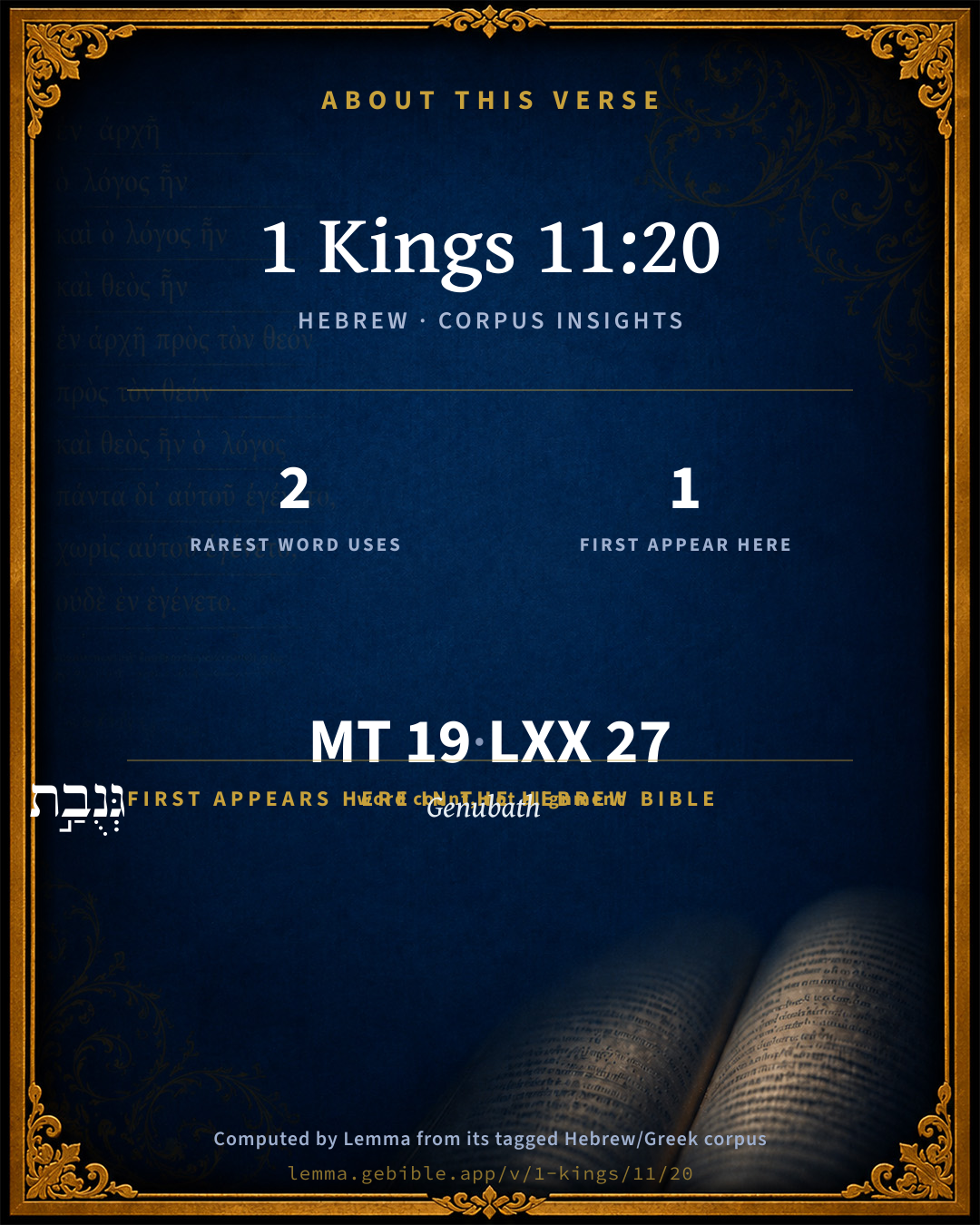
The rarest word here is גְּנֻבַ֣ת Genubath H1592 — appearing just 2 times in the whole Hebrew Bible.

First appearance in Scripture

This word makes its first canonical appearance in the Hebrew Bible here:

  • גְּנֻבַ֣ת Genubath H1592

Grammatical profile

  • 3 verbs
  • 14 nouns
  • 1 preposition
  • 1 particle

Verb forms

  • וַתֵּ֨לֶד Qal · Sequential Imperfect
  • וַתִּגְמְלֵ֣הוּ Qal · Sequential Imperfect
  • וַיְהִ֤י Qal · Sequential Imperfect

Repetition

Words recur within this verse — often emphatic in Hebrew:

  • פַּרְעֹ֑ה Pharaoh H6547 ×3
  • תַּחְפְּנֵ֗יס Tahpenes H8472 ×2
  • גְּנֻבַ֣ת Genubath H1592 ×2
  • בְּנ֔וֹ son H1121 ×2
  • בְּת֖וֹךְ midst H8432 ×2
  • בֵּ֣ית house H1004 ×2

Hebrew & Septuagint length

In English translation the verse runs 26 words from the Hebrew and 38 from the Septuagint (LXX English) — the Septuagint runs noticeably longer here. See the side-by-side →

A rough comparison of the two English renderings, which tokenize alike — not a word-level alignment.

Word counts can differ between the Hebrew and the Greek without any difference in meaning — e.g. the Hebrew direct-object marker אֵת has no separate Greek word, and Greek often adds the article ὁ.

In the original languages it is 19 Hebrew tokens and 27 Greek tokens — but the two are counted differently (Hebrew bundles its prefixes and suffixes into one token; the Greek is in lemma form), so that isn’t a like-for-like length.

Cross-references

2

Topical passages linked to 1 Kings 11:20 in the Treasury of Scripture Knowledge — connected by theme and wording, ordered by reader-vote popularity; previews shown in the World English Bible.

  • Genesis 21:7 She said, "Who would have said to Abraham, that Sarah would nurse children? For I have borne him a son in his old age."
  • 1 Samuel 1:24 When she had weaned him, she took him up with her, with three bulls, and one ephah of meal, and a bottle of wine, and brought him to the house of Yahweh in Shiloh: and the child was young.

Cross-references courtesy of OpenBible.info (CC BY 4.0).

Hebrew and Greek witnesses Masoretic Hebrew ↔ Greek Septuagint

The same verse in the two great witnesses to the Old Testament, shown verse-for-verse.

Here the Septuagint runs noticeably longer than the Hebrew — LXX2012 (modern English Septuagint) 38 words vs World English Bible 26. A rough length comparison of the two English translations, not a word-level alignment — read both below.

These are two independent witnesses, not word-aligned to each other, and the Septuagint is shown in lemma (dictionary) form.

Hebrew 1 Kings 11:20 Masoretic · Westminster Leningrad Codex

וַתֵּ֨לֶד ל֜וֹ אֲח֣וֹת תַּחְפְּנֵ֗יס אֵ֚ת גְּנֻבַ֣ת בְּנ֔וֹ וַתִּגְמְלֵ֣הוּ תַחְפְּנֵ֔ס בְּת֖וֹךְ בֵּ֣ית פַּרְעֹ֑ה וַיְהִ֤י גְנֻבַת֙ בֵּ֣ית פַּרְעֹ֔ה בְּת֖וֹךְ בְּנֵ֥י פַרְעֹֽה

The sister of Tahpenes bore him Genubath his son, whom Tahpenes weaned in Pharaoh's house; and Genubath was in Pharaoh's house among the sons of Pharaoh.

World English Bible · Public Domain

Greek LXX 1 Kings 11:20 Septuagint · lemma form

καί τίκτω αὐτός ὁ ἀδελφή θεκεμινα ὁ αδερ ὁ γανηβαθ υἱός αὐτός καί ἐκτρέφω αὐτός θεκεμινα ἐν μέσος υἱός φαραώ καί εἰμί γανηβαθ ἐν μέσος υἱός φαραώ

And the sister of Thekemina bore to him, even to Ader, Ganebath her son; and Thekemina brought him up in the midst of the sons of Pharao, and Ganebath was in the midst of the sons of Pharao.

LXX2012 (modern English Septuagint) · Public Domain

Hebrew: Westminster Leningrad Codex (CC BY 4.0). Greek: Septuagint (public domain); English from LXX2012 (modern English Septuagint) (Public Domain). How the Septuagint differs from the Hebrew →

Targum (Aramaic paraphrase)

1

The Targum is the ancient Jewish Aramaic paraphrase of the Hebrew Scriptures — an interpretive translation, not the Hebrew text itself. Onkelos (literal) and Pseudo-Jonathan (expansive) render the Torah, and Jonathan the Prophets. Coverage is partial: where no permissively-licensed English translation exists for a verse, only the Aramaic is shown. This is verse-level text, not a word-by-word alignment to the Hebrew.

  1. Targum Jonathan Prophets (Joshua–Malachi)
    וִילֵידַת לֵיהּ אֲחָתָא דְתַחְפְּנֵיס יַת גְנוּבַת בְּרֵיהּ וַחֲסַלְתֵּיהּ תַּחְפְּנֵס בְּגוֹ בֵּית פַּרְעֹה וַהֲוָה גְנוּבַת בְּבֵּית פַּרְעֹה בְּגוֹ בְּנֵי פַרְעֹה:

    (no public-domain English translation for this verse)

    Targum Jonathan — Aramaic: “Mikraot Gedolot” (public domain). English: “Sefaria Community Translation” (CC0 1.0 (public-domain dedication)); “London "Chaldee Paraphrase," 1871” (public domain). Text via Sefaria.

Commentary

Notes on 1 Kings 11:20 from classic Christian and Jewish commentators (each source and its license shown beneath its notes). The classic Christian expositions comment on the surrounding passage and are grouped to its opening verse, so a note may address several verses; the Jewish commentaries on the Tanakh (Rashi and others) are per-verse, so they appear only where the commentator wrote on this verse.

Lemma curates 59 commentaries, every one of them public domain or Creative Commons licensed, each selected and text-cleaned for this edition rather than reprinted as found. About our sources →

Trapp's Complete Commentary

John Trapp

1Ki 11:20 And the sister of Tahpenes bare him Genubath his son, whom Tahpenes weaned in Pharaoh’s house: and Genubath was in Pharaoh’s household among the sons of Pharaoh.

Ver. 20. Whom Taphenes weaned in Pharaoh’s house.] This implieth, saith an interpreter, that though she was a princess, yet she gave suck to her child, as Gen 22:1; Gen 22:8.

John Trapp, A Commentary or Exposition upon All the Books of the Old and New Testament (1647–1656) — public domain. Text from a community e-Sword module.

Ellicott's Commentary for English Readers

(20) Genubath is similarly unknown. The weaning in the house of Pharaoh, no doubt with the customary festival (comp. Gen_20:18), indicated the admittance of the child into the royal family of Egypt.

A Bible Commentary for English Readers, edited by Charles John Ellicott (1878–1897) — public domain. Text from a community e-Sword module.

The Cambridge Bible for Schools and Colleges

gen. ed. J. J. S. Perowne

20. weaned] The weaning of a child was a great event in Eastern families, and an occasion of much rejoicing. Abraham made a feast (Gen_21:8) the same day that Isaac was weaned. This may account for the part taken by the queen in this event.

The Cambridge Bible for Schools and Colleges (gen. ed. J. J. S. Perowne; Cambridge University Press, 1878–1918) — public domain. Text from a community e-Sword module.

John Gill's Exposition

And when Hadad heard in Egypt that David slept with his fathers,.... Was dead and buried, as the death of princes is soon known in other countries, and especially a king of such fame as David:

and that Joab the captain of the host was dead: whose name might be terrible to Hadad, because of the slaughter of men he had made in his country:

Hadad said unto Pharaoh, let me depart, that I may go to mine own country; with a view and an hope to recover it, now David and Joab were dead.

John Gill's Exposition of the Whole Bible (1746–1763) — public domain (CC PDM 1.0). Text via the HelloAO Bible API.

The Pulpit Commentary

And the sister of Tahpenes bare him Genubath his son otherwise unknown, whom Tahpenes weaned in Pharaoh"s house A significant token of his adoption into the royal family. The weaning, which generally took place in the second, sometimes third, (RAPC 2Ma 7:27) year,was clearly a much more marked occasion in the ancient East than it is among ourselves: (Gen_21:8; 1Sa_1:24) and Genubath was in Pharaoh"s household among the sons of Pharaoh. i.e. he was brought up in the Egyptian harem.

The Pulpit Commentary (1880–1919), ed. H.D.M. Spence-Jones & Joseph S. Exell — public domain. Text from a community e-Sword module.

unfoldingWord translationNotes

Door43 World Missions Community

Tahpenes

This is the name of a woman. (See: How to Translate Names)

Genubath ... Hadad

These are the names of men. (See: How to Translate Names)

David had lain down with his ancestors

This is a polite way of saying David was dead. AT: "David had died" (See: Euphemism)

translationWords

palace

David

unfoldingWord translationNotes — © Distant Shores Media and the Door43 World Missions Community, licensed CC BY-SA 4.0. Source: git.door43.org/Door43/en_tn.

Lesson kit

Teaching starters — assembled from the data on this page, not authored interpretation. Every prompt links to the verse data it draws on. Edit before teaching.

1 Kings, in the Historical, opens this verse with 19 words (11 distinct Hebrew lemmas). Its most distinctive word is Gᵉnubath (“Genubath”). The Greek Septuagint runs longer here. A historical commentator’s framing appears above. Read the whole chapter for the surrounding context.

Discussion questions

  1. What does “Genubath” (Gᵉnubath) contribute to the verse as a whole?
  2. This is the first place “Genubath” appears in Scripture (first appears here). What does its debut here establish?
  3. How does Genesis 21:7, which shares this passage’s theme, read alongside this verse?
  4. What does the repetition of “Pharaoh” (3× in this one verse) do in this verse?
  5. The Septuagint runs longer here than the Hebrew. What might account for the difference?
  6. These translations render this verse differently. What is at stake in choosing one wording over another?
  7. «וַתֵּ֨לֶד» is a Qal Sequential Imperfect verb. How does that grammatical form shape the action described?
  8. Compare how Trapp's Complete Commentary and Ellicott's Commentary for English Readers read this verse. Where do they agree or differ?

Things to notice

Reading settings

Reading text

Shown beneath each verse's original-language words.

Old Testament
Old Testament edition

Read the OT as the Masoretic Hebrew (MT) or the Greek Septuagint (LXX).

English shown for the Greek Septuagint (in the Hebrew ↔ Greek comparison).

Comparing translations? Open the Compare panel on any verse page to stack up to four side by side.