
Leviticus 18:26

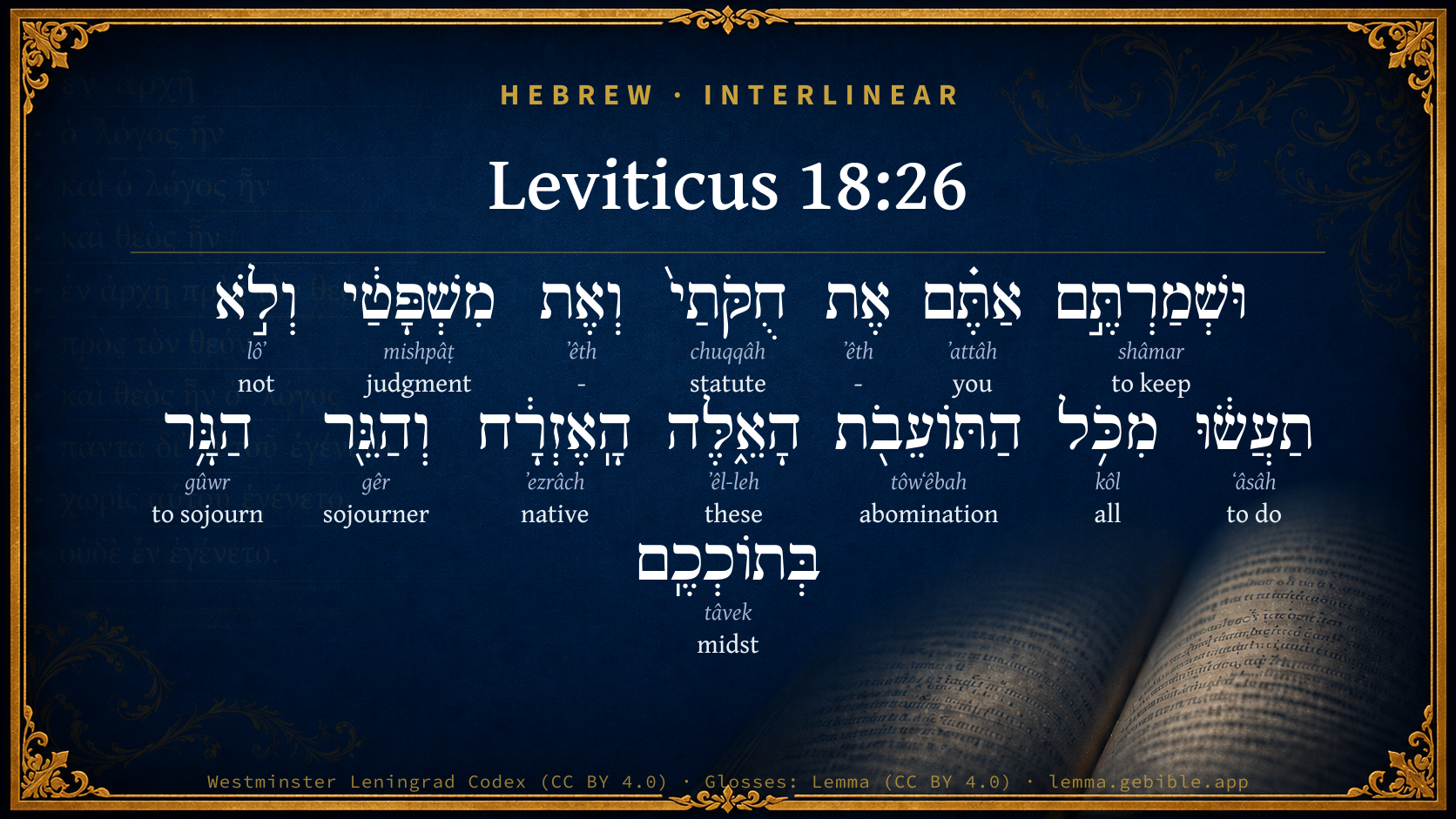
Hebrew (Westminster Leningrad Codex) Leviticus 18:26 appears in the Hebrew Old Testament. The text above is from the Westminster Leningrad Codex. Each word links to its Strong’s number, a concise gloss, and parsing drawn from the Open Scriptures Hebrew Bible morphology. Click any word for its full Brown-Driver-Briggs (BDB) entry.
Download image
Cite this verse

Leviticus 18:26 (World English Bible). Public Domain. Lemma interlinear Bible study tool, https://lemma.gebible.app/v/leviticus/18/26.

Show BibTeX & RIS
BibTeX
RIS
English Translation
You therefore shall keep my statutes and my ordinances, and shall not do any of these abominations; neither the native-born, nor the stranger who lives as a foreigner among you;
World English Bible · Public Domain
Download a study sheet

One document with this verse’s original text, its word-by-word gloss line, the meaning frame, cross-references with their text, attributed commentary, and full source and license credits — printable, and it pastes into notes with its structure intact.

This verse Autodidact and up

Study sheet (.html) Plain text (.txt)

A passage Seminary Student

Up to 50 verses in one chapter. A passage sheet keeps up to 6 commentary sources and 12 cross-references per verse, in the order this page ranks them, and says so on the sheet whenever that leaves anything out. Ask for a single verse and you get the Autodidact verse sheet above.

Everything on this page stays free to read, with no account — the sheet is a download of what is already on screen, not access to it.

Want to remove ads? Support Godless Engineer
Compare translations 3

The same verse in 3 English versions, stacked beneath the original-language interlinear above. Click any original word for its lexicon entry.

Each is an independent rendering of the whole verse — the interlinear is not word-aligned to these translations.

Highlighted words mark where these versions differ — a whole-verse word diff, not a word-by-word alignment.

  • World English Bible Public Domain
    You therefore shall keep my statutes and my ordinances, and shall not do any of these abominations; neither the native-born, nor the stranger who lives as a foreigner among you;
  • King James Version Public Domain
    Ye shall therefore keep my statutes and my judgments, and shall not commit any of these abominations; neither any of your own nation, nor any stranger that sojourneth among you:
  • unfoldingWord Literal Text CC BY-SA 4.0
    And you yourselves shall keep my statutes and my customs. And you shall not do any of these abominations—the native-born nor the sojourner, the one sojourning in your midst—

unfoldingWord Literal Text — © unfoldingWord, licensed CC BY-SA 4.0. Word-aligned USFM3 via Door43 (git.door43.org/unfoldingWord/en_ult).

Versions to compare (up to 4)

3 of 4 selected

Show all 18 translations

Every available English version of this verse, each an independent rendering of the whole verse.

  • World English Bible Public Domain
    You therefore shall keep my statutes and my ordinances, and shall not do any of these abominations; neither the native-born, nor the stranger who lives as a foreigner among you;
  • Berean Standard Bible Public Domain
    But you are to keep My statutes and ordinances, and you must not commit any of these abominations—neither your native-born nor the foreigner who lives among you.
  • Majority Standard Bible Public Domain
    But you are to keep My statutes and ordinances, and you must not commit any of these abominations—neither your native-born nor the foreigner who lives among you.
  • King James Version Public Domain
    Ye shall therefore keep my statutes and my judgments, and shall not commit any of these abominations; neither any of your own nation, nor any stranger that sojourneth among you:
  • American Standard Version (1901) Public Domain
    Ye therefore shall keep my statutes and mine ordinances, and shall not do any of these abominations; neither the home-born, nor the stranger that sojourneth among you;
  • Revised Version (1885) Public Domain
    Ye therefore shall keep my statutes and my judgments, and shall not do any of these abominations; neither the homeborn, nor the stranger that sojourneth among you:
  • Geneva Bible (1599) Public Domain
    Ye shall keepe therefore mine ordinances, and my iudgements, and commit none of these abominations, aswell hee that is of the same countrey, as the straunger that soiourneth among you.
  • Douay-Rheims (1899) Public Domain
    Keep ye my ordinances and my judgments, and do not any of these abominations: neither any of your own nation, nor any stranger that sojourneth among you.
  • Young's Literal Translation Public Domain
    and ye -- ye have kept My statutes and My judgments, and do not `any' of all these abominations, the native and the sojourner who is sojourning in your midst,
  • Literal Standard Version CC BY-SA 4.0
    And you have kept My statutes and My judgments, and do not do [any] of all these abominations, the native and the sojourner who is sojourning in your midst,
  • Unlocked Literal Bible CC BY-SA 4.0
    You, therefore, must keep my commandments and decrees, and you must not do any of these detestable things, neither the native-born Israelite nor the foreigner who lives among you.
  • unfoldingWord Literal Text CC BY-SA 4.0
    And you yourselves shall keep my statutes and my customs. And you shall not do any of these abominations—the native-born nor the sojourner, the one sojourning in your midst—
  • Darby Bible Public Domain
    But *ye* shall observe my statutes and my judgments, and shall not commit any of all these abominations: the home-born, and the stranger that sojourneth among you;
  • World Messianic Bible Public Domain
    You therefore shall keep my statutes and my ordinances, and shall not do any of these abominations; neither the native-born, nor the stranger who lives as a foreigner among you
  • Webster's Bible Public Domain
    Ye shall therefore keep my statutes and my judgments, and shall not commit any of these abominations; neither any of your own nation, nor any stranger that sojourneth among you.
  • Free Bible Version CC BY-SA 4.0
    You, however, must do what I tell you and keep my rules. You must not do any of these disgusting acts, whether an Israelite or a foreigner living among you.
  • Bible in Basic English Public Domain
    So then keep my rules and my decisions, and do not do any of these disgusting things, those of you who are Israelites by birth, or any others who are living with you:
  • JPS Tanakh (1917) Public Domain
    Ye therefore shall keep My statutes and Mine ordinances, and shall not do any of these abominations; neither the home-born, nor the stranger that sojourneth among you —

Literal Standard Version (2020), Covenant Press — licensed CC BY-SA 4.0. Text via the HelloAO Bible API (eBible.org). Unlocked Literal Bible (unfoldingWord) — licensed CC BY-SA 4.0. Text via the HelloAO Bible API (eBible.org). unfoldingWord Literal Text — © unfoldingWord, licensed CC BY-SA 4.0. Word-aligned USFM3 via Door43 (git.door43.org/unfoldingWord/en_ult). Free Bible Version, Dr. Jonathan Gallagher — licensed CC BY-SA 4.0. Text via the HelloAO Bible API (eBible.org).

Word by word

More ways to search: Search by grammar → Find every occurrence → Compare this word →

Practice this passage: Drill this verse → Learn its vocabulary →

הָֽאֶזְרָ֔ח
ʼezrâch
H249
“the · native”
Particle, Definite Article + Noun, Common, Masculine, Singular, Absolute
Part of Speech
Particle + Noun
Type
Common
Gender
Masculine
Number
Singular
State
Absolute
Full BDB Definition

Origin: from H2224 (in the sense of springing up)

TWOT: 580b

a native (one rising from the soil) - of man, native Israelites - of tree, native (to Israel)
  1. וּשְׁמַרְתֶּ֣ם shâmar H8104 “and · to keep” Conjunction + Verb, Qal, Sequential Perfect, 2nd Person, Masculine, Plural
  2. אַתֶּ֗ם ʼattâh H859 “you” Pronoun, Personal, 2nd Person, Masculine, Plural
  3. אֶת ʼêth H853 “-” Particle, Direct Object
  4. חֻקֹּתַי֙ chuqqâh H2708 “statutes · my” Noun, Common, Both, Plural, Construct + Suffix, Personal, 1st Person, Common, Singular
  5. וְאֶת ʼêth H853 “and · -” Conjunction + Particle, Direct Object
  6. מִשְׁפָּטַ֔י mishpâṭ H4941 “judgments · my” Noun, Common, Masculine, Plural, Construct + Suffix, Personal, 1st Person, Common, Singular
  7. וְלֹ֣א lôʼ H3808 “and · not” Conjunction + Particle, Negative
  8. תַעֲשׂ֔וּ ʻâsâh H6213 “to do” Verb, Qal, Imperfect, 2nd Person, Masculine, Plural
  9. מִכֹּ֥ל kôl H3605 “from · all of” Preposition + Noun, Common, Masculine, Singular, Construct
  10. הַתּוֹעֵבֹ֖ת tôwʻêbah H8441 “the · abominations” Particle, Definite Article + Noun, Common, Feminine, Plural, Absolute
  11. הָאֵ֑לֶּה ʼêl-leh H428 “the · these” Particle, Definite Article + Pronoun, Demonstrative, Common, Plural
  12. וְהַגֵּ֖ר gêr H1616 “and · the · sojourner” Conjunction + Particle, Definite Article + Noun, Common, Masculine, Singular, Absolute
  13. הַגָּ֥ר gûwr H1481 “the · sojourning” Particle, Definite Article + Verb, Qal, Participle Active, Masculine, Singular, Absolute
  14. בְּתוֹכְכֶֽם tâvek H8432 “in/at · midst · your” Preposition + Noun, Common, Masculine, Singular, Construct + Suffix, Personal, 2nd Person, Masculine, Plural

About this verse

These counts appear in no published source. They are computed here, from the morphology-tagged text and Lemma’s own curated glosses. What Lemma adds →

15
words
14
distinct lemmas
Pentateuch
section

Notable vocabulary

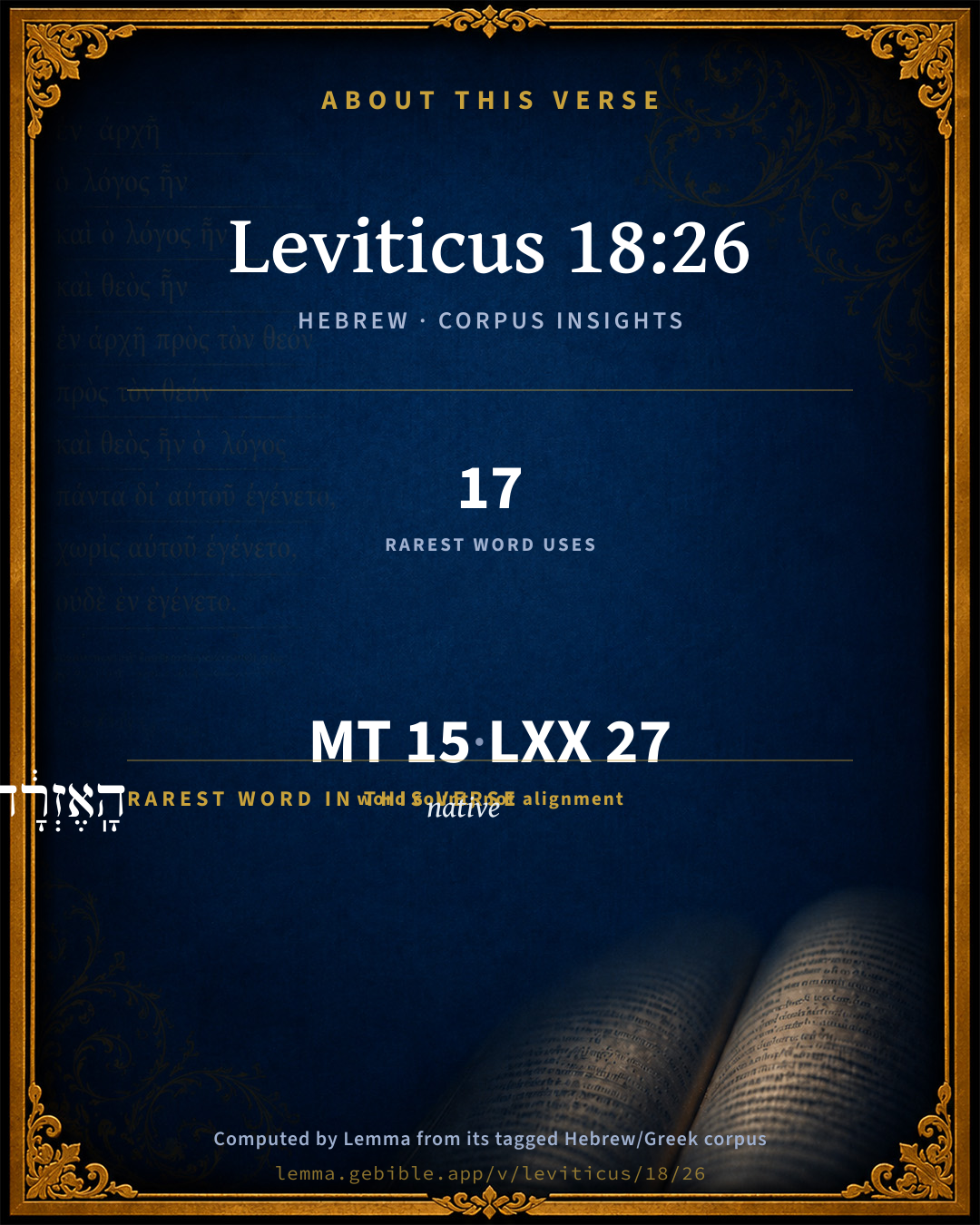
The rarest word here is הָֽאֶזְרָ֔ח native H249 — appearing just 17 times in the whole Hebrew Bible.

Shared distinctive vocabulary

הָֽאֶזְרָ֔ח native H249 occurs in 17 verses of the Hebrew Bible. Also found in:

Grammatical profile

  • 3 verbs
  • 7 nouns
  • 2 pronouns
  • 3 particles

Verb forms

  • וּשְׁמַרְתֶּ֣ם Qal · Sequential Perfect
  • תַעֲשׂ֔וּ Qal · Imperfect
  • הַגָּ֥ר Qal · Participle Active

Hebrew & Septuagint length

In English translation the verse runs 30 words from the Hebrew and 30 from the Septuagint (LXX English) — the same length.

A rough comparison of the two English renderings, which tokenize alike — not a word-level alignment.

Word counts can differ between the Hebrew and the Greek without any difference in meaning — e.g. the Hebrew direct-object marker אֵת has no separate Greek word, and Greek often adds the article ὁ.

In the original languages it is 15 Hebrew tokens and 27 Greek tokens — but the two are counted differently (Hebrew bundles its prefixes and suffixes into one token; the Greek is in lemma form), so that isn’t a like-for-like length.

Cross-references

13

Topical passages linked to Leviticus 18:26 in the Treasury of Scripture Knowledge — connected by theme and wording, ordered by reader-vote popularity; previews shown in the World English Bible.

  • Leviticus 18:5 You shall therefore keep my statutes and my ordinances; which if a man does, he shall live in them: I am Yahweh.
  • Leviticus 17:8 "You shall say to them, 'Any man there is of the house of Israel, or of the strangers who live as foreigners among them, who offers a burnt offering or sacrifice,
  • Leviticus 17:10 "'Any man of the house of Israel, or of the strangers who live as foreigners among them, who eats any kind of blood, I will set my face against that soul who eats blood, and will cut him off from among his people.
  • Leviticus 18:30 Therefore you shall keep my charge, that you do not practice any of these abominable customs, which were practiced before you, and that you do not defile yourselves with them: I am Yahweh your God.'"
  • Deuteronomy 4:1–2 Now, Israel, listen to the statutes and to the ordinances, which I teach you, to do them; that you may live, and go in and possess the land which Yahweh, the God of your fathers, gives you.
  • Deuteronomy 4:40 You shall keep his statutes, and his commandments, which I command you this day, that it may go well with you, and with your children after you, and that you may prolong your days in the land, which Yahweh your God gives you, forever.
  • Deuteronomy 12:32 Whatever thing I command you, that shall you observe to do: you shall not add thereto, nor diminish from it.
  • Psalms 105:44–45 He gave them the lands of the nations. They took the labor of the peoples in possession,
  • Luke 8:15 That in the good ground, these are such as in an honest and good heart, having heard the word, hold it tightly, and bring forth fruit with patience.
  • Luke 11:28 But he said, "On the contrary, blessed are those who hear the word of God, and keep it."
  • John 14:15 If you love me, keep my commandments.
  • John 14:21–23 One who has my commandments, and keeps them, that person is one who loves me. One who loves me will be loved by my Father, and I will love him, and will reveal myself to him."
  • John 15:14 You are my friends, if you do whatever I command you.

Cross-references courtesy of OpenBible.info (CC BY 4.0).

Hebrew and Greek witnesses Masoretic Hebrew ↔ Greek Septuagint

The same verse in the two great witnesses to the Old Testament, shown verse-for-verse.

These are two independent witnesses, not word-aligned to each other, and the Septuagint is shown in lemma (dictionary) form.

Hebrew Leviticus 18:26 Masoretic · Westminster Leningrad Codex

וּשְׁמַרְתֶּ֣ם אַתֶּ֗ם אֶת חֻקֹּתַי֙ וְאֶת מִשְׁפָּטַ֔י וְלֹ֣א תַעֲשׂ֔וּ מִכֹּ֥ל הַתּוֹעֵבֹ֖ת הָאֵ֑לֶּה הָֽאֶזְרָ֔ח וְהַגֵּ֖ר הַגָּ֥ר בְּתוֹכְכֶֽם

You therefore shall keep my statutes and my ordinances, and shall not do any of these abominations; neither the native-born, nor the stranger who lives as a foreigner among you;

World English Bible · Public Domain

Greek LXX Leviticus 18:26 Septuagint · lemma form

καί φυλάσσω πᾶς ὁ νόμιμος ἐγώ καί πᾶς ὁ πρόσταγμα ἐγώ καί οὐ ποιέω ἀπό πᾶς ὁ βδέλυγμα οὗτος ὁ ἐγχώριος καί ὁ προςγίγνομαι προσήλυτος ἐν σύ

And you⌃ shall keep all my statutes and all my ordinances, and you⌃ shall do none of these abominations; neither the native, nor the stranger that joins himself with you:

LXX2012 (modern English Septuagint) · Public Domain

Hebrew: Westminster Leningrad Codex (CC BY 4.0). Greek: Septuagint (public domain); English from LXX2012 (modern English Septuagint) (Public Domain). How the Septuagint differs from the Hebrew →

Targum (Aramaic paraphrase)

2

The Targum is the ancient Jewish Aramaic paraphrase of the Hebrew Scriptures — an interpretive translation, not the Hebrew text itself. Onkelos (literal) and Pseudo-Jonathan (expansive) render the Torah, and Jonathan the Prophets. Coverage is partial: where no permissively-licensed English translation exists for a verse, only the Aramaic is shown. This is verse-level text, not a word-by-word alignment to the Hebrew.

  1. Targum Onkelos Torah (Genesis–Deuteronomy)
    וְתִטְרוּן אַתּוּן יָת קְיָמַי וְיָת דִינַי וְלָא תַעְבְּדוּן מִכֹּל תּוֹעֶבְתָּא הָאִלֵין יַצִיבָא וְגִיוֹרָא דְיִתְגַיְרוּן בֵּינֵיכוֹן

    (no public-domain English translation for this verse)

    Targum Onkelos — Aramaic: “Onkelos Genesis” (public domain); “Onkelos Exodus” (public domain); “Onkelos Leviticus” (public domain); “Onkelos Numbers” (public domain); “Onkelos Deuteronomy” (public domain). English: “Sefaria Community Translation” (CC0 1.0 (public-domain dedication)); “J.W. Etheridge. The Targums of Onkelos and Jonathan Ben Uzziel on the Pentateuch. London: Longmans, Green, 1862” (public domain). Text via Sefaria.

  2. Targum Pseudo-Jonathan Torah (Genesis–Deuteronomy)
    וְתִיטְרוּן אַתּוּן כְנִישְׁתָּא דְיִשְרָאֵל יַת קְיָימַי וְיַת סִדְרֵי דִינַי וְלָא תַעַבְדוּן חֲדָא מִכָּל תּוֹעֶבְיָא הָאִילֵין יַצִיבַיָא וְגִיוֹרַיָא דִי יִתְגַיְירוּן בֵּינֵיכוֹן

    But you, O congregation of Israel, observe My statutes, and the order of My judgments, and commit not one of these abominations, neither (you who are) native born, or the strangers who sojourn among you.

    Targum Pseudo-Jonathan — Aramaic: “Targum Jonathan on Genesis” (public domain); “Targum Jonathan on Exodus” (public domain); “Targum Jonathan on Leviticus” (public domain); “Targum Jonathan on Numbers” (public domain); “Targum Jonathan on Deuteronomy” (public domain). English: “The Targum of Jonathan ben Uzziel, trans. J. W. Etheridge, London, 1862” (public domain). Text via Sefaria.

Commentary

Notes on Leviticus 18:26 from classic Christian and Jewish commentators (each source and its license shown beneath its notes). The classic Christian expositions comment on the surrounding passage and are grouped to its opening verse, so a note may address several verses; the Jewish commentaries on the Tanakh (Rashi and others) are per-verse, so they appear only where the commentator wrote on this verse.

Lemma curates 59 commentaries, every one of them public domain or Creative Commons licensed, each selected and text-cleaned for this edition rather than reprinted as found. About our sources →

Trapp's Complete Commentary

John Trapp

Lev 18:26 Ye shall therefore keep my statutes and my judgments, and shall not commit [any] of these abominations; [neither] any of your own nation, nor any stranger that sojourneth among you:

Ver. 26. Ye shall therefore keep.] Unless ye be ambitious of a like destruction. {Luk 13:3}

Ye shall therefore keep my statutes.] Or else, it will be a horrible shame to you to live in my good land, and not to live by my good laws.

John Trapp, A Commentary or Exposition upon All the Books of the Old and New Testament (1647–1656) — public domain. Text from a community e-Sword module.

Joseph Benson's Commentary

Lev 18:26. Nor any stranger — In nation or religion, of what kind soever. For though they might not force them to submit to their religion, yet they might restrain them from the public contempt of the Jewish laws, and from the violation of natural laws, which, besides the offence against God and nature, were matters of evil example to the Israelites themselves.

Joseph Benson's Commentary on the Old and New Testaments (1811–1818) — public domain. Text from a community e-Sword module.

Ellicott's Commentary for English Readers

(26) Ye shall therefore keep my statutes.—As the perpetration of the above named abominations entailed such disastrous consequences both to the land and to its inhabitants, the strict observance of the Divine statutes is enjoined upon all alike, whether they be Israelites by race or strangers who took up their abode amongst them and joined the Jewish community. (See Lev_17:9.)

A Bible Commentary for English Readers, edited by Charles John Ellicott (1878–1897) — public domain. Text from a community e-Sword module.

John Gill's Exposition

Ye shall therefore keep my statutes and my judgments,.... Before observed to them, whether of a ceremonial nature, and enjoined them according to his sovereign will and pleasure; or of a moral nature, and founded in justice and equity, and so worthy of their regard, and obligatory upon them; as well as in their own nature they recommended themselves to their regard, as being the reverse of those loathsome and abominable things before dehorted from:

and shall not commit any of these abominations; such as incest, adultery, idolatry, and bestiality, which are in themselves abominable things, execrable to God, and to be detested by men:

neither any of your own nation; that belonged to any of their own tribes, or should be born to them in the land of Canaan when they came thither, and were properly natives of it:

nor any stranger that sojourneth among you; any proselyte, and especially a proselyte of righteousness, who conformed to the Jewish religion, and had laid himself under obligation to do everything that was binding upon an Israelite.

John Gill's Exposition of the Whole Bible (1746–1763) — public domain (CC PDM 1.0). Text via the HelloAO Bible API.

Matthew Poole's English Annotations

Nor any stranger, in nation or religion, of what kind soever. For though they might not force them to submit to their religion, yet they might restrain them from the public contempt of the Jewish laws, and from the violation of natural laws, which besides the offence against God and nature, were matters of evil example and consequence to the Israelites themselves.

Matthew Poole's English Annotations on the Holy Bible (1683–1685) — public domain. Text from a community e-Sword/MySword module.

Whedon's Commentary on the Bible

Daniel D. Whedon

26. The stranger in all his moral conduct must be coerced into obedience. In his speculative religious beliefs he was left free. This was three thousand years before Roger Williams. In Deu_14:21 the alien was left more at liberty in eating, and the Hebrew in selling to him the flesh of the animal that died of itself.

Daniel D. Whedon (gen. ed.), Commentary on the Old and New Testaments (1874–1909) — public domain. Text from a community e-Sword module.

John Wesley's Explanatory Notes

Nor any stranger - In nation or religion, of what kind soever. For though they might not force them to submit to their religion, yet they might restrain them from the publick contempt of the Jewish laws, and from the violation of natural laws, which, besides the offense against God and nature, were matters of evil example to the Israelites themselves.

John Wesley, Explanatory Notes Upon the Whole Bible (1754–1765) — public domain. Text via the GEBible commentary corpus.

unfoldingWord translationNotes

Door43 World Missions Community

any of these detestable things

"any of these disgusting things"

this is the wickedness

This refers to "these detestable things."

Therefore be careful

"Therefore be careful to obey me"

so that the land does not vomit you up ... as it vomited out the people

Yahweh forcibly removing the people from the land is spoken of as if the land were a person who vomited the people out. See how you translated this metaphor in Leviticus 18:25. AT: "so that I do forcibly remove you from the land ... as I forcibly removed the people" (See: Metaphor and Personification)

translationWords

command

decree

alien

defile

unfoldingWord translationNotes — © Distant Shores Media and the Door43 World Missions Community, licensed CC BY-SA 4.0. Source: git.door43.org/Door43/en_tn.

Lesson kit

Teaching starters — assembled from the data on this page, not authored interpretation. Every prompt links to the verse data it draws on. Edit before teaching.

Leviticus, in the Pentateuch, opens this verse with 15 words (14 distinct Hebrew lemmas). Its most distinctive word is ʼezrâch (“native”). A historical commentator’s framing appears above. Read the whole chapter for the surrounding context.

Discussion questions

  1. What does “native” (ʼezrâch) contribute to the verse as a whole?
  2. How does Exodus 12:19, which shares the word «native», read alongside this verse?
  3. These translations render this verse differently; the difference is in the English rendering, not the original. What questions does that raise?
  4. «וּשְׁמַרְתֶּ֣ם» is a Qal Sequential Perfect verb. How does that grammatical form shape the action described?
  5. Compare how Trapp's Complete Commentary and Joseph Benson's Commentary read this verse. Where do they agree or differ?

Things to notice

Reading settings

Reading text

Shown beneath each verse's original-language words.

Old Testament
Old Testament edition

Read the OT as the Masoretic Hebrew (MT) or the Greek Septuagint (LXX).

English shown for the Greek Septuagint (in the Hebrew ↔ Greek comparison).

Comparing translations? Open the Compare panel on any verse page to stack up to four side by side.