
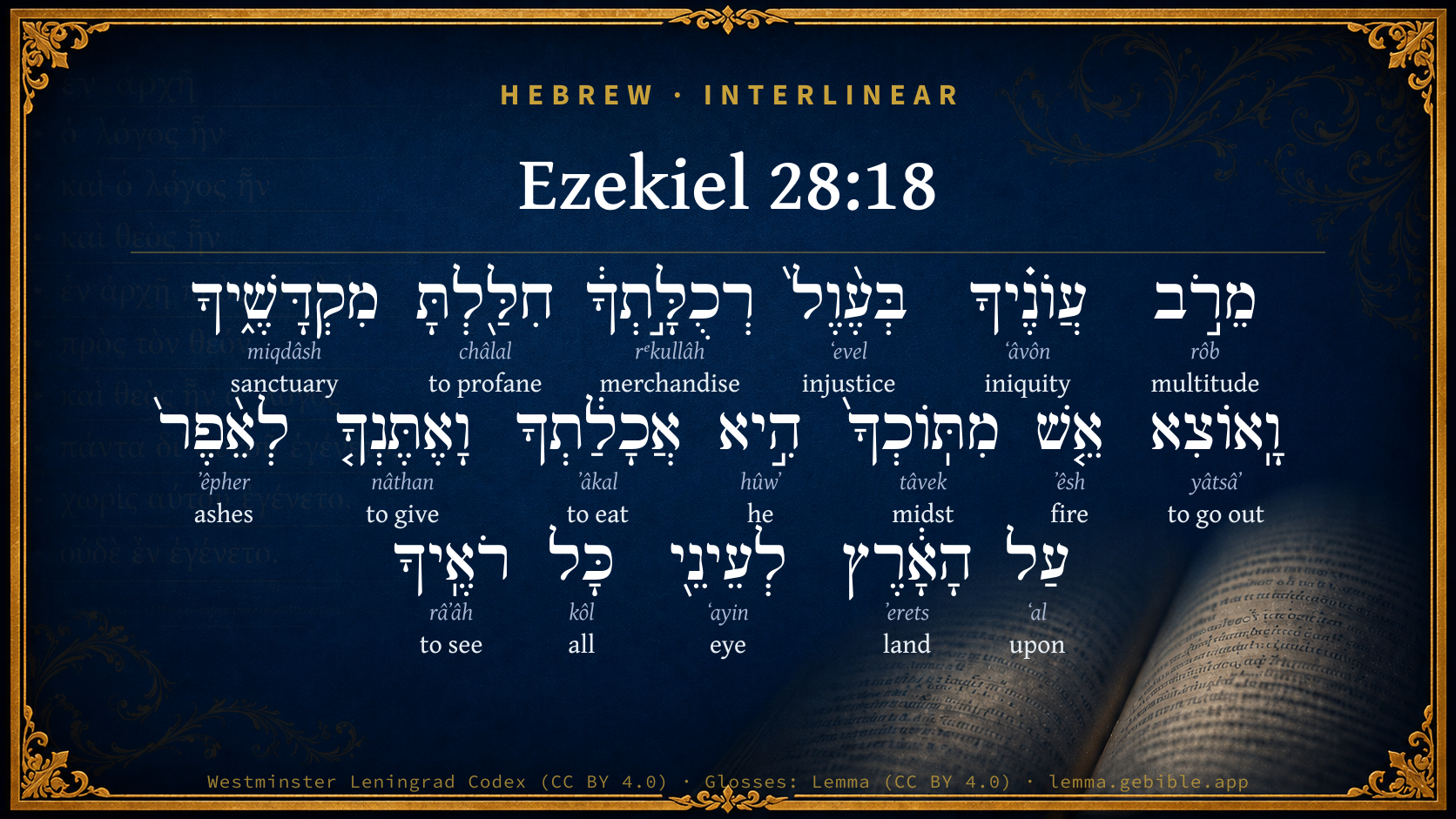
Ezekiel 28:18

Hebrew (Westminster Leningrad Codex) Ezekiel 28:18 appears in the Hebrew Old Testament. The text above is from the Westminster Leningrad Codex. Each word links to its Strong’s number, a concise gloss, and parsing drawn from the Open Scriptures Hebrew Bible morphology. Click any word for its full Brown-Driver-Briggs (BDB) entry.
Download image
Cite this verse

Ezekiel 28:18 (World English Bible). Public Domain. Lemma interlinear Bible study tool, https://lemma.gebible.app/v/ezekiel/28/18.

Show BibTeX & RIS
BibTeX
RIS
English Translation
By the multitude of your iniquities, in the unrighteousness of your traffic, you have profaned your sanctuaries; therefore have I brought forth a fire from the midst of you; it has devoured you, and I have turned you to ashes on the earth in the sight of all those who see you.
World English Bible · Public Domain
Download a study sheet

One document with this verse’s original text, its word-by-word gloss line, the meaning frame, cross-references with their text, attributed commentary, and full source and license credits — printable, and it pastes into notes with its structure intact.

This verse Autodidact and up

Study sheet (.html) Plain text (.txt)

A passage Seminary Student

Up to 50 verses in one chapter. A passage sheet keeps up to 6 commentary sources and 12 cross-references per verse, in the order this page ranks them, and says so on the sheet whenever that leaves anything out. Ask for a single verse and you get the Autodidact verse sheet above.

Everything on this page stays free to read, with no account — the sheet is a download of what is already on screen, not access to it.

Want to remove ads? Support Godless Engineer
Compare translations 3

The same verse in 3 English versions, stacked beneath the original-language interlinear above. Click any original word for its lexicon entry.

Each is an independent rendering of the whole verse — the interlinear is not word-aligned to these translations.

Highlighted words mark where these versions differ — a whole-verse word diff, not a word-by-word alignment.

  • World English Bible Public Domain
    By the multitude of your iniquities, in the unrighteousness of your traffic, you have profaned your sanctuaries; therefore have I brought forth a fire from the midst of you; it has devoured you, and I have turned you to ashes on the earth in the sight of all those who see you.
  • King James Version Public Domain
    Thou hast defiled thy sanctuaries by the multitude of thine iniquities, by the iniquity of thy traffick; therefore will I bring forth a fire from the midst of thee, it shall devour thee, and I will bring thee to ashes upon the earth in the sight of all them that behold thee.
  • unfoldingWord Literal Text CC BY-SA 4.0
    Because of your many sins and your dishonest trade, you have defiled your holy places. So I have made fire come out from you; it will consume you. I will turn you into ashes on the earth in the sight of all who look at you.

unfoldingWord Literal Text — © unfoldingWord, licensed CC BY-SA 4.0. Word-aligned USFM3 via Door43 (git.door43.org/unfoldingWord/en_ult).

Versions to compare (up to 4)

3 of 4 selected

Show all 18 translations

Every available English version of this verse, each an independent rendering of the whole verse.

  • World English Bible Public Domain
    By the multitude of your iniquities, in the unrighteousness of your traffic, you have profaned your sanctuaries; therefore have I brought forth a fire from the midst of you; it has devoured you, and I have turned you to ashes on the earth in the sight of all those who see you.
  • Berean Standard Bible Public Domain
    By the multitude of your iniquities and the dishonesty of your trading you have profaned your sanctuaries. So I made fire come from within you, and it consumed you. I reduced you to ashes on the ground in the eyes of all who saw you.
  • Majority Standard Bible Public Domain
    By the multitude of your iniquities and the dishonesty of your trading you have profaned your sanctuaries. So I made fire come from within you, and it consumed you. I reduced you to ashes on the ground in the eyes of all who saw you.
  • King James Version Public Domain
    Thou hast defiled thy sanctuaries by the multitude of thine iniquities, by the iniquity of thy traffick; therefore will I bring forth a fire from the midst of thee, it shall devour thee, and I will bring thee to ashes upon the earth in the sight of all them that behold thee.
  • American Standard Version (1901) Public Domain
    By the multitude of thine iniquities, in the unrighteousness of thy traffic, thou hast profaned thy sanctuaries; therefore have I brought forth a fire from the midst of thee; it hath devoured thee, and I have turned thee to ashes upon the earth in the sight of all them that behold thee.
  • Revised Version (1885) Public Domain
    By the multitude of thine iniquities, in the unrighteousness of thy traffic, thou hast profaned thy sanctuaries; therefore have I brought forth a fire from the midst of thee, it hath devoured thee, and I have turned thee to ashes upon the earth in the sight of all them that behold thee.
  • Geneva Bible (1599) Public Domain
    Thou hast defiled thy sanctification by the multitude of thine iniquities, and by the iniquitie of thy marchandise: therefore wil I bring forth a fire from the mids of thee, which shall deuoure thee: and I wil bring thee to ashes vpon the earth, in the sight of all them that beholde thee.
  • Douay-Rheims (1899) Public Domain
    Thou hast defiled thy sanctuaries by the multitude of thy iniquities, and by the iniquity of thy traffic: therefore I will bring forth a fire from the midst of thee, to devour thee, and I will make thee as ashes upon the earth in the sight of all that see thee.
  • Young's Literal Translation Public Domain
    From the abundance of thy iniquity, By the perversity of thy traffic, Thou hast polluted thy sanctuaries, And I bring forth fire from thy midst, It hath devoured thee, And I make thee become ashes on the earth, Before the eyes of all beholding thee.
  • Literal Standard Version CC BY-SA 4.0
    From [the] abundance of your iniquity, || By [the] perversity of your merchandise, || You have defiled your sanctuaries, || And I bring forth fire from your midst, || It has devoured you, || And I make you become ashes on the earth, || In [the] eyes of all beholding you.
  • Unlocked Literal Bible CC BY-SA 4.0
    Because of your many sins and your dishonest trade, you have defiled your holy places. So I have made fire come out from you; it will consume you. I will turn you into ashes on the earth in the sight of all who look at you.
  • unfoldingWord Literal Text CC BY-SA 4.0
    Because of your many sins and your dishonest trade, you have defiled your holy places. So I have made fire come out from you; it will consume you. I will turn you into ashes on the earth in the sight of all who look at you.
  • Darby Bible Public Domain
    By the multitude of thine iniquities, by the unrighteousness of thy traffic, thou hast profaned thy sanctuaries: and I have brought forth a fire out of the midst of thee -- it hath consumed thee; and I have brought thee to ashes upon the earth, in the sight of all them that behold thee.
  • World Messianic Bible Public Domain
    By the multitude of your iniquities, in the unrighteousness of your commerce, you have profaned your sanctuaries. Therefore I have brought out a fire from the middle of you. It has devoured you. I have turned you to ashes on the earth in the sight of all those who see you.
  • Webster's Bible Public Domain
    Thou hast defiled thy sanctuaries by the multitude of thy iniquities, by the iniquity of thy traffick; therefore will I bring forth a fire from the midst of thee, it shall devour thee, and I will bring thee to ashes upon the earth in the sight of all them that behold thee.
  • Free Bible Version CC BY-SA 4.0
    By all your sins and your dishonest trading you have made your sanctuaries unclean. So I had fire come from inside you, and it burned you up. I turned you into ashes on the ground as everybody there watched.
  • Bible in Basic English Public Domain
    By all your sin, even by your evil trading, you have made your holy places unclean; so I will make a fire come out from you, it will make a meal of you, and I will make you as dust on the earth before the eyes of all who see you.
  • JPS Tanakh (1917) Public Domain
    By the multitude of thine iniquities, in the unrighteousness of thy traffic, thou hast profaned thy sanctuaries; therefore have I brought forth a fire from the midst of thee, it hath devoured thee, and I have turned thee to ashes upon the earth in the sight of all them that behold thee.

Literal Standard Version (2020), Covenant Press — licensed CC BY-SA 4.0. Text via the HelloAO Bible API (eBible.org). Unlocked Literal Bible (unfoldingWord) — licensed CC BY-SA 4.0. Text via the HelloAO Bible API (eBible.org). unfoldingWord Literal Text — © unfoldingWord, licensed CC BY-SA 4.0. Word-aligned USFM3 via Door43 (git.door43.org/unfoldingWord/en_ult). Free Bible Version, Dr. Jonathan Gallagher — licensed CC BY-SA 4.0. Text via the HelloAO Bible API (eBible.org).

Word by word

More ways to search: Search by grammar → Find every occurrence → Compare this word →

Practice this passage: Drill this verse → Learn its vocabulary →

רְכֻלָּ֣תְךָ֔
rᵉkullâh
H7404
“merchandise · your”
Noun, Common, Feminine, Singular, Construct + Suffix, Personal, 2nd Person, Masculine, Singular
Part of Speech
Noun
Type
Common
Gender
Feminine
Number
Singular
State
Construct
Full BDB Definition

Origin: pass part of H7402

TWOT: 2165a

merchandise, traffic, trade
  1. מֵרֹ֣ב rôb H7230 “from · multitude of” Preposition + Noun, Common, Both, Singular, Construct
  2. עֲוֺנֶ֗יךָ ʻâvôn H5771 “iniquities · your” Noun, Common, Both, Plural, Construct + Suffix, Personal, 2nd Person, Masculine, Singular
  3. בְּעֶ֨וֶל֙ ʻevel H5766 “in/at · injustice of” Preposition + Noun, Common, Both, Singular, Construct
  4. חִלַּ֖לְתָּ châlal H2490 “to profane” Verb, Piel, Perfect, 2nd Person, Masculine, Singular
  5. מִקְדָּשֶׁ֑יךָ miqdâsh H4720 “sanctuaries · your” Noun, Common, Masculine, Plural, Construct + Suffix, Personal, 2nd Person, Masculine, Singular
  6. וָֽאוֹצִא yâtsâʼ H3318 “and · to go out” Conjunction + Verb, Hiphil, Sequential Imperfect, 1st Person, Common, Singular
  7. אֵ֤שׁ ʼêsh H784 “fire” Noun, Common, Both, Singular, Absolute
  8. מִתּֽוֹכְךָ֙ tâvek H8432 “from · midst · your” Preposition + Noun, Common, Masculine, Singular, Construct + Suffix, Personal, 2nd Person, Masculine, Singular
  9. הִ֣יא hûwʼ H1931 “he” Pronoun, Personal, 3rd Person, Feminine, Singular
  10. אֲכָלַ֔תְךָ ʼâkal H398 “to eat · you” Verb, Qal, Perfect, 3rd Person, Feminine, Singular + Suffix, Personal, 2nd Person, Masculine, Singular
  11. וָאֶתֶּנְךָ֤ nâthan H5414 “and · to give · you” Conjunction + Verb, Qal, Sequential Imperfect, 1st Person, Common, Singular + Suffix, Personal, 2nd Person, Masculine, Singular
  12. לְאֵ֨פֶר֙ ʼêpher H665 “to/for · ashes” Preposition + Noun, Common, Masculine, Singular, Absolute
  13. עַל ʻal H5921 “upon” Preposition
  14. הָאָ֔רֶץ ʼerets H776 “the · land” Particle, Definite Article + Noun, Common, Both, Singular, Absolute
  15. לְעֵינֵ֖י ʻayin H5869 “to/for · eyes of” Preposition + Noun, Common, Both, Dual, Construct
  16. כָּל kôl H3605 “all of” Noun, Common, Masculine, Singular, Construct
  17. רֹאֶֽיךָ râʼâh H7200 “seeing · you” Verb, Qal, Participle Active, Masculine, Plural, Construct + Suffix, Personal, 2nd Person, Masculine, Singular

About this verse

These counts appear in no published source. They are computed here, from the morphology-tagged text and Lemma’s own curated glosses. What Lemma adds →

18
words
18
distinct lemmas
Prophets
section

Notable vocabulary

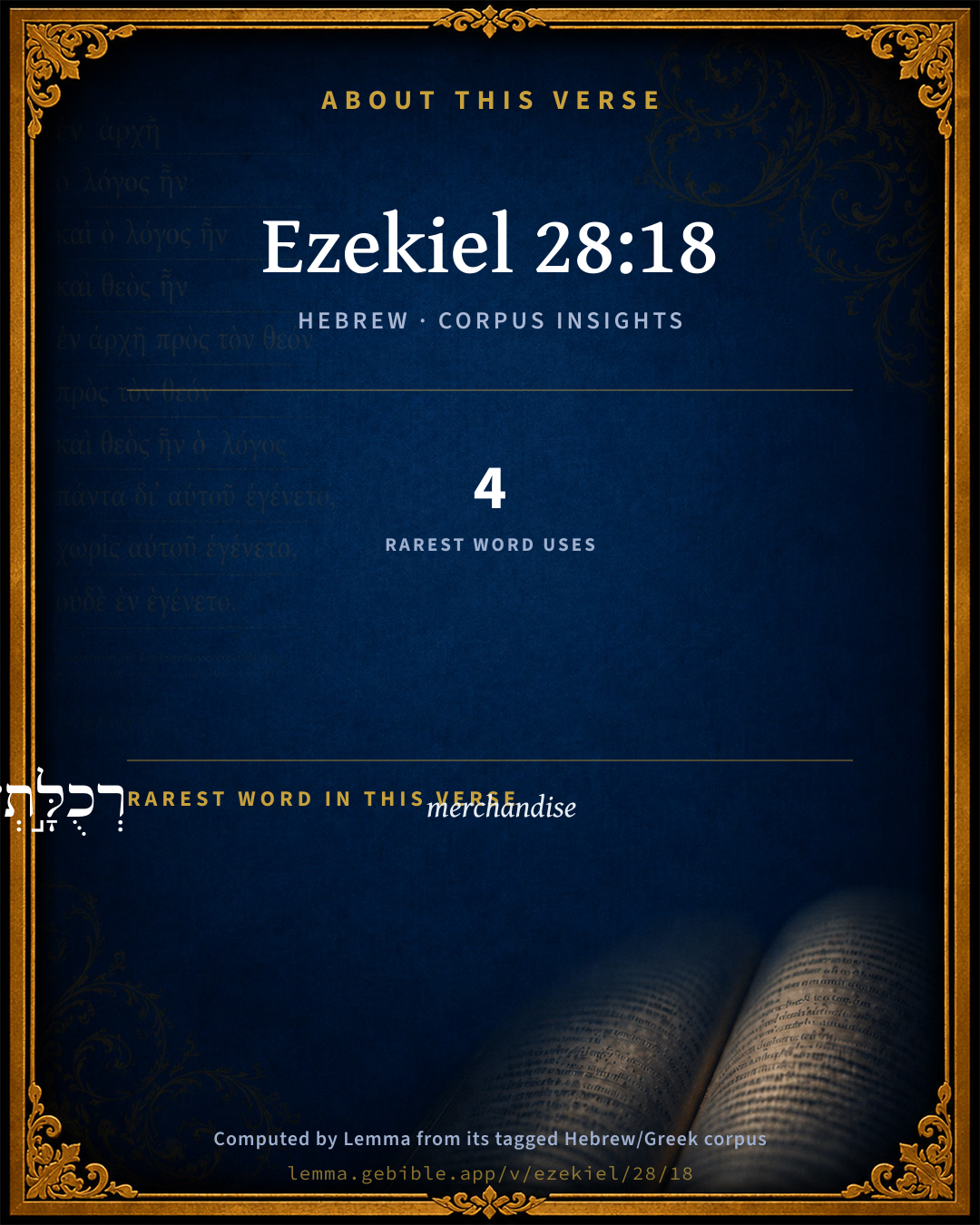
The rarest word here is רְכֻלָּ֣תְךָ֔ merchandise H7404 — appearing just 4 times in the whole Hebrew Bible.

Shared distinctive vocabulary

רְכֻלָּ֣תְךָ֔ merchandise H7404 occurs in 4 verses of the Hebrew Bible. Also found in:

Grammatical profile

  • 5 verbs
  • 11 nouns
  • 1 pronoun
  • 1 preposition

Verb forms

  • חִלַּ֖לְתָּ Piel · Perfect
  • וָֽאוֹצִא Hiphil · Sequential Imperfect
  • אֲכָלַ֔תְךָ Qal · Perfect
  • וָאֶתֶּנְךָ֤ Qal · Sequential Imperfect
  • רֹאֶֽיךָ Qal · Participle Active

Hebrew & Septuagint length

In English translation the verse runs 52 words from the Hebrew and 50 from the Septuagint (LXX English) — closely comparable.

A rough comparison of the two English renderings, which tokenize alike — not a word-level alignment.

Word counts can differ between the Hebrew and the Greek without any difference in meaning — e.g. the Hebrew direct-object marker אֵת has no separate Greek word, and Greek often adds the article ὁ.

Cross-references

14

Topical passages linked to Ezekiel 28:18 in the Treasury of Scripture Knowledge — connected by theme and wording, ordered by reader-vote popularity; previews shown in the World English Bible.

  • Malachi 4:3 You shall tread down the wicked; for they will be ashes under the soles of your feet in the day that I make," says Yahweh of Hosts.
  • Revelation 18:8 Therefore in one day her plagues will come: death, mourning, and famine; and she will be utterly burned with fire; for the Lord God who has judged her is strong.
  • Ezekiel 28:16 By the abundance of your traffic they filled the midst of you with violence, and you have sinned: therefore I have cast you as profane out of the mountain of God; and I have destroyed you, covering cherub, from the midst of the stones of fire.
  • Amos 1:9–10 Thus says Yahweh: "For three transgressions of Tyre, yes, for four, I will not turn away its punishment; Because they delivered up the whole community to Edom, And didn't remember the brotherly covenant;
  • Ezekiel 28:2 Son of man, tell the prince of Tyre, Thus says the Lord Yahweh: Because your heart is lifted up, and you have said, I am a god, I sit in the seat of God, in the midst of the seas; yet you are man, and not God, though you did set your heart as the heart of God;-
  • Judges 9:20 but if not, let fire come out from Abimelech, and devour the men of Shechem, and the house of Millo; and let fire come out from the men of Shechem, and from the house of Millo, and devour Abimelech.
  • Ezekiel 5:4 Of these again shall you take, and cast them into the midst of the fire, and burn them in the fire; from it shall a fire come forth into all the house of Israel.
  • Ezekiel 28:13–14 You were in Eden, the garden of God; every precious stone adorned you: ruby, topaz, emerald, chrysolite, onx, jasper, sapphire, turquoise, and beryl. Gold work of tambourines and of pipes was in you. In the day that you were created they were prepared.
  • Amos 1:14 But I will kindle a fire in the wall of Rabbah, And it will devour its palaces, With shouting in the day of battle, With a tempest in the day of the whirlwind;
  • Amos 2:2 But I will send a fire on Moab, And it will devour the palaces of Kerioth; And Moab will die with tumult, with shouting, and with the sound of the trumpet;
  • Amos 2:5 But I will send a fire on Judah, And it will devour the palaces of Jerusalem."
  • Mark 8:36 For what does it profit a man, to gain the whole world, and forfeit his life?
  • 2 Peter 2:6 and turning the cities of Sodom and Gomorrah into ashes, condemned them to destruction, having made them an example to those who would live ungodly;
  • Judges 9:15 The bramble said to the trees, If in truth you anoint me king over you, then come and take refuge in my shade; and if not, let fire come out of the bramble, and devour the cedars of Lebanon.

Cross-references courtesy of OpenBible.info (CC BY 4.0).

Hebrew and Greek witnesses Masoretic Hebrew ↔ Greek Septuagint

The same verse in the two great witnesses to the Old Testament, shown verse-for-verse.

These are two independent witnesses, not word-aligned to each other, and the Septuagint is shown in lemma (dictionary) form.

Hebrew Ezekiel 28:18 Masoretic · Westminster Leningrad Codex

מֵרֹ֣ב עֲוֺנֶ֗יךָ בְּעֶ֨וֶל֙ רְכֻלָּ֣תְךָ֔ חִלַּ֖לְתָּ מִקְדָּשֶׁ֑יךָ וָֽאוֹצִא אֵ֤שׁ מִתּֽוֹכְךָ֙ הִ֣יא אֲכָלַ֔תְךָ וָאֶתֶּנְךָ֤ לְאֵ֨פֶר֙ עַל הָאָ֔רֶץ לְעֵינֵ֖י כָּל רֹאֶֽיךָ

By the multitude of your iniquities, in the unrighteousness of your traffic, you have profaned your sanctuaries; therefore have I brought forth a fire from the midst of you; it has devoured you, and I have turned you to ashes on the earth in the sight of all those who see you.

World English Bible · Public Domain

Greek LXX Ezekiel 28:18 Septuagint · lemma form

διά ὁ πλῆθος ὁ ἁμαρτία σύ καί ὁ ἀδικία ὁ ἐμπορία σύ βεβηλόω ὁ ἱερόν σύ καί ἐκἄγω πῦρ ἐκ μέσος σύ οὗτος καταἐσθίω σύ καί δίδωμι σύ εἰς σποδός ἐπί ὁ γῆ σύ ἐναντίον πᾶς ὁ ὁράω σύ

Because of the multitude of your sins and the iniquities of your merchandise, I have profaned your sacred things; and I will bring fire out of the midst of you, this shall devour you; and I will make you to be ashes upon your land before all that see you.

LXX2012 (modern English Septuagint) · Public Domain

On this verse, The Cambridge Bible for Schools and Colleges discusses the Septuagint’s reading. Read the note in Commentary ↓

Hebrew: Westminster Leningrad Codex (CC BY 4.0). Greek: Septuagint (public domain); English from LXX2012 (modern English Septuagint) (Public Domain). How the Septuagint differs from the Hebrew →

Targum (Aramaic paraphrase)

1

The Targum is the ancient Jewish Aramaic paraphrase of the Hebrew Scriptures — an interpretive translation, not the Hebrew text itself. Onkelos (literal) and Pseudo-Jonathan (expansive) render the Torah, and Jonathan the Prophets. Coverage is partial: where no permissively-licensed English translation exists for a verse, only the Aramaic is shown. This is verse-level text, not a word-by-word alignment to the Hebrew.

  1. Targum Jonathan Prophets (Joshua–Malachi)
    מִסְגֵי חוֹבָךְ בִּשְׁקַר סְחוֹרְתָּךְ אָפֵיסְתָּא מַקְדְשָׁךְ וְאַיְתֵי עַמְמַיָא דְתַקִיפִין כְּאֶשְׁתָּא מֵחוֹבֵי זְדוֹנָךְ אִינוּן יְשֵׁיצוּנָךְ וְאֶתְּנִינָךְ כִּקְטַם עַל אַרְעָא לְעֵינֵי כָּל חָזָךְ:

    (no public-domain English translation for this verse)

    Targum Jonathan — Aramaic: “Mikraot Gedolot” (public domain). English: “Sefaria Community Translation” (CC0 1.0 (public-domain dedication)); “London "Chaldee Paraphrase," 1871” (public domain). Text via Sefaria.

Commentary

Notes on Ezekiel 28:18 from classic Christian and Jewish commentators (each source and its license shown beneath its notes). The classic Christian expositions comment on the surrounding passage and are grouped to its opening verse, so a note may address several verses; the Jewish commentaries on the Tanakh (Rashi and others) are per-verse, so they appear only where the commentator wrote on this verse.

Lemma curates 59 commentaries, every one of them public domain or Creative Commons licensed, each selected and text-cleaned for this edition rather than reprinted as found. About our sources →

Trapp's Complete Commentary

John Trapp

Eze 28:18 Thou hast defiled thy sanctuaries by the multitude of thine iniquities, by the iniquity of thy traffick; therefore will I bring forth a fire from the midst of thee, it shall devour thee, and I will bring thee to ashes upon the earth in the sight of all them that behold thee.

Ver. 18. Thou hast defiled thy sanctuaries,] i.e., Thy kingly palaces, where thou art looked upon and honoured as a god, but a wretched one, and which for stateliness may vie with my sanctuary. Add hereto, that as none might come into the temple but priests only; so none might come into the palace but confiding persons. The Turks at this day suffer no stranger to come into the presence of their emperor, but first they clasp him by the arms, under colour of doing him honour, but indeed to bereave him of the use of his hands, lest he should offer him any violence. {a}

Therefore will I bring forth a fire in the midst of thee.] Thou shalt perish by thine own sins, as a house is burnt by fire kindled within itself.

And I will bring thee to ashes.] Which shall remain as a lasting monument of the divine displeasure; as did the ashes and cinders of Sodom; and Herodotus saith the same of the ashes of Troy.

{a} Turkish History, 715.

John Trapp, A Commentary or Exposition upon All the Books of the Old and New Testament (1647–1656) — public domain. Text from a community e-Sword module.

The Biblical Illustrator

Joseph S. Exell

Eze_28:18

By the iniquity of thy traffic.

Corruption in commerce

The tendency is to measure all things by a money standard. The business that cannot be ruled by Christianity is wrong. What this does for a land, if it grows unchecked, is to make men sell the best things. Phoenicia did, and the spirit of her people died. Her inhabitants became the ministers of vice in every Eastern city. And the man eaten up by love of gain is preparing for himself and all he influences a like fate. Men object that business is a sort of neutral world in which the maxims of New Testament morality cannot come into play. But if this is true, either Christianity cannot be a faith for the whole of a mans life, or the business that cannot be ruled by it is wrong. It is to rule my eating and drinking, my clothing and housing of myself and mine, my buying and selling, my work am! play. Whatsoever ye do, buying or booking, do all in the name of the Lord Jesus. But men object today that the severity of the competition by which they are pressed makes some moral laxity in the conduct of business most difficult to avoid. They have to contend with others who are not hampered by scrupulosity in the methods by which they obtain orders or make profits. Some time ago, the Rev. Mr. Carter, the Secretary of the Christian Social Union, informs us, the Oxford branch of that society sent out a number of queries to practical men on the subject of commercial morality. In answer to the question: Do you find it difficult to apply the principles of Christian truth and justice to the conduct of business? two employers write: Business is based on the gladiatorial theory of existence. If Christian truth and justice is not consistent with this, business is in a bad case. A commercial traveller writes: Not only difficult, but impossible, for a man is not master of himself. If one would live, and avoid the bankruptcy court, one must do business on the same lines as others do, without troubling whether, the methods are in harmony with the principles of Christian truth and justice or not. A drapers assistant answers: Extremely so. The tendency to misrepresent, deceive, or take unfair advantage under circumstances that daily offer the opportunity of so doing is generally too strong to resist where self-interest is the motive power of action, the conventional morality the only check. To me they appear to be opposing principles--the first of self-sacrifice, the second of self-interest. Another says: If it were possible to do away with competition, the excuse and justification for a large proportion of commercial immorality would be gone. As it is, it is quite plain that honourable trade has to meet with and fight what is unjust. As Arthur Hugh Clough says in one of his poems Thou shalt not covet, but tradition Approves all forms of competition. (G. T. Forbes, M. A.)

.

The Biblical Illustrator, edited by Joseph S. Exell (c. 1880s–1900s) — public domain. Text from a community e-Sword module.

Joseph Benson's Commentary

Eze 28:18-19. Thou hast defiled thy sanctuaries — Thy throne, palace, judgment-seats. The word מקדשׁ, generally rendered sanctuary, sometimes signifies a palace, in which sense it probably ought to be taken Amo 7:13, where our translation renders it the king’s chapel. Thus Bishop Patrick understands it, Exo 25:8, where our version reads, Let them make me a sanctuary; God commanding that he should be served and attended upon in the tabernacle, as a king in his court or palace. The cherubim were his throne, the ark his footstool, the altar his table, (and therefore called by that name, Eze 41:22; Mal 1:7,) the priests his attendants, and the show-bread and sacrifices his provisions. The king of Tyre had filled his palace and courts of judicature, and the Tyrians their stately buildings, with iniquity and injustice, and therefore God was determined utterly to destroy them by the Chaldeans. I will bring fire from the midst of thee — Punishment shall follow thy crimes, and thy own ways shall bring it upon thee: thy destruction shall proceed from thyself. I will bring thee to ashes upon the earth — I will bring thee to dust. Thou shalt be made no more account of than ashes spread on the ground. All that know thee shall be astonished — So low a fall from such a height of glory will astonish all who ever saw thy former magnificence.

Joseph Benson's Commentary on the Old and New Testaments (1811–1818) — public domain. Text from a community e-Sword module.

Tyndale Open Study Notes

Tyndale Open Resources

28:18-19 Far from being a deity who could sanctify a piece of ground by his presence, the prince of Tyre had the opposite effect. He defiled the holy ground of his sanctuaries. Judgment was pronounced on his city in the previous two panels, and it was the prince of Tyre’s fate to come to a terrible end, and . . . exist no more (cp. 26:21; 27:36). The exalted captain would go down with his glorious ship and be brought to nothing by the Lord’s act.

Tyndale Open Study Notes — © Tyndale Open Resources, licensed CC BY-SA 4.0. Text via the HelloAO Bible API.

Geneva Bible (1599)

Geneva Bible translators

That is, the honor, whereunto I called them.

Geneva Bible (1599) marginal notes — public domain. Text via Bolls.life.

Jamieson, Fausset & Brown

Robert Jamieson, A. R. Fausset & David Brown

thy sanctuaries--that is, the holy places, attributed to the king of Tyre in Eze 28:14, as his ideal position. As he "profaned" it, so God will "profane" him (Eze 28:16).

fire . . . devour--As he abused his supposed elevation amidst "the stones of fire" (Eze 28:16), so God will make His "fire" to "devour" him.

Jamieson, Fausset & Brown — Commentary Critical and Explanatory on the Whole Bible (1871) — public domain (CC PDM 1.0). Text via the HelloAO Bible API.

Adam Clarke's Commentary

Verse 18. Thou hast defiled thy sanctuaries] Irony continued. As God, as the angels, as the cherubim, thou must have had thy sanctuaries; but thou hast defiled them: and as Adam, thou hast polluted thy Eden, and hast been expelled from Paradise.

Adam Clarke's Commentary on the Bible (1810–1826) — public domain. Text from a community e-Sword/MySword module.

Ellicott's Commentary for English Readers

(18) Defiled thy sanctuaries.—These are not to be understood so much of the actual temples of Tyre as of the ideal “holy mountain of God,” in which the prophet has represented the prince of Tyre as “a covering cherub.” Yet still, doubtless, even in the former sense, it was true that the Tyrians, like the Gentiles of whom St. Paul speaks in Rom_1:21, did not act up to the religious light they had, and violating their own consciences and sense of right, defiled even such representation of the true religion as still remained in their idolatrous worship. The main thought, however, is the former one, and it is in accordance with this that the fire is represented as going forth to consume the king. Many of the Hebrew manuscripts have sanctuary in the singular.

By the iniquity of thy traffick.—Here, as so often in other cases, the sin is represented as consisting in the abuse of the very blessings which God had given, and this sin as leading directly to its own punishment. No fact is more striking in history, whether of Israel or of the heathen, than that the gifts of God, which should have been to their blessing and His glory, are perverted by the sinfulness of man: first to their own guilt, and then, in consequence, to their ruin.

Eze_28:20-26 constitute another distinct prophecy, of which Eze_28:20-24 are occupied with the denunciation of judgment upon Zidon, and Eze_28:25-26 with promises to Israel. There are several obvious reasons, besides that of making up the number of the nations to seven, why at least a word of prophecy should have been directed especially against Zidon, notwithstanding her forming a part of Phœnicia and contributing to the mariners of Tyre (Eze_27:8). In the first place, Zidon (situated about twenty-five miles north of Tyre) was the more ancient city from which Tyre had sprung, and always maintained her independence. Hence she might seem not to be exposed to the judgment of God upon Tyre, unless especially mentioned. Then also Zidon (rather than Tyre) had been peculiarly the source of corrupting idolatrous influences upon Israel. This had begun as early as the times of the Judges (Jdg_10:6); it had been continued and increased in the days of Solomon (1Ki_11:33); it reached its consummation under the reign of Ahab, who married Jezebel, the daughter of the king of Zidon and high priest of Baal (1Ki_16:31), and who set up the worship of Baal as the state religion of Israel. That this influence was still powerful in Judah also in the days of Ezekiel is plain from the reference to the Thammuz worship in Eze_8:14.

There is only one mention (Jdg_10:12) of the Zidonians as coming into armed conflict with Israel; but they had rejoiced in her fall. As this prophecy closes the circle of the nations who had thus exulted in the destruction of Jerusalem, there is appropriately placed at the end a promise of restoration to Israel when all these judgments upon her enemies shall have been accomplished.

A Bible Commentary for English Readers, edited by Charles John Ellicott (1878–1897) — public domain. Text from a community e-Sword module.

The Cambridge Bible for Schools and Colleges

gen. ed. J. J. S. Perowne

18. defiled thy sanctuaries] profaned. The phrase occurs ch. Eze_7:24; here, however, where the prince is spoken of, “sanctity” or personal sacredness rather than “sanctuary” seems the sense required. It is doubtful if the word can bear this meaning. LXX. reads: because of the multitude of thine iniquities in the wrong of thy traffic I have profaned thy sanctuaries, and I have brought forth a fire. The tenses are all in the perfect of threatening, and the threats here pass away from the prince and apply more to the city. On “fire” cf. ch. Eze_19:14.

bring thee to ashes] have brought, perf. of threatening. Any reference to the Phenix, consumed in a self-kindled fire, has little probability. The idea of the city, of the spirit and activity of which the king is the embodiment, tends more and more to take the place of the idea of the king. This is evident from the closing words Eze_28:19, which are identical with those referring to the city, ch. Eze_27:36. For people read peoples as usual.

The Cambridge Bible for Schools and Colleges (gen. ed. J. J. S. Perowne; Cambridge University Press, 1878–1918) — public domain. Text from a community e-Sword module.

John Gill's Exposition

Thou hast defiled thy sanctuaries by the multitude of thine iniquities,.... Or, "thy palaces", as Kimchi; the palace of the king, and the palaces of the nobles, where much iniquity was committed, and which was the cause of their being defiled or destroyed by the Chaldeans; or it may design their sacred places, their temples, where their gods were worshipped, and idolatry committed. This may be applied to the places of religious worship among the Papists, their churches; which, instead of being adorned, are defiled with their images and image worship, and other acts of superstition and will worship:

by the iniquity of thy traffic; as by bringing in ill gotten goods into the sacred places of Tyre, as they were accounted, so by selling pardons; praying souls out of purgatory for money; by simony, or buying and selling ecclesiastical benefices; and such like spiritual merchandise in Roman churches:

therefore will I bring forth a fire from the midst of thee, it shall devour thee; sin, and the punishment of it, as Kimchi; which, for sin committed in the midst of them, should consume as fire; or some from among themselves, that should stir up and cause internal divisions, which should issue in their ruin; as the unclean spirit that shall go out of the mouth of the beast, dragon, and false prophet, to gather the antichristian kings to battle, will end in their ruin, Rev 16:14. The Targum is,

"I will bring people who are strong as fire, because of the sins of thy pride they shall destroy thee.''

Alexander, when he took Tyre, ordered all the inhabitants to be slain, excepting those that fled to the temples, and the houses to be set on fire (u); which literally fulfilled this prophecy; and which may also have respect to the destruction of Rome by fire, because of the sins committed in it, Rev 18:8,

and I will bring thee to ashes upon the earth, in the sight of all them that behold thee; the kings and merchants of the earth, who shall stand and look on the city as it is burning, and when reduced to ashes; which denotes the utter destruction of it, Rev 18:9. The Targum is,

"I will give thee as ashes on the earth, &c.'

and shall be no more accounted of.

(u) Curtius, Hist. l. 4. c. 4. p. 75.

John Gill's Exposition of the Whole Bible (1746–1763) — public domain (CC PDM 1.0). Text via the HelloAO Bible API.

Haydock's Catholic Bible Commentary

Sanctuaries, or temples, which was a crime (Calmet) in an idolater, as he took them to be the temples of a real deity. (Haydock)

George Leo Haydock (1774–1849), Haydock's Catholic Family Bible and Commentary, 1859 edition — public domain. Excludes Psalms (Douay-Rheims chapter numbering differs from Protestant) and Deuterocanonical books (Catholic canon only).

Matthew Poole's English Annotations

Thou who shouldst have kept all pure in religion, as thou art king, pretending to Divinity, has polluted it.

Thy sanctuaries: still there is, as all along from the 14th verse I think there hath been, much of an irony deriding this proud prince, an allusion to his pretended godship. A god hath his sanctuaries, and thou thine, but they nasty, polluted ones.

By the multitude, by the greatness as well as number,

of thine iniquities. The iniquity of thy traffic; impieties, irreligion, and atheism of thy merchants, as well as by their injustice, falsehood, and oppressions, by their perjuries, breaking covenants confirmed in the temples at the altars, or in the name of their gods; when thy trade thrived by these, thou and they have thought there was nothing sacred, nor any god above thee.

I will bring forth a fire; some civil dissension or occasion of thy injustice shall, like a fire,

rise from the midst of thee, among thy injured malcontents.

It shall devour thee; which, like fire in the house, shall burn all up, and waste all, thou shalt never quench it: thy discontented subjects applying themselves to Nebuchadnezzar with addresses for his favour, power, and royal justice to relieve them, and to right his own subjects oppressed by Tyre in their trade, shall enkindle Nebuchadnezzar’s rage, and he shall never be appeased but in thy ruin.

I will bring thee to ashes upon the earth; thou shalt be burnt to ashes, and these cast on the earth to be scattered abroad, and trampled under feet.

In the sight of all them that behold thee; all this done, that all about thee may see, fear, and reverence the justice, power, and holiness of the God of heaven, who ruleth among men, and knows how to abase proud atheists.

Matthew Poole's English Annotations on the Holy Bible (1683–1685) — public domain. Text from a community e-Sword/MySword module.

Whedon's Commentary on the Bible

Daniel D. Whedon

18. Defiled — Rather, profaned.

Sanctuaries — Perhaps, sanctity, with Cornill, Toy, etc.

A fire from the midst of thee — Only by internal treachery could Alexander the Great capture the city. Tyre, by her own iniquities, had kindled the flame which would consume her. (Compare Eze_19:14.)

Daniel D. Whedon (gen. ed.), Commentary on the Old and New Testaments (1874–1909) — public domain. Text from a community e-Sword module.

John Wesley's Explanatory Notes

I will bring thee - Thou shalt be burnt to ashes, and trampled under feet.

John Wesley, Explanatory Notes Upon the Whole Bible (1754–1765) — public domain. Text via the GEBible commentary corpus.

unfoldingWord translationNotes

Door43 World Missions Community

Connecting Statement:

Yahweh continues giving Ezekiel his message to the king of Tyre.

General Information:

The words "you" and "your" in these verses refer to the king of Tyre.

it will consume you

"it will devour you." The fire is spoken of here as if it was eating him up. AT: "it will burn you up" (See: Idiom)

turn you into ashes

This idiom means burning up until only ashes are left. AT: "burn you up to ashes" or "burn you up completely" (See: Idiom)

shudder

shake or tremble with fear

you will be no more forever

See how you translated this in Ezekiel 27:36.

translationWords

defile

holy

fire

consume

unfoldingWord translationNotes — © Distant Shores Media and the Door43 World Missions Community, licensed CC BY-SA 4.0. Source: git.door43.org/Door43/en_tn.

Rashi

Rabbi Shlomo Yitzchaki (Rashi)

you profaned your sanctity [Heb. מִקְדָשֶׁךָ,] your sanctity.

fire out of your midst Haughty words that came out of your mouth, saying, “I am a god.” Another explanation: [It is to be interpreted] according to the Targum: And I brought forth peoples as strong as fire because of your arrogant sins.

Rashi on the Tanakh — English translations: “The Judaica Press complete Tanach with Rashi, translated by A. J. Rosenberg” (CC BY 4.0); “Pentateuch with Rashi's commentary by M. Rosenbaum and A.M. Silbermann, 1929-1934” (public domain); “The Metsudah Tanach series, Lakewood, N.J” (CC BY 4.0); and “The Book of Joshua, Metsudah Publications, 1997” (CC BY 4.0). Text via Sefaria.

Lesson kit

Teaching starters — assembled from the data on this page, not authored interpretation. Every prompt links to the verse data it draws on. Edit before teaching.

Ezekiel, in the Prophets, opens this verse with 18 words (18 distinct Hebrew lemmas). Its most distinctive word is rᵉkullâh (“merchandise”). A historical commentator’s framing appears above. Read the whole chapter for the surrounding context.

Discussion questions

  1. What does “merchandise” (rᵉkullâh) contribute to the verse as a whole?
  2. Ezekiel 26:12 shares the word «merchandise» with this verse. How do the two illuminate each other?
  3. These translations render this verse differently. What is at stake in choosing one wording over another?
  4. The verb «חִלַּ֖לְתָּ» is Piel Perfect. How does its form color the action?
  5. Reading how Trapp's Complete Commentary and The Biblical Illustrator read this verse, where do the two commentators agree and where do they part?

Things to notice

Reading settings

Reading text

Shown beneath each verse's original-language words.

Old Testament
Old Testament edition

Read the OT as the Masoretic Hebrew (MT) or the Greek Septuagint (LXX).

English shown for the Greek Septuagint (in the Hebrew ↔ Greek comparison).

Comparing translations? Open the Compare panel on any verse page to stack up to four side by side.