
Deuteronomy 13:16

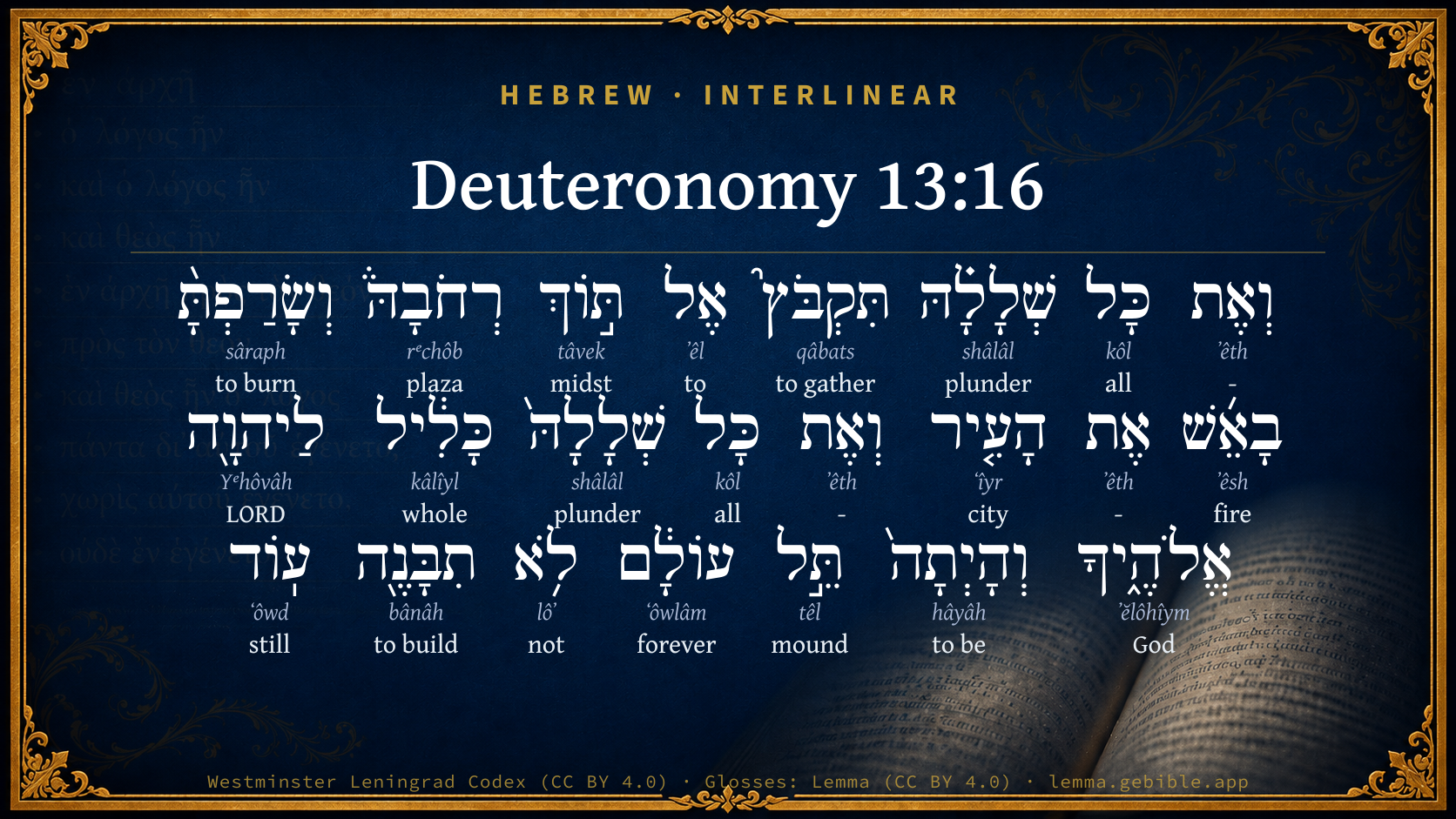
Hebrew (Westminster Leningrad Codex) Deuteronomy 13:16 appears in the Hebrew Old Testament. The text above is from the Westminster Leningrad Codex. Each word links to its Strong’s number, a concise gloss, and parsing drawn from the Open Scriptures Hebrew Bible morphology. Click any word for its full Brown-Driver-Briggs (BDB) entry.
Download image
Cite this verse

Deuteronomy 13:16 (World English Bible). Public Domain. Lemma interlinear Bible study tool, https://lemma.gebible.app/v/deuteronomy/13/16.

Show BibTeX & RIS
BibTeX
RIS
English Translation
You shall gather all the spoil of it into the midst of the street of it, and shall burn with fire the city, and all the spoil of it every whit, to Yahweh your God: and it shall be a heap forever; it shall not be built again.
World English Bible · Public Domain
Highlights
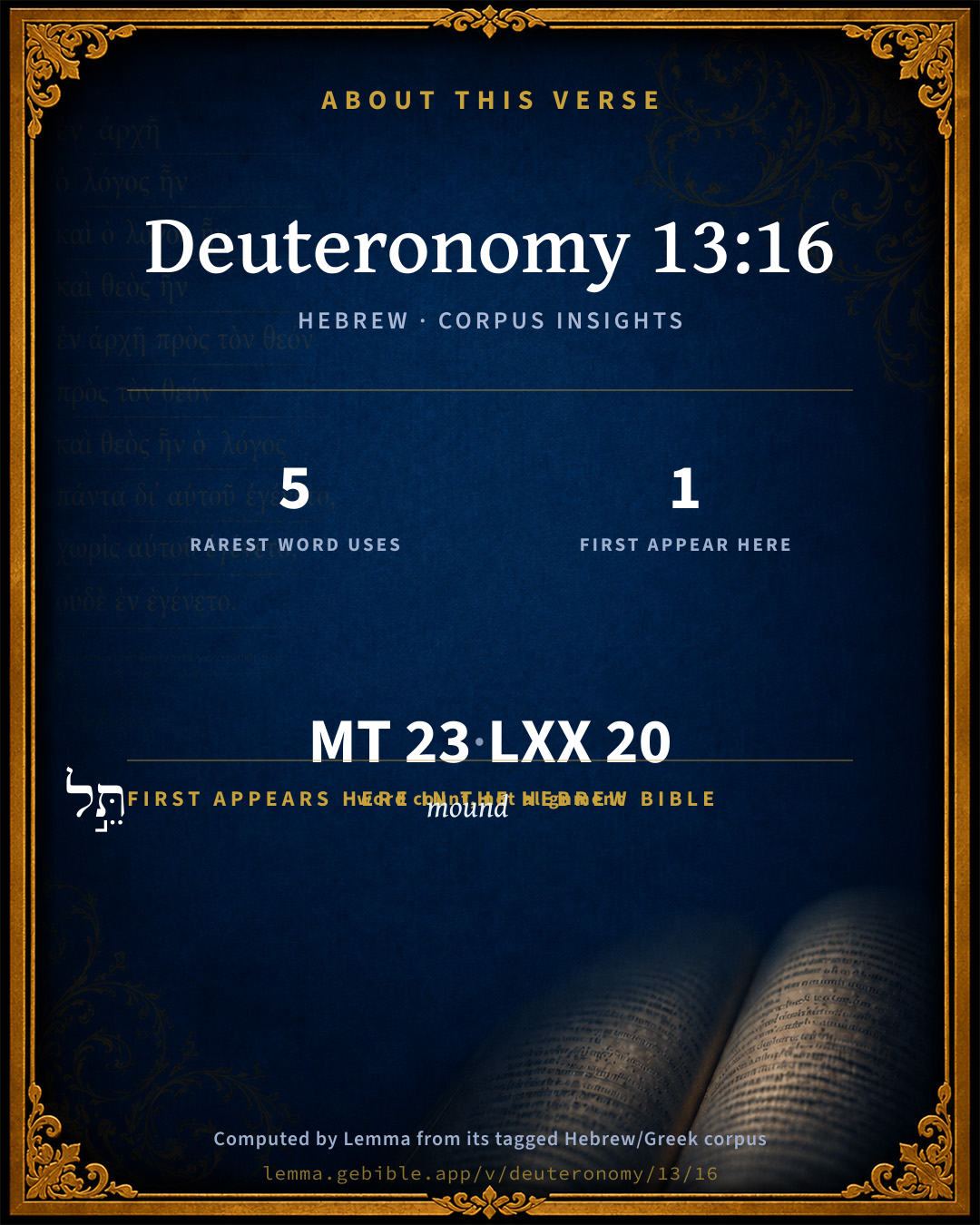
  • 1 first appearance in the Hebrew Bible
Full analysis ↓
Download a study sheet

One document with this verse’s original text, its word-by-word gloss line, the meaning frame, cross-references with their text, attributed commentary, and full source and license credits — printable, and it pastes into notes with its structure intact.

This verse Autodidact and up

Study sheet (.html) Plain text (.txt)

A passage Seminary Student

Up to 50 verses in one chapter. A passage sheet keeps up to 6 commentary sources and 12 cross-references per verse, in the order this page ranks them, and says so on the sheet whenever that leaves anything out. Ask for a single verse and you get the Autodidact verse sheet above.

Everything on this page stays free to read, with no account — the sheet is a download of what is already on screen, not access to it.

Want to remove ads? Support Godless Engineer
Compare translations 3

The same verse in 3 English versions, stacked beneath the original-language interlinear above. Click any original word for its lexicon entry.

Each is an independent rendering of the whole verse — the interlinear is not word-aligned to these translations.

Highlighted words mark where these versions differ — a whole-verse word diff, not a word-by-word alignment.

  • World English Bible Public Domain
    You shall gather all the spoil of it into the midst of the street of it, and shall burn with fire the city, and all the spoil of it every whit, to Yahweh your God: and it shall be a heap forever; it shall not be built again.
  • King James Version Public Domain
    And thou shalt gather all the spoil of it into the midst of the street thereof, and shalt burn with fire the city, and all the spoil thereof every whit, for the LORD thy God: and it shall be an heap for ever; it shall not be built again.
  • unfoldingWord Literal Text CC BY-SA 4.0
    And you shall gather all the spoil to the middle of its street and burn the city in fire, and all its spoil completely, for Yahweh your God. And it shall be a heap forever; it shall not be built again.

unfoldingWord Literal Text — © unfoldingWord, licensed CC BY-SA 4.0. Word-aligned USFM3 via Door43 (git.door43.org/unfoldingWord/en_ult).

Versions to compare (up to 4)

3 of 4 selected

Show all 18 translations

Every available English version of this verse, each an independent rendering of the whole verse.

  • World English Bible Public Domain
    You shall gather all the spoil of it into the midst of the street of it, and shall burn with fire the city, and all the spoil of it every whit, to Yahweh your God: and it shall be a heap forever; it shall not be built again.
  • Berean Standard Bible Public Domain
    And you are to gather all its plunder in the middle of the public square, and completely burn the city and all its plunder as a whole burnt offering to the LORD your God. The city must remain a mound of ruins forever, never to be rebuilt.
  • Majority Standard Bible Public Domain
    And you are to gather all its plunder in the middle of the public square, and completely burn the city and all its plunder as a whole burnt offering to the LORD your God. The city must remain a mound of ruins forever, never to be rebuilt.
  • King James Version Public Domain
    And thou shalt gather all the spoil of it into the midst of the street thereof, and shalt burn with fire the city, and all the spoil thereof every whit, for the LORD thy God: and it shall be an heap for ever; it shall not be built again.
  • American Standard Version (1901) Public Domain
    And thou shalt gather all the spoil of it into the midst of the street thereof, and shalt burn with fire the city, and all the spoil thereof every whit, unto Jehovah thy God: and it shall be a heap for ever; it shall not be built again.
  • Revised Version (1885) Public Domain
    And thou shalt gather all the spoil of it into the midst of the street thereof, and shalt burn with fire the city, and all the spoil thereof every whit, unto the LORD thy God: and it shall be an heap for ever; it shall not be built again.
  • Geneva Bible (1599) Public Domain
    And thou shalt gather all the spoyle of it into the middes of the streete thereof, and burne with fire the citie and all the spoyle thereof euery whit, vnto the Lord thy God: and it shall be an heape for euer: it shall not be built againe.
  • Douay-Rheims (1899) Public Domain
    And all the household goods that are there, thou shalt gather together in the midst of the streets thereof, and shalt burn them with the city itself, so as to consume all for the Lord thy God, and that it be a heap for ever: it shall be built no more.
  • Young's Literal Translation Public Domain
    and all its spoil thou dost gather unto the midst of its broad place, and hast burned with fire the city and all its spoil completely, before Jehovah thy God, and it hath been a heap age-during, it is not built any more;
  • Literal Standard Version CC BY-SA 4.0
    And you gather all its spoil into the midst of its broad place, and have completely burned the city and all its spoil with fire for your God YHWH, and it has been a continuous heap, it is not built anymore;
  • Unlocked Literal Bible CC BY-SA 4.0
    You will gather all the spoil from it into the middle of its street and will burn the city, as well as all its spoil—for Yahweh your God. The city will be a heap of ruins forever; it must never be built again.
  • unfoldingWord Literal Text CC BY-SA 4.0
    And you shall gather all the spoil to the middle of its street and burn the city in fire, and all its spoil completely, for Yahweh your God. And it shall be a heap forever; it shall not be built again.
  • Darby Bible Public Domain
    And all the spoil of it shalt thou gather into the midst of the open place thereof, and shalt burn the city with fire, and all the spoil thereof, wholly to Jehovah thy God; and it shall be a heap for ever; it shall not be built again.
  • World Messianic Bible Public Domain
    You shall gather all its plunder into the middle of its street, and shall burn with fire the city, with all of its plunder, to the LORD your God. It shall be a heap forever. It shall not be built again.
  • Webster's Bible Public Domain
    And thou shalt gather all the spoil of it into the midst of its street, and shalt burn with fire the city, and all the spoil of it every whit, for the LORD thy God: and it shall be a heap forever; it shalt not be built again.
  • Free Bible Version CC BY-SA 4.0
    You must pile up all the people's possessions in the middle of the public square, and completely burn the town and everything in it as a complete burnt offering to the Lord your God. The town must remain a heap of ruins forever. It must never be rebuilt.
  • Bible in Basic English Public Domain
    And take all the goods into the middle of its open space, burning the town and all its property with fire as an offering to the Lord your God; it is to be a waste for ever; there is to be no more building there.
  • JPS Tanakh (1917) Public Domain
    (13-17) And thou shalt gather all the spoil of it into the midst of the broad place thereof, and shall burn with fire the city, and all the spoil thereof every whit, unto the LORD thy God; and it shall be a heap for ever; it shall not be built again.

Literal Standard Version (2020), Covenant Press — licensed CC BY-SA 4.0. Text via the HelloAO Bible API (eBible.org). Unlocked Literal Bible (unfoldingWord) — licensed CC BY-SA 4.0. Text via the HelloAO Bible API (eBible.org). unfoldingWord Literal Text — © unfoldingWord, licensed CC BY-SA 4.0. Word-aligned USFM3 via Door43 (git.door43.org/unfoldingWord/en_ult). Free Bible Version, Dr. Jonathan Gallagher — licensed CC BY-SA 4.0. Text via the HelloAO Bible API (eBible.org).

Word by word

More ways to search: Search by grammar → Find every occurrence → Compare this word →

Practice this passage: Drill this verse → Learn its vocabulary →

תֵּ֣ל
têl
H8510
“mound of”
Noun, Common, Masculine, Singular, Construct
Part of Speech
Noun
Type
Common
Gender
Masculine
Number
Singular
State
Construct
Full BDB Definition

Origin: by contraction from H8524

TWOT: 2513a

mound, heap, heap of ruins - mound (of ruin-heap of city) - mound, hill (of elevation on which city stood)
  1. וְאֶת ʼêth H853 “and · -” Conjunction + Particle, Direct Object
  2. כָּל kôl H3605 “all of” Noun, Common, Masculine, Singular, Construct
  3. שְׁלָלָ֗הּ shâlâl H7998 “plunder · her” Noun, Common, Masculine, Singular, Construct + Suffix, Personal, 3rd Person, Feminine, Singular
  4. תִּקְבֹּץ֮ qâbats H6908 “to gather” Verb, Qal, Imperfect, 2nd Person, Masculine, Singular
  5. אֶל ʼêl H413 “to” Preposition
  6. תּ֣וֹךְ tâvek H8432 “midst of” Noun, Common, Masculine, Singular, Construct
  7. רְחֹבָהּ֒ rᵉchôb H7339 “plaza · her” Noun, Common, Feminine, Singular, Construct + Suffix, Personal, 3rd Person, Feminine, Singular
  8. וְשָׂרַפְתָּ֨ sâraph H8313 “and · to burn” Conjunction + Verb, Qal, Sequential Perfect, 2nd Person, Masculine, Singular
  9. בָאֵ֜שׁ ʼêsh H784 “in/at the · fire” Preposition, Determined + Noun, Common, Both, Singular, Absolute
  10. אֶת ʼêth H853 “-” Particle, Direct Object
  11. הָעִ֤יר ʻîyr H5892 “the · city” Particle, Definite Article + Noun, Common, Feminine, Singular, Absolute
  12. וְאֶת ʼêth H853 “and · -” Conjunction + Particle, Direct Object
  13. כָּל kôl H3605 “all of” Noun, Common, Masculine, Singular, Construct
  14. שְׁלָלָהּ֙ shâlâl H7998 “plunder · her” Noun, Common, Masculine, Singular, Construct + Suffix, Personal, 3rd Person, Feminine, Singular
  15. כָּלִ֔יל kâlîyl H3632 “whole” Adjective, Adjective, Masculine, Singular, Absolute
  16. לַיהוָ֖ה Yᵉhôvâh H3068 “to/for · LORD” Preposition + Noun, Proper
  17. אֱלֹהֶ֑יךָ ʼĕlôhîym H430 “God(s) · your” Noun, Common, Masculine, Plural, Construct + Suffix, Personal, 2nd Person, Masculine, Singular
  18. וְהָיְתָה֙ hâyâh H1961 “and · to be” Conjunction + Verb, Qal, Sequential Perfect, 3rd Person, Feminine, Singular
  19. עוֹלָ֔ם ʻôwlâm H5769 “forever” Noun, Common, Masculine, Singular, Absolute
  20. לֹ֥א lôʼ H3808 “not” Particle, Negative
  21. תִבָּנֶ֖ה bânâh H1129 “to build” Verb, Niphal, Imperfect, 3rd Person, Feminine, Singular
  22. עֽוֹד ʻôwd H5750 “still” Adverb

About this verse

These counts appear in no published source. They are computed here, from the morphology-tagged text and Lemma’s own curated glosses. What Lemma adds →

23
words
19
distinct lemmas
Pentateuch
section

Notable vocabulary

The rarest word here is תֵּ֣ל mound H8510 — appearing just 5 times in the whole Hebrew Bible.

First appearance in Scripture

This word makes its first canonical appearance in the Hebrew Bible here:

Shared distinctive vocabulary

תֵּ֣ל mound H8510 occurs in 5 verses of the Hebrew Bible. Also found in:

Grammatical profile

  • 4 verbs
  • 12 nouns
  • 1 adjective
  • 1 preposition
  • 1 adverb
  • 4 particles

Verb forms

  • תִּקְבֹּץ֮ Qal · Imperfect
  • וְשָׂרַפְתָּ֨ Qal · Sequential Perfect
  • וְהָיְתָה֙ Qal · Sequential Perfect
  • תִבָּנֶ֖ה Niphal · Imperfect

Repetition

Words recur within this verse — often emphatic in Hebrew:

  • כָּל all H3605 ×2
  • שְׁלָלָ֗הּ plunder H7998 ×2

Hebrew & Septuagint length

In English translation the verse runs 48 words from the Hebrew and 42 from the Septuagint (LXX English) — closely comparable.

A rough comparison of the two English renderings, which tokenize alike — not a word-level alignment.

Word counts can differ between the Hebrew and the Greek without any difference in meaning — e.g. the Hebrew direct-object marker אֵת has no separate Greek word, and Greek often adds the article ὁ.

In the original languages it is 23 Hebrew tokens and 20 Greek tokens — but the two are counted differently (Hebrew bundles its prefixes and suffixes into one token; the Greek is in lemma form), so that isn’t a like-for-like length.

Cross-references

8

Topical passages linked to Deuteronomy 13:16 in the Treasury of Scripture Knowledge — connected by theme and wording, ordered by reader-vote popularity; previews shown in the World English Bible.

  • Joshua 8:28 So Joshua burnt Ai, and made it a heap forever, even a desolation, to this day.
  • Jeremiah 49:2 Therefore, behold, the days come, says Yahweh, that I will cause an alarm of war to be heard against Rabbah of the children of Ammon; and it shall become a desolate heap, and her daughters shall be burned with fire: then shall Israel possess those who did possess him, says Yahweh.
  • Joshua 6:24 They burnt the city with fire, and all that was therein; only the silver, and the gold, and the vessels of brass and of iron, they put into the treasury of the house of Yahweh.
  • Isaiah 17:1 The burden of Damascus. Behold, Damascus is taken away from being a city, and it shall be a ruinous heap.
  • Isaiah 25:2 For you have made of a city a heap, of a fortified city a ruin, a palace of strangers to be no city; it shall never be built.
  • Numbers 21:2–3 Israel vowed a vow to Yahweh, and said, If you will indeed deliver this people into my hand, then I will utterly destroy their cities.
  • Joshua 6:26 Joshua charged them with an oath at that time, saying, Cursed be the man before Yahweh, that rises up and builds this city Jericho: with the loss of his firstborn shall he lay the foundation of it, and with the loss of his youngest son shall he set up the gates of it.
  • Micah 1:6 Therefore I will make Samaria like a rubble heap of the field, Like places for planting vineyards; And I will pour down its stones into the valley, And I will uncover its foundations.

Cross-references courtesy of OpenBible.info (CC BY 4.0).

Hebrew and Greek witnesses Masoretic Hebrew ↔ Greek Septuagint

The same verse in the two great witnesses to the Old Testament, shown verse-for-verse.

These are two independent witnesses, not word-aligned to each other, and the Septuagint is shown in lemma (dictionary) form.

Hebrew Deuteronomy 13:16 Masoretic · Westminster Leningrad Codex

וְאֶת כָּל שְׁלָלָ֗הּ תִּקְבֹּץ֮ אֶל תּ֣וֹךְ רְחֹבָהּ֒ וְשָׂרַפְתָּ֨ בָאֵ֜שׁ אֶת הָעִ֤יר וְאֶת כָּל שְׁלָלָהּ֙ כָּלִ֔יל לַיהוָ֖ה אֱלֹהֶ֑יךָ וְהָיְתָה֙ תֵּ֣ל עוֹלָ֔ם לֹ֥א תִבָּנֶ֖ה עֽוֹד

You shall gather all the spoil of it into the midst of the street of it, and shall burn with fire the city, and all the spoil of it every whit, to Yahweh your God: and it shall be a heap forever; it shall not be built again.

World English Bible · Public Domain

Greek LXX Deuteronomy 13:16 Septuagint · lemma form

ἀνααἱρέω ἀνααἱρέω πᾶς ὁ καταοἰκέω ἐν ὁ πόλις ἐκεῖνος ἐν φόνος μάχαιρα ἀνάθεμα ἀναθεματίζω αὐτός καί πᾶς ὁ ἐν αὐτός

And all its spoils you shall gather into its public ways, and you shall burn the city with fire, and all its spoils publicly before the Lord your God; and it shall be uninhabited for ever, it shall not be built again.

LXX2012 (modern English Septuagint) · Public Domain

Hebrew: Westminster Leningrad Codex (CC BY 4.0). Greek: Septuagint (public domain); English from LXX2012 (modern English Septuagint) (Public Domain). How the Septuagint differs from the Hebrew →

Targum (Aramaic paraphrase)

2

The Targum is the ancient Jewish Aramaic paraphrase of the Hebrew Scriptures — an interpretive translation, not the Hebrew text itself. Onkelos (literal) and Pseudo-Jonathan (expansive) render the Torah, and Jonathan the Prophets. Coverage is partial: where no permissively-licensed English translation exists for a verse, only the Aramaic is shown. This is verse-level text, not a word-by-word alignment to the Hebrew.

  1. Targum Onkelos Torah (Genesis–Deuteronomy)
    מִמְחָא תִמְחֵי יָת יָתְבֵי קַרְתָּא הַהִיא לְפִתְגַם דְחָרֶב גַמַר יָתַהּ וְיָת כָּל דִי בַהּ וְיָת בְּעִירַהּ לְפִתְגַם דְחָרֶב

    (no public-domain English translation for this verse)

    Targum Onkelos — Aramaic: “Onkelos Genesis” (public domain); “Onkelos Exodus” (public domain); “Onkelos Leviticus” (public domain); “Onkelos Numbers” (public domain); “Onkelos Deuteronomy” (public domain). English: “Sefaria Community Translation” (CC0 1.0 (public-domain dedication)); “J.W. Etheridge. The Targums of Onkelos and Jonathan Ben Uzziel on the Pentateuch. London: Longmans, Green, 1862” (public domain). Text via Sefaria.

  2. Targum Pseudo-Jonathan Torah (Genesis–Deuteronomy)
    מִמְחָא תִּמְחוּן יַת יַתְבֵי קַרְתָּא הַהוּא לְפִתְגַם דְּחָרֶב גַּמְרָא יָתָהּ וְיַת כָּל דְּבָהּ וְיַת בְּעִירָהּ לְפִתְגַּם דְּחָרֶב

    you shall smite the inhabitants of that city with the edge of the sword, to destroy it utterly and whatever is therein, even its cattle, with the edge of the sword.

    Targum Pseudo-Jonathan — Aramaic: “Targum Jonathan on Genesis” (public domain); “Targum Jonathan on Exodus” (public domain); “Targum Jonathan on Leviticus” (public domain); “Targum Jonathan on Numbers” (public domain); “Targum Jonathan on Deuteronomy” (public domain). English: “The Targum of Jonathan ben Uzziel, trans. J. W. Etheridge, London, 1862” (public domain). Text via Sefaria.

Commentary

Notes on Deuteronomy 13:16 from classic Christian and Jewish commentators (each source and its license shown beneath its notes). The classic Christian expositions comment on the surrounding passage and are grouped to its opening verse, so a note may address several verses; the Jewish commentaries on the Tanakh (Rashi and others) are per-verse, so they appear only where the commentator wrote on this verse.

Lemma curates 59 commentaries, every one of them public domain or Creative Commons licensed, each selected and text-cleaned for this edition rather than reprinted as found. About our sources →

Joseph Benson's Commentary

Deu 13:16-17. For the Lord — For the satisfaction of God’s justice, the maintenance of his honour and authority, and the pacification of his offended majesty. It shall not be built — It shall be an eternal monument of God’s justice and terror to after ages. Multiply thee — So thou shalt have no loss of thy numbers by cutting off so many people.

Joseph Benson's Commentary on the Old and New Testaments (1811–1818) — public domain. Text from a community e-Sword module.

Tyndale Open Study Notes

Tyndale Open Resources

13:16 The spoils of war, or plunder, were not to be kept. God had designated them for complete destruction (see 2:34; Lev 27:28-29).

Tyndale Open Study Notes — © Tyndale Open Resources, licensed CC BY-SA 4.0. Text via the HelloAO Bible API.

Geneva Bible (1599)

Geneva Bible translators

Signifying that no idolatry is so execrable, nor more grievously to be punished, than of them which once professed God.

Geneva Bible (1599) marginal notes — public domain. Text via Bolls.life.

Jamieson, Fausset & Brown

Robert Jamieson, A. R. Fausset & David Brown

it shall be an heap for ever; it shall not be built again--Its ruins shall be a permanent monument of the divine justice, and a beacon for the warning and terror of posterity.

Jamieson, Fausset & Brown — Commentary Critical and Explanatory on the Whole Bible (1871) — public domain (CC PDM 1.0). Text via the HelloAO Bible API.

Ellicott's Commentary for English Readers

(16) And shalt burn with fire the city.—So Gibeah was treated (Judges xx 40).

A Bible Commentary for English Readers, edited by Charles John Ellicott (1878–1897) — public domain. Text from a community e-Sword module.

John Gill's Exposition

And thou shall gather all the spoil of it into the midst of the street thereof,.... All the wealth and substance of the inhabitants, their household goods, shop goods, merchandise, utensils in trade and business, and everything that can be named. The Jews say (p), if there is no street, they make one (or a marketplace); if that is without it, they bring them into the midst of it:

and shall burn with fire the city, and all the spoil thereof every whit; be it what it may, or let it be whose property it will; and all this shall be done for the Lord thy God; as by his appointment and command, and in obedience to him, so for his honour and glory, and the vindication of his righteous law:

and it shall be an heap for ever, it shall not be built again; but lie a waste as Jericho, though not an entire waste; for according to the Jewish writers, though it might not be built as it was before, it might be made into gardens and orchards (q).

(p) Misn. Sanhedrin, c. 11. sect. 6. (q) lbid. Maimon. & Bartenora in ib.

John Gill's Exposition of the Whole Bible (1746–1763) — public domain (CC PDM 1.0). Text via the HelloAO Bible API.

Albert Barnes' Notes on the Bible

Every whit, for the Lord thy God - Some prefer: “as a whole offering to the Lord thy God.”

Albert Barnes' Notes on the Bible (1834–1885) — public domain. Text from a community e-Sword/MySword module.

Matthew Poole's English Annotations

For the Lord thy God, i.e. for the satisfaction of God’s justice, the maintenance of his honour and authority and laws, and the pacification of his offended majesty.

It shall be an heap for ever; it shall be an eternal monument of God’s justice, and terror to after-ages, who may be tempted to like practices.

Matthew Poole's English Annotations on the Holy Bible (1683–1685) — public domain. Text from a community e-Sword/MySword module.

Whedon's Commentary on the Bible

Daniel D. Whedon

16. Every whit, for the Lord thy God — כליל, here in our version rendered every whit, is in other places translated a holocaust, or “whole burnt offering.” Better rendered, a whole burnt offering to Jehovah thy God; that is, the city and the spoil were to be as utterly consumed as a whole burnt offering.

Daniel D. Whedon (gen. ed.), Commentary on the Old and New Testaments (1874–1909) — public domain. Text from a community e-Sword module.

The Pulpit Commentary

All the spoil thereof every whir, for the Lord thy God; rather, all the spoil booty thereof as a whole offering unto Jehovah thy God; it was to be wholly devoted to God, and as such to be consumed by fire. "It was a destruction, and not properly an offering. Hence the author selects neither hl; wO nor taF; j, but lyilK; whole, whole offering, (Deu_33:10; Lev_6:15) which word, in the law concerning offering, is no technical designation of any particular kind of offering. The rendering omnino is untenable" (Knobel). The city was to be made a ruin, never to be rebuilt; and thus was to be treated the same as a heathen, idolatrous city might be. (cf. Num_21:3)

The Pulpit Commentary (1880–1919), ed. H.D.M. Spence-Jones & Joseph S. Exell — public domain. Text from a community e-Sword module.

John Wesley's Explanatory Notes

For the Lord - For the satisfaction of God's justice, the maintainance of his honour and authority, and the pacification of his offended majesty. It shall not be built - It shall be an eternal monument of God's justice, and terror to after ages.

John Wesley, Explanatory Notes Upon the Whole Bible (1754–1765) — public domain. Text via the GEBible commentary corpus.

Rashi

Rabbi Shlomo Yitzchaki (Rashi)

הכה תכה THOU SHALT SURELY SMITE [THE INHABITANTS OF THAT CITY] — If you cannot put them to death by the death-penalty prescribed regarding them, kill them in some other way (Sifrei Devarim 94:1; Bava Metzia 31b; cf. Rashi on v. 10).

Rashi on the Tanakh — English translations: “The Judaica Press complete Tanach with Rashi, translated by A. J. Rosenberg” (CC BY 4.0); “Pentateuch with Rashi's commentary by M. Rosenbaum and A.M. Silbermann, 1929-1934” (public domain); “The Metsudah Tanach series, Lakewood, N.J” (CC BY 4.0); and “The Book of Joshua, Metsudah Publications, 1997” (CC BY 4.0). Text via Sefaria.

Ramban (Nachmanides)

Rabbi Moshe ben Nachman (Ramban / Nachmanides)

DESTROY IT UTTERLY, AND ALL THAT IS THEREIN. [Destroy] ‘it’ [utterly] — the men that have gone astray [after the idols]; and all that is therein — the women who followed after the men. But the children who are minors, among males and females, are not killed. And so the Rabbis said in the Sifre: 94. “Chanan: “Abba Chanan.” says: It is written, The fathers shall not be put to death for the children, neither shall the children be put to death for the fathers — the verse is speaking with reference to an apostate city.” But in the Tosephta of Tractate Sanhedrin we find a difference of opinion regarding this matter: “Minors, children of people of an apostate city, who have gone astray with [the city] are not killed. Rabbi Eliezer says they are killed. Rabbi Akiba said to him: How do I fulfill then the verse, and He will give thee compassion, and make thee compassionate, and multiply thee etc.? If its intent is to show mercy to the adults, it is already stated, destroy it utterly, and all that is therein and the cattle thereof etc. And how then do I fulfill and make thee compassionate, and multiply thee? By applying it to the children therein etc.” Thus all these commandments are explanatory of what it says in the Torah, He that sacrificeth unto the gods shall be utterly destroyed, and now he explained the nature of this “utter destruction” with reference to inciters and the worshippers [of idols].

Ramban (Nachmanides) on the Tanakh — English translation: “Commentary on the Torah by Ramban (Nachmanides). Translated and annotated by Charles B. Chavel. New York, Shilo Pub. House, 1971-1976” (CC BY 4.0). Text via Sefaria.

Lesson kit

Teaching starters — assembled from the data on this page, not authored interpretation. Every prompt links to the verse data it draws on. Edit before teaching.

Deuteronomy, in the Pentateuch, opens this verse with 23 words (19 distinct Hebrew lemmas). Its most distinctive word is têl (“mound”). A historical commentator’s framing appears above. Read the whole chapter for the surrounding context.

Discussion questions

  1. What does “mound” (têl) contribute to the verse as a whole?
  2. The word “mound” first appears here in Scripture. What is being introduced at this debut?
  3. Joshua 8:28 shares the word «mound» with this verse. How do the two illuminate each other?
  4. “all” occurs 2× in this one verse. What is the effect of the repetition?
  5. The translations on this page render this verse differently — a whole-verse word diff, not a word-by-word alignment. What might account for the different wordings?
  6. The verb «תִּקְבֹּץ֮» is Qal Imperfect. How does its form color the action?
  7. Reading how Joseph Benson's Commentary and Tyndale Open Study Notes read this verse, where do the two commentators agree and where do they part?

Things to notice

Reading settings

Reading text

Shown beneath each verse's original-language words.

Old Testament
Old Testament edition

Read the OT as the Masoretic Hebrew (MT) or the Greek Septuagint (LXX).

English shown for the Greek Septuagint (in the Hebrew ↔ Greek comparison).

Comparing translations? Open the Compare panel on any verse page to stack up to four side by side.