
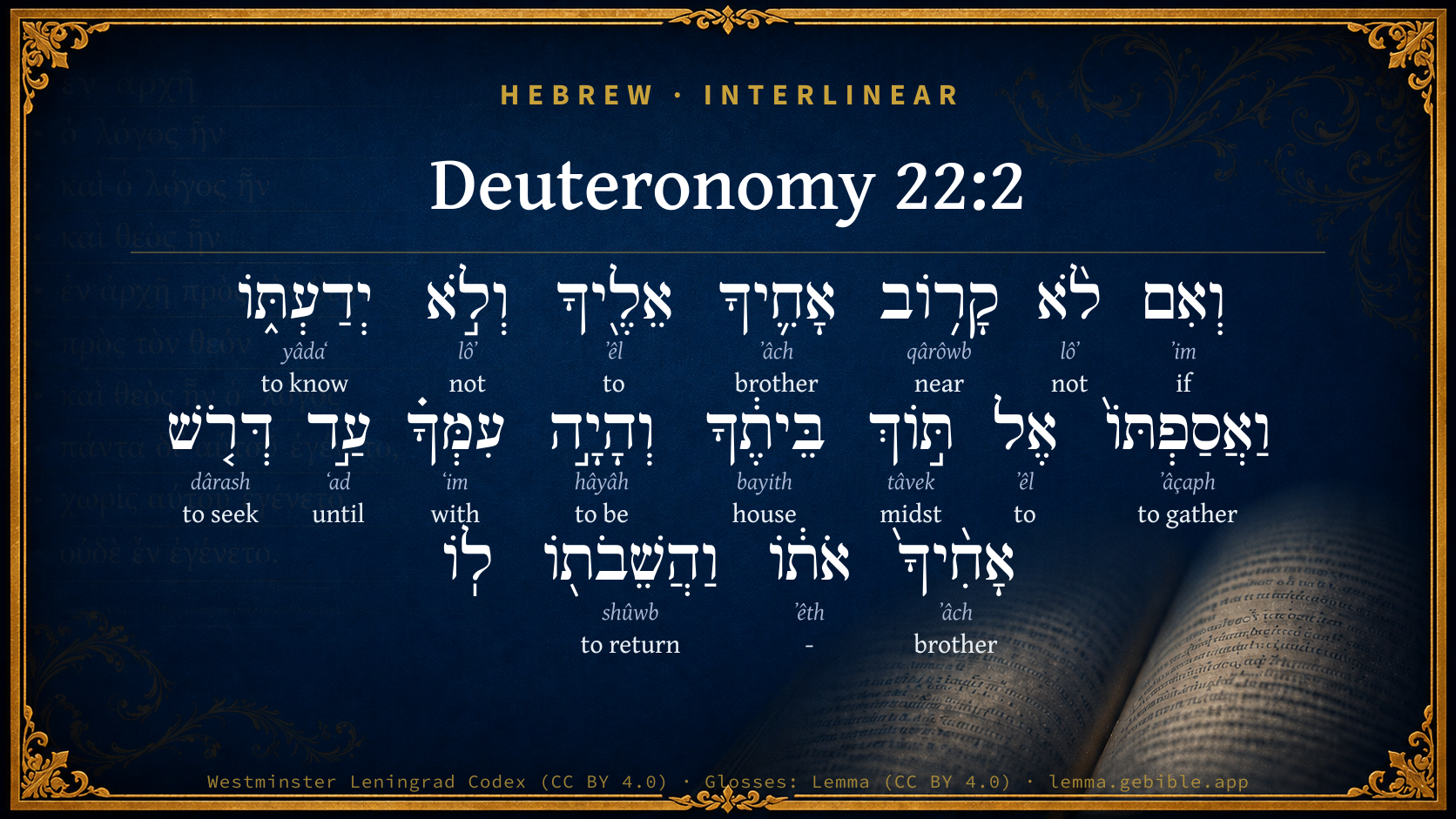
Deuteronomy 22:2

Hebrew (Westminster Leningrad Codex) Deuteronomy 22:2 appears in the Hebrew Old Testament. The text above is from the Westminster Leningrad Codex. Each word links to its Strong’s number, a concise gloss, and parsing drawn from the Open Scriptures Hebrew Bible morphology. Click any word for its full Brown-Driver-Briggs (BDB) entry.
Download image
Cite this verse

Deuteronomy 22:2 (World English Bible). Public Domain. Lemma interlinear Bible study tool, https://lemma.gebible.app/v/deuteronomy/22/2.

Show BibTeX & RIS
BibTeX
RIS
English Translation
If your brother isn't near to you, or if you don't know him, then you shall bring it home to your house, and it shall be with you until your brother seek after it, and you shall restore it to him.
World English Bible · Public Domain
Download a study sheet

One document with this verse’s original text, its word-by-word gloss line, the meaning frame, cross-references with their text, attributed commentary, and full source and license credits — printable, and it pastes into notes with its structure intact.

This verse Autodidact and up

Study sheet (.html) Plain text (.txt)

A passage Seminary Student

Up to 50 verses in one chapter. A passage sheet keeps up to 6 commentary sources and 12 cross-references per verse, in the order this page ranks them, and says so on the sheet whenever that leaves anything out. Ask for a single verse and you get the Autodidact verse sheet above.

Everything on this page stays free to read, with no account — the sheet is a download of what is already on screen, not access to it.

Want to remove ads? Support Godless Engineer
Compare translations 3

The same verse in 3 English versions, stacked beneath the original-language interlinear above. Click any original word for its lexicon entry.

Each is an independent rendering of the whole verse — the interlinear is not word-aligned to these translations.

Highlighted words mark where these versions differ — a whole-verse word diff, not a word-by-word alignment.

  • World English Bible Public Domain
    If your brother isn't near to you, or if you don't know him, then you shall bring it home to your house, and it shall be with you until your brother seek after it, and you shall restore it to him.
  • King James Version Public Domain
    And if thy brother be not nigh unto thee, or if thou know him not, then thou shalt bring it unto thine own house, and it shall be with thee until thy brother seek after it, and thou shalt restore it to him again.
  • unfoldingWord Literal Text CC BY-SA 4.0
    And if your brother not near to you, or you do not know him, then gather it to the middle of your house, and it must be with you until your brother seeks it, and you shall return it to him.

unfoldingWord Literal Text — © unfoldingWord, licensed CC BY-SA 4.0. Word-aligned USFM3 via Door43 (git.door43.org/unfoldingWord/en_ult).

Versions to compare (up to 4)

3 of 4 selected

Show all 18 translations

Every available English version of this verse, each an independent rendering of the whole verse.

  • World English Bible Public Domain
    If your brother isn't near to you, or if you don't know him, then you shall bring it home to your house, and it shall be with you until your brother seek after it, and you shall restore it to him.
  • Berean Standard Bible Public Domain
    If your brother does not live near you, or if you do not know who he is, you are to take the animal home to remain with you until your brother comes seeking it; then you can return it to him.
  • Majority Standard Bible Public Domain
    If your brother does not live near you, or if you do not know who he is, you are to take the animal home to remain with you until your brother comes seeking it; then you can return it to him.
  • King James Version Public Domain
    And if thy brother be not nigh unto thee, or if thou know him not, then thou shalt bring it unto thine own house, and it shall be with thee until thy brother seek after it, and thou shalt restore it to him again.
  • American Standard Version (1901) Public Domain
    And if thy brother be not nigh unto thee, or if thou know him not, then thou shalt bring it home to thy house, and it shall be with thee until thy brother seek after it, and thou shalt restore it to him.
  • Revised Version (1885) Public Domain
    And if thy brother be not nigh unto thee, or if thou know him not, then thou shalt bring it home to thine house, and it shall be with thee until thy brother seek after it, and thou shalt restore it to him again.
  • Geneva Bible (1599) Public Domain
    And if thy brother bee not neere vnto thee, or if thou knowe him not, then thou shalt bring it into thine house, and it shall remaine with thee, vntill thy brother seeke after it: then shalt thou deliuer it to him againe.
  • Douay-Rheims (1899) Public Domain
    And if thy brother be not nigh, or thou know him not: thou shalt bring them to thy house, and they shall be with thee until thy brother seek them, and receive them.
  • Young's Literal Translation Public Domain
    and if thy brother `is' not near unto thee, and thou hast not known him, then thou hast removed it unto the midst of thy house, and it hath been with thee till thy brother seek it, and thou hast given it back to him;
  • Literal Standard Version CC BY-SA 4.0
    and if your brother [is] not near to you, and you have not known him, then you have removed it to the midst of your house, and it has been with you until your brother seeks it, and you have given it back to him;
  • Unlocked Literal Bible CC BY-SA 4.0
    If your fellow Israelite is not near to you, or if you do not know him, then you must bring the animal home to your house, and it must be with you until he looks for it, and then you must restore it to him.
  • unfoldingWord Literal Text CC BY-SA 4.0
    And if your brother not near to you, or you do not know him, then gather it to the middle of your house, and it must be with you until your brother seeks it, and you shall return it to him.
  • Darby Bible Public Domain
    And if thy brother be not near unto thee, and thou know him not, then thou shalt bring it unto thy house, and it shall be with thee until thy brother seek after it, and thou shalt restore it unto him.
  • World Messianic Bible Public Domain
    If your brother isn’t near to you, or if you don’t know him, then you shall bring it home to your house, and it shall be with you until your brother comes looking for it, and you shall restore it to him.
  • Webster's Bible Public Domain
    And if thy brother shall not be nigh to thee, or if thou shalt not know him, then thou shalt bring it to thy own house, and it shall be with thee until thy brother shall seek after it, and thou shalt restore it to him again.
  • Free Bible Version CC BY-SA 4.0
    If its owner doesn't live near you, or if you don't know who it is, take the animal home with you and keep it until the owner comes looking, then you can return it.
  • Bible in Basic English Public Domain
    If their owner is not near, or if you are not certain who he is, then take the beast to your house and keep it till its owner comes in search of it, and then you are to give it back to him.
  • JPS Tanakh (1917) Public Domain
    And if thy brother be not nigh unto thee, and thou know him not, then thou shalt bring it home to thy house, and it shall be with thee until thy brother require it, and thou shalt restore it to him.

Literal Standard Version (2020), Covenant Press — licensed CC BY-SA 4.0. Text via the HelloAO Bible API (eBible.org). Unlocked Literal Bible (unfoldingWord) — licensed CC BY-SA 4.0. Text via the HelloAO Bible API (eBible.org). unfoldingWord Literal Text — © unfoldingWord, licensed CC BY-SA 4.0. Word-aligned USFM3 via Door43 (git.door43.org/unfoldingWord/en_ult). Free Bible Version, Dr. Jonathan Gallagher — licensed CC BY-SA 4.0. Text via the HelloAO Bible API (eBible.org).

Word by word

More ways to search: Search by grammar → Find every occurrence → Compare this word →

Practice this passage: Drill this verse → Learn its vocabulary →

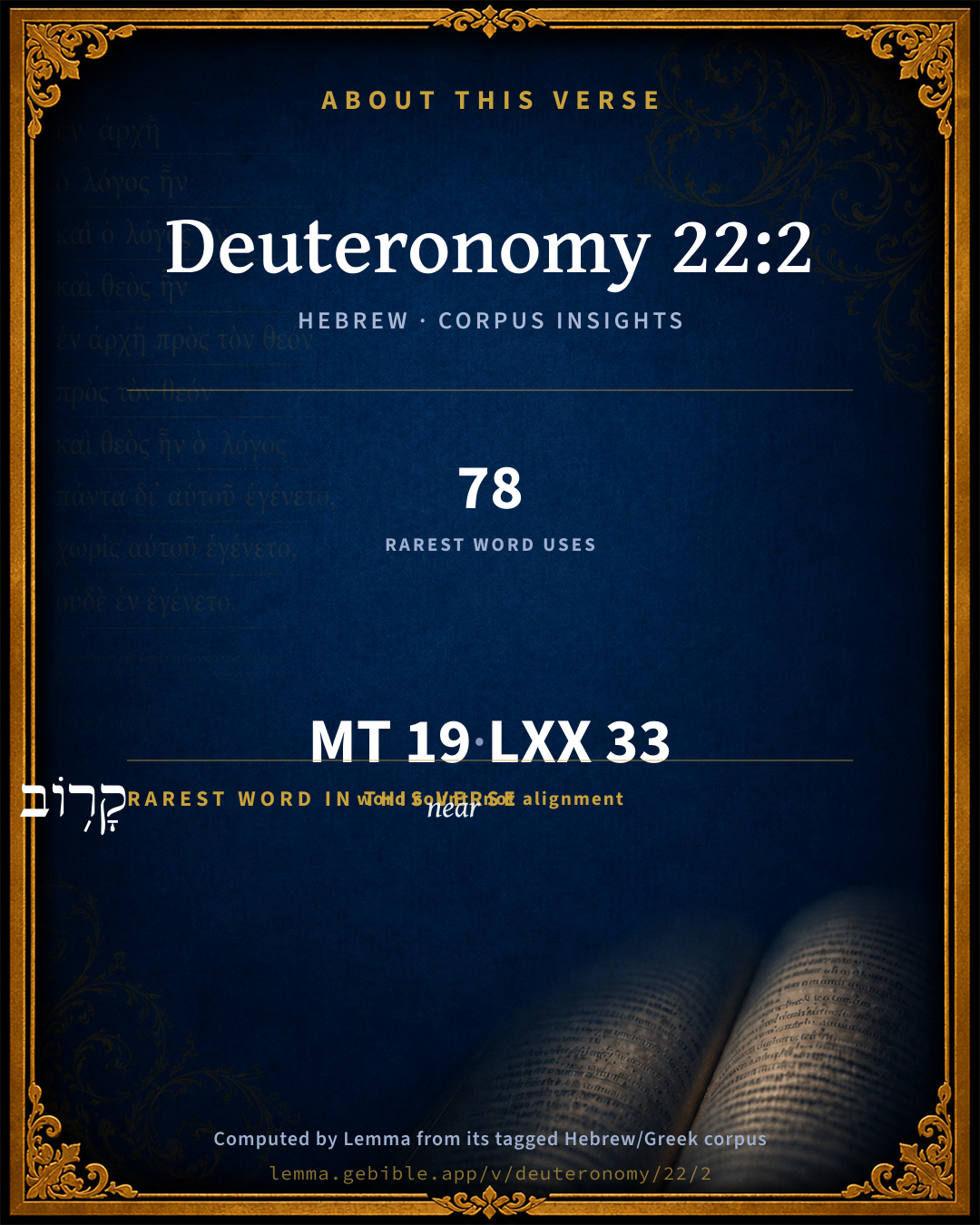
קָר֥וֹב
qârôwb
H7138
“near”
Adjective, Adjective, Masculine, Singular, Absolute
Part of Speech
Adjective
Type
Adjective
Gender
Masculine
Number
Singular
State
Absolute
Full BDB Definition

Origin: from H7126

TWOT: 2065d

near - of place - of time - of personal relationship - kinship
  1. וְאִם ʼim H518 “and · if” Conjunction + Conjunction
  2. לֹ֨א lôʼ H3808 “not” Particle, Negative
  3. אָחִ֛יךָ ʼâch H251 “brother · your” Noun, Common, Masculine, Singular, Construct + Suffix, Personal, 2nd Person, Masculine, Singular
  4. אֵלֶ֖יךָ ʼêl H413 “to · you” Preposition + Suffix, Personal, 2nd Person, Masculine, Singular
  5. וְלֹ֣א lôʼ H3808 “and · not” Conjunction + Particle, Negative
  6. יְדַעְתּ֑וֹ yâdaʻ H3045 “to know · him” Verb, Qal, Perfect, 2nd Person, Masculine, Singular + Suffix, Personal, 3rd Person, Masculine, Singular
  7. וַאֲסַפְתּוֹ֙ ʼâçaph H622 “and · to gather · him” Conjunction + Verb, Qal, Sequential Perfect, 2nd Person, Masculine, Singular + Suffix, Personal, 3rd Person, Masculine, Singular
  8. אֶל ʼêl H413 “to” Preposition
  9. תּ֣וֹךְ tâvek H8432 “midst of” Noun, Common, Masculine, Singular, Construct
  10. בֵּיתֶ֔ךָ bayith H1004 “house · your” Noun, Common, Masculine, Singular, Construct + Suffix, Personal, 2nd Person, Masculine, Singular
  11. וְהָיָ֣ה hâyâh H1961 “and · to be” Conjunction + Verb, Qal, Sequential Perfect, 3rd Person, Masculine, Singular
  12. עִמְּךָ֗ ʻim H5973 “with · you” Preposition + Suffix, Personal, 2nd Person, Masculine, Singular
  13. עַ֣ד ʻad H5704 “until” Preposition
  14. דְּרֹ֤שׁ dârash H1875 “to seek” Verb, Qal, Infinitive Construct
  15. אָחִ֨יךָ֙ ʼâch H251 “brother · your” Noun, Common, Masculine, Singular, Construct + Suffix, Personal, 2nd Person, Masculine, Singular
  16. אֹת֔וֹ ʼêth H853 “- · him” Particle, Direct Object + Suffix, Personal, 3rd Person, Masculine, Singular
  17. וַהֲשֵׁבֹת֖וֹ shûwb H7725 “and · to return · him” Conjunction + Verb, Hiphil, Sequential Perfect, 2nd Person, Masculine, Singular + Suffix, Personal, 3rd Person, Masculine, Singular

About this verse

These counts appear in no published source. They are computed here, from the morphology-tagged text and Lemma’s own curated glosses. What Lemma adds →

19
words
15
distinct lemmas
Pentateuch
section

Grammatical profile

  • 5 verbs
  • 4 nouns
  • 1 adjective
  • 5 prepositions
  • 1 conjunction
  • 3 particles

Verb forms

  • יְדַעְתּ֑וֹ Qal · Perfect
  • וַאֲסַפְתּוֹ֙ Qal · Sequential Perfect
  • וְהָיָ֣ה Qal · Sequential Perfect
  • דְּרֹ֤שׁ Qal · Infinitive Construct
  • וַהֲשֵׁבֹת֖וֹ Hiphil · Sequential Perfect

Repetition

Words recur within this verse — often emphatic in Hebrew:

  • אָחִ֛יךָ brother H251 ×2
  • לֹ֨א not H3808 ×2
  • אֵלֶ֖יךָ to H413 ×2

Hebrew & Septuagint length

In English translation the verse runs 41 words from the Hebrew and 42 from the Septuagint (LXX English) — closely comparable.

A rough comparison of the two English renderings, which tokenize alike — not a word-level alignment.

Word counts can differ between the Hebrew and the Greek without any difference in meaning — e.g. the Hebrew direct-object marker אֵת has no separate Greek word, and Greek often adds the article ὁ.

In the original languages it is 19 Hebrew tokens and 33 Greek tokens — but the two are counted differently (Hebrew bundles its prefixes and suffixes into one token; the Greek is in lemma form), so that isn’t a like-for-like length.

Cross-references

2

Topical passages linked to Deuteronomy 22:2 in the Treasury of Scripture Knowledge — connected by theme and wording, ordered by reader-vote popularity; previews shown in the World English Bible.

  • Matthew 7:12 Therefore whatever you desire for men to do to you, you shall also do to them; for this is the law and the prophets.
  • 1 Thessalonians 4:6 that no one should take advantage of and wrong a brother or sister in this matter; because the Lord is an avenger in all these things, as also we forewarned you and testified.

Cross-references courtesy of OpenBible.info (CC BY 4.0).

Hebrew and Greek witnesses Masoretic Hebrew ↔ Greek Septuagint

The same verse in the two great witnesses to the Old Testament, shown verse-for-verse.

These are two independent witnesses, not word-aligned to each other, and the Septuagint is shown in lemma (dictionary) form.

Hebrew Deuteronomy 22:2 Masoretic · Westminster Leningrad Codex

וְאִם לֹ֨א קָר֥וֹב אָחִ֛יךָ אֵלֶ֖יךָ וְלֹ֣א יְדַעְתּ֑וֹ וַאֲסַפְתּוֹ֙ אֶל תּ֣וֹךְ בֵּיתֶ֔ךָ וְהָיָ֣ה עִמְּךָ֗ עַ֣ד דְּרֹ֤שׁ אָחִ֨יךָ֙ אֹת֔וֹ וַהֲשֵׁבֹת֖וֹ לֽוֹ

If your brother isn't near to you, or if you don't know him, then you shall bring it home to your house, and it shall be with you until your brother seek after it, and you shall restore it to him.

World English Bible · Public Domain

Greek LXX Deuteronomy 22:2 Septuagint · lemma form

ἐάν δέ μή ἐγγίζω ὁ ἀδελφός σύ πρός σύ μηδέ ἐπίσταμαι αὐτός συνἄγω αὐτός ἔνδον εἰς ὁ οἰκία σύ καί εἰμί μετά σύ ἕως ἄν ζητέω αὐτός ὁ ἀδελφός σύ καί ἀποδίδωμι αὐτός

And if your brother do not come near you, and you do not know him, you shall bring it into your house within; and it shall be with you until your brother shall seek them, and you shall restore them to him.

LXX2012 (modern English Septuagint) · Public Domain

Hebrew: Westminster Leningrad Codex (CC BY 4.0). Greek: Septuagint (public domain); English from LXX2012 (modern English Septuagint) (Public Domain). How the Septuagint differs from the Hebrew →

Targum (Aramaic paraphrase)

2

The Targum is the ancient Jewish Aramaic paraphrase of the Hebrew Scriptures — an interpretive translation, not the Hebrew text itself. Onkelos (literal) and Pseudo-Jonathan (expansive) render the Torah, and Jonathan the Prophets. Coverage is partial: where no permissively-licensed English translation exists for a verse, only the Aramaic is shown. This is verse-level text, not a word-by-word alignment to the Hebrew.

  1. Targum Onkelos Torah (Genesis–Deuteronomy)
    וְאִם לָא קָרֵב אֲחוּךְ לְוָתָךְ וְלָא יְדַעַתְּ לֵהּ וְתַכְנְשִׁנֵהּ לְגוֹ בֵיתָךְ וִיהֵי עִמָךְ עַד דְיִתְבַּע אֲחוּךְ יָתֵהּ וְתָתֵיבִנֵהּ לֵהּ

    (no public-domain English translation for this verse)

    Targum Onkelos — Aramaic: “Onkelos Genesis” (public domain); “Onkelos Exodus” (public domain); “Onkelos Leviticus” (public domain); “Onkelos Numbers” (public domain); “Onkelos Deuteronomy” (public domain). English: “Sefaria Community Translation” (CC0 1.0 (public-domain dedication)); “J.W. Etheridge. The Targums of Onkelos and Jonathan Ben Uzziel on the Pentateuch. London: Longmans, Green, 1862” (public domain). Text via Sefaria.

  2. Targum Pseudo-Jonathan Torah (Genesis–Deuteronomy)
    וְאִין לָא קְרִיבָא דַעְתָּא דְאָחוּךְ עִמָךְ אוֹ לָא חַכִּימְתֵּיהּ וְתִכְנְשִׁינֵיהּ לְגוֹ בֵיתָךְ וִיהֵי מִתְפַּרְנֵס גַּבָּךְ עַד זְמַן דְּיִתְבַּע אָחוּךְ יָתֵיהּ וּתְתִיבִינֵיהּ לֵיהּ

    But if knowledge of thy brother is not thine, if thou knowest him not, thou shalt bring it into thy house, and it shall be supported by thee till the time that thou hast sought out thy brother, and thou shalt restore it to him.

    Targum Pseudo-Jonathan — Aramaic: “Targum Jonathan on Genesis” (public domain); “Targum Jonathan on Exodus” (public domain); “Targum Jonathan on Leviticus” (public domain); “Targum Jonathan on Numbers” (public domain); “Targum Jonathan on Deuteronomy” (public domain). English: “The Targum of Jonathan ben Uzziel, trans. J. W. Etheridge, London, 1862” (public domain). Text via Sefaria.

Commentary

Notes on Deuteronomy 22:2 from classic Christian and Jewish commentators (each source and its license shown beneath its notes). The classic Christian expositions comment on the surrounding passage and are grouped to its opening verse, so a note may address several verses; the Jewish commentaries on the Tanakh (Rashi and others) are per-verse, so they appear only where the commentator wrote on this verse.

Lemma curates 59 commentaries, every one of them public domain or Creative Commons licensed, each selected and text-cleaned for this edition rather than reprinted as found. About our sources →

Geneva Bible (1599)

Geneva Bible translators

Showing that brotherly affection must be showed, not only to them that dwell near unto us, but also to them which are far off.

Geneva Bible (1599) marginal notes — public domain. Text via Bolls.life.

The Cambridge Bible for Schools and Colleges

gen. ed. J. J. S. Perowne

2, 3. Wholly (except for his ass) D’s addition to the law.

The Cambridge Bible for Schools and Colleges (gen. ed. J. J. S. Perowne; Cambridge University Press, 1878–1918) — public domain. Text from a community e-Sword module.

John Gill's Exposition

And if thy brother be not nigh unto thee,.... Does not live in the same neighbourhood, but at some considerable distance; so that he cannot soon and easily be informed of his cattle, or they be sent to him:

or if thou know him not; the owner of them, what is his name, or where he lives:

then thou shall bring it into thine house; not into his dwelling house, but some out house, barn, or stable:

and it shall be with thee; remain in his custody, and be taken care of by him; and, as the Targum of Jonathan says, "be fed and nourished by him"; for, according to the Jewish canon (s), whatsoever could work and eat, that should work and eat, and whatsoever did not work and eat was to be sold; for which there was a set time, as the commentators say (t), for large cattle, as oxen, twelve months; for lesser cattle, as sheep, goats, &c. three months, here it is fixed:

until thy brother seek after it; though in the mean while the finder was to make use of means, whereby the owner might be informed of it; for whatsoever was lost, in which were marks and signs by which inquiries might be made, were to be proclaimed (u); (and it is asked) how long a man was obliged to proclaim? until it was known to his neighbours; same say (he must proclaim it) at three feasts, and seven days after the last feast, so that he may go home three days, and return three days, and proclaim one day; if (the owner) tells what is lost, but does not tell the marks or signs, he may not give it him; and a deceiver, though he tells the signs, he may not give it him, as it is said, "until thy brother seek after it"; until thou inquirest of thy brother whether he is a deceiver or not: and elsewhere it is said (w), formerly if a man lost anything, and gave the signs or marks of it, he took it; but after deceivers increased, it was ordered to be said to him, bring witnesses that thou art not a deceiver, and take it; and in the same place it is observed, that there was at Jerusalem a stone, called Eben Toim, "the stone of strays", and whoever had lost or found anything repaired thither, and gave the signs and marks of it, and took it:

and thou shalt restore it to him again; he having made it fully to appear to be his, and having defrayed all expenses in advertising and keeping it; but if no owner appear to claim it, or not to satisfaction, the finder was to keep it as his own; but otherwise he was by all means to restore it, or, as in Deu 23:1 "in restoring thou shalt restore them" (x), that is, certainly restore them; and continually wherever it so happens: the Jewish canon is (y),"if he restores it, and afterwards it strays away, and he restores it again and it strays away, even though four or five times, he is bound to restore it; as it is said, "in restoring thou shalt restore them"; Maimonides says (z), that even an hundred times he is bound to restore them.''

(s) Misn. Bava Metzia, c. 2. sect. 7. (t) Maimon. & Bartenora in ib. (u) Misn. ib. sect. 5, 6, 7. (w) T. Bab. Bava Metzia, fol. 28. 2. (x) "reducendo reduces eos", Pagninus, Montanus. (y) Misn. ut supra, (s)) sect. 9. (z) Hilchot Gazelah ve abadah, c. 11. sect. 14.

John Gill's Exposition of the Whole Bible (1746–1763) — public domain (CC PDM 1.0). Text via the HelloAO Bible API.

Haydock's Catholic Bible Commentary

Not nigh, either in blood or in place, (Calmet) though the latter signification seems more applicable; as, if the person lived at too great a distance, it would suffice to inform him where he might find what he had lost; and, if the owner was unknown, the thing must be taken care of by him who finds it till he be discovered. (Du Hamel)

George Leo Haydock (1774–1849), Haydock's Catholic Family Bible and Commentary, 1859 edition — public domain. Excludes Psalms (Douay-Rheims chapter numbering differs from Protestant) and Deuterocanonical books (Catholic canon only).

Matthew Poole's English Annotations

If thy brother be not nigh unto thee, which may make the duty more troublesome or chargeable.

If thou know him not; which implies, that if they did know the owner, they should restore it to him.

Thou shalt bring it unto thine own house, to be used like thine own cattle. Thou shalt restore it to him again, the owner, as it may be presumed, paying the charges.

Matthew Poole's English Annotations on the Holy Bible (1683–1685) — public domain. Text from a community e-Sword/MySword module.

John Wesley's Explanatory Notes

To thine own house - To be used like thine own cattle.

John Wesley, Explanatory Notes Upon the Whole Bible (1754–1765) — public domain. Text via the GEBible commentary corpus.

Rashi

Rabbi Shlomo Yitzchaki (Rashi)

עד דרש אחיך [AND IT SHALL BE WITH THEE] UNTIL THY BROTHER ENQUIRES [FOR IT] — But would it ever enter your mind that one could give it back before he enquires for it (Scripture distinctly states that you do not know to whom the animal belongs)?! But the meaning of the verse is: Thou shalt make diligent enquiries of him that he should not be a fraudulent claimant (Bava Metzia 27b. 28a; cf. Sifrei Devarim 223:4).

והשבתו לו AND THOU SHALT RESTORE IT TO HIM — it is necessary that there be some restoration — that it (the animal) should not eat in your house to its own value, and you claim this from him (in which case there is no actual restoration of what has been lost). From here, they (the Rabbis) derived the law: Whatever works and requires food (as, for instance, oxen, etc., the cost of whose food is set off by the value of its labour) should work and eat; whatever does not work but requires feeding (as, for instance, sheep) should be sold and the money restored to the man who lost it (Bava Metzia 28b).

Rashi on the Tanakh — English translations: “The Judaica Press complete Tanach with Rashi, translated by A. J. Rosenberg” (CC BY 4.0); “Pentateuch with Rashi's commentary by M. Rosenbaum and A.M. Silbermann, 1929-1934” (public domain); “The Metsudah Tanach series, Lakewood, N.J” (CC BY 4.0); and “The Book of Joshua, Metsudah Publications, 1997” (CC BY 4.0). Text via Sefaria.

Ramban (Nachmanides)

Rabbi Moshe ben Nachman (Ramban / Nachmanides)

AND IF THY BROTHER BE NOT NIGH UNTO THEE — meaning that he does not reside near you, for it is not your duty to go to another land with the lost article in order to restore it to him, or that you do not know him at all. In the Sifre we find: 223. “I know only that one is obligated to restore lost property if the loser lives nearby. Whence do I know that he must also do so if he lives far away? From what Scripture states, and thou know him not.” And if so, the phrase and if thy brother be not nigh unto thee means that he is “not near you” in your city that you may inquire about him and identify him [as the rightful claimant], then it shall be with thee until thy brother seek after it.

Ramban (Nachmanides) on the Tanakh — English translation: “Commentary on the Torah by Ramban (Nachmanides). Translated and annotated by Charles B. Chavel. New York, Shilo Pub. House, 1971-1976” (CC BY 4.0). Text via Sefaria.

Lesson kit

Teaching starters — assembled from the data on this page, not authored interpretation. Every prompt links to the verse data it draws on. Edit before teaching.

Deuteronomy, in the Pentateuch, opens this verse with 19 words (15 distinct Hebrew lemmas). Its most distinctive word is qârôwb (“near”). A historical commentator’s framing appears above. Read the whole chapter for the surrounding context.

Discussion questions

  1. What does “near” (qârôwb) contribute to the verse as a whole?
  2. How does Matthew 7:12, which shares this passage’s theme, read alongside this verse?
  3. What does the repetition of “brother” (2× in this one verse) do in this verse?
  4. These translations render this verse differently; the difference is in the English rendering, not the original. What questions does that raise?
  5. «יְדַעְתּ֑וֹ» is a Qal Perfect verb. How does that grammatical form shape the action described?
  6. Compare how Geneva Bible (1599) and The Cambridge Bible for Schools and Colleges read this verse. Where do they agree or differ?

Things to notice

Reading settings

Reading text

Shown beneath each verse's original-language words.

Old Testament
Old Testament edition

Read the OT as the Masoretic Hebrew (MT) or the Greek Septuagint (LXX).

English shown for the Greek Septuagint (in the Hebrew ↔ Greek comparison).

Comparing translations? Open the Compare panel on any verse page to stack up to four side by side.