
Joshua 20:9

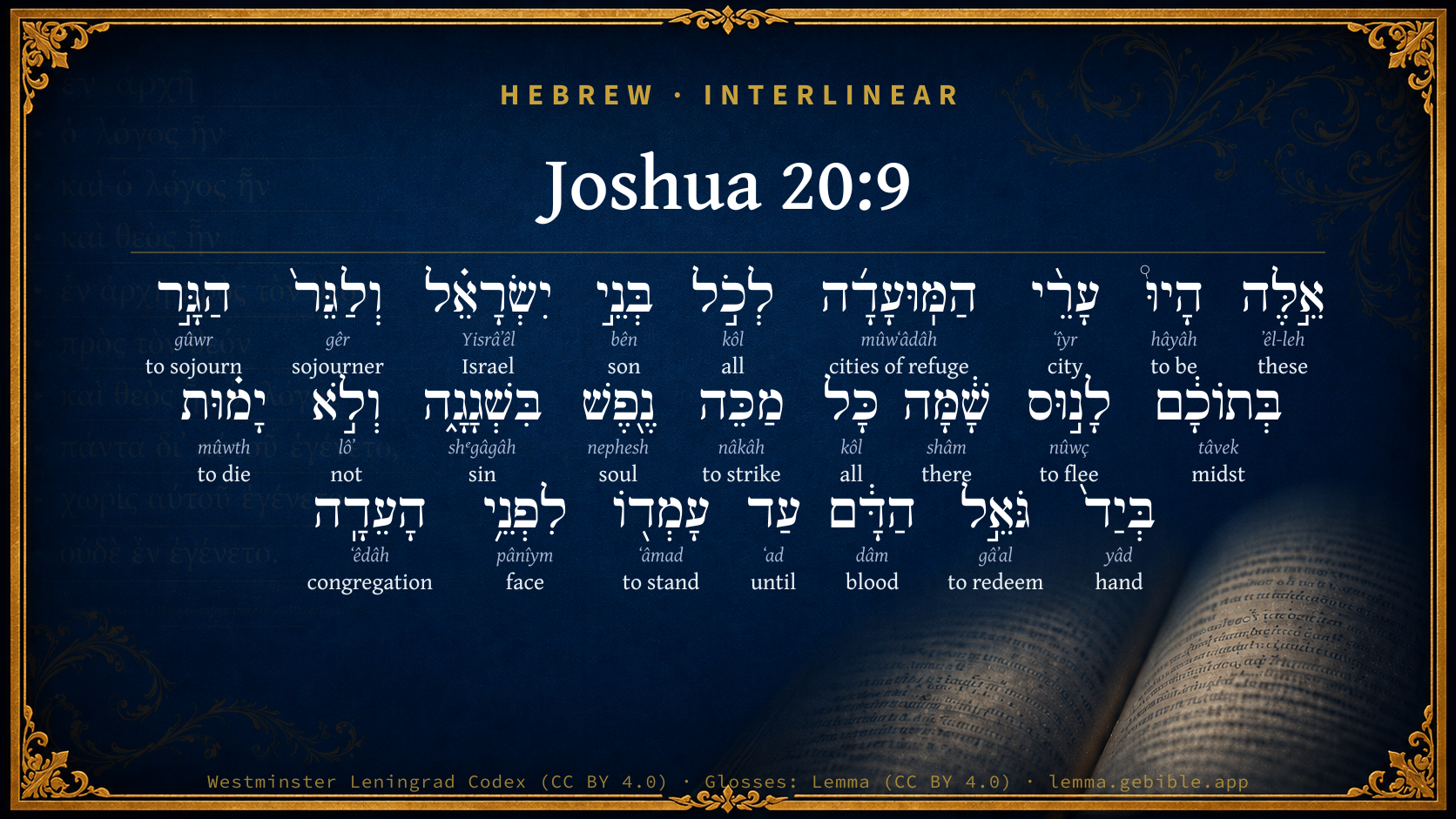
Hebrew (Westminster Leningrad Codex) Joshua 20:9 appears in the Hebrew Old Testament. The text above is from the Westminster Leningrad Codex. Each word links to its Strong’s number, a concise gloss, and parsing drawn from the Open Scriptures Hebrew Bible morphology. Click any word for its full Brown-Driver-Briggs (BDB) entry.
Download image
Cite this verse

Joshua 20:9 (World English Bible). Public Domain. Lemma interlinear Bible study tool, https://lemma.gebible.app/v/joshua/20/9.

Show BibTeX & RIS
BibTeX
RIS
English Translation
These were the appointed cities for all the children of Israel, and for the stranger who sojourns among them, that whoever kills any person unwittingly might flee there, and not die by the hand of the avenger of blood, until he stood before the congregation.
World English Bible · Public Domain
Highlights
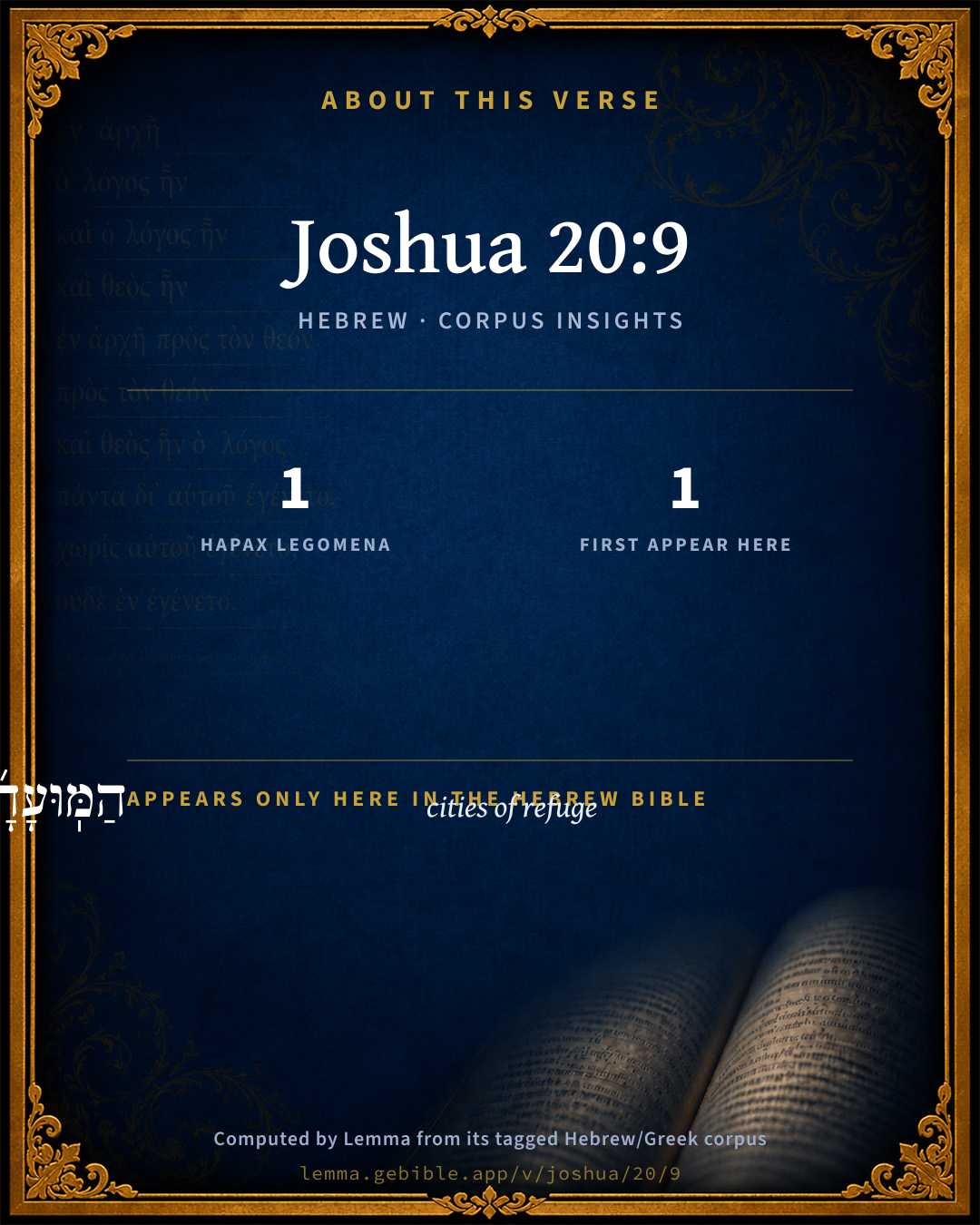
  • 1 hapax legomenon — only here in the Hebrew Bible
  • 1 first appearance in the Hebrew Bible
Full analysis ↓
Download a study sheet

One document with this verse’s original text, its word-by-word gloss line, the meaning frame, cross-references with their text, attributed commentary, and full source and license credits — printable, and it pastes into notes with its structure intact.

This verse Autodidact and up

Study sheet (.html) Plain text (.txt)

A passage Seminary Student

Up to 50 verses in one chapter. A passage sheet keeps up to 6 commentary sources and 12 cross-references per verse, in the order this page ranks them, and says so on the sheet whenever that leaves anything out. Ask for a single verse and you get the Autodidact verse sheet above.

Everything on this page stays free to read, with no account — the sheet is a download of what is already on screen, not access to it.

Want to remove ads? Support Godless Engineer
Compare translations 3

The same verse in 3 English versions, stacked beneath the original-language interlinear above. Click any original word for its lexicon entry.

Each is an independent rendering of the whole verse — the interlinear is not word-aligned to these translations.

Highlighted words mark where these versions differ — a whole-verse word diff, not a word-by-word alignment.

  • World English Bible Public Domain
    These were the appointed cities for all the children of Israel, and for the stranger who sojourns among them, that whoever kills any person unwittingly might flee there, and not die by the hand of the avenger of blood, until he stood before the congregation.
  • King James Version Public Domain
    These were the cities appointed for all the children of Israel, and for the stranger that sojourneth among them, that whosoever killeth any person at unawares might flee thither, and not die by the hand of the avenger of blood, until he stood before the congregation.
  • unfoldingWord Literal Text CC BY-SA 4.0
    These were the cities of appointment for all of the sons of Israel and for the sojourner who sojourned in the midst of them, for the fleeing there of anyone striking a person by mistake, and he would not die by the hand of the avenger of blood until he stood to the face of the congregation.

unfoldingWord Literal Text — © unfoldingWord, licensed CC BY-SA 4.0. Word-aligned USFM3 via Door43 (git.door43.org/unfoldingWord/en_ult).

Versions to compare (up to 4)

3 of 4 selected

Show all 18 translations

Every available English version of this verse, each an independent rendering of the whole verse.

  • World English Bible Public Domain
    These were the appointed cities for all the children of Israel, and for the stranger who sojourns among them, that whoever kills any person unwittingly might flee there, and not die by the hand of the avenger of blood, until he stood before the congregation.
  • Berean Standard Bible Public Domain
    These are the cities appointed for all the Israelites and foreigners among them, so that anyone who kills a person unintentionally may flee there and not die by the hand of the avenger of blood prior to standing trial before the assembly.
  • Majority Standard Bible Public Domain
    These are the cities appointed for all the Israelites and foreigners among them, so that anyone who kills a person unintentionally may flee there and not die by the hand of the avenger of blood prior to standing trial before the assembly.
  • King James Version Public Domain
    These were the cities appointed for all the children of Israel, and for the stranger that sojourneth among them, that whosoever killeth any person at unawares might flee thither, and not die by the hand of the avenger of blood, until he stood before the congregation.
  • American Standard Version (1901) Public Domain
    These were the appointed cities for all the children of Israel, and for the stranger that sojourneth among them, that whosoever killeth any person unwittingly might flee thither, and not die by the hand of the avenger of blood, until he stood before the congregation.
  • Revised Version (1885) Public Domain
    These were the appointed cities for all the children of Israel, and for the stranger that sojourneth among them, that whosoever killeth any person unwittingly might flee thither, and not die by the hand of the avenger of blood, until he stood before the congregation.
  • Geneva Bible (1599) Public Domain
    These were the cities appoynted for all the children of Israel, and for the stranger that soiourned among them, that whosoeuer killed any person ignorantly, might flee thither, and not die by the hande of the auenger of blood, vntill hee stoode before the Congregation.
  • Douay-Rheims (1899) Public Domain
    These cities were appointed for all the children of Israel, and for the strangers, that dwelt among them: that whosoever had killed a person unawares might flee to them, and not die by the hand of the kinsman, coveting to revenge the blood that was shed, until he should stand before the people to lay open his cause.
  • Young's Literal Translation Public Domain
    These have been cities of meeting for all the sons of Israel, and for a sojourner who is sojourning in their midst, for the fleeing thither of any one smiting life inadvertently, and he doth not die by the hand of the redeemer of blood till his standing before the company.
  • Literal Standard Version CC BY-SA 4.0
    These have been cities of meeting for all the sons of Israel, and for a sojourner who is sojourning in their midst, for the fleeing there of anyone striking life through ignorance, and he does not die by the hand of the redeemer of blood until his standing before the congregation.
  • Unlocked Literal Bible CC BY-SA 4.0
    These were the cities selected for all the people of Israel and for the foreigners residing among them, so that anyone who killed a person unintentionally could run to them for safety. This person would not die by the hand of the one who wanted to avenge the blood that was shed, until the accused person would first stand before the assembly.
  • unfoldingWord Literal Text CC BY-SA 4.0
    These were the cities of appointment for all of the sons of Israel and for the sojourner who sojourned in the midst of them, for the fleeing there of anyone striking a person by mistake, and he would not die by the hand of the avenger of blood until he stood to the face of the congregation.
  • Darby Bible Public Domain
    These were the cities appointed for all the children of Israel, and for the stranger that sojourneth among them, that whosoever smiteth any one mortally without intent might flee thither, and not die by the hand of the avenger of blood, until he stood before the assembly.
  • World Messianic Bible Public Domain
    These were the appointed cities for all the children of Israel, and for the alien who lives among them, that whoever kills any person unintentionally might flee there, and not die by the hand of the avenger of blood, until he stands trial before the congregation.
  • Webster's Bible Public Domain
    These were the cities appointed for all the children of Israel, and for the stranger sojourning among them, that whoever should kill any person unawares might flee thither, and not die by the hand of the avenger of blood, until he stood before the congregation.
  • Free Bible Version CC BY-SA 4.0
    These were the assigned towns for all the Israelites, as well as for the foreigners living among them. Anyone who unintentionally killed someone could go there so they would not be killed by those who wished to take revenge before they had received a public trial and been given a guilty verdict.
  • Bible in Basic English Public Domain
    These were the towns marked out for all the children of Israel and for the man from a strange country living among them, so that anyone causing the death of another in error, might go in flight there, and not be put to death by him who has the right of punishment for blood till he had come before the meeting of the people.
  • JPS Tanakh (1917) Public Domain
    These were the appointed cities for all the children of Israel, and for the stranger that sojourneth among them, that whosoever killeth any person through error might flee thither, and not die by the hand of the avenger of blood, until he stood before the congregation.

Literal Standard Version (2020), Covenant Press — licensed CC BY-SA 4.0. Text via the HelloAO Bible API (eBible.org). Unlocked Literal Bible (unfoldingWord) — licensed CC BY-SA 4.0. Text via the HelloAO Bible API (eBible.org). unfoldingWord Literal Text — © unfoldingWord, licensed CC BY-SA 4.0. Word-aligned USFM3 via Door43 (git.door43.org/unfoldingWord/en_ult). Free Bible Version, Dr. Jonathan Gallagher — licensed CC BY-SA 4.0. Text via the HelloAO Bible API (eBible.org).

Word by word

More ways to search: Search by grammar → Find every occurrence → Compare this word →

Practice this passage: Drill this verse → Learn its vocabulary →

הַמּֽוּעָדָ֜ה
mûwʻâdâh
H4152
“the · cities of refuge”
Particle, Definite Article + Noun, Common, Feminine, Singular, Absolute
Part of Speech
Particle + Noun
Type
Common
Gender
Feminine
Number
Singular
State
Absolute
Full BDB Definition

Origin: from H3259

TWOT: 878d

cities appointed (of refuge)
  1. אֵ֣לֶּה ʼêl-leh H428 “these” Pronoun, Demonstrative, Common, Plural
  2. הָיוּ֩ hâyâh H1961 “to be” Verb, Qal, Perfect, 3rd Person, Common, Plural
  3. עָרֵ֨י ʻîyr H5892 “cities of” Noun, Common, Feminine, Plural, Construct
  4. לְכֹ֣ל kôl H3605 “to/for · all of” Preposition + Noun, Common, Masculine, Singular, Construct
  5. בְּנֵ֣י bên H1121 “sons of” Noun, Common, Masculine, Plural, Construct
  6. יִשְׂרָאֵ֗ל Yisrâʼêl H3478 “Israel” Noun, Proper
  7. וְלַגֵּר֙ gêr H1616 “and · to/for the · sojourner” Conjunction + Preposition, Determined + Noun, Common, Masculine, Singular, Absolute
  8. הַגָּ֣ר gûwr H1481 “the · sojourning” Particle, Definite Article + Verb, Qal, Participle Active, Masculine, Singular, Absolute
  9. בְּתוֹכָ֔ם tâvek H8432 “in/at · midst · their” Preposition + Noun, Common, Masculine, Singular, Construct + Suffix, Personal, 3rd Person, Masculine, Plural
  10. לָנ֣וּס nûwç H5127 “to flee” Preposition + Verb, Qal, Infinitive Construct
  11. שָׁ֔מָּה shâm H8033 “there · toward” Adverb + Suffix, Demonstrative
  12. כָּל kôl H3605 “all of” Noun, Common, Masculine, Singular, Construct
  13. מַכֵּה nâkâh H5221 “striking” Verb, Hiphil, Participle Active, Masculine, Singular, Construct
  14. נֶ֖פֶשׁ nephesh H5315 “soul” Noun, Common, Both, Singular, Absolute
  15. בִּשְׁגָגָ֑ה shᵉgâgâh H7684 “in/at · sin” Preposition + Noun, Common, Feminine, Singular, Absolute
  16. וְלֹ֣א lôʼ H3808 “and · not” Conjunction + Particle, Negative
  17. יָמ֗וּת mûwth H4191 “to die” Verb, Qal, Imperfect, 3rd Person, Masculine, Singular
  18. בְּיַד֙ yâd H3027 “in/at · hand of” Preposition + Noun, Common, Both, Singular, Construct
  19. גֹּאֵ֣ל gâʼal H1350 “redeeming” Verb, Qal, Participle Active, Masculine, Singular, Construct
  20. הַדָּ֔ם dâm H1818 “the · blood” Particle, Definite Article + Noun, Common, Masculine, Singular, Absolute
  21. עַד ʻad H5704 “until” Preposition
  22. עָמְד֖וֹ ʻâmad H5975 “to stand · him” Verb, Qal, Infinitive Construct + Suffix, Personal, 3rd Person, Masculine, Singular
  23. לִפְנֵ֥י pânîym H6440 “to/for · face(s) of” Preposition + Noun, Common, Both, Plural, Construct
  24. הָעֵדָֽה ʻêdâh H5712 “the · congregation” Particle, Definite Article + Noun, Common, Feminine, Singular, Absolute

About this verse

These counts appear in no published source. They are computed here, from the morphology-tagged text and Lemma’s own curated glosses. What Lemma adds →

25
words
24
distinct lemmas
Historical
section

Notable vocabulary

1 hapax legomenon — a word that appears only here in the entire Hebrew Bible:

  • הַמּֽוּעָדָ֜ה cities of refuge H4152

First appearance in Scripture

This word makes its first canonical appearance in the Hebrew Bible here:

  • הַמּֽוּעָדָ֜ה cities of refuge H4152

Shared distinctive vocabulary

בִּשְׁגָגָ֑ה sin H7684 occurs in 18 verses of the Hebrew Bible. Also found in:

Grammatical profile

  • 7 verbs
  • 14 nouns
  • 1 pronoun
  • 1 preposition
  • 1 adverb
  • 1 particle

Verb forms

  • הָיוּ֩ Qal · Perfect
  • הַגָּ֣ר Qal · Participle Active
  • לָנ֣וּס Qal · Infinitive Construct
  • מַכֵּה Hiphil · Participle Active
  • יָמ֗וּת Qal · Imperfect
  • גֹּאֵ֣ל Qal · Participle Active
  • עָמְד֖וֹ Qal · Infinitive Construct

Repetition

A word recurs within this verse — often emphatic in Hebrew:

  • לְכֹ֣ל all H3605 ×2

Cross-references

3

Topical passages linked to Joshua 20:9 in the Treasury of Scripture Knowledge — connected by theme and wording, ordered by reader-vote popularity; previews shown in the World English Bible.

  • Numbers 35:15 For the children of Israel, and for the stranger and for the foreigner living among them, shall these six cities be for refuge; that everyone who kills any person unwittingly may flee there.
  • Joshua 20:4 He shall flee to one of those cities, and shall stand at the entrance of the gate of the city, and declare his cause in the ears of the elders of that city; and they shall take him into the city to them, and give him a place, that he may dwell among them.
  • Joshua 20:6 He shall dwell in that city, until he stand before the congregation for judgment, until the death of the high priest that shall be in those days: then shall the manslayer return, and come to his own city, and to his own house, to the city from whence he fled.

Cross-references courtesy of OpenBible.info (CC BY 4.0).

Hebrew and Greek witnesses Masoretic Hebrew ↔ Greek Septuagint

The same verse in the two great witnesses to the Old Testament, shown verse-for-verse.

These are two independent witnesses, not word-aligned to each other, and the Septuagint is shown in lemma (dictionary) form.

Hebrew Joshua 20:9 Masoretic · Westminster Leningrad Codex

אֵ֣לֶּה הָיוּ֩ עָרֵ֨י הַמּֽוּעָדָ֜ה לְכֹ֣ל בְּנֵ֣י יִשְׂרָאֵ֗ל וְלַגֵּר֙ הַגָּ֣ר בְּתוֹכָ֔ם לָנ֣וּס שָׁ֔מָּה כָּל מַכֵּה נֶ֖פֶשׁ בִּשְׁגָגָ֑ה וְלֹ֣א יָמ֗וּת בְּיַד֙ גֹּאֵ֣ל הַדָּ֔ם עַד עָמְד֖וֹ לִפְנֵ֥י הָעֵדָֽה

These were the appointed cities for all the children of Israel, and for the stranger who sojourns among them, that whoever kills any person unwittingly might flee there, and not die by the hand of the avenger of blood, until he stood before the congregation.

World English Bible · Public Domain

On this verse, The Pulpit Commentary discusses the Septuagint’s reading. Read the note in Commentary ↓

Hebrew: Westminster Leningrad Codex (CC BY 4.0). Greek: Septuagint (public domain); English from a public-domain English Septuagint. How the Septuagint differs from the Hebrew →

Targum (Aramaic paraphrase)

1

The Targum is the ancient Jewish Aramaic paraphrase of the Hebrew Scriptures — an interpretive translation, not the Hebrew text itself. Onkelos (literal) and Pseudo-Jonathan (expansive) render the Torah, and Jonathan the Prophets. Coverage is partial: where no permissively-licensed English translation exists for a verse, only the Aramaic is shown. This is verse-level text, not a word-by-word alignment to the Hebrew.

  1. Targum Jonathan Prophets (Joshua–Malachi)
    אִלֵין הֲוָאָה קִרְוַיָא דִמְזַמְנָן לְכֹל בְּנֵי יִשְׂרָאֵל וּלְגִיוֹרַיָא דִי יִתְגַיְירוּן בֵּינֵיהוֹן לְמֶעְרָק לְתַמָן כָּל דְיִקְטוֹל נַפְשָׁא בְּשָׁלוּ וְלָא יְמוּת בִּידָא דְגָאֵיל דְמָא עַד דִיקוּם קֳדָם כְּנִשְׁתָּא:

    (no public-domain English translation for this verse)

    Targum Jonathan — Aramaic: “Mikraot Gedolot” (public domain). English: “Sefaria Community Translation” (CC0 1.0 (public-domain dedication)); “London "Chaldee Paraphrase," 1871” (public domain). Text via Sefaria.

Commentary

Notes on Joshua 20:9 from classic Christian and Jewish commentators (each source and its license shown beneath its notes). The classic Christian expositions comment on the surrounding passage and are grouped to its opening verse, so a note may address several verses; the Jewish commentaries on the Tanakh (Rashi and others) are per-verse, so they appear only where the commentator wrote on this verse.

Lemma curates 59 commentaries, every one of them public domain or Creative Commons licensed, each selected and text-cleaned for this edition rather than reprinted as found. About our sources →

Trapp's Complete Commentary

John Trapp

Jos 20:9 These were the cities appointed for all the children of Israel, and for the stranger that sojourneth among them, that whosoever killeth [any] person at unawares might flee thither, and not die by the hand of the avenger of blood, until he stood before the congregation.

Ver. 9. And for the stranger that sojourneth.] Who dwelt with them for a time, and were not of the same religion: or such only as were proselyted.

Until he stood before the congregation.] Till, after the death of the high priest, and the avenger’s wrath qualified, he be restored and re-established in his own house, under the security of public protection. {a}

{a} Diod.

John Trapp, A Commentary or Exposition upon All the Books of the Old and New Testament (1647–1656) — public domain. Text from a community e-Sword module.

Tyndale Open Study Notes

Tyndale Open Resources

20:9 The treatment of foreigners in Israel was a great advance in human relations. Resident aliens were to receive every justice offered to native Israelites (see Exod 22:21; Lev 19:33-34; 24:22; Num 15:15-16).

Tyndale Open Study Notes — © Tyndale Open Resources, licensed CC BY-SA 4.0. Text via the HelloAO Bible API.

Geneva Bible (1599)

Geneva Bible translators

Before the Judges.

Geneva Bible (1599) marginal notes — public domain. Text via Bolls.life.

Adam Clarke's Commentary

Verse 9. For all the children of Israel, and for the stranger] As these typified the great provision which God was making for the salvation of both Jews and Gentiles, hence the stranger as well as the Israelite had the same right to the benefits of these cities of refuge. Is HE the God of the Jews only? Is HE not also the God of the Gentiles?

Until he stood before the congregation.] The judges and elders of the people, in trying civil and criminal causes, always sat; the persons who came for judgment, or who were tried, always stood; hence the expressions so frequent in Scripture, STANDING before the Lord, the judges, the elders, c.

IT is worthy of remark that the cities of refuge were given to the Levites see the following chapter. The sacrificial system alone afforded refuge; and while the suspected person was excluded from his family, c., he had the advantage of being with those whose business it was to instruct the ignorant, and comfort the disconsolate. Thus he had the means constantly at hand, by a careful use of which he might grow wiser and better secure the favour of his God, and a lot of blessedness in a better world. How wise, equal, and beneficent are all the institutions of God!

Adam Clarke's Commentary on the Bible (1810–1826) — public domain. Text from a community e-Sword/MySword module.

The Cambridge Bible for Schools and Colleges

gen. ed. J. J. S. Perowne

9. These were the cities appointed] “Civitates constitutæ,” Vulgate. “The citees ordeyned,” Wyclif.

for the stranger that sojourneth] “And to comlyngis that dwellen among hem;” Wyclif. Observe that the Mosaic Law applied its merciful provisions not only to the members of the Elect Nation, as though they were a sacred “caste,” but to the “stranger” also that sojourned among them. The existence of such a class of “naturalized foreigners” in Israel is easily accounted for:—

(a) The “mixed multitude” that came out of Egypt (Exo_12:38) formed one element;

(b) The remains of the Canaanites—never wholly extirpated—formed a second;

(c) Captives taken in war formed a third;

(d) Fugitives, hired servants, merchants formed a fourth. The census of these in Solomon’s time gave a return of 153,600 males (2Ch_2:17), which was nearly equal to about a tenth of the whole population.

that whosoever killeth any person] Jewish commentators tell us how in later times, in order that the asylum offered to the involuntary homicide might be more secure, (a) the roads leading to the Cities of Refuge were always kept in thorough repair, and required to be at least 32 cubits broad; (b) all obstructions were removed that might stay the flier’s foot or hinder his speed; (c) no hillock was left, no river was allowed over which there was not a bridge; (d) at every turning there were posts erected bearing the words “Refuge,” “Refuge,” to guide the unhappy man in his flight; (e) when once settled in such a city the manslayer had a convenient habitation assigned to him, and the citizens were to teach him some trade in order that he might support himself.—See Kitto’s Biblical Cyclopædia, i. p. 527.

The Cambridge Bible for Schools and Colleges (gen. ed. J. J. S. Perowne; Cambridge University Press, 1878–1918) — public domain. Text from a community e-Sword module.

John Gill's Exposition

These were the cities appointed for all the children of Israel,.... For the common use of them all, and not for that tribe only in which they stood:

and for the stranger that sojourneth among them; not only for the proselytes of righteousness, but for the proselytes of the gate also, as well as for the natives of Israel; Christ is a refuge for Jews and Gentiles, for all sinners that flee to him:

that whosoever killeth any person unawares might flee thither; and find shelter and safety:

and not die by the hand of the avenger of blood; getting thither before he could overtake him:

until he stood before the congregation: either before the congregation, the elders of the city, or court of judicature in the city of refuge, or before the court of his own city, from whence he fled, if summoned thither.

Next: Joshua Chapter 21

John Gill's Exposition of the Whole Bible (1746–1763) — public domain (CC PDM 1.0). Text via the HelloAO Bible API.

Haydock's Catholic Bible Commentary

Strangers. The limitations of the Jews in favour of their own nation are rejected. The civil and criminal law should affect all alike, except, God order it otherwise. --- Stand. This was the posture of the people accused, while the judges sat. (Drusius) (Calmet)

George Leo Haydock (1774–1849), Haydock's Catholic Family Bible and Commentary, 1859 edition — public domain. Excludes Psalms (Douay-Rheims chapter numbering differs from Protestant) and Deuterocanonical books (Catholic canon only).

Matthew Poole's English Annotations

For the stranger; not only proselytes, but others also; because this was a matter of common right, that a distinction might be made between casual man-slayers and wilful murderers.

Matthew Poole's English Annotations on the Holy Bible (1683–1685) — public domain. Text from a community e-Sword/MySword module.

Whedon's Commentary on the Bible

Daniel D. Whedon

9. And for the stranger — A fore-shadowing of the provision for the salvation of the Gentiles through Christ. And not die by the hand of the avenger of blood. — There was one important condition which must be constantly fulfilled — the fugitive must not venture beyond the borders of his refuge (Num_35:27) until the death of the High Priest. Thus must the pardoned sinner by faith abide beneath the shelter of the atoning blood, or be irretrievably lost. Heb_6:6. These safeguards against interminable and bloody feuds are in striking contrast with the blood-revenge still existing in the East under Mohammedan law. “Two villages have disputed about a stray goat; there was first tremendous shouting, especially among the women, urging on their husbands and brothers to fight; then in a moment of excitement weapons were used, and blood was shed; and blood calls for blood. Thus every member of the family to the remotest degree is kept in constant dread. He stalks about, armed, at all hours and in all places — with his goats on the mountain-side, with his donkey on the road, with his plough in the field; in seed-time and harvest, summer and winter, heat and cold. Imagination makes the ‘avenger of blood’ follow him like a shadow, ever watchful for an unguarded moment to fall upon him. Many a family has this blood-revenge compelled to flee from house and home, and seek refuge among strangers; many a village it has left desolate, for none will live where the sentence of death hangs constantly over them. In the Koran this fearful law is commended: ‘O true believers, the law of retaliation is ordained to you for the slain; the free shall die for the free.’” — Dr. Porter’s “Syria and Palestine.”

Daniel D. Whedon (gen. ed.), Commentary on the Old and New Testaments (1874–1909) — public domain. Text from a community e-Sword module.

The Pulpit Commentary

Appointed. Or, of refuge or resort. Our version has followed the LXX and Vulgate here. Greek, unawares; Hebrew, in error or inadvertently, as above. Matthew Henry"s note on the cities of refuge is worthy of remark. He says, "I delight not in quibbling on names, yet am willing to take notice of these." Thus Kedesh, he reminds us, is holy. Shechem, a shoulder, reminding us of Him upon whose shoulder the government was to be. Hebron is fellowship, recalling the fellowship we have in Christ. Bezer is a fortification, reminding us of God our stronghold (later criticism, however, gives another derivation to this unusual word, which in Job_22:24, Job_22:25, means the ore of a precious metal), Ramoth is height or exaltation, and to such exaltation we are called in Jesus Christ. Lastly, Golan is exultation, so says Matthew Henry, deriving it from lygi or lWg. But Gesenius derives it with equal probability from hlg "to make bare," hence to lead into captivity.

The Pulpit Commentary (1880–1919), ed. H.D.M. Spence-Jones & Joseph S. Exell — public domain. Text from a community e-Sword module.

John Wesley's Explanatory Notes

The stranger - Not only proselytes, but others also; because this was a matter of common right, that a distinction might be made between casual man-slayers, and wilful murderers.

John Wesley, Explanatory Notes Upon the Whole Bible (1754–1765) — public domain. Text via the GEBible commentary corpus.

unfoldingWord translationNotes

Door43 World Missions Community

would not die by the hand of the one

Here "by the hand" is an idiom that means to be the specific cause of something. AT: "would not be killed by the one" (See: Idiom)

avenge the blood that was shed

This can be stated in active form. See how you translated a similar phrase in Joshua 20:3. AT: "avenge a person's death" (See: Metonymy and Active or Passive)

translationWords

alien

unfoldingWord translationNotes — © Distant Shores Media and the Door43 World Missions Community, licensed CC BY-SA 4.0. Source: git.door43.org/Door43/en_tn.

Rashi

Rabbi Shlomo Yitzchaki (Rashi)

That were set aside. They were prepared and set aside for this.

Rashi on the Tanakh — English translations: “The Judaica Press complete Tanach with Rashi, translated by A. J. Rosenberg” (CC BY 4.0); “Pentateuch with Rashi's commentary by M. Rosenbaum and A.M. Silbermann, 1929-1934” (public domain); “The Metsudah Tanach series, Lakewood, N.J” (CC BY 4.0); and “The Book of Joshua, Metsudah Publications, 1997” (CC BY 4.0). Text via Sefaria.

Lesson kit

Teaching starters — assembled from the data on this page, not authored interpretation. Every prompt links to the verse data it draws on. Edit before teaching.

Joshua, in the Historical, opens this verse with 25 words (24 distinct Hebrew lemmas). Its most distinctive word is mûwʻâdâh (“cities of refuge”). A historical commentator’s framing appears above. Read the whole chapter for the surrounding context.

Discussion questions

  1. How does “cities of refuge” (mûwʻâdâh) shape what this verse is saying?
  2. 1 word here appears nowhere else in the Hebrew Bible. Why might the author reach for such rare wording?
  3. This is the first place “cities of refuge” appears in Scripture (first appears here). What does its debut here establish?
  4. How does Leviticus 4:2, which shares the word «sin», read alongside this verse?
  5. What does the repetition of “all” (2× in this one verse) do in this verse?
  6. These translations render this verse differently. What is at stake in choosing one wording over another?
  7. «הָיוּ֩» is a Qal Perfect verb. How does that grammatical form shape the action described?
  8. Compare how Trapp's Complete Commentary and Tyndale Open Study Notes read this verse. Where do they agree or differ?

Things to notice

  • 1 word in this verse appears nowhere else in the Hebrew Bible.
  • 1 word makes its first canonical appearance in Scripture here.
  • These translations choose different wording for 30 words in this verse.
  • “all” occurs 2× in this single verse.
  • 24 distinct Hebrew lemmas span 25 words in this verse.

Reading settings

Reading text

Shown beneath each verse's original-language words.

Old Testament
Old Testament edition

Read the OT as the Masoretic Hebrew (MT) or the Greek Septuagint (LXX).

English shown for the Greek Septuagint (in the Hebrew ↔ Greek comparison).

Comparing translations? Open the Compare panel on any verse page to stack up to four side by side.