
Numbers 8:19

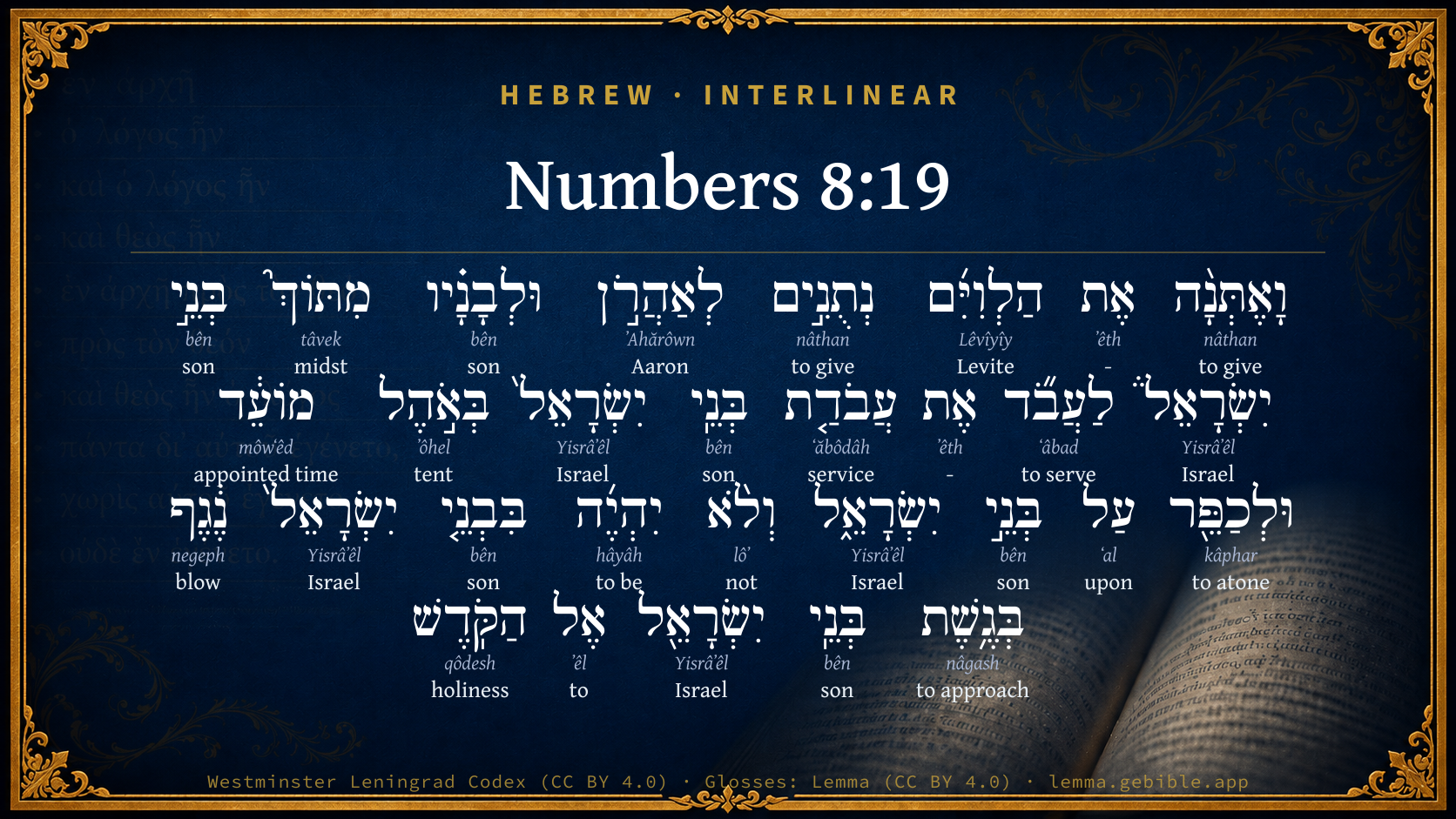
Hebrew (Westminster Leningrad Codex) Numbers 8:19 appears in the Hebrew Old Testament. The text above is from the Westminster Leningrad Codex. Each word links to its Strong’s number, a concise gloss, and parsing drawn from the Open Scriptures Hebrew Bible morphology. Click any word for its full Brown-Driver-Briggs (BDB) entry.
Download image
Cite this verse

Numbers 8:19 (World English Bible). Public Domain. Lemma interlinear Bible study tool, https://lemma.gebible.app/v/numbers/8/19.

Show BibTeX & RIS
BibTeX
RIS
English Translation
I have given the Levites as a gift to Aaron and to his sons from among the children of Israel, to do the service of the children of Israel in the Tent of Meeting, and to make atonement for the children of Israel; that there be no plague among the children of Israel, when the children of Israel come near to the sanctuary."
World English Bible · Public Domain
Download a study sheet

One document with this verse’s original text, its word-by-word gloss line, the meaning frame, cross-references with their text, attributed commentary, and full source and license credits — printable, and it pastes into notes with its structure intact.

This verse Autodidact and up

Study sheet (.html) Plain text (.txt)

A passage Seminary Student

Up to 50 verses in one chapter. A passage sheet keeps up to 6 commentary sources and 12 cross-references per verse, in the order this page ranks them, and says so on the sheet whenever that leaves anything out. Ask for a single verse and you get the Autodidact verse sheet above.

Everything on this page stays free to read, with no account — the sheet is a download of what is already on screen, not access to it.

Want to remove ads? Support Godless Engineer
Compare translations 3

The same verse in 3 English versions, stacked beneath the original-language interlinear above. Click any original word for its lexicon entry.

Each is an independent rendering of the whole verse — the interlinear is not word-aligned to these translations.

Highlighted words mark where these versions differ — a whole-verse word diff, not a word-by-word alignment.

  • World English Bible Public Domain
    I have given the Levites as a gift to Aaron and to his sons from among the children of Israel, to do the service of the children of Israel in the Tent of Meeting, and to make atonement for the children of Israel; that there be no plague among the children of Israel, when the children of Israel come near to the sanctuary."
  • King James Version Public Domain
    And I have given the Levites as a gift to Aaron and to his sons from among the children of Israel, to do the service of the children of Israel in the tabernacle of the congregation, and to make an atonement for the children of Israel: that there be no plague among the children of Israel, when the children of Israel come nigh unto the sanctuary.
  • unfoldingWord Literal Text CC BY-SA 4.0
    And I gave the Levites given ones to Aaron and to his sons from the midst of the sons of Israel, to serve the service of the sons of Israel in the tent of meeting and to make atonement for the sons of Israel. And a plague will not be among the sons of Israel when the sons of Israel come near to the holy place.”

unfoldingWord Literal Text — © unfoldingWord, licensed CC BY-SA 4.0. Word-aligned USFM3 via Door43 (git.door43.org/unfoldingWord/en_ult).

Versions to compare (up to 4)

3 of 4 selected

Show all 18 translations

Every available English version of this verse, each an independent rendering of the whole verse.

  • World English Bible Public Domain
    I have given the Levites as a gift to Aaron and to his sons from among the children of Israel, to do the service of the children of Israel in the Tent of Meeting, and to make atonement for the children of Israel; that there be no plague among the children of Israel, when the children of Israel come near to the sanctuary."
  • Berean Standard Bible Public Domain
    And I have given the Levites as a gift to Aaron and his sons from among the Israelites, to perform the service for the Israelites at the Tent of Meeting and to make atonement on their behalf, so that no plague will come against the Israelites when they approach the sanctuary.”
  • Majority Standard Bible Public Domain
    And I have given the Levites as a gift to Aaron and his sons from among the Israelites, to perform the service for the Israelites at the Tent of Meeting and to make atonement on their behalf, so that no plague will come against the Israelites when they approach the sanctuary.”
  • King James Version Public Domain
    And I have given the Levites as a gift to Aaron and to his sons from among the children of Israel, to do the service of the children of Israel in the tabernacle of the congregation, and to make an atonement for the children of Israel: that there be no plague among the children of Israel, when the children of Israel come nigh unto the sanctuary.
  • American Standard Version (1901) Public Domain
    And I have given the Levites as a gift to Aaron and to his sons from among the children of Israel, to do the service of the children of Israel in the tent of meeting, and to make atonement for the children of Israel; that there be no plague among the children of Israel, when the children of Israel come nigh unto the sanctuary.
  • Revised Version (1885) Public Domain
    And I have given the Levites as a gift to Aaron and to his sons from among the children of Israel, to do the service of the children of Israel in the tent of meeting, and to make atonement for the children of Israel: that there be no plague among the children of Israel, when the children of Israel come nigh unto the sanctuary.
  • Geneva Bible (1599) Public Domain
    And haue giuen the Leuites as a gift vnto Aaron, and to his sonnes from among the children of Israel, to do the seruice of the children of Israel in the Tabernacle of the Congregation, and to make an atonement for the children of Israel, that there be no plague among the children of Israel, when the children of Israel come neere vnto the Sanctuarie.
  • Douay-Rheims (1899) Public Domain
    And have delivered them for a gift to Aaron and his sons out of the midst of the people, to serve me for Israel in the tabernacle of the covenant, and to pray for them, lest there should be a plague among the people, if they should presume to approach unto my sanctuary.
  • Young's Literal Translation Public Domain
    `And I give the Levites gifts to Aaron and to his sons, from the midst of the sons of Israel, to do the service of the sons of Israel in the tent of meeting, and to make atonement for the sons of Israel, and there is no plague among the sons of Israel in the sons of Israel's drawing nigh unto the sanctuary.'
  • Literal Standard Version CC BY-SA 4.0
    And I give the Levites [as] gifts to Aaron and to his sons, from the midst of the sons of Israel, to do the service of the sons of Israel in the Tent of Meeting, and to make atonement for the sons of Israel, and there is no plague among the sons of Israel in the sons of Israel drawing near to the holy place.”
  • Unlocked Literal Bible CC BY-SA 4.0
    I have given the Levites as a gift to Aaron and his sons. I have taken them from among the people of Israel to do the work of the people of Israel in the tent of meeting. I have given them to atone for the people of Israel so that no plague will harm the people when they come near to the holy place.”
  • unfoldingWord Literal Text CC BY-SA 4.0
    And I gave the Levites given ones to Aaron and to his sons from the midst of the sons of Israel, to serve the service of the sons of Israel in the tent of meeting and to make atonement for the sons of Israel. And a plague will not be among the sons of Israel when the sons of Israel come near to the holy place.”
  • Darby Bible Public Domain
    And I have given the Levites as a gift to Aaron and to his sons, from among the children of Israel, to perform the service of the children of Israel in the tent of meeting, and to make atonement for the children of Israel; that there be no plague among the children of Israel, when the children of Israel draw near to the sanctuary.
  • World Messianic Bible Public Domain
    I have given the Levites as a gift to Aaron and to his sons from among the children of Israel, to do the service of the children of Israel in the Tent of Meeting, and to make atonement for the children of Israel, so that there will be no plague among the children of Israel when the children of Israel come near to the sanctuary.”
  • Webster's Bible Public Domain
    And I have given the Levites as a gift to Aaron and to his sons from among the children of Israel, to do the service of the children of Israel in the tabernacle of the congregation, and to make an atonement for the children of Israel: that there may be no plague among the children of Israel, when the children of Israel come nigh to the sanctuary.
  • Free Bible Version CC BY-SA 4.0
    Of all the Israelites, the Levites are a gift from me to Aaron and his sons to serve the Israelites at the Tent of Meeting, and on their behalf to set them right, so that nothing bad will happen to them when they come to the sanctuary.”
  • Bible in Basic English Public Domain
    And I have given them to Aaron and to his sons, from among the children of Israel, to undertake for them all the work of the Tent of meeting, and to take away sin from the children of Israel so that no evil may come on them when they come near the holy place.
  • JPS Tanakh (1917) Public Domain
    And I have given the Levites — they are given to Aaron and to his sons from among the children of Israel, to do the service of the children of Israel in the tent of meeting, and to make atonement for the children of Israel, that there be no plague among the children of Israel, through the children of Israel coming nigh unto the sanctuary.'

Literal Standard Version (2020), Covenant Press — licensed CC BY-SA 4.0. Text via the HelloAO Bible API (eBible.org). Unlocked Literal Bible (unfoldingWord) — licensed CC BY-SA 4.0. Text via the HelloAO Bible API (eBible.org). unfoldingWord Literal Text — © unfoldingWord, licensed CC BY-SA 4.0. Word-aligned USFM3 via Door43 (git.door43.org/unfoldingWord/en_ult). Free Bible Version, Dr. Jonathan Gallagher — licensed CC BY-SA 4.0. Text via the HelloAO Bible API (eBible.org).

Word by word

More ways to search: Search by grammar → Find every occurrence → Compare this word →

Practice this passage: Drill this verse → Learn its vocabulary →

נֶ֔גֶף
negeph
H5063
“blow”
Noun, Common, Masculine, Singular, Absolute
Part of Speech
Noun
Type
Common
Gender
Masculine
Number
Singular
State
Absolute
Full BDB Definition

Origin: from H5062

TWOT: 1294a

blow, striking, plague - blow, plague (fatal) - striking
  1. וָאֶתְּנָ֨ה nâthan H5414 “and · to give” Conjunction + Verb, Qal, Sequential Imperfect, 1st Person, Common, Singular + Suffix, h
  2. אֶת ʼêth H853 “-” Particle, Direct Object
  3. הַלְוִיִּ֜ם Lêvîyîy H3881 “the · Levites” Particle, Definite Article + Noun, Gentilic, Masculine, Plural, Absolute
  4. נְתֻנִ֣ים nâthan H5414 “given” Verb, Qal, Participle Passive, Masculine, Plural, Absolute
  5. לְאַהֲרֹ֣ן ʼAhărôwn H175 “to/for · Aaron” Preposition + Noun, Proper
  6. וּלְבָנָ֗יו bên H1121 “and · to/for · sons · his” Conjunction + Preposition + Noun, Common, Masculine, Plural, Construct + Suffix, Personal, 3rd Person, Masculine, Singular
  7. מִתּוֹךְ֮ tâvek H8432 “from · midst of” Preposition + Noun, Common, Masculine, Singular, Construct
  8. בְּנֵ֣י bên H1121 “sons of” Noun, Common, Masculine, Plural, Construct
  9. יִשְׂרָאֵל֒ Yisrâʼêl H3478 “Israel” Noun, Proper
  10. לַעֲבֹ֞ד ʻâbad H5647 “to serve” Preposition + Verb, Qal, Infinitive Construct
  11. אֶת ʼêth H853 “-” Particle, Direct Object
  12. עֲבֹדַ֤ת ʻăbôdâh H5656 “service of” Noun, Common, Feminine, Singular, Construct
  13. בְּנֵֽי bên H1121 “sons of” Noun, Common, Masculine, Plural, Construct
  14. יִשְׂרָאֵל֙ Yisrâʼêl H3478 “Israel” Noun, Proper
  15. בְּאֹ֣הֶל ʼôhel H168 “in/at · tent of” Preposition + Noun, Common, Masculine, Singular, Construct
  16. מוֹעֵ֔ד môwʻêd H4150 “appointed time” Noun, Common, Masculine, Singular, Absolute
  17. וּלְכַפֵּ֖ר kâphar H3722 “and · to atone” Conjunction + Preposition + Verb, Piel, Infinitive Construct
  18. עַל ʻal H5921 “upon” Preposition
  19. בְּנֵ֣י bên H1121 “sons of” Noun, Common, Masculine, Plural, Construct
  20. יִשְׂרָאֵ֑ל Yisrâʼêl H3478 “Israel” Noun, Proper
  21. וְלֹ֨א lôʼ H3808 “and · not” Conjunction + Particle, Negative
  22. יִהְיֶ֜ה hâyâh H1961 “to be” Verb, Qal, Imperfect, 3rd Person, Masculine, Singular
  23. בִּבְנֵ֤י bên H1121 “in/at · sons of” Preposition + Noun, Common, Masculine, Plural, Construct
  24. יִשְׂרָאֵל֙ Yisrâʼêl H3478 “Israel” Noun, Proper
  25. בְּגֶ֥שֶׁת nâgash H5066 “in/at · to approach” Preposition + Verb, Qal, Infinitive Construct
  26. בְּנֵֽי bên H1121 “sons of” Noun, Common, Masculine, Plural, Construct
  27. יִשְׂרָאֵ֖ל Yisrâʼêl H3478 “Israel” Noun, Proper
  28. אֶל ʼêl H413 “to” Preposition
  29. הַקֹּֽדֶשׁ qôdesh H6944 “the · holiness” Particle, Definite Article + Noun, Common, Masculine, Singular, Absolute

About this verse

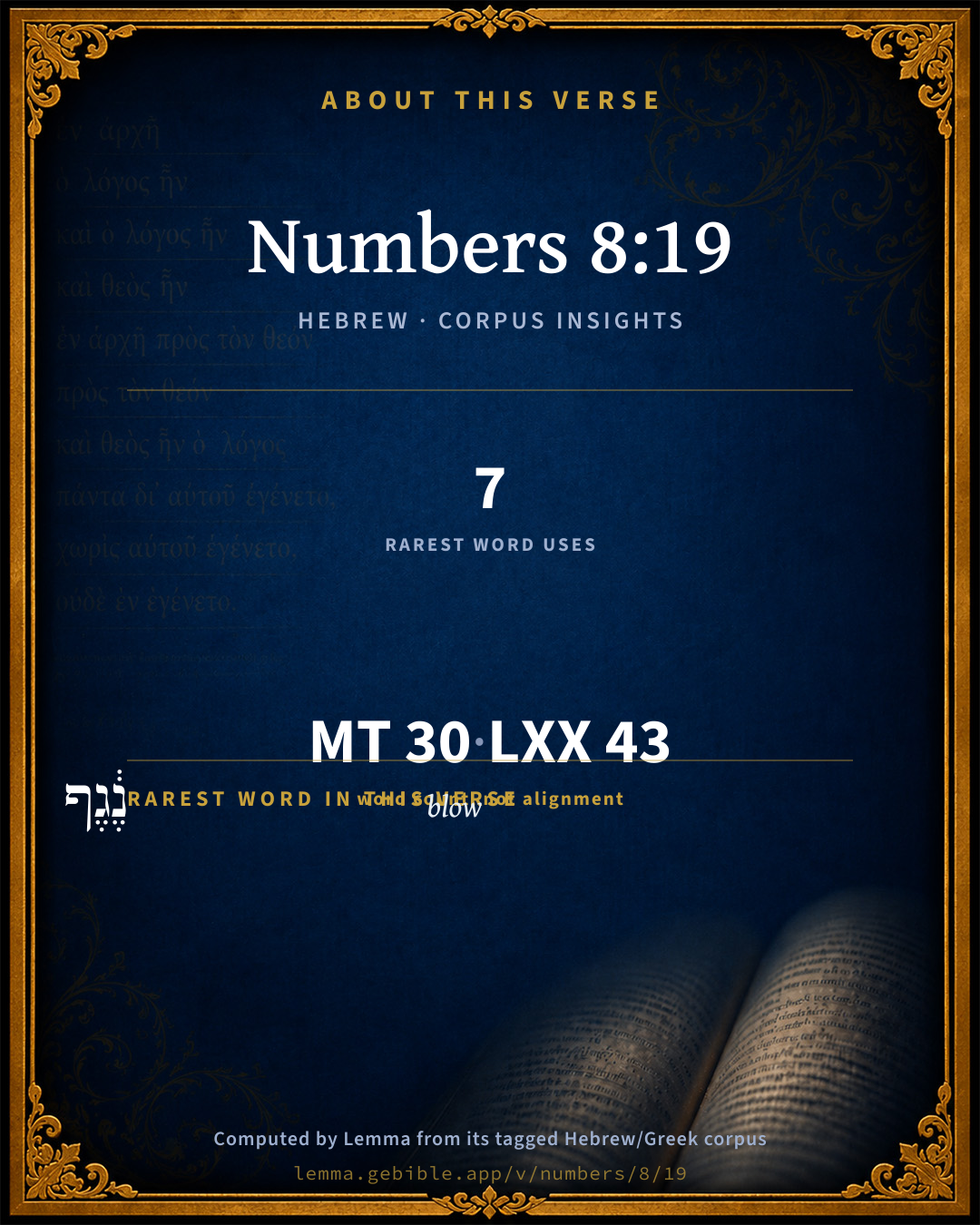
These counts appear in no published source. They are computed here, from the morphology-tagged text and Lemma’s own curated glosses. What Lemma adds →

30
words
19
distinct lemmas
Pentateuch
section

Notable vocabulary

The rarest word here is נֶ֔גֶף blow H5063 — appearing just 7 times in the whole Hebrew Bible.

Shared distinctive vocabulary

נֶ֔גֶף blow H5063 occurs in 7 verses of the Hebrew Bible. Also found in:

Grammatical profile

  • 6 verbs
  • 19 nouns
  • 2 prepositions
  • 3 particles

Verb forms

  • וָאֶתְּנָ֨ה Qal · Sequential Imperfect
  • נְתֻנִ֣ים Qal · Participle Passive
  • לַעֲבֹ֞ד Qal · Infinitive Construct
  • וּלְכַפֵּ֖ר Piel · Infinitive Construct
  • יִהְיֶ֜ה Qal · Imperfect
  • בְּגֶ֥שֶׁת Qal · Infinitive Construct

Repetition

Words recur within this verse — often emphatic in Hebrew:

  • וּלְבָנָ֗יו son H1121 ×6
  • יִשְׂרָאֵל֒ Israel H3478 ×5
  • וָאֶתְּנָ֨ה to give H5414 ×2

Hebrew & Septuagint length

In English translation the verse runs 63 words from the Hebrew and 63 from the Septuagint (LXX English) — the same length.

A rough comparison of the two English renderings, which tokenize alike — not a word-level alignment.

Word counts can differ between the Hebrew and the Greek without any difference in meaning — e.g. the Hebrew direct-object marker אֵת has no separate Greek word, and Greek often adds the article ὁ.

In the original languages it is 30 Hebrew tokens and 43 Greek tokens — but the two are counted differently (Hebrew bundles its prefixes and suffixes into one token; the Greek is in lemma form), so that isn’t a like-for-like length.

Cross-references

8

Topical passages linked to Numbers 8:19 in the Treasury of Scripture Knowledge — connected by theme and wording, ordered by reader-vote popularity; previews shown in the World English Bible.

  • Numbers 1:53 But the Levites shall encamp around the Tabernacle of the Testimony, that there may be no wrath on the congregation of the children of Israel: and the Levites shall be responsible for the Tabernacle of the Testimony."
  • Numbers 16:46 Moses said to Aaron, Take your censer, and put fire therein from off the altar, and lay incense thereon, and carry it quickly to the congregation, and make atonement for them: for there is wrath gone out from Yahweh; the plague is begun.
  • 2 Chronicles 26:16–20 But when he was strong, his heart was lifted up, so that he did corruptly, and he trespassed against Yahweh his God; for he went into the temple of Yahweh to burn incense on the altar of incense.
  • Numbers 3:6–9 "Bring the tribe of Levi near, and set them before Aaron the priest, that they may minister to him.
  • Numbers 18:2–6 Your brothers also, the tribe of Levi, the tribe of your father, bring you near with you, that they may be joined to you, and minister to you: but you and your sons with you shall be before the tent of the testimony.
  • 1 Samuel 6:19 He struck of the men of Beth-shemesh, because they had looked into the ark of Yahweh, he struck of the people fifty thousand seventy men; and the people mourned, because Yahweh had struck the people with a great slaughter.
  • 1 Chronicles 23:28–32 For their office was to wait on the sons of Aaron for the service of the house of Yahweh, in the courts, and in the chambers, and in the purifying of all holy things, even the work of the service of the house of God;
  • Ezekiel 44:11–14 Yet they shall be ministers in my sanctuary, having oversight at the gates of the house, and ministering in the house: they shall kill the burnt offering and the sacrifice for the people, and they shall stand before them to minister to them.

Cross-references courtesy of OpenBible.info (CC BY 4.0).

Hebrew and Greek witnesses Masoretic Hebrew ↔ Greek Septuagint

The same verse in the two great witnesses to the Old Testament, shown verse-for-verse.

These are two independent witnesses, not word-aligned to each other, and the Septuagint is shown in lemma (dictionary) form.

Hebrew Numbers 8:19 Masoretic · Westminster Leningrad Codex

וָאֶתְּנָ֨ה אֶת הַלְוִיִּ֜ם נְתֻנִ֣ים לְאַהֲרֹ֣ן וּלְבָנָ֗יו מִתּוֹךְ֮ בְּנֵ֣י יִשְׂרָאֵל֒ לַעֲבֹ֞ד אֶת עֲבֹדַ֤ת בְּנֵֽי יִשְׂרָאֵל֙ בְּאֹ֣הֶל מוֹעֵ֔ד וּלְכַפֵּ֖ר עַל בְּנֵ֣י יִשְׂרָאֵ֑ל וְלֹ֨א יִהְיֶ֜ה בִּבְנֵ֤י יִשְׂרָאֵל֙ נֶ֔גֶף בְּגֶ֥שֶׁת בְּנֵֽי יִשְׂרָאֵ֖ל אֶל הַקֹּֽדֶשׁ

I have given the Levites as a gift to Aaron and to his sons from among the children of Israel, to do the service of the children of Israel in the Tent of Meeting, and to make atonement for the children of Israel; that there be no plague among the children of Israel, when the children of Israel come near to the sanctuary."

World English Bible · Public Domain

Greek LXX Numbers 8:19 Septuagint · lemma form

καί ἀποδίδωμι ὁ λευίτης ἀπόδομα δίδωμι ἀαρών καί ὁ υἱός αὐτός ἐκ μέσος υἱός ἰσραήλ ἐργάζομαι ὁ ἔργον ὁ υἱός ἰσραήλ ἐν ὁ σκηνή ὁ μαρτύριον καί ἐκἱλάσκομαι περί ὁ υἱός ἰσραήλ καί οὐ εἰμί ἐν ὁ υἱός ἰσραήλ προςἐγγίζω πρός ὁ ἅγιος

And I gave the Levites presented as a gift to Aaron and his sons out of the midst of the children of Israel, to do the service of the children of Israel in the tabernacle of witness, and to make atonement for the children of Israel: thus there shall be none among the sons of Israel to draw near to the holy things.

LXX2012 (modern English Septuagint) · Public Domain

Hebrew: Westminster Leningrad Codex (CC BY 4.0). Greek: Septuagint (public domain); English from LXX2012 (modern English Septuagint) (Public Domain). How the Septuagint differs from the Hebrew →

Targum (Aramaic paraphrase)

2

The Targum is the ancient Jewish Aramaic paraphrase of the Hebrew Scriptures — an interpretive translation, not the Hebrew text itself. Onkelos (literal) and Pseudo-Jonathan (expansive) render the Torah, and Jonathan the Prophets. Coverage is partial: where no permissively-licensed English translation exists for a verse, only the Aramaic is shown. This is verse-level text, not a word-by-word alignment to the Hebrew.

  1. Targum Onkelos Torah (Genesis–Deuteronomy)
    וִיהָבִית יָת לֵוָאֵי מְסִירִין לְאַהֲרֹן וְלִבְנוֹהִי מִגוֹ בְּנֵי יִשְׂרָאֵל לְמִפְלַח יָת פּוּלְחָן בְּנֵי יִשְׂרָאֵל בְּמַשְׁכַּן זִמְנָא וּלְכַפָרָא עַל בְּנֵי יִשְׂרָאֵל וְלָא יְהֵי בִּבְנֵי יִשְׂרָאֵל מוֹתָא בְּמִקְרַב בְּנֵי יִשְׂרָאֵל לְקוּדְשָׁא

    (no public-domain English translation for this verse)

    Targum Onkelos — Aramaic: “Onkelos Genesis” (public domain); “Onkelos Exodus” (public domain); “Onkelos Leviticus” (public domain); “Onkelos Numbers” (public domain); “Onkelos Deuteronomy” (public domain). English: “Sefaria Community Translation” (CC0 1.0 (public-domain dedication)); “J.W. Etheridge. The Targums of Onkelos and Jonathan Ben Uzziel on the Pentateuch. London: Longmans, Green, 1862” (public domain). Text via Sefaria.

  2. Targum Pseudo-Jonathan Torah (Genesis–Deuteronomy)
    וִיהָבִית יַת לֵיוָאֵי יְהִיבִין לְאַהֲרן וְלִבְנוֹי מִגוֹ בְּנֵי יִשְרָאֵל לְמִפְלַח יַת פּוּלְחַן בְּנֵי יִשְרָאֵל בְּמַשְׁכַּן זִמְנָא וּלְכַפָּרָא עַל בְּנֵי יִשְרָאֵל וְלָא יְהֵי בִּבְנֵי יִשְרָאֵל מוֹתָא בִּזְמַן מִקְרַב בְּנֵי יִשְרָאֵל לְקוּדְשָׁא

    and have given the Levites (as) gifts unto Aharon and to his sons from among the sons of Israel, to minister the service of the children of Israel in the tabernacle of ordinance, and to atone for the children of Israel, lest there be mortality among the children of Israel at the time when they approach the sanctuary.

    Targum Pseudo-Jonathan — Aramaic: “Targum Jonathan on Genesis” (public domain); “Targum Jonathan on Exodus” (public domain); “Targum Jonathan on Leviticus” (public domain); “Targum Jonathan on Numbers” (public domain); “Targum Jonathan on Deuteronomy” (public domain). English: “The Targum of Jonathan ben Uzziel, trans. J. W. Etheridge, London, 1862” (public domain). Text via Sefaria.

Commentary

Notes on Numbers 8:19 from classic Christian and Jewish commentators (each source and its license shown beneath its notes). The classic Christian expositions comment on the surrounding passage and are grouped to its opening verse, so a note may address several verses; the Jewish commentaries on the Tanakh (Rashi and others) are per-verse, so they appear only where the commentator wrote on this verse.

Lemma curates 59 commentaries, every one of them public domain or Creative Commons licensed, each selected and text-cleaned for this edition rather than reprinted as found. About our sources →

Trapp's Complete Commentary

John Trapp

Num 8:19 And I have given the Levites [as] a gift to Aaron and to his sons from among the children of Israel, to do the service of the children of Israel in the tabernacle of the congregation, and to make an atonement for the children of Israel: that there be no plague among the children of Israel, when the children of Israel come nigh unto the sanctuary.

Ver. 19. As a gift to Aaron.]

“ Clarissima semper

Munera sunt, Author quae pretiosa facit. ”

Ministers also are given as an honorary to the Church. {Eph 4:11}

John Trapp, A Commentary or Exposition upon All the Books of the Old and New Testament (1647–1656) — public domain. Text from a community e-Sword module.

Joseph Benson's Commentary

Num 8:19. To do the service of Israel — To serve God in their stead; to do what otherwise they would have been obliged to do in their own persons. To make an atonement — Not by offering sacrifices, which the priests alone might do, but by assisting the priest in that expiatory work, and by a diligent performance of all the parts of their office, whereby God was pleased both with them and with the people. That there be no plague — This is added as a reason why God appointed them to serve in the tabernacle, that they might guard it, and not suffer any of the people to come near it, or meddle with holy things; which if they did, it would certainly bring a plague upon them.

Joseph Benson's Commentary on the Old and New Testaments (1811–1818) — public domain. Text from a community e-Sword module.

Tyndale Open Study Notes

Tyndale Open Resources

8:19 A plague was an appropriate punishment for unlawful actions (11:33; 14:37).

Tyndale Open Study Notes — © Tyndale Open Resources, licensed CC BY-SA 4.0. Text via the HelloAO Bible API.

Geneva Bible (1599)

Geneva Bible translators

Because the Levites go into the Sanctuary in their name.

Which service the Israelites should else do.

Geneva Bible (1599) marginal notes — public domain. Text via Bolls.life.

Jamieson, Fausset & Brown

Robert Jamieson, A. R. Fausset & David Brown

to make an atonement for the children of Israel, &c.--to aid the priests in that expiatory work; or, as the words may be rendered, "to make redemption for" the Levites being exchanged or substituted for the first-born for this important end, that there might be a sanctified body of men appointed to guard the sanctuary, and the people not allowed to approach or presumptuously meddle with holy things, which would expose them to the angry judgments of Heaven.

Jamieson, Fausset & Brown — Commentary Critical and Explanatory on the Whole Bible (1871) — public domain (CC PDM 1.0). Text via the HelloAO Bible API.

Ellicott's Commentary for English Readers

(19) As a gift.—Hebrew, given, as in Num_8:16.

That there be no plague among the children of Israel.—The appointment of the Levites in the place of the firstborn was calculated to insure the reverent and orderly discharge of the duties of the Sanctuary, and to operate as a safeguard against those sins of omission and commission into which the firstborn would have been more likely to be betrayed, and which would have provoked the Divine wrath against the Israelites generally.

A Bible Commentary for English Readers, edited by Charles John Ellicott (1878–1897) — public domain. Text from a community e-Sword module.

The Cambridge Bible for Schools and Colleges

gen. ed. J. J. S. Perowne

19. as a gift] lit. ‘given [persons].’ See on Num_3:9.

19. the service of the children of Israel] i.e. the service which Jehovah requires from them. They perform it in the person of their representatives, who are now the Levites instead of the first-born.

atonement] Not in this case propitiation for past sins, but the averting of God’s anger by preventing sin from being committed. The sin would be two-fold—the non-performance of the rightful worship, and, as the following words (which should be rendered as in R.V. marg.) shew, the too near approach of the laity to the holy things. The Levites are both substitutes for the laity, and at the same time a cordon to keep them at a distance.

that there be no plague] Cf. Num_1:53.

The Cambridge Bible for Schools and Colleges (gen. ed. J. J. S. Perowne; Cambridge University Press, 1878–1918) — public domain. Text from a community e-Sword module.

John Gill's Exposition

And Moses and Aaron, and all the congregation of the children of Israel,.... The several parties concerned in the consecration of the Levites: these

did to the Levites according unto all that the Lord commanded Moses,

so did the children of Israel unto them: which, as Jarchi notes, is said to the praise of them that did it, and of what was done by them; everything was done that was ordered, and in the manner in which it was prescribed; Moses sprinkled, or ordered to be sprinkled, the water of purification on them, and set them before the tabernacle, and before the Lord; the children of Israel laid their hands on them, and Aaron waved them, offered the sacrifices for them.

John Gill's Exposition of the Whole Bible (1746–1763) — public domain (CC PDM 1.0). Text via the HelloAO Bible API.

Matthew Poole's English Annotations

The service of the children of Israel, i.e. to serve God in their stead and behalf, to do what otherwise they had been obliged to do in their own persons.

In the tabernacle: how in it, See Poole "Num 8:15".

To make an atonement for the children of Israel; not by offering sacrifices, which the priests alone might do, but by assisting the priests in that expiatory work, and by a diligent performance of all the parts of their office, whereby God was pleased both with them and with the people. That there be no plague: this is added as a reason why God appointed them to serve in or about the tabernacle, that they might watch and guard it, and not suffer any of the people to come near it, or meddle with holy things, which if they did, it would certainly bring a plague upon them.

Matthew Poole's English Annotations on the Holy Bible (1683–1685) — public domain. Text from a community e-Sword/MySword module.

Whedon's Commentary on the Bible

Daniel D. Whedon

19. To make an atonement — This looks toward priestly functions to be discharged by the Levites. Though it is not probable that they alone ever sprinkled the blood of the sacrifices, which is a purely sacerdotal act, yet they assisted the priests who sprinkled the blood “which they received of the hand of the Levites,” (2Ch_30:16,) and were drawn more and more clearly to the priests by being released from menial service through the substitution of the Nethinim. Hence they soon became teachers, interpreters, chanters of Hebrew psalmody, and special guardians of the sanctity of the sabbath. Neh_13:22. The last prophet of the Old Testament predicts that in the latter days the Lord “shall purify the sons of Levi.”

That there be no plague — The inner sanctuaries of the tabernacle, the apartment of the priests, and the holy of holies were inaccessible to strangers, that is, non-Levites. Hence the appointment of the Levites to be guardians of the tabernacle and safeguards of the people lest they be smitten by the stroke of Jehovah’s wrath. See Num_1:51; Num_1:53, notes.

Daniel D. Whedon (gen. ed.), Commentary on the Old and New Testaments (1874–1909) — public domain. Text from a community e-Sword module.

The Pulpit Commentary

To make an atonement for the children of Israel. This is a remarkable expression, and throws light upon the nature of atonement. It is usually confined to purely sacerdotal ministrations, but it clearly has a somewhat different scope here. The idea that the Levites "made an atonement" by assisting the priests in the subordinate details of sacrifice hardly needs refutation: as well might the Gibeonites be said to "make an atonement" because they supplied the altar fire with wood. The real parallel to this is to be found in the case of Phinehas, of whom God testified that "he hath turned my wrath away from the children of Israel," and "made an atonement for the children of Israel". (Num_25:11, Num_25:13) It is evident that Phinehas turned away the wrath of God not by offering any sacrifices, but by making the sin which aroused that wrath to cease: he made an atonement for the people by discharging for them that holy and bounden duty (of putting away sin) which the rest of them failed to perform. Similarly the Levites made an atonement not by offering sacrifice (which they could no more do than the children of Judah), but by rendering unto God those personal duties of attendance and service in his courts which all the people ought to have rendered had they only been fit.

That there be no plague among the children of Israel, when the children of Israel come nigh unto the sanctuary. See Num_1:53. The children of Israel were in this strait. As "a holy nation," they were all bound, and their first-born as redeemed from the destroyer were specially bound, to render certain religious duties to God. But if they had attempted to render them they would have erred through ignorance and foolishness, and so have incurred Divine wrath and punishment, when they came nigh unto the sanctuary. From this strait the substitution of the Levites delivered them.

The Pulpit Commentary (1880–1919), ed. H.D.M. Spence-Jones & Joseph S. Exell — public domain. Text from a community e-Sword module.

John Wesley's Explanatory Notes

To do the service of Israel - To serve God in their stead, to do what otherwise they had been obliged to do in their own persons. To make an atonement - Not by offering sacrifices, which the priests alone might do, but by assisting the priests in that expiatory work, and by a diligent performance of all the parts of their office, whereby God was pleased both with them and with the people. That there be no plague - This is added as a reason why God appointed them to serve in the tabernacle, that they might guard it, and not suffer any of the people to come near it, or meddle with holy things, which if they did, it would certainly bring a plague upon them.

John Wesley, Explanatory Notes Upon the Whole Bible (1754–1765) — public domain. Text via the GEBible commentary corpus.

Rashi

Rabbi Shlomo Yitzchaki (Rashi)

ואתנה וגו׳ AND I HAVE GIVEN [THE LEVITES etc.] — Five times are the “children of Israel” mentioned in this verse (where the last four times they might have been alluded to by a personal pronoun), in order to show what affection they are held by the Lord in that the mention of them is repeated five times in one verse corresponding in number to the “Five Books of the Torah”. Thus I have seen stated in Genesis Rabbah (Leviticus Rabbah 2:4; cf. Genesis Rabbah 3:5).

ולא יהיה בבני ישראל נגף [AND I HAVE GIVEN THE LEVITES … TO DO THE SERVICE OF THE CHILDREN OF ISRAEL] THAT THERE BE NO PLAGUE AMONG THE CHILDREN OF ISRAEL [WHEN THE CHILDREN OF ISRAEL COME NIGH UNTO THE SANCTUARY] — The meaning is: I have given them etc. so that it should be unnecessary for them to come near to the Sanctuary, because [having sinned by worshipping the Calf], if they came near there would be a plague among them.

Rashi on the Tanakh — English translations: “The Judaica Press complete Tanach with Rashi, translated by A. J. Rosenberg” (CC BY 4.0); “Pentateuch with Rashi's commentary by M. Rosenbaum and A.M. Silbermann, 1929-1934” (public domain); “The Metsudah Tanach series, Lakewood, N.J” (CC BY 4.0); and “The Book of Joshua, Metsudah Publications, 1997” (CC BY 4.0). Text via Sefaria.

Lesson kit

Teaching starters — assembled from the data on this page, not authored interpretation. Every prompt links to the verse data it draws on. Edit before teaching.

Numbers, in the Pentateuch, opens this verse with 30 words (19 distinct Hebrew lemmas). Its most distinctive word is negeph (“blow”). A historical commentator’s framing appears above. Read the whole chapter for the surrounding context.

Discussion questions

  1. What does “blow” (negeph) contribute to the verse as a whole?
  2. Exodus 12:13 shares the word «blow» with this verse. How do the two illuminate each other?
  3. “son” occurs 6× in this one verse. What is the effect of the repetition?
  4. These translations render this verse differently; the difference is in the English rendering, not the original. What questions does that raise?
  5. The verb «וָאֶתְּנָ֨ה» is Qal Sequential Imperfect. How does its form color the action?
  6. Reading how Trapp's Complete Commentary and Joseph Benson's Commentary read this verse, where do the two commentators agree and where do they part?

Things to notice

Reading settings

Reading text

Shown beneath each verse's original-language words.

Old Testament
Old Testament edition

Read the OT as the Masoretic Hebrew (MT) or the Greek Septuagint (LXX).

English shown for the Greek Septuagint (in the Hebrew ↔ Greek comparison).

Comparing translations? Open the Compare panel on any verse page to stack up to four side by side.