
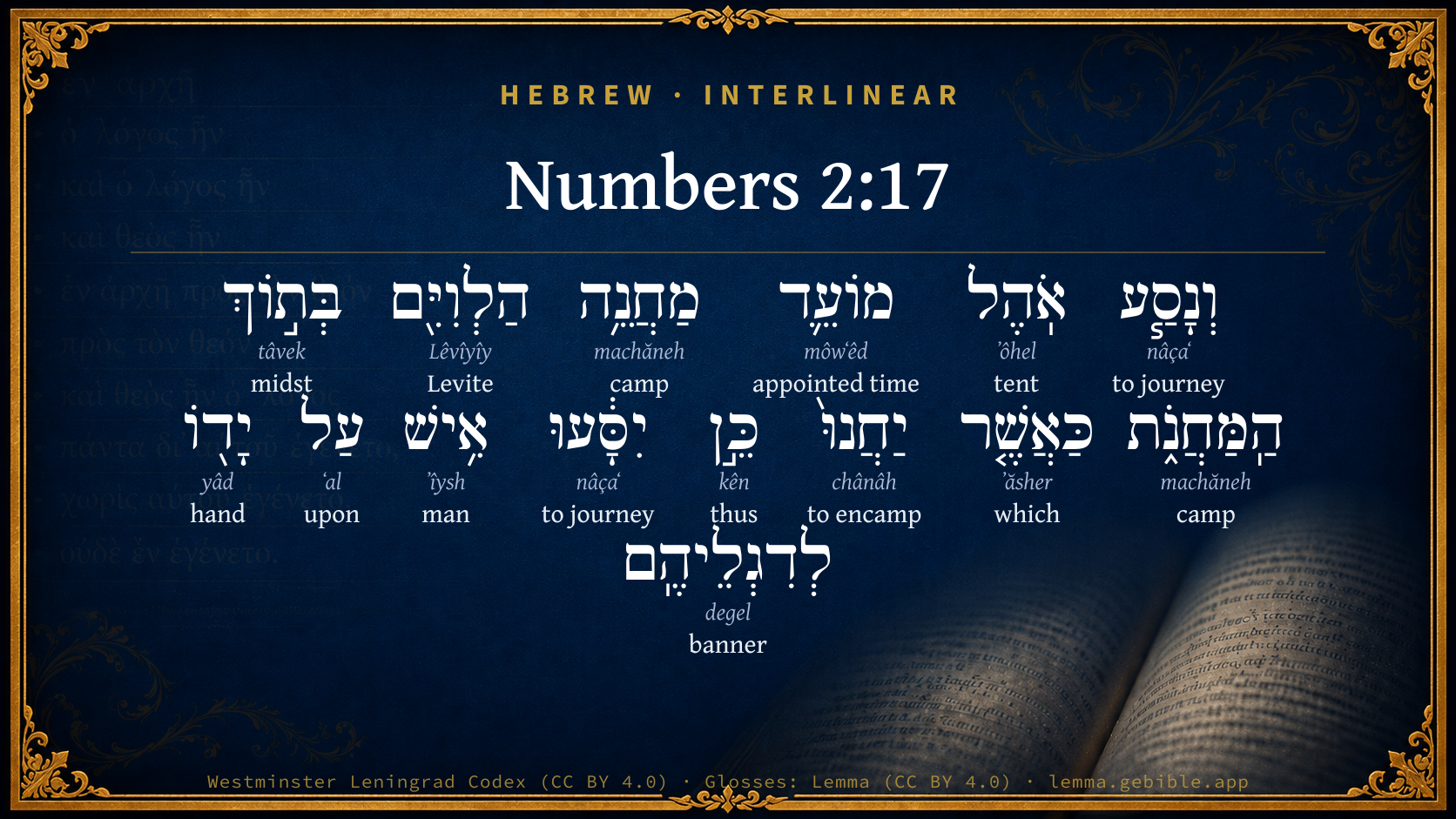
Numbers 2:17

Hebrew (Westminster Leningrad Codex) Numbers 2:17 appears in the Hebrew Old Testament. The text above is from the Westminster Leningrad Codex. Each word links to its Strong’s number, a concise gloss, and parsing drawn from the Open Scriptures Hebrew Bible morphology. Click any word for its full Brown-Driver-Briggs (BDB) entry.
Download image
Cite this verse

Numbers 2:17 (World English Bible). Public Domain. Lemma interlinear Bible study tool, https://lemma.gebible.app/v/numbers/2/17.

Show BibTeX & RIS
BibTeX
RIS
English Translation
"Then the tent of meeting shall set out, with the camp of the Levites in the midst of the camps. As they encamp, so shall they set out, every man in his place, by their standards.
World English Bible · Public Domain
Download a study sheet

One document with this verse’s original text, its word-by-word gloss line, the meaning frame, cross-references with their text, attributed commentary, and full source and license credits — printable, and it pastes into notes with its structure intact.

This verse Autodidact and up

Study sheet (.html) Plain text (.txt)

A passage Seminary Student

Up to 50 verses in one chapter. A passage sheet keeps up to 6 commentary sources and 12 cross-references per verse, in the order this page ranks them, and says so on the sheet whenever that leaves anything out. Ask for a single verse and you get the Autodidact verse sheet above.

Everything on this page stays free to read, with no account — the sheet is a download of what is already on screen, not access to it.

Want to remove ads? Support Godless Engineer
Compare translations 3

The same verse in 3 English versions, stacked beneath the original-language interlinear above. Click any original word for its lexicon entry.

Each is an independent rendering of the whole verse — the interlinear is not word-aligned to these translations.

Highlighted words mark where these versions differ — a whole-verse word diff, not a word-by-word alignment.

  • World English Bible Public Domain
    "Then the tent of meeting shall set out, with the camp of the Levites in the midst of the camps. As they encamp, so shall they set out, every man in his place, by their standards.
  • King James Version Public Domain
    Then the tabernacle of the congregation shall set forward with the camp of the Levites in the midst of the camp: as they encamp, so shall they set forward, every man in his place by their standards.
  • unfoldingWord Literal Text CC BY-SA 4.0
    And the tent of meeting will set out the camp of the Levites in the midst of the camps. As they camp, so they will set out, a man on his hand, according to their banners.

unfoldingWord Literal Text — © unfoldingWord, licensed CC BY-SA 4.0. Word-aligned USFM3 via Door43 (git.door43.org/unfoldingWord/en_ult).

Versions to compare (up to 4)

3 of 4 selected

Show all 18 translations

Every available English version of this verse, each an independent rendering of the whole verse.

  • World English Bible Public Domain
    "Then the tent of meeting shall set out, with the camp of the Levites in the midst of the camps. As they encamp, so shall they set out, every man in his place, by their standards.
  • Berean Standard Bible Public Domain
    In the middle of the camps, the Tent of Meeting is to travel with the camp of the Levites. They are to set out in the order they encamped, each in his own place under his standard.
  • Majority Standard Bible Public Domain
    In the middle of the camps, the Tent of Meeting is to travel with the camp of the Levites. They are to set out in the order they encamped, each in his own place under his standard.
  • King James Version Public Domain
    Then the tabernacle of the congregation shall set forward with the camp of the Levites in the midst of the camp: as they encamp, so shall they set forward, every man in his place by their standards.
  • American Standard Version (1901) Public Domain
    Then the tent of meeting shall set forward, with the camp of the Levites in the midst of the camps: as they encamp, so shall they set forward, every man in his place, by their standards.
  • Revised Version (1885) Public Domain
    Then the tent of meeting shall set forward, with the camp of the Levites in the midst of the camps: as they encamp, so shall they set forward, every man in his place, by their standards.
  • Geneva Bible (1599) Public Domain
    Then the Tabernacle of the Congregation shall goe with the host of the Leuites, in the mids of the campe as they haue pitched, so shall they goe forwarde, euery man in his order according to their standerds.
  • Douay-Rheims (1899) Public Domain
    And the tabernacle of the testimony shall be carried by the officers of the Levites and their troops. As it shall be set up, so shall it be taken down. Every one shall march according to their places, and ranks.
  • Young's Literal Translation Public Domain
    And the tent of meeting -- the camp of the Levites -- hath journeyed in the midst of the camps; as they encamp so they journey, each at his station by their standards.
  • Literal Standard Version CC BY-SA 4.0
    And the Tent of Meeting has journeyed [with] the camp of the Levites in the middle of the camps; as they encamp so they journey, each at his station by their standards.
  • Unlocked Literal Bible CC BY-SA 4.0
    Next, the tent of meeting must go out from the camp with the Levites in the middle of all the camps. They must go out from the camp in the same order as they come into the camp. Every man must be in his place, by his banner.
  • unfoldingWord Literal Text CC BY-SA 4.0
    And the tent of meeting will set out the camp of the Levites in the midst of the camps. As they camp, so they will set out, a man on his hand, according to their banners.
  • Darby Bible Public Domain
    And the tent of meeting shall set forth, the camp of the Levites in the midst of the camps; as they encamp, so shall they set forth, every man in his place, according to their standards.
  • World Messianic Bible Public Domain
    “Then the Tent of Meeting shall set out, with the camp of the Levites in the middle of the camps. As they encamp, so shall they set out, every man in his place, by their standards.
  • Webster's Bible Public Domain
    Then the tabernacle of the congregation shall move forward with the camp of the Levites, in the midst of the camp: as they encamp, so shall they move forward, every man in his place by their standards.
  • Free Bible Version CC BY-SA 4.0
    The Tent of Meeting which stands at the center of the camp is to accompany the Levites. They are to march out in the same order as they set up camp, each in their rightful place under their flag.
  • Bible in Basic English Public Domain
    Then the Tent of meeting is to go forward, with the tents of the Levites, in the middle of the armies; in the same order as their tents are placed, they are to go forward, every man under his flag.
  • JPS Tanakh (1917) Public Domain
    Then the tent of meeting, with the camp of the Levites, shall set forward in the midst of the camps; as they encamp, so shall they set forward, every man in his place, by their standards.

Literal Standard Version (2020), Covenant Press — licensed CC BY-SA 4.0. Text via the HelloAO Bible API (eBible.org). Unlocked Literal Bible (unfoldingWord) — licensed CC BY-SA 4.0. Text via the HelloAO Bible API (eBible.org). unfoldingWord Literal Text — © unfoldingWord, licensed CC BY-SA 4.0. Word-aligned USFM3 via Door43 (git.door43.org/unfoldingWord/en_ult). Free Bible Version, Dr. Jonathan Gallagher — licensed CC BY-SA 4.0. Text via the HelloAO Bible API (eBible.org).

Word by word

More ways to search: Search by grammar → Find every occurrence → Compare this word →

Practice this passage: Drill this verse → Learn its vocabulary →

לְדִגְלֵיהֶֽם
degel
H1714
“to/for · banners · their”
Preposition + Noun, Common, Masculine, Plural, Construct + Suffix, Personal, 3rd Person, Masculine, Plural
Part of Speech
Preposition + Noun
Type
Common
Gender
Masculine
Number
Plural
State
Construct
Full BDB Definition

Origin: from H1713

TWOT: 402a

banner, standard
  1. וְנָסַ֧ע nâçaʻ H5265 “and · to journey” Conjunction + Verb, Qal, Sequential Perfect, 3rd Person, Masculine, Singular
  2. אֹֽהֶל ʼôhel H168 “tent of” Noun, Common, Masculine, Singular, Construct
  3. מוֹעֵ֛ד môwʻêd H4150 “appointed time” Noun, Common, Masculine, Singular, Absolute
  4. מַחֲנֵ֥ה machăneh H4264 “camp of” Noun, Common, Both, Singular, Construct
  5. הַלְוִיִּ֖ם Lêvîyîy H3881 “the · Levites” Particle, Definite Article + Noun, Gentilic, Masculine, Plural, Absolute
  6. בְּת֣וֹךְ tâvek H8432 “in/at · midst of” Preposition + Noun, Common, Masculine, Singular, Construct
  7. הַֽמַּחֲנֹ֑ת machăneh H4264 “the · camps” Particle, Definite Article + Noun, Common, Both, Plural, Absolute
  8. כַּאֲשֶׁ֤ר ʼăsher H834 “like/as · which” Preposition + Particle, Relative
  9. יַחֲנוּ֙ chânâh H2583 “to encamp” Verb, Qal, Imperfect, 3rd Person, Masculine, Plural
  10. כֵּ֣ן kên H3651 “thus” Particle, Demonstrative
  11. יִסָּ֔עוּ nâçaʻ H5265 “to journey” Verb, Qal, Imperfect, 3rd Person, Masculine, Plural
  12. אִ֥ישׁ ʼîysh H376 “man” Noun, Common, Masculine, Singular, Absolute
  13. עַל ʻal H5921 “upon” Preposition
  14. יָד֖וֹ yâd H3027 “hand · his” Noun, Common, Both, Singular, Construct + Suffix, Personal, 3rd Person, Masculine, Singular

About this verse

These counts appear in no published source. They are computed here, from the morphology-tagged text and Lemma’s own curated glosses. What Lemma adds →

15
words
13
distinct lemmas
Pentateuch
section

Notable vocabulary

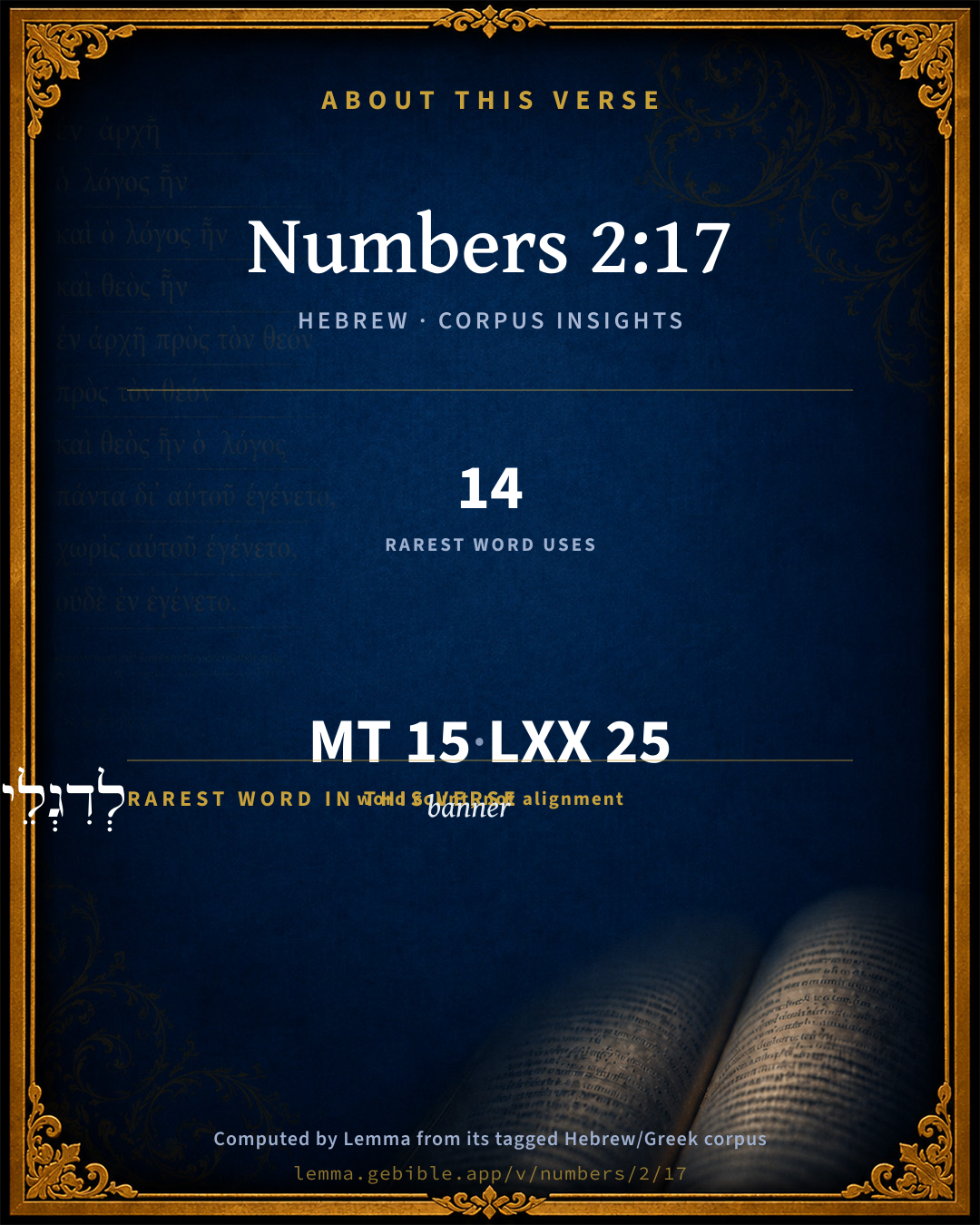
The rarest word here is לְדִגְלֵיהֶֽם banner H1714 — appearing just 14 times in the whole Hebrew Bible.

Shared distinctive vocabulary

לְדִגְלֵיהֶֽם banner H1714 occurs in 14 verses of the Hebrew Bible. Also found in:

Grammatical profile

  • 3 verbs
  • 9 nouns
  • 1 preposition
  • 2 particles

Verb forms

  • וְנָסַ֧ע Qal · Sequential Perfect
  • יַחֲנוּ֙ Qal · Imperfect
  • יִסָּ֔עוּ Qal · Imperfect

Repetition

Words recur within this verse — often emphatic in Hebrew:

  • וְנָסַ֧ע to journey H5265 ×2
  • מַחֲנֵ֥ה camp H4264 ×2

Hebrew & Septuagint length

In English translation the verse runs 36 words from the Hebrew and 44 from the Septuagint (LXX English) — closely comparable.

A rough comparison of the two English renderings, which tokenize alike — not a word-level alignment.

Word counts can differ between the Hebrew and the Greek without any difference in meaning — e.g. the Hebrew direct-object marker אֵת has no separate Greek word, and Greek often adds the article ὁ.

In the original languages it is 15 Hebrew tokens and 25 Greek tokens — but the two are counted differently (Hebrew bundles its prefixes and suffixes into one token; the Greek is in lemma form), so that isn’t a like-for-like length.

Cross-references

7

Topical passages linked to Numbers 2:17 in the Treasury of Scripture Knowledge — connected by theme and wording, ordered by reader-vote popularity; previews shown in the World English Bible.

  • Numbers 10:21 The Kohathites set forward, bearing the sanctuary: and [the others] did set up the tent against their coming.
  • Numbers 10:17 The tent was taken down; and the sons of Gershon and the sons of Merari, who bore the tent, set forward.
  • Numbers 1:50–53 but appoint the Levites over the Tabernacle of the Testimony, and over all its furnishings, and over all that belongs to it. They shall carry the tabernacle, and all its furnishings; and they shall take care of it, and shall encamp around it.
  • Numbers 3:38 Those who encamp before the tabernacle eastward, in front of the Tent of Meeting toward the sunrise, shall be Moses, and Aaron and his sons, keeping the charge of the sanctuary for the charge of the children of Israel. The stranger who comes near shall be put to death.
  • 1 Corinthians 14:40 Let all things be done decently and in order.
  • Colossians 2:5 For though I am absent in the flesh, yet am I with you in the spirit, rejoicing and seeing your order, and the steadfastness of your faith in Christ.
  • Numbers 2:1 Yahweh spoke to Moses and to Aaron, saying,

Cross-references courtesy of OpenBible.info (CC BY 4.0).

Hebrew and Greek witnesses Masoretic Hebrew ↔ Greek Septuagint

The same verse in the two great witnesses to the Old Testament, shown verse-for-verse.

These are two independent witnesses, not word-aligned to each other, and the Septuagint is shown in lemma (dictionary) form.

Hebrew Numbers 2:17 Masoretic · Westminster Leningrad Codex

וְנָסַ֧ע אֹֽהֶל מוֹעֵ֛ד מַחֲנֵ֥ה הַלְוִיִּ֖ם בְּת֣וֹךְ הַֽמַּחֲנֹ֑ת כַּאֲשֶׁ֤ר יַחֲנוּ֙ כֵּ֣ן יִסָּ֔עוּ אִ֥ישׁ עַל יָד֖וֹ לְדִגְלֵיהֶֽם

"Then the tent of meeting shall set out, with the camp of the Levites in the midst of the camps. As they encamp, so shall they set out, every man in his place, by their standards.

World English Bible · Public Domain

Greek LXX Numbers 2:17 Septuagint · lemma form

καί αἴρω ὁ σκηνή ὁ μαρτύριον καί ὁ παρεμβολή ὁ λευίτης μέσος ὁ παρεμβολή ὡς καί παρα ἐνβάλλω οὕτως καί ἐκαἴρω ἕκαστος ἔχω κατά ἡγεμονία

And then the tabernacle of witness shall be set forward, and the camp of the Levites shall be between the camps; as they shall encamp, so also shall they commence their march, each one next in order to his fellow according to their companies.

LXX2012 (modern English Septuagint) · Public Domain

Hebrew: Westminster Leningrad Codex (CC BY 4.0). Greek: Septuagint (public domain); English from LXX2012 (modern English Septuagint) (Public Domain). How the Septuagint differs from the Hebrew →

Targum (Aramaic paraphrase)

2

The Targum is the ancient Jewish Aramaic paraphrase of the Hebrew Scriptures — an interpretive translation, not the Hebrew text itself. Onkelos (literal) and Pseudo-Jonathan (expansive) render the Torah, and Jonathan the Prophets. Coverage is partial: where no permissively-licensed English translation exists for a verse, only the Aramaic is shown. This is verse-level text, not a word-by-word alignment to the Hebrew.

  1. Targum Onkelos Torah (Genesis–Deuteronomy)
    וְנַטֵל מַשְׁכַּן זִמְנָא מַשְׁרִית לֵוָאֵי בְּגוֹ מַשִּׁרְיָתָא כְּמָא דְשָׁרַן כֵּן נָטְלִין גְבַר עַל אַתְרֵהּ לְטִקְסֵיהוֹן

    (no public-domain English translation for this verse)

    Targum Onkelos — Aramaic: “Onkelos Genesis” (public domain); “Onkelos Exodus” (public domain); “Onkelos Leviticus” (public domain); “Onkelos Numbers” (public domain); “Onkelos Deuteronomy” (public domain). English: “Sefaria Community Translation” (CC0 1.0 (public-domain dedication)); “J.W. Etheridge. The Targums of Onkelos and Jonathan Ben Uzziel on the Pentateuch. London: Longmans, Green, 1862” (public domain). Text via Sefaria.

  2. Targum Pseudo-Jonathan Torah (Genesis–Deuteronomy)
    וְיִטוֹל מַשְׁכַּן זִמְנָא מַשִׁרְיַת לֵיוָאֵי בְּגוֹ מַשִׁרְיָיתָא וּבֵית מַשִׁירְוֵיהוֹן בְּאַרְבַּעְתֵּי מִילִין מְרַבְּעַן בִּמְצִיעוּתָא הֲוָון נַטְלִין הֵיכְמָא דְשָׁרַן הֵיכְדֵין נַטְלִין גְבַר עַל תְּחוּמֵיהּ לְטִיקְסֵיהוֹן

    But the tabernacle shall go with the host of the Levites, in the midst of their host; and their camp spreadeth over four miles, in the midst are they to be: as they encamp, so shall they go, every man going in his appointed place, by their standard.

    Targum Pseudo-Jonathan — Aramaic: “Targum Jonathan on Genesis” (public domain); “Targum Jonathan on Exodus” (public domain); “Targum Jonathan on Leviticus” (public domain); “Targum Jonathan on Numbers” (public domain); “Targum Jonathan on Deuteronomy” (public domain). English: “The Targum of Jonathan ben Uzziel, trans. J. W. Etheridge, London, 1862” (public domain). Text via Sefaria.

Commentary

Notes on Numbers 2:17 from classic Christian and Jewish commentators (each source and its license shown beneath its notes). The classic Christian expositions comment on the surrounding passage and are grouped to its opening verse, so a note may address several verses; the Jewish commentaries on the Tanakh (Rashi and others) are per-verse, so they appear only where the commentator wrote on this verse.

Lemma curates 59 commentaries, every one of them public domain or Creative Commons licensed, each selected and text-cleaned for this edition rather than reprinted as found. About our sources →

The Biblical Illustrator

Joseph S. Exell

Num_2:17

The camp of the Levites in the midst.

The Tabernacle in the midst of the host

I. The reasons for placing the tabernacle after this manner.

1. God doth hereby admonish them, that they should always have Him before their eyes, lest they should forget His worship or offend Him with their sins (comp. Lev_26:11-12).

2. He had respect indifferently unto all the tribes. If any others had pitched their tents farther than from the Tabernacle, they would have quarrelled and complained that they had been contemned and despised.

3. The Levites were hereby put in mind of their duty, and therefore are lodged about it.

II. The uses of placing the tabernacle after this manner.

1. It assureth us that God will ever be in the midst of us, and settle His rest and residence among us (comp. Lev_26:11-12; Eze_27:27).

(1) God is joined unto us in the person of His own only Son Emmanuel--i.e., God with us. We are made members of His body (see Mat_28:20).

(2) We have with Him the preaching of the gospel, whereby God is, as it were, brought down to reside and remain among us.

(3) We have the promise of His presence and the seals thereof in His sacraments, whereby we are at one with Him, and He with us (see Gal_3:27; Joh_6:54-56; 1Co_10:16-17).

(4) When we come together in the Church to call upon His name He is near unto us, and most familiar with us (see Mat_18:20).

(5) He dwelleth among us whensoever He preserveth us from evil and delivereth us from our enemies.

2. It serveth to teach us to what end God hath instituted civil states and commonwealths in this world--to wit, to be stays and props to the Church, that the people of God may assemble together in peace and quietness.

3. It serveth to conclude the full and final happiness of the faithful, which is begun in this life, but shall be consummated in the end of this world. (W. Attersoll.)

The Biblical Illustrator, edited by Joseph S. Exell (c. 1880s–1900s) — public domain. Text from a community e-Sword module.

Joseph Benson's Commentary

Num 2:17. In the midst — This is not to be understood strictly, but largely; for in their march they were divided, and part of that tribe marched next after Judah, (Num 10:17,) and the other part exactly in the midst of the camp.

Joseph Benson's Commentary on the Old and New Testaments (1811–1818) — public domain. Text from a community e-Sword module.

Geneva Bible (1599)

Geneva Bible translators

Because it might be in equal distance from each one, and all indifferently have recourse thereunto.

Geneva Bible (1599) marginal notes — public domain. Text via Bolls.life.

The Cambridge Bible for Schools and Colleges

gen. ed. J. J. S. Perowne

17. in the midst of the camps] This appears to mean in the centre of the line of march. The tribes on the east and south sides start first and second. Then follows the Tabernacle with all its parts and accessories, the Levites who carry it forming a hollow square. After them follow the tribes on the west and north sides. The Levitical families retain the respective positions which they occupy when encamped. In the present order of the text, these positions are not described till Num_3:23; Num_3:29; Num_3:35; Num_3:38. A different priestly tradition as to the order of match is given in Num_10:17-21.

The Cambridge Bible for Schools and Colleges (gen. ed. J. J. S. Perowne; Cambridge University Press, 1878–1918) — public domain. Text from a community e-Sword module.

John Gill's Exposition

Then the tabernacle of the congregation shall set forward with the camp of the Levites,.... Which reached four miles, according to the Targum of Jonathan, as did Judah's. Levi's stone, as the Jews say (i), was the carbuncle, and his flag was coloured, a third part white, and a third part black, and a third part red, and on it were formed Urim and Thummim:

in the midst of the camp; or "camps" (k); between the camps of Judah and Reuben, before mentioned, and those of Ephraim and Dan, which are after spoken of: the order in which they moved was this, as Aben Ezra observes; the Gershonites and Merarites marched between the standard of Judah and the standard of Reuben; and the Kohathites marched, and with them Aaron and his sons, between the standard of Reuben and the standard of Ephraim:

as they encamp, so shall they set forward; this is to be understood, according to Aben Ezra, not of the camp of Levi, since the standard of Judah was to the east, and the Gershonites, which were to the west of the sanctuary, and the Merarites in the north, set forward together; but of the camps of Israel, which set forward, not as they were encamped about the tabernacle, for those that were encamped on the side of it, in marching went before and behind, but as they were encamped with respect to themselves; first marched the standard of Judah, then that of Reuben, which went before, and then those of Ephraim and Dan, which followed; and besides, as each camp was pitched, so it moved; as the camp of Judah, his host marched between those of Issachar and Zebulun, and the same order the rest observed:

every man in his place by their standards, as every individual person in the several tribes were ranked under their respective banners, so they marched.

(i) Bemidbar Rabba, sect. 2. fol. 178. 2. (k) "in medio castrorum", Pagninus, Montanus, Tigurine version; so Ainsworth; "in medio reliquorum castrorum", Junius & Tremellius.

John Gill's Exposition of the Whole Bible (1746–1763) — public domain (CC PDM 1.0). Text via the HelloAO Bible API.

Haydock's Catholic Bible Commentary

And. Hebrew, "when the tabernacle of the assembly, shall depart, the camp of the Levites in the midst of the camp, they shall depart in the same order as they encamp, each in his rank, and his ensigns." The Levites shall always be in the middle. (Calmet) --- So the Romans made their camps, of a square form, and placed the sacred things in the centre. (Grotius) --- Down. The same officers who took it down, shall set it up again. (Menochius)

George Leo Haydock (1774–1849), Haydock's Catholic Family Bible and Commentary, 1859 edition — public domain. Excludes Psalms (Douay-Rheims chapter numbering differs from Protestant) and Deuterocanonical books (Catholic canon only).

Matthew Poole's English Annotations

In the midst of the camp, which is not to be understood strictly or exactly, but largely; for in their march they were divided, and part of that tribe marched next after Judah, Num 10:17, and the other part exactly in the midst of the camp.

Matthew Poole's English Annotations on the Holy Bible (1683–1685) — public domain. Text from a community e-Sword/MySword module.

Whedon's Commentary on the Bible

Daniel D. Whedon

17. The camp of the Levites is fully described in Num_3:14-39. The tabernacle itself, transported by the Gershonites and Merarites, had not its position in the column behind Reuben, but immediately in the rear of Judah, so as to be set up early for the reception of the sacred vessels and furniture, carried by the Kohathites in this central position in the rear of Reuben, for their better protection. See Num_10:17.

Daniel D. Whedon (gen. ed.), Commentary on the Old and New Testaments (1874–1909) — public domain. Text from a community e-Sword module.

The Pulpit Commentary

Then the tabernacle... shall set forward. Thus it was provided that, whether at rest or on the march, the Divine habitation should be exactly in the midst of Israel.

The Pulpit Commentary (1880–1919), ed. H.D.M. Spence-Jones & Joseph S. Exell — public domain. Text from a community e-Sword module.

John Wesley's Explanatory Notes

In the midst - This is not to be understood strictly, but largely; for in their march they were divided, and part of that tribe marched next after Judah, chap. x, 17, and the other part exactly in the midst of the camp.

John Wesley, Explanatory Notes Upon the Whole Bible (1754–1765) — public domain. Text via the GEBible commentary corpus.

unfoldingWord translationNotes

Door43 World Missions Community

the tent of meeting must go out ... in the middle of all the camps

This means that the tent of meeting must be carried by the Levites in the middle of the tribes as they travel.

They must go out

"They" refers to the twelve tribes.

by his banner

Each man does not have his own personal banner; rather, this refers to the banner belonging to his tribe. AT: "by his tribe's banner" (See: Synecdoche)

translationWords

tent of meeting

Levi

unfoldingWord translationNotes — © Distant Shores Media and the Door43 World Missions Community, licensed CC BY-SA 4.0. Source: git.door43.org/Door43/en_tn.

Rashi

Rabbi Shlomo Yitzchaki (Rashi)

ונסע אהל מועד AND THE TENT OF MEETING SHALL SET FORWARD after these two divisions (those of Judah and Reuben), as is shown by the position of this statement in the narrative.

כאשר יחנו כן יסעו AS THEY ENCAMP SO SHALL THEY JOURNEY — just as I have explained (v. 9): their positions when marching shall be the same as when encamping — each division marches on that side that is assigned to it.

על ידו means, in his place. The term יד does not even in this sense lose its original meaning, viz., that of “hand’’ — the area at one’s side is termed על ידו “that which is by his hand”, being that which is closest to him, and always within the reach of his hand (and not beyond it); en son aise in O. F.

Rashi on the Tanakh — English translations: “The Judaica Press complete Tanach with Rashi, translated by A. J. Rosenberg” (CC BY 4.0); “Pentateuch with Rashi's commentary by M. Rosenbaum and A.M. Silbermann, 1929-1934” (public domain); “The Metsudah Tanach series, Lakewood, N.J” (CC BY 4.0); and “The Book of Joshua, Metsudah Publications, 1997” (CC BY 4.0). Text via Sefaria.

Lesson kit

Teaching starters — assembled from the data on this page, not authored interpretation. Every prompt links to the verse data it draws on. Edit before teaching.

Numbers, in the Pentateuch, opens this verse with 15 words (13 distinct Hebrew lemmas). Its most distinctive word is degel (“banner”). A historical commentator’s framing appears above. Read the whole chapter for the surrounding context.

Discussion questions

  1. The word degel carries the sense “banner.” How does it shape the verse?
  2. Numbers 1:52 shares the word «banner» with this verse. How do the two illuminate each other?
  3. “to journey” occurs 2× in this one verse. What is the effect of the repetition?
  4. The translations on this page render this verse differently — a whole-verse word diff, not a word-by-word alignment. What might account for the different wordings?
  5. The verb «וְנָסַ֧ע» is Qal Sequential Perfect. How does its form color the action?
  6. Reading how The Biblical Illustrator and Joseph Benson's Commentary read this verse, where do the two commentators agree and where do they part?

Things to notice

Reading settings

Reading text

Shown beneath each verse's original-language words.

Old Testament
Old Testament edition

Read the OT as the Masoretic Hebrew (MT) or the Greek Septuagint (LXX).

English shown for the Greek Septuagint (in the Hebrew ↔ Greek comparison).

Comparing translations? Open the Compare panel on any verse page to stack up to four side by side.