
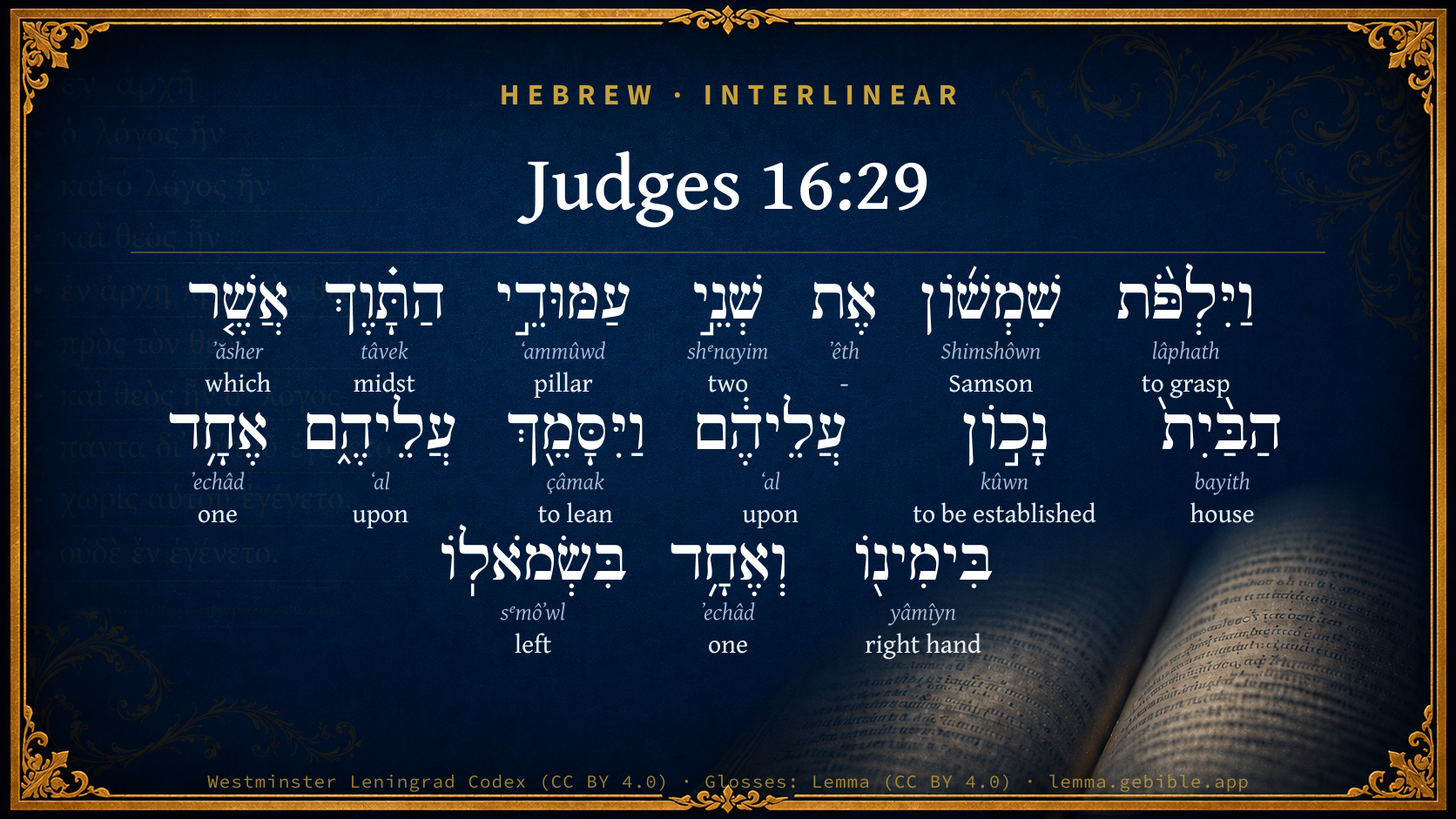
Judges 16:29

Hebrew (Westminster Leningrad Codex) Judges 16:29 appears in the Hebrew Old Testament. The text above is from the Westminster Leningrad Codex. Each word links to its Strong’s number, a concise gloss, and parsing drawn from the Open Scriptures Hebrew Bible morphology. Click any word for its full Brown-Driver-Briggs (BDB) entry.
Download image
Cite this verse

Judges 16:29 (World English Bible). Public Domain. Lemma interlinear Bible study tool, https://lemma.gebible.app/v/judges/16/29.

Show BibTeX & RIS
BibTeX
RIS
English Translation
Samson took hold of the two middle pillars on which the house rested, and leaned on them, the one with his right hand, and the other with his left.
World English Bible · Public Domain
Highlights
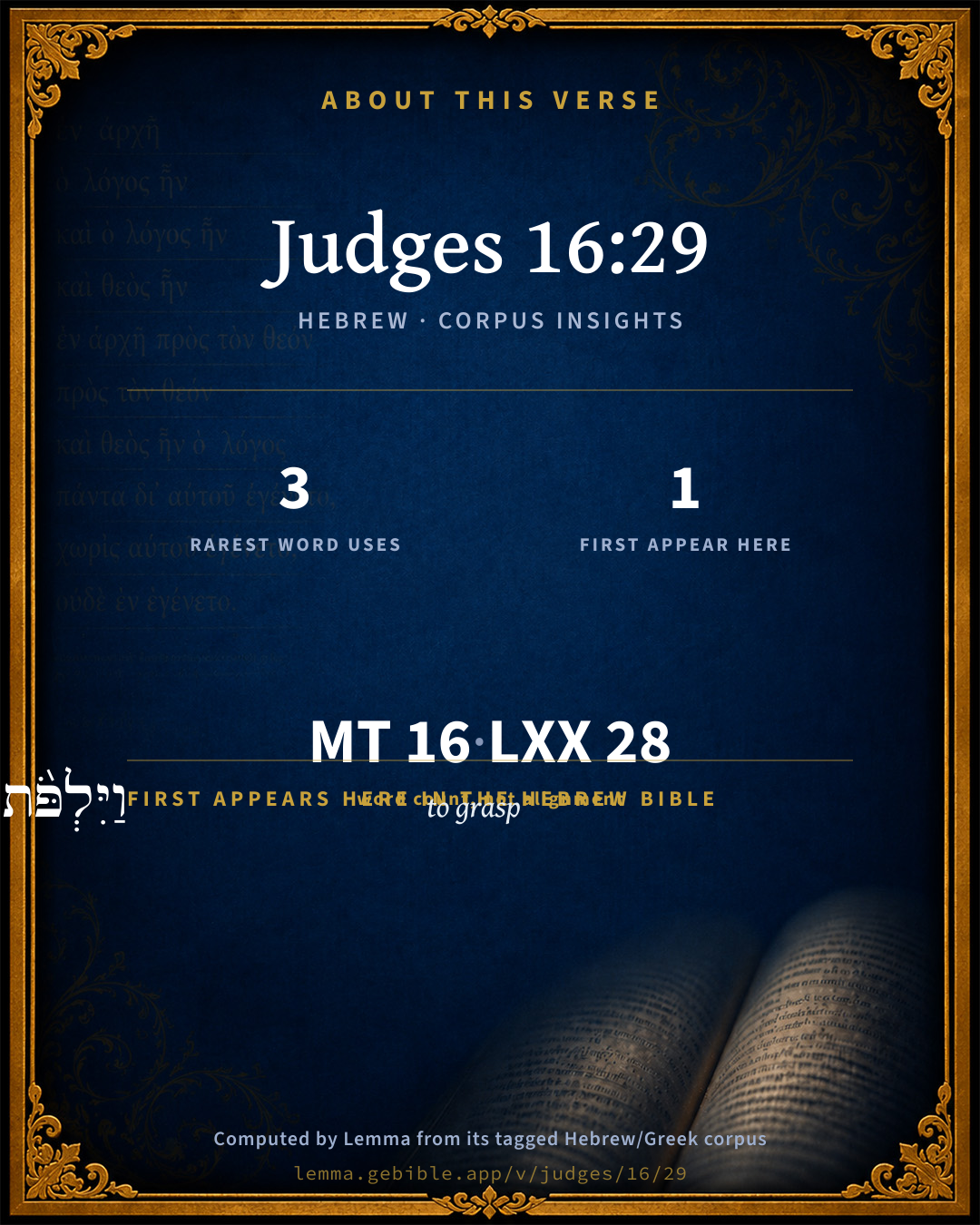
  • 1 first appearance in the Hebrew Bible
Full analysis ↓
Download a study sheet

One document with this verse’s original text, its word-by-word gloss line, the meaning frame, cross-references with their text, attributed commentary, and full source and license credits — printable, and it pastes into notes with its structure intact.

This verse Autodidact and up

Study sheet (.html) Plain text (.txt)

A passage Seminary Student

Up to 50 verses in one chapter. A passage sheet keeps up to 6 commentary sources and 12 cross-references per verse, in the order this page ranks them, and says so on the sheet whenever that leaves anything out. Ask for a single verse and you get the Autodidact verse sheet above.

Everything on this page stays free to read, with no account — the sheet is a download of what is already on screen, not access to it.

Want to remove ads? Support Godless Engineer
Compare translations 3

The same verse in 3 English versions, stacked beneath the original-language interlinear above. Click any original word for its lexicon entry.

Each is an independent rendering of the whole verse — the interlinear is not word-aligned to these translations.

Highlighted words mark where these versions differ — a whole-verse word diff, not a word-by-word alignment.

  • World English Bible Public Domain
    Samson took hold of the two middle pillars on which the house rested, and leaned on them, the one with his right hand, and the other with his left.
  • King James Version Public Domain
    And Samson took hold of the two middle pillars upon which the house stood, and on which it was borne up, of the one with his right hand, and of the other with his left.
  • unfoldingWord Literal Text CC BY-SA 4.0
    And Samson grasped the two columns of the center upon which the house was set, and he leaned himself against them, one on his right and one on his left.

unfoldingWord Literal Text — © unfoldingWord, licensed CC BY-SA 4.0. Word-aligned USFM3 via Door43 (git.door43.org/unfoldingWord/en_ult).

Versions to compare (up to 4)

3 of 4 selected

Show all 18 translations

Every available English version of this verse, each an independent rendering of the whole verse.

  • World English Bible Public Domain
    Samson took hold of the two middle pillars on which the house rested, and leaned on them, the one with his right hand, and the other with his left.
  • Berean Standard Bible Public Domain
    And Samson reached out for the two central pillars supporting the temple. Bracing himself against them with his right hand on one pillar and his left hand on the other,
  • Majority Standard Bible Public Domain
    And Samson reached out for the two central pillars supporting the temple. Bracing himself against them with his right hand on one pillar and his left hand on the other,
  • King James Version Public Domain
    And Samson took hold of the two middle pillars upon which the house stood, and on which it was borne up, of the one with his right hand, and of the other with his left.
  • American Standard Version (1901) Public Domain
    And Samson took hold of the two middle pillars upon which the house rested, and leaned upon them, the one with his right hand, and the other with his left.
  • Revised Version (1885) Public Domain
    And Samson took hold of the two middle pillars upon which the house rested, and leaned upon them, the one with his right hand, and the other with his left.
  • Geneva Bible (1599) Public Domain
    And Samson layd hold on the two middle pillars whereupon the house stood, and on which it was borne vp: on the one with his right hand, and on the other with his left.
  • Douay-Rheims (1899) Public Domain
    And laying hold on both the pillars on which the house rested, and holding the one with his right hand, and the other with his left,
  • Young's Literal Translation Public Domain
    And Samson turneth aside `to' the two middle pillars, on which the house is established, and on which it is supported, `to' the one with his right hand, and one with his left;
  • Literal Standard Version CC BY-SA 4.0
    And Samson turns aside [to] the two middle pillars, on which the house is established, and on which it is supported, [to] one with his right hand and one with his left;
  • Unlocked Literal Bible CC BY-SA 4.0
    Samson held on to the two middle pillars on which the building rested, and he leaned against them, one pillar with his right hand, and the other with his left.
  • unfoldingWord Literal Text CC BY-SA 4.0
    And Samson grasped the two columns of the center upon which the house was set, and he leaned himself against them, one on his right and one on his left.
  • Darby Bible Public Domain
    And Samson grasped the two middle pillars upon which the house rested, and he leaned his weight upon them, his right hand on the one and his left hand on the other.
  • World Messianic Bible Public Domain
    Samson took hold of the two middle pillars on which the house rested and leaned on them, the one with his right hand and the other with his left.
  • Webster's Bible Public Domain
    And Samson took hold of the two middle pillars upon which the house stood, and on which it was supported, of the one with his right hand, and of the other with his left.
  • Free Bible Version CC BY-SA 4.0
    Samson reached for the two middle pillars that supported the temple. With his right hand leaning on one pillar and his left hand on the other,
  • Bible in Basic English Public Domain
    Then Samson put his arms round the two middle pillars supporting the house, putting his weight on them, on one with his right hand and on the other with his left.
  • JPS Tanakh (1917) Public Domain
    And Samson took fast hold of the two middle pillars upon which the house rested, and leaned upon them, the one with his right hand, and the other with his left.

Literal Standard Version (2020), Covenant Press — licensed CC BY-SA 4.0. Text via the HelloAO Bible API (eBible.org). Unlocked Literal Bible (unfoldingWord) — licensed CC BY-SA 4.0. Text via the HelloAO Bible API (eBible.org). unfoldingWord Literal Text — © unfoldingWord, licensed CC BY-SA 4.0. Word-aligned USFM3 via Door43 (git.door43.org/unfoldingWord/en_ult). Free Bible Version, Dr. Jonathan Gallagher — licensed CC BY-SA 4.0. Text via the HelloAO Bible API (eBible.org).

Word by word

More ways to search: Search by grammar → Find every occurrence → Compare this word →

Practice this passage: Drill this verse → Learn its vocabulary →

וַיִּלְפֹּ֨ת
lâphath
H3943
“and · to grasp”
Conjunction + Verb, Qal, Sequential Imperfect, 3rd Person, Masculine, Singular
Part of Speech
Conjunction + Verb
Stem
Qal
Form
Sequential Imperfect
Person
3rd Person
Gender
Masculine
Number
Singular
Full BDB Definition

Origin: a primitive root

TWOT: 1123

to twist, grasp, turn, grasp with a twisting motion - (Qal) to grasp - (Niphal) to twist, weave, wind
  1. שִׁמְשׁ֜וֹן Shimshôwn H8123 “Samson” Noun, Proper
  2. אֶת ʼêth H853 “-” Particle, Direct Object
  3. שְׁנֵ֣י shᵉnayim H8147 “two” Adjective, Cardinal number, Masculine, Dual, Construct
  4. עַמּוּדֵ֣י ʻammûwd H5982 “pillars of” Noun, Common, Masculine, Plural, Construct
  5. הַתָּ֗וֶךְ tâvek H8432 “the · midst” Particle, Definite Article + Noun, Common, Masculine, Singular, Absolute
  6. אֲשֶׁ֤ר ʼăsher H834 “which” Particle, Relative
  7. הַבַּ֨יִת֙ bayith H1004 “the · house” Particle, Definite Article + Noun, Common, Masculine, Singular, Absolute
  8. נָכ֣וֹן kûwn H3559 “being established” Verb, Niphal, Participle Active, Masculine, Singular, Absolute
  9. עֲלֵיהֶ֔ם ʻal H5921 “upon · them” Preposition + Suffix, Personal, 3rd Person, Masculine, Plural
  10. וַיִּסָּמֵ֖ךְ çâmak H5564 “and · to lean” Conjunction + Verb, Niphal, Sequential Imperfect, 3rd Person, Masculine, Singular
  11. עֲלֵיהֶ֑ם ʻal H5921 “upon · them” Preposition + Suffix, Personal, 3rd Person, Masculine, Plural
  12. אֶחָ֥ד ʼechâd H259 “one” Adjective, Cardinal number, Masculine, Singular, Absolute
  13. בִּימִינ֖וֹ yâmîyn H3225 “in/at · right hand · his” Preposition + Noun, Common, Feminine, Singular, Construct + Suffix, Personal, 3rd Person, Masculine, Singular
  14. וְאֶחָ֥ד ʼechâd H259 “and · one” Conjunction + Adjective, Cardinal number, Masculine, Singular, Absolute
  15. בִּשְׂמֹאלֽוֹ sᵉmôʼwl H8040 “in/at · left · his” Preposition + Noun, Common, Masculine, Singular, Construct + Suffix, Personal, 3rd Person, Masculine, Singular

About this verse

These counts appear in no published source. They are computed here, from the morphology-tagged text and Lemma’s own curated glosses. What Lemma adds →

16
words
14
distinct lemmas
Historical
section

Notable vocabulary

The rarest word here is וַיִּלְפֹּ֨ת to grasp H3943 — appearing just 3 times in the whole Hebrew Bible.

First appearance in Scripture

This word makes its first canonical appearance in the Hebrew Bible here:

  • וַיִּלְפֹּ֨ת to grasp H3943

Shared distinctive vocabulary

וַיִּלְפֹּ֨ת to grasp H3943 occurs in 3 verses of the Hebrew Bible. Also found in:

Grammatical profile

  • 3 verbs
  • 6 nouns
  • 3 adjectives
  • 2 prepositions
  • 2 particles

Verb forms

  • וַיִּלְפֹּ֨ת Qal · Sequential Imperfect
  • נָכ֣וֹן Niphal · Participle Active
  • וַיִּסָּמֵ֖ךְ Niphal · Sequential Imperfect

Repetition

Words recur within this verse — often emphatic in Hebrew:

  • עֲלֵיהֶ֔ם upon H5921 ×2
  • אֶחָ֥ד one H259 ×2

Hebrew & Septuagint length

In English translation the verse runs 29 words from the Hebrew and 35 from the Septuagint (LXX English) — closely comparable.

A rough comparison of the two English renderings, which tokenize alike — not a word-level alignment.

Word counts can differ between the Hebrew and the Greek without any difference in meaning — e.g. the Hebrew direct-object marker אֵת has no separate Greek word, and Greek often adds the article ὁ.

In the original languages it is 16 Hebrew tokens and 28 Greek tokens — but the two are counted differently (Hebrew bundles its prefixes and suffixes into one token; the Greek is in lemma form), so that isn’t a like-for-like length.

Hebrew and Greek witnesses Masoretic Hebrew ↔ Greek Septuagint

The same verse in the two great witnesses to the Old Testament, shown verse-for-verse.

These are two independent witnesses, not word-aligned to each other, and the Septuagint is shown in lemma (dictionary) form.

Hebrew Judges 16:29 Masoretic · Westminster Leningrad Codex

וַיִּלְפֹּ֨ת שִׁמְשׁ֜וֹן אֶת שְׁנֵ֣י עַמּוּדֵ֣י הַתָּ֗וֶךְ אֲשֶׁ֤ר הַבַּ֨יִת֙ נָכ֣וֹן עֲלֵיהֶ֔ם וַיִּסָּמֵ֖ךְ עֲלֵיהֶ֑ם אֶחָ֥ד בִּימִינ֖וֹ וְאֶחָ֥ד בִּשְׂמֹאלֽוֹ

Samson took hold of the two middle pillars on which the house rested, and leaned on them, the one with his right hand, and the other with his left.

World English Bible · Public Domain

Greek LXX Judges 16:29 Septuagint · lemma form

καί περιλαμβάνω σαμψων ὁ δύο κίων ὁ οἶκος ἐπί ὅς ὁ οἶκος ἵστημι καί ἐπιστηρίζω ἐπί αὐτός καί κρατέω εἷς ὁ δεξιός αὐτός καί εἷς ὁ ἀριστερός αὐτός

And Sampson took hold of the two pillars of the house on which the house stood, and leaned on them, and laid hold of one with his right hand, and the other with his left.

LXX2012 (modern English Septuagint) · Public Domain

Hebrew: Westminster Leningrad Codex (CC BY 4.0). Greek: Septuagint (public domain); English from LXX2012 (modern English Septuagint) (Public Domain). How the Septuagint differs from the Hebrew →

Targum (Aramaic paraphrase)

1

The Targum is the ancient Jewish Aramaic paraphrase of the Hebrew Scriptures — an interpretive translation, not the Hebrew text itself. Onkelos (literal) and Pseudo-Jonathan (expansive) render the Torah, and Jonathan the Prophets. Coverage is partial: where no permissively-licensed English translation exists for a verse, only the Aramaic is shown. This is verse-level text, not a word-by-word alignment to the Hebrew.

  1. Targum Jonathan Prophets (Joshua–Malachi)
    וַאֲחַד שִׁמְשׁוֹן יַת תְּרֵין עַמוּדֵי מְצִיעָאֵי דְבֵיתָא מַתְקַן עִלַוֵיהוֹן וְאִסְתְּמִיךְ עֲלֵיהוֹן חַד בִּימִינֵיהּ וְחַד בִּסְמָלֵיהּ:

    (no public-domain English translation for this verse)

    Targum Jonathan — Aramaic: “Mikraot Gedolot” (public domain). English: “Sefaria Community Translation” (CC0 1.0 (public-domain dedication)); “London "Chaldee Paraphrase," 1871” (public domain). Text via Sefaria.

Commentary

Notes on Judges 16:29 from classic Christian and Jewish commentators (each source and its license shown beneath its notes). The classic Christian expositions comment on the surrounding passage and are grouped to its opening verse, so a note may address several verses; the Jewish commentaries on the Tanakh (Rashi and others) are per-verse, so they appear only where the commentator wrote on this verse.

Lemma curates 59 commentaries, every one of them public domain or Creative Commons licensed, each selected and text-cleaned for this edition rather than reprinted as found. About our sources →

Trapp's Complete Commentary

John Trapp

Jdg 16:29 And Samson took hold of the two middle pillars upon which the house stood, and on which it was borne up, of the one with his right hand, and of the other with his left.

Ver. 29. And Samson took hold.] Orat et laborat: the heathens could say, Admota manu invocanda est Minerva. Men must pray, but with it do their endeavour; for God is not mocked. They that will be wise to salvation, must not only beg, but dig. {Pro 2:3-5} Samson first prayed, and then bowed himself with all his might. {Jdg 16:30}

John Trapp, A Commentary or Exposition upon All the Books of the Old and New Testament (1647–1656) — public domain. Text from a community e-Sword module.

Adam Clarke's Commentary

Verse 29. The two middle pillars upon which the house stood] Much learned labour has been lost on the attempt to prove that a building like this might stand on two pillars. But what need of this? There might have been as many pillars here as were in the temple of Diana at Ephesus, and yet the two centre pillars be the key of the building; these being once pulled down, the whole house would necessarily fall.

Adam Clarke's Commentary on the Bible (1810–1826) — public domain. Text from a community e-Sword/MySword module.

Ellicott's Commentary for English Readers

(29) And on which it was borne up.—Rather, as it is given in the margin, and he leaned himself upon them.

A Bible Commentary for English Readers, edited by Charles John Ellicott (1878–1897) — public domain. Text from a community e-Sword module.

John Gill's Exposition

And Samson took hold of the two middle pillars, upon which the house stood, and on which it was borne up,.... Some have objected, that a building so large and so capacious as this was could not be supported by two pillars, and those placed in the middle, and so near to each other that Samson could lay hold on them; on which it has been observed, that the architecture of the ancients is little known to us, and they might have curious and ingenious arts of building, now lost; and several authors have taken notice of two Roman theatres built by Curio, that held abundantly more people than this house did, which were supported only by a single pin or hinge, as Pliny (y) relates; and our Westminster hall, which was built by William Rufus, and is two hundred and seventy feet long, and seventy four broad (z), and has a roof the largest in all Europe, is supported without any pillars at all; add to all which, that mention being made of the two middle pillars of this house, supposes that there were others in other parts of it, though these were the main and principal ones, on which the weight of the building chiefly lay. Kimchi observes, that the word signifies to incline or bend, as if Samson made the pillars to bend or bow; but it is a better sense that he laid hold of them:

of the one with his right hand, and the other with his left; and thus he stood with his arms stretched out, as Jesus on the cross, of whom he was a type, as often observed.

(y) Nat. Hist. l. 36. c. 15. (z) Rapin's History of England, vol. 1. p. 188.

John Gill's Exposition of the Whole Bible (1746–1763) — public domain (CC PDM 1.0). Text via the HelloAO Bible API.

Haydock's Catholic Bible Commentary

Both the. Hebrew adds, "middle" pillars, so that their fall occasioned that the whole temple, (Calmet) excepting perhaps some of the ruins, which are still shewn at Gaza. (Button.) "He tugged, he shook till down they came, and drew

The whole roof after them with bursts of thunder." (Milton) (Haydock)

George Leo Haydock (1774–1849), Haydock's Catholic Family Bible and Commentary, 1859 edition — public domain. Excludes Psalms (Douay-Rheims chapter numbering differs from Protestant) and Deuterocanonical books (Catholic canon only).

Matthew Poole's English Annotations

Quest. How could so great a building, containing so many thousands of people, rest upon two pillars so near placed together? Here infidels triumph, as if they had got an unanswerable argument against the truth of the Scriptures. But it is a far more incredible and ridiculous thing to imagine that the penman of this book should feign such a circumstance as this is, if it had been false, whereby he would have utterly overthrown the credit of the whole book; and that he should do this before a people that could easily have confuted him; and that people should have so high a veneration for that book in which they knew so notorious a falsehood to be: these things, I say, are for more absurd to believe, than the truth of this relation. But to this I shall add two answers. First, It is no sufficient argument to prove that this was not true, because we do not at this day understand how it was done. There were many great works and excellent pieces of art, some footsteps whereof are left in ancient writers; but the exact way and particular manner of them is wholly, or in a great measure, unknown and lost; so that Pancirollus hath written a whole book of such things. Particularly, the old way of architecture is much in the dark, as is confessed by the learned. It may be pretended, that though there might be curious arts of building in the learned and ingenious part of the world, it is not probable they were among such a rude and barbarous people as the Philistines. But this is certainly a very great mistake; for these people were either in part of, or very near neighbours to, the Phoenicians, from whom it is confessed the arts came to the Grecians. And forasmuch as many things which were concluded by the ancients to be impossible, are by the wit and industry of later ages found to be possible, and certainly true; it cannot be strange if some things now seem impossible to some men, which were then known to be practicable. And he that will venture his faith and salvation upon this proposition, that such a building as this was simply impossible, because he doth not see the possibility of it; or, which is all one, That no man understands more than he doth; will find few admirers of his wisdom. And to question the truth and divinity of the Holy Scriptures, which is so fully and clearly proved by sundry arguments, upon such a nicety as this, is but a more learned kind of doting.

Answ. 2. Instances are not wanting of far more large and capacious buildings than this, that have been supported only by one pillar. Particularly, Pliny, in the 15th chapter of the 36th book of his Natural History, mentions two theatres built by one C. Curio, who lived in Julius Caesar’s time, each of which was supported only by one pillar, or pin, or hinge, though very many thousands of people did sit in it together. And much more might two pillars suffice to uphold a building large enough to contain three thousand persons, which is the number mentioned, Jdg 16:27. Or the pillars might be made two in the lower part merely for ornament sake, which might easily be so ordered as to support a third and main pillar in the middle, which upheld the whole fabric.

Matthew Poole's English Annotations on the Holy Bible (1683–1685) — public domain. Text from a community e-Sword/MySword module.

The Pulpit Commentary

The two middle pillars. There may have been, say, four pillars in the front; the two middle ones standing near together, and the other two nearer the sides.

The Pulpit Commentary (1880–1919), ed. H.D.M. Spence-Jones & Joseph S. Exell — public domain. Text from a community e-Sword module.

Rashi

Rabbi Shlomo Yitzchaki (Rashi)

Shimshon embraced. He grasped, "embrasser" in old French, as in "The man trembled, and was embraced" —he was embraced in a woman's arms.

Rashi on the Tanakh — English translations: “The Judaica Press complete Tanach with Rashi, translated by A. J. Rosenberg” (CC BY 4.0); “Pentateuch with Rashi's commentary by M. Rosenbaum and A.M. Silbermann, 1929-1934” (public domain); “The Metsudah Tanach series, Lakewood, N.J” (CC BY 4.0); and “The Book of Joshua, Metsudah Publications, 1997” (CC BY 4.0). Text via Sefaria.

Lesson kit

Teaching starters — assembled from the data on this page, not authored interpretation. Every prompt links to the verse data it draws on. Edit before teaching.

Judges, in the Historical, opens this verse with 16 words (14 distinct Hebrew lemmas). Its most distinctive word is lâphath (“to grasp”). A historical commentator’s framing appears above. Read the whole chapter for the surrounding context.

Discussion questions

  1. How does “to grasp” (lâphath) shape what this verse is saying?
  2. The word “to grasp” first appears here in Scripture. What is being introduced at this debut?
  3. Ruth 3:8 shares the word «to grasp» with this verse. How do the two illuminate each other?
  4. “upon” occurs 2× in this one verse. What is the effect of the repetition?
  5. These translations render this verse differently. What is at stake in choosing one wording over another?
  6. The verb «וַיִּלְפֹּ֨ת» is Qal Sequential Imperfect. How does its form color the action?
  7. Reading how Trapp's Complete Commentary and Adam Clarke's Commentary read this verse, where do the two commentators agree and where do they part?

Things to notice

Reading settings

Reading text

Shown beneath each verse's original-language words.

Old Testament
Old Testament edition

Read the OT as the Masoretic Hebrew (MT) or the Greek Septuagint (LXX).

English shown for the Greek Septuagint (in the Hebrew ↔ Greek comparison).

Comparing translations? Open the Compare panel on any verse page to stack up to four side by side.