Deuteronomy 4:15

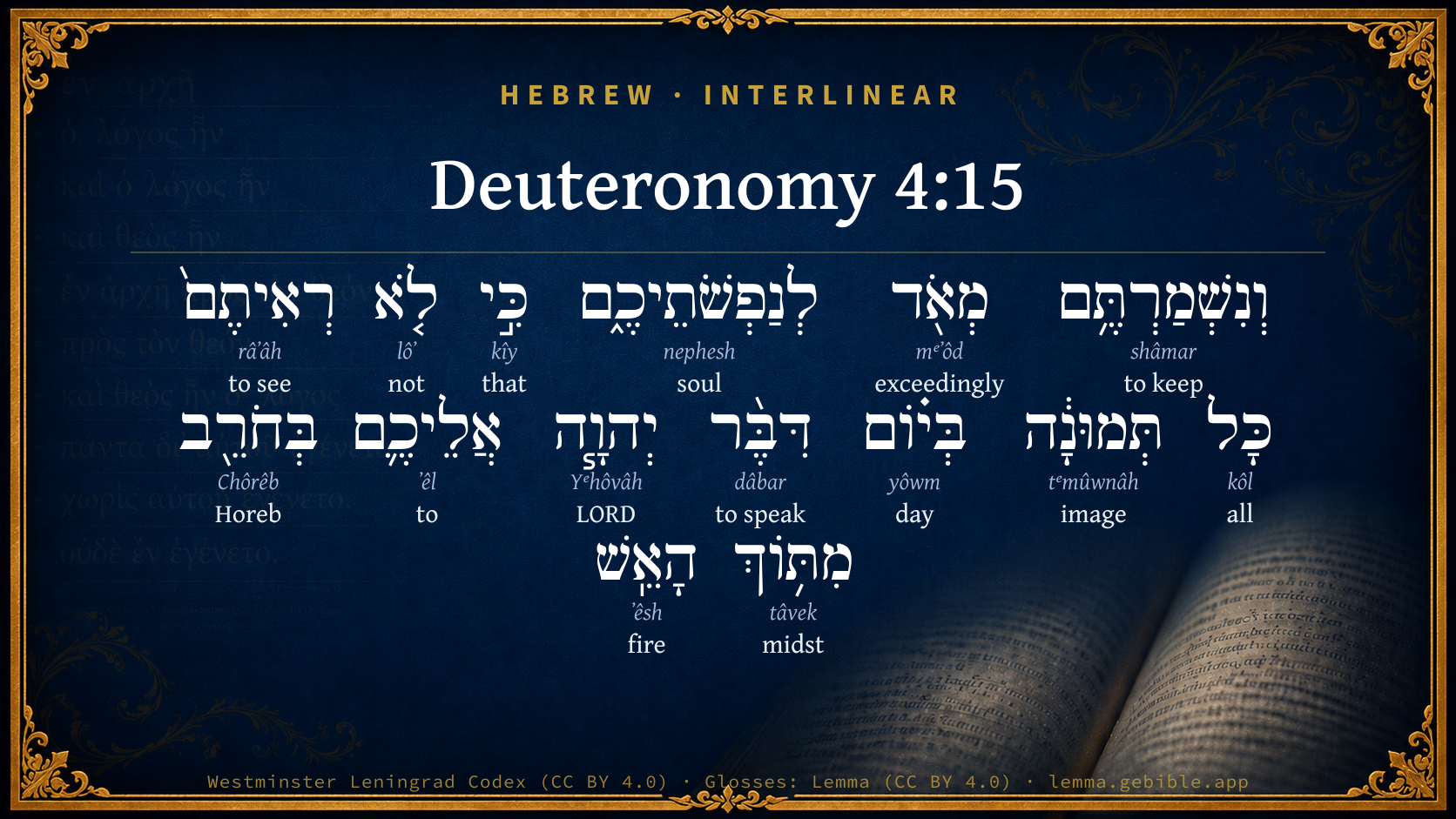
Hebrew (Westminster Leningrad Codex) Deuteronomy 4:15 appears in the Hebrew Old Testament. The text above is from the Westminster Leningrad Codex. Each word links to its Strong’s number, a concise gloss, and parsing drawn from the Open Scriptures Hebrew Bible morphology. Click any word for its full Brown-Driver-Briggs (BDB) entry.
Download image
Cite this verse

Deuteronomy 4:15 (World English Bible). Public Domain. Lemma interlinear Bible study tool, https://lemma.gebible.app/v/deuteronomy/4/15.

Show BibTeX & RIS
BibTeX
RIS
English Translation
Take therefore good heed to yourselves; for you saw no manner of form on the day that Yahweh spoke to you in Horeb out of the midst of the fire.
World English Bible · Public Domain
Download a study sheet

One document with this verse’s original text, its word-by-word gloss line, the meaning frame, cross-references with their text, attributed commentary, and full source and license credits — printable, and it pastes into notes with its structure intact.

This verse Autodidact and up

Study sheet (.html) Plain text (.txt)

A passage Seminary Student

Up to 50 verses in one chapter. A passage sheet keeps up to 6 commentary sources and 12 cross-references per verse, in the order this page ranks them, and says so on the sheet whenever that leaves anything out. Ask for a single verse and you get the Autodidact verse sheet above.

Everything on this page stays free to read, with no account — the sheet is a download of what is already on screen, not access to it.

Want to remove ads? Support Godless Engineer
Compare translations 3

The same verse in 3 English versions, stacked beneath the original-language interlinear above. Click any original word for its lexicon entry.

Each is an independent rendering of the whole verse — the interlinear is not word-aligned to these translations.

Highlighted words mark where these versions differ — a whole-verse word diff, not a word-by-word alignment.

  • World English Bible Public Domain
    Take therefore good heed to yourselves; for you saw no manner of form on the day that Yahweh spoke to you in Horeb out of the midst of the fire.
  • King James Version Public Domain
    Take ye therefore good heed unto yourselves; for ye saw no manner of similitude on the day that the LORD spake unto you in Horeb out of the midst of the fire:
  • unfoldingWord Literal Text CC BY-SA 4.0
    And strongly guard your souls, for you did not see any form on day Yahweh spoke to you at Horeb from the midst of the fire,

unfoldingWord Literal Text — © unfoldingWord, licensed CC BY-SA 4.0. Word-aligned USFM3 via Door43 (git.door43.org/unfoldingWord/en_ult).

Versions to compare (up to 4)

3 of 4 selected

Show all 18 translations

Every available English version of this verse, each an independent rendering of the whole verse.

  • World English Bible Public Domain
    Take therefore good heed to yourselves; for you saw no manner of form on the day that Yahweh spoke to you in Horeb out of the midst of the fire.
  • Berean Standard Bible Public Domain
    So since you saw no form of any kind on the day the LORD spoke to you out of the fire at Horeb, be careful
  • Majority Standard Bible Public Domain
    So since you saw no form of any kind on the day the LORD spoke to you out of the fire at Horeb, be careful
  • King James Version Public Domain
    Take ye therefore good heed unto yourselves; for ye saw no manner of similitude on the day that the LORD spake unto you in Horeb out of the midst of the fire:
  • American Standard Version (1901) Public Domain
    Take ye therefore good heed unto yourselves; for ye saw no manner of form on the day that Jehovah spake unto you in Horeb out of the midst of the fire.
  • Revised Version (1885) Public Domain
    Take ye therefore good heed unto yourselves; for ye saw no manner of form on the day that the LORD spake unto you in Horeb out of the midst of the fire:
  • Geneva Bible (1599) Public Domain
    Take therefore good heede vnto your selues: for ye sawe no image in the day that the Lord spake vnto you in Horeb out of the middes of the fire:
  • Douay-Rheims (1899) Public Domain
    Keep therefore your souls carefully. You saw not any similitude in the day that the Lord God spoke to you in Horeb from the midst of the fire:
  • Young's Literal Translation Public Domain
    and ye have been very watchful of your souls, for ye have not seen any similitude in the day of Jehovah's speaking unto you in Horeb out of the midst of the fire,
  • Literal Standard Version CC BY-SA 4.0
    And you have been very watchful of your souls, for you have not seen any likeness in the day of YHWH’s speaking to you in Horeb out of the midst of the fire,
  • Unlocked Literal Bible CC BY-SA 4.0
    So take great heed to yourselves—for you saw no kind of form on the day that Yahweh spoke to you at Horeb out of the middle of the fire—
  • unfoldingWord Literal Text CC BY-SA 4.0
    And strongly guard your souls, for you did not see any form on day Yahweh spoke to you at Horeb from the midst of the fire,
  • Darby Bible Public Domain
    And take great heed to your souls (for ye saw no form on the day that Jehovah spoke to you in Horeb from the midst of the fire),
  • World Messianic Bible Public Domain
    Be very careful, for you saw no kind of form on the day that the LORD spoke to you in Horeb out of the middle of the fire,
  • Webster's Bible Public Domain
    Take ye therefore good heed to yourselves; for ye saw no manner of similitude on the day that the LORD spoke to you in Horeb out of the midst of the fire;
  • Free Bible Version CC BY-SA 4.0
    You didn't see any form when the Lord spoke to you from the fire at Horeb, so be very careful
  • Bible in Basic English Public Domain
    So keep watch on yourselves with care; for you saw no form of any sort on the day when the voice of the Lord came to you in Horeb out of the heart of the fire:
  • JPS Tanakh (1917) Public Domain
    Take ye therefore good heed unto yourselves — for ye saw no manner of form on the day that the LORD spoke unto you in Horeb out of the midst of the fire —

Literal Standard Version (2020), Covenant Press — licensed CC BY-SA 4.0. Text via the HelloAO Bible API (eBible.org). Unlocked Literal Bible (unfoldingWord) — licensed CC BY-SA 4.0. Text via the HelloAO Bible API (eBible.org). unfoldingWord Literal Text — © unfoldingWord, licensed CC BY-SA 4.0. Word-aligned USFM3 via Door43 (git.door43.org/unfoldingWord/en_ult). Free Bible Version, Dr. Jonathan Gallagher — licensed CC BY-SA 4.0. Text via the HelloAO Bible API (eBible.org).

Word by word

More ways to search: Search by grammar → Find every occurrence → Compare this word →

Practice this passage: Drill this verse → Learn its vocabulary →

תְּמוּנָ֔ה
tᵉmûwnâh
H8544
“image”
Noun, Common, Feminine, Singular, Absolute
Part of Speech
Noun
Type
Common
Gender
Feminine
Number
Singular
State
Absolute
Full BDB Definition

Origin: from H4327

TWOT: 1191b

form, image, likeness, representation, semblance
  1. וְנִשְׁמַרְתֶּ֥ם shâmar H8104 “and · to keep” Conjunction + Verb, Niphal, Sequential Perfect, 2nd Person, Masculine, Plural
  2. מְאֹ֖ד mᵉʼôd H3966 “exceedingly” Adverb
  3. לְנַפְשֹׁתֵיכֶ֑ם nephesh H5315 “to/for · souls · your” Preposition + Noun, Common, Both, Plural, Construct + Suffix, Personal, 2nd Person, Masculine, Plural
  4. כִּ֣י kîy H3588 “that” Conjunction
  5. לֹ֤א lôʼ H3808 “not” Particle, Negative
  6. רְאִיתֶם֙ râʼâh H7200 “to see” Verb, Qal, Perfect, 2nd Person, Masculine, Plural
  7. כָּל kôl H3605 “all of” Noun, Common, Masculine, Singular, Construct
  8. בְּי֗וֹם yôwm H3117 “in/at · day of” Preposition + Noun, Common, Masculine, Singular, Construct
  9. דִּבֶּ֨ר dâbar H1696 “to speak” Verb, Piel, Perfect, 3rd Person, Masculine, Singular
  10. יְהוָ֧ה Yᵉhôvâh H3068 “LORD” Noun, Proper
  11. אֲלֵיכֶ֛ם ʼêl H413 “to · you” Preposition + Suffix, Personal, 2nd Person, Masculine, Plural
  12. בְּחֹרֵ֖ב Chôrêb H2722 “in/at · Horeb” Preposition + Noun, Proper
  13. מִתּ֥וֹךְ tâvek H8432 “from · midst of” Preposition + Noun, Common, Masculine, Singular, Construct
  14. הָאֵֽשׁ ʼêsh H784 “the · fire” Particle, Definite Article + Noun, Common, Both, Singular, Absolute

About this verse

These counts appear in no published source. They are computed here, from the morphology-tagged text and Lemma’s own curated glosses. What Lemma adds →

15
words
15
distinct lemmas
Pentateuch
section

Notable vocabulary

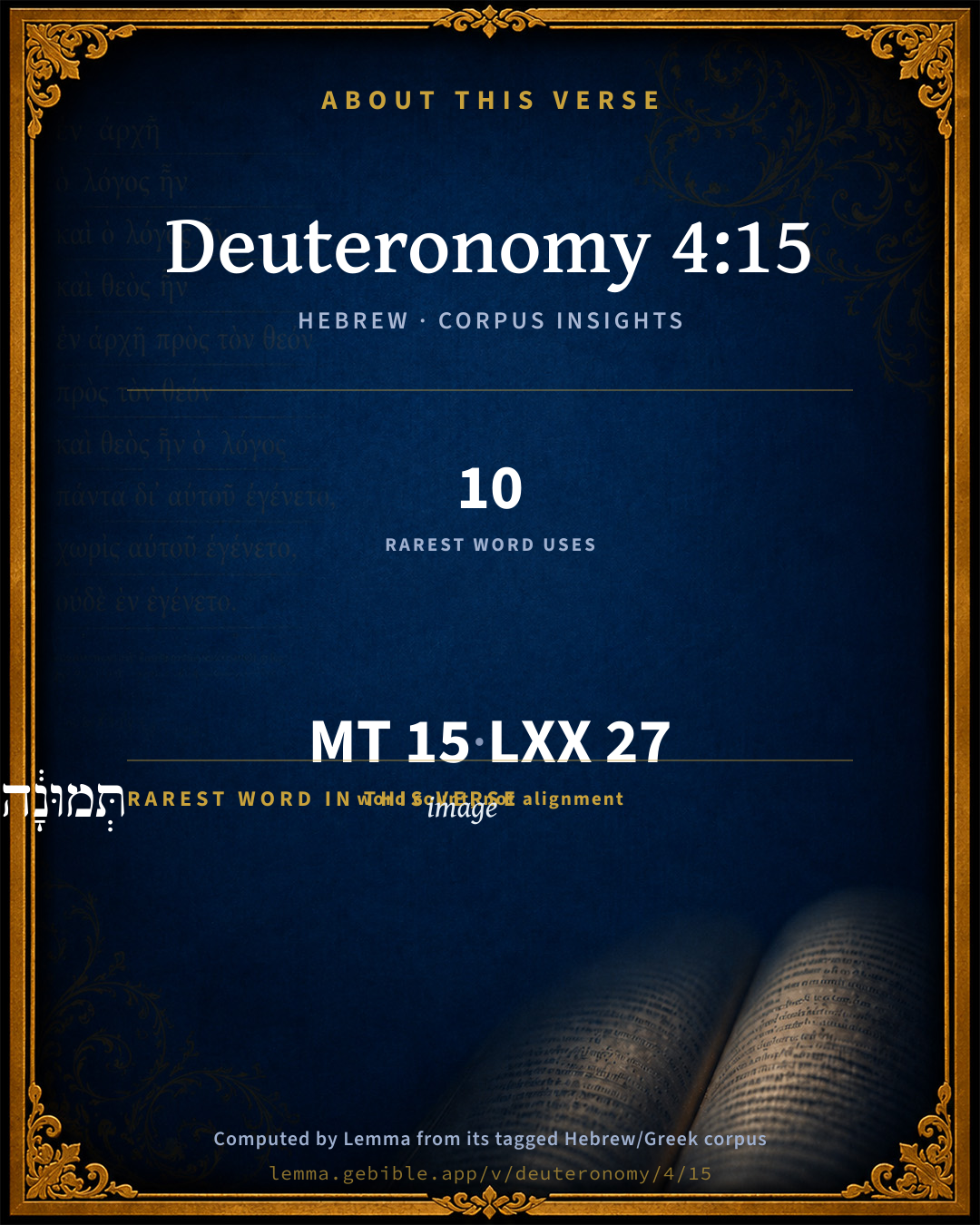
The rarest word here is תְּמוּנָ֔ה image H8544 — appearing just 10 times in the whole Hebrew Bible.

Shared distinctive vocabulary

תְּמוּנָ֔ה image H8544 occurs in 10 verses of the Hebrew Bible. Also found in:

Grammatical profile

  • 3 verbs
  • 8 nouns
  • 1 preposition
  • 1 conjunction
  • 1 adverb
  • 1 particle

Verb forms

  • וְנִשְׁמַרְתֶּ֥ם Niphal · Sequential Perfect
  • רְאִיתֶם֙ Qal · Perfect
  • דִּבֶּ֨ר Piel · Perfect

Hebrew & Septuagint length

In English translation the verse runs 30 words from the Hebrew and 34 from the Septuagint (LXX English) — closely comparable.

A rough comparison of the two English renderings, which tokenize alike — not a word-level alignment.

Word counts can differ between the Hebrew and the Greek without any difference in meaning — e.g. the Hebrew direct-object marker אֵת has no separate Greek word, and Greek often adds the article ὁ.

In the original languages it is 15 Hebrew tokens and 27 Greek tokens — but the two are counted differently (Hebrew bundles its prefixes and suffixes into one token; the Greek is in lemma form), so that isn’t a like-for-like length.

Cross-references

13

Topical passages linked to Deuteronomy 4:15 in the Treasury of Scripture Knowledge — connected by theme and wording, ordered by reader-vote popularity; previews shown in the World English Bible.

  • Deuteronomy 4:12 Yahweh spoke to you out of the midst of the fire: you heard the voice of words, but you saw no form; only [you heard] a voice.
  • Isaiah 40:18 To whom then will you liken God? or what likeness will you compare to him?
  • 2 Corinthians 4:4–6 in whom the god of this world has blinded the minds of the unbelieving, that the light of the Gospel of the glory of Christ, who is the image of God, should not dawn on them.
  • Malachi 2:15 Did he not make one, although he had the residue of the Spirit? Why one? He sought a godly seed. Therefore take heed to your spirit, and let none deal treacherously against the wife of his youth.
  • Deuteronomy 4:9 Only take heed to yourself, and keep your soul diligently, lest you forget the things which your eyes saw, and lest they depart from your heart all the days of your life; but make them known to your children and your children's children;
  • Joshua 23:11 Take good heed therefore to yourselves, that you love Yahweh your God.
  • 1 Chronicles 28:9–10 You, Solomon my son, know the God of your father, and serve him with a perfect heart and with a willing mind; for Yahweh searches all hearts, and understands all the imaginations of the thoughts: if you seek him, he will be found of you; but if you forsake him, he will cast you off forever.
  • Psalms 119:9 How can a young man keep his way pure? By living according to your word.
  • Proverbs 4:23 Keep your heart with all diligence, For out of it is the wellspring of life.
  • Proverbs 4:27 Don't turn to the right hand nor to the left. Remove your foot from evil.
  • Jeremiah 17:21 Thus says Yahweh, Take heed to yourselves, and bear no burden on the Sabbath day, nor bring it in by the gates of Jerusalem;
  • Hebrews 1:3 His Son is the radiance of his glory, the very image of his substance, and upholding all things by the word of his power, when he had by himself made purification for our sins, sat down on the right hand of the Majesty on high;
  • Deuteronomy 4:23 Take heed to yourselves, lest you forget the covenant of Yahweh your God, which he made with you, and make you an engraved image in the form of anything which Yahweh your God has forbidden you.

Cross-references courtesy of OpenBible.info (CC BY 4.0).

Hebrew and Greek witnesses Masoretic Hebrew ↔ Greek Septuagint

The same verse in the two great witnesses to the Old Testament, shown verse-for-verse.

These are two independent witnesses, not word-aligned to each other, and the Septuagint is shown in lemma (dictionary) form.

Hebrew Deuteronomy 4:15 Masoretic · Westminster Leningrad Codex

וְנִשְׁמַרְתֶּ֥ם מְאֹ֖ד לְנַפְשֹׁתֵיכֶ֑ם כִּ֣י לֹ֤א רְאִיתֶם֙ כָּל תְּמוּנָ֔ה בְּי֗וֹם דִּבֶּ֨ר יְהוָ֧ה אֲלֵיכֶ֛ם בְּחֹרֵ֖ב מִתּ֥וֹךְ הָאֵֽשׁ

Take therefore good heed to yourselves; for you saw no manner of form on the day that Yahweh spoke to you in Horeb out of the midst of the fire.

World English Bible · Public Domain

Greek LXX Deuteronomy 4:15 Septuagint · lemma form

καί φυλάσσω σφόδρα ὁ ψυχή σύ ὅτι οὐ ὁράω ὁμοίωμα ἐν ὁ ἡμέρα ὅς λαλέω κύριος πρός σύ ἐν χωρηβ ἐν ὁ ὄρος ἐκ μέσος ὁ πῦρ

And take good heed to your hearts, for you⌃ saw no similitude in the day in which the Lord spoke to you in Choreb in the mountain out of the midst of the fire:

LXX2012 (modern English Septuagint) · Public Domain

Hebrew: Westminster Leningrad Codex (CC BY 4.0). Greek: Septuagint (public domain); English from LXX2012 (modern English Septuagint) (Public Domain). How the Septuagint differs from the Hebrew →

Targum (Aramaic paraphrase)

2

The Targum is the ancient Jewish Aramaic paraphrase of the Hebrew Scriptures — an interpretive translation, not the Hebrew text itself. Onkelos (literal) and Pseudo-Jonathan (expansive) render the Torah, and Jonathan the Prophets. Coverage is partial: where no permissively-licensed English translation exists for a verse, only the Aramaic is shown. This is verse-level text, not a word-by-word alignment to the Hebrew.

  1. Targum Onkelos Torah (Genesis–Deuteronomy)
    וְתִסְתַּמְרוּן לַחֲדָא לְנַפְשָׁתֵיכוֹן אֲרֵי לָא חֲזֵיתוּן כָּל דְמוּת בְּיוֹמָא דִי מַלִיל יְיָ עִמְכוֹן בְּחֹרֵב מִגוֹ אֶשָׁתָא

    (no public-domain English translation for this verse)

    Targum Onkelos — Aramaic: “Onkelos Genesis” (public domain); “Onkelos Exodus” (public domain); “Onkelos Leviticus” (public domain); “Onkelos Numbers” (public domain); “Onkelos Deuteronomy” (public domain). English: “Sefaria Community Translation” (CC0 1.0 (public-domain dedication)); “J.W. Etheridge. The Targums of Onkelos and Jonathan Ben Uzziel on the Pentateuch. London: Longmans, Green, 1862” (public domain). Text via Sefaria.

  2. Targum Pseudo-Jonathan Torah (Genesis–Deuteronomy)
    וְתִסְתַּמְרוּן לַחֲדָא לְנַפְשָׁתֵיכוֹן אֲרוּם לָא חֲמִיתוּן כָּל דְּמוּ בְּיוֹמָא דְמַלֵּיל יְיָ עִמְכוֹן בְּחוֹרֵב מִגּוֹ אֵישָׁתָא

    Keep then your souls diligently; for you saw no likeness on the day when the Lord spake with you in Horeb from the midst of the fire.

    Targum Pseudo-Jonathan — Aramaic: “Targum Jonathan on Genesis” (public domain); “Targum Jonathan on Exodus” (public domain); “Targum Jonathan on Leviticus” (public domain); “Targum Jonathan on Numbers” (public domain); “Targum Jonathan on Deuteronomy” (public domain). English: “The Targum of Jonathan ben Uzziel, trans. J. W. Etheridge, London, 1862” (public domain). Text via Sefaria.

Commentary

Notes on Deuteronomy 4:15 from classic Christian and Jewish commentators (each source and its license shown beneath its notes). The classic Christian expositions comment on the surrounding passage and are grouped to its opening verse, so a note may address several verses; the Jewish commentaries on the Tanakh (Rashi and others) are per-verse, so they appear only where the commentator wrote on this verse.

Lemma curates 59 commentaries, every one of them public domain or Creative Commons licensed, each selected and text-cleaned for this edition rather than reprinted as found. About our sources →

Trapp's Complete Commentary

John Trapp

Deu 4:15 Take ye therefore good heed unto yourselves; for ye saw no manner of similitude on the day [that] the LORD spake unto you in Horeb out of the midst of the fire:

Ver. 15. Take ye therefore good heed.] These many cautions note our proneness to this evil above others. This appeareth somewhat in children so delighted with pictures, and in that idolomania of these Jews, of the eastern churches, and of the synagogue of Rome.

John Trapp, A Commentary or Exposition upon All the Books of the Old and New Testament (1647–1656) — public domain. Text from a community e-Sword module.

Joseph Benson's Commentary

Deu 4:15. Ye saw no similitude in Horeb — God, who, in some other places and times, did appear in a human form, now in this most solemn appearance, when he came to give eternal laws for the direction of the Israelites in the worship of himself, and in their duty to their fellow- creatures, purposely avoided all such representations, to show that he abhors all worship by images, of what kind soever, because he is the invisible God, and cannot be represented by any visible image.

Joseph Benson's Commentary on the Old and New Testaments (1811–1818) — public domain. Text from a community e-Sword module.

Whedon's Commentary on the Bible

Daniel D. Whedon

IDOLATRY SPECIALLY FORBIDDEN, Deu_4:15-24.

Idolatry in various and in most gross forms prevailed throughout the East among the nations with whom Israel would be brought in contact. Moses in these few passages comprehends the various form of idolatry prevalent.

Daniel D. Whedon (gen. ed.), Commentary on the Old and New Testaments (1874–1909) — public domain. Text from a community e-Sword module.

Tyndale Open Study Notes

Tyndale Open Resources

4:15 form: No image could capture the transcendent glory and power of the invisible God (Neh 9:20; Isa 63:10-14; Zech 4:6; John 4:24). Any form of the Lord could become an object of worship in lieu of worshiping God himself.

Tyndale Open Study Notes — © Tyndale Open Resources, licensed CC BY-SA 4.0. Text via the HelloAO Bible API.

Geneva Bible (1599)

Geneva Bible translators

Hebrew, souls.

Signifying, that destruction is prepared for all them that make any image to represent God.

Geneva Bible (1599) marginal notes — public domain. Text via Bolls.life.

Jamieson, Fausset & Brown

Robert Jamieson, A. R. Fausset & David Brown

A PARTICULAR DISSUASIVE AGAINST IDOLATRY. (Deu. 4:14-40)

Take . . . good heed . . . for ye saw no manner of similitude--The extreme proneness of the Israelites to idolatry, from their position in the midst of surrounding nations already abandoned to its seductions, accounts for their attention being repeatedly drawn to the fact that God did not appear on Sinai in any visible form; and an earnest caution, founded on that remarkable circumstance, is given to beware, not only of making representations of false gods, but also any fancied representation of the true God.

Jamieson, Fausset & Brown — Commentary Critical and Explanatory on the Whole Bible (1871) — public domain (CC PDM 1.0). Text via the HelloAO Bible API.

Adam Clarke's Commentary

Verse 15. Ye saw no manner of similitude] Howsoever God chose to appear or manifest himself, he took care never to assume any describable form. He would have no image worship, because he is a SPIRIT, and they who worship him must worship him in Spirit and in truth. These outward things tend to draw the mind out of itself, and diffuse it on sensible, if not sensual, objects; and thus spiritual worship is prevented, and the Holy Ghost grieved. Persons acting in this way can never know much of the religion of the heart.

Adam Clarke's Commentary on the Bible (1810–1826) — public domain. Text from a community e-Sword/MySword module.

Ellicott's Commentary for English Readers

(15) Ye saw no manner of similitude.—The worship of the invisible Jehovah is here specially insisted on. The difficulty of learning to worship one whom we cannot see is, happily, one which our education does not enable us to realise in its relation to Israel of old. All nations had their visible symbols of deity. Centuries afterwards the world described the followers of Christ as Atheists, because they had no visible God. It is especially recorded in praise of Moses that “he endured as seeing Him who is invisible” (Heb_11:27).

A Bible Commentary for English Readers, edited by Charles John Ellicott (1878–1897) — public domain. Text from a community e-Sword module.

The Cambridge Bible for Schools and Colleges

gen. ed. J. J. S. Perowne

15. ye saw no manner of form] Resumes and repeats the reminder in Deu_4:12 in a way that would have been unnecessary but for the digression in 13 f.; and proves that the latter is original. Form, Heb. temûnah.

The Cambridge Bible for Schools and Colleges (gen. ed. J. J. S. Perowne; Cambridge University Press, 1878–1918) — public domain. Text from a community e-Sword module.

John Gill's Exposition

Take ye therefore good heed unto yourselves,.... As to keep all the laws given them, so particularly to avoid idolatry:

for ye saw no manner of similitude on the day the Lord spake unto you in Horeb out of the midst of the fire; and therefore, as they had nothing that directed and led them, so they had nothing that could be a temptation to them, to make any form or likeness, and worship it.

John Gill's Exposition of the Whole Bible (1746–1763) — public domain (CC PDM 1.0). Text via the HelloAO Bible API.

Haydock's Catholic Bible Commentary

Carefully. Hebrew, "Be therefore particularly attentive, as much as you love your own soul." (Vatable) By keeping my commandments you can alone obtain salvation, ver. 9. (Menochius) --- Similitude of any living creature, such as were the objects of adoration among the pagans. Some represented their gods under the forms of men, women, beasts, birds, or reptiles; while others adored the sun, moon, and stars. (Haydock) --- This last was indeed the most ancient species of idolatry, Job xxi. 26. Baal, Astarte, Moloc, Chamos, &c., were different names by which they denoted the heavenly bodies. But the Egyptians carried their superstition to the greatest excess. There was hardly any sort of animal which did not obtain sovereign worship among them. (Calmet) --- Their great gods, Isis and Osiris, were sometimes depicted like a man and woman; at other times, like beasts, and frequently they appeared with parts of both. The head of Isis was generally adorned or disfigured with the horns of a bull; (Haydock) and that animal, either alive or in a picture, as well as dogs and cats, were adored throughout the country, while some places had their peculiar idols. The lion, the wolf, and the fish called latus, gave their names to the cities Leontopolis, &c., which had a particular veneration for them. Moses takes care to inform the Hebrews that the true God is like none of these things; and that they cannot pretend to represent him under any such forms, without doing him an injury. (Calmet) --- If Catholics endeavour to put the people in mind of the blessed Trinity, by representing a venerable old man, Jesus Christ in his human nature, and a dove, under which forms the Scripture has introduced the three divine persons, they do not pretend that their divine and most spiritual nature can be thus expressed. "If," says the Council of Trent, Session 25, "the historical accounts of Scripture be sometimes set forth in paintings, for the benefit of the illiterate, let the people be informed that the Divinity is not thus represented with a design to insinuate that it may be seen with the eyes of the body." So neither can the figure of a triangle, with the ineffable name of God in Hebrew, &c., explain this adorable mystery. But such things may recall to our remembrance, the innumerable benefits which we have received from the three divine persons, after we have been once informed what we have to believe respecting them. This is the laudable motive which has induced the Church to encourage the keeping of such pictures, as well as those of the saints, with due respect. "Not as if we believed that any divinity or virtue resided in them for which they were to be worshipped, or that we should ask any thing of them, or place our confidence in images, as the Gentiles formerly did, who hoped in their idols, (Psalm cxxxiv.,) but because the honour given to them is referred to the originals, which they represent," &c. (Council of Trent, Session 25.) (Haydock)

George Leo Haydock (1774–1849), Haydock's Catholic Family Bible and Commentary, 1859 edition — public domain. Excludes Psalms (Douay-Rheims chapter numbering differs from Protestant) and Deuterocanonical books (Catholic canon only).

Matthew Poole's English Annotations

By which caution he insinuates man’s great proneness to the worship of images.

God, who in other places and times did appear in a similitude, in the fashion of a man, now in this most solemn appearance, when he comes to give eternal laws for the regulation and direction of the Israelites in the worship of God, and in their duty to men, he purposely avoids all such representations, to show that he abhors all worship of images, or of himself by images of what kind soever, as it here follows, Deu 4:16-19, because he is the invisible God, and cannot be represented by any visible image. See Isa 40:18; Act 17:29.

Matthew Poole's English Annotations on the Holy Bible (1683–1685) — public domain. Text from a community e-Sword/MySword module.

The Pulpit Commentary

Vers. 15-20. As the people had seen no form or figure when God spake to them, so they were to beware for their very lives (cf. ver. 9) of acting corruptly by making any kind of image, whether of man or of beast, for the purpose of worshipping God as represented by it; they were also to beware of being so attracted by the splendor of the heavenly bodies as to be forcibly seduced to worship them and offer them religious service. They were not in this respect to imitate the heathen; for God, who had delivered them out of the furnace of Egyptian bondage, had taken them for himself to be his special possession; and therefore they were to take heed not to forget the covenant of Jehovah their God, nor to offend him by making any image or representation of him as the object of worship. Among the heathen, and especially in Egypt, images were the very pillar and support of religion; but in Israel, as God had revealed himself to them without form, it was as a spirit he was to be worshipped, and not under any outward representation.

Vers. 15-20. Warning against heathenish idolatry.

I THE ORIGIN OF HEATHEN IDOLATRY. The result of a "corruption" (Per. 16). Not a stage in the advance upwards from fetishism, etc.; but, as inquiries are tending more and more to show, the consequence:

1. Of a depravation of the idea of God.

2. Of a corruption of the worship of God.

3. Arising in turn from the substitution of the creature for God in the affections (cf. Rom_1:20-26)

II THE FORMS OF HEATHEN IDOLATRY.

1. Hero-worship (ver. 16).

2. Animal-worship (vers. 17, 18).

3. Nature-worship (ver. 19).

Greek idolatry furnishes conspicuous instances of the first; Egypt was notorious for the second, so Hinduism; while Parseeism, and the early Vedic worship illustrates the third (cf. Job_31:21)

III THE FRUITS OF HEATHEN IDOLATRY.

1. A degraded intellect.

2. Degraded affections.

3. Degraded morals. (Ro 1)

Therefore Israel must not "corrupt" themselves. J.O.

Vers. 15-24. The Divine jealousy of graven images.

The great temptation of Israel was to idolatry. Images were worshipped by all those nations among whom they came, and they were in constant danger of conforming to the sinful practice. Hence this warning and statement about the Divine jealousy. Let us observe

I THAT JEALOUSY PRESUPPOSES LOVE. Love must be strong as death, else jealousy will not be cruel as the grave; nor will its coals prove coals of fire, having a most vehement flame. (Son_8:6) The God who proves so jealous is he whose essence is love. If God did not love men so much, he would not be so jealous when they turn away from him. He knows that, as a wife cannot be happy separated from her loving husband, no more can the human spirit be, away from him. Israel then and we now have to deal with a God of love.

II GOD IS JEALOUS WHEN MEN GIVE HIM VISIBILITY. Idolatry is trying to help worship through the aid of the senses. The image is not regarded as the god, but his likeness. Man embodies his ideas of God in outward forms. But imagination is not creative; it combines in new relations what has already been given to it. Hence idolatry has never done more than place the creatures, whether beast, or bird, or fish, or reptile, or the heavenly bodies, in new relations to the invisible Divinity. God resents this visibility as degradation. He knows that man becomes degraded by such associations. Hence his deserved wrath against idolatry.

III IF GOD BE NOT OUR KINDLING FLAME, HE WILL IN JEALOUSY BE OUR CONSUMING FIRE. It is at the torch of the Divine that the human soul becomes enkindled. The flaming fires of Pentecost sublimate the soul and fit it for primeval powers. It is this warning, elevating influence that is love"s natural action. But when rebellious man turns the grace of God into lasciviousness; when love is ignored instead of returned, and the soul seeks in the things of sense what God only cad give, then love begins to burn as jealousy with a vehement, consuming flame.

IV IT BECOMES US CONSEQUENTLY TO WORSHIP GOD IN THE SPIRIT. We must keep upon the serene heights of faith, and not fall into the degradation of superstition. We are made for better things than weakly to associate in our minds the invisible and eternal God with the creatures of sense. Let us give faith proper scope, and the worship of God will prove both possible and delightful. But the worship of God through images makes stocks and stones of men. "They that make them are like unto them; so is every one that trusteth in them". (Psa_115:8) May our worship raise us and not degrade us! Superstition degrades, but worship of the invisible God in the Spirit elevates and ennobles our souls. R.M.E.

The Pulpit Commentary (1880–1919), ed. H.D.M. Spence-Jones & Joseph S. Exell — public domain. Text from a community e-Sword module.

John Wesley's Explanatory Notes

In Horeb - God, who in other places and times did appear in a similitude in the fashion of a man, now in this most solemn appearance, when he comes to give eternal laws for the direction of the Israelites in the worship of God, and in their duty to men, purposely avoids all such representations, to shew that he abhors all worship of images, or of himself by images of what kind soever, because he is the invisible God, and cannot be represented by any visible image.

John Wesley, Explanatory Notes Upon the Whole Bible (1754–1765) — public domain. Text via the GEBible commentary corpus.

Keil & Delitzsch

C. F. Keil & F. Delitzsch

As the Israelites had seen no shape of God at Horeb, they were to beware for their souls' sake (for their lives) of acting corruptly, and making to themselves any kind of image of Jehovah their God, namely, as the context shows, to worship God in it. (On pesel, see at Exo 20:4.) The words which follow, viz., "a form of any kind of sculpture," and "a representation of male or female" (for tabnith, see at Exo 25:9), are in apposition to "graven image," and serve to explain and emphasize the prohibition.

Keil & Delitzsch — Biblical Commentary on the Old Testament (1861–1891) — public domain (CC PDM 1.0). Text via the HelloAO Bible API. (Old Testament only.)

Scofield Reference Notes

C. I. Scofield

saw no manner

Cf. (See Scofield "Joh 1:18").

The Scofield Reference Bible (1917 edition), notes by C. I. Scofield — public domain. Text from a community e-Sword module.

unfoldingWord translationNotes

Door43 World Missions Community

General Information:

Moses continues speaking to the people of Israel.

So take great heed to yourselves

Possible meanings are 1) "So you need to be very careful how you act" or 2) "Guard your souls carefully."

do not corrupt yourselves

"do not do what is wrong"

creeps on the ground

"crawls on the ground"

translationWords

Yahweh

Horeb

corrupt

image

like

creature

beast

heaven

unfoldingWord translationNotes — © Distant Shores Media and the Door43 World Missions Community, licensed CC BY-SA 4.0. Source: git.door43.org/Door43/en_tn.

Ramban (Nachmanides)

Rabbi Moshe ben Nachman (Ramban / Nachmanides)

TAKE YE THEREFORE GOOD HEED UNTO YOURSELVES. He warns them lest they mistakenly follow the voice they heard and they commit the corruption of “mutilating the shoots.” He states first the likeness of male or female, [lest they corrupt themselves by making a graven image in the likeness of male or female] of the Being from Whom the voice came. Afterwards he mentioned all that is on the earth of beast and of fowl, of those that creep on the ground, and of the fish that are in the water, and then he reverts to the host of heaven. Now I have already explained the expression, which the Eternal thy G-d hath allotted unto all peoples, for every nation has a star and constellation, and, above them the angels of the Supreme One, like those mentioned in the Book of Daniel, the prince of the kingdom of Persia, and the prince of the kingdom of Greece, Verse 20. — this being the reason why they [the nations] make of them gods for themselves and worship them. Scripture continues, And you the Eternal hath taken, for you are the portion of the Eternal. You are thus not to appoint a prince or helper over yourselves except for Him, for it is He Who brought you forth out of the iron furnace when you were in Egypt in the midst of a furnace of fire and wood [i.e., a furnace of affliction] and He took you out from there in spite of their princes against whom He executed judgments. Had He not brought about their downfall you would not have gone out, for they were [so much] in their ascendancy that you would not be able to leave. Thus He has done all this in order that you be “an inheritance” to Him. and be to His Great Name a treasure from among all peoples.

Ramban (Nachmanides) on the Tanakh — English translation: “Commentary on the Torah by Ramban (Nachmanides). Translated and annotated by Charles B. Chavel. New York, Shilo Pub. House, 1971-1976” (CC BY 4.0). Text via Sefaria.

Lesson kit

Teaching starters — assembled from the data on this page, not authored interpretation. Every prompt links to the verse data it draws on. Edit before teaching.

Deuteronomy, in the Pentateuch, opens this verse with 15 words (15 distinct Hebrew lemmas). Its most distinctive word is tᵉmûwnâh (“image”). A historical commentator’s framing appears above. Read the whole chapter for the surrounding context.

Discussion questions

  1. How does “image” (tᵉmûwnâh) shape what this verse is saying?
  2. How does Exodus 20:4, which shares the word «image», read alongside this verse?
  3. The translations on this page render this verse differently — a whole-verse word diff, not a word-by-word alignment. What might account for the different wordings?
  4. «וְנִשְׁמַרְתֶּ֥ם» is a Niphal Sequential Perfect verb. How does that grammatical form shape the action described?
  5. Compare how Trapp's Complete Commentary and Joseph Benson's Commentary read this verse. Where do they agree or differ?

Things to notice

Reading settings

Reading text

Shown beneath each verse's original-language words.

Old Testament
Old Testament edition

Read the OT as the Masoretic Hebrew (MT) or the Greek Septuagint (LXX).

English shown for the Greek Septuagint (in the Hebrew ↔ Greek comparison).

Comparing translations? Open the Compare panel on any verse page to stack up to four side by side.