2 Samuel 24:5

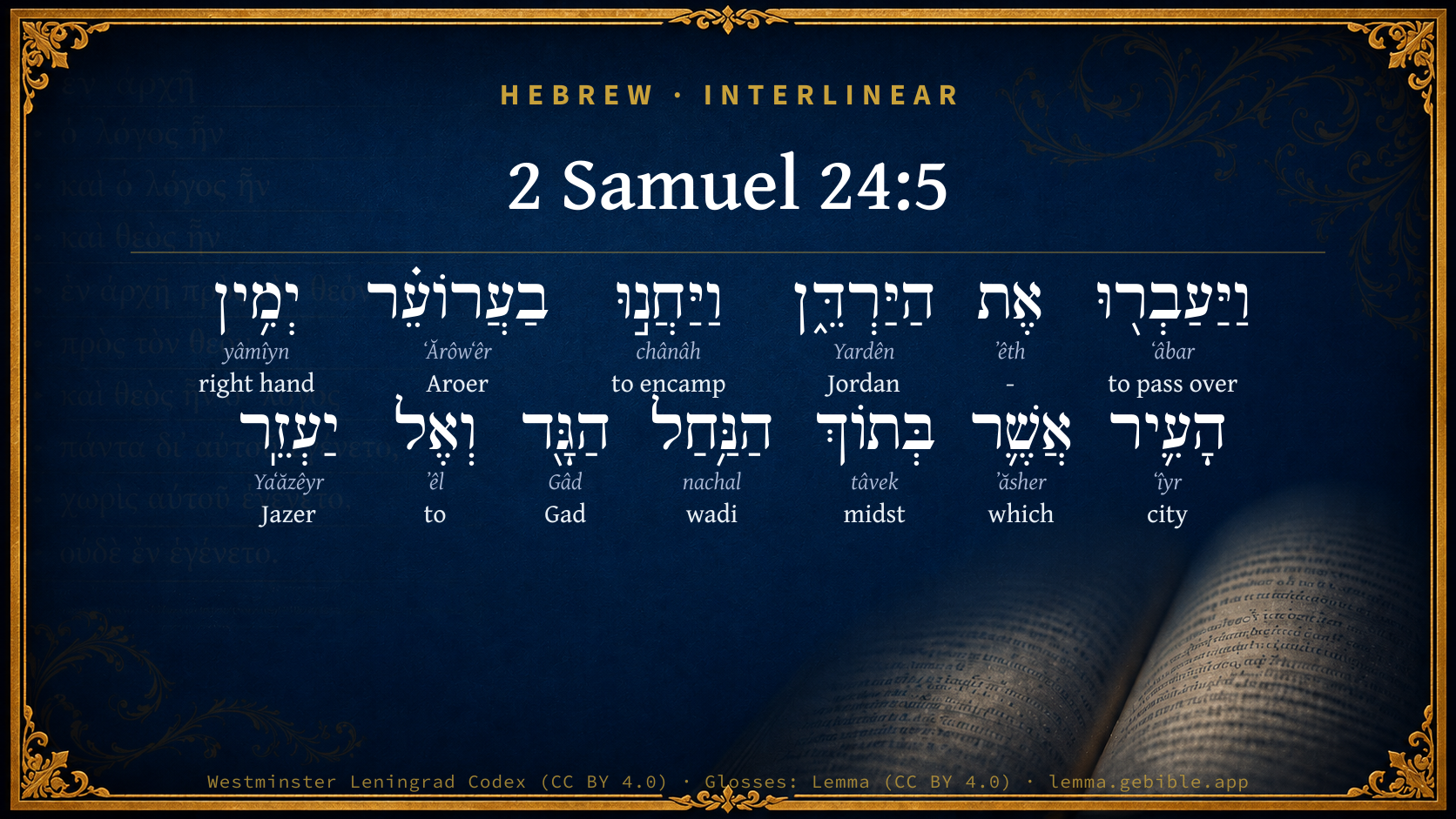
Hebrew (Westminster Leningrad Codex) 2 Samuel 24:5 appears in the Hebrew Old Testament. The text above is from the Westminster Leningrad Codex. Each word links to its Strong’s number, a concise gloss, and parsing drawn from the Open Scriptures Hebrew Bible morphology. Click any word for its full Brown-Driver-Briggs (BDB) entry.
Download image
Cite this verse

2 Samuel 24:5 (World English Bible). Public Domain. Lemma interlinear Bible study tool, https://lemma.gebible.app/v/2-samuel/24/5.

Show BibTeX & RIS
BibTeX
RIS
English Translation
They passed over the Jordan, and encamped in Aroer, on the right side of the city that is in the middle of the valley of Gad, and to Jazer:
World English Bible · Public Domain
Download a study sheet

One document with this verse’s original text, its word-by-word gloss line, the meaning frame, cross-references with their text, attributed commentary, and full source and license credits — printable, and it pastes into notes with its structure intact.

This verse Autodidact and up

Study sheet (.html) Plain text (.txt)

A passage Seminary Student

Up to 50 verses in one chapter. A passage sheet keeps up to 6 commentary sources and 12 cross-references per verse, in the order this page ranks them, and says so on the sheet whenever that leaves anything out. Ask for a single verse and you get the Autodidact verse sheet above.

Everything on this page stays free to read, with no account — the sheet is a download of what is already on screen, not access to it.

Want to remove ads? Support Godless Engineer
Compare translations 3

The same verse in 3 English versions, stacked beneath the original-language interlinear above. Click any original word for its lexicon entry.

Each is an independent rendering of the whole verse — the interlinear is not word-aligned to these translations.

Highlighted words mark where these versions differ — a whole-verse word diff, not a word-by-word alignment.

  • World English Bible Public Domain
    They passed over the Jordan, and encamped in Aroer, on the right side of the city that is in the middle of the valley of Gad, and to Jazer:
  • King James Version Public Domain
    And they passed over Jordan, and pitched in Aroer, on the right side of the city that lieth in the midst of the river of Gad, and toward Jazer:
  • unfoldingWord Literal Text CC BY-SA 4.0
    And they crossed the Jordan, and they camped at Aroer, south of the city that in the midst of the wadi, Gad and to Jazer.

unfoldingWord Literal Text — © unfoldingWord, licensed CC BY-SA 4.0. Word-aligned USFM3 via Door43 (git.door43.org/unfoldingWord/en_ult).

Versions to compare (up to 4)

3 of 4 selected

Show all 18 translations

Every available English version of this verse, each an independent rendering of the whole verse.

  • World English Bible Public Domain
    They passed over the Jordan, and encamped in Aroer, on the right side of the city that is in the middle of the valley of Gad, and to Jazer:
  • Berean Standard Bible Public Domain
    They crossed the Jordan and camped near Aroer, south of the town in the middle of the valley, and proceeded toward Gad and Jazer.
  • Majority Standard Bible Public Domain
    They crossed the Jordan and camped near Aroer, south of the town in the middle of the valley, and proceeded toward Gad and Jazer.
  • King James Version Public Domain
    And they passed over Jordan, and pitched in Aroer, on the right side of the city that lieth in the midst of the river of Gad, and toward Jazer:
  • American Standard Version (1901) Public Domain
    And they passed over the Jordan, and encamped in Aroer, on the right side of the city that is in the middle of the valley of Gad, and unto Jazer:
  • Revised Version (1885) Public Domain
    And they passed over Jordan, and pitched in Aroer, on the right side of the city that is in the middle of the valley of Gad, and unto Jazer.
  • Geneva Bible (1599) Public Domain
    And they passed ouer Iorden, and pitched in Aroer at the right side of the citie that is in the middes of the valley of Gad and toward Iazer.
  • Douay-Rheims (1899) Public Domain
    And when they had passed the Jordan, they came to Aroer to the right side of the city, which is in the vale of Gad.
  • Young's Literal Translation Public Domain
    and they pass over the Jordan, and encamp in Aroer, on the right of the city that `is' in the midst of the brook of Gad, and unto Jazer,
  • Literal Standard Version CC BY-SA 4.0
    and they pass over the Jordan, and encamp in Aroer, on the right of the city that [is] in the midst of the Brook of Gad, and to Jazer,
  • Unlocked Literal Bible CC BY-SA 4.0
    They crossed over the Jordan and encamped near Aroer, south of the city in the valley. Then they traveled on through Gad to Jazer.
  • unfoldingWord Literal Text CC BY-SA 4.0
    And they crossed the Jordan, and they camped at Aroer, south of the city that in the midst of the wadi, Gad and to Jazer.
  • Darby Bible Public Domain
    And they passed over the Jordan, and encamped in Aroer, on the right side of the city that is in the midst of the ravine of Gad, and toward Jaazer.
  • World Messianic Bible Public Domain
    They passed over the Jordan and encamped in Aroer, on the right side of the city that is in the middle of the valley of Gad, and to Jazer;
  • Webster's Bible Public Domain
    And they passed over Jordan, and pitched in Aroer, on the right side of the city that lieth in the midst of the river of Gad, and towards Jazer:
  • Free Bible Version CC BY-SA 4.0
    They crossed the Jordan and camped on the south side of the town of Aroer, in the middle of the valley, and then continued towards Gad and Jazer.
  • Bible in Basic English Public Domain
    And they went over Jordan, and starting from Aroer, from the town which is in the middle of the valley, they went in the direction of the Gadites, and on to Jazer;
  • JPS Tanakh (1917) Public Domain
    And they passed over the Jordan, and pitched in Aroer, on the right side of the city that is in the middle of the valley of Gad, and unto Jazer;

Literal Standard Version (2020), Covenant Press — licensed CC BY-SA 4.0. Text via the HelloAO Bible API (eBible.org). Unlocked Literal Bible (unfoldingWord) — licensed CC BY-SA 4.0. Text via the HelloAO Bible API (eBible.org). unfoldingWord Literal Text — © unfoldingWord, licensed CC BY-SA 4.0. Word-aligned USFM3 via Door43 (git.door43.org/unfoldingWord/en_ult). Free Bible Version, Dr. Jonathan Gallagher — licensed CC BY-SA 4.0. Text via the HelloAO Bible API (eBible.org).

Word by word

More ways to search: Search by grammar → Find every occurrence → Compare this word →

Practice this passage: Drill this verse → Learn its vocabulary →

יַעְזֵֽר
Yaʻăzêyr
H3270
“Jazer”
Noun, Proper
Part of Speech
Noun
Type
Proper
Full BDB Definition

Origin: from H5826

TWOT: None

Jazer or Jaazer = "helped" - a Levitical city east of the Jordan, in Gilead in the territory of Gad, formerly an Amorite city; site uncertain
  1. וַיַּעַבְר֖וּ ʻâbar H5674 “and · to pass over” Conjunction + Verb, Qal, Sequential Imperfect, 3rd Person, Masculine, Plural
  2. אֶת ʼêth H853 “-” Particle, Direct Object
  3. הַיַּרְדֵּ֑ן Yardên H3383 “the · Jordan” Particle, Definite Article + Noun, Proper
  4. וַיַּחֲנ֣וּ chânâh H2583 “and · to encamp” Conjunction + Verb, Qal, Sequential Imperfect, 3rd Person, Masculine, Plural
  5. בַעֲרוֹעֵ֗ר ʻĂrôwʻêr H6177 “in/at · Aroer” Preposition + Noun, Proper
  6. יְמִ֥ין yâmîyn H3225 “right hand of” Noun, Common, Feminine, Singular, Construct
  7. הָעִ֛יר ʻîyr H5892 “the · city” Particle, Definite Article + Noun, Common, Feminine, Singular, Absolute
  8. אֲשֶׁ֛ר ʼăsher H834 “which” Particle, Relative
  9. בְּתוֹךְ tâvek H8432 “in/at · midst of” Preposition + Noun, Common, Masculine, Singular, Construct
  10. הַנַּ֥חַל nachal H5158 “the · wadi” Particle, Definite Article + Noun, Common, Masculine, Singular, Absolute
  11. הַגָּ֖ד Gâd H1410 “the · Gad” Particle, Definite Article + Noun, Proper
  12. וְאֶל ʼêl H413 “and · to” Conjunction + Preposition

About this verse

These counts appear in no published source. They are computed here, from the morphology-tagged text and Lemma’s own curated glosses. What Lemma adds →

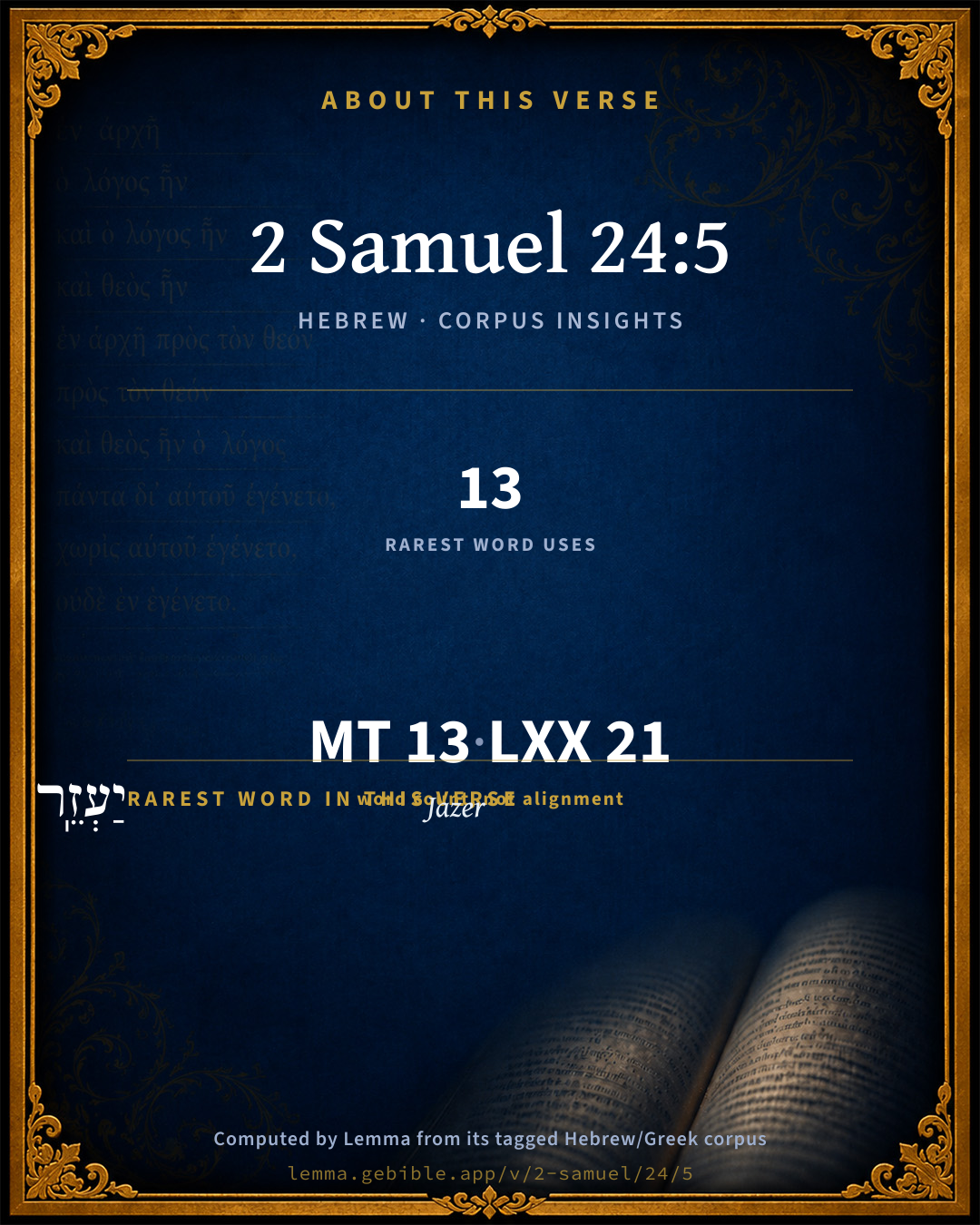
13
words
13
distinct lemmas
Historical
section

Notable vocabulary

The rarest word here is יַעְזֵֽר Jazer H3270 — appearing just 13 times in the whole Hebrew Bible.

Shared distinctive vocabulary

יַעְזֵֽר Jazer H3270 occurs in 12 verses of the Hebrew Bible. Also found in:

Grammatical profile

  • 2 verbs
  • 8 nouns
  • 1 preposition
  • 2 particles

Verb forms

  • וַיַּעַבְר֖וּ Qal · Sequential Imperfect
  • וַיַּחֲנ֣וּ Qal · Sequential Imperfect

Hebrew & Septuagint length

In English translation the verse runs 29 words from the Hebrew and 27 from the Septuagint (LXX English) — closely comparable.

A rough comparison of the two English renderings, which tokenize alike — not a word-level alignment.

Word counts can differ between the Hebrew and the Greek without any difference in meaning — e.g. the Hebrew direct-object marker אֵת has no separate Greek word, and Greek often adds the article ὁ.

In the original languages it is 13 Hebrew tokens and 21 Greek tokens — but the two are counted differently (Hebrew bundles its prefixes and suffixes into one token; the Greek is in lemma form), so that isn’t a like-for-like length.

Cross-references

10

Topical passages linked to 2 Samuel 24:5 in the Treasury of Scripture Knowledge — connected by theme and wording, ordered by reader-vote popularity; previews shown in the World English Bible.

  • Deuteronomy 2:36 From Aroer, which is on the edge of the valley of the Arnon, and [from] the city that is in the valley, even to Gilead, there was not a city too high for us; Yahweh our God delivered up all before us:
  • Joshua 13:9 from Aroer, that is on the edge of the valley of the Arnon, and the city that is in the middle of the valley, and all the plain of Medeba to Dibon;
  • Joshua 13:16 Their border was from Aroer, that is on the edge of the valley of the Arnon, and the city that is in the middle of the valley, and all the plain by Medeba;
  • Numbers 21:32 Moses sent to spy out Jazer; and they took the towns of it, and drove out the Amorites who were there.
  • Numbers 32:1 Now the children of Reuben and the children of Gad had a very great multitude of cattle: and when they saw the land of Jazer, and the land of Gilead, that behold, the place was a place for cattle;
  • Numbers 32:3 Ataroth, and Dibon, and Jazer, and Nimrah, and Heshbon, and Elealeh, and Sebam, and Nebo, and Beon,
  • Numbers 32:35 and Atrothshophan, and Jazer, and Jogbehah,
  • 1 Samuel 30:28 and to those who were in Aroer, and to those who were in Siphmoth, and to those who were in Eshtemoa,
  • Isaiah 16:8–9 For the fields of Heshbon languish, [and] the vine of Sibmah; the lords of the nations have broken down the choice branches of it, which reached even to Jazer, which wandered into the wilderness; its shoots were spread abroad, they passed over the sea.
  • Isaiah 17:2 The cities of Aroer are forsaken; they shall be for flocks, which shall lie down, and none shall make them afraid.

Cross-references courtesy of OpenBible.info (CC BY 4.0).

Hebrew and Greek witnesses Masoretic Hebrew ↔ Greek Septuagint

The same verse in the two great witnesses to the Old Testament, shown verse-for-verse.

These are two independent witnesses, not word-aligned to each other, and the Septuagint is shown in lemma (dictionary) form.

Hebrew 2 Samuel 24:5 Masoretic · Westminster Leningrad Codex

וַיַּעַבְר֖וּ אֶת הַיַּרְדֵּ֑ן וַיַּחֲנ֣וּ בַעֲרוֹעֵ֗ר יְמִ֥ין הָעִ֛יר אֲשֶׁ֛ר בְּתוֹךְ הַנַּ֥חַל הַגָּ֖ד וְאֶל יַעְזֵֽר

They passed over the Jordan, and encamped in Aroer, on the right side of the city that is in the middle of the valley of Gad, and to Jazer:

World English Bible · Public Domain

Greek LXX 2 Samuel 24:5 Septuagint · lemma form

καί διαβαίνω ὁ ἰορδάνης καί παρα ἐνβάλλω ἐν αροηρ ἐκ δεξιός ὁ πόλις ὁ ἐν μέσος ὁ φάραγξ γαδ καί ελιεζερ

And they went over Jordan, and encamped in Aroer, on the right of the city which is in the midst of the valley of Gad and Eliezer.

LXX2012 (modern English Septuagint) · Public Domain

Hebrew: Westminster Leningrad Codex (CC BY 4.0). Greek: Septuagint (public domain); English from LXX2012 (modern English Septuagint) (Public Domain). How the Septuagint differs from the Hebrew →

Targum (Aramaic paraphrase)

1

The Targum is the ancient Jewish Aramaic paraphrase of the Hebrew Scriptures — an interpretive translation, not the Hebrew text itself. Onkelos (literal) and Pseudo-Jonathan (expansive) render the Torah, and Jonathan the Prophets. Coverage is partial: where no permissively-licensed English translation exists for a verse, only the Aramaic is shown. This is verse-level text, not a word-by-word alignment to the Hebrew.

  1. Targum Jonathan Prophets (Joshua–Malachi)
    וַעֲבַרוּ יַת יַרְדְנָא וּשְׁרוֹ בַעֲרוֹעֵר דָרוֹם קַרְתָּא דִבְגוֹ נַחְלָא דְשִׁבְטָא גָד וְאֶל יַעְזֵר:

    (no public-domain English translation for this verse)

    Targum Jonathan — Aramaic: “Mikraot Gedolot” (public domain). English: “Sefaria Community Translation” (CC0 1.0 (public-domain dedication)); “London "Chaldee Paraphrase," 1871” (public domain). Text via Sefaria.

Commentary

Notes on 2 Samuel 24:5 from classic Christian and Jewish commentators (each source and its license shown beneath its notes). The classic Christian expositions comment on the surrounding passage and are grouped to its opening verse, so a note may address several verses; the Jewish commentaries on the Tanakh (Rashi and others) are per-verse, so they appear only where the commentator wrote on this verse.

Lemma curates 59 commentaries, every one of them public domain or Creative Commons licensed, each selected and text-cleaned for this edition rather than reprinted as found. About our sources →

Trapp's Complete Commentary

John Trapp

2Sa 24:5 And they passed over Jordan, and pitched in Aroer, on the right side of the city that [lieth] in the midst of the river of Gad, and toward Jazer:

Ver. 5. And pitched in Aroer.] A city of the Gadites. {Num 32:34} Here they pitched with their bands and troops, probably to overawe the people, who might be ill-willing and discontented at such an unnecessary trouble and charge, especially if poll-money were now required of them; which kind of taxation being here in England first granted to Edward III, became a precedent for the next reign; and caused therein the first and greatest popular insurrection that ever was seen in this kingdom. {a}

{a} Dan., Hist. of Eng.

John Trapp, A Commentary or Exposition upon All the Books of the Old and New Testament (1647–1656) — public domain. Text from a community e-Sword module.

Joseph Benson's Commentary

2Sa 24:5-7. They passed over Jordan — They went first into the eastern part of the country, and so by the northern coasts to the west, and then to the south. And pitched in Aroer — These words seem to import, that they pitched their tents in the field, and thither summoned the neighbouring towns to come unto them: which was very troublesome, and at last proved intolerably grievous. And to the land of Tahtim-hodshi — It is in vain to seek after this land, which is not mentioned in the book of Joshua, but, it is likely, was near to Gilead; and had been lately recovered, some think, from other people, and was now inhabited by the Israelites. And they came to — about Zidon — Not to the city of Zidon, for that was not in their power; but to the coast about it. And came to the strong hold of Tyre — To the territory near it. And to all the cities of the Hivites, &c. — Who lived in those north-west parts of the country. Even to Beer-sheba — On the south side.

Joseph Benson's Commentary on the Old and New Testaments (1811–1818) — public domain. Text from a community e-Sword module.

The Pulpit Commentary

Aroer. There is some uncertainty as to the Aroer here meant. There is first a city of that name in the tribe of Gad facing Rabbah, (Jos_13:25) and this is apparently the city meant; for it is said that "Joab and his men pitched in Aroer, on the south side of the city situated in the middle of the valley of Gad, and unto Jazer." Now, Jazer is also in Gad, about seven miles west of Rabbah, and as Rabbah is on the extreme east of the Israelite territory towards Ammon, it would be a very convenient spot from which to commence the numbering, But there is another Aroer on the Arnon, to the south of Reuben, and many commentators think that this Aroer must be meant, as otherwise the tribe of Reuben would seem to have been omitted. But this Aroer is regularly called "Aroer on the brink of the valley of Arnon" (Deu_2:36 Deu_4:48; Jos_12:2 Jos_13:9, Jos_13:16) or simply Aroer "in the valley of Arnon" (Deu_3:12; 2Ki_10:33) and cannot possibly be "the city in the midst of the valley of Gad," nor can this Aroer be "toward Jazer." Really the difficulty is made by commentators whose idea of the method of the census is superficial. Joab, in commencing it, formed an encampment in the open country on the right-hand side, that is, on the south of Aroer in the tribe of Gad, as being central, with Reuben on the south, and Manasseh on the north. It was "toward Jazer," that is, it was on the Jazer side of Aroer, and not on the side opposite Rabbah. We, with our simpler way of describing the points of the compass, would merely say that Joab"s camp was in the open pasture land southwest of Aroer. Joab probably selected this spot because, though on the eastern border, it was yet not too far from Jerusalem, was central, and because a brook from Jazer flowing eastward for some distance, and thence to the north past Rabbah, would supply his people with water; and from this camp he would direct the proceedings of those who were to take the census. And as probably there would be considerable opposition for the people would see in an act which for four centuries had been in desuetude threats of heavier taxation, of heavier forced labour, and of longer service with the army Joab would require the presence of a body of troops sufficiently powerful to overawe malcontents. And these would be of no use at Aroer on the Arnon, in the distant south, but must lie eneamped in some central position, whence detachments could rapidly be moved to any place where there was danger of resistance.

Vers. 5-10 (THE ROYAL BED CHAMBER.) (1Ch_21:5-8)

An, awakened conscience.

The taking of the census occupied over nine months; and during this time David remained insensible to his sin, and waited for the result. At length the work was finished (about wheat harvest), and the number given to the king; but, whilst he looked at the definite proof of the nation"s increase, and at first, perhaps, felt elated at the thought of commanding an army of mere than a million soldiers (with something of the spirit of another monarch, Dan_4:30), the same night" David"s heart smote him; and he said unto Jehovah, I have sinned," etc.; "and David arose in the morning," etc. (ver. 11). What the remonstrance of Joab failed to effect was wrought by the operation of his own conscience. "It was well for him that his own ways reproved him, and that conscience sounded the first trumpet of alarm. This is characteristic of the regenerate. Men who have no light of grace, no tenderness of conscience, must have their sin recalled to them by the circumstances which at once reveal its enormity and visit it with punishment; but the regenerate have an inward monitor that waits not for these consequences to rouse its energy, but lights up the candle of the Lord within them, and will not let them rest after they have done amiss till they have felt compunction and made confession" (J. Leifchild). Conscience is of a threefold nature a law, a judgment, a sentiment. (1Sa_22:20-22) Observe, with respect to it

I THE CAUSES OF ITS CONTINUING LONG ASLEEP. These are summed up in "the deceitfulness of sin". (2Sa_12:5, 2Sa_12:6) More especially:

1. The persistency of the influence under which sin is at first indulged; viz.the pleasing illusion (arising from partial views, strong passions, and self-will) that it is different from what it really is, and the agent better than he really is; which (even when the true standard of right is recognized) perverts the.moral judgment and deadens the moral emotion. "A concrete fact is presented in a partial aspect; conscience pronounces its judgment according to the representation made to it; this representation, or rather misrepresentation, is made, directly or indirectly by the influence of the rebellious will, the true seat of all moral evil" (McCosh). Hence evil is often deemed good, and self-glory the glory of God.

2. The assumption (arising from self-confidence) that what has been resolved upon is justifiable and right; and indisposition to review the grounds of the determination or to examine one"s self so that a too favourable estimate of his character may be corrected.

3. The absorption of the mind in the pursuit of the object sought and in other occupations, preventing due consideration of the state of the heart. Alas! how many on this account "regard iniquity in their heart" with an easy conscience!

Great crimes alarm the conscience; but she sleeps While thoughtful man is plausibly amused. (Cowper.)

"And Satan is so far from awaking him, that he draws the curtains close about him that no light nor noise in his conscience may break his rest" (Gurnall). "If a man accustoms himself to slight or pass over the first motions to good, or shrinkings of conscience from evil, which originally are as natural to the heart as the appetites of hunger and thirst are to the stomach, conscience will by degrees grow dull and unconcerned, and, from not spying out motes, come at length to overlook beams; from carelessness it shall fall into a slumber; and from a slumber it shall settle into a deep and long sleep; till at last, perhaps, it sleeps itself into a lethargy, and that such a one that nothing but hell and judgment shall be able to awaken it" (South, Serm. 23.).

II THE MEANS BY WHICH IT IS SUDDENLY AROUSED. In some cases the publication of the offence, the reprobation of society, the threatening of punishment; in others, serious consideration, deliberate reflection, deeper self-inspection (1Sa_24:5; Psa_4:4) induced by:

1. The feeling of disappointment and dissatisfaction which commonly attends the attainment of an earthly end, or the accomplishment of a selfish purpose. David has "the number of the people before him; yet, after all, he cannot "delight in this thing" (ver. 3). "All is vanity." Where shall the heart find rest? (Psa_116:17 Psa_73:25)

1. The occurrence of circumstances naturally adapted to fix attention on a particular subject and excite inquiry concerning the motives by which one is actuated: a pause in "life"s fitful fever;" the necessity of contemplating what next? and next? a sleepless night (Est_6:1) "sleep that bringeth oft tidings of future hap" (Dante) dream, a vision of the night

2. (Job_33:15) "David had made spiritual progress since the time when it required the parable of Nathan, and the prophetic announcement, "Thou art the man," to awaken him from his spiritual slumber. At this period of his life he examined himself and Weighed his own actions in private, especially at night time; and no sooner was the census of the men of war reported to him than, instead of being elated with self-confidence and puffed up with vain glory, "his heart smote him, etc. (Wordsworth). "Night and sleep bring us times of revision or moral reflection, such as greatly promote the best uses of existence. Whatever wrong has been committed stalks into the mind with an appalling tread. All those highest thoughts and most piercing truths that most deeply concern the great problem of life will often come nigh to thoughtful men in the dusk of their evenings, and their hours of retirement to rest. The night is the judgment bar of the day. About all the reflection there is in the world is due, if not directly to the night, to the habit prepared and fashioned by it. Great thoughts and wonderfully distinct crowd in, stirring great convictions all the more welcome to a good man; to the bad, how terrible! "Thou hast visited me in the night," says David; "thou hast tried me;" and again, "My reins instruct me in the night season." What lessons of wisdom have every man"s reins given him in the depths of the night! things how high, how close to other worlds! reproofs how piercing in authority, how nearly Divine!" (Bushnell, "Moral Uses of Dark Things").

3. The operation of Divine grace (in connection with a man"s own thoughts), which visits the upright in heart, dispels every illusion, and strengthens every holy and God-ward aspiration. Did the Lord in judgment move David to number Israel? His judgment was founded on love, and his goodness led him to repentance.

III THE EFFECT OF ITS RENEWED ACTIVITY. "And David said unto Jehovah, I have sinned greatly in that I have done," etc.

1. A right knowledge of himself and a correct judgment of hisconduct.

2. A painful sense of his guilt and folly. In the truly penitent:

3. A humble confession before the Lord; (1Sa_7:6) and:

4. Fervent prayer for forgiveness. (2Sa_12:13)

Of the way of forgiveness and its own pacification, indeed, conscience is unable to declare anything; the knowledge thereof is afforded by the Word of God alone (ver. 18). Nevertheless, its awakening tests and manifests the character, and results in peace and righteousness, or in increased "hardness of heart," confirmed rebellion, remorse, and despair. The hour of its awakening comes to all; but it may come too late, when there is found "no place for repentance" (ver. 16). D.

Vers. 9-13, 18, 19. (1Ch_21:9-13, 1Ch_21:18, 1Ch_21:19)

The Prophet Gad.

when David was up in the morning," etc. Gad had formerly given valuable direction to David; (1Sa_22:5) and he must have been now far advanced in life. He was "David"s seer," or spiritual counsellor; a true prophet of God (1Sa_2:27 1Sa_3:19; 2Sa_7:3) assisted in the arrangements for the temple service, (1Ch_9:22) and (like Samuel and Nathan) wrote a (theocratic) history of his time. (1Ch_29:29) "The most celebrated representatives of special prophecy in David"s period were Nathan the prophet and Gad the seer. As Nathan connected Messianic prophecy forever with the house of David, so Gad was instrumental in moulding the history of salvation even till the period of the New Testament, since, by directing David to build an altar on the threshing floor of Araunah the Jebusite, he laid the foundation of the temple upon Mount Moriah, in which Israel, by prayer and sacrifice, honoured his God for more than a thousand years" (Delitzsch). He was fully acquainted with the king"s purpose, the remonstrance of Joab, the completion of the census; and may possibly already, from his intimacy with David, have observed misgivings in him concerning the measure, and surmised his present state of mind. "He said nothing to him about his sin, but spoke only of correction for it; which confirms it that David was made sensible of his sin before he came to him" (Gill). Notice:

1. His Divine mission. "The word of Jehovah came unto the prophet," etc.

(1) It came to him directly, by inward intuition, when "in a state most nearly related to communion with God in prayer" (Oehler).

(2) With the irresistible assurance of its Divine origin. "The prophets themselves had the clearest and most profound consciousness that they did not utter their own thoughts, but those revealed to them by God" (Riehm).

(3) With a powerful impulse to give it utterance, in "fulfilment of a definite duty laid upon him by God.

(4) And it proved whence it came, by its manifest adaptation and actual accomplishment; the Divine wisdom and might with which it was imbued (vers. 15, 25). "The three elements which enter into the true conception of a prophet are revelation, inspiration, and utterance; for the prophet is the inspired medium of truth to other minds. Revelation, the inner disclosure of the Divine thought and will to the human soul, is an essential element of genuine prophecy. But this revelation cannot become realized, cannot become a real disclosure of thought and purpose to the individual as a preparation for prophecy, without inspiration. The soul of the prophet must be ethically quickened and elevated in order that the word of Jehovah may reach the people through him. Nor can the message remain concealed in the prophet"s own soul; for it is a message, a Divine commission, to communicate a revealed truth to those for whom it is divinely intended" (Ladd, "The Doctrine of Sacred Scripture," 1:124).

2. His prophetic message. More than what is recorded may have been spoken in his two interviews with the king; but his words contain:

(1) An assertion of the sole sovereignty of Jehovah, which had been for a season practically ignored. "Thus saith Jehovah," etc. (ver. 12). The office of a prophet was that of "watchman to the theocracy" (Jer_6:27) he had to observe and denounce every departure from its principles on the part of the king or people, and give warning of coming danger.

(2) An announcement of the approach of judgment. "I lay before thee three things," etc. Already, perchance, the king had a presentiment thereof; but now it was rendered plain and certain. Yet "mercy is mixed with judgment; the Lord is angry, yet shows great condescension and goodness." "His mercies are great" (ver. 14).

(3) An appointment of the means of deliverance. "Go up, rear an altar unto Jehovah," etc. (ver. 18).

(4) An injunction of those duties or conditions, in the fulfilment of which the favour of God would be enjoyed submission, trust, and unreserved self-devotion.

3. His faithful obedience. "And Gad came to David," etc., with:

(1) Simplicity; uttering the word of God, just as it was revealed to him, adding nothing, and withholding nothing.

(2) Fearlessness.

(3) Earnestness. "Now advise," etc.

(4) Diligence and perseverance.

4. His salutary influence (in accordance with the purpose of his mission), not only in the removal of the pestilence, but also in

(1) checking the spirit of presumption and of rebellion against Jehovah,

(2) pacifying a troubled conscience,

(3) restoring both king and people.to their allegiance,

(4) promoting the interests of the kingdom of God. D.

The Pulpit Commentary (1880–1919), ed. H.D.M. Spence-Jones & Joseph S. Exell — public domain. Text from a community e-Sword module.

Geneva Bible (1599)

Geneva Bible translators

Or, river.

Geneva Bible (1599) marginal notes — public domain. Text via Bolls.life.

Jamieson, Fausset & Brown

Robert Jamieson, A. R. Fausset & David Brown

they passed over Jordan--This census was taken first in the eastern parts of the Hebrew kingdom; and it would seem that Joab was accompanied by a military force, either to aid in this troublesome work, or to overawe the people who might display reluctance or opposition.

the river of Gad--"Wady" would be a better term. It extends over a course estimated at about sixty miles, which, though in summer almost constantly dry, exhibits very evident traces of being swept over by an impetuous torrent in winter (see Deu 2:36).

Jamieson, Fausset & Brown — Commentary Critical and Explanatory on the Whole Bible (1871) — public domain (CC PDM 1.0). Text via the HelloAO Bible API.

Adam Clarke's Commentary

Verse 5. And pitched in Aroer] This was beyond Jordan, on the river Arnon, in the tribe of Gad: hence it appears, says Calmet, that they began their census with the most eastern parts of the country beyond Jordan.

Adam Clarke's Commentary on the Bible (1810–1826) — public domain. Text from a community e-Sword/MySword module.

Ellicott's Commentary for English Readers

(5) Pitched in Aroer.—The census began on the east of Jordan, at the extreme south, thence passed northwards through the eastern tribes, and crossing the Jordan, passed southwards through the western tribes. Aroer is the city described in Deu_2:36; Jos_13:16 as on the river Arnon, at the extreme southern border of the trans-Jordanie territory.

Of Gad.—This follows the Masoretic reading. It is better to put a period after the word river, and for “of Gad” to read “towards Gad.” Perhaps the words “and they came” (towards Gad) may have been lost from the text.

Jazer.—A boundary city of Gad (Jos_13:25). Thence they went to Gilead.

A Bible Commentary for English Readers, edited by Charles John Ellicott (1878–1897) — public domain. Text from a community e-Sword module.

The Cambridge Bible for Schools and Colleges

gen. ed. J. J. S. Perowne

5. in Aroer] This Aroer is generally thought to be Aroer near Rabbah in the tribe of Gad (Jos_13:25): but since it is natural to suppose that the census began from the southern boundary of the Trans-Jordanic territory, which was the river Arnon, and since the city that is in the midst of the ravine is repeatedly mentioned in connexion with Aroer upon the Arnon (Deu_2:36; Jos_13:9; Jos_13:16; cp. Jos_12:2) in describing the southern boundary of the tribe of Reuben, it seems far better to understand Aroer to be the Aroer on the Arnon.

The site of Aroer on the Arnon is marked by the ruins of Ara’ar on the northern edge of the Wady Mojeb. This deep gorge in the level plateau is the ravine (E. V. river) of the Arnon. The latest explorer of Moab says: “Above the Roman bridge are some faint remains of early buildings; perhaps ‘the city that is in the midst of the river.’ At least it is scarcely possible that such exuberant vegetation, with perennial moisture, should have remained unappropriated in the time of Israel’s greatness; and whether the place so vaguely spoken of were above or below the fords;—‘cities’ or villages there were sure to be in the midst of the ‘river’ or wady.” Tristram’s Land of Moab, p. 128.

on the right side] On the south, for the Hebrews reckoned the points of the compass facing the east.

of Gad] If the view taken above with regard to Aroer is correct, of Gad must be separated from the river, and rendered towards Gad. Probably some such words as and they came have dropped out, as the preposition towards before Jazer requires a verb of motion. Indeed there are good reasons for supposing that the Heb. text is corrupt, and that we should read with some MSS. of the Sept.: “And they began from Aroer, and from the city which is in the midst of the ravine; and they came to Gad and towards Jazer.”

Jazer] Or Jaazer, a city captured by Israel from the Amorites (Num_21:32), rebuilt by the tribe of Gad (Num_32:35; Jos_13:25), allotted to the Levites (Jos_21:39), subsequently Moabite (Isa_16:8-9), and recaptured by Judas Maccabaeus from the Ammonites (1Ma_5:6). Its site is probably to be placed at es Szîr, 7 miles W.S.W. of Ammân (Rabbah) and 9 miles N. of Heshbon.

The Cambridge Bible for Schools and Colleges (gen. ed. J. J. S. Perowne; Cambridge University Press, 1878–1918) — public domain. Text from a community e-Sword module.

John Gill's Exposition

And they passed over Jordan,.... To take the number of the tribes of Reuben and Gad and the half tribe of Manasseh first:

and pitched in Aroer; for it seems that Joab and the captains had the army with them, and the several captains under their command, partly to assist in numbering the people, and partly to keep them in awe, lest they should oppose them, not knowing what was the design of all this Aroer was a city given to the tribe of Gad, and rebuilt by them, Num 32:34,

on the right side of the city; that is, of Aroer, the south side of it, as the Targum, did Joab and his army pitch:

that lieth in the midst of the river of Gad; which was the river Arnon, so called now from the tribe of Gad, which possessed it, and so the Targum, in the midst of the river of the tribe of Gad; for in the midst of the river Arnon Aroer lay, see Jos 13:9,

and toward Jazer; another city given to the Gadites, Num 32:3; and, according to Bunting (u), was sixteen miles from Aroer.

(u) Travels, &c. p. 147.

John Gill's Exposition of the Whole Bible (1746–1763) — public domain (CC PDM 1.0). Text via the HelloAO Bible API.

Albert Barnes' Notes on the Bible

Aroer - Aroer on the Arnon (Deu 2:36 note). Aroer itself stood on the very edge of the precipitous cliff of the valley; and in the valley beneath, possibly in an island in the stream, stood another city which is here alluded to.

River - Rather, “the valley” (margin). They passed from Aroer, northward to Gad, and so pitched at Jazer (see the marginal references), which is on the frontier of Gad and Reuben.

Albert Barnes' Notes on the Bible (1834–1885) — public domain. Text from a community e-Sword/MySword module.

Haydock's Catholic Bible Commentary

God, at the eastern extremity, on the banks of the Arnon.

George Leo Haydock (1774–1849), Haydock's Catholic Family Bible and Commentary, 1859 edition — public domain. Excludes Psalms (Douay-Rheims chapter numbering differs from Protestant) and Deuterocanonical books (Catholic canon only).

Matthew Poole's English Annotations

They passed over Jordan; they began their computation in the eastern part of David’s dominions, which were beyond Jordan.

Pitched, or encamped. For Joab carried with them divers of his commanders, and others; partly, for his honour, and, the credit of the work; partly, to assist him in that troublesome work; and partly, to overcome the people, in case they should oppose it as sinful or burdensome, or savouring of some evil design which David might have upon them.

Of the river of Gad, i. e. of the river which lay in the tribe of Gad, or upon the borders of Gad and Reuben, which was called Arnon, Deu 2:36.

Toward Jazer, or, near Jazer, which also was upon the river Arnon.

Matthew Poole's English Annotations on the Holy Bible (1683–1685) — public domain. Text from a community e-Sword/MySword module.

Whedon's Commentary on the Bible

Daniel D. Whedon

5. Pitched in Aroer — Encamped and fixed their headquarters at this place. Aroer was a little east of the Jordan, and not far from Rabbah, probably at the modern Ayra. See on Jos_13:25.

River of Gad — Probably the wady Nimrin.

Jazer — See on Num_21:32.

Daniel D. Whedon (gen. ed.), Commentary on the Old and New Testaments (1874–1909) — public domain. Text from a community e-Sword module.

unfoldingWord translationNotes

Door43 World Missions Community

They crossed

"Joab and the commanders of the army crossed"

Aroer

This was a city on the northern edge of the Arnon River. (See: How to Translate Names)

Jazer

This is a town in Gad. (See: How to Translate Names)

Tahtim Hodshi

This may refer to the town of Kadesh in the land of the Hittite people. (See: How to Translate Names)

translationWords

Jordan River

Gad

Gilead

Sidon

stronghold

Tyre

Hivite

Canaan

Negev

Beersheba

unfoldingWord translationNotes — © Distant Shores Media and the Door43 World Missions Community, licensed CC BY-SA 4.0. Source: git.door43.org/Door43/en_tn.

Rashi

Rabbi Shlomo Yitzchaki (Rashi)

[The valley of] Gad unto Yazer. He [Yoav] started with the people of Gad because they were hardened warriors. He reasoned, "If only they fight me and stop me".

Rashi on the Tanakh — English translations: “The Judaica Press complete Tanach with Rashi, translated by A. J. Rosenberg” (CC BY 4.0); “Pentateuch with Rashi's commentary by M. Rosenbaum and A.M. Silbermann, 1929-1934” (public domain); “The Metsudah Tanach series, Lakewood, N.J” (CC BY 4.0); and “The Book of Joshua, Metsudah Publications, 1997” (CC BY 4.0). Text via Sefaria.

Lesson kit

Teaching starters — assembled from the data on this page, not authored interpretation. Every prompt links to the verse data it draws on. Edit before teaching.

2 Samuel, in the Historical, opens this verse with 13 words (13 distinct Hebrew lemmas). Its most distinctive word is Yaʻăzêyr (“Jazer”). A historical commentator’s framing appears above. Read the whole chapter for the surrounding context.

Discussion questions

  1. How does “Jazer” (Yaʻăzêyr) shape what this verse is saying?
  2. Numbers 21:32 shares the word «Jazer» with this verse. How do the two illuminate each other?
  3. These translations render this verse differently; the difference is in the English rendering, not the original. What questions does that raise?
  4. The verb «וַיַּעַבְר֖וּ» is Qal Sequential Imperfect. How does its form color the action?
  5. Reading how Trapp's Complete Commentary and Joseph Benson's Commentary read this verse, where do the two commentators agree and where do they part?

Things to notice

Reading settings

Reading text

Shown beneath each verse's original-language words.

Old Testament
Old Testament edition

Read the OT as the Masoretic Hebrew (MT) or the Greek Septuagint (LXX).

English shown for the Greek Septuagint (in the Hebrew ↔ Greek comparison).

Comparing translations? Open the Compare panel on any verse page to stack up to four side by side.