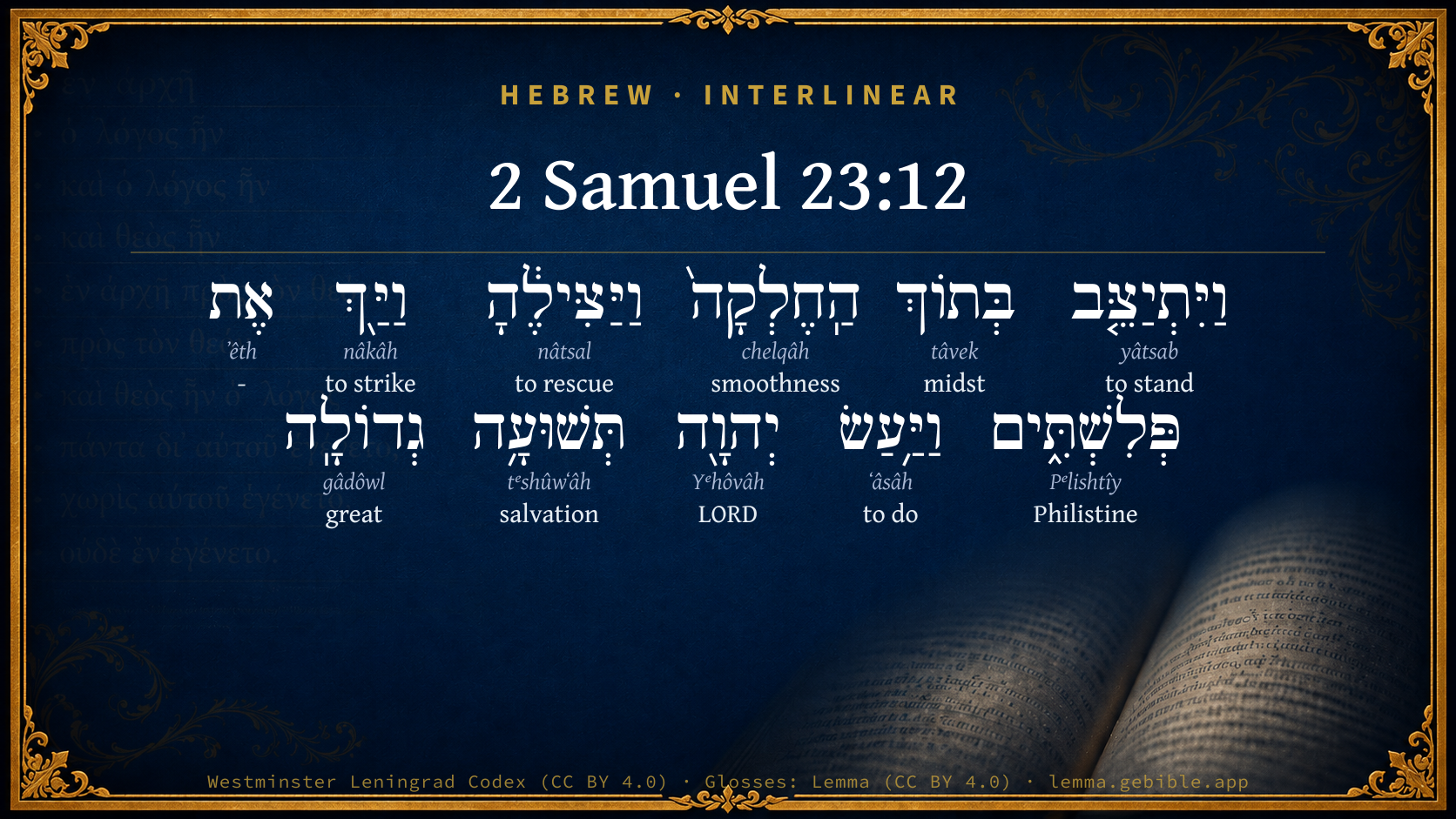
2 Samuel 23:12

Hebrew (Westminster Leningrad Codex) 2 Samuel 23:12 appears in the Hebrew Old Testament. The text above is from the Westminster Leningrad Codex. Each word links to its Strong’s number, a concise gloss, and parsing drawn from the Open Scriptures Hebrew Bible morphology. Click any word for its full Brown-Driver-Briggs (BDB) entry.
Download image
Cite this verse

2 Samuel 23:12 (World English Bible). Public Domain. Lemma interlinear Bible study tool, https://lemma.gebible.app/v/2-samuel/23/12.

Show BibTeX & RIS
BibTeX
RIS
English Translation
But he stood in the midst of the plot, and defended it, and killed the Philistines; and Yahweh worked a great victory.
World English Bible · Public Domain
Download a study sheet

One document with this verse’s original text, its word-by-word gloss line, the meaning frame, cross-references with their text, attributed commentary, and full source and license credits — printable, and it pastes into notes with its structure intact.

This verse Autodidact and up

Study sheet (.html) Plain text (.txt)

A passage Seminary Student

Up to 50 verses in one chapter. A passage sheet keeps up to 6 commentary sources and 12 cross-references per verse, in the order this page ranks them, and says so on the sheet whenever that leaves anything out. Ask for a single verse and you get the Autodidact verse sheet above.

Everything on this page stays free to read, with no account — the sheet is a download of what is already on screen, not access to it.

Want to remove ads? Support Godless Engineer
Compare translations 3

The same verse in 3 English versions, stacked beneath the original-language interlinear above. Click any original word for its lexicon entry.

Each is an independent rendering of the whole verse — the interlinear is not word-aligned to these translations.

Highlighted words mark where these versions differ — a whole-verse word diff, not a word-by-word alignment.

  • World English Bible Public Domain
    But he stood in the midst of the plot, and defended it, and killed the Philistines; and Yahweh worked a great victory.
  • King James Version Public Domain
    But he stood in the midst of the ground, and defended it, and slew the Philistines: and the LORD wrought a great victory.
  • unfoldingWord Literal Text CC BY-SA 4.0
    But he stationed himself in the midst of the portion, and he delivered it, and he struck the Philistines. And Yahweh did great salvation.

unfoldingWord Literal Text — © unfoldingWord, licensed CC BY-SA 4.0. Word-aligned USFM3 via Door43 (git.door43.org/unfoldingWord/en_ult).

Versions to compare (up to 4)

3 of 4 selected

Show all 18 translations

Every available English version of this verse, each an independent rendering of the whole verse.

  • World English Bible Public Domain
    But he stood in the midst of the plot, and defended it, and killed the Philistines; and Yahweh worked a great victory.
  • Berean Standard Bible Public Domain
    But Shammah took his stand in the middle of the field, defended it, and struck down the Philistines. So the LORD brought about a great victory.
  • Majority Standard Bible Public Domain
    But Shammah took his stand in the middle of the field, defended it, and struck down the Philistines. So the LORD brought about a great victory.
  • King James Version Public Domain
    But he stood in the midst of the ground, and defended it, and slew the Philistines: and the LORD wrought a great victory.
  • American Standard Version (1901) Public Domain
    But he stood in the midst of the plot, and defended it, and slew the Philistines; and Jehovah wrought a great victory.
  • Revised Version (1885) Public Domain
    But he stood in the midst of the plot, and defended it, and slew the Philistines: and the LORD wrought a great victory.
  • Geneva Bible (1599) Public Domain
    But he stoode in the middes of the fielde, and defended it, and slewe the Philistims: so the Lord gaue great victorie.
  • Douay-Rheims (1899) Public Domain
    He stood in the midst of the field, and defended it, and defeated the Philistines: and the Lord gave a great victory.
  • Young's Literal Translation Public Domain
    and he stationeth himself in the midst of the portion, and delivereth it, and smiteth the Philistines, and Jehovah worketh a great salvation.
  • Literal Standard Version CC BY-SA 4.0
    and he stations himself in the midst of the portion, and delivers it, and strikes the Philistines, and YHWH works a great salvation.
  • Unlocked Literal Bible CC BY-SA 4.0
    But Shammah stood in the middle of the field and defended it. He killed the Philistines, and Yahweh brought about a great victory.
  • unfoldingWord Literal Text CC BY-SA 4.0
    But he stationed himself in the midst of the portion, and he delivered it, and he struck the Philistines. And Yahweh did great salvation.
  • Darby Bible Public Domain
    and he stood in the midst of the plot and delivered it, and smote the Philistines, and Jehovah wrought a great deliverance.
  • World Messianic Bible Public Domain
    But he stood in the middle of the plot and defended it, and killed the Philistines; and the LORD worked a great victory.
  • Webster's Bible Public Domain
    But he stood in the midst of the ground, and defended it, and slew the Philistines: and the LORD wrought a great victory.
  • Free Bible Version CC BY-SA 4.0
    but Shammah took his stand in the middle of the field, defending it and killing the Philistines. The Lord gave them a great victory.
  • Bible in Basic English Public Domain
    But he kept his place in the middle of the bit of land, and kept back their attack and overcame the Philistines: and the Lord gave a great salvation.
  • JPS Tanakh (1917) Public Domain
    But he stood in the midst of the plot, and defended it, and slew the Philistines; and the LORD wrought a great victory.

Literal Standard Version (2020), Covenant Press — licensed CC BY-SA 4.0. Text via the HelloAO Bible API (eBible.org). Unlocked Literal Bible (unfoldingWord) — licensed CC BY-SA 4.0. Text via the HelloAO Bible API (eBible.org). unfoldingWord Literal Text — © unfoldingWord, licensed CC BY-SA 4.0. Word-aligned USFM3 via Door43 (git.door43.org/unfoldingWord/en_ult). Free Bible Version, Dr. Jonathan Gallagher — licensed CC BY-SA 4.0. Text via the HelloAO Bible API (eBible.org).

Word by word

More ways to search: Search by grammar → Find every occurrence → Compare this word →

Practice this passage: Drill this verse → Learn its vocabulary →

הַֽחֶלְקָה֙
chelqâh
H2513
“the · smoothness”
Particle, Definite Article + Noun, Common, Feminine, Singular, Absolute
Part of Speech
Particle + Noun
Type
Common
Gender
Feminine
Number
Singular
State
Absolute
Full BDB Definition

Origin: from H2506

TWOT: 670c

portion, parcel - of ground - smooth part, smoothness, flattery - smoothness, smooth part - slippery places - smoothness, flattery
  1. וַיִּתְיַצֵּ֤ב yâtsab H3320 “and · to stand” Conjunction + Verb, Hithpael, Sequential Imperfect, 3rd Person, Masculine, Singular
  2. בְּתוֹךְ tâvek H8432 “in/at · midst of” Preposition + Noun, Common, Masculine, Singular, Construct
  3. וַיַּצִּילֶ֔הָ nâtsal H5337 “and · to rescue · her” Conjunction + Verb, Hiphil, Sequential Imperfect, 3rd Person, Masculine, Singular + Suffix, Personal, 3rd Person, Feminine, Singular
  4. וַיַּ֖ךְ nâkâh H5221 “and · to strike” Conjunction + Verb, Hiphil, Sequential Imperfect, 3rd Person, Masculine, Singular
  5. אֶת ʼêth H853 “-” Particle, Direct Object
  6. פְּלִשְׁתִּ֑ים Pᵉlishtîy H6430 “Philistines” Noun, Gentilic, Masculine, Plural, Absolute
  7. וַיַּ֥עַשׂ ʻâsâh H6213 “and · to do” Conjunction + Verb, Qal, Sequential Imperfect, 3rd Person, Masculine, Singular
  8. יְהוָ֖ה Yᵉhôvâh H3068 “LORD” Noun, Proper
  9. תְּשׁוּעָ֥ה tᵉshûwʻâh H8668 “salvation” Noun, Common, Feminine, Singular, Absolute
  10. גְדוֹלָֽה gâdôwl H1419 “great” Adjective, Adjective, Feminine, Singular, Absolute

About this verse

These counts appear in no published source. They are computed here, from the morphology-tagged text and Lemma’s own curated glosses. What Lemma adds →

11
words
11
distinct lemmas
Historical
section

Shared distinctive vocabulary

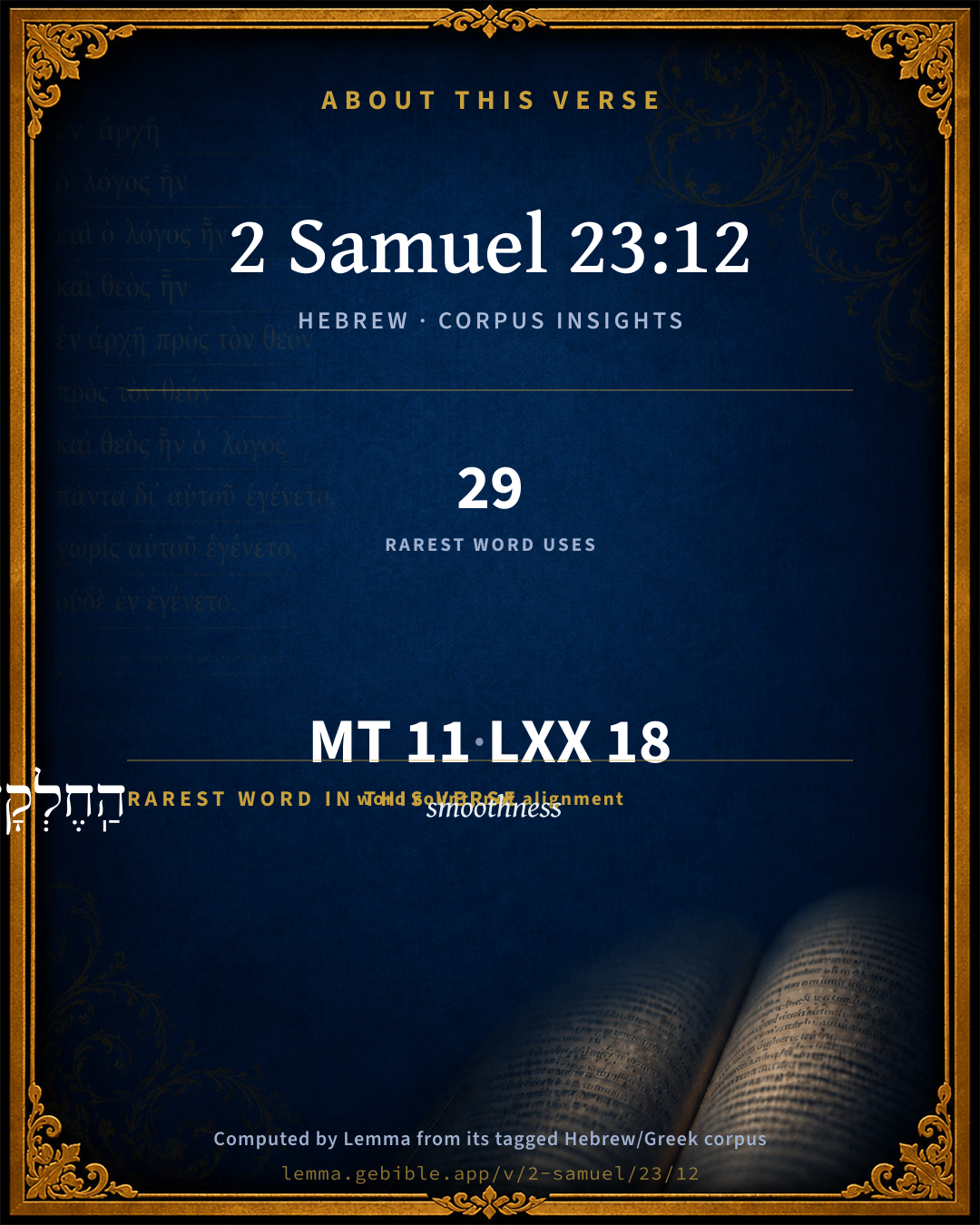
הַֽחֶלְקָה֙ smoothness H2513 occurs in 25 verses of the Hebrew Bible. Also found in:

Grammatical profile

  • 4 verbs
  • 5 nouns
  • 1 adjective
  • 1 particle

Verb forms

  • וַיִּתְיַצֵּ֤ב Hithpael · Sequential Imperfect
  • וַיַּצִּילֶ֔הָ Hiphil · Sequential Imperfect
  • וַיַּ֖ךְ Hiphil · Sequential Imperfect
  • וַיַּ֥עַשׂ Qal · Sequential Imperfect

Hebrew & Septuagint length

In English translation the verse runs 22 words from the Hebrew and 24 from the Septuagint (LXX English) — closely comparable.

A rough comparison of the two English renderings, which tokenize alike — not a word-level alignment.

Word counts can differ between the Hebrew and the Greek without any difference in meaning — e.g. the Hebrew direct-object marker אֵת has no separate Greek word, and Greek often adds the article ὁ.

In the original languages it is 11 Hebrew tokens and 18 Greek tokens — but the two are counted differently (Hebrew bundles its prefixes and suffixes into one token; the Greek is in lemma form), so that isn’t a like-for-like length.

Cross-references

4

Topical passages linked to 2 Samuel 23:12 in the Treasury of Scripture Knowledge — connected by theme and wording, ordered by reader-vote popularity; previews shown in the World English Bible.

  • 2 Samuel 23:10 He arose, and struck the Philistines until his hand was weary, and his hand froze to the sword; and Yahweh worked a great victory that day; and the people returned after him only to take spoil.
  • Proverbs 21:31 The horse is prepared for the day of battle; But victory is with Yahweh.
  • Psalms 3:8 Salvation belongs to Yahweh. Your blessing be on your people. Selah.
  • Psalms 44:2 You drove out the nations with your hand, But you planted them. You afflicted the peoples, But you spread them abroad.

Cross-references courtesy of OpenBible.info (CC BY 4.0).

Hebrew and Greek witnesses Masoretic Hebrew ↔ Greek Septuagint

The same verse in the two great witnesses to the Old Testament, shown verse-for-verse.

These are two independent witnesses, not word-aligned to each other, and the Septuagint is shown in lemma (dictionary) form.

Hebrew 2 Samuel 23:12 Masoretic · Westminster Leningrad Codex

וַיִּתְיַצֵּ֤ב בְּתוֹךְ הַֽחֶלְקָה֙ וַיַּצִּילֶ֔הָ וַיַּ֖ךְ אֶת פְּלִשְׁתִּ֑ים וַיַּ֥עַשׂ יְהוָ֖ה תְּשׁוּעָ֥ה גְדוֹלָֽה

But he stood in the midst of the plot, and defended it, and killed the Philistines; and Yahweh worked a great victory.

World English Bible · Public Domain

Greek LXX 2 Samuel 23:12 Septuagint · lemma form

καί στηλόω ἐν μέσος ὁ μερίς καί ἐκαἱρέω αὐτός καί πατάσσω ὁ ἀλλόφυλος καί ποιέω κύριος σωτηρία μέγας

And he stood firm in the midst of the portion, and rescued it, and struck the Philistines; and the Lord wrought a great deliverance.

LXX2012 (modern English Septuagint) · Public Domain

Hebrew: Westminster Leningrad Codex (CC BY 4.0). Greek: Septuagint (public domain); English from LXX2012 (modern English Septuagint) (Public Domain). How the Septuagint differs from the Hebrew →

Targum (Aramaic paraphrase)

1

The Targum is the ancient Jewish Aramaic paraphrase of the Hebrew Scriptures — an interpretive translation, not the Hebrew text itself. Onkelos (literal) and Pseudo-Jonathan (expansive) render the Torah, and Jonathan the Prophets. Coverage is partial: where no permissively-licensed English translation exists for a verse, only the Aramaic is shown. This is verse-level text, not a word-by-word alignment to the Hebrew.

  1. Targum Jonathan Prophets (Joshua–Malachi)
    וְאִתְעַתֵּד בְּגוֹ אַחְסַנְתָּא וְשֵׁיזְבֵיהּ וּקְטַל יַת פְּלִשְׁתָּאֵי וַעֲבַד יְיָ פּוּרְקָנָא רַבָּא:

    (no public-domain English translation for this verse)

    Targum Jonathan — Aramaic: “Mikraot Gedolot” (public domain). English: “Sefaria Community Translation” (CC0 1.0 (public-domain dedication)); “London "Chaldee Paraphrase," 1871” (public domain). Text via Sefaria.

Commentary

Notes on 2 Samuel 23:12 from classic Christian and Jewish commentators (each source and its license shown beneath its notes). The classic Christian expositions comment on the surrounding passage and are grouped to its opening verse, so a note may address several verses; the Jewish commentaries on the Tanakh (Rashi and others) are per-verse, so they appear only where the commentator wrote on this verse.

Lemma curates 59 commentaries, every one of them public domain or Creative Commons licensed, each selected and text-cleaned for this edition rather than reprinted as found. About our sources →

Trapp's Complete Commentary

John Trapp

2Sa 23:12 But he stood in the midst of the ground, and defended it, and slew the Philistines: and the LORD wrought a great victory.

Ver. 12. In the midst of the ground, and defended it,] i.e., That part of the ground that had the lentiles; as Eleazar had done that part that had the barley. It was for provender, and about harvest, that they skirmished mostly. {1Sa 23:1}

John Trapp, A Commentary or Exposition upon All the Books of the Old and New Testament (1647–1656) — public domain. Text from a community e-Sword module.

Geneva Bible (1599)

Geneva Bible translators

Which hath neither respect to many nor few, when he will show his power.

Geneva Bible (1599) marginal notes — public domain. Text via Bolls.life.

John Gill's Exposition

But he stood in the midst of the ground,.... The field of lentiles:

and defended it; the field, so that the Philistines could not ravage it, and get food and forage from it:

and slew the Philistines; made a great slaughter among them, entirely routed them, so that they that escaped his sword were obliged to flee:

and the Lord wrought a great victory; to whom the glory of it belonged; a similar fact is ascribed to Eleazar before mentioned in Ch1 11:13; and, indeed, it seems to be the same, and in which they were both concerned; for it is plain from the account that there were more than one engaged in this action, since it is there said, "and they set themselves in the midst of that parcel"; and though that parcel of ground is said there to be full of barley, it may easily be reconciled by observing, that one part of it might be sowed with barley, and the other part with lentiles; so the Targum in Ch1 11:13; for it was half lentiles and half barley; and Eleazar might be placed to defend the one, and Shammah the other; from whence it appears it was about March when this action was, at the latter end of which barley harvest began.

John Gill's Exposition of the Whole Bible (1746–1763) — public domain (CC PDM 1.0). Text via the HelloAO Bible API.

Matthew Poole's English Annotations

Defended it; that the Philistines could neither burn, nor tread it down and spoil it or carry it away.

Matthew Poole's English Annotations on the Holy Bible (1683–1685) — public domain. Text from a community e-Sword/MySword module.

John Wesley's Explanatory Notes

Lord wrought - How great soever the bravery of the instruments is, the praise of the achievement is to be given to God. These fought, but God wrought the victory.

John Wesley, Explanatory Notes Upon the Whole Bible (1754–1765) — public domain. Text via the GEBible commentary corpus.

Lesson kit

Teaching starters — assembled from the data on this page, not authored interpretation. Every prompt links to the verse data it draws on. Edit before teaching.

2 Samuel, in the Historical, opens this verse with 11 words (11 distinct Hebrew lemmas). Its most distinctive word is chelqâh (“smoothness”). A historical commentator’s framing appears above. Read the whole chapter for the surrounding context.

Discussion questions

  1. The word chelqâh carries the sense “smoothness.” How does it shape the verse?
  2. How does Genesis 27:16, which shares the word «smoothness», read alongside this verse?
  3. These translations render this verse differently. What is at stake in choosing one wording over another?
  4. «וַיִּתְיַצֵּ֤ב» is a Hithpael Sequential Imperfect verb. How does that grammatical form shape the action described?
  5. Compare how Trapp's Complete Commentary and Geneva Bible (1599) read this verse. Where do they agree or differ?

Things to notice

Reading settings

Reading text

Shown beneath each verse's original-language words.

Old Testament
Old Testament edition

Read the OT as the Masoretic Hebrew (MT) or the Greek Septuagint (LXX).

English shown for the Greek Septuagint (in the Hebrew ↔ Greek comparison).

Comparing translations? Open the Compare panel on any verse page to stack up to four side by side.