
Exodus 12:31

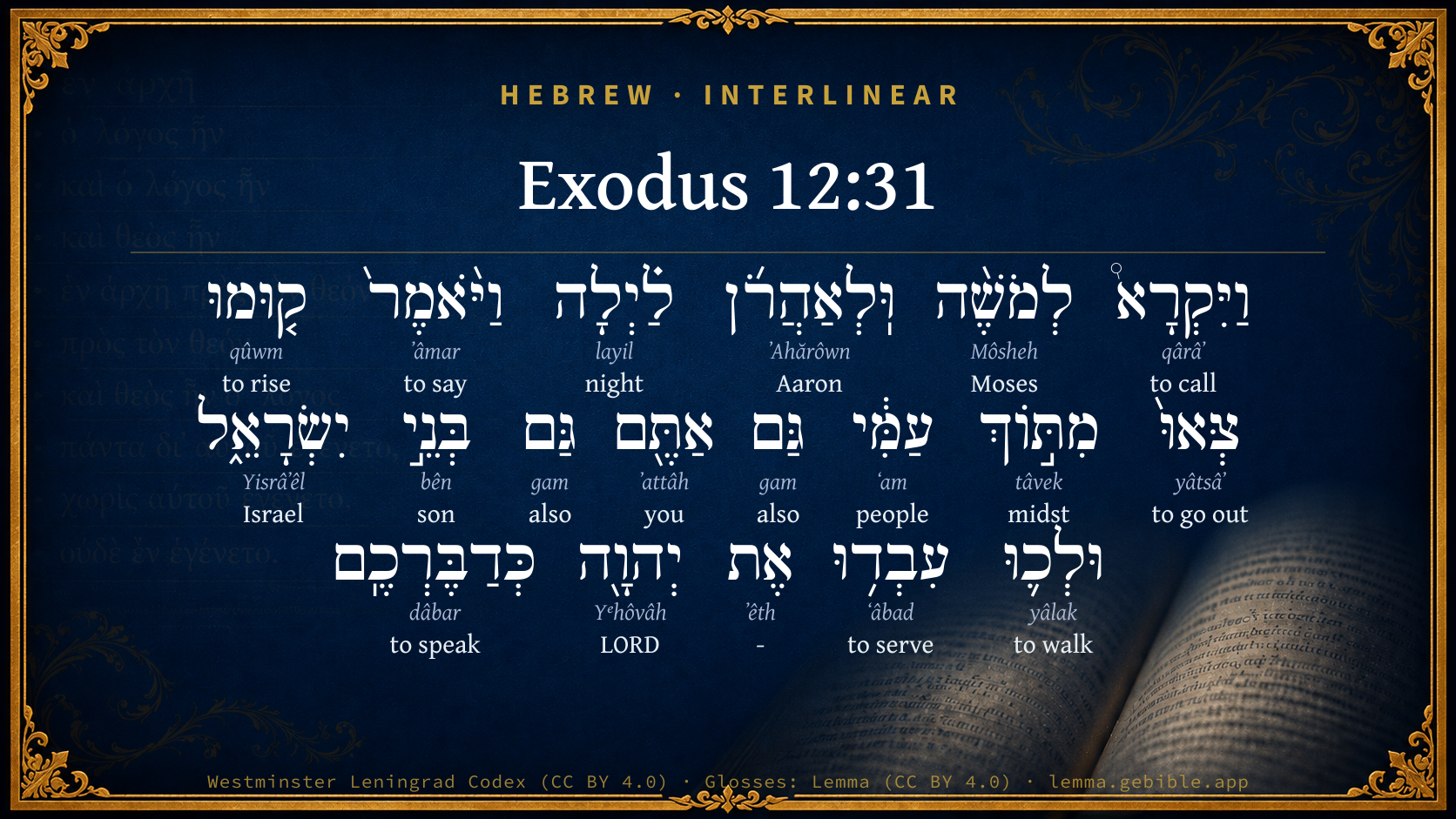
Hebrew (Westminster Leningrad Codex) Exodus 12:31 appears in the Hebrew Old Testament. The text above is from the Westminster Leningrad Codex. Each word links to its Strong’s number, a concise gloss, and parsing drawn from the Open Scriptures Hebrew Bible morphology. Click any word for its full Brown-Driver-Briggs (BDB) entry.
Download image
Cite this verse

Exodus 12:31 (World English Bible). Public Domain. Lemma interlinear Bible study tool, https://lemma.gebible.app/v/exodus/12/31.

Show BibTeX & RIS
BibTeX
RIS
English Translation
He called for Moses and Aaron by night, and said, "Rise up, get out from among my people, both you and the children of Israel; and go, serve Yahweh, as you have said!
World English Bible · Public Domain
Download a study sheet

One document with this verse’s original text, its word-by-word gloss line, the meaning frame, cross-references with their text, attributed commentary, and full source and license credits — printable, and it pastes into notes with its structure intact.

This verse Autodidact and up

Study sheet (.html) Plain text (.txt)

A passage Seminary Student

Up to 50 verses in one chapter. A passage sheet keeps up to 6 commentary sources and 12 cross-references per verse, in the order this page ranks them, and says so on the sheet whenever that leaves anything out. Ask for a single verse and you get the Autodidact verse sheet above.

Everything on this page stays free to read, with no account — the sheet is a download of what is already on screen, not access to it.

Want to remove ads? Support Godless Engineer
Compare translations 3

The same verse in 3 English versions, stacked beneath the original-language interlinear above. Click any original word for its lexicon entry.

Each is an independent rendering of the whole verse — the interlinear is not word-aligned to these translations.

Highlighted words mark where these versions differ — a whole-verse word diff, not a word-by-word alignment.

  • World English Bible Public Domain
    He called for Moses and Aaron by night, and said, "Rise up, get out from among my people, both you and the children of Israel; and go, serve Yahweh, as you have said!
  • King James Version Public Domain
    And he called for Moses and Aaron by night, and said, Rise up, and get you forth from among my people, both ye and the children of Israel; and go, serve the LORD, as ye have said.
  • unfoldingWord Literal Text CC BY-SA 4.0
    And he called for Moses and for Aaron in the night and said, “Get up, get out from among my people, both you and also the sons of Israel. And go, serve Yahweh, as you have said.

unfoldingWord Literal Text — © unfoldingWord, licensed CC BY-SA 4.0. Word-aligned USFM3 via Door43 (git.door43.org/unfoldingWord/en_ult).

Versions to compare (up to 4)

3 of 4 selected

Show all 18 translations

Every available English version of this verse, each an independent rendering of the whole verse.

  • World English Bible Public Domain
    He called for Moses and Aaron by night, and said, "Rise up, get out from among my people, both you and the children of Israel; and go, serve Yahweh, as you have said!
  • Berean Standard Bible Public Domain
    Then Pharaoh summoned Moses and Aaron by night and said, “Get up, leave my people, both you and the Israelites! Go, worship the LORD as you have requested.
  • Majority Standard Bible Public Domain
    Then Pharaoh summoned Moses and Aaron by night and said, “Get up, leave my people, both you and the Israelites! Go, worship the LORD as you have requested.
  • King James Version Public Domain
    And he called for Moses and Aaron by night, and said, Rise up, and get you forth from among my people, both ye and the children of Israel; and go, serve the LORD, as ye have said.
  • American Standard Version (1901) Public Domain
    And he called for Moses and Aaron by night, and said, Rise up, get you forth from among my people, both ye and the children of Israel; and go, serve Jehovah, as ye have said.
  • Revised Version (1885) Public Domain
    And he called for Moses and Aaron by night, and said, Rise up, get you forth from among my people, both ye and the children of Israel; and go, serve the LORD, as ye have said.
  • Geneva Bible (1599) Public Domain
    And hee called to Moses and to Aaron by night, and saide, Rise vp, get you out from among my people, both yee, and the children of Israel, and goe serue the Lord as ye haue sayde.
  • Douay-Rheims (1899) Public Domain
    And Pharao calling Moses and Aaron, in the night, said: Arise and go forth from among my people, you and the children of Israel: go, sacrifice to the Lord as you say.
  • Young's Literal Translation Public Domain
    and he calleth for Moses and for Aaron by night, and saith, `Rise, go out from the midst of my people, both ye and the sons of Israel, and go, serve Jehovah according to your word;
  • Literal Standard Version CC BY-SA 4.0
    and he calls for Moses and for Aaron by night and says, “Rise, go out from the midst of my people, both you and the sons of Israel, and go, serve YHWH according to your word;
  • Unlocked Literal Bible CC BY-SA 4.0
    Pharaoh summoned Moses and Aaron in the night and said, “Get up, get out from among my people, you and the Israelites. Go, worship Yahweh, as you have said you wanted to do.
  • unfoldingWord Literal Text CC BY-SA 4.0
    And he called for Moses and for Aaron in the night and said, “Get up, get out from among my people, both you and also the sons of Israel. And go, serve Yahweh, as you have said.
  • Darby Bible Public Domain
    And he called Moses and Aaron in the night, and said, Rise up, go away from among my people, both ye and the children of Israel; and go, serve Jehovah, as ye have said.
  • World Messianic Bible Public Domain
    He called for Moses and Aaron by night, and said, “Rise up, get out from among my people, both you and the children of Israel; and go, serve the LORD, as you have said!
  • Webster's Bible Public Domain
    And he called for Moses and Aaron by night, and said, Arise, and depart from among my people, both ye and the children of Israel: and go, serve the LORD, as ye have said.
  • Free Bible Version CC BY-SA 4.0
    Pharaoh called for Moses and Aaron during the night and told them, “Get out of here! Leave my people, the two of you and the Israelites! Go, so you can worship the Lord as you have asked.
  • Bible in Basic English Public Domain
    And he sent for Moses and Aaron by night, and said, Get up and go out from among my people, you and the children of Israel; go and give worship to the Lord as you have said.
  • JPS Tanakh (1917) Public Domain
    And he called for Moses and Aaron by night and said: 'Rise up, get you forth from among my people, both ye and the children of Israel; and go, serve the LORD, as ye have said.

Literal Standard Version (2020), Covenant Press — licensed CC BY-SA 4.0. Text via the HelloAO Bible API (eBible.org). Unlocked Literal Bible (unfoldingWord) — licensed CC BY-SA 4.0. Text via the HelloAO Bible API (eBible.org). unfoldingWord Literal Text — © unfoldingWord, licensed CC BY-SA 4.0. Word-aligned USFM3 via Door43 (git.door43.org/unfoldingWord/en_ult). Free Bible Version, Dr. Jonathan Gallagher — licensed CC BY-SA 4.0. Text via the HelloAO Bible API (eBible.org).

Word by word

More ways to search: Search by grammar → Find every occurrence → Compare this word →

Practice this passage: Drill this verse → Learn its vocabulary →

לַ֗יְלָה
layil
H3915
“night”
Noun, Common, Masculine, Singular, Absolute
Part of Speech
Noun
Type
Common
Gender
Masculine
Number
Singular
State
Absolute
Full BDB Definition

Origin: from the same as H3883

TWOT: 1111

night - night (as opposed to day) - of gloom, protective shadow (figuratively)
  1. וַיִּקְרָא֩ qârâʼ H7121 “and · to call” Conjunction + Verb, Qal, Sequential Imperfect, 3rd Person, Masculine, Singular
  2. לְמֹשֶׁ֨ה Môsheh H4872 “to/for · Moses” Preposition + Noun, Proper
  3. וּֽלְאַהֲרֹ֜ן ʼAhărôwn H175 “and · to/for · Aaron” Conjunction + Preposition + Noun, Proper
  4. וַיֹּ֨אמֶר֙ ʼâmar H559 “and · to say” Conjunction + Verb, Qal, Sequential Imperfect, 3rd Person, Masculine, Singular
  5. ק֤וּמוּ qûwm H6965 “rise” Verb, Qal, Imperative, 2nd Person, Masculine, Plural
  6. צְּאוּ֙ yâtsâʼ H3318 “go out” Verb, Qal, Imperative, 2nd Person, Masculine, Plural
  7. מִתּ֣וֹךְ tâvek H8432 “from · midst of” Preposition + Noun, Common, Masculine, Singular, Construct
  8. עַמִּ֔י ʻam H5971 “people · my” Noun, Common, Masculine, Singular, Construct + Suffix, Personal, 1st Person, Common, Singular
  9. גַּם gam H1571 “also” Particle, Accusative
  10. אַתֶּ֖ם ʼattâh H859 “you” Pronoun, Personal, 2nd Person, Masculine, Plural
  11. גַּם gam H1571 “also” Particle, Accusative
  12. בְּנֵ֣י bên H1121 “sons of” Noun, Common, Masculine, Plural, Construct
  13. יִשְׂרָאֵ֑ל Yisrâʼêl H3478 “Israel” Noun, Proper
  14. וּלְכ֛וּ yâlak H3212 “and · walk” Conjunction + Verb, Qal, Imperative, 2nd Person, Masculine, Plural
  15. עִבְד֥וּ ʻâbad H5647 “serve” Verb, Qal, Imperative, 2nd Person, Masculine, Plural
  16. אֶת ʼêth H853 “-” Particle, Direct Object
  17. יְהוָ֖ה Yᵉhôvâh H3068 “LORD” Noun, Proper
  18. כְּדַבֶּרְכֶֽם dâbar H1696 “like/as · to speak · you” Preposition + Verb, Piel, Infinitive Construct + Suffix, Personal, 2nd Person, Masculine, Plural

About this verse

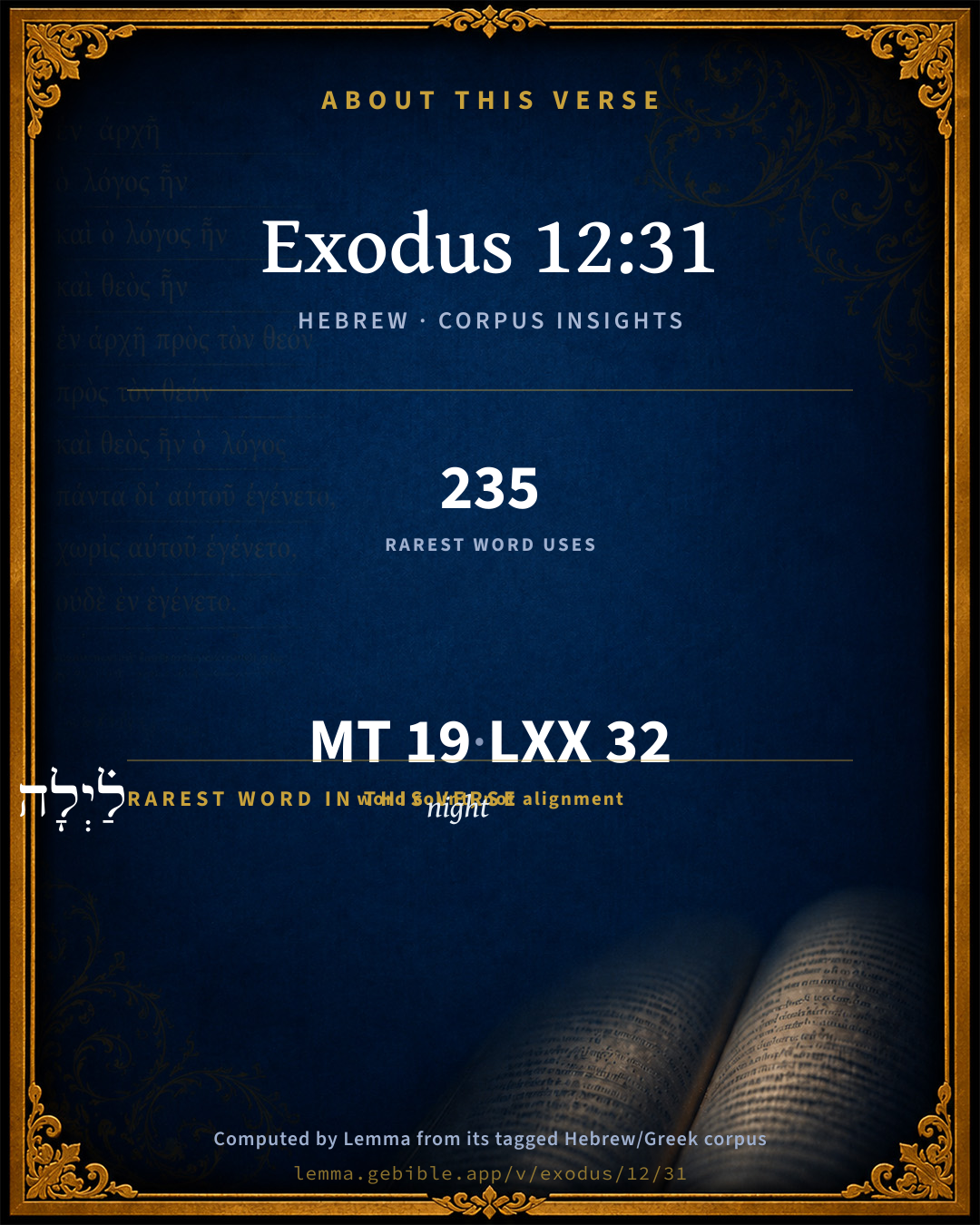
These counts appear in no published source. They are computed here, from the morphology-tagged text and Lemma’s own curated glosses. What Lemma adds →

19
words
18
distinct lemmas
Pentateuch
section

Grammatical profile

  • 7 verbs
  • 8 nouns
  • 1 pronoun
  • 3 particles

Verb forms

  • וַיִּקְרָא֩ Qal · Sequential Imperfect
  • וַיֹּ֨אמֶר֙ Qal · Sequential Imperfect
  • ק֤וּמוּ Qal · Imperative
  • צְּאוּ֙ Qal · Imperative
  • וּלְכ֛וּ Qal · Imperative
  • עִבְד֥וּ Qal · Imperative
  • כְּדַבֶּרְכֶֽם Piel · Infinitive Construct

Repetition

A word recurs within this verse — often emphatic in Hebrew:

  • גַּם also H1571 ×2

Hebrew & Septuagint length

In English translation the verse runs 33 words from the Hebrew and 36 from the Septuagint (LXX English) — closely comparable.

A rough comparison of the two English renderings, which tokenize alike — not a word-level alignment.

Word counts can differ between the Hebrew and the Greek without any difference in meaning — e.g. the Hebrew direct-object marker אֵת has no separate Greek word, and Greek often adds the article ὁ.

In the original languages it is 19 Hebrew tokens and 32 Greek tokens — but the two are counted differently (Hebrew bundles its prefixes and suffixes into one token; the Greek is in lemma form), so that isn’t a like-for-like length.

Cross-references

7

Topical passages linked to Exodus 12:31 in the Treasury of Scripture Knowledge — connected by theme and wording, ordered by reader-vote popularity; previews shown in the World English Bible.

  • Exodus 6:1 Yahweh said to Moses, "Now you shall see what I will do to Pharaoh, for by a strong hand he shall let them go, and by a strong hand he shall drive them out of his land."
  • Exodus 3:19–20 I know that the king of Egypt won't give you permission to go, no, not by a mighty hand.
  • Exodus 8:8 Then Pharaoh called for Moses and Aaron, and said, "Entreat Yahweh, that he take away the frogs from me, and from my people; and I will let the people go, that they may sacrifice to Yahweh."
  • Exodus 10:9 Moses said, "We will go with our young and with our old; with our sons and with our daughters, with our flocks and with our herds will we go; for we must hold a feast to Yahweh."
  • Psalms 105:38 Egypt was glad when they departed, For the fear of them had fallen on them.
  • Exodus 10:29–11:1 Moses said, "You have spoken well. I will see your face again no more."
  • Exodus 11:8 All these your servants shall come down to me, and bow down themselves to me, saying, 'Get out, and all the people who follow you; and after that I will go out.'" He went out from Pharaoh in hot anger.

Cross-references courtesy of OpenBible.info (CC BY 4.0).

Hebrew and Greek witnesses Masoretic Hebrew ↔ Greek Septuagint

The same verse in the two great witnesses to the Old Testament, shown verse-for-verse.

These are two independent witnesses, not word-aligned to each other, and the Septuagint is shown in lemma (dictionary) form.

Hebrew Exodus 12:31 Masoretic · Westminster Leningrad Codex

וַיִּקְרָא֩ לְמֹשֶׁ֨ה וּֽלְאַהֲרֹ֜ן לַ֗יְלָה וַיֹּ֨אמֶר֙ ק֤וּמוּ צְּאוּ֙ מִתּ֣וֹךְ עַמִּ֔י גַּם אַתֶּ֖ם גַּם בְּנֵ֣י יִשְׂרָאֵ֑ל וּלְכ֛וּ עִבְד֥וּ אֶת יְהוָ֖ה כְּדַבֶּרְכֶֽם

He called for Moses and Aaron by night, and said, "Rise up, get out from among my people, both you and the children of Israel; and go, serve Yahweh, as you have said!

World English Bible · Public Domain

Greek LXX Exodus 12:31 Septuagint · lemma form

καί καλέω φαραώ μωυσῆς καί ααρων νύξ καί εἶπον αὐτός ἀναἵστημι καί ἐκἔρχομαι ἐκ ὁ λαός ἐγώ καί σύ καί ὁ υἱός ἰσραήλ βαδίζω καί λατρεύω κύριος ὁ θεός σύ καθά λέγω

And Pharao called Moses and Aaron by night, and said to them, Rise and depart from my people, both you⌃ and the children of Israel. Go and serve the Lord your God, even as you⌃ say.

LXX2012 (modern English Septuagint) · Public Domain

Hebrew: Westminster Leningrad Codex (CC BY 4.0). Greek: Septuagint (public domain); English from LXX2012 (modern English Septuagint) (Public Domain). How the Septuagint differs from the Hebrew →

Targum (Aramaic paraphrase)

2

The Targum is the ancient Jewish Aramaic paraphrase of the Hebrew Scriptures — an interpretive translation, not the Hebrew text itself. Onkelos (literal) and Pseudo-Jonathan (expansive) render the Torah, and Jonathan the Prophets. Coverage is partial: where no permissively-licensed English translation exists for a verse, only the Aramaic is shown. This is verse-level text, not a word-by-word alignment to the Hebrew.

  1. Targum Onkelos Torah (Genesis–Deuteronomy)
    וּקְרָא לְמשֶׁה וּלְאַהֲרֹן לֵילְיָא וַאֲמַר קוּמוּ פּוּקוּ מִגוֹ עַמִי אַף אַתּוּן אַף בְּנֵי יִשְׂרָאֵל וֶאֱזִילוּ פְלָחוּ קֳדָם יְיָ כְּמָא דִהֲוֵתוּן אָמְרִין:

    (no public-domain English translation for this verse)

    Targum Onkelos — Aramaic: “Onkelos Genesis” (public domain); “Onkelos Exodus” (public domain); “Onkelos Leviticus” (public domain); “Onkelos Numbers” (public domain); “Onkelos Deuteronomy” (public domain). English: “Sefaria Community Translation” (CC0 1.0 (public-domain dedication)); “J.W. Etheridge. The Targums of Onkelos and Jonathan Ben Uzziel on the Pentateuch. London: Longmans, Green, 1862” (public domain). Text via Sefaria.

  2. Targum Pseudo-Jonathan Torah (Genesis–Deuteronomy)
    וּתְחוּם אַרְעָא דְמִצְרַיִם מַהֲלָךְ אַרְבַּע מְאָה פַּרְסֵי הֲוַת וְאַרְעָא דְגוֹשֶׁן דְּתַמָּן משֶׁה וּבְנֵי יִשְרָאֵל בִּמְצִיעוּת אַרְעָא דְמִצְרַיִם הֲוַת וּפַלְטְרִין דְּבֵית מַלְכוּתָא דְפַרְעה בְּרֵישׁ אַרְעָא דְמִצְרַיִם הֲוָה וְכַד קְרָא לְמשֶׁה וּלְאַהֲרן בְּלֵילְיָא דְפִסְחָא אִשְׁתְּמַא קָלֵיהּ עַד אַרְעָא דְגשֶׁן מִתְחַנֵּן הֲוָה פַּרְעה בְּקַל עָצִיב וְכֵן אָמַר קוּמוּ פּוּקוּ מִגּוֹ עַמִּי אוּף אַתּוּן אוּף בְּנֵי יִשְרָאֵל וְזִילוּ פְלָחוּ קֳדָם יְיָ הֵיכְמָא דַאֲמַרְתּוּן

    And the border of the land of Mizraim extended four hundred pharsee; but the land of Goshen, where Mosheh and the sons of Israel were, was in the midst of the land of Mizraim; and the royal palace of Pharoh was at the entrance of the land of Mizraim. But when he cried to Mosheh and to Aharon in the night of the Pascha, his voice was heard unto the land of Goshen; Pharoh crying with a voice of woe, and saying thus: Arise, Go forth from among my people, both you and the sons of Israel; and go, worship before the Lord, as you have said;

    Targum Pseudo-Jonathan — Aramaic: “Targum Jonathan on Genesis” (public domain); “Targum Jonathan on Exodus” (public domain); “Targum Jonathan on Leviticus” (public domain); “Targum Jonathan on Numbers” (public domain); “Targum Jonathan on Deuteronomy” (public domain). English: “The Targum of Jonathan ben Uzziel, trans. J. W. Etheridge, London, 1862” (public domain). Text via Sefaria.

Commentary

Notes on Exodus 12:31 from classic Christian and Jewish commentators (each source and its license shown beneath its notes). The classic Christian expositions comment on the surrounding passage and are grouped to its opening verse, so a note may address several verses; the Jewish commentaries on the Tanakh (Rashi and others) are per-verse, so they appear only where the commentator wrote on this verse.

Lemma curates 59 commentaries, every one of them public domain or Creative Commons licensed, each selected and text-cleaned for this edition rather than reprinted as found. About our sources →

Trapp's Complete Commentary

John Trapp

Exo 12:31 And he called for Moses and Aaron by night, and said, Rise up, [and] get you forth from among my people, both ye and the children of Israel; and go, serve the LORD, as ye have said.

Ver. 31. And he called for Moses.] That is, He sent them to be packing. See Exo 10:29.

John Trapp, A Commentary or Exposition upon All the Books of the Old and New Testament (1647–1656) — public domain. Text from a community e-Sword module.

Joseph Benson's Commentary

Exo 12:31-32. Rise up, and get you forth — Pharaoh had told Moses he should see his face no more, but now he sent for him; those will seek God in their distress, who before had set him at defiance. Such a fright he was now in that he gave orders by night for their discharge, fearing lest, if he delayed, he himself should fall next. And that he sent them out, not as men hated (as the pagan historians have represented this matter) but as men feared, is plain by his request to them. Bless me also — Let me have your prayers, that I may not be plagued for what is past when you are gone.

Joseph Benson's Commentary on the Old and New Testaments (1811–1818) — public domain. Text from a community e-Sword module.

The Pulpit Commentary

Vers. 31-36. THE DISMISSAL. The first action seems to have been taken by Pharaoh. The "cry" of the people had no doubt been heard in the palace, and he was aware that the blow had not fallen on himself alone, and may have anticipated what the people"s feelings would be; but he did not wait for any direct pressure to be put upon him before yielding. He sent his chief officers (Exo_11:8) while it was still night, (Exo_12:31) to inform Moses and Aaron, not only that they might, but that they must take their departure immediately, with all the people, and added that they might take with them their flocks and herds. The surrender was thus complete; and it was accompanied by a request which we should scarcely have expected. Pharaoh craved at the hands of the two brothers a blessing! We are not told how his request was received; but that it should have been made is a striking indication of how his pride was humbled. The overture from Pharaoh was followed rapidly by a popular movement, which was universal and irresistible. The Egyptians "rose up" everywhere, and "were urgent upon the people," to "send them out of the land in haste" (ver. 33); and to expedite their departure readily supplied them at their request with gold and silver and raiment (ver. 35), thus voluntarily spoiling themselves for the benefit of the foreigners. The Israelites, long previously prepared for the moment which had now arrived, made their final arrangements, and before the day was over a lengthy column was set in motion, and proceeded from Rameses, which seems to have been a suburb of Tunis (Brugsch, Hist. of Egypt, vol. 2. pp. 96-99), to an unknown place called Succoth, which must have lain towards the south-east, and was probably not very remote from the capital

And he called for Moses and Aaron. Kalisch understands this as a summons to the King"s presence (Commentary, p. 130), and even supposes that the two brothers complied, notwithstanding what Moses had (Exo_10:29) But perhaps no more is meant than at Pharaoh"s instance Moses and Aaron were summoned to an interview with some of the Court officials. (see Exo_11:8) As ye have said. Literally, "according to your words." The reference is to such passages as Exo_8:1, 20 9:1, 13.

Vers. 31-36. Israel"s going forth from Egypt a pattern to oppressed Churches.

Churches are sometimes enslaved and oppressed by the civil power. In unsuspecting confidence they have accepted the State"s protection, and entered into certain relations with it, supposed to be mutually advantageous. But, as time has gone on, the terms of the original arrangement have been disregarded; the civil power has made encroachments; has narrowed the Church"s liberties, has behaved oppressively towards it, has reduced it to actual slavery. A time comes at last when the bondage is felt to be intolerable; and the Church demands its liberty, claims to go out from under the yoke of the oppressor. Under such circumstances the following analogies are noticeable:

I THE OPPRESSED CHURCH, LONG REFUSED THE LIBERTY WHICH IT HAS BEEN DRIVEN TO CLAIM, IS APT AT LAST TO BE "THRUST OUT" BY ITS OPPRESSOR. The early efforts of a downtrodden church after freedom are strenuously opposed, denounced as at once wrongful, foolish, and futile, sometimes punished by an increase in the oppression. The Church is set to "make bricks without straw." If this process fails, and the demand for freedom continues, the claims made are perhaps at the next stage derided. (See Exo_5:2) They are then for a long time determinedly and persistently refused. If occasionally a seeming concession is made, it is scarcely made before it is retracted. If still the Church will not give way, but continues the struggle, a crisis arrives. The State finds itself in difficulties. One inconvenience after another befals is in consequence of the prolonged conflict. At length it comes to be felt that the inconveniences of the struggle exceed the benefits of the connection; and a sudden change of policy takes place. The Church is sent adrift; cut away like an encumbering mass of wreck; bidden to shift for itself, and trouble the State no more. The State is glad to be rid of it.

II THE EMANCIPATED CHURCH FINDS ITSELF, ON EMANCIPATION, SURROUNDED BY DIFFICULTIES AND PERPLEXITIES. In the first place, the attitude of the State towards it is apt to be hostile; and an attempt may even be made to coerce it and force it to resume its old position. Apart from this, it labours under many disadvantages. It has recollections of the "flesh-pots of Egypt," which offer a strong contrast to the fare whereto it is reduced. It has to enter on a dull and wearisome course; to plod forward toilsomely, painfully. It finds its movements hampered by encumbrances. All these things are against it. But if the nerves be braced to bear, if the will be resolute to turn away from all thought of the "flesh-pots," if the fact of freedom be kept before the mind"s eye and the old ills of slavery held in recollection, the difficulties of the early journey will pass away, the presence of God will be revealed, and after (it may be) forty years of trial, the wilderness will have been passed through, and there will be a triumphant entrance into Canaan.

III THE EMANCIPATED CHURCH HAS A RIGHT TO TAKE WITH IT ALL ITS OWN PROPERTY, AND IS ENTITLED, IF OCCASION ARISE, TO "SPOIL THE EGYPTIANS." Moses and Aaron would not stir without their flocks and herds the main wealth of a pastoral nation. "Not a hoof," they said, "should be left behind". (Exo_10:26) So the emancipated Church should take with her whatever is her own into the wilderness. She must not relinquish her property to the oppressor. It is really not hers, but God"s: she is trustee to God for it. She is entitled to say that she "knows not with what she must serve the Lord till she is come out." And she is entitled to ask for parting gifts when she is about to quit a known shelter and to confront the perils and dangers of an unknown future. If God gives her favour in the eyes of those whom she is leaving, she will do well to require of them their silver and their gold and their raiment all that they have most precious and take it with her, not as "borrowed" wealth, but as endowment freely "given," intentionally made over for a permanence, out of goodwill and affection, or out of compassion and pity. She will find a proper use for all that is most rich and most rare in the service of the sanctuary.

Vers. 31-37. The dismissal.

The blow had been so measured by infinite wisdom as to produce precisely the desired effect. Pharaoh "called for Moses and Aaron by night," etc. Observe

I PHARAOH IS NOW AS ANXIOUS TO GET RID OF THE ISRAELITES AS FORMERLY HE WAS TO KEEP THEM. It had been predicted at the beginning that this would be the issue of God"s dealings with him. (Exo_6:1) Note,

1. Pharaoh"s folly in resisting the demand of God so long. He has to concede everything at last. Had he yielded at the beginning, he could have done so with honour, and with the happiest results to his dynasty and kingdom. As it is, he has gained nothing, and has lost much, nearly all. He has ruined Egypt, suffered severely in his own person, lost his first-born, and irretrievably forfeited his prestige in the eyes of his subjects. Foolish king! and yet the same unequal and profitless contest is being repeated in the history of every sinner!

2. The dismissal is unconditional. No more talk of leaving the little ones, or the flocks and herds; or even of returning after the three days" journey. Pharaoh wants no more to do with this fatal people. No one could any longer dream of the Israelites returning, or expect them to do so. They were "thrust out altogether". (Exo_11:1)

3. He seeks a blessing (ver. 32). He wished Moses to leave a blessing behind him. He would be blessed, and still continue in his sins. Beyond letting Israel go, he had no intention of renouncing his idols, and becoming a worshipper of the God he had so long defied. Many would like to be blessed, while cleaving to their sins.

II THE EGYPTIANS ARE AS EAGER AS THEIR MONARCH TO SEE THE ISRAELITES SAFELY OUT OF EGYPT.

1. They were affrighted. "They said, we be all dead men" (ver. 33). They were perfectly right. Had Israel been detained longer, their nation would have been destroyed. It would be well if every sinner had as clear a perception of the effects of persistence in his evil.

2. They were urgent to send the people away. Not simply because this was what Jehovah had commanded, but because they were terrified to have them in their midst any longer. The Israelites were a people of ill-omen to them. They wished to get rid of the nation at once and for ever. This is not without significance. We remember how the Gadarenes besought Jesus that he would depart out of their coasts. (Mat_8:34) Worldly people have no liking for the company of the converted. Society bustles them out of its midst. Their old companions betray a singular uncomfortableness in their presence. They would rather have done with them. "Therefore they say unto God, Depart from us; for we desire not the knowledge of thy ways". (Job_21:14) Alas! the world that desires to be rid of the society of God"s people will one day get its wish. The separation they would fain hasten will take place, and for ever. (Mat_25:46)

3. They were willing to buy the departure of Israel (ver. 35, 36). The Israelites asked, and the Egyptians freely gave, of jewels of gold, of jewels of silver, and of raiment. Thus, singularly did Providence provide for the enriching of the people in the hour of their exodus. They went forth, not in squalor and disorder, but as a triumphant host, laden with the spoils of the enemy. The spoils of the world will yet turn to the enrichment of the Church.

III THE ISRAELITES MAKE NO DELAY IN AVAILING THEMSELVES OF THE OPPORTUNITY OF FREEDOM (ver. 34). Pharaoh did not need to tell them twice to leave the land. Their dough was unleavened, but, binding up their kneading-troughs in their clothes upon their shoulders, they prepared at once for departure. There are supreme moments in every man"s history, the improvement or non-improvement of which will decide his salvation. Many other things at such a moment may need to be left undone; but the man is insane who does not postpone everything to the making sure of his deliverance. Such times are not indolently to be waited for. The Lord is to be sought at once. But God"s ways of saving are varied. The seeking, as in Augnstine"s case, may go on a long time before God is found. J.O.

The Pulpit Commentary (1880–1919), ed. H.D.M. Spence-Jones & Joseph S. Exell — public domain. Text from a community e-Sword module.

The Preacher's Complete Homiletical Commentary

Joseph S. Exell (gen. ed.)

CRITICAL NOTES.—

Exo_12:35-36. Borrowed … lent.] Render: “Asked,” and “let them have what they asked;” and cf. “Critical Note” on Exo_11:2.

MAIN HOMILETICS OF THE PARAGRAPH.—Exo_12:31-36

THE ISRAELITES GOING OUT OF EGYPTIAN BONDAGE; OR, THE FREEDOM OF THE CHURCH

I. That the Israelites were given their freedom by those who had long oppressed them; and so the Church shall be freed by those who have long enslaved it. The king and his people urged the Israelites to depart from their country, and to be gone at once. The Egyptians were alarmed at the recent judgment, and were afraid lest they should all become dead men. The retributions of Heaven strike the wicked with terror. And so shall it be in reference to the ultimate liberty of the Church; its oppressors shall be made by the severe providence of God to give it its destined freedom. This freedom is promised. Many agencies are working for it. The good earnestly anticipate it. It will then more fully realise its mission. The Church has long enough been in bondage to cruel tyrants and wicked men; they have oppressed it, they have persecuted it, they have reproached it, they have maligned it, and they have plundered it; but the time comes when Heaven shall interfere on its behalf, and by signal judgments bring it out from the hands of the evil oppressor. And thus we see the tyrant contradicting his own fancied interests, his own prior conduct, and giving freedom to the slave he had determined should remain in lifelong bondage.

II. That the Israelites, in availing themselves of their freedom, had to make many temporary shifts; and so the Church, in stepping into liberty, will have to encounter many perplexities. The Israelites, in the moment of freedom, did not immediately enter upon the enjoyment and rest of the promised land, but they had quickly to leave their home of bondage without due preparation, and then were years in the wilderness as weary pilgrims. They had to take with them dough before it was leavened, and to bind their kneading-troughs up in their clothes, and carry them on their shoulders. The first experiences of freedom are always perplexing, even though they may be mingled with joy at the thought of liberty and exemption from a cruel servitude. A wise Church will rather carry its food than leave it, and it is a more welcome burden than the making of bricks without straw. And so when the Church enters upon its destined freedom, it will have to experience many straits and perplexities; it will require wisdom to act in them, fortitude to meet them, and perseverance to make them contribute to its ultimate well-being and glory.

III. That the Israelites, going into freedom, took with them all the wealth they could get from the Egyptians; and so the Church, in entering upon its liberty, should avail itself of all the valuables it can obtain from the world. The Israelites obtained from the Egyptians jewels of silver and gold, and all the raiment they could obtain from them. Nor was this an injustice, as it had all been duly earned by the slaves who were now free. These valuables were not borrowed with the idea of returning them. The word rendered “borrowed” may be rendered asked—they asked of the Egyptians these jewels as payment for their work. And these jewels were in after-days used in making vessels for the sanctuary of the Lord. Ornaments of gold and silver were worn by the Egyptian women, and even by the men, in great profusion. There, as in Eastern countries now, where the tenure of property is insecure, it was customary to invest all spare money in jewellery, which could be easily concealed. And so the world has many valuables which would enrich the Church, to which the Church is justly entitled, and which it should seek to attain. The world has ornaments and raiment which should be sought by the Christian Church in the hour of its freedom. The Church should ask for the gold and silver of the world; it has helped to make and earn it, and has a claim upon it. It should seek the moral and intellectual ornaments of the world—men who are of high moral principle, who are of cultured thought, and of splendid business tact and ability. The Church of Christ should seek to win these ornaments in the hour of its freedom, as they will enhance its true worth and utility in the future. All these can in future days become the vessels of the sanctuary. Like the jewels of the Egyptians, they can be turned from their old and inferior use to a new and glorious purpose in the Tabernacle of the Lord. This service will appropriate and consecrate them. The Church has yet to learn more fully that the jewels of Egypt may become the vessels of the Lord.

SUGGESTIVE COMMENTS ON THE VERSES

Exo_12:31-33. Vengeance from God can make His rejected servants to be called by His enemies.

Persecuting powers may command liberty to those whom they have oppressed.

God’s prediction of the liberty of His Church is exactly performed in due time.

God can and will make worldly powers give liberty of conscience to His Church for worshipping of Him.

God at His pleasure giveth not only persons, but estates and substances, for His Church.

Exo_12:34-36. The Church is very ready to go out of bondage when urged by the world to do so.

God’s people, to have their liberty, will be glad to go out with raw dough.

Gold, and silver, and precious things God allows His people to look after by His word.

It is God’s prerogative to turn the hearts of enemies to favour His Church.

The wicked sometimes minister, by the providence of God, to the wealth of the Church.

ILLUSTRATIONS

BY

REV. WM. ADAMSON

Kneading Troughs! Exo_12:34. The Egyptians, so we are told, used large troughs for their dough—kneading it with the feet; and it is probable that the Israelites had been accustomed to the same. But in anticipation of their journey, they had no doubt prepared small wooden bowls, such as are used by the Arabs in their wanderings now, and which serve also to contain the cakes when baked. Harmer says that the Arabs use these very troughs—which in travelling they carry in the loose folds of their burnous—to prepare cakes for strangers in the very desert through which Israel journeyed. And thus did Israel teach a lesson of prudence and foresight of providing for the future—

“Each morn the bees fly forth to fill the growing comb,

And levy golden tribute of the uncomplaining flowers;

To-morrow is their care; they work for food to-morrow;

But man deferreth duty’s task, and loveth ease to-day.”

—Tupper.

Jewels! Exo_12:35. The gift of these treasures was a tribute from the conquered to the conquered. They were employed by Israel in making beautiful the place of holiness. Sometimes, writes Spurgeon, after great battles, monuments are raised to the memory of the fight; and of what are they composed! They are composed of weapons of death and instruments of war surrendered by the defeated foe. The Egyptians yielded up their bravery to Israel’s triumphant host, who turned them into silver trumpets and pillars—golden bowls and tables. And the day is coming when the fury, and wrath, and hatred shall all be woven into a song—when the weapons of our enemies shall serve to make monuments to the praise of God—

“The piercing thorns have changed to flowers;

The spears have grown to sceptres bright”.

—Upham.

The Preacher's Complete Homiletical Commentary (gen. ed. Joseph S. Exell; Funk & Wagnalls, c. 1892) — public domain (pre-1929). A full-Bible homiletical/sermon-outline anthology covering 65 of 66 books (2 John is absent from the source module). Text from a community e-Sword module.

Tyndale Open Study Notes

Tyndale Open Resources

12:31–14:31 The Lord delivered on his promises and rescued Israel, bringing them out of Egypt.

12:31-33 The same Pharaoh who had said that Moses would never again see his face and live (see 10:28) now asked for Moses to come and see him. Just as God had predicted, Pharaoh then ordered the Israelites to leave his land. He implicitly recognized the Lord’s power as he asked Moses to bless him. He never formally admitted that the Lord is God and that he, Pharaoh, was not.

Tyndale Open Study Notes — © Tyndale Open Resources, licensed CC BY-SA 4.0. Text via the HelloAO Bible API.

Jamieson, Fausset & Brown

Robert Jamieson, A. R. Fausset & David Brown

called for Moses and Aaron--a striking fulfilment of the words of Moses (Exo 11:8), and showing that they were spoken under divine suggestion.

Jamieson, Fausset & Brown — Commentary Critical and Explanatory on the Whole Bible (1871) — public domain (CC PDM 1.0). Text via the HelloAO Bible API.

Adam Clarke's Commentary

Verse 31. Called for Moses and Aaron] That is, he sent the message here mentioned to them; for it does not appear that he had any farther interview with Moses and Aaron, after what is mentioned Ex 10:28-29, and Ex 11:8. See Clarke on Ex 10:28; "Ex 10:29"; "Ex 11:8".

Adam Clarke's Commentary on the Bible (1810–1826) — public domain. Text from a community e-Sword/MySword module.

Ellicott's Commentary for English Readers

THE DISMISSAL OF THE ISRAELITES.

(31) He called for Moses and Aaron.—This does not mean that Pharaoh summoned them to his presence, but only that he sent a message to them. (See above, Exo_11:8.) The messengers were undoubtedly chief officials; they “bowed themselves down” before Moses, who was now recognised as “very great” (Exo_11:3), and delivered their master’s message, which granted in express terms all that Moses had ever demanded. Pharaoh’s spirit was, for the time, thoroughly broken.

A Bible Commentary for English Readers, edited by Charles John Ellicott (1878–1897) — public domain. Text from a community e-Sword module.

The Cambridge Bible for Schools and Colleges

gen. ed. J. J. S. Perowne

31. as ye have said] Exo_3:18, Exo_5:3, Exo_7:16 (all J). It seems therefore (Di.) that the Pharaoh only gives leave for a temporary absence.

31, 32. The Pharaoh hastily summons Moses and Aaron, and gives permission for the people to go and serve Yahweh with their flocks and herds, as they had requested. ‘The passage has sometimes been deemed inconsistent with Exo_10:29. But there is a difference between seeking an audience to demand leave to depart or threaten chastisement, and response to the urgent summons of the stricken king’ (C.-H.).

The Cambridge Bible for Schools and Colleges (gen. ed. J. J. S. Perowne; Cambridge University Press, 1878–1918) — public domain. Text from a community e-Sword module.

John Gill's Exposition

And the Egyptians were urgent upon the people,.... The people of Israel; not using force, but strong entreaties, the most powerful arguments, and importunate language they were masters of:

that they might send them out of the land in haste: this looks as if it was the people about Pharaoh, his ministers and courtiers, they were pressing upon to dismiss the Israelites at once, and to hasten their departure; or else Moses and Aaron, and the elders of the people, to stir them up to a quick dispatch of their affairs, that they might be soon rid of them; unless the sense is, that they were very solicitous and earnest with the people, that they would get away out of the land as fast as they could:

for they said, we be all dead men; for their firstborn being all slain, they expected that they themselves, and the rest of their families, would be struck with death next; and this they feared would be the case in a very little time, if they did not depart:

for they had sufficient reason to convince them, that it was purely on their account, and because they had not leave to go out of the land, that all the above judgments, and particularly the last, were inflicted on them.

John Gill's Exposition of the Whole Bible (1746–1763) — public domain (CC PDM 1.0). Text via the HelloAO Bible API.

Whedon's Commentary on the Bible

Daniel D. Whedon

31-33. And he called for Moses and Aaron by night — Pharaoh had commanded them to see his face no more, but now an awful fear seized the monarch that the whole nation was to be destroyed, and he sent as an humble suppliant, beseeching Israel to depart, and take all their families, flocks, and herds.

And bless me also — Pray Jehovah that no worse come upon me.

Daniel D. Whedon (gen. ed.), Commentary on the Old and New Testaments (1874–1909) — public domain. Text from a community e-Sword module.

John Wesley's Explanatory Notes

Rise up, and get you forth - Pharaoh had told Moses he should see his face no more, but now he sent for him; those will seek God in their distress, who before had set him at defiance. Such a fright he was now in that he gave orders by night for their discharge, fearing lest if he delay'd, he himself should fall next. And that he sent them out, not as men hated (as the Pagan historians have represented this matter) but as men feared, is plain by his request to them.

John Wesley, Explanatory Notes Upon the Whole Bible (1754–1765) — public domain. Text via the GEBible commentary corpus.

unfoldingWord translationNotes

Door43 World Missions Community

We will all die

The Egyptians were afraid that they would die if the Israelites did not leave Egypt. AT: "We will all die if you do not leave" (See: Assumed Knowledge and Implicit Information)

translationWords

people group

worship

Yahweh

flocks

bless

die

unfoldingWord translationNotes — © Distant Shores Media and the Door43 World Missions Community, licensed CC BY-SA 4.0. Source: git.door43.org/Door43/en_tn.

Rashi

Rabbi Shlomo Yitzchaki (Rashi)

ויקרא למשה ולאהרן לילה AND HE CALLED FOR MOSES AND AARON BY NIGHT — This tells us that he went round to the entrances leading into the city (i. e. to each different district) crying out, “Where does Moses reside? Where does Aaron reside?” (Mekhilta).

גם אתם BOTH YE — the men,

גם בני ישראל AND THE CHILDREN OF ISRAEL — the little ones (i. e. בני must be understood literally).

ולכו עבדו את ה' כדברכם AND GO, SERVE THE LORD, AS YE HAVE SAID — everything shall be as you have said and not as I have said: annulled is what I have said, (5:2) “I will not let you go” (“Arise, go out”); annulled is, (10:8) “who are they that shall go?” (“go, both you and the children of Israel”); annulled is, (10:24) “but your flocks and herds must remain” (“Take also your flocks and herds”) (cf. Mekhilta).

Rashi on the Tanakh — English translations: “The Judaica Press complete Tanach with Rashi, translated by A. J. Rosenberg” (CC BY 4.0); “Pentateuch with Rashi's commentary by M. Rosenbaum and A.M. Silbermann, 1929-1934” (public domain); “The Metsudah Tanach series, Lakewood, N.J” (CC BY 4.0); and “The Book of Joshua, Metsudah Publications, 1997” (CC BY 4.0). Text via Sefaria.

Ramban (Nachmanides)

Rabbi Moshe ben Nachman (Ramban / Nachmanides)

AND HE CALLED FOR MOSES AND AARON BY NIGHT. “This teaches us that Pharaoh went round to the entrances leading into the city, crying out, ‘Where does Moses dwell? Where does Aaron dwell?’” Thus the language of Rashi. Now this happened because Moses and Aaron lodged [close to the vicinity of the palace] that night, [the city of] Egypt, so that Moses’ words would be fulfilled, as he said, And all these thy servants shall come down unto me, and bow down unto me, saying: Get thee out. And when Pharaoh came to them, they sent messengers to the land of Goshen where the children of Israel dwelled, giving them permission to leave, and they all assembled in Rameses. By that time, it was already well into the day. From there they journeyed with a high hand, with Moses at their lead, as it is said, And they journeyed from Rameses in the first month, on the fifteenth day of the first month; on the morrow after the Passover the children of Israel went out with a high hand in the sight of all the Egyptians. The verse stating, The Eternal thy G-d brought thee forth out of Egypt by night [is no contradiction], since from the time Pharaoh gave them permission to go — [which was at night] — they are already deemed as “going forth” from Egypt.And thus the Rabbis have said in the Sifre:, 128. See above, Note 209, on the word “Sifre.” “Had they not gone forth out of Egypt only at daytime, as it is said, On the morrow after the Passover the children of Israel went out? [How then does Scripture say that we were brought forth out of Egypt by night?] Simply, this teaches us that the redemption [from bondage] took place at night [although the actual exodus took place during the day].” And in the Gemara of Tractate Berachoth we read: “All Rabbis agree that the redemption took place at night, as it is said, The Eternal thy G-d brought thee forth out of Egypt by night, but the actual going forth took place only at daytime, as it is said, On the morrow after the Passover the children of Israel went with a high hand in the sight of all the Egyptians.” And some scholars say that they went out from [the city of] Egypt at night, and at daytime they went out from the land of Egypt, which is Rameses, for many of them dwelled in the city of Egypt, and they left at night and joined their brothers in Rameses. But this is not correct, since Scripture says, And none of you shall go out of the door of his house until the morning. Thus they were forbidden to go out of their homes at all at night. And similarly the Rabbis have said in the Mechilta: “And he called to Moses, and Aaron by night, and said: Rise up, get you forth. But Moses said to Pharaoh: ‘Thus we have been commanded: And none of you shall go out of the door of his house until the morning. Are we thieves that we should go forth at night? We shall go forth only with a high hand in the sight of all the Egyptians.’”Now Onkelos explained, was translated by Onkelos thus: “The Eternal thy G-d brought thee forth out of Egypt and did miracles for you at night.” that the miracles which were done for the Israelites on that night make it proper to say that on that night G-d “brought thee forth,” because on account of these miracles, they went forth from Egypt.

RISE UP, GET YOU FORTH FROM AMONG MY PEOPLE. The intent thereof is that it was a royal command that they go forth at once, “for I will not give you permission to tarry among my people at all, since they are being killed on account of you.”

BOTH YE — [i.e., Moses and Aaron], who do the smiting, the men; and the children of Israel, the little ones.” — AND THE CHILDREN OF ISRAEL. “All of you go out, and do not tarry here under any circumstance.” This was to fulfill what G-d had said to Moses, He shall surely thrust you hence.

AND GO SERVE THE ETERNAL, AS YE HAVE SAID. Pharaoh said this by way of conciliation so that they would be willing to go forth and listen to him, “since you have been wanting to go to the desert to serve the Eternal.”

Ramban (Nachmanides) on the Tanakh — English translation: “Commentary on the Torah by Ramban (Nachmanides). Translated and annotated by Charles B. Chavel. New York, Shilo Pub. House, 1971-1976” (CC BY 4.0). Text via Sefaria.

Lesson kit

Teaching starters — assembled from the data on this page, not authored interpretation. Every prompt links to the verse data it draws on. Edit before teaching.

Exodus, in the Pentateuch, opens this verse with 19 words (18 distinct Hebrew lemmas). Its most distinctive word is layil (“night”). A historical commentator’s framing appears above. Read the whole chapter for the surrounding context.

Discussion questions

  1. The word layil carries the sense “night.” How does it shape the verse?
  2. How does Exodus 6:1, which shares this passage’s theme, read alongside this verse?
  3. What does the repetition of “also” (2× in this one verse) do in this verse?
  4. The translations on this page render this verse differently — a whole-verse word diff, not a word-by-word alignment. What might account for the different wordings?
  5. «וַיִּקְרָא֩» is a Qal Sequential Imperfect verb. How does that grammatical form shape the action described?
  6. Compare how Trapp's Complete Commentary and Joseph Benson's Commentary read this verse. Where do they agree or differ?

Things to notice

Reading settings

Reading text

Shown beneath each verse's original-language words.

Old Testament
Old Testament edition

Read the OT as the Masoretic Hebrew (MT) or the Greek Septuagint (LXX).

English shown for the Greek Septuagint (in the Hebrew ↔ Greek comparison).

Comparing translations? Open the Compare panel on any verse page to stack up to four side by side.