
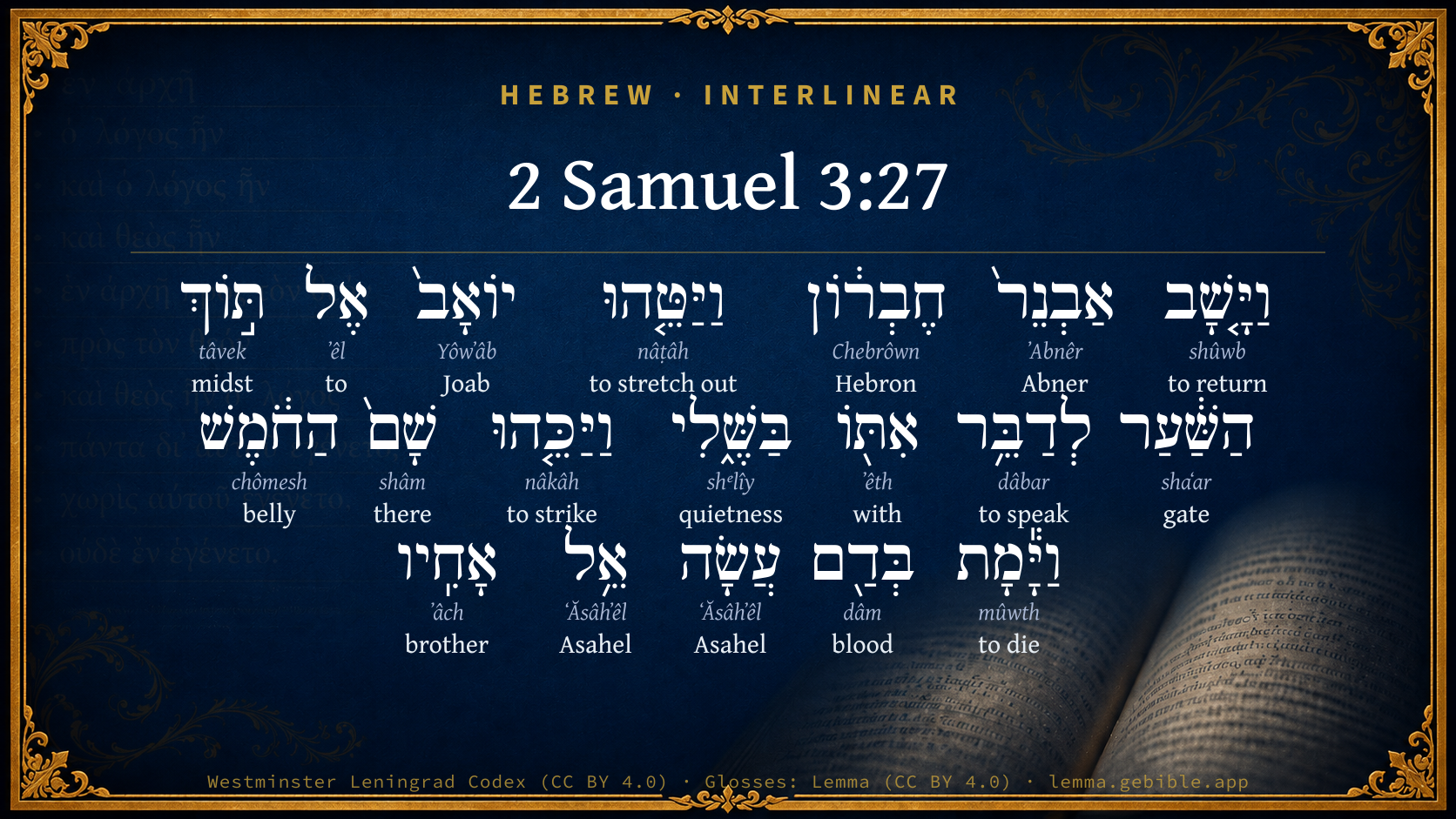
2 Samuel 3:27

Hebrew (Westminster Leningrad Codex) 2 Samuel 3:27 appears in the Hebrew Old Testament. The text above is from the Westminster Leningrad Codex. Each word links to its Strong’s number, a concise gloss, and parsing drawn from the Open Scriptures Hebrew Bible morphology. Click any word for its full Brown-Driver-Briggs (BDB) entry.
Download image
Cite this verse

2 Samuel 3:27 (World English Bible). Public Domain. Lemma interlinear Bible study tool, https://lemma.gebible.app/v/2-samuel/3/27.

Show BibTeX & RIS
BibTeX
RIS
English Translation
When Abner was returned to Hebron, Joab took him aside into the midst of the gate to speak with him quietly, and struck him there in the body, so that he died, for the blood of Asahel his brother.
World English Bible · Public Domain
Highlights
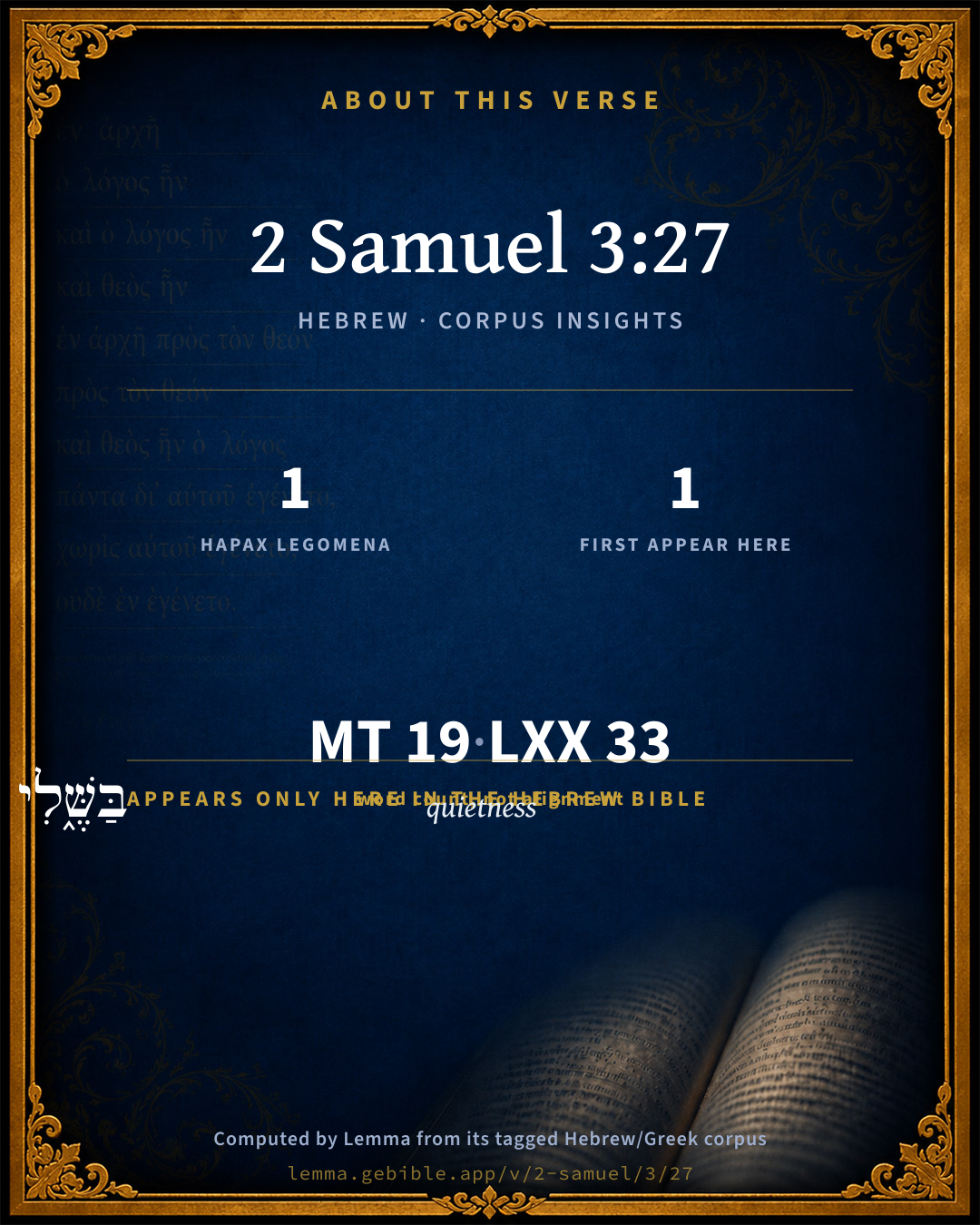
  • 1 hapax legomenon — only here in the Hebrew Bible
  • 1 first appearance in the Hebrew Bible
Full analysis ↓
Download a study sheet

One document with this verse’s original text, its word-by-word gloss line, the meaning frame, cross-references with their text, attributed commentary, and full source and license credits — printable, and it pastes into notes with its structure intact.

This verse Autodidact and up

Study sheet (.html) Plain text (.txt)

A passage Seminary Student

Up to 50 verses in one chapter. A passage sheet keeps up to 6 commentary sources and 12 cross-references per verse, in the order this page ranks them, and says so on the sheet whenever that leaves anything out. Ask for a single verse and you get the Autodidact verse sheet above.

Everything on this page stays free to read, with no account — the sheet is a download of what is already on screen, not access to it.

Want to remove ads? Support Godless Engineer
Compare translations 3

The same verse in 3 English versions, stacked beneath the original-language interlinear above. Click any original word for its lexicon entry.

Each is an independent rendering of the whole verse — the interlinear is not word-aligned to these translations.

Highlighted words mark where these versions differ — a whole-verse word diff, not a word-by-word alignment.

  • World English Bible Public Domain
    When Abner was returned to Hebron, Joab took him aside into the midst of the gate to speak with him quietly, and struck him there in the body, so that he died, for the blood of Asahel his brother.
  • King James Version Public Domain
    And when Abner was returned to Hebron, Joab took him aside in the gate to speak with him quietly, and smote him there under the fifth rib, that he died, for the blood of Asahel his brother.
  • unfoldingWord Literal Text CC BY-SA 4.0
    And Abner returned Hebron, and Joab turned him aside to the middle of the gate to speak with him in quiet. And he struck him there the stomach, and he died, for the blood of Asahel his brother.

unfoldingWord Literal Text — © unfoldingWord, licensed CC BY-SA 4.0. Word-aligned USFM3 via Door43 (git.door43.org/unfoldingWord/en_ult).

Versions to compare (up to 4)

3 of 4 selected

Show all 18 translations

Every available English version of this verse, each an independent rendering of the whole verse.

  • World English Bible Public Domain
    When Abner was returned to Hebron, Joab took him aside into the midst of the gate to speak with him quietly, and struck him there in the body, so that he died, for the blood of Asahel his brother.
  • Berean Standard Bible Public Domain
    When Abner returned to Hebron, Joab pulled him aside into the gateway, as if to speak to him privately, and there Joab stabbed him in the stomach. So Abner died on account of the blood of Joab’s brother Asahel.
  • Majority Standard Bible Public Domain
    When Abner returned to Hebron, Joab pulled him aside into the gateway, as if to speak to him privately, and there Joab stabbed him in the stomach. So Abner died on account of the blood of Joab’s brother Asahel.
  • King James Version Public Domain
    And when Abner was returned to Hebron, Joab took him aside in the gate to speak with him quietly, and smote him there under the fifth rib, that he died, for the blood of Asahel his brother.
  • American Standard Version (1901) Public Domain
    And when Abner was returned to Hebron, Joab took him aside into the midst of the gate to speak with him quietly, and smote him there in the body, so that he died, for the blood of Asahel his brother.
  • Revised Version (1885) Public Domain
    And when Abner was returned to Hebron, Joab took him aside into the midst of the gate to speak with him quietly, and smote him there in the belly, that he died, for the blood of Asahel his brother.
  • Geneva Bible (1599) Public Domain
    And when Abner was come againe to Hebron, Ioab tooke him aside in the gate to speake with him peaceably, and smote him vnder the fift ryb, that he dyed, for the blood of Asahel his brother.
  • Douay-Rheims (1899) Public Domain
    And when Abner was returned to Hebron, Joab took him aside to the middle of the gate, to speak to him treacherously: and he stabbed him there in the groin, and he died, in revenge of the blood of Asael his brother.
  • Young's Literal Translation Public Domain
    And Abner turneth back to Hebron, and Joab turneth him aside unto the midst of the gate to speak with him quietly, and smiteth him there in the fifth `rib' -- and he dieth -- for the blood of Asahel his brother.
  • Literal Standard Version CC BY-SA 4.0
    And Abner turns back to Hebron, and Joab turns him aside to the midst of the gate to speak with him quietly, and strikes him there in the fifth [rib]—and he dies—for the blood of his brother Asahel.
  • Unlocked Literal Bible CC BY-SA 4.0
    When Abner returned to Hebron, Joab took him aside in the middle of the gate to speak with him quietly. There Joab stabbed him in the stomach and killed him. In this way, Joab avenged the blood of Asahel his brother.
  • unfoldingWord Literal Text CC BY-SA 4.0
    And Abner returned Hebron, and Joab turned him aside to the middle of the gate to speak with him in quiet. And he struck him there the stomach, and he died, for the blood of Asahel his brother.
  • Darby Bible Public Domain
    And when Abner was returned to Hebron, Joab took him aside in the gate to speak with him secretly, and smote him there in the belly, that he died, for the blood of Asahel his brother.
  • World Messianic Bible Public Domain
    When Abner had returned to Hebron, Joab took him aside into the middle of the gate to speak with him quietly, and struck him there in the body, so that he died for the blood of Asahel his brother.
  • Webster's Bible Public Domain
    And when Abner had returned to Hebron, Joab took him aside in the gate to speak with him quietly, and smote him there under the fifth rib that he died, for the blood of Asahel his brother.
  • Free Bible Version CC BY-SA 4.0
    When Abner arrived back in Hebron, Joab took him aside into the town gatehouse as if he was going to talk with him in private. But Joab stabbed him in the belly, killing him in revenge for killing Joab's brother Asahel.
  • Bible in Basic English Public Domain
    And when Abner was back in Hebron, Joab took him on one side by the doorway of the town to have a word with him quietly, and there he gave him a wound in the stomach, causing his death in payment for the death of his brother Asahel.
  • JPS Tanakh (1917) Public Domain
    And when Abner was returned to Hebron, Joab took him aside into the midst of the gate to speak with him quietly, and smote him there in the groin, that he died, for the blood of Asahel his brother.

Literal Standard Version (2020), Covenant Press — licensed CC BY-SA 4.0. Text via the HelloAO Bible API (eBible.org). Unlocked Literal Bible (unfoldingWord) — licensed CC BY-SA 4.0. Text via the HelloAO Bible API (eBible.org). unfoldingWord Literal Text — © unfoldingWord, licensed CC BY-SA 4.0. Word-aligned USFM3 via Door43 (git.door43.org/unfoldingWord/en_ult). Free Bible Version, Dr. Jonathan Gallagher — licensed CC BY-SA 4.0. Text via the HelloAO Bible API (eBible.org).

Word by word

More ways to search: Search by grammar → Find every occurrence → Compare this word →

Practice this passage: Drill this verse → Learn its vocabulary →

בַּשֶּׁ֑לִי
shᵉlîy
H7987
“in/at the · quietness”
Preposition, Determined + Noun, Common, Masculine, Singular, Absolute
Part of Speech
Preposition + Noun
Type
Common
Gender
Masculine
Number
Singular
State
Absolute
Full BDB Definition

Origin: from H7951

TWOT: 2392b

quiet, private, quietness
  1. וַיָּ֤שָׁב shûwb H7725 “and · to return” Conjunction + Verb, Qal, Sequential Imperfect, 3rd Person, Masculine, Singular
  2. אַבְנֵר֙ ʼAbnêr H74 “Abner” Noun, Proper
  3. חֶבְר֔וֹן Chebrôwn H2275 “Hebron” Noun, Proper
  4. וַיַּטֵּ֤הוּ nâṭâh H5186 “and · to stretch out · him” Conjunction + Verb, Hiphil, Sequential Imperfect, 3rd Person, Masculine, Singular + Suffix, Personal, 3rd Person, Masculine, Singular
  5. יוֹאָב֙ Yôwʼâb H3097 “Joab” Noun, Proper
  6. אֶל ʼêl H413 “to” Preposition
  7. תּ֣וֹךְ tâvek H8432 “midst of” Noun, Common, Masculine, Singular, Construct
  8. הַשַּׁ֔עַר shaʻar H8179 “the · gate” Particle, Definite Article + Noun, Common, Masculine, Singular, Absolute
  9. לְדַבֵּ֥ר dâbar H1696 “to speak” Preposition + Verb, Piel, Infinitive Construct
  10. אִתּ֖וֹ ʼêth H854 “with · him” Preposition + Suffix, Personal, 3rd Person, Masculine, Singular
  11. וַיַּכֵּ֤הוּ nâkâh H5221 “and · to strike · him” Conjunction + Verb, Hiphil, Sequential Imperfect, 3rd Person, Masculine, Singular + Suffix, Personal, 3rd Person, Masculine, Singular
  12. שָׁם֙ shâm H8033 “there” Adverb
  13. הַחֹ֔מֶשׁ chômesh H2570 “the · belly” Particle, Definite Article + Noun, Common, Masculine, Singular, Absolute
  14. וַיָּ֕מָת mûwth H4191 “and · to die” Conjunction + Verb, Qal, Sequential Imperfect, 3rd Person, Masculine, Singular
  15. בְּדַ֖ם dâm H1818 “in/at · blood of” Preposition + Noun, Common, Masculine, Singular, Construct
  16. עֲשָׂה ʻĂsâhʼêl H6214 “Asahel” Noun, Proper
  17. אֵ֥ל ʻĂsâhʼêl H6214 “Asahel” Noun, Proper
  18. אָחִֽיו ʼâch H251 “brother · his” Noun, Common, Masculine, Singular, Construct + Suffix, Personal, 3rd Person, Masculine, Singular

About this verse

These counts appear in no published source. They are computed here, from the morphology-tagged text and Lemma’s own curated glosses. What Lemma adds →

19
words
18
distinct lemmas
Historical
section

Notable vocabulary

1 hapax legomenon — a word that appears only here in the entire Hebrew Bible:

  • בַּשֶּׁ֑לִי quietness H7987

First appearance in Scripture

This word makes its first canonical appearance in the Hebrew Bible here:

  • בַּשֶּׁ֑לִי quietness H7987

Shared distinctive vocabulary

הַחֹ֔מֶשׁ belly H2570 occurs in 4 verses of the Hebrew Bible. Also found in:

Grammatical profile

  • 5 verbs
  • 11 nouns
  • 2 prepositions
  • 1 adverb

Verb forms

  • וַיָּ֤שָׁב Qal · Sequential Imperfect
  • וַיַּטֵּ֤הוּ Hiphil · Sequential Imperfect
  • לְדַבֵּ֥ר Piel · Infinitive Construct
  • וַיַּכֵּ֤הוּ Hiphil · Sequential Imperfect
  • וַיָּ֕מָת Qal · Sequential Imperfect

Repetition

A word recurs within this verse — often emphatic in Hebrew:

  • עֲשָׂה Asahel H6214 ×2

Hebrew & Septuagint length

In English translation the verse runs 39 words from the Hebrew and 45 from the Septuagint (LXX English) — closely comparable.

A rough comparison of the two English renderings, which tokenize alike — not a word-level alignment.

Word counts can differ between the Hebrew and the Greek without any difference in meaning — e.g. the Hebrew direct-object marker אֵת has no separate Greek word, and Greek often adds the article ὁ.

In the original languages it is 19 Hebrew tokens and 33 Greek tokens — but the two are counted differently (Hebrew bundles its prefixes and suffixes into one token; the Greek is in lemma form), so that isn’t a like-for-like length.

Cross-references

7

Topical passages linked to 2 Samuel 3:27 in the Treasury of Scripture Knowledge — connected by theme and wording, ordered by reader-vote popularity; previews shown in the World English Bible.

  • 2 Samuel 20:9–10 Joab said to Amasa, Is it well with you, my brother? Joab took Amasa by the beard with his right hand to kiss him.
  • 1 Kings 2:5 Moreover you know also what Joab the son of Zeruiah did to me, even what he did to the two captains of the hosts of Israel, to Abner the son of Ner, and to Amasa the son of Jether, whom he killed, and shed the blood of war in peace, and put the blood of war on his sash that was about his loins, and in his shoes that were on his feet.
  • Deuteronomy 27:24 Cursed be he who strikes his neighbor in secret. All the people shall say, Amen.
  • 1 Kings 2:32 Yahweh will return his blood on his own head, because he fell on two men more righteous and better than he, and killed them with the sword, and my father David didn't know it, [to wit], Abner the son of Ner, captain of the host of Israel, and Amasa the son of Jether, captain of the host of Judah.
  • 2 Samuel 2:19–23 Asahel pursued after Abner; and in going he didn't turn to the right hand nor to the left from following Abner.
  • Jeremiah 41:2 Then arose Ishmael the son of Nethaniah, and the ten men who were with him, and struck Gedaliah the son of Ahikam the son of Shaphan with the sword, and killed him, whom the king of Babylon had made governor over the land.
  • Jeremiah 41:6–7 Ishmael the son of Nethaniah went forth from Mizpah to meet them, weeping all along as he went: and it happened, as he met them, he said to them, Come to Gedaliah the son of Ahikam.

Cross-references courtesy of OpenBible.info (CC BY 4.0).

Hebrew and Greek witnesses Masoretic Hebrew ↔ Greek Septuagint

The same verse in the two great witnesses to the Old Testament, shown verse-for-verse.

These are two independent witnesses, not word-aligned to each other, and the Septuagint is shown in lemma (dictionary) form.

Hebrew 2 Samuel 3:27 Masoretic · Westminster Leningrad Codex

וַיָּ֤שָׁב אַבְנֵר֙ חֶבְר֔וֹן וַיַּטֵּ֤הוּ יוֹאָב֙ אֶל תּ֣וֹךְ הַשַּׁ֔עַר לְדַבֵּ֥ר אִתּ֖וֹ בַּשֶּׁ֑לִי וַיַּכֵּ֤הוּ שָׁם֙ הַחֹ֔מֶשׁ וַיָּ֕מָת בְּדַ֖ם עֲשָׂה אֵ֥ל אָחִֽיו

When Abner was returned to Hebron, Joab took him aside into the midst of the gate to speak with him quietly, and struck him there in the body, so that he died, for the blood of Asahel his brother.

World English Bible · Public Domain

Greek LXX 2 Samuel 3:27 Septuagint · lemma form

καί ἐπιστρέφω αβεννηρ εἰς χεβρων καί ἐκκλίνω αὐτός ιωαβ ἐκ πλάγιος ὁ πύλη λαλέω πρός αὐτός ἐνεδρεύω καί πατάσσω αὐτός ἐκεῖ ἐπί ὁ ψόα καί ἀποθνήσκω ἐν ὁ αἷμα ασαηλ ὁ ἀδελφός ιωαβ

And he brought back Abenner to Chebron, and Joab caused him to turn aside from the gate to speak to him, laying wait for him: and he struck him there in the loins, and he died for the blood of Asael the brother of Joab.

LXX2012 (modern English Septuagint) · Public Domain

On this verse, Trapp's Complete Commentary discusses the Septuagint’s reading. Read the note in Commentary ↓

Hebrew: Westminster Leningrad Codex (CC BY 4.0). Greek: Septuagint (public domain); English from LXX2012 (modern English Septuagint) (Public Domain). How the Septuagint differs from the Hebrew →

Targum (Aramaic paraphrase)

1

The Targum is the ancient Jewish Aramaic paraphrase of the Hebrew Scriptures — an interpretive translation, not the Hebrew text itself. Onkelos (literal) and Pseudo-Jonathan (expansive) render the Torah, and Jonathan the Prophets. Coverage is partial: where no permissively-licensed English translation exists for a verse, only the Aramaic is shown. This is verse-level text, not a word-by-word alignment to the Hebrew.

  1. Targum Jonathan Prophets (Joshua–Malachi)
    וְתַב אַבְנֵר לְחֶבְרוֹן וְאַפְנֵיהּ יוֹאָב לְגוֹ תַרְעָא לְמַלָלָא עִמֵיהּ בְּשֵׁלַיָא וּמְחָהִי תַמָן בִּסְטַר יַרְכֵיהּ וּמִית בִּדְמָא דַעֲשָׂהאֵל אֲחוּהִי:

    (no public-domain English translation for this verse)

    Targum Jonathan — Aramaic: “Mikraot Gedolot” (public domain). English: “Sefaria Community Translation” (CC0 1.0 (public-domain dedication)); “London "Chaldee Paraphrase," 1871” (public domain). Text via Sefaria.

Commentary

Notes on 2 Samuel 3:27 from classic Christian and Jewish commentators (each source and its license shown beneath its notes). The classic Christian expositions comment on the surrounding passage and are grouped to its opening verse, so a note may address several verses; the Jewish commentaries on the Tanakh (Rashi and others) are per-verse, so they appear only where the commentator wrote on this verse.

Lemma curates 59 commentaries, every one of them public domain or Creative Commons licensed, each selected and text-cleaned for this edition rather than reprinted as found. About our sources →

Trapp's Complete Commentary

John Trapp

2Sa 3:27 And when Abner was returned to Hebron, Joab took him aside in the gate to speak with him quietly, and smote him there under the fifth [rib], that he died, for the blood of Asahel his brother.

Ver. 27. To speak with him quietly.] Or, Peaceably, or privately. Tremellius rendereth it imprudeutem, unwitting: the LXX, εν παραλογισμω, by a fallacy.

And smote him under the fifth rib.] Basely and treacherously, but not without divine providence: that David might come a fairer way to the kingdom, than by Abner’s perfidy.

For the blood of Asahel his brother.] This was the pretext, and might be some cause; but the main reason was, lest Abner should by David be promoted above him.

John Trapp, A Commentary or Exposition upon All the Books of the Old and New Testament (1647–1656) — public domain. Text from a community e-Sword module.

Tyndale Open Study Notes

Tyndale Open Resources

3:27 as if to speak with him privately: Joab accused Abner of deception (3:25), but he used deception himself to lure Abner to his death. • in revenge: Joab was motivated by the practice of blood vengeance, avenging the death of a kinsman by killing the killer.

Tyndale Open Study Notes — © Tyndale Open Resources, licensed CC BY-SA 4.0. Text via the HelloAO Bible API.

Geneva Bible (1599)

Geneva Bible translators

Or, secretly.

Geneva Bible (1599) marginal notes — public domain. Text via Bolls.life.

Adam Clarke's Commentary

Verse 27. And smote him there] Joab feared that, after having rendered such essential services to David, Abner would be made captain of the host: he therefore determined to prevent it by murdering the man, under pretense of avenging the death of his brother Asahel.

The murder, however, was one of the most unprovoked and wicked: and such was the power and influence of this nefarious general, that the king dared not to bring him to justice for his crime. In the same way he murdered Amasa, a little time afterwards. See 2Sa 20:10. Joab was a cool-blooded, finished murderer. "Treason and murder ever keep together, like two yoke-devils."

Adam Clarke's Commentary on the Bible (1810–1826) — public domain. Text from a community e-Sword/MySword module.

Ellicott's Commentary for English Readers

(27) Aside in the gate.—The gateway was a customary place of conference in the East, and Joab there awaited Abner’s return; he then took him “aside” to some place of privacy, as the LXX. reads, “by the side of the gate.” On the phrase “fifth rib,” see Note on 2Sa_2:23. The reason for this cold-blooded and treacherous murder on the part of Joab is expressly said to be “for the blood of Asahel his brother;” but no doubt his revenge was quickened by jealousy.

A Bible Commentary for English Readers, edited by Charles John Ellicott (1878–1897) — public domain. Text from a community e-Sword module.

The Cambridge Bible for Schools and Colleges

gen. ed. J. J. S. Perowne

27. in the gate] Lit. into the midst of the gate, the space between the inner and outer gateways. But the publicity of the city gate was unsuited to a private conference, and the Sept. offers a more probable reading, “took him apart by the side of the gate.”

under the fifth rib] In the belly. See note on 2Sa_2:23.

for the blood of Asahel his brother] Since Abner had slain Asahel in self-defence (ch. 2Sa_2:23), Joab’s act was not justifiable on the score of blood-revenge. This was merely a convenient pretext for getting rid of a dangerous rival. He foresaw that if he allowed Abner to have the credit of placing the crown of Israel on David’s head, he would lose his own position and influence. Failing in his endeavour to persuade David that Abner was playing him false, with characteristic unscrupulousness he planned this deliberate and treacherous murder, as on a later occasion he murdered his rival Amasa (ch. 2Sa_20:10).

The Cambridge Bible for Schools and Colleges (gen. ed. J. J. S. Perowne; Cambridge University Press, 1878–1918) — public domain. Text from a community e-Sword module.

John Gill's Exposition

And when Abner was returned to Hebron,.... Alone, and not the twenty men with him; not to David's court, but just to the city, to the gate of it:

Joab took him aside in the gate: where he was waiting for him, and met him; this was a public place, where people were continually passing and repassing, and where courts of judicature used to be held; wherefore Abner might think himself safe here with Joab, and have no suspicion at all of his design, and shows how fearless Joab was of God or men:

to speak with him quietly; peaceably, in a friendly manner, as all his gestures towards him showed; so that Abner made no difficulty of turning aside with him, supposing he had something to communicate to him from the king, which he had forgot:

and smote him under the fifth rib, that he died; in the same place that Abner had smote his brother, of which see Sa2 2:23; and this he did:

for the blood of Asahel his brother; for Abner's shedding his brother's blood; but this was not the only reason, and perhaps not the chief; but, as Josephus (h) observes, because he was fearful if Abner was received into the friendship of the king, he would be preferred unto him, and take his place as general of the army, as being an older and more experienced officer; so Procopius Gazaeus, and Theodoret.

(h) Antiqu. l. 7. c. 1. sect. 5.

John Gill's Exposition of the Whole Bible (1746–1763) — public domain (CC PDM 1.0). Text via the HelloAO Bible API.

Haydock's Catholic Bible Commentary

Middle. Septuagint, "sides." --- Brother; (who had been wounded in the same place) a just punishment of Abner’s licentiousness. (Salien) --- This was given out as the pretext of the murder; but envy seems to have been the chief promoter. (Menochius) --- Joab treated Amasa in the same manner, chap. xx. 10. Ambition was his god. (Calmet) --- Abisai was ready to assist him to murder Abner, ver. 30. Thus the fairest prospects of union seemed to vanish, and David was sincerely grieved, as he manifested in the most decided manner, confessing it was only the want of power which prevented him from bringing these merciless and potent brothers, his own nephews, to immediate punishment, ver. 39. (Haydock)

George Leo Haydock (1774–1849), Haydock's Catholic Family Bible and Commentary, 1859 edition — public domain. Excludes Psalms (Douay-Rheims chapter numbering differs from Protestant) and Deuterocanonical books (Catholic canon only).

Matthew Poole's English Annotations

In the gate; in the entrance into the city before he came to the king; and in the place where conferences used to be.

Quietly; with appearance of great civility and kindness. Or, secretly, as having some matter of great importance to utter, which none but himself must hear.

Smote him there under the fifth rib; as he did Asahel, 2Sa 2:23.

For the blood of Asahel his brother; to revenge the death of Asahel; and withal (though that be not here mentioned) to secure his own standing, and rid his hands of so great and powerful a competitor. And thus was Joab’s design; but God had other designs in it, both to punish Abner’s manifest wickedness, and particularly his rebellion against David, and against God and his own conscience therein; and that David might not owe his kingdom to Abner, and to his revenge and treachery, but wholly to God’s wise and powerful providence.

Matthew Poole's English Annotations on the Holy Bible (1683–1685) — public domain. Text from a community e-Sword/MySword module.

Whedon's Commentary on the Bible

Daniel D. Whedon

27. For the blood of Asahel — This ostensibly, but doubtless another reason, was a jealous fear lest Abner should supersede him in office and power with David.

Daniel D. Whedon (gen. ed.), Commentary on the Old and New Testaments (1874–1909) — public domain. Text from a community e-Sword module.

The Pulpit Commentary

Joab took him aside in the gate. As we read in 2Sa_18:24 of David sitting "between the two gates," and of "the roof over thegate," and in ver. 33 of "the chamber over the gate," Ewald"s idea of there being a roofed inner space, with a guard room over it, as in the mediaeval gate towers in German towns, is probably right. As the "two gates" would make the space between them gloomy, the spot would just suit Joab"s purpose. He meets Abner, therefore, in a friendly manner, and drawing him aside, as if to converse with him apart from the people going in and out, there assassinates him. The place was so public that the deed must have been witnessed by multitudes, though the gloom, felt the more by them from the contrast with the bright glare of sunshine outside, had given Joab the opportunity of drawing his sword without Abner"s observing it. For the blood of Asahel his brother. Joab"s act was in accordance with Oriental feeling; and the duties of the avenger of blood might with some straining be made to cover his retaliation for an act done by Abner in self-defence. (Num_35:26, Num_35:27) It is remarkable that Hebron was itself a city of refuge, (Jos_20:7) and this may have led Joab to murder him in the gate, before he had actually entered. Still, Abner did not expect any such retribution, and supposing that Joab knew of the purpose that had brought him to Hebron, he could not suppose that he would be so indifferent to his master"s interests as to put a summary stop to the negotiations for uniting the tribes under David. As it was, this deed brought upon David an evil name, and four or five years had to elapse before the tribes could be induced to take him for their king. Even then his hold over them was far less than it would otherwise have been; for though the shock was gradually got over, yet the suspicion still dung to him. And if the deed was Joab"s own act, still David had contributed to it by underhand dealings. His very fear of Joab had caused him to wrong his able general, and given him just cause for resentment.

The Pulpit Commentary (1880–1919), ed. H.D.M. Spence-Jones & Joseph S. Exell — public domain. Text from a community e-Sword module.

unfoldingWord translationNotes

Door43 World Missions Community

the middle of the gate

This refers to one of the gates in the city wall at Hebron. As the UDB implies, city gates were constructed as part of buildings set into the city walls. Inside the passageway were doors leading to side rooms, where guests could be received and business and judicial proceedings could be conducted. It was probably in one of these rooms that Joab murdered Abner.

the blood of Asahel

Here "blood" is associated with the death of Asahel. AT: "the death of Asahel" (See: Metonymy)

Asahel

This is the name of a male person. (See: How to Translate Names)

translationWords

Hebron

gate

avenge

blood

brother

unfoldingWord translationNotes — © Distant Shores Media and the Door43 World Missions Community, licensed CC BY-SA 4.0. Source: git.door43.org/Door43/en_tn.

Rashi

Rabbi Shlomo Yitzchaki (Rashi)

Within the gate. [Yoav brought Avner] before a sanhedrin to be judged for the [spilling of] blood of his brother, Asoel.

Deceptively. In a mistake provoking [way] so that Avner would not realize that it is in [Yoav's] heart to kill him. Cut up the verse [to rearrange it's words as follows] "and Yoav steered him deceptively to go within the gate to talk to him."

Rashi on the Tanakh — English translations: “The Judaica Press complete Tanach with Rashi, translated by A. J. Rosenberg” (CC BY 4.0); “Pentateuch with Rashi's commentary by M. Rosenbaum and A.M. Silbermann, 1929-1934” (public domain); “The Metsudah Tanach series, Lakewood, N.J” (CC BY 4.0); and “The Book of Joshua, Metsudah Publications, 1997” (CC BY 4.0). Text via Sefaria.

Lesson kit

Teaching starters — assembled from the data on this page, not authored interpretation. Every prompt links to the verse data it draws on. Edit before teaching.

2 Samuel, in the Historical, opens this verse with 19 words (18 distinct Hebrew lemmas). Its most distinctive word is shᵉlîy (“quietness”). A historical commentator’s framing appears above. Read the whole chapter for the surrounding context.

Discussion questions

  1. The word shᵉlîy carries the sense “quietness.” How does it shape the verse?
  2. 1 word here appears nowhere else in the Hebrew Bible. Why might the author reach for such rare wording?
  3. This is the first place “quietness” appears in Scripture (first appears here). What does its debut here establish?
  4. How does 2 Samuel 2:23, which shares the word «belly», read alongside this verse?
  5. What does the repetition of “Asahel” (2× in this one verse) do in this verse?
  6. These translations render this verse differently; the difference is in the English rendering, not the original. What questions does that raise?
  7. «וַיָּ֤שָׁב» is a Qal Sequential Imperfect verb. How does that grammatical form shape the action described?
  8. Compare how Trapp's Complete Commentary and Tyndale Open Study Notes read this verse. Where do they agree or differ?

Things to notice

  • 1 word in this verse appears nowhere else in the Hebrew Bible.
  • 1 word makes its first canonical appearance in Scripture here.
  • This verse counts 19 Hebrew ↔ 33 Greek words.
  • These translations choose different wording for 15 words in this verse.
  • “Asahel” occurs 2× in this single verse.

Reading settings

Reading text

Shown beneath each verse's original-language words.

Old Testament
Old Testament edition

Read the OT as the Masoretic Hebrew (MT) or the Greek Septuagint (LXX).

English shown for the Greek Septuagint (in the Hebrew ↔ Greek comparison).

Comparing translations? Open the Compare panel on any verse page to stack up to four side by side.