
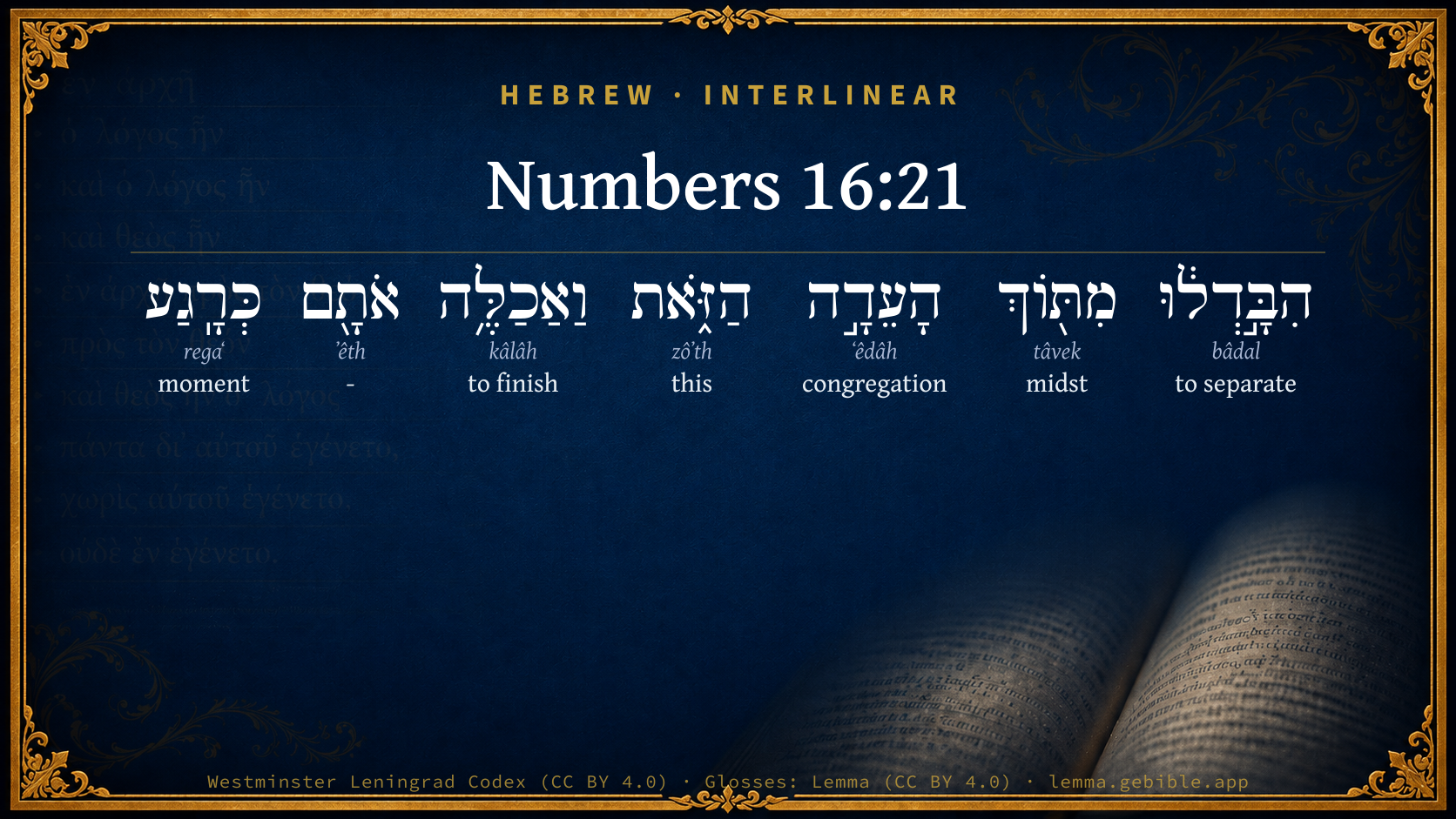
Numbers 16:21

Hebrew (Westminster Leningrad Codex) Numbers 16:21 appears in the Hebrew Old Testament. The text above is from the Westminster Leningrad Codex. Each word links to its Strong’s number, a concise gloss, and parsing drawn from the Open Scriptures Hebrew Bible morphology. Click any word for its full Brown-Driver-Briggs (BDB) entry.
Download image
Cite this verse

Numbers 16:21 (World English Bible). Public Domain. Lemma interlinear Bible study tool, https://lemma.gebible.app/v/numbers/16/21.

Show BibTeX & RIS
BibTeX
RIS
English Translation
Separate yourselves from among this congregation, that I may consume them in a moment.
World English Bible · Public Domain
Download a study sheet

One document with this verse’s original text, its word-by-word gloss line, the meaning frame, cross-references with their text, attributed commentary, and full source and license credits — printable, and it pastes into notes with its structure intact.

This verse Autodidact and up

Study sheet (.html) Plain text (.txt)

A passage Seminary Student

Up to 50 verses in one chapter. A passage sheet keeps up to 6 commentary sources and 12 cross-references per verse, in the order this page ranks them, and says so on the sheet whenever that leaves anything out. Ask for a single verse and you get the Autodidact verse sheet above.

Everything on this page stays free to read, with no account — the sheet is a download of what is already on screen, not access to it.

Want to remove ads? Support Godless Engineer
Compare translations 3

The same verse in 3 English versions, stacked beneath the original-language interlinear above. Click any original word for its lexicon entry.

Each is an independent rendering of the whole verse — the interlinear is not word-aligned to these translations.

Highlighted words mark where these versions differ — a whole-verse word diff, not a word-by-word alignment.

  • World English Bible Public Domain
    Separate yourselves from among this congregation, that I may consume them in a moment.
  • King James Version Public Domain
    Separate yourselves from among this congregation, that I may consume them in a moment.
  • unfoldingWord Literal Text CC BY-SA 4.0
    “Separate yourselves from the midst of this congregation, and I shall finish them according to a moment.”

unfoldingWord Literal Text — © unfoldingWord, licensed CC BY-SA 4.0. Word-aligned USFM3 via Door43 (git.door43.org/unfoldingWord/en_ult).

Versions to compare (up to 4)

3 of 4 selected

Show all 18 translations

Every available English version of this verse, each an independent rendering of the whole verse.

  • World English Bible Public Domain
    Separate yourselves from among this congregation, that I may consume them in a moment.
  • Berean Standard Bible Public Domain
    “Separate yourselves from this congregation so that I may consume them in an instant.”
  • Majority Standard Bible Public Domain
    “Separate yourselves from this congregation so that I may consume them in an instant.”
  • King James Version Public Domain
    Separate yourselves from among this congregation, that I may consume them in a moment.
  • American Standard Version (1901) Public Domain
    Separate yourselves from among this congregation, that I may consume them in a moment.
  • Revised Version (1885) Public Domain
    Separate yourselves from among this congregation, that I may consume them in a moment.
  • Geneva Bible (1599) Public Domain
    Separate your selues from among this Cogregation, that I may consume them at once.
  • Douay-Rheims (1899) Public Domain
    Separate yourselves from among this congregation, that I may presently destroy them.
  • Young's Literal Translation Public Domain
    `Be ye separated from the midst of this company, and I consume them in a moment;'
  • Literal Standard Version CC BY-SA 4.0
    “Be separated from the midst of this congregation, and I consume them in a moment”;
  • Unlocked Literal Bible CC BY-SA 4.0
    “Separate yourselves from among this community that I may consume them immediately.”
  • unfoldingWord Literal Text CC BY-SA 4.0
    “Separate yourselves from the midst of this congregation, and I shall finish them according to a moment.”
  • Darby Bible Public Domain
    Separate yourselves from the midst of this assembly, and I will consume them in a moment.
  • World Messianic Bible Public Domain
    “Separate yourselves from among this congregation, that I may consume them in a moment!”
  • Webster's Bible Public Domain
    Separate yourselves from among this congregation, that I may consume them in a moment.
  • Free Bible Version CC BY-SA 4.0
    “Step away from these Israelites and I will destroy them right away.”
  • Bible in Basic English Public Domain
    Come out from among this people, so that I may send sudden destruction on them.
  • JPS Tanakh (1917) Public Domain
    'Separate yourselves from among this congregation, that I may consume them in a moment.'

Literal Standard Version (2020), Covenant Press — licensed CC BY-SA 4.0. Text via the HelloAO Bible API (eBible.org). Unlocked Literal Bible (unfoldingWord) — licensed CC BY-SA 4.0. Text via the HelloAO Bible API (eBible.org). unfoldingWord Literal Text — © unfoldingWord, licensed CC BY-SA 4.0. Word-aligned USFM3 via Door43 (git.door43.org/unfoldingWord/en_ult). Free Bible Version, Dr. Jonathan Gallagher — licensed CC BY-SA 4.0. Text via the HelloAO Bible API (eBible.org).

Word by word

More ways to search: Search by grammar → Find every occurrence → Compare this word →

Practice this passage: Drill this verse → Learn its vocabulary →

כְּרָֽגַע
regaʻ
H7281
“like/as · moment”
Preposition + Noun, Common, Masculine, Singular, Absolute
Part of Speech
Preposition + Noun
Type
Common
Gender
Masculine
Number
Singular
State
Absolute
Full BDB Definition

Origin: from H7280 a wink (of the eyes), i.e. a very short space of time

TWOT: 2116a

a moment (noun masculine) - for a moment, at one moment...at another moment (adverb) - in a moment (with preposition)
  1. הִבָּ֣דְל֔וּ bâdal H914 “separate” Verb, Niphal, Imperative, 2nd Person, Masculine, Plural
  2. מִתּ֖וֹךְ tâvek H8432 “from · midst of” Preposition + Noun, Common, Masculine, Singular, Construct
  3. הָעֵדָ֣ה ʻêdâh H5712 “the · congregation” Particle, Definite Article + Noun, Common, Feminine, Singular, Absolute
  4. הַזֹּ֑את zôʼth H2063 “the · this” Particle, Definite Article + Pronoun, Demonstrative, Feminine, Singular
  5. וַאַכַלֶּ֥ה kâlâh H3615 “and · to finish” Conjunction + Verb, Piel, Cohortative, 1st Person, Common, Singular
  6. אֹתָ֖ם ʼêth H853 “- · them” Particle, Direct Object + Suffix, Personal, 3rd Person, Masculine, Plural

About this verse

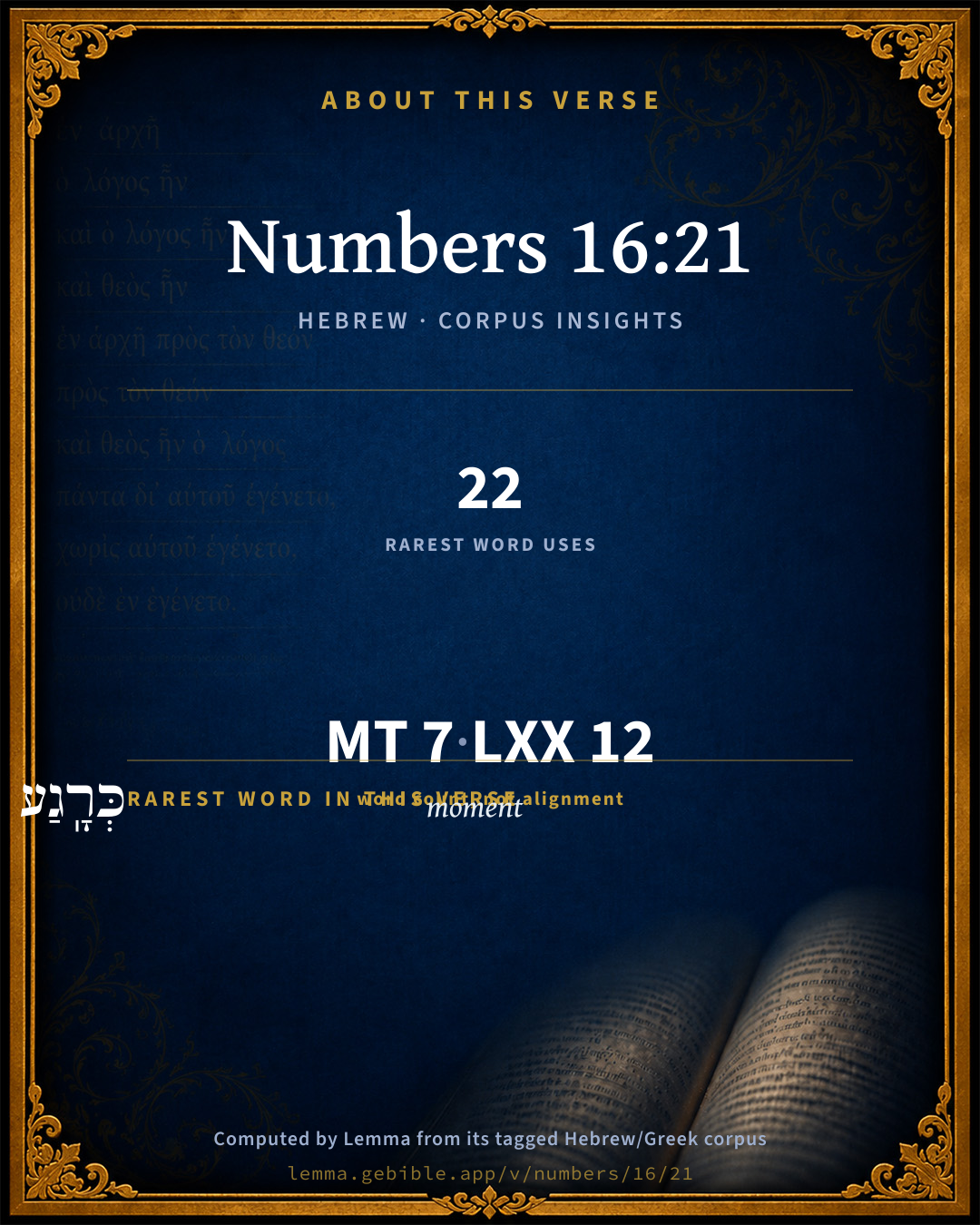
These counts appear in no published source. They are computed here, from the morphology-tagged text and Lemma’s own curated glosses. What Lemma adds →

7
words
7
distinct lemmas
Pentateuch
section

Notable vocabulary

The rarest word here is כְּרָֽגַע moment H7281 — appearing just 22 times in the whole Hebrew Bible.

Shared distinctive vocabulary

כְּרָֽגַע moment H7281 occurs in 22 verses of the Hebrew Bible. Also found in:

Grammatical profile

  • 2 verbs
  • 3 nouns
  • 1 pronoun
  • 1 particle

Verb forms

  • הִבָּ֣דְל֔וּ Niphal · Imperative
  • וַאַכַלֶּ֥ה Piel · Cohortative

Hebrew & Septuagint length

In English translation the verse runs 14 words from the Hebrew and 16 from the Septuagint (LXX English) — closely comparable.

A rough comparison of the two English renderings, which tokenize alike — not a word-level alignment.

Word counts can differ between the Hebrew and the Greek without any difference in meaning — e.g. the Hebrew direct-object marker אֵת has no separate Greek word, and Greek often adds the article ὁ.

In the original languages it is 7 Hebrew tokens and 12 Greek tokens — but the two are counted differently (Hebrew bundles its prefixes and suffixes into one token; the Greek is in lemma form), so that isn’t a like-for-like length.

Cross-references

14

Topical passages linked to Numbers 16:21 in the Treasury of Scripture Knowledge — connected by theme and wording, ordered by reader-vote popularity; previews shown in the World English Bible.

  • Exodus 32:10 Now therefore leave me alone, that my wrath may burn hot against them, and that I may consume them; and I will make of you a great nation."
  • Numbers 16:45 Get away from among this congregation, that I may consume them in a moment. They fell on their faces.
  • Exodus 33:5 Yahweh said to Moses, "Tell the children of Israel, 'You are a stiff-necked people. If I were to go up into your midst for one moment, I would consume you. Therefore now take off your jewelry from you, that I may know what to do to you."
  • Psalms 73:19 How they are suddenly destroyed! They are completely swept away with terrors.
  • Revelation 18:4 I heard another voice from heaven, saying, "Come out of her, my people, that you have no participation in her sins, and that you don't receive of her plagues,
  • Genesis 19:15–22 When the morning arose, then the angels hurried Lot, saying, "Arise, take your wife, and your two daughters who are here, lest you be consumed in the iniquity of the city."
  • Numbers 14:12 I will strike them with the pestilence, and disinherit them, and will make of you a nation greater and mightier than they.
  • Numbers 14:15 Now if you shall kill this people as one man, then the nations which have heard the fame of you will speak, saying,
  • Isaiah 37:36 The angel of Yahweh went forth, and struck in the camp of the Assyrians one hundred and eighty-five thousand; and when men arose early in the morning, behold, these were all dead bodies.
  • Jeremiah 5:16 Their quiver is an open tomb, they are all mighty men.
  • Acts 2:40 With many other words he testified, and exhorted them, saying, "Save yourselves from this crooked generation!"
  • 2 Corinthians 6:17 Therefore, "'Come out from among them, And be separate,' says the Lord, 'Touch no unclean thing. I will receive you.
  • Ephesians 5:6–7 Let no one deceive you with empty words. For because of these things, the wrath of God comes on the children of disobedience.
  • Hebrews 12:28–29 Therefore, receiving a Kingdom that can't be shaken, let us have grace, through which we serve God acceptably, with reverence and awe,

Cross-references courtesy of OpenBible.info (CC BY 4.0).

Hebrew and Greek witnesses Masoretic Hebrew ↔ Greek Septuagint

The same verse in the two great witnesses to the Old Testament, shown verse-for-verse.

These are two independent witnesses, not word-aligned to each other, and the Septuagint is shown in lemma (dictionary) form.

Hebrew Numbers 16:21 Masoretic · Westminster Leningrad Codex

הִבָּ֣דְל֔וּ מִתּ֖וֹךְ הָעֵדָ֣ה הַזֹּ֑את וַאַכַלֶּ֥ה אֹתָ֖ם כְּרָֽגַע

Separate yourselves from among this congregation, that I may consume them in a moment.

World English Bible · Public Domain

Greek LXX Numbers 16:21 Septuagint · lemma form

ἀποσχίζω ἐκ μέσος ὁ συναγωγή οὗτος καί ἐκ ἀναἁλίσκω αὐτός εἰς ἅπαξ

Separate your selves from the midst of this congregation, and I will consume them at once.

LXX2012 (modern English Septuagint) · Public Domain

Hebrew: Westminster Leningrad Codex (CC BY 4.0). Greek: Septuagint (public domain); English from LXX2012 (modern English Septuagint) (Public Domain). How the Septuagint differs from the Hebrew →

Targum (Aramaic paraphrase)

2

The Targum is the ancient Jewish Aramaic paraphrase of the Hebrew Scriptures — an interpretive translation, not the Hebrew text itself. Onkelos (literal) and Pseudo-Jonathan (expansive) render the Torah, and Jonathan the Prophets. Coverage is partial: where no permissively-licensed English translation exists for a verse, only the Aramaic is shown. This is verse-level text, not a word-by-word alignment to the Hebrew.

  1. Targum Onkelos Torah (Genesis–Deuteronomy)
    אִתְפְּרָשׁוּ מִגוֹ כְּנִשְׁתָּא הָדָא וֶאֱשֵׁיצֵי יַתְהוֹן כְּשָׁעָה

    (no public-domain English translation for this verse)

    Targum Onkelos — Aramaic: “Onkelos Genesis” (public domain); “Onkelos Exodus” (public domain); “Onkelos Leviticus” (public domain); “Onkelos Numbers” (public domain); “Onkelos Deuteronomy” (public domain). English: “Sefaria Community Translation” (CC0 1.0 (public-domain dedication)); “J.W. Etheridge. The Targums of Onkelos and Jonathan Ben Uzziel on the Pentateuch. London: Longmans, Green, 1862” (public domain). Text via Sefaria.

  2. Targum Pseudo-Jonathan Torah (Genesis–Deuteronomy)
    אִתְפְּרָשׁוּ מִגוֹ כְּנִישְׁתָּא הֲדָא וְאֵישֵׁיצֵי יַתְהוֹן כְּשָׁעָה זְעֵירָא

    Separate yourselves from among this congregation, that I may destroy them quickly.

    Targum Pseudo-Jonathan — Aramaic: “Targum Jonathan on Genesis” (public domain); “Targum Jonathan on Exodus” (public domain); “Targum Jonathan on Leviticus” (public domain); “Targum Jonathan on Numbers” (public domain); “Targum Jonathan on Deuteronomy” (public domain). English: “The Targum of Jonathan ben Uzziel, trans. J. W. Etheridge, London, 1862” (public domain). Text via Sefaria.

Commentary

Notes on Numbers 16:21 from classic Christian and Jewish commentators (each source and its license shown beneath its notes). The classic Christian expositions comment on the surrounding passage and are grouped to its opening verse, so a note may address several verses; the Jewish commentaries on the Tanakh (Rashi and others) are per-verse, so they appear only where the commentator wrote on this verse.

Lemma curates 59 commentaries, every one of them public domain or Creative Commons licensed, each selected and text-cleaned for this edition rather than reprinted as found. About our sources →

Trapp's Complete Commentary

John Trapp

Num 16:21 Separate yourselves from among this congregation, that I may consume them in a moment.

Ver. 21. Separate yourselves.] Good men are taken away from the evil to come. When God pulls away the pillars, what will become of the building? Lot was no sooner taken out of Sodom, but Sodom was taken out of the world.

John Trapp, A Commentary or Exposition upon All the Books of the Old and New Testament (1647–1656) — public domain. Text from a community e-Sword module.

Tyndale Open Study Notes

Tyndale Open Resources

16:21-26 The Lord threatened to destroy the entire community because of its pervasive sin (cp. Gen 18:16-33). Moses and Aaron interceded to narrow the Lord’s judgment down to those who were guilty of this particular rebellion.

Tyndale Open Study Notes — © Tyndale Open Resources, licensed CC BY-SA 4.0. Text via the HelloAO Bible API.

Ellicott's Commentary for English Readers

(21) Separate yourselves from among this congregation . . . —By their obedience to the summons of Korah the congregation generally, or at Yeast a large portion of it, had made themselves partakers in his sin, and had become obnoxious to the Divine wrath.

A Bible Commentary for English Readers, edited by Charles John Ellicott (1878–1897) — public domain. Text from a community e-Sword module.

John Gill's Exposition

Separate yourselves, from among this congregation,.... Not only from Korah's company, but from the congregation of the children of Israel, whom Korah had got together, besides the two hundred fifty men that were at first with him; who by their words and behaviour, and particularly by their association and standing along with him, showed them to be on his side, which greatly provoked the Lord:

that I may consume them in a moment; by fire from him, as the two hundred fifty men were afterwards consumed, Num 16:35.

John Gill's Exposition of the Whole Bible (1746–1763) — public domain (CC PDM 1.0). Text via the HelloAO Bible API.

Matthew Poole's English Annotations

To wit, Korah and his two hundred and fifty men, and the people whom he gathered against Moses and Aaron, Num 16:19.

Matthew Poole's English Annotations on the Holy Bible (1683–1685) — public domain. Text from a community e-Sword/MySword module.

Whedon's Commentary on the Bible

Daniel D. Whedon

21. Separate yourselves — This command to withdraw themselves from the congregation was not obeyed, but through intercession the command was tacitly countermanded.

Consume them — By assembling at the instigation of Korah this whole congregation had avowed their adherence to the rebels.

In a moment — Here is an outflashing of justice untempered by mercy.

Daniel D. Whedon (gen. ed.), Commentary on the Old and New Testaments (1874–1909) — public domain. Text from a community e-Sword module.

The Pulpit Commentary

That I may consume them in a moment. Literally, "and I will consume them." The same thing must be said of this as of Num_14:11, Num_14:12.

The Pulpit Commentary (1880–1919), ed. H.D.M. Spence-Jones & Joseph S. Exell — public domain. Text from a community e-Sword module.

Ramban (Nachmanides)

Rabbi Moshe ben Nachman (Ramban / Nachmanides)

SEPARATE YOURSELVES FROM AMONG THIS CONGREGATION, THAT I MAY CONSUME THEM IN A MOMENT. One may ask: If [the whole people of] Israel did not sin and did not rebel against their teacher, why was [G-d’s] wrath upon them, saying, that I may consume them in a moment? And if [on the other hand] they also rebelled [against Moses] as did Korach and his company, how could Moses and Aaron say [on their behalf]: shall one man sin, and wilt Thou be wroth with all the congregation? Now Rabbeinu Chananel wrote as follows: “Separate yourselves from among this congregation means the congregation of Korach, not the congregation of the children of Israel. [But Moses and Aaron, thinking that G-d referred to all the people], said: O G-d, the G-d of the spirits of all flesh, shall one man sin etc. Immediately the Holy One, blessed be He, informed Moses that He did not want to destroy the whole congregation of the children of Israel, but only the congregation of Korach. Therefore He explained to him: ‘When I said, Separate yourselves from among this congregation, the meaning was: Get you up from about the dwelling of Korach, Dathan, and Abiram. He told them, Get you up from about the dwelling etc., because perhaps when Korach and his company would see them going away, they might repent.”These are his [Rabbeinu Chananel’s] words, which are not right, for it would not be correct to say about Korach, Dathan, and Abiram — three men — Separate yourselves from among ‘this congregation,’ for they were not “a congregation,” since the Israelites were not among them, and Aaron was going about in the midst of the congregation that offered the incense! Besides, the expression separate ‘yourselves’ alludes only to Moses and Aaron, just like Get you up from among the congregation. Similarly, that I may consume them in a moment refers to a plague, which consumes a mighty and large people in a moment [and cannot therefore refer only to Korach, Dathan, and Abiram]. And [finally], far be it [from us to say] that Moses did not understand his own prophecy and made a mistake therein!But the meaning thereof is as follows: At first the heart of the people was on the side of Moses and Aaron, but when Korach and his company took every man his censer and laid incense thereon and stood at the door of the Tent of Meeting with Moses and Aaron, Korach called together all the congregation and told them that he was concerned about the honor of all of them. This was pleasing to them, so they all assembled to see peradventure it will be right in the eyes of G-d, and the service [of the offerings] will return to their firstborn, this being the meaning of the verse, And Korach assembled all the congregation against them. Thus they [all] became liable to destruction because they cast aspersions on their teacher, which is like casting aspersions on the Divine Presence, and they [likewise] rejected in their hearts the prophecy of a prophet, for which they were liable to death by the hand of Heaven. But Moses and Aaron spoke up in their defense, saying that it was only Korach who sinned in this matter, for he was the cause of it all and it was he who incited them, therefore it was right that he alone should die, in order to publicize and make known his punishment to the [whole] community.This is indeed the way of those who plead for mercy, for they mitigate the [severity of the] people’s sin, and put [the blame for] it upon the individual who caused it, because he at any rate is [certainly] guilty. And so did David say, Lo, I have sinned, and I have done iniquitously; but these sheep, what have they done? Let Thy hand, I pray thee, be against me, and against my father’s house. And the punishment [i.e., the plague in the days of David] came upon the people as well [despite David accepting the blame himself] because of their own sin, for they should have given the [half-] shekels themselves [in order to be counted] — if [we say that] the punishment was on account of that sin, as our Rabbis explained it. For the king had not commanded them not to give the [half-] shekels, as he only wanted to know their numbers, therefore their guilt and his guilt in this incident was equal. Moreover, in addition to [being punished for] the census, there was a punishment upon the people [already] at the beginning of this matter, as it is written, And again the anger of the Eternal was kindled against Israel, and He moved David against them, [saying: ‘Go, number Israel and Judah’]., Verse 1.Now Rashi wrote there: “I do not know why [G-d’s anger was kindled against Israel].” And I say by way of explanation that Israel was punished because of the delay in the building of the Sanctuary, since the ark went from tent to tent as a stranger in the Land, and none of the tribes bestirred themselves to say, “Let us seek G-d and build a house to His Name, just as it is written, even unto His habitation shall ye seek, and thither thou shalt come.” [This situation continued] until David was roused to action in this matter after many years and a long period of time [had elapsed since he had become king], as it is said, And it came to pass, when the king dwelt in his house, and the Eternal had given him rest from all his enemies round about, that the king said unto Nathan the prophet: ‘See now, I dwell in a house of cedar, but the ark of G-d dwelleth within curtains.’ Now G-d, blessed be He, prevented David [from building the Sanctuary], because He said, for thou hast shed much blood upon the earth in My sight, and thus the building was [further] delayed until the reign of Solomon. But had Israel really desired this matter [and really wanted to build the Sanctuary], and had they bestirred themselves to action from the start, it would have been done [already] in the days of one of the Judges, or in the days of Saul, or even in the days of David. For had the tribes of Israel aroused themselves in this matter, he [David] would not have been [considered] the builder, but Israel would have been the builders. But since the people did not concern themselves about it, and David was the one who was troubled about it and called for action, and it was he who prepared all the materials [for the House of G-d], 29:2. he was the builder. However, since he was a man of judgment, guided [in his actions] by the attribute of justice, he was not fit for [the task of building] the House of Mercy, mentions for the first time that one of the gates on the eastern side of the wall surrounding Jerusalem was called by the people Shaarei Harachamim — the “Gates of Mercy” — a name which is still used to this day. Since no definite source is known for the name given to this gate, it is possible that it is derived from this concept of the Sanctuary as “the House of Mercy,” and thus the name “Gates of Mercy” is a shortened form of “the gates of the House of Mercy.” See II Chronicles 23:19 for such usage in the Scriptures: the gates of the House of the Eternal. therefore the building [of the Sanctuary] was delayed as long as David lived due to the negligence of Israel [in not coming forth themselves to build it], and therefore the [Divine] wrath was upon them. It was for this reason that the place which the Eternal shall choose … to put His Name there came to be known, as a result of their punishment through the plague., at the moment that the plague ceased, by the treshing-floor of Aravnah the Jebusite,” and on that spot David built the altar. This is the meaning of Ramban’s statement that ‘the place which G-d shall choose’ came to be known [i.e., identified] through the punishment and plague which came upon Israel for their indolence in the pursuit of the building of the Sanctuary. But had the people bestirred themselves to action, the place would have been identified through a more pleasant way. This is Ramban’s clear intention.Scripture alludes to all this when it says, For I have not dwelt in a house since the day that I brought up the children of Israel out of Egypt, even to this day, but have walked in a tent and in a tabernacle. In all places wherein I have walked among all the children of Israel, spoke I a word with any of the tribes of Israel, whom I commanded to feed My people Israel, saying: Why have ye not built Me a house of cedar?, 7:6-7. Thus Scripture is blaming [the people] because the Divine Presence was walking about among all Israel from tent to tent, and from tabernacle ] is clearly based on this verse in Chronicles. In II Samuel 7:6 the reading is: in a tent and in a tabernacle. to tabernacle, and there was not one among all the Judges of Israel, who were their shepherds, that bestirred himself in this matter. Scripture also states that G-d too kept distant from them, and did not tell any one of them to build the House, but “now that you [David] have aroused yourself to do it, thou didst well that it was in thy heart, and I will now command that it should be built by thy son Solomon, who will be a man of peace.”

Ramban (Nachmanides) on the Tanakh — English translation: “Commentary on the Torah by Ramban (Nachmanides). Translated and annotated by Charles B. Chavel. New York, Shilo Pub. House, 1971-1976” (CC BY 4.0). Text via Sefaria.

Lesson kit

Teaching starters — assembled from the data on this page, not authored interpretation. Every prompt links to the verse data it draws on. Edit before teaching.

Numbers, in the Pentateuch, opens this verse with 7 words (7 distinct Hebrew lemmas). Its most distinctive word is regaʻ (“moment”). A historical commentator’s framing appears above. Read the whole chapter for the surrounding context.

Discussion questions

  1. What does “moment” (regaʻ) contribute to the verse as a whole?
  2. Exodus 33:5 shares the word «moment» with this verse. How do the two illuminate each other?
  3. These translations render this verse differently. What is at stake in choosing one wording over another?
  4. The verb «הִבָּ֣דְל֔וּ» is Niphal Imperative. How does its form color the action?
  5. Reading how Trapp's Complete Commentary and Tyndale Open Study Notes read this verse, where do the two commentators agree and where do they part?

Things to notice

Reading settings

Reading text

Shown beneath each verse's original-language words.

Old Testament
Old Testament edition

Read the OT as the Masoretic Hebrew (MT) or the Greek Septuagint (LXX).

English shown for the Greek Septuagint (in the Hebrew ↔ Greek comparison).

Comparing translations? Open the Compare panel on any verse page to stack up to four side by side.