
Numbers 15:29

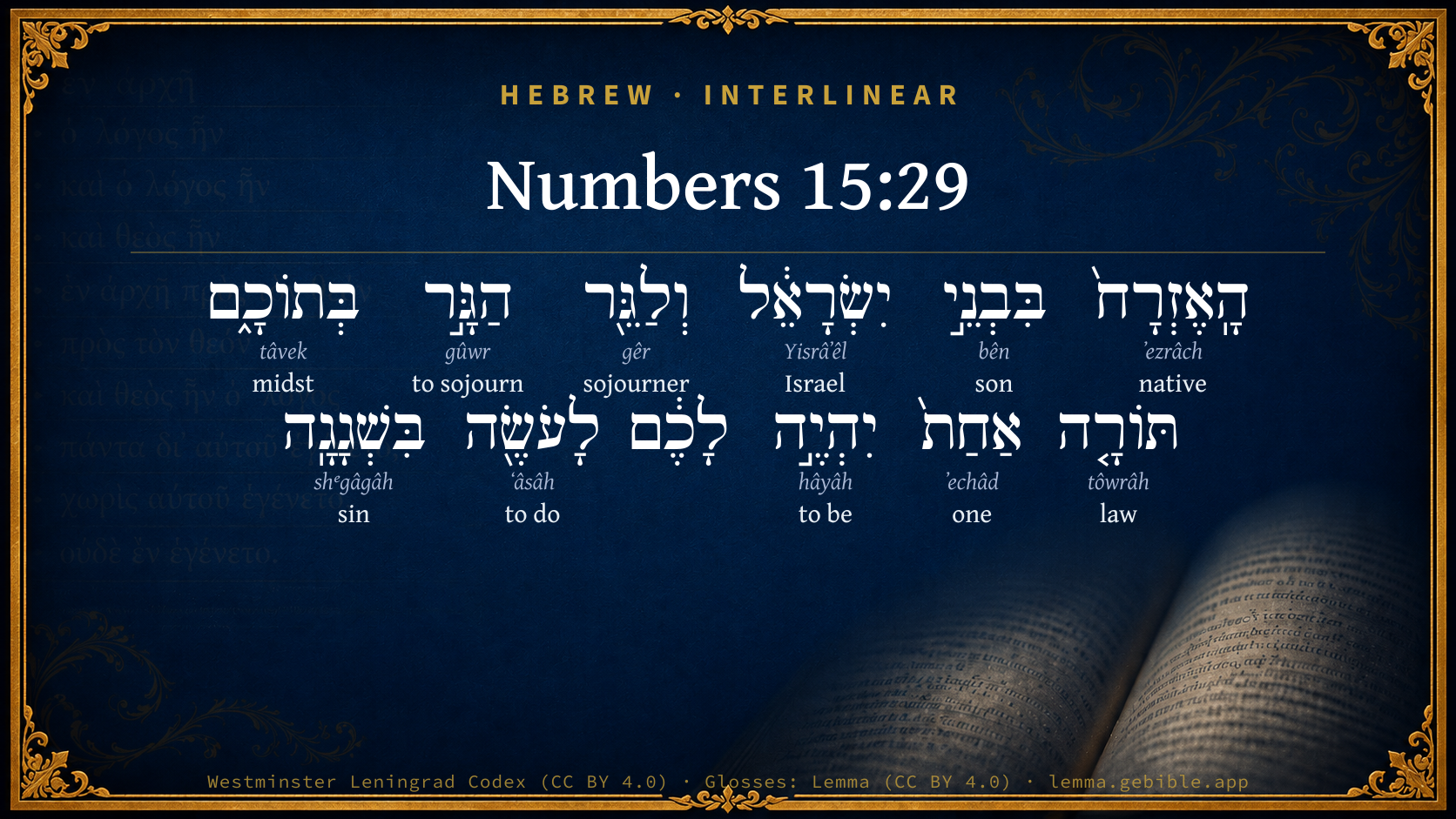
Hebrew (Westminster Leningrad Codex) Numbers 15:29 appears in the Hebrew Old Testament. The text above is from the Westminster Leningrad Codex. Each word links to its Strong’s number, a concise gloss, and parsing drawn from the Open Scriptures Hebrew Bible morphology. Click any word for its full Brown-Driver-Briggs (BDB) entry.
Download image
Cite this verse

Numbers 15:29 (World English Bible). Public Domain. Lemma interlinear Bible study tool, https://lemma.gebible.app/v/numbers/15/29.

Show BibTeX & RIS
BibTeX
RIS
English Translation
You shall have one law for him who does anything unwittingly, for him who is home-born among the children of Israel, and for the stranger who lives as a foreigner among them.
World English Bible · Public Domain
Download a study sheet

One document with this verse’s original text, its word-by-word gloss line, the meaning frame, cross-references with their text, attributed commentary, and full source and license credits — printable, and it pastes into notes with its structure intact.

This verse Autodidact and up

Study sheet (.html) Plain text (.txt)

A passage Seminary Student

Up to 50 verses in one chapter. A passage sheet keeps up to 6 commentary sources and 12 cross-references per verse, in the order this page ranks them, and says so on the sheet whenever that leaves anything out. Ask for a single verse and you get the Autodidact verse sheet above.

Everything on this page stays free to read, with no account — the sheet is a download of what is already on screen, not access to it.

Want to remove ads? Support Godless Engineer
Compare translations 3

The same verse in 3 English versions, stacked beneath the original-language interlinear above. Click any original word for its lexicon entry.

Each is an independent rendering of the whole verse — the interlinear is not word-aligned to these translations.

Highlighted words mark where these versions differ — a whole-verse word diff, not a word-by-word alignment.

  • World English Bible Public Domain
    You shall have one law for him who does anything unwittingly, for him who is home-born among the children of Israel, and for the stranger who lives as a foreigner among them.
  • King James Version Public Domain
    Ye shall have one law for him that sinneth through ignorance, both for him that is born among the children of Israel, and for the stranger that sojourneth among them.
  • unfoldingWord Literal Text CC BY-SA 4.0
    The native among the sons of Israel and for the sojourner, the one sojourning in their midst, one law shall be for you for the one doing by mistake.

unfoldingWord Literal Text — © unfoldingWord, licensed CC BY-SA 4.0. Word-aligned USFM3 via Door43 (git.door43.org/unfoldingWord/en_ult).

Versions to compare (up to 4)

3 of 4 selected

Show all 18 translations

Every available English version of this verse, each an independent rendering of the whole verse.

  • World English Bible Public Domain
    You shall have one law for him who does anything unwittingly, for him who is home-born among the children of Israel, and for the stranger who lives as a foreigner among them.
  • Berean Standard Bible Public Domain
    You shall have the same law for the one who acts in error, whether he is a native-born Israelite or a foreigner residing among you.
  • Majority Standard Bible Public Domain
    You shall have the same law for the one who acts in error, whether he is a native-born Israelite or a foreigner residing among you.
  • King James Version Public Domain
    Ye shall have one law for him that sinneth through ignorance, both for him that is born among the children of Israel, and for the stranger that sojourneth among them.
  • American Standard Version (1901) Public Domain
    Ye shall have one law for him that doeth aught unwittingly, for him that is home-born among the children of Israel, and for the stranger that sojourneth among them.
  • Revised Version (1885) Public Domain
    Ye shall have one law for him that doeth aught unwittingly, for him that is homeborn among the children of Israel, and for the stranger that sojourneth among them.
  • Geneva Bible (1599) Public Domain
    He that is borne among the children of Israel, and the stranger that dwelleth among them, shall haue both one lawe, who so doth sinne by ignorance.
  • Douay-Rheims (1899) Public Domain
    The same law shall be for all that sin by ignorance, whether they be natives or strangers.
  • Young's Literal Translation Public Domain
    for the native among the sons of Israel, and for the sojourner who is sojourning in their midst -- one law is to you, for him who is doing `anything' through ignorance.
  • Literal Standard Version CC BY-SA 4.0
    one law is for yourselves—for the native among the sons of Israel and for the sojourner who is sojourning in their midst—for him who is doing [anything] through ignorance.
  • Unlocked Literal Bible CC BY-SA 4.0
    You must have the same law for the one who does anything unintentionally, the same law for the one who is native born among the people of Israel and for the foreigners who are staying among them.
  • unfoldingWord Literal Text CC BY-SA 4.0
    The native among the sons of Israel and for the sojourner, the one sojourning in their midst, one law shall be for you for the one doing by mistake.
  • Darby Bible Public Domain
    For him that is born in the land among the children of Israel, and for the stranger that sojourneth among them -- there shall be one law for you, for him who doeth anything through inadvertence.
  • World Messianic Bible Public Domain
    You shall have one law for him who does anything unwittingly, for him who is native-born among the children of Israel, and for the stranger who lives as a foreigner among them.
  • Webster's Bible Public Domain
    Ye shall have one law for him that sinneth through ignorance, both for him that is born among the children of Israel, and for the stranger that sojourneth among them.
  • Free Bible Version CC BY-SA 4.0
    You shall apply the same law for the one who mistakenly sins to an Israelite or a foreigner living among you.
  • Bible in Basic English Public Domain
    The law in connection with wrong done unconsciously is to be the same for him who is an Israelite by birth and for the man from another country who is living among them.
  • JPS Tanakh (1917) Public Domain
    both he that is home-born among the children of Israel, and the stranger that sojourneth among them: ye shall have one law for him that doeth aught in error.

Literal Standard Version (2020), Covenant Press — licensed CC BY-SA 4.0. Text via the HelloAO Bible API (eBible.org). Unlocked Literal Bible (unfoldingWord) — licensed CC BY-SA 4.0. Text via the HelloAO Bible API (eBible.org). unfoldingWord Literal Text — © unfoldingWord, licensed CC BY-SA 4.0. Word-aligned USFM3 via Door43 (git.door43.org/unfoldingWord/en_ult). Free Bible Version, Dr. Jonathan Gallagher — licensed CC BY-SA 4.0. Text via the HelloAO Bible API (eBible.org).

Word by word

More ways to search: Search by grammar → Find every occurrence → Compare this word →

Practice this passage: Drill this verse → Learn its vocabulary →

הָֽאֶזְרָח֙
ʼezrâch
H249
“the · native”
Particle, Definite Article + Noun, Common, Masculine, Singular, Absolute
Part of Speech
Particle + Noun
Type
Common
Gender
Masculine
Number
Singular
State
Absolute
Full BDB Definition

Origin: from H2224 (in the sense of springing up)

TWOT: 580b

a native (one rising from the soil) - of man, native Israelites - of tree, native (to Israel)
  1. בִּבְנֵ֣י bên H1121 “in/at · sons of” Preposition + Noun, Common, Masculine, Plural, Construct
  2. יִשְׂרָאֵ֔ל Yisrâʼêl H3478 “Israel” Noun, Proper
  3. וְלַגֵּ֖ר gêr H1616 “and · to/for the · sojourner” Conjunction + Preposition, Determined + Noun, Common, Masculine, Singular, Absolute
  4. הַגָּ֣ר gûwr H1481 “the · sojourning” Particle, Definite Article + Verb, Qal, Participle Active, Masculine, Singular, Absolute
  5. בְּתוֹכָ֑ם tâvek H8432 “in/at · midst · their” Preposition + Noun, Common, Masculine, Singular, Construct + Suffix, Personal, 3rd Person, Masculine, Plural
  6. תּוֹרָ֤ה tôwrâh H8451 “law” Noun, Common, Feminine, Singular, Absolute
  7. אַחַת֙ ʼechâd H259 “one” Adjective, Cardinal number, Feminine, Singular, Absolute
  8. יִהְיֶ֣ה hâyâh H1961 “to be” Verb, Qal, Imperfect, 3rd Person, Masculine, Singular
  9. לָעֹשֶׂ֖ה ʻâsâh H6213 “to/for the · doing” Preposition, Determined + Verb, Qal, Participle Active, Masculine, Singular, Absolute
  10. בִּשְׁגָגָֽה shᵉgâgâh H7684 “in/at · sin” Preposition + Noun, Common, Feminine, Singular, Absolute

About this verse

These counts appear in no published source. They are computed here, from the morphology-tagged text and Lemma’s own curated glosses. What Lemma adds →

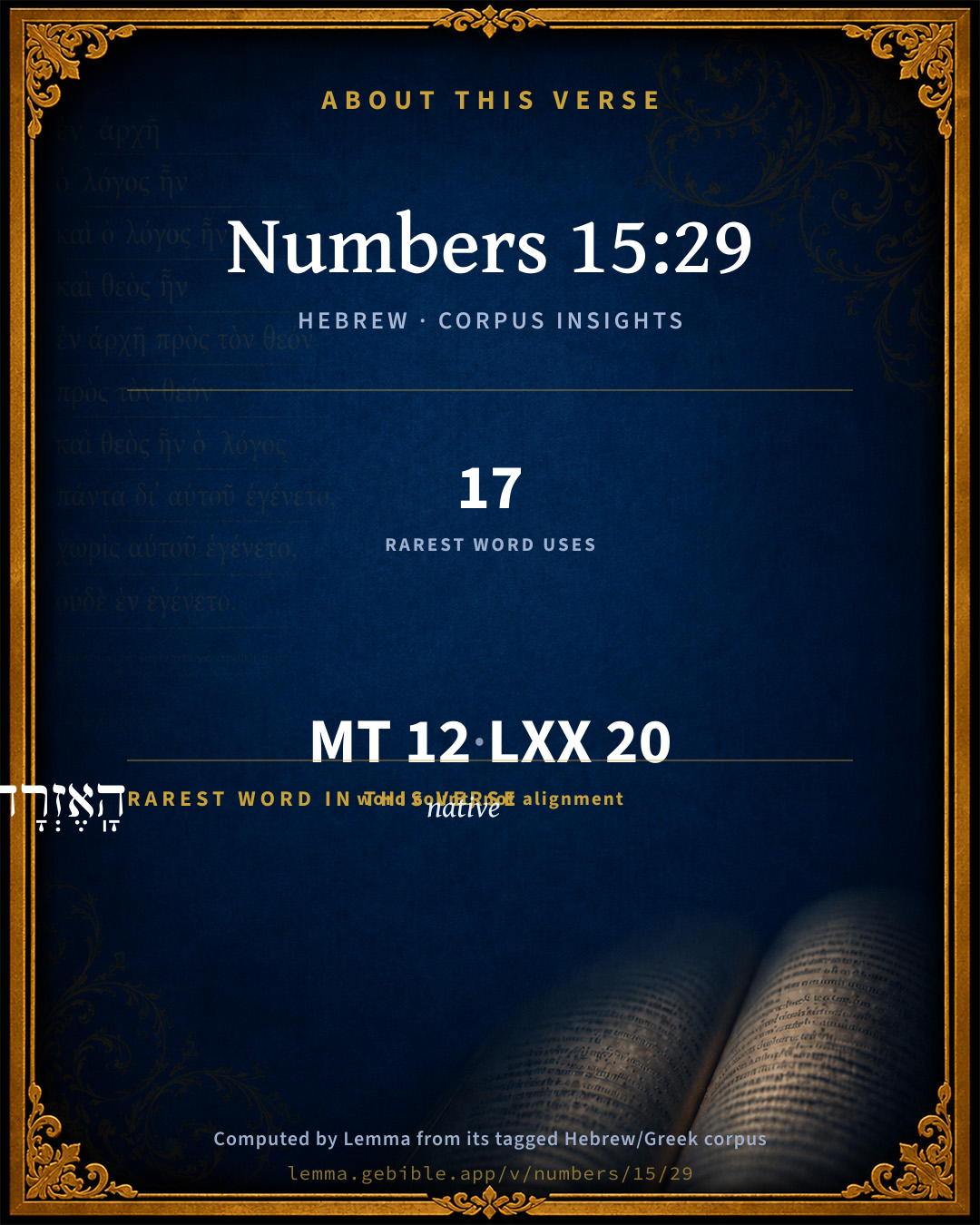
12
words
11
distinct lemmas
Pentateuch
section

Notable vocabulary

The rarest word here is הָֽאֶזְרָח֙ native H249 — appearing just 17 times in the whole Hebrew Bible.

Shared distinctive vocabulary

הָֽאֶזְרָח֙ native H249 occurs in 17 verses of the Hebrew Bible. Also found in:

Grammatical profile

  • 3 verbs
  • 7 nouns
  • 1 adjective
  • 1 preposition

Verb forms

  • הַגָּ֣ר Qal · Participle Active
  • יִהְיֶ֣ה Qal · Imperfect
  • לָעֹשֶׂ֖ה Qal · Participle Active

Hebrew & Septuagint length

In English translation the verse runs 32 words from the Hebrew and 27 from the Septuagint (LXX English) — closely comparable.

A rough comparison of the two English renderings, which tokenize alike — not a word-level alignment.

Word counts can differ between the Hebrew and the Greek without any difference in meaning — e.g. the Hebrew direct-object marker אֵת has no separate Greek word, and Greek often adds the article ὁ.

In the original languages it is 12 Hebrew tokens and 20 Greek tokens — but the two are counted differently (Hebrew bundles its prefixes and suffixes into one token; the Greek is in lemma form), so that isn’t a like-for-like length.

Cross-references

5

Topical passages linked to Numbers 15:29 in the Treasury of Scripture Knowledge — connected by theme and wording, ordered by reader-vote popularity; previews shown in the World English Bible.

  • Numbers 15:15 For the assembly, there shall be one statute for you, and for the stranger who lives as a foreigner [with you], a statute forever throughout your generations: as you are, so shall the foreigner be before Yahweh.
  • Leviticus 16:29 "It shall be a statute to you forever: in the seventh month, on the tenth day of the month, you shall afflict your souls, and shall do no manner of work, the native-born, or the stranger who lives as a foreigner among you:
  • Leviticus 17:15 "'Every person that eats what dies of itself, or that which is torn by animals, whether he is native-born or a foreigner, he shall wash his clothes, and bathe himself in water, and be unclean until the evening: then he shall be clean.
  • Numbers 9:14 If a foreigner lives among you, and desires to keep the Passover to Yahweh; according to the statute of the Passover, and according to its ordinance, so shall he do. You shall have one statute, both for the foreigner, and for him who is born in the land.'"
  • Romans 3:29–30 Or is God the God of Jews only? Isn't he the God of Gentiles also? Yes, of Gentiles also,

Cross-references courtesy of OpenBible.info (CC BY 4.0).

Hebrew and Greek witnesses Masoretic Hebrew ↔ Greek Septuagint

The same verse in the two great witnesses to the Old Testament, shown verse-for-verse.

These are two independent witnesses, not word-aligned to each other, and the Septuagint is shown in lemma (dictionary) form.

Hebrew Numbers 15:29 Masoretic · Westminster Leningrad Codex

הָֽאֶזְרָח֙ בִּבְנֵ֣י יִשְׂרָאֵ֔ל וְלַגֵּ֖ר הַגָּ֣ר בְּתוֹכָ֑ם תּוֹרָ֤ה אַחַת֙ יִהְיֶ֣ה לָכֶ֔ם לָעֹשֶׂ֖ה בִּשְׁגָגָֽה

You shall have one law for him who does anything unwittingly, for him who is home-born among the children of Israel, and for the stranger who lives as a foreigner among them.

World English Bible · Public Domain

Greek LXX Numbers 15:29 Septuagint · lemma form

ὁ ἐγχώριος ἐν υἱός ἰσραήλ καί ὁ προσήλυτος ὁ προςκεῖμαι ἐν αὐτός νόμος εἷς εἰμί αὐτός ὅς ἄν ποιέω ἀκουσίως

There shall be one law for the native among the children of Israel, and for the stranger that abides among them, whoever shall commit a trespass unwillingly.

LXX2012 (modern English Septuagint) · Public Domain

Hebrew: Westminster Leningrad Codex (CC BY 4.0). Greek: Septuagint (public domain); English from LXX2012 (modern English Septuagint) (Public Domain). How the Septuagint differs from the Hebrew →

Targum (Aramaic paraphrase)

2

The Targum is the ancient Jewish Aramaic paraphrase of the Hebrew Scriptures — an interpretive translation, not the Hebrew text itself. Onkelos (literal) and Pseudo-Jonathan (expansive) render the Torah, and Jonathan the Prophets. Coverage is partial: where no permissively-licensed English translation exists for a verse, only the Aramaic is shown. This is verse-level text, not a word-by-word alignment to the Hebrew.

  1. Targum Onkelos Torah (Genesis–Deuteronomy)
    יַצִיבָא בִּבְנֵי יִשְׂרָאֵל וּלְגִיוֹרָא דְיִתְגַיַר בֵּינֵיהוֹן אוֹרַיְתָא חֲדָא יְהֵי לְכוֹן לִדְיַעְבֵּד בְּשָׁלוּ

    (no public-domain English translation for this verse)

    Targum Onkelos — Aramaic: “Onkelos Genesis” (public domain); “Onkelos Exodus” (public domain); “Onkelos Leviticus” (public domain); “Onkelos Numbers” (public domain); “Onkelos Deuteronomy” (public domain). English: “Sefaria Community Translation” (CC0 1.0 (public-domain dedication)); “J.W. Etheridge. The Targums of Onkelos and Jonathan Ben Uzziel on the Pentateuch. London: Longmans, Green, 1862” (public domain). Text via Sefaria.

  2. Targum Pseudo-Jonathan Torah (Genesis–Deuteronomy)
    יַצִיבָא בִּבְנֵי יִשְרָאֵל וּלְגִיוֹרֵי דְמִתְגַיְירִין בֵּינֵיכוֹן (א"ה צ"ל בֵּינֵיהוֹן) אוֹרַיְיתָא חֲדָא יְהֵי לְכוֹן וּלְמַאן דְיֶעֱבַד בְּשָׁלוּ

    as well for the native-born of the children of Israel, and for the strangers who sojourn among you, there shall be one law for him who transgresseth through ignorance:

    Targum Pseudo-Jonathan — Aramaic: “Targum Jonathan on Genesis” (public domain); “Targum Jonathan on Exodus” (public domain); “Targum Jonathan on Leviticus” (public domain); “Targum Jonathan on Numbers” (public domain); “Targum Jonathan on Deuteronomy” (public domain). English: “The Targum of Jonathan ben Uzziel, trans. J. W. Etheridge, London, 1862” (public domain). Text via Sefaria.

Commentary

Notes on Numbers 15:29 from classic Christian and Jewish commentators (each source and its license shown beneath its notes). The classic Christian expositions comment on the surrounding passage and are grouped to its opening verse, so a note may address several verses; the Jewish commentaries on the Tanakh (Rashi and others) are per-verse, so they appear only where the commentator wrote on this verse.

Lemma curates 59 commentaries, every one of them public domain or Creative Commons licensed, each selected and text-cleaned for this edition rather than reprinted as found. About our sources →

John Gill's Exposition

But the soul that doeth ought presumptuously,.... Or with "an high hand" (t), or through pride, as the Targum of Jonathan; in an haughty, insolent, bold and daring manner; in an obstinate, stubborn, self-willed way, with purpose and design, openly and publicly, neither fearing God nor regarding man:

whether he be born in the land, or a stranger; here a stranger as well signifies a proselyte of the gate as a proselyte of righteousness; seeing this presumptuous sinning may respect idolatry and blasphemy, which sins were punishable in proselytes of the gate by the magistrates of Israel as well as by the immediate hand of God:

the same reproacheth the Lord; by denying him to be the true Jehovah, by worshipping other gods, and by speaking in a blaspheming manner of him the true God; and indeed every presumptuous sin, which is committed in a bold and audacious manner, in contempt of God and defiance of his law, is a reproaching him the lawgiver, and a trampling upon his legislative power and authority:

and that soul shall be cut off from among his people, either by the hand of the civil magistrate, upon conviction of him, or by the immediate hand of God; no sacrifice was to be offered for such, no atonement to be made or forgiveness to be had; see Mat 12:31.

(t) "in manu excelsa", Pagninus, Montanus, Vatablus.

John Gill's Exposition of the Whole Bible (1746–1763) — public domain (CC PDM 1.0). Text via the HelloAO Bible API.

Lesson kit

Teaching starters — assembled from the data on this page, not authored interpretation. Every prompt links to the verse data it draws on. Edit before teaching.

Numbers, in the Pentateuch, opens this verse with 12 words (11 distinct Hebrew lemmas). Its most distinctive word is ʼezrâch (“native”). A historical commentator’s framing appears above. Read the whole chapter for the surrounding context.

Discussion questions

  1. What does “native” (ʼezrâch) contribute to the verse as a whole?
  2. How does Exodus 12:19, which shares the word «native», read alongside this verse?
  3. These translations render this verse differently. What is at stake in choosing one wording over another?
  4. «הַגָּ֣ר» is a Qal Participle Active verb. How does that grammatical form shape the action described?

Things to notice

Reading settings

Reading text

Shown beneath each verse's original-language words.

Old Testament
Old Testament edition

Read the OT as the Masoretic Hebrew (MT) or the Greek Septuagint (LXX).

English shown for the Greek Septuagint (in the Hebrew ↔ Greek comparison).

Comparing translations? Open the Compare panel on any verse page to stack up to four side by side.