
2 Chronicles 23:20

Hebrew (Westminster Leningrad Codex) 2 Chronicles 23:20 appears in the Hebrew Old Testament. The text above is from the Westminster Leningrad Codex. Each word links to its Strong’s number, a concise gloss, and parsing drawn from the Open Scriptures Hebrew Bible morphology. Click any word for its full Brown-Driver-Briggs (BDB) entry.
Download image
Cite this verse

2 Chronicles 23:20 (World English Bible). Public Domain. Lemma interlinear Bible study tool, https://lemma.gebible.app/v/2-chronicles/23/20.

Show BibTeX & RIS
BibTeX
RIS
English Translation
He took the captains of hundreds, and the nobles, and the governors of the people, and all the people of the land, and brought down the king from the house of Yahweh: and they came through the upper gate to the king's house, and set the king on the throne of the kingdom.
World English Bible · Public Domain
Download a study sheet

One document with this verse’s original text, its word-by-word gloss line, the meaning frame, cross-references with their text, attributed commentary, and full source and license credits — printable, and it pastes into notes with its structure intact.

This verse Autodidact and up

Study sheet (.html) Plain text (.txt)

A passage Seminary Student

Up to 50 verses in one chapter. A passage sheet keeps up to 6 commentary sources and 12 cross-references per verse, in the order this page ranks them, and says so on the sheet whenever that leaves anything out. Ask for a single verse and you get the Autodidact verse sheet above.

Everything on this page stays free to read, with no account — the sheet is a download of what is already on screen, not access to it.

Want to remove ads? Support Godless Engineer
Compare translations 3

The same verse in 3 English versions, stacked beneath the original-language interlinear above. Click any original word for its lexicon entry.

Each is an independent rendering of the whole verse — the interlinear is not word-aligned to these translations.

Highlighted words mark where these versions differ — a whole-verse word diff, not a word-by-word alignment.

  • World English Bible Public Domain
    He took the captains of hundreds, and the nobles, and the governors of the people, and all the people of the land, and brought down the king from the house of Yahweh: and they came through the upper gate to the king's house, and set the king on the throne of the kingdom.
  • King James Version Public Domain
    And he took the captains of hundreds, and the nobles, and the governors of the people, and all the people of the land, and brought down the king from the house of the LORD: and they came through the high gate into the king's house, and set the king upon the throne of the kingdom.
  • unfoldingWord Literal Text CC BY-SA 4.0
    And he took the chiefs of the hundreds, and the majestic ones, and the rulers among the people, and all the people of the land. And he brought down the king from the house of Yahweh; and they came into the midst of the Upper Gate of the house of the king, and they sat the king on the throne of the kingdom.

unfoldingWord Literal Text — © unfoldingWord, licensed CC BY-SA 4.0. Word-aligned USFM3 via Door43 (git.door43.org/unfoldingWord/en_ult).

Versions to compare (up to 4)

3 of 4 selected

Show all 18 translations

Every available English version of this verse, each an independent rendering of the whole verse.

  • World English Bible Public Domain
    He took the captains of hundreds, and the nobles, and the governors of the people, and all the people of the land, and brought down the king from the house of Yahweh: and they came through the upper gate to the king's house, and set the king on the throne of the kingdom.
  • Berean Standard Bible Public Domain
    He also took with him the commanders of hundreds, the nobles, the rulers of the people, and all the people of the land, and they brought the king down from the house of the LORD and entered the royal palace through the Upper Gate. They seated King Joash on the royal throne,
  • Majority Standard Bible Public Domain
    And he took with him the commanders of hundreds, the nobles, the rulers of the people, and all the people of the land, and they brought the king down from the house of the LORD and entered the royal palace through the Upper Gate. They seated King Joash on the royal throne,
  • King James Version Public Domain
    And he took the captains of hundreds, and the nobles, and the governors of the people, and all the people of the land, and brought down the king from the house of the LORD: and they came through the high gate into the king's house, and set the king upon the throne of the kingdom.
  • American Standard Version (1901) Public Domain
    And he took the captains of hundreds, and the nobles, and the governors of the people, and all the people of the land, and brought down the king from the house of Jehovah: and they came through the upper gate unto the king's house, and set the king upon the throne of the kingdom.
  • Revised Version (1885) Public Domain
    And he took the captains of hundreds, and the nobles, and the governors of the people, and all the people of the land, and brought down the king from the house of the LORD: and they came through the upper gate unto the king’s house, and set the king upon the throne of the kingdom.
  • Geneva Bible (1599) Public Domain
    And he tooke the captaines of hundreths, and the noble men, and the gouernours of the people, and all the people of the land, and he caused the King to come downe out of the house of the Lord, and they went thorowe the hie gate of the Kings house, and set the King vpon the throne of the kingdome.
  • Douay-Rheims (1899) Public Domain
    And he took the captains of hundreds, and the most valiant men, and the chiefs of the people, and all the people of the land, and they brought down the king from the house of the Lord, and brought him through the upper gate into the king's house, and set him on the royal throne.
  • Young's Literal Translation Public Domain
    And he taketh the heads of the hundreds, and the honourable ones, and the rulers among the people, and all the people of the land, and bringeth down the king from the house of Jehovah, and they come in through the high gate to the house of the king, and cause the king to sit on the throne of the kingdom.
  • Literal Standard Version CC BY-SA 4.0
    And he takes the heads of the hundreds, and the majestic ones, and the rulers among the people, and all the people of the land, and brings down the king from the house of YHWH, and they come in through the high gate to the house of the king, and cause the king to sit on the throne of the kingdom.
  • Unlocked Literal Bible CC BY-SA 4.0
    Jehoiada took with him the commanders of hundreds, the noblemen, the governors of the people, and all the people of the land. He brought down the king from the house of Yahweh; the people came through the Upper Gate to the king's house and sat the king on the throne of the kingdom.
  • unfoldingWord Literal Text CC BY-SA 4.0
    And he took the chiefs of the hundreds, and the majestic ones, and the rulers among the people, and all the people of the land. And he brought down the king from the house of Yahweh; and they came into the midst of the Upper Gate of the house of the king, and they sat the king on the throne of the kingdom.
  • Darby Bible Public Domain
    And he took the captains of the hundreds, and the nobles, and the governors of the people, and all the people of the land, and brought down the king from the house of Jehovah; and they came through the upper gate into the king's house, and set the king upon the throne of the kingdom.
  • World Messianic Bible Public Domain
    He took the captains of hundreds, the nobles, the governors of the people, and all the people of the land, and brought the king down from the LORD’s house. They came through the upper gate to the king’s house, and set the king on the throne of the kingdom.
  • Webster's Bible Public Domain
    And he took the captains of hundreds, and the nobles, and the governors of the people, and all the people of the land, and brought down the king from the house of the LORD: and they came through the high gate into the king's house, and set the king upon the throne of the kingdom.
  • Free Bible Version CC BY-SA 4.0
    Along with the commanders, the nobles, the governors of the people, and all the people, he led the king in a procession down from the Lord's Temple through the upper gate to the royal palace. There they set the king on the royal throne.
  • Bible in Basic English Public Domain
    Then he took the captains of hundreds and the chiefs and the rulers of the people and all the people of the land, and they came down with the king from the house of the Lord through the higher doorway into the king's house, and put the king on the seat of the kingdom.
  • JPS Tanakh (1917) Public Domain
    And he took the captains of hundreds, and the nobles, and the governors of the people, and all the people of the land, and brought down the king from the house of the LORD; and they came through the upper gate unto the king's house, and set the king upon the throne of the kingdom.

Literal Standard Version (2020), Covenant Press — licensed CC BY-SA 4.0. Text via the HelloAO Bible API (eBible.org). Unlocked Literal Bible (unfoldingWord) — licensed CC BY-SA 4.0. Text via the HelloAO Bible API (eBible.org). unfoldingWord Literal Text — © unfoldingWord, licensed CC BY-SA 4.0. Word-aligned USFM3 via Door43 (git.door43.org/unfoldingWord/en_ult). Free Bible Version, Dr. Jonathan Gallagher — licensed CC BY-SA 4.0. Text via the HelloAO Bible API (eBible.org).

Word by word

More ways to search: Search by grammar → Find every occurrence → Compare this word →

Practice this passage: Drill this verse → Learn its vocabulary →

הָֽאַדִּירִים֩
ʼaddîyr
H117
“the · great”
Particle, Definite Article + Adjective, Adjective, Masculine, Plural, Absolute
Part of Speech
Particle + Adjective
Type
Adjective
Gender
Masculine
Number
Plural
State
Absolute
Full BDB Definition

Origin: from H142

TWOT: 28b

great, majestic - of waters of sea - of a tree - of kings, nations, gods - great one, majestic one - of nobles, chieftains, servants
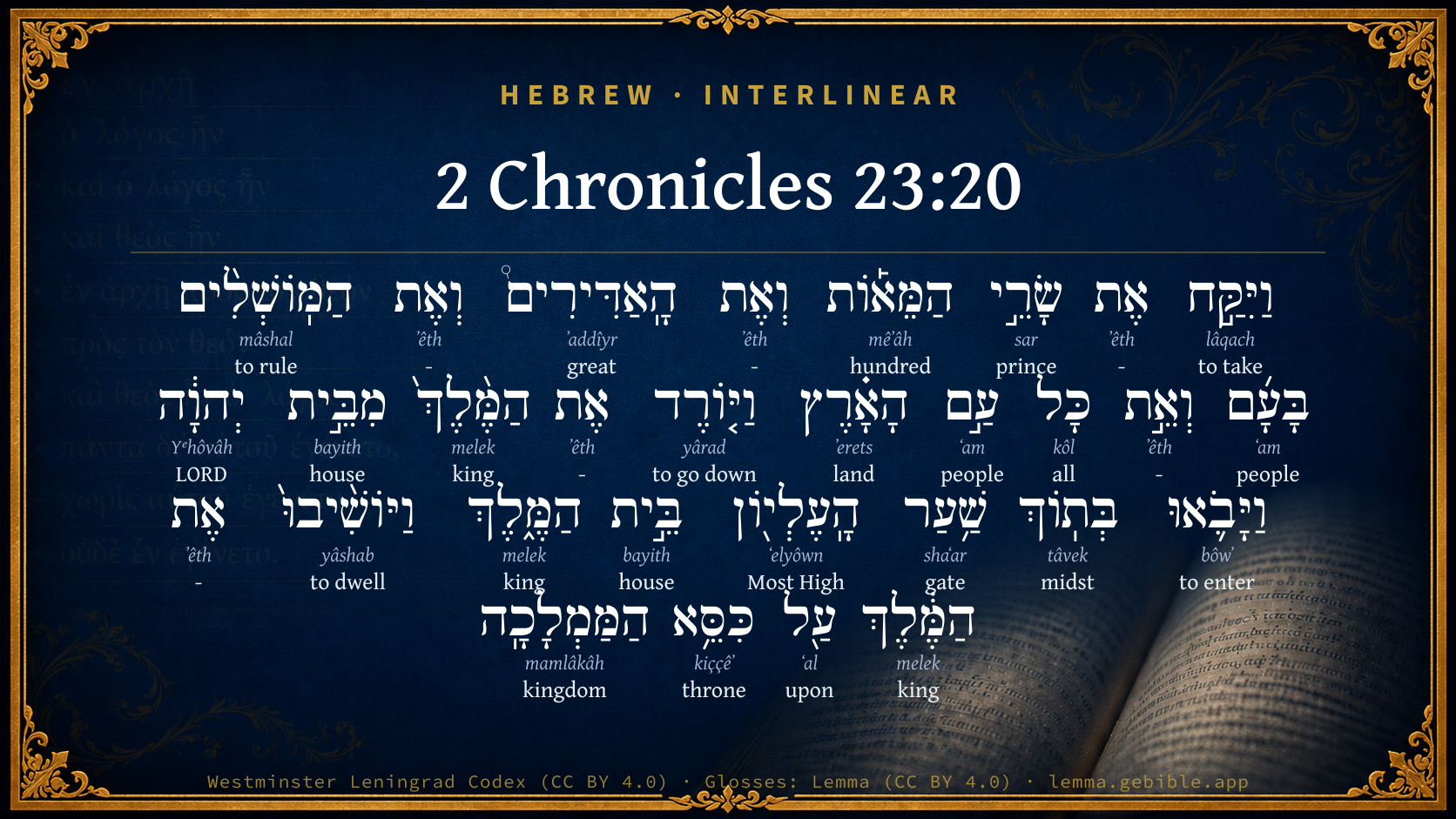
  1. וַיִּקַּ֣ח lâqach H3947 “and · to take” Conjunction + Verb, Qal, Sequential Imperfect, 3rd Person, Masculine, Singular
  2. אֶת ʼêth H853 “-” Particle, Direct Object
  3. שָׂרֵ֣י sar H8269 “princes of” Noun, Common, Masculine, Plural, Construct
  4. הַמֵּא֡וֹת mêʼâh H3967 “the · hundred” Particle, Definite Article + Adjective, Cardinal number, Both, Plural, Absolute
  5. וְאֶת ʼêth H853 “and · -” Conjunction + Particle, Direct Object
  6. וְאֶת ʼêth H853 “and · -” Conjunction + Particle, Direct Object
  7. הַמּֽוֹשְׁלִ֨ים mâshal H4910 “the · ruling” Particle, Definite Article + Verb, Qal, Participle Active, Masculine, Plural, Absolute
  8. בָּעָ֜ם ʻam H5971 “in/at the · people” Preposition, Determined + Noun, Common, Masculine, Singular, Absolute
  9. וְאֵ֣ת ʼêth H853 “and · -” Conjunction + Particle, Direct Object
  10. כָּל kôl H3605 “all of” Noun, Common, Masculine, Singular, Construct
  11. עַ֣ם ʻam H5971 “people of” Noun, Common, Masculine, Singular, Construct
  12. הָאָ֗רֶץ ʼerets H776 “the · land” Particle, Definite Article + Noun, Common, Both, Singular, Absolute
  13. וַיּ֤וֹרֶד yârad H3381 “and · to go down” Conjunction + Verb, Hiphil, Sequential Imperfect, 3rd Person, Masculine, Singular
  14. אֶת ʼêth H853 “-” Particle, Direct Object
  15. הַמֶּ֨לֶךְ֙ melek H4428 “the · king” Particle, Definite Article + Noun, Common, Masculine, Singular, Absolute
  16. מִבֵּ֣ית bayith H1004 “from · house of” Preposition + Noun, Common, Masculine, Singular, Construct
  17. יְהוָ֔ה Yᵉhôvâh H3068 “LORD” Noun, Proper
  18. וַיָּבֹ֛אוּ bôwʼ H935 “and · to enter” Conjunction + Verb, Qal, Sequential Imperfect, 3rd Person, Masculine, Plural
  19. בְּתֽוֹךְ tâvek H8432 “in/at · midst of” Preposition + Noun, Common, Masculine, Singular, Construct
  20. שַׁ֥עַר shaʻar H8179 “gate of” Noun, Common, Masculine, Singular, Construct
  21. הָֽעֶלְי֖וֹן ʻelyôwn H5945 “the · Most High” Particle, Definite Article + Adjective, Adjective, Masculine, Singular, Absolute
  22. בֵּ֣ית bayith H1004 “house of” Noun, Common, Masculine, Singular, Construct
  23. הַמֶּ֑לֶךְ melek H4428 “the · king” Particle, Definite Article + Noun, Common, Masculine, Singular, Absolute
  24. וַיּוֹשִׁ֨יבוּ֙ yâshab H3427 “and · to dwell” Conjunction + Verb, Hiphil, Sequential Imperfect, 3rd Person, Masculine, Plural
  25. אֶת ʼêth H853 “-” Particle, Direct Object
  26. הַמֶּ֔לֶךְ melek H4428 “the · king” Particle, Definite Article + Noun, Common, Masculine, Singular, Absolute
  27. עַ֖ל ʻal H5921 “upon” Preposition
  28. כִּסֵּ֥א kiççêʼ H3678 “throne of” Noun, Common, Masculine, Singular, Construct
  29. הַמַּמְלָכָֽה mamlâkâh H4467 “the · kingdom” Particle, Definite Article + Noun, Common, Feminine, Singular, Absolute

About this verse

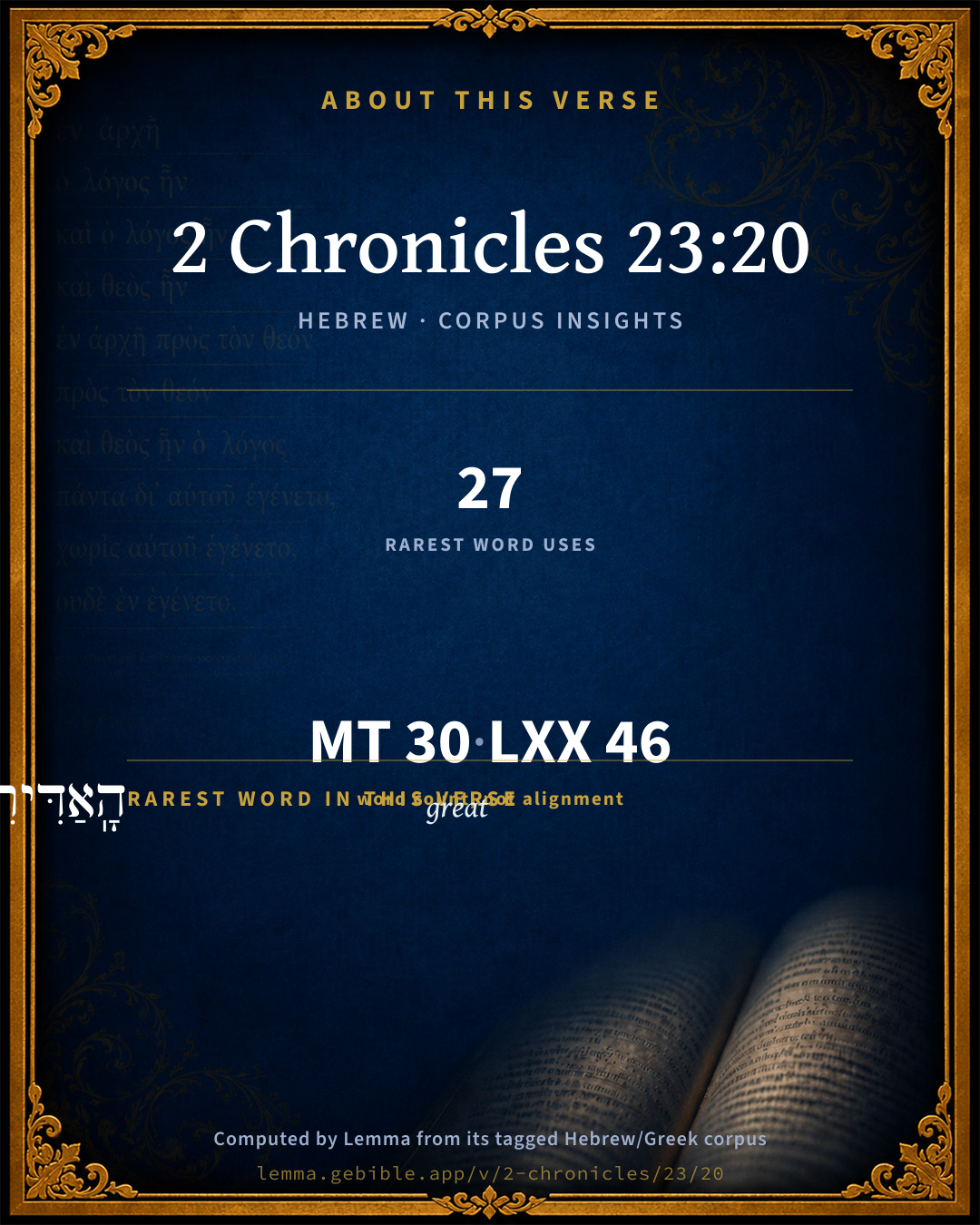
These counts appear in no published source. They are computed here, from the morphology-tagged text and Lemma’s own curated glosses. What Lemma adds →

30
words
21
distinct lemmas
Historical
section

Shared distinctive vocabulary

הָֽאַדִּירִים֩ great H117 occurs in 25 verses of the Hebrew Bible. Also found in:

Grammatical profile

  • 5 verbs
  • 15 nouns
  • 3 adjectives
  • 1 preposition
  • 6 particles

Verb forms

  • וַיִּקַּ֣ח Qal · Sequential Imperfect
  • הַמּֽוֹשְׁלִ֨ים Qal · Participle Active
  • וַיּ֤וֹרֶד Hiphil · Sequential Imperfect
  • וַיָּבֹ֛אוּ Qal · Sequential Imperfect
  • וַיּוֹשִׁ֨יבוּ֙ Hiphil · Sequential Imperfect

Repetition

Words recur within this verse — often emphatic in Hebrew:

  • הַמֶּ֨לֶךְ֙ king H4428 ×3
  • בָּעָ֜ם people H5971 ×2
  • מִבֵּ֣ית house H1004 ×2

Hebrew & Septuagint length

In English translation the verse runs 53 words from the Hebrew and 57 from the Septuagint (LXX English) — closely comparable.

A rough comparison of the two English renderings, which tokenize alike — not a word-level alignment.

Word counts can differ between the Hebrew and the Greek without any difference in meaning — e.g. the Hebrew direct-object marker אֵת has no separate Greek word, and Greek often adds the article ὁ.

In the original languages it is 30 Hebrew tokens and 46 Greek tokens — but the two are counted differently (Hebrew bundles its prefixes and suffixes into one token; the Greek is in lemma form), so that isn’t a like-for-like length.

Cross-references

3

Topical passages linked to 2 Chronicles 23:20 in the Treasury of Scripture Knowledge — connected by theme and wording, ordered by reader-vote popularity; previews shown in the World English Bible.

  • 2 Kings 11:19 He took the captains over hundreds, and the Carites, and the guard, and all the people of the land; and they brought down the king from the house of Yahweh, and came by the way of the gate of the guard to the king's house. He sat on the throne of the kings.
  • 2 Kings 11:9–10 The captains over hundreds did according to all that Jehoiada the priest commanded; and they took every man his men, those who were to come in on the Sabbath, with those who were to go out on the Sabbath, and came to Jehoiada the priest.
  • 2 Kings 15:35 However the high places were not taken away: the people still sacrificed and burned incense in the high places. He built the upper gate of the house of Yahweh.

Cross-references courtesy of OpenBible.info (CC BY 4.0).

Hebrew and Greek witnesses Masoretic Hebrew ↔ Greek Septuagint

The same verse in the two great witnesses to the Old Testament, shown verse-for-verse.

These are two independent witnesses, not word-aligned to each other, and the Septuagint is shown in lemma (dictionary) form.

Hebrew 2 Chronicles 23:20 Masoretic · Westminster Leningrad Codex

וַיִּקַּ֣ח אֶת שָׂרֵ֣י הַמֵּא֡וֹת וְאֶת הָֽאַדִּירִים֩ וְאֶת הַמּֽוֹשְׁלִ֨ים בָּעָ֜ם וְאֵ֣ת כָּל עַ֣ם הָאָ֗רֶץ וַיּ֤וֹרֶד אֶת הַמֶּ֨לֶךְ֙ מִבֵּ֣ית יְהוָ֔ה וַיָּבֹ֛אוּ בְּתֽוֹךְ שַׁ֥עַר הָֽעֶלְי֖וֹן בֵּ֣ית הַמֶּ֑לֶךְ וַיּוֹשִׁ֨יבוּ֙ אֶת הַמֶּ֔לֶךְ עַ֖ל כִּסֵּ֥א הַמַּמְלָכָֽה

He took the captains of hundreds, and the nobles, and the governors of the people, and all the people of the land, and brought down the king from the house of Yahweh: and they came through the upper gate to the king's house, and set the king on the throne of the kingdom.

World English Bible · Public Domain

Greek LXX 2 Chronicles 23:20 Septuagint · lemma form

καί λαμβάνω ὁ πατριάρχης καί ὁ δυνατός καί ὁ ἄρχων ὁ λαός καί πᾶς ὁ λαός ὁ γῆ καί ἀναβιβάζω ὁ βασιλεύς εἰς οἶκος κύριος καί εἰςἔρχομαι διά ὁ πύλη ὁ ἐσώτερος εἰς ὁ οἶκος ὁ βασιλεύς καί καταἵζω ὁ βασιλεύς ἐπί ὁ θρόνος ὁ βασιλεία

And he took the heads of families, and the mighty men, and the chiefs of the people, and all the people of the land, and they conducted the king into the house of the Lord; and he went through the inner gate into the king's house, and they seated the king on the throne of the kingdom.

LXX2012 (modern English Septuagint) · Public Domain

Hebrew: Westminster Leningrad Codex (CC BY 4.0). Greek: Septuagint (public domain); English from LXX2012 (modern English Septuagint) (Public Domain). How the Septuagint differs from the Hebrew →

Commentary

Notes on 2 Chronicles 23:20 from classic Christian and Jewish commentators (each source and its license shown beneath its notes). The classic Christian expositions comment on the surrounding passage and are grouped to its opening verse, so a note may address several verses; the Jewish commentaries on the Tanakh (Rashi and others) are per-verse, so they appear only where the commentator wrote on this verse.

Lemma curates 59 commentaries, every one of them public domain or Creative Commons licensed, each selected and text-cleaned for this edition rather than reprinted as found. About our sources →

Trapp's Complete Commentary

John Trapp

2Ch 23:20 And he took the captains of hundreds, and the nobles, and the governors of the people, and all the people of the land, and brought down the king from the house of the LORD: and they came through the high gate into the king’s house, and set the king upon the throne of the kingdom.

Ver. 20. And brought down the king.] See 2Ki 11:19.

John Trapp, A Commentary or Exposition upon All the Books of the Old and New Testament (1647–1656) — public domain. Text from a community e-Sword module.

Geneva Bible (1599)

Geneva Bible translators

Which was the principal gate, that the King might be seen of all the people.

Geneva Bible (1599) marginal notes — public domain. Text via Bolls.life.

Ellicott's Commentary for English Readers

(20) And he took.—See 2Ki_11:19.

The nobles, and the governors of the people.—Kings has: “And the Carians and the Couriers.” (See Note on 2Ch_23:1.)

The nobles.—Comp. Psa_16:3.

Governors of the people.—Comp. Isa_28:14. These “nobles and governors” are perhaps “the heads of the clans” of 2Ch_23:2, and “the princes of 2Ch_23:13; though the phrase certainly looks like an attempt at explaining the obscure titles of the royal guard.

And they came through the high gate.—Kings, “And they came by the way of the Couriers’ Gate.” (See Note on 2Ch_23:5, supra.) The Couriers’ Gate may have been called the High Gate, as being the grand entrance to the palace. A gate of the Temple has the same designation in 2Ch_27:3.

A Bible Commentary for English Readers, edited by Charles John Ellicott (1878–1897) — public domain. Text from a community e-Sword module.

The Cambridge Bible for Schools and Colleges

gen. ed. J. J. S. Perowne

20. the nobles] Heb. addîrîm; cp. Neh_3:5 (with Ryle’s note). In 2 Kin., “the Carites”; cp. 2Ch_23:1 (note).

the high gate] R.V. the upper gate; cp. 2Ch_27:3, “the high (‘upper,’ R.V.) gate of the house of the Lord.” In 2 Kin., “by the way of the gate of the guard” (doubtless one of the gates of the palace). The Chronicler writing at a time when the palace had ceased to exist, prefers to fix localities by reference to the Temple.

The Cambridge Bible for Schools and Colleges (gen. ed. J. J. S. Perowne; Cambridge University Press, 1878–1918) — public domain. Text from a community e-Sword module.

Albert Barnes' Notes on the Bible

The high gate - See 2Ki 11:19 note.

Albert Barnes' Notes on the Bible (1834–1885) — public domain. Text from a community e-Sword/MySword module.

Haydock's Catholic Bible Commentary

Upper gate of the guards, at the back or western end of the temple, C. v. 5.

George Leo Haydock (1774–1849), Haydock's Catholic Family Bible and Commentary, 1859 edition — public domain. Excludes Psalms (Douay-Rheims chapter numbering differs from Protestant) and Deuterocanonical books (Catholic canon only).

Matthew Poole's English Annotations

Through the high gate, to wit, of the court belonging and leading to the king’s palace.

Matthew Poole's English Annotations on the Holy Bible (1683–1685) — public domain. Text from a community e-Sword/MySword module.

The Pulpit Commentary

The high gate. There is some doubt as to what this gate was, whether the temple gate of 2Ch_27:3, the chief gate of the outer court, or whether it was merely a palace gate, and not identified also with the precincts of the temple. It is called in the parallel "the gate of the guard."

The Pulpit Commentary (1880–1919), ed. H.D.M. Spence-Jones & Joseph S. Exell — public domain. Text from a community e-Sword module.

unfoldingWord translationNotes

Door43 World Missions Community

the commanders of hundreds

The phrase "commander of hundreds" is probably an official title for a military officer. Possible meanings are 1) the word "hundreds" represents the exact amount of soldiers that these commanders led. AT: "the commanders of 100 soldiers" or 2) the word translated as "hundreds" does not represent an exact number, but is the name of a military division. AT: "the commanders of military divisions" See how you translated this in 2 Chronicles 23:1. (See: Numbers)

all the people of the land

This is a generalization that means he took very many people with him. AT: "a very large group of the people of Israel" (See: Hyperbole and Generalization)

He brought down the king from the house of Yahweh

The temple was built on the highest hill in Jerusalem. AT: "He brought the king down from the temple to the palace"

the throne of the kingdom

"the royal throne"

So all the people of the land

This is generalization to say that most of the people rejoiced. (See: Hyperbole and Generalization)

the city was quiet

Here "the city" represents the people of the city, and "quiet" represents peace, since no one opposed Joash after Athaliah died. AT: "the people of the city were at peace" (See: Metonymy)

translationWords

commander

noble

govern

kingdom

Athaliah

sword

unfoldingWord translationNotes — © Distant Shores Media and the Door43 World Missions Community, licensed CC BY-SA 4.0. Source: git.door43.org/Door43/en_tn.

Lesson kit

Teaching starters — assembled from the data on this page, not authored interpretation. Every prompt links to the verse data it draws on. Edit before teaching.

2 Chronicles, in the Historical, opens this verse with 30 words (21 distinct Hebrew lemmas). Its most distinctive word is ʼaddîyr (“great”). A historical commentator’s framing appears above. Read the whole chapter for the surrounding context.

Discussion questions

  1. The word ʼaddîyr carries the sense “great.” How does it shape the verse?
  2. How does Exodus 15:10, which shares the word «great», read alongside this verse?
  3. What does the repetition of “king” (3× in this one verse) do in this verse?
  4. These translations render this verse differently; the difference is in the English rendering, not the original. What questions does that raise?
  5. «וַיִּקַּ֣ח» is a Qal Sequential Imperfect verb. How does that grammatical form shape the action described?
  6. Compare how Trapp's Complete Commentary and Geneva Bible (1599) read this verse. Where do they agree or differ?

Things to notice

Reading settings

Reading text

Shown beneath each verse's original-language words.

Old Testament
Old Testament edition

Read the OT as the Masoretic Hebrew (MT) or the Greek Septuagint (LXX).

English shown for the Greek Septuagint (in the Hebrew ↔ Greek comparison).

Comparing translations? Open the Compare panel on any verse page to stack up to four side by side.