
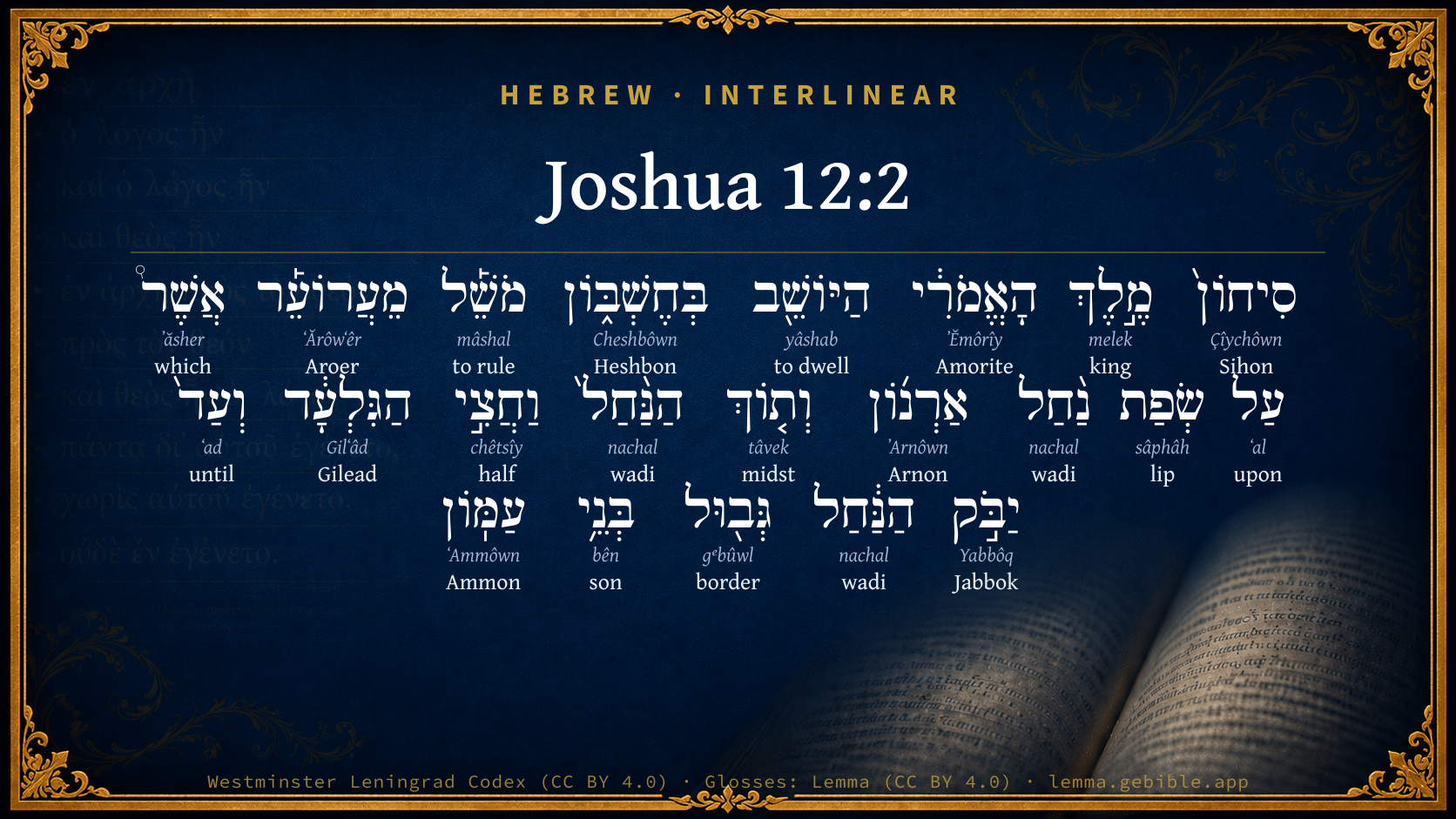
Joshua 12:2

Hebrew (Westminster Leningrad Codex) Joshua 12:2 appears in the Hebrew Old Testament. The text above is from the Westminster Leningrad Codex. Each word links to its Strong’s number, a concise gloss, and parsing drawn from the Open Scriptures Hebrew Bible morphology. Click any word for its full Brown-Driver-Briggs (BDB) entry.
Download image
Cite this verse

Joshua 12:2 (World English Bible). Public Domain. Lemma interlinear Bible study tool, https://lemma.gebible.app/v/joshua/12/2.

Show BibTeX & RIS
BibTeX
RIS
English Translation
Sihon king of the Amorites, who lived in Heshbon, and ruled from Aroer, which is on the edge of the valley of the Arnon, and [the city that is in] the middle of the valley, and half Gilead, even to the river Jabbok, the border of the children of Ammon;
World English Bible · Public Domain
Download a study sheet

One document with this verse’s original text, its word-by-word gloss line, the meaning frame, cross-references with their text, attributed commentary, and full source and license credits — printable, and it pastes into notes with its structure intact.

This verse Autodidact and up

Study sheet (.html) Plain text (.txt)

A passage Seminary Student

Up to 50 verses in one chapter. A passage sheet keeps up to 6 commentary sources and 12 cross-references per verse, in the order this page ranks them, and says so on the sheet whenever that leaves anything out. Ask for a single verse and you get the Autodidact verse sheet above.

Everything on this page stays free to read, with no account — the sheet is a download of what is already on screen, not access to it.

Want to remove ads? Support Godless Engineer
Compare translations 3

The same verse in 3 English versions, stacked beneath the original-language interlinear above. Click any original word for its lexicon entry.

Each is an independent rendering of the whole verse — the interlinear is not word-aligned to these translations.

Highlighted words mark where these versions differ — a whole-verse word diff, not a word-by-word alignment.

  • World English Bible Public Domain
    Sihon king of the Amorites, who lived in Heshbon, and ruled from Aroer, which is on the edge of the valley of the Arnon, and [the city that is in] the middle of the valley, and half Gilead, even to the river Jabbok, the border of the children of Ammon;
  • King James Version Public Domain
    Sihon king of the Amorites, who dwelt in Heshbon, and ruled from Aroer, which is upon the bank of the river Arnon, and from the middle of the river, and from half Gilead, even unto the river Jabbok, which is the border of the children of Ammon;
  • unfoldingWord Literal Text CC BY-SA 4.0
    Sihon, the king of the Amorite, the one dwelling in Heshbon, ruling from Aroer, which on the lip of the wadi of Arnon, and the middle of the wadi and half of Gilead and unto the Jabbok wadi, the border of the sons of Ammon,

unfoldingWord Literal Text — © unfoldingWord, licensed CC BY-SA 4.0. Word-aligned USFM3 via Door43 (git.door43.org/unfoldingWord/en_ult).

Versions to compare (up to 4)

3 of 4 selected

Show all 18 translations

Every available English version of this verse, each an independent rendering of the whole verse.

  • World English Bible Public Domain
    Sihon king of the Amorites, who lived in Heshbon, and ruled from Aroer, which is on the edge of the valley of the Arnon, and [the city that is in] the middle of the valley, and half Gilead, even to the river Jabbok, the border of the children of Ammon;
  • Berean Standard Bible Public Domain
    Sihon king of the Amorites, who lived in Heshbon. He ruled from Aroer on the rim of the Arnon Valley, along the middle of the valley, up to the Jabbok River (the border of the Ammonites), that is, half of Gilead,
  • Majority Standard Bible Public Domain
    Sihon king of the Amorites, who lived in Heshbon. He ruled from Aroer on the rim of the Arnon Valley, along the middle of the valley, up to the Jabbok River (the border of the Ammonites), that is, half of Gilead,
  • King James Version Public Domain
    Sihon king of the Amorites, who dwelt in Heshbon, and ruled from Aroer, which is upon the bank of the river Arnon, and from the middle of the river, and from half Gilead, even unto the river Jabbok, which is the border of the children of Ammon;
  • American Standard Version (1901) Public Domain
    Sihon king of the Amorites, who dwelt in Heshbon, and ruled from Aroer, which is on the edge of the valley of the Arnon, and `the city that is in' the middle of the valley, and half Gilead, even unto the river Jabbok, the border of the children of Ammon;
  • Revised Version (1885) Public Domain
    Sihon king of the Amorites, who dwelt in Heshbon, and ruled from Aroer, which is on the edge of the valley of Arnon, and the city that is in the middle of the valley, and half Gilead, even unto the river Jabbok, the border of the children of Ammon;
  • Geneva Bible (1599) Public Domain
    Sihon King of the Amorites, that dwelt in Heshbon, hauing dominion from Aroer, which is beside the riuer of Arnon, and from the middle of the riuer, and from halfe Gilead vnto the riuer Iabbok, in the border of the children of Ammon.
  • Douay-Rheims (1899) Public Domain
    Sehon king of the Amorrhites, who dwelt in Hesebon, and had dominion from Aroer, which is seated upon the bank of the torrent Arnon, and of the middle part in the valley, and of half Galaad, as far as the torrent Jaboc, which is the border of the children of Ammon.
  • Young's Literal Translation Public Domain
    Sihon, king of the Amorite, who is dwelling in Heshbon, ruling from Aroer which `is' on the border of the brook Arnon, and the middle of the brook, and half of Gilead, and unto Jabok the brook, the border of the Bene-Ammon;
  • Literal Standard Version CC BY-SA 4.0
    Sihon, king of the Amorite, who is dwelling in Heshbon, ruling from Aroer which [is] on the border of the Brook of Arnon, and the middle of the brook, and half of Gilead, and to the Brook of Jabok, the border of the sons of Ammon;
  • Unlocked Literal Bible CC BY-SA 4.0
    Sihon, king of the Amorites, lived in Heshbon. He ruled from Aroer, which is on the rim of the Arnon Gorge from the middle of the valley, and half of Gilead down to the Jabbok River on the border of the Ammonites.
  • unfoldingWord Literal Text CC BY-SA 4.0
    Sihon, the king of the Amorite, the one dwelling in Heshbon, ruling from Aroer, which on the lip of the wadi of Arnon, and the middle of the wadi and half of Gilead and unto the Jabbok wadi, the border of the sons of Ammon,
  • Darby Bible Public Domain
    Sihon the king of the Amorites, who dwelt at Heshbon, [and] ruled from Aroer, which is upon the bank of the river Arnon, and from the middle of the ravine, and over half Gilead, as far as the river Jabbok, [which is] the border of the children of Ammon;
  • World Messianic Bible Public Domain
    Sihon king of the Amorites, who lived in Heshbon, and ruled from Aroer, which is on the edge of the valley of the Arnon, and the middle of the valley, and half Gilead, even to the river Jabbok, the border of the children of Ammon;
  • Webster's Bible Public Domain
    Sihon king of the Amorites, who dwelt in Heshbon, and ruled from Aroer, which is upon the bank of the river Arnon, and from the middle of the river, and from half Gilead, even to the river Jabbok, which is the border of the children of Ammon;
  • Free Bible Version CC BY-SA 4.0
    Sihon, king of the Amorites, who lived in Heshbon, ruled from Aroer on the edge of the Arnon valley, all the way from the middle of the valley to the Jabbok River, the boundary with the Ammonites (and included half of Gilead).
  • Bible in Basic English Public Domain
    Sihon, king of the Amorites, who was living in Heshbon, ruling from Aroer, which is on the edge of the valley of the Arnon, and the town in the middle of the valley, and half Gilead, as far as the river Jabbok, the limits of the children of Ammon;
  • JPS Tanakh (1917) Public Domain
    Sihon king of the Amorites, who dwelt in Heshbon, and ruled from Aroer, which is on the edge of the valley of Arnon, and the middle of the valley, and half Gilead, even unto the river Jabbok, the border of the children of Ammon;

Literal Standard Version (2020), Covenant Press — licensed CC BY-SA 4.0. Text via the HelloAO Bible API (eBible.org). Unlocked Literal Bible (unfoldingWord) — licensed CC BY-SA 4.0. Text via the HelloAO Bible API (eBible.org). unfoldingWord Literal Text — © unfoldingWord, licensed CC BY-SA 4.0. Word-aligned USFM3 via Door43 (git.door43.org/unfoldingWord/en_ult). Free Bible Version, Dr. Jonathan Gallagher — licensed CC BY-SA 4.0. Text via the HelloAO Bible API (eBible.org).

Word by word

More ways to search: Search by grammar → Find every occurrence → Compare this word →

Practice this passage: Drill this verse → Learn its vocabulary →

יַבֹּ֣ק
Yabbôq
H2999
“Jabbok”
Noun, Proper
Part of Speech
Noun
Type
Proper
Full BDB Definition

Origin: probably from H1238

TWOT: None

Jabbok = "emptying" - a stream which intersects the mountain range of Gilead, and falls into the Jordan on the east about midway between the Sea of Galilee and the Dead Sea
  1. סִיחוֹן֙ Çîychôwn H5511 “Sihon” Noun, Proper
  2. מֶ֣לֶךְ melek H4428 “king of” Noun, Common, Masculine, Singular, Construct
  3. הָאֱמֹרִ֔י ʼĔmôrîy H567 “the · Amorite” Particle, Definite Article + Noun, Gentilic, Masculine, Singular, Absolute
  4. הַיּוֹשֵׁ֖ב yâshab H3427 “the · dwelling” Particle, Definite Article + Verb, Qal, Participle Active, Masculine, Singular, Absolute
  5. בְּחֶשְׁבּ֑וֹן Cheshbôwn H2809 “in/at · Heshbon” Preposition + Noun, Proper
  6. מֹשֵׁ֡ל mâshal H4910 “ruling” Verb, Qal, Participle Active, Masculine, Singular, Absolute
  7. מֵעֲרוֹעֵ֡ר ʻĂrôwʻêr H6177 “from · Aroer” Preposition + Noun, Proper
  8. אֲשֶׁר֩ ʼăsher H834 “which” Particle, Relative
  9. עַל ʻal H5921 “upon” Preposition
  10. שְׂפַת sâphâh H8193 “lip of” Noun, Common, Feminine, Singular, Construct
  11. נַ֨חַל nachal H5158 “wadi of” Noun, Common, Masculine, Singular, Construct
  12. אַרְנ֜וֹן ʼArnôwn H769 “Arnon” Noun, Proper
  13. וְת֤וֹךְ tâvek H8432 “and · midst of” Conjunction + Noun, Common, Masculine, Singular, Construct
  14. הַנַּ֨חַל֙ nachal H5158 “the · wadi” Particle, Definite Article + Noun, Common, Masculine, Singular, Absolute
  15. וַחֲצִ֣י chêtsîy H2677 “and · half of” Conjunction + Noun, Common, Masculine, Singular, Construct
  16. הַגִּלְעָ֔ד Gilʻâd H1568 “the · Gilead” Particle, Definite Article + Noun, Proper
  17. וְעַד֙ ʻad H5704 “and · until” Conjunction + Preposition
  18. הַנַּ֔חַל nachal H5158 “the · wadi” Particle, Definite Article + Noun, Common, Masculine, Singular, Absolute
  19. גְּב֖וּל gᵉbûwl H1366 “border of” Noun, Common, Masculine, Singular, Construct
  20. בְּנֵ֥י bên H1121 “sons of” Noun, Common, Masculine, Plural, Construct
  21. עַמּֽוֹן ʻAmmôwn H5983 “Ammon” Noun, Proper

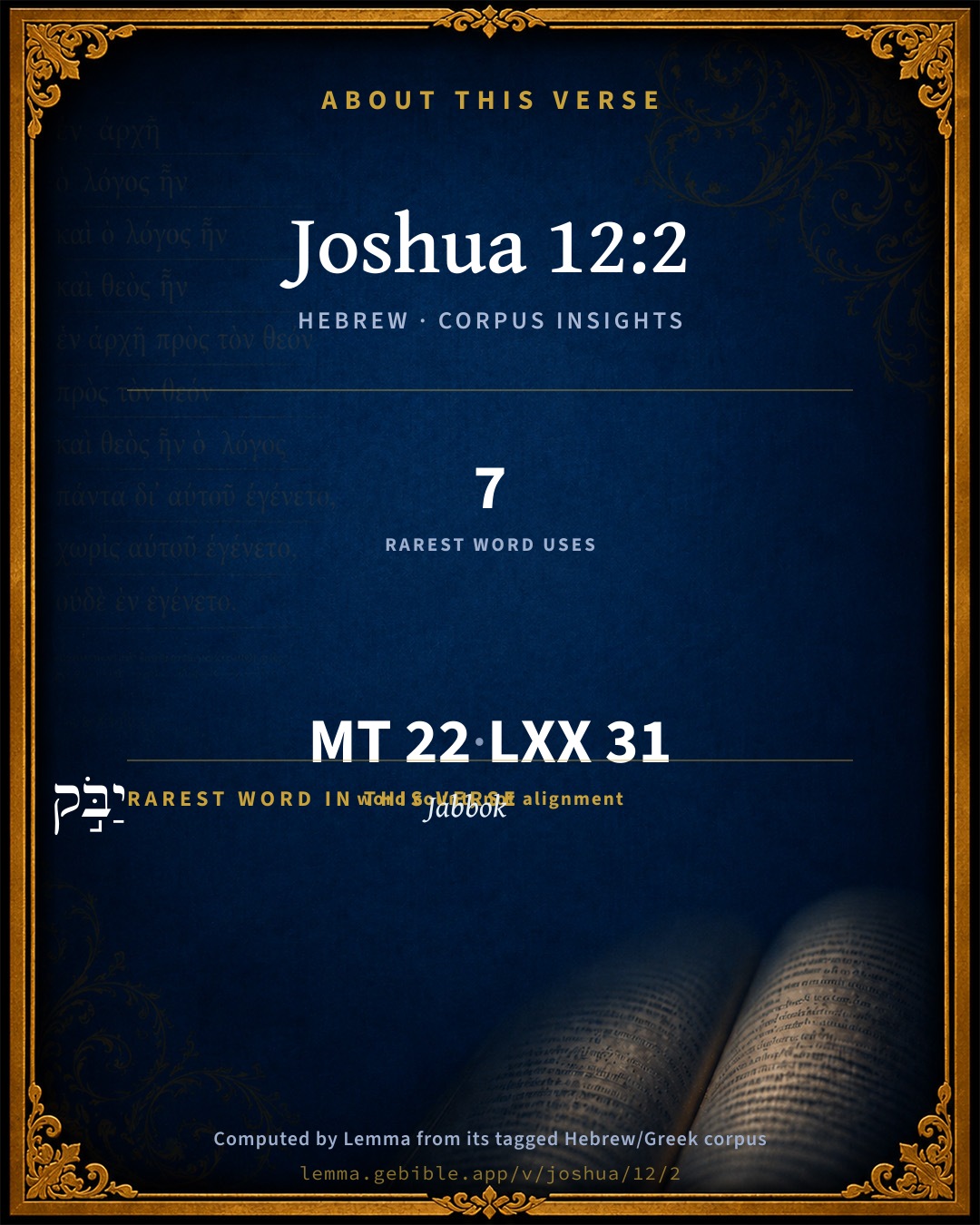
About this verse

These counts appear in no published source. They are computed here, from the morphology-tagged text and Lemma’s own curated glosses. What Lemma adds →

22
words
20
distinct lemmas
Historical
section

Notable vocabulary

The rarest word here is יַבֹּ֣ק Jabbok H2999 — appearing just 7 times in the whole Hebrew Bible.

Shared distinctive vocabulary

יַבֹּ֣ק Jabbok H2999 occurs in 7 verses of the Hebrew Bible. Also found in:

Grammatical profile

  • 2 verbs
  • 17 nouns
  • 2 prepositions
  • 1 particle

Verb forms

  • הַיּוֹשֵׁ֖ב Qal · Participle Active
  • מֹשֵׁ֡ל Qal · Participle Active

Repetition

A word recurs within this verse — often emphatic in Hebrew:

  • נַ֨חַל wadi H5158 ×3

Hebrew & Septuagint length

In English translation the verse runs 50 words from the Hebrew and 38 from the Septuagint (LXX English) — closely comparable.

A rough comparison of the two English renderings, which tokenize alike — not a word-level alignment.

Word counts can differ between the Hebrew and the Greek without any difference in meaning — e.g. the Hebrew direct-object marker אֵת has no separate Greek word, and Greek often adds the article ὁ.

In the original languages it is 22 Hebrew tokens and 31 Greek tokens — but the two are counted differently (Hebrew bundles its prefixes and suffixes into one token; the Greek is in lemma form), so that isn’t a like-for-like length.

Cross-references

9

Topical passages linked to Joshua 12:2 in the Treasury of Scripture Knowledge — connected by theme and wording, ordered by reader-vote popularity; previews shown in the World English Bible.

  • Genesis 32:22 He rose up that night, and took his two wives, and his two handmaids, and his eleven sons, and passed over the ford of the Jabbok.
  • Numbers 21:23–30 Sihon would not allow Israel to pass through his border: but Sihon gathered all his people together, and went out against Israel into the wilderness, and came to Jahaz; and he fought against Israel.
  • Deuteronomy 2:24–37 Rise up, take your journey, and pass over the valley of the Arnon: behold, I have given into your hand Sihon the Amorite, king of Heshbon, and his land; begin to possess it, and contend with him in battle.
  • Deuteronomy 3:6–17 We utterly destroyed them, as we did to Sihon king of Heshbon, utterly destroying every inhabited city, with the women and the little ones.
  • Judges 11:13 The king of the children of Ammon answered to the messengers of Jephthah, Because Israel took away my land, when he came up out of Egypt, from the Arnon even to the Jabbok, and to the Jordan: now therefore restore those [lands] again peaceably.
  • Judges 11:22 They possessed all the border of the Amorites, from the Arnon even to the Jabbok, and from the wilderness even to the Jordan.
  • Nehemiah 9:22 Moreover you gave them kingdoms and peoples, which you did allot after their portions: so they possessed the land of Sihon, even the land of the king of Heshbon, and the land of Og king of Bashan.
  • Psalms 135:11 Sihon king of the Amorites, Og king of Bashan, And all the kingdoms of Canaan,

Cross-references courtesy of OpenBible.info (CC BY 4.0).

Hebrew and Greek witnesses Masoretic Hebrew ↔ Greek Septuagint

The same verse in the two great witnesses to the Old Testament, shown verse-for-verse.

These are two independent witnesses, not word-aligned to each other, and the Septuagint is shown in lemma (dictionary) form.

Hebrew Joshua 12:2 Masoretic · Westminster Leningrad Codex

סִיחוֹן֙ מֶ֣לֶךְ הָאֱמֹרִ֔י הַיּוֹשֵׁ֖ב בְּחֶשְׁבּ֑וֹן מֹשֵׁ֡ל מֵעֲרוֹעֵ֡ר אֲשֶׁר֩ עַל שְׂפַת נַ֨חַל אַרְנ֜וֹן וְת֤וֹךְ הַנַּ֨חַל֙ וַחֲצִ֣י הַגִּלְעָ֔ד וְעַד֙ יַבֹּ֣ק הַנַּ֔חַל גְּב֖וּל בְּנֵ֥י עַמּֽוֹן

Sihon king of the Amorites, who lived in Heshbon, and ruled from Aroer, which is on the edge of the valley of the Arnon, and [the city that is in] the middle of the valley, and half Gilead, even to the river Jabbok, the border of the children of Ammon;

World English Bible · Public Domain

Greek LXX Joshua 12:2 Septuagint · lemma form

σηων ὁ βασιλεύς ὁ ἀμορραῖος ὅς καταοἰκέω ἐν εσεβων κυριεύω ἀπό αροηρ ὅς εἰμί ἐν ὁ φάραγξ κατά μέρος ὁ φάραγξ καί ὁ ἥμισυς ὁ γαλαάδ ἕως ιαβοκ ὅριον υἱός αμμων

Seon king of the Amorites, who lived in Esebon, ruling from Arnon, which is in the valley, on the side of the valley, and half of Galaad as far as Jaboc, the borders of the children of Ammon.

LXX2012 (modern English Septuagint) · Public Domain

On this verse, The Pulpit Commentary discusses the Septuagint’s reading. Read the note in Commentary ↓

Hebrew: Westminster Leningrad Codex (CC BY 4.0). Greek: Septuagint (public domain); English from LXX2012 (modern English Septuagint) (Public Domain). How the Septuagint differs from the Hebrew →

Targum (Aramaic paraphrase)

1

The Targum is the ancient Jewish Aramaic paraphrase of the Hebrew Scriptures — an interpretive translation, not the Hebrew text itself. Onkelos (literal) and Pseudo-Jonathan (expansive) render the Torah, and Jonathan the Prophets. Coverage is partial: where no permissively-licensed English translation exists for a verse, only the Aramaic is shown. This is verse-level text, not a word-by-word alignment to the Hebrew.

  1. Targum Jonathan Prophets (Joshua–Malachi)
    סִיחוֹן מַלְכָּא אֱמוֹרָאָה דְיָתֵיב בְּחֶשְׁבּוֹן שַׁלִיט מֵעֲרוֹעֵר דְעַל כֵּיף נַחֲלָא דְאַרְנוֹן וְגוֹ נַחֲלָא וּפַלְגוּת אֲרַע גִלְעָד וְעַד יוּבְקָא דְנַחֲלָא תְּחוּמָא דִבְנֵי עַמוֹן:

    (no public-domain English translation for this verse)

    Targum Jonathan — Aramaic: “Mikraot Gedolot” (public domain). English: “Sefaria Community Translation” (CC0 1.0 (public-domain dedication)); “London "Chaldee Paraphrase," 1871” (public domain). Text via Sefaria.

Commentary

Notes on Joshua 12:2 from classic Christian and Jewish commentators (each source and its license shown beneath its notes). The classic Christian expositions comment on the surrounding passage and are grouped to its opening verse, so a note may address several verses; the Jewish commentaries on the Tanakh (Rashi and others) are per-verse, so they appear only where the commentator wrote on this verse.

Lemma curates 59 commentaries, every one of them public domain or Creative Commons licensed, each selected and text-cleaned for this edition rather than reprinted as found. About our sources →

Trapp's Complete Commentary

John Trapp

Jos 12:2 Sihon king of the Amorites, who dwelt in Heshbon, [and] ruled from Aroer, which [is] upon the bank of the river Arnon, and from the middle of the river, and from half Gilead, even unto the river Jabbok, [which is] the border of the children of Ammon;

Ver. 2. And from half Gilead.] For the other half was held by Og. {Jos 12:5}

John Trapp, A Commentary or Exposition upon All the Books of the Old and New Testament (1647–1656) — public domain. Text from a community e-Sword module.

Tyndale Open Study Notes

Tyndale Open Resources

12:2 King Sihon (see Num 21:24-25) had controlled the northern Jordan Valley as far as the Sea of Galilee but not the northern part of Gilead (Josh 12:5).

Tyndale Open Study Notes — © Tyndale Open Resources, licensed CC BY-SA 4.0. Text via the HelloAO Bible API.

Adam Clarke's Commentary

Verse 2. From Aroer] Aroer was situated on the western side of the river Arnon, in the middle of the valley through which this river takes its course. The kingdom of Sihon extended from the river Arnon and the city of Aroer on the south to the river Jabbok on the north.

And from half Gilead ] The mountains of Gilead extended from north to south from Mount Hermon towards the source of the river Arnon, which was about the midst of the extent of the kingdom of Sihon: thus Sihon is said to have possessed the half of Gilead, that is, the half of the mountains and of the country which bore the name of Gilead on the east of his territories.

River Jabbok] This river has its source in the mountains of Gilead; and, running from east to west, falls into Jordan. It bounds the territories of Sihon on the north, and those of the Ammonites on the south.

Adam Clarke's Commentary on the Bible (1810–1826) — public domain. Text from a community e-Sword/MySword module.

The Cambridge Bible for Schools and Colleges

gen. ed. J. J. S. Perowne

2. Sihon king of the Amorites] See Num_21:24; Deu_2:33; Deu_3:6; Deu_3:16.

who dwelt in Heshbon] On the western border of the high plain (Mishor, Jos_13:17), and on the boundary line between the tribes of Reuben and Gad. “The ruins of Hesbân, 20 miles east of the Jordan, on the parallel of the northern end of the Dead Sea, mark the site, as they bear the name, of the ancient Heshbon.” “There is little, of a place once famed in olden story, for the traveller to see. A large piece of walling at the west end of the bold isolated hill, on which the old fortress stood; with a square block house, and a pointed archway adjoining; a temple on the crest of the hill, with the pavement unbroken and the bases of four columns still in situ; on the east, in the plain, just at the base of the hill, a great cistern, called by some ‘the fish-pools of Hesbon,’ but more probably only the reservoir for the supply of the city—these are all that remain.” Tristram’s Land of Moab, pp. 338, 339.

from Aroer] “which is set on the brenke of the stronde of Arnon,” Wyclif. Aroer lay partly on and partly in the Arnon, i. e. on an island, now ’Arâir. It was allotted to Reuben (Jos_13:16), but later came into the possession of Moab (Jer_48:19). Bochardt found ruins with the name ’Arâir on the old Roman road, upon the very edge of the precipitous north bank of the Wady Mojeb.

half Gilead] Properly Gilead denotes (i) a mountain on the south bank of the Jabbok (Gen_31:21-48) with a city of the same name; (ii) the immediate neighbourhood of this mountain (Num_32:1; Deu_2:36-37); (iii) the whole mountain district between the Arnon and the Jabbok, now called Belka (see Deu_34:1; 1Ki_4:19).

the river Jabbok] “The streem of Jabuch,” Wyclif, = “the gushing-brook,” now the Wady Zurka.

The Cambridge Bible for Schools and Colleges (gen. ed. J. J. S. Perowne; Cambridge University Press, 1878–1918) — public domain. Text from a community e-Sword module.

John Gill's Exposition

Sihon king of the Amorites, who dwelt in Heshbon,.... Which he took from the Moabites, and made his capital city, Num 21:26,

and ruled from Aroer, which is upon the bank of the river of Arnon; a city of Moab, which never fell into the hands of Sihon, and therefore he is said to rule from it but not over it:

and from the middle of the river; that is, the river Arnon, which being the boundary of the Moabites and Amorites, the king of the Amorites might be said to rule from the middle of it:

and from half Gilead even unto the river Jabbok, which is the border of the children of Ammon; so it is said to be, Deu 3:16; it should be rendered, not "from half Gilead", but "and half Gilead", as it is in the Hebrew text, and so in the Targum; for half Gilead belonged to the kingdom of Sihon, as the other half did to the kingdom of Og, as in Jos 12:5; and so Jarchi remarks.

John Gill's Exposition of the Whole Bible (1746–1763) — public domain (CC PDM 1.0). Text via the HelloAO Bible API.

Haydock's Catholic Bible Commentary

Galaad. Sehon occupied from the middle of the torrent Arnon, as far as half of the mountains of Galaad, and the torrent Jaboc. (Calmet) --- Og possessed the other half of the mountains northward, while the Ammonites had the eastern parts. (Haydock)

George Leo Haydock (1774–1849), Haydock's Catholic Family Bible and Commentary, 1859 edition — public domain. Excludes Psalms (Douay-Rheims chapter numbering differs from Protestant) and Deuterocanonical books (Catholic canon only).

Matthew Poole's English Annotations

From the middle of the river: it is not unusual, even amongst us, for a river to be divided between two lords, and for their territories or jurisdictions to meet in the middle of the river; and besides, here is a very particular reason for this expression, because the city Ar, which was no part of Sihon’s dominions, but belonged to the Moabites, Deu 2:9,18, was in the middle of the river Arnon, Deu 2:36 Deu 3:16; and therefore the middle of the river is most fitly and properly here mentioned, as the bound of Sihon’s dominion on that side.

And from half Gilead, Heb. and the half Gilead, i.e. half of the country of Gilead: the particle from is not in the original, and this doth not seem to denote the term or bound from which his dominion begun, as our version implies, for so indeed it was not; but the place or country in and over which his dominion was, which, as is here said, began at Arnon, and took in half Gilead, and ended at Jabbok, beyond which was the other half of Gilead, which belonged to Og, as is expressly said, Jos 12:5, where the words being wholly the same that are here, it is most reasonable to understand and translate them in the same manner.

Matthew Poole's English Annotations on the Holy Bible (1683–1685) — public domain. Text from a community e-Sword/MySword module.

Whedon's Commentary on the Bible

Daniel D. Whedon

2. Aroer — See on Jos_13:16.

The middle of the river — The midst of the valley of the Arnon. This is “a more exact definition of the previous clause, since the Arnon, which flowed through the middle of the valley, formed the actual boundary; whereas Aroer stood not upon the river itself, but on the northern slope of the valley.” — Keil. Compare chap. Jos_13:16, note.

And from half Gilead — The word from should be omitted both here and in the next verse. Sihon ruled over the southern half of Gilead, Og over the northern half. Jos_12:5. Gilead is the name of the great mountain region of limestone on the east of the Jordan, stretching from Mount Lebanon nearly to the territory of Moab. Jabbok is now the Wady Zurka, which intersects the mountain range of Gilead, and falls into the Jordan about half way between the Sea of Galilee and the Dead Sea. See on Num_21:24. Ammon was a son of Lot, born of incestuous intercourse. Gen_19:30-38. The Ammonites at one time possessed the whole country between the rivers Arnon and Jabbok, from the Jordan on the west to the wilderness on the east. They were driven out of it by Sihon, king of the Amorites, and he was in turn expelled by the Israelites. Yet long subsequent to these events the country was popularly called the land of the Ammonites, and was even claimed by them. Jdg_11:12-22. For this reason the Jabbok is still called the border of the children of Ammon.

Daniel D. Whedon (gen. ed.), Commentary on the Old and New Testaments (1874–1909) — public domain. Text from a community e-Sword module.

The Pulpit Commentary

The river Jabbok. Literally, the pouring or emptying stream. It is remarkable that, while the LXX renders here by ceimarrov , a winter torrent, it steadily renders the same Hebrew word, when referring to Aruon, by faragx . This latter word indicates the rocky cleft through which the water flows; the former, the fact that, though rapid and impetuous in winter, it was usually dried up in summer. Cf. the term ceimarrov , applied to the Kedron by St. John; (Jos_18:1) are markable instance of accuracy, by the way, if, as we are confidently told, the author of that Gospel was an Ephesine Gentile who had never seen Jerusalem and was imperfectly acquainted with Jewish localities and customs. The Jabbok has been identified with the Wady Zerka, or blue stream.

The Pulpit Commentary (1880–1919), ed. H.D.M. Spence-Jones & Joseph S. Exell — public domain. Text from a community e-Sword module.

John Wesley's Explanatory Notes

Middle of the river - It is not unusual even among us, for a river to be divided between two lords, and for their territories or jurisdictions to meet in the middle of the river: and besides, here is a very particular reason for this expression, because the city Ar, which was no part of Sihon's dominions, but belonged to the Moabites, Deut. ii, 9, 18, was in the middle of the river Arnon, Deut. ii, 36; iii, 16, and therefore the middle of the river is properly here mentioned, as the bound of Sihon's dominion on that side. Half Gilead - Hebrew. and the half Gilead, that is, half of the country of Gilead; this doth not denote the bound from which his dominion began, but the country, over which his dominion was, which began at Arnon, and took in half Gilead, and ended at Jabbok, beyond which was the other half of Gilead which belonged to Og.

John Wesley, Explanatory Notes Upon the Whole Bible (1754–1765) — public domain. Text via the GEBible commentary corpus.

Rashi

Rabbi Shlomo Yitzchaki (Rashi)

To the Yabok river, which was the border of the land of the Bnei Amon, the end of the territory of the land of Bnei Amon. From there [the Yabok River] and further the Bnei Amon had dominion.

Rashi on the Tanakh — English translations: “The Judaica Press complete Tanach with Rashi, translated by A. J. Rosenberg” (CC BY 4.0); “Pentateuch with Rashi's commentary by M. Rosenbaum and A.M. Silbermann, 1929-1934” (public domain); “The Metsudah Tanach series, Lakewood, N.J” (CC BY 4.0); and “The Book of Joshua, Metsudah Publications, 1997” (CC BY 4.0). Text via Sefaria.

Lesson kit

Teaching starters — assembled from the data on this page, not authored interpretation. Every prompt links to the verse data it draws on. Edit before teaching.

Joshua, in the Historical, opens this verse with 22 words (20 distinct Hebrew lemmas). Its most distinctive word is Yabbôq (“Jabbok”). A historical commentator’s framing appears above. Read the whole chapter for the surrounding context.

Discussion questions

  1. The word Yabbôq carries the sense “Jabbok.” How does it shape the verse?
  2. How does Genesis 32:22, which shares the word «Jabbok», read alongside this verse?
  3. What does the repetition of “wadi” (3× in this one verse) do in this verse?
  4. These translations render this verse differently; the difference is in the English rendering, not the original. What questions does that raise?
  5. «הַיּוֹשֵׁ֖ב» is a Qal Participle Active verb. How does that grammatical form shape the action described?
  6. Compare how Trapp's Complete Commentary and Tyndale Open Study Notes read this verse. Where do they agree or differ?

Things to notice

Reading settings

Reading text

Shown beneath each verse's original-language words.

Old Testament
Old Testament edition

Read the OT as the Masoretic Hebrew (MT) or the Greek Septuagint (LXX).

English shown for the Greek Septuagint (in the Hebrew ↔ Greek comparison).

Comparing translations? Open the Compare panel on any verse page to stack up to four side by side.