
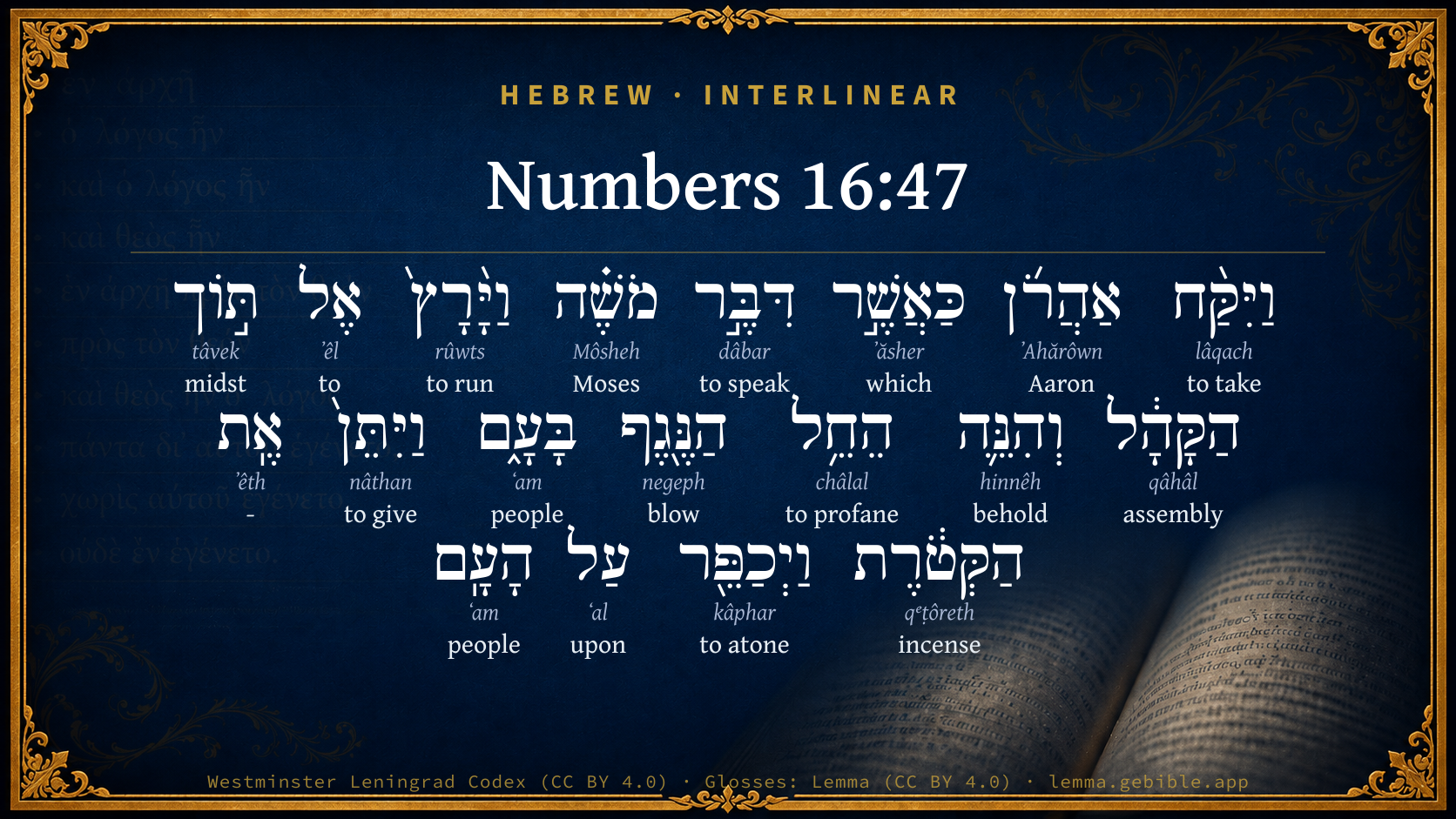
Numbers 16:47

Hebrew (Westminster Leningrad Codex) Numbers 16:47 appears in the Hebrew Old Testament. The text above is from the Westminster Leningrad Codex. Each word links to its Strong’s number, a concise gloss, and parsing drawn from the Open Scriptures Hebrew Bible morphology. Click any word for its full Brown-Driver-Briggs (BDB) entry.
Download image
Cite this verse

Numbers 16:47 (World English Bible). Public Domain. Lemma interlinear Bible study tool, https://lemma.gebible.app/v/numbers/16/47.

Show BibTeX & RIS
BibTeX
RIS
English Translation
Aaron took as Moses spoke, and ran into the midst of the assembly; and, behold, the plague was begun among the people: and he put on the incense, and made atonement for the people.
World English Bible · Public Domain
Download a study sheet

One document with this verse’s original text, its word-by-word gloss line, the meaning frame, cross-references with their text, attributed commentary, and full source and license credits — printable, and it pastes into notes with its structure intact.

This verse Autodidact and up

Study sheet (.html) Plain text (.txt)

A passage Seminary Student

Up to 50 verses in one chapter. A passage sheet keeps up to 6 commentary sources and 12 cross-references per verse, in the order this page ranks them, and says so on the sheet whenever that leaves anything out. Ask for a single verse and you get the Autodidact verse sheet above.

Everything on this page stays free to read, with no account — the sheet is a download of what is already on screen, not access to it.

Want to remove ads? Support Godless Engineer
Compare translations 3

The same verse in 3 English versions, stacked beneath the original-language interlinear above. Click any original word for its lexicon entry.

Each is an independent rendering of the whole verse — the interlinear is not word-aligned to these translations.

Highlighted words mark where these versions differ — a whole-verse word diff, not a word-by-word alignment.

  • World English Bible Public Domain
    Aaron took as Moses spoke, and ran into the midst of the assembly; and, behold, the plague was begun among the people: and he put on the incense, and made atonement for the people.
  • King James Version Public Domain
    And Aaron took as Moses commanded, and ran into the midst of the congregation; and, behold, the plague was begun among the people: and he put on incense, and made an atonement for the people.
  • unfoldingWord Literal Text CC BY-SA 4.0
    And Aaron took, just as Moses spoke, and he ran to the midst of the assembly. And behold, the plague had begun among the people. And he put the incense, and he made atonement for the people.

unfoldingWord Literal Text — © unfoldingWord, licensed CC BY-SA 4.0. Word-aligned USFM3 via Door43 (git.door43.org/unfoldingWord/en_ult).

Versions to compare (up to 4)

3 of 4 selected

Show all 18 translations

Every available English version of this verse, each an independent rendering of the whole verse.

  • World English Bible Public Domain
    Aaron took as Moses spoke, and ran into the midst of the assembly; and, behold, the plague was begun among the people: and he put on the incense, and made atonement for the people.
  • Berean Standard Bible Public Domain
    So Aaron took the censer as Moses had ordered and ran into the midst of the assembly. And seeing that the plague had begun among the people, he offered the incense and made atonement for the people.
  • Majority Standard Bible Public Domain
    So Aaron took the censer as Moses had ordered and ran into the midst of the assembly. And seeing that the plague had begun among the people, he offered the incense and made atonement for the people.
  • King James Version Public Domain
    And Aaron took as Moses commanded, and ran into the midst of the congregation; and, behold, the plague was begun among the people: and he put on incense, and made an atonement for the people.
  • American Standard Version (1901) Public Domain
    And Aaron took as Moses spake, and ran into the midst of the assembly; and, behold, the plague was begun among the people: and he put on the incense, and made atonement for the people.
  • Revised Version (1885) Public Domain
    And Aaron took as Moses spake, and ran into the midst of the assembly; and, behold, the plague was begun among the people: and he put on the incense, and made atonement for the people.
  • Geneva Bible (1599) Public Domain
    Then Aaron tooke as Moses commanded him, and ranne into the middes of the Congregation, and beholde, the plague was begun among the people, and hee put in incense, and made an atonement for the people.
  • Douay-Rheims (1899) Public Domain
    When Aaron had done this, and had run to the midst of the multitude which the burning fire was now destroying, he offered the incense:
  • Young's Literal Translation Public Domain
    And Aaron taketh as Moses hath spoken, and runneth unto the midst of the assembly, and lo, the plague hath begun among the people; and he giveth the perfume, and maketh atonement for the people,
  • Literal Standard Version CC BY-SA 4.0
    And Aaron takes [it] as Moses has spoken, and runs to the midst of the assembly, and behold, the plague has begun among the people; and he gives the incense, and makes atonement for the people,
  • Unlocked Literal Bible CC BY-SA 4.0
    So Aaron did as Moses directed. He ran into the middle of the community. The plague had quickly started to spread among the people, so he put in the incense and made atonement for the people.
  • unfoldingWord Literal Text CC BY-SA 4.0
    And Aaron took, just as Moses spoke, and he ran to the midst of the assembly. And behold, the plague had begun among the people. And he put the incense, and he made atonement for the people.
  • Darby Bible Public Domain
    And Aaron took as Moses had said, and ran into the midst of the congregation; and behold, the plague had begun among the people; and he put on incense, and made atonement for the people.
  • World Messianic Bible Public Domain
    Aaron did as Moses said, and ran into the middle of the assembly. The plague had already begun among the people. He put on the incense, and made atonement for the people.
  • Webster's Bible Public Domain
    And Aaron took as Moses commanded, and ran into the midst of the congregation; and behold, the plague was begun among the people: and he put on incense, and made an atonement for the people.
  • Free Bible Version CC BY-SA 4.0
    Aaron took the incense burner just as Moses had told him and ran into the middle of the assembly. He saw that the plague had started to affect the people so he offered the incense and made the people right with the Lord.
  • Bible in Basic English Public Domain
    And at the words of Moses, Aaron took his vessel, and went running among the people; and even then the disease had made a start among them; and he put spices in his vessel to take away the sin of the people.
  • JPS Tanakh (1917) Public Domain
    (17-12) And Aaron took as Moses spoke, and ran into the midst of the assembly; and, behold, the plague was begun among the people; and he put on the incense, and made atonement for the people.

Literal Standard Version (2020), Covenant Press — licensed CC BY-SA 4.0. Text via the HelloAO Bible API (eBible.org). Unlocked Literal Bible (unfoldingWord) — licensed CC BY-SA 4.0. Text via the HelloAO Bible API (eBible.org). unfoldingWord Literal Text — © unfoldingWord, licensed CC BY-SA 4.0. Word-aligned USFM3 via Door43 (git.door43.org/unfoldingWord/en_ult). Free Bible Version, Dr. Jonathan Gallagher — licensed CC BY-SA 4.0. Text via the HelloAO Bible API (eBible.org).

Word by word

More ways to search: Search by grammar → Find every occurrence → Compare this word →

Practice this passage: Drill this verse → Learn its vocabulary →

הַנֶּ֖גֶף
negeph
H5063
“the · blow”
Particle, Definite Article + Noun, Common, Masculine, Singular, Absolute
Part of Speech
Particle + Noun
Type
Common
Gender
Masculine
Number
Singular
State
Absolute
Full BDB Definition

Origin: from H5062

TWOT: 1294a

blow, striking, plague - blow, plague (fatal) - striking
  1. וַיִּקַּ֨ח lâqach H3947 “and · to take” Conjunction + Verb, Qal, Sequential Imperfect, 3rd Person, Masculine, Singular
  2. אַהֲרֹ֜ן ʼAhărôwn H175 “Aaron” Noun, Proper
  3. כַּאֲשֶׁ֣ר ʼăsher H834 “like/as · which” Preposition + Particle, Relative
  4. דִּבֶּ֣ר dâbar H1696 “to speak” Verb, Piel, Perfect, 3rd Person, Masculine, Singular
  5. מֹשֶׁ֗ה Môsheh H4872 “Moses” Noun, Proper
  6. וַיָּ֨רָץ֙ rûwts H7323 “and · to run” Conjunction + Verb, Qal, Sequential Imperfect, 3rd Person, Masculine, Singular
  7. אֶל ʼêl H413 “to” Preposition
  8. תּ֣וֹך tâvek H8432 “midst of” Noun, Common, Masculine, Singular, Construct
  9. הַקָּהָ֔ל qâhâl H6951 “the · assembly” Particle, Definite Article + Noun, Common, Masculine, Singular, Absolute
  10. וְהִנֵּ֛ה hinnêh H2009 “and · behold” Conjunction + Particle, Demonstrative
  11. הֵחֵ֥ל châlal H2490 “to profane” Verb, Hiphil, Perfect, 3rd Person, Masculine, Singular
  12. בָּעָ֑ם ʻam H5971 “in/at the · people” Preposition, Determined + Noun, Common, Masculine, Singular, Absolute
  13. וַיִּתֵּן֙ nâthan H5414 “and · to give” Conjunction + Verb, Qal, Sequential Imperfect, 3rd Person, Masculine, Singular
  14. אֶֽת ʼêth H853 “-” Particle, Direct Object
  15. הַקְּטֹ֔רֶת qᵉṭôreth H7004 “the · incense” Particle, Definite Article + Noun, Common, Feminine, Singular, Absolute
  16. וַיְכַפֵּ֖ר kâphar H3722 “and · to atone” Conjunction + Verb, Piel, Sequential Imperfect, 3rd Person, Masculine, Singular
  17. עַל ʻal H5921 “upon” Preposition
  18. הָעָֽם ʻam H5971 “the · people” Particle, Definite Article + Noun, Common, Masculine, Singular, Absolute

About this verse

These counts appear in no published source. They are computed here, from the morphology-tagged text and Lemma’s own curated glosses. What Lemma adds →

19
words
18
distinct lemmas
Pentateuch
section

Notable vocabulary

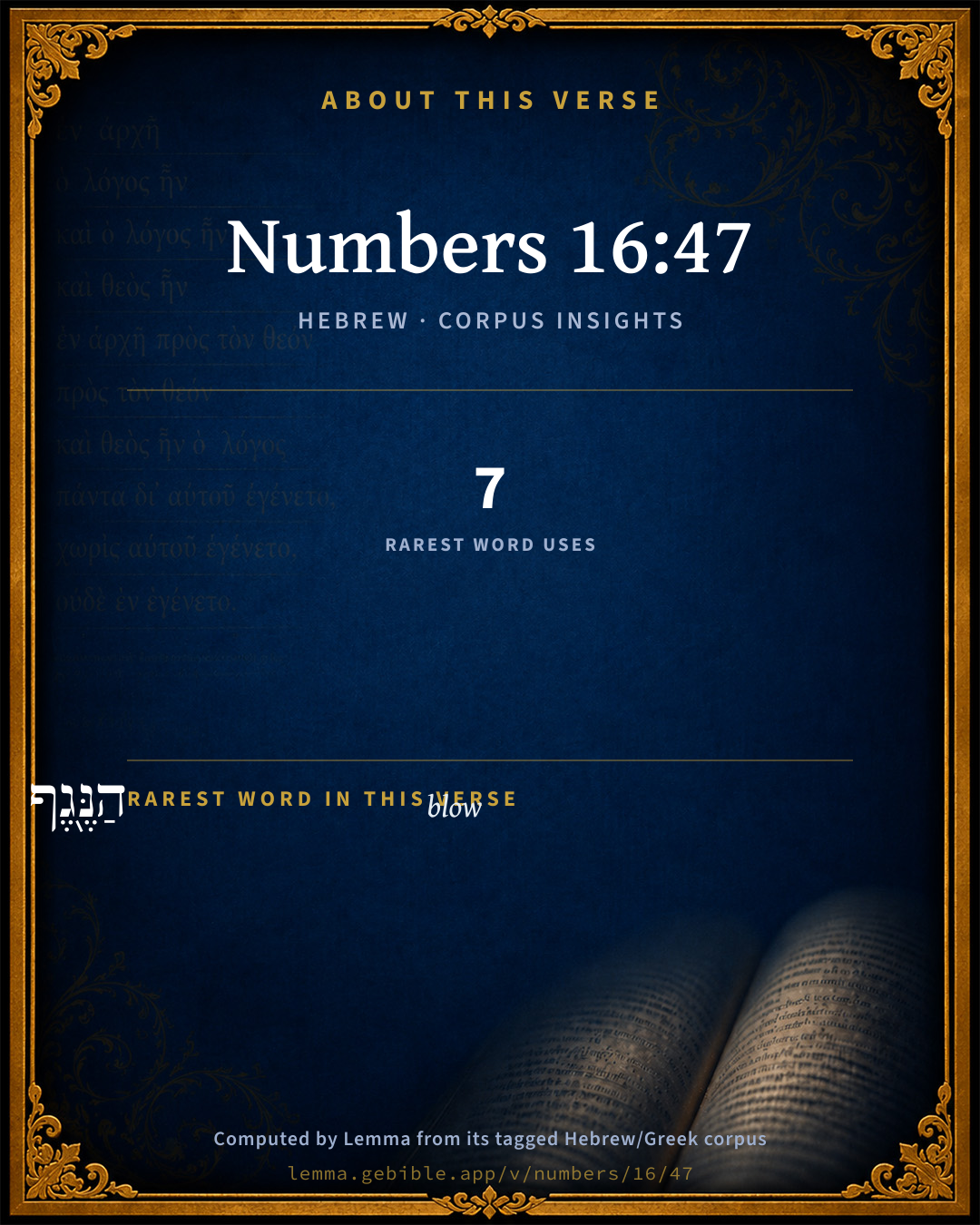
The rarest word here is הַנֶּ֖גֶף blow H5063 — appearing just 7 times in the whole Hebrew Bible.

Shared distinctive vocabulary

הַנֶּ֖גֶף blow H5063 occurs in 7 verses of the Hebrew Bible. Also found in:

Grammatical profile

  • 6 verbs
  • 8 nouns
  • 2 prepositions
  • 3 particles

Verb forms

  • וַיִּקַּ֨ח Qal · Sequential Imperfect
  • דִּבֶּ֣ר Piel · Perfect
  • וַיָּ֨רָץ֙ Qal · Sequential Imperfect
  • הֵחֵ֥ל Hiphil · Perfect
  • וַיִּתֵּן֙ Qal · Sequential Imperfect
  • וַיְכַפֵּ֖ר Piel · Sequential Imperfect

Repetition

A word recurs within this verse — often emphatic in Hebrew:

  • בָּעָ֑ם people H5971 ×2

Hebrew & Septuagint length

In English translation the verse runs 34 words from the Hebrew and 34 from the Septuagint (LXX English) — the same length.

A rough comparison of the two English renderings, which tokenize alike — not a word-level alignment.

Word counts can differ between the Hebrew and the Greek without any difference in meaning — e.g. the Hebrew direct-object marker אֵת has no separate Greek word, and Greek often adds the article ὁ.

Cross-references

7

Topical passages linked to Numbers 16:47 in the Treasury of Scripture Knowledge — connected by theme and wording, ordered by reader-vote popularity; previews shown in the World English Bible.

  • Numbers 16:46 Moses said to Aaron, Take your censer, and put fire therein from off the altar, and lay incense thereon, and carry it quickly to the congregation, and make atonement for them: for there is wrath gone out from Yahweh; the plague is begun.
  • Numbers 25:6–8 Behold, one of the children of Israel came and brought to his brothers a Midianite woman in the sight of Moses, and in the sight of all the congregation of the children of Israel, while they were weeping at the door of the tent of meeting.
  • Deuteronomy 33:10–11 They shall teach Jacob your ordinances, Israel your law: They shall put incense before you, Whole burnt offering on your altar.
  • Psalms 106:29 Thus they provoked him to anger with their deeds. The plague broke in on them.
  • Isaiah 53:10–12 Yet it pleased Yahweh to bruise him; he has put him to grief: when you shall make his soul an offering for sin, he shall see [his] seed, he shall prolong his days, and the pleasure of Yahweh shall prosper in his hand.
  • Matthew 5:44 But I tell you, love your enemies, bless those who curse you, do good to those who hate you, and pray for those who mistreat you and persecute you,
  • Romans 12:21 Don't be overcome by evil, but overcome evil with good.

Cross-references courtesy of OpenBible.info (CC BY 4.0).

Hebrew and Greek witnesses Masoretic Hebrew ↔ Greek Septuagint

The same verse in the two great witnesses to the Old Testament, shown verse-for-verse.

These are two independent witnesses, not word-aligned to each other, and the Septuagint is shown in lemma (dictionary) form.

Hebrew Numbers 16:47 Masoretic · Westminster Leningrad Codex

וַיִּקַּ֨ח אַהֲרֹ֜ן כַּאֲשֶׁ֣ר דִּבֶּ֣ר מֹשֶׁ֗ה וַיָּ֨רָץ֙ אֶל תּ֣וֹך הַקָּהָ֔ל וְהִנֵּ֛ה הֵחֵ֥ל הַנֶּ֖גֶף בָּעָ֑ם וַיִּתֵּן֙ אֶֽת הַקְּטֹ֔רֶת וַיְכַפֵּ֖ר עַל הָעָֽם

Aaron took as Moses spoke, and ran into the midst of the assembly; and, behold, the plague was begun among the people: and he put on the incense, and made atonement for the people.

World English Bible · Public Domain

Greek LXX Numbers 16:47 Septuagint · lemma form
And Aaron took as Moses spoke to him, and ran among the congregation, for already the plague had begun among the people; and he put on incense, and made an atonement for the people.

LXX2012 (modern English Septuagint) · Public Domain

Hebrew: Westminster Leningrad Codex (CC BY 4.0). Greek: Septuagint (public domain); English from LXX2012 (modern English Septuagint) (Public Domain). How the Septuagint differs from the Hebrew →

Commentary

Notes on Numbers 16:47 from classic Christian and Jewish commentators (each source and its license shown beneath its notes). The classic Christian expositions comment on the surrounding passage and are grouped to its opening verse, so a note may address several verses; the Jewish commentaries on the Tanakh (Rashi and others) are per-verse, so they appear only where the commentator wrote on this verse.

Lemma curates 59 commentaries, every one of them public domain or Creative Commons licensed, each selected and text-cleaned for this edition rather than reprinted as found. About our sources →

Trapp's Complete Commentary

John Trapp

Num 16:47 And Aaron took as Moses commanded, and ran into the midst of the congregation; and, behold, the plague was begun among the people: and he put on incense, and made an atonement for the people.

Ver. 47. The plague.] Which ran as a fire in a grain field.

John Trapp, A Commentary or Exposition upon All the Books of the Old and New Testament (1647–1656) — public domain. Text from a community e-Sword module.

Geneva Bible (1599)

Geneva Bible translators

God had begun to punish the people.

Geneva Bible (1599) marginal notes — public domain. Text via Bolls.life.

Ellicott's Commentary for English Readers

(47) And ran into the midst of the congregation.—The whole occasion was an extraordinary one. On ordinary occasions incense might only be offered on the golden altar within the holy place in which the priests ministered.

A Bible Commentary for English Readers, edited by Charles John Ellicott (1878–1897) — public domain. Text from a community e-Sword module.

John Gill's Exposition

And he stood between the dead and the living,.... The plague beginning at one end of the camp, and so proceeded on, Aaron placed himself between that part of it wherein it had made havoc, and that wherein yet it was not come; the Targum of Jonathan is,"he stood in prayer in the middle, and made a partition, with his censer, between the dead and living;''in this he was a type of Christ, the Mediator between God and man, the living God and dead sinners; for though his atonement and intercession are not made for the dead in a corporeal sense, nor for those who have sinned, and sin unto death, the unpardonable sin, nor for men appointed unto death, but for the living in Jerusalem, or for those who are written in the Lamb's book of life; yet for those who are dead in sin, and as deserving of eternal death as others, whereby they are saved from everlasting ruin:

and the plague was stayed; it proceeded no further than where Aaron stood and offered his incense, and made atonement: so the consequence of the atonement and intercession of Christ is, that the wrath of God sin deserves comes not upon those that have a share therein, the second death shall not seize upon them, nor they be hurt with it; for, being justified by the blood of Christ, and atonement for their sins being made by his sacrifice, they are saved from wrath to come.

John Gill's Exposition of the Whole Bible (1746–1763) — public domain (CC PDM 1.0). Text via the HelloAO Bible API.

Albert Barnes' Notes on the Bible

A striking proof of the efficacy of that very Aaronic priesthood which the rebels had presumed to reject. The incense offering which had brought down destruction when presented by unauthorised hands, now in the hand of the true priest is the medium of instant salvation to the whole people. Aaron by his acceptable ministration and his personal self-devotion foreshadows emphatically in this transaction the perfect mediation and sacrifice of Himself made by Christ.

Albert Barnes' Notes on the Bible (1834–1885) — public domain. Text from a community e-Sword/MySword module.

Matthew Poole's English Annotations

Ran into the midst of the congregation; hazarding his own life to obey God, and to do this wicked people good.

Matthew Poole's English Annotations on the Holy Bible (1683–1685) — public domain. Text from a community e-Sword/MySword module.

Whedon's Commentary on the Bible

Daniel D. Whedon

47. Aaron… ran — Here the spirit of forgiveness shines forth resplendently. Against these great leaders a double wrong had been done — a conspiracy against their authority and a wicked slander of their fair fame. Num_16:41. Yet they both evince the most intense desire for the salvation of their enemies. The cloud of incense was a mute prayer symbolizing the priestly intercession that came between the divine wrath and the people, and by covering them arrests the plague.

Daniel D. Whedon (gen. ed.), Commentary on the Old and New Testaments (1874–1909) — public domain. Text from a community e-Sword module.

Scofield Reference Notes

C. I. Scofield

atonement

(See Scofield "Exo 29:33")

The Scofield Reference Bible (1917 edition), notes by C. I. Scofield — public domain. Text from a community e-Sword module.

unfoldingWord translationNotes

Door43 World Missions Community

he put in the incense

Putting the incense in the censer here represents burning it. AT: "he burned the incense" (See: Metonymy)

the plague was stopped

This can be stated in active form. AT: "the plague stopped spreading" (See: Active or Passive)

translationWords

die

life

unfoldingWord translationNotes — © Distant Shores Media and the Door43 World Missions Community, licensed CC BY-SA 4.0. Source: git.door43.org/Door43/en_tn.

Lesson kit

Teaching starters — assembled from the data on this page, not authored interpretation. Every prompt links to the verse data it draws on. Edit before teaching.

Numbers, in the Pentateuch, opens this verse with 19 words (18 distinct Hebrew lemmas). Its most distinctive word is negeph (“blow”). A historical commentator’s framing appears above. Read the whole chapter for the surrounding context.

Discussion questions

  1. The word negeph carries the sense “blow.” How does it shape the verse?
  2. Exodus 12:13 shares the word «blow» with this verse. How do the two illuminate each other?
  3. “people” occurs 2× in this one verse. What is the effect of the repetition?
  4. These translations render this verse differently; the difference is in the English rendering, not the original. What questions does that raise?
  5. The verb «וַיִּקַּ֨ח» is Qal Sequential Imperfect. How does its form color the action?
  6. Reading how Trapp's Complete Commentary and Geneva Bible (1599) read this verse, where do the two commentators agree and where do they part?

Things to notice

Reading settings

Reading text

Shown beneath each verse's original-language words.

Old Testament
Old Testament edition

Read the OT as the Masoretic Hebrew (MT) or the Greek Septuagint (LXX).

English shown for the Greek Septuagint (in the Hebrew ↔ Greek comparison).

Comparing translations? Open the Compare panel on any verse page to stack up to four side by side.