
Joshua 8:13

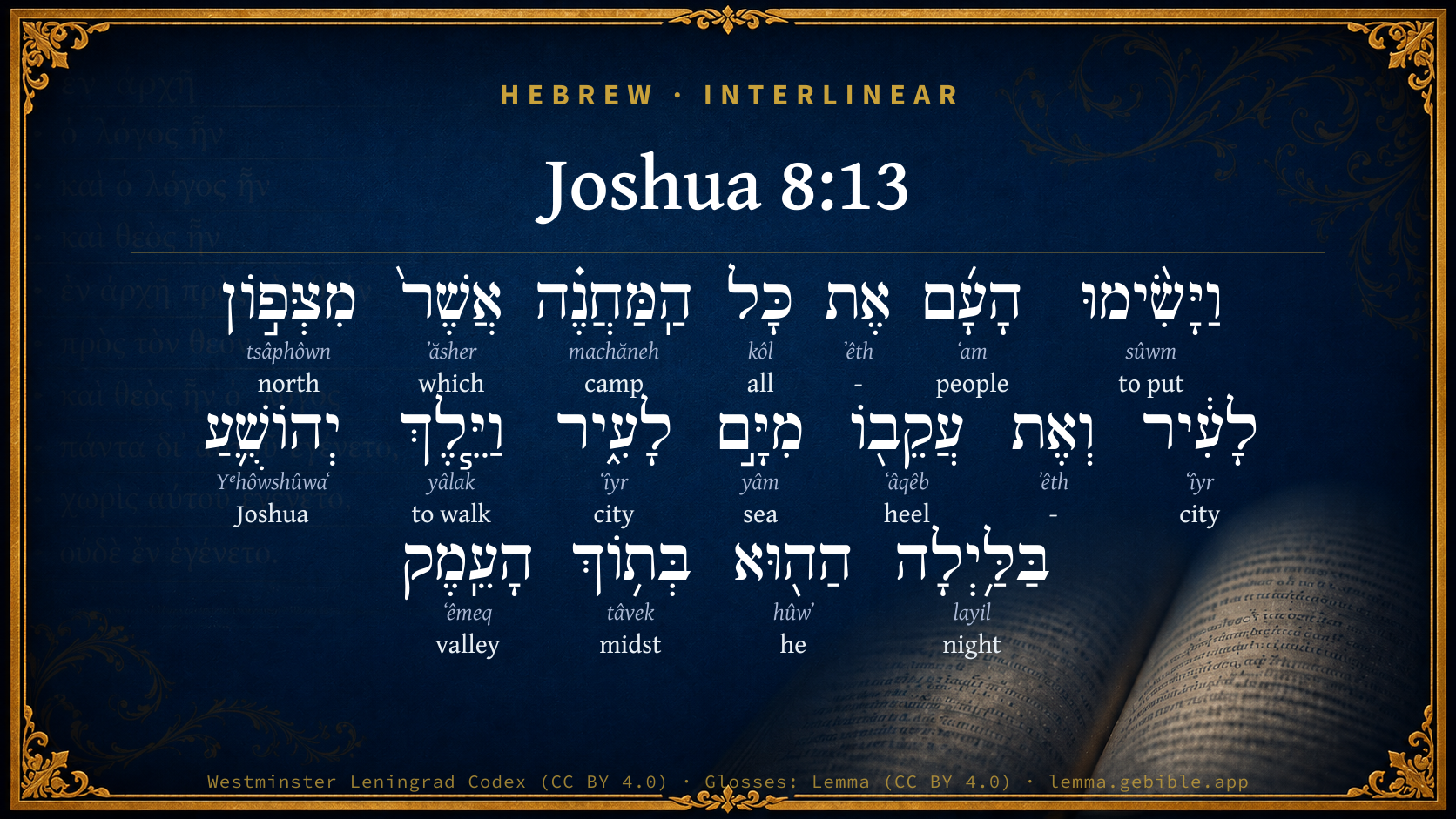
Hebrew (Westminster Leningrad Codex) Joshua 8:13 appears in the Hebrew Old Testament. The text above is from the Westminster Leningrad Codex. Each word links to its Strong’s number, a concise gloss, and parsing drawn from the Open Scriptures Hebrew Bible morphology. Click any word for its full Brown-Driver-Briggs (BDB) entry.
Download image
Cite this verse

Joshua 8:13 (World English Bible). Public Domain. Lemma interlinear Bible study tool, https://lemma.gebible.app/v/joshua/8/13.

Show BibTeX & RIS
BibTeX
RIS
English Translation
So they set the people, even all the host who was on the north of the city, and their liers-in-wait who were on the west of the city; and Joshua went that night into the midst of the valley.
World English Bible · Public Domain
Download a study sheet

One document with this verse’s original text, its word-by-word gloss line, the meaning frame, cross-references with their text, attributed commentary, and full source and license credits — printable, and it pastes into notes with its structure intact.

This verse Autodidact and up

Study sheet (.html) Plain text (.txt)

A passage Seminary Student

Up to 50 verses in one chapter. A passage sheet keeps up to 6 commentary sources and 12 cross-references per verse, in the order this page ranks them, and says so on the sheet whenever that leaves anything out. Ask for a single verse and you get the Autodidact verse sheet above.

Everything on this page stays free to read, with no account — the sheet is a download of what is already on screen, not access to it.

Want to remove ads? Support Godless Engineer
Compare translations 3

The same verse in 3 English versions, stacked beneath the original-language interlinear above. Click any original word for its lexicon entry.

Each is an independent rendering of the whole verse — the interlinear is not word-aligned to these translations.

Highlighted words mark where these versions differ — a whole-verse word diff, not a word-by-word alignment.

  • World English Bible Public Domain
    So they set the people, even all the host who was on the north of the city, and their liers-in-wait who were on the west of the city; and Joshua went that night into the midst of the valley.
  • King James Version Public Domain
    And when they had set the people, even all the host that was on the north of the city, and their liers in wait on the west of the city, Joshua went that night into the midst of the valley.
  • unfoldingWord Literal Text CC BY-SA 4.0
    So the people set all of the camp that from the north of the city and its heel from the west of the city. And Joshua went during that night into the midst of the valley.

unfoldingWord Literal Text — © unfoldingWord, licensed CC BY-SA 4.0. Word-aligned USFM3 via Door43 (git.door43.org/unfoldingWord/en_ult).

Versions to compare (up to 4)

3 of 4 selected

Show all 18 translations

Every available English version of this verse, each an independent rendering of the whole verse.

  • World English Bible Public Domain
    So they set the people, even all the host who was on the north of the city, and their liers-in-wait who were on the west of the city; and Joshua went that night into the midst of the valley.
  • Berean Standard Bible Public Domain
    So the forces were stationed with the main camp to the north of the city and the rear guard to the west of the city. And that night Joshua went into the valley.
  • Majority Standard Bible Public Domain
    So the forces were stationed with the main camp to the north of the city and the rear guard to the west of the city. And that night Joshua went into the valley.
  • King James Version Public Domain
    And when they had set the people, even all the host that was on the north of the city, and their liers in wait on the west of the city, Joshua went that night into the midst of the valley.
  • American Standard Version (1901) Public Domain
    So they set the people, even all the host that was on the north of the city, and their liers-in-wait that were on the west of the city; and Joshua went that night into the midst of the valley.
  • Revised Version (1885) Public Domain
    So they set the people, even all the host that was on the north of the city, and their liers in wait that were on the west of the city; and Joshua went that night into the midst of the vale.
  • Geneva Bible (1599) Public Domain
    And the people set all the hoste that was on the Northside against the citie, and the liers in waite on the West, against the citie: and Ioshua went the same night into the mids of the valley.
  • Douay-Rheims (1899) Public Domain
    But all the rest of the army went in battle array on the north side, so that the last of that multitude reached to the west side of the city. So Josue went that night, and stood in the midst of the valley.
  • Young's Literal Translation Public Domain
    and they set the people, all the camp which `is' on the north of the city, and its rear on the west of the city, and Joshua goeth on that night into the midst of the valley.
  • Literal Standard Version CC BY-SA 4.0
    and they set the people, all the camp which [is] on the north of the city, and its rear on the west of the city, and that night Joshua goes on into the midst of the valley.
  • Unlocked Literal Bible CC BY-SA 4.0
    They positioned all the soldiers, the main army on the north side of the city, and the rear guard on the west side of the city. Joshua spent that night in the valley.
  • unfoldingWord Literal Text CC BY-SA 4.0
    So the people set all of the camp that from the north of the city and its heel from the west of the city. And Joshua went during that night into the midst of the valley.
  • Darby Bible Public Domain
    And when they had set the people, the whole camp on the north of the city, and their ambush on the west of the city, Joshua went that night into the midst of the valley.
  • World Messianic Bible Public Domain
    So they set the people, even all the army who was on the north of the city, and their ambush on the west of the city; and Joshua went that night into the middle of the valley.
  • Webster's Bible Public Domain
    And when they had set the people, even all the host that was on the north of the city, and their liers in wait on the west of the city, Joshua went that night into the midst of the valley.
  • Free Bible Version CC BY-SA 4.0
    So the army took up their positions—the main army to the north of the town, and the ambush to the west. Joshua went that night to the valley.
  • Bible in Basic English Public Domain
    So all the people were in their places, the army on the north side of the town and the secret force on the west; and that night Joshua went down into the valley.
  • JPS Tanakh (1917) Public Domain
    So the people set themselves in array, even all the host that was on the north of the city, their rear lying in wait on the west of the city; and Joshua went that night into the midst of the vale.

Literal Standard Version (2020), Covenant Press — licensed CC BY-SA 4.0. Text via the HelloAO Bible API (eBible.org). Unlocked Literal Bible (unfoldingWord) — licensed CC BY-SA 4.0. Text via the HelloAO Bible API (eBible.org). unfoldingWord Literal Text — © unfoldingWord, licensed CC BY-SA 4.0. Word-aligned USFM3 via Door43 (git.door43.org/unfoldingWord/en_ult). Free Bible Version, Dr. Jonathan Gallagher — licensed CC BY-SA 4.0. Text via the HelloAO Bible API (eBible.org).

Word by word

More ways to search: Search by grammar → Find every occurrence → Compare this word →

Practice this passage: Drill this verse → Learn its vocabulary →

עֲקֵב֖וֹ
ʻâqêb
H6119
“heel · his”
Noun, Common, Masculine, Singular, Construct + Suffix, Personal, 3rd Person, Masculine, Singular
Part of Speech
Noun
Type
Common
Gender
Masculine
Number
Singular
State
Construct
Full BDB Definition

Origin: from H6117

TWOT: 1676a

heel, rear, footprint, hinder part, hoof, rear of a troop, footstep - heel - mark of heel, footprint - hinder part, rear
  1. וַיָּשִׂ֨ימוּ sûwm H7760 “and · to put” Conjunction + Verb, Qal, Sequential Imperfect, 3rd Person, Masculine, Plural
  2. הָעָ֜ם ʻam H5971 “the · people” Particle, Definite Article + Noun, Common, Masculine, Singular, Absolute
  3. אֶת ʼêth H853 “-” Particle, Direct Object
  4. כָּל kôl H3605 “all of” Noun, Common, Masculine, Singular, Construct
  5. הַֽמַּחֲנֶ֗ה machăneh H4264 “the · camp” Particle, Definite Article + Noun, Common, Both, Singular, Absolute
  6. אֲשֶׁר֙ ʼăsher H834 “which” Particle, Relative
  7. מִצְּפ֣וֹן tsâphôwn H6828 “from · north of” Preposition + Noun, Common, Feminine, Singular, Construct
  8. לָעִ֔יר ʻîyr H5892 “to/for the · city” Preposition, Determined + Noun, Common, Feminine, Singular, Absolute
  9. וְאֶת ʼêth H853 “and · -” Conjunction + Particle, Direct Object
  10. מִיָּ֣ם yâm H3220 “from · sea” Preposition + Noun, Common, Masculine, Singular, Absolute
  11. לָעִ֑יר ʻîyr H5892 “to/for the · city” Preposition, Determined + Noun, Common, Feminine, Singular, Absolute
  12. וַיֵּ֧לֶךְ yâlak H3212 “and · to walk” Conjunction + Verb, Qal, Sequential Imperfect, 3rd Person, Masculine, Singular
  13. יְהוֹשֻׁ֛עַ Yᵉhôwshûwaʻ H3091 “Joshua” Noun, Proper
  14. בַּלַּ֥יְלָה layil H3915 “in/at the · night” Preposition, Determined + Noun, Common, Masculine, Singular, Absolute
  15. הַה֖וּא hûwʼ H1931 “the · he” Particle, Definite Article + Pronoun, Personal, 3rd Person, Masculine, Singular
  16. בְּת֥וֹךְ tâvek H8432 “in/at · midst of” Preposition + Noun, Common, Masculine, Singular, Construct
  17. הָעֵֽמֶק ʻêmeq H6010 “the · valley” Particle, Definite Article + Noun, Common, Masculine, Singular, Absolute

About this verse

These counts appear in no published source. They are computed here, from the morphology-tagged text and Lemma’s own curated glosses. What Lemma adds →

18
words
16
distinct lemmas
Historical
section

Notable vocabulary

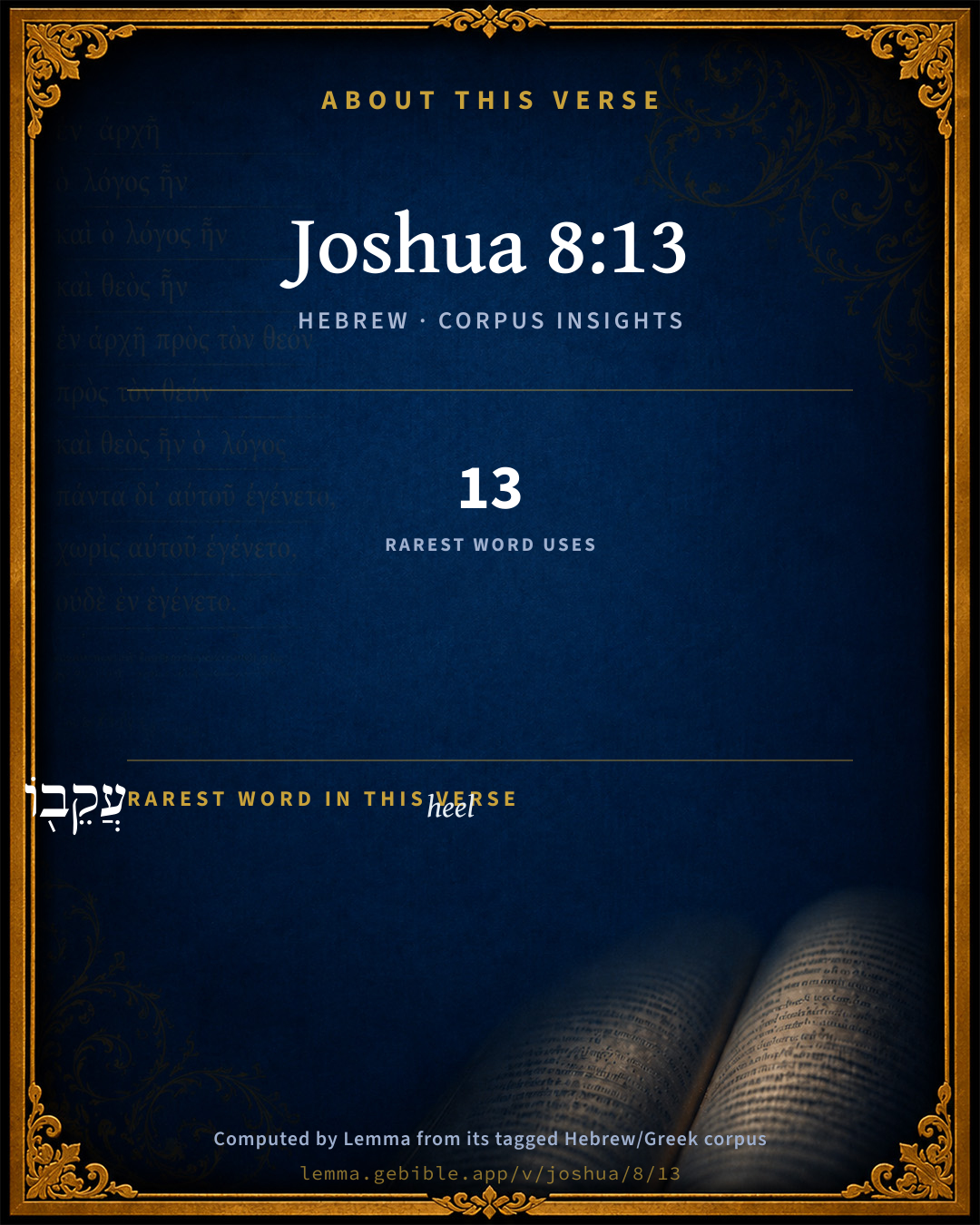
The rarest word here is עֲקֵב֖וֹ heel H6119 — appearing just 13 times in the whole Hebrew Bible.

Shared distinctive vocabulary

עֲקֵב֖וֹ heel H6119 occurs in 13 verses of the Hebrew Bible. Also found in:

Grammatical profile

  • 2 verbs
  • 12 nouns
  • 1 pronoun
  • 3 particles

Verb forms

  • וַיָּשִׂ֨ימוּ Qal · Sequential Imperfect
  • וַיֵּ֧לֶךְ Qal · Sequential Imperfect

Repetition

A word recurs within this verse — often emphatic in Hebrew:

  • לָעִ֔יר city H5892 ×2

Cross-references

2

Topical passages linked to Joshua 8:13 in the Treasury of Scripture Knowledge — connected by theme and wording, ordered by reader-vote popularity; previews shown in the World English Bible.

  • Joshua 8:8 It shall be, when you have seized on the city, that you shall set the city on fire; according to the word of Yahweh shall you do: behold, I have commanded you.
  • Joshua 8:12 He took about five thousand men, and set them in ambush between Bethel and Ai, on the west side of the city.

Cross-references courtesy of OpenBible.info (CC BY 4.0).

Hebrew and Greek witnesses Masoretic Hebrew ↔ Greek Septuagint

The same verse in the two great witnesses to the Old Testament, shown verse-for-verse.

These are two independent witnesses, not word-aligned to each other, and the Septuagint is shown in lemma (dictionary) form.

Hebrew Joshua 8:13 Masoretic · Westminster Leningrad Codex

וַיָּשִׂ֨ימוּ הָעָ֜ם אֶת כָּל הַֽמַּחֲנֶ֗ה אֲשֶׁר֙ מִצְּפ֣וֹן לָעִ֔יר וְאֶת עֲקֵב֖וֹ מִיָּ֣ם לָעִ֑יר וַיֵּ֧לֶךְ יְהוֹשֻׁ֛עַ בַּלַּ֥יְלָה הַה֖וּא בְּת֥וֹךְ הָעֵֽמֶק

So they set the people, even all the host who was on the north of the city, and their liers-in-wait who were on the west of the city; and Joshua went that night into the midst of the valley.

World English Bible · Public Domain

Hebrew: Westminster Leningrad Codex (CC BY 4.0). Greek: Septuagint (public domain); English from a public-domain English Septuagint. How the Septuagint differs from the Hebrew →

Targum (Aramaic paraphrase)

1

The Targum is the ancient Jewish Aramaic paraphrase of the Hebrew Scriptures — an interpretive translation, not the Hebrew text itself. Onkelos (literal) and Pseudo-Jonathan (expansive) render the Torah, and Jonathan the Prophets. Coverage is partial: where no permissively-licensed English translation exists for a verse, only the Aramaic is shown. This is verse-level text, not a word-by-word alignment to the Hebrew.

  1. Targum Jonathan Prophets (Joshua–Malachi)
    וְשַׁוִיאוּ עַמָא יַת כָּל מַשְׁרִיתָא דְמִצִפוּנָא לְקַרְתָּא וְיַת כְּמָנֵיהּ מַעֲרַב לְקַרְתָּא וַאֲזַל יְהוֹשֻׁעַ בְּלֵילְיָא הַהוּא בְּגוֹ מֵישְׁרָא:

    (no public-domain English translation for this verse)

    Targum Jonathan — Aramaic: “Mikraot Gedolot” (public domain). English: “Sefaria Community Translation” (CC0 1.0 (public-domain dedication)); “London "Chaldee Paraphrase," 1871” (public domain). Text via Sefaria.

Commentary

Notes on Joshua 8:13 from classic Christian and Jewish commentators (each source and its license shown beneath its notes). The classic Christian expositions comment on the surrounding passage and are grouped to its opening verse, so a note may address several verses; the Jewish commentaries on the Tanakh (Rashi and others) are per-verse, so they appear only where the commentator wrote on this verse.

Lemma curates 59 commentaries, every one of them public domain or Creative Commons licensed, each selected and text-cleaned for this edition rather than reprinted as found. About our sources →

Trapp's Complete Commentary

John Trapp

Jos 8:13 And when they had set the people, [even] all the host that [was] on the north of the city, and their liers in wait on the west of the city, Joshua went that night into the midst of the valley.

Ver. 13. Joshua went that night.] That is, very early in the morning, {Jos 8:9-10} with a small company, that he might provoke the citizens to sally out, which they did the rather, because they saw the Israelites in the midst of the valley, iniquo loco, in a place of disadvantage.

John Trapp, A Commentary or Exposition upon All the Books of the Old and New Testament (1647–1656) — public domain. Text from a community e-Sword module.

Matthew Poole's English Annotations

To wit, accompanied with a small part of the host now mentioned, i.e. very early in the morning, when it was yet dark, as is said in a like case, Joh 20:1, whence it is here called night, though it was early in the morning, as is said Jos 8:10; for it seems most probable that all was done in one night’s space, and in this manner: Joshua sends away the ambush by night, Jos 8:3, and lodgeth that night with twenty-five thousand men, Jos 8:9, not far from the city. But not able nor willing to sleep all night, he rises very early, Jos 8:10, and numbers his men, which by the help of the several officers was quickly done, and so immediately leads them towards Ai; and while it was yet duskish or night, he goes into the midst of the valley, Jos 8:13; and when the day dawns he is discovered by the king and people of Ai, who thereupon rose up early to fight with them, Jos 8:14. Though others conceive this was the second night, and so the ambush had lain hid a night and a day together. But then there might be danger of their being discovered, although that danger may seem to be the less, because Ai might be shut up, that none might go out nor come in, but by order, and upon necessity, because of the nearness of their enemies, as Jericho formerly was for the same reason, Jos 6:1. Into the midst of the valley; which was near the city, thereby to allure them forth.

Matthew Poole's English Annotations on the Holy Bible (1683–1685) — public domain. Text from a community e-Sword/MySword module.

Geneva Bible (1599)

Geneva Bible translators

To the intent that they in the city might the better discover his army.

Geneva Bible (1599) marginal notes — public domain. Text via Bolls.life.

Jamieson, Fausset & Brown

Robert Jamieson, A. R. Fausset & David Brown

Joshua went that night into the midst of the valley--The deep and steep-sided glen to the north of Tell-el-hajar, into which one looks down from the tell, fully agrees with this account [VAN DE VELDE]. Joshua himself took up his position on the north side of "the ravine"--the deep chasm of the wady El-Murogede; "that night"--means, while it was dark, probably after midnight, or very early in the morning (Joh 20:1). The king of Ai, in the early dawn, rouses his slumbering subjects and makes a hasty sally with all his people who were capable of bearing arms, once more to surprise and annihilate them.

Jamieson, Fausset & Brown — Commentary Critical and Explanatory on the Whole Bible (1871) — public domain (CC PDM 1.0). Text via the HelloAO Bible API.

John Calvin's Commentaries

13. Joshua went that night, etc It is not probable that all were called out from the camp, but the army was composed of those who were more accustomed to war. That it was sufficiently numerous appears from the fact, that five thousand were withdrawn from it for ambuscade. At first thirty-five thousand appear to be enumerated, but it is clear from the context that the number was not so great. I am rather inclined to conjecture that thirty thousand were led out for open fight, and that five thousand were specially set apart for an ambuscade. Joshua hastens to execute the task assigned to him, commencing his march in the morning, and in this haste we see how effectual the promise had proved. Had not the mind of all been freed from fear he never could have found them so prompt to obey.

Apparently, indeed, little prudence is shown in sending so large a body to proceed by hidden paths to a place suitable for ambuscade. For with whatever silence and composure they might proceed, the mere movement of their feet must have caused a considerable noise. Should any one say that there was nobody to meet them, as all the inhabitants of the district had deserted the fields and taken refuge in the city, we will find it mentioned shortly after, that before the Israelites came near to the city their arrival was known by the king of Ai; and this could scarcely have been without scouts. But granting that they met no one in the fields, it was certainly a difficult matter to pass by, to select a suitable place during night for an ambuscade, and to take possession of it without giving some indication of their presence. With regard to the procedure of Joshua, though he might see that the business could be accomplished by a smaller force, he seems to have been compelled by the recent trepidation of the people to be very careful not to engage them in any enterprise of danger. For had only a few of the army been dispatched they would perhaps have declined a part by which they were to be particularly exposed.

The Lord meanwhile displays the greatest indulgence to his people in delivering up an enemy that was to be so easily conquered. His wonderful favor especially appears in blinding all of them, so that they have no suspicion of the ambuscade. I have no doubt that when it is said they knew not of it, the writer of the history means to draw attention to the rare and extraordinary kindness of God in so covering, as it were, with the shadow of his hand, first, the thirty thousand who accompanied Joshua, and then the five thousand, that they all escaped the notice of the enemy. When mention is now made of five thousand, I do not understand it to mean that Joshua furnished a new ambuscade, as if the number, already excessive, were not sufficient, but that the writer now merely shows how the thirty-five thousand whom Joshua had armed were distributed. For to what end would so small a reinforcement have been given to so great a multitude? Besides, the place where they are ordered to halt is the same as that which had been previously pointed out; this could not apply to two separate bodies of troops.

John Calvin's Commentaries (1540-1563) — public domain. Text from the Calvin Translation Society English edition (1840s-50s) via the Christian Classics Ethereal Library (ccel.org). Calvin's coverage is partial (roughly two-thirds of the Bible); uncommented books and verses are honest gaps, never fabricated. The 19th-century editor's footnotes and remarks are omitted so the notes are faithfully Calvin's own voice.

Ellicott's Commentary for English Readers

(13) Joshua went that night into the. . . . valley (Emek).—Not the ravine (or Gai) before mentioned (Jos_8:11), but a wider and more open part of the valley, probably a little further to the south;· the object being to draw the men of Ai into a pursuit in the direction of the road to Gilgal.

A Bible Commentary for English Readers, edited by Charles John Ellicott (1878–1897) — public domain. Text from a community e-Sword module.

John Gill's Exposition

And when they had set the people,.... In battle array, as in Kg1 20:12; that is, Joshua and the officers of the army:

even all the host that was on the north of the city; where Joshua and the main army were:

and the liers in wait on the west of the city: both the first and second ambush; when all, were prepared and got ready by their several officers, to act the part they were to do:

Joshua went that night into the midst of the valley; according to Ben Gersom, to see whether the guards or sentinels which were placed there were awake or asleep, lest the men of Ai should come suddenly upon them and smite them; but perhaps it might be to pray and meditate.

John Gill's Exposition of the Whole Bible (1746–1763) — public domain (CC PDM 1.0). Text via the HelloAO Bible API.

Albert Barnes' Notes on the Bible

Joshua went down by night into the valley where He would be seen at daylight by the men of Ai, and was accompanied no doubt by a picked body of troops. The king of Ai, in the morning, would see neither the ambush in his rear, nor the whole of the great host of Israel among the hills away to the north on his left; but supposing, as it appears, that the Israelites before him were a body detached as on the former occasion to assail his city, he sallied out promptly to attack them.

Albert Barnes' Notes on the Bible (1834–1885) — public domain. Text from a community e-Sword/MySword module.

Haydock's Catholic Bible Commentary

Night. He spent the forepart of it at Galgal, to prevent any suspicion, ver. 9. But setting out very early, (ver. 10,) he arrived at Hai before sun-rise.

George Leo Haydock (1774–1849), Haydock's Catholic Family Bible and Commentary, 1859 edition — public domain. Excludes Psalms (Douay-Rheims chapter numbering differs from Protestant) and Deuterocanonical books (Catholic canon only).

Whedon's Commentary on the Bible

Daniel D. Whedon

13. Joshua went that night into the midst of the valley — That is, the valley on the north of Ai. Jos_8:11, note. This movement was executed very late in the night, probably just before the dawn of day, when he was descried by the watchmen approaching the city in front.

Daniel D. Whedon (gen. ed.), Commentary on the Old and New Testaments (1874–1909) — public domain. Text from a community e-Sword module.

The Pulpit Commentary

And when they had set. This may mean the leaders of the detachment of 30, 000. Joshua does not appear to have been with them, for he is not mentioned till the latter part of the verse (see note on ver. 3). Joshua went that night. Having made all his dispositions, he descended in the evening from his vantage ground on the hill into the plain, so as to invite attack in the morning, a stratagem which (see next verse) was completely successful. Some MSS., however, have lYw "and he rested," for "and he went" here. The valley. The word here is qm not yg as in ver. 11. Therefore the narrow waterless ravine in which the troops in ambush were to lie hid is not meant here, but a wider valley. A consideration of this fact might do something to settle the much disputed question of the situation of Ai. The qm though deep, as the name implies, was a valley large enough for cultivation or luxuriant vegetation. (Job_39:10 Psa_65:1-4 Son_2:1) Even a battle might be fought there. (Job_39:21) Such a valley as that of Chamonix or Lauterbrunnen would answer to the description, and so would the passes of Glencoe and Killiecrankie.

The Pulpit Commentary (1880–1919), ed. H.D.M. Spence-Jones & Joseph S. Exell — public domain. Text from a community e-Sword module.

John Wesley's Explanatory Notes

Joshua went - Namely, accompanied with a small part of the host now mentioned, that is, very early in the morning, when it was yet dark, as is said in a like case, John xx, 1, whence it is here called night, though it was early in the morning, as is said, ver. 10, for it seems most probable, that all was done in one night's space, and in this manner; Joshua sends away the ambush by night, ver. 3, and lodgeth that night with twenty-five thousand men, ver. 9, not far from the city. But not able or willing to sleep all night, he rises very early, ver. 10, and numbers his men, which by the help of the several officers was quietly done, and so immediately leads them towards Ai; and while it was yet duskish or night, he goes into the midst of the valley, ver. 13, and when the day dawns he is discovered by the king and people of Ai, who thereupon rose up early to fight with them, ver. 14. The valley - Which was near the city, thereby to allure them forth.

John Wesley, Explanatory Notes Upon the Whole Bible (1754–1765) — public domain. Text via the GEBible commentary corpus.

unfoldingWord translationNotes

Door43 World Missions Community

General Information:

The Israelites prepare to fight the people of Ai.

the main army

This refers to the largest group of fighting men, those not in the ambush group.

rear guard

those who were "set in ambush on the west side of the city" (See: Joshua 8:12)

translationWords

Joshua

king

Ai

Israel

Jordan River

unfoldingWord translationNotes — © Distant Shores Media and the Door43 World Missions Community, licensed CC BY-SA 4.0. Source: git.door43.org/Door43/en_tn.

Rashi

Rabbi Shlomo Yitzchaki (Rashi)

The people positioned. This positioning expresses readiness to wage war near the [city] wall. This is similar to what is said regarding Ben-Hadad, in I Melachim 20:12, (who said to his servants:) “Position yourselves against the city and they positioned themselves.”

And their ambush party their ambushers this word עַקֵבוֹ is similar to וַיעֲקְבֵנִי.

That night, Yehoshua walked through the valley Our Sages have said that he lodged in the depth of the law.

Rashi on the Tanakh — English translations: “The Judaica Press complete Tanach with Rashi, translated by A. J. Rosenberg” (CC BY 4.0); “Pentateuch with Rashi's commentary by M. Rosenbaum and A.M. Silbermann, 1929-1934” (public domain); “The Metsudah Tanach series, Lakewood, N.J” (CC BY 4.0); and “The Book of Joshua, Metsudah Publications, 1997” (CC BY 4.0). Text via Sefaria.

Lesson kit

Teaching starters — assembled from the data on this page, not authored interpretation. Every prompt links to the verse data it draws on. Edit before teaching.

Joshua, in the Historical, opens this verse with 18 words (16 distinct Hebrew lemmas). Its most distinctive word is ʻâqêb (“heel”). A historical commentator’s framing appears above. Read the whole chapter for the surrounding context.

Discussion questions

  1. The word ʻâqêb carries the sense “heel.” How does it shape the verse?
  2. Genesis 3:15 shares the word «heel» with this verse. How do the two illuminate each other?
  3. “city” occurs 2× in this one verse. What is the effect of the repetition?
  4. These translations render this verse differently. What is at stake in choosing one wording over another?
  5. The verb «וַיָּשִׂ֨ימוּ» is Qal Sequential Imperfect. How does its form color the action?
  6. Reading how Trapp's Complete Commentary and Matthew Poole's English Annotations read this verse, where do the two commentators agree and where do they part?

Things to notice

Reading settings

Reading text

Shown beneath each verse's original-language words.

Old Testament
Old Testament edition

Read the OT as the Masoretic Hebrew (MT) or the Greek Septuagint (LXX).

English shown for the Greek Septuagint (in the Hebrew ↔ Greek comparison).

Comparing translations? Open the Compare panel on any verse page to stack up to four side by side.