
Joshua 22:31

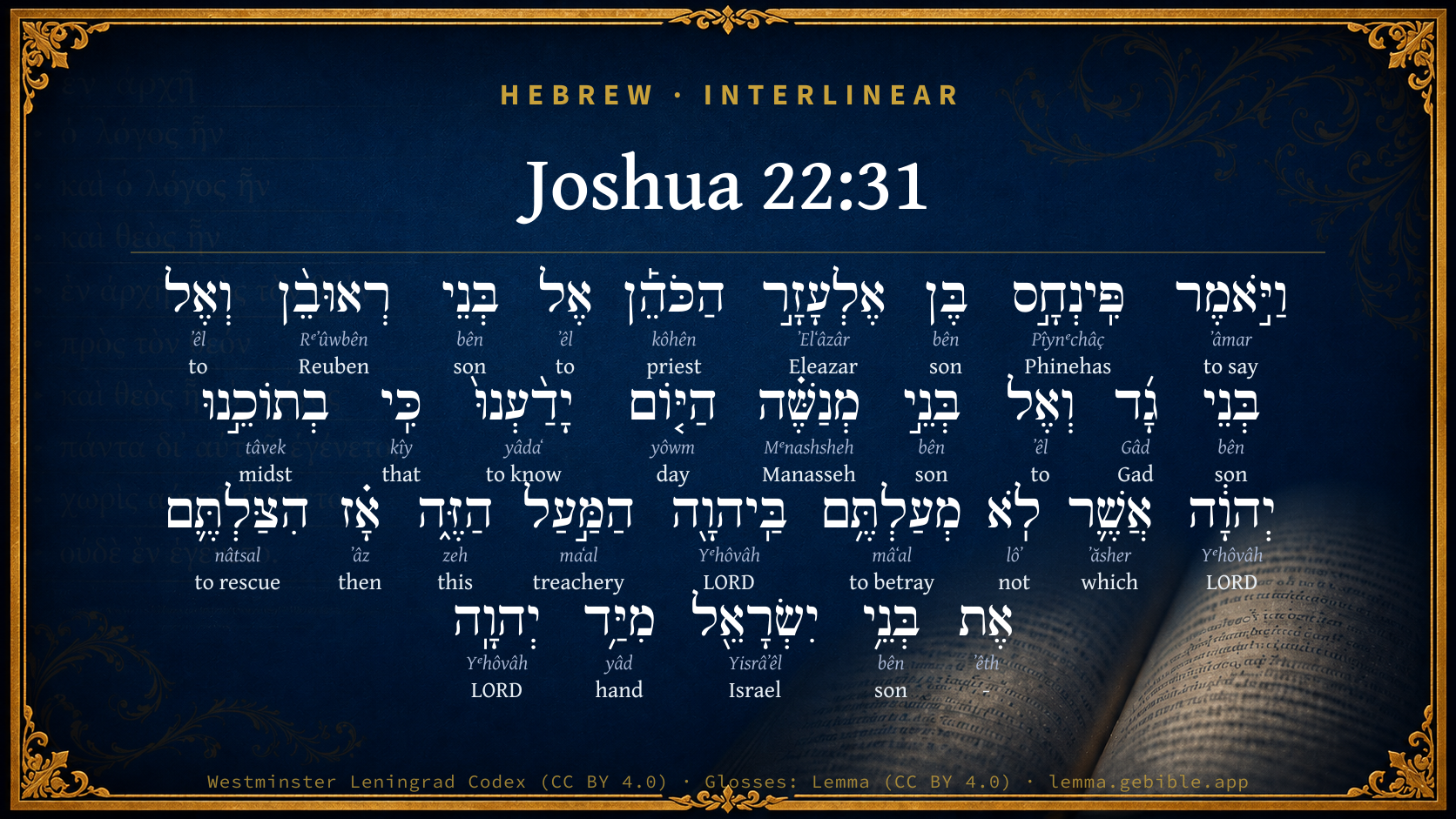
Hebrew (Westminster Leningrad Codex) Joshua 22:31 appears in the Hebrew Old Testament. The text above is from the Westminster Leningrad Codex. Each word links to its Strong’s number, a concise gloss, and parsing drawn from the Open Scriptures Hebrew Bible morphology. Click any word for its full Brown-Driver-Briggs (BDB) entry.
Download image
Cite this verse

Joshua 22:31 (World English Bible). Public Domain. Lemma interlinear Bible study tool, https://lemma.gebible.app/v/joshua/22/31.

Show BibTeX & RIS
BibTeX
RIS
English Translation
Phinehas the son of Eleazar the priest said to the children of Reuben, and to the children of Gad, and to the children of Manasseh, This day we know that Yahweh is in the midst of us, because you have not committed this trespass against Yahweh: now have you delivered the children of Israel out of the hand of Yahweh.
World English Bible · Public Domain
Download a study sheet

One document with this verse’s original text, its word-by-word gloss line, the meaning frame, cross-references with their text, attributed commentary, and full source and license credits — printable, and it pastes into notes with its structure intact.

This verse Autodidact and up

Study sheet (.html) Plain text (.txt)

A passage Seminary Student

Up to 50 verses in one chapter. A passage sheet keeps up to 6 commentary sources and 12 cross-references per verse, in the order this page ranks them, and says so on the sheet whenever that leaves anything out. Ask for a single verse and you get the Autodidact verse sheet above.

Everything on this page stays free to read, with no account — the sheet is a download of what is already on screen, not access to it.

Want to remove ads? Support Godless Engineer
Compare translations 3

The same verse in 3 English versions, stacked beneath the original-language interlinear above. Click any original word for its lexicon entry.

Each is an independent rendering of the whole verse — the interlinear is not word-aligned to these translations.

Highlighted words mark where these versions differ — a whole-verse word diff, not a word-by-word alignment.

  • World English Bible Public Domain
    Phinehas the son of Eleazar the priest said to the children of Reuben, and to the children of Gad, and to the children of Manasseh, This day we know that Yahweh is in the midst of us, because you have not committed this trespass against Yahweh: now have you delivered the children of Israel out of the hand of Yahweh.
  • King James Version Public Domain
    And Phinehas the son of Eleazar the priest said unto the children of Reuben, and to the children of Gad, and to the children of Manasseh, This day we perceive that the LORD is among us, because ye have not committed this trespass against the LORD: now ye have delivered the children of Israel out of the hand of the LORD.
  • unfoldingWord Literal Text CC BY-SA 4.0
    And Phinehas, the son of Eleazar, the priest, said to the sons of Reuben and to the sons of Gad and to the sons of Manasseh, “Today we know that Yahweh in the midst of us, that you have not acted unfaithfully in this unfaithfulness against Yahweh. Therefore, you have delivered the sons of Israel from the hand of Yahweh.”

unfoldingWord Literal Text — © unfoldingWord, licensed CC BY-SA 4.0. Word-aligned USFM3 via Door43 (git.door43.org/unfoldingWord/en_ult).

Versions to compare (up to 4)

3 of 4 selected

Show all 18 translations

Every available English version of this verse, each an independent rendering of the whole verse.

  • World English Bible Public Domain
    Phinehas the son of Eleazar the priest said to the children of Reuben, and to the children of Gad, and to the children of Manasseh, This day we know that Yahweh is in the midst of us, because you have not committed this trespass against Yahweh: now have you delivered the children of Israel out of the hand of Yahweh.
  • Berean Standard Bible Public Domain
    Phinehas son of Eleazar the priest said to the descendants of Reuben, Gad, and Manasseh, “Today we know that the LORD is among us, because you have not committed this breach of faith against Him. Consequently, you have delivered the Israelites from the hand of the LORD.”
  • Majority Standard Bible Public Domain
    Phinehas son of Eleazar the priest said to the descendants of Reuben, Gad, and Manasseh, “Today we know that the LORD is among us, because you have not committed this breach of faith against Him. Consequently, you have delivered the Israelites from the hand of the LORD.”
  • King James Version Public Domain
    And Phinehas the son of Eleazar the priest said unto the children of Reuben, and to the children of Gad, and to the children of Manasseh, This day we perceive that the LORD is among us, because ye have not committed this trespass against the LORD: now ye have delivered the children of Israel out of the hand of the LORD.
  • American Standard Version (1901) Public Domain
    And Phinehas the son of Eleazar the priest said unto the children of Reuben, and to the children of Gad, and to the children of Manasseh, This day we know that Jehovah is in the midst of us, because ye have not committed this trespass against Jehovah: now have ye delivered the children of Israel out of the hand of Jehovah.
  • Revised Version (1885) Public Domain
    And Phinehas the son of Eleazar the priest said unto the children of Reuben, and to the children of Gad, and to the children of Manasseh, This day we know that the LORD is in the midst of us, because ye have not committed this trespass against the LORD: now have ye delivered the children of Israel out of the hand of the LORD.
  • Geneva Bible (1599) Public Domain
    And Phinehas the sonne of Eleazar the Priest said vnto the children of Reuben and to the children of Gad, and to the children of Manasseh, This day we perceiue, that the Lord is among vs, because ye haue not done this trespasse against the Lord: nowe ye haue deliuered the children of Israel out of the hand of the Lord.
  • Douay-Rheims (1899) Public Domain
    And Phinees the priest the son of Eleazar said to them: Now we know that the Lord is with us, because you are not guilty of this revolt, and you have delivered the children of Israel from the hand of the Lord.
  • Young's Literal Translation Public Domain
    And Phinehas son of Eleazar the priest saith unto the sons of Reuben, and unto the sons of Gad, and unto the sons of Manasseh, `To-day we have known that Jehovah `is' in our midst, because ye have not committed against Jehovah this trespass -- then ye have delivered the sons of Israel out of the hand of Jehovah.'
  • Literal Standard Version CC BY-SA 4.0
    And Phinehas son of Eleazar the priest says to the sons of Reuben, and to the sons of Gad, and to the sons of Manasseh, “Today we have known that YHWH [is] in our midst, because you have not committed this trespass against YHWH—then you have delivered the sons of Israel out of the hand of YHWH.”
  • Unlocked Literal Bible CC BY-SA 4.0
    Phinehas son of Eleazar the priest said to the people of Reuben, Gad, and Manasseh, “Today we know that Yahweh is among us, because you have not committed this breach of faith against him. Now you have rescued the people of Israel out of the hand of Yahweh.”
  • unfoldingWord Literal Text CC BY-SA 4.0
    And Phinehas, the son of Eleazar, the priest, said to the sons of Reuben and to the sons of Gad and to the sons of Manasseh, “Today we know that Yahweh in the midst of us, that you have not acted unfaithfully in this unfaithfulness against Yahweh. Therefore, you have delivered the sons of Israel from the hand of Yahweh.”
  • Darby Bible Public Domain
    And Phinehas the son of Eleazar the priest said unto the children of Reuben, and to the children of Gad, and to the children of Manasseh, This day we perceive that Jehovah is among us, because ye have not committed this trespass against Jehovah: now have ye delivered the children of Israel out of the hand of Jehovah.
  • World Messianic Bible Public Domain
    Phinehas the son of Eleazar the priest said to the children of Reuben, to the children of Gad, and to the children of Manasseh, “Today we know that the LORD is among us, because you have not committed this trespass against the LORD. Now you have delivered the children of Israel out of the LORD’s hand.”
  • Webster's Bible Public Domain
    And Phinehas the son of Eleazar the priest said to the children of Reuben, and to the children of Gad, and to the children of Manasseh, This day we perceive that the LORD is among us, because ye have not committed this trespass against the LORD: now ye have delivered the children of Israel out of the hand of the LORD.
  • Free Bible Version CC BY-SA 4.0
    Phinehas replied to the tribes of Reuben and Gad, and the half-tribe of Manasseh, “Today we know that the Lord is with us because you have not acted disloyally in doing this. Now you have saved the Israelites from being punished by the Lord.”
  • Bible in Basic English Public Domain
    And Phinehas, the son of Eleazar the priest, said to the children of Reuben and the children of Gad and the children of Manasseh, Now we are certain that the Lord is among us, because you have not done this wrong against the Lord: and you have kept us from falling into the hands of the Lord.
  • JPS Tanakh (1917) Public Domain
    And Phinehas the son of Eleazar the priest said unto the children of Reuben, and to the children of Gad, and to the children of Manasseh: 'This day we know that the LORD is in the midst of us, because ye have not committed this treachery against the LORD; now have ye delivered the children of Israel out of the hand of the LORD.'

Literal Standard Version (2020), Covenant Press — licensed CC BY-SA 4.0. Text via the HelloAO Bible API (eBible.org). Unlocked Literal Bible (unfoldingWord) — licensed CC BY-SA 4.0. Text via the HelloAO Bible API (eBible.org). unfoldingWord Literal Text — © unfoldingWord, licensed CC BY-SA 4.0. Word-aligned USFM3 via Door43 (git.door43.org/unfoldingWord/en_ult). Free Bible Version, Dr. Jonathan Gallagher — licensed CC BY-SA 4.0. Text via the HelloAO Bible API (eBible.org).

Word by word

More ways to search: Search by grammar → Find every occurrence → Compare this word →

Practice this passage: Drill this verse → Learn its vocabulary →

פִּֽינְחָ֣ס
Pîynᵉchâç
H6372
“Phinehas”
Noun, Proper
Part of Speech
Noun
Type
Proper
Full BDB Definition

Origin: apparently from H6310 and a variation of H5175

TWOT: None

Phinehas = "mouth of brass" - son of Eleazar and grandson of Aaron; his zealousness for the Lord averted a plague on Israel and gained him the promise of the Lord of an everlasting priesthood in his family - a priest and the son of the priest Eli - the father of a helper of Ezra
  1. וַיֹּ֣אמֶר ʼâmar H559 “and · to say” Conjunction + Verb, Qal, Sequential Imperfect, 3rd Person, Masculine, Singular
  2. בֶּן bên H1121 “son of” Noun, Common, Masculine, Singular, Construct
  3. אֶלְעָזָ֣ר ʼElʻâzâr H499 “Eleazar” Noun, Proper
  4. הַכֹּהֵ֡ן kôhên H3548 “the · priest” Particle, Definite Article + Noun, Common, Masculine, Singular, Absolute
  5. אֶל ʼêl H413 “to” Preposition
  6. בְּנֵי bên H1121 “sons of” Noun, Common, Masculine, Plural, Construct
  7. רְאוּבֵ֨ן Rᵉʼûwbên H7205 “Reuben” Noun, Proper
  8. וְאֶל ʼêl H413 “and · to” Conjunction + Preposition
  9. בְּנֵי bên H1121 “sons of” Noun, Common, Masculine, Plural, Construct
  10. גָ֜ד Gâd H1410 “Gad” Noun, Proper
  11. וְאֶל ʼêl H413 “and · to” Conjunction + Preposition
  12. בְּנֵ֣י bên H1121 “sons of” Noun, Common, Masculine, Plural, Construct
  13. מְנַשֶּׁ֗ה Mᵉnashsheh H4519 “Manasseh” Noun, Proper
  14. הַיּ֤וֹם yôwm H3117 “the · day” Particle, Definite Article + Noun, Common, Masculine, Singular, Absolute
  15. יָדַ֨עְנוּ֙ yâdaʻ H3045 “to know” Verb, Qal, Perfect, 1st Person, Common, Plural
  16. כִּֽי kîy H3588 “that” Conjunction
  17. בְתוֹכֵ֣נוּ tâvek H8432 “in/at · midst · our” Preposition + Noun, Common, Masculine, Singular, Construct + Suffix, Personal, 1st Person, Common, Plural
  18. יְהוָ֔ה Yᵉhôvâh H3068 “LORD” Noun, Proper
  19. אֲשֶׁ֛ר ʼăsher H834 “which” Particle, Relative
  20. לֹֽא lôʼ H3808 “not” Particle, Negative
  21. מְעַלְתֶּ֥ם mâʻal H4603 “to betray” Verb, Qal, Perfect, 2nd Person, Masculine, Plural
  22. בַּֽיהוָ֖ה Yᵉhôvâh H3068 “in/at · LORD” Preposition + Noun, Proper
  23. הַמַּ֣עַל maʻal H4604 “the · treachery” Particle, Definite Article + Noun, Common, Masculine, Singular, Absolute
  24. הַזֶּ֑ה zeh H2088 “the · this” Particle, Definite Article + Pronoun, Demonstrative, Masculine, Singular
  25. אָ֗ז ʼâz H227 “then” Adverb
  26. הִצַּלְתֶּ֛ם nâtsal H5337 “to rescue” Verb, Hiphil, Perfect, 2nd Person, Masculine, Plural
  27. אֶת ʼêth H853 “-” Particle, Direct Object
  28. בְּנֵ֥י bên H1121 “sons of” Noun, Common, Masculine, Plural, Construct
  29. יִשְׂרָאֵ֖ל Yisrâʼêl H3478 “Israel” Noun, Proper
  30. מִיַּ֥ד yâd H3027 “from · hand of” Preposition + Noun, Common, Both, Singular, Construct
  31. יְהוָֽה Yᵉhôvâh H3068 “LORD” Noun, Proper

About this verse

These counts appear in no published source. They are computed here, from the morphology-tagged text and Lemma’s own curated glosses. What Lemma adds →

32
words
24
distinct lemmas
Historical
section

Notable vocabulary

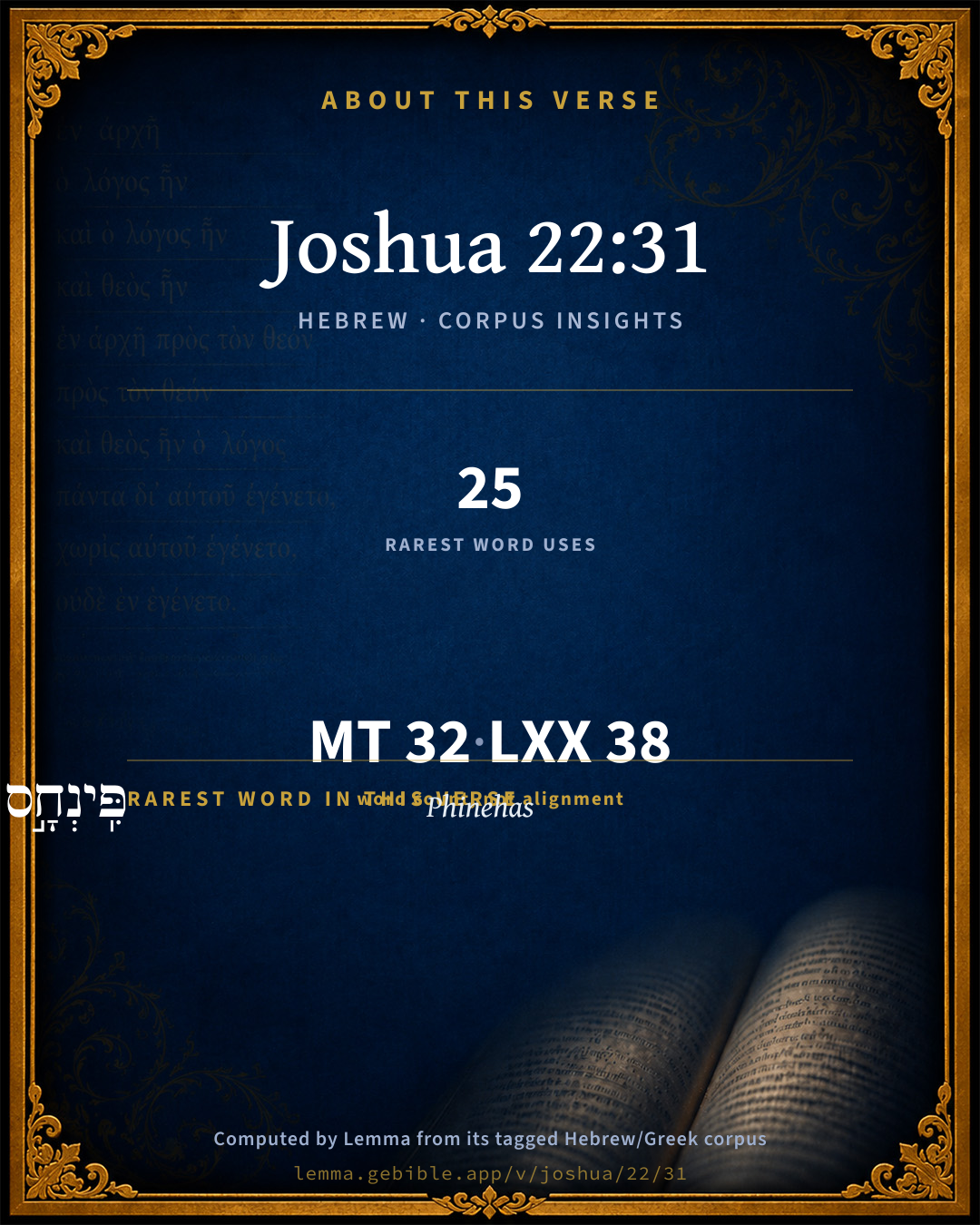
The rarest word here is פִּֽינְחָ֣ס Phinehas H6372 — appearing just 25 times in the whole Hebrew Bible.

Shared distinctive vocabulary

פִּֽינְחָ֣ס Phinehas H6372 occurs in 24 verses of the Hebrew Bible. Also found in:

Grammatical profile

  • 4 verbs
  • 19 nouns
  • 1 pronoun
  • 3 prepositions
  • 1 conjunction
  • 1 adverb
  • 3 particles

Verb forms

  • וַיֹּ֣אמֶר Qal · Sequential Imperfect
  • יָדַ֨עְנוּ֙ Qal · Perfect
  • מְעַלְתֶּ֥ם Qal · Perfect
  • הִצַּלְתֶּ֛ם Hiphil · Perfect

Repetition

Words recur within this verse — often emphatic in Hebrew:

  • בֶּן son H1121 ×5
  • יְהוָ֔ה LORD H3068 ×3
  • אֶל to H413 ×3

Hebrew & Septuagint length

In English translation the verse runs 60 words from the Hebrew and 59 from the Septuagint (LXX English) — closely comparable.

A rough comparison of the two English renderings, which tokenize alike — not a word-level alignment.

Word counts can differ between the Hebrew and the Greek without any difference in meaning — e.g. the Hebrew direct-object marker אֵת has no separate Greek word, and Greek often adds the article ὁ.

In the original languages it is 32 Hebrew tokens and 38 Greek tokens — but the two are counted differently (Hebrew bundles its prefixes and suffixes into one token; the Greek is in lemma form), so that isn’t a like-for-like length.

Cross-references

9

Topical passages linked to Joshua 22:31 in the Treasury of Scripture Knowledge — connected by theme and wording, ordered by reader-vote popularity; previews shown in the World English Bible.

  • Leviticus 26:11–12 I will set my tent among you: and my soul won't abhor you.
  • 2 Chronicles 15:2 and he went out to meet Asa, and said to him, Hear you me, Asa, and all Judah and Benjamin: Yahweh is with you, while you are with him; and if you seek him, he will be found of you; but if you forsake him, he will forsake you.
  • Numbers 14:41–43 Moses said, Why now do you disobey the commandment of Yahweh, seeing it shall not prosper?
  • Joshua 3:10 Joshua said, Hereby you shall know that the living God is among you, and that he will without fail drive out from before you the Canaanite, and the Hittite, and the Hivite, and the Perizzite, and the Girgashite, and the Amorite, and the Jebusite.
  • Psalms 68:17 The chariots of God are tens of thousands and thousands of thousands. The Lord is among them, from Sinai, into the sanctuary.
  • Isaiah 12:6 Cry aloud and shout, you inhabitant of Zion; for great in the midst of you is the Holy One of Israel!"
  • Zechariah 8:23 Thus says Yahweh of Hosts: "In those days, ten men will take hold, out of all the languages of the nations, they will take hold of the skirt of him who is a Jew, saying, 'We will go with you, for we have heard that God is with you.'"
  • Matthew 1:23 "Behold, the virgin shall be with child, And shall bring forth a son. They shall call his name Immanuel;" Which is, being interpreted, "God with us."
  • 1 Corinthians 14:25 And thus the secrets of his heart are revealed. So he will fall down on his face and worship God, declaring that God is among you indeed.

Cross-references courtesy of OpenBible.info (CC BY 4.0).

Hebrew and Greek witnesses Masoretic Hebrew ↔ Greek Septuagint

The same verse in the two great witnesses to the Old Testament, shown verse-for-verse.

These are two independent witnesses, not word-aligned to each other, and the Septuagint is shown in lemma (dictionary) form.

Hebrew Joshua 22:31 Masoretic · Westminster Leningrad Codex

וַיֹּ֣אמֶר פִּֽינְחָ֣ס בֶּן אֶלְעָזָ֣ר הַכֹּהֵ֡ן אֶל בְּנֵי רְאוּבֵ֨ן וְאֶל בְּנֵי גָ֜ד וְאֶל בְּנֵ֣י מְנַשֶּׁ֗ה הַיּ֤וֹם יָדַ֨עְנוּ֙ כִּֽי בְתוֹכֵ֣נוּ יְהוָ֔ה אֲשֶׁ֛ר לֹֽא מְעַלְתֶּ֥ם בַּֽיהוָ֖ה הַמַּ֣עַל הַזֶּ֑ה אָ֗ז הִצַּלְתֶּ֛ם אֶת בְּנֵ֥י יִשְׂרָאֵ֖ל מִיַּ֥ד יְהוָֽה

Phinehas the son of Eleazar the priest said to the children of Reuben, and to the children of Gad, and to the children of Manasseh, This day we know that Yahweh is in the midst of us, because you have not committed this trespass against Yahweh: now have you delivered the children of Israel out of the hand of Yahweh.

World English Bible · Public Domain

Greek LXX Joshua 22:31 Septuagint · lemma form

καί εἶπον φινεες ὁ ἱερεύς ὁ υἱός ρουβην καί ὁ υἱός γαδ καί ὁ ἥμισυς φυλή μανασσή σήμερον γιγνώσκω ὅτι μετά ἐγώ κύριος διότι οὐ πλημμελέω ἐναντίον κύριος πλημμέλεια καί ὅτι ῥύομαι ὁ υἱός ἰσραήλ ἐκ χείρ κύριος

And Phinees the priest said to the sons of Ruben, and to the sons of Gad, and to the half of the tribe of Manasse, To-day we know that the Lord is with us, because you⌃ have not trespassed grievously against the Lord, and because you⌃ have delivered the children of Israel out of the hand of the Lord.

LXX2012 (modern English Septuagint) · Public Domain

Hebrew: Westminster Leningrad Codex (CC BY 4.0). Greek: Septuagint (public domain); English from LXX2012 (modern English Septuagint) (Public Domain). How the Septuagint differs from the Hebrew →

Targum (Aramaic paraphrase)

1

The Targum is the ancient Jewish Aramaic paraphrase of the Hebrew Scriptures — an interpretive translation, not the Hebrew text itself. Onkelos (literal) and Pseudo-Jonathan (expansive) render the Torah, and Jonathan the Prophets. Coverage is partial: where no permissively-licensed English translation exists for a verse, only the Aramaic is shown. This is verse-level text, not a word-by-word alignment to the Hebrew.

  1. Targum Jonathan Prophets (Joshua–Malachi)
    וַאֲמַר פִינְחָס בַּר אֶלְעָזָר כַּהֲנָא לִבְנֵי רְאוּבֵן וְלִבְנֵי גָד וְלִבְנֵי מְנַשֶׁה יוֹמָא דֵין יְדַעְנָא אֲרֵי בֵינָנָא שַׁרְיָא שְׁכִינְתָּא דַייָ דְלָא שְׁקַרְתּוּן בְּמֵימְרָא דַייָ שִׁקְרָא הָדֵין בְּכֵן שֵׁיזַבְתּוּן יַת בְּנֵי יִשְׂרָאֵל מִיַד מֵימְרָא דַיָי:

    (no public-domain English translation for this verse)

    Targum Jonathan — Aramaic: “Mikraot Gedolot” (public domain). English: “Sefaria Community Translation” (CC0 1.0 (public-domain dedication)); “London "Chaldee Paraphrase," 1871” (public domain). Text via Sefaria.

Commentary

Notes on Joshua 22:31 from classic Christian and Jewish commentators (each source and its license shown beneath its notes). The classic Christian expositions comment on the surrounding passage and are grouped to its opening verse, so a note may address several verses; the Jewish commentaries on the Tanakh (Rashi and others) are per-verse, so they appear only where the commentator wrote on this verse.

Lemma curates 59 commentaries, every one of them public domain or Creative Commons licensed, each selected and text-cleaned for this edition rather than reprinted as found. About our sources →

Trapp's Complete Commentary

John Trapp

Jos 22:31 And Phinehas the son of Eleazar the priest said unto the children of Reuben, and to the children of Gad, and to the children of Manasseh, This day we perceive that the LORD [is] among us, because ye have not committed this trespass against the LORD: now ye have delivered the children of Israel out of the hand of the LORD.

Ver. 31. And Phinehas.] Who here showed himself to be, as an ambassador should be, Vir bonus dicendi peritus; a good man and well spoken.

This day we perceive that the Lord is among us.] Since we are all of one heart and one soul in his service, and you are not guilty of this apostasy. Of bees they say that stir and strife among them is a sign their queen is about to remove, to leave the hive, and to be gone. So God; dissension driveth him from a people, and lets in dissolution.

John Trapp, A Commentary or Exposition upon All the Books of the Old and New Testament (1647–1656) — public domain. Text from a community e-Sword module.

Tyndale Open Study Notes

Tyndale Open Resources

22:31 you have rescued: In his reply to the eastern tribes, Phinehas used very similar language to the words God had spoken when Phinehas turned God’s anger from Israel at Peor (Num 25:11).

Tyndale Open Study Notes — © Tyndale Open Resources, licensed CC BY-SA 4.0. Text via the HelloAO Bible API.

Geneva Bible (1599)

Geneva Bible translators

By preserving and governing us.

Whom if ye had offended; he would have punished with you.

Geneva Bible (1599) marginal notes — public domain. Text via Bolls.life.

Adam Clarke's Commentary

Verse 31. We perceive that the Lord is among us] Or, according to the Targum of Jonathan. "This day we know that the majesty of Jehovah dwelleth among us, because ye have not committed this prevarication against the WORD of the Lord, and thus ye have delivered the children of Israel from the hand of the WORD of the Lord." They rejoice to find them innocent, and that there is no ground of quarrel between the children of the same family. And from this they draw a very favourable conclusion, that as God was among them as the sole object of their religious worship, so he would abide with them as their protector and their portion; and as they were his friends, they take it for granted that he will deliver them from the hands of their enemies.

Adam Clarke's Commentary on the Bible (1810–1826) — public domain. Text from a community e-Sword/MySword module.

Ellicott's Commentary for English Readers

(31) We perceive that the Lord is among us, because ye have not committed this trespass . . .—The best token of the Divine presence among men is the Divine likeness and holiness in men. “if we say that we have fellowship with Him, and walk in darkness, we lie . . . but if we walk in the light, we have fellowship one with another.”

A Bible Commentary for English Readers, edited by Charles John Ellicott (1878–1897) — public domain. Text from a community e-Sword module.

The Cambridge Bible for Schools and Colleges

gen. ed. J. J. S. Perowne

31. is among us] Phinehas recognises the presence of God in the congregation, because His Providence had restrained their brethren from even the semblance of idolatry.

out of the hand of the Lord] As otherwise a punishment like that in Num_25:9 might have again fallen on the whole people.

The Cambridge Bible for Schools and Colleges (gen. ed. J. J. S. Perowne; Cambridge University Press, 1878–1918) — public domain. Text from a community e-Sword module.

John Gill's Exposition

And Phinehas the son of Eleazar the priest, and the princes,.... Being fully satisfied with the relation of things that had been given them, and having taken their leave of the assembly:

returned from the children of Reuben, and from the children of Gad; the Greek version adds, "and from the half tribe of Manasseh"; which, though not in the Hebrew text, is undoubtedly meant:

out of the land of Gilead: which, though only a part of the country these tribes inhabited, is put for the whole, and it is not improbable that the assembly might be held in it:

unto the land of Canaan, to the children of Israel; the rest of the children of Israel who dwelt in the land of Canaan, properly so called:

and brought them word again; reported the whole affair, related all that had passed, and acquainted them with the intention and design of their brethren erecting the altar, and what had been the issue of their embassy to them.

John Gill's Exposition of the Whole Bible (1746–1763) — public domain (CC PDM 1.0). Text via the HelloAO Bible API.

Haydock's Catholic Bible Commentary

Lord, who would not have failed to punish Israel for such a crime. (Calmet) --- They rejoice, therefore, not only at the fidelity of their brethren, but also on their own account, because they may now confidently look up for protection to God, instead of being in continual apprehensions of feeling his avenging arm. (Haydock)

George Leo Haydock (1774–1849), Haydock's Catholic Family Bible and Commentary, 1859 edition — public domain. Excludes Psalms (Douay-Rheims chapter numbering differs from Protestant) and Deuterocanonical books (Catholic canon only).

Matthew Poole's English Annotations

The Lord is among us, by his gracious presence and preventing goodness, in keeping you from so great an offence, and all of us from those dismal calamities that would have followed upon it.

Out of the hand of the Lord, i.e. from the wrath and dreadful judgments of God; by avoiding that sin which would have involved both you and us in a most bloody war, you have delivered us from the evils we feared. He that prevents an unexpected or approaching disease or mischief, doth as truly deliver a man from it, as he that cures or removes it after it hath been inflicted.

Matthew Poole's English Annotations on the Holy Bible (1683–1685) — public domain. Text from a community e-Sword/MySword module.

Whedon's Commentary on the Bible

Daniel D. Whedon

31. The Lord is among us — The commission were more than satisfied with the explanation; they were delighted with the loyalty and fidelity of their misjudged brethren. This whole account is highly honourable to both the accusing party and the accused, inasmuch as it shows that both were animated with the high and holy purpose of cleaving to the worship of the true God.

Daniel D. Whedon (gen. ed.), Commentary on the Old and New Testaments (1874–1909) — public domain. Text from a community e-Sword module.

The Pulpit Commentary

Now ye have delivered the children of Israel out of the hand of the Lord. The word here rendered "now" is rather then. But the Hebrew word, like our own, is used as implying not only consecution of time, but consequence of action. (see Psa_40:8 Psa_69:5 Jer_22:15) Thus the meaning here is, "We see, then, that instead of bringing upon us heavy chastisement, as we had feared, ye have acted in a way which secures us from the punishment of which we were afraid.

HOMILIES BY W.F. ADENEY Ver. 31. God"s presence manifested in the faithful conduct of His people.

I GOD IS PRESENT IN THE MIDST OF HIS FAITHFUL PEOPLE. By the nature of things, God is present everywhere. (Psa_139:7-10) Yet there is a more intimate and revealed presence of God which is not universal, but which is the peculiar privilege of some, while to others it is denied. This consists in the outflow of sympathy, the exercise of special grace, the nearness of spiritual communion. Two persons can be locally near, and yet in thought and sympathy very distant from one another. Spiritual presence is conditioned not by space but by sympathy. When we are out of sympathy with God He is far from us. When we are one with Him in sympathy He is near. This is a real presence. God does not simply send blessings and breathe benedictions from a distance. He makes the bodies of His people a temple, (1Co_6:9) and their hearts the home of His Spirit. (Joh_14:23)

II GOD"S PRESENCE IS A FACT OF GREAT INTEREST TO HIS PEOPLE. Phinehas expresses satisfaction in the recognition of God"s presence.

(1) God"s presence should be a source of blessing, since

(a) He is our father, and we are homeless without Him;

(b) He is the Almighty One, and we are full of need;

(c) He is the light and life of all things, and without Him we are in darkness and death, like a planet without its sun.

(2) God"s presence is proved by experience to be a source of blessing, bestowing

(a) safety,

(b) purity,

(c) joy,

(d) glory.

The possession of all the treasures of the world without God would leave the soul poor indeed. His presence is a pearl of great price.

III GOD"S PRESENCE CAN BE RECOGNISED BY THE CONDUCT OF HIS PEOPLE.

(1) God"s presence is discernible. It is not for ever secret and hidden. Phinehas perceives the presence of the Lord. We do not always perceive it, but there are events which make it strikingly apparent. If we know how to recognise it, we need not be always asking, "Is the Lord among us or no?" but, like Hagar (Gen_16:13) and Jacob, (Gen_28:16) we shall be surprised and satisfied with the manifestation of God in our midst.

(2) God"s presence is manifested in the conduct of His people.

(a) It is not proved by our opinions: we may have very correct ideas about the nature and character of God while we are far from Him.

(b) It is not made manifest by our feelings: emotions are deceptive, and very strong religious feelings may be found in a very godless life.

(c) It is seen in conduct.

IV THE CONDUCT WHICH PROVES THE PRESENCE OF GOD IS FAITHFULNESS IN HIS SERVICE. Phinehas perceives "that the Lord is among us, because ye have not committed this trespass against the Lord." Faithfulness in the service of God, and a consequent spirit of brotherly kindness and sympathy, such as that now manifested among the tribes of Israel, are good signs of the presence of God in a Church.

(1) His presence is the cause of fidelity. Our fidelity reveals His presence, but it does not secure it. He is present first, and inspires devotion, and binds His people together in united affection through their common devotion to Him.

(2) He must need depart from His people when they become unfaithful. No past enjoyment of God will secure His abiding presence. If God depart, though wealth and ease and numbers testify to apparent prosperity, we may exclaim, "Ichabod the glory has departed. W.F.A.

The Pulpit Commentary (1880–1919), ed. H.D.M. Spence-Jones & Joseph S. Exell — public domain. Text from a community e-Sword module.

John Wesley's Explanatory Notes

Is among us - By his gracious presence, and preventing goodness, in keeping you from so great an offense, and all of us from those calamities that would have followed it. Hand of the Lord - That is, from the wroth and dreadful judgments of God, by avoiding that sin which would have involved both you and us in a most bloody war; you have delivered us from the evils we feared. He that prevents an approaching disease or mischief, doth as truly deliver a man from it, as he that cures or removes it after it hath been inflicted.

John Wesley, Explanatory Notes Upon the Whole Bible (1754–1765) — public domain. Text via the GEBible commentary corpus.

Lesson kit

Teaching starters — assembled from the data on this page, not authored interpretation. Every prompt links to the verse data it draws on. Edit before teaching.

Joshua, in the Historical, opens this verse with 32 words (24 distinct Hebrew lemmas). Its most distinctive word is Pîynᵉchâç (“Phinehas”). A historical commentator’s framing appears above. Read the whole chapter for the surrounding context.

Discussion questions

  1. How does “Phinehas” (Pîynᵉchâç) shape what this verse is saying?
  2. Exodus 6:25 shares the word «Phinehas» with this verse. How do the two illuminate each other?
  3. “son” occurs 5× in this one verse. What is the effect of the repetition?
  4. These translations render this verse differently; the difference is in the English rendering, not the original. What questions does that raise?
  5. The verb «וַיֹּ֣אמֶר» is Qal Sequential Imperfect. How does its form color the action?
  6. Reading how Trapp's Complete Commentary and Tyndale Open Study Notes read this verse, where do the two commentators agree and where do they part?

Things to notice

Reading settings

Reading text

Shown beneath each verse's original-language words.

Old Testament
Old Testament edition

Read the OT as the Masoretic Hebrew (MT) or the Greek Septuagint (LXX).

English shown for the Greek Septuagint (in the Hebrew ↔ Greek comparison).

Comparing translations? Open the Compare panel on any verse page to stack up to four side by side.