
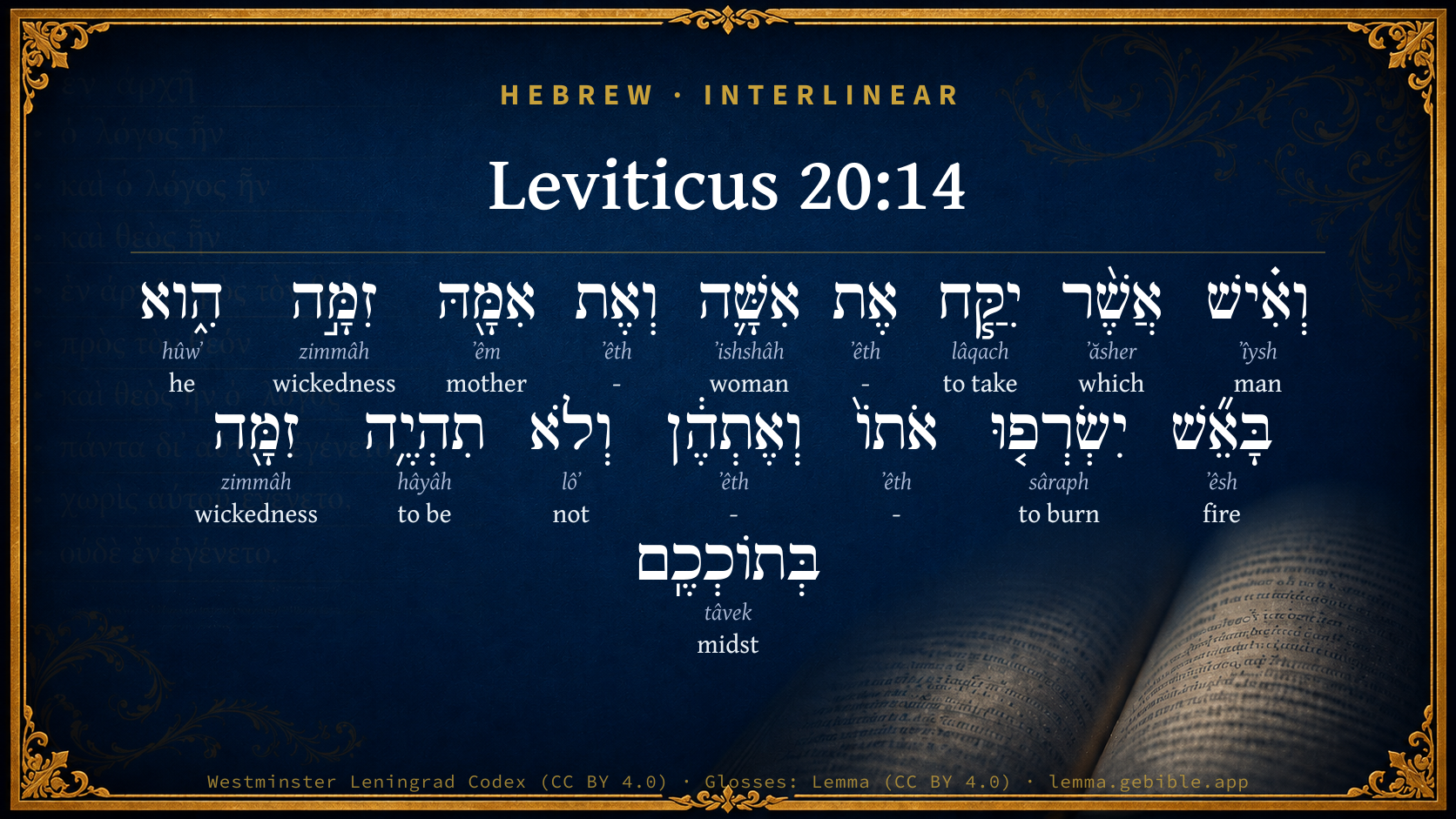
Leviticus 20:14

Hebrew (Westminster Leningrad Codex) Leviticus 20:14 appears in the Hebrew Old Testament. The text above is from the Westminster Leningrad Codex. Each word links to its Strong’s number, a concise gloss, and parsing drawn from the Open Scriptures Hebrew Bible morphology. Click any word for its full Brown-Driver-Briggs (BDB) entry.
Download image
Cite this verse

Leviticus 20:14 (World English Bible). Public Domain. Lemma interlinear Bible study tool, https://lemma.gebible.app/v/leviticus/20/14.

Show BibTeX & RIS
BibTeX
RIS
English Translation
"'If a man takes a wife and her mother, it is wickedness: they shall be burned with fire, both he and they; that there may be no wickedness among you.
World English Bible · Public Domain
Download a study sheet

One document with this verse’s original text, its word-by-word gloss line, the meaning frame, cross-references with their text, attributed commentary, and full source and license credits — printable, and it pastes into notes with its structure intact.

This verse Autodidact and up

Study sheet (.html) Plain text (.txt)

A passage Seminary Student

Up to 50 verses in one chapter. A passage sheet keeps up to 6 commentary sources and 12 cross-references per verse, in the order this page ranks them, and says so on the sheet whenever that leaves anything out. Ask for a single verse and you get the Autodidact verse sheet above.

Everything on this page stays free to read, with no account — the sheet is a download of what is already on screen, not access to it.

Want to remove ads? Support Godless Engineer
Compare translations 3

The same verse in 3 English versions, stacked beneath the original-language interlinear above. Click any original word for its lexicon entry.

Each is an independent rendering of the whole verse — the interlinear is not word-aligned to these translations.

Highlighted words mark where these versions differ — a whole-verse word diff, not a word-by-word alignment.

  • World English Bible Public Domain
    "'If a man takes a wife and her mother, it is wickedness: they shall be burned with fire, both he and they; that there may be no wickedness among you.
  • King James Version Public Domain
    And if a man take a wife and her mother, it is wickedness: they shall be burnt with fire, both he and they; that there be no wickedness among you.
  • unfoldingWord Literal Text CC BY-SA 4.0
    And a man who takes a wife and her mother—this depravity. They shall burn him and them with fire, and depravity will not be in your midst.

unfoldingWord Literal Text — © unfoldingWord, licensed CC BY-SA 4.0. Word-aligned USFM3 via Door43 (git.door43.org/unfoldingWord/en_ult).

Versions to compare (up to 4)

3 of 4 selected

Show all 18 translations

Every available English version of this verse, each an independent rendering of the whole verse.

  • World English Bible Public Domain
    "'If a man takes a wife and her mother, it is wickedness: they shall be burned with fire, both he and they; that there may be no wickedness among you.
  • Berean Standard Bible Public Domain
    If a man marries both a woman and her mother, it is depraved. Both he and they must be burned in the fire, so that there will be no depravity among you.
  • Majority Standard Bible Public Domain
    If a man marries both a woman and her mother, it is depraved. Both he and they must be burned in the fire, so that there will be no depravity among you.
  • King James Version Public Domain
    And if a man take a wife and her mother, it is wickedness: they shall be burnt with fire, both he and they; that there be no wickedness among you.
  • American Standard Version (1901) Public Domain
    And if a man take a wife and her mother, it is wickedness: they shall be burnt with fire, both he and they; that there be no wickedness among you.
  • Revised Version (1885) Public Domain
    And if a man take a wife and her mother, it is wickedness: they shall be burnt with fire, both he and they; that there be no wickedness among you.
  • Geneva Bible (1599) Public Domain
    Likewise he that taketh a wife and her mother, committeth wickednesse: they shall burne him and them with fire, that there be no wickednes among you.
  • Douay-Rheims (1899) Public Domain
    If any man after marrying the daughter, marry her mother, he hath done a heinous crime: he shall be burnt alive with them: neither shall so great an abomination remain in the midst of you.
  • Young's Literal Translation Public Domain
    `And a man who taketh the woman and her mother -- it `is' wickedness; with fire they burn him and them, and there is no wickedness in your midst.
  • Literal Standard Version CC BY-SA 4.0
    And a man who takes the woman and her mother—it [is] wickedness; they burn him and them with fire, and there is no wickedness in your midst.
  • Unlocked Literal Bible CC BY-SA 4.0
    If a man marries a woman and also marries her mother, this is wickedness. They must be burned, both he and the women, so that there will be no wickedness among you.
  • unfoldingWord Literal Text CC BY-SA 4.0
    And a man who takes a wife and her mother—this depravity. They shall burn him and them with fire, and depravity will not be in your midst.
  • Darby Bible Public Domain
    And if a man take a wife and her mother, it is infamy: they shall burn him and them with fire, that there be no infamy among you.
  • World Messianic Bible Public Domain
    “‘If a man takes a wife and her mother, it is wickedness. They shall be burned with fire, both he and they, that there may be no wickedness among you.
  • Webster's Bible Public Domain
    And if a man shall take a wife and her mother, it is wickedness: they shall be burnt with fire, both he and they: that there be no wickedness among you.
  • Free Bible Version CC BY-SA 4.0
    A man who marries both a woman and her mother has acted perversely. They must all be burned to death so that there will be no such wickedness among you.
  • Bible in Basic English Public Domain
    And if a man takes as wife a woman and her mother, it is an act of shame; let them be burned with fire, all three of them, so that there may be no shame among you.
  • JPS Tanakh (1917) Public Domain
    And if a man take with his wife also her mother, it is wickedness: they shall be burnt with fire, both he and they; that there be no wickedness among you.

Literal Standard Version (2020), Covenant Press — licensed CC BY-SA 4.0. Text via the HelloAO Bible API (eBible.org). Unlocked Literal Bible (unfoldingWord) — licensed CC BY-SA 4.0. Text via the HelloAO Bible API (eBible.org). unfoldingWord Literal Text — © unfoldingWord, licensed CC BY-SA 4.0. Word-aligned USFM3 via Door43 (git.door43.org/unfoldingWord/en_ult). Free Bible Version, Dr. Jonathan Gallagher — licensed CC BY-SA 4.0. Text via the HelloAO Bible API (eBible.org).

Word by word

More ways to search: Search by grammar → Find every occurrence → Compare this word →

Practice this passage: Drill this verse → Learn its vocabulary →

זִמָּ֣ה
zimmâh
H2154
“wickedness”
Noun, Common, Feminine, Singular, Absolute
Part of Speech
Noun
Type
Common
Gender
Feminine
Number
Singular
State
Absolute
Full BDB Definition

Origin: from H2161

TWOT: 556b

plan, device, wickedness, evil plan, mischievous purpose - plan, purpose - evil device, wickedness - not chaste, incest, licentiousness, adultery, idolatry, harlotry
  1. וְאִ֗ישׁ ʼîysh H376 “and · man” Conjunction + Noun, Common, Masculine, Singular, Absolute
  2. אֲשֶׁ֨ר ʼăsher H834 “which” Particle, Relative
  3. יִקַּ֧ח lâqach H3947 “to take” Verb, Qal, Imperfect, 3rd Person, Masculine, Singular
  4. אֶת ʼêth H853 “-” Particle, Direct Object
  5. אִשָּׁ֛ה ʼishshâh H802 “woman” Noun, Common, Feminine, Singular, Absolute
  6. וְאֶת ʼêth H853 “and · -” Conjunction + Particle, Direct Object
  7. אִמָּ֖הּ ʼêm H517 “mother · her” Noun, Common, Feminine, Singular, Construct + Suffix, Personal, 3rd Person, Feminine, Singular
  8. הִ֑וא hûwʼ H1931 “he” Pronoun, Personal, 3rd Person, Feminine, Singular
  9. בָּאֵ֞שׁ ʼêsh H784 “in/at the · fire” Preposition, Determined + Noun, Common, Both, Singular, Absolute
  10. יִשְׂרְפ֤וּ sâraph H8313 “to burn” Verb, Qal, Imperfect, 3rd Person, Masculine, Plural
  11. אֹתוֹ֙ ʼêth H853 “- · him” Particle, Direct Object + Suffix, Personal, 3rd Person, Masculine, Singular
  12. וְאֶתְהֶ֔ן ʼêth H853 “and · - · them” Conjunction + Particle, Direct Object + Suffix, Personal, 3rd Person, Feminine, Plural
  13. וְלֹא lôʼ H3808 “and · not” Conjunction + Particle, Negative
  14. תִהְיֶ֥ה hâyâh H1961 “to be” Verb, Qal, Imperfect, 3rd Person, Feminine, Singular
  15. זִמָּ֖ה zimmâh H2154 “wickedness” Noun, Common, Feminine, Singular, Absolute
  16. בְּתוֹכְכֶֽם tâvek H8432 “in/at · midst · your” Preposition + Noun, Common, Masculine, Singular, Construct + Suffix, Personal, 2nd Person, Masculine, Plural

About this verse

These counts appear in no published source. They are computed here, from the morphology-tagged text and Lemma’s own curated glosses. What Lemma adds →

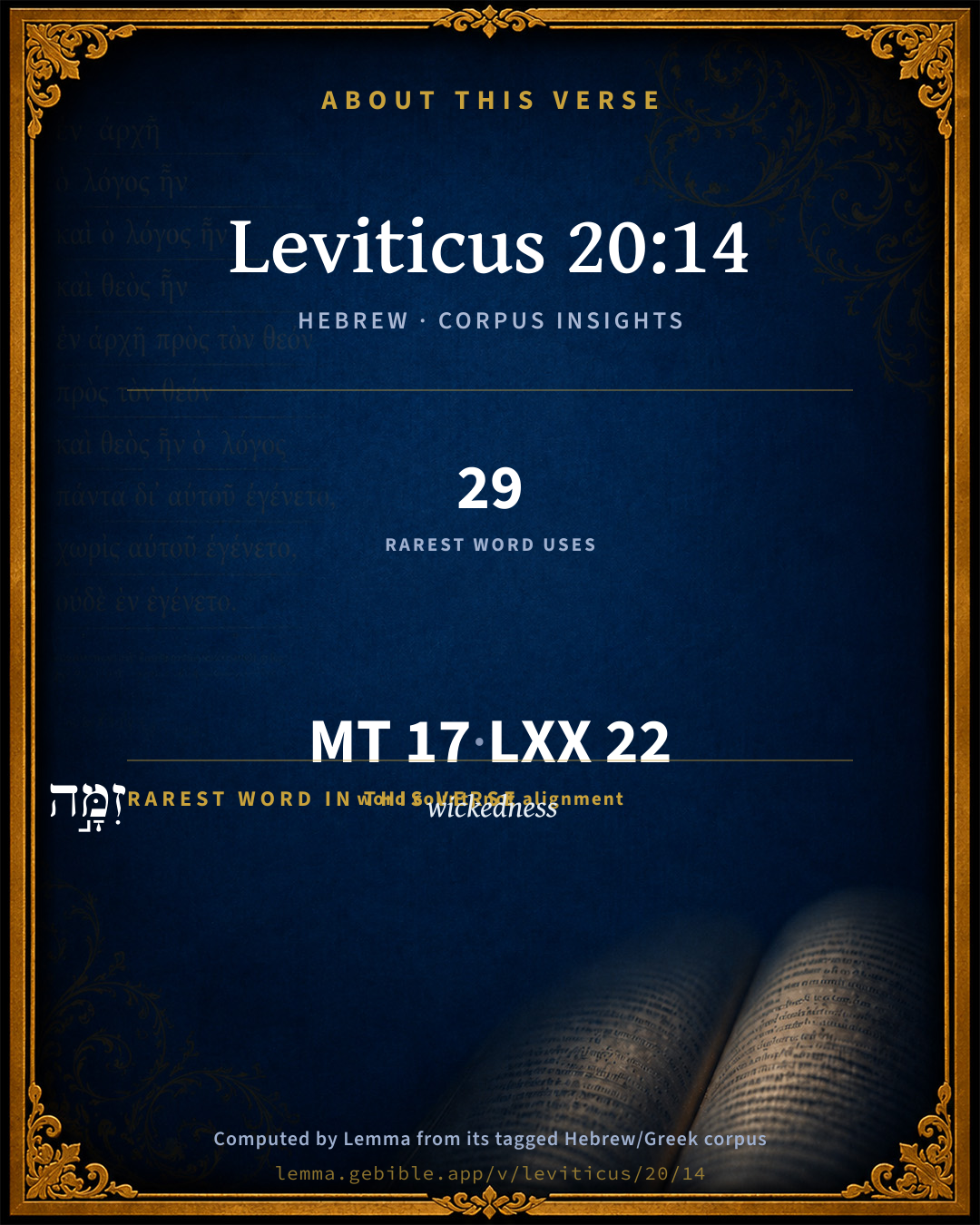
17
words
13
distinct lemmas
Pentateuch
section

Shared distinctive vocabulary

זִמָּ֣ה wickedness H2154 occurs in 27 verses of the Hebrew Bible. Also found in:

Grammatical profile

  • 3 verbs
  • 7 nouns
  • 1 pronoun
  • 6 particles

Verb forms

  • יִקַּ֧ח Qal · Imperfect
  • יִשְׂרְפ֤וּ Qal · Imperfect
  • תִהְיֶ֥ה Qal · Imperfect

Repetition

A word recurs within this verse — often emphatic in Hebrew:

  • זִמָּ֣ה wickedness H2154 ×2

Hebrew & Septuagint length

In English translation the verse runs 30 words from the Hebrew and 27 from the Septuagint (LXX English) — closely comparable.

A rough comparison of the two English renderings, which tokenize alike — not a word-level alignment.

Word counts can differ between the Hebrew and the Greek without any difference in meaning — e.g. the Hebrew direct-object marker אֵת has no separate Greek word, and Greek often adds the article ὁ.

In the original languages it is 17 Hebrew tokens and 22 Greek tokens — but the two are counted differently (Hebrew bundles its prefixes and suffixes into one token; the Greek is in lemma form), so that isn’t a like-for-like length.

Cross-references

6

Topical passages linked to Leviticus 20:14 in the Treasury of Scripture Knowledge — connected by theme and wording, ordered by reader-vote popularity; previews shown in the World English Bible.

  • Leviticus 18:17 "'You shall not uncover the nakedness of a woman and her daughter. You shall not take her son's daughter, or her daughter's daughter, to uncover her nakedness; they are near kinswomen: it is wickedness.
  • Deuteronomy 27:23 Cursed be he who lies with his mother-in-law. All the people shall say, Amen.
  • Joshua 7:15 It shall be, that he who is taken with the devoted thing shall be burnt with fire, he and all that he has; because he has transgressed the covenant of Yahweh, and because he has done folly in Israel.
  • Amos 2:7 They trample on the dust of the earth on the head of the poor, And deny justice to the oppressed; And a man and his father use the same maiden, to profane my holy name;
  • Leviticus 21:9 "'The daughter of any priest, if she profanes herself by playing the prostitute, she profanes her father: she shall be burned with fire.
  • Joshua 7:25 Joshua said, Why have you troubled us? Yahweh shall trouble you this day. All Israel stoned him with stones; and they burned them with fire, and stoned them with stones.

Cross-references courtesy of OpenBible.info (CC BY 4.0).

Hebrew and Greek witnesses Masoretic Hebrew ↔ Greek Septuagint

The same verse in the two great witnesses to the Old Testament, shown verse-for-verse.

These are two independent witnesses, not word-aligned to each other, and the Septuagint is shown in lemma (dictionary) form.

Hebrew Leviticus 20:14 Masoretic · Westminster Leningrad Codex

וְאִ֗ישׁ אֲשֶׁ֨ר יִקַּ֧ח אֶת אִשָּׁ֛ה וְאֶת אִמָּ֖הּ זִמָּ֣ה הִ֑וא בָּאֵ֞שׁ יִשְׂרְפ֤וּ אֹתוֹ֙ וְאֶתְהֶ֔ן וְלֹא תִהְיֶ֥ה זִמָּ֖ה בְּתוֹכְכֶֽם

"'If a man takes a wife and her mother, it is wickedness: they shall be burned with fire, both he and they; that there may be no wickedness among you.

World English Bible · Public Domain

Greek LXX Leviticus 20:14 Septuagint · lemma form

ὅς ἐάν λαμβάνω γυνή καί ὁ μήτηρ αὐτός ἀνόμημα εἰμί ἐν πῦρ κατακαίω αὐτός καί αὐτός καί οὐ εἰμί ἀνομία ἐν σύ

Whosoever shall take a woman and her mother, it is iniquity: they shall burn him and them with fire; so there shall not be iniquity among you.

LXX2012 (modern English Septuagint) · Public Domain

Hebrew: Westminster Leningrad Codex (CC BY 4.0). Greek: Septuagint (public domain); English from LXX2012 (modern English Septuagint) (Public Domain). How the Septuagint differs from the Hebrew →

Targum (Aramaic paraphrase)

2

The Targum is the ancient Jewish Aramaic paraphrase of the Hebrew Scriptures — an interpretive translation, not the Hebrew text itself. Onkelos (literal) and Pseudo-Jonathan (expansive) render the Torah, and Jonathan the Prophets. Coverage is partial: where no permissively-licensed English translation exists for a verse, only the Aramaic is shown. This is verse-level text, not a word-by-word alignment to the Hebrew.

  1. Targum Onkelos Torah (Genesis–Deuteronomy)
    וּגְבַר דִי יִסַב יָת אִתְּתָא וְיָת אִמַהּ עֵצַת חִטְאִין הִיא בְּנוּרָא יוֹקְדוּן יָתֵהּ וְיָתְהֶן וְלָא תְהֵי עֵצַת חִטְאִין בֵּינֵיכוֹן

    (no public-domain English translation for this verse)

    Targum Onkelos — Aramaic: “Onkelos Genesis” (public domain); “Onkelos Exodus” (public domain); “Onkelos Leviticus” (public domain); “Onkelos Numbers” (public domain); “Onkelos Deuteronomy” (public domain). English: “Sefaria Community Translation” (CC0 1.0 (public-domain dedication)); “J.W. Etheridge. The Targums of Onkelos and Jonathan Ben Uzziel on the Pentateuch. London: Longmans, Green, 1862” (public domain). Text via Sefaria.

  2. Targum Pseudo-Jonathan Torah (Genesis–Deuteronomy)
    וּגְבַר דְיִסַב יַת אִיתָא וְיַת אִימָהּ זְנוּ הִיא בְּנוּרָא יוֹקְדוּן יָתֵיהּ וְיַתְהֶן בְּאַתְּכוּת אַבָּר לְפוּמְהוֹן וְלָא תְהֵי זְנוּ בֵּינֵיכוֹן

    And if a man take a wife and her mother, it is fornication let them be burned with fire with melted lead in their mouth, that fornication may not be among you.

    Targum Pseudo-Jonathan — Aramaic: “Targum Jonathan on Genesis” (public domain); “Targum Jonathan on Exodus” (public domain); “Targum Jonathan on Leviticus” (public domain); “Targum Jonathan on Numbers” (public domain); “Targum Jonathan on Deuteronomy” (public domain). English: “The Targum of Jonathan ben Uzziel, trans. J. W. Etheridge, London, 1862” (public domain). Text via Sefaria.

Commentary

Notes on Leviticus 20:14 from classic Christian and Jewish commentators (each source and its license shown beneath its notes). The classic Christian expositions comment on the surrounding passage and are grouped to its opening verse, so a note may address several verses; the Jewish commentaries on the Tanakh (Rashi and others) are per-verse, so they appear only where the commentator wrote on this verse.

Lemma curates 59 commentaries, every one of them public domain or Creative Commons licensed, each selected and text-cleaned for this edition rather than reprinted as found. About our sources →

Trapp's Complete Commentary

John Trapp

Lev 20:14 And if a man take a wife and her mother, it [is] wickedness: they shall be burnt with fire, both he and they; that there be no wickedness among you.

Ver. 14. See on Lev 18:1-30.

John Trapp, A Commentary or Exposition upon All the Books of the Old and New Testament (1647–1656) — public domain. Text from a community e-Sword module.

Joseph Benson's Commentary

Lev 20:14. They — All who consented to it.

Joseph Benson's Commentary on the Old and New Testaments (1811–1818) — public domain. Text from a community e-Sword module.

Geneva Bible (1599)

Geneva Bible translators

It is an execrable and detestable thing.

Geneva Bible (1599) marginal notes — public domain. Text via Bolls.life.

Adam Clarke's Commentary

Verse 14. They shall be burnt with fire] As there are worse crimes mentioned here, (see Le 20:11 and Le 20:17), where the delinquent is ordered simply to be put to death, or to be cut off, it is very likely that the crime mentioned in this verse was not punished by burning alive, but by some kind of branding, by which they were ever after rendered infamous. I need not add that the original, באש ישרפו baesh yishrephu, may, without violence to its grammatical meaning, be understood as above, though in other places it is certainly used to signify a consuming by fire. But the case in question requires some explanation; it is this: a man marries a wife, and afterward takes his mother-in-law or wife's mother to wife also: now for this offence the text says all three shall be burnt with fire, and this is understood as signifying that they shall be burnt alive. Now the first wife, we may safely presume, was completely innocent, and was legally married: for a man may take to wife the daughter if single, or the mother if a widow, and in neither of these cases can any blame attach to the man or the party he marries; the crime therefore lies in taking both. Either, therefore, they were all branded as infamous persons, and this certainly was severe enough in the case of the first wife; or the man and the woman taken last were burnt: but the text says, both he and they; therefore, we should seek for another interpretation of they shall be burnt with fire, than that which is commonly given. Branding with a hot iron would certainly accomplish every desirable end both for punishment and prevention of the crime; and because the Mosaic laws are so generally distinguished by humanity, it seems to be necessary to limit the meaning of the words as above.

Adam Clarke's Commentary on the Bible (1810–1826) — public domain. Text from a community e-Sword/MySword module.

Ellicott's Commentary for English Readers

(14) A wife and her mother.—See Lev_18:17.

They shall be burnt with fire.—This, as we have seen, is the second of the four modes of capital punishment. (See Lev_20:2.) In the following ten cases those guilty of the sins specified suffered this punishment: (1) the unchaste high priest’s daughter (Lev_21:9); (2) he who had commerce with his daughter; (3)or with his daughter’s daughter; (4) or with his son’s daughter; (5) or with his wife’s daughter; (6) or with her daughter’s daughter; (7) or with her son’s daughter; (8) or with his mother-in-law; (9) or with the mother of his mother-in-law; and (10), or with the mother of his father-in-law. It will thus be seen that with the exception of the high priest’s daughter this death was only inflicted for incest. As the Bible nowhere states the precise mode in which this kind of death is to be carried out, the authorities during the second Temple maintained that it must be executed in such a manner as to leave the body externally un changed by the flames, because, when God himself inflicted this punishment, the dead bodies of Nadab and Abihu were in a perfect state of preservation. (See Lev_10:2.) To effect this the criminal was put into dung up to his knees, a soft cloth containing a hard one was then tied around his throat, while the two witnesses who had secured his sentence drew tighter by the two cords till the criminal opened his mouth, when molten lead was poured down his throat, thus burning him to death. Hence the ancient Chaldee Version renders it here, “they shall be burnt with fire, with melted lead in their mouth.”

A Bible Commentary for English Readers, edited by Charles John Ellicott (1878–1897) — public domain. Text from a community e-Sword module.

John Gill's Exposition

And if a man take a wife, and her mother,.... Marry both the one and the other, or commit uncleanness with them, they consenting to it:

it is wickedness; abominable wickedness, shocking and detestable; there are other things, which also are wicked and not to be done, but this is extremely wicked, wickedness to a high degree:

they shall be burnt with fire, both he and they; the man, the mother and her daughter both being married together to him, or both consenting to his lying with them; otherwise, if one of them was first his wife, it was not reasonable that she should be put to death; and therefore some interpret "they", one of them, as Jarchi observes, one or other of them; and so Aben Ezra explains it, this or that; if the mother was his wife, the daughter was to be burnt; and so on the contrary, if the daughter was his wife, the mother was to be burnt; according to the Targum of Jonathan, they were to be burnt by pouring lead into their mouths: and so the manner of burning is described in the Misnah (g); they that are to be burnt are fixed in dung up to their knees, then they put a hard napkin within a soft one, and roll it about is neck; one draws it one way, and another another way, until he opens his mouth; then they take hot melted lead, and pour it into his mouth, which goes down into his bowels and burns them. But it was rather done with faggots, of which an instance is given:

that there be no wickedness among you; of such kind, continued, countenanced, and pass unpunished. This punishment was to be inflicted, to deter persons from it. The law against it is in Lev 18:17.

(g) Sanhedrin, c. 7. sect. 2.

John Gill's Exposition of the Whole Bible (1746–1763) — public domain (CC PDM 1.0). Text via the HelloAO Bible API.

Albert Barnes' Notes on the Bible

The burning under the sentence of the Law took place after the death of the criminal by stoning, or strangling. Jos 7:25.

Albert Barnes' Notes on the Bible (1834–1885) — public domain. Text from a community e-Sword/MySword module.

Haydock's Catholic Bible Commentary

Alive, is not in the original; but must be understood. The Rabbins say melted lead was to be poured down the throats of the guilty. The words of Moses seem rather to refer to external fire. (Calmet) --- With them, if they both gave their consent to the crime. (Menochius)

George Leo Haydock (1774–1849), Haydock's Catholic Family Bible and Commentary, 1859 edition — public domain. Excludes Psalms (Douay-Rheims chapter numbering differs from Protestant) and Deuterocanonical books (Catholic canon only).

Matthew Poole's English Annotations

It is wickedness, i.e. abominable and extraordinary wickedness, as the singularity of the punishment showeth.

Both he and they; either, or both or all of them, if they consented to it.

Matthew Poole's English Annotations on the Holy Bible (1683–1685) — public domain. Text from a community e-Sword/MySword module.

Whedon's Commentary on the Bible

Daniel D. Whedon

14. Burnt with fire — The heinousness of the incest specified in this verse is emphasized by burning the dead bodies of the culprits after they had been stoned. Cremation, so common among the Greeks and Romans, was exceedingly abhorrent to the Hebrews. Burning alive is not a penalty of the Mosaic law. See Jos_7:15, note. Hence little confidence is to be put in the Targum of Palestine, which says, “Let them be burned with fire, with melted lead in their mouths.”

Daniel D. Whedon (gen. ed.), Commentary on the Old and New Testaments (1874–1909) — public domain. Text from a community e-Sword module.

John Wesley's Explanatory Notes

They - All who consented to it.

John Wesley, Explanatory Notes Upon the Whole Bible (1754–1765) — public domain. Text via the GEBible commentary corpus.

Rashi

Rabbi Shlomo Yitzchaki (Rashi)

ישרפו אתו ואתהן [AND IF A MAN TAKE A WIFE AND HER MOTHER, IT IS WICKEDNESS] THEY SHALL BE BURNT [WITH FIRE] BOTH HE AND THEY — You cannot say that this means that they shall burn also his first wife (i. e. her whom he married first), because you must admit that he married her legally for she was not forbidden to him as a wife. But the fact is that the case of “a woman and her mother": mentioned here must be a case where both of them are forbidden to him on account of a previous relationship to him, — that, for instance, after having married a woman, he marries also his mother-in-law and her mother. It is these two that have to be burnt. There are, however, some of our Rabbis who say we have here a case of where, in addition to having married a woman, he marries only his mother-in-law (but not also the latter's mother). But what then could be the meaning of אתהן? It means one of them (“את "הן) and this is a Greek word, הן (ξυ) meaning “one" (Sanhedrin 76b; Sifra, Kedoshim, Chapter 10 12).

Rashi on the Tanakh — English translations: “The Judaica Press complete Tanach with Rashi, translated by A. J. Rosenberg” (CC BY 4.0); “Pentateuch with Rashi's commentary by M. Rosenbaum and A.M. Silbermann, 1929-1934” (public domain); “The Metsudah Tanach series, Lakewood, N.J” (CC BY 4.0); and “The Book of Joshua, Metsudah Publications, 1997” (CC BY 4.0). Text via Sefaria.

Lesson kit

Teaching starters — assembled from the data on this page, not authored interpretation. Every prompt links to the verse data it draws on. Edit before teaching.

Leviticus, in the Pentateuch, opens this verse with 17 words (13 distinct Hebrew lemmas). Its most distinctive word is zimmâh (“wickedness”). A historical commentator’s framing appears above. Read the whole chapter for the surrounding context.

Discussion questions

  1. The word zimmâh carries the sense “wickedness.” How does it shape the verse?
  2. How does Leviticus 18:17, which shares the word «wickedness», read alongside this verse?
  3. What does the repetition of “wickedness” (2× in this one verse) do in this verse?
  4. These translations render this verse differently; the difference is in the English rendering, not the original. What questions does that raise?
  5. «יִקַּ֧ח» is a Qal Imperfect verb. How does that grammatical form shape the action described?
  6. Compare how Trapp's Complete Commentary and Joseph Benson's Commentary read this verse. Where do they agree or differ?

Things to notice

Reading settings

Reading text

Shown beneath each verse's original-language words.

Old Testament
Old Testament edition

Read the OT as the Masoretic Hebrew (MT) or the Greek Septuagint (LXX).

English shown for the Greek Septuagint (in the Hebrew ↔ Greek comparison).

Comparing translations? Open the Compare panel on any verse page to stack up to four side by side.