
Joshua 17:9

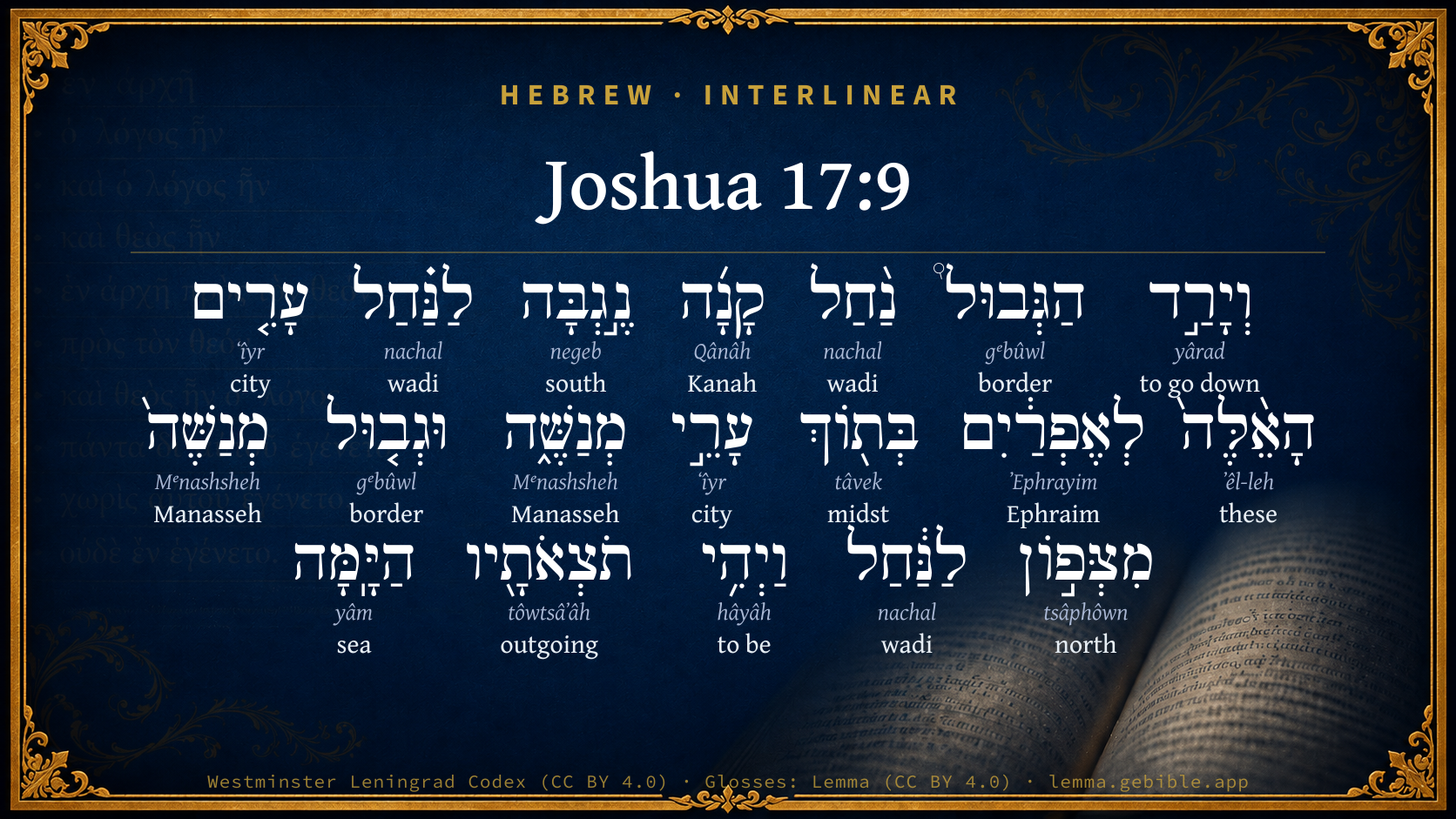
Hebrew (Westminster Leningrad Codex) Joshua 17:9 appears in the Hebrew Old Testament. The text above is from the Westminster Leningrad Codex. Each word links to its Strong’s number, a concise gloss, and parsing drawn from the Open Scriptures Hebrew Bible morphology. Click any word for its full Brown-Driver-Briggs (BDB) entry.
Download image
Cite this verse

Joshua 17:9 (World English Bible). Public Domain. Lemma interlinear Bible study tool, https://lemma.gebible.app/v/joshua/17/9.

Show BibTeX & RIS
BibTeX
RIS
English Translation
The border went down to the brook of Kanah, southward of the brook: these cities belonged to Ephraim among the cities of Manasseh: and the border of Manasseh was on the north side of the brook, and the goings out of it were at the sea:
World English Bible · Public Domain
Download a study sheet

One document with this verse’s original text, its word-by-word gloss line, the meaning frame, cross-references with their text, attributed commentary, and full source and license credits — printable, and it pastes into notes with its structure intact.

This verse Autodidact and up

Study sheet (.html) Plain text (.txt)

A passage Seminary Student

Up to 50 verses in one chapter. A passage sheet keeps up to 6 commentary sources and 12 cross-references per verse, in the order this page ranks them, and says so on the sheet whenever that leaves anything out. Ask for a single verse and you get the Autodidact verse sheet above.

Everything on this page stays free to read, with no account — the sheet is a download of what is already on screen, not access to it.

Want to remove ads? Support Godless Engineer
Compare translations 3

The same verse in 3 English versions, stacked beneath the original-language interlinear above. Click any original word for its lexicon entry.

Each is an independent rendering of the whole verse — the interlinear is not word-aligned to these translations.

Highlighted words mark where these versions differ — a whole-verse word diff, not a word-by-word alignment.

  • World English Bible Public Domain
    The border went down to the brook of Kanah, southward of the brook: these cities belonged to Ephraim among the cities of Manasseh: and the border of Manasseh was on the north side of the brook, and the goings out of it were at the sea:
  • King James Version Public Domain
    And the coast descended unto the river Kanah, southward of the river: these cities of Ephraim are among the cities of Manasseh: the coast of Manasseh also was on the north side of the river, and the outgoings of it were at the sea:
  • unfoldingWord Literal Text CC BY-SA 4.0
    And the border went down the wadi of Kanah. Southward of the wadi, these cities to Ephraim, in the midst of the cities of Manasseh. And the border of Manasseh from the north of the wadi, and its goings out were seaward.

unfoldingWord Literal Text — © unfoldingWord, licensed CC BY-SA 4.0. Word-aligned USFM3 via Door43 (git.door43.org/unfoldingWord/en_ult).

Versions to compare (up to 4)

3 of 4 selected

Show all 18 translations

Every available English version of this verse, each an independent rendering of the whole verse.

  • World English Bible Public Domain
    The border went down to the brook of Kanah, southward of the brook: these cities belonged to Ephraim among the cities of Manasseh: and the border of Manasseh was on the north side of the brook, and the goings out of it were at the sea:
  • Berean Standard Bible Public Domain
    From there the border continued southward to the Brook of Kanah. There were cities belonging to Ephraim among the cities of Manasseh, but the border of Manasseh was on the north side of the brook and ended at the Sea.
  • Majority Standard Bible Public Domain
    From there the border continued southward to the Brook of Kanah. There were cities belonging to Ephraim among the cities of Manasseh, but the border of Manasseh was on the north side of the brook and ended at the Sea.
  • King James Version Public Domain
    And the coast descended unto the river Kanah, southward of the river: these cities of Ephraim are among the cities of Manasseh: the coast of Manasseh also was on the north side of the river, and the outgoings of it were at the sea:
  • American Standard Version (1901) Public Domain
    And the border went down unto the brook of Kanah, southward of the brook: these cities belonged to Ephraim among the cities of Manasseh: and the border of Manasseh was on the north side of the brook, and the goings out thereof were at the sea:
  • Revised Version (1885) Public Domain
    And the border went down unto the brook of Kanah, southward of the brook: these cities belonged to Ephraim among the cities of Manasseh: and the border of Manasseh was on the north side of the brook, and the goings out thereof were at the sea:
  • Geneva Bible (1599) Public Domain
    Also this border goeth downe vnto the riuer Kanah Southward to the riuer: these cities of Ephraim are among the cities of Manasseh: and the border of Manasseh is on the Northside of the riuer, and the endes of it are at the Sea,
  • Douay-Rheims (1899) Public Domain
    And the border goeth down to the valley of the reeds, to the south of the torrent of the cities of Ephraim, which are in the midst of the cities of Manasses: the border of Manasses is on the north side of the torrent, and the outgoings of it are at the sea:
  • Young's Literal Translation Public Domain
    And the border hath come down `to' the brook of Kanah, southward of the brook; these cities of Ephraim `are' in the midst of the cities of Manasseh, and the border of Manasseh `is' on the north of the brook, and its outgoings are at the sea.
  • Literal Standard Version CC BY-SA 4.0
    And the border has come down [to] the Brook of Kanah, southward of the brook; these cities of Ephraim [are] in the midst of the cities of Manasseh, and the border of Manasseh [is] on the north of the brook, and its outgoings are at the sea.
  • Unlocked Literal Bible CC BY-SA 4.0
    The border went down to the brook of Kanah. These cities south of the brook among the towns of Manasseh belonged to Ephraim. The border of Manasseh was on the north side of the brook, and it ended at the sea.
  • unfoldingWord Literal Text CC BY-SA 4.0
    And the border went down the wadi of Kanah. Southward of the wadi, these cities to Ephraim, in the midst of the cities of Manasseh. And the border of Manasseh from the north of the wadi, and its goings out were seaward.
  • Darby Bible Public Domain
    And the border descended to the torrent Kanah, south of the torrent. These cities were Ephraim's among the cities of Manasseh. And the territory of Manasseh was on the north side of the torrent, and ended at the sea.
  • World Messianic Bible Public Domain
    The border went down to the brook of Kanah, southward of the brook. These cities belonged to Ephraim among the cities of Manasseh. The border of Manasseh was on the north side of the brook, and ended at the sea.
  • Webster's Bible Public Domain
    And the border descended to the river Kanah, southward of the river. These cities of Ephraim are among the cities of Manasseh: the border of Manasseh also was on the north side of the river, and the limits of it were at the sea:
  • Free Bible Version CC BY-SA 4.0
    From there the boundary ran down to the valley of Kenah. South of the valley some of the towns belonged to Ephraim among the towns of Manasseh. The boundary ran along the north side of the valley and ended at the sea.
  • Bible in Basic English Public Domain
    And the limit goes down to the stream Kanah, to the south of the stream: these towns were Ephraim's among the towns of Manasseh; Manasseh's limit was on the north side of the stream, ending at the sea:
  • JPS Tanakh (1917) Public Domain
    And the border went down unto the brook of Kanah, southward of the brook, by cities which belonged to Ephraim among the cities of Manasseh; but the border of Manasseh was on the north side of the brook; and the goings out thereof were at the sea:

Literal Standard Version (2020), Covenant Press — licensed CC BY-SA 4.0. Text via the HelloAO Bible API (eBible.org). Unlocked Literal Bible (unfoldingWord) — licensed CC BY-SA 4.0. Text via the HelloAO Bible API (eBible.org). unfoldingWord Literal Text — © unfoldingWord, licensed CC BY-SA 4.0. Word-aligned USFM3 via Door43 (git.door43.org/unfoldingWord/en_ult). Free Bible Version, Dr. Jonathan Gallagher — licensed CC BY-SA 4.0. Text via the HelloAO Bible API (eBible.org).

Word by word

More ways to search: Search by grammar → Find every occurrence → Compare this word →

Practice this passage: Drill this verse → Learn its vocabulary →

קָנָ֜ה
Qânâh
H7071
“Kanah”
Noun, Proper
Part of Speech
Noun
Type
Proper
Full BDB Definition

Origin: fem. of H7070

TWOT: None

Kanah = "reed" - a stream flowing into the Mediterranean Sea that marked the boundary between Ephraim on the south and Manasseh on the north - a town marking the boundary of Asher
  1. וְיָרַ֣ד yârad H3381 “and · to go down” Conjunction + Verb, Qal, Sequential Perfect, 3rd Person, Masculine, Singular
  2. הַגְּבוּל֩ gᵉbûwl H1366 “the · border” Particle, Definite Article + Noun, Common, Masculine, Singular, Absolute
  3. נַ֨חַל nachal H5158 “wadi of” Noun, Common, Masculine, Singular, Construct
  4. נֶ֣גְבָּה negeb H5045 “south · toward” Noun, Common, Masculine, Singular, Absolute + Suffix, Demonstrative
  5. לַנַּ֗חַל nachal H5158 “to/for the · wadi” Preposition, Determined + Noun, Common, Masculine, Singular, Absolute
  6. עָרִ֤ים ʻîyr H5892 “cities” Noun, Common, Feminine, Plural, Absolute
  7. הָאֵ֨לֶּה֙ ʼêl-leh H428 “the · these” Particle, Definite Article + Pronoun, Demonstrative, Common, Plural
  8. לְאֶפְרַ֔יִם ʼEphrayim H669 “to/for · Ephraim” Preposition + Noun, Proper
  9. בְּת֖וֹךְ tâvek H8432 “in/at · midst of” Preposition + Noun, Common, Masculine, Singular, Construct
  10. עָרֵ֣י ʻîyr H5892 “cities of” Noun, Common, Feminine, Plural, Construct
  11. מְנַשֶּׁ֑ה Mᵉnashsheh H4519 “Manasseh” Noun, Proper
  12. וּגְב֤וּל gᵉbûwl H1366 “and · border of” Conjunction + Noun, Common, Masculine, Singular, Construct
  13. מְנַשֶּׁה֙ Mᵉnashsheh H4519 “Manasseh” Noun, Proper
  14. מִצְּפ֣וֹן tsâphôwn H6828 “from · north of” Preposition + Noun, Common, Feminine, Singular, Construct
  15. לַנַּ֔חַל nachal H5158 “to/for the · wadi” Preposition, Determined + Noun, Common, Masculine, Singular, Absolute
  16. וַיְהִ֥י hâyâh H1961 “and · to be” Conjunction + Verb, Qal, Sequential Imperfect, 3rd Person, Masculine, Singular
  17. תֹצְאֹתָ֖יו tôwtsâʼâh H8444 “outgoings · his” Noun, Common, Feminine, Plural, Construct + Suffix, Personal, 3rd Person, Masculine, Singular
  18. הַיָּֽמָּה yâm H3220 “the · sea · toward” Particle, Definite Article + Noun, Common, Masculine, Singular, Absolute + Suffix, Demonstrative

About this verse

These counts appear in no published source. They are computed here, from the morphology-tagged text and Lemma’s own curated glosses. What Lemma adds →

19
words
14
distinct lemmas
Historical
section

Notable vocabulary

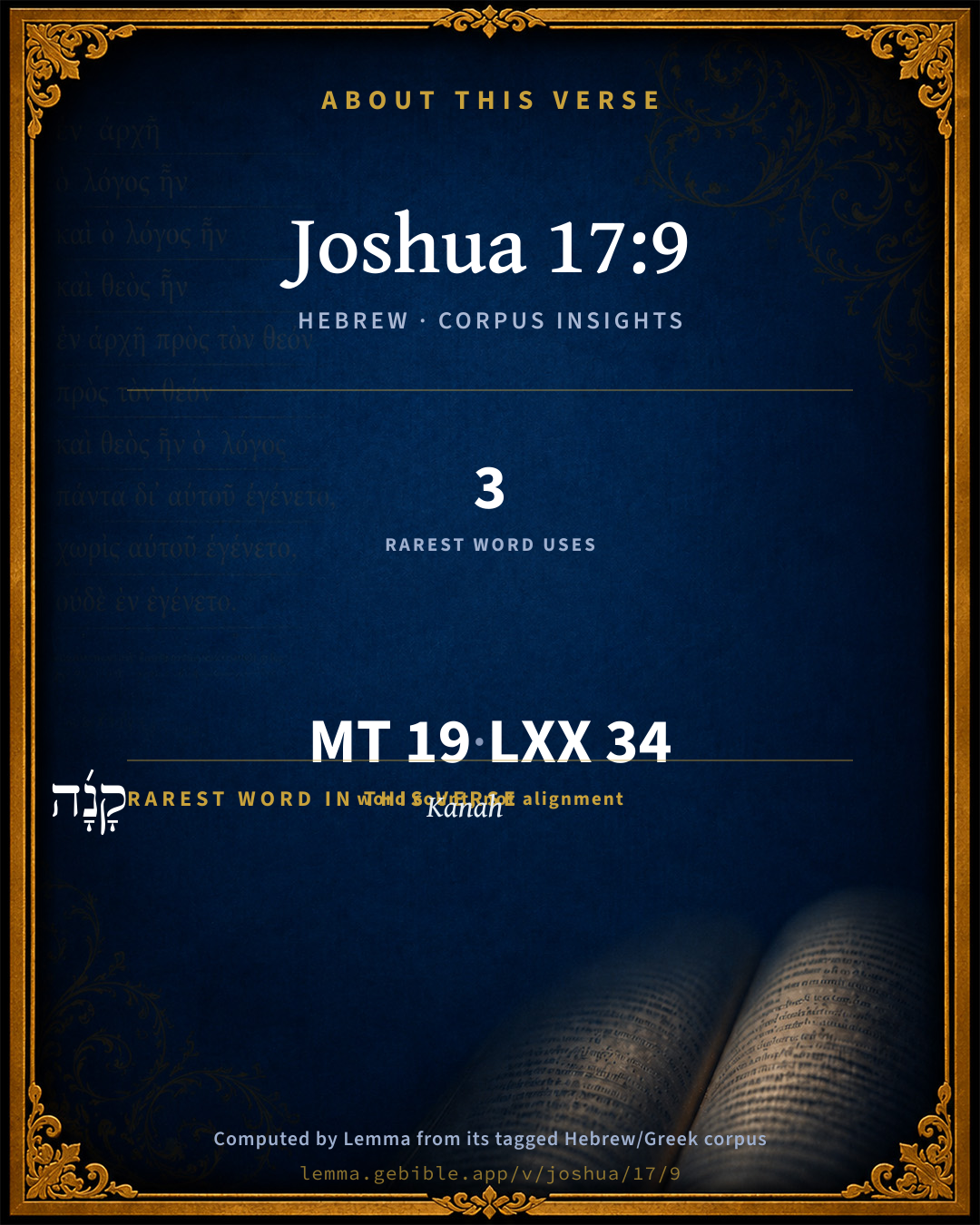
The rarest word here is קָנָ֜ה Kanah H7071 — appearing just 3 times in the whole Hebrew Bible.

Shared distinctive vocabulary

קָנָ֜ה Kanah H7071 occurs in 3 verses of the Hebrew Bible. Also found in:

Grammatical profile

  • 2 verbs
  • 16 nouns
  • 1 pronoun

Verb forms

  • וְיָרַ֣ד Qal · Sequential Perfect
  • וַיְהִ֥י Qal · Sequential Imperfect

Repetition

Words recur within this verse — often emphatic in Hebrew:

  • נַ֨חַל wadi H5158 ×3
  • הַגְּבוּל֩ border H1366 ×2
  • עָרִ֤ים city H5892 ×2
  • מְנַשֶּׁ֑ה Manasseh H4519 ×2

Hebrew & Septuagint length

In English translation the verse runs 46 words from the Hebrew and 49 from the Septuagint (LXX English) — closely comparable.

A rough comparison of the two English renderings, which tokenize alike — not a word-level alignment.

Word counts can differ between the Hebrew and the Greek without any difference in meaning — e.g. the Hebrew direct-object marker אֵת has no separate Greek word, and Greek often adds the article ὁ.

In the original languages it is 19 Hebrew tokens and 34 Greek tokens — but the two are counted differently (Hebrew bundles its prefixes and suffixes into one token; the Greek is in lemma form), so that isn’t a like-for-like length.

Cross-references

3

Topical passages linked to Joshua 17:9 in the Treasury of Scripture Knowledge — connected by theme and wording, ordered by reader-vote popularity; previews shown in the World English Bible.

  • Joshua 16:3 and it went down westward to the border of the Japhletites, to the border of Beth Horon the lower, even to Gezer; and the goings out of it were at the sea.
  • Joshua 16:8–9 From Tappuah the border went along westward to the brook of Kanah; and the goings out of it were at the sea. This is the inheritance of the tribe of the children of Ephraim according to their families;
  • Joshua 19:29 and the border turned to Ramah, and to the fortified city of Tyre; and the border turned to Hosah; and the goings out of it were at the sea by the region of Achzib;

Cross-references courtesy of OpenBible.info (CC BY 4.0).

Hebrew and Greek witnesses Masoretic Hebrew ↔ Greek Septuagint

The same verse in the two great witnesses to the Old Testament, shown verse-for-verse.

These are two independent witnesses, not word-aligned to each other, and the Septuagint is shown in lemma (dictionary) form.

Hebrew Joshua 17:9 Masoretic · Westminster Leningrad Codex

וְיָרַ֣ד הַגְּבוּל֩ נַ֨חַל קָנָ֜ה נֶ֣גְבָּה לַנַּ֗חַל עָרִ֤ים הָאֵ֨לֶּה֙ לְאֶפְרַ֔יִם בְּת֖וֹךְ עָרֵ֣י מְנַשֶּׁ֑ה וּגְב֤וּל מְנַשֶּׁה֙ מִצְּפ֣וֹן לַנַּ֔חַל וַיְהִ֥י תֹצְאֹתָ֖יו הַיָּֽמָּה

The border went down to the brook of Kanah, southward of the brook: these cities belonged to Ephraim among the cities of Manasseh: and the border of Manasseh was on the north side of the brook, and the goings out of it were at the sea:

World English Bible · Public Domain

Greek LXX Joshua 17:9 Septuagint · lemma form

καί καταβαίνω ὁ ὅριον ἐπί φάραγξ καρανα ἐπί λίψ κατά φάραγξ ιαριηλ τερέβινθος ὁ ἐφράιμ ἀνά μέσος πόλις μανασσή καί ὅριον μανασσή ἐπί ὁ βορέας εἰς ὁ χειμάροος καί εἰμί αὐτός ὁ διέξοδος θάλασσα

And the borders shall go down to the valley of Carana southward by the valley of Jariel, (there is a turpentine tree belonging to Ephraim between that and the city of Manasse:) and the borders of Manasse are northward to the brook; and the sea shall be its termination.

LXX2012 (modern English Septuagint) · Public Domain

On this verse, The Pulpit Commentary discusses the Septuagint’s reading. Read the note in Commentary ↓

Hebrew: Westminster Leningrad Codex (CC BY 4.0). Greek: Septuagint (public domain); English from LXX2012 (modern English Septuagint) (Public Domain). How the Septuagint differs from the Hebrew →

Targum (Aramaic paraphrase)

1

The Targum is the ancient Jewish Aramaic paraphrase of the Hebrew Scriptures — an interpretive translation, not the Hebrew text itself. Onkelos (literal) and Pseudo-Jonathan (expansive) render the Torah, and Jonathan the Prophets. Coverage is partial: where no permissively-licensed English translation exists for a verse, only the Aramaic is shown. This is verse-level text, not a word-by-word alignment to the Hebrew.

  1. Targum Jonathan Prophets (Joshua–Malachi)
    וְנָחִית תְּחוּמָא לְנַחֲלָא דְקָנָה לְדָרוֹמָא לְנַחֲלָא קִרְוַיָא הָאִלֵין לְאֶפְרַיִם בְּגוֹ קִרְוֵי מְנַשֶׁה וּתְחוּם מְנַשֶׁה מִצִפּוּנָא לְנַחֲלָא וַהֲוָן מַפְקָנוֹהִי לְיַמָא:

    (no public-domain English translation for this verse)

    Targum Jonathan — Aramaic: “Mikraot Gedolot” (public domain). English: “Sefaria Community Translation” (CC0 1.0 (public-domain dedication)); “London "Chaldee Paraphrase," 1871” (public domain). Text via Sefaria.

Commentary

Notes on Joshua 17:9 from classic Christian and Jewish commentators (each source and its license shown beneath its notes). The classic Christian expositions comment on the surrounding passage and are grouped to its opening verse, so a note may address several verses; the Jewish commentaries on the Tanakh (Rashi and others) are per-verse, so they appear only where the commentator wrote on this verse.

Lemma curates 59 commentaries, every one of them public domain or Creative Commons licensed, each selected and text-cleaned for this edition rather than reprinted as found. About our sources →

Trapp's Complete Commentary

John Trapp

Jos 17:9 And the coast descended unto the river Kanah, southward of the river: these cities of Ephraim [are] among the cities of Manasseh: the coast of Manasseh also [was] on the north side of the river, and the outgoings of it were at the sea:

Ver. 9. See Jos 17:8; and take heed of unnatural wars and bickerings.

“ Nullos habitura triumphos. ”

John Trapp, A Commentary or Exposition upon All the Books of the Old and New Testament (1647–1656) — public domain. Text from a community e-Sword module.

Joseph Benson's Commentary

Jos 17:9. The coast of Manasseh was on the north side — By the coast of Manasseh is meant the cities inhabited by the Manassites; which were all on the north side of this river; as all those on the south side of it, though in the territory allotted to the Manassites: were inhabited by the children of Ephraim.

Joseph Benson's Commentary on the Old and New Testaments (1811–1818) — public domain. Text from a community e-Sword module.

Geneva Bible (1599)

Geneva Bible translators

Or, the brook of reeds.

That is, toward the main sea.

Geneva Bible (1599) marginal notes — public domain. Text via Bolls.life.

Jamieson, Fausset & Brown

Robert Jamieson, A. R. Fausset & David Brown

the coast descended unto the river Kanah, southward of the river--The line which separated the possessions of the two brothers from each other ran to the south of the stream. Thus the river was in the territory of Manasseh; but the cities which were upon the river, though all were within the limits of Manasseh's possessions, were assigned partly to Ephraim, and partly to Manasseh; those on the south side being given to the former; those upon the north to the latter [KEIL]. It appears (Jos 17:10) that Manasseh was still further interlaced with other neighboring tribes.

Jamieson, Fausset & Brown — Commentary Critical and Explanatory on the Whole Bible (1871) — public domain (CC PDM 1.0). Text via the HelloAO Bible API.

Adam Clarke's Commentary

Verse 9. Unto the river Kanah] Literally, the river or valley of the reeds, translated by the Vulgate, vallis arundintei. The tribe of Manasseh appears to have been bounded on the north by this torrent or valley, and on the south by the Mediterranean Sea.

Adam Clarke's Commentary on the Bible (1810–1826) — public domain. Text from a community e-Sword/MySword module.

The Cambridge Bible for Schools and Colleges

gen. ed. J. J. S. Perowne

9. unto the river Kanah] From Tappuah the border descended to the river of Kanah, or “the Brook of Reeds” (see above, Jos_16:8), southward of the watercourse.

these cities of Ephraim] See above, Jos_16:9.

The Cambridge Bible for Schools and Colleges (gen. ed. J. J. S. Perowne; Cambridge University Press, 1878–1918) — public domain. Text from a community e-Sword module.

John Gill's Exposition

And the coast descended unto the river Kanah, southward of the river,.... The same mentioned in the account of the coast of Ephraim, Jos 16:8; which was north of that river, as Manasseh was to the south of it:

these cities of Ephraim are among the cities of Manasseh; that is, the cities before mentioned, Asher, Michmethah, Entappuah, and Tappuah; though they were in the tribe of Manasseh, yet they were inhabited by the Ephraimites:

the coast of Manasseh also was on the north side of the river; of the river Kanah, as well as on the south of it; it had cities there, though possessed by the tribe of Ephraim:

and the outgoings of it were at the sea; the Mediterranean sea.

John Gill's Exposition of the Whole Bible (1746–1763) — public domain (CC PDM 1.0). Text via the HelloAO Bible API.

Albert Barnes' Notes on the Bible

These cities ... - The text is possibly corrupt. The intention seems to be to state that the cities lying south of the river, though within the limits of Manasseh, were in fact made over to Ephraim, and were among the “separate cities” Jos 16:9. On the contrary, the north bank of the river, both land and towns, belonged to Manasseh exclusively.

Albert Barnes' Notes on the Bible (1834–1885) — public domain. Text from a community e-Sword/MySword module.

Matthew Poole's English Annotations

These cities of Ephrain; Tappuah, and the cities upon the coast descending to the river, &c., last mentioned. Are among the cities of Manasseh, i.e. are intermixed with their cities, which was not strange nor unfit, these two being linked together by a nearer alliance than the rest.

Matthew Poole's English Annotations on the Holy Bible (1683–1685) — public domain. Text from a community e-Sword/MySword module.

Whedon's Commentary on the Bible

Daniel D. Whedon

9. Cities of Ephraim are among the cities of Manasseh — Compare Jos_16:8, note. “The line which separated the possessions of the two brothers ran to the south of the river Kenath, but the cities which were upon the river were assigned partly to Ephraim and partly to Manasseh; those upon the south being assigned to the former, and those upon the north to the latter.” — Masius. In Jos_17:10 we find Manasseh interlaced with other border tribes.

Daniel D. Whedon (gen. ed.), Commentary on the Old and New Testaments (1874–1909) — public domain. Text from a community e-Sword module.

The Pulpit Commentary

Southward of the brook. It would seem as if some words had fallen away here also. The LXX adds Jariel, translates hla (these) by terebinth, and omits the word "cities." The cities southward of the brook belonged of course to Ephraim. But what is meant here is that Ephraim had cities north of the brook. That the border of Manasseh lay to the northward of the brook is asserted twice over in the latter part of this and the next verse. These cities of Ephraim are among (literally, in the midst of) the cities of Manasseh. (see Jos_16:9) If exact and minute accuracy is found in this record, how is it that accusations of inaccuracy are so readily made against its author, when his narrative is clearly very much abbreviated, and where a fuller knowledge of the facts might possibly clear up what now appears obscure? Our present text has not the names of these cities.

The Pulpit Commentary (1880–1919), ed. H.D.M. Spence-Jones & Joseph S. Exell — public domain. Text from a community e-Sword module.

John Wesley's Explanatory Notes

Three cities - Tappuah, and the cities upon the coast descending to the river, &c. last mentioned. Among the cities of Manasseh - That is, are intermixed with their cities, which was not strange nor unfit, these two being linked together by a nearer alliance than the rest.

John Wesley, Explanatory Notes Upon the Whole Bible (1754–1765) — public domain. Text via the GEBible commentary corpus.

unfoldingWord translationNotes

Door43 World Missions Community

The border

"The border of Manasseh's land"

brook

a very small river

Kanah

name of a brook (See: How to Translate Names)

On the north side Asher can be reached

Possible meanings are 1) that the border of Manasseh's land on the north side touched the land that belonged to the tribe of Asher or 2) that one can travel north to reach Asher. AT: "Asher was on the north side" or "One can travel north to reach Asher" (See: Active or Passive)

to the east, Issachar

The verb may be supplied from the previous phrase. AT: "to the east, one can reach Issachar" (See: Ellipsis)

translationWords

Manasseh

Ephraim

the sea

Asher

Issachar

unfoldingWord translationNotes — © Distant Shores Media and the Door43 World Missions Community, licensed CC BY-SA 4.0. Source: git.door43.org/Door43/en_tn.

Rashi

Rabbi Shlomo Yitzchaki (Rashi)

These cities— from Tapuach to the stream of Kanoh belonged to Ephraim, but were located among the cities of Menashe.

Rashi on the Tanakh — English translations: “The Judaica Press complete Tanach with Rashi, translated by A. J. Rosenberg” (CC BY 4.0); “Pentateuch with Rashi's commentary by M. Rosenbaum and A.M. Silbermann, 1929-1934” (public domain); “The Metsudah Tanach series, Lakewood, N.J” (CC BY 4.0); and “The Book of Joshua, Metsudah Publications, 1997” (CC BY 4.0). Text via Sefaria.

Lesson kit

Teaching starters — assembled from the data on this page, not authored interpretation. Every prompt links to the verse data it draws on. Edit before teaching.

Joshua, in the Historical, opens this verse with 19 words (14 distinct Hebrew lemmas). Its most distinctive word is Qânâh (“Kanah”). A historical commentator’s framing appears above. Read the whole chapter for the surrounding context.

Discussion questions

  1. How does “Kanah” (Qânâh) shape what this verse is saying?
  2. How does Joshua 16:8, which shares the word «Kanah», read alongside this verse?
  3. What does the repetition of “wadi” (3× in this one verse) do in this verse?
  4. These translations render this verse differently. What is at stake in choosing one wording over another?
  5. «וְיָרַ֣ד» is a Qal Sequential Perfect verb. How does that grammatical form shape the action described?
  6. Compare how Trapp's Complete Commentary and Joseph Benson's Commentary read this verse. Where do they agree or differ?

Things to notice

Reading settings

Reading text

Shown beneath each verse's original-language words.

Old Testament
Old Testament edition

Read the OT as the Masoretic Hebrew (MT) or the Greek Septuagint (LXX).

English shown for the Greek Septuagint (in the Hebrew ↔ Greek comparison).

Comparing translations? Open the Compare panel on any verse page to stack up to four side by side.