
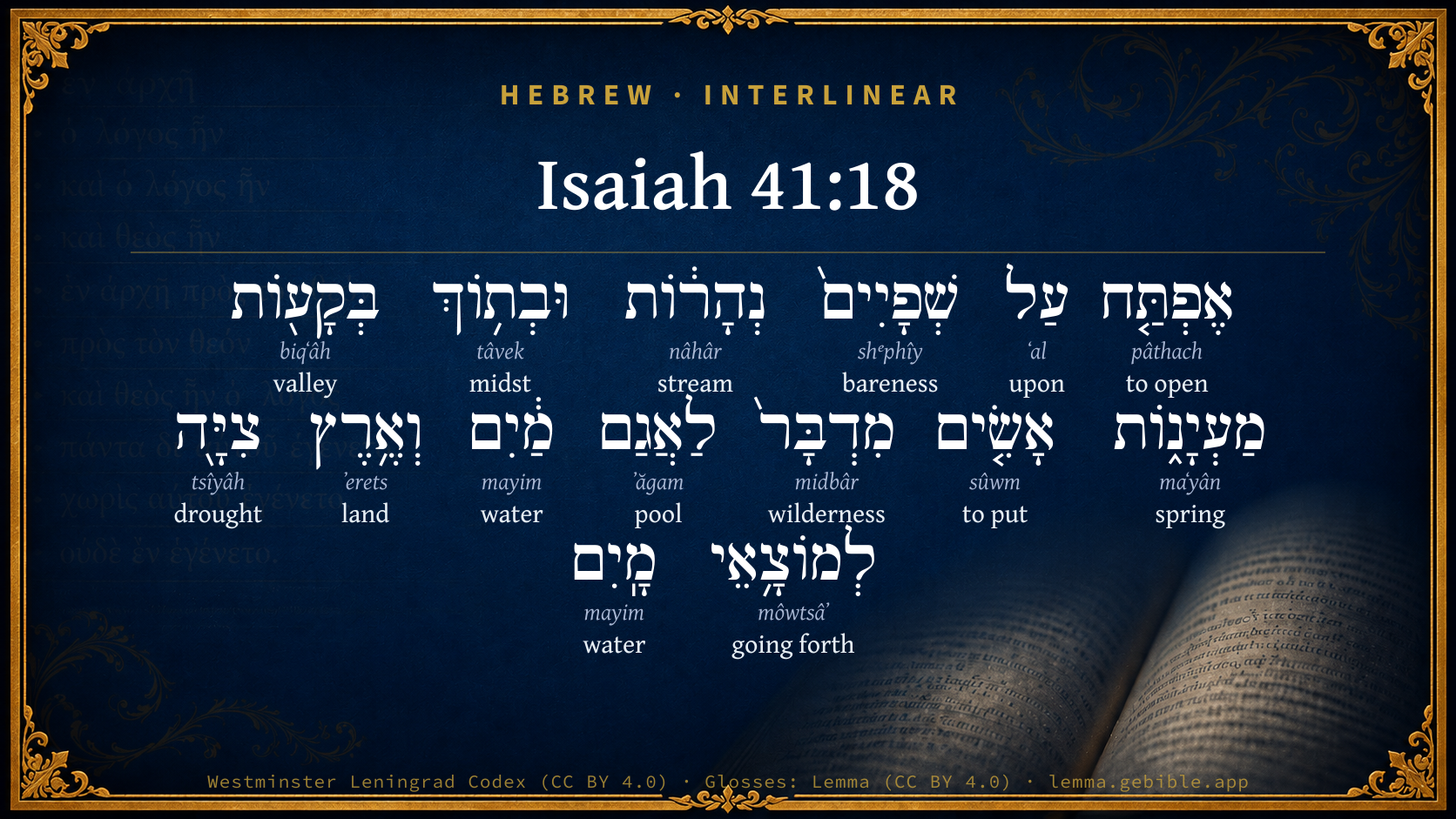
Isaiah 41:18

Hebrew (Westminster Leningrad Codex) Isaiah 41:18 appears in the Hebrew Old Testament. The text above is from the Westminster Leningrad Codex. Each word links to its Strong’s number, a concise gloss, and parsing drawn from the Open Scriptures Hebrew Bible morphology. Click any word for its full Brown-Driver-Briggs (BDB) entry.
Download image
Cite this verse

Isaiah 41:18 (World English Bible). Public Domain. Lemma interlinear Bible study tool, https://lemma.gebible.app/v/isaiah/41/18.

Show BibTeX & RIS
BibTeX
RIS
English Translation
I will open rivers on the bare heights, and springs in the midst of the valleys; I will make the wilderness a pool of water, and the dry land springs of water.
World English Bible · Public Domain
Download a study sheet

One document with this verse’s original text, its word-by-word gloss line, the meaning frame, cross-references with their text, attributed commentary, and full source and license credits — printable, and it pastes into notes with its structure intact.

This verse Autodidact and up

Study sheet (.html) Plain text (.txt)

A passage Seminary Student

Up to 50 verses in one chapter. A passage sheet keeps up to 6 commentary sources and 12 cross-references per verse, in the order this page ranks them, and says so on the sheet whenever that leaves anything out. Ask for a single verse and you get the Autodidact verse sheet above.

Everything on this page stays free to read, with no account — the sheet is a download of what is already on screen, not access to it.

Want to remove ads? Support Godless Engineer
Compare translations 3

The same verse in 3 English versions, stacked beneath the original-language interlinear above. Click any original word for its lexicon entry.

Each is an independent rendering of the whole verse — the interlinear is not word-aligned to these translations.

Highlighted words mark where these versions differ — a whole-verse word diff, not a word-by-word alignment.

  • World English Bible Public Domain
    I will open rivers on the bare heights, and springs in the midst of the valleys; I will make the wilderness a pool of water, and the dry land springs of water.
  • King James Version Public Domain
    I will open rivers in high places, and fountains in the midst of the valleys: I will make the wilderness a pool of water, and the dry land springs of water.
  • unfoldingWord Literal Text CC BY-SA 4.0
    I will open streams on the bare heights, and in the midst of the valleys, fountains. I will make the wilderness into a pool of waters, and the dry land, into springs of waters.

unfoldingWord Literal Text — © unfoldingWord, licensed CC BY-SA 4.0. Word-aligned USFM3 via Door43 (git.door43.org/unfoldingWord/en_ult).

Versions to compare (up to 4)

3 of 4 selected

Show all 18 translations

Every available English version of this verse, each an independent rendering of the whole verse.

  • World English Bible Public Domain
    I will open rivers on the bare heights, and springs in the midst of the valleys; I will make the wilderness a pool of water, and the dry land springs of water.
  • Berean Standard Bible Public Domain
    I will open rivers on the barren heights, and fountains in the middle of the valleys. I will turn the desert into a pool of water, and the dry land into flowing springs.
  • Majority Standard Bible Public Domain
    I will open rivers on the barren heights, and fountains in the middle of the valleys. I will turn the desert into a pool of water, and the dry land into flowing springs.
  • King James Version Public Domain
    I will open rivers in high places, and fountains in the midst of the valleys: I will make the wilderness a pool of water, and the dry land springs of water.
  • American Standard Version (1901) Public Domain
    I will open rivers on the bare heights, and fountains in the midst of the valleys; I will make the wilderness a pool of water, and the dry land springs of water.
  • Revised Version (1885) Public Domain
    I will open rivers on the bare heights, and fountains in the midst of the valleys: I will make the wilderness a pool of water, and the dry land springs of water.
  • Geneva Bible (1599) Public Domain
    I will open riuers in the toppes of the hils, and fountaines in the middes of the valleis: I will make the wildernesse as a poole of water, and the waste land as springs of water.
  • Douay-Rheims (1899) Public Domain
    I will open rivers in the high bills, and fountains in the midst of the plains: I will turn the desert into pools of waters, and the impassable land into streams of waters.
  • Young's Literal Translation Public Domain
    I open on high places rivers, And in midst of valleys fountains, I make a wilderness become a pond of water, And a dry land become springs of water.
  • Literal Standard Version CC BY-SA 4.0
    I open rivers on high places, || And fountains in midst of valleys, || I make a wilderness become a pond of water, || And a dry land becomes springs of water.
  • Unlocked Literal Bible CC BY-SA 4.0
    I will make streams to flow down the slopes, and springs in the middle of the valleys; I will make the desert into a pool of water, and the dry land into springs of water.
  • unfoldingWord Literal Text CC BY-SA 4.0
    I will open streams on the bare heights, and in the midst of the valleys, fountains. I will make the wilderness into a pool of waters, and the dry land, into springs of waters.
  • Darby Bible Public Domain
    I will open rivers on the bare heights, and fountains in the midst of the valleys; I will make the wilderness into a pool of water, and the dry land into water-springs.
  • World Messianic Bible Public Domain
    I will open rivers on the bare heights, and springs in the middle of the valleys. I will make the wilderness a pool of water, and the dry land springs of water.
  • Webster's Bible Public Domain
    I will open rivers in high places, and fountains in the midst of the valleys: I will make the wilderness a pool of water, and the dry land springs of water.
  • Free Bible Version CC BY-SA 4.0
    I will open up rivers in the desolate highlands and springs in the valleys. I will make pools in the wilderness and springs in the desert.
  • Bible in Basic English Public Domain
    I will make rivers on the dry mountain-tops, and fountains in the valleys: I will make the waste land a pool of water, and the dry land springs of water.
  • JPS Tanakh (1917) Public Domain
    I will open rivers on the high hills, and fountains in the midst of the valleys; I will make the wilderness a pool of water, and the dry land springs of water.

Literal Standard Version (2020), Covenant Press — licensed CC BY-SA 4.0. Text via the HelloAO Bible API (eBible.org). Unlocked Literal Bible (unfoldingWord) — licensed CC BY-SA 4.0. Text via the HelloAO Bible API (eBible.org). unfoldingWord Literal Text — © unfoldingWord, licensed CC BY-SA 4.0. Word-aligned USFM3 via Door43 (git.door43.org/unfoldingWord/en_ult). Free Bible Version, Dr. Jonathan Gallagher — licensed CC BY-SA 4.0. Text via the HelloAO Bible API (eBible.org).

Word by word

More ways to search: Search by grammar → Find every occurrence → Compare this word →

Practice this passage: Drill this verse → Learn its vocabulary →

לַאֲגַם
ʼăgam
H98
“to/for · pool of”
Preposition + Noun, Common, Masculine, Singular, Construct
Part of Speech
Preposition + Noun
Type
Common
Gender
Masculine
Number
Singular
State
Construct
Full BDB Definition

Origin: from an unused root (meaning to collect as water)

TWOT: 18a

pool, troubled pool - troubled or muddy (gloomy) pools, marshes - any pool, pond - swamp reeds, reeds, rush(es)
  1. אֶפְתַּ֤ח pâthach H6605 “to open” Verb, Qal, Imperfect, 1st Person, Common, Singular
  2. עַל ʻal H5921 “upon” Preposition
  3. שְׁפָיִים֙ shᵉphîy H8205 “bare heights” Noun, Common, Masculine, Plural, Absolute
  4. נְהָר֔וֹת nâhâr H5104 “streams” Noun, Common, Masculine, Plural, Absolute
  5. וּבְת֥וֹךְ tâvek H8432 “and · in/at · midst of” Conjunction + Preposition + Noun, Common, Masculine, Singular, Construct
  6. בְּקָע֖וֹת biqʻâh H1237 “valleys” Noun, Common, Feminine, Plural, Absolute
  7. מַעְיָנ֑וֹת maʻyân H4599 “springs” Noun, Common, Masculine, Plural, Absolute
  8. אָשִׂ֤ים sûwm H7760 “to put” Verb, Qal, Imperfect, 1st Person, Common, Singular
  9. מִדְבָּר֙ midbâr H4057 “wilderness” Noun, Common, Masculine, Singular, Absolute
  10. מַ֔יִם mayim H4325 “water(s)” Noun, Common, Masculine, Plural, Absolute
  11. וְאֶ֥רֶץ ʼerets H776 “and · land of” Conjunction + Noun, Common, Both, Singular, Construct
  12. צִיָּ֖ה tsîyâh H6723 “drought” Noun, Common, Feminine, Singular, Absolute
  13. לְמוֹצָ֥אֵי môwtsâʼ H4161 “to/for · goings forth of” Preposition + Noun, Common, Masculine, Plural, Construct
  14. מָֽיִם mayim H4325 “water(s)” Noun, Common, Masculine, Plural, Absolute

About this verse

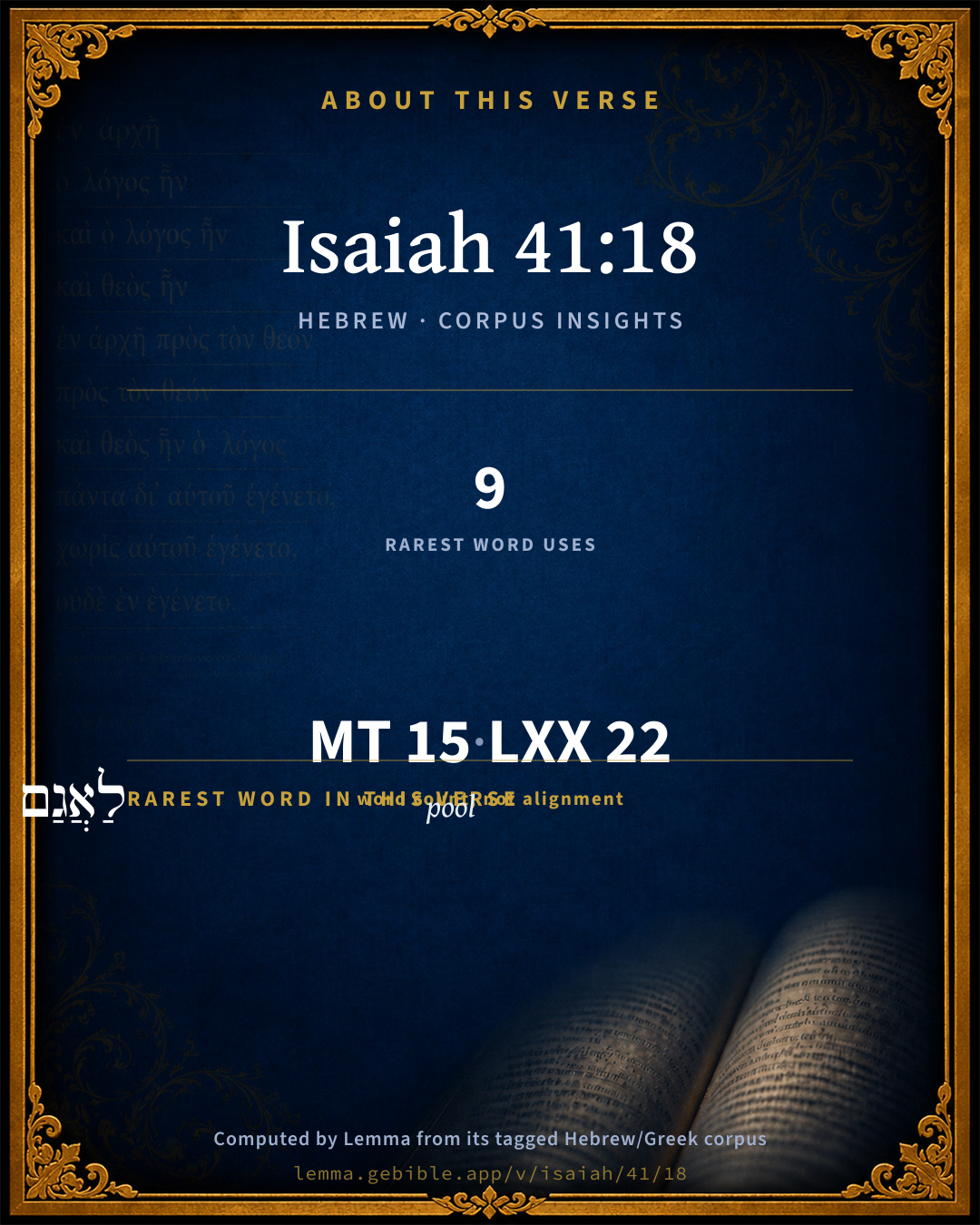
These counts appear in no published source. They are computed here, from the morphology-tagged text and Lemma’s own curated glosses. What Lemma adds →

15
words
14
distinct lemmas
Prophets
section

Notable vocabulary

The rarest word here is לַאֲגַם pool H98 — appearing just 9 times in the whole Hebrew Bible.

Shared distinctive vocabulary

לַאֲגַם pool H98 occurs in 9 verses of the Hebrew Bible. Also found in:

Grammatical profile

  • 2 verbs
  • 12 nouns
  • 1 preposition

Verb forms

  • אֶפְתַּ֤ח Qal · Imperfect
  • אָשִׂ֤ים Qal · Imperfect

Repetition

A word recurs within this verse — often emphatic in Hebrew:

  • מַ֔יִם water H4325 ×2

Hebrew & Septuagint length

In English translation the verse runs 32 words from the Hebrew and 28 from the Septuagint (LXX English) — closely comparable.

A rough comparison of the two English renderings, which tokenize alike — not a word-level alignment.

Word counts can differ between the Hebrew and the Greek without any difference in meaning — e.g. the Hebrew direct-object marker אֵת has no separate Greek word, and Greek often adds the article ὁ.

In the original languages it is 15 Hebrew tokens and 22 Greek tokens — but the two are counted differently (Hebrew bundles its prefixes and suffixes into one token; the Greek is in lemma form), so that isn’t a like-for-like length.

Cross-references

18

Topical passages linked to Isaiah 41:18 in the Treasury of Scripture Knowledge — connected by theme and wording, ordered by reader-vote popularity; previews shown in the World English Bible.

  • Isaiah 35:6–7 Then shall the lame man leap as a hart, and the tongue of the mute shall sing; for in the wilderness shall waters break out, and streams in the desert.
  • Psalms 107:35 He turns a desert into a pool of water, And a dry land into water springs.
  • Isaiah 58:11 and Yahweh will guide you continually, and satisfy your soul in dry places, and make strong your bones; and you shall be like a watered garden, and like a spring of water, whose waters don't fail.
  • Isaiah 30:25 There shall be on every lofty mountain, and on every high hill, brooks [and] streams of waters, in the day of the great slaughter, when the towers fall.
  • Isaiah 43:19–20 Behold, I will do a new thing; now shall it spring forth; shall you not know it? I will even make a way in the wilderness, and rivers in the desert.
  • Ezekiel 47:1–8 He brought me back to the door of the house; and, behold, waters issued out from under the threshold of the house eastward; (for the forefront of the house was toward the east;) and the waters came down from under, from the right side of the house, on the south of the altar.
  • Revelation 7:17 for the Lamb who is in the midst of the throne shepherds them, and leads them to springs of waters of life. And God will wipe away every tear from their eyes."
  • Isaiah 44:3 For I will pour water on him who is thirsty, and streams on the dry ground; I will pour my Spirit on your seed, and my blessing on your offspring:
  • Isaiah 32:2 A man shall be as a hiding-place from the wind, and a covert from the tempest, as streams of water in a dry place, as the shade of a great rock in a weary land.
  • Isaiah 49:9–10 saying to those who are bound, Go forth; to those who are in darkness, Show yourselves. They shall feed in the ways, and on all bare heights shall be their pasture.
  • Joel 3:18 It will happen in that day, That the mountains will drop down sweet wine, The hills will flow with milk, All the brooks of Judah will flow with waters; And a fountain will come forth from the house of Yahweh, And will water the valley of Shittim.
  • Revelation 22:1 He showed me a river of water of life, clear as crystal, proceeding out of the throne of God and of the Lamb,
  • Isaiah 12:3 Therefore with joy you shall draw water out of the wells of salvation.
  • Zechariah 14:8 It will happen in that day, that living waters will go out from Jerusalem; half of them toward the eastern sea, and half of them toward the western sea; in summer and in winter will it be.
  • Psalms 105:41 He opened the rock, and waters gushed out. They ran as a river in the dry places.
  • Isaiah 48:21 They didn't thirst when he led them through the deserts; he caused the waters to flow out of the rock for them; he split the rock also, and the waters gushed out.
  • Psalms 78:15–16 He split rocks in the wilderness, And gave them drink abundantly as out of the depths.
  • Psalms 46:4 There is a river, the streams of which make the city of God glad, The holy place of the tents of the Most High.

Cross-references courtesy of OpenBible.info (CC BY 4.0).

Hebrew and Greek witnesses Masoretic Hebrew ↔ Greek Septuagint

The same verse in the two great witnesses to the Old Testament, shown verse-for-verse.

These are two independent witnesses, not word-aligned to each other, and the Septuagint is shown in lemma (dictionary) form.

Hebrew Isaiah 41:18 Masoretic · Westminster Leningrad Codex

אֶפְתַּ֤ח עַל שְׁפָיִים֙ נְהָר֔וֹת וּבְת֥וֹךְ בְּקָע֖וֹת מַעְיָנ֑וֹת אָשִׂ֤ים מִדְבָּר֙ לַאֲגַם מַ֔יִם וְאֶ֥רֶץ צִיָּ֖ה לְמוֹצָ֥אֵי מָֽיִם

I will open rivers on the bare heights, and springs in the midst of the valleys; I will make the wilderness a pool of water, and the dry land springs of water.

World English Bible · Public Domain

Greek LXX Isaiah 41:18 Septuagint · lemma form

ἀλλά ἀναοἴγω ἐπί ὁ ὄρος ποταμός καί ἐν μέσος πεδίον πηγή ποιέω ὁ ἔρημος εἰς ἕλος καί ὁ διψάω γῆ ἐν ὑδραγωγός

but I will open rivers on the mountains, and fountains in the midst of plains: I will make the desert pools of water, and a thirsty land watercourses.

LXX2012 (modern English Septuagint) · Public Domain

Hebrew: Westminster Leningrad Codex (CC BY 4.0). Greek: Septuagint (public domain); English from LXX2012 (modern English Septuagint) (Public Domain). How the Septuagint differs from the Hebrew →

Targum (Aramaic paraphrase)

1

The Targum is the ancient Jewish Aramaic paraphrase of the Hebrew Scriptures — an interpretive translation, not the Hebrew text itself. Onkelos (literal) and Pseudo-Jonathan (expansive) render the Torah, and Jonathan the Prophets. Coverage is partial: where no permissively-licensed English translation exists for a verse, only the Aramaic is shown. This is verse-level text, not a word-by-word alignment to the Hebrew.

  1. Targum Jonathan Prophets (Joshua–Malachi)
    אֲקָרֵב גָלוּתְהוֹן מִבֵּינֵי עַמְמַיָא וְאֶדְבְּרִינוּן בְּאוֹרַח תַקָנָא וְאֶפְתַּח לְהוֹן עַל נַגְדִין נַהֲרִין וּבְגוֹ מַשִׁרְיָן מַבּוּעִין אֲשַׁוֵי מַדְבְּרָא לַאֲגַמִין דְמַיָן וַאֲרַע בֵּית צַחְוָנָא לְמַבּוּעֵי מַיָא:

    I will gather their captives from the midst of the nations, and I will lead them in the right path; and I will open for them rivers in torrentbeds, and fountains in the midst of the valleys: I will make the desert pools of water, and the land that is a thirsty place springs of water.

    Targum Jonathan — Aramaic: “Mikraot Gedolot” (public domain). English: “Sefaria Community Translation” (CC0 1.0 (public-domain dedication)); “London "Chaldee Paraphrase," 1871” (public domain). Text via Sefaria.

Commentary

Notes on Isaiah 41:18 from classic Christian and Jewish commentators (each source and its license shown beneath its notes). The classic Christian expositions comment on the surrounding passage and are grouped to its opening verse, so a note may address several verses; the Jewish commentaries on the Tanakh (Rashi and others) are per-verse, so they appear only where the commentator wrote on this verse.

Lemma curates 59 commentaries, every one of them public domain or Creative Commons licensed, each selected and text-cleaned for this edition rather than reprinted as found. About our sources →

Trapp's Complete Commentary

John Trapp

Isa 41:18 I will open rivers in high places, and fountains in the midst of the valleys: I will make the wilderness a pool of water, and the dry land springs of water.

Ver. 18. I will open rivers in high places.] Rather work miracles, as once in the wilderness, {Exo 17:6-7} than my poor people shall want necessary support and succour (help).

John Trapp, A Commentary or Exposition upon All the Books of the Old and New Testament (1647–1656) — public domain. Text from a community e-Sword module.

The Biblical Illustrator

Joseph S. Exell

Isa_41:18

I will open rivers in high places

Gods I wills

In this verso the Lord twice says, I will; and in that respect this verse is in harmony with the rest of the chapter.

When we come to the I wills of God, then we get among the precious things, the deep things, the things which minister comfort and strength to the people of God. We sometimes say I will; but it is in a feeble fashion compared with the way in which God says it. People say Must is for the king. So I will is for the King of kings. It is His prerogative to will

1. It is an I will, uttered with deliberation. James said, Known unto God are all His works from the beginning of the world. We say, I will in a hurry, and then we take time to repent of it. We are under excitement, persuasion, or compulsion, and we say, I will, and we are very sorry afterwards, and perhaps we are so unfaithful as not to keep our word; but God never speaks under compulsion; He is almighty. God never speaks in a hurry; He has infinite leisure. Now, when a man speaks a thing prudently and wisely, you believe that he will carry it out, if he can. You may have much more confidence with regard to what the Lord says, for He has not spoken without due deliberation.

2. When God says, I will, His resolution is supported by omnipotence. You say, I will, but you cannot do what you have promised. That can never happen with God.

3. When God says, I will, it is sealed with immutability. We are always changing. Hence, we say to-day, I will, and we mean it; but to-morrow we wish that we had never said. I will, and the next day we say, I will not. But God never changes.

4. When God says, I will, it will be carried out in faithfulness. (C. H.Spurgeon.)

Two I wills in Isa_41:1-29.

I propose to apply the text as a general promise to many things.

I. TO THE TRIALS OF SAINTS.

1. Their temporal trials. What though there is nothing at present, perhaps by to-morrow morning the Lord may have opened rivers in high places, and fountains in the midst of the valleys.

2. The spiritual experience of believers. There are in our text four words relating to water. Everything had been dry before, and there was no water for the thirsty to drink. Now, here you have rivers, fountains, a pool, and springs of water. There is a difference in the four words. The first is rivers. There shall come directly from God a rush of mighty grace, like the streams of flowing rivers. There shall be waters to swim in. You shall have abundance where before you had nothing. The next word is fountains, which may be rendered wells. Wells are places to which people regularly go for water. They represent the means of grace. Perhaps you have been to the means of grace, and obtained no comfort. But, on a sudden, God appears, and opens wells in the midst of the valley. Now the service is all full of refreshment. There is a third word, I will make the wilderness a pool of water. Here you have the idea of overflowing abundance. God can give you so much joy that you will not know how to hold it all; you will have to let it be like a pool that overflows its banks. God can give you so much earnestness that you can hardly employ it all in the work that you have to do. He can give you so much nearness to Himself, that your heart shall scarcely be able to contain your delight. The fourth word is springs. It seems to indicate a perpetual freshness. Where there was a long-continued drought, there shall come perpetual freshness; always something new--new thoughts of Christ, new delights in holy service, new prospects of the world to come, new communion with God.

II. To the experience of converts.

1. Who were these people to whom the Lord spoke? They were people who were poor and needy. God will not do much for spiritually rich people; I mean you who say that you are rich in yourselves.

2. When will He do it? When they begin to seek Him. When the poor and needy seek water. Can you expect God to bless you if you do not seek Him?

3. But the time is noted further still. It is not only when they begin to seek, but when they begin silently to plead. When their tongue faileth for thirst, I the Lord will hear them. They could not speak. Yet says the Lord, I will hear them. A glib tongue is bad at praying. When a man prays in his heart, he is often like Moses, slow of speech

4. But the time mentioned is more sorrowful still; these people were in abject distress. When the poor and needy seek water, and there is none. My day of grace in past, says one. I wonder whoever told you that he! Ah, well, says one, I have gone to look for mercy, and there is none. So you think. Now is the time for Divine interposition. When you seek water, and find none, God will open rivers for you.

5. The promise also relates to those who are in various positions. Some are in very high places. You run up to the very tops of the mountains, and you fancy God cannot reach you there, but He says, I will open rivers in high places. A river on the top of a mountain is a wonderful thing; but God can make it so. Others are ordinary sinners down in the valleys. Well, says the Lord, I will open fountains in the midst of the valleys. Yes, and to vary the promise still more the Lord says, I will make the wilderness a pool of water. Have you ever seen a large extent of flat country covered with sand and stones? God pictures you as being like that barren, dried-up land, and He says that He will turn you into a pool of water. In a word, no condition can be so bad but God can change it.

III. TO THE LABOURS OF WORKERS FOR GOD. God can soon change the condition of the plot of ground on which you are at work.

1. I may be speaking to one who says, Mine is a very bad place to work in, for I cannot get the people to come and hear the Gospel; there seems to be no spirit of hearing. Do not give up preaching; do not give up working, you who long for souls to be saved, for God can suddenly give a love for His house, and an eagerness to hear the Gospel.

2. Another says, I get the people to hear, but there is no feeling. When the old St. Pauls Cathedral had to be taken down for the present one to be built, Sir Christopher Wren had to remove some massive walls that had stood for hundreds of years; so he had a battering-ram, with a great mass of people, working away to break down the walls. I think that for four-and-twenty hours they kept right on, and there seemed to be no sign of giving way, the walls were so well built, very different from our modem walls. The structure was like a rock, it could not be stirred; but the battering-ram kept on and on and on, blow after blow, stroke after stroke, and at last the whole mass began to quiver, like a jelly, and by and by over went the massive walls. You have only to keep on long enough, and the same thing will happen in your work. The first blows upon the wall were not wasted; they were preparing for the others, and getting the whole structure into a condition of disintegration; and when that was done, down it came, and great was the fall thereof.

3. Well, says one, what we want in our place is for the ministry itself to be supplied. If the minister himself is dry, what is to be done? Find fault with him, and leave him? No! if he is a man of God, pray for him, and never rest till the Lord makes the dry land springs of water.

4. But what is wanted, too, is the same blessing upon the helpers. What is the preacher to do, what is the Church to do, if the workers are half asleep? One sleepy Christian in a Church may do much mischief. In some businesses the whole thing is so arranged, that if one person goes to sleep, all the machinery goes wrong; and I believe that it is very much so in the Church of God.

5. Then we may look for a change throughout the whole congregation. Men and women will cry out, What must we do to be saved? There will be plenty of people to be talked to about their souls. We shall have no difficulty in increasing the Church, month by month, with such as shall be saved.

6. Then all the neighbour-hood will be transformed. (C. H. Spurgeon.)

Gods abounding generosity

He does not measure His gifts of water by the pint and by the gallon; but here you have pools, and springs, and rivers. When He has given waters, He will give trees to grow by the waters. When God gives blessing, He makes other blessings to spring out of it. (C. H.Spurgeon.)

The Biblical Illustrator, edited by Joseph S. Exell (c. 1880s–1900s) — public domain. Text from a community e-Sword module.

Tyndale Open Study Notes

Tyndale Open Resources

41:18 rivers . . . fountains . . . pools of water . . . springs: These images would strike a responsive chord in an agrarian culture. They also suggest that rescue from the Exile would be a second exodus (cp. Exod 15:27; 17:6).

Tyndale Open Study Notes — © Tyndale Open Resources, licensed CC BY-SA 4.0. Text via the HelloAO Bible API.

Geneva Bible (1599)

Geneva Bible translators

God will rather change the order of nature than they should want anything, that cry to him by true faith in their miseries: declaring to them hereby that they shall lack nothing by the way, when they return from Babylon.

Geneva Bible (1599) marginal notes — public domain. Text via Bolls.life.

Jamieson, Fausset & Brown

Robert Jamieson, A. R. Fausset & David Brown

Alluding to the waters with which Israel was miraculously supplied in the desert after having come out of Egypt.

high places--bare of trees, barren, and unwatered (Jer 4:11; Jer 14:6). "High places . . . valleys" spiritually express that in all circumstances, whether elevated or depressed, God's people will have refreshment for their souls, however little to be expected it might seem.

Jamieson, Fausset & Brown — Commentary Critical and Explanatory on the Whole Bible (1871) — public domain (CC PDM 1.0). Text via the HelloAO Bible API.

Ellicott's Commentary for English Readers

(18) I will open rivers.—The words have all the emphasis of varied iteration. Every shape of the physical contour of the country, bare hills, arid steppes, and the like, is to be transformed into a new beauty by water in the form adapted to each: streamlets, rivers, lakes, and springs. (Comp. Isa_35:7.)

A Bible Commentary for English Readers, edited by Charles John Ellicott (1878–1897) — public domain. Text from a community e-Sword module.

The Cambridge Bible for Schools and Colleges

gen. ed. J. J. S. Perowne

18. Cf. ch. Isa_30:25. in high places] R.V. on the bare heights. The word occurs only in ch. Isa_49:9 and in Jeremiah (Isa_3:2 &c.). In Num_23:3 the text is doubtful.

The Cambridge Bible for Schools and Colleges (gen. ed. J. J. S. Perowne; Cambridge University Press, 1878–1918) — public domain. Text from a community e-Sword module.

John Gill's Exposition

I will open rivers in high places,.... Which is not usual; but God will change the course of nature, and work miracles, rather than his people shall want what is necessary for them; thus he opens to them his everlasting and unchangeable love, and makes it manifest, and shows it to them, and their interest in it, which is a broad river, that cannot be passed over; this is in high places, it flows from the throne of God, and of the Lamb; and of this river of pleasure he makes his people to drink, the streams whereof make glad the city of our God; likewise the fulness of grace in his Son, whose grace is as rivers of water in a dry land, exceeding abundant, and very refreshing; also the graces of his Spirit, which he gives in great abundance, and are those rivers of water he causes to flow forth from them that believe in Christ, in the comfortable exercise of them; see Psa 36:8,

and fountains in the midst of the valleys; God himself is the fountain of life, and of living waters; Christ is the fountain of gardens, and in him are wells of salvation; the grace of the Spirit is a well of living water, springing up unto eternal life; and of these, humble souls, comparable to the lowly valleys, are partakers, Psa 36:9,

I will make the wilderness a pool of water, and the dry land springs of water; respecting either the Gentile world, which was like a wilderness and dry land before the Gospel came into it, but by that was watered and made fruitful; or the state and case of the people of God being in a wilderness condition, when the Lord takes notice of them, and supplies them with everything necessary, so that they are like a watered garden, whose springs fail not, Rev 12:14. This passage is applied by the Jews to the times of the Messiah (w).

(w) Bemidbar Rabba, sect. 1. 4. fol. 212. 3.

John Gill's Exposition of the Whole Bible (1746–1763) — public domain (CC PDM 1.0). Text via the HelloAO Bible API.

Albert Barnes' Notes on the Bible

I will open rivers - That is, I will cause rivers to flow (see the note at Isa 35:7). The allusion here is doubtless to the miraculous supply of water in the desert when the Israelites had come out of Egypt. God then supplied their needs; and in a similar manner he would always meet his people, and would supply their needs as if rivers of pure water were made to flow from dry and barren hills.

In high places - The word used here denotes properly barrenness or nakedness Job 33:21; and then a hill that is bare, or destitute of trees. It is applied usually to hills in a desert Jer 3:2, Jer 3:21; Jer 4:11; Jer 7:29; Jer 14:6. Such hills, without trees, and in a dry and lonely desert, were of course usually without water. The idea is, that God would refresh them as if rivers were made to flow from such hills; and it may not improperly be regarded as a promise that God would meet and bless his people in situations, and from sources where they least expected refreshment and comfort.

And fountains in the midst of the valleys - (See Isa 30:25, note; Isa 35:6, note).

I will make the wilderness - (See the note at Isa 35:7).

Albert Barnes' Notes on the Bible (1834–1885) — public domain. Text from a community e-Sword/MySword module.

Haydock's Catholic Bible Commentary

Waters. The captives shall be refreshed in the deserts, chap. xxxv. 6., and xliii. 20. (Calmet)

George Leo Haydock (1774–1849), Haydock's Catholic Family Bible and Commentary, 1859 edition — public domain. Excludes Psalms (Douay-Rheims chapter numbering differs from Protestant) and Deuterocanonical books (Catholic canon only).

Matthew Poole's English Annotations

In high places; upon the mountains, where by the course of nature there are no rivers.

In the midst of the valleys; or, in the valleys, to wit, in such of them as are not well watered. I will make the wilderness a pool of water, and the dry land springs of water: these people, who are like a dry and barren wilderness, I will abundantly water with my blessing, and make them fruitful and beautiful, as the next verse showeth; which may be understood, either of the Jews, who were in a wilderness condition, till God brought them out of it; or of the Gentiles converted to the true religion under the gospel.

Matthew Poole's English Annotations on the Holy Bible (1683–1685) — public domain. Text from a community e-Sword/MySword module.

The Pulpit Commentary

I will open rivers in high places. (comp. Isa_30:25) If even the "high places" had water, much more would-the low ground the valleys be abundantly supplied. The abundance is indicated by the fourfold designation of the water-supply, as coming from

(1) rivers;

(2) fountains (or wells);

(3) pools; and

(4) springs (comp. vers. 11, 12).

Water in the wilderness.

"I will make the wilderness a pool of water, and the dry land springs of water." The place of the fountain is the key-note of this sermon. We are not surprised to find a fountain in the grove or the garden there, amidst its diamond spray the birds brighten their plumage. But here the caravan halts, whilst men and women fall on their breasts and drink in the living nectar the sweet water that never harms. We have to meditate upon this subject, however, in its highest aspects. We see not all of life. In nature we come upon unexpected spots of verdure in sterile places; in human life we come upon a true friend in the thorny experiences of adversity. Best of all we have here in this world, which in so many aspects is a wilderness One who gives us the testimony concerning himself, that he will be in us "a well of water springing up into everlasting life." We have

I SPRINGS IN THE DRY LAND OF SIN. What depth of meaning there is in the promise, "The Seed of the woman shall bruise the serpent"s head"!

All seemed lost; and yet at his very feet there sprang up for man "a fountain opened for sin and uncleanness." This is God"s revelation fulfilled in Jesus Christ. Often revelations are left to human discovery. There have been hidden beauties in the universe unknown continents which man must search out and explore. There are hidden adaptations in nature to the need of man, which will reward his enterprise medicaments for disease, ministrants of alleviation. And there are yet "hidden fountains," which the discovering hand of man will lay bare in the wilderness. But sin must be met by grace at once, that man may be saved that the child may yet say, "Father.

II SPRINGS IN THE DRY LAND OF SORROW. Hagar flies. Not the first, nor the last, that the east wind of bitter hatred has driven from the protecting doors. The newspapers record crime. We shudder. But blows at the heart, deeds never reported, never known, borne in the silence of suffering, are often the worst.

1. In solitude Hagar finds an angel. In earliest times they were ministering spirits, and we are distinctly told that they not only were, but are. We lose much comfort from forgetting that they are ministers to us! How? That is what the inquisitive mind is always asking. It is the how?" which makes such piles on piles of useless divinity. The Word of God is inspired! How? The atonement is made! How? The dead shall arise! How?

2. In want she finds refreshment. Weary and worn and sad, God does not allow her to lack refreshment. Sarah dealt hardly with her, and she fled front her face. But another face was looking down upon her. How kind and considerate ought those to be who have others under them! Often far away from home and friends, there should ever be in our relationships all that we mean by kind consideration.

3. In misery she found peace. The mind filled with tumultuous thoughts was calmed! The angel tells her that the Lord hath heard her affliction." What a sermon in a sentence! Teach and preach this, brethren. No eloquent words! No explanatory sentences! Sorrow itself has a voice, and God hears that. What rest comes to the heart that feels God has seen and knows all! "She called the Name of the Lord that spake unto her, Thou God seest me; for she said, Have I also here looked after him that seeth me? Wherefore the well was called Beer-laha-roi;" that is, "the well of him that liveth and seeth me.

III SPRINGS IN THE DRY LAND OF SOLITUDE. What shall I do? Where shall I go? Am I to leave home? Am I to enter a wilderness that I know not? Yes; anywhere, everywhere; but remember God is there. "Whither shall I go from thy presence?" What will to-morrow bring? A Father. Whence will come my supply? Do not know the fountain is hidden. But it is there. What is needful for me to do is to drink and live to taste the living waters. Many analyze them admit their purity, but do not drink! Our solicitudes are natural. Especially so when life is, like Hagar"s, dependent on others. Some here may be driven out into the wilderness at any time. True; but Christ is there! You will, perhaps, never know how precious this fountain is tilt you are away from the old home.

IV SPRINGS IN THE DRY LAND OF SEPARATION. Alas! other fountains dry up. That is to say, they are sealed to us for a time. But in the hours of bereavement and desolation I call on you to witness:

1. What hidden fountains there are in the Bible. How its histories live when we read our own experiences into them! How its psalms pulse with life when we too are panting after the water-brooks!

2. What hidden revelations in Christ. We know him as a Saviour. But how little we know yet! "In him are hid all the treasures of wisdom and knowledge." We "grow in grace and in the knowledge of our Lord Jesus Christ." Some persons we need to know less of to preserve our respect and love. Jesus our Lord is infinite in all beauty, purity, and glory; and the more we know of him the more intense will be our devotion, the more complete our trust, the more fervent our love. Let the hidden fountains be not only rejoiced in by us, but let our voice be heard, "Ho, every one that thirsteth, come ye to the waters!" We think little of water till we are feverish with thirst on shipboard or in an Eastern wilderness. Some of you perchance may have known what thirst is, and how much less precious is the jewelled cup than the water it contains. Yet from the beginning God has sent the rivers through the deserts one day to be peopled, and the springs as at Damascus run through the valleys. Every nation under heaven can bless God for the rain from heaven and for the water-springs! Soon may all tribes and peoples surround "the fountain." We drink of earthly fountains, and thirst again. But whoso drinketh of the water which Christ will give them shall never thirst again. Within, in the wilderness of these poor hearts, he strikes the fountain that is to lift up its pure springs through the immortal ages. W.M.S.

The Pulpit Commentary (1880–1919), ed. H.D.M. Spence-Jones & Joseph S. Exell — public domain. Text from a community e-Sword module.

John Wesley's Explanatory Notes

In high places - Upon the mountains where by the course of nature there are no rivers. The dry land - Their people who are like a dry and barren wilderness. I will abundantly water with my blessings.

John Wesley, Explanatory Notes Upon the Whole Bible (1754–1765) — public domain. Text via the GEBible commentary corpus.

J. A. Alexander on Isaiah

Joseph Addison Alexander

“I will open upon bare hills streams, and in the midst of valleys fountains; I will place the desert for (i.e., convert it into) a pool of water, and a dry land for (or into) springs of water.” The same figure for entire and joyful change occurs in Isa 30:25 and Isa 35:7, and with its opposite or converse in Psa 107:33; Psa 107:35.

Joseph Addison Alexander, The Prophecies of Isaiah (1846–1847; New York: Scribner, 1870–1878) — public domain. Text from a community e-Sword module.

Rashi

Rabbi Shlomo Yitzchaki (Rashi)

rivers an understanding heart for Torah and prophecy.

a desert A place where there was no Torah wisdom.

Rashi on the Tanakh — English translations: “The Judaica Press complete Tanach with Rashi, translated by A. J. Rosenberg” (CC BY 4.0); “Pentateuch with Rashi's commentary by M. Rosenbaum and A.M. Silbermann, 1929-1934” (public domain); “The Metsudah Tanach series, Lakewood, N.J” (CC BY 4.0); and “The Book of Joshua, Metsudah Publications, 1997” (CC BY 4.0). Text via Sefaria.

Ibn Ezra

Rabbi Abraham ibn Ezra

שפים High places. It is the opposite of בקעות valleys. This also is wonderful, that rivers will be found on high places.

מדבר Wilderness. A plain that is not inhabited.

Ibn Ezra on the Tanakh — English translations: “Sefaria Community Translation” (CC0 1.0 (public-domain dedication)); “Yalkut, Sifsei Chachomim Chumash, Metsudah Publications, 2009” (CC BY 4.0); and “Commentary of Ibn Ezra on Isaiah - trans. by M. Friedlander, 1873” (public domain). Text via Sefaria.

Lesson kit

Teaching starters — assembled from the data on this page, not authored interpretation. Every prompt links to the verse data it draws on. Edit before teaching.

Isaiah, in the Prophets, opens this verse with 15 words (14 distinct Hebrew lemmas). Its most distinctive word is ʼăgam (“pool”). A historical commentator’s framing appears above. Read the whole chapter for the surrounding context.

Discussion questions

  1. What does “pool” (ʼăgam) contribute to the verse as a whole?
  2. How does Exodus 7:19, which shares the word «pool», read alongside this verse?
  3. What does the repetition of “water” (2× in this one verse) do in this verse?
  4. These translations render this verse differently. What is at stake in choosing one wording over another?
  5. «אֶפְתַּ֤ח» is a Qal Imperfect verb. How does that grammatical form shape the action described?
  6. Compare how Trapp's Complete Commentary and The Biblical Illustrator read this verse. Where do they agree or differ?

Things to notice

Reading settings

Reading text

Shown beneath each verse's original-language words.

Old Testament
Old Testament edition

Read the OT as the Masoretic Hebrew (MT) or the Greek Septuagint (LXX).

English shown for the Greek Septuagint (in the Hebrew ↔ Greek comparison).

Comparing translations? Open the Compare panel on any verse page to stack up to four side by side.