
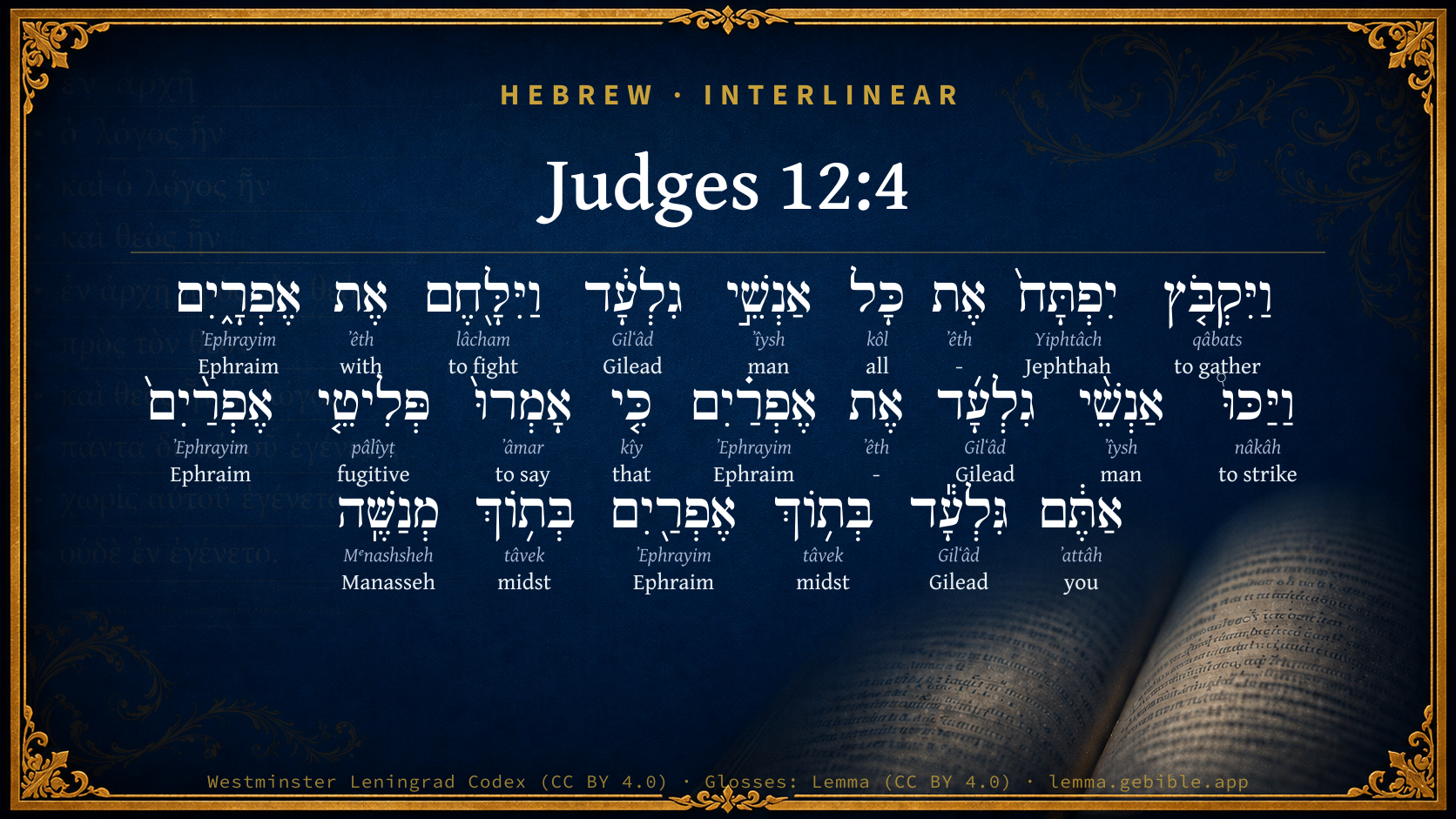
Judges 12:4

Hebrew (Westminster Leningrad Codex) Judges 12:4 appears in the Hebrew Old Testament. The text above is from the Westminster Leningrad Codex. Each word links to its Strong’s number, a concise gloss, and parsing drawn from the Open Scriptures Hebrew Bible morphology. Click any word for its full Brown-Driver-Briggs (BDB) entry.
Download image
Cite this verse

Judges 12:4 (World English Bible). Public Domain. Lemma interlinear Bible study tool, https://lemma.gebible.app/v/judges/12/4.

Show BibTeX & RIS
BibTeX
RIS
English Translation
Then Jephthah gathered together all the men of Gilead, and fought with Ephraim; and the men of Gilead struck Ephraim, because they said, You are fugitives of Ephraim, you Gileadites, in the midst of Ephraim, [and] in the midst of Manasseh.
World English Bible · Public Domain
Download a study sheet

One document with this verse’s original text, its word-by-word gloss line, the meaning frame, cross-references with their text, attributed commentary, and full source and license credits — printable, and it pastes into notes with its structure intact.

This verse Autodidact and up

Study sheet (.html) Plain text (.txt)

A passage Seminary Student

Up to 50 verses in one chapter. A passage sheet keeps up to 6 commentary sources and 12 cross-references per verse, in the order this page ranks them, and says so on the sheet whenever that leaves anything out. Ask for a single verse and you get the Autodidact verse sheet above.

Everything on this page stays free to read, with no account — the sheet is a download of what is already on screen, not access to it.

Want to remove ads? Support Godless Engineer
Compare translations 3

The same verse in 3 English versions, stacked beneath the original-language interlinear above. Click any original word for its lexicon entry.

Each is an independent rendering of the whole verse — the interlinear is not word-aligned to these translations.

Highlighted words mark where these versions differ — a whole-verse word diff, not a word-by-word alignment.

  • World English Bible Public Domain
    Then Jephthah gathered together all the men of Gilead, and fought with Ephraim; and the men of Gilead struck Ephraim, because they said, You are fugitives of Ephraim, you Gileadites, in the midst of Ephraim, [and] in the midst of Manasseh.
  • King James Version Public Domain
    Then Jephthah gathered together all the men of Gilead, and fought with Ephraim: and the men of Gilead smote Ephraim, because they said, Ye Gileadites are fugitives of Ephraim among the Ephraimites, and among the Manassites.
  • unfoldingWord Literal Text CC BY-SA 4.0
    And Jephthah assembled all of the men of Gilead and fought with Ephraim. And the men of Gilead struck Ephraim because they said, “You, Gilead, fugitives of Ephraim in the midst of Ephraim, in the midst of Manasseh.”

unfoldingWord Literal Text — © unfoldingWord, licensed CC BY-SA 4.0. Word-aligned USFM3 via Door43 (git.door43.org/unfoldingWord/en_ult).

Versions to compare (up to 4)

3 of 4 selected

Show all 18 translations

Every available English version of this verse, each an independent rendering of the whole verse.

  • World English Bible Public Domain
    Then Jephthah gathered together all the men of Gilead, and fought with Ephraim; and the men of Gilead struck Ephraim, because they said, You are fugitives of Ephraim, you Gileadites, in the midst of Ephraim, [and] in the midst of Manasseh.
  • Berean Standard Bible Public Domain
    Jephthah then gathered all the men of Gilead and fought against Ephraim. And the men of Gilead struck them down because the Ephraimites had said, “You Gileadites are fugitives in Ephraim, living in the territories of Ephraim and Manasseh.”
  • Majority Standard Bible Public Domain
    Jephthah then gathered all the men of Gilead and fought against Ephraim. And the men of Gilead struck them down because the Ephraimites had said, “You Gileadites are fugitives in Ephraim, living in the territories of Ephraim and Manasseh.”
  • King James Version Public Domain
    Then Jephthah gathered together all the men of Gilead, and fought with Ephraim: and the men of Gilead smote Ephraim, because they said, Ye Gileadites are fugitives of Ephraim among the Ephraimites, and among the Manassites.
  • American Standard Version (1901) Public Domain
    Then Jephthah gathered together all the men of Gilead, and fought with Ephraim; and the men of Gilead smote Ephraim, because they said, Ye are fugitives of Ephraim, ye Gileadites, in the midst of Ephraim, `and' in the midst of Manasseh.
  • Revised Version (1885) Public Domain
    Then Jephthah gathered together all the men of Gilead, and fought with Ephraim: and the men of Gilead smote Ephraim, because they said, Ye are fugitives of Ephraim, ye Gileadites, in the midst of Ephraim, and in the midst of Manasseh.
  • Geneva Bible (1599) Public Domain
    Then Iphtah gathered all the men of Gilead, and fought with Ephraim: and the men of Gilead smote Ephraim, because they said, Ye Gileadites are runnagates of Ephraim among the Ephraimites, and among the Manassites.
  • Douay-Rheims (1899) Public Domain
    Then calling to him all the men of Galaad, he fought against Ephraim: and the men of Galaad defeated Ephraim, because he had said: Galaad is a fugitive of Ephraim, and dwelleth in the midst of Ephraim and Manasses.
  • Young's Literal Translation Public Domain
    And Jephthah gathered all the men of Gilead, and fighteth with Ephraim, and the men of Gilead smite Ephraim, because they said, `Fugitives of Ephraim `are' ye Gileadites, in the midst of Ephraim -- in the midst of Manasseh.'
  • Literal Standard Version CC BY-SA 4.0
    And Jephthah gathered all the men of Gilead, and fights with Ephraim, and the men of Gilead strike Ephraim, because they said, “You Gileadites [are] fugitives of Ephraim, in the midst of Ephraim—in the midst of Manasseh.”
  • Unlocked Literal Bible CC BY-SA 4.0
    Jephthah gathered together all the men of Gilead and he fought against Ephraim. The men of Gilead attacked the men of Ephraim because they said, “You Gileadites are fugitives in Ephraim—in Ephraim and Manasseh.”
  • unfoldingWord Literal Text CC BY-SA 4.0
    And Jephthah assembled all of the men of Gilead and fought with Ephraim. And the men of Gilead struck Ephraim because they said, “You, Gilead, fugitives of Ephraim in the midst of Ephraim, in the midst of Manasseh.”
  • Darby Bible Public Domain
    Then Jephthah gathered all the men of Gilead and fought with E'phraim; and the men of Gilead smote E'phraim, because they said, "You are fugitives of E'phraim, you Gileadites, in the midst of E'phraim and Manas'seh."
  • World Messianic Bible Public Domain
    Then Jephthah gathered together all the men of Gilead, and fought with Ephraim. The men of Gilead struck Ephraim, because they said, “You are fugitives of Ephraim, you Gileadites, in the middle of Ephraim, and in the middle of Manasseh.”
  • Webster's Bible Public Domain
    Then Jephthah collected all the men of Gilead, and fought with Ephraim: and the men of Gilead smote Ephraim, because they said, Ye Gileadites are fugitives of Ephraim among the Ephraimites, and among the Manassites.
  • Free Bible Version CC BY-SA 4.0
    Jephthah summoned all of the men of Gilead and fought against the Ephraimites. The men of Gilead killed them because the Ephraimites taunted them, saying, “You Gileadites are nothing more than escapees living among Ephraim and Manasseh.”
  • Bible in Basic English Public Domain
    Then Jephthah got together all the men of Gilead and made war on Ephraim; and the men of Gilead overcame Ephraim.
  • JPS Tanakh (1917) Public Domain
    Then Jephthah gathered together all the men of Gilead, and fought with Ephraim; and the men of Gilead smote Ephraim, because they said: 'Ye are fugitives of Ephraim, ye Gileadites, in the midst of Ephraim, and in the midst of Manasseh.'

Literal Standard Version (2020), Covenant Press — licensed CC BY-SA 4.0. Text via the HelloAO Bible API (eBible.org). Unlocked Literal Bible (unfoldingWord) — licensed CC BY-SA 4.0. Text via the HelloAO Bible API (eBible.org). unfoldingWord Literal Text — © unfoldingWord, licensed CC BY-SA 4.0. Word-aligned USFM3 via Door43 (git.door43.org/unfoldingWord/en_ult). Free Bible Version, Dr. Jonathan Gallagher — licensed CC BY-SA 4.0. Text via the HelloAO Bible API (eBible.org).

Word by word

More ways to search: Search by grammar → Find every occurrence → Compare this word →

Practice this passage: Drill this verse → Learn its vocabulary →

פְּלִיטֵ֤י
pâlîyṭ
H6412
“fugitives of”
Noun, Common, Masculine, Plural, Construct
Part of Speech
Noun
Type
Common
Gender
Masculine
Number
Plural
State
Construct
Full BDB Definition

Origin: from H6403

TWOT: 1774b , 1774c

refugee, fugitive, escaped one
  1. וַיִּקְבֹּ֤ץ qâbats H6908 “and · to gather” Conjunction + Verb, Qal, Sequential Imperfect, 3rd Person, Masculine, Singular
  2. יִפְתָּח֙ Yiphtâch H3316 “Jephthah” Noun, Proper
  3. אֶת ʼêth H853 “-” Particle, Direct Object
  4. כָּל kôl H3605 “all of” Noun, Common, Masculine, Singular, Construct
  5. אַנְשֵׁ֣י ʼîysh H376 “men of” Noun, Common, Masculine, Plural, Construct
  6. גִלְעָ֔ד Gilʻâd H1568 “Gilead” Noun, Proper
  7. וַיִּלָּ֖חֶם lâcham H3898 “and · to fight” Conjunction + Verb, Niphal, Sequential Imperfect, 3rd Person, Masculine, Singular
  8. אֶת ʼêth H854 “with” Preposition
  9. אֶפְרָ֑יִם ʼEphrayim H669 “Ephraim” Noun, Proper
  10. וַיַּכּוּ֩ nâkâh H5221 “and · to strike” Conjunction + Verb, Hiphil, Sequential Imperfect, 3rd Person, Masculine, Plural
  11. אַנְשֵׁ֨י ʼîysh H376 “men of” Noun, Common, Masculine, Plural, Construct
  12. גִלְעָ֜ד Gilʻâd H1568 “Gilead” Noun, Proper
  13. אֶת ʼêth H853 “-” Particle, Direct Object
  14. אֶפְרַ֗יִם ʼEphrayim H669 “Ephraim” Noun, Proper
  15. כִּ֤י kîy H3588 “that” Conjunction
  16. אָמְרוּ֙ ʼâmar H559 “to say” Verb, Qal, Perfect, 3rd Person, Common, Plural
  17. אֶפְרַ֨יִם֙ ʼEphrayim H669 “Ephraim” Noun, Proper
  18. אַתֶּ֔ם ʼattâh H859 “you” Pronoun, Personal, 2nd Person, Masculine, Plural
  19. גִּלְעָ֕ד Gilʻâd H1568 “Gilead” Noun, Proper
  20. בְּת֥וֹךְ tâvek H8432 “in/at · midst of” Preposition + Noun, Common, Masculine, Singular, Construct
  21. אֶפְרַ֖יִם ʼEphrayim H669 “Ephraim” Noun, Proper
  22. בְּת֥וֹךְ tâvek H8432 “in/at · midst of” Preposition + Noun, Common, Masculine, Singular, Construct
  23. מְנַשֶּֽׁה Mᵉnashsheh H4519 “Manasseh” Noun, Proper

About this verse

These counts appear in no published source. They are computed here, from the morphology-tagged text and Lemma’s own curated glosses. What Lemma adds →

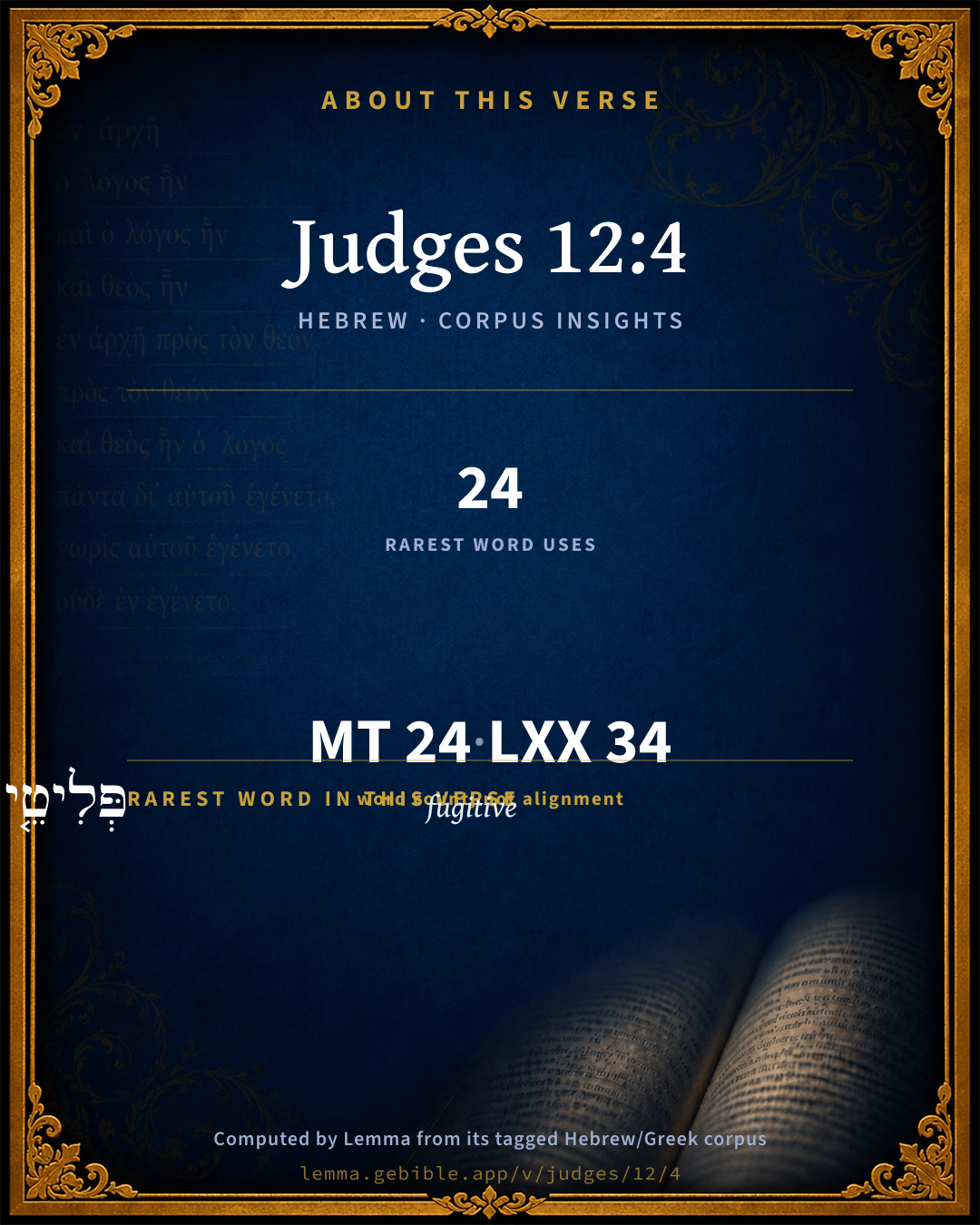
24
words
16
distinct lemmas
Historical
section

Notable vocabulary

The rarest word here is פְּלִיטֵ֤י fugitive H6412 — appearing just 24 times in the whole Hebrew Bible.

Shared distinctive vocabulary

פְּלִיטֵ֤י fugitive H6412 occurs in 23 verses of the Hebrew Bible. Also found in:

Grammatical profile

  • 4 verbs
  • 15 nouns
  • 1 pronoun
  • 1 preposition
  • 1 conjunction
  • 2 particles

Verb forms

  • וַיִּקְבֹּ֤ץ Qal · Sequential Imperfect
  • וַיִּלָּ֖חֶם Niphal · Sequential Imperfect
  • וַיַּכּוּ֩ Hiphil · Sequential Imperfect
  • אָמְרוּ֙ Qal · Perfect

Repetition

Words recur within this verse — often emphatic in Hebrew:

  • אֶפְרָ֑יִם Ephraim H669 ×4
  • גִלְעָ֔ד Gilead H1568 ×3
  • אַנְשֵׁ֣י man H376 ×2
  • בְּת֥וֹךְ midst H8432 ×2

Hebrew & Septuagint length

In English translation the verse runs 41 words from the Hebrew and 42 from the Septuagint (LXX English) — closely comparable.

A rough comparison of the two English renderings, which tokenize alike — not a word-level alignment.

Word counts can differ between the Hebrew and the Greek without any difference in meaning — e.g. the Hebrew direct-object marker אֵת has no separate Greek word, and Greek often adds the article ὁ.

In the original languages it is 24 Hebrew tokens and 34 Greek tokens — but the two are counted differently (Hebrew bundles its prefixes and suffixes into one token; the Greek is in lemma form), so that isn’t a like-for-like length.

Cross-references

8

Topical passages linked to Judges 12:4 in the Treasury of Scripture Knowledge — connected by theme and wording, ordered by reader-vote popularity; previews shown in the World English Bible.

  • 1 Samuel 25:10 Nabal answered David's servants, and said, Who is David? and who is the son of Jesse? there are many servants now-a-days who break away every man from his master.
  • Proverbs 12:13 An evil man is trapped by sinfulness of lips, But the righteous shall come out of trouble.
  • Numbers 32:39–40 The children of Machir the son of Manasseh went to Gilead, and took it, and dispossessed the Amorites who were therein.
  • Deuteronomy 3:12–17 This land we took in possession at that time: from Aroer, which is by the valley of the Arnon, and half the hill-country of Gilead, and the cities of it, gave I to the Reubenites and to the Gadites:
  • Judges 11:10 The elders of Gilead said to Jephthah, Yahweh shall be witness between us; surely according to your word so will we do.
  • Nehemiah 4:4 Hear, our God; for we are despised: and turn back their reproach on their own head, and give them up for a spoil in a land of captivity;
  • Psalms 78:9 The children of Ephraim, being armed and carrying bows, Turned back in the day of battle.
  • Proverbs 15:1 A gentle answer turns away wrath, But a harsh word stirs up anger.

Cross-references courtesy of OpenBible.info (CC BY 4.0).

Hebrew and Greek witnesses Masoretic Hebrew ↔ Greek Septuagint

The same verse in the two great witnesses to the Old Testament, shown verse-for-verse.

These are two independent witnesses, not word-aligned to each other, and the Septuagint is shown in lemma (dictionary) form.

Hebrew Judges 12:4 Masoretic · Westminster Leningrad Codex

וַיִּקְבֹּ֤ץ יִפְתָּח֙ אֶת כָּל אַנְשֵׁ֣י גִלְעָ֔ד וַיִּלָּ֖חֶם אֶת אֶפְרָ֑יִם וַיַּכּוּ֩ אַנְשֵׁ֨י גִלְעָ֜ד אֶת אֶפְרַ֗יִם כִּ֤י אָמְרוּ֙ פְּלִיטֵ֤י אֶפְרַ֨יִם֙ אַתֶּ֔ם גִּלְעָ֕ד בְּת֥וֹךְ אֶפְרַ֖יִם בְּת֥וֹךְ מְנַשֶּֽׁה

Then Jephthah gathered together all the men of Gilead, and fought with Ephraim; and the men of Gilead struck Ephraim, because they said, You are fugitives of Ephraim, you Gileadites, in the midst of Ephraim, [and] in the midst of Manasseh.

World English Bible · Public Domain

Greek LXX Judges 12:4 Septuagint · lemma form

καί συνστρέφω ιεφθαε ὁ πᾶς ἀνήρ γαλαάδ καί παρατάσσω ὁ ἐφράιμ καί πατάσσω ἀνήρ γαλαάδ ὁ ἐφράιμ ὅτι εἶπον ὁ διασώζω ὁ ἐφράιμ σύ γαλαάδ ἐν μέσος ὁ ἐφράιμ καί ἐν μέσος ὁ μανασσή

And Jephthae gathered all the men of Galaad, and fought with Ephraim; and the men of Galaad struck Ephraim, because they that were escaped of Ephraim said, You⌃ are of Galaad in the midst of Ephraim and in the midst of Manasse.

LXX2012 (modern English Septuagint) · Public Domain

On this verse, The Cambridge Bible for Schools and Colleges discusses the Septuagint’s reading. Read the note in Commentary ↓

Hebrew: Westminster Leningrad Codex (CC BY 4.0). Greek: Septuagint (public domain); English from LXX2012 (modern English Septuagint) (Public Domain). How the Septuagint differs from the Hebrew →

Targum (Aramaic paraphrase)

1

The Targum is the ancient Jewish Aramaic paraphrase of the Hebrew Scriptures — an interpretive translation, not the Hebrew text itself. Onkelos (literal) and Pseudo-Jonathan (expansive) render the Torah, and Jonathan the Prophets. Coverage is partial: where no permissively-licensed English translation exists for a verse, only the Aramaic is shown. This is verse-level text, not a word-by-word alignment to the Hebrew.

  1. Targum Jonathan Prophets (Joshua–Malachi)
    וּכְנַשׁ יִפְתָּח יַת כָּל אֱנָשֵׁי גִלְעָד וְאַגִיחַ קְרָבָא עִם דְבֵית אֶפְרָיִם וּמְחוֹ אֱנָשֵׁי גִלְעָד יַת דְבֵית אֶפְרַיִם אֲרֵי אֲמַרוּ מְשֵׁיזְבַיָא דְבֵית אֶפְרַיִם מָה אַתּוּן חֲשִׁיבִין דְבֵית גִלְעָד בְּנֵי בֵית אֶפְרַיִם בְּגוֹ בֵית מְנַשֶׁה:

    (no public-domain English translation for this verse)

    Targum Jonathan — Aramaic: “Mikraot Gedolot” (public domain). English: “Sefaria Community Translation” (CC0 1.0 (public-domain dedication)); “London "Chaldee Paraphrase," 1871” (public domain). Text via Sefaria.

Commentary

Notes on Judges 12:4 from classic Christian and Jewish commentators (each source and its license shown beneath its notes). The classic Christian expositions comment on the surrounding passage and are grouped to its opening verse, so a note may address several verses; the Jewish commentaries on the Tanakh (Rashi and others) are per-verse, so they appear only where the commentator wrote on this verse.

Lemma curates 59 commentaries, every one of them public domain or Creative Commons licensed, each selected and text-cleaned for this edition rather than reprinted as found. About our sources →

Jamieson, Fausset & Brown

Robert Jamieson, A. R. Fausset & David Brown

DISCERNED BY THE WORD SIBBOLETH, ARE SLAIN BY THE GILEADITES. (Jdg 12:4-15)

the men of Gilead smote Ephraim, because they said, Ye Gileadites are fugitives of Ephraim--The remonstrances of Jephthah, though reasonable and temperate, were not only ineffectual, but followed by insulting sneers that the Gileadites were reckoned both by the western Manassites and Ephraimites as outcasts--the scum and refuse of their common stock. This was addressed to a peculiarly sensitive people. A feud immediately ensued. The Gileadites, determined to chastise this public affront, gave them battle; and having defeated the Ephraimites, they chased their foul-mouthed but cowardly assailants out of the territory. Then rushing to the fords of the Jordan, they intercepted and slew every fugitive. The method adopted for discovering an Ephraimite was by the pronunciation of a word naturally suggested by the place where they stood. Shibboleth, means "a stream"; Sibboleth, "a burden." The Eastern tribe had, it seems, a dialectical provincialism in the sound of Shibboleth; and the Ephraimites could not bring their organs to pronounce it.

Jamieson, Fausset & Brown — Commentary Critical and Explanatory on the Whole Bible (1871) — public domain (CC PDM 1.0). Text via the HelloAO Bible API.

Trapp's Complete Commentary

John Trapp

Jdg 12:4 Then Jephthah gathered together all the men of Gilead, and fought with Ephraim: and the men of Gilead smote Ephraim, because they said, Ye Gileadites [are] fugitives of Ephraim among the Ephraimites, [and] among the Manassites.

Ver. 4. Then Jephthah gathered together all the men of Gilead.] When he saw they were set upon it, and that they would needs quarrel with their friends, and not with their faults, he set light by their threats, Minorum strepitus armorum crepitus and resolved to chastise their insolency with the edge of the sword. When there is no hope of curing, men must fall to cutting. {a}

Ye Gileadites are fugitives.] {b} Or, Abjects, mongrels, the refuse of both tribes: a brand of dishonour, and therefore heinously taken, and heavily revenged. Such opprobrious and reviling speeches, Leviter volant, non, leviter violant. Jephthah and his soldiers might haply here be glanced at, because he was forced to flee from his father’s house.

Among the Ephraimites,] q.d., The scum of those two noble tribes, fellows of no fashion. But the meanest are not to be slighted; since

“ A cane non magno saepe tenetar aper. ”

{a} Immedicabile vulnus ense recidendum.

{b} Or, the Gileadites being got between the Ephraimites and Manassites, the Ephraimites said, Ye are but the fugitives of Ephraim.

John Trapp, A Commentary or Exposition upon All the Books of the Old and New Testament (1647–1656) — public domain. Text from a community e-Sword module.

Joseph Benson's Commentary

Jdg 12:4. The men of Gilead smote Ephraim, because they said, &c. — That which provoked the army of Jephthah to kill so many of them was their insulting language, added to their threats, whereby they reproached the men of Gilead, (who were the chief managers of the late war,) as if they were but the scum and dregs of the tribe of Ephraim. Ye Gileadites are fugitives of Ephraim — A contemptuous expression, designed to provoke and kindle wrath. The word Ephraim is here taken largely, as comprehending the other neighbouring tribes, of which Ephraim was the chief, and especially their brethren of Manasseh, who lived next to them, and were descended from the same father, Joseph. By Gileadites, they seem here principally to mean, those Manassites who inhabited Gilead, beyond Jordan. And although other Gileadites were joined with them, yet they vent their passion principally against these, because they envied them most, as having had a chief hand in the victory. These they opprobriously call fugitives, that is, such as had deserted their brethren of Ephraim and Manasseh, planted themselves beyond Jordan, at a distance from their brethren, and were alienated in affection from them.

Joseph Benson's Commentary on the Old and New Testaments (1811–1818) — public domain. Text from a community e-Sword module.

Geneva Bible (1599)

Geneva Bible translators

Ye ran from us, and chose Gilead, and now in respect of us, ye are nothing.

Geneva Bible (1599) marginal notes — public domain. Text via Bolls.life.

Adam Clarke's Commentary

Verse 4. And fought with Ephraim] Some commentators suppose that there were two battles in which the Ephraimites were defeated: the first mentioned in the above clause; and the second occasioned by the taunting language mentioned in the conclusion of the verse, Ye Gileadites are fugitives of Ephraim. Where the point of this reproach lies, or what is the reason of it, cannot be easily ascertained.

Adam Clarke's Commentary on the Bible (1810–1826) — public domain. Text from a community e-Sword/MySword module.

Ellicott's Commentary for English Readers

(4) All the men of Gilead.—This probably implies the Eastern tribes generally.

And the men of Gilead smote Ephraim because they said . . .—The translation and the meaning are here highly uncertain. It seems to be implied that in spite of Jephthah’s perfectly reasonable answer the Ephraimites advanced to attack Gilead, and goaded the Gileadites to fury by intolerable taunts, which prevented the Gileadites from giving any quarter when they had won the victory.

Ye Gileadites are fugitives of Ephraim.—If the English Version is here correct, the meaning is, “You people of the eastern half of the tribe of Manasseh are a mere race of runaway slaves, who belong neither to Ephraim nor to Manasseh” (1Sa_25:10). It is very possible that fierce jealousies may have sprung up between the Eastern Manassites and their tribal brethren of the West, and that these may have mainly originated in the fact that the Eastern Manassites less and less acknowledged the lead of Ephraim, but changing their character and their habits, threw in their lot more and more with the pastoral tribes of Reuben and Gad. The taunt sounds as if it had sprung from a schism in clanship, a contemptuous disclaimer on the part of Ephraim of any ties with this Eastern half-tribe. Indeed, the taunt may have been so far true that very probably any who fell into debt or disgrace in Ephraim and Eastern Manasseh might be as likely to fly to Western Manasseh as an English defaulter might escape to New York. And if the Ephraimites indulged in such shameful jibes, it might well be deemed sufficient to account for the ruthless character of the fighting. But the rendering of the English Version is very uncertain, and the versions vary in the view they take of the meaning, punctuation, and even of the reading of the passage. On the whole, the best view is to render the words thus: The men of Gilead smote Ephraim [not only in the battle, but in the far more fatal pursuit] because they [the men of Gilead] said, Ye are fugitives of Ephraim (see on Jdg_12:5). Then follows the geographical explanation and historical illustration of the clause, which is, “It was possible for the Gileadites to inflict this vengeance, for (1) Gilead [lies] between Ephraim and [Eastern] Manasseh.” [Part, at any rate, of Gilead belonged to Gad, and lies geographically between the district of Eastern Manasseh and the district of Ephraim, as is sufficiently clear since Ephraim has advanced “northwards,” or towards Tsaphon (Jdg_12:1), for the attack.] Then (2) there follows the seizure of the fords, which led to the total slaughter of all these Ephraimite fugitives. One slight circumstance which adds probability to this view is that “fugitives” (comp. Jer_44:14) is a term which could hardly be applied to a whole tribe.

A Bible Commentary for English Readers, edited by Charles John Ellicott (1878–1897) — public domain. Text from a community e-Sword module.

The Cambridge Bible for Schools and Colleges

gen. ed. J. J. S. Perowne

4. because they said … Manasseh] These words, which make no sense where they stand, and are omitted by some mss. of the LXX and marked with an asterisk in Syro-Hex., probably belonged in part to Jdg_12:6 ‘… and slew him at the fords of Jordan, for they said, Ye are fugitives of Ephraim.’ The words in italics may have been left out by a copyist, and then written on the margin, whence they were restored to the text, but in the wrong place. Afterwards Gilead is in the midst of E., in the midst of M. (so the text runs) was added as a gloss on the previous sentence which became unintelligible in its new position.

The Cambridge Bible for Schools and Colleges (gen. ed. J. J. S. Perowne; Cambridge University Press, 1878–1918) — public domain. Text from a community e-Sword module.

John Gill's Exposition

Then Jephthah gathered together all the men of Gilead, and fought with Ephraim,.... The Ephraimites not being pacified with the account Jephthah gave of the war between him and the children of Ammon, but continuing in their tumultuous outrage; he, being a man of spirit and courage, got as many of the Gileadites together as he could, and gave them battle:

and the men of Gilead smote Ephraim; had the advantage of them, worsted them, killed many of them, and put the rest to flight:

because they said, ye Gileadites are fugitives of Ephraim among the Ephraimites, and among the Manassites; what provoked them to fall upon them with the greater fury, and use them the more severely when, they had the better of them, was their reproachful language to them, insulting the Gileadites, who perhaps were chiefly, if not all, of the half tribe of Manasseh beyond Jordan, of which Jephthah was, that they were the scum of the house of Joseph, that they had run away from their brethren, and dwelt in a corner of the land by themselves; and were of no account at all among Ephraim and Manasseh, and disclaimed by them both, and not esteemed by either. The Targum is,"the fugitives of Ephraim said, what are ye Gileadites accounted of among the Ephraimites, and among the Manassites?''on which Kimchi remarks, that those Ephraimites that came in this tumultuous manner, and insulted Jephthah, were a most abject company of men, the refuse of the tribe of Ephraim, shepherds who through necessity were obliged to come over Jordan with their flocks and herds for pasture: but the words may be rendered, "for they said, fugitives of Ephraim are ye, even the Gileadites, who were, or being between the Ephraimites and the Manassites"; that is, the Gileadites called the Ephraimites so, when they fled before them, and when they got at the fords of Jordan, which lay between Ephraim and the half tribe of Manasseh on the other side Jordan; and they are in the next verse expressly so called.

John Gill's Exposition of the Whole Bible (1746–1763) — public domain (CC PDM 1.0). Text via the HelloAO Bible API.

Albert Barnes' Notes on the Bible

Because they said ... - This passage is extremely obscure. Render: - “The men of Gilead smote Ephraim, for they (the Gileadites) said, Ye are. the fugitives of Ephraim. (Gilead lies between Ephraim and Manasseh; and Gilead took the fords of Jordan before Ephraim, and it came to pass, when the fugitives of Ephraim said Let me pass over, and the Gileadites asked him, art thou an Ephraimite, and he answered No, Then (the Gileadites) said to him say Shibboleth, etc. So they (the Gileadites) killed them at the fords of Jordan”). All that is included in the parenthesis is explanatory of the brief statement “They smote them, for they said, Ye are the fugitives of Ephraim;” i. e. in spite of denial they ascertained that they were the fugitives of Ephraim, and so pitilessly slaughtered them when they endeavored to return to their own country through Gilead. This part of Gilead, where the fords were, was clearly not in Manasseh, but in Gad. “Slew” Jdg 12:6 implies “slaughtering” in cold blood, not killing in battle (see Jer 39:6). The word in the original text is the proper word for slaying animals for sacrifice.

Albert Barnes' Notes on the Bible (1834–1885) — public domain. Text from a community e-Sword/MySword module.

Haydock's Catholic Bible Commentary

Fugitive. Vile and timid, so that his brethren around him might destroy him at any time. (Menochius) --- Galaad dwelt in the midst of the descendants of Joseph. (Haydock) --- But Ephraim, in despite, had represented him as an outcast. Their envy deserved to be severely punished. (Calmet) --- The same passion had nearly excited them to make war upon Gedeon, chap. viii. (Menochius)

George Leo Haydock (1774–1849), Haydock's Catholic Family Bible and Commentary, 1859 edition — public domain. Excludes Psalms (Douay-Rheims chapter numbering differs from Protestant) and Deuterocanonical books (Catholic canon only).

Matthew Poole's English Annotations

According to this translation, these words are a scoffing and contemptuous expression of the Ephraimites concerning the Gileadites, whom they call fugitives of Ephraim; the word Ephraim being here taken largely, as it is elsewhere as Isa 7:2,5, so as it comprehends the other neighbouring tribes, of which Ephraim was in some sort the head or chief; and especially their brethren of Manasseh, who lived next to them, and were descended from the same father, Joseph; by reason whereof both these tribes are sometimes reckoned for one, and called by the name of the tribe of Joseph. And this large signification of Ephraim may seem probable from the following words, where, instead of

Ephraim, is put the Ephraimites and the Manassites. By

Gileadites here they seem principally to mean the Manassites beyond Jordan, who dwelt in Gilead, as appears from Deu 3:13; Jos 17:1,5,6. And although other Gileadites were joined with them, yet they vent their passion against these; principally, because they envied them most; partly, because they seemed to have had a chief hand in the victory, Jdg 11:29; and partly, because they were more nearly related to them, and therefore more obliged to desire their conjunction with them in the war. These they here opprobriously call

fugitives, i.e. such as had deserted their brethren of Ephraim and Manasseh, and for some worldly advantage planted themselves beyond Jordan, at a distance from their brethren, and were alienated in affection from them, and carried on a distinct and separate interest of their own, as appears by their monopolizing the glory of this success to themselves, and excluding their brethren from it. According to the Hebrew, the words lie and may be rendered thus, Therefore (so chi is oft rendered) they said, Fugitives of Ephraim are ye, (i.e. Ye Ephraimites are mere runaways; for the words next foregoing are,

the men, of Gilead smote Ephraim. And having told you what they said, because the pronoun they was ambiguous, he adds by way of explication,) who said it, even the Gileadites, (and they said it when they had got the advantage over them, and got between them and home, as the next verse shows,) being between Ephraim, and Manasseh; i.e. having taken the passages of Jordan, as it follows, which lay between Ephraim and that part of Manasseh which was beyond Jordan. Or these latter words may be rendered thus, And the Gileadites were between Ephraim and Manasseh. So there is only an ellipsis of two small words, which are oft defective, and to be understood in Scripture. Or thus, And the Gileadites were in the midst of the Ephraimites, and in the midst of the Manassites, to wit, those Manassites who ordinarily lived within Jordan, who possibly were confederate with the Ephraimites in this quarrel. And so the meaning is, they followed close after them, and overtook them, and fell upon the midst of them, and smote them; and they sent a party to intercept them at the passages of Jordan, as it here follows.

Matthew Poole's English Annotations on the Holy Bible (1683–1685) — public domain. Text from a community e-Sword/MySword module.

Whedon's Commentary on the Bible

Daniel D. Whedon

4. The men of Gilead smote Ephraim — This was the first actual tribal war, and was brought about by a rash tribal jealousy. Ephraim wasin every sense to blame.

Because they said — That is, the men of Ephraim said.

Fugitives of Ephraim — This taunting charge from the men of Ephraim is given as a further reason why the victorious Gileadites dealt so severely with the Ephraimites who fell into their hands. To the rash arrogance of their language, as given in Jdg_12:1, they also added this insult to those who rallied to the support of Jephthah.

Among the Ephraimites, and among the Manassites — The meaning of Ephraim’s insulting charge will be seen by regarding it as an allusion to Jephthah’s early history. He was an outlaw and fugitive from the tribe of Manasseh, (Jdg_11:1-3,) and for most of his life had been the leader of a band of border ruffians, who resorted to him from various tribes. The men of Ephraim would insinuate that all who followed Jephthah were of this class, and now, by making him judge in Israel, they meant to settle down among the ancient and honoured tribes of Ephraim and Manasseh, and thus monopolize the dominion of all Israel. Thus the words Ye Gileadites are equivalent to Jephthah’s clique of ruffians. Another rendering of this passage is, Fugitives of Ephraim are ye; Gilead is in the midst of Ephraim and in the midst of Manasseh. The meaning then would be, that Jephthah’s warriors were fugitives from the Ephraimites, and a set of rebels wishing to form a rival government on the east of Jordan, and pretending to be Gileadites. But Gilead, the true descendants of Manasseh’s grandson, (Num_26:29,) Ephraim urges, is altogether swallowed up in the great tribes of Manasseh and Ephraim, which join each other in the centre of Israel on the west of the Jordan.

Daniel D. Whedon (gen. ed.), Commentary on the Old and New Testaments (1874–1909) — public domain. Text from a community e-Sword module.

The Pulpit Commentary

Vers. 4, 5. The English version of these somewhat obscure verses is obviously wrong, and devoid of sense. The obscurity arises partly from verses 5 and 6 being merely an amplification, i.e. a narrative in detail of what is more briefly related in ver. 4; and from the insertion of the explanatory words, "Gilead lies in the midst of Ephraim and in the midst of Manasseh," in ver. 4. The literal translation of the two verses is as follows:And the men of Gilead smote Ephraim (at the fords of Jordan), for, said they, ye are fugitives of Ephraim. (Gilead lies in the midst of Ephraim and in the midst of Manasseh, i.e. between Manasseh and Ephraim, so that in coming from Manasseh, where they had taken refuge, to return to Ephraim they were obliged to pass through Gilead, and the Gileadites had taken the passages of Jordan before the Ephraimites; and it was so, that when the fugitives of Ephraim said , Let me pass over, that the men of Gilead said, Art thou an Ephraimite? If he said, Nay, then said they unto him, Say now Shibboleth, etc. , i.e. they put him to the test of pronunciation; and if they found by his pronunciation of the word Shibboleth, viz., Sibboleth, that he was an Ephraimite, in spite of his denial, then they took him and slew him (killed him in cold blood) at the passages of Jordan. ) And there fell at that time, etc. The direct narrative goes on here from ver. 4. Omitting the long explanatory parenthesis from the latter part of ver. 4 to the latter part of ver. 6, the narrative runs (ver. 4), And the men of Gilead smote Ephraim, for, said they, ye are fugitives of Ephraim; and there fell at that time of the Ephraimites forty and two thousand. The parenthesis explains why the Ephraimites had to pass through Gilead, and how the Gileadites ascertained in each case whether a man was an Ephraimite or not.

The reproach of the righteous.

"Ye Gileadites are fugitives of Ephraim among the Ephraimites, and among the Manassites.

I THOSE WHO ARE OPPOSED TO TRUTH AND GOODNESS OFTEN OBJECT TO THE CIRCUMSTANCES IN LIFE AND THE CHARACTER OF THOSE WHO ARE REPUTED TO DO GREAT WORKS IN GOD"S SERVICE. "Fugitives" is a term of social reproach. It suggests vile reasons which made it convenient for them to leave their own home. So it was said, "Is not this Joseph, the carpenter"s son?" and, "Can any good thing come out of Nazareth?" So Joh_9:24, Joh_9:29.

II THIS OBJECTION IS INCONSEQUENT. It ignores the real authorship of goodness, and the method of his working, and character of his instrumentalities in all time. It is self-contradictory. M. (Joh_9:31)

The Pulpit Commentary (1880–1919), ed. H.D.M. Spence-Jones & Joseph S. Exell — public domain. Text from a community e-Sword module.

John Wesley's Explanatory Notes

Ye Gileadites - These words are a contemptuous expression of the Ephraimites concerning the Gileadites, whom they call fugitives of Ephraim; the word Ephraim being here taken largely, as it comprehends the other neighbouring tribes, of which Ephraim was the chief; and especially their brethren of Manasseh, who lived next to them, and were descended from the same father, Joseph. By Gileadites here they seem principally to mean the Manassites beyond Jordan, who dwelt in Gilead. And although other Gileadites were joined with them, yet they vent their passion against these; principally, because they envied them most; as having had a chief hand in the victory. These they opprobriously call fugitives, that is, such as had deserted their brethren of Ephraim and Manasseh, planted themselves beyond Jordan, at a distance from their brethren, and were alienated in affection from them.

John Wesley, Explanatory Notes Upon the Whole Bible (1754–1765) — public domain. Text via the GEBible commentary corpus.

Keil & Delitzsch

C. F. Keil & F. Delitzsch

He therefore gathered together all the men (men of war) of Gilead and smote the Ephraimites, because they had said, "Ye Gileadites are fugitives of Ephraim in the midst of Ephraim and Manasseh." The meaning of these obscure words is probably the following: Ye Gileadites are a mob gathered together from Ephraimites that have run away; "ye are an obscure set of men, men of no name, dwelling in the midst of two most noble and illustrious tribes" (Rosenmller). This contemptuous speech did not apply to the tribes of Reuben and Gad as such, but simply to the warriors whom Jephthah had gathered together out of Gilead. For the words are not to be rendered erepti Ephraim, "the rescued of Ephraim," as they are by Seb. Schmidt and Stud., or to be understood as referring to the fact that the Gileadites had found refuge with the Ephraimites during the eighteen years of oppression on the part of the Ammonites, since such an explanation is at variance with the use of the word פּליט, which simply denotes a fugitive who has escaped from danger, and not one who has sought and found protection with another. The Ephraimites had to pay for this insult offered to their brethren by a terrible defeat.

Keil & Delitzsch — Biblical Commentary on the Old Testament (1861–1891) — public domain (CC PDM 1.0). Text via the HelloAO Bible API. (Old Testament only.)

Rashi

Rabbi Shlomo Yitzchaki (Rashi)

Since the contemptibles of Ephraim had said, "What are you,Gilod?" The lowliest in Ephraim would mock Gilod, saying, "Of what significance are you, Gilod, among Ephraim and among Menasheh?" This is Targum Yonasan's interpretation.

Rashi on the Tanakh — English translations: “The Judaica Press complete Tanach with Rashi, translated by A. J. Rosenberg” (CC BY 4.0); “Pentateuch with Rashi's commentary by M. Rosenbaum and A.M. Silbermann, 1929-1934” (public domain); “The Metsudah Tanach series, Lakewood, N.J” (CC BY 4.0); and “The Book of Joshua, Metsudah Publications, 1997” (CC BY 4.0). Text via Sefaria.

Lesson kit

Teaching starters — assembled from the data on this page, not authored interpretation. Every prompt links to the verse data it draws on. Edit before teaching.

Judges, in the Historical, opens this verse with 24 words (16 distinct Hebrew lemmas). Its most distinctive word is pâlîyṭ (“fugitive”). A historical commentator’s framing appears above. Read the whole chapter for the surrounding context.

Discussion questions

  1. What does “fugitive” (pâlîyṭ) contribute to the verse as a whole?
  2. How does Genesis 14:13, which shares the word «fugitive», read alongside this verse?
  3. What does the repetition of “Ephraim” (4× in this one verse) do in this verse?
  4. These translations render this verse differently. What is at stake in choosing one wording over another?
  5. «וַיִּקְבֹּ֤ץ» is a Qal Sequential Imperfect verb. How does that grammatical form shape the action described?
  6. Compare how Jamieson, Fausset & Brown and Trapp's Complete Commentary read this verse. Where do they agree or differ?

Things to notice

Reading settings

Reading text

Shown beneath each verse's original-language words.

Old Testament
Old Testament edition

Read the OT as the Masoretic Hebrew (MT) or the Greek Septuagint (LXX).

English shown for the Greek Septuagint (in the Hebrew ↔ Greek comparison).

Comparing translations? Open the Compare panel on any verse page to stack up to four side by side.