
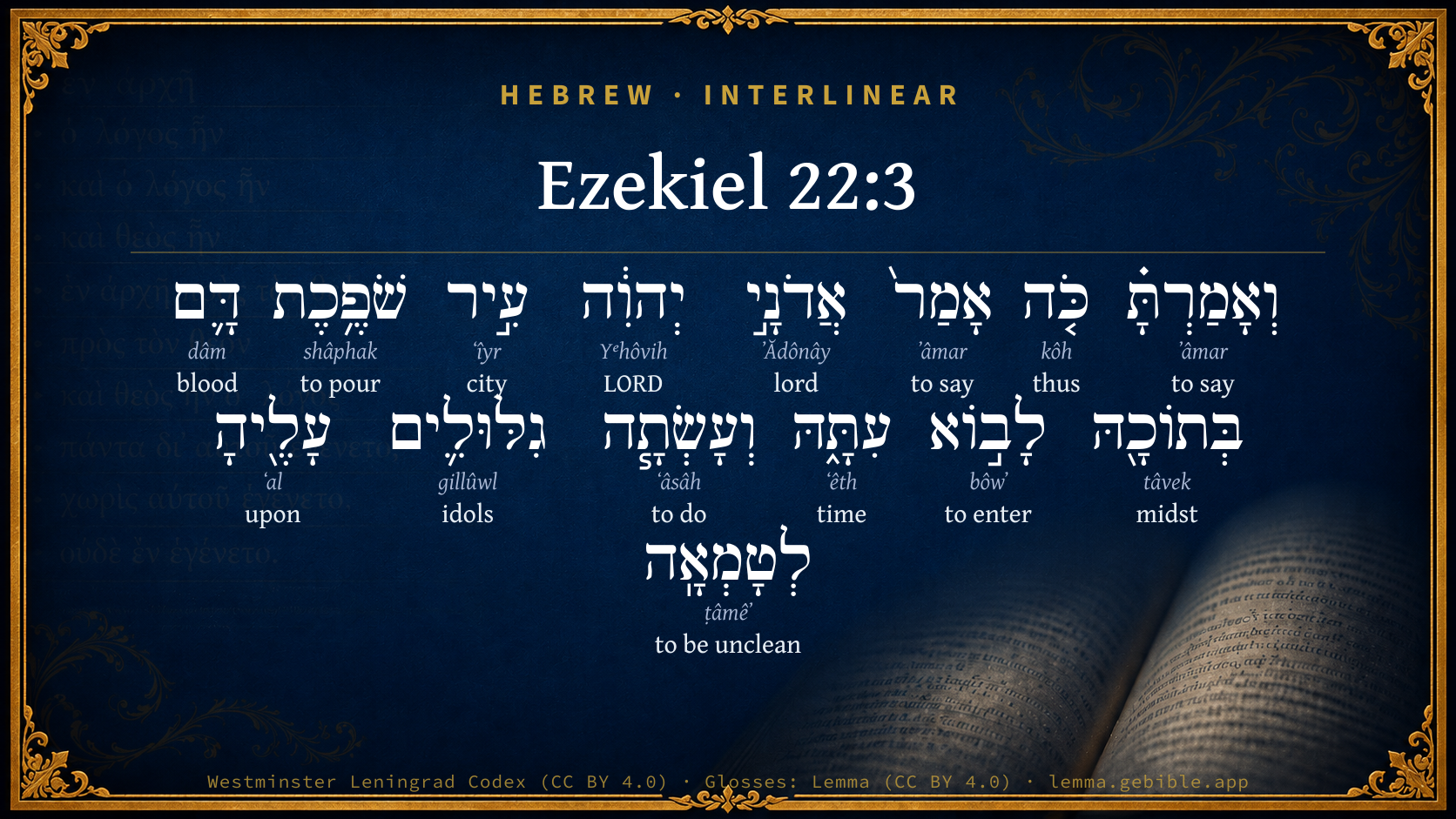
Ezekiel 22:3

Hebrew (Westminster Leningrad Codex) Ezekiel 22:3 appears in the Hebrew Old Testament. The text above is from the Westminster Leningrad Codex. Each word links to its Strong’s number, a concise gloss, and parsing drawn from the Open Scriptures Hebrew Bible morphology. Click any word for its full Brown-Driver-Briggs (BDB) entry.
Download image
Cite this verse

Ezekiel 22:3 (World English Bible). Public Domain. Lemma interlinear Bible study tool, https://lemma.gebible.app/v/ezekiel/22/3.

Show BibTeX & RIS
BibTeX
RIS
English Translation
You shall say, Thus says the Lord Yahweh: A city that sheds blood in the midst of her, that her time may come, and that makes idols against herself to defile her!
World English Bible · Public Domain
Download a study sheet

One document with this verse’s original text, its word-by-word gloss line, the meaning frame, cross-references with their text, attributed commentary, and full source and license credits — printable, and it pastes into notes with its structure intact.

This verse Autodidact and up

Study sheet (.html) Plain text (.txt)

A passage Seminary Student

Up to 50 verses in one chapter. A passage sheet keeps up to 6 commentary sources and 12 cross-references per verse, in the order this page ranks them, and says so on the sheet whenever that leaves anything out. Ask for a single verse and you get the Autodidact verse sheet above.

Everything on this page stays free to read, with no account — the sheet is a download of what is already on screen, not access to it.

Want to remove ads? Support Godless Engineer
Compare translations 3

The same verse in 3 English versions, stacked beneath the original-language interlinear above. Click any original word for its lexicon entry.

Each is an independent rendering of the whole verse — the interlinear is not word-aligned to these translations.

Highlighted words mark where these versions differ — a whole-verse word diff, not a word-by-word alignment.

  • World English Bible Public Domain
    You shall say, Thus says the Lord Yahweh: A city that sheds blood in the midst of her, that her time may come, and that makes idols against herself to defile her!
  • King James Version Public Domain
    Then say thou, Thus saith the Lord GOD, The city sheddeth blood in the midst of it, that her time may come, and maketh idols against herself to defile herself.
  • unfoldingWord Literal Text CC BY-SA 4.0
    You must say, ‘The Lord Yahweh says this: This is a city that pours out blood in her midst so that her time may come; a city that makes idols to make herself unclean.

unfoldingWord Literal Text — © unfoldingWord, licensed CC BY-SA 4.0. Word-aligned USFM3 via Door43 (git.door43.org/unfoldingWord/en_ult).

Versions to compare (up to 4)

3 of 4 selected

Show all 18 translations

Every available English version of this verse, each an independent rendering of the whole verse.

  • World English Bible Public Domain
    You shall say, Thus says the Lord Yahweh: A city that sheds blood in the midst of her, that her time may come, and that makes idols against herself to defile her!
  • Berean Standard Bible Public Domain
    and tell her that this is what the Lord GOD says: ‘O city who brings her own doom by shedding blood within her walls and making idols to defile herself,
  • Majority Standard Bible Public Domain
    and tell her that this is what the Lord GOD says: ‘O city who brings her own doom by shedding blood within her walls and making idols to defile herself,
  • King James Version Public Domain
    Then say thou, Thus saith the Lord GOD, The city sheddeth blood in the midst of it, that her time may come, and maketh idols against herself to defile herself.
  • American Standard Version (1901) Public Domain
    And thou shalt say, Thus saith the Lord Jehovah: A city that sheddeth blood in the midst of her, that her time may come, and that maketh idols against herself to defile her!
  • Revised Version (1885) Public Domain
    And thou shalt say, Thus saith the Lord GOD: A city that sheddeth blood in the midst of her, that her time may come, and that maketh idols against herself to defile her!
  • Geneva Bible (1599) Public Domain
    Then say, Thus sayth the Lord God, The citie sheddeth blood in the middes of it, that her time may come, and maketh idols against her selfe to pollute her selfe.
  • Douay-Rheims (1899) Public Domain
    And thou shalt shew her all her abominations, and shalt say: Thus saith the Lord God: This is the city that sheddeth blood in the midst of her, that her time may come: and that hath made idols against herself, to defile herself.
  • Young's Literal Translation Public Domain
    and thou hast said: Thus said the Lord Jehovah: The city is shedding blood in its midst, For the coming in of its time, And it hath made idols on it for defilement.
  • Literal Standard Version CC BY-SA 4.0
    and you have said, Thus said Lord YHWH: The city is shedding blood in its midst, || For the coming in of its time, || And it has made idols on it for defilement.
  • Unlocked Literal Bible CC BY-SA 4.0
    You must say, 'The Lord Yahweh says this: This is a city that pours out blood in her midst so that her time may come; a city that makes idols to make herself unclean.
  • unfoldingWord Literal Text CC BY-SA 4.0
    You must say, ‘The Lord Yahweh says this: This is a city that pours out blood in her midst so that her time may come; a city that makes idols to make herself unclean.
  • Darby Bible Public Domain
    and say, Thus saith the Lord Jehovah: A city that sheddeth blood in her midst, that her time may come, and maketh idols against herself to defile herself.
  • World Messianic Bible Public Domain
    You shall say, ‘The Lord GOD says: “A city that sheds blood within herself, that her time may come, and that makes idols against herself to defile her!
  • Webster's Bible Public Domain
    Then say thou, Thus saith the Lord GOD; The city sheddeth blood in the midst of it, that her time may come, and maketh idols against herself to defile herself.
  • Free Bible Version CC BY-SA 4.0
    and tell them that this is what the Lord God says: You are a city who has caused your own doom by murdering people within your walls, and by making idols to worship that made you unclean.
  • Bible in Basic English Public Domain
    And you are to say, This is what the Lord has said: A town causing blood to be drained out in her streets so that her time may come, and making images in her to make her unclean!
  • JPS Tanakh (1917) Public Domain
    And thou shalt say: Thus saith the Lord GOD: O city that sheddest blood in the midst of thee, that thy time may come, and that makest idols unto thyself to defile thee;

Literal Standard Version (2020), Covenant Press — licensed CC BY-SA 4.0. Text via the HelloAO Bible API (eBible.org). Unlocked Literal Bible (unfoldingWord) — licensed CC BY-SA 4.0. Text via the HelloAO Bible API (eBible.org). unfoldingWord Literal Text — © unfoldingWord, licensed CC BY-SA 4.0. Word-aligned USFM3 via Door43 (git.door43.org/unfoldingWord/en_ult). Free Bible Version, Dr. Jonathan Gallagher — licensed CC BY-SA 4.0. Text via the HelloAO Bible API (eBible.org).

Word by word

More ways to search: Search by grammar → Find every occurrence → Compare this word →

Practice this passage: Drill this verse → Learn its vocabulary →

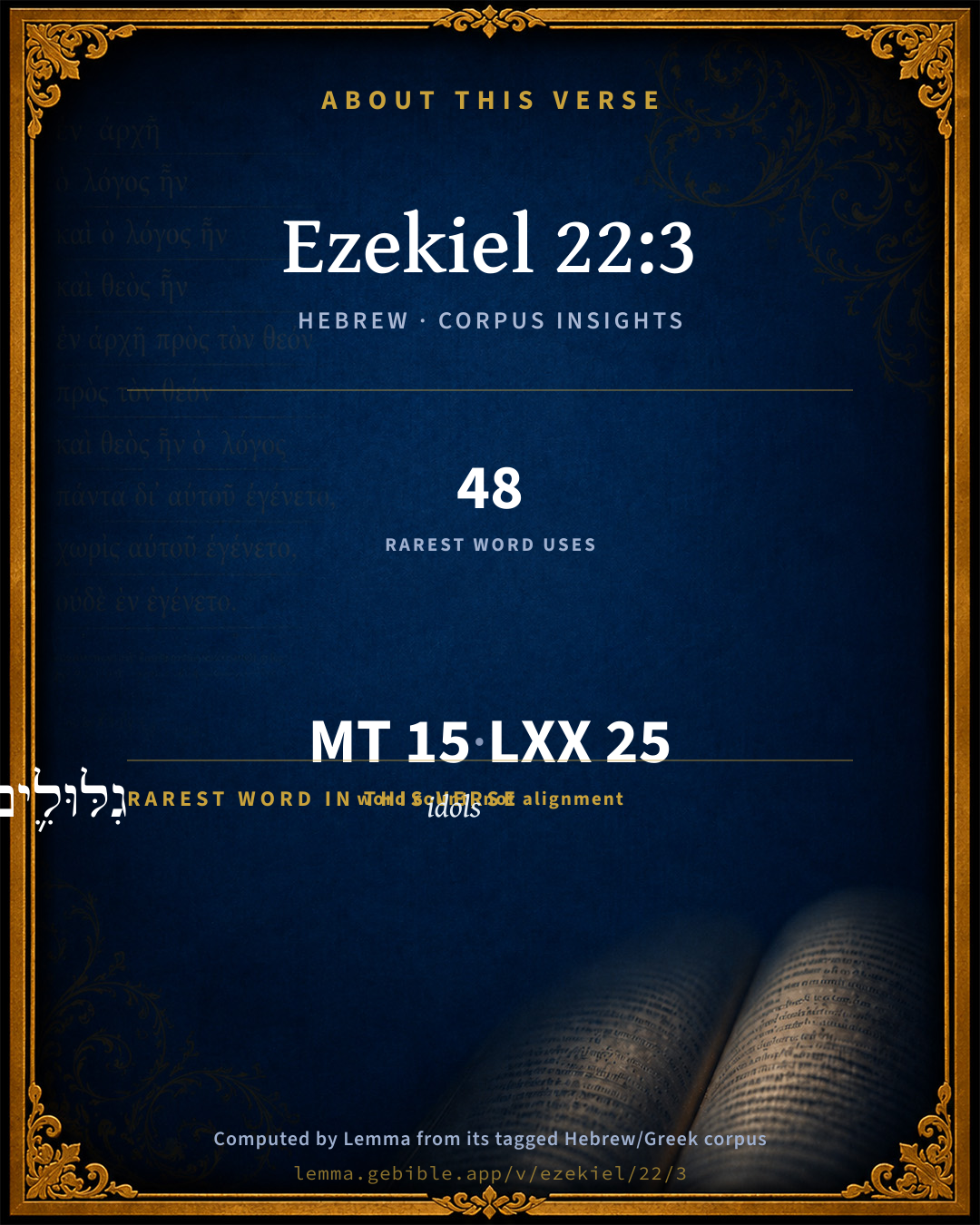
גִלּוּלִ֛ים
gillûwl
H1544
“idols”
Noun, Common, Masculine, Plural, Absolute
Part of Speech
Noun
Type
Common
Gender
Masculine
Number
Plural
State
Absolute
Full BDB Definition

Origin: from H1556

TWOT: 353h

idols
  1. וְאָמַרְתָּ֗ ʼâmar H559 “and · to say” Conjunction + Verb, Qal, Sequential Perfect, 2nd Person, Masculine, Singular
  2. כֹּ֤ה kôh H3541 “thus” Adverb
  3. אָמַר֙ ʼâmar H559 “to say” Verb, Qal, Perfect, 3rd Person, Masculine, Singular
  4. אֲדֹנָ֣י ʼĂdônây H136 “Lord · my” Noun, Common, Masculine, Plural, Construct + Suffix, Personal, 1st Person, Common, Singular
  5. יְהוִ֔ה Yᵉhôvih H3069 “LORD” Noun, Proper
  6. עִ֣יר ʻîyr H5892 “city” Noun, Common, Feminine, Singular, Absolute
  7. שֹׁפֶ֥כֶת shâphak H8210 “pouring” Verb, Qal, Participle Active, Feminine, Singular, Absolute
  8. דָּ֛ם dâm H1818 “blood” Noun, Common, Masculine, Singular, Absolute
  9. בְּתוֹכָ֖הּ tâvek H8432 “in/at · midst · her” Preposition + Noun, Common, Masculine, Singular, Construct + Suffix, Personal, 3rd Person, Feminine, Singular
  10. לָב֣וֹא bôwʼ H935 “to enter” Preposition + Verb, Qal, Infinitive Construct
  11. עִתָּ֑הּ ʻêth H6256 “time · her” Noun, Common, Both, Singular, Construct + Suffix, Personal, 3rd Person, Feminine, Singular
  12. וְעָשְׂתָ֧ה ʻâsâh H6213 “and · to do” Conjunction + Verb, Qal, Sequential Perfect, 3rd Person, Feminine, Singular
  13. עָלֶ֖יהָ ʻal H5921 “upon · her” Preposition + Suffix, Personal, 3rd Person, Feminine, Singular
  14. לְטָמְאָֽה ṭâmêʼ H2930 “to be unclean” Preposition + Verb, Qal, Infinitive Construct

About this verse

These counts appear in no published source. They are computed here, from the morphology-tagged text and Lemma’s own curated glosses. What Lemma adds →

15
words
14
distinct lemmas
Prophets
section

Shared distinctive vocabulary

גִלּוּלִ֛ים idols H1544 occurs in 45 verses of the Hebrew Bible. Also found in:

Grammatical profile

  • 6 verbs
  • 7 nouns
  • 1 preposition
  • 1 adverb

Verb forms

  • וְאָמַרְתָּ֗ Qal · Sequential Perfect
  • אָמַר֙ Qal · Perfect
  • שֹׁפֶ֥כֶת Qal · Participle Active
  • לָב֣וֹא Qal · Infinitive Construct
  • וְעָשְׂתָ֧ה Qal · Sequential Perfect
  • לְטָמְאָֽה Qal · Infinitive Construct

Repetition

A word recurs within this verse — often emphatic in Hebrew:

  • וְאָמַרְתָּ֗ to say H559 ×2

Hebrew & Septuagint length

In English translation the verse runs 32 words from the Hebrew and 34 from the Septuagint (LXX English) — closely comparable.

A rough comparison of the two English renderings, which tokenize alike — not a word-level alignment.

Word counts can differ between the Hebrew and the Greek without any difference in meaning — e.g. the Hebrew direct-object marker אֵת has no separate Greek word, and Greek often adds the article ὁ.

In the original languages it is 15 Hebrew tokens and 25 Greek tokens — but the two are counted differently (Hebrew bundles its prefixes and suffixes into one token; the Greek is in lemma form), so that isn’t a like-for-like length.

Cross-references

13

Topical passages linked to Ezekiel 22:3 in the Treasury of Scripture Knowledge — connected by theme and wording, ordered by reader-vote popularity; previews shown in the World English Bible.

  • Ezekiel 22:27 Her princes in the midst of it are like wolves ravening the prey, to shed blood, [and] to destroy souls, that they may get dishonest gain.
  • 2 Kings 21:2–9 He did that which was evil in the sight of Yahweh, after the abominations of the nations whom Yahweh cast out before the children of Israel.
  • Jeremiah 2:1–3 The word of Yahweh came to me, saying,
  • Ezekiel 7:2–12 You, son of man, thus says the Lord Yahweh to the land of Israel, An end: the end is come on the four corners of the land.
  • Ezekiel 12:25 For I am Yahweh; I will speak, and the word that I shall speak shall be performed; it shall be no more deferred: for in your days, rebellious house, will I speak the word, and will perform it, says the Lord Yahweh.
  • Ezekiel 22:4 You have become guilty in your blood that you have shed, and are defiled in your idols which you have made; and you have caused your days to draw near, and are come even to your years: therefore have I made you a reproach to the nations, and a mocking to all the countries.
  • Ezekiel 22:6 Behold, the princes of Israel, everyone according to his power, have been in you to shed blood.
  • Ezekiel 23:37 For they have committed adultery, and blood is in their hands; and with their idols have they committed adultery; and they have also caused their sons, whom they bore to me, to pass through [the fire] to them to be devoured.
  • Ezekiel 23:45 Righteous men, they shall judge them with the judgment of adulteresses, and with the judgment of women who shed blood; because they are adulteresses, and blood is in their hands.
  • Ezekiel 24:6–9 Therefore thus says the Lord Yahweh: Woe to the bloody city, to the caldron whose rust is therein, and whose rust is not gone out of it! take out of it piece after piece; No lot is fallen on it.
  • Zephaniah 3:3 Her princes in the midst of her are roaring lions. Her judges are evening wolves. They leave nothing until the next day.
  • Romans 2:5 But according to your hardness and unrepentant heart you are treasuring up for yourself wrath in the day of wrath, revelation, and of the righteous judgment of God;
  • 2 Peter 2:3 In covetousness they will exploit you with deceptive words: whose sentence now from of old doesn't linger, and their destruction will not slumber.

Cross-references courtesy of OpenBible.info (CC BY 4.0).

Hebrew and Greek witnesses Masoretic Hebrew ↔ Greek Septuagint

The same verse in the two great witnesses to the Old Testament, shown verse-for-verse.

These are two independent witnesses, not word-aligned to each other, and the Septuagint is shown in lemma (dictionary) form.

Hebrew Ezekiel 22:3 Masoretic · Westminster Leningrad Codex

וְאָמַרְתָּ֗ כֹּ֤ה אָמַר֙ אֲדֹנָ֣י יְהוִ֔ה עִ֣יר שֹׁפֶ֥כֶת דָּ֛ם בְּתוֹכָ֖הּ לָב֣וֹא עִתָּ֑הּ וְעָשְׂתָ֧ה גִלּוּלִ֛ים עָלֶ֖יהָ לְטָמְאָֽה

You shall say, Thus says the Lord Yahweh: A city that sheds blood in the midst of her, that her time may come, and that makes idols against herself to defile her!

World English Bible · Public Domain

Greek LXX Ezekiel 22:3 Septuagint · lemma form

καί εἶπον ὅδε λέγω κύριος κύριος ὦ πόλις ἐκχέω αἷμα ἐν μέσος αὐτός ὁ ἔρχομαι καιρός αὐτός καί ποιέω ἐνθύμημα κατά ἑαυτοῦ ὁ μιαίνω αὐτός

And you shall say, Thus says the Lord God: O city that sheds blood in the midst of her, so that her time should come, and that forms devices against herself, to defile herself;

LXX2012 (modern English Septuagint) · Public Domain

Hebrew: Westminster Leningrad Codex (CC BY 4.0). Greek: Septuagint (public domain); English from LXX2012 (modern English Septuagint) (Public Domain). How the Septuagint differs from the Hebrew →

Targum (Aramaic paraphrase)

1

The Targum is the ancient Jewish Aramaic paraphrase of the Hebrew Scriptures — an interpretive translation, not the Hebrew text itself. Onkelos (literal) and Pseudo-Jonathan (expansive) render the Torah, and Jonathan the Prophets. Coverage is partial: where no permissively-licensed English translation exists for a verse, only the Aramaic is shown. This is verse-level text, not a word-by-word alignment to the Hebrew.

  1. Targum Jonathan Prophets (Joshua–Malachi)
    וְתֵימַר כִּדְנַן אֲמַר יְיָ אֱלֹהִים קַרְתָּא דְאַשְׁדֵי דַם זַכַּאי בְּגַוָהּ מְטָא עִדַן תַּבְרָהּ וּדְפָלְחִין לְטַעֲוָתָא בְגַוָהּ בְּדִיל לְסַאֲבוּתָא:

    (no public-domain English translation for this verse)

    Targum Jonathan — Aramaic: “Mikraot Gedolot” (public domain). English: “Sefaria Community Translation” (CC0 1.0 (public-domain dedication)); “London "Chaldee Paraphrase," 1871” (public domain). Text via Sefaria.

Commentary

Notes on Ezekiel 22:3 from classic Christian and Jewish commentators (each source and its license shown beneath its notes). The classic Christian expositions comment on the surrounding passage and are grouped to its opening verse, so a note may address several verses; the Jewish commentaries on the Tanakh (Rashi and others) are per-verse, so they appear only where the commentator wrote on this verse.

Lemma curates 59 commentaries, every one of them public domain or Creative Commons licensed, each selected and text-cleaned for this edition rather than reprinted as found. About our sources →

Trapp's Complete Commentary

John Trapp

Eze 22:3 Then say thou, Thus saith the Lord GOD, The city sheddeth blood in the midst of it, that her time may come, and maketh idols against herself to defile herself.

Ver. 3. In the midst of it.] Publiae et impune.

Against herself.] As a sinner against her own soul.

John Trapp, A Commentary or Exposition upon All the Books of the Old and New Testament (1647–1656) — public domain. Text from a community e-Sword module.

Geneva Bible (1599)

Geneva Bible translators

To her own undoing.

That is, the time of her destruction.

Geneva Bible (1599) marginal notes — public domain. Text via Bolls.life.

Jamieson, Fausset & Brown

Robert Jamieson, A. R. Fausset & David Brown

sheddeth blood . . . that her time may come--Instead of deriving advantage from her bloody sacrifices to idols, she only thereby brought on herself "the time" of her punishment.

against herself-- (Pro 8:36).

Jamieson, Fausset & Brown — Commentary Critical and Explanatory on the Whole Bible (1871) — public domain (CC PDM 1.0). Text via the HelloAO Bible API.

Adam Clarke's Commentary

Verse 3. Her time may come] Till now, it was my long-suffering; she has fulfilled her days - completed the time of her probation; has not mended, but is daily worse; therefore her judgment can linger no longer.

Adam Clarke's Commentary on the Bible (1810–1826) — public domain. Text from a community e-Sword/MySword module.

Ellicott's Commentary for English Readers

(3) That her time may come.—Her time of punishment. That which will be the inevitable consequence of her acts is represented by a very common figure, as if it were her purpose in doing them. She has been so fully warned of the result that continuance in her course seems to involve the design of bringing on that result.

A Bible Commentary for English Readers, edited by Charles John Ellicott (1878–1897) — public domain. Text from a community e-Sword module.

The Cambridge Bible for Schools and Colleges

gen. ed. J. J. S. Perowne

3. the city sheddeth] Rather as address: city that sheddeth! ch. Eze_24:6; Eze_24:9. Her “time” is that of her chastisement, cf. Eze_30:3 “the time of the heathen,” Jer_27:7. So Eze_22:4, “days” and “years,” i.e. full number of thy years.

against herself] Rather: unto herself, parallel to “in the midst of it.”

The Cambridge Bible for Schools and Colleges (gen. ed. J. J. S. Perowne; Cambridge University Press, 1878–1918) — public domain. Text from a community e-Sword module.

John Gill's Exposition

Then say thou, thus saith the Lord God,.... For though the prophet was to sit as judge, yet in the name of the King of kings, under whose authority he acted:

the city sheddeth blood in the midst of it; openly and impudently, in the face of all, and in great abundance; even innocent blood, as the Targum has it: murders were frequent and common, either through quarrels, or through unrighteous judgments in courts of judicature:

that her time may come; to fill up the measure of her iniquity, and to receive the just punishment of her sins. So the Targum,

"the time of her destruction:''

and maketh idols against herself, to defile herself; being guilty, not only of murder, but of idolatry; she was an idol maker and an idol worshipper; and which was against herself, as well as against God; to her own ruin and destruction, as well as to his dishonour; and it is no wonder she should be defiled with such dunghill gods as these were, as the word used signifies. The Targum renders it, "in the midst of her"; and Kimchi interprets it, by "her", or "above her", upon the mountains and hills.

John Gill's Exposition of the Whole Bible (1746–1763) — public domain (CC PDM 1.0). Text via the HelloAO Bible API.

Matthew Poole's English Annotations

The city, Jerusalem,

sheddeth, is shedding, blood; it is her present practice as well as her former, murders are committed by her, and it is said the city did it; it was done with public consent, and probably under pretext of judiciary process to colour it, as in Naboth’s case, and as they would have done to Jeremiah.

In the midst of it: this aggravates their murders, and makes them more bloody, in that it was done where so many were, that should have been safety to the innocent; it was not done in a wilderness.

Her time; the time of ripeness in her sins, and of execution of judgments on her for them.

May come: this they did not design, they rather took away innocents, whom they surmised were dangerous to their state, to prevent, but this hastened the punishment.

Maketh idols; either maketh new images of their old idols, or repaireth the decayed beauty of them Or, taketh in new gods of their neighbours, who might hell them; but all this is against themselves, for this doth more defile them, and provoke God to wrath against them.

Matthew Poole's English Annotations on the Holy Bible (1683–1685) — public domain. Text from a community e-Sword/MySword module.

Whedon's Commentary on the Bible

Daniel D. Whedon

3. The city that takes the sword shall perish by the sword, and that “maketh doll images unto itself” shall find in these supposed deities, not help, but defilement and ruin.

Daniel D. Whedon (gen. ed.), Commentary on the Old and New Testaments (1874–1909) — public domain. Text from a community e-Sword module.

The Pulpit Commentary

The city sheddeth blood, etc. As in the great indictment of Isaiah, (Isa_1:15, 21 4:4) the sins of murder and idolatry aregrouped together. She sins as if with the purpose "that her time" (i.e. the time of her punishment) "may come."

The Pulpit Commentary (1880–1919), ed. H.D.M. Spence-Jones & Joseph S. Exell — public domain. Text from a community e-Sword module.

John Wesley's Explanatory Notes

Her time - The time of ripeness in her sins, and of execution of judgments on her. To defile - For this does more defile them, and provoke God to wrath against them.

John Wesley, Explanatory Notes Upon the Whole Bible (1754–1765) — public domain. Text via the GEBible commentary corpus.

Rashi

Rabbi Shlomo Yitzchaki (Rashi)

O city that sheds blood in her midst, her time is approaching This is a transposed verse, and this is its meaning: A city that sheds blood in her midst the Lord God said that its time is coming.

and makes idols Like “and which makes idols, etc.”

Rashi on the Tanakh — English translations: “The Judaica Press complete Tanach with Rashi, translated by A. J. Rosenberg” (CC BY 4.0); “Pentateuch with Rashi's commentary by M. Rosenbaum and A.M. Silbermann, 1929-1934” (public domain); “The Metsudah Tanach series, Lakewood, N.J” (CC BY 4.0); and “The Book of Joshua, Metsudah Publications, 1997” (CC BY 4.0). Text via Sefaria.

Lesson kit

Teaching starters — assembled from the data on this page, not authored interpretation. Every prompt links to the verse data it draws on. Edit before teaching.

Ezekiel, in the Prophets, opens this verse with 15 words (14 distinct Hebrew lemmas). Its most distinctive word is gillûwl (“idols”). A historical commentator’s framing appears above. Read the whole chapter for the surrounding context.

Discussion questions

  1. How does “idols” (gillûwl) shape what this verse is saying?
  2. Leviticus 26:30 shares the word «idols» with this verse. How do the two illuminate each other?
  3. “to say” occurs 2× in this one verse. What is the effect of the repetition?
  4. These translations render this verse differently; the difference is in the English rendering, not the original. What questions does that raise?
  5. The verb «וְאָמַרְתָּ֗» is Qal Sequential Perfect. How does its form color the action?
  6. Reading how Trapp's Complete Commentary and Geneva Bible (1599) read this verse, where do the two commentators agree and where do they part?

Things to notice

Reading settings

Reading text

Shown beneath each verse's original-language words.

Old Testament
Old Testament edition

Read the OT as the Masoretic Hebrew (MT) or the Greek Septuagint (LXX).

English shown for the Greek Septuagint (in the Hebrew ↔ Greek comparison).

Comparing translations? Open the Compare panel on any verse page to stack up to four side by side.