
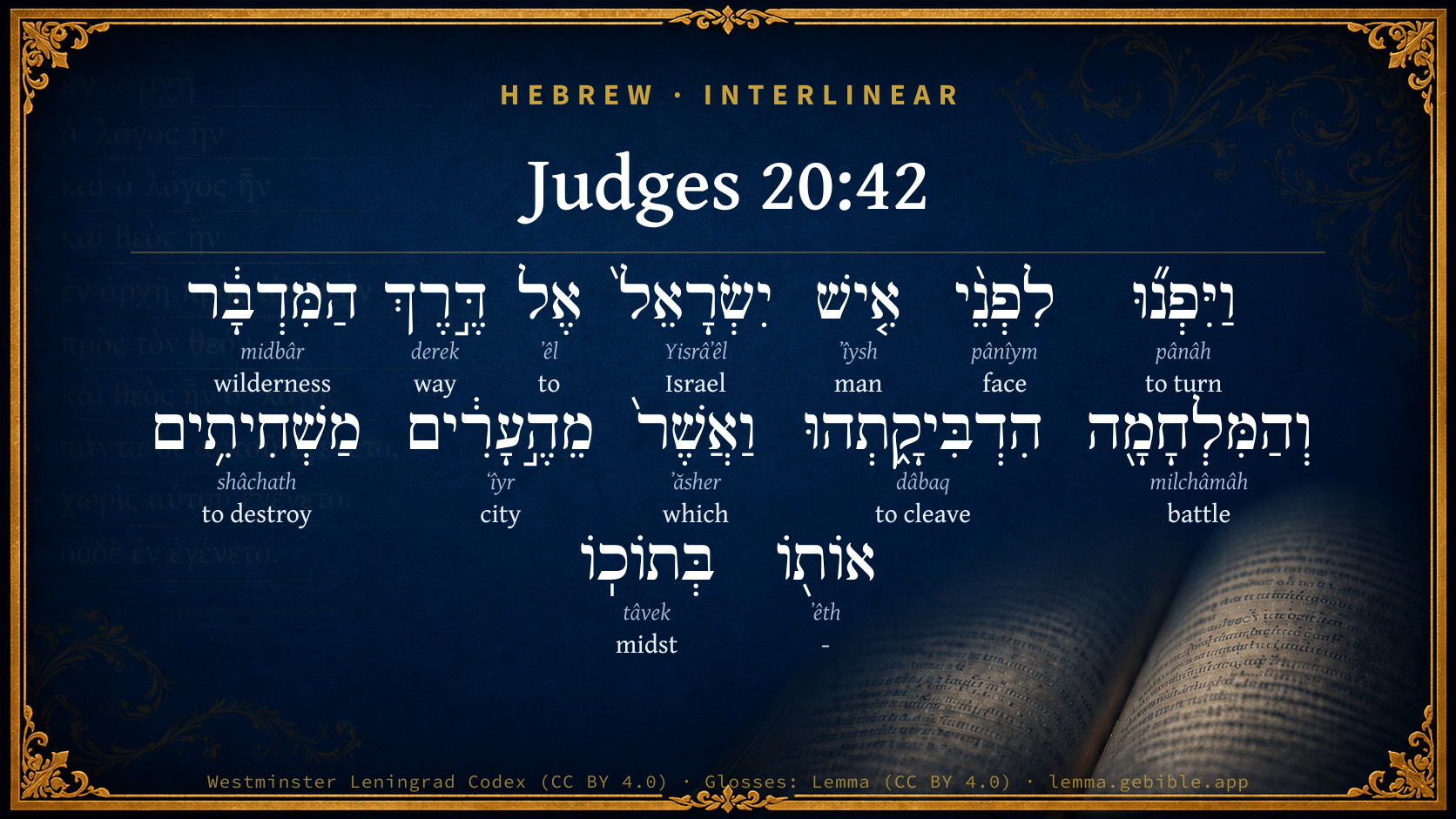
Judges 20:42

Hebrew (Westminster Leningrad Codex) Judges 20:42 appears in the Hebrew Old Testament. The text above is from the Westminster Leningrad Codex. Each word links to its Strong’s number, a concise gloss, and parsing drawn from the Open Scriptures Hebrew Bible morphology. Click any word for its full Brown-Driver-Briggs (BDB) entry.
Download image
Cite this verse

Judges 20:42 (World English Bible). Public Domain. Lemma interlinear Bible study tool, https://lemma.gebible.app/v/judges/20/42.

Show BibTeX & RIS
BibTeX
RIS
English Translation
Therefore they turned their backs before the men of Israel to the way of the wilderness; but the battle followed hard after them; and those who came out of the cities destroyed them in the midst of it.
World English Bible · Public Domain
Download a study sheet

One document with this verse’s original text, its word-by-word gloss line, the meaning frame, cross-references with their text, attributed commentary, and full source and license credits — printable, and it pastes into notes with its structure intact.

This verse Autodidact and up

Study sheet (.html) Plain text (.txt)

A passage Seminary Student

Up to 50 verses in one chapter. A passage sheet keeps up to 6 commentary sources and 12 cross-references per verse, in the order this page ranks them, and says so on the sheet whenever that leaves anything out. Ask for a single verse and you get the Autodidact verse sheet above.

Everything on this page stays free to read, with no account — the sheet is a download of what is already on screen, not access to it.

Want to remove ads? Support Godless Engineer
Compare translations 3

The same verse in 3 English versions, stacked beneath the original-language interlinear above. Click any original word for its lexicon entry.

Each is an independent rendering of the whole verse — the interlinear is not word-aligned to these translations.

Highlighted words mark where these versions differ — a whole-verse word diff, not a word-by-word alignment.

  • World English Bible Public Domain
    Therefore they turned their backs before the men of Israel to the way of the wilderness; but the battle followed hard after them; and those who came out of the cities destroyed them in the midst of it.
  • King James Version Public Domain
    Therefore they turned their backs before the men of Israel unto the way of the wilderness; but the battle overtook them; and them which came out of the cities they destroyed in the midst of them.
  • unfoldingWord Literal Text CC BY-SA 4.0
    So they turned to the face of the men of Israel to the way of the wilderness, but the battle overtook him, and who from the cities destroying him in the midst of him.

unfoldingWord Literal Text — © unfoldingWord, licensed CC BY-SA 4.0. Word-aligned USFM3 via Door43 (git.door43.org/unfoldingWord/en_ult).

Versions to compare (up to 4)

3 of 4 selected

Show all 18 translations

Every available English version of this verse, each an independent rendering of the whole verse.

  • World English Bible Public Domain
    Therefore they turned their backs before the men of Israel to the way of the wilderness; but the battle followed hard after them; and those who came out of the cities destroyed them in the midst of it.
  • Berean Standard Bible Public Domain
    So they fled before the men of Israel toward the wilderness, but the battle overtook them, and the men coming out of the cities struck them down there.
  • Majority Standard Bible Public Domain
    So they fled before the men of Israel toward the wilderness, but the battle overtook them, and the men coming out of the cities struck them down there.
  • King James Version Public Domain
    Therefore they turned their backs before the men of Israel unto the way of the wilderness; but the battle overtook them; and them which came out of the cities they destroyed in the midst of them.
  • American Standard Version (1901) Public Domain
    Therefore they turned their backs before the men of Israel unto the way of the wilderness; but the battle followed hard after them; and they that came out of the cities destroyed them in the midst thereof.
  • Revised Version (1885) Public Domain
    Therefore they turned their backs before the men of Israel unto the way of the wilderness; but the battle followed hard after them; and they which came out of the cities destroyed them in the midst thereof.
  • Geneva Bible (1599) Public Domain
    Therefore they fled before the men of Israel vnto the way of the wildernesse, but the battell ouertooke them: also they which came out of the cities, slew them among them.
  • Douay-Rheims (1899) Public Domain
    And began to go towards the way of the desert, the enemy pursuing them thither also. And they that fired the city came also out to meet them.
  • Young's Literal Translation Public Domain
    and they turn before the men of Israel unto the way of the wilderness, and the battle hath followed them; and those who `are' from the city are destroying them in their midst;
  • Literal Standard Version CC BY-SA 4.0
    and they turn before the men of Israel to the way of the wilderness, and the battle has followed them; and those who [are] from the cities are destroying them in their midst;
  • Unlocked Literal Bible CC BY-SA 4.0
    So they ran away from the people of Israel, escaping on the way to the wilderness. But the fighting overtook them. The soldiers of Israel came out of the cities and killed them where they stood.
  • unfoldingWord Literal Text CC BY-SA 4.0
    So they turned to the face of the men of Israel to the way of the wilderness, but the battle overtook him, and who from the cities destroying him in the midst of him.
  • Darby Bible Public Domain
    Therefore they turned their backs before the men of Israel in the direction of the wilderness; but the battle overtook them, and those who came out of the cities destroyed them in the midst of them.
  • World Messianic Bible Public Domain
    Therefore they turned their backs before the men of Israel to the way of the wilderness, but the battle followed hard after them; and those who came out of the cities destroyed them in the middle of it.
  • Webster's Bible Public Domain
    Therefore they turned their backs before the men of Israel to the way of the wilderness; but the battle overtook them; and them who came out of the cities they destroyed in the midst of them.
  • Free Bible Version CC BY-SA 4.0
    They turned and ran from the Israelites towards the desert, but the battle caught up with them, and the Israelites also killed those who left the towns on the way.
  • Bible in Basic English Public Domain
    So turning their backs on the men of Israel, they went in the direction of the waste land; but the fight overtook them; and those who came out of the town were heading them off and putting them to the sword.
  • JPS Tanakh (1917) Public Domain
    Therefore they turned their backs before the men of Israel unto the way of the wilderness; but the battle followed hard after them; and they that came out of the city destroyed them in the midst of the men of Israel.

Literal Standard Version (2020), Covenant Press — licensed CC BY-SA 4.0. Text via the HelloAO Bible API (eBible.org). Unlocked Literal Bible (unfoldingWord) — licensed CC BY-SA 4.0. Text via the HelloAO Bible API (eBible.org). unfoldingWord Literal Text — © unfoldingWord, licensed CC BY-SA 4.0. Word-aligned USFM3 via Door43 (git.door43.org/unfoldingWord/en_ult). Free Bible Version, Dr. Jonathan Gallagher — licensed CC BY-SA 4.0. Text via the HelloAO Bible API (eBible.org).

Word by word

More ways to search: Search by grammar → Find every occurrence → Compare this word →

Practice this passage: Drill this verse → Learn its vocabulary →

הִדְבִּיקָ֑תְהוּ
dâbaq
H1692
“to cleave · him”
Verb, Hiphil, Perfect, 3rd Person, Feminine, Singular + Suffix, Personal, 3rd Person, Masculine, Singular
Part of Speech
Verb
Stem
Hiphil
Form
Perfect
Person
3rd Person
Gender
Feminine
Number
Singular
Full BDB Definition

Origin: a primitive root

TWOT: 398

to cling, stick, stay close, cleave, keep close, stick to, stick with, follow closely, join to, overtake, catch - (Qal) - to cling, cleave to - to stay with - (Pual) to be joined together - (Hiphil) - to cause to cleave to - to pursue closely - to overtake - (Hophal) to be made to cleave
  1. וַיִּפְנ֞וּ pânâh H6437 “and · to turn” Conjunction + Verb, Qal, Sequential Imperfect, 3rd Person, Masculine, Plural
  2. לִפְנֵ֨י pânîym H6440 “to/for · face(s) of” Preposition + Noun, Common, Both, Plural, Construct
  3. אִ֤ישׁ ʼîysh H376 “man of” Noun, Common, Masculine, Singular, Construct
  4. יִשְׂרָאֵל֙ Yisrâʼêl H3478 “Israel” Noun, Proper
  5. אֶל ʼêl H413 “to” Preposition
  6. דֶּ֣רֶךְ derek H1870 “way of” Noun, Common, Both, Singular, Construct
  7. הַמִּדְבָּ֔ר midbâr H4057 “the · wilderness” Particle, Definite Article + Noun, Common, Masculine, Singular, Absolute
  8. וְהַמִּלְחָמָ֖ה milchâmâh H4421 “and · the · battle” Conjunction + Particle, Definite Article + Noun, Common, Feminine, Singular, Absolute
  9. וַאֲשֶׁר֙ ʼăsher H834 “and · which” Conjunction + Particle, Relative
  10. מֵהֶ֣עָרִ֔ים ʻîyr H5892 “from · the · cities” Preposition + Particle, Definite Article + Noun, Common, Feminine, Plural, Absolute
  11. מַשְׁחִיתִ֥ים shâchath H7843 “destroying” Verb, Hiphil, Participle Active, Masculine, Plural, Absolute
  12. אוֹת֖וֹ ʼêth H853 “- · him” Particle, Direct Object + Suffix, Personal, 3rd Person, Masculine, Singular
  13. בְּתוֹכֽוֹ tâvek H8432 “in/at · midst · his” Preposition + Noun, Common, Masculine, Singular, Construct + Suffix, Personal, 3rd Person, Masculine, Singular

About this verse

These counts appear in no published source. They are computed here, from the morphology-tagged text and Lemma’s own curated glosses. What Lemma adds →

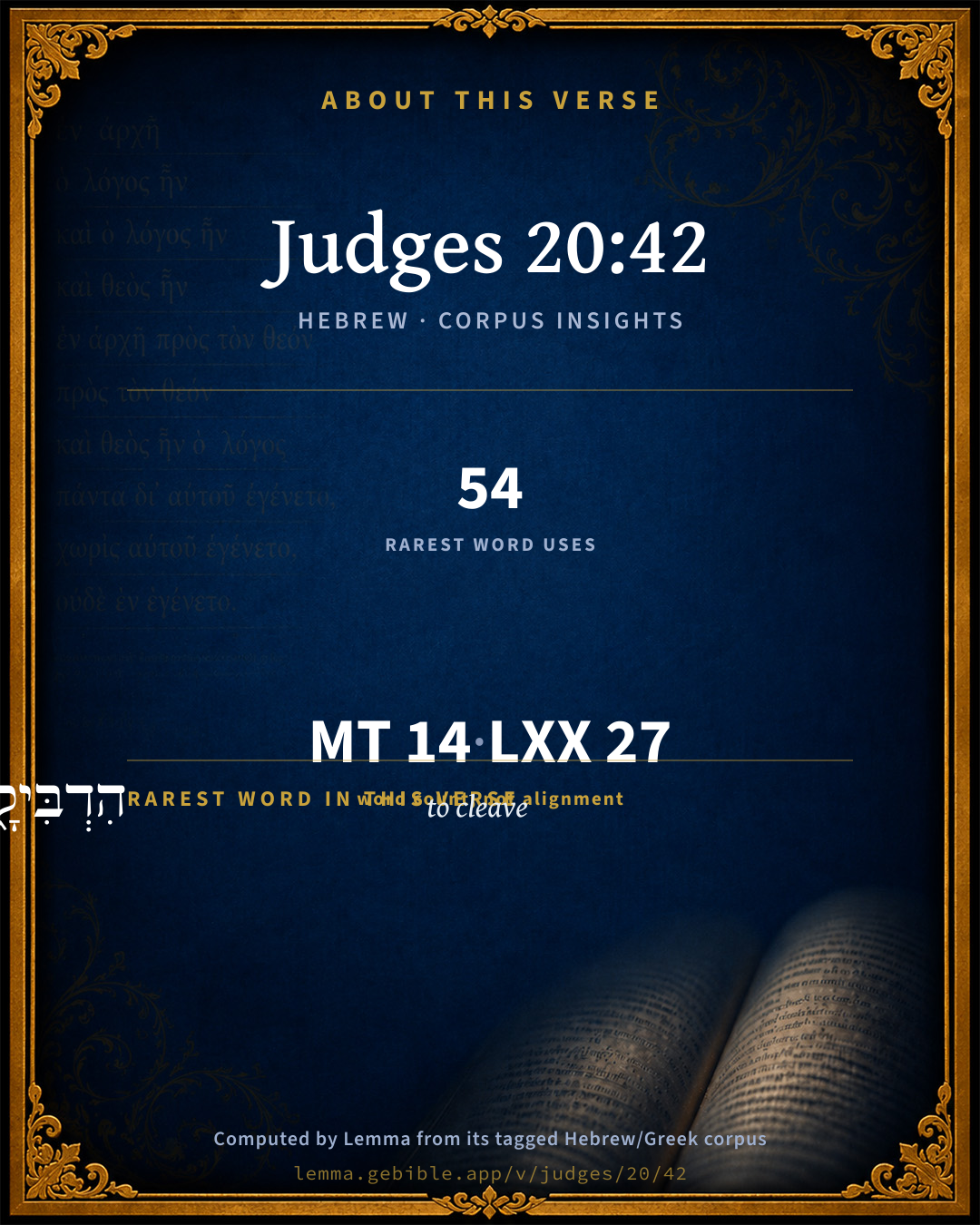
14
words
14
distinct lemmas
Historical
section

Shared distinctive vocabulary

הִדְבִּיקָ֑תְהוּ to cleave H1692 occurs in 52 verses of the Hebrew Bible. Also found in:

Grammatical profile

  • 3 verbs
  • 8 nouns
  • 1 preposition
  • 2 particles

Verb forms

  • וַיִּפְנ֞וּ Qal · Sequential Imperfect
  • הִדְבִּיקָ֑תְהוּ Hiphil · Perfect
  • מַשְׁחִיתִ֥ים Hiphil · Participle Active

Hebrew & Septuagint length

In English translation the verse runs 38 words from the Hebrew and 34 from the Septuagint (LXX English) — closely comparable.

A rough comparison of the two English renderings, which tokenize alike — not a word-level alignment.

Word counts can differ between the Hebrew and the Greek without any difference in meaning — e.g. the Hebrew direct-object marker אֵת has no separate Greek word, and Greek often adds the article ὁ.

In the original languages it is 14 Hebrew tokens and 27 Greek tokens — but the two are counted differently (Hebrew bundles its prefixes and suffixes into one token; the Greek is in lemma form), so that isn’t a like-for-like length.

Cross-references

5

Topical passages linked to Judges 20:42 in the Treasury of Scripture Knowledge — connected by theme and wording, ordered by reader-vote popularity; previews shown in the World English Bible.

  • Joshua 8:24 It happened, when Israel had made an end of killing all the inhabitants of Ai in the field, in the wilderness in which they pursued them, and they were all fallen by the edge of the sword, until they were consumed, that all Israel returned to Ai, and struck it with the edge of the sword.
  • Joshua 8:15 Joshua and all Israel made as if they were beaten before them, and fled by the way of the wilderness.
  • Lamentations 1:3 Judah is gone into captivity because of affliction, and because of great servitude; She dwells among the nations, she finds no rest: All her persecutors overtook her within the straits.
  • Hosea 9:9 They have deeply corrupted themselves, As in the days of Gibeah. He will remember their iniquity. He will punish them for their sins.
  • Hosea 10:9 "Israel, you have sinned from the days of Gibeah. There they remained. The battle against the children of iniquity doesn't overtake them in Gibeah.

Cross-references courtesy of OpenBible.info (CC BY 4.0).

Hebrew and Greek witnesses Masoretic Hebrew ↔ Greek Septuagint

The same verse in the two great witnesses to the Old Testament, shown verse-for-verse.

These are two independent witnesses, not word-aligned to each other, and the Septuagint is shown in lemma (dictionary) form.

Hebrew Judges 20:42 Masoretic · Westminster Leningrad Codex

וַיִּפְנ֞וּ לִפְנֵ֨י אִ֤ישׁ יִשְׂרָאֵל֙ אֶל דֶּ֣רֶךְ הַמִּדְבָּ֔ר וְהַמִּלְחָמָ֖ה הִדְבִּיקָ֑תְהוּ וַאֲשֶׁר֙ מֵהֶ֣עָרִ֔ים מַשְׁחִיתִ֥ים אוֹת֖וֹ בְּתוֹכֽוֹ

Therefore they turned their backs before the men of Israel to the way of the wilderness; but the battle followed hard after them; and those who came out of the cities destroyed them in the midst of it.

World English Bible · Public Domain

Greek LXX Judges 20:42 Septuagint · lemma form

καί ἐπιβλέπω ἐνώπιον υἱός ἰσραήλ εἰς ὁδός ὁ ἔρημος καί φεύγω καί ὁ παράταξις φθάνω ἐπί αὐτός καί ὁ ἀπό ὁ πόλις διαφθείρω αὐτός ἐν μέσος αὐτός

And they turned to the way of the wilderness from before the children of Israel, and fled: but the battle overtook them, and they from the cities destroyed them in the midst of them.

LXX2012 (modern English Septuagint) · Public Domain

On this verse, John Gill's Exposition discusses the Septuagint’s reading. Read the note in Commentary ↓

Hebrew: Westminster Leningrad Codex (CC BY 4.0). Greek: Septuagint (public domain); English from LXX2012 (modern English Septuagint) (Public Domain). How the Septuagint differs from the Hebrew →

Targum (Aramaic paraphrase)

1

The Targum is the ancient Jewish Aramaic paraphrase of the Hebrew Scriptures — an interpretive translation, not the Hebrew text itself. Onkelos (literal) and Pseudo-Jonathan (expansive) render the Torah, and Jonathan the Prophets. Coverage is partial: where no permissively-licensed English translation exists for a verse, only the Aramaic is shown. This is verse-level text, not a word-by-word alignment to the Hebrew.

  1. Targum Jonathan Prophets (Joshua–Malachi)
    וְאִתְפְּנִיאוּ קֳדָם אֱנָשׁ יִשְׂרָאֵל לְאוֹרַח מַדְבְּרָא וְעָבְדֵי קְרָבָא אַדְבִּיקוּנוּן וֶאֱנָשׁ כְּמָנָא קָמוּ מִקִרְוֵיהוֹן קָטְלִין בְּהוֹן מִכָּא וּמִכָּא:

    (no public-domain English translation for this verse)

    Targum Jonathan — Aramaic: “Mikraot Gedolot” (public domain). English: “Sefaria Community Translation” (CC0 1.0 (public-domain dedication)); “London "Chaldee Paraphrase," 1871” (public domain). Text via Sefaria.

Commentary

Notes on Judges 20:42 from classic Christian and Jewish commentators (each source and its license shown beneath its notes). The classic Christian expositions comment on the surrounding passage and are grouped to its opening verse, so a note may address several verses; the Jewish commentaries on the Tanakh (Rashi and others) are per-verse, so they appear only where the commentator wrote on this verse.

Lemma curates 59 commentaries, every one of them public domain or Creative Commons licensed, each selected and text-cleaned for this edition rather than reprinted as found. About our sources →

Geneva Bible (1599)

Geneva Bible translators

For they were compassed in on every side.

Geneva Bible (1599) marginal notes — public domain. Text via Bolls.life.

Ellicott's Commentary for English Readers

(42) Unto the way of the wilderness.—The wilderness is that known as “the wilderness of Bethaven” ( Jos_18:12). It is described in Joshua 16 as “the wilderness that goeth up from Jericho throughout Mount Bethel.” (See Robinson, Bibl. Res. 1:572.) The first thought of fugitives in Eastern Palestine was to get to one of the fords of the Jordan (2Sa_15:23; 2Ki_25:4-5).

Them which came out of the cities they destroyed in the midst of them.—This obscure clause is rendered differently in different versions. If the English Version be correct, as it probably is, the meaning must be that the Benjamites fled to their own cities, and were pursued thither and slain by the Israelites.

A Bible Commentary for English Readers, edited by Charles John Ellicott (1878–1897) — public domain. Text from a community e-Sword module.

The Cambridge Bible for Schools and Colleges

gen. ed. J. J. S. Perowne

42. unto the way of the wilderness] in the direction of the barren hilly region, E. of Gibeah, which descends from the Central Highlands to the Jordan valley.

out of the cities] i.e. the Benjamite cities on the line of the flight. But all the male Benjamites had been out with the army, and most of them killed: so read out of the city, i.e. Gibeah; the reference will then be to the men who formed the ambush. For in the midst thereof (lit. of him) read in the midst, as Jos_8:22. The Benjamites suddenly found themselves caught between Israelites in front and rear. The men of Ai were intercepted in the same way.

The verse comes from the B narrative: cf. Jdg_20:21; Jdg_20:25 destroyed them. With the correction of the text the marg. becomes unnecessary.

The Cambridge Bible for Schools and Colleges (gen. ed. J. J. S. Perowne; Cambridge University Press, 1878–1918) — public domain. Text from a community e-Sword module.

John Gill's Exposition

Thus they enclosed the Benjaminites round about,.... Surrounded them on all sides, the army of Israel being posted in different places, and people coming out of all the cities to their assistance. Josephus (a) says, they were forced into, and cooped up, in a hollow place in a valley, so that they could not escape:

and chased them; or "caused to pursue" (b); calling after them a pursuit, crying to one another as they went along, saying, pursue them, pursue them; so Jarchi and Kimchi; which cry, as it inspired the pursuers with zeal, so they pursued with terror:

and trod them down with ease; they making no resistance, being quite dispirited; the Targrim is,"from the house of their rest,''where they took up their rest, and designed to rest that night, but could not, being so closely pursued, and diligently sought after. Some take "menuchah", rendered "ease", to be the name of a place, from or unto which they were pursued and trodden down, see Ch1 2:52 and so the Septuagint seems to take it for the name of a place, rendering it, "from Noua":

over against Gibeah, towards the sunrising; that is, as Jarchi interprets it, to the east of Gibeah, there was this overthrow and slaughter made.

(a) Ut supra. (Antiqu. l. 5. c. 2. sect. 10.) (b) "persequi fecerunt eum", Pagninus, Montanus, Drusius; "vel eos", Vatablus.

John Gill's Exposition of the Whole Bible (1746–1763) — public domain (CC PDM 1.0). Text via the HelloAO Bible API.

Trapp's Complete Commentary

John Trapp

Therefore they turned [their backs] before the men of Israel unto the way of the wilderness; but the battle overtook them; and them which [came] out of the cities they destroyed in the midst of them.

Ver. 42. In flying from death, they fled to it. Una salus victis, &c.

John Trapp, A Commentary or Exposition upon All the Books of the Old and New Testament (1647–1656) — public domain. Text from a community e-Sword module.

Albert Barnes' Notes on the Bible

The way of the wilderness - i. e., the wilderness which extended from Jericho to the hills of Bethel.

Them which came out of the cities - These must be the Benjamites Jdg 20:15. Hence, “in the midst of them” must mean “in their own cities”, where they severally fled for refuge, but failed to find shelter Jdg 20:48. Anathoth, Alemath, Ramah, Ataroth, Geba, Michmash, Ai, Bethel, Migron, etc., would probably be the cities meant, all lying east and north of Gibeah.

Albert Barnes' Notes on the Bible (1834–1885) — public domain. Text from a community e-Sword/MySword module.

Haydock's Catholic Bible Commentary

Them. Hebrew, "and those who came out of the cities, (of Benjamin) they (destroyed, (Haydock) or the other Israelites) destroyed them who fled in the midst of them."

George Leo Haydock (1774–1849), Haydock's Catholic Family Bible and Commentary, 1859 edition — public domain. Excludes Psalms (Douay-Rheims chapter numbering differs from Protestant) and Deuterocanonical books (Catholic canon only).

Matthew Poole's English Annotations

The battle, i.e. the men of battle or war; the abstract for the concrete, as poverty, 2Ki 24:14, pride, Psa 36:11, deceit, Pro 12:5, dreams, Jer 27:9, election, Rom 11:7, are put for persons that are poor, proud, deceitful, dreamers, elect. Them which came out of the cities they destroyed in the midst of them: so the sense may seem to be this, That the Israelites did not only kill the inhabitants of Gibeah, and all the Benjamites that came into the field against them, six hundred excepted; but in the midst of them, or together with them, they killed also the rest of the Benjamites, who, when they saw their army was wholly destroyed, made haste to flee out of their several cities or towns, that so they might escape the sword, which was coming towards them. But the words may be rendered thus: And them who were of the other cities, to wit, of Benjamin, i.e. who abode in their own cities and did not go up to Gibeah,

they destroyed in the midst of them, i.e. in their several cities; or, in the midst of it, i.e. of every city; for so it is said, Jdg 20:48, where it is said that they smote the men of every city. But this I submit to the learned.

Matthew Poole's English Annotations on the Holy Bible (1683–1685) — public domain. Text from a community e-Sword/MySword module.

Whedon's Commentary on the Bible

Daniel D. Whedon

42. Way of the wilderness — The wild mountainous country northeast of Gibeah.

Them which came out of the cities — That is, the old men, women, and children, that fled for their lives out of the cities of Benjamin.

In the midst of them — Rather, in the midst of it; that is, the wilderness.

Daniel D. Whedon (gen. ed.), Commentary on the Old and New Testaments (1874–1909) — public domain. Text from a community e-Sword module.

The Pulpit Commentary

Therefore they turned their backs, etc. The narrative now at length advances one step. The result of the Benjamites finding themselves between the ambushment and the army of Israel was that they took to flight in an easterly direction (ver. 43) toward the wilderness, i.e. the wilderness described in Jos_16:1 as "the wilderness that goeth up from Jericho throughout Mount Bethel," where the direction of the wilderness relative to Ephraim is also described as being "on the east." In like manner Zedekiah fled towards the plain (arabah) or plains of Jericho a term nearly synonymous with wilderness. (2Ki_25:4, 2Ki_25:5) Them which came out of the cities, etc. This is a very obscure passage, and is very variously explained. Those which came out of the cities must be the same as are so described in ver. 15, and designates the Benjamites who were not inhabitants of Gibeah. The simplest way, therefore, to understand the passage is to render it without reference to the accents: "And the battle overtook him and those that were from the cities (i.e. the men of Gibeah and the rest of the Benjamites), destroying him (the whole Benjamite army) in the midst of him," i.e. going right into the midst of them, and destroying right and left. Some, however, render it in the midst of it, i.e. of the wilderness. The plural participle destroying agrees with the singular noun of multitude, the battle or war, meaning all the men of war.

The Pulpit Commentary (1880–1919), ed. H.D.M. Spence-Jones & Joseph S. Exell — public domain. Text from a community e-Sword module.

unfoldingWord translationNotes

Door43 World Missions Community

But the fighting overtook them

This speaks about fighting as if it were a person who could overtake someone. AT: "But the soldiers of Israel caught up to them" or "But they were not able to escape the fighting" (See: Personification)

translationWords

Israel

desert

unfoldingWord translationNotes — © Distant Shores Media and the Door43 World Missions Community, licensed CC BY-SA 4.0. Source: git.door43.org/Door43/en_tn.

Rashi

Rabbi Shlomo Yitzchaki (Rashi)

While those in the city. The ambushers who had penetrated the city demolished the tribe from within the city.

Rashi on the Tanakh — English translations: “The Judaica Press complete Tanach with Rashi, translated by A. J. Rosenberg” (CC BY 4.0); “Pentateuch with Rashi's commentary by M. Rosenbaum and A.M. Silbermann, 1929-1934” (public domain); “The Metsudah Tanach series, Lakewood, N.J” (CC BY 4.0); and “The Book of Joshua, Metsudah Publications, 1997” (CC BY 4.0). Text via Sefaria.

Lesson kit

Teaching starters — assembled from the data on this page, not authored interpretation. Every prompt links to the verse data it draws on. Edit before teaching.

Judges, in the Historical, opens this verse with 14 words (14 distinct Hebrew lemmas). Its most distinctive word is dâbaq (“to cleave”). A historical commentator’s framing appears above. Read the whole chapter for the surrounding context.

Discussion questions

  1. The word dâbaq carries the sense “to cleave.” How does it shape the verse?
  2. Genesis 2:24 shares the word «to cleave» with this verse. How do the two illuminate each other?
  3. These translations render this verse differently. What is at stake in choosing one wording over another?
  4. The verb «וַיִּפְנ֞וּ» is Qal Sequential Imperfect. How does its form color the action?
  5. Reading how Geneva Bible (1599) and Ellicott's Commentary for English Readers read this verse, where do the two commentators agree and where do they part?

Things to notice

Reading settings

Reading text

Shown beneath each verse's original-language words.

Old Testament
Old Testament edition

Read the OT as the Masoretic Hebrew (MT) or the Greek Septuagint (LXX).

English shown for the Greek Septuagint (in the Hebrew ↔ Greek comparison).

Comparing translations? Open the Compare panel on any verse page to stack up to four side by side.