
Ezekiel 14:9

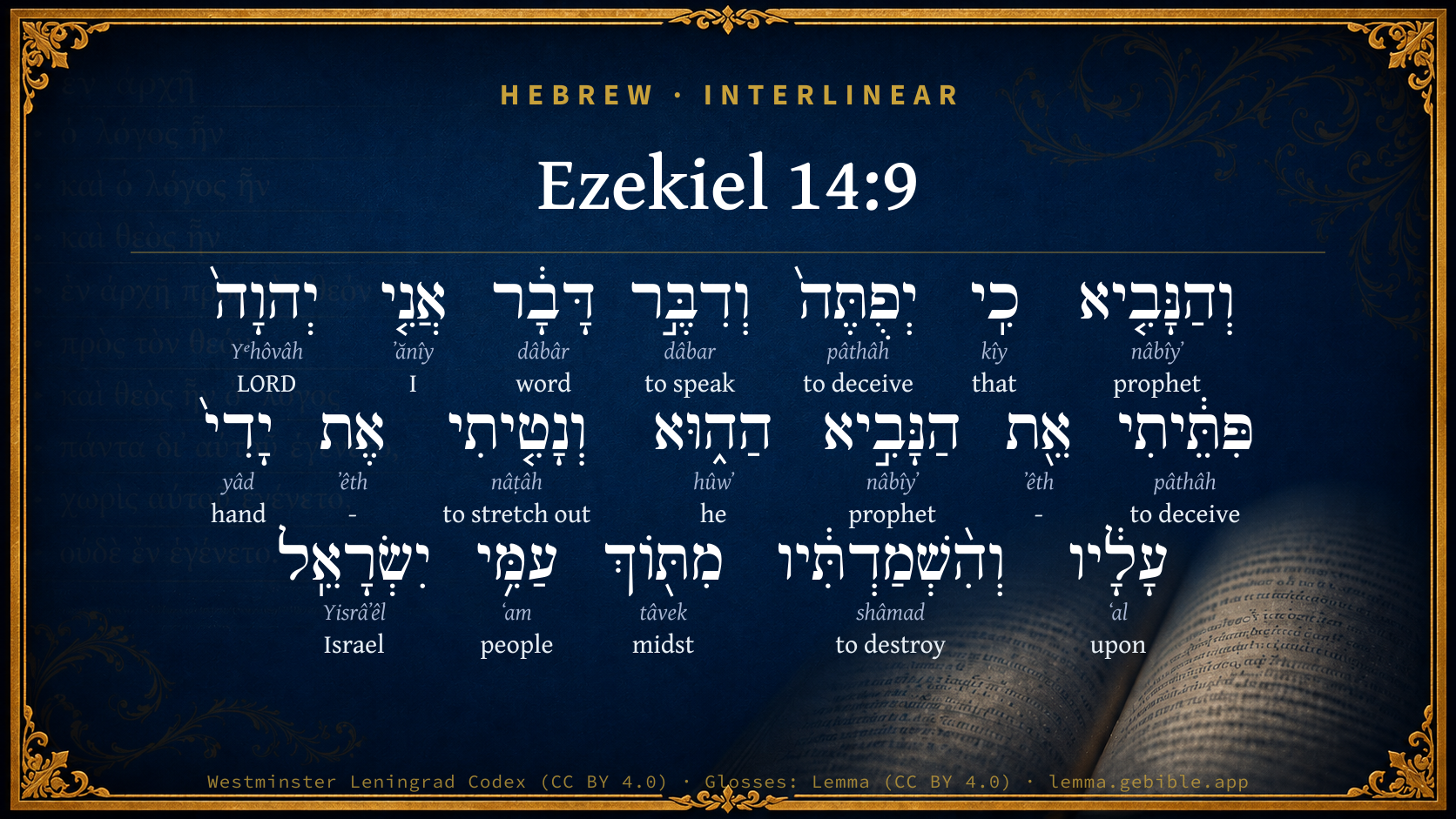
Hebrew (Westminster Leningrad Codex) Ezekiel 14:9 appears in the Hebrew Old Testament. The text above is from the Westminster Leningrad Codex. Each word links to its Strong’s number, a concise gloss, and parsing drawn from the Open Scriptures Hebrew Bible morphology. Click any word for its full Brown-Driver-Briggs (BDB) entry.
Download image
Cite this verse

Ezekiel 14:9 (World English Bible). Public Domain. Lemma interlinear Bible study tool, https://lemma.gebible.app/v/ezekiel/14/9.

Show BibTeX & RIS
BibTeX
RIS
English Translation
If the prophet be deceived and speak a word, I, Yahweh, have deceived that prophet, and I will stretch out my hand on him, and will destroy him from the midst of my people Israel.
World English Bible · Public Domain
Download a study sheet

One document with this verse’s original text, its word-by-word gloss line, the meaning frame, cross-references with their text, attributed commentary, and full source and license credits — printable, and it pastes into notes with its structure intact.

This verse Autodidact and up

Study sheet (.html) Plain text (.txt)

A passage Seminary Student

Up to 50 verses in one chapter. A passage sheet keeps up to 6 commentary sources and 12 cross-references per verse, in the order this page ranks them, and says so on the sheet whenever that leaves anything out. Ask for a single verse and you get the Autodidact verse sheet above.

Everything on this page stays free to read, with no account — the sheet is a download of what is already on screen, not access to it.

Want to remove ads? Support Godless Engineer
Compare translations 3

The same verse in 3 English versions, stacked beneath the original-language interlinear above. Click any original word for its lexicon entry.

Each is an independent rendering of the whole verse — the interlinear is not word-aligned to these translations.

Highlighted words mark where these versions differ — a whole-verse word diff, not a word-by-word alignment.

  • World English Bible Public Domain
    If the prophet be deceived and speak a word, I, Yahweh, have deceived that prophet, and I will stretch out my hand on him, and will destroy him from the midst of my people Israel.
  • King James Version Public Domain
    And if the prophet be deceived when he hath spoken a thing, I the LORD have deceived that prophet, and I will stretch out my hand upon him, and will destroy him from the midst of my people Israel.
  • unfoldingWord Literal Text CC BY-SA 4.0
    If a prophet is deceived and speaks a message, then I, Yahweh, will deceive that prophet; I will reach out with my hand against him and destroy him from the midst of my people Israel.

unfoldingWord Literal Text — © unfoldingWord, licensed CC BY-SA 4.0. Word-aligned USFM3 via Door43 (git.door43.org/unfoldingWord/en_ult).

Versions to compare (up to 4)

3 of 4 selected

Show all 18 translations

Every available English version of this verse, each an independent rendering of the whole verse.

  • World English Bible Public Domain
    If the prophet be deceived and speak a word, I, Yahweh, have deceived that prophet, and I will stretch out my hand on him, and will destroy him from the midst of my people Israel.
  • Berean Standard Bible Public Domain
    But if the prophet is enticed to speak a message, then it was I the LORD who enticed him, and I will stretch out My hand against him and destroy him from among My people Israel.
  • Majority Standard Bible Public Domain
    But if the prophet is enticed to speak a message, then it was I the LORD who enticed him, and I will stretch out My hand against him and destroy him from among My people Israel.
  • King James Version Public Domain
    And if the prophet be deceived when he hath spoken a thing, I the LORD have deceived that prophet, and I will stretch out my hand upon him, and will destroy him from the midst of my people Israel.
  • American Standard Version (1901) Public Domain
    And if the prophet be deceived and speak a word, I, Jehovah, have deceived that prophet, and I will stretch out my hand upon him, and will destroy him from the midst of my people Israel.
  • Revised Version (1885) Public Domain
    And if the prophet be deceived and speaketh a word, I the LORD have deceived that prophet, and I will stretch out my hand upon him, and will destroy him from the midst of my people Israel.
  • Geneva Bible (1599) Public Domain
    And if the Prophet be deceiued, when hee hath spoken a thing, I the Lord haue deceiued that Prophet, and I will stretch out mine hande vpon him, and will destroy him from the middes of my people of Israel.
  • Douay-Rheims (1899) Public Domain
    And when the prophet shall err, and speak a word: I the Lord have deceived that prophet: and I will stretch forth my hand upon him, and will cut him off from the midst of my people Israel.
  • Young's Literal Translation Public Domain
    `And the prophet, when he is enticed, and hath spoken a word -- I, Jehovah, I have enticed that prophet, and have stretched out My hand against him, and have destroyed him from the midst of My people Israel.
  • Literal Standard Version CC BY-SA 4.0
    And the prophet, when he is enticed, and has spoken a word—I, YHWH, have enticed that prophet, and have stretched out My hand against him, and have destroyed him from the midst of My people Israel.
  • Unlocked Literal Bible CC BY-SA 4.0
    If a prophet is deceived and speaks a message, then I, Yahweh, will deceive that prophet; I will reach out with my hand against him and destroy him from the midst of my people Israel.
  • unfoldingWord Literal Text CC BY-SA 4.0
    If a prophet is deceived and speaks a message, then I, Yahweh, will deceive that prophet; I will reach out with my hand against him and destroy him from the midst of my people Israel.
  • Darby Bible Public Domain
    And if the prophet be enticed and shall speak a word, I Jehovah have enticed that prophet; and I will stretch out my hand against him, and will destroy him from the midst of my people Israel.
  • World Messianic Bible Public Domain
    “‘“If the prophet is deceived and speaks a word, I, the LORD, have deceived that prophet, and I will stretch out my hand on him, and will destroy him from among my people Israel.
  • Webster's Bible Public Domain
    And if the prophet be deceived when he hath spoken a thing, I the LORD have deceived that prophet, and I will stretch out my hand upon him, and will destroy him from the midst of my people Israel.
  • Free Bible Version CC BY-SA 4.0
    But if the prophet is deceived into giving a message, it was I the Lord who deceived him to do this. I will still reach out and destroy that prophet from my people Israel.
  • Bible in Basic English Public Domain
    And if the prophet, tricked by deceit, says anything, it is I the Lord by whom he has been tricked, and I will put out my hand against him, and he will be cut off from among my people Israel.
  • JPS Tanakh (1917) Public Domain
    And when the prophet is enticed and speaketh a word, I the LORD have enticed that prophet, and I will stretch out My hand upon him, and will destroy him from the midst of My people Israel.

Literal Standard Version (2020), Covenant Press — licensed CC BY-SA 4.0. Text via the HelloAO Bible API (eBible.org). Unlocked Literal Bible (unfoldingWord) — licensed CC BY-SA 4.0. Text via the HelloAO Bible API (eBible.org). unfoldingWord Literal Text — © unfoldingWord, licensed CC BY-SA 4.0. Word-aligned USFM3 via Door43 (git.door43.org/unfoldingWord/en_ult). Free Bible Version, Dr. Jonathan Gallagher — licensed CC BY-SA 4.0. Text via the HelloAO Bible API (eBible.org).

Word by word

More ways to search: Search by grammar → Find every occurrence → Compare this word →

Practice this passage: Drill this verse → Learn its vocabulary →

יְפֻתֶּה֙
pâthâh
H6601
“to deceive”
Verb, Pual, Imperfect, 3rd Person, Masculine, Singular
Part of Speech
Verb
Stem
Pual
Form
Imperfect
Person
3rd Person
Gender
Masculine
Number
Singular
Full BDB Definition

Origin: a primitive root

TWOT: 1853

to be spacious, be open, be wide - (Qal) to be spacious or open or wide - (Hiphil) to make spacious, make open - to be simple, entice, deceive, persuade - (Qal) - to be open-minded, be simple, be naive - to be enticed, be deceived - (Niphal) to be deceived, be gullible - (Piel) - to persuade, seduce - to deceive - (Pual) - to be persuaded - to be deceived
  1. וְהַנָּבִ֤יא nâbîyʼ H5030 “and · the · prophet” Conjunction + Particle, Definite Article + Noun, Common, Masculine, Singular, Absolute
  2. כִֽי kîy H3588 “that” Conjunction
  3. וְדִבֶּ֣ר dâbar H1696 “and · to speak” Conjunction + Verb, Piel, Sequential Perfect, 3rd Person, Masculine, Singular
  4. דָּבָ֔ר dâbâr H1697 “word” Noun, Common, Masculine, Singular, Absolute
  5. אֲנִ֤י ʼănîy H589 “I” Pronoun, Personal, 1st Person, Common, Singular
  6. יְהוָה֙ Yᵉhôvâh H3068 “LORD” Noun, Proper
  7. פִּתֵּ֔יתִי pâthâh H6601 “to deceive” Verb, Piel, Perfect, 1st Person, Common, Singular
  8. אֵ֖ת ʼêth H853 “-” Particle, Direct Object
  9. הַנָּבִ֣יא nâbîyʼ H5030 “the · prophet” Particle, Definite Article + Noun, Common, Masculine, Singular, Absolute
  10. הַה֑וּא hûwʼ H1931 “the · he” Particle, Definite Article + Pronoun, Personal, 3rd Person, Masculine, Singular
  11. וְנָטִ֤יתִי nâṭâh H5186 “and · to stretch out” Conjunction + Verb, Qal, Sequential Perfect, 1st Person, Common, Singular
  12. אֶת ʼêth H853 “-” Particle, Direct Object
  13. יָדִי֙ yâd H3027 “hand · my” Noun, Common, Both, Singular, Construct + Suffix, Personal, 1st Person, Common, Singular
  14. עָלָ֔יו ʻal H5921 “upon · him” Preposition + Suffix, Personal, 3rd Person, Masculine, Singular
  15. וְהִ֨שְׁמַדְתִּ֔יו shâmad H8045 “and · to destroy · him” Conjunction + Verb, Hiphil, Sequential Perfect, 1st Person, Common, Singular + Suffix, Personal, 3rd Person, Masculine, Singular
  16. מִתּ֖וֹךְ tâvek H8432 “from · midst of” Preposition + Noun, Common, Masculine, Singular, Construct
  17. עַמִּ֥י ʻam H5971 “people · my” Noun, Common, Masculine, Singular, Construct + Suffix, Personal, 1st Person, Common, Singular
  18. יִשְׂרָאֵֽל Yisrâʼêl H3478 “Israel” Noun, Proper

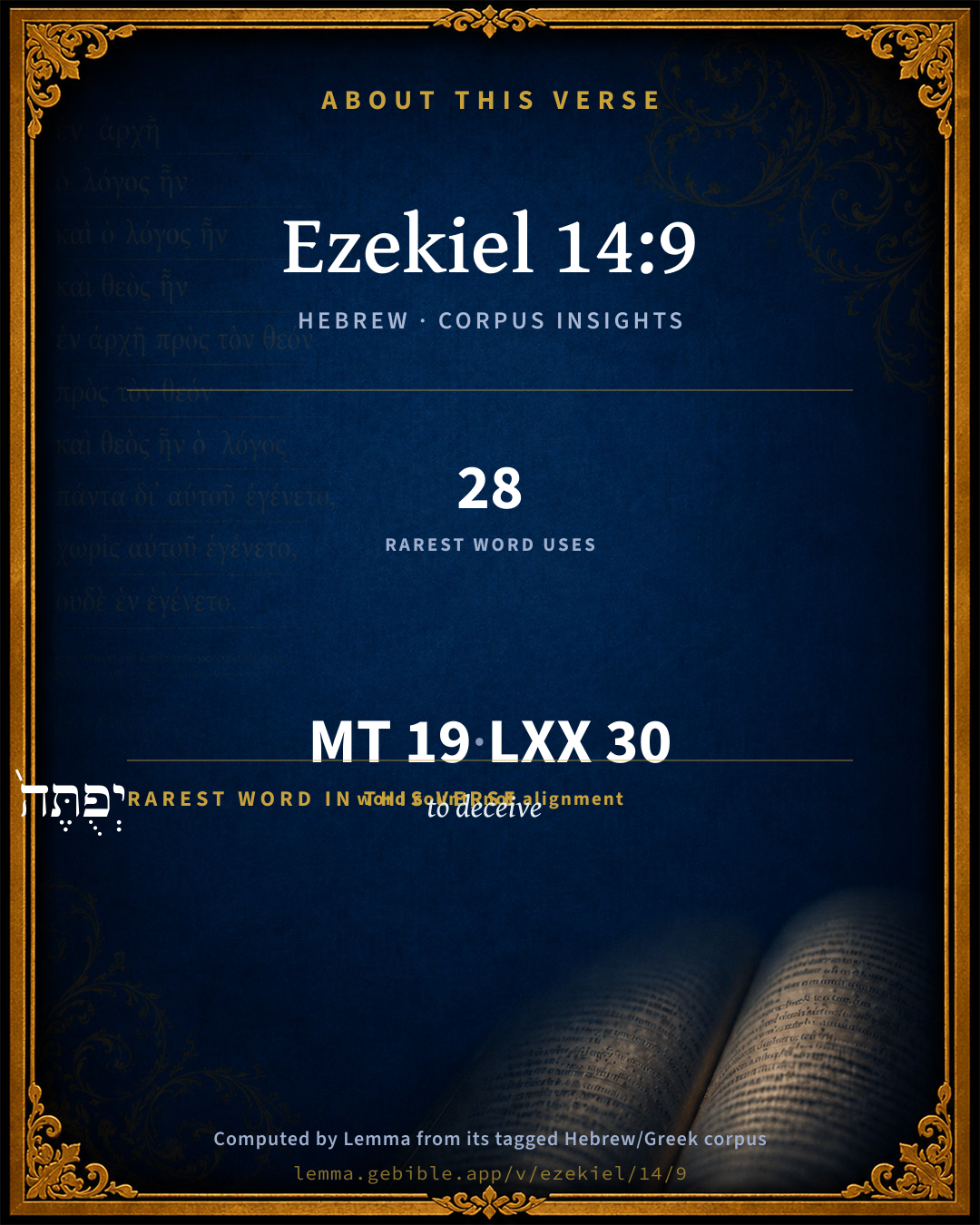
About this verse

These counts appear in no published source. They are computed here, from the morphology-tagged text and Lemma’s own curated glosses. What Lemma adds →

19
words
16
distinct lemmas
Prophets
section

Shared distinctive vocabulary

יְפֻתֶּה֙ to deceive H6601 occurs in 26 verses of the Hebrew Bible. Also found in:

Grammatical profile

  • 5 verbs
  • 8 nouns
  • 2 pronouns
  • 1 preposition
  • 1 conjunction
  • 2 particles

Verb forms

  • יְפֻתֶּה֙ Pual · Imperfect
  • וְדִבֶּ֣ר Piel · Sequential Perfect
  • פִּתֵּ֔יתִי Piel · Perfect
  • וְנָטִ֤יתִי Qal · Sequential Perfect
  • וְהִ֨שְׁמַדְתִּ֔יו Hiphil · Sequential Perfect

Repetition

Words recur within this verse — often emphatic in Hebrew:

  • וְהַנָּבִ֤יא prophet H5030 ×2
  • יְפֻתֶּה֙ to deceive H6601 ×2

Hebrew & Septuagint length

In English translation the verse runs 35 words from the Hebrew and 40 from the Septuagint (LXX English) — closely comparable.

A rough comparison of the two English renderings, which tokenize alike — not a word-level alignment.

Word counts can differ between the Hebrew and the Greek without any difference in meaning — e.g. the Hebrew direct-object marker אֵת has no separate Greek word, and Greek often adds the article ὁ.

In the original languages it is 19 Hebrew tokens and 30 Greek tokens — but the two are counted differently (Hebrew bundles its prefixes and suffixes into one token; the Greek is in lemma form), so that isn’t a like-for-like length.

Cross-references

16

Topical passages linked to Ezekiel 14:9 in the Treasury of Scripture Knowledge — connected by theme and wording, ordered by reader-vote popularity; previews shown in the World English Bible.

  • Jeremiah 4:10 Then said I, Ah, Lord Yahweh! surely you have greatly deceived this people and Jerusalem, saying, You shall have peace; whereas the sword reaches to the life.
  • Ezekiel 20:25 Moreover also I gave them statutes that were not good, and ordinances in which they should not live;
  • 2 Samuel 12:11–12 This is what Yahweh says: 'Behold, I will raise up evil against you out of your own house; and I will take your wives before your eyes, and give them to your neighbor, and he will lie with your wives in the sight of this sun.
  • 1 Kings 22:20–23 Yahweh said, Who shall entice Ahab, that he may go up and fall at Ramoth-gilead? One said on this manner; and another said on that manner.
  • Job 12:16 With him is strength and wisdom; The deceived and the deceiver are his.
  • Psalms 81:11–12 But my people didn't listen to my voice. Israel desired none of me.
  • Isaiah 5:25 Therefore Yahweh's anger burns against his people, And he has stretched out his hand against them, and has struck them. The mountains tremble, And their dead bodies are as refuse in the midst of the streets. For all this, his anger is not turned away, But his hand is still stretched out.
  • Isaiah 9:12 the Syrians before, and the Philistines behind; and they shall devour Israel with open mouth. For all this his anger is not turned away, but his hand is stretched out still.
  • Isaiah 9:17 Therefore the Lord will not rejoice over their young men, neither will he have compassion on their fatherless and widows; for everyone is profane and an evil-doer, and every mouth speaks folly. For all this his anger is not turned away, but his hand is stretched out still.
  • Isaiah 9:21 Manasseh, Ephraim; and Ephraim, Manasseh; and they together shall be against Judah. For all this his anger is not turned away, but his hand is stretched out still.
  • Isaiah 10:4 They shall only bow down under the prisoners, and shall fall under the slain. For all this his anger is not turned away, but his hand is stretched out still.
  • Isaiah 63:16 For you are our Father, though Abraham doesn't know us, and Israel does not acknowledge us: you, Yahweh, are our Father; our Redeemer from everlasting is your name.
  • Isaiah 66:4 I also will choose their delusions, and will bring their fears on them; because when I called, none did answer; when I spoke, they did not hear: but they did that which was evil in my eyes, and chose that in which I didn't delight.
  • Jeremiah 14:15 Therefore thus says Yahweh concerning the prophets who prophesy in my name, and I didn't send them, yet they say, Sword and famine shall not be in this land: By sword and famine shall those prophets be consumed.
  • Ezekiel 16:27 See therefore, I have stretched out my hand over you, and have diminished your ordinary [food], and delivered you to the will of those who hate you, the daughters of the Philistines, who are ashamed of your lewd way.
  • 2 Thessalonians 2:9–12 even he whose coming is according to the working of Satan with all power and signs and lying wonders,

Cross-references courtesy of OpenBible.info (CC BY 4.0).

Hebrew and Greek witnesses Masoretic Hebrew ↔ Greek Septuagint

The same verse in the two great witnesses to the Old Testament, shown verse-for-verse.

These are two independent witnesses, not word-aligned to each other, and the Septuagint is shown in lemma (dictionary) form.

Hebrew Ezekiel 14:9 Masoretic · Westminster Leningrad Codex

וְהַנָּבִ֤יא כִֽי יְפֻתֶּה֙ וְדִבֶּ֣ר דָּבָ֔ר אֲנִ֤י יְהוָה֙ פִּתֵּ֔יתִי אֵ֖ת הַנָּבִ֣יא הַה֑וּא וְנָטִ֤יתִי אֶת יָדִי֙ עָלָ֔יו וְהִ֨שְׁמַדְתִּ֔יו מִתּ֖וֹךְ עַמִּ֥י יִשְׂרָאֵֽל

If the prophet be deceived and speak a word, I, Yahweh, have deceived that prophet, and I will stretch out my hand on him, and will destroy him from the midst of my people Israel.

World English Bible · Public Domain

Greek LXX Ezekiel 14:9 Septuagint · lemma form

καί ὁ προφήτης ἐάν πλανάω καί λαλέω ἐγώ κύριος πλανάω ὁ προφήτης ἐκεῖνος καί ἐκτείνω ὁ χείρ ἐγώ ἐπί αὐτός καί ἀπο ἀναἵζω αὐτός ἐκ μέσος ὁ λαός ἐγώ ἰσραήλ

And if a prophet should cause to err and should speak, I the Lord have caused that prophet to err, and will stretch out my hand upon him, and will utterly destroy him from the midst of my people Israel.

LXX2012 (modern English Septuagint) · Public Domain

Hebrew: Westminster Leningrad Codex (CC BY 4.0). Greek: Septuagint (public domain); English from LXX2012 (modern English Septuagint) (Public Domain). How the Septuagint differs from the Hebrew →

Targum (Aramaic paraphrase)

1

The Targum is the ancient Jewish Aramaic paraphrase of the Hebrew Scriptures — an interpretive translation, not the Hebrew text itself. Onkelos (literal) and Pseudo-Jonathan (expansive) render the Torah, and Jonathan the Prophets. Coverage is partial: where no permissively-licensed English translation exists for a verse, only the Aramaic is shown. This is verse-level text, not a word-by-word alignment to the Hebrew.

  1. Targum Jonathan Prophets (Joshua–Malachi)
    וּנְבִיָא אֲרֵי יִטְעֵי וִימַלֵיל פִּתְגָמָא אֲנָא יְיָ אַטְעֵיתִי יַת נְבִיָא הַהוּא וַאֲרֵים יַת מְחַת גְבוּרְתִּי עֲלוֹהִי וֶאֱשֵׁיצִינֵיהּ מִגוֹ עַמִי יִשְׂרָאֵל:

    (no public-domain English translation for this verse)

    Targum Jonathan — Aramaic: “Mikraot Gedolot” (public domain). English: “Sefaria Community Translation” (CC0 1.0 (public-domain dedication)); “London "Chaldee Paraphrase," 1871” (public domain). Text via Sefaria.

Commentary

Notes on Ezekiel 14:9 from classic Christian and Jewish commentators (each source and its license shown beneath its notes). The classic Christian expositions comment on the surrounding passage and are grouped to its opening verse, so a note may address several verses; the Jewish commentaries on the Tanakh (Rashi and others) are per-verse, so they appear only where the commentator wrote on this verse.

Lemma curates 59 commentaries, every one of them public domain or Creative Commons licensed, each selected and text-cleaned for this edition rather than reprinted as found. About our sources →

Trapp's Complete Commentary

John Trapp

Eze 14:9 And if the prophet be deceived when he hath spoken a thing, I the LORD have deceived that prophet, and I will stretch out my hand upon him, and will destroy him from the midst of my people Israel.

Ver. 9. I the Lord have deceived that prophet.] I had not only a permissive, but an active hand in that imposture; not as a sin, but as a punishment of other sins. See 1Ki 22:20 Job 12:16 Jer 4:10 2Th 2:11.

And I will stretch out mine hand upon him,] i.e., Upon that false prophet, who, although he hath thus acted, not without my providence, yet hath sinned against my law, which is the rule men must walk by, or else suffer for their transgression. Aut faciendum aut patiendum. Now God hath long hands, as we use to say of princes; neither may any think to live out of the reach of his rod.

John Trapp, A Commentary or Exposition upon All the Books of the Old and New Testament (1647–1656) — public domain. Text from a community e-Sword module.

Joseph Benson's Commentary

Eze 14:9-12. And if the prophet be deceived — Or, seduced. This is to be understood of the false prophets, whose practices are reproved throughout the whole foregoing chapter. I the Lord have deceived that prophet — I Jehovah have suffered him to be deceived; I have given him up to strong delusions, as a just judgment upon him for going after idols, and setting up false pretences to inspiration, 2Th 2:11-12. Or the words may signify, I will disappoint the expectations of those prophets who seduce my people, by speaking peace to them. For I will bring upon them those evils which they, with great assurance, have declared shall never come to pass. Thus Bishop Newcome, “When any false prophet is deceived, the probable event proving contrary to his prophecy, I Jehovah have so superintended the course of things as to deceive that prophet.”

And I will, &c. — Or, Yea, I will stretch out my hand upon him — Remarkably punish his falsehood, and in severity destroy him. And they — Both the deceiver and the deceived; shall bear the punishment of their iniquity — There is so great a parity in the folly and impiety of both the seducing prophets and the seduced people, that it is hard to say, whose sin is greatest. The punishment of the prophet shall be, &c. — Their punishments shall be as similar as they made their sins: both shall be cut off and destroyed. That the house of Israel may go no more astray from me — The judgments I will inflict upon the false prophets, and those that consult them, shall be an instruction to my people to continue steady to me and my worship, and not hanker after the idolatrous practices of the neighbouring nations.

Joseph Benson's Commentary on the Old and New Testaments (1811–1818) — public domain. Text from a community e-Sword module.

Tyndale Open Study Notes

Tyndale Open Resources

14:9-10 False prophets, who sought to counteract God’s will by prophesying what God had not spoken, would do God’s will unwittingly—they and other rebels would be deceived and confirmed in their rebellion. False prophets and rebellious people alike were thus punished for their sins (see also Deut 13; 1 Kgs 22:6-23).

Tyndale Open Study Notes — © Tyndale Open Resources, licensed CC BY-SA 4.0. Text via the HelloAO Bible API.

Geneva Bible (1599)

Geneva Bible translators

The Prophet declareth that God for man’s ingratitude raiseth up false prophets to seduce them that delight in lies rather than in the truth of God, and thus he punisheth sin by sin, 1 Kings 22:20, 22, and destroyeth as well those Prophets as that people.

Geneva Bible (1599) marginal notes — public domain. Text via Bolls.life.

Jamieson, Fausset & Brown

Robert Jamieson, A. R. Fausset & David Brown

I the Lord have deceived that prophet--not directly, but through Satan and his ministers; not merely permissively, but by overruling their evil to serve the purposes of His righteous judgment, to be a touchstone to separate the precious from the vile, and to "prove" His people (Deu 13:3; Kg1 22:23; Jer 4:10; Th2 2:11-12). Evil comes not from God, though God overrules it to serve His will (Job 12:16; Jam 1:3). This declaration of God is intended to answer their objection, "Jeremiah and Ezekiel are but two opposed to the many prophets who announce 'peace to us." "Nay, deceive not yourselves, those prophets of yours are deluding you, and I permit them to do so as a righteous judgment on your wilful blindness."

Jamieson, Fausset & Brown — Commentary Critical and Explanatory on the Whole Bible (1871) — public domain (CC PDM 1.0). Text via the HelloAO Bible API.

Adam Clarke's Commentary

Verse 9. I the Lord have deceived that prophet] That is, he ran before he was sent; he willingly became the servant of Satan's illusions; and I suffered this to take place, because he and his followers refused to consult and serve me. I have often had occasion to remark that it is common in the Hebrew language to state a thing as done by the Lord which he only suffers or permits to be done; for so absolute and universal is the government of God, that the smallest occurrence cannot take place without his will or permission.

Adam Clarke's Commentary on the Bible (1810–1826) — public domain. Text from a community e-Sword/MySword module.

John Calvin's Commentaries

Here God meets that foolish thought in which many minds are rapt up. When they had their own impostors at hand, they thought that all God’s threats could be repelled as it were by a shield. Jeremiah and Ezekiel threaten us, say they, but we have others to cheer us with good hope: they promise that all things shall be joyful and prosperous to us: since, therefore, only two or three deprive us of the hope of safety, and others, and those, too, far more numerous, promise us security, we have no need to despair. Since they thus oppose their impostors to the true prophets, and imagine a kind of conflict, in which imposture prevails and God’s truth is vanquished, he says there is no reason why the flatteries of the false prophets should deceive you. For if you say that they bear also the prophetic name and office, I reply, that they err through your fault; for I deceive them because your impiety deserves it. This may as yet be obscure, but I will endeavor to explain it by a familiar example. At this time we see that many through sloth withdraw themselves from all fear, and promise themselves freedom from punishment, while they reject all care for God. O, say they, what have I to do with religion? for this only occasions me trouble; whoever wishes to give himself up seriously to God amidst, these dissension’s and divisions will enter a labyrinth. Since, therefore, many think themselves free from fault, even if they reject God, this doctrine may be turned against them. There are, indeed, at this day dissension’s in religion which disturb many; but do you think that this happens rashly: Oh! we know not which party to follow: inquire; for God has not so given the rein to Satan and his ministers, that the Church is disturbed, and men are mutually opposed by chance. But when this happens by the just judgment of God, it is certain that no one can be deceived unless of his own accord. For the Prophet takes that principle from Moses, whenever false prophets come forth, that this is a proof of faithfulness and of sincere piety. Thy God tries thee, says Moses, whether you love him. (Deuteronomy 8:3.) Since, therefore, no false prophet arises without the just judgment of God, and since God wishes to distinguish between sincere worshipers and hypocrites, it follows that no one can be excused on this pretext, of differing opinions which arise by wise ordination. For since God wishes to make an experiment, as I have said, concerning his servants and sons, and since false prophets so mingle all things, and involve the clear daylight in darkness, no one who truly and heartily seeks God shall be entangled among their snares.

But Ezekiel will proceed still further, as I have previously hinted, namely, that all impostures and errors do not spring up rashly, but proceed from the ingratitude of the people itself. For if they had not so willingly given themselves up to the false prophets, God would doubtless have spared them. But, since false prophets abounded on every side, and were so plentiful everywhere, hence it may be understood that, the people were worthy of such impostures. Now then we perceive the meaning of the Holy Spirit when God pronounces that he is the author of all the error which the false prophets were thus scattering abroad. For it is not sufficient to observe merely the sound of the words, and then to illicit the substance of the prophetic teaching; but we must attend to the Spirit’s purpose. I have already explained why the Prophet says this, namely, that the Israelites should cease to turn their backs according to their custom, saying, that if they remained in doubt amidst various opinions, this ought not to be imputed to them as a crime. For he answers, that the false prophets only took this license, because the people deserved to be blinded: and in fine, he says that Satan’s lies multiplied not at random or at the will of men, but because God repays a graceless and perfidious people with a just recompense. So Paul says that error has a divine efficacy, when men prefer embracing a lie to the truth (2 Thessalonians 2:11, 12), and do not submit themselves to God, but rather shake off his yoke. Now, therefore, whoever wishes to excuse himself under the pretext of simplicity for not acquiescing in God’s word, this answer is at hand — that all things are thus mingled by God’s just decree. Since, therefore, Satan eclipses the light whenever clouds are scattered to disturb the weak, we here find God to be the author of it, since man’s impiety deserves it. For the Prophet does not here discourse profanely about God’s absolute power, as they say; but when he brings forward God’s name, he takes it for granted that God is not delighted with such disturbance, when false prophets seize upon his name. It is certain, then, that God does not delight in such deception; but the cause must be thought, as we shall soon see: the cause is not always manifest; but without controversy this is fixed, that God punishes men justly, when true religion is so rent asunder by divisions, and truth is obscured by falsehood.

We must hold, then, that God does not rage like a tyrant, but exercises just judgment. Besides, this passage teaches us that neither impostures nor deceptions arise without God’s permission. This seems at first sight absurd, for God seems to contend with himself when he gives license to Satan to pervert sound doctrine: and if this happens by God’s authority, it seems perfectly contradictory to itself. But let us always remember this, that God’s judgments are not without reason called a profound abyss (Psalm 36:6), that when we see rebellious men acting as they do in these times, we should not wish to comprehend what far surpasses even the sense of angels. Soberly, therefore, and reverently must we judge of God’s works, and especially of his secret counsels. But with the aid of reverence and modesty, it will be easy to reconcile these two things — that God begets, and cherishes, and defends his Church, and confirms the teaching of his prophets, all the while that he permits it to be torn and distracted by intestine broils. Why so? He acts thus that he may punish the wickedness of men as often as he pleases when he sees them abuse his goodness and indulgence. When God lights up the flame of his doctrine, this is the sign of his inestimable pity; when he suffers the Church to be disturbed, and men to be in some degree dissipated, this is to be imputed to the wickedness of men. Whatever be the explanation, he pronounces that he deceived the false prophets, because Satan could not utter a single word unless he were permitted, and not only so, but even ordered; while God exercises his wrath against the wicked.

In another sense Jeremiah says that he was deceived (Jeremiah 20:7). I am deceived, but you Jehovah have deceived me: for there he speaks ironically. For when ungodly men boasted that so many of his prophecies were delusive, and derided him as a foolish and misguided man, he says, If I am deceived, you, O Lord, have deceived me. We see, then, that by false irony he reproves the petulance of those who despised his prophecies; and finally, he shows that God was the author of his teaching. But in this place God pronounces without a figure that he deceived the false prophets. If any one now objects, that nothing is more remote from God’s nature than to deceive, the answer is at hand. Although the metaphor is rather rough, yet we know that God transfers to himself by a figure of speech what properly does not belong to him. He is said to laugh at the impious; but we know that it is not agreeable to his nature to ridicule, to laugh, to see, and to sleep. (Psalm 2:4; Psalm 37:13.) And so in this place, I confess, there is an improper form of speaking; but the sense is not doubtful — that all impostures are scattered abroad by God — since Satan, as I have said, can never utter the slightest word unless commanded by God. But the kind of deceit which will solve this difficulty for us is described in the sacred history. For when Ahab had a great crowd of false prophets, Micah alone stood firm, and faithfully discharged his duty to God: when brought before king Ahab, he immediately blows away their boastings — Behold! all my prophets predict victory: he answers — I saw God sitting on his throne; and when all the armies of heaven were collected before him, God inquired, Who shall deceive Ahab? And a spirit offered himself, namely, a devil, and said, I will deceive him, because I will be a lying spirit in the mouth of all his prophets. God answers, Depart, and thus it shall be. (1 Kings 22; 2 Chronicles 18.) Afterwards it follows, Therefore the Lord put a lie in the mouth of all those prophets. Here he distinctly shows us the manner in which God maddens the false prophets, and deceives them, namely, since he sends forth Satan to fill them with his lies. Since, then, they are impelled by Satan, the father of lies, what can they do but lie and deceive? The whole of this, then, depends on the just judgments of God, as this place teaches. God, therefore, does not deceive, so to speak, without an agency, but uses Satan and impostors as organs of his vengeance. If any one flies to that subtle distinction between ordering and permitting, he is easily refuted by the context. For that cannot be called mere permission when God willingly seeks for some one to deceive Ahab, and then he himself orders Satan to go forth and do so. But the last clause which I have quoted takes away all doubt, since God put a lie in the mouth of the prophets, that is, suggested a lie to all the false prophets. If God suggests, we shall see that Satan flies forth not only by his permission to scatter his impostures; but since God wished to use his aid, so he afforded it on this condition and to this end. But we shall leave the rest for the next lecture.

John Calvin's Commentaries (1540-1563) — public domain. Text from the Calvin Translation Society English edition (1840s-50s) via the Christian Classics Ethereal Library (ccel.org). Calvin's coverage is partial (roughly two-thirds of the Bible); uncommented books and verses are honest gaps, never fabricated. The 19th-century editor's footnotes and remarks are omitted so the notes are faithfully Calvin's own voice.

Ellicott's Commentary for English Readers

(9) And if the prophet be deceived.—The exact sense of the original is, “If a prophet be persuaded and speak a word, I the LORD have persuaded that prophet.” The thought is thus in close connection with what precedes; in Eze_14:3-4; Eze_14:7, the Lord has refused to allow an answer through the prophet to the hypocritical enquirer; but if the prophet, by giving the desired answer, allows himself to become a partaker of the sin which God abhors, then God will treat him according to that general method of dealing with sin which is here described. He “persuades” the prophet in the same sense in which He hardened Pharaoh’s heart, by making such persuasion the natural consequence of the immutable moral laws which He has ordained. Men are held back from sin only by God’s own Holy Spirit drawing them towards Himself. When they set this aside by transgressing God’s commands, the inevitable tendency—the tendency under the moral laws God has established—is to further sin. Hence the prophet who allowed himself to be persuaded, contrary to God’s command, to answer the hypocritical enquirer at all, would inevitably be persuaded further to answer him according to his desires. God does not force men either to receive the truth or to act righteously. If, notwithstanding His remonstrances, their hearts are set upon wrong, He will even give them up and “send them strong delusion that they should believe a lie” (2Th_2:11). We are too often told in Scripture of this method of the Divine dealing to leave any room for us to misunderstand the principle. The result is a terrible one, but it is quite in keeping with all we can observe of the Divine work in nature. The man that refuses the medicine, must sink under the disease. The principle is clearly exemplified in the case of Ahab (1Ki_22:19-23), where the Lord is represented as sending a lying spirit into the mouths of the prophets, that they might counsel the king to the wrong course he was already determined to take. God is declared to do this because it was the result under His moral laws of the wicked and domineering spirit of the king who had driven away the true prophets and gathered around himself those who were willing to pervert their office and prophesy falsely to gratify his wishes. Of course this is not to suppose that God can ever be the author of sin and deceit; but He has ordained that sin shall punish itself, and when the heart rejects Him, He withdraws His Spirit from it and gives it up to its own delusions. Thus when Saul’s heart became alienated from God, and “the Spirit of the Lord departed from” him, the evil spirit, which came instead, is said to be “from the LORD” (1Sa_16:14). This kind of judgment is necessarily more common in times of great and general declension from the right. Hence false prophets were especially abundant towards the close of the kingdom of Judah, and form a marked characteristic in the New Testament prophecies of “the last days.” No more terrible judgment can be imagined than that of thus giving up the sinner to the consequences of his own sin.

Will destroy him from the midst of my people Israel.—This is not the word which is so often used in the penalties of the law, “will cut him off from my people.” The latter refers only to excommunication, to exclusion from the privileges of the chosen people; but this means that the untrue prophet shall literally be destroyed, like Balaam (Num_31:8), among the enemies of God with whom he had cast in his lot.

A Bible Commentary for English Readers, edited by Charles John Ellicott (1878–1897) — public domain. Text from a community e-Sword module.

The Cambridge Bible for Schools and Colleges

gen. ed. J. J. S. Perowne

9–11. Fate of the prophet who gives an answer to idolatrous inquirers: he and they shall perish together

9. be deceived when he hath spoken] Rather, be deceived (or, enticed) and speak a word, i.e. a prophetic word, ch. Eze_12:25 seq. The meaning appears to be: if the prophet, entering into the “heart” of the idolaters, the circle and direction of their thoughts, and the general spirit which animates them, gives them a prophetic oracle which coincides with the line of their thoughts, and thus helps to foster their delusions, that prophet himself has been seduced or enticed; and it is the Lord who has enticed him. The passage has a resemblance to 1Ki_22:20. There a lying spirit came forth from the Lord and entered into the prophets of Ahab and deceived them, so that they entered into the designs of the wicked king and gave an answer favourable to him. Here it is the Lord himself who entices the prophet. In both cases this enticement or deception was in punishment for previous sin. Ezekiel does not appear to reflect upon the point whether the prophet before being deceived was true or false. The “prophet” became false when deceived, when he entered into the spirit and purposes of the idolaters, and spoke a word to them in the line of their sinful conduct and hopes. And this word merely hardened them in their mind and was a step towards taking them in their own heart (Eze_14:5).

The Cambridge Bible for Schools and Colleges (gen. ed. J. J. S. Perowne; Cambridge University Press, 1878–1918) — public domain. Text from a community e-Sword module.

John Gill's Exposition

And if the prophet be deceived when he hath spoken a thing,.... That is pleasing to men, and is not true, in hope of reward and applause, but it never comes to pass, and his expectations are not answered:

I the Lord have deceived that prophet; by sending a lying spirit to him, as to Ahab's prophets, Kg1 22:22; by giving him up to strong delusions, to believe a lie, and publish it, Th2 2:11; and to his own heart's lusts; being willing, for the sake of gain, to prophesy smooth things, though false to the people, promising them peace when there was none; and then by frustrating his predictions, and disappointing him of his ends and views. R. Saadiah interprets this, as Kimchi observes, of God revealing and making it manifest that he was deceived; but more is meant by it than this, or even a bare permission; for though God is not the author of sin, yet he wills it to be done for wise ends and purposes, and sometimes in a way of judgment, as a punishment for sin; and which was the case here; both with respect to the prophet that deceived, who as the fruit of his sin, his covetousness, was given up in just judgment to a reprobate mind; and the people that were deceived, who, rejecting the true prophets of the Lord, were willing to have smooth things prophesied to them:

and I will stretch out my hand upon them; his avenging hand; the stroke of his power, as the Targum; a heavy one, and that for giving heed to a lying spirit; for uttering falsehood, and that with a wicked design, to gain the applause of the people, or for filthy lucre's sake:

and I will destroy him from the midst of my people Israel; by some sore judgment or sudden death, and so be made a public example of.

John Gill's Exposition of the Whole Bible (1746–1763) — public domain (CC PDM 1.0). Text via the HelloAO Bible API.

Albert Barnes' Notes on the Bible

I the Lord hare deceived that prophet - A deep truth lies beneath these words, namely, that evil as well as good is under God’s direction. He turns it as He will, employing it to test the sincerity of men, and thus making it ultimately contribute to the purification of His people, to the confirmation of the righteous, to the increase of their glory and felicity. The case of the false prophets who deceived Ahab 1 Kings 22 is a striking representation of this principle. The Lord sends forth an evil spirit to persuade Ahab to his ruin. Toward the close of the kingdom of Judah false prophets were especially rife. The thoughts of men’s hearts were revealed, the good separated from the bad, and the remnant of the people purged from the sins by which of late years the whole nation had been defiled.

Albert Barnes' Notes on the Bible (1834–1885) — public domain. Text from a community e-Sword/MySword module.

Haydock's Catholic Bible Commentary

Err. He speaks of false prophets, answering out of their own heads, and according to their own corrupt inclinations. --- Deceived, &c. God Almighty deceives false prophets, partly by withdrawing his light from them; and abandoning them to their own corrupt inclinations, which push them on to prophesy such things as are agreeable to those that consult them: and partly by disappointing them, and causing all things to happen contrary to what they have said. (Challoner) --- God permits the deception, to punish both the impostor and his hearers. (Worthington) --- Thus was Balaam treated, (Calmet) Numbers xxii. (Haydock) --- He could do nothing of himself, (St. Jerome) 2 Kings xxii. 22. (Calmet) --- Here also an interrogation might be used (Haydock) in Hebrew, "have I?" &c. (Feiffer dub. cent. 4. b. lviii.) --- I have manifested the deceit, chap. xiii. 18.

George Leo Haydock (1774–1849), Haydock's Catholic Family Bible and Commentary, 1859 edition — public domain. Excludes Psalms (Douay-Rheims chapter numbering differs from Protestant) and Deuterocanonical books (Catholic canon only).

Matthew Poole's English Annotations

The prophet, viz. the prophet who makes this his trade and gain, the false prophet, who speaks all serene and quiet, in hope of reward for his kind answer to those that desired to hear what might please them more than what God commanded, promised, or threatened.

Have deceived; permitted him to err, or. iustly left him in his blindness, that he shall not discern his own self-deceivings; or else when such prophet promiseth good, and thinks concurrence of all second causes tend to it, yet I will disappoint and frustrate, as Isa 44:25, if the confederacies to save were in likelihood sufficient, and it were no presumption to hope the best; and if your prophets on this ground promised you success, yet they shall deceive you, for I would defeat and disappoint them and you; so the sense would not carry a moral and culpable deceiving, but a just defeating and disappointing, or disabling, second causes, on which disappointment of hopes will follow. If Egypt’s arms had so weakened the Babylonians, that none but wounded men remained, yet the promise of your escape should fail you, O Israelites, for, Jer 37:10, these should rise up and burn your city.

Stretch out my hand upon him; remarkably punish his falsehood, and in severity destroy him.

Matthew Poole's English Annotations on the Holy Bible (1683–1685) — public domain. Text from a community e-Sword/MySword module.

Whedon's Commentary on the Bible

Daniel D. Whedon

9. When he hath spoken a thing — Literally, and speaketh a thing.

I the Lord have deceived that prophet — The prophecy was false and did not come from God (Eze_13:4; Eze_13:6); but the prophet who willfully follows a lie will soon lose the power to know the truth. This is God’s punishment for sin: that a man’s own “ways” and “abominations” fall upon him (Eze_7:3; Eze_9:10; Eze_11:21), and is the rod by which he is chastised (Eze_7:11; Eze_7:20; note Eze_14:5). These liars (Eze_13:7-8) at first hope that the prophecy which comes from their own hearts may be true (Eze_13:6); at last by the action of this well-known mental law they are made to believe the lies they tell. It is one of God’s laws that rebellion against the truth blinds a man’s eyes so that he cannot see the truth (Eze_12:1). He who speaks seeing “nothing” (xiii, 3) shall presently see a false vision and be himself deceived; but this will not do away with his guilt. No teaching of Scripture was more emphasized by Jesus than this (Mat_13:14; Joh_12:40; see also Act_28:26; Rom_11:8; 2Co_3:14). They who call evil good and good evil in order to deceive others will in the end be themselves deceived. The Hebrews, who took no interest in “second causes” and knew nothing of psychological laws, naturally and properly referred to God directly that which is now seen to be the inevitable result of willful falsehood according to the eternal laws of mind established by the Creator from the beginning.

The above explanation is given because of the ordinary supposition that the “deception” spoken of refers to the substance of the prophecy; but the connection indicates very clearly that it has reference particularly to the outcome of such prophesying. The Lord has blinded the prophet’s eyes not to his own wickedness, nor even necessarily to the sequence of historical events, but to the results which shall come to him personally through these falsehoods. He expects praise and reward, and does not see his own destruction which shall surely come because of it.

Daniel D. Whedon (gen. ed.), Commentary on the Old and New Testaments (1874–1909) — public domain. Text from a community e-Sword module.

The Pulpit Commentary

I the Lord have deceived that prophet, etc. The teaching of modern thought is to soften language like this into "I have permitted him to be deceived." The distinction was seldom, if ever, present to the mind of the Old Testament, or indeed of the New Testament, writers. It is Jehovah who sends the "lying spirit" in 1Ki_22:20-23. It is he who in the latter days shall send men "strong delusions" that they shall believe a lie. (2Th_2:11) In both cases it is implied that the delusion is a righteous punishment, is indeed the natural, because the divinely appointed, punishment of the sin. Populus vult decipi et decipiatur, but the very deception is a means for undeceiving them. At last their eyes shall be opened. The punishment of the false prophet and of those who trust him is at once retributive, and a discipline, and, if the discipline fails for them, at least a warning for others.

The Pulpit Commentary (1880–1919), ed. H.D.M. Spence-Jones & Joseph S. Exell — public domain. Text from a community e-Sword module.

John Wesley's Explanatory Notes

The prophet - The false prophet, who speaks all serene, and quiet, in hope of reward. Have deceived - Permitted him to err, or justly left him in his blindness.

John Wesley, Explanatory Notes Upon the Whole Bible (1754–1765) — public domain. Text via the GEBible commentary corpus.

unfoldingWord translationNotes

Door43 World Missions Community

I will reach out with my hand against him

God's "hand" refers to what he does. AT: "I will work against him" (See: Metonymy)

They will carry their own iniquity

Here the word "iniquity" represents the guilt that people incur for committing iniquity. Yahweh speaks of people suffering the consequences of their iniquity as if they were carrying the iniquity. AT: "They will suffer the consequences of their own iniquity" (See: Metonymy and Metaphor)

house of Israel

The word "house" is a metonym for the family that lives in the house, in this case the Israelites, the descendants of Jacob over many years. See how you translated this in Ezekiel 3:1. AT: "the Israelite people group" (See: Metonymy)

will no longer wander away from following me

Yahweh speaks of the people no longer worshiping him as if they were to wander away from him and no longer follow him. AT: "will no longer stop worshiping me" (See: Metaphor)

this is the Lord Yahweh's declaration

Yahweh speaks of himself by name to express the certainty of what he is declaring. See how you translated this in Ezekiel 5:11. AT: "this is what the Lord Yahweh has declared" or "this is what I, the Lord Yahweh, have declared" (See: First, Second, or Third Person)

translationWords

deceive

defile

transgress

God

Lord Yahweh

declare

unfoldingWord translationNotes — © Distant Shores Media and the Door43 World Missions Community, licensed CC BY-SA 4.0. Source: git.door43.org/Door43/en_tn.

Rashi

Rabbi Shlomo Yitzchaki (Rashi)

But the prophet who is enticed and speaks a word that is not true.

have enticed I opened a doorway for him to [do] whatever he wishes. And from here we can learn that if one wishes to defile himself, they open [a door] for him.

Rashi on the Tanakh — English translations: “The Judaica Press complete Tanach with Rashi, translated by A. J. Rosenberg” (CC BY 4.0); “Pentateuch with Rashi's commentary by M. Rosenbaum and A.M. Silbermann, 1929-1934” (public domain); “The Metsudah Tanach series, Lakewood, N.J” (CC BY 4.0); and “The Book of Joshua, Metsudah Publications, 1997” (CC BY 4.0). Text via Sefaria.

Lesson kit

Teaching starters — assembled from the data on this page, not authored interpretation. Every prompt links to the verse data it draws on. Edit before teaching.

Ezekiel, in the Prophets, opens this verse with 19 words (16 distinct Hebrew lemmas). Its most distinctive word is pâthâh (“to deceive”). A historical commentator’s framing appears above. Read the whole chapter for the surrounding context.

Discussion questions

  1. The word pâthâh carries the sense “to deceive.” How does it shape the verse?
  2. How does Genesis 9:27, which shares the word «to deceive», read alongside this verse?
  3. What does the repetition of “prophet” (2× in this one verse) do in this verse?
  4. The translations on this page render this verse differently — a whole-verse word diff, not a word-by-word alignment. What might account for the different wordings?
  5. «יְפֻתֶּה֙» is a Pual Imperfect verb. How does that grammatical form shape the action described?
  6. Compare how Trapp's Complete Commentary and Joseph Benson's Commentary read this verse. Where do they agree or differ?

Things to notice

Reading settings

Reading text

Shown beneath each verse's original-language words.

Old Testament
Old Testament edition

Read the OT as the Masoretic Hebrew (MT) or the Greek Septuagint (LXX).

English shown for the Greek Septuagint (in the Hebrew ↔ Greek comparison).

Comparing translations? Open the Compare panel on any verse page to stack up to four side by side.