Joshua 13:9

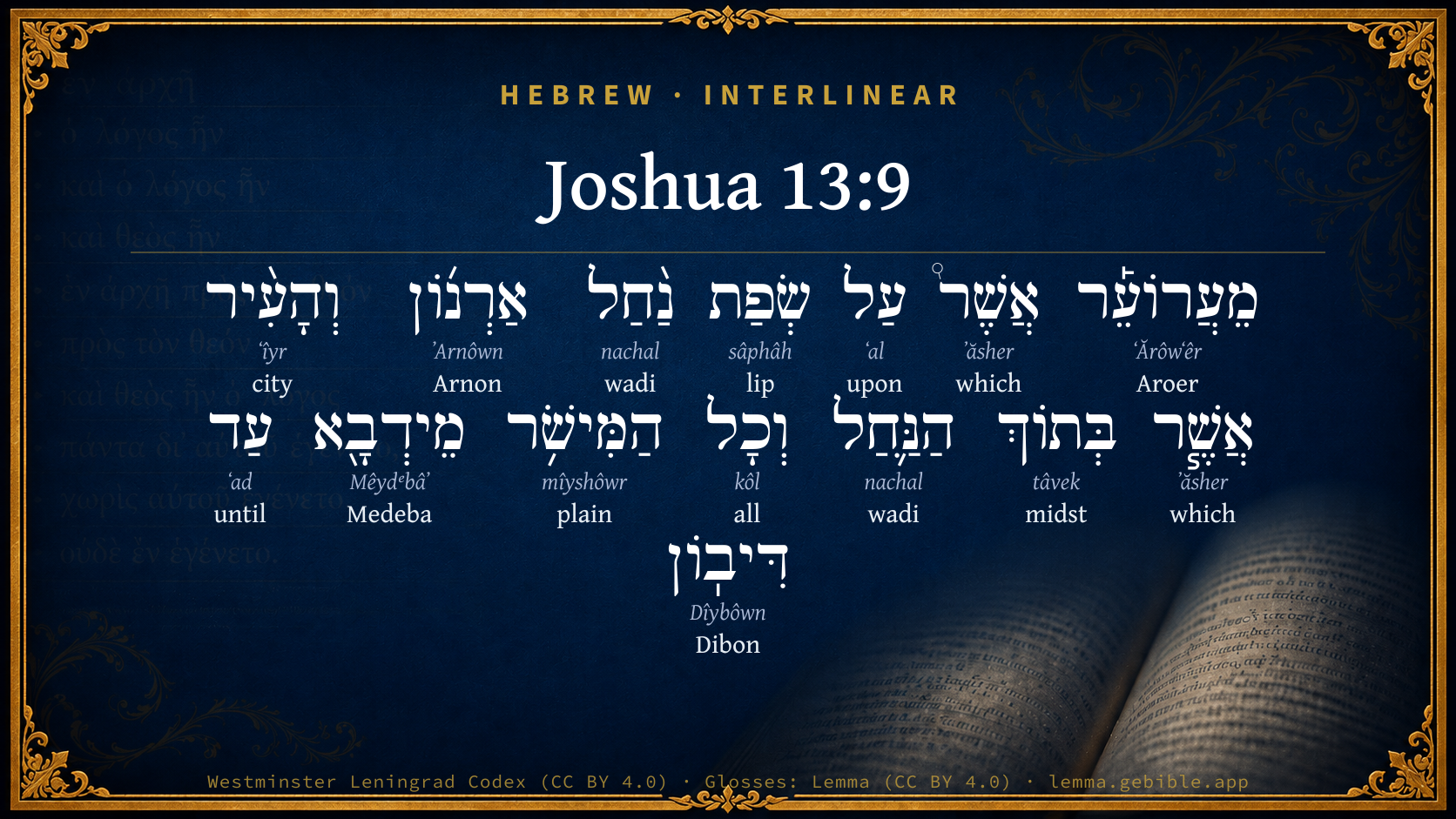
Hebrew (Westminster Leningrad Codex) Joshua 13:9 appears in the Hebrew Old Testament. The text above is from the Westminster Leningrad Codex. Each word links to its Strong’s number, a concise gloss, and parsing drawn from the Open Scriptures Hebrew Bible morphology. Click any word for its full Brown-Driver-Briggs (BDB) entry.
Download image
Cite this verse

Joshua 13:9 (World English Bible). Public Domain. Lemma interlinear Bible study tool, https://lemma.gebible.app/v/joshua/13/9.

Show BibTeX & RIS
BibTeX
RIS
English Translation
from Aroer, that is on the edge of the valley of the Arnon, and the city that is in the middle of the valley, and all the plain of Medeba to Dibon;
World English Bible · Public Domain
Download a study sheet

One document with this verse’s original text, its word-by-word gloss line, the meaning frame, cross-references with their text, attributed commentary, and full source and license credits — printable, and it pastes into notes with its structure intact.

This verse Autodidact and up

Study sheet (.html) Plain text (.txt)

A passage Seminary Student

Up to 50 verses in one chapter. A passage sheet keeps up to 6 commentary sources and 12 cross-references per verse, in the order this page ranks them, and says so on the sheet whenever that leaves anything out. Ask for a single verse and you get the Autodidact verse sheet above.

Everything on this page stays free to read, with no account — the sheet is a download of what is already on screen, not access to it.

Want to remove ads? Support Godless Engineer
Compare translations 3

The same verse in 3 English versions, stacked beneath the original-language interlinear above. Click any original word for its lexicon entry.

Each is an independent rendering of the whole verse — the interlinear is not word-aligned to these translations.

Highlighted words mark where these versions differ — a whole-verse word diff, not a word-by-word alignment.

  • World English Bible Public Domain
    from Aroer, that is on the edge of the valley of the Arnon, and the city that is in the middle of the valley, and all the plain of Medeba to Dibon;
  • King James Version Public Domain
    From Aroer, that is upon the bank of the river Arnon, and the city that is in the midst of the river, and all the plain of Medeba unto Dibon;
  • unfoldingWord Literal Text CC BY-SA 4.0
    from Aroer, which is on the lip of the wadi of Arnon, and the city that in the middle of the wadi, and all of the plateau of Medeba unto Dibon;

unfoldingWord Literal Text — © unfoldingWord, licensed CC BY-SA 4.0. Word-aligned USFM3 via Door43 (git.door43.org/unfoldingWord/en_ult).

Versions to compare (up to 4)

3 of 4 selected

Show all 18 translations

Every available English version of this verse, each an independent rendering of the whole verse.

  • World English Bible Public Domain
    from Aroer, that is on the edge of the valley of the Arnon, and the city that is in the middle of the valley, and all the plain of Medeba to Dibon;
  • Berean Standard Bible Public Domain
    The area from Aroer on the rim of the Arnon Valley, along with the city in the middle of the valley, the whole plateau of Medeba as far as Dibon,
  • Majority Standard Bible Public Domain
    The area from Aroer on the rim of the Arnon Valley, along with the city in the middle of the valley, the whole plateau of Medeba as far as Dibon,
  • King James Version Public Domain
    From Aroer, that is upon the bank of the river Arnon, and the city that is in the midst of the river, and all the plain of Medeba unto Dibon;
  • American Standard Version (1901) Public Domain
    from Aroer, that is on the edge of the valley of the Arnon, and the city that is in the middle of the valley, and all the plain of Medeba unto Dibon;
  • Revised Version (1885) Public Domain
    from Aroer, that is on the edge of the valley of Arnon, and the city that is in the middle of the valley, and all the plain of Medeba unto Dibon;
  • Geneva Bible (1599) Public Domain
    From Aroer that is on the brinke of the riuer Arnon, and from the citie that is in the mids of the riuer, and all the plaine of Medeba vnto Dibon,
  • Douay-Rheims (1899) Public Domain
    From Aroer, which is upon the bank of the torrent Amen, and in the midst of the valley and all the plains of Medaba, as far as Dibon:
  • Young's Literal Translation Public Domain
    from Aroer, which `is' on the edge of the brook Arnon, and the city which `is' in the midst of the brook, and all the plain of Medeba unto Dihon,
  • Literal Standard Version CC BY-SA 4.0
    from Aroer, which [is] on the edge of the Brook of Arnon, and the city which [is] in the midst of the brook, and all the plain of Medeba to Dihon,
  • Unlocked Literal Bible CC BY-SA 4.0
    from Aroer, which is on the edge of the Arnon river gorge (including the city that is in the middle of the gorge), to all the plateau of Medeba as far as Dibon;
  • unfoldingWord Literal Text CC BY-SA 4.0
    from Aroer, which is on the lip of the wadi of Arnon, and the city that in the middle of the wadi, and all of the plateau of Medeba unto Dibon;
  • Darby Bible Public Domain
    from Aroer, which is on the bank of the river Arnon, and the city that is in the midst of the ravine, and all the plateau of Medeba to Dibon,
  • World Messianic Bible Public Domain
    from Aroer, that is on the edge of the valley of the Arnon, and the city that is in the middle of the valley, and all the plain of Medeba to Dibon;
  • Webster's Bible Public Domain
    From Aroer that is upon the bank of the river Arnon, and the city that is in the midst of the river, and all the plain of Medeba to Dibon;
  • Free Bible Version CC BY-SA 4.0
    It stretched from Aroer on the edge of the Arnon valley, from the town in the middle of the valley, and all the plateau of Medeba, up to Dibon;
  • Bible in Basic English Public Domain
    From Aroer, on the edge of the valley of the Arnon, and the town in the middle of the valley, and all the table-land from Medeba to Dibon;
  • JPS Tanakh (1917) Public Domain
    from Aroer, that is on the edge of the valley of Arnon, and the city that is in the middle of the valley, and all the table-land from Medeba unto Dibon;

Literal Standard Version (2020), Covenant Press — licensed CC BY-SA 4.0. Text via the HelloAO Bible API (eBible.org). Unlocked Literal Bible (unfoldingWord) — licensed CC BY-SA 4.0. Text via the HelloAO Bible API (eBible.org). unfoldingWord Literal Text — © unfoldingWord, licensed CC BY-SA 4.0. Word-aligned USFM3 via Door43 (git.door43.org/unfoldingWord/en_ult). Free Bible Version, Dr. Jonathan Gallagher — licensed CC BY-SA 4.0. Text via the HelloAO Bible API (eBible.org).

Word by word

More ways to search: Search by grammar → Find every occurrence → Compare this word →

Practice this passage: Drill this verse → Learn its vocabulary →

מֵידְבָ֖א
Mêydᵉbâʼ
H4311
“Medeba”
Noun, Proper
Part of Speech
Noun
Type
Proper
Full BDB Definition

Origin: from H4325 and H1679

TWOT: None

Medeba = "water of rest" - a town in Moab assigned to Reuben and located 4 miles (6 kilometers) southwest of Heshbon; still extant
  1. מֵעֲרוֹעֵ֡ר ʻĂrôwʻêr H6177 “from · Aroer” Preposition + Noun, Proper
  2. אֲשֶׁר֩ ʼăsher H834 “which” Particle, Relative
  3. עַל ʻal H5921 “upon” Preposition
  4. שְׂפַת sâphâh H8193 “lip of” Noun, Common, Feminine, Singular, Construct
  5. נַ֨חַל nachal H5158 “wadi of” Noun, Common, Masculine, Singular, Construct
  6. אַרְנ֜וֹן ʼArnôwn H769 “Arnon” Noun, Proper
  7. וְהָעִ֨יר ʻîyr H5892 “and · the · city” Conjunction + Particle, Definite Article + Noun, Common, Feminine, Singular, Absolute
  8. אֲשֶׁ֧ר ʼăsher H834 “which” Particle, Relative
  9. בְּתוֹךְ tâvek H8432 “in/at · midst of” Preposition + Noun, Common, Masculine, Singular, Construct
  10. הַנַּ֛חַל nachal H5158 “the · wadi” Particle, Definite Article + Noun, Common, Masculine, Singular, Absolute
  11. וְכָל kôl H3605 “and · all of” Conjunction + Noun, Common, Masculine, Singular, Construct
  12. הַמִּישֹׁ֥ר mîyshôwr H4334 “the · plain” Particle, Definite Article + Noun, Common, Masculine, Singular, Absolute
  13. עַד ʻad H5704 “until” Preposition
  14. דִּיבֽוֹן Dîybôwn H1769 “Dibon” Noun, Proper

About this verse

These counts appear in no published source. They are computed here, from the morphology-tagged text and Lemma’s own curated glosses. What Lemma adds →

15
words
13
distinct lemmas
Historical
section

Notable vocabulary

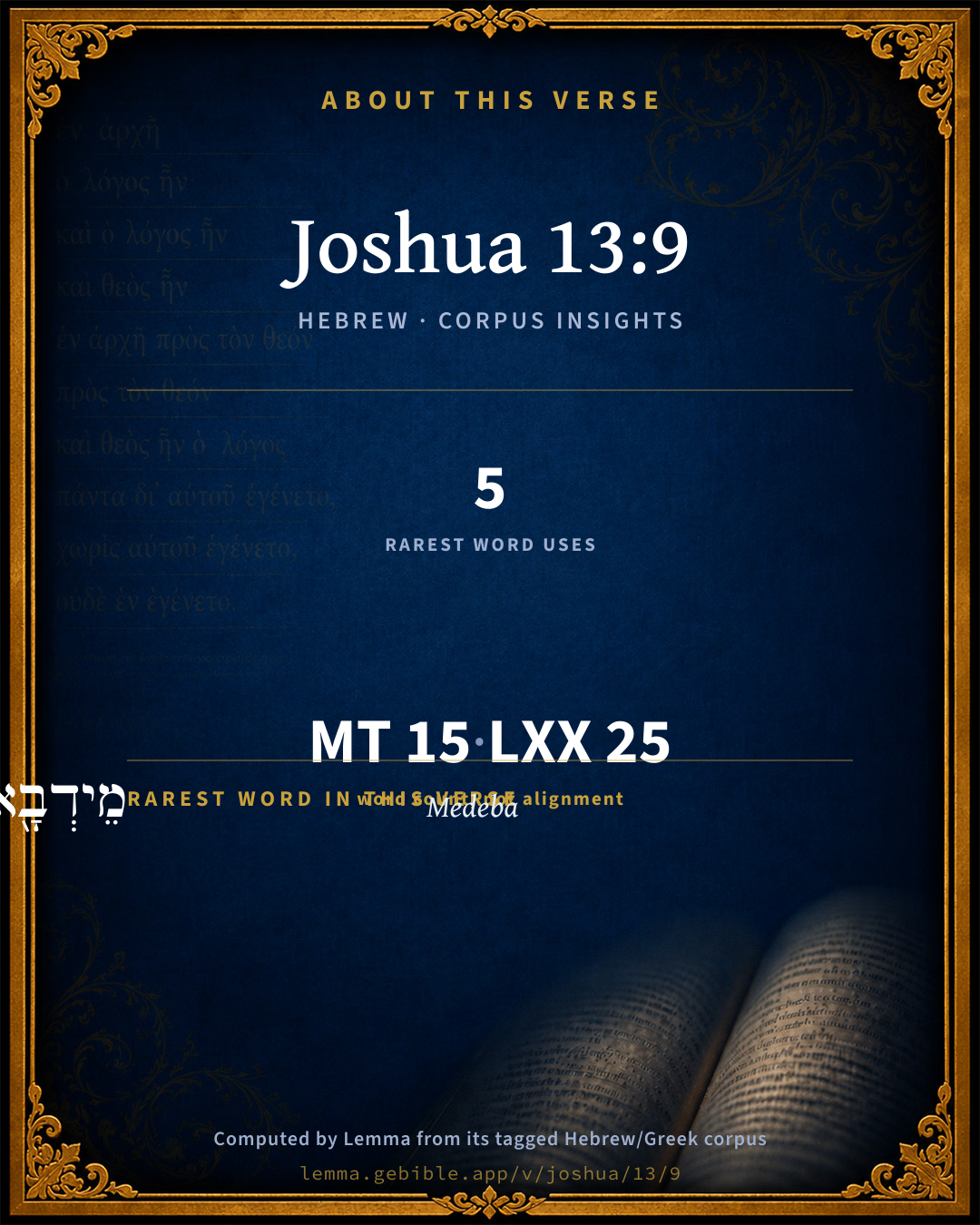
The rarest word here is מֵידְבָ֖א Medeba H4311 — appearing just 5 times in the whole Hebrew Bible.

Shared distinctive vocabulary

מֵידְבָ֖א Medeba H4311 occurs in 5 verses of the Hebrew Bible. Also found in:

Grammatical profile

  • 11 nouns
  • 2 prepositions
  • 2 particles

Repetition

Words recur within this verse — often emphatic in Hebrew:

  • נַ֨חַל wadi H5158 ×2
  • אֲשֶׁר֩ which H834 ×2

Hebrew & Septuagint length

In English translation the verse runs 32 words from the Hebrew and 26 from the Septuagint (LXX English) — closely comparable.

A rough comparison of the two English renderings, which tokenize alike — not a word-level alignment.

Word counts can differ between the Hebrew and the Greek without any difference in meaning — e.g. the Hebrew direct-object marker אֵת has no separate Greek word, and Greek often adds the article ὁ.

In the original languages it is 15 Hebrew tokens and 25 Greek tokens — but the two are counted differently (Hebrew bundles its prefixes and suffixes into one token; the Greek is in lemma form), so that isn’t a like-for-like length.

Cross-references

8

Topical passages linked to Joshua 13:9 in the Treasury of Scripture Knowledge — connected by theme and wording, ordered by reader-vote popularity; previews shown in the World English Bible.

  • Numbers 21:30 We have shot at them; Heshbon is perished even to Dibon, We have laid waste even to Nophah, Which [reaches] to Medeba.
  • Joshua 13:16 Their border was from Aroer, that is on the edge of the valley of the Arnon, and the city that is in the middle of the valley, and all the plain by Medeba;
  • Deuteronomy 3:12 This land we took in possession at that time: from Aroer, which is by the valley of the Arnon, and half the hill-country of Gilead, and the cities of it, gave I to the Reubenites and to the Gadites:
  • Deuteronomy 3:16 To the Reubenites and to the Gadites I gave from Gilead even to the valley of the Arnon, the middle of the valley, and the border [of it], even to the river Jabbok, which is the border of the children of Ammon;
  • Joshua 12:2 Sihon king of the Amorites, who lived in Heshbon, and ruled from Aroer, which is on the edge of the valley of the Arnon, and [the city that is in] the middle of the valley, and half Gilead, even to the river Jabbok, the border of the children of Ammon;
  • Isaiah 15:2 They are gone up to Bayith, and to Dibon, to the high places, to weep: Moab wails over Nebo, and over Medeba; on all their heads is baldness, every beard is cut off.
  • Jeremiah 48:18 You daughter who dwells in Dibon, come down from your glory, and sit in thirst; for the destroyer of Moab is come up against you, he has destroyed your strongholds.
  • Jeremiah 48:22 and on Dibon, and on Nebo, and on Beth Diblathaim,

Cross-references courtesy of OpenBible.info (CC BY 4.0).

Hebrew and Greek witnesses Masoretic Hebrew ↔ Greek Septuagint

The same verse in the two great witnesses to the Old Testament, shown verse-for-verse.

These are two independent witnesses, not word-aligned to each other, and the Septuagint is shown in lemma (dictionary) form.

Hebrew Joshua 13:9 Masoretic · Westminster Leningrad Codex

מֵעֲרוֹעֵ֡ר אֲשֶׁר֩ עַל שְׂפַת נַ֨חַל אַרְנ֜וֹן וְהָעִ֨יר אֲשֶׁ֧ר בְּתוֹךְ הַנַּ֛חַל וְכָל הַמִּישֹׁ֥ר מֵידְבָ֖א עַד דִּיבֽוֹן

from Aroer, that is on the edge of the valley of the Arnon, and the city that is in the middle of the valley, and all the plain of Medeba to Dibon;

World English Bible · Public Domain

Greek LXX Joshua 13:9 Septuagint · lemma form

ἀπό αροηρ ὅς εἰμί ἐπί ὁ χεῖλος χειμάροος αρνων καί ὁ πόλις ὁ ἐν μέσος ὁ φάραγξ καί πᾶς ὁ μισωρ ἀπό μαιδαβα ἕως δαιβαν

from Aroer, which is on the bank of the brook of Arnon, and the city in the midst of the valley, and all Misor from Maedaban.

LXX2012 (modern English Septuagint) · Public Domain

Hebrew: Westminster Leningrad Codex (CC BY 4.0). Greek: Septuagint (public domain); English from LXX2012 (modern English Septuagint) (Public Domain). How the Septuagint differs from the Hebrew →

Targum (Aramaic paraphrase)

1

The Targum is the ancient Jewish Aramaic paraphrase of the Hebrew Scriptures — an interpretive translation, not the Hebrew text itself. Onkelos (literal) and Pseudo-Jonathan (expansive) render the Torah, and Jonathan the Prophets. Coverage is partial: where no permissively-licensed English translation exists for a verse, only the Aramaic is shown. This is verse-level text, not a word-by-word alignment to the Hebrew.

  1. Targum Jonathan Prophets (Joshua–Malachi)
    מֵעֲרוֹעֵר דְעַל כֵּיף נַחֲלָא דְאַרְנוֹן וְקַרְתָּא דִי בְגוֹ נַחֲלָא וְכָל מֵישַׁר מֵידְבָא עַד דִיבוֹן:

    (no public-domain English translation for this verse)

    Targum Jonathan — Aramaic: “Mikraot Gedolot” (public domain). English: “Sefaria Community Translation” (CC0 1.0 (public-domain dedication)); “London "Chaldee Paraphrase," 1871” (public domain). Text via Sefaria.

Commentary

Notes on Joshua 13:9 from classic Christian and Jewish commentators (each source and its license shown beneath its notes). The classic Christian expositions comment on the surrounding passage and are grouped to its opening verse, so a note may address several verses; the Jewish commentaries on the Tanakh (Rashi and others) are per-verse, so they appear only where the commentator wrote on this verse.

Lemma curates 59 commentaries, every one of them public domain or Creative Commons licensed, each selected and text-cleaned for this edition rather than reprinted as found. About our sources →

Trapp's Complete Commentary

John Trapp

Jos 13:9 From Aroer, that [is] upon the bank of the river Arnon, and the city that [is] in the midst of the river, and all the plain of Medeba unto Dibon;

Ver. 9. From Aroer, that is upon the bank.] Besides which, it may seem there was another Aroer, in the midst of the river, {Isa 17:2} as Venice in the midst of the sea, and taking for her motto,

“ Media insuperabilis unda. ”

John Trapp, A Commentary or Exposition upon All the Books of the Old and New Testament (1647–1656) — public domain. Text from a community e-Sword module.

Joseph Benson's Commentary

Jos 13:9-11. The city that is in the midst of the river — Some interpreters render this clause, The city in the midst of the valley; judging that, as Arnon was but a small brook, it could hardly have a city, or an island large enough for a city to be built on, in the midst of it. But certainly a city might be built on ground lying between two streams of the same river: see on Jos 12:2. Medeba unto Dibon — Two cities anciently belonging to the Moabites, and taken from them by the Amorites, (Num 21:30,) and from them by the Israelites; and, after the Israelites were gone into captivity, recovered by the first possessors, the Moabites. And Maachathites — Whose land God had given to the Israelites without Jordan, though they had not yet used the gift of God, nor taken possession of it, as is noted, Jos 13:13.

Joseph Benson's Commentary on the Old and New Testaments (1811–1818) — public domain. Text from a community e-Sword module.

The Pulpit Commentary

Aroer. Three, or even four, cities of this name were known, and have been identified by modern travellers under names somewhat similar.

1. Aroer upon Aruon, on the north bank of that river, at the extreme south of the territory of Reuben. (see Deu_2:36 Deu_3:12 Deu_4:48 Jos_12:2 Jos_13:9, Jos_13:16; and probably Jer_48:19)

2. Aroer in Gad, (Jos_13:25) described there as "before," i.e., on the way to "Rabbah." It was no doubt some short distance to the westward of this chief city of the Ammonites (see also Num_32:34, where the Gadites are said to have built it). These two are probably the "cities of Aroer" referred to in Isa_17:2 (but see next note but one, where also 2Sa_24:5 will be discussed).

3. A city in Judah. (1Sa_30:28) To one of these cities probably belonged Shammah or Shammoth, the Hararite or Harorite. (2Sa_23:11; he is called Harodite in ver. 25, and 1Ch_11:27) The river Arnon. (see note on Jos_12:2) The city that is in the midst of the river. This city (or perhaps cities) has received but little attention from commentators, probably by reason of its bearing no name. Those who have tried to identify it have failed In Deu_2:36, in this passage, and in 2Sa_24:5, it is mentioned in connection with Aroer. In Jos_7:2, instead of "the city that is in the midst of the river," we find simply "the middle ( of the river." But as 2Sa_24:5 stands in our version, the city referred to stood in the middle of the river of Gad. This would suggest the idea that the old derivation of Aroer by Wells and others from the word ryi (city) doubled, with the signification of the double city, is nearer the mark than that of wasteness, or desolateness, or nakedness, as of a region bare of trees, which has found favour of late, and it is not without support in Hebrew forms. A city, moreover, in the midst of or "on the brink of" a winter torrent would be less likely to be waste or desolate than in other situations. But we are not yet at the end of our difficulties. The word Nahal, which comes before Gad in the passage of which we are now speaking, has the article. Thus the translation, "river of Gad" cannot be maintained. And besides, the enumeration of the people must have begun at the Arnon, or southern border of Israel beyond Jordan. It is possible that the text may be corrupt here, as it is in other parts of 2 Samuel, and possibly the meaning may be that the officers pitched in Aroer, passed through Reuben, and having come within the confines of Gad arrived at Jazer. This again is rendered doubtful by the close connection of Aroer and Jazer in Jos_13:25. It is of course, therefore, possible that the reference in 2Sa 24 is to the Jabbok, not the Arnon ravine. A question, of such intricacy can only be Settled, if settled at all, by an investigation on. the spot. The plain. The word here is rwOvymi. This derived from the root rvy signifies level ground, and is applied to the region north of Moab, especially that part of it which belonged to Reuben. Flat, and almost unbroken, even by trees, it was particularly adapted for grazing land (see also note above, and on ver. 4). Medeba. This is mentioned in Scripture, together with Dibon, as here in Num_21:30 Isa_15:2. It was on the level ground before mentioned (see Gesenius, s.v. rwOvymi). Dibon. (see Jer_48:18, Jer_48:22, called Dimon in Isa_15:9; but Dibon in Isa_15:2; see also Num_33:45, Num_33:46) It was one of the cities built by the children of Num_32:34. It is now called Dhiban, and is a short distance north of the Arnon. The Moabite stone, found at Dibon in 1868, mentions the occupation of Medeba by Omri, and implies that Dibon, the principal city in those parts, was also subject to him, but recovered finally by Mesha.

The Pulpit Commentary (1880–1919), ed. H.D.M. Spence-Jones & Joseph S. Exell — public domain. Text from a community e-Sword module.

Geneva Bible (1599)

Geneva Bible translators

Or, valley.

Geneva Bible (1599) marginal notes — public domain. Text via Bolls.life.

Adam Clarke's Commentary

Verse 9. From Aroer] See Clarke on Jos 12:2.

Adam Clarke's Commentary on the Bible (1810–1826) — public domain. Text from a community e-Sword/MySword module.

The Cambridge Bible for Schools and Colleges

gen. ed. J. J. S. Perowne

9. and all the plain of Medeba] Instead of “half Gilead,” as in ch. Jos_12:2, we have here “all the plain (= Mishor = “table-land” or “downs”) of Medeba unto Dibon,” “the wijld feeldis of Medeba,” Wyclif. Medeba is first mentioned in the fragment of a populare song of the time of the conquest, Num_21:30, “Heshbon is perished even unto Dibon, and we have laid them waste even unto Nophah, which reacheth unto Medeba.” It is in the pastoral district of the Belka, four miles S. E. of Heshbon, and like it lying on a rounded but rocky hill. In Christian times it was a noted bishopric of the patriarchate of Becerra. Dibon, or Dibon-Gad, from its being taken possession of and rebuilt by the children of Gad (Num_32:3; Num_32:34), or Dimon (in Isa_15:9), has been discovered with the name Dhiban on the Roman road three miles north of the Arnon (Wady el-Mojeb). Here the inscribed block of basalt, known as “the Moabite stone,” was discovered in 1868.

The Cambridge Bible for Schools and Colleges (gen. ed. J. J. S. Perowne; Cambridge University Press, 1878–1918) — public domain. Text from a community e-Sword module.

John Gill's Exposition

From Aroer, that is on the bank of the river Arnon,.... A city belonging to Moab, from whence the description begins, the river Arnon, on which it was situated, being the border between Moab and the Amorites, Num 21:13,

and the city that is in the midst of the river; or "even the city"; meaning the same city of Aroer, it lying both on the bank of it, and in the middle of it, or it was a double city, as may seem from Isa 17:2; and so differently situated at that river:

and all the plains of Medeba unto Dibon; of these two places, see Num 21:30; between them lay a plain, which some take to be the plain of Moab; but it rather seems to be a plain that was between these two places, and, according to Jos 13:17, Dibon itself was in a plain.

John Gill's Exposition of the Whole Bible (1746–1763) — public domain (CC PDM 1.0). Text via the HelloAO Bible API.

Haydock's Catholic Bible Commentary

Aroer, and part of the town of Dibon, belonged to Gad, Numbers xxxii. 34.

George Leo Haydock (1774–1849), Haydock's Catholic Family Bible and Commentary, 1859 edition — public domain. Excludes Psalms (Douay-Rheims chapter numbering differs from Protestant) and Deuterocanonical books (Catholic canon only).

Matthew Poole's English Annotations

The city that is in the midst of the river; of which see Poole "Deu 3:16", and see Poole "Jos 12:2". Either this is the same city now mentioned, even Aroer, which is said to have been a double city, as the very name seems to import, whereof one part was on the bank of the river, and the other in the middle of it, whence we read of the cities of Aroer, Isa 17:2; or it is another city, possibly Ar, as it is elsewhere named.

Medeba and

Dibon; two cities anciently belonging to the Moabites, and taken from them by the Amorites, Num 21:30, and from them by the Israelites; and after the Israelites were gone into captivity, recovered by the first possessors the Moabites, as may seem from Isa 15:2.

Matthew Poole's English Annotations on the Holy Bible (1683–1685) — public domain. Text from a community e-Sword/MySword module.

Whedon's Commentary on the Bible

Daniel D. Whedon

9-12. On the places named in these verses see the notes on Jos_13:16-31, where the tribal territories are fully described.

Daniel D. Whedon (gen. ed.), Commentary on the Old and New Testaments (1874–1909) — public domain. Text from a community e-Sword module.

John Wesley's Explanatory Notes

Medeba unto Dibon - Two cities anciently belonging to the Moabites, and taken from them by the Amorites, Num. xxi, 30, and from them by the Israelites; and after the Israelites were gone into captivity, recovered by the first possessors, the Moabites.

John Wesley, Explanatory Notes Upon the Whole Bible (1754–1765) — public domain. Text via the GEBible commentary corpus.

Rashi

Rabbi Shlomo Yitzchaki (Rashi)

From Aroreir, which is on the bank etc. He procedes to describe the entire land on the other side of the Jordan. Then he explains the boundry of each tribe; [as stated], “And Moshe gave” —i.e., he gave to each tribe [their territory].

Rashi on the Tanakh — English translations: “The Judaica Press complete Tanach with Rashi, translated by A. J. Rosenberg” (CC BY 4.0); “Pentateuch with Rashi's commentary by M. Rosenbaum and A.M. Silbermann, 1929-1934” (public domain); “The Metsudah Tanach series, Lakewood, N.J” (CC BY 4.0); and “The Book of Joshua, Metsudah Publications, 1997” (CC BY 4.0). Text via Sefaria.

Lesson kit

Teaching starters — assembled from the data on this page, not authored interpretation. Every prompt links to the verse data it draws on. Edit before teaching.

Joshua, in the Historical, opens this verse with 15 words (13 distinct Hebrew lemmas). Its most distinctive word is Mêydᵉbâʼ (“Medeba”). A historical commentator’s framing appears above. Read the whole chapter for the surrounding context.

Discussion questions

  1. What does “Medeba” (Mêydᵉbâʼ) contribute to the verse as a whole?
  2. How does Numbers 21:30, which shares the word «Medeba», read alongside this verse?
  3. What does the repetition of “wadi” (2× in this one verse) do in this verse?
  4. These translations render this verse differently; the difference is in the English rendering, not the original. What questions does that raise?
  5. Compare how Trapp's Complete Commentary and Joseph Benson's Commentary read this verse. Where do they agree or differ?

Things to notice

Reading settings

Reading text

Shown beneath each verse's original-language words.

Old Testament
Old Testament edition

Read the OT as the Masoretic Hebrew (MT) or the Greek Septuagint (LXX).

English shown for the Greek Septuagint (in the Hebrew ↔ Greek comparison).

Comparing translations? Open the Compare panel on any verse page to stack up to four side by side.