
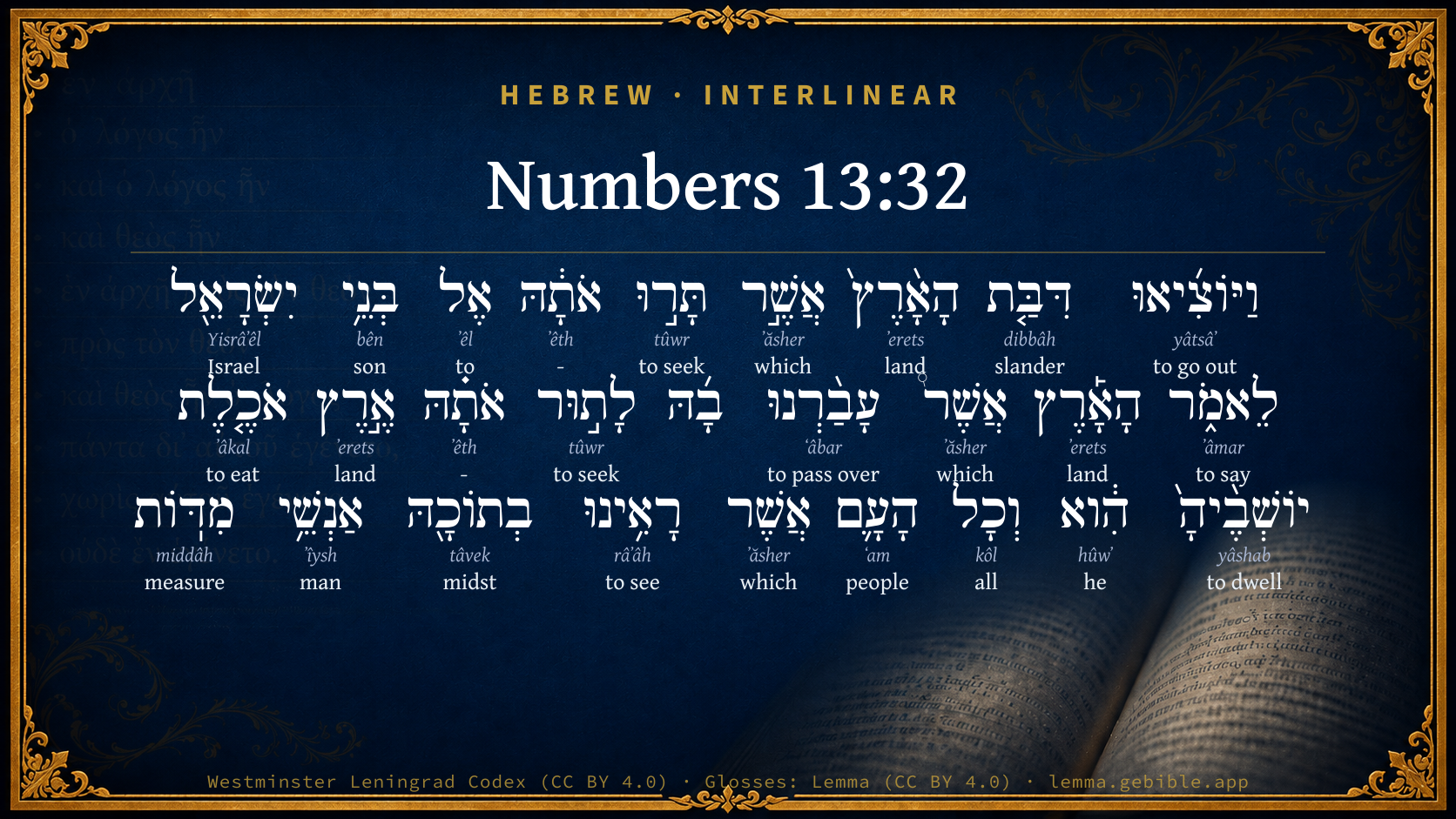
Numbers 13:32

Hebrew (Westminster Leningrad Codex) Numbers 13:32 appears in the Hebrew Old Testament. The text above is from the Westminster Leningrad Codex. Each word links to its Strong’s number, a concise gloss, and parsing drawn from the Open Scriptures Hebrew Bible morphology. Click any word for its full Brown-Driver-Briggs (BDB) entry.
Download image
Cite this verse

Numbers 13:32 (World English Bible). Public Domain. Lemma interlinear Bible study tool, https://lemma.gebible.app/v/numbers/13/32.

Show BibTeX & RIS
BibTeX
RIS
English Translation
They brought up an evil report of the land which they had spied out to the children of Israel, saying, The land, through which we have gone to spy it out, is a land that eats up the inhabitants of it; and all the people who we saw in it are men of great stature.
World English Bible · Public Domain
Download a study sheet

One document with this verse’s original text, its word-by-word gloss line, the meaning frame, cross-references with their text, attributed commentary, and full source and license credits — printable, and it pastes into notes with its structure intact.

This verse Autodidact and up

Study sheet (.html) Plain text (.txt)

A passage Seminary Student

Up to 50 verses in one chapter. A passage sheet keeps up to 6 commentary sources and 12 cross-references per verse, in the order this page ranks them, and says so on the sheet whenever that leaves anything out. Ask for a single verse and you get the Autodidact verse sheet above.

Everything on this page stays free to read, with no account — the sheet is a download of what is already on screen, not access to it.

Want to remove ads? Support Godless Engineer
Compare translations 3

The same verse in 3 English versions, stacked beneath the original-language interlinear above. Click any original word for its lexicon entry.

Each is an independent rendering of the whole verse — the interlinear is not word-aligned to these translations.

Highlighted words mark where these versions differ — a whole-verse word diff, not a word-by-word alignment.

  • World English Bible Public Domain
    They brought up an evil report of the land which they had spied out to the children of Israel, saying, The land, through which we have gone to spy it out, is a land that eats up the inhabitants of it; and all the people who we saw in it are men of great stature.
  • King James Version Public Domain
    And they brought up an evil report of the land which they had searched unto the children of Israel, saying, The land, through which we have gone to search it, is a land that eateth up the inhabitants thereof; and all the people that we saw in it are men of a great stature.
  • unfoldingWord Literal Text CC BY-SA 4.0
    And they brought out a bad report of the land that they explored to the sons of Israel, saying, “The land through which we passed to explore it, it a land eating the ones dwelling in it. And all the people whom we saw in the midst of it men of size,

unfoldingWord Literal Text — © unfoldingWord, licensed CC BY-SA 4.0. Word-aligned USFM3 via Door43 (git.door43.org/unfoldingWord/en_ult).

Versions to compare (up to 4)

3 of 4 selected

Show all 18 translations

Every available English version of this verse, each an independent rendering of the whole verse.

  • World English Bible Public Domain
    They brought up an evil report of the land which they had spied out to the children of Israel, saying, The land, through which we have gone to spy it out, is a land that eats up the inhabitants of it; and all the people who we saw in it are men of great stature.
  • Berean Standard Bible Public Domain
    So they gave the Israelites a bad report about the land that they had spied out: “The land we explored devours its inhabitants, and all the people we saw there are great in stature.
  • Majority Standard Bible Public Domain
    So they gave the Israelites a bad report about the land that they had spied out: “The land we explored devours its inhabitants, and all the people we saw there are great in stature.
  • King James Version Public Domain
    And they brought up an evil report of the land which they had searched unto the children of Israel, saying, The land, through which we have gone to search it, is a land that eateth up the inhabitants thereof; and all the people that we saw in it are men of a great stature.
  • American Standard Version (1901) Public Domain
    And they brought up an evil report of the land which they had spied out unto the children of Israel, saying, The land, through which we have gone to spy it out, is a land that eateth up the inhabitants thereof; and all the people that we saw in it are men of great stature.
  • Revised Version (1885) Public Domain
    And they brought up an evil report of the land which they had spied out unto the children of Israel, saying, The land, through which we have gone to spy it out, is a land that eateth up the inhabitants thereof; and all the people that we saw in it are men of great stature.
  • Geneva Bible (1599) Public Domain
    But the men, that went vp with him, saide, we be not able to goe vp against the people: for they are stronger then we.
  • Douay-Rheims (1899) Public Domain
    But the others, that had been with him, said: No, we are not able to go up to this people, because they are stronger than we.
  • Young's Literal Translation Public Domain
    and they bring out an evil account of the land which they have spied unto the sons of Israel, saying, `The land into which we passed over to spy it, is a land eating up its inhabitants; and all the people whom we saw in its midst `are' men of stature;
  • Literal Standard Version CC BY-SA 4.0
    and they bring out an evil account of the land which they have spied out to the sons of Israel, saying, “The land into which we passed over to spy it out is a land eating up its inhabitants; and all the people whom we saw in its midst [are] men of stature;
  • Unlocked Literal Bible CC BY-SA 4.0
    So they spread around a discouraging report to the people of Israel about the land that they had examined. They said, “The land that we looked at is a land that eats up its inhabitants. All the people whom we saw there are people of great height.
  • unfoldingWord Literal Text CC BY-SA 4.0
    And they brought out a bad report of the land that they explored to the sons of Israel, saying, “The land through which we passed to explore it, it a land eating the ones dwelling in it. And all the people whom we saw in the midst of it men of size,
  • Darby Bible Public Domain
    And they brought to the children of Israel an evil report of the land which they had searched out, saying, The land, which we have passed through to search it out, is a land that eateth up its inhabitants; and all the people that we have seen in it are men of great stature;
  • World Messianic Bible Public Domain
    They brought up an evil report of the land which they had spied out to the children of Israel, saying, “The land, through which we have gone to spy it out, is a land that eats up its inhabitants; and all the people who we saw in it are men of great stature.
  • Webster's Bible Public Domain
    And they brought an evil report of the land which they had searched to the children of Israel, saying, The land through which we have passed to search it, is a land that eateth up its inhabitants; and all the people that we saw in it, are men of a great stature.
  • Free Bible Version CC BY-SA 4.0
    They spread a negative report among the Israelites about the country they had explored. They told people, “The country we explored destroys the people that live there. Plus everyone we saw was really big!
  • Bible in Basic English Public Domain
    And they gave the children of Israel a bad account of the land they had been to see, saying, This land through which we went is a land causing destruction to those living in it; and all the people we saw there are men of more than common size.
  • JPS Tanakh (1917) Public Domain
    And they spread an evil report of the land which they had spied out unto the children of Israel, saying: 'The land, through which we have passed to spy it out, is a land that eateth up the inhabitants thereof; and all the people that we saw in it are men of great stature.

Literal Standard Version (2020), Covenant Press — licensed CC BY-SA 4.0. Text via the HelloAO Bible API (eBible.org). Unlocked Literal Bible (unfoldingWord) — licensed CC BY-SA 4.0. Text via the HelloAO Bible API (eBible.org). unfoldingWord Literal Text — © unfoldingWord, licensed CC BY-SA 4.0. Word-aligned USFM3 via Door43 (git.door43.org/unfoldingWord/en_ult). Free Bible Version, Dr. Jonathan Gallagher — licensed CC BY-SA 4.0. Text via the HelloAO Bible API (eBible.org).

Word by word

More ways to search: Search by grammar → Find every occurrence → Compare this word →

Practice this passage: Drill this verse → Learn its vocabulary →

דִּבַּ֤ת
dibbâh
H1681
“slander of”
Noun, Common, Feminine, Singular, Construct
Part of Speech
Noun
Type
Common
Gender
Feminine
Number
Singular
State
Construct
Full BDB Definition

Origin: from H1680 (in the sense of furtive motion)

TWOT: 396b

whispering, defamation, evil report - whispering - defamation, defaming - evil report, unfavourable saying
  1. וַיּוֹצִ֜יאוּ yâtsâʼ H3318 “and · to go out” Conjunction + Verb, Hiphil, Sequential Imperfect, 3rd Person, Masculine, Plural
  2. הָאָ֨רֶץ֙ ʼerets H776 “the · land” Particle, Definite Article + Noun, Common, Both, Singular, Absolute
  3. אֲשֶׁ֣ר ʼăsher H834 “which” Particle, Relative
  4. תָּר֣וּ tûwr H8446 “to seek” Verb, Qal, Perfect, 3rd Person, Common, Plural
  5. אֹתָ֔הּ ʼêth H853 “- · her” Particle, Direct Object + Suffix, Personal, 3rd Person, Feminine, Singular
  6. אֶל ʼêl H413 “to” Preposition
  7. בְּנֵ֥י bên H1121 “sons of” Noun, Common, Masculine, Plural, Construct
  8. יִשְׂרָאֵ֖ל Yisrâʼêl H3478 “Israel” Noun, Proper
  9. לֵאמֹ֑ר ʼâmar H559 “to say” Preposition + Verb, Qal, Infinitive Construct
  10. הָאָ֡רֶץ ʼerets H776 “the · land” Particle, Definite Article + Noun, Common, Both, Singular, Absolute
  11. אֲשֶׁר֩ ʼăsher H834 “which” Particle, Relative
  12. עָבַ֨רְנוּ ʻâbar H5674 “to pass over” Verb, Qal, Perfect, 1st Person, Common, Plural
  13. לָת֣וּר tûwr H8446 “to seek” Preposition + Verb, Qal, Infinitive Construct
  14. אֹתָ֗הּ ʼêth H853 “- · her” Particle, Direct Object + Suffix, Personal, 3rd Person, Feminine, Singular
  15. אֶ֣רֶץ ʼerets H776 “land” Noun, Common, Both, Singular, Absolute
  16. אֹכֶ֤לֶת ʼâkal H398 “eating” Verb, Qal, Participle Active, Feminine, Singular, Absolute
  17. יוֹשְׁבֶ֨יהָ֙ yâshab H3427 “dwelling · her” Verb, Qal, Participle Active, Masculine, Plural, Construct + Suffix, Personal, 3rd Person, Feminine, Singular
  18. הִ֔וא hûwʼ H1931 “he” Pronoun, Personal, 3rd Person, Feminine, Singular
  19. וְכָל kôl H3605 “and · all of” Conjunction + Noun, Common, Masculine, Singular, Construct
  20. הָעָ֛ם ʻam H5971 “the · people” Particle, Definite Article + Noun, Common, Masculine, Singular, Absolute
  21. אֲשֶׁר ʼăsher H834 “which” Particle, Relative
  22. רָאִ֥ינוּ râʼâh H7200 “to see” Verb, Qal, Perfect, 1st Person, Common, Plural
  23. בְתוֹכָ֖הּ tâvek H8432 “in/at · midst · her” Preposition + Noun, Common, Masculine, Singular, Construct + Suffix, Personal, 3rd Person, Feminine, Singular
  24. אַנְשֵׁ֥י ʼîysh H376 “men of” Noun, Common, Masculine, Plural, Construct
  25. מִדּֽוֹת middâh H4060 “measures” Noun, Common, Feminine, Plural, Absolute

About this verse

These counts appear in no published source. They are computed here, from the morphology-tagged text and Lemma’s own curated glosses. What Lemma adds →

27
words
20
distinct lemmas
Pentateuch
section

Notable vocabulary

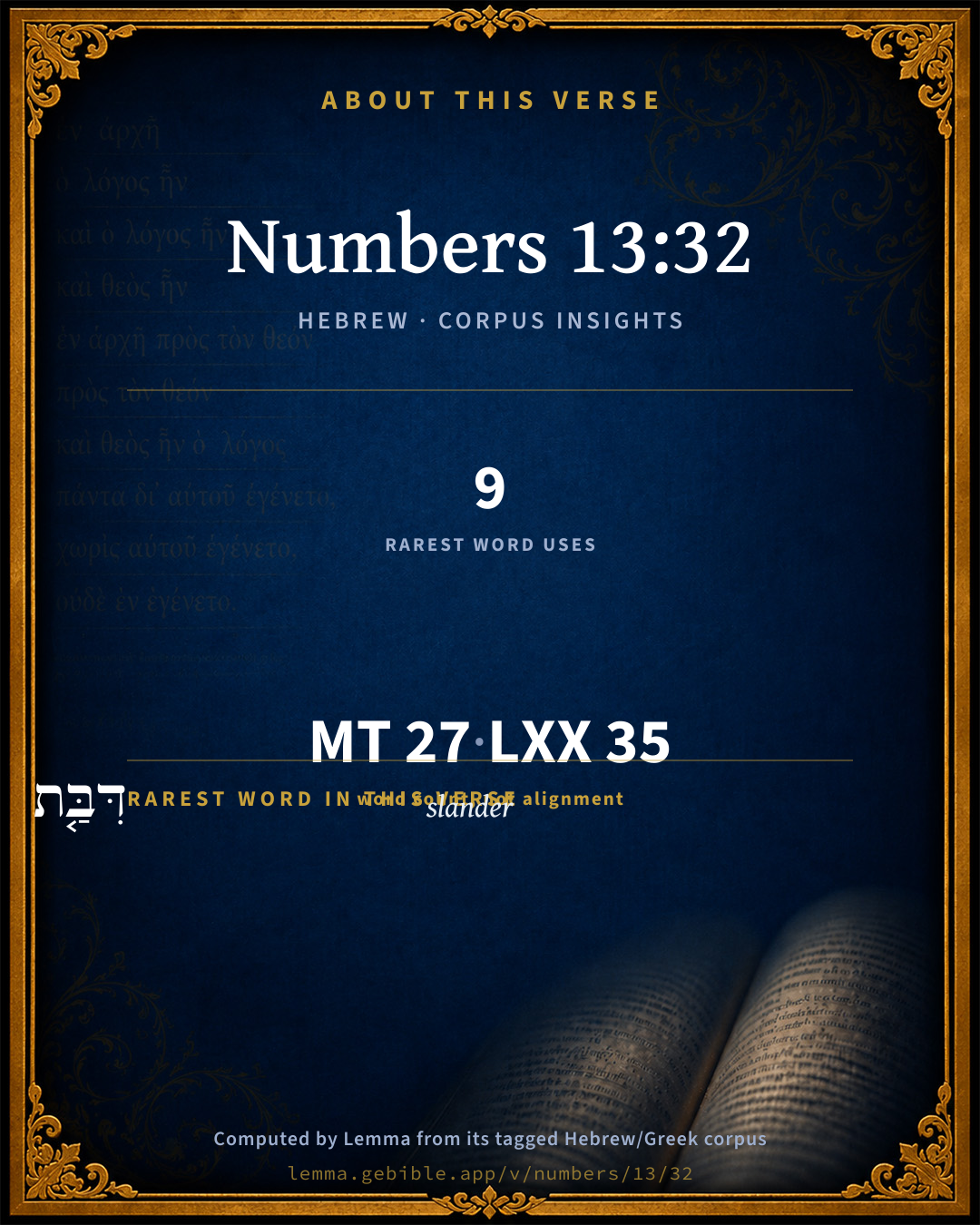
The rarest word here is דִּבַּ֤ת slander H1681 — appearing just 9 times in the whole Hebrew Bible.

Shared distinctive vocabulary

דִּבַּ֤ת slander H1681 occurs in 9 verses of the Hebrew Bible. Also found in:

Grammatical profile

  • 8 verbs
  • 11 nouns
  • 1 pronoun
  • 2 prepositions
  • 5 particles

Verb forms

  • וַיּוֹצִ֜יאוּ Hiphil · Sequential Imperfect
  • תָּר֣וּ Qal · Perfect
  • לֵאמֹ֑ר Qal · Infinitive Construct
  • עָבַ֨רְנוּ Qal · Perfect
  • לָת֣וּר Qal · Infinitive Construct
  • אֹכֶ֤לֶת Qal · Participle Active
  • יוֹשְׁבֶ֨יהָ֙ Qal · Participle Active
  • רָאִ֥ינוּ Qal · Perfect

Repetition

Words recur within this verse — often emphatic in Hebrew:

  • הָאָ֨רֶץ֙ land H776 ×3
  • תָּר֣וּ to seek H8446 ×2
  • אֲשֶׁ֣ר which H834 ×3

Hebrew & Septuagint length

In English translation the verse runs 55 words from the Hebrew and 37 from the Septuagint (LXX English) — the Septuagint runs noticeably shorter here. See the side-by-side →

A rough comparison of the two English renderings, which tokenize alike — not a word-level alignment.

Word counts can differ between the Hebrew and the Greek without any difference in meaning — e.g. the Hebrew direct-object marker אֵת has no separate Greek word, and Greek often adds the article ὁ.

In the original languages it is 27 Hebrew tokens and 35 Greek tokens — but the two are counted differently (Hebrew bundles its prefixes and suffixes into one token; the Greek is in lemma form), so that isn’t a like-for-like length.

Cross-references

8

Topical passages linked to Numbers 13:32 in the Treasury of Scripture Knowledge — connected by theme and wording, ordered by reader-vote popularity; previews shown in the World English Bible.

  • Amos 2:9 Yet I destroyed the Amorite before them, Whose height was like the height of the cedars, And he was strong as the oaks; Yet I destroyed his fruit from above, and his roots from beneath.
  • Numbers 14:36–37 The men, whom Moses sent to spy out the land, who returned, and made all the congregation to murmur against him, by bringing up an evil report against the land,
  • Ezekiel 36:13–14 Thus says the Lord Yahweh: Because they say to you, You [land] are a devourer of men, and have been a bereaver of your nation;
  • Matthew 23:13 "Woe to you, scribes and Pharisees, hypocrites! For you devour widows' houses, and as a pretense you make long prayers. Therefore you will receive greater condemnation.
  • Deuteronomy 1:28 Where are we going up? our brothers have made our heart to melt, saying, The people are greater and taller than we; the cities are great and fortified up to the sky; and moreover we have seen the sons of the Anakim there.
  • 2 Samuel 21:20 There was again war at Gath, where was a man of great stature, who had on every hand six fingers, and on every foot six toes, four and twenty in number; and he also was born to the giant.
  • Numbers 13:28 However the people who dwell in the land are strong, and the cities are fortified, [and] very great: and moreover we saw the children of Anak there.
  • 1 Chronicles 20:6 There was again war at Gath, where was a man of great stature, whose fingers and toes were twenty-four, six [on each hand], and six [on each foot]; and he also was born to the giant.

Cross-references courtesy of OpenBible.info (CC BY 4.0).

Hebrew and Greek witnesses Masoretic Hebrew ↔ Greek Septuagint

The same verse in the two great witnesses to the Old Testament, shown verse-for-verse.

Here the Septuagint runs noticeably shorter than the Hebrew — LXX2012 (modern English Septuagint) 37 words vs World English Bible 55. A rough length comparison of the two English translations, not a word-level alignment — read both below.

These are two independent witnesses, not word-aligned to each other, and the Septuagint is shown in lemma (dictionary) form.

Hebrew Numbers 13:32 Masoretic · Westminster Leningrad Codex

וַיּוֹצִ֜יאוּ דִּבַּ֤ת הָאָ֨רֶץ֙ אֲשֶׁ֣ר תָּר֣וּ אֹתָ֔הּ אֶל בְּנֵ֥י יִשְׂרָאֵ֖ל לֵאמֹ֑ר הָאָ֡רֶץ אֲשֶׁר֩ עָבַ֨רְנוּ בָ֜הּ לָת֣וּר אֹתָ֗הּ אֶ֣רֶץ אֹכֶ֤לֶת יוֹשְׁבֶ֨יהָ֙ הִ֔וא וְכָל הָעָ֛ם אֲשֶׁר רָאִ֥ינוּ בְתוֹכָ֖הּ אַנְשֵׁ֥י מִדּֽוֹת

They brought up an evil report of the land which they had spied out to the children of Israel, saying, The land, through which we have gone to spy it out, is a land that eats up the inhabitants of it; and all the people who we saw in it are men of great stature.

World English Bible · Public Domain

Greek LXX Numbers 13:32 Septuagint · lemma form

καί ἐκφέρω ἔκστασις ὁ γῆ ὅς κατασκέπτομαι αὐτός πρός ὁ υἱός ἰσραήλ λέγω ὁ γῆ ὅς παραἔρχομαι αὐτός κατασκέπτομαι γῆ καταἐσθίω ὁ καταοἰκέω ἐπί αὐτός εἰμί πᾶς ὁ λαός ὅς ὁράω ἐν αὐτός ἀνήρ ὑπερμήκης

But the men that went up together with him said, We will not go up, for we shall not by any means be able to go up against the nation, for it is much stronger than we.

LXX2012 (modern English Septuagint) · Public Domain

On this verse, The Pulpit Commentary discusses the Septuagint’s reading. Read the note in Commentary ↓

Hebrew: Westminster Leningrad Codex (CC BY 4.0). Greek: Septuagint (public domain); English from LXX2012 (modern English Septuagint) (Public Domain). How the Septuagint differs from the Hebrew →

Targum (Aramaic paraphrase)

2

The Targum is the ancient Jewish Aramaic paraphrase of the Hebrew Scriptures — an interpretive translation, not the Hebrew text itself. Onkelos (literal) and Pseudo-Jonathan (expansive) render the Torah, and Jonathan the Prophets. Coverage is partial: where no permissively-licensed English translation exists for a verse, only the Aramaic is shown. This is verse-level text, not a word-by-word alignment to the Hebrew.

  1. Targum Onkelos Torah (Genesis–Deuteronomy)
    וְאַפִּיקוּ שׁוּם בִּישׁ עַל אַרְעָא דִי אַלִילוּ יָתָהּ לְוַת בְּנֵי יִשְׂרָאֵל לְמֵימָר אַרְעָא דִי עֲבַרְנָא בָהּ לְאַלָלָא יָתָהּ אַרְעָא מְקַטְלָא יַתְבָהָא הִיא וְכָל עַמָא דִי חֲזֵינָא בְגַוָהּ אֱנָשִׁין דְמִשְׁחָן

    (no public-domain English translation for this verse)

    Targum Onkelos — Aramaic: “Onkelos Genesis” (public domain); “Onkelos Exodus” (public domain); “Onkelos Leviticus” (public domain); “Onkelos Numbers” (public domain); “Onkelos Deuteronomy” (public domain). English: “Sefaria Community Translation” (CC0 1.0 (public-domain dedication)); “J.W. Etheridge. The Targums of Onkelos and Jonathan Ben Uzziel on the Pentateuch. London: Longmans, Green, 1862” (public domain). Text via Sefaria.

  2. Targum Pseudo-Jonathan Torah (Genesis–Deuteronomy)
    וְאַפִּיקוּ טִיב בִּישׁ עַל אַרְעָא דְאַלִילוּ יָתָהּ לְוַת בְּנֵי יִשְרָאֵל לְמֵימָר אַרְעָא דְעָבַרְנוּ בָהּ לְאַלְלָא יָתָהּ אַרְעָא מְקַטְלָא יַתְבָהָא הִיא בְמַרְעִין וְכָל עַמָא דְגַוָהּ גַבְרַיָא מָרֵי מִיכְלַן בִּישִׁין

    And they brought out an evil report about the land which they had surveyed, to the sons of Israel, saying, The country through which we have passed to explore it is a land that killeth its inhabitants with diseases; and all the people who are in it are giants, masters of evil ways.

    Targum Pseudo-Jonathan — Aramaic: “Targum Jonathan on Genesis” (public domain); “Targum Jonathan on Exodus” (public domain); “Targum Jonathan on Leviticus” (public domain); “Targum Jonathan on Numbers” (public domain); “Targum Jonathan on Deuteronomy” (public domain). English: “The Targum of Jonathan ben Uzziel, trans. J. W. Etheridge, London, 1862” (public domain). Text via Sefaria.

Commentary

Notes on Numbers 13:32 from classic Christian and Jewish commentators (each source and its license shown beneath its notes). The classic Christian expositions comment on the surrounding passage and are grouped to its opening verse, so a note may address several verses; the Jewish commentaries on the Tanakh (Rashi and others) are per-verse, so they appear only where the commentator wrote on this verse.

Lemma curates 59 commentaries, every one of them public domain or Creative Commons licensed, each selected and text-cleaned for this edition rather than reprinted as found. About our sources →

The Biblical Illustrator

Joseph S. Exell

Num_13:32-33

They brought up an evil report.

The report of the spies

I. Gods promises will always bear investigation. It is true that none of us has entered heaven; but Jesus, who has gone on in advance to take possession of it in His peoples name, has sent back an Eshcol cluster of its vintage, that we may know something of what we should expect. He has given us the earnest of the Spirit in our hearts. The believer already has everlasting life; for the regeneration which he has here experienced needs but to be expanded and elevated and sublimated, to become the life of heaven. It is a confirmation of Jehovahs word to him; it is the seal of God Himself to the truthfulness of His promise that he shall yet enter into heavens own rest.

II. There are Anakim to be encountered in the conquest of every promised land. Christ has said, If any man will come after Me, &c., and has urged us to count the cost before we commence to raise our tower. So He would prepare us for self-denial, hardship, and long-continued struggle; but we must not suppose that in all this the gospel is an exception to the general law. No Canaan of success, in any pursuit, can be gained save by the conquest of the Anakim. He who would rise to a position of eminence in the department of literature, for example, must learn to scorn delights, and live laborious days. He must deny himself many pleasures in which others allow themselves to indulge, and must keep himself, in a sense, secluded from the world, living in his library and at his desk. The man of business who would climb the steep that leads to wealth, must pursue a similar course. He cannot leave his place; he keeps himself chained to the oar; he knows that nothing will avail but work--hard and continuous work; for so only can he conquer those influences that stand in the way of his attainment of his object. It is the same with the artist; and, on a lower platform, with the athlete. All of them have to go into training; and, in every pursuit, a campaign, with its perils and fatigues, comes before a victory. We cannot complain, there-tore, if the same law holds in the spiritual life. The giants with whom we have to contend are mainly in ourselves, in the shape of evil principles and sins that most easily beset us; and it is only through self-conquest that we can pass to any external victory. We cannot vault by one spasmodic leap up to the height of holiness, any more than the Israelites could all at once obtain possession of the Land of Promise. By little and little it has to be done. It needs prayer, and watchfulness, and constancy; and if we decline to enter upon the conflict, we shall fall short of the inheritance.

III. The true believer is always able to conquer his spiritual adversaries with the help of God. It is not a question of feebleness, but of faith. Whether the work we set before us be our own sanctification, or the evangelisation of the city, or the conversion of the world, the principle is still the same. We can do all things through Christ strengthening us; and if we attempt great things, trusting in Him, we may expect to do great things, not otherwise.

IV. There is a point beyond which it is no longer possible to repair the follies of the past. They who will not when they may, shall not when they will. You see this in every department and pursuit of life. Up to a certain limit it seems to be in a mans power, if he choose, to make up for the past; but beyond that limit it is no longer possible, whether he choose or not. (W. M. Taylor, D. D.)

The spies

I. In the first place, the ungodly world are not to be excused for that which must, nevertheless, be admitted to be a very natural matter, namely, that instead of investigating religion for themselves, they usually trust to the representation of others.

1. The worldly man looks at a Christian to see whether his religion be joyful. By this, says he, shall I know whether there is that in religion which will make a man glad. If I see the professor of it with a joyous countenance, then I will believe it to be a good thing. But hark, sir! hast thou any right to put it to that test? Is not God to be counted true, even before we have proved Him?

2. Again, you say you will test the holiness of Christs religion by the holiness of Christs people. You have no right, I reply, to put the question to any such test as that. The proper test that you ought to use is to try it yourselves--to taste and see that the Lord is good. By tasting and seeing you will prove His goodness, and by the same process you must prove the holiness of His gospel. It will be in vain for you to say at the day of judgment, Such and such a man was inconsistent, therefore I despised religion. Your excuse will then be discovered to be idle, for you shall have to confess that in other respects you did not take another mans opinion. In business, in the cares of this life, you were independent enough; in your political opinions you did not pin your faith to any mans coat; and, therefore, it shall be said of you at last, you had enough independence of mind to steer your own course, even against the example of others, in business, in politics, and such like things; you certainly had enough of mental vigour, if you had chosen to have done so, to have stood out against the inconsistency of professors, and to have searched for yourselves.

II. With that, by way of guard, I shall now bring forth the bad spies. I wish that the men mentioned in the text had been the only spies who have brought an evil report; it would have been a great mercy if the plague that killed them had killed all the rest of the same sort. Remember, these spies are to be judged, not by what they say, but by what they do; for to a worldling words are nothing--acts are everything. The reports that we bring of our religion are not the reports of the pulpit, not the reports that we utter with our lips, but the report of our daffy life, speaking in our own houses, and the every-day business of life.

1. Welt, first, I produce a man who brings up an evil report of the land, and you will see at once that he does so, for he is a dull and heavy spirit. If he preaches he takes this text Through much tribulation we must inherit the kingdom. Somehow or other he never mentions Gods people without calling them Gods tried children. As for joy in the Lord, he looks upon it with suspicion. Lord, what a wretched land is this! is the very height of poetry to him. He is always in the valley where the mists are hovering; he never climbs the mountain brow, to stand above the tempests of this life. He was gloomy before he made a profession of religion--since then he has become more gloomy still.

2. But there is another class of professors who bring up a bad report of the land. And this I am afraid will affect us all; in some measure we must all plead guilty to it. The Christian man, although he endeavours uniformly to walk according to the law of Christ, finds still another law in his members warring against the law of his mind, and consequently there are times when his witness is not consistent. Sometimes this witness is, The gospel is holy, for he is holy himself. But, alas! with the very best of men there are times when our witness contradicts our faith. When you see an angry Christian, and when you meet with a Christian who is proud, when you catch a Christian overtaken in a fault, as you may sometimes do, then his testimony is not consistent. He contradicts then what he has at other times declared by his acts.

III. Thus I have brought forth the evil spies who bring up a bad report; and now we have some good spies too. But we will let them speak. Come, Joshua and Caleb, we want your testimony; though you are dead and gone you have left: children behind you; and they, still grieved as you were at the evil report, rend their clothes, but they boldly stand to it that the land they have passed through is an exceeding good land. One of the best spies I have ever met with is an aged Christian. I remember to have heard him stand up and tell what he thought of religion. He was a blind old man, who for twenty years had not seen the light of the sun. His grey locks hung from his brow and floated over his shoulders. He stood up at the table of the Lord, and thus addressed us:--Brethren and sisters, I shall soon be taken from you; in a few more months I shall gather up my feet upon my bed, and sleep with my fathers. I have not the tongue of the learned, nor the mind of the eloquent, but I desire, before I go, to bear one public testimony to God. Fifty and six years have I served Him, and I have never found Him once unfaithful. I can say, Surely goodness and mercy have followed me all the days of my life, and not one good thing hath failed of all the Lord God has promised.

IV. And now I want to press with all my might upon every professing Christian here the great necessity of bringing out a uniformly good testimony concerning religion. One of Napoleons officers loved him so well that when a cannonball was likely to smite the emperor he threw himself in the way, in order that he might die as a sacrifice for his master. Oh, Christian, you would do the same, I think. If Christ were here you would run between Him and insult--yea, between Him and death. Well, then, I am sure you would not wantonly expose Christ; bug remember, every unguarded word you use, every inconsistent act, puts a slur on Christ. The world, you know, does not find fault with you--they lay it all to your Master. If you make a slip to-morrow, they will not say, That is John Smiths human nature; they will say, That is John Smiths religion. They know better, but they will be sure to say it. Do not allow Christ to bear the blame--do not suffer His escutcheon to be tarnished--do not permit His banner to be trampled in the dust. Then there is another consideration. You must remember, if you do wrong, the world will be quite sure to notice you. They never think of looking at the virtues of holy men; all the courage of martyrs, and all the fidelity of confessors, and all the holiness of saints, but our iniquities are ever before them. Please to recollect that wherever you are, as a Christian, the eyes of the world are upon you; the Argus eyes of an evil generation follow you everywhere. If a Church is blind the world is not. And remember, too, that the world always wears magnifying glasses to look at Christians faults. (C. H. Spurgeon.)

The evil reporters

1. In these wicked reporters see how Moses, that worthy governor, was deceived, for thinking there had been a good choice made of faithful men, the greater part was naught, even ten of the twelve that were sent. So may good men be abused when they mean well, and must not be censured for that which falleth out against their wills. Again, so is the proverb verified All is not gold that glittereth. The Lord is to be prayed unto to direct our choices; for weak is the wisdom of man, unless the wisdom of our all-seeing God go before and direct.

2. In that they confess it was land that flowed with milk and honey, observe the rich blessings God bestoweth upon men, and make such use in your own particular as he did that said, O Lord, thou givest to me all things fat and fair, I give to Thee all things lean and foul. Again, since the country was so good, and the inhabitants so wicked, let it make you remember the religious houses, planted most usually in places that flowed with milk and honey, and yet the possessors so idolatrous, and every way evil, as the world now taketh notice they were. Happy men are they that consider the Lords superabounding goodness to them, and make it an argument to press them daily to thankfulness, love, and all obedience to Him both in soul and body.

3. Note the manner of their praising of the land. It is with a but; surely say they, it floweth with milk and honey; but, but what? But the people be too strong, and we are not able to go up to possess it. Thus do slanderers ever set out their praises. Such an one is a good man, but. Such a woman is a good woman and a good neighbour, but. The preacher to-day made a good sermon, but. No man hath a better servant, but. So ever with one but or other they abate their praise, and sting the party or matter praised in the minds of them they speak unto. The Lord of lords and Judge of judges well seeth this their dealing, yea, the world noteth it, and even they, to whom they, howsoever they hold their peace, secretly in their hearts abhor such smoothing calumniation. The end of it with God may appear by this example as fearful a one as may be read in any history. Which you may see was this, that six hundred thousand of them died in the wilderness, and never entered into the Land of Promise, and the infamy of these butting reporters abide chronicled to this day in the Book of God, the chronicle to be feared above all chronicles. In county and country, with great and small, these buts towards our brethren and good matters are used. God in mercy work the remove of them. (Bp. Babington.)

Difficulties

I. There is the Anak speculative. He is bred by much of the scientific tendency of the time. Men make everything of law, and forget a personal God.

1. While science has revealed law, it has also revealed marvellous manipulation of law to special uses, viz., telegraph, telephone, phonograph. Now, if man can so use law to special ends without breaking law, cannot God use His own laws, so that they shall come to focus in blessing on my head, and without breaking them?

2. The most capacious mind is most attentive to details. The infinite mind does not find details burdensome. Therefore God can care for me, and help me.

3. The revelation of the Divine Fatherhood; and fatherhood always means care, love, help, particular attention.

II. There is the Anak experimental. He takes such shapes as these--I cannot believe, it is hard to serve God; I cannot make myself love; I have no assurance, &c., &c. If we will only confront this son of Anak by a determined doing of precisely what Christ tells us, we shall soon discover that he cannot stand before us and prevent entrance into the Canaan of forgiveness and of peace.

III. There is the Anak volitional. And he is the main Anak that really prevents us. Two sailors going to their boat past midnight, and getting into it that they might row themselves to their ship yonder, with brains fuddled by a spree on shore, laid hold of the oars and tugged and tugged; and when the morning broke found they had not moved an inch. And with clearer brains and in the advancing light they discovered the reason--they had not lifted the anchor. Ah, how often an unlifted anchor of some known sin is the real Anak keeping back and holding back! (W. Hoyt, D. D.)

Difficulties determine character

Character, like Achilles in disguise at the court of Lycomedes, does not disclose itself till the trumpet blast is sounded, and there is a rush for armour as besuits it.

I. Intellectual. Schoolboy finds pathway beset with difficulties. They grow, rather than diminish. Nothing will tell its own mystery: how far we shall proceed will depend upon an unconquerable will and intensest application. As answers, we have illiteracy, scholarship, genius.

II. Social Problems of life and government complex and infinite. A few lead; the multitude follow.

III. Industrial. We seek and find our own work. Just what is in us will come out.

IV. Religious. Here, too, difficulties will not remove themselves. Just how we approach them will reveal the infidel, athiest, or Christian. Conclusion: Life, in all its departments, is of one piece and like texture; and its difficulties are for trial, discipline, and mastery. (L. O. Thompson.)

The report of the spies; or, The difference between truth and facts

This was a mean report, it was hardly a report at all--so nearly may a man come to speak the truth, and yet not to be truthful, so wide is the difference between fact and truth. Many a book is true that is written under the name of fiction; many a book is untrue that lays claim only to the dry arguments of statistics and schedules. Truth is subtle; it is a thing of atmosphere, perspective, unnameable environment, spiritual influence. Not a word of what the truth says may have occurred in what is known as literal fact, because it is too large a thing ever to be encompassed within the boundaries of any individual experience. The fact relates to an individuality; the truth relates to a race. A fact is an incident which occurred; a truth is a gospel which is occurring throughout all the ages of time. The men, therefore, who reported about walled cities, and tall inhabitants, and mountain refuges, and fortresses by the sea, confined themselves to simply material considerations; they overlooked the fact that the fortress might be stronger than the soldier, that the people had nothing but figure, and weight, and bulk, and were destitute of the true spirit which alone is a guarantee of sovereignty of character and conquest of arms. But this is occurring every day. Again and again we come upon terms which might have been written this very year. We are all men of the same class, with an exceptional instance here and there; we look at walls, we receive despatches about the stature of the people and the number of their fortresses, and draw very terrible conclusions concerning material resources, forgetting in our eloquent despatches the only thing worth telling, namely, that if we were sent by Providence and are inspired by the Living God and have a true cause and are intent to fight with nobler weapons than gun and sword, the mountains themselves shall melt whilst we look upon them, and they who inhabit the fortresses shall sleep to rise no more. This is what we must do in life--in all life--educational, commercial, religious. We have nothing to do with outsides and appearances, and with resources that can be totalled in so many arithmetical figures; we have to ascertain, first, Did God send us? and secondly, if He sent us, to feel that no man can drive us back. (J. Parker, D. D.)

The testimony of a Christian life

Now lads, said the late Duncan Mathieson, the Scottish Evangelist, to a lot of boys who had been converted at his meetings, the people here are not in the habit of reading their Bible to learn what God says to them, but Ill tell you what theyll read. Theyll read your lives and ways very carefully to see if you are really what you profess to be. And mind you this, if they find your lives to be inconsistent with your profession, the devil will give them this for an excuse in rejecting Christ. Very true indeed are these words. Would that we could lay them more constantly to heart t The life of the professing Christian is the only book of evidences that many people ever read in reference to Christianity. The Christian professors life is thus the worlds Bible. When there are inconsistencies and flaws in it, then the world makes these a plea against religion. Let us remember that the worlds eyes are upon us. Let us keep our book of evidences clear and pure.

Reason better than imagination

I think it was Henry Ward Beecher who used to relate how when he was a boy there was no stove in the church which he then attended. Some of the worshippers began to think that they might be better with a fire, but they were opposed by others, who thought that a stove should have no place in the house of the Lord, indeed that they could not get to heaven from a church with a stove in it but, despite their fierce opposition, the elders by a narrow majority ultimately decided to have it, and accordingly it was procured and placed in the church. On the following Sunday the doubters mustered strong. Some complained of being very warm, and others declared they were nearly stifled, while a few boldly pronounced that the stove had no right to be there at all, and together they made a rush for the offending piece of furniture, to turn it out of the building, when lo, to their surprise, they found it was empty. These people were very bad reasoners, but had a great imaginative faculty.

Folly of exaggerating the enemys strength

It is a bad plan to exaggerate the enemys strength; to do so is to increase it. Our English warriors have owed many a victory on land and sea to the confidence with which they entered the fight. Francis Drake was playing bowls on the Hoe at Plymouth when information was brought him of the appearance of the terrible Armada. Some were for hurrying away at once; but the great sailor insisted on finishing the game, gaily assuring his comrades: There will be plenty of time to beat the Spaniards. It is with something of the same dauntless spirit that we should enter upon our holy war. There was real wisdom in the lads answer when asked what he thought of the first two chapters of Job. He had but just learned to read, and had set himself with firm resolve to read the Bible through from Genesis to Revelation. He had now come to Job, and his friend asked, Well, what do you think of it? Well, replied the child, I dont like that Satan a bit; and when I get to learn to write and when I have to write Satan, I will always write Satan with a small s. Alas! too many of us would have to write the word in large capitals if our writing expressed our feelings. Fear and timidity magnify the foe. Let us learn a holier and braver lesson. (G. Howard James.)

.

The Biblical Illustrator, edited by Joseph S. Exell (c. 1880s–1900s) — public domain. Text from a community e-Sword module.

Joseph Benson's Commentary

Num 13:32. Eateth up its inhabitants — Not so much by civil wars, for that was likely to make their conquest more easy; but rather by the unwholesomeness of the air and place, which they guessed from the many funerals which, as some Hebrew writers, not without probability, affirm they observed in their travels through it; though that came to pass from another cause, even from the singular providence of God, which, to facilitate the Israelites’ conquest, cut off vast numbers of the Canaanites, either by a plague, or by the hornet sent before them, as is expressed Jos 24:12. Le Clerc, indeed, explains this of their being liable to be destroyed, or eaten up, by the incursions of many neighbouring enemies, in which sense the same phrase is used Eze 36:12. The Jews, however, take it to be meant of famine, by which the country was wont to consume its inhabitants, and which they suppose to have distressed it at that time.

But the spies had before acknowledged it to be a plentiful land, a land flowing with milk and honey. Many, therefore, understand the expression as denoting the number of the inhabitants, and would translate the original words, The land is meat for its inhabitants; that is, the inhabitants devour and eat up all the produce of the land.

Joseph Benson's Commentary on the Old and New Testaments (1811–1818) — public domain. Text from a community e-Sword module.

Whedon's Commentary on the Bible

Daniel D. Whedon

32. A land that eateth up the inhabitants — This cannot mean that the land was sterile and the inhabitants dying of famine. It may refer to some pestilence whose ravages were noted by the spies. Calvin “thinks that the wretched inhabitants were worn out by the laborious task of cultivating it.” But it is more reasonable to suppose that from the central position of Canaan among the powerful Oriental empires it was an apple of discord, and that the people were constantly embroiled in wasting wars to maintain their independence. Hence Israel would be decimated in conquering it, and diminished, or eaten up, in defending it. See Eze_36:13-15, for a confirmation of this exegesis. “It is remarkable how rapidly unbelief grows when it has once found expression. At first it was only a suggestion.

Num_13:28-29. Then, when Caleb had tried to still the fears to which it had given rise, it became an assertion. Num_13:31. Lastly, it assumed the form of ‘an evil report of the land’ itself, as of one ‘that eateth up the inhabitants thereof,’ (Num_13:32,) — where the people are consumed by pestilence or exterminated by constant warfare of fierce races, against whom it were hopeless to attempt contending. That, if such were the views and feelings of the great majority of their best and most trusted men, the people should have risen in rebellion, need not, perhaps, surprise us. But it indicated how thoroughly unprepared Israel was for the possession of the land. Viewed from the human stand-point, the history of the Bible is one of constant disappointments.” — Dr. Edersheim.

Men of a great stature — Hebrew, men of measures; that is, of tall stature. See the dimensions of King Og’s bedstead, Deu_3:11.

Daniel D. Whedon (gen. ed.), Commentary on the Old and New Testaments (1874–1909) — public domain. Text from a community e-Sword module.

Jamieson, Fausset & Brown

Robert Jamieson, A. R. Fausset & David Brown

a land that eateth up the inhabitants--that is, an unhealthy climate and country. Jewish writers say that in the course of their travels they saw a great many funerals, vast numbers of the Canaanites being cut off at that time, in the providence of God, by a plague or the hornet (Jos 24:12).

men of a great stature--This was evidently a false and exaggerated report, representing, from timidity or malicious artifice, what was true of a few as descriptive of the people generally.

Jamieson, Fausset & Brown — Commentary Critical and Explanatory on the Whole Bible (1871) — public domain (CC PDM 1.0). Text via the HelloAO Bible API.

Adam Clarke's Commentary

Verse 32. Men of a great stature] אנשי מדות anshey middoth, men of measures - two men's height; i. e., exceedingly tall men.

Adam Clarke's Commentary on the Bible (1810–1826) — public domain. Text from a community e-Sword/MySword module.

Ellicott's Commentary for English Readers

(32) A land that eateth up the inhabitants thereof.—Some understand by this phrase a land of scarcity, unable to support its inhabitants; others understand it as denoting an unhealthy land, in which sense it appears to be still used in the East. (See Roberts’ Oriental Illustrations, p. 101, 8vo, 1844.) It seems more probable, however, that the allusion is to the strife and discord which prevailed amongst the various tribes who contended for its possession. (Comp. Lev_26:38.)

Men of great stature.—Literally, men of measures (comp. Isa_45:14), where the word middah, measure, occurs in the singular number, “men of stature.” Such persons did undoubtedly exist in the land of Canaan, but there is no evidence that the inhabitants generally were of extraordinary size.

A Bible Commentary for English Readers, edited by Charles John Ellicott (1878–1897) — public domain. Text from a community e-Sword module.

The Cambridge Bible for Schools and Colleges

gen. ed. J. J. S. Perowne

32. that eateth up the inhabitants thereof] It is so unfertile that its inhabitants have not enough to live upon. Some of the spies are represented as contradicting the statement of the others in Num_13:27. The latter dates from a time before the fall of the Southern Kingdom, when the land was rich and prosperous, while the present passage reflects the state of Judaea as it was known to the priestly writer in the period which followed the Babylonian conquest. See Eze_36:8; Eze_36:11; Eze_36:13 f., 29 f., Hag_1:6; Hag_2:19.

The Cambridge Bible for Schools and Colleges (gen. ed. J. J. S. Perowne; Cambridge University Press, 1878–1918) — public domain. Text from a community e-Sword module.

Albert Barnes' Notes on the Bible

A land that eateth up ... - i. e. it is a land which from its position is exposed to incessant attacks from one quarter and another, and so its occupants must be always armed and watchful.

Albert Barnes' Notes on the Bible (1834–1885) — public domain. Text from a community e-Sword/MySword module.

Matthew Poole's English Annotations

They brought up, Heb. brought forth, to wit, out of their mouths; they uttered a reproach, or reproachful words.

Of the land i.e. against it, or concerning the land. It is the genitive case of the object, as Mat 10:1; 14:1.

Eateth up the inhabitants; not so much by civil wars, as most think, for that was likely to make their conquest more easy; nor by the barrenness of the soil, which consumed the people with the excessive pains it required to make it fruitful, as others think, for they confessed the excellency of the land, Num 13:27; but rather by the unwholesomeness of the air and place, which they guessed from the many funerals which, as some Hebrew writers, not without probability, affirm, they observed in their travels through it; though that came to pass from another cause, even from the singular providence of God, which, to facilitate the Israelites’ conquest, cut off vast numbers of the Canaanites, either by a plague, or by the hornet sent before them, as is expressed Jos 24:12, or some other way.

Matthew Poole's English Annotations on the Holy Bible (1683–1685) — public domain. Text from a community e-Sword/MySword module.

The Pulpit Commentary

A land that eateth up the inhabitants thereof. This cannot mean that the people died of starvation, pestilence, or other natural causes, which would have been contrary to facts and to their own report. It must mean that the population was continually changing through internecine wars, and the incursions of fresh tribes from the surrounding wastes. The history of Palestine from first to last testifies to the constant presence of this d anger. The remarkable variation in the lists of tribes inhabiting Canaan may be thus accounted for. All the people... are men of great stature, twODmi yvega "men of measures." Septuagint, andrev upermhkeiv . The "all" is an exaggeration very natural to men who had to justify the counsels of cowardice.

The Pulpit Commentary (1880–1919), ed. H.D.M. Spence-Jones & Joseph S. Exell — public domain. Text from a community e-Sword module.

John Wesley's Explanatory Notes

Eateth up its inhabitants - Not so much by civil wars, for that was likely to make their conquest more easy; but rather by the unwholesomeness of the air and place, which they guessed from the many funerals, which, as some Hebrew writers, not without probability affirm, they observed in their travels through it: though that came to pass from another cause, even from the singular providence of God, which, to facilitate the Israelites conquest, cut off vast numbers of the Canaanites either by a plague, or by the hornet sent before them, as is expressed, Josh. xxiv, 12.

John Wesley, Explanatory Notes Upon the Whole Bible (1754–1765) — public domain. Text via the GEBible commentary corpus.

Keil & Delitzsch

C. F. Keil & F. Delitzsch

Thus they spread an evil report of the land among the Israelites, by exaggerating the difficulties of the conquest in their unbelieving despair, and describing Canaan as a land which "ate up its inhabitants." Their meaning certainly was not "that the wretched inhabitants were worn out by the laborious task of cultivating it, or that the land was pestilential on account of the inclemency of the weather, or that the cultivation of the land was difficult, and attended with many evils," as Calvin maintains. Their only wish was to lay stress upon the difficulties and dangers connected with the conquest and maintenance of the land, on account of the tribes inhabiting and surrounding it: the land was an apple of discord, because of its fruitfulness and situation; and as the different nations strove for its possession, its inhabitants wasted away (Cler., Ros., O. v. Gerlach). The people, they added, are מדּות אנשׁי, "men of measures," i.e., of tall stature (cf. Isa 45:14), "and there we saw the Nephilim, i.e., primeval tyrants (see at Gen 6:4), Anak's sons, giants of Nephilim, and we seemed to ourselves and to them as small as grasshoppers."

Keil & Delitzsch — Biblical Commentary on the Old Testament (1861–1891) — public domain (CC PDM 1.0). Text via the HelloAO Bible API. (Old Testament only.)

unfoldingWord translationNotes

Door43 World Missions Community

they spread around ... They said

Here "they" refers to all of the men who examined the land except for Caleb and Joshua.

the land that they had examined

Here "they" refers to all of the men who examined the land including Caleb and Joshua.

a land that eats up its inhabitants

The men speak of the land, or the people of the land, being very dangerous as if the land ate up people. AT: "a very dangerous land" or "a land where the people will kill us" (See: Metaphor)

Anak

This is the name of a man. (See: How to Translate Names)

In our own sight ... in their sight

Here sight represents evaluation and judgement. AT: "In our own opinion ... in their opinion" or "In our own judgement ... in their judgement" (See: Metaphor)

we were like grasshoppers in comparison with them

The men speak of grasshoppers to show how very small they thought themselves to be compared to the people of the land. AT: "we are as small as grasshoppers in comparison with them" (See: Simile)

translationWords

report

people group

Israel

giant

unfoldingWord translationNotes — © Distant Shores Media and the Door43 World Missions Community, licensed CC BY-SA 4.0. Source: git.door43.org/Door43/en_tn.

Rashi

Rabbi Shlomo Yitzchaki (Rashi)

אכלת יושביה [A LAND] THAT EATETH UP THE INHABITANTS THEREOF — “In every place which we passed we found them (the inhabitants) burying their dead". — But, as a matter of fact, the Holy One, blessed be He, did this (caused many deaths amongst them at that time, and so the Canaanites were engaged in burying their dead) for the best, in order to occupy them busily with their mourning so that they should pay no attention to these (the spies) (Sotah 35a).

אנשי מדות MEN OF GREAT STATURE (lit., of measure) — tall and high men, in speaking of whom one feels compelled to give their size, as is stated, for instance, with reference to Goliath (I Samuel 17:4): “his height was six cubits and a span”. Similar to this phrase are: (II Samuel 21:20) “a man of great stature"; (I Chronicles 11:23) “a man of great stature.

Rashi on the Tanakh — English translations: “The Judaica Press complete Tanach with Rashi, translated by A. J. Rosenberg” (CC BY 4.0); “Pentateuch with Rashi's commentary by M. Rosenbaum and A.M. Silbermann, 1929-1934” (public domain); “The Metsudah Tanach series, Lakewood, N.J” (CC BY 4.0); and “The Book of Joshua, Metsudah Publications, 1997” (CC BY 4.0). Text via Sefaria.

Ramban (Nachmanides)

Rabbi Moshe ben Nachman (Ramban / Nachmanides)

AND THEY BROUGHT FORTH ‘DIBATH’ (AN EVIL REPORT OF) THE LAND WHICH THEY HAD SPIED OUT UNTO THE CHILDREN OF ISRAEL. The meaning of this is that the spies left Moses and Aaron and [went around] saying in the [people’s] tents that it is a Land that eateth up the inhabitants thereof. For at first when they spoke to the people in front of Moses and Aaron [saying] that the Land … floweth with milk and honey but that the people are fierce, and Caleb said, for we are well able to overcome it, the people hesitated [between these two opinions], and there were some of them who [still] trusted in their power and strength, and some of them [who trusted] in the help of the Eternal against the mighty. Then the spies spread the evil report in front of the people themselves, as it is written, the Land through which we have passed to spy it out, is a Land that eateth up the inhabitants thereof, etc., until they caused the whole congregation to complain, this being the sense of the verse stating, and they returned, and made all the congregation to murmur against him, by bringing up an evil report against the Land., Verse 36. This happened because when the spies saw the [Amorite] people whose height was like the height of the cedars, and he was strong as the oaks, the fear of them was fallen upon them and they made the hearts of their brothers melt. And when they saw that the Israelites were still considering going up [to the Land], and that Joshua and Caleb were encouraging them to do so, they invented a false report in order to frustrate their [intention of] going up by all possible means.Know that he who “bringeth forth ‘dibah’” is a fool who speaks falsely, but he who tells a truthful [bad report] is called “one who ‘brings’ dibah,” as it is said, and Joseph brought ‘dibatham ra’ah’ (evil report of them) unto their father. ” it means that he tells the truth as he sees, and when it uses the expression “bringeth forth” [which is in Hebrew a different verb], it means a false report. See also Ramban ibid., Vol. I, p. 449. It was for this [false report] that they were punished by death through a plague, as it is said, And those men that ‘brought forth’ an evil report of the Land, died by the plague before the Eternal., Scripture by using the word ra’ah (evil) wishes to emphasize that not only was their report false but that it was also of an exceedingly evil nature.

IT IS A LAND THAT EATETH UP THE INHABITANTS THEREOF; AND ALL THE PEOPLE THAT WE SAW IN IT ARE MEN OF GREAT STATURE. If a land is bad and has scanty and poor water so that the Land miscarrieth, it does not sustain men of great [physical] stature, and its inhabitants are weak and flabby, small in size and lacking in strength! [So the question appears in what way is the spies’ statement that the Land produces men of great stature an evil report?] But the evil report of the spies consisted in saying that the Land has an overpowering atmosphere and a heavy nature, and its water and fruits are thick and heavy, so that [the fruits] grow to a very large size, such that people of an average temperament cannot take them, unless they are giants and men of powerful build who are naturally strong and exceptional in their height and stature. Therefore the Land supports very tall men but brings [premature] death to the rest of the people, as is the nature of coarse foods. The spies then continued and emphasized the strength of the giants, for at first they said, and moreover, we saw the children of Anak there, and now they exaggerated and called them nephilim [a word which implies that they were so enormous that the hearts of those who saw them “fell” through fear]; saying to the people, and there we saw the Nephilim, the three sons of Anak who are of the ancient Nephilim about whom you have heard, for the same were the mighty men that were of old, the men of renown. And since the nature of the Nephilim who lived in the times of Noah was known throughout the world, the spies mentioned that these sons of Anak were their descendants, in order to frighten them, and to terrify them. Therefore the spies said now, and we were in our own sight as grasshoppers, and so we were in their sight.

Ramban (Nachmanides) on the Tanakh — English translation: “Commentary on the Torah by Ramban (Nachmanides). Translated and annotated by Charles B. Chavel. New York, Shilo Pub. House, 1971-1976” (CC BY 4.0). Text via Sefaria.

Sforno

Rabbi Ovadia Sforno

A land which consumes its inhabitants. Although the inhabitants were robust, this was not a virtue of the Land. Rather, it was because only the strongest survived, those with a strong constitution, and the rest died due to the poor air.

Sforno on the Tanakh — English translation: “Yalkut, Sifsei Chachomim Chumash, Metsudah Publications, 2009” (CC BY 4.0). Text via Sefaria.

Lesson kit

Teaching starters — assembled from the data on this page, not authored interpretation. Every prompt links to the verse data it draws on. Edit before teaching.

Numbers, in the Pentateuch, opens this verse with 27 words (20 distinct Hebrew lemmas). Its most distinctive word is dibbâh (“slander”). The Greek Septuagint runs shorter here. A historical commentator’s framing appears above. Read the whole chapter for the surrounding context.

Discussion questions

  1. How does “slander” (dibbâh) shape what this verse is saying?
  2. How does Genesis 37:2, which shares the word «slander», read alongside this verse?
  3. What does the repetition of “land” (3× in this one verse) do in this verse?
  4. The Septuagint runs shorter here than the Hebrew. What might account for the difference?
  5. These translations render this verse differently; the difference is in the English rendering, not the original. What questions does that raise?
  6. «וַיּוֹצִ֜יאוּ» is a Hiphil Sequential Imperfect verb. How does that grammatical form shape the action described?
  7. Compare how The Biblical Illustrator and Joseph Benson's Commentary read this verse. Where do they agree or differ?

Things to notice

Reading settings

Reading text

Shown beneath each verse's original-language words.

Old Testament
Old Testament edition

Read the OT as the Masoretic Hebrew (MT) or the Greek Septuagint (LXX).

English shown for the Greek Septuagint (in the Hebrew ↔ Greek comparison).

Comparing translations? Open the Compare panel on any verse page to stack up to four side by side.