
Exodus 39:3

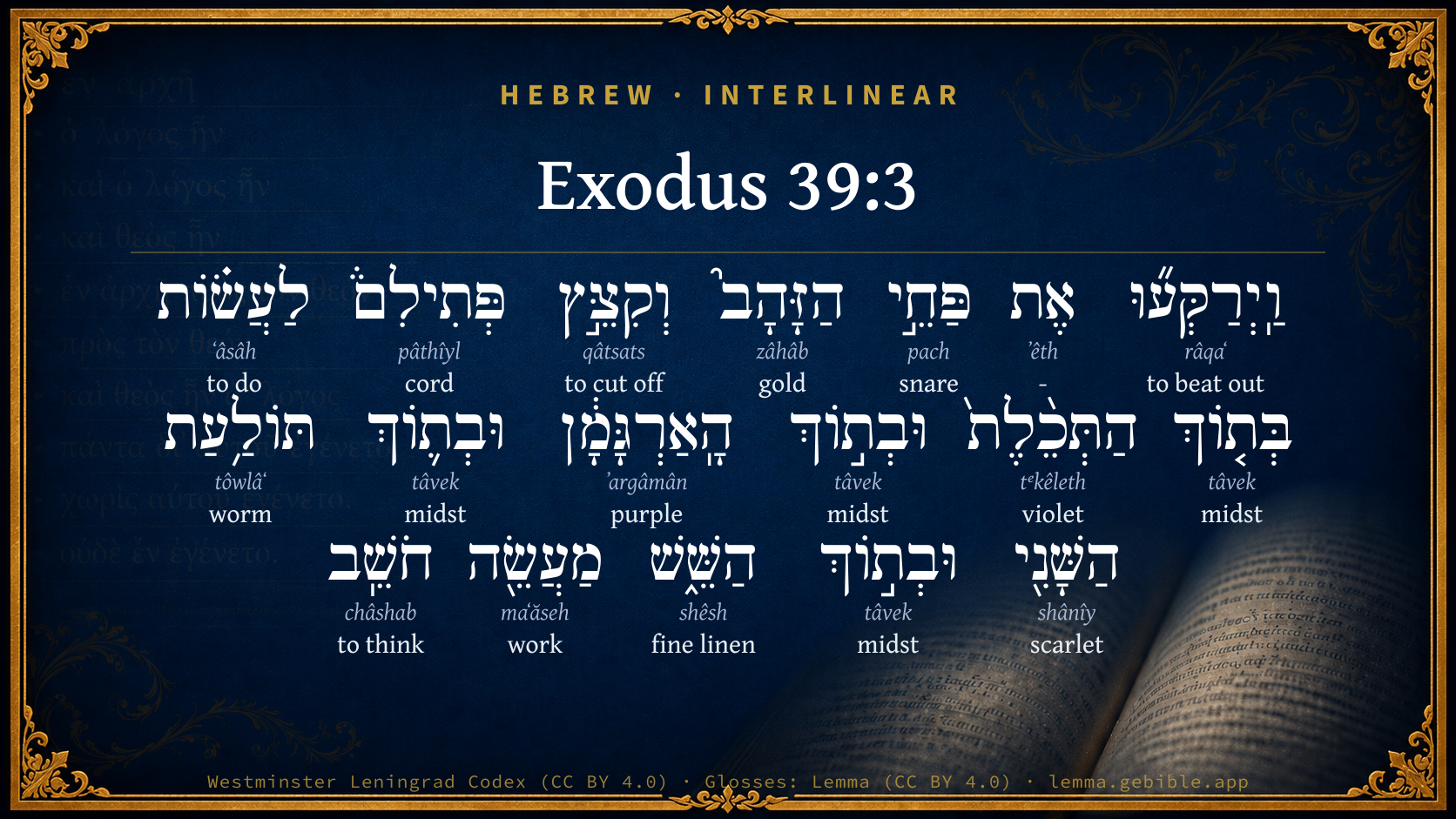
Hebrew (Westminster Leningrad Codex) Exodus 39:3 appears in the Hebrew Old Testament. The text above is from the Westminster Leningrad Codex. Each word links to its Strong’s number, a concise gloss, and parsing drawn from the Open Scriptures Hebrew Bible morphology. Click any word for its full Brown-Driver-Briggs (BDB) entry.
Download image
Cite this verse

Exodus 39:3 (World English Bible). Public Domain. Lemma interlinear Bible study tool, https://lemma.gebible.app/v/exodus/39/3.

Show BibTeX & RIS
BibTeX
RIS
English Translation
They beat the gold into thin plates, and cut it into wires, to work it in the blue, in the purple, in the scarlet, and in the fine linen, the work of the skillful workman.
World English Bible · Public Domain
Highlights
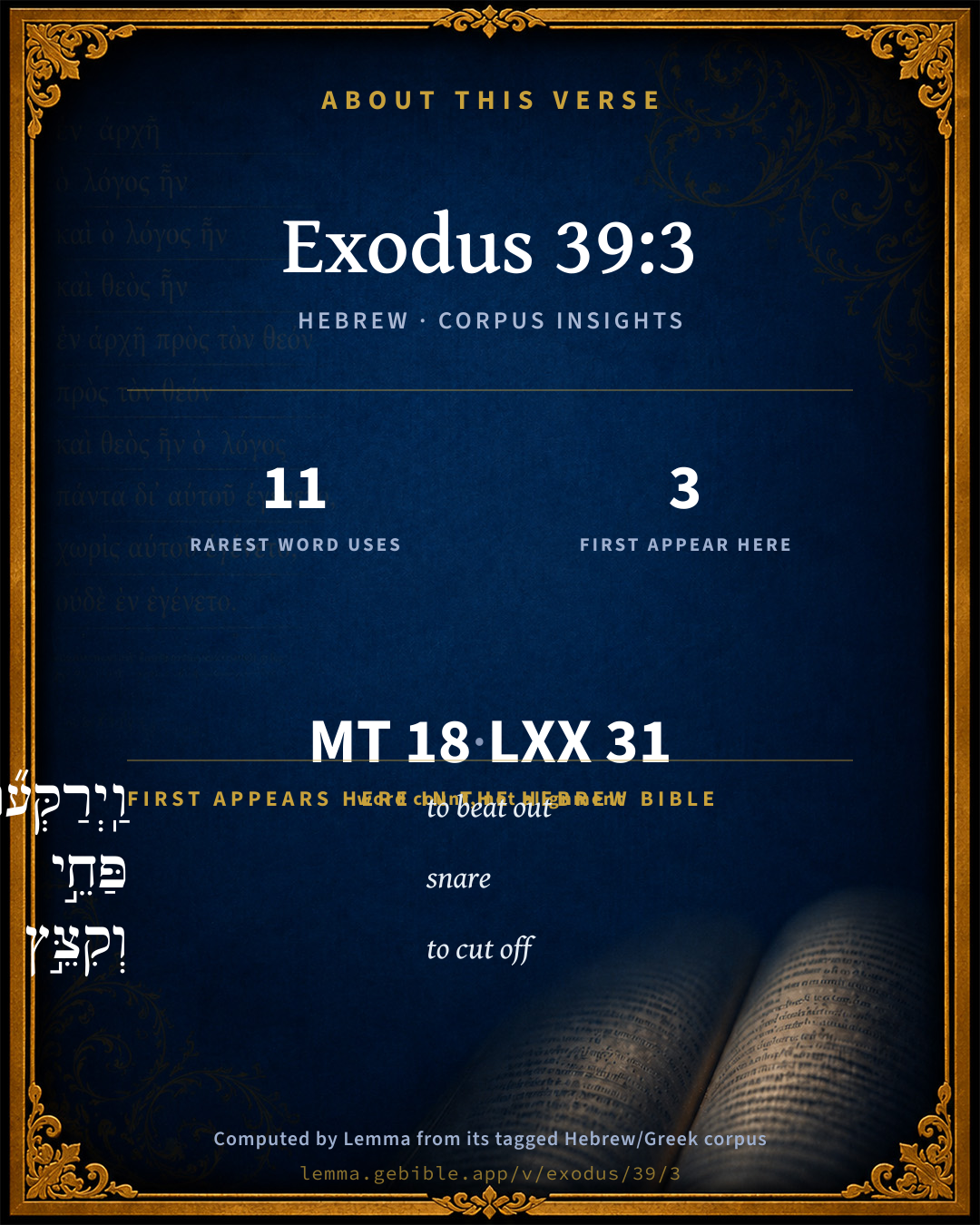
  • 3 first appearances in the Hebrew Bible
Full analysis ↓
Download a study sheet

One document with this verse’s original text, its word-by-word gloss line, the meaning frame, cross-references with their text, attributed commentary, and full source and license credits — printable, and it pastes into notes with its structure intact.

This verse Autodidact and up

Study sheet (.html) Plain text (.txt)

A passage Seminary Student

Up to 50 verses in one chapter. A passage sheet keeps up to 6 commentary sources and 12 cross-references per verse, in the order this page ranks them, and says so on the sheet whenever that leaves anything out. Ask for a single verse and you get the Autodidact verse sheet above.

Everything on this page stays free to read, with no account — the sheet is a download of what is already on screen, not access to it.

Want to remove ads? Support Godless Engineer
Compare translations 3

The same verse in 3 English versions, stacked beneath the original-language interlinear above. Click any original word for its lexicon entry.

Each is an independent rendering of the whole verse — the interlinear is not word-aligned to these translations.

Highlighted words mark where these versions differ — a whole-verse word diff, not a word-by-word alignment.

  • World English Bible Public Domain
    They beat the gold into thin plates, and cut it into wires, to work it in the blue, in the purple, in the scarlet, and in the fine linen, the work of the skillful workman.
  • King James Version Public Domain
    And they did beat the gold into thin plates, and cut it into wires, to work it in the blue, and in the purple, and in the scarlet, and in the fine linen, with cunning work.
  • unfoldingWord Literal Text CC BY-SA 4.0
    And they hammered the thin plates of gold, and he cut into threads to work among the blue and among the purple and among the worm of scarlet and among the fine linen, the work of a skillful craftsman.

unfoldingWord Literal Text — © unfoldingWord, licensed CC BY-SA 4.0. Word-aligned USFM3 via Door43 (git.door43.org/unfoldingWord/en_ult).

Versions to compare (up to 4)

3 of 4 selected

Show all 18 translations

Every available English version of this verse, each an independent rendering of the whole verse.

  • World English Bible Public Domain
    They beat the gold into thin plates, and cut it into wires, to work it in the blue, in the purple, in the scarlet, and in the fine linen, the work of the skillful workman.
  • Berean Standard Bible Public Domain
    They hammered out thin sheets of gold and cut threads from them to interweave with the blue, purple, and scarlet yarn, and fine linen—the work of a skilled craftsman.
  • Majority Standard Bible Public Domain
    They hammered out thin sheets of gold and cut threads from them to interweave with the blue, purple, and scarlet yarn, and fine linen—the work of a skilled craftsman.
  • King James Version Public Domain
    And they did beat the gold into thin plates, and cut it into wires, to work it in the blue, and in the purple, and in the scarlet, and in the fine linen, with cunning work.
  • American Standard Version (1901) Public Domain
    And they did beat the gold into thin plates, and cut it into wires, to work it in the blue, and in the purple, and in the scarlet, and in the fine linen, the work of the skilful workman.
  • Revised Version (1885) Public Domain
    And they did beat the gold into thin plates, and cut it into wires, to work it in the blue, and in the purple, and in the scarlet, and in the fine linen, the work of the cunning workman.
  • Geneva Bible (1599) Public Domain
    And they did beate the golde into thinne plates, and cut it into wiers, to worke it in ye blewe silke and in the purple, and in the skarlet, and in the fine linen, with broydred worke.
  • Douay-Rheims (1899) Public Domain
    With embroidered work: and he cut thin plates of gold, and drew them small into threads, that they might be twisted with the woof of the aforesaid colours,
  • Young's Literal Translation Public Domain
    and they expand the plates of gold, and have cut off wires to work in the midst of the blue, and in the midst of the purple, and in the midst of the scarlet, and in the midst of the linen -- work of a designer;
  • Literal Standard Version CC BY-SA 4.0
    and they expand the plates of gold, and have cut off wires to work in the midst of the blue, and in the midst of the purple, and in the midst of the scarlet, and in the midst of the linen—the work of a designer;
  • Unlocked Literal Bible CC BY-SA 4.0
    They hammered gold sheets and cut them into wires, to work them into the blue, purple, and scarlet wool, and into the fine linen, the work of a skillful workman.
  • unfoldingWord Literal Text CC BY-SA 4.0
    And they hammered the thin plates of gold, and he cut into threads to work among the blue and among the purple and among the worm of scarlet and among the fine linen, the work of a skillful craftsman.
  • Darby Bible Public Domain
    And they beat the gold into thin plates, and cut it [into] wires, to work it artistically into the blue, and into the purple, and into the scarlet, and into the byssus.
  • World Messianic Bible Public Domain
    They beat the gold into thin plates, and cut it into wires, to work it in with the blue, the purple, the scarlet, and the fine linen, the work of the skillful workman.
  • Webster's Bible Public Domain
    And they beat the gold into thin plates, and cut it into wires, to work it in the blue, and in the purple, and in the scarlet, and in the fine linen, with curious work.
  • Free Bible Version CC BY-SA 4.0
    They hammered out thin sheets of gold and cut threads from them to weave in with the blue, purple, and scarlet thread, together with fine linen, all skillfully worked.
  • Bible in Basic English Public Domain
    Hammering the gold into thin plates and cutting it into wires to be worked into the blue and the purple and the red and the linen by the designer.
  • JPS Tanakh (1917) Public Domain
    And they did beat the gold into thin plates, and cut it into threads, to work it in the blue, and in the purple, and in the scarlet, and in the fine linen, the work of the skilful workman.

Literal Standard Version (2020), Covenant Press — licensed CC BY-SA 4.0. Text via the HelloAO Bible API (eBible.org). Unlocked Literal Bible (unfoldingWord) — licensed CC BY-SA 4.0. Text via the HelloAO Bible API (eBible.org). unfoldingWord Literal Text — © unfoldingWord, licensed CC BY-SA 4.0. Word-aligned USFM3 via Door43 (git.door43.org/unfoldingWord/en_ult). Free Bible Version, Dr. Jonathan Gallagher — licensed CC BY-SA 4.0. Text via the HelloAO Bible API (eBible.org).

Word by word

More ways to search: Search by grammar → Find every occurrence → Compare this word →

Practice this passage: Drill this verse → Learn its vocabulary →

וַֽיְרַקְּע֞וּ
râqaʻ
H7554
“and · to beat out”
Conjunction + Verb, Piel, Sequential Imperfect, 3rd Person, Masculine, Plural
Part of Speech
Conjunction + Verb
Stem
Piel
Form
Sequential Imperfect
Person
3rd Person
Gender
Masculine
Number
Plural
Full BDB Definition

Origin: a primitive root

TWOT: 2217

to beat, stamp, beat out, spread out, stretch - (Qal) - to stamp, beat out - one who beats out (participle) - (Piel) to overlay, beat out (for plating) - (Pual) beaten out (participle) - (Hiphil) to make a spreading (of clouds)
  1. אֶת ʼêth H853 “-” Particle, Direct Object
  2. פַּחֵ֣י pach H6341 “snares of” Noun, Common, Masculine, Plural, Construct
  3. הַזָּהָב֮ zâhâb H2091 “the · gold” Particle, Definite Article + Noun, Common, Masculine, Singular, Absolute
  4. וְקִצֵּ֣ץ qâtsats H7112 “and · to cut off” Conjunction + Verb, Piel, Perfect, 3rd Person, Masculine, Singular
  5. פְּתִילִם֒ pâthîyl H6616 “cords” Noun, Common, Masculine, Plural, Absolute
  6. לַעֲשׂ֗וֹת ʻâsâh H6213 “to do” Preposition + Verb, Qal, Infinitive Construct
  7. בְּת֤וֹךְ tâvek H8432 “in/at · midst of” Preposition + Noun, Common, Masculine, Singular, Construct
  8. הַתְּכֵ֨לֶת֙ tᵉkêleth H8504 “the · violet” Particle, Definite Article + Noun, Common, Feminine, Singular, Absolute
  9. וּבְת֣וֹךְ tâvek H8432 “and · in/at · midst of” Conjunction + Preposition + Noun, Common, Masculine, Singular, Construct
  10. הָֽאַרְגָּמָ֔ן ʼargâmân H713 “the · purple” Particle, Definite Article + Noun, Common, Masculine, Singular, Absolute
  11. וּבְת֛וֹךְ tâvek H8432 “and · in/at · midst of” Conjunction + Preposition + Noun, Common, Masculine, Singular, Construct
  12. תּוֹלַ֥עַת tôwlâʻ H8438 “worm of” Noun, Common, Feminine, Singular, Construct
  13. הַשָּׁנִ֖י shânîy H8144 “the · scarlet” Particle, Definite Article + Noun, Common, Masculine, Singular, Absolute
  14. וּבְת֣וֹךְ tâvek H8432 “and · in/at · midst of” Conjunction + Preposition + Noun, Common, Masculine, Singular, Construct
  15. הַשֵּׁ֑שׁ shêsh H8336 “the · fine linen” Particle, Definite Article + Noun, Common, Masculine, Singular, Absolute
  16. מַעֲשֵׂ֖ה maʻăseh H4639 “work of” Noun, Common, Masculine, Singular, Construct
  17. חֹשֵֽׁב châshab H2803 “thinking” Verb, Qal, Participle Active, Masculine, Singular, Absolute

About this verse

These counts appear in no published source. They are computed here, from the morphology-tagged text and Lemma’s own curated glosses. What Lemma adds →

18
words
15
distinct lemmas
Pentateuch
section

Notable vocabulary

The rarest word here is וַֽיְרַקְּע֞וּ to beat out H7554 — appearing just 11 times in the whole Hebrew Bible.

First appearance in Scripture

These words make their first canonical appearance in the Hebrew Bible here:

  • וַֽיְרַקְּע֞וּ to beat out H7554
  • פַּחֵ֣י snare H6341
  • וְקִצֵּ֣ץ to cut off H7112

Shared distinctive vocabulary

וַֽיְרַקְּע֞וּ to beat out H7554 occurs in 11 verses of the Hebrew Bible. Also found in:

Grammatical profile

  • 4 verbs
  • 13 nouns
  • 1 particle

Verb forms

  • וַֽיְרַקְּע֞וּ Piel · Sequential Imperfect
  • וְקִצֵּ֣ץ Piel · Perfect
  • לַעֲשׂ֗וֹת Qal · Infinitive Construct
  • חֹשֵֽׁב Qal · Participle Active

Repetition

A word recurs within this verse — often emphatic in Hebrew:

  • בְּת֤וֹךְ midst H8432 ×4

Hebrew & Septuagint length

In English translation the verse runs 35 words from the Hebrew and 26 from the Septuagint (LXX English) — closely comparable.

A rough comparison of the two English renderings, which tokenize alike — not a word-level alignment.

Word counts can differ between the Hebrew and the Greek without any difference in meaning — e.g. the Hebrew direct-object marker אֵת has no separate Greek word, and Greek often adds the article ὁ.

In the original languages it is 18 Hebrew tokens and 31 Greek tokens — but the two are counted differently (Hebrew bundles its prefixes and suffixes into one token; the Greek is in lemma form), so that isn’t a like-for-like length.

Cross-references

2

Topical passages linked to Exodus 39:3 in the Treasury of Scripture Knowledge — connected by theme and wording, ordered by reader-vote popularity; previews shown in the World English Bible.

  • Exodus 26:1 "Moreover you shall make the tent with ten curtains; of fine twined linen, and blue, and purple, and scarlet, with cherubim. The work of the skillful workman you shall make them.
  • Exodus 36:8 All the wise-hearted men among those who did the work made the tent with ten curtains; of fine twined linen, blue, purple, and scarlet, with cherubim, the work of the skillful workman, they made them.

Cross-references courtesy of OpenBible.info (CC BY 4.0).

Hebrew and Greek witnesses Masoretic Hebrew ↔ Greek Septuagint

The same verse in the two great witnesses to the Old Testament, shown verse-for-verse.

These are two independent witnesses, not word-aligned to each other, and the Septuagint is shown in lemma (dictionary) form.

Hebrew Exodus 39:3 Masoretic · Westminster Leningrad Codex

וַֽיְרַקְּע֞וּ אֶת פַּחֵ֣י הַזָּהָב֮ וְקִצֵּ֣ץ פְּתִילִם֒ לַעֲשׂ֗וֹת בְּת֤וֹךְ הַתְּכֵ֨לֶת֙ וּבְת֣וֹךְ הָֽאַרְגָּמָ֔ן וּבְת֛וֹךְ תּוֹלַ֥עַת הַשָּׁנִ֖י וּבְת֣וֹךְ הַשֵּׁ֑שׁ מַעֲשֵׂ֖ה חֹשֵֽׁב

They beat the gold into thin plates, and cut it into wires, to work it in the blue, in the purple, in the scarlet, and in the fine linen, the work of the skillful workman.

World English Bible · Public Domain

Greek LXX Exodus 39:3 Septuagint · lemma form

δραχμή εἷς ὁ κεφαλή ὁ ἥμισυς ὁ σίκλος κατά ὁ σίκλος ὁ ἅγιος πᾶς ὁ παραπορεύομαι ὁ ἐπίσκεψις ἀπό εἰκοσαετής καί ἐπάνω εἰς ὁ ἑξήκοντα μυριάς καί τρισχίλιοι πεντακόσιοι καί πεντήκοντα

Every one that passed the survey from twenty years old and upwards to the number of six hundred thousand, and three thousand five hundred and fifty.

LXX2012 (modern English Septuagint) · Public Domain

Hebrew: Westminster Leningrad Codex (CC BY 4.0). Greek: Septuagint (public domain); English from LXX2012 (modern English Septuagint) (Public Domain). How the Septuagint differs from the Hebrew →

Targum (Aramaic paraphrase)

2

The Targum is the ancient Jewish Aramaic paraphrase of the Hebrew Scriptures — an interpretive translation, not the Hebrew text itself. Onkelos (literal) and Pseudo-Jonathan (expansive) render the Torah, and Jonathan the Prophets. Coverage is partial: where no permissively-licensed English translation exists for a verse, only the Aramaic is shown. This is verse-level text, not a word-by-word alignment to the Hebrew.

  1. Targum Onkelos Torah (Genesis–Deuteronomy)
    וְרַדִידוּ יָת טַסֵי דַהֲבָא וְקַצִיצוּ חוּטִין לְמֶעְבַּד בְּגוֹ תִּכְלָא וּבְגוֹ אַרְגְוָנָא וּבְגוֹ צְבַע זְהוֹרִי וּבְגוֹ בוּצָא עוֹבַד אֳמָן:

    (no public-domain English translation for this verse)

    Targum Onkelos — Aramaic: “Onkelos Genesis” (public domain); “Onkelos Exodus” (public domain); “Onkelos Leviticus” (public domain); “Onkelos Numbers” (public domain); “Onkelos Deuteronomy” (public domain). English: “Sefaria Community Translation” (CC0 1.0 (public-domain dedication)); “J.W. Etheridge. The Targums of Onkelos and Jonathan Ben Uzziel on the Pentateuch. London: Longmans, Green, 1862” (public domain). Text via Sefaria.

  2. Targum Pseudo-Jonathan Torah (Genesis–Deuteronomy)
    וְרַדִּידוּ יַת טַסֵי דְדַהֲבָא וְקָטָעוּ יַתְהוֹן שֶׁזְרִין לְמֶעְבַּד בְּגוֹ תִכְלָא וּבְגוֹ אַרְגְּוָונָא וּבְגוֹ צְבַע זְהוֹרֵי וּבְגוֹ בוּצָא עוֹבַד אוּמָן

    And they beat out the plates of gold, and cut them into threads to inwork with the hyacinth, and the purple, and the crimson, and the fine linen, the work of the artificer.

    Targum Pseudo-Jonathan — Aramaic: “Targum Jonathan on Genesis” (public domain); “Targum Jonathan on Exodus” (public domain); “Targum Jonathan on Leviticus” (public domain); “Targum Jonathan on Numbers” (public domain); “Targum Jonathan on Deuteronomy” (public domain). English: “The Targum of Jonathan ben Uzziel, trans. J. W. Etheridge, London, 1862” (public domain). Text via Sefaria.

Commentary

Notes on Exodus 39:3 from classic Christian and Jewish commentators (each source and its license shown beneath its notes). The classic Christian expositions comment on the surrounding passage and are grouped to its opening verse, so a note may address several verses; the Jewish commentaries on the Tanakh (Rashi and others) are per-verse, so they appear only where the commentator wrote on this verse.

Lemma curates 59 commentaries, every one of them public domain or Creative Commons licensed, each selected and text-cleaned for this edition rather than reprinted as found. About our sources →

Joseph Benson's Commentary

Exo 39:3. Cut it into wires — They had not then the art which we have now, of drawing a piece of gold into threads of what length we please; but they beat it first into thin plates, and then cut off small wires, which they wove with the other materials here mentioned.

Joseph Benson's Commentary on the Old and New Testaments (1811–1818) — public domain. Text from a community e-Sword module.

Jamieson, Fausset & Brown

Robert Jamieson, A. R. Fausset & David Brown

cut the gold into wires to work it--that is, the metal was beaten with a hammer into thin plates, cut with scissors or some other instrument into long slips, then rounded into filaments or threads. "Cloth of golden tissue is not uncommon on the monuments, and specimens of it have been found rolled about mummies; but it is not easy to determine whether the gold thread was originally interwoven or subsequently inserted by the embroiderer" [TAYLOR].

Jamieson, Fausset & Brown — Commentary Critical and Explanatory on the Whole Bible (1871) — public domain (CC PDM 1.0). Text via the HelloAO Bible API.

Adam Clarke's Commentary

Verse 3. They did beat the gold into thin plates] For the purpose, as it is supposed, of cutting it into wires (פתילם) or threads; for to twist or twine is the common acceptation of the root פתל pathal. I cannot suppose that the Israelites had not then the art of making gold thread, as they possessed several ornamental arts much more difficult: but in the present instance, figures made in a more solid form than that which could have been effected by gold thread, might have been required.

Adam Clarke's Commentary on the Bible (1810–1826) — public domain. Text from a community e-Sword/MySword module.

Ellicott's Commentary for English Readers

(3) They did beat the gold into thin plates and cut it into wires.—This very primitive method of forming gold thread is nowhere else mentioned. It implies a ruder state of the art of metallurgy than we should have expected.

To work it in the blue.—The blue, the purple, the scarlet, and the white linen thread were woven into a patterned fabric. The gold was inserted afterwards in the way of embroidery. A similar practice prevailed in Egypt (Wilkinson, Ancient Egyptians, vol. iii., p. 128).

A Bible Commentary for English Readers, edited by Charles John Ellicott (1878–1897) — public domain. Text from a community e-Sword module.

The Cambridge Bible for Schools and Colleges

gen. ed. J. J. S. Perowne

3. As far as fine linen, an addition, not in Exo_28:6, explaining how the gold was used; it was beaten into thin plates, and these were then cut into narrow strips, forming wires or threads, which were worked in with the variously coloured yarns (Exo_35:25). Cf. Wilk.-B. ii. 166 f.

beat] cf. Num_16:38-39. The verb is the one from which râḳîa‘, ‘firmament,’ lit. something beaten out, is derived.

the cunning workman] the designer, or pattern-weaver.

The Cambridge Bible for Schools and Colleges (gen. ed. J. J. S. Perowne; Cambridge University Press, 1878–1918) — public domain. Text from a community e-Sword module.

Haydock's Catholic Bible Commentary

Threads. Hebrew, "wires to work it in the blue....with cunning work." The ancients had the art of beating gold into thin plates, with which they adorned the horns of their victims, &c. (Æneid iv.) See Numbers xvi. 58. (Calmet)

George Leo Haydock (1774–1849), Haydock's Catholic Family Bible and Commentary, 1859 edition — public domain. Excludes Psalms (Douay-Rheims chapter numbering differs from Protestant) and Deuterocanonical books (Catholic canon only).

The Pulpit Commentary

They did beat the gold into thin plates and out it into wires. This mode of producing gold thread is remarkable, and had not been previously mentioned.

The Pulpit Commentary (1880–1919), ed. H.D.M. Spence-Jones & Joseph S. Exell — public domain. Text from a community e-Sword module.

Rashi

Rabbi Shlomo Yitzchaki (Rashi)

וירקעו AND THEY DID EXTEND — וירקעו is of the same root and meaning as, (Psalms 136:6) “To Him that stretcheth out (לרקע) the earth”. Render וירקעו as the Targum does: ורדידו, they extended by beating. Plates did they beat out of the gold; in old French estendre — to extend into thin plates. Here it informs you how they wove the gold together with the woollen threads. They beat out the thin plates and from them they cut threads along the length of the plates to make of these threads a mixture (to mix them) with each of the different kind of woolen threads in the ephod and the breast-plate in regard to which gold is mentioned in this connection. One thread of gold they intertwined with six threads of blue purple, and so with each kind of wool. For all the materials had their threads six-fold, and the gold formed the seventh with each of them (cf. Yoma 72a).

Rashi on the Tanakh — English translations: “The Judaica Press complete Tanach with Rashi, translated by A. J. Rosenberg” (CC BY 4.0); “Pentateuch with Rashi's commentary by M. Rosenbaum and A.M. Silbermann, 1929-1934” (public domain); “The Metsudah Tanach series, Lakewood, N.J” (CC BY 4.0); and “The Book of Joshua, Metsudah Publications, 1997” (CC BY 4.0). Text via Sefaria.

Ramban (Nachmanides)

Rabbi Moshe ben Nachman (Ramban / Nachmanides)

AND THEY BEAT THE GOLD INTO THIN PLATES. In all the sacred work that was done, Scripture did not add an explanation as to the method of execution except for here. It should rather have said: “and they made the ephod of gold, and blue-purple etc., the work of a skilful workman; they made shoulder-pieces for it etc.,” for such is the way it describes all of them. It is possible that Scripture relates here [how it was made] because of the original thought that they had to put into making the gold threads, for they were greatly astonished [to be told] that the gold should be spun and twined as is done with wool or linen, for no-one ever heard of doing such a thing until that day.

Ramban (Nachmanides) on the Tanakh — English translation: “Commentary on the Torah by Ramban (Nachmanides). Translated and annotated by Charles B. Chavel. New York, Shilo Pub. House, 1971-1976” (CC BY 4.0). Text via Sefaria.

Lesson kit

Teaching starters — assembled from the data on this page, not authored interpretation. Every prompt links to the verse data it draws on. Edit before teaching.

Exodus, in the Pentateuch, opens this verse with 18 words (15 distinct Hebrew lemmas). Its most distinctive word is râqaʻ (“to beat out”). A historical commentator’s framing appears above. Read the whole chapter for the surrounding context.

Discussion questions

  1. What does “to beat out” (râqaʻ) contribute to the verse as a whole?
  2. 3 words make their first appearance in Scripture here. What does this debut establish?
  3. How does Numbers 16:39, which shares the word «to beat out», read alongside this verse?
  4. What does the repetition of “midst” (4× in this one verse) do in this verse?
  5. These translations render this verse differently; the difference is in the English rendering, not the original. What questions does that raise?
  6. «וַֽיְרַקְּע֞וּ» is a Piel Sequential Imperfect verb. How does that grammatical form shape the action described?
  7. Compare how Joseph Benson's Commentary and Jamieson, Fausset & Brown read this verse. Where do they agree or differ?

Things to notice

Reading settings

Reading text

Shown beneath each verse's original-language words.

Old Testament
Old Testament edition

Read the OT as the Masoretic Hebrew (MT) or the Greek Septuagint (LXX).

English shown for the Greek Septuagint (in the Hebrew ↔ Greek comparison).

Comparing translations? Open the Compare panel on any verse page to stack up to four side by side.